Tag Archives: Nova Scotia

REMEMBERING GREAT-GRAND-UNCLE

Arthur Symons, Private, 56th Battalion, Canadian Over-Seas Expeditionary Forces.
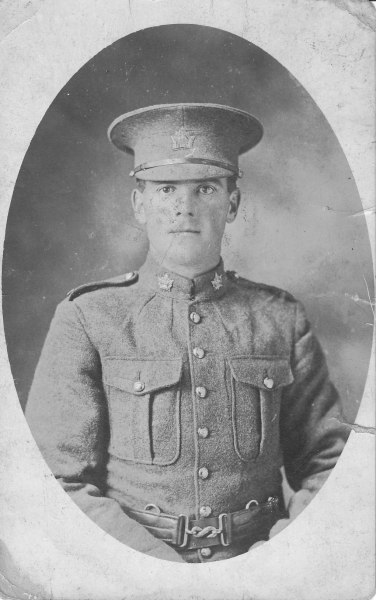
I once had a great-granduncle, Arthur. Until I started doing Genealogy, I had no idea there was such a title, but there it is, and I had one.

Of course, I never met him, but, as it is Remembrance Day I wanted him to be remembered.

My Granny’s mother, Lilian, had a family of five siblings, and Arthur was her younger brother. He was four years younger than her. Granny told me that Arthur immigrated to Canada in the early 1900s.

Despite many searches. I could find no information on his immigration. However, months after I started my research, I came across a border crossing Manifest from Canada to Sweetgrass, Montana.

It had all the information I had been searching for!

At this point, I was not sure he was even married, but the info on the border crossing gave me missing details and Arthur was beginning to become a real person.

The Manifest stated Arthur was 50 years old, accompanied by his wife, Catherine, son Alexander, and daughter Dorothy. It was dated the 18th of July, 1936. The family were visiting Yellowstone Park and Glacier Park. it gave Arthur’s address in Calgary, Alberta and his occupation as a Postal Porter. (1) It stated that he arrived in Canada at Halifax, Nova Scotia on the 19th of March, 1901 on the SS. Soman.

I haven’t yet found the passenger list for the SS Soman, but I keep looking.

When WWI broke out, he enlisted in the 56th Battalion Canadian Over-Seas Expeditionary Forces on May 3, 1915, in Calgary, Alberta. He was shipped back to the UK for training. While ‘back home’, he visited his sister Lilian – my great-grandmother – and had these photos taken with his sister and my Granny, Edith Bevan O’Bray.
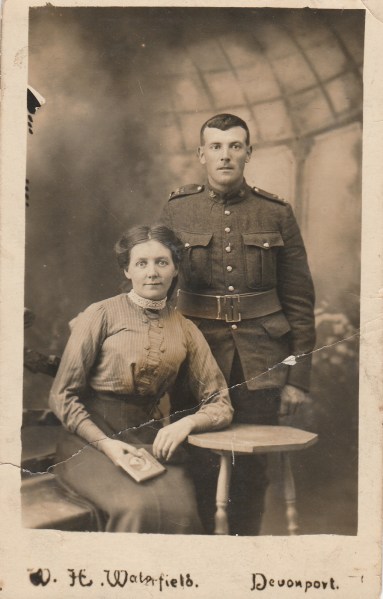
Arthur Symons with his sister Lilian Symons Bevan. C. 1914-18
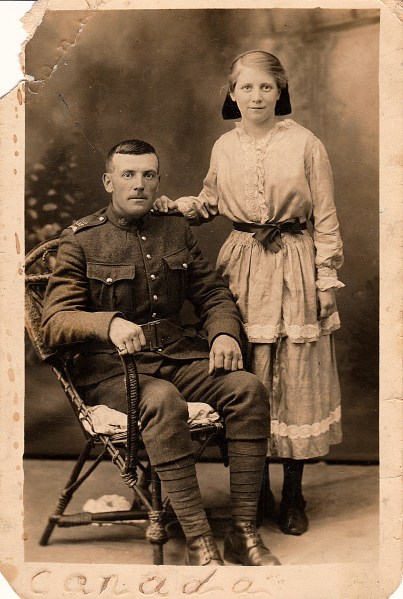
Arthur Symons with my Granny, Edith Bevan C. 1914-18.

Arthur Symons was born in Leicester, Leicestershire, England, in 1886. His siblings were Lilian Mary Symons—my great-grandmother; Thomas, who died in infancy; Arthur, Olive, and Ada, who was my Gran’s favourite Aunt, and only two years older than her.

Aunt Ada was also my Godmother. Together, they joined the WRNS (Women’s Royal Naval Service) in 1918 (2)

Great-grand-uncle Arthur fought at the Battle of Passchendaele and was severely wounded in the right leg, right hand and left foot. He was transferred to the Granville Special Hospital, located in Ramsgate, Kent, England. An orthopaedic facility to treat soldiers with damaged limbs. Later because of air raids on the Kent coast, the hospital was moved to Buxton. He was medically discharged on 28th August 1919.

In part Two, I will explore his stay in the Granville Special Hospital for Canadian troops. The first line of his medical records, dated November 29, 1917, stated he was “Dangerously ill.”

(1) Canadian Postal Porter – Porter – Worker having manual handling duties, typically at a large sorting office or railway station in London. Tasks included the loading, unloading, segregation and transfer of mailbags or other containers. Porters were also employed at some other locations, such as the PO Savings Bank.

(2) Granny and her Aunt in the Women’s Royal Naval Service.
Learning about the Acadian Diet

Some of the most interesting information about my ancestors comes from documents detailing what they ate.

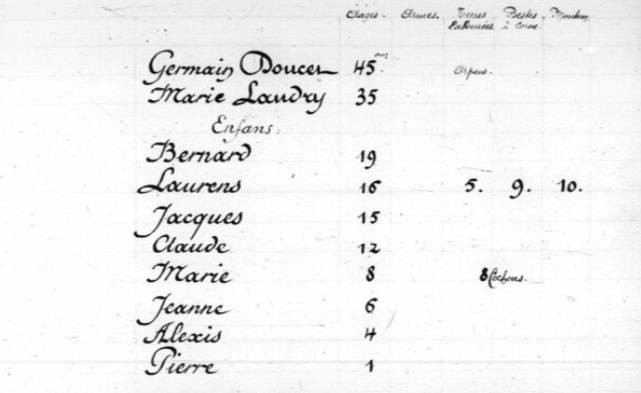
The 1686 Acadian Census, for example, shows my ancestor Alexis Doucet at four years old living in Port Royal with his parents and seven brothers and sisters on “5 arpents of cultivable land with 9 cattle, 10 sheep and eight pigs.”1

The census detailed our ancestors’ cattle and livestock along with the cultivated land because those elements were the primary elements of wealth in North America at that time. The settlers’ ability to nourish themselves determined whether they would be able to thrive, multiple, and permanently inhabit a place on behalf of whichever European colony to which they belonged.

Doucet’s family and their neighbours were ingenious at this task, as Caroline‐Isabelle Caron points out in her delightful booklet about Acadians in Canada.

Indeed, the Acadians set roots in the marshy salines left untouched by the First Nations, in the tidal flood plain which they proceed to dry and put into culture thanks to a complex system of dykes (levées) affixed with drying valves called aboiteaux. This technology was imported from France, probably from the Loudunais region where some early settlers originated. The vast network of dykes the Acadians created inside and beyond the marshlands before 1755, ensured the fertilization of vast meadows for the culture of wheat but also the growth of salt‐hay pastures, a particularly attractive source food for cattle. At this time, Acadian agriculture ranked among the most fertile in the world, boasting near constant, abundant crops.

A typical Acadian farm consisted of one house with one or two rooms on the first floor, a barn, outdoor latrines, a cellar, and a well. Dwellings were usually built up from the ground without foundation, the walls sided with whitewashed cob walls surmounted by a thatched roof. In addition to an enclosure to keep farm animals (chickens, sheep, pigs), the courtyard contained a fenced garden to grow legumes and root vegetables (carrots, turnips, radishes, but not potatoes), herbs (for both cooking and apothecary), and berries. The Acadians planted, among a vast array of fruit trees, the first apple trees the Annapolis valley is reputed for today.

Abundant food supply stimulated strong demographic growth. It is believed that between 1650 and 1755, the growth rate of the population increased annually by 4.5 percent. Birthrates alone explains this growth, the result of a near 100 percent marriage rate and very high fertility rates, as well as low mortality rates due to the quasi absence of epidemic diseases or famine, and easy access to arable land and drinking water. Despite tentative estimates, experts agree that the Acadian population grew from over 400 people in 1671 to more than 1400 in 1730, for a total of 10,000 to 18,000 people in 1755.2

By the way, the dykes made by Acadians like my ancestor, still exist today. The most successful examples allow only a third of the territory to be farmed, with the other two thirds dedicated to natural wetland rejuvenation and rough cover.3

These early settlers’ ingenuity at bringing old world technology to their new circumstances enabled them to cultivate land that wasn’t already being farmed by the First Nations communities already in the area. That fact meant that they weren’t seen as a threat by their First Nations neighbours and became friends and neighbours. Some of the French settlers fell in love with First Nations people, as Alexis’ grandmother had. According to recent DNA research, Germain’s last name “Doucet” is presumed to be an adopted name, because his father, Germain Doucet, definitely descended from First Nations.4

But that’s a tale for another day.

1Hebert, Tim , Transcription of the 1686 Acadian Census, at Port-Royal, Acadie 1686 Census Transcribed. The original census can be found at Acadian Census microfilm C-2572 of the National Archives of Canada “Acadie Recensements 1671 – 1752,” p 30.

2Caron, Caroline‐Isabelle. The Acadians. Immigration and Ethnicity in Canada 33, 2015. http://archive.org/details/the-acadians.

3Fundy Dykelands and Wildlife | Novascotia.Ca.” Accessed February 7, 2024. https://novascotia.ca/natr/wildlife/habitats/dykelands/.

4Estes, Roberta. “Germain Doucet and Haplogroup C3b.” DNAeXplained – Genetic Genealogy, September 18, 2012. https://dna-explained.com/2012/09/18/germain-doucet-and-haplogroup-c3b/.

Acadian research guide contains hundreds of resource links

On this 259th anniversary of the Acadian deportation, those researching their Acadian heritage might find the research guide, Acadians of Nova Scotia, New Brunswick, Prince Edward Island, Newfoundland of interest. It consists of Acadian Parish Registers under the French and British regimes in addition to the modern-day period under Confederation.

Click on this link, Acadians of Nova Scotia, New Brunswick, Prince Edward Island, Newfoundland, to see a 162-page downloadable document that will help you find your family’s name in community parish records, etc.

2014 Acadian Congress
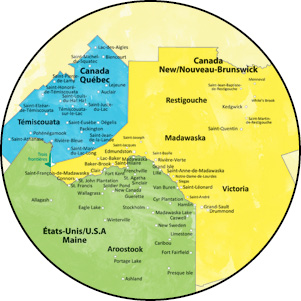
The Acadian Congress takes place August 8 to 24, 2014. The map below indicates the areas where many of the Congress activities will take place.

Carte3RegionsPetit

“Then uprose their commander, and  spake from the steps of the altar. Holding aloft in his hands, with its seals, the royal commission. “You are convened this day,” he said, “by his Majesty’s orders… Painful the task is I do, which to you I know must be grievous. Yet must I bow and obey, and deliver the will of our monarch; Namely, that all your lands, and dwellings, and cattle of all kinds, forfeited be to the crown; and that you yourselves from this province be transported to other lands. God grant you may dwell there. Ever as faithful subjects, a happy and peaceable people! “

“Prisoners, now I declare you; for such is his Majesty’s pleasure!”

Silent a moment they stood in speechless wonder, and then arose louder and ever louder a wail of sorrow and anger. “

Source: Henry Wadsworth Longfellow, Évangéline and other selected poems Penguin Books, 1988.