Tag Archives: Ontario

Uncle Bill and His Five Daughters

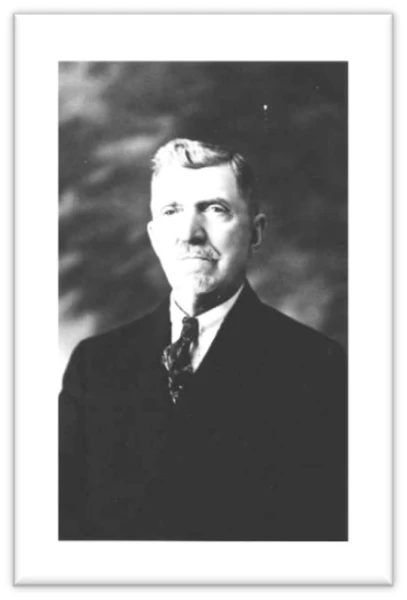
On August 23rd, 1886 in St. John’s, Antigua, British West Indies Mary France, the wife of William Percival gave birth to a son, William France Anthony Percival, my Uncle Bill.

Little is known about his early years in Antigua. At the age of eighteen in 1904 he immigrated to Canada. Records indicate that on the 13th of June 1909 at the age of 23 he converted to Catholicism and was baptised at the Holy Rosary Parish in Toronto.
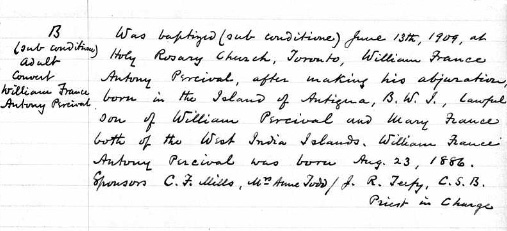
Baptismal Record

In 1914 Bill settled in Sudbury, Ontario and began working as a dispatcher and later became the Assistant Chief Clerk for Canadian Pacific Railway. A job he held for 33 years.

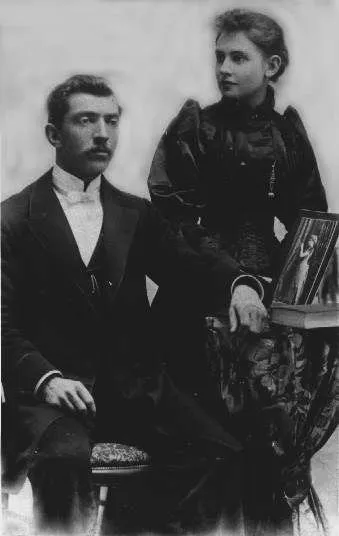
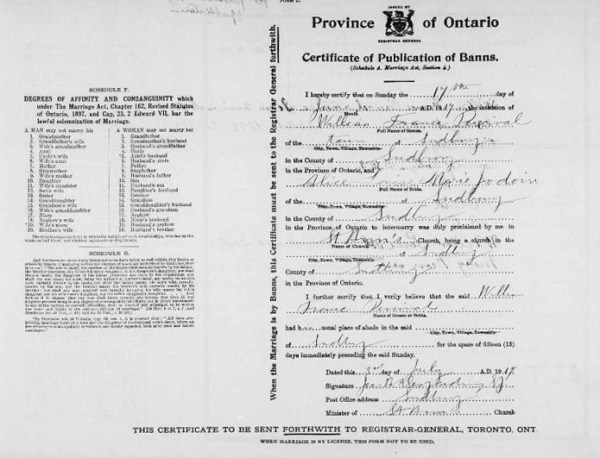
Bill began courting Alice Jodouin, the daughter of Louis and Louisa Jodouin.  Before long the customary banns announcing the upcoming marriage of the young couple were published. Banns are a notice read out on three successive Sundays in a parish church, announcing an intended marriage and giving the opportunity for objections.

The banns
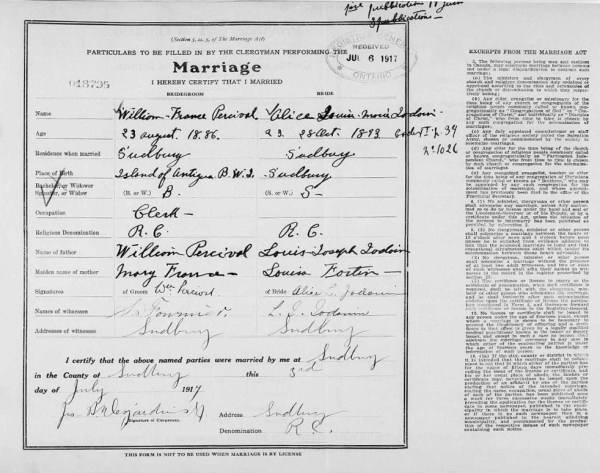
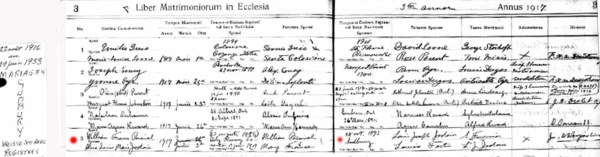
Uncle Bill and Aunt Alice were married on the 3rd of July 1917 in Saint Anne Church, the French Parish in Sudbury.

The church record of the marriage
The officiating Priest

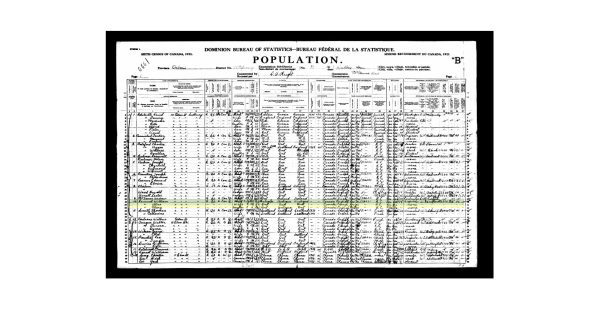
The 1921 Canadian Census shows Uncle, Aunt Alice and their first daughter, Mary.was born in 1919.Later in 1921, Madge was born, followed by Frederica (Freddie)  in 1923, then Natalie in 1925 and Willena (Billye) in 1927.
After raising 5 daughters they were hoping for a son. In 1934 Aunt Alice was expecting another child. Would it be a boy? The family would be complete with the son they had always wanted and a little brother for all the girls

Alas! It was not meant to be. John Allan was stillborn. This tragedy, the loss of a son caused many heartaches for the family.
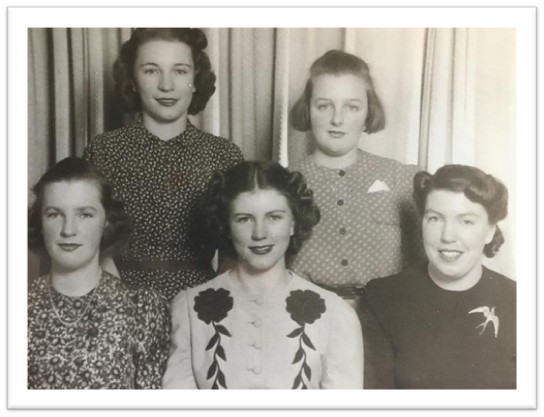
The Percival Sisters
Back row: Freddie and Billye
Front Row: Natalie, Madge and Mary

I never knew Uncle Bill, however, he enjoyed quiet moments sailing on Lake Ramsey, according to my older brother Karl, who had the good fortune of knowing him. At the time I was too young and our family moved from Sudbury to the rolling hills of the Eastern Townships in Quebec. I do not remember Uncle Bill.
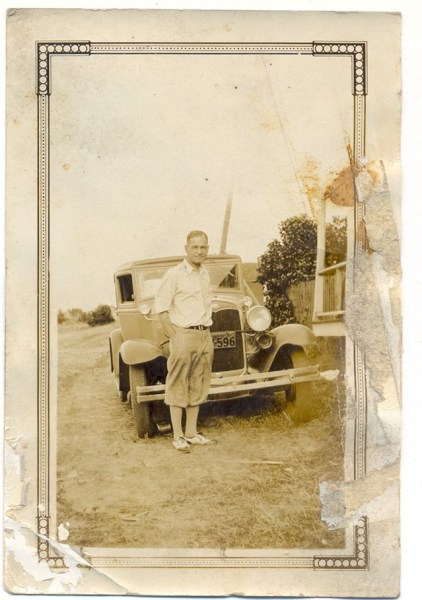
Shortly after retiring Uncle Bill passed away on December 8th, 1948 at the age of 62.
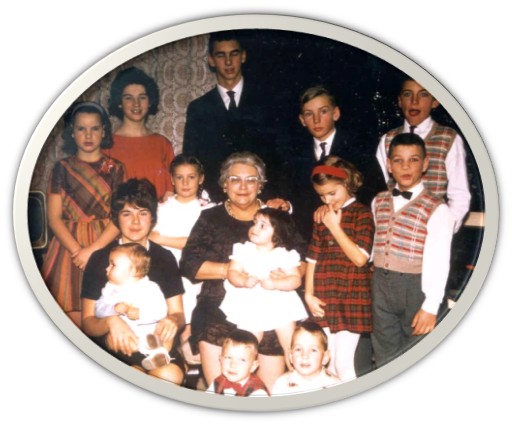
Aunt Alice surrounded by her many grandchildren.

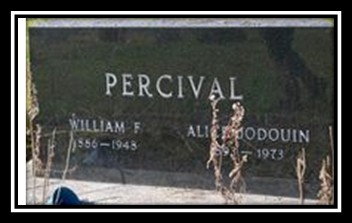
Aunt Alice lived another 25 years after Uncle Bill’s passing and continued as the church organist. She died in 1973  and is resting beside him  in the LaSalle Catholic Cemetery in Sudbury, Ontario

Over the years I  have visited many relatives in Sudbury and have fond memories.

Sources:

Familysearch.org

Personal photo collection of the author
Bottles, Boats and Blocks

by Claire Lindell

In the late nineteenth and early twentieth century, many enthusiastic young men with entrepreneurial spirits set out to make their fortunes. L.J Jodouin, my maternal; grandfather was among them. It was said that where there was a need he found a way to fulfill it. L.J.’s business ventures were a great success.

Louis Joseph Jodouin was born in 1861 in Montebello, Quebec, the third of five children of Joseph Jodouin and Leocadie Fortin. When he was a young man his family moved to Hull, Quebec where he was schooled by the Christian Brothers and attended college in nearby Ottawa.

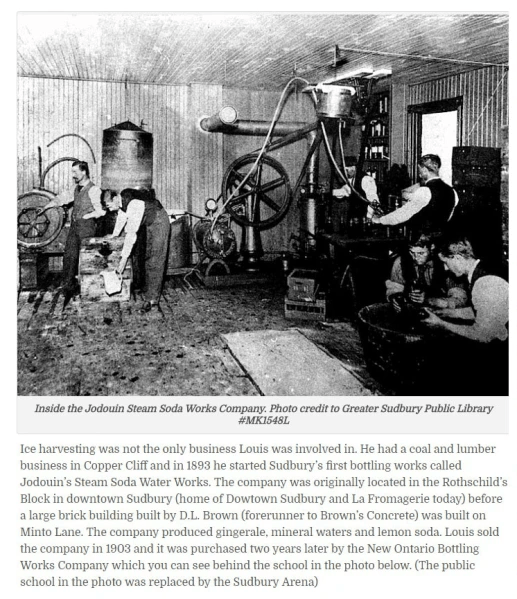
In 1891, at the age of twenty-seven, he went to Sudbury, Ontario where in nearby Copper Cliff prospectors found nickel and mines were being opened. It is there he started his first enterprise, L. J. Jodouin Bottling Works. With six employees he bottled and sold ginger ale, lemon soda, cream soda, and mineral water. Due to the influx of miners, the Sudbury area was a new and growing community, and L.J.’s business was profitable

            Louis and Louisa

              1893

With financial security assured the young man decided it was time to seek a bride and start a family. Although the couple had the same grandfather and different grandmothers, they received dispensation and were married in Saint Columbkille Cathedral in Pembroke, Ontario in January of 1893. The young couple settled in Sudbury where they built their home and raised nine children, three boys and six girls.

In 1903 the bottling works were sold to the Taylor and Pringle Company of Owen Sound. His next venture was an ice business. He built a huge icehouse in the rear of his home along with a stable for the horses. At the time people had wooden iceboxes where the top section was lined with metal and large blocks of ice were placed within. Foods that needed to be kept cold were placed on shelves below. Ice was delivered regularly in the same manner as milk and bread from house to house by horse-drawn wagons and later years by truck.

Over the years Louis Joseph had many enterprises. He built a boathouse on Lake Ramsey, a large lake nearby. He rented boats and canoes. He ran a water taxi service and a huge gasoline-powered barge to transport large quantities of building and personal supplies for the people building cottages along the lake. The boat house was also used for storing huge blocks of ice during the winter months.  

The ice business was my grandfather’s lifelong enterprise and the most successful. A key to the success was the annual contracts with both railways. The Canadian Pacific and the Canadian National Railways. This arrangement continued until the mid-1940 when the trains acquired powered refrigeration.

My cousin Madelyn Percival described how Grandfather would spend his days.

  “In the winter months, Grandfather would often go out on Lake Ramsey to oversee the ice operations wearing his long raccoon coat and fur hat and fur mitts, but for the most part, he ran the business from a rocking chair near the dining room window overlooking the backyard where the horses were kept so he could see all the action!”

He was a good employer, and an active citizen, a town councilor, a school trustee, a voluntary fireman, and a member of the Board of Health. He played in the town band, sang in the church choir, and was an avid lacrosse player until he was hit in the head and lost his hearing.

“L.J. bought one of the first motor cars in Sudbury, although he could not drive because of his deafness. His eldest daughter, Alice Percival was the first woman driver in Sudbury and for many years she was his chauffeur.”

            In 1943 on the eve of his seventy-ninth birthday Grandpa Jodouin passed away. His son, Arthur, continued the ice business into the late 1950s and early 60s supplying the many cottagers in the area until electricity became available.

References:

  • Ancestry.com Quebec, Canada Viral and Church Records. Drouin Collection 1921-1968 database online.
  • Sudbury Star newspaper article., Author, Gary Peck. “The Not-so-distant Past, Jodouin Steam Soda Water Works.” October 2, 1981
  • Ancestry.com. Ontario, Canada, Catholic Church Records. Drouin Collection 1802-1967 database online.
  • Archives of Ontario, Toronto, Canada Registration of Marriage, 1869-1928 Series MS032:Reel 70 source ancestry.com and Genealogical Research Library( Brampton, Ontario, Canada Ontario Canada Marriages Ancestry.com Operations In.,2010.
  • Excerpts from an interview with the author and her cousin Madelyn Percival Smith , Louis Joseph’s granddaughter, Toronto Canada, August 2010.
  • Below is a video: cutting ice on Lake Ramsey

This biographical sketch of my maternal grandfather was first published in our book “Beads in a Necklace” published in 2017 by our Genealogy Ensemble group. It seems appropriate to include it in our ongoing blog.

French Canadians in Ontario

French Canadians in Ontario

This compilation “French Canadians in Ontario” consists of lists of the many of the churches throughout Ontario where our French Canadian ancestors migrated and explains where the document of births, marriages and deaths are located for the many parishes.

This compilation is a useful tool for those who may not know exactly where these records are now located. Many can be found at BanQ, the national archives located on Viger Street in Montreal, Quebec.

fleur-de-lis-377307

Highlight the file below and right click to open link in a new window

The French Canadians in Ontario

Life Decisions

A simple act followed by a statement can be life-changing. Such was the case for Kaarlo.

Several  years of study at Michigan College of Mines in Houghton, Michigan had prepared Kaarlo, a young Finnish boy from Ashtabula, Ohio  for a career in the mining industry. He had worked as a cook on the ore boats on the Great Lakes and knew he wanted something more fulfilling, much as he loved sailing the lakes.

In 1928 he graduated with a degree in Mining  Engineering. There was a job waiting for him at  Royal Tiger Gold Mines in Breckenridge, Colorado. He packed his Model T Ford and set out for the west with high hopes and dreams of creating a good life, doing something he truly enjoyed.

It wasn’t long after arriving at the mines that he found the owner-manager tampering with the assays (the device used to measure gold). Once the owner realized that the young man was aware of his actions, he ordered him to be “out of town by sundown!”.  Kaarlo didn’t back down and stated that he would leave as soon as he could get his car on a railroad car to carry it  over the mountains.

Dreams of working in the gold mines were crushed. Being young and a go-getter,  he immediately contacted the College to see if they knew of any openings for newly graduated engineers. They responded that there were openings in Canada in the nickel mines in Copper Cliff, Ontario.  It was time to head north.

300px-BigNickel

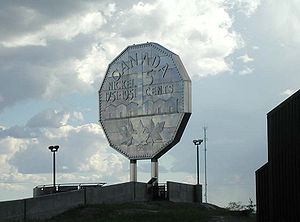
                                    The Big Nickel in CopperCliff, Ontario,  now part of Greater Sudbury

Kaarlo Victor Lindell crossed in to Canada on the 31st of January 1929 at Bridgeburg, Ontario1 with hopes and dreams of a rewarding career and a new challenge. He found a room in a boarding house and began working for the  International Nickel  Company(INCO) and never looked back. He spoke Finnish and soon made friends with his coworkers, among them many Finns. His employer took advantage of his knowledge of Finnish and in 1934 was sent to Northern Finland where he was actively involved in opening a nickel mine in Petsamo. In 1939 that part of Finland was seized by the Russians.

Along the way he met a pert, pretty, vivacious young lady, named Estelle (Esty) and sought her hand. They were married on September 6th 1930 in Sudbury. In the meantime Kaarlo had legally changed his name to Karl and took religious instruction in the Catholic faith having been a Lutheran all his life.

In 1939 with WW11 on the horizon Karl wanted to serve his new country. He became a naturalized citizen on the 8th of August 19392, however, with four children and a fifth on the way,  (me) his services were needed in the nickel  industry. He remained at work for INCO. Nickel production was crucial for ammunition during the war years.

7f8387d73db3917a06b23e636e118174

Royal Tiger Gold Mines thrived from 1918 and into the 1930s, however, it declared bankruptcy in 1938 and in 1973 the town and all the buildings in it were torched to keep the “hippies” from squatting.

Northern Ontario, on the other hand has over time developed  and prospered.

It is interesting to speculate how Kaarlo’s life might have been, especially  if he had stayed in Colorado?


I would not be here to tell the story!


The Trail of the Huguenots in Europe, the U.S.A and Canada

The Trail of the Huguenots in Europe, the United States, South Africa and Canada
Author: G. Elmore Reaman
QFHS #UEL-REF HG 010.01 R4 1972
Total pages: 318
From page 137 to page 205, this section of the book address the Protestant families in Nouvelle France (New France)
Being a book owned by the United Empire Loyalist’ Association of Canada, it cannot be taken out of the library.

The following is an excerpt from this superb book by G. Elmore Reaman.

It is a generally accepted point of view in Canada that Frenchmen have always been Roman Catholics and that Protestantism has had little or no reliationship with France. It has been further accepted that there was no connection between Protestant French and the exploration of Canada by the French. A careful study of both of these points of view will show that they are untenable. It may come as a surprise to learn that historians of this period state on good authority that, if it hadn’t been for the business enterprise of Huguenots in France and their desire to found a colony where they could remain loyal to the King of France and yet enjoy freedom of worship, it is doubtful if there would be many French in Canada today. Furthermore, it is quite possible that had the French allowed Huguenots to migrate to Canada in the seventeenth century, England would have stood a slim chance of conquering Canada.

Such information does exist in authentic sources, but few persons in Europe or America—and that includes Canada—have any knowledge of it. French Roman Catholics have naturally advanced their point of view and Protestants have never thought it worth while to investigate it. Huguenot Societies in France, England, and the United States are not aware that from 1534 until 1633 Canada was practically Huguenot controlled nor do they know that many of the earliest settlers in Upper Canada (Ontario) were descendants of émigrés from France, some of whom first went to the British Isles, then to the United States, and finally to Ontario.
G. Elmore Reaman

G. Elmore Reaman (1889-1969) was born in Concord, Ontario, he received his education at the University of Toronto, McMaster University, Queen’s University, Cornell University.

Dr. Reaman’s materials are found at the University of Waterloo Archives.

Posted by Jacques Gagné for Genealogy Ensemble