
Tag Archives: Protestant

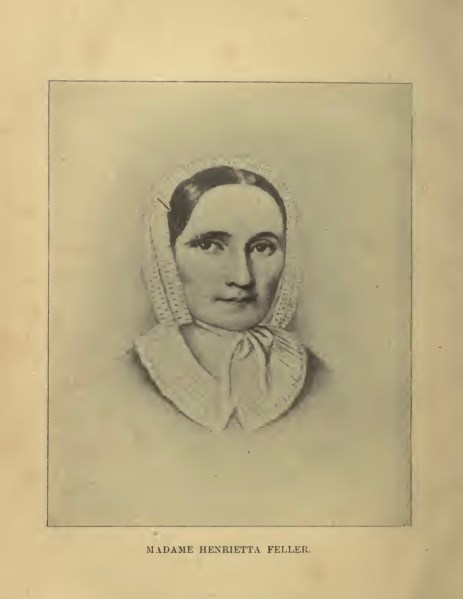
Henriette Feller

A young Protestant widow from Switzerland came to Canada in 1835 to convert the heathens. If it wasn’t for Henriette Feller, my family might still be speaking French and attending Roman Catholic services.

Henriette Odin (1800 – 1867) was born in Montagny, a village, outside of Lausanne, Switzerland. Her Protestant ancestors had been driven out of France when Louis XIV revoked religious freedoms and many took refuge in Switzerland. Her father was the director of the Vantonal Hospital at Lausanne.

“Wisdom and love distinguished both parents and their influence on the family was of the happiest kind.”

As a teenager, Henriette began visiting in the hospital and her tender and gentle demeanour was a comfort to the patients. She learned to change dressings and considered becoming a nurse but then she had a religious awakening.

Henriette married Louis Feller, a widower, in 1822. He was the head of a prison and had a son and two daughters. Their daughter Elize died as a young child and soon after, Louis died of typhoid fever. Louis Feller left all his assets to Henriette. They both gave their lives to a Christian Evangelical sect that wanted to spread the love of Jesus Christ. If you loved Jesus, everything else would be alright. The Swiss government didn’t approve and persecuted those who espoused the evangelical faith.

At an opportune time, Monsieur Henri Olivier and his wife came to Henriette’s Church, Henri as a pastor. He held missionary prayer meetings and under the Société des Missions d’Evangeliques de Lausanne, instructed young men for missionary service.

 “Whose business is it to go to the heathen for whom we pray and give?” 

The North American Indians became their prime missionary endeavour. Soon Henri, his wife and two young men were sent to Canada to convert the indigenous population to Protestantism using the word of Jesus from the New Testament. The young men went west but the Oliviers preferred to stay in Montreal and work on converting the French Roman Catholics. Henriette corresponded regularly with Mme Olivier, who encouraged her to follow them to Canada. In 1835, Henriette and a young missionary, Louis Roussy, sailed to New York, a journey of 33 days. They then travelled up the Hudson River to Lake Champlain, on the Richelieu River to St Jean, a long tedious journey to La Prairie in an old coach and finally across the St Lawrence River in a primitive boat to be met in Montreal by the Oliviers.

Converting Catholics was hard work, with very limited success because of the strong position of the clergy in the everyday lives of the French Canadians. Henriette thought they could do more good in the rural areas south of Montreal, where the priests and the churches were far apart. Henri Olivier soon returned to Switzerland but Henriette Feller and Louis Roussy stayed.

The Levecque family, in Grand Ligne, south of Montreal, offered Henriette their attic space with a room for her to live in and another for the school. She taught the children during the day using the bible and at night, the adults climbed to her room and read and discussed the New Testament.
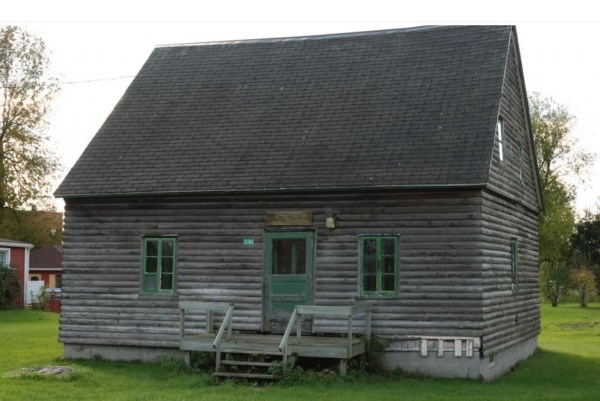
The Leveque family house used as Henriette’s first school

Troubles escalated with the local Catholics during the rebellion of 1837. Those at the mission were threatened and forced into exile in the United States. They found sympathy for their cause in Champlain, New York and were able to raise money and received continued support from the Americans.

When things quieted down, they returned to Grande Ligne to find the houses emptied, animals taken and crops gone. With the help of several friends of the Mission, they rebuilt. The new construction, a much larger, substantial stone building, housing the mission and the school, opened in 1840. This was the begining of the Feller Institute.
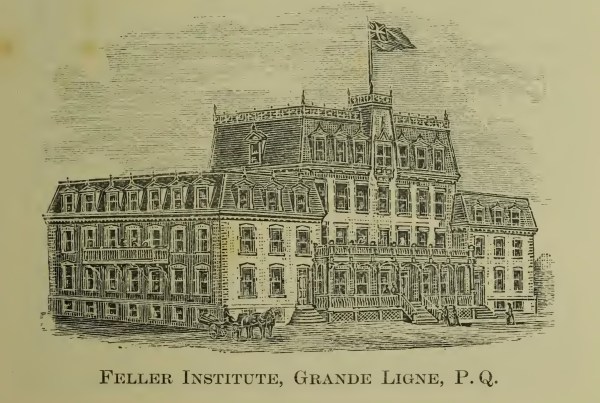
While Henriette, known as Mere (Mother), continued to teach, Louis Roussy, as a colporteur, spread the word of God through the distribution of Bibles. My family lore said that one day, he and Eloi Roy visited my great-great grand mother, Sophie Marie Prudhomme Bruneau. She was interested in what they told her and invited them to stay the night. Her husband Barnabé Bruneau then joined in the discussions and eventually, my great-great grandparents and all their 13 children converted to Protestantism.
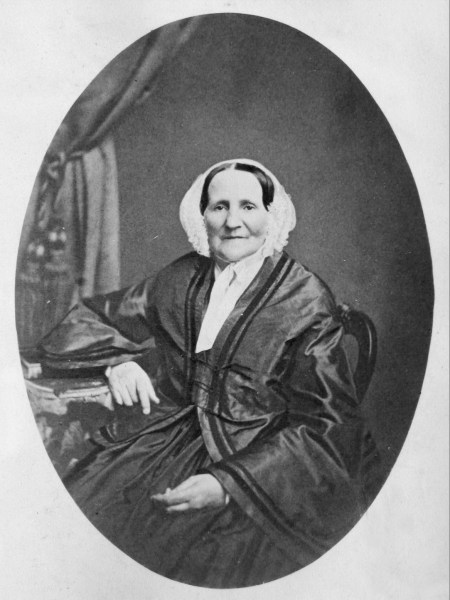
Henriette Feller

The hard work took its toll on Henriette’s health, which was a constant source of anxiety for her close associates. She had pneumonia several times and never completely recovered, even after a trip home to Switzerland. She suffered a stroke in 1865 and although bedridden, was still the driving force for the school until her death in 1868. Henriette Feller is buried in the Grande Ligne Cemetery with many of her converts, including some of my ancestors. Most of my family is protestant to this day.

Although Madame Feller occupied a somewhat anomalous position, for her influence was well-nigh all-powerful, and few ventured to contradict or oppose one in whom the tenderness of woman and the firmness of man were so happily united, she never overstepped apostolic limits.”

Notes:

Walter N. Wyeth, D.D. Henrietta Feller and The Grand Ligne Mission, Philadelphia, PA. 1898. printed and Bound by C.J. Krehbeil & Co. Cincinnati, Ohio.

Paul Villard M.A., M. D., D. D. Up to the Light the story of French Protestantism in Canada. 1928. Ryerson Press, Toronto, Canada.

PHILIP G.A. GRIFFIN-ALLWOOD Wesley Memorial United Church  Cramp Memoir of Madame Feller 244. Mère Henriette Feller (1800-1868) of La Grande Ligne and Ordered Ministry in Canada.

Historical Sketch of the Grande Linge Mission by the President 1893

https://www.findagrave.com/cemetery/2457971/saint-blaise-baptist-cemetery

https://en.wikipedia.org/wiki/Feller_College

Protestants of Bourbonnais, Bourgogne and area

Researching the Protestants of Bourbonnais, Bourgogne, Franche-Comté, Nivernais and Pays de Montbéliard of the 16th and 17th centuries

Researching your ancestors from this central region of France can be conducted online through the regional archives (Archives départementales). Online searches for the 16th, 1 7th and 18th centuries must be carried out by the commune (village, town, township, city) where your ancestor resided. Once you have determined the commune you seek, click on its name.

A list will come up of all the Catholic parishes of that département as well as the Protestant temples (churches) if the acts of baptisms and marriages survived. There were very few records of deaths among Protestant families for this period.

For each Catholic parish and/or Protestant temple, you can select the time period, listed by years, months and days. These church registers are available online for free by simply clicking on the dossier of your choice. Downloads of documents are also free.

Two notes of caution: the penmanship of ancient Church Registers, both Protestant and Catholic, can be best described as scribbling, and these resources are only available in French. You can apply online translation tools such as Google Translate or DeepL.

 Côte d’or – Archives départementales  http://archives.cotedor.fr/v2/site/ad21/

 Doubs – Archives départementales  http://recherche-archives.doubs.fr/?id=recherche_guidee_etat_civil_numerisee

Haute-Saône – Archives départementales  http://archives.haute-saone.fr/

Jura – Archives départementales  https://www.archives-departementales.com/index.php?article41/archives-en-ligne-du-jura-numerisees

 Niévre – Archives départementales  http://archives.cg58.fr/

 Saône-et-Loire – Archives départementales  http://www.archives71.fr/

Territoire de Belfort – Archives départementales http://www.archives.territoiredebelfort.fr/

Yonne – Archives départementales  https://archives.yonne.fr/Archives-en-ligne

If you do not know the name of the commune in France of your ancestor lived, see:

Journal des femmesNoms de familles. A listing of family names in France that tells you in which commune or département a family name is most common. http://www.journaldesfemmes.com/nom-de-famille/

If you are a North American family lineage researcher, you may have been researching online using FamilySearch.org or/and Ancestry.com. In my opinion, the best commercial research tool in France is Filae.com  https://www.filae.com/recherche  This research tool is NOT free of charge.

The attached 28-page research guide to finding the Protestants who lived in this area of France in the 16th and 17th centuries can be accessed here:  Protestants of Bourbonnais, Bourgogne, etc.

The Protestants of Anjou, Beauce, Bretagne, Maine, Normandie, Perche, Poitou, Touraine of the 16th and 17th centuries

 France Région du Grand-Ouest

During the 17th and 18th centuries, the north-western region of France contributed the greatest number of immigrants to New France, Acadia and the Great Lakes Region of Upper Canada.

Most of these immigrants were Catholic, however, some were Protestant.

The Protestant presence in the north-western region of France began in 1523-1527 in the cities of Angers, Le Mans, and Rennes. From 1553 to 1560, Protestant churches were organized in Anjou, Aunis, Bretagne, Poitou, Saintonge, and Touraine within this region of France.

The following research guide will help you navigate the morass of resources available to genealogists researching Protestant ancestors from Normandy, Poitou and beyond. It contains information in both English and French.

Click on this link to read the 116-page PDF research guide:

The Protestants of North-West France

This guide includes: France Huguenot Family Lineage Searches in various archives in France; French Protestant records on FamilySearch.org; a description of Protestant Church Registers at various regional archives in France; the region; the authors (books about Protestants in north-west France, including collectif, or various authors); Protestant historical societies (national); Protestant historical societies (regional); Online resources including theses; Archives (France); Archives départmentales; Libraries; Old Protestant newspapers; Publishers; Protestant genealogy (regional); links to other articles on Genealogy Ensemble.

 Protestant Church Registers at various regional archives in France

(Archives départementales & Archives communales de France)

Protestant pastoral church registers began around 1560 in many regions of France. At the regional archives of the Charente-Maritime, Protestant pastoral church registers began in 1561. At the Archives départementales du Calvados and at nearby Bibliothèque municipale de Caen, fonds contain Protestant baptisms and marriages from 1560 to 1572, in addition to an index of Protestant families and places of residence.

Documents which are normally found among the Collection communale et Collection départementale (archives originating from fonds) were researched and compiled by archivists at various Archives départementales (Regional Archives) and Archives communales (Municipal Archives.) These Protestant church registers can be found among the Parish registers (Registres paroissiaux) of an appreciable number of Archives départementales.

Protestant Church registers are described online at various archives as Actes pastoraux or Registres pastoraux. These are the acts of baptisms and marriages written by Protestant pastors (pasteurs Protestants) during the period described as Période du Désert, between the years of 1665 and 1787.

A second collection of church registers, addressing Protestant families and covering 1793 to 1820, is described as Actes de catholicité because Catholic Priests would baptize the children of Protestant parents. Also available online at most of the 95 Archives départementales de France are the civil registers described as Tables décennales, a regrouping of civil registers by 10-year periods from 1793 to 1912, or later at a number of départements (states).  Among these Tables décennales you will find Protestant families (from 1822 onward) later at most regional archives (Archives départementales) of France.

Many of the regional archives (Archives départementales) will feature online information from fonds referred to as Familles protestantes du 16e et 17e siècles (Protestant families of the 16th and 17th centuries). In most cases these fonds were obtained from regional Protestant museums, historical and archeological societies, municipal archives and genealogical societies.

A few regional archives have listings of Protestant families of their own regions from the Société de l’histoire du protestantisme français (SHPF). This society, organized in 1852 and based in Paris, features a growing online database, in partnership with the Bibliothèque nationale de France, addressing the Protestant families of many regions of France from the 16th century onward. See: https://www.//shpf.fr/collections

Common Terms

The following are French language expressions you may come across as you research the Protestants of France in the 16th and 17th centuries.

Archives des consistoires de France – Protestant archives at the Archives nationales (France) Pierrefitte-sur-Seine (Paris)

Assemblée de nouveaux convertis – A description of former protestant individuals who left the faith in order to join the Catholic Church – It does appear that in some rare cases, that the contrary to the above also addressed former catholics who joined the protestant faith.

Assemblée protestante – Protestant church or temple

Assemblée de religionnaires – Protestant church or temple

Chapelle protestante – Protestant chapel

Communauté protestante – Protestant community

Communauté réformée – Protestant community

Culte protestant – Protestant faith

Culte réformé – Protestant faith

Demi-fief de Haubert – A person of the nobility (Bourgeoisie) who was the owner of a Seigniory which dates back to the Knights (Chevaliers) time period of ancient France.

Église réformée – Protestant Church of France

Exercice du culte – Liberty of action in regard to a place or places of worship

Familles protestantes – Protestant families

Familles réformées – Protestant families

Lieu de prière – Place of worship

Lieux de prière -Places of worship

Lieu d’exercice – Faith place name

Lieux d’exercice – Faith place names

Nouveau converti – New convert (Male)

Nouveaux convertis – New converts

Nouvelle convertie – New convert (Female)

Nouvelles converties – New converts

Placet au Roi (roi) – Written directives issued by various kings of France which reflects the will (power) of the Crown of France

Réformé – Protestant individual

Relaps – A person who no longer attend regular church services

Religion réformée – Protestant faith

Religionnaire – Protestant individual

Religionnaires – Protestant individuals

Synode – Synod

Synodes – Synods

Temple protestant – Protestant temple

Temple réformé – Protestant temple

Temples protestants – Protestant temples

Temples réformés – Protestant temples