Tag Archives: Thomas McHugh

The Cipher

When I say that my grandfather, Thomas McHugh, worked as a cipher, Bletchley Park, MI5, Russian spies immediately come to mind. He was neither a Russian spy nor did he work as a cipher during the war. His employer was the Bank of Montreal, and it was his first job when he came to Canada in 1912.

The decision to immigrate to Canada was not easy for Thomas. He was in his mid-30s and already had seven children, between the ages of one and fifteen. For over 40 years, the jute manufacturers of Dundee, Scotland, had been providing employment for his parents, aunts, uncles, siblings, wife, and for him. However, by the early 1900s, he was facing a precarious future for his children.

By that time, Dundee had suffered a serious decline in the textile industry and more significantly, the jute industry. Jute was imported from India; however, the mill owners realized that it would lower production costs to open mills in India to prepare the jute and import the finished product to Scotland. Once mills were established in India, the jute production in the mills in Dundee decreased substantially.1

So when Thomas arrived in Canada, a little ahead of his wife and his children, he was eager and prepared to do any job that he could. The Bank of Montreal had its headquarters in Montreal, Quebec. At the beginning of the 20th century, the bank had significant dealings with Great Britain and there were correspondence and banking instructions back and forth between Canada and Great Britain daily. These instructions were mainly sent by telegraph overnight.  Some of these instructions were confidential, and it was preferred that they remain so. Overnight instructions reduced the number of people who would have access to them. And the time difference between Montreal and the United Kingdom meant that the banks in London and Edinburgh were open for business while Montreal was still asleep.
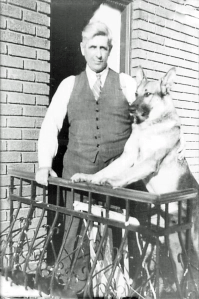
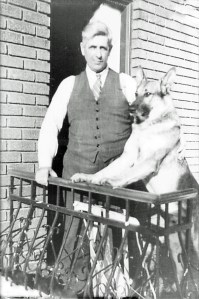
Thomas with Pal in Verdun

Even in those days, the banks were concerned about security, privacy and confidentiality. The banking instructions and transactions that were transmitted by telegraph were encrypted. It was the job of the cipher clerk to decipher them so that the bank staff could then ensure that the instructions were carried out as required.

To be a cipher clerk, one had to be reliable, meticulous and honest, and maintain the confidentiality of the bank’s business above all else. To decipher the information, the clerk used a cipher handbook and worked overnight, making it a difficult job for a man with a family.

So while my grandfather, the cipher, did not work in espionage, I still think that his first job in Canada was rather interesting.2

  1. Wikipedia web site, The History of Dundee, online<https://en.wikipedia.org/wiki/History_of_Dundee>, accessed February 19, 2017.
  2. McHugh, Edward. Personal knowledge. [Father of writer].

The Fuller Brush Salesman

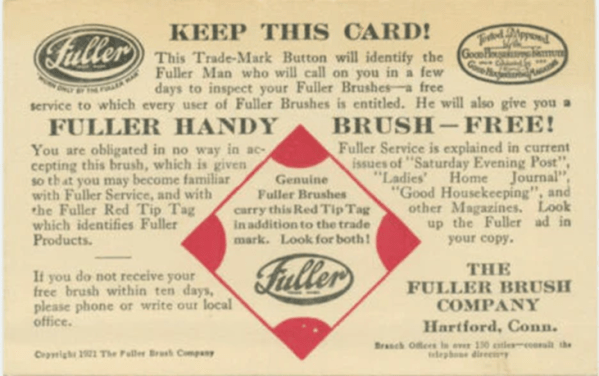
The advertisement in the February 24, 1928 edition of the Montreal Star called for three reliable men to apply for a special sales campaign for the Fuller Brush Company.

My dad, Edward McHugh, probably answered an advertisement similar to this one when he finished school in the late 1920s. He worked as a Fuller Brush salesman for two years in Montreal. Alfred Fuller founded the Fuller Brush Company in 1906. The company produced good quality brushes and increased its sales force by advertising for salesmen. But the secret of its selling success was that each salesman (they preferred men in those days) had to sign a pledge in which they promised that “I will be courteous; I will be kind; I will be sincere; I will be helpful.”1

The salesmen left cards like this one when no one was home:

Image courtesy of the Fuller Brush Co., https://fuller.com/pages/fuller-brush-history, accessed March 13, 2024
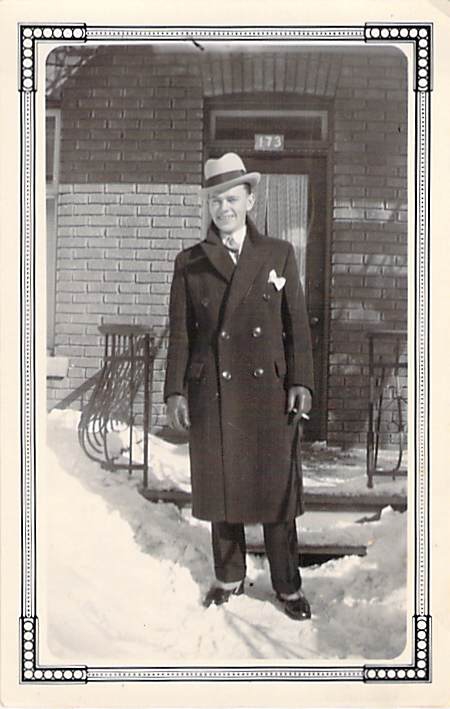
Edward McHugh

As you can see in the above picture, my dad was a snazzy dresser. Knowing him, he probably took a lot of care with his appearance when he was out selling brushes. I remember him polishing his shoes every morning before going to work.

I assume that he succeeded fairly well at selling Fuller Brushes.2 But he must have been restless and in search of adventure because he left Montreal after just two years of selling brushes. Just travelling to Bermuda would have been quite an adventure in itself. He would have started his trip by going to New York City by train where he would then take an ocean liner. The Furness Bermuda Line and operated regular passenger and mail service between New York and Hamilton, Bermuda at the time.3

Edward must have encountered some challenges selling Fuller Brushes in Bermuda as he ended up working as a bell hop in a hotel that catered to rich patrons from the U.S. and Canada. The tips he earned helped him pay for business college when he returned home to Montreal.4

The Princess Hotel, Hamilton, Bermuda5

By the time Dad completed his business and accounting courses, Canada was in the Great Depression. He again got itchy feet again and moved to Drummondville, Quebec with his older brother, Thomas McHugh, his sister, Sarah Jane McHugh, and her husband, Jack Day. In Drummondville, he did not work as a Fuller Brush salesman, a bell hop, or in business or accounting. He apprenticed as an electrician at the Celanese and worked there for eight years until 1940, when he enrolled in the Royal Canadian Air Force as an aircraft mechanic at the outset of World War II. The RCAF trained my dad in aircraft hydraulics and he was assigned to Bomber Command stationed in Yorkshire, England, for the remainder of the war.6

It is no surprise that Dad did not become an aircraft mechanic after the war. He loved being an electrician and his started his own electrical company, Provincial Engineering. He eventually sold his portion of the business. I remember him saying, “the boss always gets paid last.” After that, he joined a firm and worked in a supervisory capacity on the electrification of towns in regional Quebec such as Sept-Iles and Chibougamau.

Dad was curious and loved trying new things. He never backed down from a challenge.

When my dad retired, he and my mom travelled to Bermuda regularly for their winter getaways. He must have enjoyed going back and perhaps even having a meal or two at the hotel he worked at when he was a young bell hop.

  1. Fuller Brush Company website, History of the Fuller Brush Company, https://fuller.com/pages/fuller-brush-history, accessed 20 February 2024
  2. Library and Archives Canada, Military records, Edward McHugh
  3. Wikipedia, Furness – Bermuda Line, https://en.wikipedia.org/wiki/Furness_Bermuda_Line, accessed 26 February 2024
  4. Library and Archives Canada, Military records, Edward McHugh
  5. Historic Hotels of the World, Hamilton Princess, Hamilton, Bermuda, https://www.historichotelsthenandnow.com/princesshamilton.html, accessed 26 February 2024
  6. Library and Archives Canada, Military records, Edward McHugh

The Trip of a Lifetime

My father, Edward McHugh, didn’t really talk about his family’s trip of a lifetime. After all, Dad wasn’t even born yet. But it must have been discussed by everyone when he was a boy. In 1911, the first member of the family, Mary Ann McHugh, moved from Dundee, Scotland to Montreal.

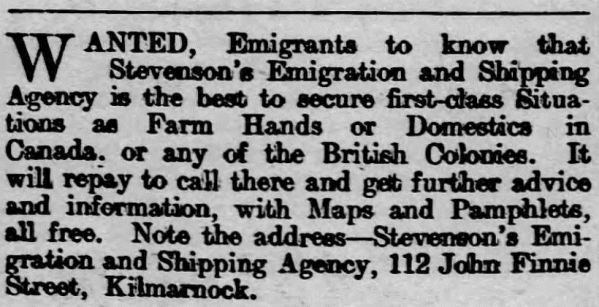
At the time, booking agents in the United Kingdom advertised and recruited potential immigrants to Canada. There was an acute need of domestic help and agricultural workers. Between 1890 and 1920, Canada experienced its third wave of immigration and its peak was between 1911 and 1913, just before World War I.1 The following type of advertisement was common in the newspapers.2

Booking agent advertisement

Maybe one of these advertisements gave the McHugh family the idea to emigrate to Canada. Or maybe Mary was ready for an adventure. She was just 21 when she disembarked from the SS Grampian that had left Glasgow on June 24, 1911 and arrived in Quebec City on July 9, 1911.  She would have had a medical exam when she arrived to ensure that she was in good health and did not have an infectious disease. Conditions for immigration to the colonies were well known in the United Kingdom. The February 11, 1911 edition of the Hamilton Observer, in its article, Canadian Notes, People Prohibited, details the reason some potential immigrants could expect to be refused by Canada. The article explains the booking agent’s liability for the immigrants that arrived in Canada for a period of three years following their arrival:

“The following classes of people are prohibited from landing … feeble minded, idiotic, insane, or who have been insane within five years, afflicted with any loathsome, contagious, or infectious disease; anyone who is a pauper, who is destitute, who is a professional beggar or vagrant.”3

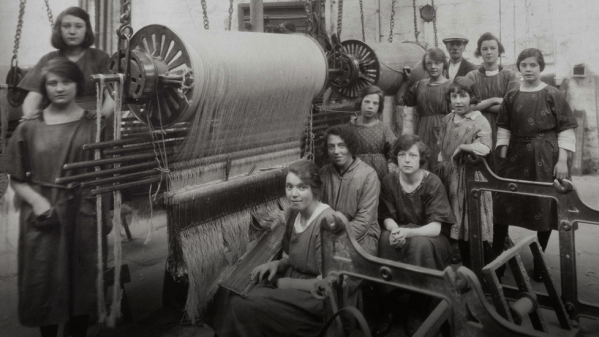
All of the members of the McHugh family worked in the jute mills in Dundee. The 1911 census indicates Mary was a jute weaver, which probably meant that she operated a jute weaving machine.4 She lived with her mother, Sarah Jane McLaughlin, and her brothers, Edward and Francis. They lived at 1 Tait Lane, Dundee. Her other brother, Thomas, my grandfather, lived with his wife and seven children at 9 Tait Lane.

The picture below shows the jute weaving machine.5

Mary must have been satisfied with her new life in Montreal, Quebec. Within a year, her mother and her two brothers, along with my grandfather, had followed her to Canada. Six months later, my grandmother, Elsie Orrock, and her seven children joined her husband, Thomas, in Montreal.

The McHughs lived close together in Dundee and they also lived close together in Verdun, Quebec. While I will never know for sure why they decided to emigrate, I can guess that they wanted a life that was not as hard as the one working in the jute mills. There are a few clues that this was not a spur of a moment decision but a planned family decision.

Mary left first and, if it did not suit her to live in Canada, she would have been able to easily return to Dundee. Her mother and brothers were still there. By the time her mother emigrated, along with her three sons, they arrived with $150 CAD, about $4,750 in today’s dollars. Browsing through the passenger lists, I can see that they had a lot more money than many of their fellow passengers. 6 They were not a rich family, so this amount of money would have taken some time to save up.

Coincidentally my grandfather joined the Freemasons in 1910 and achieved a Master Mason diploma and a Mark Mason diploma.7 By that time, he already had six children. He worked long hours in the jute mill, including Saturdays. Why would he join the masons when he was already a very busy man providing for his family, plus taking care of his widowed mother, and his siblings who still lived at home? There is no evidence that he ever joined the masons when he arrived in Canada. I believe that it is possible that he joined the masons to in case he needed the contacts to find employment. As he quickly found work, his busy family life prevented him from pursuing his membership in the masons.

Only one of my grandfather’s siblings stayed in Scotland, Sarah Jane McHugh. She was not living with the other McHughs at the time of the 1911 census. But she remained close to the family. Surprisingly, she travelled to Montreal to be a witness at her brother’s wedding at the Notre Dame Basilica in Montreal on May 8, 1913.8 That would have been quite a trip for Sarah Jane to make.

  1. Wikipedia, Immigration to Canada, https://en.wikipedia.org/wiki/Immigration_to_Canada, accessed 27 September 2023.
  2. Irvine Herald and Ayrshire Advertiser (Irvine, Strathclyde, Scotland) · 13 Oct 1911, accessed Newspapers.com, downloaded 24 August 2023.
  3. The Hamilton Advertiser (Hamilton, Strathclyde, Scotland) · 11 Feb 1911, accessed Newspapers.com, downloaded 24 August 2023.
  4. Scotland’s People, National Records of Scotland, 1911 Census, Sarah Jane McHugh, downloaded 23 June 2019.
  5. V&A Dundee Design Museum, Women’s Day tweet, 6 March 2020.
  6. Passengers lists for S.S. Grampian arriving in Port of Quebec, May 21, 1912, Library and Archives Canada, https://www.bac-lac.gc.ca/eng/discover/immigration/immigration-records/passenger-lists/passenger-lists-1865-1922/Pages/image.aspx?Image=e003578022&URLjpg=http%3a%2f%2fcentral.bac-lac.gc.ca%2f.item%2f%3fid%3de003578022%26op%3dimg%26app%3dpassengerlist&Ecopy=e003578022, accessed February 3, 2022.
  7. Thomas McHugh, registration of the Grand Lodge of Scotland, dated 25 August 1910.
  8. Registration of marriage of Francis McHugh and Helen Smith, 8 May 1913, downloaded 6 January 2022.

The Cipher

When I say that my grandfather, Thomas McHugh, worked as a cipher, Bletchley Park, MI5, and Russian spies immediately come to mind. He was neither a Russian spy nor did he work as a cipher during the war. His employer was the Bank of Montreal and it was his first job when he came to Canada in 1912.

The decision to immigrate to Canada was not easy for Thomas. He was in his mid-30s and already had seven children, between the ages of one and fifteen. For over 40 years, the jute manufacturers of Dundee, Scotland had been providing employment for his parents, aunts, uncles, siblings, wife, and for him. However, by the early 1900s, he was facing a precarious future for his children.

By the early 1900s, Dundee had suffered a serious decline in the textile industry and more significantly, the jute industry.  Jute was imported from India, however, the mill owners realized that it would significantly lower the cost of production to open mills in India to prepare the jute and import the finished product to Scotland. Once mills were established in India, the jute production in the mills in Dundee decreased substantially.1

So when Thomas arrived in Canada, a little ahead of his wife and his children, he was eager and prepared to do any job so that he could. The Bank of Montreal had its headquarters in Montreal, Quebec. In the early 1900s, the bank had significant dealings with Great Britain and there were correspondence and banking instructions back and forth between Canada and Great Britain daily. These instructions were mainly sent by telegraph overnight. There were two reasons for this. Some of these instructions were confidential and it was preferred that they remain so. Overnight instructions reduced the number of people who would have access to them. Another reason was the time difference between Montreal and the United Kingdom. The banks in London and Edinburgh were open for business while Montreal was still asleep.

Thomas McHugh with Pal

Even in those days, the banks were concerned about security, privacy, and confidentiality. The banking instructions and transactions were submitted by telegraph and were encrypted. It was the job of the cipher clerk to decipher them so that the bank staff could then ensure that the instructions were carried out as required.

To be a cipher clerk, one had to be reliable, meticulous, and honest, and ensure the confidentiality of the bank’s business. The cipher clerk used a cipher handbook to decipher the information. Also, the cipher clerk worked overnight, so it was a difficult job for a man with a family.

So while my grandfather, the cipher, did not work in espionage, I still think that his first job in Canada was rather interesting.2

1 Wikipedia web site, The History of Dundee, https://en.wikipedia.org/wiki/History_of_Dundee, accessed February 19, 2017

2 McHugh, Edward. Personal knowledge. [Father of writer].
Discovery and Imagination

Historical walking tours are a great way to walk in your ancestors’ footsteps. Even if you know a lot about the place your ancestors lived, you are sure to learn a few new facts. I recently visited Drummondville, where my dad, Edward McHugh, lived for eight years during the Great Depression. He, as well as his brother, Thomas, and his sister, Sarah Jane, had gone to Drummondville in 1933 after being out of work in Montreal. They were employed by the Celanese, one of the biggest employers in Quebec during the 1930s. The Celanese was a textile plant and my dad worked in the Silk Factory as an electrician. The Celanese plant in Drummondville was one of the main reasons why Drummondville hardly felt the effects of the Great Depression.

The walking tour I went on was a free tour offered by the Société d’histoire de Drummond (historical society of Drummondville).1 The tour started at Parc Woodyatt, named after James Blain Woodyatt, Director General and member of the Board of Directors of Southern Canada Power. Southern Canada Power built, owned and operated the hydroelectric complex In Drummondville. The public park Woodyatt opened in 1930 and included sports facilities such as a pool, a skating rink and tennis courts.2

My dad, who loved to skate and swim and was an avid tennis player, would have gone to this park regularly.

My dad also loved to go to the theatre and I can easily imagine him spending his Saturday evenings at the Théâtre Capitol, built in 1937. He would have been excited when the theatre opened. This lovely art deco building is currently a multi-screen cinema complex.

Across from the town square is the impressive Roman Catholic Basilica Saint- Frédéric. When the McHugh siblings lived in Drummondville in the 1930s, this church was not yet a basilica. The first church was a chapel built in 1822 and demolished in 1879 as it became too small to accommodate the parishioners. The second church was situated where the Saint-Frédéric Park is now, just in front of the current church. The second church burnt down in 1899. The third church, built at the church’s current location, was completed in 1907 and was the victim of arson in 1921. The fourth church is the one currently standing and it was completed in 1922. It is truly magnificent. It was named a minor basilica by Pope Francis in 2015.4

Image result for eglise saint frederic drummondville

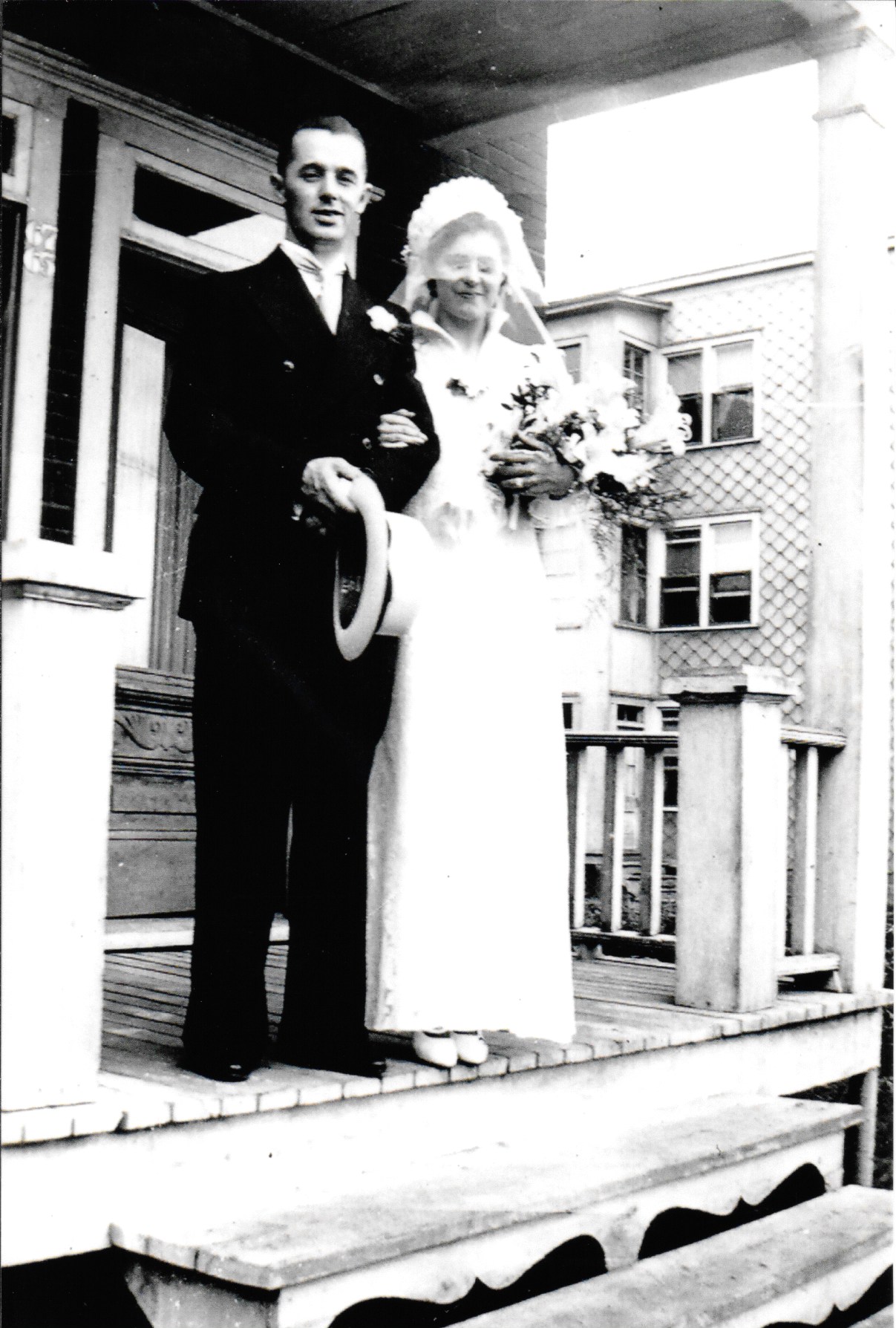
In 1937, my uncle Thomas McHugh and Simone Cloutier, a young lady from Drummondville, were married in Saint-Frédéric.5  A Casavant organ, built in 1930, would have played at their wedding. Fourteen Stations of the Cross grace the church. Stained glass windows represent the life of Saint-Frédéric, an archbishop in France.6 The McHugh family was a large one, with nine siblings. They would probably have all attended the wedding, and would have most likely travelled from Montreal by train.

McHugh, Thomas with Simone Cloutier (maybe)

Sadly, they returned to visit this magnificent church less than one year later. Thomas McHugh died of an illness in the hospital.7 My father, along with his other brothers, signed the register as pallbearers.8 Thomas McHugh is buried in the Saint-Frédéric cemetery on Saint-Joseph Boulevard, not very far from the church.

From the outside I saw the Hôpital Sainte-Croix where, sadly, my uncle would have died. The current site of this hospital was founded in 1927 and, at the time of my uncle’s death, had 18 beds and one operating room. It was run by the Soeurs de la Présentation de Marie. 9

We finished our day by driving through the working class district of Drummondville where the workers of the Celanese lived. I know my dad lived on the top floor of a duplex. He had no car so he would have lived in walking distance from work.

It was truly a day of discovery and imagination.


  1. A sincere thank you to the Société d’histoire de Drummond for this walking tour and for all of the valuable work that they do to preserve the history of Drummondville.
  2. Société d’histoire de Drummond
  3. Société d’histoire de Drummond
  4. Société d’histoire de Drummond
  5. Registration of the marriage of Thomas McHugh and Simone Cloutier, July 17, 1937, Paroisse Saint-Frédéric de Drummond, Registres photographiés au Registres de Arthabaska
  6. Church pamphlet entitled Guide – Visite et histoire de la Basilique Saint-Frédéric de Drummondville
  7. The Drummondville Statesman, “Thomas McHugh Passes Away,” May 27, 1938, accessed March 19, 2016
  8. Registration of the death of Thomas McHugh, May 25, 1938, Paroisse Saint-Frédéric de Drummond, Registres photographiés au Registres de Arthabaska
  9. Société d’histoire de Drummond

The Canadian Celanese and the Great Depression

“Damn!” My dad, Edward McHugh, cursed to himself. He thought ruefully that his great idea to change his job ten months ago did not work out very well. His first job after school was in the office of Henry Birks & Sons. While he was working there, he decided to take a bookkeeping class at night at Sullivan College and the A.R. Whittell Can Company thought that he showed initiative, was a snappy dresser, and would make a good salesperson. So they hired him. It was now 1931 and he had just been laid off because sales were dropping.1

McHugh, Ed Verdun

Edward McHugh in Verdun, Quebec, in the 1930s

Now what? Edward knew that the prospects of getting a job were bleak. Luckily Edward still lived at home with his parents and his father was a foreman at the Atlas Absestos Company.2 Still, it was worrisome.

It would be two years before Edward would find employment. He spent many evenings with his brothers and sisters, playing cards. During these evenings, their supper was sandwiches, made out of a loaf of white bread, some butter, and one can of salmon. 3

Maybe the idea to go altogether to Drummondville was hatched at one of the card parties. In any event, in 1933, in the depth of the Depression, the McHugh siblings, Edward, Thomas, Sarah Jane, and Sarah’s husband Jack, decided to move to Drummondville, Quebec to find work.

At that time and even though Quebec was hard hit by the Depression, the Canadian Celanese Company in Drummondville was a significant employer in the province, with 1,757 employees. The picture below shows the employees of the Canadian Celanese Company in that year.4

Celanese 1931

Moving to Drummondville would have been equivalent to immigrating to a new country. None of the members of the family would have had an automobile so the trip from Montreal to Drummondville would have had to be by train. As with many immigrants, their motives were financial.

As far as I know, they were all employed by the Canadian Celanese Company. The Celanese Corporation was founded in 1915 by two Swiss chemists, Camille and Henri Dreyfus and enjoyed significant success during WWI because of its development of synthetic fiber. The Canadian plant was built in 1926 in Drummondville. This location was chosen due to its proximity to a large expanse of forest, it was close to Montreal that was the centre of the textile industry at the time, and inexpensive hydro power  supplied by Southern Canadian Power was available.5

This picture of the Celanese, taken in the 1920s, shows that it was a significant manufacturing plant: 6

Celanese 1920s

My dad was hired as an electrician and worked in what was called the silk factory.7 The Celanese required electricians to work full time to ensure that the machines were never idle.

My dad and his siblings settled in and made a life in Drummondville. Both my dad and his brother, Thomas, played on the Celanese football team.8 Thomas married Simone Cloutier in 1937 and then died a year later in 1938 of an illness. Thomas is buried in the cemetery of the St. Frederic Church in Drummondville.9

Edward continued to work for the Celanese until the outbreak of the war. He signed up for duty in August 1940 at the Ste. Hyacinthe recruiting centre. The Celanese agreed to hire him once the war had finished but he did not go back.10

  1. Military records from WWII, Edward McHugh, Royal Canadian Air Force Attestation Paper. This information was in his employment records. It states that he left Henry Birks and Sons for a better job and that he was let go from A.R. Whittell because of lack of work.
  2. Although Thomas McHugh, Edward’s father, was deceased when the RCAF Attestation Paper was filled out, Thomas’ job at his death was noted. It is an assumption that he was working there in 1933. There is no indication that he was out of work during the Depression.
  3. As told to the author by her aunt, Elsie McHugh.
  4. The Ministry of Patrimoine Culturel, Province of Québec, http://www.patrimoine-culturel.gouv.qc.ca/rpcq/detail.do?methode=consulter&id=14311&type=pge#.W6gnEWhKiUk, accessed September 23, 2018.
  5. Ibid.
  6. Eastern Townships Archives Portal, https://www.townshipsarchives.ca/canadian-celanese-ltd 192?, accessed September 24, 2018.
  7. Military records from WWII, Edward McHugh, Royal Canadian Air Force Attestation Paper.
  8. Death of Thomas McHugh, “The Drummondville Spokesman,” “Thomas McHugh Passes Away,”May 27, 1938, accessed March 19, 2015. This article states that Thomas McHugh was on the Celanese football team. It is assumed that Edward was also on that team as his Attestation Paper said that he played football extensively.
  9. Marriage and death certificates of Thomas McHugh. Drouin Collection. St. Frederic Parish, Drummondville, Quebec.
  10. Military records from WWII, Edward McHugh, Royal Canadian Air Force Attestation Paper.

Regular and Irregular Marriages in Scotland

My dad always said that my grandmother, Elspeth Orrock McHugh, was warm and generous and ready to do anything for the family. I was not surprised to find out that she hosted her sister’s wedding in her home in Dundee, Scotland on November 1, 1901.1 They would have just moved into this home2 and it would have been quite an event in her already busy life.

Elspeth had three young daughters, Anne and Elsie, aged three and two, 3 and Sarah Jane who was just 3 months old.4 Imagine hosting a wedding with three children under the age of three. Then again, the extended family would have been there to help.

Elspeth’s sister, Jemima Kinnear Orrock and Duncan McMillan Bissett had a regular marriage even though it took place in a private home. The certificate of marriage states that it was performed in accordance with the rites of the Church of Scotland and after banns were read,5 sometimes referred to as “crying the banns” or “crying the siller.”6 Banns or proclamations of marriage were read in the church three weeks in a row in case there was an impediment to the marriage.7 It is clear from the information on the marriage registration that this marriage was religious and therefore regular. This is just one of the ways that couples could legally marry in nineteenth century Scotland. In England, marriage was a religious sacrament whereas in Scotland it was a legal contract.8

Scotland’s distinctive marriage laws were based on mutual consent, rather than religious ceremony.9   Even so, the most common type of marriage took place in accordance with the rites of the Church of Scotland. The Marriage Act of 1836 also allowed priests and ministers of other churches and religious groups to perform marriage ceremonies.10 Marriages in accordance with the rites of other religions were also considered regular marriages.

Unlike England, Scotland did not allow civil marriages until an Act of Parliament in 1939.11

Interesting enough, Scotland also allowed other distinctive marriage arrangements, termed irregular marriages, that were considered legally binding and, as noted above, based on mutual consent.

A couple could simply pronounce themselves married in front of witnesses. They could also just pronounce themselves married, but it was more common to have witnesses in case they needed to prove it at some point.12

A promise of marriage, followed by a sexual relationship was also considered a binding legal marriage. Although this had to be backed up by some sort of proof, often by a written promise of marriage.13

And there was also the marriage by ‘habit and repute’ whereby the couple simply presented themselves in public as man and wife. 14

Even though the Church of Scotland frowned upon irregular marriages, it was preferable to ‘living in sin.’ Therefore these irregular marriages were tolerated. Their children were considered legitimate and were entitled to inherit property.15

Any irregular marriage could be registered if the couple presented themselves before the sheriff or magistrate. They usually had to pay a fine. Even though Scotland was tolerant of irregular marriages, they were not common in the 19th century. Most citizens preferred to be married either in church or in accordance with the rites of the church in a private home.16


  1. Scotland’s People web site, Statutory registers Marriages, marriage registration of Jemima Kinnear Orrock and Duncan McMillan Bisett, November 1, 1901, accessed July 31, 2018.
  2. The 1901 census, taken on the night of March 31/April 1, 1901 gives the family’s address as Milbank Road. The registration of Sarah Jane McHugh to Elpeth and Thomas McHugh on August 10, 1901 gives the Fleuchar Street address, the same as the address at which Jemima and Duncan were married. Therefore they would have had to have moved between March and August 1901. See references 3 and 4 below.
  3. Scotland’s People web site, 1901 Census, National Records of Scotland, entry for Thomas McHugh, accessed April 6, 2018.
  4. Scotland’s People web site, Statutory registers Births, birth of Sarah Jane McHugh, August 10, 1901, accessed December 1, 2017.
  5. Scotland’s People web site, Statutory registers Marriages, marriage registration of Jemima Kinnear Orrock and Duncan McMillan Bisett, November 1, 1901, accessed July 31, 2018.
  6. Rampant Scotland web site, Did you know? – Marriage customs in Scotland, http://www.rampantscotland.com/know/blknow_marriage.htm, accessed August 19, 2018.
  7. National Records of Scotland web site, Old Parish Registers – Marriages and Proclamation of Banns, https://www.nrscotland.gov.uk/research/guides/birth-death-and-marriage-records/old-parish-registers/marriages-and-proclamation-of-banns, accessed August 22, 2018.
  8. University of Glasgow web site, School of Social and Political Sciences, Scottish Ways of Birth and Death, Marriages, https://www.gla.ac.uk/schools/socialpolitical/research/economicsocialhistory/historymedicine/scottishwayofbirthanddeath/marriage, accessed August 20, 2018.
  9. Ibid.
  10. Ibid.
  11. Ibid.
  12. Ibid.
  13. Ibid.
  14. Ibid.
  15. Ibid.
  16. Ibid.

The White Death

Michael McHugh looked at his son, born only minutes before, with sadness. What would become of him? The room was warm and toasty even though it was one of the coldest winters in Scotland1 when Francis McHugh was born at midnight on February 21, 1895.2 Nevertheless Michael shivered in apprehension. The doctor was clear. Michael did not have long to live. He would likely be dead before the year was out.

Michael’s eldest son, Thomas was present at the birth. He was just nineteen and much too young to shoulder the burden of Michael’s family once Michael died even though Thomas was already contributing to the family’s finances. He worked in a jute factory as a yarn bleacher.3 At the age of 19, Thomas should be thinking of starting his own family one day. But how could he do that when he would have his mother and four siblings under nine to take care of?

Francis was the fifth child.4 The family lived in a tenement situated in the overcrowded industrial area near the jute factories. It is unlikely that the flat had a bathroom. The night that Francis was born, the flat would have been crowded. A female relative or two would have been there to help with the birth and the younger children. Thomas would have fetched the midwife or “howdie.”5 She would have stayed until Francis and his mother, Sarah, were comfortable and taken care of.

Michael had worked his 12-hour days at the jute factory6 until he could no longer manage it. He became increasing weak, losing weight at a rapid rate. He coughed up phlegm and sometimes blood. When he saw the doctor, his worse fears were confirmed. He had tuberculosis. The doctor named it phthisis. Michael knew it as “the white death.”

Michael was ashamed. It was known that tuberculosis was contagious, but the stigma remained. It was considered a poor man’s disease because of the unsanitary conditions of the tenements that the poor lived in.7

The doctor was careful to explain to Michael that it was contagious and Michael was careful not to cough or spit when he was with the children. He probably never carried Francis in his arms, out of fear of infecting him.

Michael died at home three months later.8 It would be about six years before Sarah Jane who was eight at the time of Francis’ birth, would be old enough to work and contribute to the family earnings. In the meantime, Thomas took care of them and he continued to do so, even when he immigrated to Canada in 1912, bringing his mother, his two brothers, his wife and his seven children.9


  1. Wikipedia web site, “Winter of 1894,” https://en.wikipedia.org/wiki/Winter_of_1894%E2%80%9395_in_the_United_Kingdom, accessed November 28, 2017. The British Isles suffered a severe winter in 1894/1895 that ended a decade of harsh winters, sometimes referred to as the Little Ice Age. Because the River Thames froze over, shipping was restricted and the economy suffered. Coal was at a premium.
  2. Birth registration of Francis McHugh, Scotland’s People, Statutory registers, Births, 282/1 384, accessed November 26, 2017.
  3. In the 1991 census, Thomas was 14 and he worked as a yarn bleacher. Scotland’s People 1891 census 282/1 35/48, accessed November 18, 2017.
  4. Scotland’s People 1891 census 282/1 35/48, accessed November 18, 2017. The 1891 census shows the children, Thomas, Sarah and Mary Ann. Edward McHugh was born in 1873, as per the registration of his birth, Scotland’s People, Statutory registers, Births, 282/1 384, accessed November 26, 2017.
  5. National Records of Scotland website. “Safe Delivery, A History of the Scottish Midwife,” https://www.nrscotland.gov.uk/research/learning/features/safe-delivery-a-history-of-scottish-midwives, accessed December 21, 2017.
  6. Dark Dundee web site, “Workers of the Mills,” https://www.darkdundee.co.uk/archive/dundee-landmarks/workers-of-the-mills/, accessed January 18, 2018. A regular working day was 12 hours in the jute mills. Dundee had one of the lowest wages in the country in the 19th century, and the highest cost of living. Low wages meant that there was little for anything that was not a necessity. While the jute mill workers had regular wages, it would have been hard to get themselves out of poverty.
  7. University of Virginia website, “Early Research and Treatment of Tuberculosis in the 19th Century, http://exhibits.hsl.virginia.edu/alav/tuberculosis/, accessed January 18, 2018.
  8. Michael McHugh’s death certificate, date of death May 16, 1895. Scotland’s People, Statutory registers, Death, 282/1 148, accessed November 26, 2017. Cause of death: Phthisis lasting 4 months. It is doubtful that it lasted four months. The four months may have indicated the time that had elapsed since the diagnosis or since he was off work or even bedridden.
  9. Canadian Passenger Lists, 1865-1935 Database, Ancestry.com, accessed November 14, 2017.

Did they travel on the same ship?

It has always bothered me that on the passenger lists of the S.S. Grampian, sailing from Glasgow to Quebec City, my grandfather, Thomas McHugh, was not listed with his wife, Elsie McHugh and their seven children.

My father was always clear that Thomas arrived ahead of his large family in the early 1900s. The plan was that Thomas would have time to find work and a place to live, and get settled in.

I first found my grandmother, Elsie McHugh and the seven children listed on the passenger list of the S.S. Grampian, leaving Glasgow and arriving in Quebec City. The year was 1912.  I knew that I also had to find out when Thomas arrived. I returned again and again to passenger lists for travel between Scotland and Canada in 1910 and 1911. No luck. It was only when I started to research my great-uncle, Edward McHugh that I discovered Thomas also on the passenger list of the S.S. Grampian in 1912, leaving Glasgow and arriving in Quebec City. Thomas was accompanied by his mother and two brothers.

Harrumph. It seemed as if Thomas didn’t leave ahead of time. But why in the world were Elsie and the children not listed with Thomas? Were they separated because of the children? This didn’t make sense. Elsie would have needed all the help she could get. Little Adam was just three and his brother, Thomas was one year old.

I kept going back to these entries. There was something about them that bothered me. I looked up potential reasons to be separated on a ship. I looked up whether families would be divided for any reason in the list of passengers. No luck.

Also, I kept getting mixed up whether it was May or October 1912. I would look at my notes and if it said May, I realized that the date was October and I would change it. I would then go back later and change it back to May. Argh. I needed to get it right.

This week I decided to establish definitely whether Thomas came over to Canada first. Perhaps he came to Canada and then went back to Scotland for his mother, his brothers, his wife, and his children. This would make perfect sense. This would explain why my father was so sure that he came ahead of the family and all the evidence that I had said that he came over with his family.

Well, I could find no trace of Thomas on passenger lists of 1910 or 1911. He wouldn’t have come before 1910, I would think.  I did find him again on the passenger list of the S.S. Grampian, May 1912. And I found Elsie again. Wait a minute. October 1912! The penny dropped. They both travelled over on the S.S. Grampian but at different times of the year. I was so blinded by the name of the ship that I did not realize that even though they were on the same ship, they travelled on different dates.

While this was not a brick wall, it was certainly a puzzle for me. A puzzle of my own making. Once again, this reaffirms that, while primary genealogical research is important, it is also valuable to revisit assumptions, documents, and notes. Look and look again and again.  Most genealogists I know enthusiastically forge ahead and tend to neglect reviewing previous finds. I am no exception.


“Those of us already deep in the accumulation may also benefit from revisiting our past research.”

Brenda Dougall Merriman, Genealogical Standards of Evidence: A Guide for Family Historians


The Cipher

By Sandra McHugh

When I say that my grandfather, Thomas McHugh, worked as a cipher, Bletchley Park, MI5, and Russian spies immediately come to mind. He was neither a Russian spy nor did he work as a cipher during the war. His employer was the Bank of Montreal and it was his first job when he came to Canada in 1912.

The decision to immigrate to Canada was not easy for Thomas. He was in his mid-30s and already had seven children, between the ages of one and fifteen. For over 40 years, the jute manufacturers of Dundee, Scotland had been providing employment for his parents, aunts, uncles, siblings, wife, and for him. However, by the early 1900s, he was facing a precarious future for his children.

By the early 1900s, Dundee had suffered a serious decline in the textile industry and more significantly, the jute industry.  Jute was imported from India, however, the mill owners realized that it would significantly lower the cost of production to open mills in India to prepare the jute and import the finished product to Scotland. Once mills were established in India, the jute production in the mills in Dundee decreased substantially.1

So when Thomas arrived in Canada, a little ahead of his wife and his children, he was eager and prepared to do any job so that he could. The Bank of Montreal had its headquarters in Montreal, Quebec. In the early 1900s, the bank had significant dealings with Great Britain and there were correspondence and banking instructions back and forth between Canada and Great Britain daily. These instructions were mainly sent by telegraph overnight. There were two reasons for this. Some of these instructions were confidential and it was preferred that they remain so. Overnight instructions reduced the number of people who would have access to them. Another reason was the time difference between Montreal and the United Kingdom. The banks in London and Edinburgh were open for business while Montreal was still asleep.

Even in those days, the banks were concerned about security, privacy, and confidentiality. The banking instructions and transactions were submitted by telegraph and were encrypted. It was the job of the cipher clerk to decipher them so that the bank staff could then ensure that the instructions were carried out as required.

To be a cipher clerk, one had to be reliable, meticulous, and honest, and ensure the confidentiality of the bank’s business. The cipher clerk used a cipher handbook to decipher the information. Also, the cipher clerk worked overnight, so it was a difficult job for a man with a family.

So while my grandfather, the cipher, did not work in espionage, I still think that his first job in Canada was rather interesting.2

1 https://en.wikipedia.org/wiki/History_of_Dundee

2 As related by my father, Edward McHugh