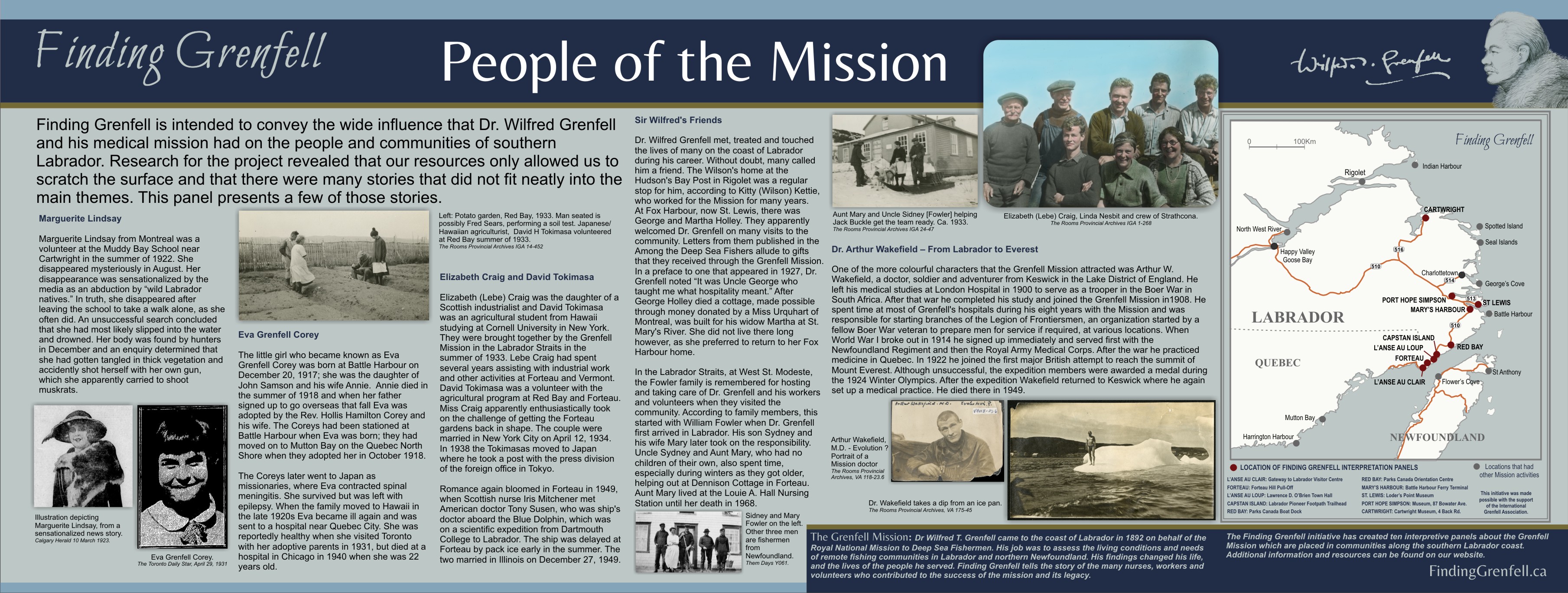
how i came to write miss lindsay’s tale

“Our ancestors want their stories told” said my third cousin and fellow genealogy writer. We are both related to my great aunt, Miss Marguerite Lindsay, and we were both told the same story growing up: Poor Marguerite Lindsay died tragically in Labrador, in 1922, at age 25. Period.

We never questioned the statement nor begged for gory details. Little did we know that she did indeed have a story to tell and she finally got her wish almost 100 years later.

I wrote a story about Marguerite’s mother, Mary Heloise Bagg Lindsay, and at the end of her story I listed the names of her six children, including her youngest daughter Marguerite.

Great Granny Bagg (Kittens on the Wedding Dress)

Shortly after the publication of her story on our website, I received an e-mail from a student at Memorial University in St John’s, Newfoundland. She wanted to know where Marguerite was buried. I found that to be a very strange question in response to a story about her mother. I replied hesitantly and asked why she wanted to know. What a delightful surprise to hear that not only had she researched Miss Lindsay’s story but also offered to send me copies of her findings and the 1922 newspaper clippings!

The media covered the tragic tale in great detail over an 18-month period including the final coroner’s report. The official report concluded that her accidental death occurred from a shot by her own pistol when she tripped and fell.

I devoured the newspaper clippings and finally knew the whole story that no one spoke of so long ago.

Research is not my forte but it seems everyone that I contacted had something to tell me. Several websites produced other glimpses into Cartwright, Labrador and Grenfell himself. What a thrill to discover a great deal of information about the International Grenfell Association preserved on microfilm at The Rooms Provincial Archives in St. John’s, Newfoundland.

That fateful summer in 1922, Marguerite worked as a volunteer school teacher with the Grenfell Mission in Cartwright, Labrador, under Reverend Henry Gordon. The local community named their school in Cartwright after him.
Miss Marguerite Lindsay Grenfell Mission Volunteer

When I contacted the assistant principal at Henry Gordon Academy, she seemed equally as excited as I to talk about Miss Lindsay. We decided to skip e-mails and speak directly over the phone instead.

Well, this is some of what she told me…They named the marsh where they found her body “Miss Lindsay’s Marsh”. An honorary plaque graces the local church and a memorial prayer said every Christmas. Some of the young students wrote her a poem and the new students are all told Miss Lindsay’s story. Miss Martin, a fellow teacher, recently retired from the Henry Gordon Academy and still has the sewing machine that her grandfather, John Martin, bought with his reward money for finding Miss Lindsay’s body that December back in 1922.

And just then…the music began to play over the phone, and I quietly listened to Harry Martin’s song “Somewhere Beyond the Hills” written for Marguerite.

“I can’t believe that I am talking to a descendant of Miss Lindsay!” said my new friend.

I could almost imagine Marguerite standing beside me soaking up all these loving tributes… her story finally told.

(Rumour has it that if I can make the 100th year anniversary of Miss Lindsay’s death in August 2022, there might be a potluck supper and memorial service at the church in her honour!)
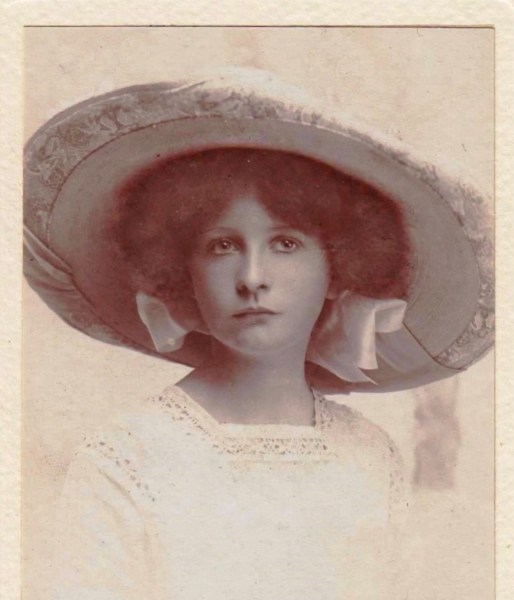
Helen Frances Marguerite Lindsay 1896-1922

Edited by author 2020-07-13

Notes: Miss Lindsay’s three part story can be found below:

https://genealogyensemble.com/2019/10/30/miss-lindsay-part-1/

https://genealogyensemble.com/2019/12/18/miss-lindsay-part-2/

https://genealogyensemble.com/2019/12/25/miss-lindsay-part-3/

1. A summary of Miss Lindsay’s story can be found on the Finding Grenfell website under the People of the Mission section: (https://www.findinggrenfell.ca/home/files/pg/panel-people-v4-large.jpg).

Beautiful hooked rug by Grenfell Mission artisans – courtesy of Janice Hamilton

2. The famous Grenfell hooked rugs: http://www.grenfellhookedmats.com/and also, they continue to make and sell rugs, clothing, books and other items, or you can buy a membership in the historical society
Far from Home

The news from home gave John Hunter, my great-grandfather, a jolt. Usually letters from home to the troops during WWI were full of the joys of everyday life, encouraging the soldiers that the war would end soon and that the family back home awaited their return with anticipation.

For many months now, John Hunter had been getting bad news. John knew that his wife, Mary Hynd, had become seriously ill. Then John got the news that she was in the hospital, and then that she had died.

Luckily for John, he at least received news regularly from home in Scotland.  All mail going to France, where John was stationed, first had to reach Regent’s Park in England. From Scotland, this would have taken a bit of time. Nevertheless, the government consistently delivered letters to the troops as they felt that the letters helped with the troops’ morale. Nineteen thousand mailbags crossed the Channel every day and arrived at one of three stations in France: Le Havre, Boulogne, or Calais.1

John, a sapper with the 326th Company of the Royal Engineers, worked as a miner by trade back in Scotland. Sappers, sometimes called quarrymen or tunnelers, mined the quarries and built the tunnels essential to the Allies in their battles against the Germans.

The 326th Company was formed at Buxton, England and it landed at Le Havre on May 23, 1917, consisting of four officers, 264 men, and two horses.2 They moved to Marquise on May 27, 1917.  By this time, Mary, back home in Scotland, had been diagnosed with liver and intestinal cancer. Mary died on October 14, 1917 and her death certificate states that her husband, John, was out of the country in Rinxent, France. Rinxent is about 3 km from Marquise. The significant quarrying operations in Rinxent provided the stones for the laying and maintenance of roads by the Allies.3

It was in a document on October 27, 1918 that the request was made to the war office in London to release Sapper John Hunter, 326th Company, Royal Engineers from his war duties and to transfer him to the reserve. Permission was granted:

“…. Provided he can be spared, you will issue the necessary instructions for him to be despatched to the Scottish Command Discharge Centre, East London Street Schools, Edinburgh, with a view to him being transferred to the reserve and returned to his home.”

This permission was based on “compassionate grounds” and “due to his domestic situation.” Mary had left behind two children, my grandmother, Grace, 17, and Thomas, 12.

The Deputy Adjutant General signed off on the transfer of John Hunter to his home. He was transferred to Calais and then shipped to England, and then transferred to Scotland.4

By the time he actually arrived back home in Scotland, the Armistice had been signed, essentially bringing the war to an end. Nevertheless, as part of a quarrying company, he would have still needed permission to return home as the companies continued to mine in France until late 1919.


  1. BBC, “How did 12 million letters reach WWI soldiers each week,” http://www.bbc.co.uk/guides/zqtmyrd, accessed April 21, 2019.
  2. https://www.longlongtrail.co.uk/quarry-companies-of-the-royal-engineers/, The Long, Long Trail” or “The Long, Long Trail: the British Army in the Great War” or “Chris Baker’s site The Long, Long Trail” as title in addition to the URL, accessed April 21, 2019.
  3. https://www.longlongtrail.co.uk/battlefields/gazetteer-of-the-western-front/gazetteer-of-the-western-front-rinxent/, The Long, Long Trail” or “The Long, Long Trail: the British Army in the Great War” or “Chris Baker’s site The Long, Long Trail” as title in addition to the URL, accessed April 21, 2019.
  4. Document to the Commandant, Scottish Command Discharge Centre, Edinburgh, ref. Z1/B, signed December 13, 1918 by Lieutenant R.E. for Lieutenant Corporal, Troops Base Depot.

The Protestants of Alsace-Lorraine of the 16th and 17th centuries

From the birth of Protestantism, Calvinists, Lutherans, Anabaptists, Baptists and Mennonites were present with houses of prayer, chapels, temples and churches in the Alsace-Lorraine, otherwise known as the Grand-Est region of France, bordering both Germany and Switzerland.

It must have been confusing for the believers, since the Catholic Church also had a presence within this region, although with reduced power in comparaison to other regions of France.

At the British Conquest of 1759 at the Plains of Abraham, nearly 200 families of German ancestry resided in the St. Lawrence Valley. In the 2016 Canadian Census, 3,322,405 Canadians (nearly 10% of the population) reported German origin. A large proportion of these Canadians of Germanic anscestry lived in Ontario or Central Canada.

For people doing family lineage research in the modern-day départements of Bas-Rhin, Haut-Rhin, Meurthe-et-Moselle, Meuse, Moselle and Vosges, one is struck with the Germanic influence in this region of Grand-Est in France. Germanic family names and place names date from the early 16th century.

The choice of authors of books, essays, theses and papers for this research guide was  difficult. International online retailers such as Amazon.fr have not to this point in time secured the best authors, historians, academics and archivists within this north-east region of France. On the other hand, great institutions of learning, historical societies, and publishing houses at various universities and colleges have published interesting dossiers which address Protestantism in the Grand Est region of France, from the birth of Protestantism in Europe.

Link to the PDF research guide: The Protestants of Alsace-Lorraine of the 16th and 17th centuries

Contents of the research guide: The region; Links to Protestant resources in the National Archives of France; Links to Protestant resources on Familysearch.org; Authors (books about Protestants of Alsace-Lorraine in the 16th and 17th centuries); Historical societies (France); Historical societies (Alsace-Lorraine); Online resources, including theses; Libraries and archives; Publishers; Genealogy resources; Relevant links on Genealogy Ensemble

Little Emigrants

Up until recently, I had a vague awareness of the history of child emigration from Great Britain to Canada, Home Children as they were called, but took little interest. I am not descended from a home child so it had nothing to do with my family.

Until I learned that it did.

Shortly after I sent my DNA sample to Ancestry.com, I heard from Shirley Joyce of Toronto. We share the same great, great grandparents, John Angus and his wife, Rachel Martin, from Tulliallan in Scotland and through them there is a home child connection.

John (b. 1813) and Rachel had three children: David (b.1842), Ann (b.1844) William (b.1847). The 1841 census documented John as a labourer and his wife as a homemaker 1.

David, their first born, became a shoemaker in Partick near Glasgow and married Anne Rankine. They had nine children, including my grandfather James Rankine Angus, who emigrated to Canada as an adult in 1901 2.

William, the youngest, became a rope and sail maker. I know little of him.

Shirley Joyce told me more about Ann, the middle child, who became a domestic servant. She had six children between the years 1865 and 1886 fathered by three different men. She only married the father of her last two children, Hugh Stein, in 1881, at age 37. Ann’s daughter Rachel, one of the twins born in Largs in 1876 to Ann and an unknown father, became Shirley’s grandmother. 3

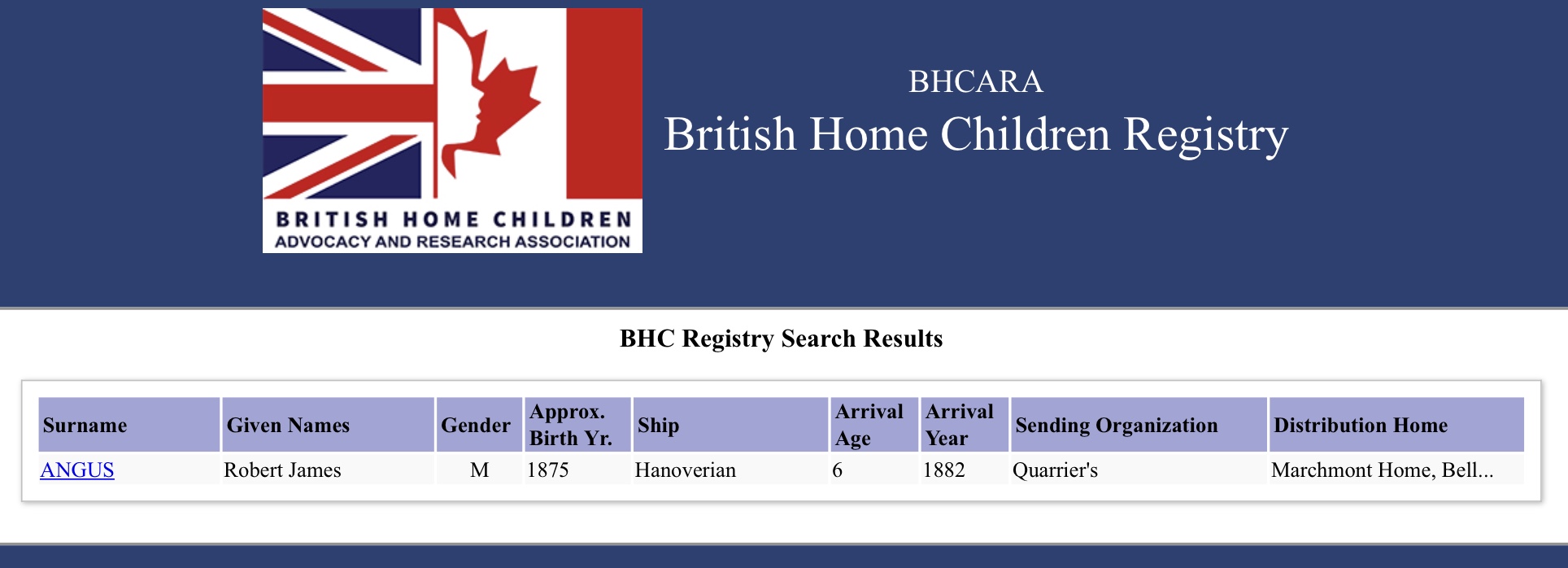
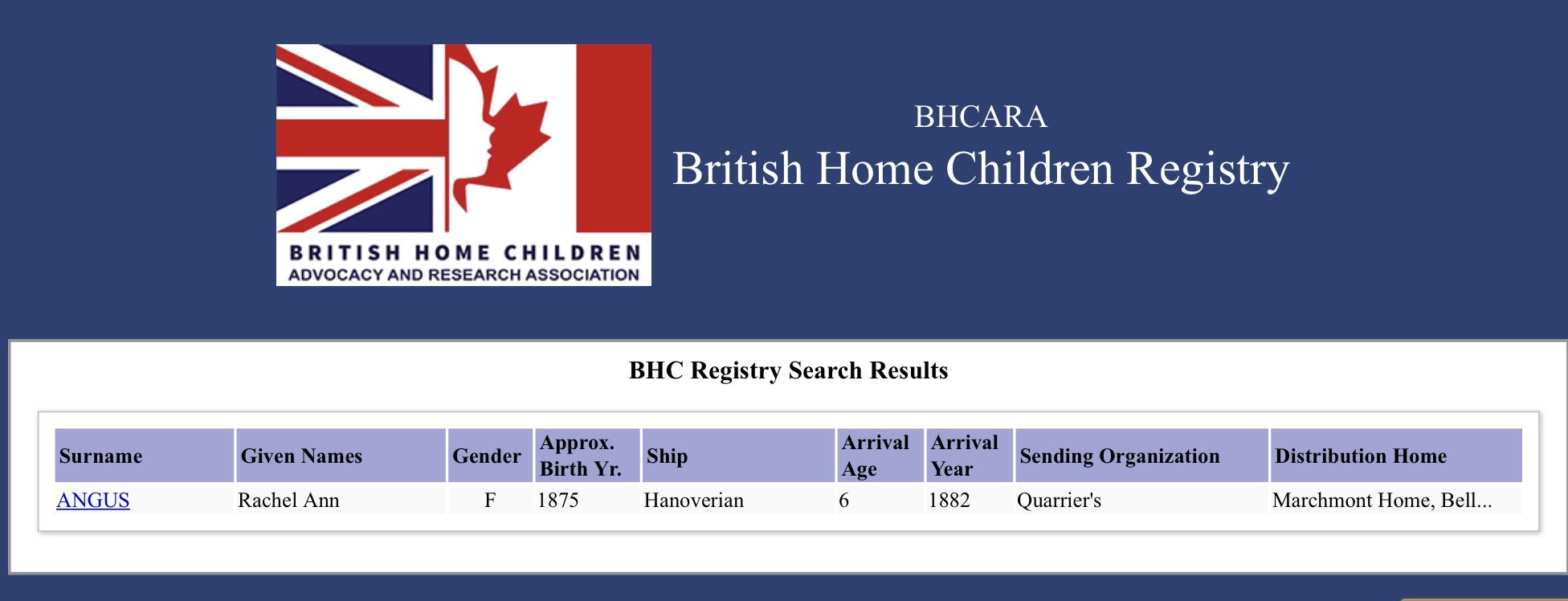
Ann’s mother, Rachel Martin Angus, great, great grandmother to both Shirley and me, cared for the children while Ann worked. Not an uncommon practice. However, Rachel at age 36, found herself widowed in 1880 4 . One can only imagine Rachel’s financial and emotional situation at that point as she tried to raise four grandchildren on her own with little or no income. According to Shirley, in 1882 Rachel gave up on the youngest, the six-year old twins Rachel and James, abandoning them to an orphanage in Glasgow, the Glasgow Union Workhouse.5  Two months later they were put on a ship and sailed to Canada, destined for a home child distribution centre, Marchmont Home, in Belleville, Ontario. 6. 

Why did Rachel feel she must abandon her grandchildren? Why did the orphanage accept them so readily? Did Rachel receive counselling on possible options? Did she know they could be sent to Canada if she left them? Did the orphanage contact the mother of twins about the situation and ask her to take responsibility? Shirley tells me that, according to her grandmother’s records from Quarriers,  Ann’s new partner knew nothing of her previous children.7.

Did no one in the extended family step up to help?

In the defence of my great grandfather, the shoemaker, the twins’ uncle and the father of nine children himself, how could he take on two more mouths to feed. Did he even know of his mother’s and sister’s predicament?

Glasgow (and Par-tick), rough and dirty at the time, suffered particularly poor air quality from industrial pollution and coal fires.  Hundreds of multi-story tenement buildings had been erected to house the workers flooding into the city to feed the rapid expansion of the ship building industry. Overcrowding and primitive plumbing contributed to rampant disease. Life expectancy was low 8. It is understandable that the various agencies responsible for abandoned children would see Canadian farms as a healthier alternative to life in the Glasgow environment.

Between the years 1869 to 1939, an estimated 100,000 children were sent to Canada to be used as indentured farm workers and domestic servants. Believed by Canadians to be orphans, only two percent truly were. Most simply came from destitute and desperate families such as that of twins Rachel and James.

Some of the Home Children were welcomed into their Canadian placement homes and even adopted. Consequently, they thrived. Most lived outside the family circle in sheds or barns and were treated simply as hired labour. If they did not satisfyIMG_3791 the owner, they were returned to the distribution home and sent out again to another placement.
The children were often poorly clothed, overworked and under fed. Few received the education for which they were entitled under their contracts. The agencies responsible for them, such as Quarriers for Rachel and James, provided little or no oversight.

Public opinion too often shunned these children. Canadians needed their labour but they were seen as diseased urchins, riff-raff, even thieves. They grew up marginalised, lonely and ashamed. As they grew older, they hid their home child background and rarely, if ever, spoke of it. Yet for all of that, most became hard working Canadian citizens as did their descendants.

Today I look at two names on the British Home Child Registry: Rachel Ann Angus and Robert James Angus, twins age 6, and I am appalled. Yes, childhood was not seen then as it is today. Children were viewed as little adults and expected to work. But they were also expected to remain with their families. How frightened these two small children must have been as the ship pulled away from the dock taking them far from anything they had ever known. They were not even kept together in Canada but placed on separate farms.

IMG_3794IMG_3793

Footnotes:

  1. Angus family tree. Owner Barbara Angus (Tarrant). Ancestry .ca
  2. Ibid
  3. E-mail correspondence with Shirley Joyce
  4. Angus family tree. Owner Barbara Angus (Tarrant). Ancestry .ca
  5. E-mail correspondence with Shirley Joyce
  6. British Home Child Registry. https://www.britishhomechildrenregistry.com/
  7. E-mail correspondence with Shirley Joyce
  8. http://en.wikipedia.org/wiki/History_of_Partick


Background Information:

https://www.britishhomechildren.com/

https://www.scotsman.com/lifestyle-2-15039/the-15-000-scots-children-shipped-to-canada-1-4616584

British Home Children: Their Stories. Global Heritage Press, 2010.

Joyce, Sandra. The Street Arab: the Story of a British Home Child. Welldone Pub., 2011

Pettit, Mary. Mary Janeway: the Legacy of a Home Child. Natural Heritage Books, 2009.


A Trip to England in 1842

When Stanley Clark Bagg (SCB) and his father, Stanley Bagg, of Montreal, visited England in 1842, they were combining business and pleasure. The business involved selling property that SCB’s maternal grandfather had owned in Durham, England, and the pleasure involved a whirlwind tour of London, Scotland, Ireland and France, as well as visits with various great-aunts and great-uncles who still lived in England.

It was a good time for a trip: SCB had just finished a four-year apprenticeship with a notary and could now practice as a notary himself. It made sense to travel before he opened his own office.

A few months after his return to Montreal, SCB wrote to his cousin in Philadelphia, outlining the trip. Unfortunately, he did not include any details or impressions of their adventures, but the list of places they visited sounds exhausting. Passenger rail services were expanding in England at the time, but much of their travel would have been done by horse-drawn coach.

Crossing the Atlantic, however, was fast. The age of the trans-Atlantic steamship had arrived in the 1830s, and SCB wrote, “We made the passage to Liverpool from Halifax in the incredible short space of nine days and six hours, which was I believe the shortest passage ever made across the Atlantic. From Liverpool we went to London, thence to Leeds, Manchester, Birmingham, York Darlington, Durham, Stockton, Sunderland, Newcastle, Shields, Tynemouth, Otterburn …. ”1

As they moved north to Scotland, they passed though many small towns, including Lesmahagow, and they explored both Glasgow and Edinburgh. On the way back to London, they stopped in Carlisle, in the north of England.

After a few days in London, they crossed the Channel to France, where they visited Boulogne, Paris, Versailles, Le Havre and several other spots before returning to London. SCB wrote, “We left London shortly afterwards for Ireland, and having visited Kingstown, Dublin and Kilmainham, returned to Liverpool, where … we embarked on board a steamship and after a boisterous passage of 14 days arrived at Boston exceedingly gratified with our tour.”2

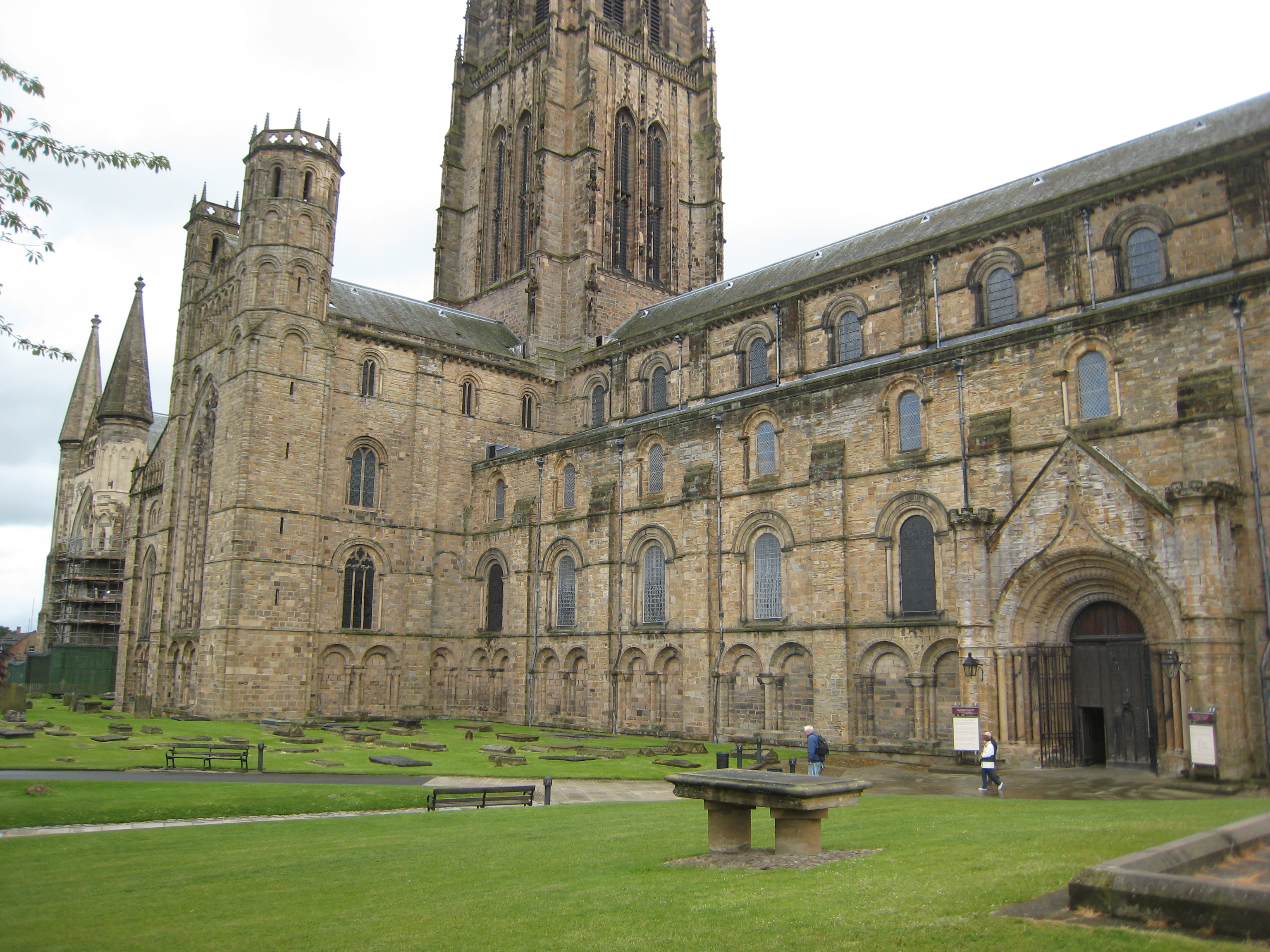
Durham Cathedral
Durham Cathedral (jh photo)

Anchor-maker William Mitcheson, brother of SCB’s grandmother Mary Mitcheson Clark, lived in London, and the Baggs visited him there. While in County Durham, they visited more Mitcheson relations, including Mrs. Dodd (Mary Mitcheson’s sister Margaret) near Ryton, and Mrs. Maugham (Mary’s sister Elizabeth) at Sunderland.

It is clear that the visit to Durham was the highlight of the trip, but not because of the business they finalized there. In fact, SCB did not mention it at all in his letter. When SCB turned 21 in December, 1841, he gained control over the properties in Montreal and Durham that he had inherited from his grandfather John Clark (1767-1827). (He was just 14 when Clark died, so his father acted as executor of the estate until SCB became an adult. The property in Durham was generating rental income, but SCB wanted to sell it. In a notarized document dated after their return to Montreal, SCB’s father listed the sales of three properties in Durham.3

Meanwhile, SCB was interested in ancient legends, old coins, Norman castles and the like, and was enthralled with Durham. More than 20 years later, he presented a lecture to the Numismatic and Antiquarian Society of Montreal on “The Antiquities and Legends of Durham.”4

He described the legend surrounding the founding of Durham city by 9th century monks. When Danes attacked England’s northeast coast, the monks fled their monastery on the Island of Lindisfarne with the miraculously well-preserved body of their former bishop. Eventually they built an abbey at the future site of Durham city and buried him there. Today, that bishop is remembered as Saint Cuthbert and pilgrims still visit the abbey church, Durham Cathedral.

In his 1866 lecture to the Numismatic Society, SCB opened up about his feelings on the trip. He recalled, “The first time I had the privilege of attending a divine service in Durham Abbey, I was enraptured with the sweet and masterly chanting, unsurpassed in the empire. My father and I obtained seats in the choir. The service was exceedingly impressive, so much so, that …. whenever the portion of the Psalter chanted upon that occasion recurs in the services of the church, it carries me back in imagination to the first service I attended in the venerable abbey of my mother’s native city.”4

This article was also published on Writinguptheancestors.blogspot.com

See also:

Janice Hamilton, “A Freehold Estate in Durham,” Writing Up the Ancestors, May 3, 2019 http://writinguptheancestors.blogspot.com/2019/05/a-freehold-estate-in-durham_92.html

Janice Hamilton, “Mary Mitcheson Clark,” Writing Up the Ancestors, May 16, 2014, http://writinguptheancestors.blogspot.com/2014/05/mary-mitcheson-clark.html

Janice Hamilton, “Mary Ann (Clark) Bagg,” Writing Up the Ancestors, Nov. 29, 2013,   http://writinguptheancestors.blogspot.com/2013/11/mary-ann-clark-bagg.html

Janice Hamilton, “The Mitcheson Family of Limehouse,” Writing Up the Ancestors, Jan. 21, 2015, http://writinguptheancestors.blogspot.com/2015/01/the-mitcheson-family-of-limehouse.html

Janice Hamilton, “Stanley Bagg’s Difficulties,” Writing Up the Ancestors, Jan. 10, 2014  http://writinguptheancestors.blogspot.com/2014/01/stanley-baggs-difficulties.html

 Sources

  1. Letter from Stanley Clark Bagg to Rev. R. M. Mitcheson, Dec. 6, 1842, probably transcribed by Stanley Bagg Lindsay; Lindsay family collection.
  2. Record in a passenger list of Stanley Bagg and S.C. Bagg travelling from Liverpool to Boston aboard the Acadia. Boston Courier (Boston, Massachusetts, Monday, Sept. 19, 1842, issue 1921;) 19th Century Newspapers Collection, special interest databases, www.americanancestors.org (accessed April 18, 2019.)
  3. Joseph-Hilarion Jobin, “Account and mortgages from Stanley Bagg Esq to Stanley Clark Bagg,” 8 October 1842, notarial act #3537, Bibliothèque et Archives nationales du Québec.
  4. Stanley Clark Bagg, “The Antiquities and Legends of Durham: a Lecture before the Numismatic and Antiquarian Society of Montreal,” p. 21, Montreal, 1866. https://archive.org/details/cihm_48731/page/n4 (accessed Dec. 27, 2019)