An Ordinary Man

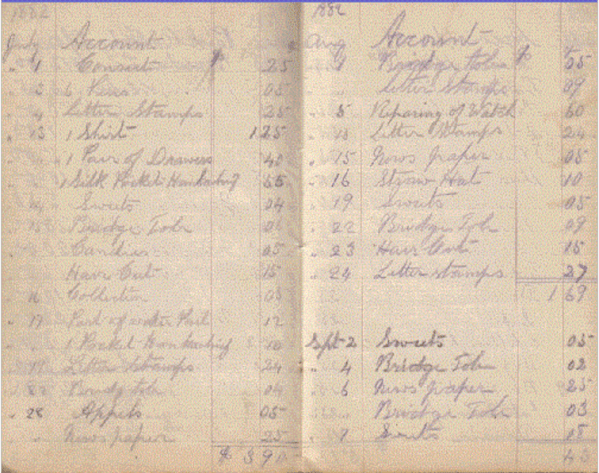
1882 store book page as a single man.

“When the courting at midnight has ended

And he stands with his hat in his fist

And she lovingly lingers beside him,

To wish him ta-ta and be kissed,

How busy his thoughts of the future,

You betchya his thoughts he don’t speak,

He is wondering how they can manage,

To live on six dollars a week.”

(little poem etched in pencil in one of Norman’s early ‘store books’)

Norman Nicholson, my husband’s great grandfather liked to keep track of things: Indeed, that was his one extraordinary trait. He kept track of his every expense, business or household, over five decades (right down to 5 cents tossed to a tramp). He kept balances, inventories, invoices and lists from 1881 when he left home to live on his own to 1921 at this death at home in Richmond, Quebec.

He kept all this information in dozens of ledgers, diaries and notebooks and he kept these booklets neatly arranged in a trunk under the window in his daughter’s room. ( I know because it said so in one of the many letters he kept, which the daughter in her turn kept, and which eventually fell into my hands as the wife of his great grandson.)
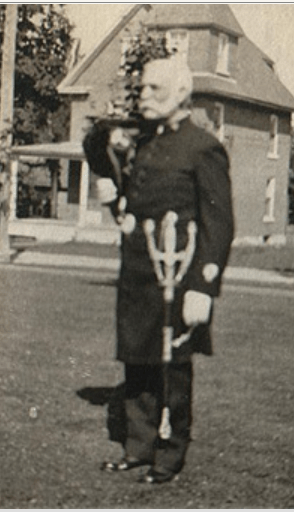
Norman in Masonic Regalia circa 1905

That’s how history-challenged I came to have a real appreciation for the life of a 1st generation Canadian living in the Eastern Townships of Quebec at the turn of the 20th century, that is Norman Nicholson, son of Malcolm Nicolson, he who came to this country in 1841 at age 26 with his parents and 8 siblings after being cleared from the family farm on the nearly treeless Isle of Lewis, Hebrides; who walked from Port St Francis to Flodden and settled on crown land, earning money by burning wood for potash and clearing trails through the forest.

That’s how I’ve come to understand that my husband’s great grandfather, Canadian-born, Canadian schooled Norman Nicholson, successful hemlock bark dealer, turkey salesman, bill collector for a local doctor, Town Public Works Clerk, Inspector for the Transcontinental Railway and The Quebec Streams Commission (I have all the documentation) was a work-a-day sort, devoted husband to the spirited feminist-minded Margaret McLeod, (also a Lewis descendant) doting father to three feisty and ambitious daughters Edith, Marion, Flora and one lost soul of a son, Herb.

He was the kind of ordinary man who lives a full life, with all its joys and sorrows and broken dreams, and dies, the memory of him quickly fading to black until, one day, (with any luck at all) a glimmer, as a great great grandson, flipping through the brittle pages of a photo album, points to one particular picture and asks. “Who’s this ‘sick-looking’ dude with the white moustache and beard?” And the boy’s middle aged father answers: “Oh, that’s Norman Nicholson, your great great grandfather, or at least, I think it is.”

“Was he a general or something, too?” the boy asks referring to the man’s mason uniform – because the boy is related to General Douglas MacArthur on another branch of his family tree.

“No, Norman Nicholson was just an ordinary man.”

Cost of setting up house 1883. 45 dollars for furniture

Now, after scanning the ledgers and reading all his diaries, that I can confirm: ordinary, in every possible way. Not a hero like Alexander Mackenzie, the Lewis born explorer, for whom a great Canadian river is named, although Norman did have a thing for bodies of water. From his 1912 diary: List of Rivers East of Cochrane, Abitibi River, Sucker Creek, Mistango River, Low Bush Creek

Not a villain like Lewis descendant Donald Morrison, the Megantic Outlaw, subject of Canada’s largest ever manhunt and at least two books and one documentary, although Norman did have a part in the man’s post capture defense.

From an 1889 press clipping: Let it be hereby resolved that Norman Nicholson be appointed by the Richmond Royal Caledonia Society to press the authorities for an interview with Donald Morrison.

Neither famous, nor infamous, neither scoundrel nor saint; ergo NOT the kind of man whose exploits are chronicled for future generations in plodding high school history texts or low budget straight to cable documentaries; just a loyal husband, protective father, dutiful citizen. An ordinary man, the kind of man who reaches a point in life where he feels the need to lay down the law to his kids: November 14, 1902 Future Regulations: All must be up and downstairs by 7:30 o’ clock in the morning, Sunday included, breakfast at 7:30. The kind of man who, lonely on the job in middle age, writes love letters to his wife: “I don’t want a concrete hall or a little birch canoe; just want a place with you by the fireside.”
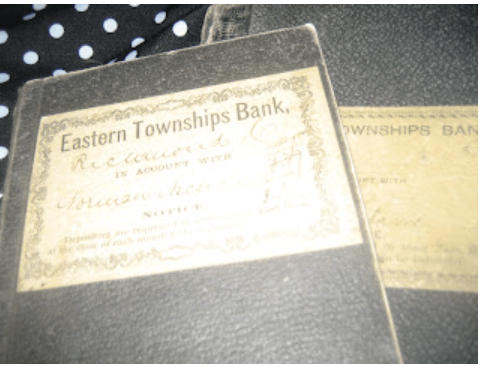
Very very ordinary. No, not the stuff of history books or even good caricature, although it would be easy to characterize Norman as the quintessential penny pinching Scot (someone who believes his bank book to be the best kind of reading) but that characterization would be totally unfair.

Norman Nicholson may have been a practical man:

Price of ash for 1899: 8 cents for 12 inch;10 cents for 13 inch; 12 cents for 14 inch.

1913 Trip to Boston to see Grand Lodge: ticket to Montreal, 2.55, street car 05, ticket to Newport, 3.25. Dinner on train .60

with a petty side:

number of times Dr. Kellock was away from his congregation in year 1897: 24 January in Boston; 21 March in Spencerville; 24 October in Toronto;

October 18, 1899. Date McMorine had his water cut off in his store by M. McDonald tinsmith.

But he also was a romantic:

Nothing to do Margaret, Dar..ling, nothing to do. Let’s take a trip on memory’s ship back to the by gone days. Let’s sail to the old village, anchor outside the school door. Look in and see, that’s you and me, a couple of kids once more.

See? An ordinary man of conflicting passions, just like you and me, the kind of man who has but one chance to have something flattering written about him and that’s at the end of his life:

From the Richmond Guardian June, 1922:

The death occurred suddenly last Friday morning in Montreal of Mr. Norman Nicholson, one of the most respected citizens of this place…

And then that’s it, finito, no more, except, perhaps, for an epitaph on a tombstone in a far-flung country cemetery no one ever visits.

RIP Norman Nicholson, my husband’s great grandfather. An oh-so ordinary man, except for this one extraordinary trait, this compulsion to keep track of things, to leave a paper trail for posterity – if mostly in list form.

END

LIST Cost of LIving 1900 Richmond Quebec.

1900 accounts, family of six, children in teens. Wife Margaret got a hefty allowance with her purchases going unnoted, but I see no mention of material or sewing notions in the list and Margaret sewed her daughter’s clothes for the most part. In 1900 the Nicholsons were comfortably middle class with a fine house, but their fortunes would soon fail with the end of the hemlock bark industry.

January

1/3 of a beef, 106 pounds 6.35

Skating rink 10

6 lbs pork 25

2 beef tongues 20

Marion for Rink 10

Postage 12

79 lbs pork from Bromfield 4.35

Sunday School 04

Church plate 05

Scribbler for Flora 05

1 lb sulphur 05

Hairdressing 15

Membership Board of Trade 1.00

Treat of cigars 25

Fare to Sherbrooke and return 1.35

Copy book Flora 08

Scribbler Edith 05

Marion skating rink 10

½ lb Black tea 18

Sunday school 04

1 Ladies Jacket 8.50

1 pair gent’s overshoes 2.00

¼ lb candies 05

1 lb frosting sugar 08

1 lb baking soda 04

¼ lb peppermint 05

Sunday School 04

Church concert 60

Postage 20

1 paper of pins 05

I pocket handkerchief 08

Herbert 05

Postage 25

1 jar molasses 14

Mending Marion’s boots 25

February

Sunday School 04

Bridge toll 02

¼ pound candies 05

Times for one year 1.00

Maggie 25

½ pound Black tea 18

Marion for rink 10

Sunday School 03

¼ lbs cream of tartar 09

1 lbs currants 10

1 bottle Powell’s medicine 25

Maggie 50

W. Daigle for hauling bark 15

1 writing pad 15

1 pair rubbers Edith 45

1 pair rubbers Marion 45

1 loaf break 05

1 lb crackers 08

1 pint oysters 20

Cough candies 02

Scribbler for Marion 05

Postage 02

Maggie 50

1 loaf bread 05

1 bag fine salt 10

Sunday school 02

Church Collection 10

100 lbs salt 05

1 whisk 15

1 loaf bread 06

¾ pounds walnuts 10

Maggie for Church 2.10

1 lamp chimney 07

1 bottle M. Liniment 25

Maggie 06

½ black tea

1 pair laces 04

4 gallons coal oil 75

10 lbs corn meal 15

10 lbs Graham flour 25

5 gallons Coal Oil 95

1 hockey stick 30

Herbert for Dictionary 15

Maggie 10

½ loaf bread 06

1 lbs ginger snaps 10

¼ pound Ceylon Pepper 10

Postage 06

Flora and Marion 05

1 package Corn Starch 09

¼ lbs cream of tarter

Hair dressing 15

Marion for rink 10

March

1 jar molasses 12

1 doz eggs 20

Maggie 10

Chinaman for laundry 14

Sunday School 04

Patriotic Fund for Hockey 60

1 pair rubbers Herbert 60

Maggie 40

Marion and Flora 10

Sutherland for Miss Wilson 1.00

Postage 20

Mending tins 05

Missionary meeting 05

Skating rink 05

Maggie 25

¼ pounds cream of tartar 10

Sunday School 03

Maggie for concert 10

1 cake shaving soap 07

1 lbs soda 04

½ lbs Black tea

¼ lbs cream of tartar 09

1 bottle vanilla 10

5 pounds sugar 25

Maggie 25

5 lbs butter McKee 1.00

Marion 05

Herbert for Sharpening skates 05

Maggie 1.00

5 lbs G Flour 10

6 ½ lbs butter 1.45

Mending Herbert’s boots 25

1 loaf bread 10

Cough candies 05

1 quart milk 05

Skating rink 20

Maggie 22

9 ½ lbs butter 2.00

Flora 05

1 bags fine salt 10

Maggie 50

1 bag flour 2.25

49 pounds oats 49

5 lbs sugar 25

Sunday School 04

½ lbs Black tea

Postage 10

Postal notes 05

Subscription to Herald `1.50

Subscription to Westminster

Pady Jim 25

12 ¾ cords wood 35.25

I scrubbing brush 10

April

5 lbs sugar 25

Maggie 10

1 pair of rubbers Flora 35

Sunday School 04

½ gal Coal oil 10

1 bottle ammonia 05

1 lamp burner 10

1 doz herrings 25

20 lbs Graham Flour 50

1 bag rolled oats 25

5 Gal Coal Oil 95

20 pounds corn meal 30

Flora 05

Small writing pad 05

1 box crackers 25

½ pound candies 10

Scrubbing floor 25

Herbert for sugar 10

Maggie 20

Hair dressing 15

1 jar molasses 15

½ lbs Black tea 18

2 lbs tapioca 10

Postage 27

Sunday School 07

Herbert for Birthday 25

Maggie 10

1 Gallon syrup 65

3 lbs sugar maple 24

3 pairs shoe laces 08

2 pair stockings 60

5 lbs sugar 25

Sugar scale 40

Maggie 2.60

1 pair rubbers 60

Maggie 35

To Sunday School 03

2 dozen eggs 30

1 package popcorn 05

F Lyster for milk 95

Fir dressing Herbert 15

5 lbs sugar 25

Maggie 1.00

Hauling manure 20

Postage 10

Sunday School 03

Bill of goods bought by Dan 32

1 box crackers 25

1 spool thread 10

1 can corn beef? 25

3 ¾ lbs steak 47

Sunday school 04

Candies 04

May

5 lbs sugar 25

½ lbs Black tea 18

¼ pounds ginger 09

1 bag potatoes 45

¼ ream bill paper 05

Daigle for manuring 40

Edith 50

Herbert suit of clothes 4.00

Spading garden 1.00

Mending M and F. Shoes 70

Garden seeds 40

2 pairs shoes Edith and Marion 3.00

1 necktie for funeral 25

Maggie 25

Seeds got by Dr. Cleveland 50

1 package envelopes 07

Post office box 1.00

Sunday School 03

2 scribblers 10

1 bag oatmeal 1.90

1 lb flour 4.50

Mending boots 1.25

Pass Book 10

Postage 09

10 lbs graham flour 30

¼ lbs cream of tartar 25

2 lbs steak 25

3 ½ pounds S. Ham 25

Military dinner 75

3 gallons Maple Syrup 1.95
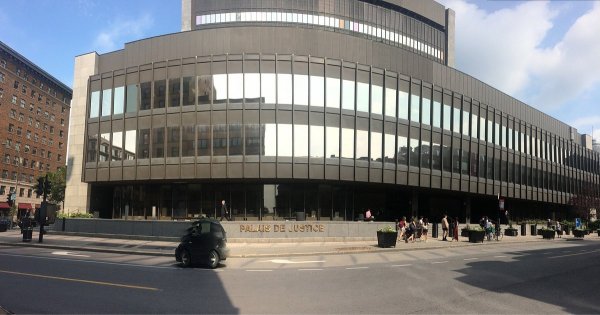
A Guide to Court Records

Montreal Court House – Palais de Justice

Online resources found on BAnQ

https://www.banq.qc.ca/ressources_en_ligne/intruments_rech_archivistique/archives_judiciaires/index.html?language_id=1

Judicial archives guide

Guide to Court Records, Evelyn Kolish, 2017, 99 p. [PDF – 1.16 Mo]

BAnQ has close to 21 kilometres of court records in its 10 centres, dating back to the middle of the 17th century. These records constitute an historical archival fonds of remarkable depth and continuity, that enables researchers to study how Québec society has changed from its origins to the present day.

Created by courts throughout Québec, these records are preserved in the BAnQ regional centre closest to their point of origin. Because they show how different aspects of daily life have changed, both over time and by region, they can give sometimes highly detailed information about the past. This information can provide many different paths of inquiry: into specific people and events, as well as into broader social, economic and political phenomena – not to mention the judicial system itself! The Guide to Court Records will give researchers an overview of how the courts themselves and the records they create have changed over the past four centuries. Furthermore, for practical purposes, the Guide is based specifically on the court records preserved in BAnQ’s regional centres

Below is a copy of the document the above text refers to.

The History of a Summer Community    

I spent the past two months working on the history of my summer community in Maine. It is not exactly family history, although my family has been vacationing in this place by the ocean for almost 100 years, so bear with me while I tell you what I learned about writing local history.

Local history is essential to understanding our ancestors. The towns, cities and rural neighbourhoods where they lived were the places where they went to work, to shop, to worship, to play. By researching their communities, we can get hints about their daily activities, their values, their friends and acquaintances and the educational opportunities open to them.

Biddeford Pool, the community where I spend my summers, is on a tiny peninsula that juts out into the Atlantic Ocean, flanked on one side by a sandy beach and on the other by the rocky shore of Saco Bay. Originally known as Winter Harbor, the peninsula was once home to a thriving fishing village with a herring fleet and shipbuilding industry. In the mid-1800s, several enterprising local residents decided to build hotels and rent out rooms to boarders for the summer.

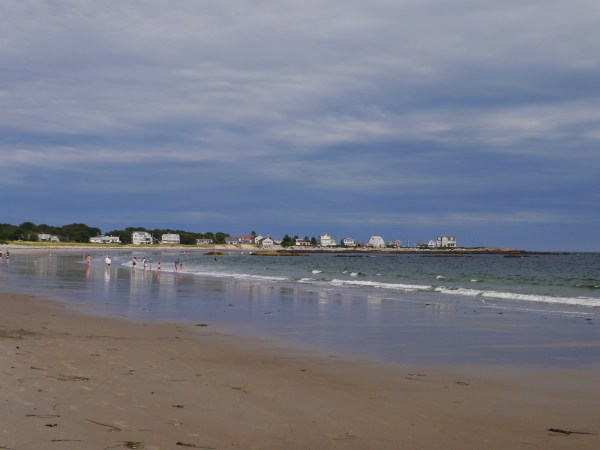
The big beach, low tide, Biddeford Pool, Maine

Families from big cities such as Cincinnati, St. Louis, Memphis and Montreal have been going there for generations. Eventually, some summer visitors decided to build their own cottages, and they encouraged friends and family members to join them on the coast. Today, many of their descendants are still vacationing at Biddeford Pool, still sailing the same waters, swimming at the same beach and playing on the same golf course that their grandparents and great-grandparents enjoyed.

Many of these families are interrelated, although no one has ever done a big family tree of the summer resident families.

Inspired by my experiences with Genealogy Ensemble, several of us started a blog a few years ago and encouraged people to write their own stories. We invited them to find out how their families first came to Maine, and we asked for childhood memories and other stories. Most people were polite, smiled and nodded, but did not write a word. I can’t say I was totally surprised. People are on holiday there, busy with friends and family, and once they get home, they get into their regular routines. Privacy may have been a concern for some. Also, writing is not easy for everyone.

Even more disappointing was that many people never looked at the blog. Maybe they are just not comfortable with digital media, and perhaps we were too successful in trying to keep it low-key. But it seemed the entire effort was a failure.

This spring I took a fresh look at the two dozen stories that were posted on the blog and enjoyed them. And at a time when most of my parents’ generation have already died or are now well into their 90s, the articles preserve memories of the way things used to be in the community – the bad and the good. So now, a group of about half a dozen of us are again copying what the members of Genealogy Ensemble did: we putting together a collection of short articles in a self-published book. At the very least, it will be on the shelves of the community’s little library, and filed beside the hundreds of old photographs that the Biddeford Pool Historical Society has collected and digitized. Hopefully, future researchers and family members will read it.

Some of us went to the county registry of deeds office to research the histories of our century-old cottages, and we used genealogy sources such as Familysearch.org to find marriage records, census records and city directories, as well as old newspaper databases. Others wrote personal anecdotes.

This project is a bit haphazard. It depends on who volunteered to participate and what he or she chose to write about. It is far from a one-place study or a carefully structured oral history project. And we left out most of the local residents who once lived there year-round, such as the lobster fishermen. That is unfortunate, however, narrowing the focus of the book has made it possible to get the project finished in one season, plus we know clearly who the target audience of the book will be.

I will let you know next summer how it turns out. 

The French Republican Calendar

Genealogists love FamilySearch. I have spent many enjoyable hours searching for my ancestors on their free databases. As a way of giving back, I enjoy transcribing historical documents so that others can search for their ancestors. This is called indexing and projects are always available on the FamilySearch web site for volunteers to transcribe.

Not too long ago I chose an intermediate French indexing project on FamilySearch, to transcribe Belgium birth registrations.  I now know that an intermediate level of difficulty may mean very difficult. I was able to decipher the names fairly easily, even the uncommon ones, such as Dieudonné. But I ran into difficulties with the dates.

The records I were transcribing were registered in 1798, smack in the middle of French Republican calendar and therefore the dates needed to be converted to the Gregorian calendar. The French Republican calendar, also known as the French Revolutionary calendar, was used by the French government for twelve years from late 1793 to 1805, and for 18 days by the Paris Commune in 1871. It was used in government records in France and other areas under French rule, including Belgium.  The Republican calendar was one of the ways that the French government wanted to do away with the ancien regime after the French Revolution. The new calendar was created by a commission whose members were French intellectuals. Year I (roman numeral) was the first year of the Republic and each new year was set at midnight beginning on the day the autumnal equinox falls at the Paris Observatory. There were twelve months, each divided into three ten-day weeks called décades. The five or six additional days needed to complete the solar year were called complementary days. This calendar closely resembled the one developed by the ancient Egyptians. 1

Luckily, Family Search has a wiki page that explains how to convert the date on the French Republican calendar to the Gregorian calendar. The twelve months in the French Republican calendar are based the natural events that occur during the year. For example, vendémiaire is the grape harvest month. The Family Search wiki gives an example of how the date would be written out: The 13th of Pluviose in the seventh year. This means that this date is the 13th day of the rainy month in year seven of the French Republican calendar. Family Search then provides four calendars that provides the conversion into the Gregorian calendar depending on the French Republican calendar year.2

I had ten birth registrations to transcribe and it took me two and a half hours to complete.  I spent quite a bit of time trying to understand the French Republican calendar. Looking on the Family Search site, I see that there are more civil registrations to transcribe in French but I will wait until I have a few hours ahead of me as once I start, I like to finish the batch.

Even though it is difficult and painstaking to convert the French Republican calendar dates to the Gregorian calendar, I enjoyed learning about this calendar. And, of course, it is always a thrill to know that you have connected the individuals in the historical records a little closer to their descendants.

  1. Wikipedia, French Republican Calendar, https://en.wikipedia.org/wiki/French_Republican_calendar, accessed 8 September 2022.
  2. Family Search, French Republican Calendar, https://www.familysearch.org/en/wiki/French_Republican_Calendar, accessed 8 September 2022

Montreal Archives Property Assessments 1847-2003

Évaluation foncière 1847-2003

Property assessment 1847-2003
4,606 online listings
https://archivesdemontreal.ica-atom.org/roles-devaluation-fonciere-1847-2003

3723 documents textuels (registres). – Environ 3800 microfiches. – 957 microfilms. – 12 boîtes.

3,723 documents (registers) – About 3,800 microfiches. – 957 microfilms – 12 boxes

Portée et contenu     
La série renseigne essentiellement sur l’évaluation foncière dans les
différents quartiers de la Ville de Montréal, de 1847 à 2003 inclusivement. Le rôle d’évaluation permet d’établir le montant des taxes municipales à partir d’un taux fixé par règlement par le conseil municipal.

Content of dossiers                                                                          The collection addresses the property assessment from 1847 to 2003 in various districts of the city of Montreal.

Chaque propriété listée dans le rôle d’un quartier possède un numéro de compte unique à huit chiffres, dont les deux premiers réfèrent au quartier.

Les autres informations disponibles sont l’adresse civique, le cadastre, le nom du ou des propriétaire(s) et la valeur de la propriété, résultat de l’évaluation de la bâtisse et du terrain.

Each property listed within various districts was assigned with an assessment number of eight digits, the first two being the district number. Additional information includes the street address, the cadastral number, the name or names of owner or owners in addition to the monetary value of said property.

La série comprend les registres originaux sur papier pour les périodes 1847-1934, 1963-1978 et l’année 1987. Les rôles d’évaluation pour les périodes 1847-1962 et 1979-1986 ont été microfilmés. Les rôles d’évaluation pour la période 1963-1978 et l’année 1987 sont disponibles uniquement en format papier (registre). Pour les années 1988 à 2003, les rôles ont été microfilmés.

Fonds includes the original dossiers of 1847-1934,1973-1978 and the year of 1987 in their original paper formats. The periods of 1847-1934,1973-1978 and 1987 are available on microfilms.

Les documents sont en français et en anglais.

Documents are available in either the French or English languages.

Archives de Montréal  Consultation
archives@montreal.ca Téléphone : 514-872-1173 / 514-872-2615

Opened on Tuesdays and Thursdays

https://archivesdemontreal.com/nous-joindre/

Catalogue of dossiers
https://archivesdemontreal.ica-atom.org/

Researched and compiled by
Jacques Gagné
gagne.jacques@sympatico.ca