On a recent family trip to Cork, Ireland, we detoured briefly looking for the Anglin Family farmhouse ruins from the early 1800’s. Several Anglin cousins over the years recorded and shared their trips so that with copious precious notes in hand we thought we were well equipped for our adventure!
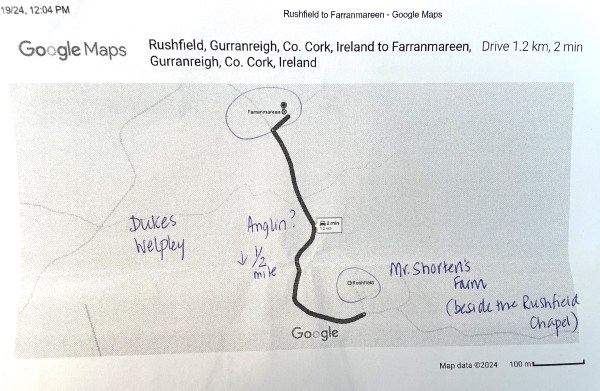
An Anglin letter from 1963 pinpointed the location of the family home somewhere between Farranmareen in the north and Rushfield (one kilometre further south) “near Bandon” just 36 kilometres west of Cork. We looked up the two geographic latitude and longitude (GPS) coordinates for the two markers so … how hard could it be?
All eyes were focused left and right as we drove the kilometre between the two points. Alas! Nothing to see but green fields everywhere and a scattering of houses. Where were the signs with “The Anglin Farm was HERE”?
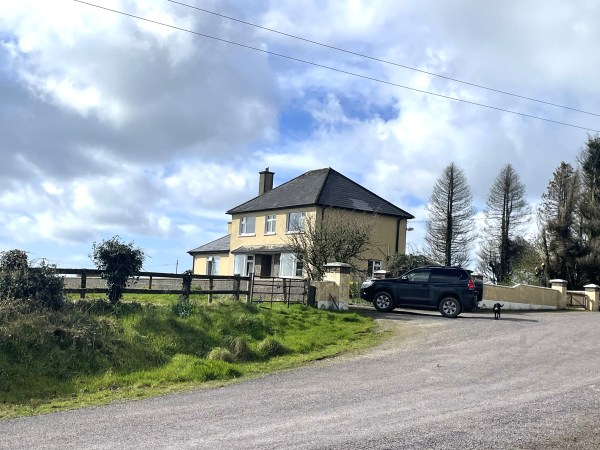
Upon reaching Rushfield, my notes referred to a chapel not far from a farmhouse on the corner. Spying a farmhouse nearby, we made our way through the barking dogs and knocked on the door, but no one answered. We persevered as there was a vehicle in the driveway and a huge transport truck parked nearby. Another knock. Suddenly a farmer walked around from the side of the house munching on a bit of lunch.
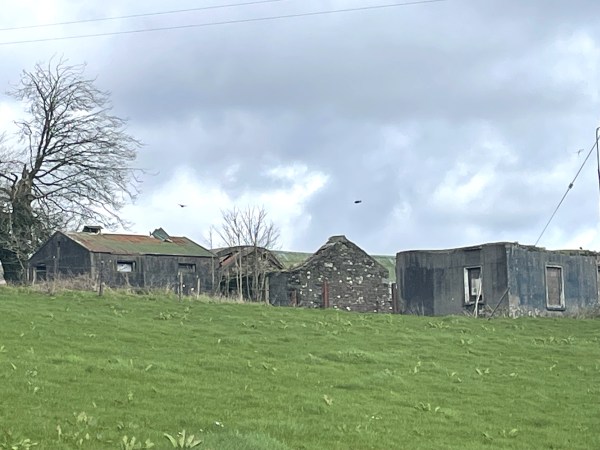
I introduced myself as an Anglin and referred to the cousins over the years who had made the same pilgrimage. The farmer looked puzzled. So I inquired about the whereabouts of the Rushfield Chapel to which in reply he pointed to some ruins across the road that barely even looked like a building anymore. Disappointed but refusing to give up, I checked my notes and inquired if he knew a Mr. Shorten who was helpful to my cousin in 1963. He smiled and introduced himself as … Mr. Shorten!
Rushfield Chapel ruins
This Mr. Shorten didn’t recognize the Anglin name (it must have been his father in 1963) but guessed where the Anglin farm might have been. Back up the road to Farranmarren we drove to knock on a few more doors. The next stop was a bungalow with another barking dog. A middle-aged lady came to the end of the drive and thought the Anglin farm might have been in the field beside her. However, she suggested that her elderly neighbour across the road might know more and brought me to meet her.
“Looking for the farm some years ago, with my wife and two Anglin cousins, we could not find any buildings. But we knocked on a door at a corner where you leave the main road. The door was answered by an older lady whose maiden name turned out to be Duke. She gave us tea and said that our Anglin ancestors operated mixed farming and would have been comfortable during the famine.” (Perry Anglin)
After a brief introduction, I couldn’t resist asking her: “Is your maiden name ‘Duke’ by any chance?” Well her eyes lit up and she smiled saying: “Yes!” My great great grandfather William’s oldest brother John Anglin married Sarah Duke in 1836 in Cork. I was speaking with my (very) distant cousin!
William and John’s parents, Robert Anglin and Sarah Whelpley, had four sons and one daughter. All four sons emigrated to Kingston, Ontario, one by one, with my great great grandfather William (the youngest son) leaving Ireland in 1843 just before the Great Famine. John eventually joined the others in Kingston but only after the death of their parents. Their sister emigrated to the States possibly not wanting to stop in Kingston to care for four brothers!
William married Mary Gardiner in 1847 in Kingston and had two daughters (both died young) and two sons (William and James) who both became doctors and surgeons.
It appears likely that over the years Mother Nature reclaimed the Anglin Family farm with its defining stone walls having disappeared completely beneath the greenery. However, I can attest to the fact that the view described by my cousin remains the same:
“It is a stunning view from the farm down into the Bandon River and beyond to a coastal range tinted mauve in the distance.”
I would like to finish my little story by sharing some helpful information with my Anglin cousins! Here are the GPS coordinates of the Anglin Family farm: 51°47’00.3″N 8°56’09.8″W
James Cecil Hunt (1879-1937) worked a 30-year career as a Locomotive Engineer in Manitoba, Canada. He left his birthplace in Owen Sound, Ontario, at the age of 22, and headed west to Port Arthur (now Thunder Bay), Ontario. There he met and married Cassie (Catherine Elizabeth Grummett 1884-1966), a glamorous Winnipeg girl, at the age of 28. They raised their five children in Brandon, Manitoba, and eventually moved back to Winnipeg where they bought a house and stayed the rest of his life.
Cecil and Cassie’s Wedding 1907Cassie on her wedding day 1907
His first job as a “labourer” according to the 1901 Census might have been with the Canadian Northern Railway (CNoR). “The Canadian Northern Railway was incorporated (1899) as a result of the amalgamation of two small Manitoba branch lines. It was built up over the next 20 years by its principal promoters, William Mackenzie and Donald Mann, to become a 16,093 km transcontinental railway system.”
However, the competition with their transcontinental rivals proved to be insurmountable and Mackenzie and Mann were forced out of the company, which then became one of the first major components of the soon publicly owned Canadian National Railways (CNR).1
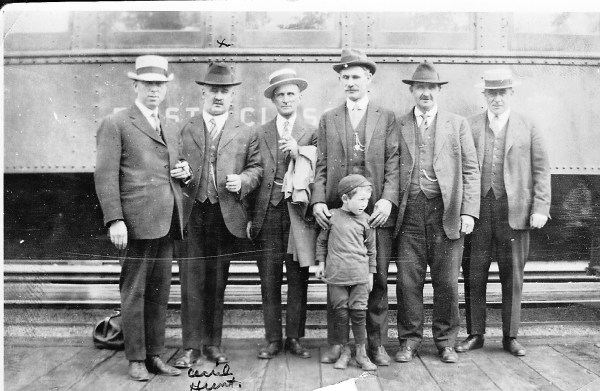
Cecil Hunt (second from the left) and other locomotive engineers posing in front of a First Class car.
After 18 years working up the CNoR ladder, Cecil’s career as a Locomotive Engineer began shortly after the June 1919 incorporation of the CNR, which then consisted of several other bankrupt railways belonging to the Canadian government.2 The CNR is the longest railway system in North America, controlling more than 31,000 km of track in Canada and the United States. It is the only transcontinental rail network in North America, connecting to three coasts: Atlantic, Pacific and the Gulf of Mexico.3
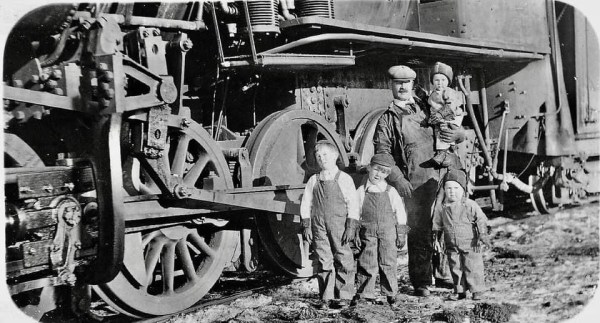
As a Locomotive Engineer, Cecil would have operated and controlled a locomotive engine (No. 73083.5 to be exact) that powered the train on railways. His responsibilities would have included controlling the speed, acceleration, and braking to ensure smooth and timely journeys as well as a thorough knowledge of the entire railway system, signals, and track conditions, all while adhering to strict safety regulations and protocols.4
Cecil and children Allan, Lyndon, Holman and Beatrice circa 1916
Cecil’sCNR Steam Engine no. 7308(scrapped in November 1951)
According to the 1931 Census, Cecil at age 52 owned a three-story eight room stucco house at 588 Warsaw Avenue, in Winnipeg not far from the Red River, and made an annual salary of $3,200 ($65,000 in today’s dollars). Locomotive engineers easily make double that today.5
Cecil had obviously done well for himself since ten years before becoming a proud homeowner, he already owned a Model T Ford which, according to this photo, the whole family enjoyed!
Cecil, Sydney, Cassie, Beatrice, Holman, Lyndon and Allan (my husband’s father) circa 1920
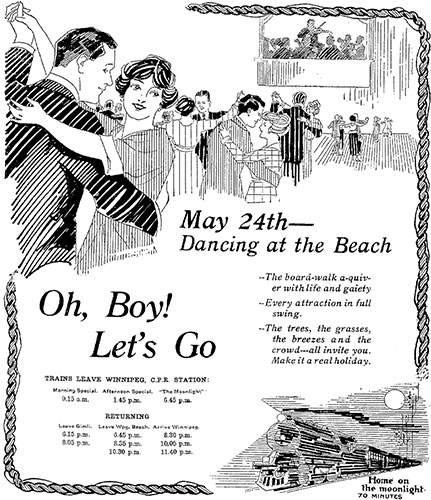
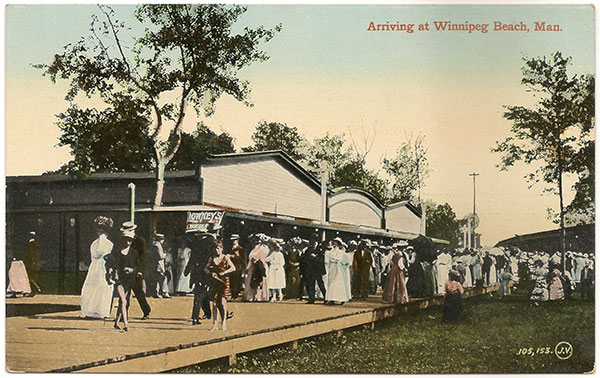
Although, travel by car did not become common until the mid-1920’s, most people could take the “beach train” for their excursions to the famous nearby Winnipeg Beach. By 1912, ten trains took 40,000 vacationers to the beach each weekend.5.5
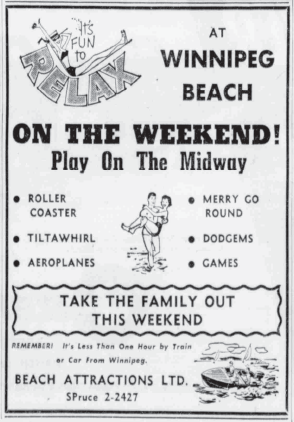
Winnipeg Beach had developed into an impressive amusement park – complete with a roller coaster, merry-go-round, and “moving picture house”. Over the years, more attractions were added, including bumper cars and an airplane ride. All this as well as the very popular dance pavilion and multiple arcades along the boardwalk. The “Moonlight Special” provided a round trip by train for 50 cents and a night of dancing could be purchased for another nickel. It is rumoured that “many generations of people owe their existence to the fact that their parents, grandparents or great-grandparents met on the ‘Moonlight’.”6
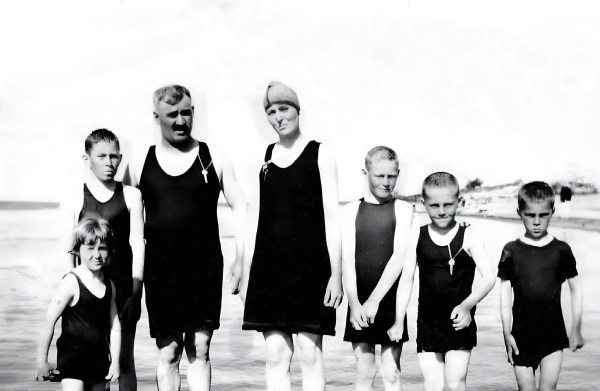
Winnipeg Beach: L to R – Beatrice, Sydney, Cecil, Cassie, Allan, Lyndon and Holman (notice the locker keys pinned to their bathing suits!)
In May 1937, Cecil and Cassie attended their son Allan’s wedding to Agnes Kirk (my husband’s parents). Allan worked his whole life in aviation with several airlines culminating in a 37-year career with Trans-Canada Airlines (which later became Air Canada) and my husband also had a 30-year career with Air Canada. Three generations of Hunts working in national transportation!
Shortly after that May wedding, Cecil suffered heart failure and Cassie nursed him at home until November when he died at age 58. The “weak heart” gene plagued all the Hunt men and continues to do so even to this day.
Tall stylish Cassie, however, lived almost another 30 years, and as a CNR widow, travelled with her train pass visiting her family from coast-to-coast every few years. After Cecil’s death, she lived for a while with her son Holman in the Slate River district near Thunder Bay, and then with her daughter Beatrice in Richmond, British Columbia until she died at the age of 82. Her obituary pays tribute to her lifelong commitment to the Order of the Eastern Star (part of the Masonic Family) both in Winnipeg and in Richmond.
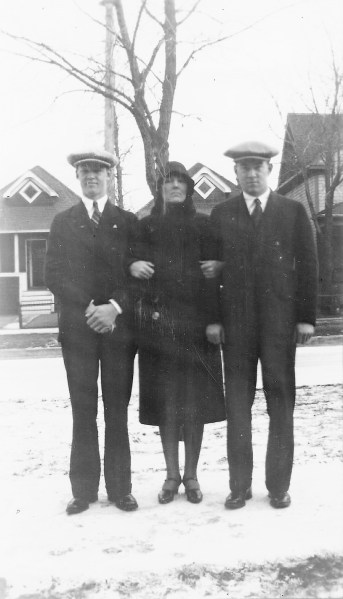
Cassie and her two sons Allan and Sydney
The glimpse into the life of any ancestor makes writing about genealogy so gratifying … and the best part about this story is my husband getting to know a little about the grandfather he never met.
Please read my story about my husband and his father Allan Hunt:
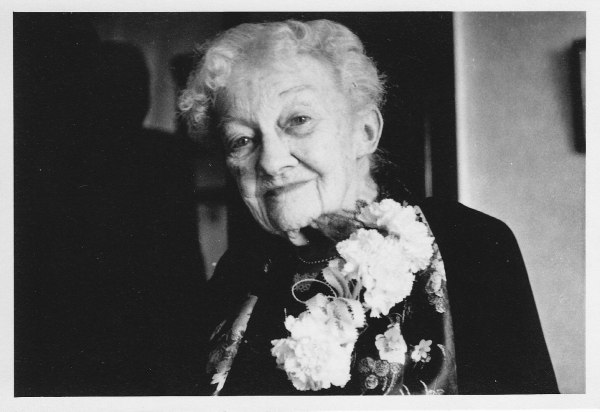
I recently discovered two photos of “Amy” in my dusty old boxes of family memorabilia. The first captured her elderly wrinkled face with a twinkle in her eye and a flower corsage adorning her left shoulder and the other portrayed a 29-year old Amy dressed in a formal gown complete with a silk fan also with a flower corsage on her left shoulder. Inscribed on the reverse side of this second photo, written in Amy’s scrawl, was “Bob with love Amy – Xmas 1894.”
It turns out that Amy C. Lindsay (1865-1960) was my great grandfather Robert Lindsay’s (1855-1931) half sister. His mother Henrietta Dyde died within months of losing her fourth child and, a couple of years later, his father Robert A. Lindsay (1826-1891) married a young Charlotte Vennor (1843-1912) who became stepmother to his three boys – Robert, Charles and Percival – all under the age of ten. Over time, Robert A. and Charlotte had five more children, with Amy being their first born and ten years junior to Robert.
Who the heck was “Bob”?
Amy never married, so “Bob” could not have been a lost love in WW1, as she was 50 years old at that time. The most plausible explanation could be a gift to her older half brother Robert – “Bob” – and that’s the reason why the photo ended up in with my family.
My guess is that she idolized her oldest half-brother and gifted him that special photo which somehow survived the test of time to be found by me in my dusty old boxes. Mystery solved!
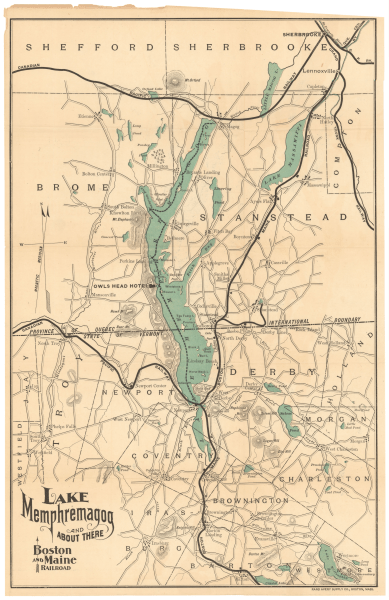
In 1873, when Amy turned eight, her parents bought a huge summer estate property called Woodland on Lake Memphremagog just south of Georgeville, Quebec. Lake Memphremagog1 is in the Eastern Townships just 72 miles east of Montreal, Quebec. It is 31 miles long, from north to south, spanning the international border between Quebec and Vermont but is predominately in Quebec.
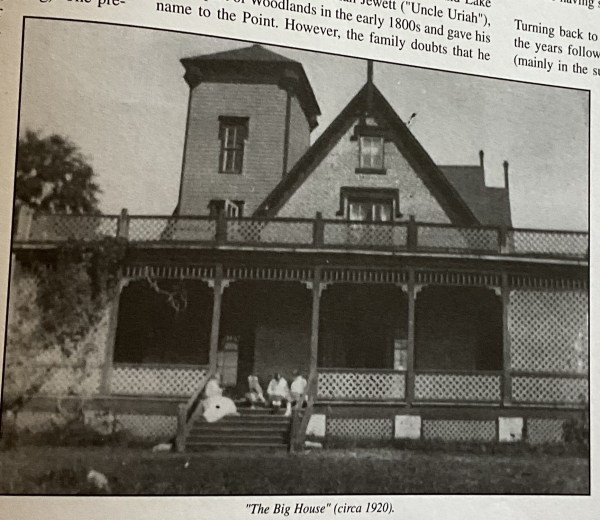
Amy’s father acquired “Woodland” from the original owner William Wood and it consisted of 280 acres of land bordering on the waterfront. William Wood had built a large red brick manor house that a neighbour described as a “barrack with a steeple.” Regardless of how it looked, it became home to several generations of the Lindsay family until the early 1960’s when it was replaced. They affectionately called it “The Big House.”
During this time, several other wealthy English speaking families acquired farm properties in the area and established their summer residences there as well. Woodland became a full functioning farm complete with livestock and crops all managed by hired hands. Over time, various third parties managed the farm until well into the 20th century, which left the family with plenty of free time on their hands.
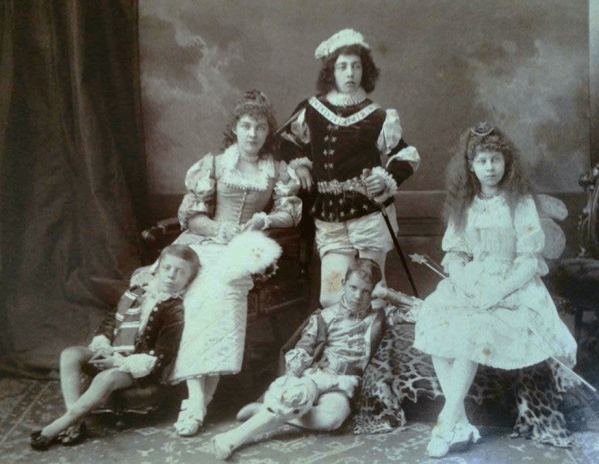
The Lindsay family took up residence in the Big House every summer. Amy’s father worked as an accountant for the Bank of Montreal and evidently could be spared for the long summer months to enjoy time with his family. “Apparently Robert Lindsay followed a daily routine of walking around the property with his entire family in tow according to size.” On another special occasion the whole family dressed up in fancy costume clothes for a party.
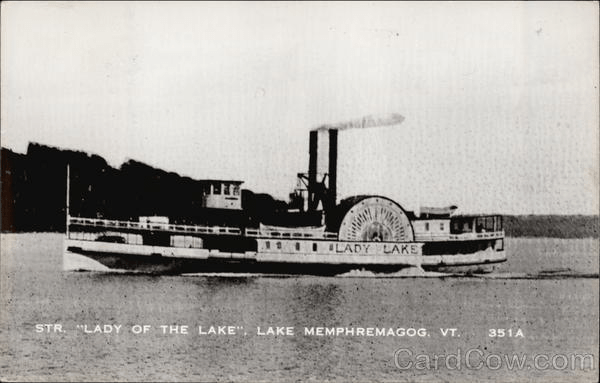
The grand “Lady of the Lake” steamer would sail twice daily on Lake Memphremagog stopping at private docks and thus providing the family with lake excursions right from the front doorstep of the “Big House.”
The Lindsay family (including mother-in-law Vennor who rescued Woodland financially in 1885) enjoyed the property until Robert’s death in 1891. Mrs. Vennor died four years after him and the property devolved to the four surviving grandchildren: Amy, Douglas, Cecil and Edith. (Their brother Sydenham died young while trying to save a drowning victim.)
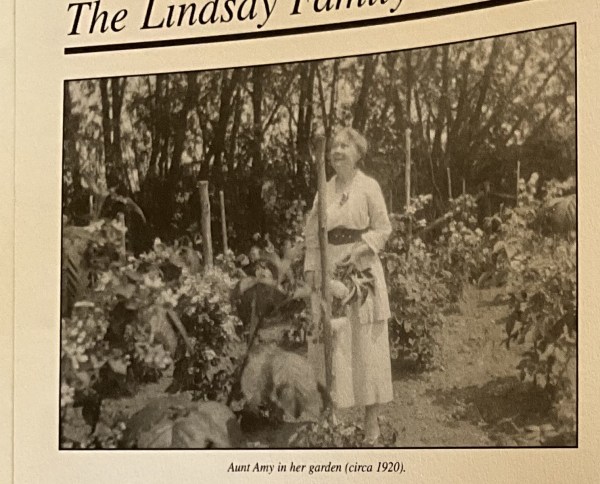
According to her family, “Amy was a small lady, well liked and well respected by most… She loved the lake and Georgeville and spent almost all her summers there… She lived in the Big House and had a beautiful English country garden nearby where she liked to spend many hours puttering about.”2
Although Amy never had children of her own, her many nieces and nephews doted on their “Aunt Amy.” After her mother died in 1913, her nephew took her to Paris and they stayed at the Hotel Pas de Calais, a four-star boutique hotel, right in the heart of tourist Paris. Nothing but the best for Aunt Amy!
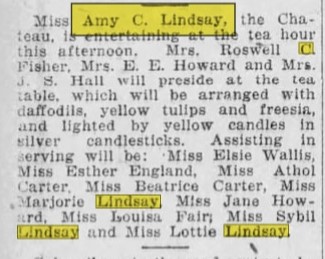
According to an article in the Montreal Star, when Amy hosted a social tea at The Chateau (across from the Ritz-Carlton Hotel), “the tea table was arranged with daffodils, yellow tulips and freesia and lighted by yellow candles in silver candlesticks.” What made it even more special were her five adult nieces assisting her in the serving of tea. She must have been very proud!
Woodland stayed in the Lindsay family until 2020 with several generations enjoying the spectacular property and family legacy. The road leading to their property was aptly named “Chemin Lindsay” and remains so today.
Although Amy spent extended summers with the multi-generational Lindsay family at Woodland, she lived the rest of the year in the downtown area in Montreal known as “The Golden Square Mile.”3 She seemed to move around quite a bit but always within the same area first staying with her mother until her death and then sometimes with her sister Edith (Carter) after that. Although in 1920 she enjoyed “wintering” at the Ritz-Carlton Hotel!
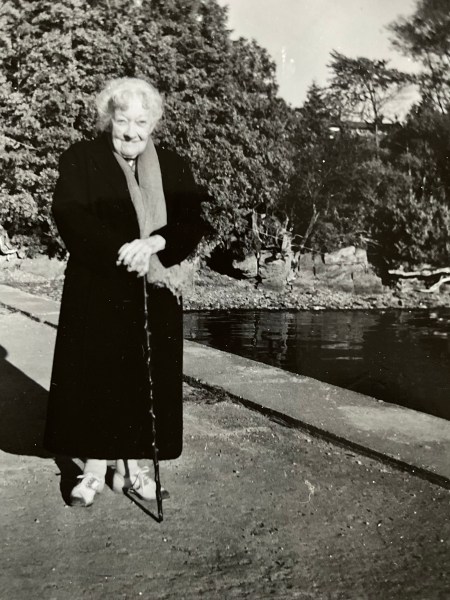
Amy eventually settled for her last 20 years in the Maxwelton Apartments on Sherbrooke Street near McTavish across from the McGill University campus while summering at Woodland until she died in 1960 at age 95.
According to the family, she obtained her first TV late in life and became an avid hockey fan! What a thrill it must have been to watch that first televised hockey game in 1952!
Amy on the Georgeville dock 1955 at age 90
In her last will and testament, written in 1896 when she inherited one quarter of Woodland, she bequeathed “Bob” her cherished set of Waverly books by Sir Walter Scott. He died long before her and, unfortunately, they were not to be found in my dusty old boxes!
Charlotte Haines (1773-1851) was only ten years old when the breakaway 13 colonies won the War of Independence in April 1783. Those residing in the new United States of America, who had remained loyal to the British Crown, were persecuted and forced out of their homes and their belongings seized. Chaos reigned everywhere and families were torn apart.
One fateful day around this time, young Charlotte sneaked away to visit her British Loyalist cousins, against the expressed wishes of her American Patriot stepfatheri. Upon her return, standing outside the front door, he refused her entry back into the family home.
Charlotte was my three-times great-grandmother. Her daughter Margaret Ann Peters married Daniel Hanington and their son James Peters Hanington was my grandmother’s father.
The British government came to the aid of these Loyalists and arranged for transportation for those who wished to leave the new America. Charlotte’s grandparents, Gilbert and Anna Pugsley, rescued young Charlotte and her brother David. Together they sailed from New York for ten days on the “Jason”ii, with 124 other “refugees” as part of the final large scale evacuation and landed in New Brunswick (then still part of Nova Scotia) in October 1783…just in time for the brutally cold winter.
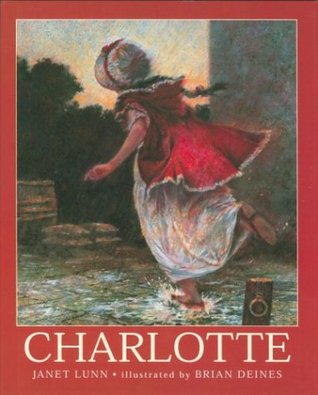
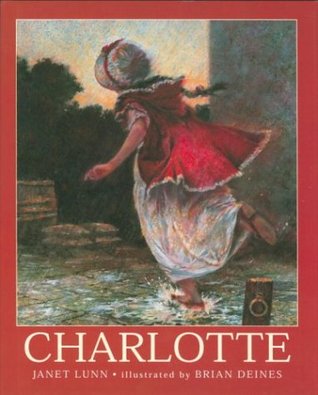
Charlotte has been the favourite subject of a couple of books and several folktales. She warranted her own chapter in “Pioneer Profiles of New Brunswick Settlers”iii and is the main character in a children’s book titled “Charlotte”iv. One folktale claimed that she was the first Loyalist to set foot ashore (not true) and in doing so, she lost her “slipper” in the mud (possibly). The matching slipper (unlikely) was donated to the New Brunswick Museum years later, however, it looks somewhat too big and stylish for a ten-year old girl. But they make wonderful stories and fully recognize young Charlotte as one of the first “petticoat pioneers” of New Brunswick.
Children’s story about Charlotte Haines by Janet Lunn
Fourteen thousand Loyalists established a new settlement in 1783 along the St. John River and shortly afterwards they petitioned for their own colony. In 1784, Great Britain granted their request and divided Nova Scotia into two — New Brunswick and Nova Scotia. The Loyalists, who made up 90 percent of the population of New Brunswick, became a separate colony with its capital, Fredericton, 90 miles upriver from Saint John.
The Loyalists and their children were entitled to free land once they provided the necessary proof. Charlotte, as the biological daughter of John Haines, a Loyalist on record, appears in 1786 documentation as one of the grantees of 84 lots on Long Island, Queen’s County, along with several other prominent Loyalists – although she was only 13 at the time. I can imagine her grandfather Pugsley nodding discreetly in her direction as he looked after her interests.
For their first three years, the British provided the Loyalists with a few simple tools, blankets, material for clothing and seeds for wheat, peas, corn and potatoes. The rations of basic food supplied by the British supplemented the abundance of game and fish available to them in the forest and streams. Most lived in tents on dirt floors until they were able to build primitive log cabins. Tree by tree, stump by stump, the fertile uplands were cleared to widen the fields making them ready for crops.
The Loyalists kept meaningful social contacts through various community events. Neighbours organized “frolics” whereby the men would work together to clear land, move rocks, build a barn or complete some other task which proved impossible for one or two people. At the same time, the women prepared meals and the children had a chance to play with friends. Women also held their own frolics to make quilts, card wool or shell corn. These Loyalist neighbours were dependent on one another in times of sickness, accidents and childbirth and supported one another at gatherings for weddings, funerals and church services.
Perhaps Charlotte met her future husband at one of these popular frolics. At 17, Charlotte married William Peters (also from a United Empire Loyalist family) in 1791 in Gagetown. Soon afterwards, the happy couple moved downriver, settled in Hampstead and built a home where the St. John River widens to a magnificent view.
At that time, there existed only ten miles of roadway in the whole province and another 20 years would pass before there would be an 82-mile long road linking Fredericton and Saint John. However, in the meantime, the river served as a “highway” enabling the transport of passengers and necessary goods between the two cities.
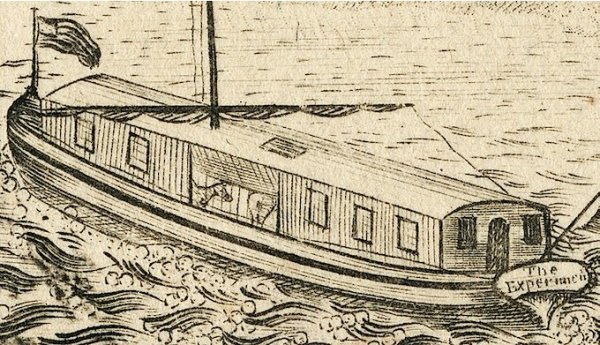
When the steamboats first chugged noisily up the river in 1816, William decided to compete with them and he built a 100-foot long side wheeler powered by 12 horses walking up and down the deck and propelling the boat along.
A drawing of The Experiment – an example of another horse powered side wheeler.
William actively pursued his interest in politics, and as the first representative of Queen’s County in the New Brunswick Legislature, he spent a lot of time in Fredericton (50 miles away) attending the sessions of Parliament.
Meanwhile, back home, Charlotte managed their entire land-holding on her own. Eventually they had 15 children, five sons and ten daughters. She bore her last child at 50 years old according to the baptismal certificate. They all survived except their son John who drowned at 21 attempting to save another man’s life.
Not only did she clothe, feed and care for them all (including the servants) but also provided much of their early education as well. On Saturday evenings in the summer, the fiddlers would play rollicking tunes and the tapping of dancing feet could be heard in big houses and cabins alike. When winter shut down the fields, and with food plentifully stored in the cellar, the spinning wheels would begin to hum during those coldest months.
By the time William died in 1836, they had recently relocated to Woodstock (100 miles upriver from Hampstead) with two of their younger children, James and Caroline. Their older children were married with homes of their own scattered along the St. John River Valley. Around this time, she wrote a letterv to her daughter Susan, Mrs. Thomas Tilley:
I take my pen to address a few lines to you to inquire after the health of you and all of your family. The grate distance we are from you prevents me from hearing. You heard of the death of your Father at Woodstock.
Charlotte described William’s death in some detail and then continued:
I hop [sic] this may find you all well. I am not well. My head troubles me very much. There is not one day that it don’t ake [sic] so that I cant hardly stir. My cough is something better. James and Caroline is well and harty [sic] and quite contented hear. I like the place and if your Father has lived and been hear to see to it we might have made a good living. It is pleasant and a good place for business but we must try to due the best we can. The place is out of repair and soon would have been a common if we had not come hear. I should be glad if my friends was near to us. I don’t know as ever I shall see you all again. I thought to have gon [sic]to see you all before I came up hear but I was so sick that I could not go down to see you. James and Caroline wishes to be remembered to you and all the family. I desire to be remembered to Thomas and the children and tel them I should be glad to see them and you. Give my love to all inquiring friends and except a share for yourself. This from you afectionet [sic] Mother, Charlotte Peters
Although she had her share of aches and pains at that time, she lived another 15 years and ultimately enjoyed the blessing of 111 grandchildren.
She had a powerful influence over all her family for she believed that their heritage carried a great responsibility to others. When the grandchildren would visit, her graceful hands were always busy winding yarn or knitting a sock while patiently answering their questions and reciting passages from the bible.
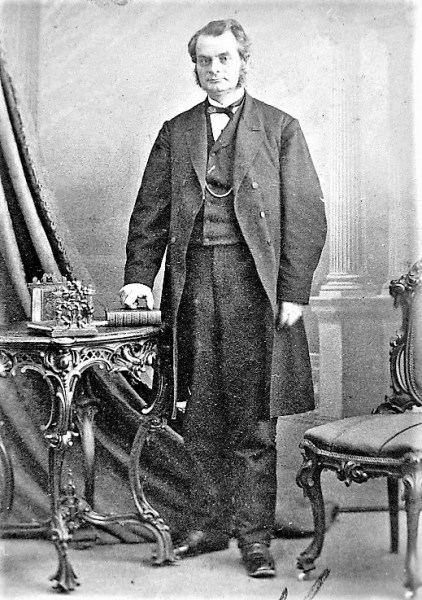
One of her grandchildren, Samuel Leonard Tilley, later known as Sir Leonard, served as Premier of New Brunswick and went on to became one of the Fathers of Confederation.
Sir Samuel Leonard Tilley 1864
A common tale states that Tilley proposed the term “Dominion” in Canada’s name, at the London conference in 1866, which he gleaned from Psalm 72:8 – “He shall have dominion also from sea to sea, and from the river unto the ends of the earth”. Ultimately, as Minister of Finance in the federal government, he was also instrumental in seeing the transcontinental railway completed.vi
Young Charlotte Haines might have felt all alone in the world at age ten but, when she died 68 years later, the epitaph on her tombstone proclaimed her legacy: “…Lamented by a large circle of descendants and friends by whom she was universally beloved and respected.”
The gravestone of Charlotte Haines Peters and family – St.John’s Anglican Church, Gagetown, Queens County, New Brunswick
Charlotte’s daughter Margaret Ann Peters and her husband Daniel Hanington “Roaring Dan” (my great great grandparents).
Notes:
iCharlotte’s mother, Miss Pugsley, died when she was very young. Charlotte’s father remarried Sarah Haight before he died. Then Sarah remarried Stephen Haviland who was Charlotte’s stepmother’s husband (step step father?)
… and now his church celebrates its 200th Anniversary in 2023
(upcoming celebration details below)
The deed described the property as “a commodious estate upon the outskirts of the thriving town of Halifax, in the Colony of Nova Scotia, Canada”. Imagine William’s surprise to arrive in Halifax in February to discover that “outskirts” meant a 200-mile hike through thick forest and deep snow!
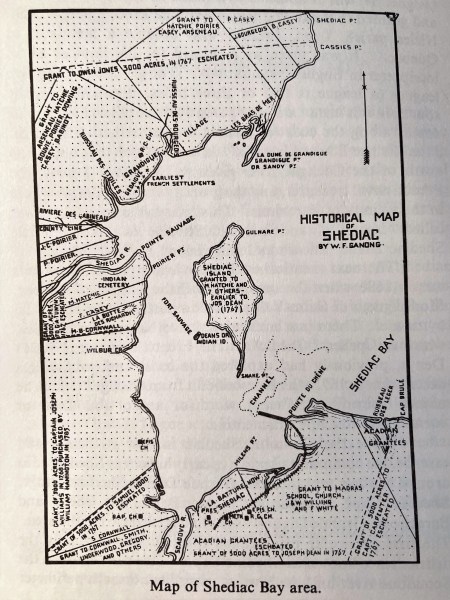
My great-great-great grandfather, William Hanington, was born in London, England, in 1759. As the son of a fish dealer, he trained as an apprentice to the Fishmonger’s Company but became a freeman in 1782. Two years later, at the age of 25, this adventurous young man paid £500 sterling for 5,000 acres of land “near” Halifax, Nova Scotia, from Captain Joseph Williams.
After the initial shock upon their arrival, William and his companion found an Indian guide, loaded all their worldly belongings onto a hand sled, trudged through the snow, slept in the open and finally arrived in bitterly cold Shediac in March 1785. His discouraged companion quickly returned to Halifax and sailed back to England on the first available ship!
Large Lower left piece of land belonged to William Hanington 1785
William, however, was obviously made of sturdier stuff and delighted by what he found! A good size stream flowed into the bay and he had never seen such giant trees! He must have pictured the lucrative possibilities for trade in lumber, fish, furs and more.
Seven years after his arrival in Shediac, at the age of 33, he hired a couple of Indian guides to paddle a canoe over to Ile St. Jean (now known as Prince Edward Island) where there were other English settlers. The Darbys were Loyalist sympathizers who escaped from the rebels in New York. While riding along in an oxcart through St. Eleanor’s (now known as Summerside), he spotted a young lady (age 18) named Mary Darby, drawing water in her father’s yard. After a brief stay with her family, William and Mary married and paddled back to Shediac where they eventually raised a large family of 13 children.
After the first three years together, they persuaded Mary’s sister Elizabeth and her husband John Welling to come over from Ile St. Jean and settle on their land – becoming the second English family in Shediac.
And in the next five years, William boasted eight families on his property of about one hundred acres of cleared land. He opened a general store and dealt in fish, fur and lumber. The furs and timber were shipped to England and the fish to Halifax and the West Indies! He imported English goods from Halifax and West Indies products – mainly sugar, molasses and rum from St. Pierre. He also bartered with the friendly Indians for furs and helped them clear land.
Before long, a considerable village clustered about the Hanington Store – including a post office and a tavern. William remained the leading figure of the community and acted as the Collector of Customs of the Port, Supervisor of Roads and Magistrate enabling him to officiate over the marriages of many couples. To top it all off, in 1800, just 15 years after his arrival from England, this remarkable young man built a shipyard 10 miles north of Shediac in Cocagne.
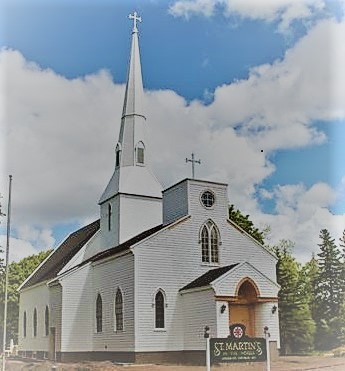
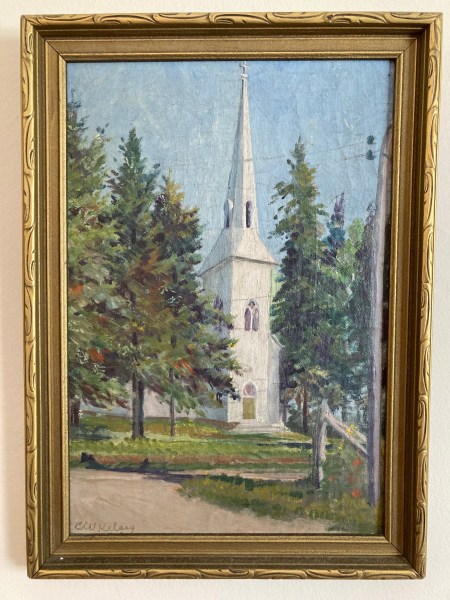
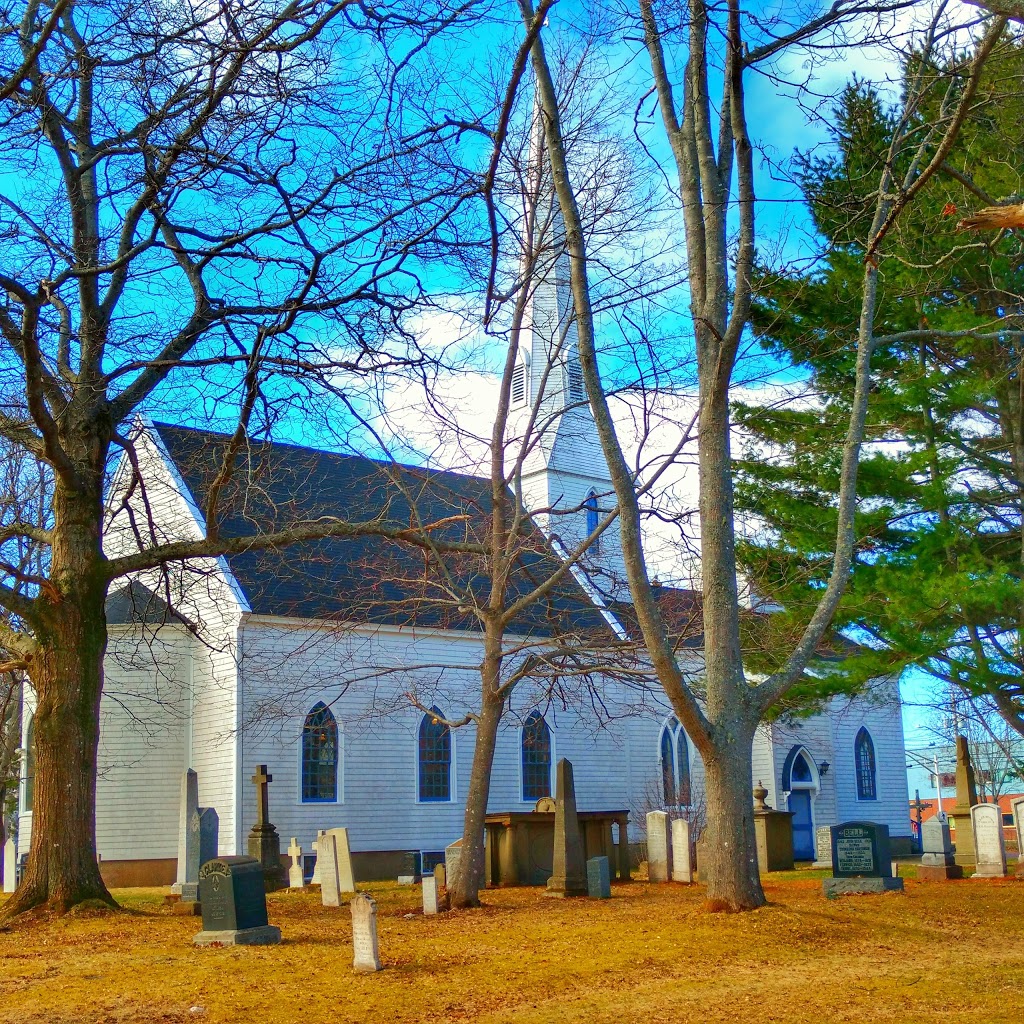
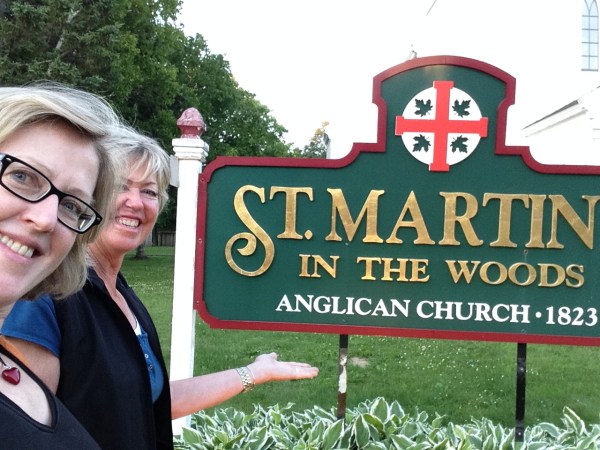
The only thing lacking in this delightful little community was a church. Until then, William being a religious man, conducted service in his home every Sunday and welcomed all to attend. Then in 1823, William donated the necessary land and lumber and oversaw the completion of St. Martin-in-the-Woods, the first Protestant church. He named it after his church in England; the famous St. Martin-in-the-Fields overlooking Trafalgar Square in London.
Painting of
St Martin-in-the-Woods Church
by Charles Kelsey
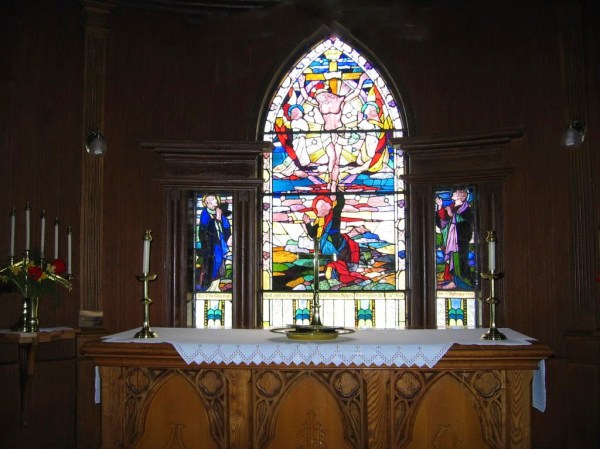
In 1934, my grandfather Canon Sydenham Lindsay (Shediac summer resident at Iona Cottage – She Owned A Cottage – with his wife Millicent Hanington and sometimes stand-in priest at the church) dedicated a large memorial stain glass window in the sanctuary to his father-in-law, Dr. James Peters Hanington (1846-1927) who was my great-grandfather and William’s grandson. The window was designed and installed by Charles W. Kelsey of Montreal and described as follows:
“The centre light of the window represents the Crucifixion, with Mary Magdalene at the foot of the cross, while the two side windows represent the Blessed Virgin Mary and Saint John the Evangelist.” (1934 – The Montreal Gazette)
Stain Glass Window in St Martin-in-the-Woods (photo credit Paul Almond)
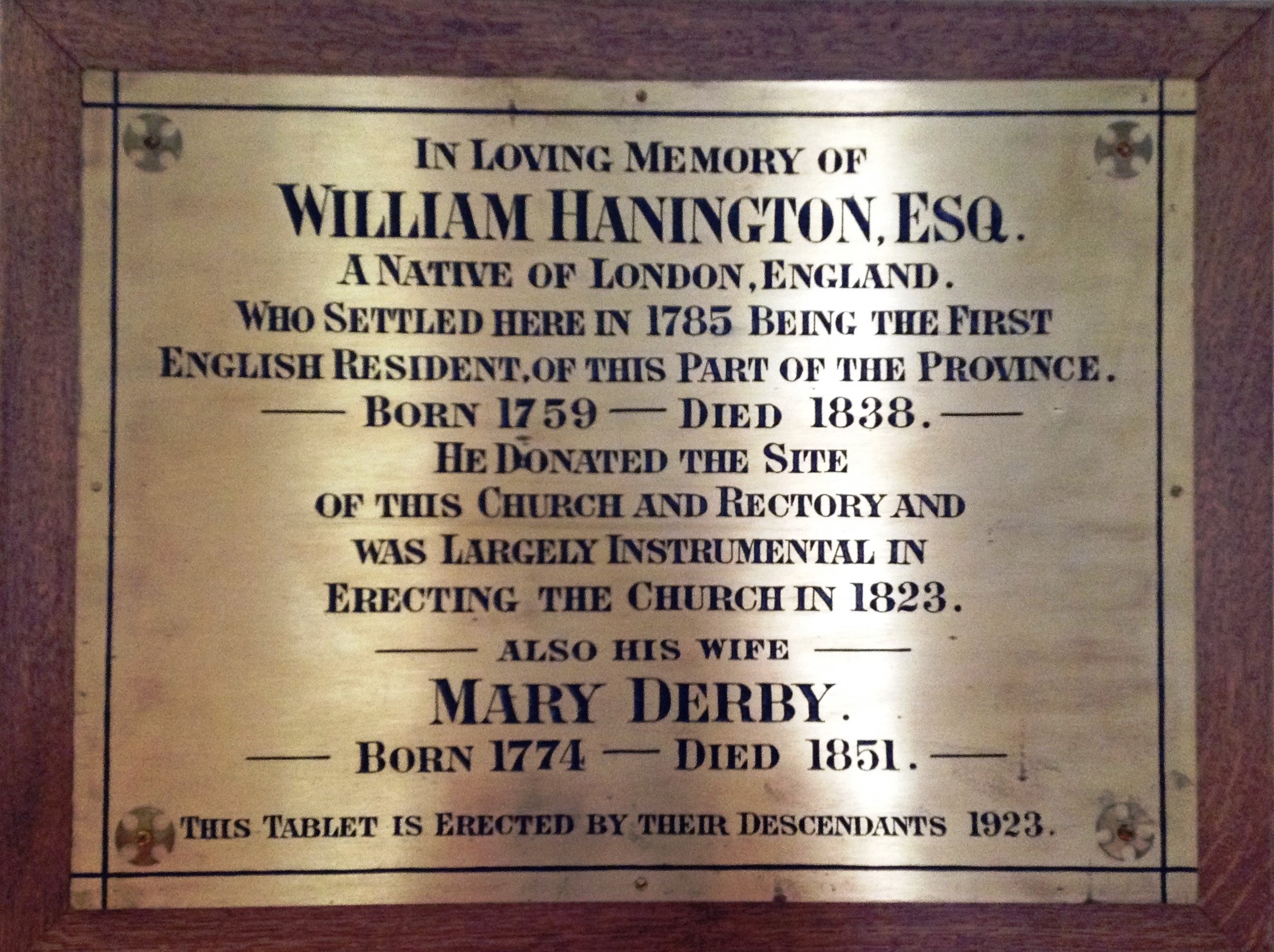
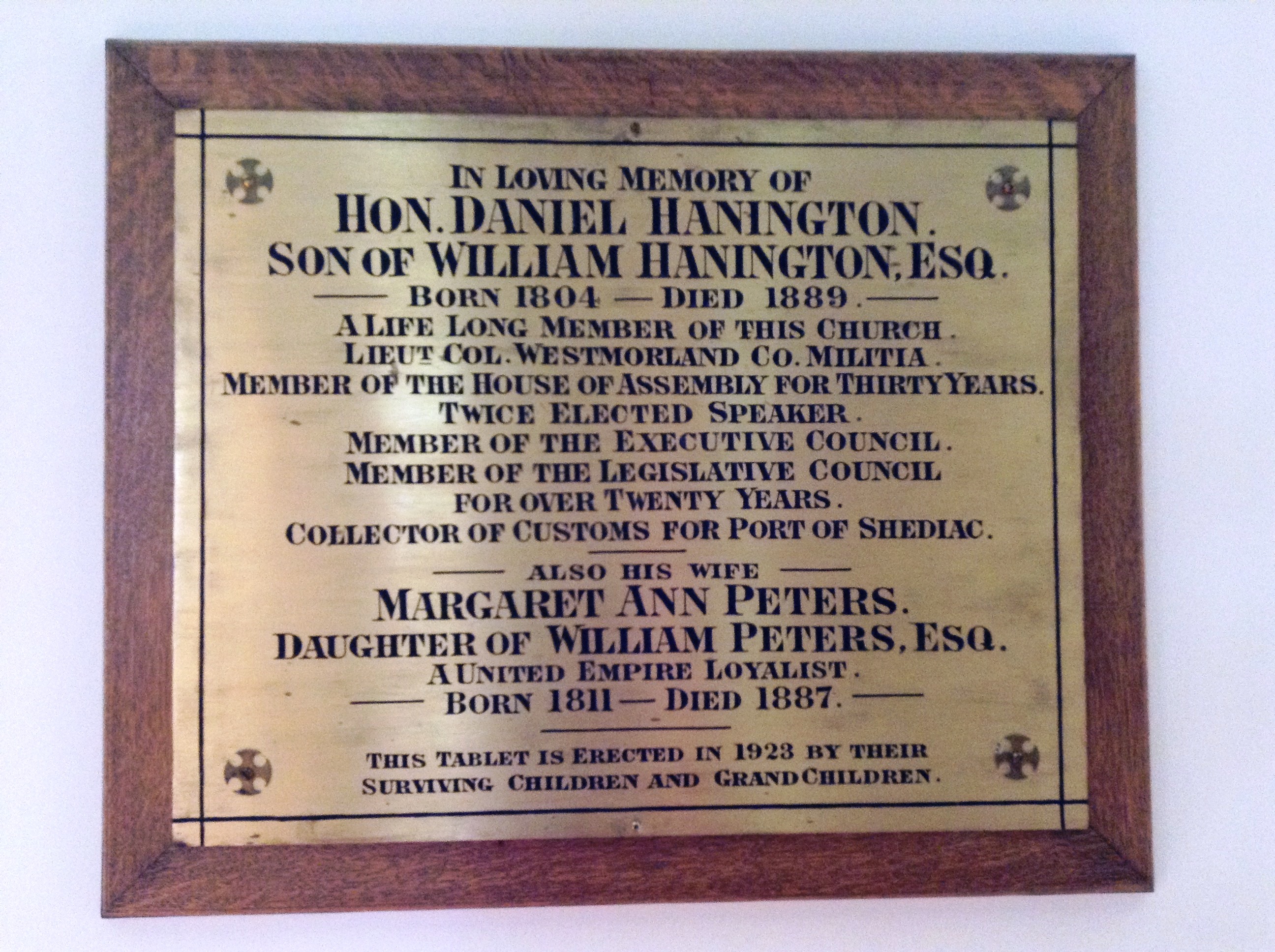
Also mounted inside on the church’s side walls are two honourary brass plaques. One in memory of William and his wife and one in memory of his son Hon. Daniel Hanington (1804-1889) and his wife Margaret Ann Peters – my great great grandparents.
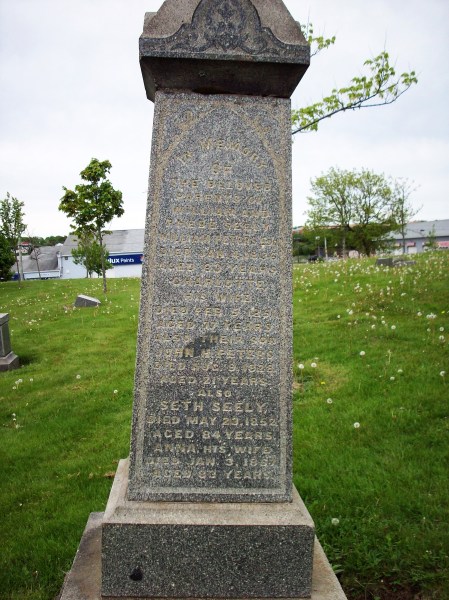
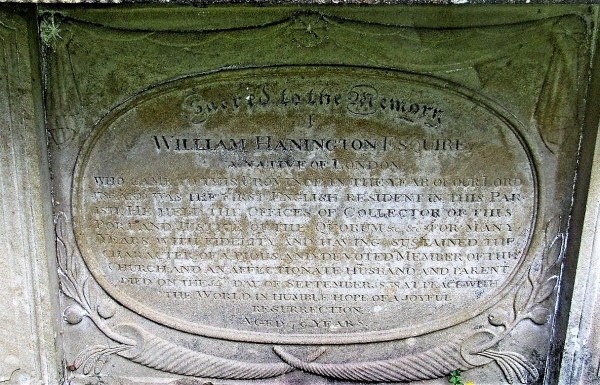
William died in 1838 at age 79. A huge memorial of native freestone marked his grave, in the cemetery beside his beloved church nestled in the community of Shediac, where he spent a lifetime building a “commodious estate” from a forest of giant trees.
Two hundred years later on this anniversary of the St. Martin-in-the-Woods church, William and Mary are lovingly encircled by the graves of several generations of their descendants.
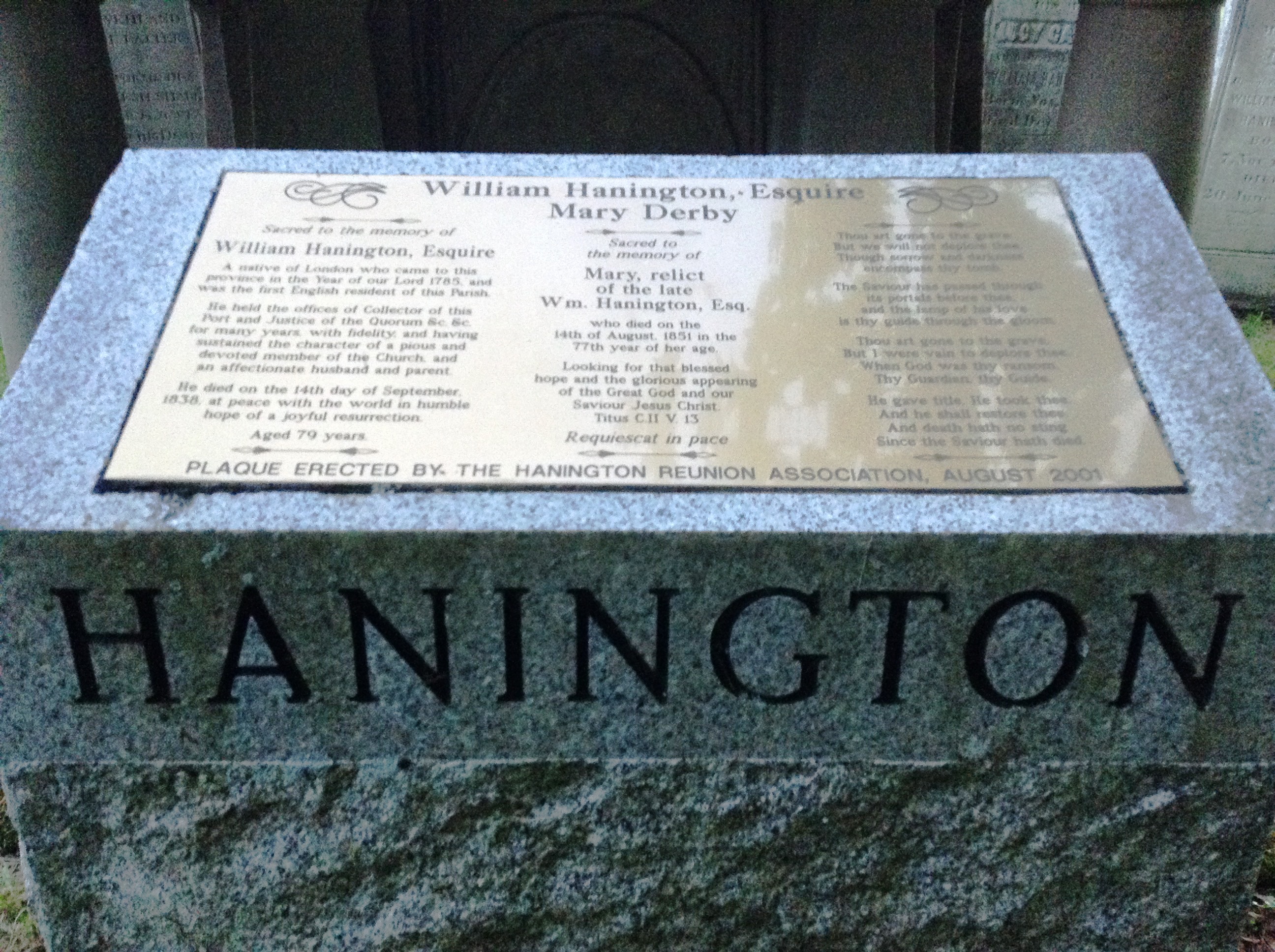
A memorial plaque to William and his wife Mary, was erected in 2001 by the Hanington Reunion Association. This year the Association will be adding a bench in the cemetery in celebration of the 200 years.
Close-up of theHeadstone of William Hanington (1759-1838)
(L)Hanington Reunion Association Plaque (2001) honouring William Hanington and his wife Mary Darby and (R) photo by Scotty Horsman showing William’s large headstone at the side of the church.
In 2015, my sister and I visited the church and our ancestors in the graveyard and also enjoyed meeting some Hanington cousins as well!
ANNIVERSARY CELEBRATION DETAILS FOR SEPT 16-17, 2023:
The main events for the 200th Anniversary will be Sept. 16th and 17th with a corn boil, hotdog/hamburger barbecue and cake on Saturday, Sept. 16th. There will also be games, a bonfire, fireworks and music at the church shore.
The Anglican Bishop, David Edwards, of Fredericton will be attending this celebration. He will also be at the 10:30 AM church service on Sunday, Sept. 17th. After the church service there will be a pot luck lunch and a skit in the hall. There will also be items on display in thechurch basement and in the hall. There will be items for sale – glasses, mugs and lapel pins, with the Hanington crest as well as lapel pins. ornaments and trivets with the church on them.
JULIUS GRIFFITH – RCA, OSA, CSPWC, CSGA (1912-1997)
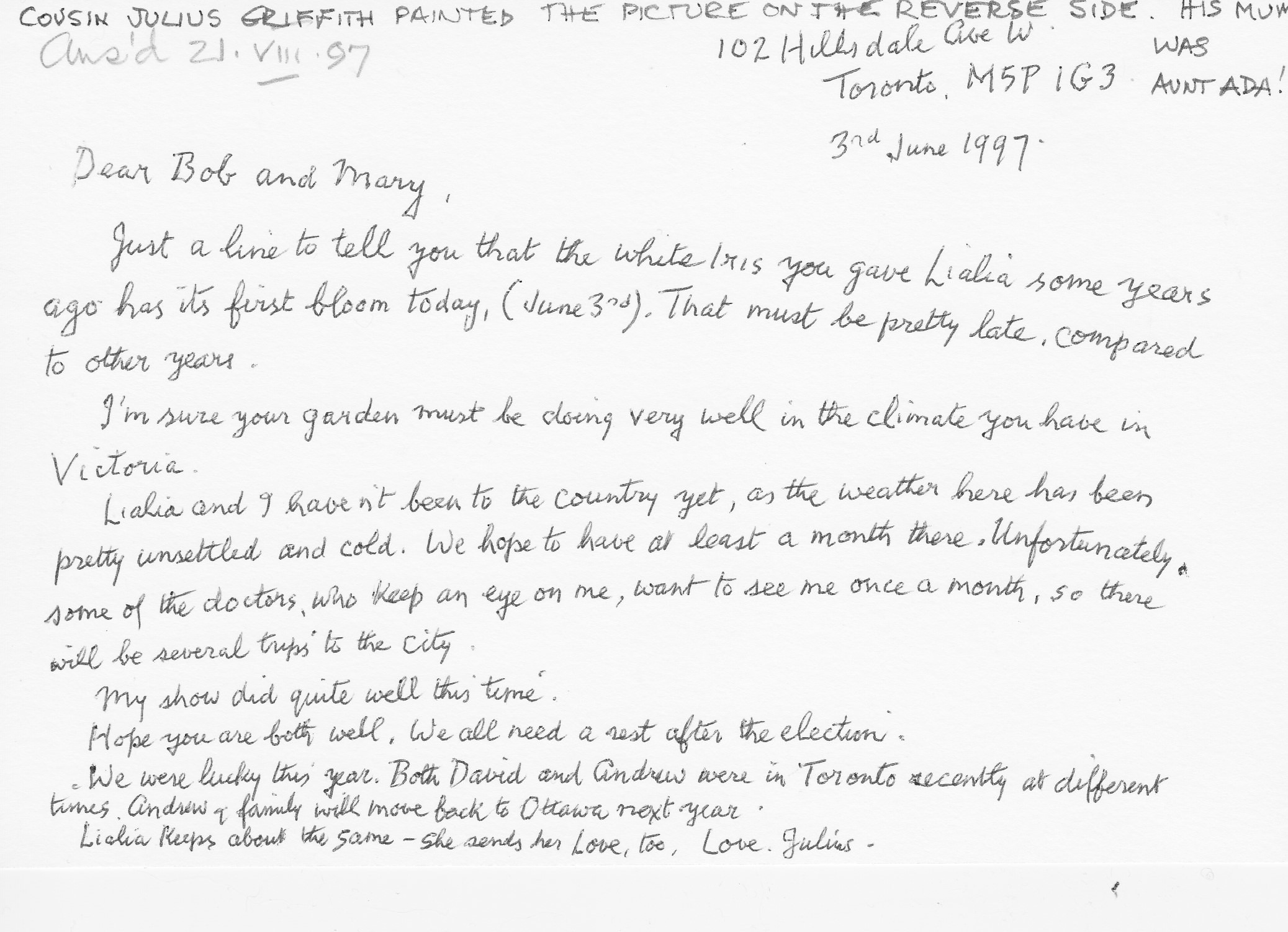
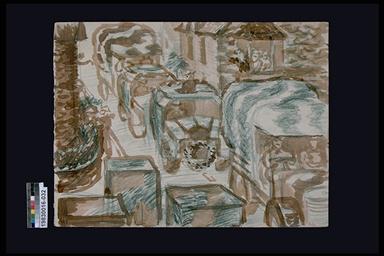
My collection of genealogy treasures includes two picture postcards sent to my Aunt Mary by her talented artist cousin, Julius Griffith, prior to his death in November 1997.
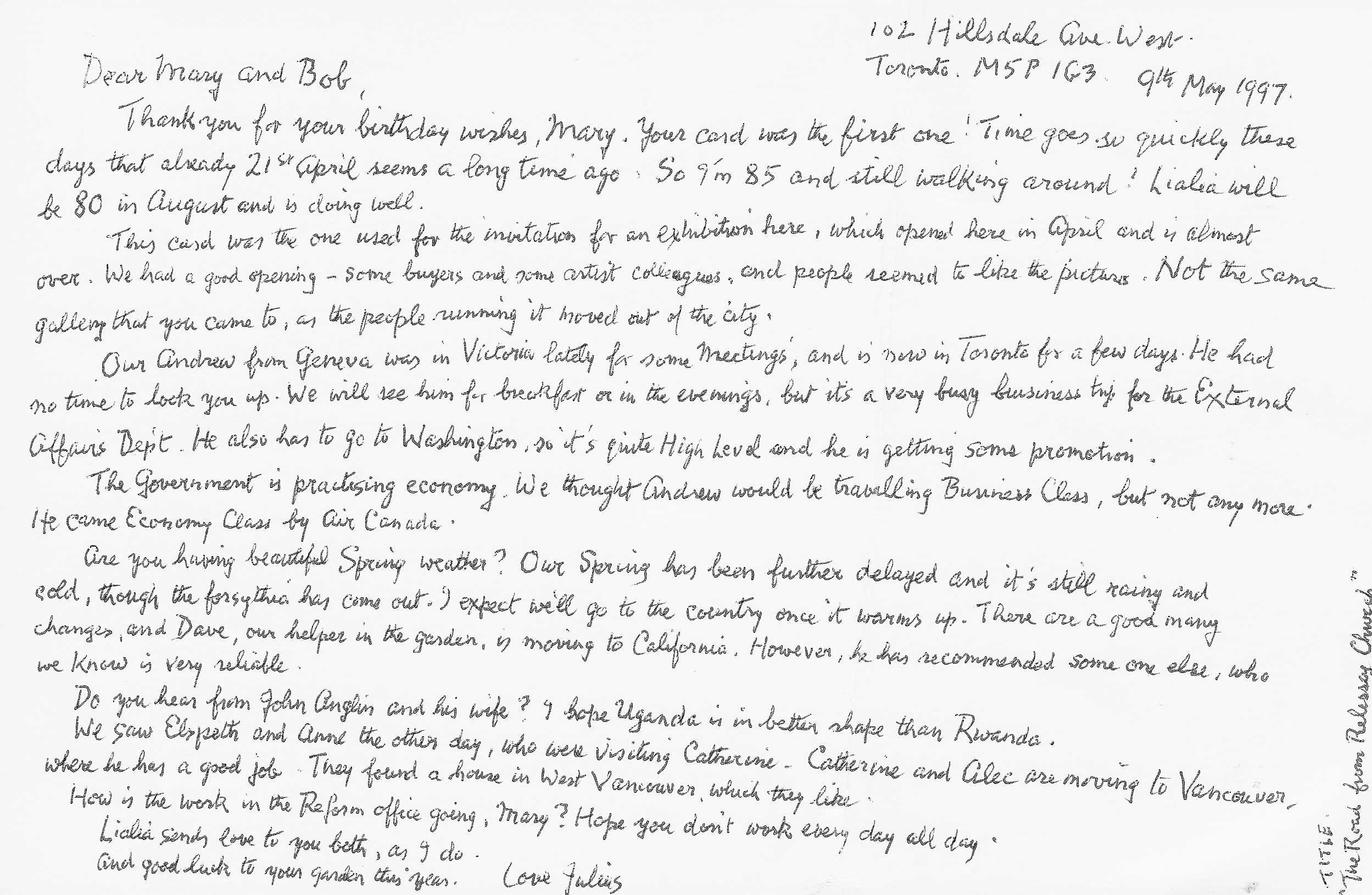
His meticulous handwriting described that day’s garden blooms, commented on the recent election, provided a short health update, news of a son moving back to Ottawa with his family and Lialia sending her love. At the very end, he writes “my show did quite well this time.”
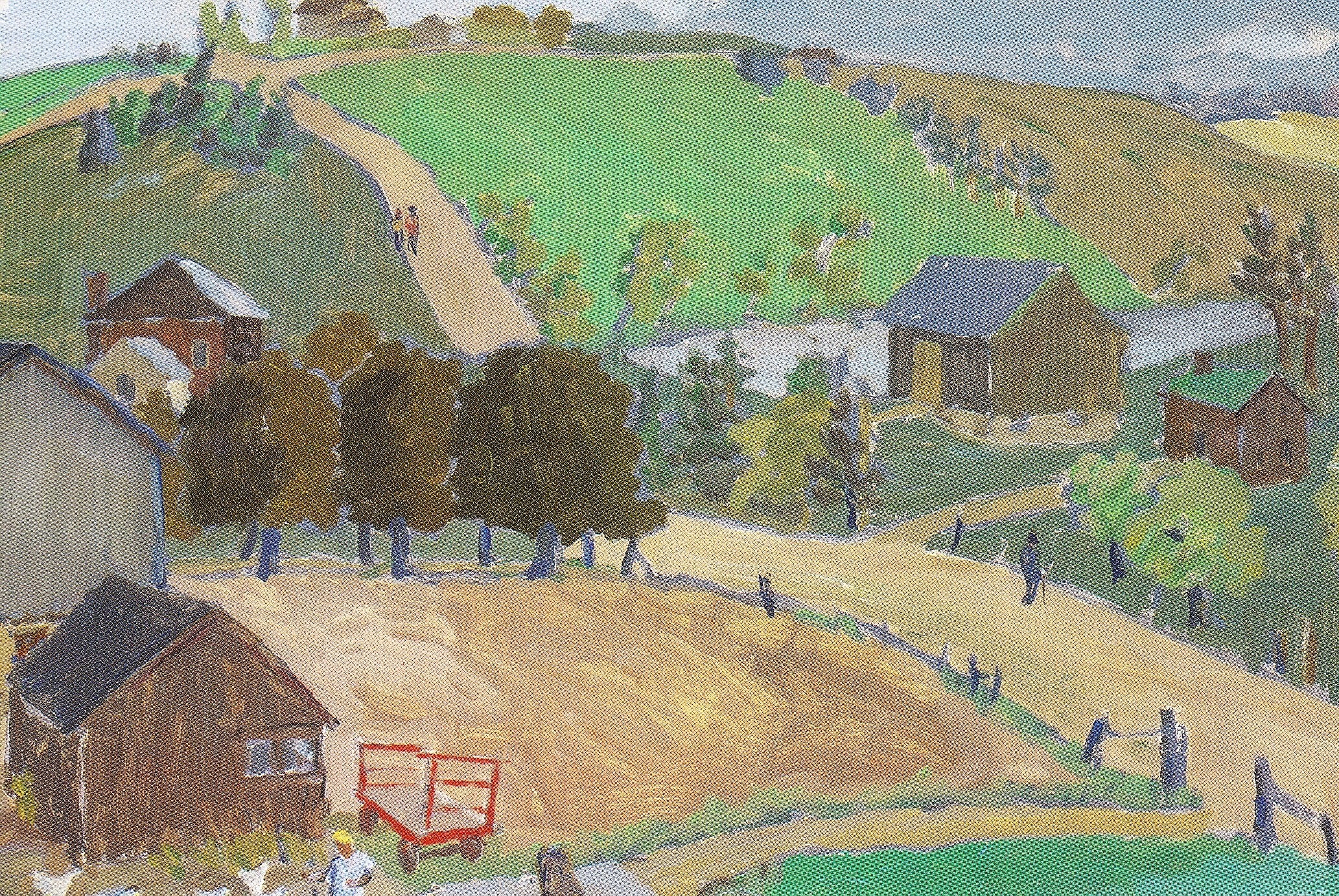
“The Road between Allen’s Farms”
And so it should have. Her cousin, Julius Edward Griffith (1912-1997) was a successful enough painter in watercolour that the members of the Canadian Society of Painters in Water Colours (CSPW), voted for him to be included as a member. Co-founded by a group of prestigious painters including Group of Seven artists A.J. Casson and Franklin Carmichael in 1925, the association continues to exist and has a storied history. For their Diamond Jubilee in 1985, they selected 60 paintings, including one from cousin Julius, and gave them to Her Majesty Queen Elizabeth II. The Queen formally exhibited the collection in Windsor Castle’s Drawing Gallery in 19861.
One of my two postcards could be a replica of his circa 1982 painting presented to the Queen, which was called “The Empty Farmhouse.” The official description describes it as a “watercolour view across fields of a square farmhouse with four windows, surrounded by trees.”
Julius Edward Griffith (1912-1997) was a successful painter in watercolour and oils, a graphic artist, an illustrator, a fine print maker and an art teacher.
As the only child of Katharine Ada Lindsay and Julius Henry Griffith, and born in Vancouver, British Columbia, Julius relished his grandfather Lindsay’s extensive art collection when he visited with him in Montreal, Quebec. Thus began his art education.
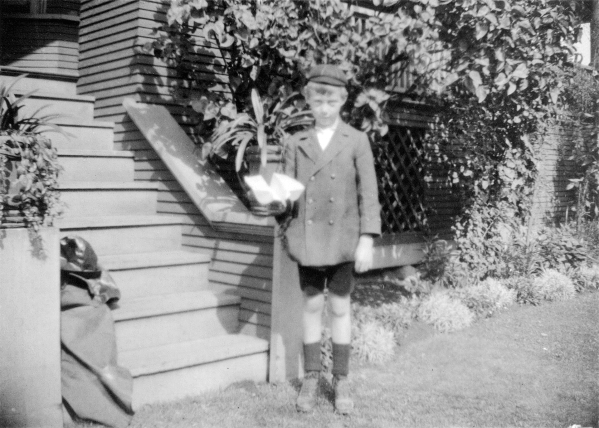
Julius Griffith – 1920
When Julius finished High School at 16, he was too young to attend the Royal Military College, as was his father’s family tradition. Instead, he studied at the Vancouver School of Art (Now Emily Carr University of Art + Design)under Charles H. Scott, F.H. Varley and J.W.G. MacDonald (two of which were Canada’s famous Group of Seven artists2). What a fantastic start to his artistic career! At the same time, he also learned block printing techniques from American artist Bruce Inverarity3 who lived in Vancouver at that time. Julius was immediately drawn to block printing because he enjoyed black and white contrast.
A few years later, he moved to England with his parents and studied at the Slade School of Art4 in London and continued his studies at the Central School of Arts & Crafts with Noel Rooke5 learning the technique of wood carving.
At age 21, Julius returned to Vancouver during the Depression hoping to get any kind of work as an artist. And he did! The owner of the Vancouver Sun newspaper commissioned him to paint two murals on the walls of his building and different groups of people were invited to watch his progress. Among these groups were his previous art teachers, Fred Varley and Jock Macdonald and their students at the time. He must have been so pleased at this role reversal!
In 1938, near the end of his fourth year back in England at the Royal College of Art6, he returned to Vancouver to see his father just before he died. After his father’s death, WWII interrupted Julius’ studies but he returned to England with his mother at that time as he wanted to serve.
During the war he worked with the “Air-raid Precautions” for a time and eventually joined the Red Cross. He worked in a country-house hospital in Sussex and, with so little to do, Julius taught art and learned to speak Russian.
What a serendipitous decision! He fell in love with his teacher – nurse Lialia Oralevs originally from Latvia – and they married quietly a couple of years later before the end of the war.
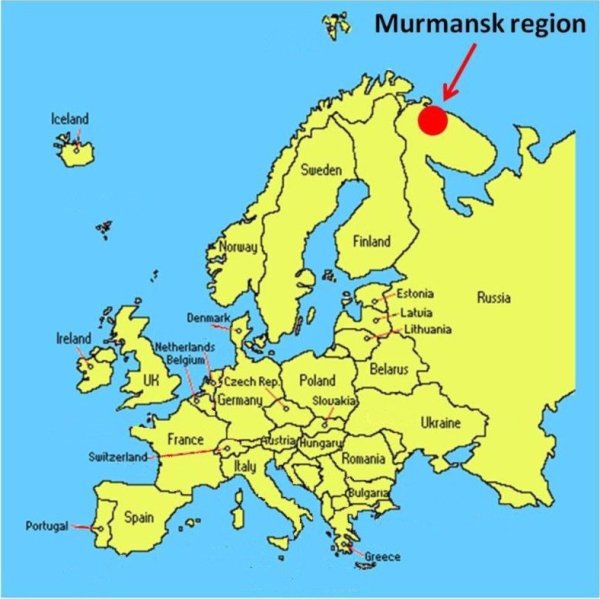
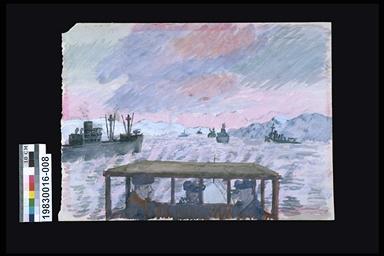
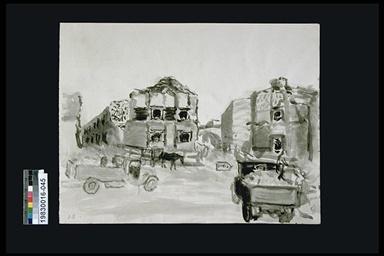
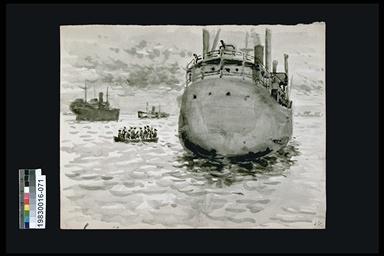
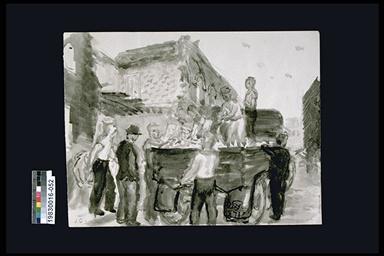
After learning to speak Russian, Julius presented himself in London to the Royal British Navy, passed an oral Russian test and worked as an interpreter under the rank of Sub-Lieutenant stationed in Murmansk7 and Archangel until the end of the war.
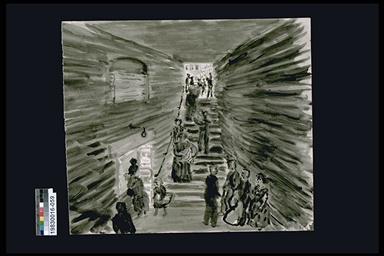
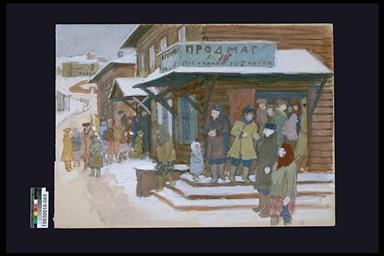
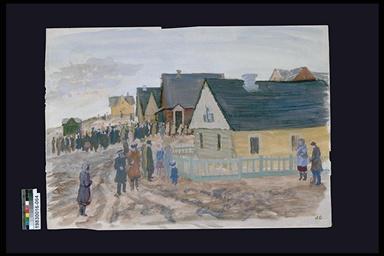
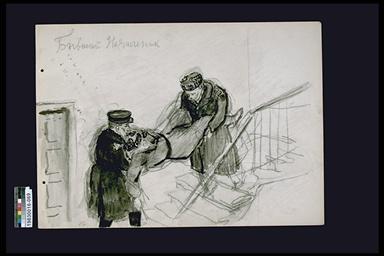
While in Russia, Julius would sketch scenes from memory in the privacy of his room at night and only after his 30-year oath of secrecy expired did he show them to the Canadian War Museum8. They purchased 90 of these drawings and The British War Artists Collection acquired several as well.
After the war, Julius and Lialia returned permanently to Canada. Julius quickly earned a degree at age 34 which enabled him to teach art and support his wife and four sons while continuing to pursue his passion as a graphic artist and wood engraver. Julius taught art in many of the top schools in Toronto – the Western Technical School, Artists’ Workshop, Ryerson Polytechnic Institute, Ontario College of Art, and at Central Technical School.
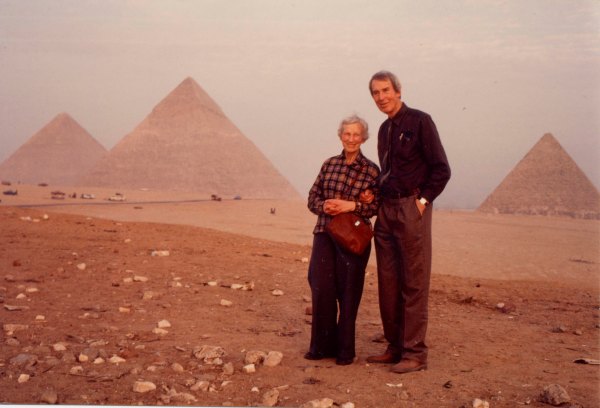
Although I never met Julius, I understand that they made quite the impressive pair with Julius at 6 feet 4 inches towering over five foot Lialia. Not surprisingly, “Julius seemed to develop a slight lilt to the left in later years, probably because he would put is left hand on Lialia’s shoulder and lean to hear or speak to her.” This 1985 photo taken during a trip to Egypt illustrates this charming pose.
Julius and Lialia – 1985 (courtesy of Lorne Griffith)
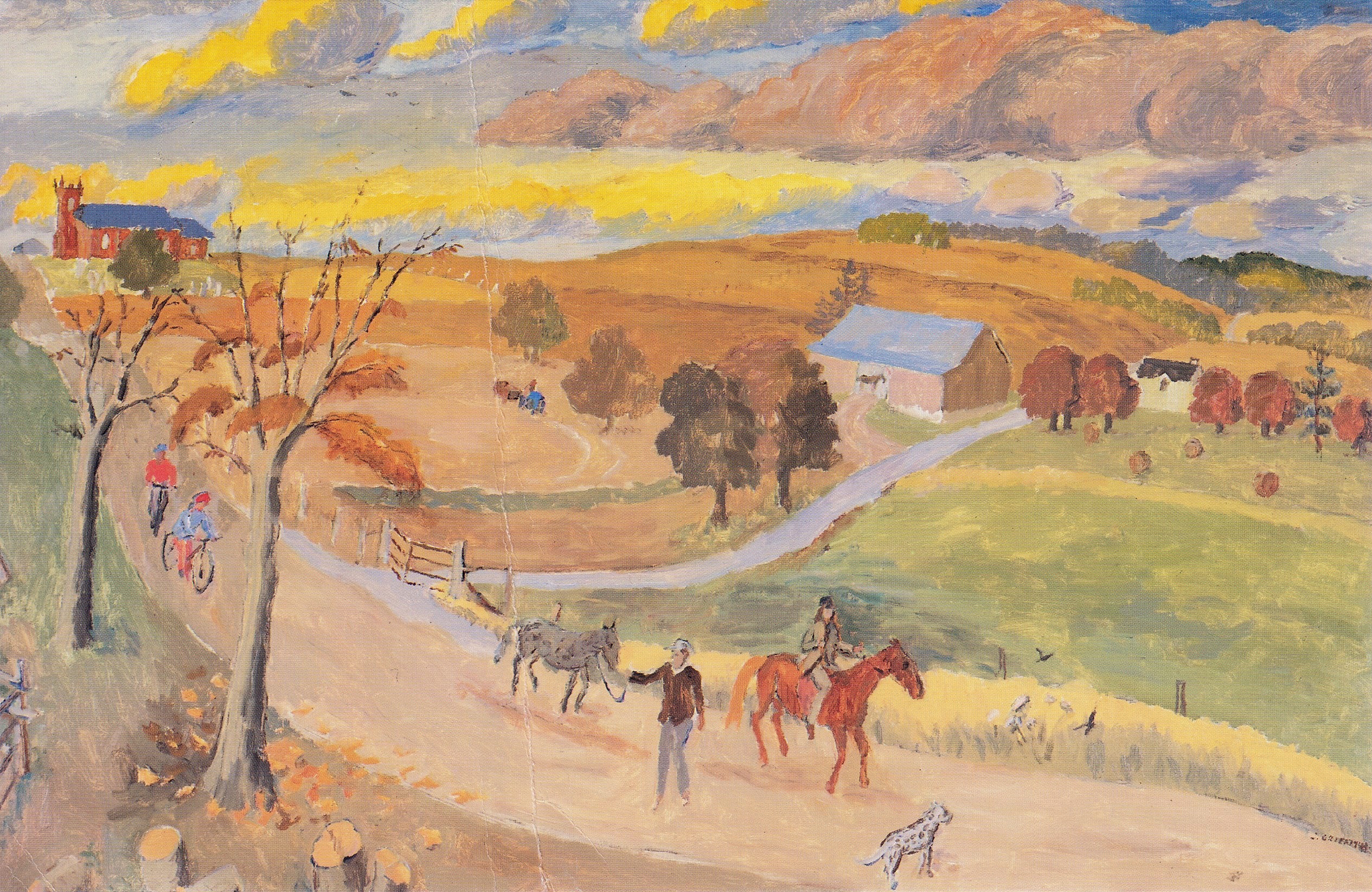
On the other postcard that he sent to my Aunt Mary in 1997, he wrote “This card was the one used for the invitation for an exhibition here, which opened in April and is almost over. We had a good opening – some buyers and some artist colleagues, and other people seemed to like the pictures.”
” The Road from Relessey Church”
Although I don’t have any of Julius’ original paintings, his two picture postcards with his personal handwritten messages are real treasures to me.
NOTE:
Julius’ work is displayed in the collections of the National Gallery of Canada, Canadian War Museum, Imperial War Museum (London), Art Gallery of Ontario, Toronto City Archives, Toronto Public Library, Art Gallery of Hamilton, McMaster University (Hamilton), Carleton University (Ottawa), Glenbow Museum (Calgary), Art Gallery of Greater Victoria (British Columbia), and numerous corporate and private collections.
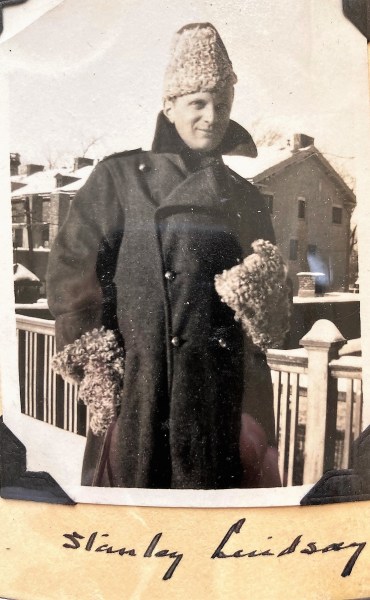
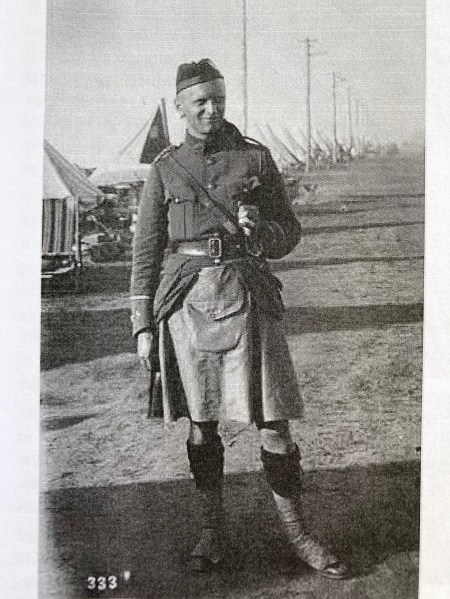
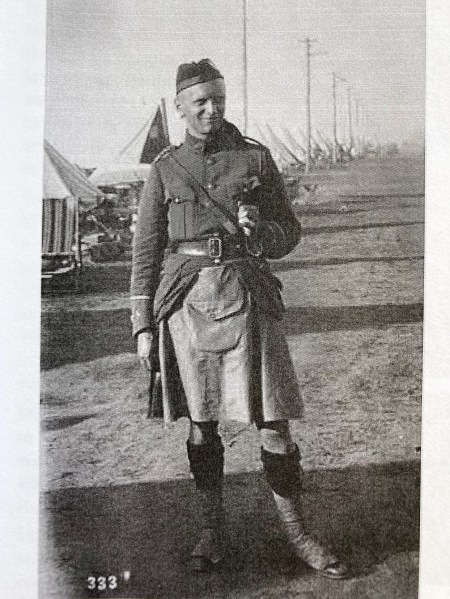
Six months after surviving the battle at St. Julien, Belgium, and the German gas attack in 1915, something entirely different brought Captain Stanley Bagg Lindsay (1889-1965) to his knees. He slipped and fell in the trenches while on active duty, and needed surgery on a hernia on his left side. He was officially declared unfit for duty and was granted sick leave to recover back home in Montreal, Quebec, for the winter.
Stanley Lindsay – winter 1916
Within months of his return to England, the hernia recurred on his right side needing immediate surgery and his health never fully recovered after that. Several bouts of influenza also plagued him throughout the war, before and after his hernias, and weakened him for the rest of his life.
He was 29 when the war ended. He returned to Montreal, but did not resume his studies at McGill University, choosing instead to follow in his father’s footsteps and become a stockbroker. His salary as a Captain had brought in an average of $142 per month during his four years of service. This translates into $3900 per month in today’s dollars. He quite possibly returned to civilian life with a decent nest egg with which to begin his new career.
Stanley’s health issues did not appear to hinder his long career as a stockbroker and eventually he became a partner at Crutchlow, Deare & Co. According to family lore, he purposefully sold off the family’s portfolio of stock investments just before the Great Crash of 1929.1 Perhaps his war experience left him with some kind of sixth sense.
Although Stanley never married, he remained close to his two brothers (and their families) and his three sisters.
Two of his sisters, Marjorie and Marguerite, had been nurses during the war with the Information Bureau,2 a Canadian Red Cross organization in London which cared for Canadian soldiers. Marguerite died young in Cartwright, Labrador, in 1926 while volunteering with the Grenfell Mission.3
Stanley lived with Marjorie and their parents at 455 Sherbrooke Street West (previously known as The Prince of Wales Terrace) until their father’s death in 1931. Then they moved with their mother into an apartment at 1009 Sherbrooke Street West until her death in 1938 and remained there until their own deaths: Marjorie in 1961 and Stanley in 1965. His eldest sister Ada lived in Vancouver with her husband Julius Griffith and their only son, Julius, who became a well known Canadian artist.4
Stanley’s two brothers – my grandfather Sydenham5 (an Anglican priest) and Lionel (a pediatrician) – provided him with ten nieces and nephews to spoil. He absolutely adored my mother Ann and showered her with his love and gifts. He must have been devastated when she died of Hodgkin’s Disease at the age of 36 in November, 1961, having lost his sister Marjorie earlier that year.
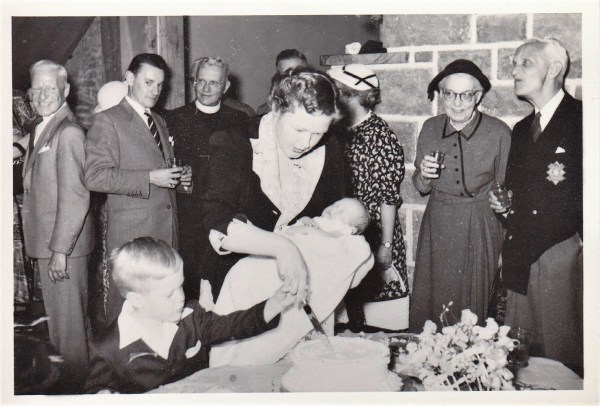
Stanley Lindsay (far right) at Ann’s baby’s christening party 1953
Luckily for me, he devoted his free time to the family history. I have pages upon pages of his beautifully (legible!) handwritten notes about that side of our family. All the usual dates and facts were recorded, but in a clear, more descriptive fashion.
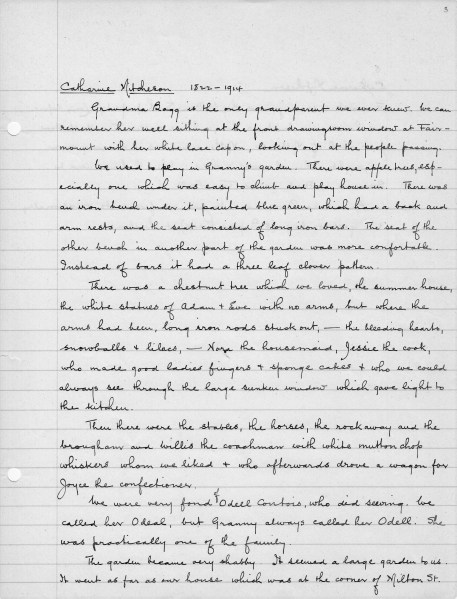
One of his pages about his grandmother, Catherine Mitcheson Bagg, recalled a visit to her home as a boy:
“We can remember her well sitting at the front drawing room window at Fairmount with her white lace cap on, looking out at the people passing.
“We used to play in Granny’s garden. There were apple trees, especially one which was easy to climb and play house in. There was an iron bench under it, painted blue green…. There was a chestnut tree which we loved, the summer house, the white statutes of Adam and Eve with no arms, … the bleeding hearts, snowballs and lilacs … Nora the housemaid and Jessie the cook, who made good ladies fingers and sponge cakes and who we could always see through large sunken window which gave light to the kitchen.
“There were the stables, the horses, the rockaway and the brougham and Willis the coachman with white mutton chop whiskers whom we liked and who afterwards drove a wagon for Joyce the confectioner. We were very fond of Odell Comtois who did sewing…. She was practically one of the family.
“The garden became very shabby. It seemed a large garden to us. It went as far as our house which was at the corner of Milton Street. The west side adjoined the Wilson-Smith property. Long before our house was built, a large house called Tara Hall stood just north of Milton Street. Mother [Mary Heloise (Bagg) Lindsay] remembers it burning down one night when she was a child. Where the house used to stand is a street called Tara Hall.”
As well as being everyone’s favourite uncle, an excellent family historian and a successful stockbroker, Stanley belonged to several local clubs including the Canadian Club, the University Club and the Royal Montreal Golf Club.6
After almost dying at Ypres during the Great War, Stanley lived another fifty years.
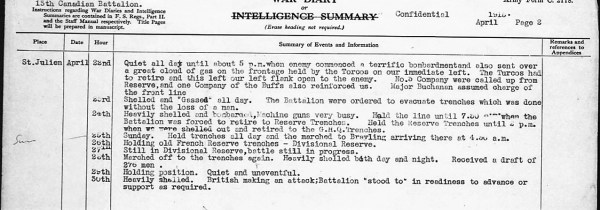
Somehow my great-uncle Stanley survived the Battle of St. Julien1 which was part of the larger Second Battle of Ypres (22 April – 25 May 1915). There were around 100,000 casualties in that battle alone.
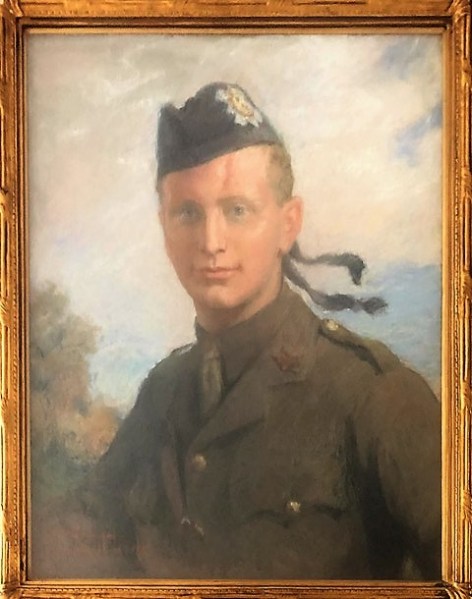
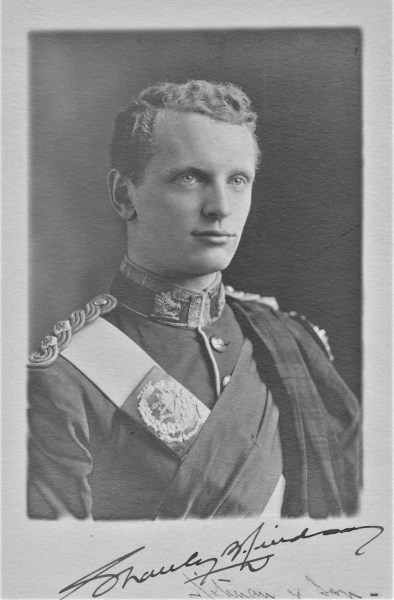
Stanley Bagg Lindsay (1889-1965) fought in The Great War with the 13th Battalion, Royal Highlanders of Canada (RHC). The Germans deployed poisonous chlorine gas in Ypres, Belgium, against the Allied armies (Belgium, French, British Expeditionary and Canadian Expeditionary Forces) for the first time.
This is the letter he wrote home to Montreal on April 27, 1915, from the trenches in Ypres, Belgium:
You must know by now that we have been getting a rather exciting time of it and it is honestly beyond me to understand why I am still alive.
I will tell you briefly what took place.
On the evening of the 21st we took over the trenches from the 14th Battalion. Everything was very quiet. The French were right next to us on our left. About 5 PM on the afternoon of the 22nd bombardment such as I never thought possible began by the Germans. Shells (coal boxes) shrapnel for about two hours, and then the Germans attacked and captured the French trenches which brought them right next to us on our left.
Stanley signed up to to serve with the Canadian Over-Seas Expeditionary Forces (CEF) on September 23,1914, according to his attestation papers. He left his studies at McGill University at age 25 to do so.
Seven months later, he witnessed the horrors of the German war machine first hand. His letter home continued:
During the night they rushed troops through this gap and next morning were right in behind us. We, however, held onto the trenches for 24 hours in spite of the fact that they had machine guns behind us, and shelled us heavily. The night of the 23rd we had orders to evacuate those trenches, and dig-in in another position which we did. The next morning we were shelled and shelled and finally shelled out of the trenches. By this time the casualties were high. I took up on a position with MacTier and a few men and stayed there for sometime till we had orders to evacuate. Since then the biggest battle ever fought has been going on. I am afraid the casualties will be very high.
Guy Drummond, Major Norsworthy and Lees are killed and some are wounded. You might telephone to Mrs. C.K.2that he is alright.
Many of these men’s families knew each other socially before the war as they all lived near one another in Montreal’s “Golden Square Mile”. 3 Hence, his suggestion to let their friend, Mrs. Clark-Kennedy, know that her son was still alive.
The events that took place next, with these men specifically mentioned, were written up in – Montreal and the Battle of Ypres 1915 One Hundred years4 – in a book on Canadian Military History.
With German infantry hot on their heels, Captain Clark-Kennedy, with Lieutenants Stanley Lindsay and William MacTier, conducted a resolute rear guard. But the new battalion position proved as hazardous, for it was quickly taken under observed fire from the Germans in occupied Canadian trenches.
Numerous individual and section duels took place during the two long nights when the 13th held the division flank unsupported by artillery, low on ammunition and without food or water. How these exhausted men, without sleep for over seventy-two hours, managed again and again to march, dig, and do battle is the stuff of regimental legend and legacy.
Somehow, during this chaos, Stanley found the time and energy to write his letter home and described the same experience in his own words:
I believe that the authorities think we did well and are pleased with us. The conduct of my own men was absolutely splendid, and I am sorry to say that many of them have been killed and wounded.
I don’t know when I shall be able to write again, so don’t worry. Just now we are in a dugout with heavy shell fire going on. The fight up ahead is heavy. We hope to get a rest soon, as we are all pretty much all (done) in.
The total cost of the battle to the 13th Batallion was 483 all ranks or 49 percent5.
The waiting crowd at Southampton docks burst into cheers when some of these remaining Canadians disembarked the train.
Even the normally reserved Imperials took notice and embraced their colonial brethren. Recruiting posters in Glasgow and Edinburgh for Scotland’s Black Watch, now proudly added, “with which is allied the 13th Canadian Battalion, RHC.” 6
4Roman Jarymowycz (2015) “Montreal and the Battle of Ypres 1915 One Hundred Years,” Canadian Military History: Vol. 24: Iss. 1, Article 11. Available at: http://scholars.wlu.ca/cmh/vol24/iss1/11
5Roman Jarymowycz (2015) “Montreal and the Battle of Ypres 1915 One Hundred Years,” Canadian Military History: Vol. 24: Iss. 1, Article 11. Available at: http://scholars.wlu.ca/cmh/vol24/iss1/11
6Roman Jarymowycz (2015) “Montreal and the Battle of Ypres 1915 One Hundred Years,” Canadian Military History: Vol. 24: Iss. 1, Article 11. Available at: http://scholars.wlu.ca/cmh/vol24/iss1/11
*Note: This seemed like the perfect time to publish this story again. If you’re lucky, you may inherit a box of family papers someday…and if you’re smart, you will take the opportunity to ask for them when you see everyone over the holidays!
The latest de-cluttering expert tells us to keep only things that give us “joy”1. All other items should be thanked for their purpose or memories and then given away. At the end of this challenge all that should remain are the things that spark joy in us!
We are told to start with clothes, then books, kitchen cupboards and desktops. Only then, after all that practise detecting feelings of joy over an item, will we be ready to tackle family photos and personal memorabilia.
On the highest shelf of my largest cupboard were three dusty old boxes that I inherited many years ago. They were to be the last step of my de-cluttering project!
I slowly opened the lid of the first box finding lots of old photographs, mostly black and white, some labelled and others not. The first handful of photos was mostly of loving couples and family reunions at the dinner table. Others showed groups of people standing proudly on the front step of a house (a new home perhaps?). The next scoopful were of children at play – sometimes holding family pets in their arms. Another handful produced proud young adults smartly dressed in various uniforms – perhaps starting a new job or ready to go to war. The last bunch showed lazy days on sandy beach holidays, numerous birthday party celebrations and Christmas gatherings.
Frozen moments captured in time from so long ago for me to enjoy now. It all felt so precious. I very gently placed the photographs back, undisturbed, into that first box.
Nothing to be given away.
The second box was filled to the brim with letters and cards. Some still neatly tucked into their envelopes, others held together with yellowing scotch tape and looking well fingered. Most of them had handwritten messages in big loopy writing that was difficult to read. The stamps alone told another story postmarked from places and dates from years ago. Among the letters were also children’s drawings, thank you notes, lists of party guests, festive menus and various well loved recipes.
But my very favourite find in this box were the love letters, written with such passion and lovingly folded into perfect little rectangles and decorated with doodled hearts.
Nothing to be given away.
The last box contained newspaper clippings announcing family births, deaths, weddings and other special events from all my ancestors over the years. And then, underneath all that newspaper, I discovered more treasures!
First, my grandmother’s monogrammed lace handkerchief with a tiny baby’s christening dress complete with a lock of hair tied in a ribbon and stored in a small envelope. Then I picked up the old school primer (book) and several dried flowers fell to the floor. Neatly stored in the bottom were numerous diaries filled with daily messages with the writing continuing up the sides of each page. Finally, carefully folded in tissue paper was an old sampler stitched by my ancestor, as a young girl two hundred years ago. Several of my family’s treasures (and perhaps a little piece of them?) had been lovingly preserved in this last box.
Nothing to be given away.
As I closed the lid on the last box, it dawned on me that someone had already sorted the family memorabilia into those three separate boxes, leaving me to find…three dusty old boxes of pure joy.
A family van pulled up outside the front of our house on Halloween night in 2020. A tiny fairy, dressed in white, leaped from the van completely beside herself, jumping up and down and waving at us in our living room window. She and her buddies ran to the goodie tray, picked something, and ran back again pausing to wave again before piling back into the van.
Pure Joy!
Generations of children have enjoyed Halloween over the years and perhaps the planning of costumes took priority in their lives even when their worlds seem to be falling apart.
For example, the children dressed in costumes depicting soldiers and nurses during World War 1 –
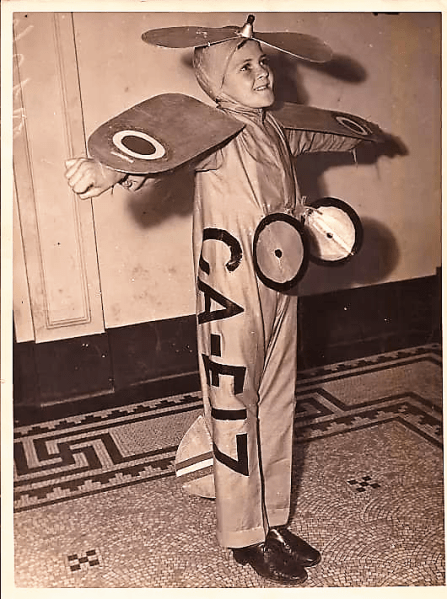
While during World War 2, the costumes became a little more intricate like this young boy dressed as an airplane –
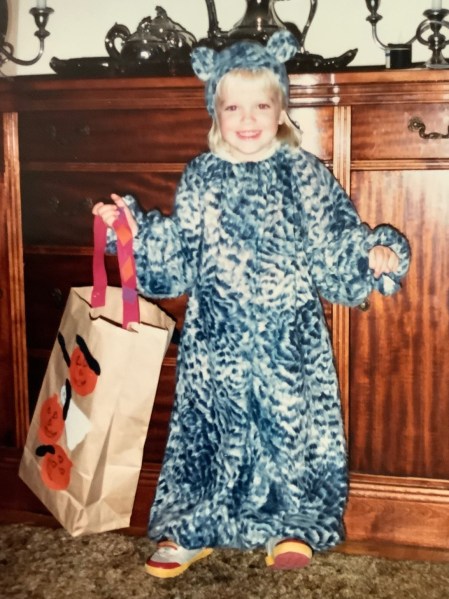
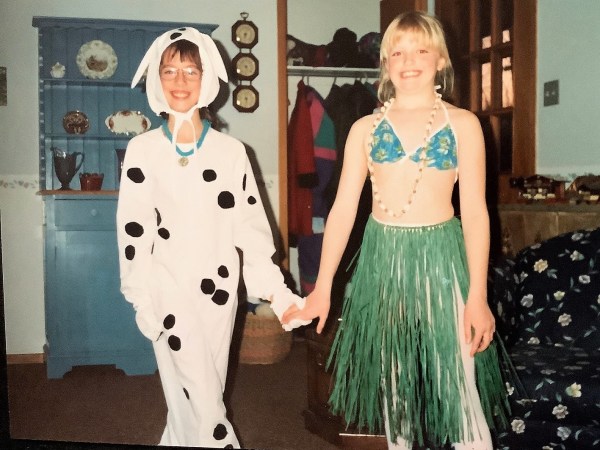
Every year, I dusted off the sewing machine and happily pursued my daughter’s Halloween costume project. I especially remember the cat costume and the dalmatian (Walt Disney’s 101) costume as two of her favourites which were enjoyed time and time again afterward as part of the “dress-up” box.
The Cat Costume
The Dalmation and Hawaiian Girl Costumes from the Dress-Up Box
In 2020, the whole world was held hostage by the Coronavirus. Halloween became a real challenge to those who wanted to celebrate the children’s special night. You really had to use your imagination if you wanted to distribute candy to the “trick-or-treaters”. Some folks even invented cardboard chutes that delivered candy to the children safely distanced from their front doors.
But we had something else in mind.
Our grandkids in England spent the evening safely at home in costumes with a feast of ghoulish fajitas, carved “jack-o-latern” red peppers and witches fingers for dinner with “vampire teeth cookies” for dessert. Their photos inspired us to make something special happen for our local children daring to go door-to-door during the pandemic.
We set up our display at the end of the driveway on Halloween afternoon. Our painted pumpkin displayed high on a stool and, a little lower down at kiddie height, a small table with a goodie tray filled with chocolate bars and chips and a sign inviting the children to help themselves.
As the final touch, we brought out a tall double lamp and plugged it into the house outlet with a long extension cord. The upper lamp pointed towards the sky and the lower lamp aimed directly on the pumpkin and candy.
I proudly posted a photo of our Halloween setup on social media. “Is this an all-you-can-eat buffet?” commented someone jokingly. Perhaps, but that would depend on if the children were greedy or not. If the first child emptied the tray into their bag then it would be lights out for the rest of the night.
Halloween 2020 – We watched the activity from our living room window behind the bush
But that did not happen.
A steady stream of neighbourhood children on foot were the first to stop by. Their mothers gently urging them to only take a couple treats. Then they happily skipped away after a quick wave in thanks.
After a few hours, my husband checked on the candy supply and reported that we still had half our stash left.
Near the end of the evening, another van pulled up filled with slightly older kids. Again they all waved their thanks to us in the window after helping themselves.
We both became quite emotional every time a child waved back at us, and during those moments, everything seemed right in the world.
At the end of the evening, we were delightfully surprised to find a single bag of chips left on the tray. No one was greedy afterall.
Everyone had left something for the next person.
And for one magical evening children and adults alike could forget what was going on in the world.
I still smile whenever I think of that tiny fairy.










 Genealogy Ensemble
