All posts by Janice Hamilton

Janice Hamilton is a Montreal-based writer, genealogist and photographer.

Horses, Snowshoes and Social Life

Horses were a common part of daily life in turn-of-the-century Montreal. Tradesmen delivered milk and other items by horse and cart, fire engines were horse-drawn, and many people got around the city in horse-drawn carriages in summer and sleighs in winter. For those who could afford it, horseback riding, horse racing and horse shows were also popular.

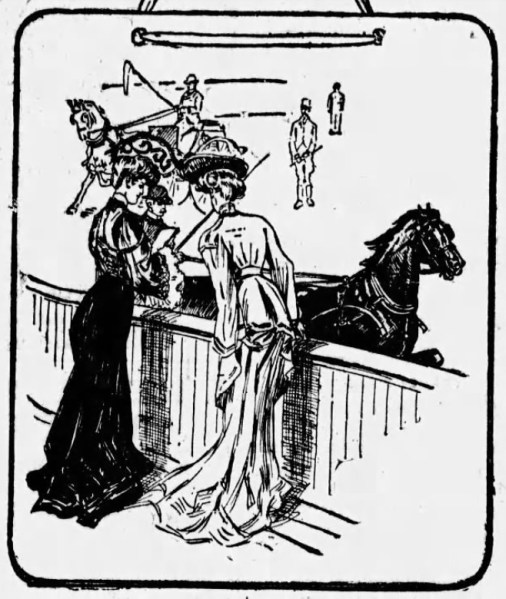
My great-grandfather Robert Stanley Bagg (1848-1912) was a skilled rider and every spring in the early 1900s, he and his wife, Clara, attended the Montreal horse show, held in suburban Westmount. Hunters, jumpers, harness horses and ponies competed for honours, but the show seems to have been more of a social activity than a sporting one, and proceeds from a tea served during the afternoon’s events were donated to the Society for Prevention of Cruelty to Animals.

Illustration of ladies enjoying the Horse Show, 1904. Source: The Montreal Star, May 7, 1904, p. 20

The Montreal Star published columns of names of attendees, and in 1904, the paper noted that R. Stanley Bagg had a private viewing box. Perhaps, like other boxholders, he and Clara entertained guests at dinner prior to the evening events.

Two years later, the Star reported that Clara, dressed in green tweed with a black hat trimmed with white, attended the show with her sister-in-law Amelia Norton, in a purple dress and a white hat, and her daughter Evelyn, in a grey homespun dress and a pale blue hat, trimmed with white.1

Stanley was still riding at age 59 when was injured in an accident on Mount Royal, the mountain that rises behind the city center. The Star reported that he was riding on rough ground near the park ranger’s house when his horse stumbled on a rock, fell and rolled over on one side, pinning Mr. Bagg beneath him. Two men who happened to be nearby helped him get up and encouraged him to rest for a few minutes before riding home. Stanley had sprained his shoulder, hit his head and his face was badly scraped, however, he soon recovered.2

Snowshoeing was also a popular sport in Montreal, and one of Stanley’s favourite winter activities. Between the end of November and the beginning of March, the city’s rival snowshoeing clubs competed in races, held weekly “tramps” over the mountain and organized longer excursions to other locations on the Island of Montreal. Club social activities usually included an annual dinner, charity fundraisers and lots of singing. Stanley was a member of the St. George Snowshoe Club, and it had its own club song with a chorus that began, “Hurrah! Hurrah! It’s jolly on the snow. Hurrah! Hurrah! The stiffest storm may blow.…”3

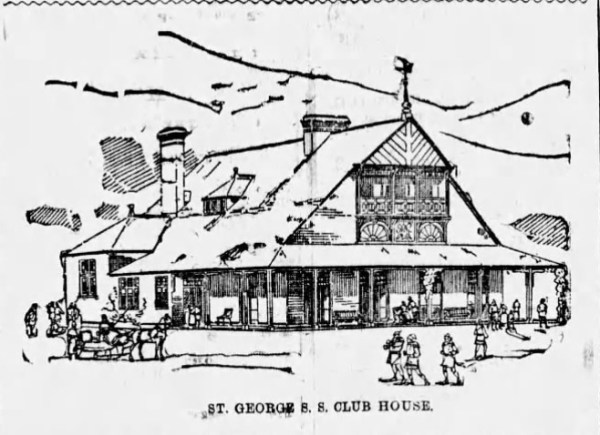
Stanley was on his club’s building and furnishing committee, overseeing the construction of a new clubhouse at Côte St. Antoine. The building was constructed in the early English stye of architecture, with spacious verandas on all sides, a high-pitched roof with dormers and a square entrance hall that gave way to an assembly room with a huge fireplace and large windows overlooking the veranda. When the club house held its grand opening on the evening of December 21, 1887, Stanley was among those who led the way from the Windsor Hotel downtown to the new building.4

The St. George Snowshoe Club’s new clubhouse. Source: The Montreal Star, Feb. 12, 1887, p. 6

When he wasn’t enjoying sports, Stanley, a lawyer, worked in the Bagg family real estate business.  Family life was also important, especially when they were travelling together or on summer holida

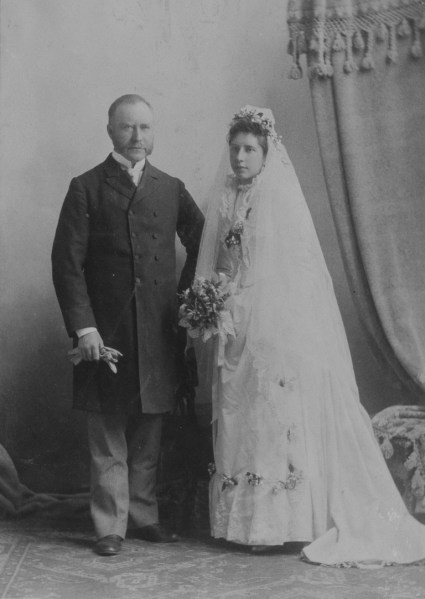
Stanley was married to Clara Smithers (1860-1946). One of eleven children, she was the daughter of Charles Francis Smithers, president of the Bank of Montreal, and his wife, Irish-born Martha Bagnall Shearman. When he started pursuing Clara in 1880, Stanley was age 32 and living at home at Fairmount Villa with his mother and sisters. (His father had died in 1873.) Stanley and Clara were married on June 8, 1882 at St. Martin’s Anglican Church in the presence of guests who included “the elite of our inner social circles.”5

The couple’s eldest child, Evelyn St. Clare Stanley Bagg, was born in 1883, and another daughter – my future grandmother – Gwendolyn Stanley Bagg was born in 1887. Their third child, Harold Fortesque Stanley Bagg, arrived in 1895.

Having started a family, Stanley and Clara must have realized it was time to own a house of their own, so Stanley hired architect William McLea Walbank to build a house at 436 Saint-Urbain, near his mother’s home. It was completed in 1884. 

According to a newspaper report, it was a handsome, well-finished brick villa of the Early English style of architecture, on Upper St. Urbain Street. The house contained all the modern conveniences of the time and was heated by Spence’s patent hot water furnace throughout. It claimed to be rat-proof. The bricks were all of Montreal manufacture and compared favorably with imported pressed bricks.

The family did not stay there long, however. In 1890, Lovell’s city directory listed Stanley as living in Georgeville, Quebec, while his sister Mary, the wife of stock broker Robert Lindsay, was living in the house on St. Urbain. Stanley had purchased a large house in Georgeville, on Lake Memphremagog, although it was probably a summer residence. Montreal was a very dirty and unhealthy city, especially in the heat, so many Montrealers left town during the summer months.

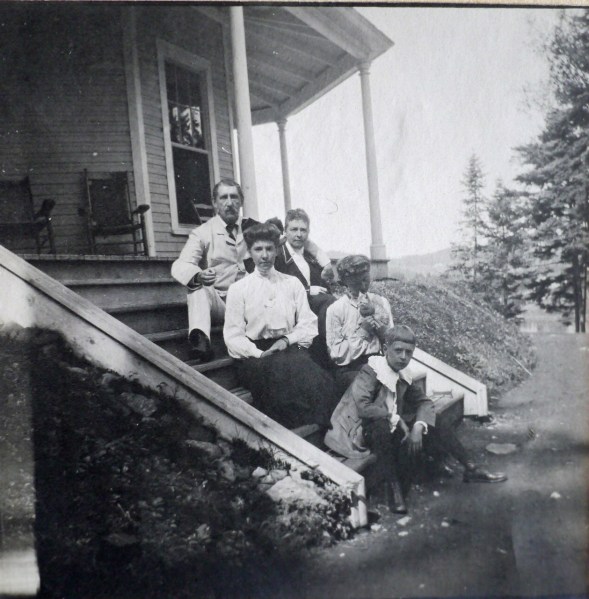
The Bagg family on summer holiday. Source: Gwendolyn Catherine Stanley Bagg, Portrait of the Family, Cacouna, 1903, McCord-Stewart Museum, M2013.591.134

It does not appear that the Baggs owned the Georgeville house for many years. My grandmother acquired a camera around 1901 and her snapshots showed family summer vacations at Cacouna on the lower St. Lawrence River, at a rented a house on a lake near Ste. Agathe in the Laurentian Mountains, and at a summer hotel at Kennebunk Beach, Maine.

As for their city home, perhaps Stanley and Clara realized that their house on St. Urbain was not in the city’s most desirable neighbourhood. The place to live in Montreal was on the southwest slope of Mount Royal, an area known as the Golden Square Mile. Montreal was the financial and industrial capital of Canada, and businessmen were making fortunes and building mansions in that part of the city.

Stanley purchased a lot at the western edge of the Golden Square Mile, the corner of Sherbrooke Street and Côte des Neiges Road, and architect Walbank designed a new red sandstone house for him. Construction started in 1891, and the Baggs were living there by 1892. It was Stanley’s home until his death from cancer in 1912.6 Clara then divided the house into two apartments and remained there until she died in 1946.

Sources:

  1. “Horse Makes Farewell Bow Tonight,” The Montreal Star (Montreal, Quebec), May 12, 1906, p. 12, digital image, https://www.newspapers.com/image/738949773; accessed Aug. 4, 2024.
  • “Snowshoeing; The Red Cross Knights; St. George’s Snowshoe Club Inaugurated Last Night,” The Gazette, (Montreal, Quebec), Dec. 21, 1887, p. 8, digital image, https://www.newspapers.com/image/419349867; accessed Aug. 3, 2024.
  • “Marriage Chimes: Fashionable Wedding at St. Martin’s Church Yesterday,” The Gazette, (Montreal, Quebec), June 9, 1882, p. 3.

The Silver Spoon

In this article I refer to Robert Stanley Bagg by his middle name since it was the name by which he was best known. In other articles I have referred to him as RSB to differentiate him from his father, Stanley Clark Bagg (SCB) and his grandfather, Stanley Bagg.

My great-grandfather Robert Stanley Clark Bagg, or R. Stanley Bagg (1848-1912), was born with the proverbial silver spoon in his mouth, however, working in the family real estate business was not what he really wanted to do in life. It wasn’t until after he retired that he was able to follow his true passion: politics.

I never heard any family stories about Stanley, perhaps because he died several years before my mother was born. It wasn’t until Montreal’s two major English-language newspapers were digitized a few years ago that I learned about his various interests and activities. In fact, his name appeared in Montreal newspapers frequently, especially after the late 1890s when he became active in the Conservative party.  

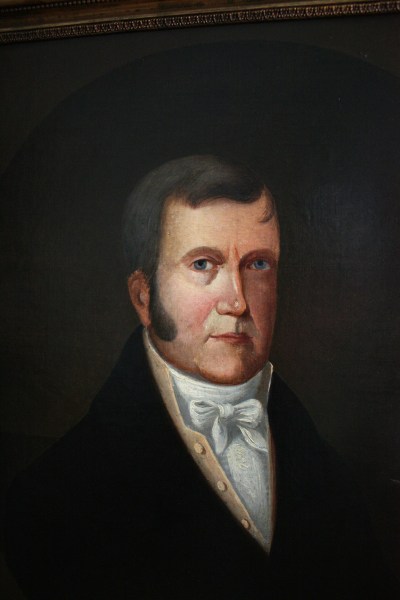
Portrait of Robert Stanley Bagg by Adam Sheriff Scott. Private collection.

Stanley was the second child of Montreal notary and land-owner Stanley Clark Bagg (1820-1873) and Philadelphia-born Catharine Mitcheson (1821-1914). The couple’s first child died before Stanley was born. Three younger sisters, Katharine, Amelia and Mary, were born in 1850, 1852 and 1854, and a fourth sister, Helen, arrived in 1861. Even as a child, Stanley must have been told that he would have a leadership role in the family, not only as the eldest, but also as the only male.

According to his obituary in the Montreal Gazette,1 Stanley studied law at McGill University and passed the bar in 1873. He then left Montreal for England, intending to further his studies, however, his father died unexpectedly in August of that year and Stanley came home. For a short time, he was in partnership with lawyer Donald Macmaster, sharing an office on St. James Street, in the old business heart of the city, but he gave up his legal practice to concentrate on the administration of his late father’s real estate. Nevertheless, throughout his life, Stanley identified himself as a lawyer or an advocate, a term used to refer to the practice of Quebec’s civil law.  

The job Stanley undertook as administrator of his father’s estate was not an easy one. Montreal was growing rapidly, with thousands of new immigrants arriving, manufacturing, railroads and industries expanding and construction of new residences ongoing. The farmland that comprised the vast S. C. Bagg Estate, mostly located on the west side of St. Laurent Boulevard in a corridor north of Sherbrooke Street, increased in value as the city grew. Sales, mainly of residential properties, became a profitable business.

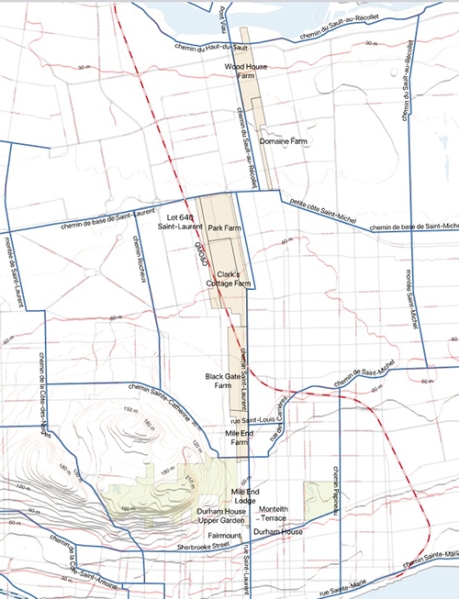
This map shows the extent of the late Stanley Clark Bagg’s properties, shaded in beige, in 1875, when an inventory was made of his estate. These properties are overlaid over a modern map of the island of Montreal. At that time, the actual city of Montreal was south of Sherbrooke Street, extending down to the banks of the Saint Lawrence River. The eastern slope of Mount Royal is adjacent to the Mile End properties. Map created by Justin Bur, based on two open data sources: physical geography from CanVec, Natural Resources Canada and modern streets from Geobase, City of Montreal.

Stanley does not seem to have been interested in developing and promoting housing or commercial real estate projects himself, but he did decide which pieces of land to subdivide into lots and he supervised sales. The Estate also rented small residential and commercial buildings, and some of the land was sold to the city for civic projects such as parks.

He encountered many unexpected headaches over the years. He had to ask the provincial government to pass a special law in 1875 to override a provision in SCB’s will in order to make the lot prices competitive.2 There were misunderstandings in 1889-91 over which properties were part of the estate and which belonged to the five children. And sister Helen’s husband disappeared under mysterious circumstances in 1897, owing the family large sums of money.

Although Stanley was the main administrator of his father’s estate, several family members acted as advisors. His mother had a great deal of input, and sister Amelia kept track of some of the property sales. When a major decision had to be made, family members got together to discuss it, or if that was not possible, they communicated through letters.

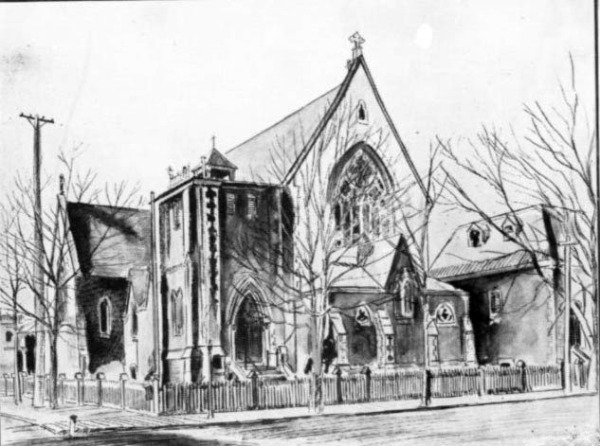
Robert Stanley Bagg and Clara Smithers were married in 1882 at St. Martin’s Anglican Church, on what was then the corner of Saint Urban and Bagg Streets. Bagg Street was later renamed Prince Arthur and the current Bagg Street is located several blocks further north. St. Martin’s never acquired a spire and it was eventually demolished. Image source: St. Martin’s Church, Historical Sketch of St. Martin’s Church : 1874-1902, Montreal, Canada, 1902?; Canadiana, https://www.canadiana.ca/view/oocihm.85997  Accessed June 14, 2023.

When Stanley announced his retirement as of January, 1901, his mother arranged to hire someone to succeed him, and she wrote Stanley a thank-you letter.3 She described her husband’s unexpected death as a calamity for the family, especially for Stanley who was “so young and inexperienced in the ways of the world.”  She commended him for the “able, honourable and efficient manner” in which he had performed his arduous duties for 27 years. She added, “I am most anxious that you should have a complete rest from all the worry and anxiety that is unavoidably connected with the responsible position you have occupied for such a long time – and while personally I shall greatly miss you, I hope that your absence and a complete change will allow you to regain your usual health and strength.”

One activity Stanley found helped to restore his health was travel, especially ocean voyages.  Perhaps he got the travel bug when he was 20 and spent a year exploring the highlights of Europe with his parents, his aunt and his sisters.

In 1875, Stanley visited England again with his mother and one of his sisters, and he returned to Europe with his new wife, Clara Smithers, on their two-month-long honeymoon in the summer of 1882.

In 1891, he and Clara spent an extended period of time in England, taking along their two young daughters. That year’s Census of England showed Stanley, Clara, the children, a governess and a cook staying in a lodging house in St. George Hanover Square, in central London. Ten years later, after his retirement, Stanley returned to Europe, this time touring for eight months.

While real estate management, legal training and travel seem to have been family traditions, so was military service. Stanley’s father had served in the military, and his grandfather had been a major in the 1st Battalion Loyal Volunteers during the Rebellion of 1837. His great-grandfather Phineas Bagg had served during the American Revolution ((1775-1783) before immigrating to Canada.

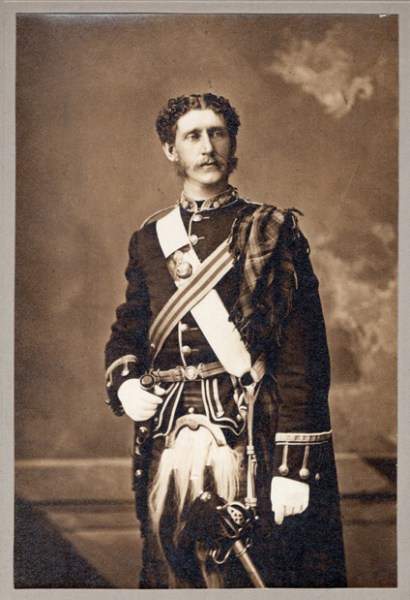
In 1877, the Canada Gazette reported that R. Stanley Bagg, gentleman, began his military service as an ensign with the 5th Battalion, Royal Fusiliers, Montreal. When he retired in 1882, he retained the rank of captain from what had become the Royal Scots Fusiliers. Although his military career was relatively short, it appears to have been a success. The Montreal Star quoted the following article about Stanley that had appeared in the paper 30 years earlier:4

“There are few better-known figures in Montreal than Captain Stanley Bagg. He was an enthusiastic volunteer and belonged to the old 5th Royals before and after they had become a kilted regiment. At the time of the ship labourers’ riots in Quebec, when several regiments of Montreal were sent to restore order and liberate the regular garrison, who were practically prisoners in the Citadel, the 5th Royal Scots were marched up Mountain Hill and the honour of leading them was conferred by the colonel of the regiment on Captain Bagg owing to his height and commanding presence. Captain Bagg has always been an ardent supporter of and participant in athletic sports. A good rider and one of the old Dowell school of boxers, he kept himself in such first-class condition that he can stand almost any fatigue.”

I had read the letter written by Stanley’s mother about his retirement many years ago, and it had left me with an image of my great-grandfather as a tired and anxious man. This newspaper article made me realize that he had indeed once been a strong leader and an good athlete.

This article is also posted on http://www.writinguptheancestors.ca

Footnotes:

1. “R. Stanley Bagg Died Yesterday,” The Gazette, July 23, 1912, p. 4, accessed June 9, 2024.

2. “38 Vict. cap. XCIV, assented to 23 February 1875”, Statutes of the Province of Quebec passed in the thirty-eighth year of the reign of Her Majesty Queen Victoria, part 1, p. 474, https://books.google.ca, accessed June 9, 2024.

3. Catharine Mitcheson Bagg, Correspondence, P070/B6.4, Bagg Family Fonds, McCord Stewart Museum, https://collections.musee-mccord-stewart.ca/en/objects/details/176488; classification scheme; personal documents; correspondence. Accessed June 14, 2024.

4. “From the Star Files 30 Years Ago Today” The Montreal Star, Sept. 17, 1909, p. 10, www.newspapers.com, accessed June 9, 2024.

See also:

Janice Hamilton, “Bagg Family Dispute part 1: Stanley Clark Bagg’s Estate”, Writing Up the Ancestors, Dec. 13, 2023, https://www.writinguptheancestors.ca/2023/12/bagg-family-dispute-part-1-stanley-clark-baggs-estate.html

Janice Hamilton, “The Bagg Family Dispute part 2”, Writing Up the Ancestors, Feb. 14, 2024, https://www.writinguptheancestors.ca/2024/02/the-bagg-family-dispute-part-2.html

Janice Hamilton, “Helen Frances Bagg: A Happy Exile”, Writing Up the Ancestors, Jan. 6, 2016, https://www.writinguptheancestors.ca/2016/01/helen-frances-bagg-happy-exile.html

Janice Hamilton, “Continental Notes for Public Circulation”, Writing Up the Ancestors, April 8, 2020, https://www.writinguptheancestors.ca/2020/04/continental-notes-for-public-circulation.html

Janice Hamilton, “Aunt Amelia’s Ledger”, Writing Up the Ancestors, April 26, 2023, https://www.writinguptheancestors.ca/2023/04/aunt-amelias-ledger.html

Clara Smithers Weds R. Stanley Bagg, Writing Up the Ancestors, March 2, 2014, https://www.writinguptheancestors.ca/2014/03/clara-smithers-weds-r-stanley-bagg.html

Janice Hamilton, “The Life and Times of Stanley Bagg, 1788-1853”, Writing Up the Ancestors, Oct. 5, 2016, https://www.writinguptheancestors.ca/2016/10/the-life-and-times-of-stanley-bagg-1788.html

The Art of Ectoplasm: a Book Review

When I was a teenager, I came across a book in my parents’ house called Intention and Survival, written by T. Glen Hamilton, my grandfather. Inside a plain beige cover, the text was illustrated with grainy black and white photographs. Many of them showed a middle-aged woman, her eyes closed, with a white substance coming from her mouth or nostrils. Tiny images of the faces of deceased individuals seemed to be embedded in this substance.

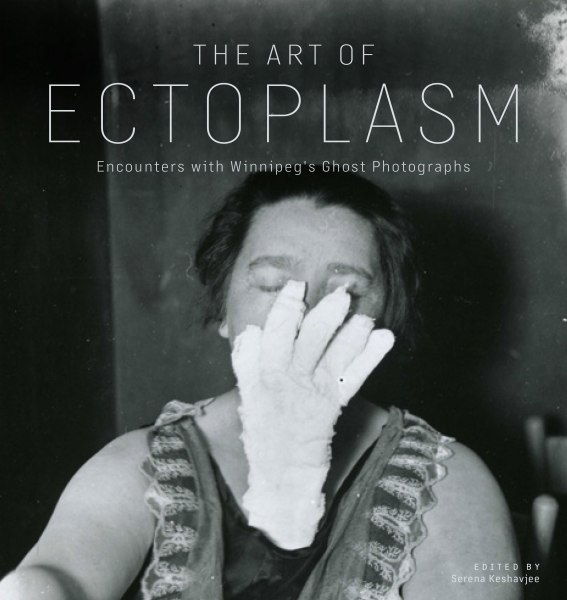
Those photos gave me nightmares, and for decades, I have been trying to figure out what to make of them. Now, a new book called The Art of Ectoplasm: Encounters with Winnipeg’s Ghost Photographs is helping me understand them.

Edited by Serena Keshavjee, a professor of art and architectural history at the University of Winnipeg, and published by the University of Manitoba Press, The Art of Ectoplasm looks at the context in which my grandparents researched and photographed psychic phenomena, including that white substance called ectoplasm. The book describes their work and the many artistic projects it has inspired.   

Published on large-format paper, the book itself is a work of art. The black and white, sepia and contemporary colour photographs almost glow. Most of the old photos were taken during séances held at the Hamiltons’ Winnipeg, Manitoba home 100 years ago. Shot in a darkened room, lit by flash, with large-format cameras, these are sharp, high-contrast images that can be seen as both documentary photos and as art. Meanwhile, the 300-page text explores the history of these séances and includes an extensive bibliography. 

Dr. Thomas Glendenning Hamilton (1879-1935), known to most of his friends as T.G., was a family physician and surgeon, president of the Manitoba Medical Association and member of the Manitoba Legislative Assembly. He was a strict Presbyterian and elder of his church. He and his wife, Lillian (Forrester) Hamilton (1880-1956), had four children, including twin boys. Everyone in the household got sick during the 1918-1919 influenza pandemic, and one of the twins, three-year-old Arthur, died of the flu.

At the time, many people were strongly religious and believed in personal survival after death. Some tried to communicate with deceased loved ones. Alhough T.G.’s experiments in telepathy date from 1918, before the influenza pandemic, Arthur’s death may have stimulated the Hamiltons’ interest in the psychic field. Lillian started experimenting with table movements and rapping, and eventually T.G. was encouraged to participate. He decided to take a scientific approach. He prepared a room in the family home where the conditions could be carefully controlled and, in 1923, he began to conduct a series of experiments related to telekinesis, trance and mediumship that included the appearance of ectoplasm. These séances took place once or twice a week over a twelve-year span.

Lillian encouraged and collaborated with her husband, conducted research to make sense of alleged trance communications, did much of the organizing and often chaperoned the mediums. After T.G.’s death, she compiled the notes taken during the séances, as well as the photographs, her husband’s speeches and other material. She also continued to attend séances. She has received little public credit for her contributions, but that is beginning to change as Katie Oates, of Western University in London, Ontario, contributed a chapter in this book that focuses on Lillian’s role.

In 1979, T.G. and Lillian’s daughter, Margaret Hamilton Bach (1909-1986), donated the original photographic plates and documents to the archives at the University of Manitoba. Since then, the university has received many other collections of material related to psychical research and, as archivist Brian Hubner writes in The Art of Ectoplasm, the city has become known as “weird Winnipeg, an unlikely centre of the paranormal”.

Shelley Sweeney, archivist emerita and retired head of the University of Manitoba Archives and Special Collections, notes that the Hamilton Family Fonds has inspired a variety of projects, including books, plays and visual arts. It is the most utilized collection of personal records held by the archives, and photographs from the Hamilton collection have been exhibited in museums around the world.

In another article, Esyllt W. Jones, a professor of history and community health sciences at the University of Manitoba, puts the Hamiltons’ séances into the context of the couple’s grief following their child’s death. She also shows how their experience was an example of the trauma caused by the pandemic and the loss of loved ones during World War I.

Miniature face in ectoplasm of C.H. Spurgeon, with medium Mary Marshall, taken by T.G. Hamilton, May 1, 1929. UMASC H.A.V. Green Fonds

Thanks to the movie Ghostbusters, the word ectoplasm became popular in the 1980s, long after T.G.’s research involving ectoplasm took place between 1928 and 1934. Ectoplasm has been described as a vaporous substance that appears from the mouth or other orifices of a medium. Formless at first, it can change to resemble muslin or cotton batting before being reabsorbed into the medium’s body. T.G. thought of it as a living thing, directed by an internal intelligence. Ectoplasm has not been tested in a laboratory and, since World War II, it has not been considered a topic for credible scientific study.

The scientific methods that T.G. used in his “laboratory” are outdated today, but during his lifetime, as editor and contributor Keshavjee writes, psychical research was considered within the bounds of accepted scientific inquiry. There was a large body of literature on the topic and a number of well-respected scientists of the era accepted that strange things happened in the séance room. But, Keshavjee suggests, when the Hamilton séance activities began to be directed by an unseen personality called Walter, T.G.’s claims that he followed scientific methods lost credibility.

Today, questions about fraud hang over many psychic activities. Some people are convinced the Hamilton séances were fraudulent, others believe they were genuine. For the most part, this book accepts the Hamilton séance photographs without trying to address the issue.

In his chapter defending the Hamilton family psychical research legacy, Walter Meyer zu Erpen, founder of the Survival Research Institute of Canada and an archivist who has spent more than 30 years investigating these events and the people involved, concludes that the ectoplasm photographed by the Hamiltons was genuine.

Whether the appearance of ectoplasm was proof of survival after death is another question. In general, Keshavjee writes, there is little basis for belief that psychic phenomena inherently provide evidence of life after death. Meyer zu Erpen admits he is taking a middle-of-the-road position when he suggests that, in the Hamilton séances, only the ectoplasm samples with miniature faces of the deceased contribute to evidence for survival of human personality beyond death.

T.G. was convinced, however, that what he experienced in the séance room could only be the work of surviving spirts. For him, and for Lillian, survival was a fact.

The Art of Ectoplasm did not answer all my concerns, but for anyone interested in the Hamilton séances from an artistic, historical or psychical research perspective, it is worth going beyond the amazing photos and reading the text.

This article was simultaneously posted on my personal family history blog, http://www.writinguptheancestors.ca

Notes:

Full disclosure: as family historian, my research has been quoted several times in The Art of Ectoplasm and my father edited Intention and Survival.

The Art of Ectoplasm is available from the University of Manitoba Press, https://uofmpress.ca/books. It can also be ordered from Amazon, Indigo and other booksellers.

See also:

Hamilton Family Fonds, University of Manitoba, UM Digital Collections, Archives and Special Collections, https://digitalcollections.lib.umanitoba.ca/islandora/object/uofm%3Ahamilton_family

Walter Meyer zu Erpen, “Hamilton, Thomas Glendenning” in Dictionary of Canadian Biography, vol. 16, University of Toronto/Université Laval, 2003–, http://www.biographi.ca/en/bio/hamilton_thomas_glendenning_16E.html

Janice Hamilton, “Reinventing Themselves Has Been Launched”, Writing Up the Ancestors, June 23, 2021, https://www.writinguptheancestors.ca/2021/06/reinventing-themselves-has-been-launched.html

The Bagg Family Dispute, part 2

In collaboration with Justin Bur

When my great-great grandfather Stanley Clark Bagg died in 1873, his wife and five children inherited large tracts of farmland on the island of Montreal, land that they made a family business of selling.1 But misunderstandings over who owned what and how to keep track of the income created a lot of difficulties. 

Stanley Clark Bagg (I usually refer to him as SCB to differentiate him from his father, Stanley Bagg, and his son, Robert Stanley Bagg,) had inherited most of this property from his grandfather John Clark (1767-1827).2 But there were conditions attached to some of these bequests: Clark’s 1825 will stated that land that comprised the Durham House property, and land comprising Mile End Farm, should pass down through three generations of descendants before it could be sold. The legal term for this, in civil law, is a substitution. However, a change in the law, passed in 1866, limited substitutions to two generations.3 That meant that the generation of Robert Stanley Bagg and his sisters Katharine, Amelia, Mary and Helen were the last generation affected by the substitutions and they could do what they liked with these properties.

The substitution clause referring to Durham House was part of the 1819 marriage contract between SCB’s parents, in which John Clark gave that property to his daughter as a wedding present.4 (It is shown in dark green on the map below.)

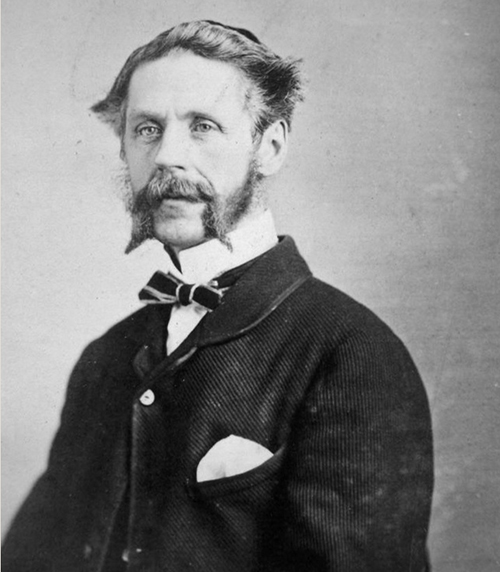
Robert Stanley Bagg, # II-57308.1, 1880, Notman & Sandham, McCord-Stewart Museum; Bagg family collection.

When SCB died at age 53, none of his family members was ready to manage these properties. His only son, Robert Stanley Bagg, or RSB, (1848-1912) had recently graduated in law, but he had no experience in renting or selling properties. Furthermore, neither the notary who completed the inventory of SCB’s estate in 1875,5 nor SCB’s widow, nor his children were aware of the substitutions. The Durham House and Mile End Farm properties were treated as though they were no different than the other properties belonging to the late SCB’s estate.

The 22-acre Durham House property (lots 19–28 and 101–115, cadastre of the Saint-Laurent ward) was located north of Sherbrooke Street, on the west side of today’s Saint-Laurent Boulevard. SCB had subdivided part of it and sold lots from it as early as 1846. In 1889, RSB, who was an executor of his father’s estate, subdivided the Upper Garden of Durham House (lot 19, Saint-Laurent ward) and began to sell those lots. He signed the property documents as “R. Stanley Bagg for the estate,” and his mother, Catharine Mitcheson Bagg, also signed.

But the Durham House property actually belonged jointly to the five Bagg siblings. It was not part of SCB’s estate, and his widow could not inherit this land, sell lots from it or acquire income from it. Yet that is what she did: the name Dame Catharine Mitcheson, widow of Stanley Clark Bagg, appeared on five deeds of sale in 1889.  

It is not clear who discovered the error, but perhaps someone close to the Bagg family took a good look at the property documents and noticed these details. SCB’s middle daughter, Amelia Bagg, was to marry Joseph Mulholland the following year, and he worked as a real estate agent for the Stanley Clark Bagg Estate. Also, Joseph’s brother-in-law, John Murray Smith, was about to purchase several of the Durham House lots. Any one of these people could have discovered the marriage contract and John Clark’s will, which SCB had registered at the provincial land registry office.6

This map shows details of several of the late Stanley Clark Bagg’s properties in 1875, when an inventory was made of his estate. Durham House and its upper garden, as well as a small part of the Mile End Farm and SCB’s home, Fairmount Villa, are overlaid over a modern map of the island of Montreal. Mile End Lodge had been John Clark’s home. At that time, the densely populated part of Montreal was south of Sherbrooke Street. Mount Royal Park, opened in 1876, is on the left. Map created by Justin Bur, based on two open data sources: physical geography from CanVec, Natural Resources Canada and modern streets from Geobase, City of Montreal.

As soon as they became aware of the situation, the Bagg siblings tried to remedy it with a notarized document called a Ratification.7 It said that, as the actual owners, they ratified and approved the five sales made by their mother. A few weeks later, in January and April of 1890, the Bagg siblings sold five lots to John Murray Smith and four to James Baxter, and this time, the vendors named in the deeds were correct.

Next, Catharine and her five children took a step to sort out the income from lots from the Durham House property that SCB had sold in his lifetime. They did not involve a notary, but tried to look after the issue as a family, signing a document called an Indenture on May 12, 1890.8

The indenture stated that neither Catharine nor her children had known about the marriage contract until December, 1889. The Bagg children (by now all were adults) declared the love and affection they had for their mother and their desire to settle the matter amicably, and released her from all claims and demands. For her part, Catharine agreed to repay to her children the capital sums she had received from the sale of these properties. Because she had paid taxes and expenses on them, the children made no claim for the interest payments she had received.

Action Demanded

No doubt confident that everything had been resolved, RSB took his wife and two young daughters on an extended trip to England, leaving his mother and sisters to handle offers for land sales during his absence. After his return, however, the family dispute blew up once more, this time over the Mile End Farm property. Two of the married sisters, Katharine Sophia Mills and Mary Heloise Lindsay, hired a notary to represent their interests.

Notary Henry Fry sent a complaint on their behalf to the three living executors of SCB’s will — Catharine Mitcheson Bagg, Robert Stanley Bagg and notary J.E.O. Labadie – demanding immediate action. Dated July 22, 1891 and titled Signification and Demand,9   this document stated that the executors of SCB’s will were bound, upon his death, to deliver over the Durham House and Mile End Farm properties to his children, and to produce an account of the administration of these properties.

Catharine Mitcheson Bagg, #71147, 1883, William Notman & Son, McCord-Stewart Museum; Bagg family collection.

It stated that the executors “have wholly failed and neglected to render such account, but on the contrary, have, since the death of the said Stanley Clark Bagg, continued in possession of the said substituted property and have even sold and alienated portions thereof and have received the consideration money of such sales and have received and retained the entire revenues therefrom and that although they have been recently requested to render such account, the said executors have neglected and refused to do so.”

The executors had until August 10 to provide an account of the property belonging to the substitutions. They must have met this demand because no further complaints have turned up. Furthermore, the Bagg siblings seem to have found a better solution to their dilemma: they partitioned the Durham House property and sold a large chunk of the Mile End Farm.

In September 1891, the remaining unsold lots of the Durham House property were grouped into five batches, and the five siblings pulled numbers out of a hat to determine who got which ones.10 They could then sell these lots, or keep them, as they pleased.

Two months later, the five siblings sold 145 arpents of land, including most of the Mile End Farm and a section of the adjoining Black Gate Farm, to Clarence James McCuaig and Rienzi Athel Mainwaring,11 These Toronto land developers had plans to develop an exclusive housing development they called Montreal Annex in the area.12

As for keeping track of property sales, Amelia, the middle Bagg sibling who was now married to Joseph Mulholland, took on that responsibility. Starting in 1892, she kept a ledger in which she wrote down the dates, names of purchasers and prices paid for each of the lots that were part of the Mile End Farm and Durham House properties.13

This article is also posted on my personal family history blog, www.writinguptheancestors.ca

See also:

Janice Hamilton, “Bagg Family Dispute Part 1: Stanley Clark Bagg’s Estate”, Writing Up the Ancestors, Dec. 13, 2023, https://www.writinguptheancestors.ca/2023/12/bagg-family-dispute-part-1-stanley-clark-baggs-estate.html

Janice Hamilton, “Aunt Amelia’s Ledger” Writing Up the Ancestors, April 26, 2023,  https://www.writinguptheancestors.ca/2023/04/aunt-amelias-ledger.html

Janice Hamilton, “Stanley Clark Bagg’s Family”, Writing Up the Ancestors, Feb. 29, 2020,  https://www.writinguptheancestors.ca/2020/02/stanley-clark-baggs-family.html

Janice Hamilton, “My Great-Great Aunts, Montreal Real-Estate Developers”, Writing Up the Ancestors, October 11, 2017, https://www.writinguptheancestors.ca/2017/10/my-great-great-great-aunts-montreal.html

Janice Hamilton, “A Home Well Lived In”, Writing Up the Ancestors, Jan. 21, 2014, https://www.writinguptheancestors.ca/2014/01/a-home-well-lived-in.html

Notes:

The Indenture, the Deed of Ratification and several other documents mentioned in this article were donated to the archives of the McCord Stewart Museum in Montreal around 1975 by my cousin.

This article was written in collaboration with urban historian Justin Bur. Justin has done a great deal of historical research on the Mile End neighbourhood of Montreal (around Saint-Laurent Blvd. and Mount Royal Ave.) and is a longtime member of the Mile End Memories/Memoire du Mile-End community history group (http://memoire.mile-end.qc.ca/en/). He is one of the authors of Dictionnaire historique du Plateau Mont-Royal (Montreal, Éditions Écosociété, 2017), along with Yves Desjardins, Jean-Claude Robert, Bernard Vallée and Joshua Wolfe. His most recent article about the Bagg family is La famille Bagg et le Mile End, published in Bulletin de la Société d’histoire du Plateau-Mont-Royal, Vol. 18, no. 3, Automne 2023.

Sources:

  1. Stanley Clark Bagg will, J.A. Labadie, n.p. no 15635, 7 July 1866
  2. John Clark will, Henry Griffin, n.p. no 5989, 29 August 1825
  3. In 1866 the government of Lower Canada enacted the Civil Code. This was a compilation and revision of the civil law inherited from the French regime; article 932 of the code put a two-generation limit on substitutions.
  4. Marriage contract between Stanley Bagg and Mary Ann Clark, N.B. Doucet, n.p. no 6489, 5 August 1819
  5. Stanley Clark Bagg inventory, J.A. Labadie, n.p. no 16733, 7 June 1875
  6. John Clark’s will and the marriage contract between Stanley Bagg and Mary Ann Clark are still publicly available at the Registre foncier du Québec. John Clark’s will had been transcribed there in 1844 (Montréal ancien #4752). The marriage contract (Montréal Ouest #66032) was transcribed in 1872. SCB’s will was transcribed into the register (Montréal Ouest #74545) in 1873.
  7. Deed of Ratification, Adolphe Labadie, n.p. no 2063, December 12, 1889, register Montreal Est #25109, McCord Stewart Museum (P070/66,3) This notary was a son of notary J.E.O. Labadie, who was an executor of the will, and grandson of notary J.A. Labadie, who had handled SCB’s will and the inventory of his estate.
  8. Indenture, May 12, 1890, McCord Stewart Museum (P070/B6,3).
  9. Signification and Demand, Henry Fry, n.p. no. 2234, 22 July 1891, McCord Stewart Museum (P070/B6,3).
  10. Deed of Partition, John Fair, n.p no 3100, Sept. 10, 1891, register Montreal Est #29503, McCord Stewart Museum (P070/B8,4).
  11. Deed of Sale, William de Montmollin Marler, n.p. #17571, 20 November, 1891, register Hochelaga-Jacques-Cartier #40225
  12. Justin Bur, Yves Desjardins, Jean-Claude Robert, Bernard Vallée, Joshua Wolfe, Dictionnaire historique du Plateau Mont-Royal (Montreal, Éditions Écosociété, 2017), p 271.
  13. Amelia Josephine Bagg Mulholland, Grand livre, 1891-1927, McCord Museum, Fonds Bagg, P070/B07,1. https://collections.musee-mccord-stewart.ca/en/objects/293626/a-j-mulholland-ledger (accessed April 3, 2023)

The Bagg Family Dispute, part 1: Stanley Clark Bagg’s Estate

Written by Janice Hamilton, with research by Justin Bur

Note: there were three generations named Stanley Bagg, so for the sake of brevity I use their initials: SCB for generation two, Stanley Clark Bagg, and RSB for generation three, Robert Stanley Bagg.

   Be careful what you wish for, especially when it comes to writing a will and placing conditions on how your descendants are to use their inheritance. That was a lesson my ancestors learned the hard way.

It took a special piece of provincial legislation in 1875 and what appears to have been a family crisis before these issues were finally resolved many years later. 

The estate at the heart of these problems was that of the late Stanley Clark Bagg (1820-1873), or SCB. He had owned extensive properties on the Island of Montreal. Several adjacent farms, including Mile End Farm and Clark Cottage Farm, stretched from around Sherbrooke Street, along the west side of Saint Lawrence Street (now Saint-Laurent Boulevard), while three other farms extended along the old country road, north to the Rivière des Prairies. SCB had inherited most of this land from his grandfather John Clark (1767-1827).  Although he trained as a notary, SCB did not practise this profession for long, but made a living renting and selling these and other smaller properties.  

This map shows the extent of the late Stanley Clark Bagg’s properties, shaded in beige, in 1875, when an inventory was made of his estate. These properties are overlaid over a modern map of the island of Montreal. At that time, the actual city of Montreal was south of Sherbrooke Street, extending down to the banks of the Saint Lawrence River. The slope of Mount Royal is just west of the SCB estate. Map created by Justin Bur, based on two open data sources: physical geography from CanVec, Natural Resources Canada and modern streets from Geobase, City of Montreal.

At age 52, SCB suddenly died of typhoid. In his will, written in 1866, he named his wife, Catharine Mitcheson Bagg (1822-1914), as the main beneficiary of his estate, to use and enjoy for her lifetime, and then pass it on to their descendants. He also made her an executor, along with his son Robert Stanley Bagg (RSB, 1848-1912). There were two other executors: Montreal notary J.E.O. Labadie and his wife’s brother, Philadelphia lawyer McGregor J. Mitcheson.

But SCB’s estate was large and complicated, and no one was prepared to handle it. RSB had recently graduated in law from McGill and was continuing his studies in Europe at the time of his father’s death. As for Catharine, she became involved in decisions regarding property sales over the years, but she must have felt overwhelmed at first.

Notary J.A. Labadie spent two years doing an inventory of all of SCB’s properties, listing where they were located, their boundaries, and when and from whom they had been acquired, but he did not mention two key documents. One of these was the marriage contract between SCB’s parents, the other was John Clark’s will.

John Clark, a butcher, was born in County Durham, England and came to Montreal around 1797. Bagg family collection.

In the marriage contract, John Clark gave a wedding present to his daughter, Mary Ann Clark (1795-1835), and her husband, Stanley Bagg (1788-1853): a stone house and about 22 acres of land on Saint Lawrence Street. Clark named the property Durham House. But it was not a straight donation; it was a substitution, similar to a trust, to benefit three generations: Mary Ann’s and Stanley’s child (SCB), grandchildren (RSB and his four sisters) and the great-grandchildren. Each intervening generation was to have the use and income from the property, and was responsible for transmitting it to the next generation. That meant SCB could not bequeath it in his will because his children automatically gained possession, and so on, with the final recipients being the great-grandchildren.

In his 1825 will, Clark had made an even more restrictive condition regarding the Mile End Farm. This time the substitution was intended to be perpetual “unto the said Mary Ann Clark and unto her said heirs, issue of her said marriage and to their lawful heirs entailed forever.”

Perhaps Clark imposed these conditions on his descendants for sentimental reasons. Durham House was his daughter’s family home, and Stanley Bagg had probably courted Mary Ann on the Mile End Farm while he was running a tavern there with his father. Or maybe Clark simply believed that these provisions would give the best financial protection to his future descendants. SCB must have thought this was a good idea because his will also included a substitution of three generations.

Clark and SCB did not foresee, however, that the laws regarding inheritances would change. In fact, the provincial government changed the law regarding substitutions a few months after SCB wrote his will. This new law limited substitutions to two generations. Meanwhile, when SCB died in 1873, no one seems to have remembered that the substituted legacies Clark had created even existed. 

Stanley Clark Bagg, Montreal, QC, 1863, William Notman, McCord Stewart Museum #1-5660.1

Real estate sales practices also changed over the years. Clark had written a codicil specifying that any lot sales from the Mile End Lodge property, where he and his wife lived and which he left to her, were subject to a rente constituée. The buyer paid the vendor an amount once a year (usually 6% of the redemption value), but it was like a mortgage that could never be paid off. In the early 1800s this had been a common practice in Quebec, designed to provide funds to the seller’s family members for several generations.

SCB similarly stipulated that nothing on the Durham House property could be sold outright, but only by rente constituée. By the time he died, some of the properties located near the city outskirts were becoming attractive to speculators and to people wanting to build houses or businesses, but the inconvenience of a rente constituée was discouraging sales. It became clear that the executors had to resolve the issue.

They asked the provincial legislature to pass a special law. On February 23, 1875, the legislature assented to “An Act to authorize the Executors of the will of Stanley C. Bagg, Esq., late of the City of Montreal, to sell, exchange, alienate and convey certain Real Estate, charged with substitution in said will, and to invest the proceeds thereof.” (According to the Quebec Official Gazette, this was one of about 100 acts that received royal assent that day after having been passed in the legislative session to incorporate various companies and organizations, approve personal name changes, amend articles in the municipal and civil codes, etc.)

This act allowed the executors of the SCB estate, after obtaining authorization from a judge of the superior court, and in consultation with the curator to the substitution, to sell land outright, provided that the proceeds were reinvested in real estate or mortgages for the benefit of the estate. In other words, the rente constituée was no longer required, and sales previously made by the estate were considered valid.

No more changes were made until 1889, when family members realized that part of SCB’s property actually belonged to his children, and not to his estate, and a family dispute erupted. The story of how they resolved this issue and remained on good terms will be posted soon.

This article is also posted on my personal family history blog, http://www.writinguptheancestors.ca

Notes and Sources:

I could not have written this article without the help of urban historian Justin Bur. Justin has done a great deal of historical research on the Mile End neighbourhood of Montreal (around Saint-Laurent Blvd. and Mount Royal Ave.) and is a longtime member of the Mile End Memories/Memoire du Mile-End community history group (http://memoire.mile-end.qc.ca/en/). He is one of the authors of Dictionnaire historique du Plateau Mont-Royal (Montreal, Éditions Écosociété, 2017), along with Yves Desjardins, Jean-Claude Robert, Bernard Vallée and Joshua Wolfe. His most recent article about the Bagg family is La famille Bagg et le Mile End, published in Bulletin de la Société d’histoire du Plateau-Mont-Royal, Vol. 18, no. 3, Automne 2023.

Documents referenced:

Mile End Tavern lease, Jonathan Abraham Gray, n.p. no 2874, 17 October 1810

Marriage contract between Stanley Bagg and Mary Ann Clark, N.B. Doucet, n.p. no 6489, 5 August 1819/ reg. Montreal (Ouest) 66032

John Clark will, Henry Griffin, n.p. no 5989, 29 August 1825

Stanley Clark Bagg will, J.A. Labadie, n.p. no 15635, 7 July 1866

Stanley Clark Bagg inventory, J.A. Labadie, n.p. no 16733, 7 June 1875

Quebec legislation: 38 Vict. cap. XCIV, assented to 23 February 1875

See also:

Janice Hamilton, “Stanley Clark Bagg’s Early Years,” Writing Up the Ancestors, Jan. 8, 2020, https://www.writinguptheancestors.ca/2020/01/stanley-clark-baggs-early-years.html

Janice Hamilton, “John Clark, 19th Century Real Estate Visionary,” Writing Up the Ancestors,   May 22, 2019, https://www.writinguptheancestors.ca/2019/05/john-clark-19th-century-real-estate.html

Duncan M. Mitcheson, Real Estate Agent

with research from the Riverside Historical Society

updated Nov. 11, 2024

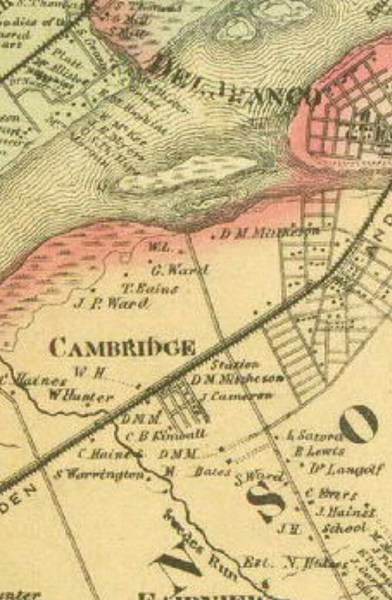
The New Map of the Consolidated City of Philadelphia, published in 1855 by R.L. Barnes. In 1854, various small, incorporated towns located outside the original old City of Philadelphia became incorporated into the City of Philadelphia. Now Philadelphia was not only a city but also known as the County of Philadelphia. Image courtesy RHS (see note below)

Occasionally someone who knows more about one of my ancestors than I do finds my family history blog and gets in touch. That is what happened this summer when Herman Maurer, a member of the Riverside Historical Society in New Jersey, reached out to tell me that my ancestor had founded his town. 

Three years ago, Herman wrote a book called Progress to Riverside: A Story of Our Town’s Past to mark Riverside Township’s 125th anniversary. In the course of his research, he ran across 19th century Philadelphia real estate agent Duncan M. Mitcheson.1

Riverside, New Jersey is a suburban township located across the Delaware River from Philadelphia. In the early 1850s, Duncan and his brother McGregor J. Mitcheson purchased property next to Riverside and subdivided it into cottage lots. This area became the village of Cambridge. Duncan planned the street layout, including today’s busy Chester Avenue, Front Street, Brown, Main and Arch Streets still carry the names that Duncan chose 170 years ago.

Numerous Cambridge deed transfers recorded in the local county clerk’s office between the 1850s and mid-1880s, with the signatures of both Mitcheson brothers on them, convinced Herman that Duncan and his brother McGregor were the primary developers of the village of Cambridge.

This was a surprise to me since I knew very little about Duncan. Now it became clear that he was a successful businessman who embraced modern ideas at a time of rapid changes in society.   

Duncan McGregor Mitcheson (1827-1904) was the middle child of Robert Mitcheson and Mary Frances McGregor. Born in northern England and in Scotland, they were married in Philadelphia around 1818. Duncan’s older sister, Catharine Mitcheson Bagg, was my two-times great-grandmother.

The Mitcheson family lived in Spring Garden, in the northern part of Philadelphia. The family’s home was large and, after their parents died around 1860, Duncan’s older brother, Reverend Robert M. Mitcheson, and his wife and children lived there. Duncan lived with them until Robert died in 1877. In the 1880 census, when he was age 53, Duncan appears to have been staying in a rooming house. Later Philadelphia city directories show that he lived on Spruce Street, near the old part of the city, and had an office nearby on Walnut Street. He never married.  Like his two brothers, Duncan attended the University of Pennsylvania, but unlike them, he did not graduate.3 He dropped out in 1842, at the end of his second year.  University attendance was rare then: there were only 26 students, all male, in Duncan’s freshman class.

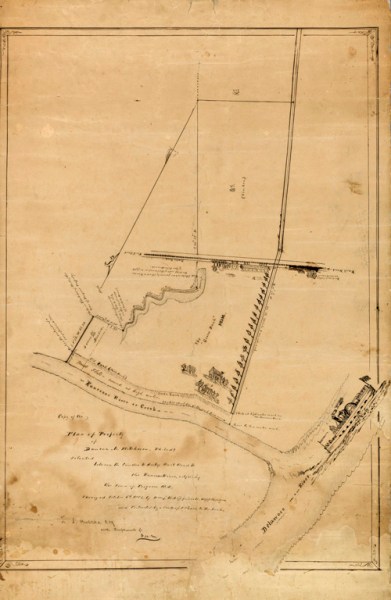
Map, dated Oct. 6, 1853, showing Duncan’s Green Bank Farm overlooking Roncocas Creek and the Delaware River. Duncan sent this map to another Philadelphia real estate developer, Samuel Bechtold Jr., as a complimentary copy. Bechtold was the developer of Progress (now known as Riverside). This map has recently been conserved.

Duncan began his career as a merchant, but an 1861 Pennsylvania business directory identified him as a conveyancer: someone who draws up deeds and leases for property transfers. He was listed as a real estate agent for most of his career.

The Riverside Historical Society’s research revealed that Duncan invested $5000 in land in New Jersey, with an initial purchase of 80 acres, in 1853. He and his brother then formed a real estate partnership to develop the village of Cambridge. An advertisement for these building lots appeared in the Philadelphia newspaper Public Ledger on March 24, 1853. The lots were “located on the Camden and Amboy Railroad, about one mile below Rancocas Creek and the Town of Progress and within a quarter of a mile of the River Delaware, upon a very healthy, dry and level site that will require no filling up, nor grading and can be reached in about half an hour from the Walnut Street Wharf.”

The lots were advertised at the “remarkably low rates” of $25 and $30 each. The $30 lots were 20 feet by 100 feet, while the $25 lots were slightly smaller. A few larger lots were available at $60 and $100 each. 

On November 4, 1854, another ad in the Public Ledger noted that the Cambridge lots were near the water, opposite the splendid riverside mansions of Philadelphia’s 23rd Ward. Duncan also reassured potential buyers that the lots were a safe investment. “From the continued increase of the population of Philadelphia, and the consequent increased demand for Houses and Lots, and as well as from the fact that thousands now living in this city could not only have more room, enjoy better health, but live less expensively at Cambridge.”

Duncan also owned farmland on three sides of Cambridge, and he was one of the larger landowners in the town of Progress in the 1850s. In January, 1854 he purchased 180 acres of vacant land for $15,000. That property, located between Rancocas Creek, the railroad, Chester Avenue and Tar Kiln Run, was known as Green Bank Farm, or Duncan M. Mitcheson’s Model Farm.

This was a period of technological and scientific innovation. The Great Exhibition, held in London, England in 1851, had showcased developments in many fields, including agriculture. These advances were badly needed: food production had to become more efficient to feed growing urban populations. Duncan’s model farm may have featured agricultural innovations such as a McCormick reaper that could rapidly harvest large quantities of crops. And perhaps Duncan was a member of the Model Farm Association, formed in 1860 to establish a model farm, botanic garden and agricultural school in Pennsylvania.

In the spring of 1854, Duncan purchased another 80 acres of vacant land for $6000, extending Green Bank Farm past the railroad tracks. In addition, he, or possibly his brother, owned a nearby property named Rob Roy Farm, after the famous Scottish outlaw and folk hero Rob Roy McGregor.  

How the Mitcheson brothers acquired the funds to buy so much land is not known, but their father owned properties in England and in Philadelphia. Robert Mitcheson senior died in 1859 and in his will, he forgave an $8000 mortgage he held on Duncan’s farm.

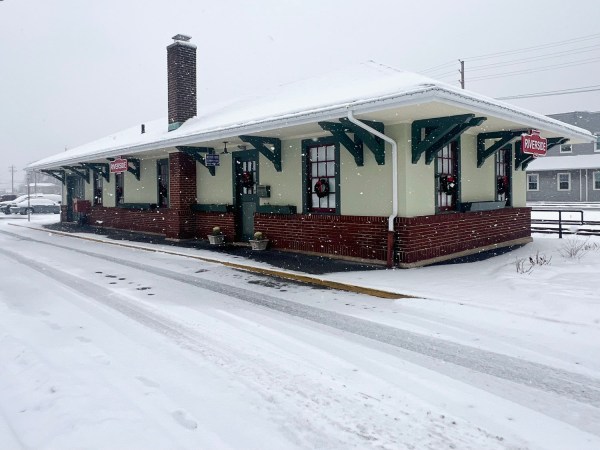
Riverside Train Station. photo by Herman Maurer

In 1859, the Drake Well, the first commercial oil well in the U.S., was drilled in north-western Pennsylvania. That well sparked the first petroleum boom in the United States, creating a wave of investment in drilling, refining and marketing. Duncan saw an opportunity to make money. In February, 1865 he placed the following ad in the Philadelphia Inquirer: “OIL LANDS FOR SALE—located in Venango and Clarion Counties (Pennsylvania). Companies are about to be formed, secure choice lands by addressing or writing to: Duncan M. Mitcheson, real estate office at the northeast corner of Fourth and Walnut Streets, Philadelphia. Also 1,000, 20,000 and 50,000 acres in West Virginia.”

He placed another ad a month later: “CHOICE Oil Tract…Eighty Acres. For sale in fee simple lots situated on the Bennyhoff Creek, Venango County, of which the greater part is boring grounds. This eighty-acre tract will be divided to suit and sold fee simple, with unquestionable titles…”

In July, 1866 Duncan advertised another speculative deal in the Philadelphia Inquirer: 1250 interests, valued at $100 each, in The Virginia Gold Mining Company of Colorado. The company’s property was located near Central City, Colorado, founded in 1859 during the Pike’s Peak Gold Rush.  

In 1893, when he was 70 years old, Duncan sold almost 1000 vacant building lots in Cambridge for the sum of one dollar to his deceased brother McGregor’s two grown children, Joseph McGregor Mitcheson and Mary Frances Mitcheson. During the first two decades of the 20th century, they sold many of the Cambridge properties to families who had recently emigrated from Poland.

Joseph, a bachelor, was a Philadelphia lawyer and a commander in the U.S. naval reserve. Mary Frances married accountant Arthur L. Nunns in 1904. The couple were childless and when she died in 1959, at age 84, she gave a million dollars to the Protestant Episcopal Diocese of Pennsylvania. It was the largest bequest it had ever received.4 During my 2013 visit to Philadelphia, the head of St. James School, a tuition-free, private Episcopalian middle school, told me that gift Is still benefiting the community.

As for Duncan, the 1900 census showed that he had retired. He died in 1904 and was buried, along with his parents and other family members, at St. James the Less Episcopal Church Cemetery in Philadelphia.

Note: The images of both maps were provided by the Riverside Historical Society. The Green Bank Farm map was recently conserved through a 2023 grant funded by the Burlington County Board of Commissioners.

See also:

Janice Hamilton, “Robert Mitcheson, Philadelphia Merchant”, Writing Up the Ancestors, March 1, 2023, https://www.writinguptheancestors.ca/2023/03/robert-mitcheson-philadelphia-merchant.html

Janice Hamilton, “The MacGregors: Family History or True Story?” Writing Up the Ancestors, March 21, 2014, https://www.writinguptheancestors.ca/2014/03/the-macgregors-family-legend-or-true.html

Janice Hamilton, “Philadelphia and the Mitcheson Family” Writing Up the Ancestors, Nov. 22, 2013, https://www.writinguptheancestors.ca/2013/11/philadelphia-and-mitcheson-family.html

Sources:

  1. Herman Maurer, Progress to Riverside: A Story of Our Town’s Past, Riverside Historical Society Inc. 2020, p. 13.
  2. Philadelphia, Pennsylvania, City Directory 1889, entry for Mitcheson, Duncan M., Ancestry.com, citing U.S. City Directories, 1822-1995 (online database), accessed Oct. 1, 2024.
  3. University of Pennsylvania, 1894. entry for Duncan MacGregor Mitcheson. Ancestry.com, citing US. College Student Lists, 1763-1924 (online database), accessed Oct. 1, 2024.
  4. The New York Times, May 6, 1959.

This article is also posted on http://www.writinguptheancestors.ca

Launching “Up for the Season”

I was a journalist and magazine writer for many years, and I have written dozens of articles about my ancestors, but none of these projects has been as well received as the small book I recently co-edited about the small coastal community where I spend my summers.

Biddeford Pool, Maine has been welcoming summer residents for several generations. My mother came here as a child, and I have summered here since I was four.  Now, only a few long-lived members of my mother’s generation are still with us, and stories from the past are disappearing.

So in 2019, inspired by the success of my family history blog, I started a blog about the Pool’s summer community. I wrote some of the articles, but the main goal was for people to write their own stories.  My friend Dabney described the Sunday mornings of her childhood when everyone went to church wearing their Sunday best, then returned home to enjoy roast beef or fried chicken for lunch. Jesse told readers what he learned about life while racing his sailboat in the mid-1960s. Lisa recalled the 1950s when Mr. Anderson, dressed in a summer suit and straw hat, delighted the neighbourhood children by taking out his false teeth and giving them a toothless smile.

These were great stories, but the blog was a failure. Nobody noticed the publicity flyers I made up, and the posts were not frequent enough to land on people’s radar. When one friend asked, “what is a blog?” I knew the project was doomed.  

Upon our return to Maine in 2022, after a two-year absence due to Covid, I asked some friends what they thought I should do with the blog: delete it as a failed experiment, try to revive it, or turn it into a book? We decided on a book. We included all the articles from the blog and added many new stories.

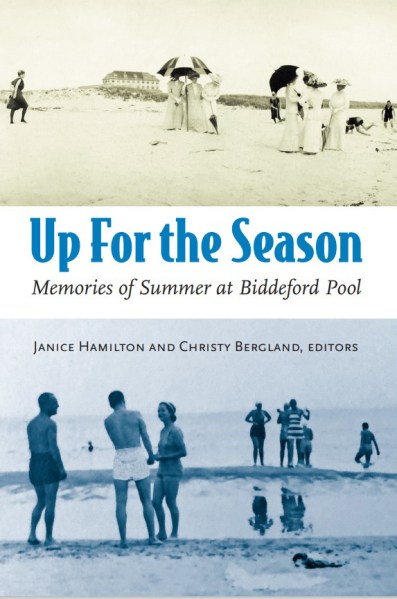
The book is called, Up for the Season: Memories of Summer at Biddeford Pool, edited by myself and Christy Bergland, an artist from Baltimore whose grandfather first came to the Pool as the summer doctor in 1907. The title is a quote attributed to a local lobster fisherman who knew many of the summer residents in the 1950s. When he saw a cottager for the first time each summer, he would ask, “Up for the season?”

co-editors Janice Hamilton, left, and Christy Bergland, right. photo by Richard Levy

The theme of the book is, when and why did your family first start coming to Biddeford Pool? It turns out that many of the men who started coming to the Pool in the late 1800s and early 1900s lived and worked together in mid-western cities such as Cincinnati and St. Louis, and they recommended it to their friends as a good place to bring their families.

The book is probably a hit for several reasons. First, people love to hear these stories about the days when men wore tuxedos to the annual Labour Day dance at the golf club and children got their first taste of freedom as they explored this safe little peninsula. unsupervised by parents.

The quality of the writing is another reason. While most of the contributors are not professional writers, they are nevertheless gifted storytellers. Eagles Nest, a turreted house overlooking the rocky shore, came to life when LeeLee mentioned the seagull who arrives for cocktails on the porch. This was a perfect example of “show, don’t tell.”

For me, putting this project together was a lot of fun because it was a group effort. Christy and several other friends helped with all the important decisions, such as the title choice.

A fun book launch. photo by Harold Rosenberg.

We hired a copy editor to catch the typos and a book designer to do the layout. The printing was done by Rapido Books, a Montreal printing company that I had previously used for a family history book. They shipped two boxes of 50 books seamlessly across the border, and they have an online bookstore for print-on-demand copies. Over the course of this summer, Christy and Mary handled the book sales and accounting with Jo’s assistance. As of the end of August, we have sold more than 100 copies and accumulated a profit of several hundred dollars that we donated to the Biddeford Pool Community Center.

Marketing in a small community where everyone knows everyone is not complicated. We put up posters in key locations advertising an early July book launch, and an announcement appeared in the Community Center newsletter. The launch, held at Lisa’s old shingled family cottage by the bay, was an overwhelming success. We also held a smaller event at the end of the summer where several of the authors read their stories aloud.

Today, many family historians are taking the next step beyond researching their ancestors’ BMDs , and they are writing about their families. Writing about the individuals, families and businesses in a community is not very different from writing about ancestors, and the sources of information — interviews, newspaper articles, city directories, census data and so on – are also the same.

Now that Up for the Season has been so well received, we are hoping that people will be inspired to start writing volume two. Many stories are waiting to be told.

The Life and Times of Great-Aunt Amelia

My mother used to tell me that Amelia Norton was her favourite of her four great-aunts on her mother’s side of the family. From what I have learned about Amelia’s life, it appears she was indeed a kind and generous person.

Amelia Josephine Bagg was born in Montreal in 1852. Her father, Stanley Clark Bagg, was a wealthy landowner in Montreal, so Amelia had a privileged upbringing that included a year-long tour of Europe with the whole family in 1868-69, when she was 16.

After her father died in 1873, her brother, Robert Stanley Bagg, took over management of their late father’s real estate, renting out some properties and selling others. Amelia had a strong interest in the Bagg family real estate business, helping to keep the records of sales, and she also owned property in her own name.

Mr. and Mrs. Mulholland. 1891. Wm. Notman and Son, McCord-Stewart Museum, II-95084 1.

Amelia lived with her mother, Catharine Mitcheson Bagg, until she married at age 38. The wedding took place on Dec. 18, 1890 at Christ Church, Montreal’s largest Anglican church. Her husband was Joseph Mulholland, the eldest son of hardware merchant Henry Mulholland and his wife, Ann Workman. Born in Montreal in 1840, Joseph had a twin who died as an infant. Joseph is connected to me in two ways: in addition to being married to Amelia, his sister Jane Mulholland (1847-1938) and her husband, Montreal banker John Murray Smith (1838-1894), were my great-grandparents on my mother’s father’s side.

As a young man, Joseph had worked in the hardware business. Now, as Amelia’s husband, he started a new career in real estate. In 1891, he and his brother-in-law collaborated in a business venture: Joseph and John purchased a vacant piece of land from Robert Stanley Bagg on Saint Charles Borromée Street (now renamed Clark Street) near Pine Avenue and built a row of attached house there.1 The building, designed by architect Eric Mann, survives to this day.

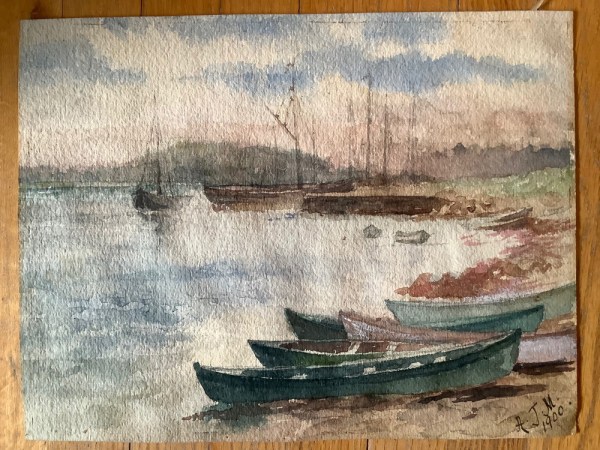
Amelia was known as a talented amateur artist. This watercolour painting of the Montreal waterfront belongs to one of the Bagg family descendants.

Joseph died, age 57, in 1897. Five years later, Amelia married again, this time to Reverend John George Norton, Archdeacon of Montreal.It was a relatively small wedding with only family members and a few close friends present.2 John was born in Ireland in 1840 and he was educated there. He moved to Montreal in 1884 with his wife and two children. His wife died five years later.

As the wife of one of the leading clerics in Montreal’s English-speaking community, Amelia took on a new role, especially in church charities. According to a biography of Archdeacon Norton in The Storied Province of Quebec, “Mrs. Norton is a lady of culture and refinement. Mrs. Norton was a valued ally and helpmate in all the parochial work of the church.”3

At that time, governments gave little funding to health care or social services, so benevolent societies played an essential role in society. As president of the Women’s Auxiliary of Christ Church Cathedral for many years, Amelia was especially interested in its missionary work.4 In addition, her name appeared regularly in lists of donors to various charities published in the local newspapers.

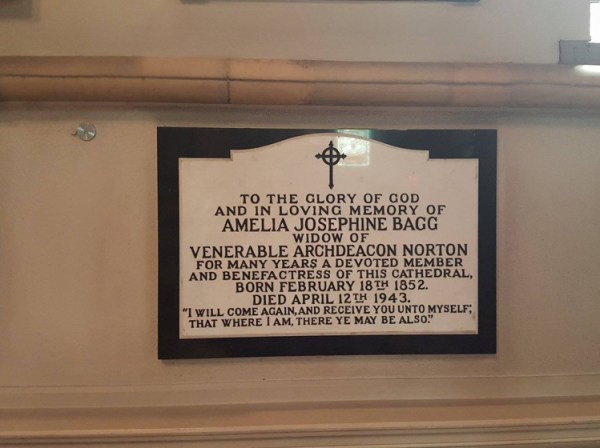
This memorial to Amelia is in Christ Church Cathedral, Montreal. Photo by Genevieve Rosseel.

The couple lived in the church rectory for many years and after John retired, they moved into their own house on McTavish Street, near McGill University. When the Venerable John George Norton, Rector Emeritus and Archdeacon of Montreal John died in 1924 at the age of 84, many people attended his funeral service at Christ Church, where he had officiated for 37 years.

Meanwhile, Amelia seems to have been the go-to person when family members needed help. After Amelia’s Aunt Fanny (Mitcheson) Hague was widowed in 1915, Fanny came to live with the Nortons and remained there until she died in 1919.

My grandparents also went to Amelia for help. They had built a new house just before the Depression hit and my grandfather lost his job. Amelia helped to support the family until my grandfather found a new job after the Depression.

Amelia died in 1943, at age 91, at home on McTavish Street, following a long illness. She is buried with her first husband in the Mulholland-Workman family plot in Montreal’s Mount Royal Cemetery.

Sources

  1. Le Prix Courant: le journal de commerce, 10 Avril 1891, p 13, https://numerique.banq.qc.ca, entry for John Murray Smith, https://numerique.banq.qc.ca/patrimoine/details/52327/2746357?docsearchtext=%22John%20Murray%20Smith%22, accessed June 18, 2023.
  • 2. “Marriage at the Cathedral”, The Gazette, 25 June, 1902, p. 6, Newspapers.com, accessed June 18, 2023.
  • 3. William Wood, editor, The Storied Province of Quebec, Past and Present, Dominion Publishing Company, 1931, vol. 3, p. 118.
  • 4.  “Obituary: Mrs. J. Norton, 91, Dies at Home Here,” The Gazette, April 13, 1943, p. 14, Newspapers.com, entry for Amelia Norton, accessed June 20. 2023.

5.    Mount Royal Cemetery, section F200-c

See also

Frank Dawson Adams, A History of Christ Church Cathedral, Montreal, Montreal: Burton’s Limited, 1941, https://numerique.banq.qc.ca/patrimoine/details/52327/2561503

Janice Hamilton, “Continental Notes for Public Circulation”, April 8, 2020, Writing Up the Ancestors, https://www.writinguptheancestors.ca/2020/04/continental-notes-for-public-circulation.html

Janice Hamilton, “Aunt Amelia’s Ledger”, April 26, 2023, Writing Up the Ancestors,          https://www.writinguptheancestors.ca/2023/04/aunt-amelias-ledger.html

Janice Hamilton, “Henry Mulholland, Montreal Hardware Merchant”, March 17, 2016, Writing Up the Ancestors, https://www.writinguptheancestors.ca/2016/03/henry-mulholland-montreal-hardware.html

Janice Hamilton, “The World of Mrs. Murray Smith”, Feb.24, 2016, Writing Up the Ancestors, https://www.writinguptheancestors.ca/2016/02/the-small-world-of-mrs-murray-smith.html

Janice Hamilton, “Never Too Late for Love,” April 4, 2014.  Writing Up the Ancestors, https://www.writinguptheancestors.ca/2014/04/never-too-late-for-love.html

This article is also posted on the family history blog Writing Up the Ancestors.

Aunt Amelia’s Ledger

with additional research by Justin Bur

Some of my female ancestors are almost invisible. They got married, had children and left no other traces of their lives. But a few left paper trails such as letters, journals and drawings. My two-times great-aunt Amelia Josephine Bagg (1852-1943) was one of them. Married twice but with no children of her own, she became deeply involved in the family real estate business.

Amelia was the third of the five children (one boy, four girls) of Montreal landowner Stanley Clark Bagg (SCB) and his wife, Catharine Mitcheson Bagg. The children grew up in the family home, Fairmount Villa, near what is now the corner of Sherbrooke and St. Urbain streets. There, they had a big garden to play in and no doubt a nanny to care for them when they were little and a governess to educate them.

Unlike many women of her time and class, Amelia found the opportunity to use her education.

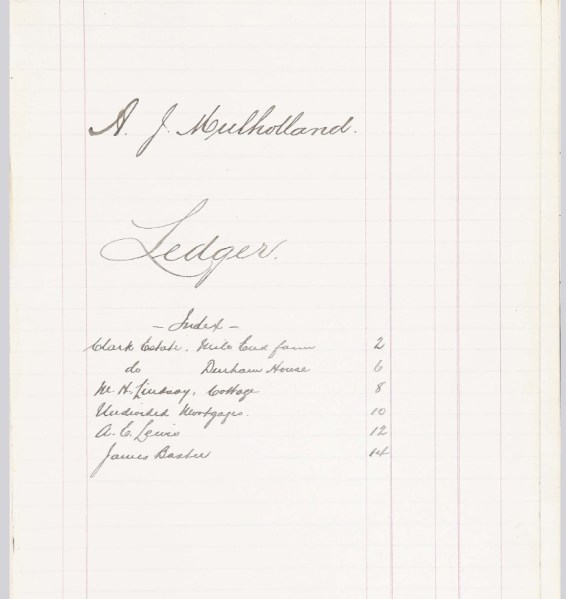
Amelia Mulholland’s ledger, McCord Stewart Museum, https://collections.musee-mccord-stewart.ca/internal/media/dispatcher/261758/preview p. 5.

SCB had inherited several large properties on the Island of Montreal, extended along the west side of St. Lawrence Street (now busy Boulevard Saint-Laurent). During his lifetime, this was agricultural land and, although he was trained as a notary, SCB made his income by leasing his properties to farmers.

He died unexpectedly at age 53, in 1873, when Amelia was just 21. SCB named his wife and her brother (who was a Philadelphia lawyer) as executors of his estate.1 Son Robert Stanley Bagg (RSB), a recent law graduate from McGill University, took on the responsibility of managing it. Over the years, the widowed Catharine and her daughters had a great deal of input into decisions about the estate, with Amelia being the daughter who took the greatest interest.    

Around the end of the century, Montreal grew rapidly. Business leaders developed new industries, founded banks and built railways, and immigrants arrived to fill newly created jobs. Property belonging to SCB’s estate could now be divided into lots and sold to people who wanted to build homes or invest in rental housing. Around 1890, some legal hurdles prevented the family from selling the most valuable properties, however, the family managed to resolve these problems. That will be a story for another time.

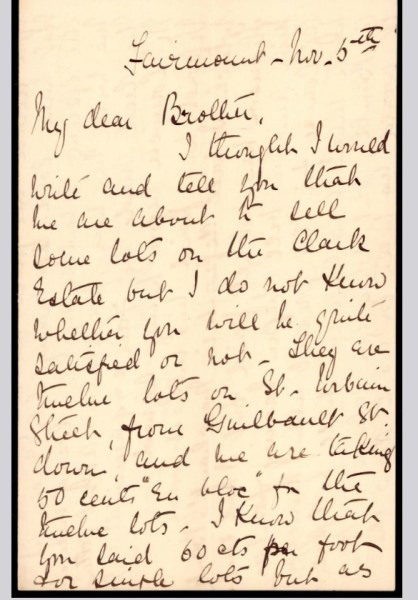
Amelia’s letter to brother Robert Stanley Bagg, McCord Stewart Museum,  https://collections.musee-mccord-stewart.ca/en/objects/416400/correspondance  p. 43

With these issues resolved, Amelia and her siblings divided up some of the land and became owners of lots that they could sell or buildings they could rent out themselves. Amelia became an independently wealthy woman.

She also developed an interest in the details of the family real estate business, keeping track of land prices, interest rates and other factors influencing real estate sales. In the fall of 1890,2 while her brother took his wife and children on an extended trip to England, Amelia coordinated decisions on new property sales. She wrote to ask for his advice and to bring him up-to-date on family news.3

“Fairmount, Nov. 6th

“My dear Brother,

“I thought I would write and tell you that we are about to sell some lots on the ‘Clark Estate’ but I do not know whether you will be quite satisfied or not. They are twelve lots on St. Urbain Street, from Guilbault St. down, and we are taking 50 cents “en bloc” for the twelve lots. I know that you said 60 cents per foot for single lots but as this is for twelve lots we thought perhaps it was better not to lose the sale.4 Bob said that you told him we could take less than the price named, and McMann said he was selling lots of Park Avenue for 45cts.7 I hesitated for a long time as I did not wish to make a sale that you would not approve, but Kate was in favor of selling, so also was Bob, and Helen and I did not know what to do….5

“Vipond has paid his interest today which I will deposit in Merchant’s Bank. Thomson has not yet paid but I had sent him another bill before hearing from you. Of course for the present all money both interest and capital will be deposited in the bank, but when you return we think it would be better for us to draw the interest and leave only the capital in the bank.….”

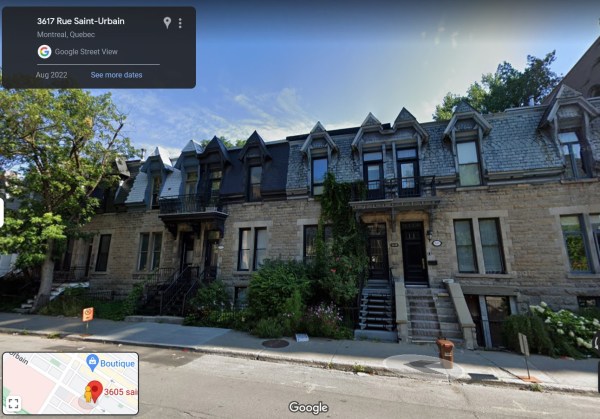
Row houses on St. Urbain Street near Prince Arthur. Google Street View

Much of the Bagg estate was still leased out to farmers at that time, and one day a month was reserved for tenants to deliver the rent. In the same letter, Amelia referred to this so-called reception day, but she was actually describing the arrival of her sister Mary Heloise Lindsay’s fifth child on Nov. 3, 1890. Mary and her husband Robert Lindsay lived at 436 St. Urbain. Amelia told her brother:

Kate and I made out the Nov. statements of rents due and gave the list to Bob so that when the people paid he could check them off. We were surprised at an unexpected arrival at 436 St. Urbain Street on Monday. It is true that is the reception day there now, but this particular visitor was not expected just then. It was a dear fat little girl! She arrived at 8 o’clock in the evening.”

Amelia also kept track of the sales of lots from the estate between 1890 and 1900 in a hardcover ledger with ruled pages. My mother eventually inherited that ledger. Her cousin had given numerous family letters, business records and other documents to the McCord Stewart Museum (a Montreal museum of social history) some years earlier, but my mother hung on to the ledger. After she died, I found it in a desk drawer in the spare bedroom.

When I started to research the Bagg family and their role in Montreal history, the ledger’s importance as a record of those land transactions became clear, so I donated it to the McCord.6 I hope Amelia would have approved.

This article is also posted on http://www.writinguptheancestors.ca.

See also:

Janice Hamilton, “Stanley Clark Bagg’s Four Forgotten Daughters,” Writing Up the Ancestors, Sept. 30,2017, https://www.writinguptheancestors.ca/2017/09/stanley-clark-baggs-four-forgotten.html

Janice Hamilton, “My Great-Great Aunts, Montreal Real Estate Developers,” Writing Up the Ancestors, Oct. 11, 2017, https://www.writinguptheancestors.ca/2017/10/my-great-great-great-aunts-montreal.html

Janice Hamilton, “John Clark, 19th Century Real-Estate Visionary,” Writing Up the Ancestors, May 22, 2019, https://www.writinguptheancestors.ca/category/john-clark

Notes and Sources

  1. City of Philadelphia (Pennsylvania). Register of Wills Office; Wills, No 772-802, 1887, Ancestry.com. Pennsylvania, U.S., Wills and Probate Records, 1683-1993 [database on-line, entry for Catharine Mitcheson Bagg, accessed April 2, 2023], original data: Pennsylvania County, District and Probate Courts. This is a copy of the will that is very easy to read. It was probably copied in Philadelphia because McGregor J. Mitcheson, Catharine’s brother and an executor of SCB’s will, died in 1886. About a month after SCB’s 1873 death, notary J. A. Labadie deposited at the land registry office in Montreal a copy of the 1866 will and the 1870 codicil and a declaration of death. Bureau d’enregistrement Montréal-Ouest, no 74545, registered 6 September 1873; at Registre foncier du Québec, online.
  2. Amelia did not note the year on her letter, but we know it was written in written in 1890 because that was the year her niece Marjorie Mary Clark Lindsay was born. 

3. Correspondance de la famille Bagg. McCord Museum, Fonds Bagg, P070/B08,  https://collections.musee-mccord-stewart.ca/en/objects/416400/correspondance  p. 43 (accessed April 3, 2023)

4. RSB must have told them to hold out for the full price. The lots were not sold until the following year. On Nov. 18, 1891, real estate agent and furrier Robert Lamb purchased not just the 12 lots mentioned here, but an extended row of 22 lots, paying 60 cents a square foot.

5. The people mentioned here are probably Amelia’s sisters Katherine Sophia Mills and Helen Frances Lewis. Bob was likely Robert Lindsay, her sister Mary’s husband. McCann was a real estate agent.

6. Amelia Josephine Bagg Mulholland, Grand livre, 1891-1927, McCord Museum, Fonds Bagg, P070/B07,1. https://collections.musee-mccord-stewart.ca/en/objects/293626/a-j-mulholland-ledger (accessed April 3, 2023)

Robert Mitcheson, Philadelphia Merchant

When my English-born three-times great-grandfather Robert Mitcheson arrived in Philadelphia from the West Indies in 1817, he was a 38-year-old unattached merchant. Within two years he was married and had started a family, established a new career and was on the way to becoming an American citizen.

Robert (1779-1859) grew up in County Durham, England, where his father was a farmer and small-scale landowner. Robert became an iron manufacturer as a young man, then spent some time in the West Indies. Family stories say he was largely occupied in the West Indies trade. In 1817 he sailed from Antigua to Philadelphia with the intention of settling in the United States. He applied for naturalization – a first step towards citizenship — in July, 18201 and took an oath of citizenship on Sept. 12, 1825.

Robert Mitcheson, portrait probably painted in Philadelphia in the 1830s. Artist unknown. Bagg family collection.

Perhaps he had met his future wife, Scottish-born Mary Frances (Fanny) MacGregor, on a previous trip to the city. I have not found a record of their marriage, but it probably took place in Philadelphia. The couple’s first child, Robert McGregor Mitcheson, was born on August 15, 1818 and baptized at St. John’s Episcopal Church in north-end Philadelphia.2

In 1819 Robert was listed in a city directory as a distiller, and the following year’s directory clarified that he made brandy and cordials. The business was located at 275 North Third Street, in the Northern Liberties area of the city. The distillery continued to appear in each annual directory until 1835, when Robert was simply listed as “gentleman”, with his home address on Coates Street.

The family appeared in the U.S. census for the first time in 1830,3 living in Spring Garden, then a largely rural part of Philadelphia. Robert owned a large lot bounded by Coates (later renamed Fairmount Street) and Olive Streets, between Eleventh and Twelfth Streets. There, he and Fanny raised their five children: Robert McGregor (1818-1877), Catharine (my two-times great-grandmother, 1822-1914), Duncan (1827-1904), Joseph McGregor (1828-1886) and Mary Frances (1833-1919). Two other children, Sarah and Virginia, died as babies. Two of their sons graduated from the University of Pennsylvania. Robert M. became an Episcopal minister, and Joseph, who went by the name MacGregor J. Mitcheson, was a lawyer.

This painting of Monteith House, the family home in Spring Garden, was painted by daughter Catharine Mitcheson. Bagg family collection.

Robert never became part of city’s elite, despite his financial success. For one thing, he was a newcomer living in an old city. Founded in 1682, Philadelphia was the birthplace of the United States and many of its citizens were known as the descendants of colonial and revolutionary families. Also, Robert appears to have been a low-key person. A search for his name in local newspapers brought up only one article that named a long list of people involved in establishing a refuge for boys.

The only obituary I was able to find appeared in a Montreal newspaper, where daughter Catharine Mitcheson Bagg and her husband, Stanley Clark Bagg, lived.4 It said: “As a citizen of Philadelphia for more than 40 years, he has done much, in a quiet and unostentatious manner, for the advancement of her interests and the relief of the distressed. He enjoyed a well-earned reputation for unwavering integrity in all the transactions of his long life – prolonged almost to his 80th birthday — and his remarkable urbanity of manner which the firm, yet elastic step of his manly person, were but slightly impaired up to the period of his dissolution. He was universally respected and died serenely, with a Christian’s hope and faith.”5

Robert appears to have travelled back to England at least once, probably to visit family members and take care of some business, as he had inherited property in Durham when his father died in 1821. A land transfer document dated September 16, 1835 described him as “Robert Mitcheson, iron manufacturer, late of Swalwell, now of Philadelphia”.6 Several weeks later Robert Mitcheson, gentleman, appeared as a passenger on the Pocahontas, sailing from Liverpool to Philadelphia.7  

Perhaps he also visited his brother William, an anchor maker and ship owner in London. A short biography of his son published by the St. Andrews Society in Philadelphia described Robert as a “retired merchant and shipowner,”8 however, I cannot confirm whether Robert owned any ships or perhaps invested in his brother’s business.

After Robert left the distillery business he reinvented himself again, this time as a landlord. The city was rapidly expanding and there was a need for housing. Many people lived in boarding houses and Robert saw rents from boarders as a way to generate income for his grown children after he died. In his will, he left 14 “dwelling houses” located near his house, as well as several nearby other buildings, in trust to sons Robert M. and MacGregor J..9 They were to collect the income and pay certain sums every year to their other three siblings, and to look after repairs to the buildings.

This large monument in the cemetery of St. James the Less Episcopal Church is in memory of Robert Mitcheson, his wife and several other family members. JH photo, 2013.

Robert died at age 79 and was buried in the cemetery at St. James the Less, a small, Gothic-style Episcopal church built around 1846 as a chapel of ease for wealthy families in the area. Robert is said to have helped found that church.

His story doesn’t end there, however. Sadly, his estate was the focus of a court battle that took almost 30 years to resolve, by which time both executors had also died. In addition to a dispute between the brothers, the case focused on a legal error in the way the trust was set up10 and who was to inherit the final balance of income.11  

To Learn More: Robert Mitcheson’s younger years are the subject of “A Restless Young Man,” Writing Up the Ancestors, Jan. 24, 2023, https://www.writinguptheancestors.ca/2023/01/a-restless-young-man.html. You can also search for articles about Robert’s parents and grandparents in England, his wife, sister Mary and other siblings, and some of his descendants on http://www.writinguptheancestors.ca.

Notes and Sources

1. Ancestry.com. Pennsylvania, U.S., Federal Naturalization Records, 1795-1931 [database on-line]. Original data: Naturalization Records. National Archives at Philadelphia, Philadelphia, Pennsylvania. Accessed Feb. 15, 2023.

2. I found records from St. John’s Church at the Historical Society of Pennsylvania, Philadelphia in 2013.

3. “United States Census, 1830,” database with images, FamilySearch (https://familysearch.org/ark:/61903/1:1:XH5W-MC3, accessed Feb. 16, 2023), Robt Mitchinson, Spring Garden, Philadelphia, Pennsylvania, United States; citing 323, NARA microfilm publication M19, (Washington D.C.: National Archives and Records Administration, n.d.), roll 158; FHL microfilm 20,632.

4. Stanley Clark Bagg (SCB) was Robert’s son-in-law and also his nephew: Robert’s older sister, Mary Mitcheson Clark, was SCB’s maternal grandmother.

5. Montreal Herald and Daily Commercial Gazette, 28 March 1859, p. 2, Bibliothèque et archives nationale du Québec, https://numerique.banq.qc.ca/patrimoine/details/52327/3169230, accessed Feb. 17, 2023.

6. Clayton and Gibson, Ref No. D/CG 7/379, 16 September 1835, Durham County Record Office, https://www.durham.gov.uk/recordoffice.

7. “Pennsylvania, Philadelphia Passenger Lists Index, 1800-1906,” database with images, FamilySearch (https://familysearch.org/ark:/61903/1:1:QV9Y-VXJ9, accessed Feb. 17, 2023), Robert Mitcheson, 1835; citing ship Pocahontas, NARA microfilm publication M360 (Washington, D.C.: National Archives and Records Administration, n.d.); FHL microfilm 419,525.

8. Biography of MacGregor Joseph Mitcheson in An Historical Catalogue of the St. Andrews Society of Philadelphia with Biographical Sketches of Deceased Members, 1749-1907, printed for the Society 1907; p. 287, Google Books, accessed July 19, 2013.

9. Will of Robert Mitcheson, March 5, 1859. Philadelphia County (Pennsylvania) Register of Wills, 1862-1916, Index to wills, 1682-1924. Volume 41, #105, FamilySearch, (https://www.familysearch.org/ark:/61903/3:1:3Q9M-C9B2-5S45-H?i=190&cat=353446, image 191-194, accessed Feb. 18, 2023.)

10. Mitcheson’s Estate, Orphan’s Court. Weekly Notes of Cases Argued and Determined in the Supreme Court of Pennsylvania, the County Courts of Philadelphia, and the United States District and Circuit Courts for the Eastern District of Pennsylvania by Members of the Bar. Volume XI, December 1881 to August 1882; p. 240. Philadelphia: Kay and Brother, 1882. Google Books, accessed Feb. 17, 2023.

11. Mitcheson’s Estate, Pennsylvania Court Reports, containing cases decided in the courts of the several counties of the Commonwealth of Pennsylvania, Vol. V, p. 99. Philadelphia, T. & J.W. Johnson & Co., 1888. Google Books, accessed Feb. 17, 2023.

This article is also posted on my family history blog, www.writinguptheancestors.ca