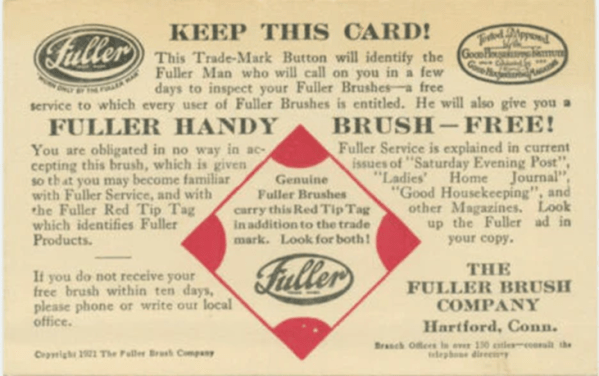
The advertisement in the February 24, 1928 edition of the Montreal Star called for three reliable men to apply for a special sales campaign for the Fuller Brush Company.
My dad, Edward McHugh, probably answered an advertisement similar to this one when he finished school in the late 1920s. He worked as a Fuller Brush salesman for two years in Montreal. Alfred Fuller founded the Fuller Brush Company in 1906. The company produced good quality brushes and increased its sales force by advertising for salesmen. But the secret of its selling success was that each salesman (they preferred men in those days) had to sign a pledge in which they promised that “I will be courteous; I will be kind; I will be sincere; I will be helpful.”1
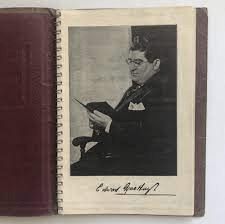
The salesmen left cards like this one when no one was home:
As you can see in the above picture, my dad was a snazzy dresser. Knowing him, he probably took a lot of care with his appearance when he was out selling brushes. I remember him polishing his shoes every morning before going to work.
I assume that he succeeded fairly well at selling Fuller Brushes.2 But he must have been restless and in search of adventure because he left Montreal after just two years of selling brushes. Just travelling to Bermuda would have been quite an adventure in itself. He would have started his trip by going to New York City by train where he would then take an ocean liner. The Furness Bermuda Line and operated regular passenger and mail service between New York and Hamilton, Bermuda at the time.3
Edward must have encountered some challenges selling Fuller Brushes in Bermuda as he ended up working as a bell hop in a hotel that catered to rich patrons from the U.S. and Canada. The tips he earned helped him pay for business college when he returned home to Montreal.4
The Princess Hotel, Hamilton, Bermuda5
By the time Dad completed his business and accounting courses, Canada was in the Great Depression. He again got itchy feet again and moved to Drummondville, Quebec with his older brother, Thomas McHugh, his sister, Sarah Jane McHugh, and her husband, Jack Day. In Drummondville, he did not work as a Fuller Brush salesman, a bell hop, or in business or accounting. He apprenticed as an electrician at the Celanese and worked there for eight years until 1940, when he enrolled in the Royal Canadian Air Force as an aircraft mechanic at the outset of World War II. The RCAF trained my dad in aircraft hydraulics and he was assigned to Bomber Command stationed in Yorkshire, England, for the remainder of the war.6
It is no surprise that Dad did not become an aircraft mechanic after the war. He loved being an electrician and his started his own electrical company, Provincial Engineering. He eventually sold his portion of the business. I remember him saying, “the boss always gets paid last.” After that, he joined a firm and worked in a supervisory capacity on the electrification of towns in regional Quebec such as Sept-Iles and Chibougamau.
Dad was curious and loved trying new things. He never backed down from a challenge.
When my dad retired, he and my mom travelled to Bermuda regularly for their winter getaways. He must have enjoyed going back and perhaps even having a meal or two at the hotel he worked at when he was a young bell hop.
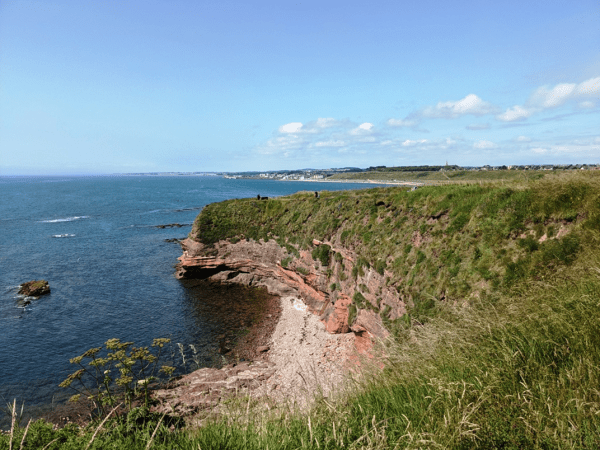
Henry Boggie is my great-grandfather, but he was never really part of the family.
My grandmother, Elspeth Mill Boggie Orrock was born in 1875 in Arbroath in County Angus, Scotland. Her mother, Annie Linn Orrock, registered the birth and gave Elspeth her surname Orrock but she also gave Elspeth the name Boggie. The registration notes that Elspeth was illegitimate as her parents were not married.1
In 1881, when Elspeth was 6 years old, Annie Linn, still residing at 32 East Mill Wynd where she had given birth to Elspeth, instituted a civil paternity suit against Henry Boggie in the Sheriff Court. On 11 September 1882, a decree was issued by the Sheriff Court, stating that the birth registration be corrected to include Henry Boggie as Elspeth’s father.2
Paternity cases were usually attempts to make the father pay child support and we can assume that this is probably why Annie Linn sued Henry for paternity.3 There is no evidence that Henry and Annie every lived together.
The censuses show that Henry lived with his mother until at least 1891. He worked as a mason and remained in Arbroath his entire life. He died fairly young, at 53. The registration of his birth says that he was single.4 It is unlikely that he fathered any other children.
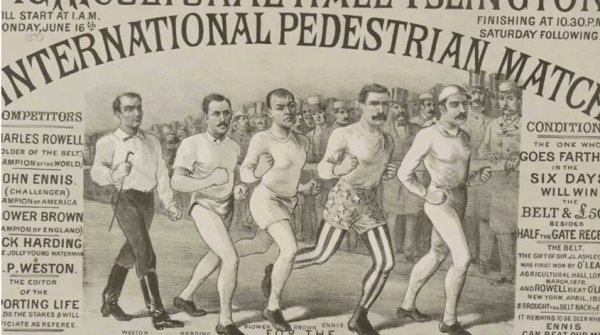
The records indicate that Henry led a quiet life, living in the same city all his life. However, Henry did practice an unusual sport, pedestrianism. In the 19th century, he would have been called a ped. At the time, pedestrianism was popular in Scotland and elsewhere. The six-day, 450-mile race usually began on a Sunday at 1:00 a.m. It started after midnight on Sunday because public amusements were prohibited on Sundays. The athletes walked for six days in a row, in a circle and had to complete the 450 miles. They could run, walk, or crawl. They ate, drank, and napped in little tents at the side. 5
Bloomberg, When Walking was a Spectator Sport, 7 August 2015
The walking matches were a spectator sport, with music and refreshments. It was like a fair. Gambling was also part of the attraction. There were lots of possibilities to place bets, such as the first pedestrian to drop out or the first to achieve a set number of miles. At the time, champagne was considered a stimulant. Some of the trainers (yes, they had trainers) would encourage the participants to drink copious amounts of it.6
Henry seems to have participated in several pedestrian tournaments. He was described as one of the “crack” walkers who participated in the Dundee tournament when he joined the Aberdeen Walking Match in December 1879. It took place in Cooke’s Circus, an equestrian establishment so we can assume that the participants walked around the equestrian arena. Prize money totalled £40 (about £6,000 today) and the winner won the champion belt of Scotland.7
On March 8, 1880, Henry competed in the Perth Grand Pedestrian Tournament. The thirty-three participants hailed from England and Scotland. The format of this tournament was that the men would walk or run between eleven o’clock in the morning and stop at eleven o’clock in the evening. First prize was £25 (about £3,800 today). Jostling, hindering another participant, or using bad language would result in disqualification. Reserved seats were two shillings, second seats were one shilling, and third seats were a sixpence. A musical band was in attendance. Gambling was prohibited.8
The newspaper articles that list Henry’s participation in the Dundee, Perth, and Aberdeen tournaments are just a glimpse into this interesting sport. Not only did the participants travel to compete in these tournaments, the six-day races would have been quite exciting and exhilarating. There is no indication whether or not Henry ever won prize money, but still, he was a “crack” competitor.
Scotland’s People, National Records of Scotland, Statutory Registers of Birth, 1875, District of Arbroath, County of Forfar, Elspeth Mill Boggie Orrock, retrieved 12 January 2018.
Register of Corrected Entries for the District of Arbroath in the County of Forfar, dated 11 September 1882, directing that the defendant, Henry Boggie, Mason, should appear on the registration of birth of Elspeth Mill Boggie Orrock, in possession of author.
Scotland’s People, National Records of Scotland, Statutory Registers of Death, 1905, District of Arbroath, County of Forfar, Henry Boggie, retrieved 22 January 2024.
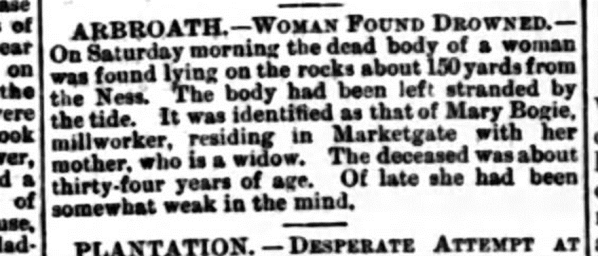
In the 1871 census in the United Kingdom, categories of disability were added to the census questions. These categories included the deaf and dumb, blind, imbecile or idiot, and lunatic.1 Imbecile, idiot, and lunatic are pejorative terms today but in the 19th century, they were medical terms used to indicate mental health conditions. Idiots and imbeciles had learning disabilities. Lunacy was a term used broadly to denote anyone with a mental illness.2
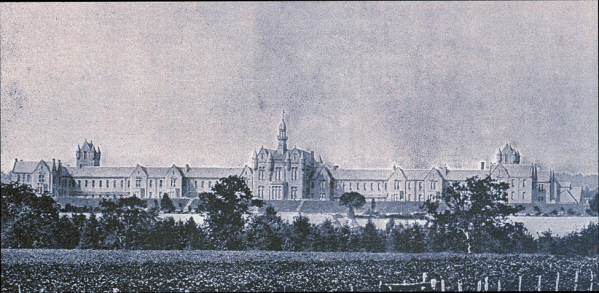
James Kinnear Orrock, my 2X great-uncle, was committed to the Dundee Royal Lunatic Asylum on December 9, 1888. Superintendent James Rorie declared that he was a pauper and that he was delusional. James’ mother, Mary Watson, my 2X great-grandmother, requested that he be committed.4 Not unlike today, the police were involved. A constable declared that he had been violent and incoherent. It is obvious from the notice of admissions that James was experiencing psychotic episodes.
Westgreen Asylum, Liff, Dundee, Scotland in 1897, Westgreen Asylum, Liff, Dundee, Scotland in 1897
James was just 30 when he was admitted to the asylum. Sadly, he remained there until his death in 1930 when he was 72.5 It is distressing that he lived in this institution more than half his life. While little was known about mental illness at the time, the asylum offered the patients safety and hope. Specialist registrar Amy Macaskill states “What is clear is that they wanted to offer a degree of care and protection and containment for people who were causing difficulty at home and were in some level of distress.”6 The asylums cared for people who were depressed, anxious, delusional, as well as those suffering from other conditions such as epilepsy, alcoholism, and syphilis.7
The Dundee Royal Lunatic Asylum had separate quarters for men and women. The pauper wards for men each had a day room, with a number of single rooms with windows overlooking the airing court. The windows provided the only ventilation. The rooms were not heated but there were open fire places in the corridors. There were weaver shops in a separate building where some patients made packing cloth. Male patients also did stone breaking and some worked on the grounds. They were paid with tobacco and beer. There was a billiard room and dancing parties for the patients, attended by both men and women. A chaplain provided services on Sundays.8
When James was admitted, he was certified a pauper lunatic. This certification gave him access to psychiatric care, but it does not necessarily mean that he was a pauper. His admission records indicate that he was a seaman and he could have been gainfully employed. The Board of Governors of the asylums assessed each patient’s finances. If any financial assistance was required, then the patient was declared a pauper. If the patient or their family was assessed as being able to entirely finance their own care, they were classified as private patients. Private patients benefitted from better food, were able to wear their own clothes, and could be discharged if the person paying for their care wanted their discharge. Unfortunately, while a technical and legal label, the term “pauper lunatic” carried a stigma and deterred people from seeking help.9
We have come a long way in our care for those suffering from mental illness since the 19th century. The Lunacy (Scotland) Act 1857 formed mental health law in Scotland from 1857 until 1913. Its purpose was to provide official oversight of mental health institutions and to ensure that they were adequately funded.10
My father, Edward McHugh, didn’t really talk about his family’s trip of a lifetime. After all, Dad wasn’t even born yet. But it must have been discussed by everyone when he was a boy. In 1911, the first member of the family, Mary Ann McHugh, moved from Dundee, Scotland to Montreal.
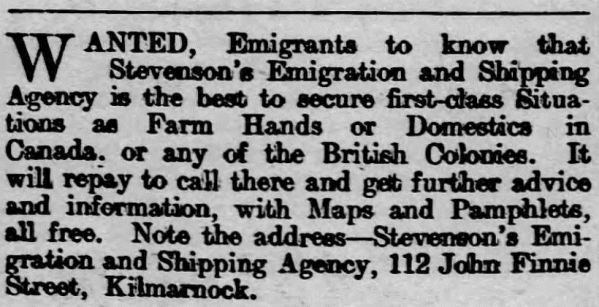
At the time, booking agents in the United Kingdom advertised and recruited potential immigrants to Canada. There was an acute need of domestic help and agricultural workers. Between 1890 and 1920, Canada experienced its third wave of immigration and its peak was between 1911 and 1913, just before World War I.1 The following type of advertisement was common in the newspapers.2
Booking agent advertisement
Maybe one of these advertisements gave the McHugh family the idea to emigrate to Canada. Or maybe Mary was ready for an adventure. She was just 21 when she disembarked from the SS Grampian that had left Glasgow on June 24, 1911 and arrived in Quebec City on July 9, 1911. She would have had a medical exam when she arrived to ensure that she was in good health and did not have an infectious disease. Conditions for immigration to the colonies were well known in the United Kingdom. The February 11, 1911 edition of the Hamilton Observer, in its article, Canadian Notes, People Prohibited, details the reason some potential immigrants could expect to be refused by Canada. The article explains the booking agent’s liability for the immigrants that arrived in Canada for a period of three years following their arrival:
“The following classes of people are prohibited from landing … feeble minded, idiotic, insane, or who have been insane within five years, afflicted with any loathsome, contagious, or infectious disease; anyone who is a pauper, who is destitute, who is a professional beggar or vagrant.”3
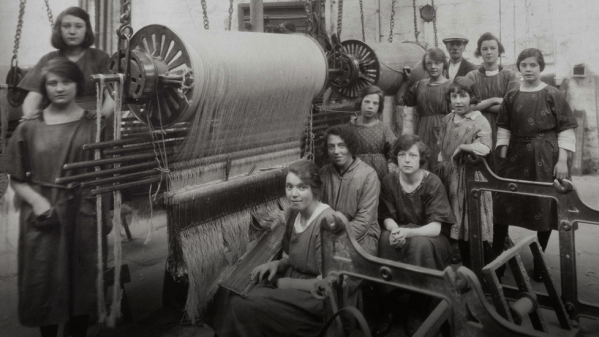
All of the members of the McHugh family worked in the jute mills in Dundee. The 1911 census indicates Mary was a jute weaver, which probably meant that she operated a jute weaving machine.4 She lived with her mother, Sarah Jane McLaughlin, and her brothers, Edward and Francis. They lived at 1 Tait Lane, Dundee. Her other brother, Thomas, my grandfather, lived with his wife and seven children at 9 Tait Lane.
The picture below shows the jute weaving machine.5
Mary must have been satisfied with her new life in Montreal, Quebec. Within a year, her mother and her two brothers, along with my grandfather, had followed her to Canada. Six months later, my grandmother, Elsie Orrock, and her seven children joined her husband, Thomas, in Montreal.
The McHughs lived close together in Dundee and they also lived close together in Verdun, Quebec. While I will never know for sure why they decided to emigrate, I can guess that they wanted a life that was not as hard as the one working in the jute mills. There are a few clues that this was not a spur of a moment decision but a planned family decision.
Mary left first and, if it did not suit her to live in Canada, she would have been able to easily return to Dundee. Her mother and brothers were still there. By the time her mother emigrated, along with her three sons, they arrived with $150 CAD, about $4,750 in today’s dollars. Browsing through the passenger lists, I can see that they had a lot more money than many of their fellow passengers. 6 They were not a rich family, so this amount of money would have taken some time to save up.
Coincidentally my grandfather joined the Freemasons in 1910 and achieved a Master Mason diploma and a Mark Mason diploma.7 By that time, he already had six children. He worked long hours in the jute mill, including Saturdays. Why would he join the masons when he was already a very busy man providing for his family, plus taking care of his widowed mother, and his siblings who still lived at home? There is no evidence that he ever joined the masons when he arrived in Canada. I believe that it is possible that he joined the masons to in case he needed the contacts to find employment. As he quickly found work, his busy family life prevented him from pursuing his membership in the masons.
Only one of my grandfather’s siblings stayed in Scotland, Sarah Jane McHugh. She was not living with the other McHughs at the time of the 1911 census. But she remained close to the family. Surprisingly, she travelled to Montreal to be a witness at her brother’s wedding at the Notre Dame Basilica in Montreal on May 8, 1913.8 That would have been quite a trip for Sarah Jane to make.
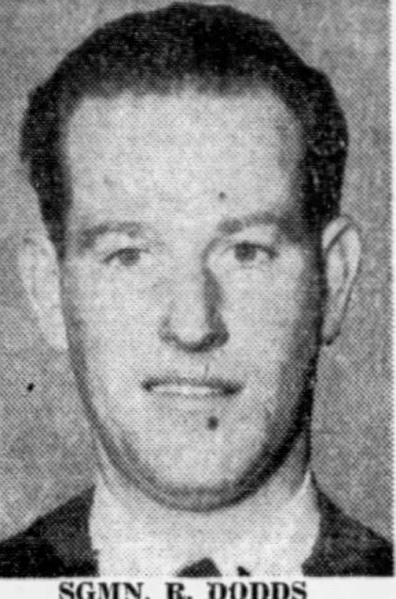
My aunt, Sarah Jane McHugh, was delighted to host the linen shower to celebrate her daughter, Dawna Day’s upcoming marriage to Ralph Dodds. The happy couple announced their engagement in October 1947. Ralph had recently been discharged after serving in the Royal Canadian Navy for over six years. The couple’s wedding would take place in Vancouver, Ralph’s home town. Dawna was from Montreal.
Ralph was just 20 when he started his navy career in Esquimalt, British Columbia in 1939.1 With the advent of World War II, the Esquimalt Navy base became the largest naval training center in western Canada. 2 Ralph Dodds trained to become a signalman would have learned all aspects of military communications in the Canadian Navy. He would have used semaphore flags, read and transmitted morse code messages, and assured radio communications.3 During his training, Ralph would not have predicted that he would participate in the sinking of a German U-boat during the Battle of the Atlantic, that he would be on a destroyer that participated in a sea fight on D-Day, or that the destroyer he was on would be shipwrecked off the coast of Iceland.
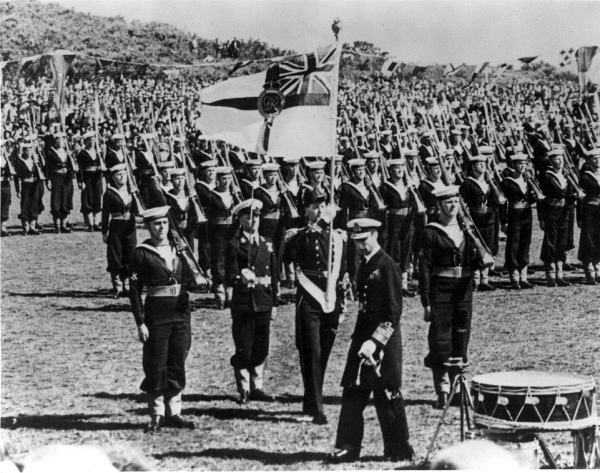
King George VI presents the King’s Colours to the Royal Canadian Navy at Beacon Hill Park, Victoria, 1939. Photo: CFB Esquimalt Naval and Military Museum collection
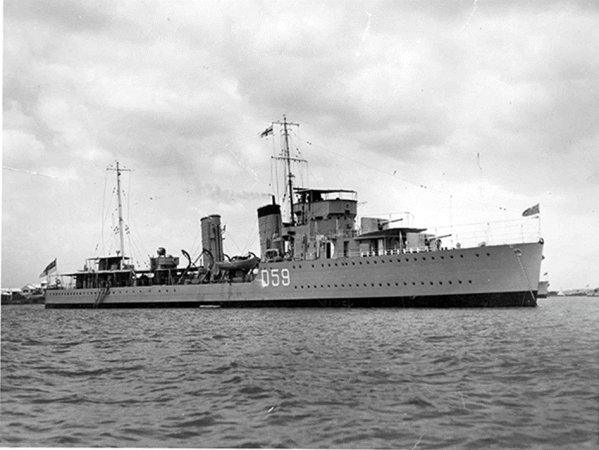
While Ralph was assigned to a naval station, and to a corvette (small destroyer), for most of his naval career, he was assigned to the HMCS Skeena.
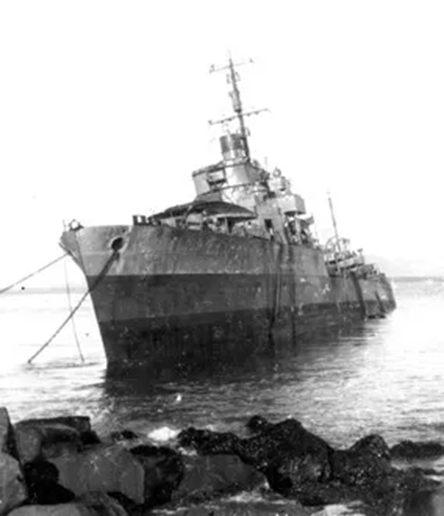
HMCS Skeena, D59, Government of Canada website, Ships’ histories
The HMCS Skeena was commissioned in 1931 in Portsmouth, U.K. and was one of the first two ships built to Canadian order. With the outbreak of the war, the Skeena initially performed domestic escort duties. In May 1940, she was sent to Plymouth, U.K. and became part of the Western Approaches Command, taking part in the evacuation of France and escorting convoys in British waters. She was later assigned to continuous convoy duty.
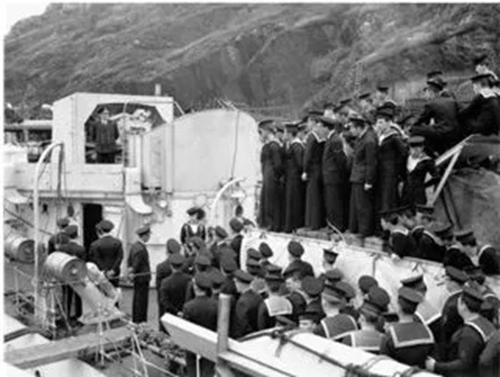
During one of its escort duties in the Atlantic, the Skeena destroyed U-boat U-588. This happened during ON-115 (ON means Outbound to North America). There were twelve escort ships for a trade convoy of 43 merchant ships that left Liverpool on July 12, 1942. On July 29, seven U-boats of the Wolfpack Wolf had spotted them. This Wolfpack was quickly joined by another six U-boats of the Wolfpack Pirat. The Wolf Pack tactic, or the “Rudeltaktik,” was devised to attack the Allied convoy system by forming into position effecting a massed organized attack.4 This particular battle resulted in the loss of three of the ships in the convoy and significant damage to two of the ships in the convoy. One of the damaged ships returned to the U.K. and one was escorted to St. John’s, Newfoundland. The Skeena, on which Ralph was a signalman, and the HMCS Wetaskiwin, an escort corvette, destroyed U-boat 588 with depth charges (antisubmarine missiles) on July 31. The hostilities lasted until August 3 when the U-boats lost contact with the convoy due to misty weather. The convoy with the remaining ships reached Boston on August 8, 1942.5
The sinking of American freighters, Edward Rutledge, Tasker H. Bliss and Hugh L. Scott at Fedala Roads, November 12, 1942
Commodore Leonard Murray congratulating the ship’s companies of HMCS Skeena and HMCS Wetaskiwin for sinking the German submarine U-588 on 31 July 1942. St. John’s, Newfoundland, Aug. 4, 1942. (NAC PA-115347)
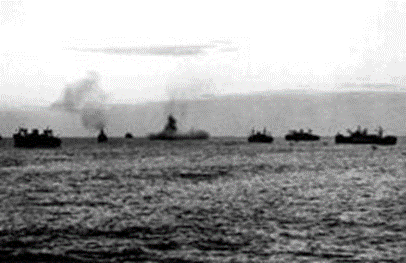
The Skeena also participated in a hot sea fight in the Channel on D-Day. The Skeena’s assignment was to prevent enemy U-boats from attacking Allied ships while the Invasion of France was being carried out.
“Torpedoes were shooting about in the Channel and missed the Skeena by only a matter of feet,” said Ralph in an interview he gave to the Vancouver Sun.
The destroyer also had to contend with German Dorniers (bombers) that were bombing the destroyers in the Channel. One of the aerial missiles fell so close to the Skeena that shrapnel was later found on the deck.6
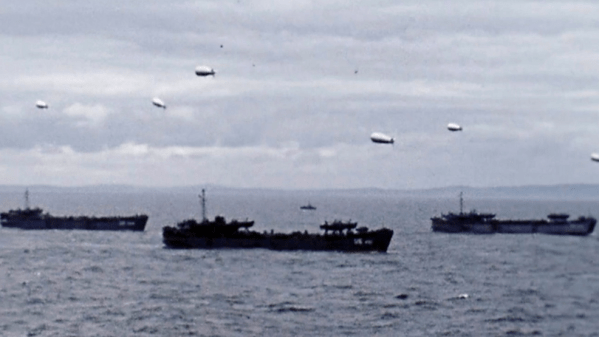
Ships and blimps sit off the coast of France on D-Day, June 6, 1944. War Footage From the George Stevens Collection at the Library of Congress
After five years of war, the HMCS Skeena met her end as she sheltered from a violent gale with 15-metre waves off the coast of Iceland, at Videy Island on October 24, 1944. Even though the crew had thrown out a second anchor to secure the ship, the Skeena smashed into the rocks. When the crew abandoned ship, the men were unable to hold the lines. Some crew members were smashed into the rocks, while others were tossed into the sea. Fifteen sailors died.7 Ralph Dodds survived.
During his lifetime, Edward McHugh made several trips back and forth across the Atlantic Ocean, but there was a world of difference between his first trip and his last.1
Edward was 19 when he immigrated from Scotland to Canada in 1912 with his widowed mother, his two brothers, his sister-in-law and his brother’s seven children. Destined for Montreal, they traveled on the steamship S.S. Grampian in third class, or steerage. Edward would have slept on a bunk bed and shared his room with other family members, and meals would have been served at long communal tables in the dining room.2
Forty years later, in 1951, he traveled first class from Southampton to New York on the luxurious R.M.S. Queen Elizabeth ocean liner.3 He would have enjoyed a spacious stateroom, first class lounges and formal dining. He could have ordered anything he wanted from room service.4 There would have been plenty of space to store his eleven pieces of luggage.5
By that time, Edward had retired and was able to afford first class passage because of his successful career as a musician. This is the story of how a talented, working-class young man from Scotland and Montreal became famous in America as the Gospel Singer.
Edward, born in 1893 in Dundee, Scotland, came from a family of jute-factory workers of Irish heritage. His father was a yarn dyer.6 When the family arrived in Canada, they settled in Verdun, a district of Montreal located close to the factories that would have provided employment for the three McHugh brothers. Edward worked as a manual labourer in the rail yards on the locomotives.7
Shortly after his arrival in Canada, he made his public singing debut at Montreal’s Hunt Club, singing God Save the King. The Duke of Connaught, then the Governor General of Canada, heard him sing and was instrumental in sending him to study at London’s Royal College of Music.8 This college accepted both students who paid tuition and students who won entry through competitions.9 Given Edward’s humble background, it is probable he had a scholarship.
By 1919, Edward had decided to pursue a musical career so he left Montreal, settled in New York City and continued his studies .10
It took a few years for Edward’s career to take off, but in 1927, Edward was invited to sing The Old Rugged Cross, an evangelical hymn written in 1912,11 on Boston radio station WEEI.12 The next day, the station received 2,300 letters praising Edward’s baritone voice. His choice of hymn and the timing were excellent. Gospel songs had become increasingly popular as they were easier to sing than traditional hymns. 13
In 1938, Edward published a compilation of gospel hymns and poems.14 His fame grew and, by the 1940s, he was nicknamed the Gospel Singer and he was a regular on NBC radio.16
In 1947, an ad for Edward’s 15-minute radio program appeared in Billboard Magazine. It claimed, “Edward MacHugh, Your Gospel Singer, [. . .] who is said to have the most perfect diction of any singer without sacrificing warmth . . . ”19
It wasn’t just the quality of his voice that made him popular; he seems to have tapped into a need for comfort in troubled times. During World War II, his fans often requested he sing God Will Take Care of You,17 a song that must have soothed people whose loved ones were risking their lives serving their country.
When asked about gospel music, Edward replied, “A lot of people think that hymn-singing is ‘corny.’ That’s okay with me. I get my satisfaction in giving real pleasure to a great number of people and perhaps in being some small help in times of trouble and affliction.”18
It is clear that Edward’s beautiful baritone voice moved many listeners. He popularized hymns and gospel songs through his radio shows, compilations, records and concerts,20 and he sang songs of simplicity, devotion and encouragement in times of pain.
After he retired in the 1940s, Edward and his wife Jennie lived a quiet life in Norwalk, Connecticut. They had no children. During his retirement, Edward continued to make records and take part in religious festivals and church anniversaries. He passed away in 1957 at the age of 63 in Fort Lauderdale, Florida.21
Note: At some time in his life, Edward changed his name from McHugh to MacHugh
“UK, Outward Passenger Lists, 1890-1960,” database, Ancestry.com, Edward McHugh, Grampion, Glasgow to Quebec, leaving May 11, 1912.
1920 United States Federal Census, 1920, Manhattan, New York City, New York, Enumeration District (ED) 829, sheet 2, Ward 11 a.d., Dwelling 250, apt. 39, Edward McHugh: digital image, Ancestry.com (http://www.ancestry.com: accessed 27 February 2017)
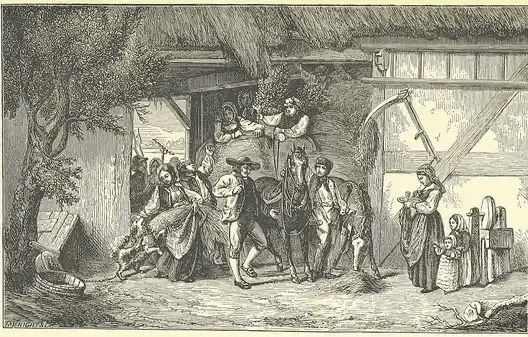
James Orrock, my two-times great-grandfather, was a farm labourer in Scotland in the mid 1800s. Agricultural labourers did not work all their lives on one farm. It was common for farm servants, both men and women, to attend farm hiring fairs. They would then hire themselves out to the highest bidder.1
Hiring Fair
According to the 1851 census, James worked on a farm in the village of Marykirk, Kincardineshire.2 His wife-to-be, also a farm servant, worked on a different farm located in the same village. They married two years later. By then they had moved to Kirken, in County Angus.3 Mary and James went on to have seven children and it is no surprise that their children were born in different villages, as James would have moved from job to job, always as a farm servant. The various censuses indicate that James worked as a ploughman, farm servant, or agricultural labourer. His family followed him as he moved for work. In 1863, their daughter, Martha Linn died of small pox at the age of three.4 Two years later tragedy struck again when James died at the age of 33 from tuberculosis.5
When Mary became a widow, her situation would have been precarious. James had been sick for a long time and had been unable to work. Mary had to find a way to provide for her children. Farm servants were usually lodged at the farm where they worked. Families often had small dwellings, with a small yard, where they could have a garden and a henhouse. With the death of James, Mary would have also lost her home. It is no surprise that she moved to Arbroath, perhaps in the hope of working in the jute and sailcloth mills. At the time of James’ death, demand for jute was high due to the American Civil War6 and work was available in the mills. Mary would soon learn that, while Arbroath provided employment, it also provided additional worries about her son, James.
The 1871 census shows Mary living with four of her six remaining children in Arbroath.7 Her eldest son, Alexander, 17, worked as a farm servant in a village about 10 km away, in Kirkden.8 Ann and Jemima, 16 and 14, would have been working. David and Jane were in school. But where was James, only 12 at the time?
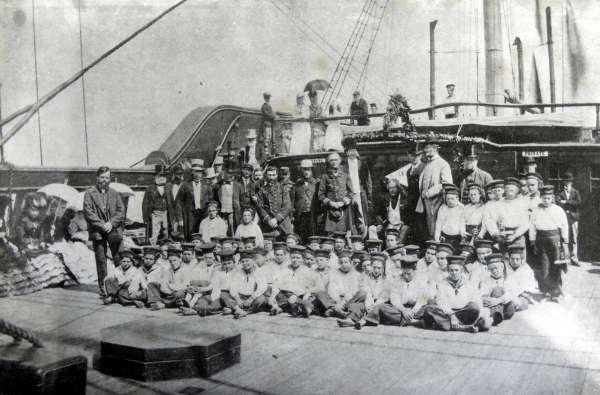
I found James in the 1871 census listed as an inmate at the Mars Training Ship for Homeless and Destitute Boys, about 35 km away from his family.9 This ship was moored on the river Tay at Woodhaven Harbour, Wormit, Fife from 1869 to 1929.10
The HMS Mars was built in 1848 and saw military service in the Crimean War. Deemed surplus in 1869, it became a training ship with space for 400 boys with the objective to take destitute and homeless boys off the streets of Dundee, Edinburgh, and Glasgow and train them for service in the Royal Navy or the Merchant Marine at their discharge at age 16.11
The Mars Training Ship was an initiative put forth by Lord Provost William Hay and members of the elite. Truancy and vagrancy were rife in the cities of Scotland, due to overcrowding, unemployment, and poverty. The inmates of the Mars were often picked up for truancy or for begging and were sent to the training ship for five years by magistrates. The boys were poor, orphans, beggars, or homeless or sometimes they had just fallen in with the wrong crowd.12
Mars Training Ship Institution 13
The move from farm life to a bigger urban centre would have been difficult for James. He was 12 when he shows up as an inmate in the Mars Training Ship and he was probably sent there at the age of 10 or 11. There is no way to know why he ended up there. We know that his family was poor. It is probable that he wandered the streets while his mother and two sisters worked long hours in the jute mills. He may have been a difficult child as he suffered from mental illness later on in life.14
The Mars Training School was an industrial school, as opposed to a reform school. The boys did not have a criminal record; however, in some ways they were prisoners. All of the boys were very poor and many of them were homeless. For those who did have homes, they were deliberately given very little opportunity to maintain connections with family and friends.15
Upon arrival on the ship, a medical officer examined the boys once they were stripped. The children then washed, put on their uniforms, and were assigned a number. From then on, they were only referred to by their number. Even the boys called each other by their numbers.16
The day on the Mars ship would begin early, at 5:30 a.m. The boys scrubbed the deck, had breakfast, and then said their prayers. In the morning they learned English, arithmetic, geography, and music. The afternoons were dedicated to practical skills such as shoe repairing, clothing and sail-making, woodworking, metalworking, tailoring and seamanship. The boys were attended by doctors and dentists and were well fed. There was less disease onboard than in the crowded and unsanitary cities of Dundee, Edinburgh, and Glasgow. To further reduce the chance of disease, the boys would make an annual trip to Elie, a coastal town, allowing a skeleton crew to fumigate and clean the ship. 17
James would have been discharged from the ship when he was 16. Records of his later life did, indeed, indicate that he worked as a seaman.18
National Records of Scotland, 1851 census, Parish of Marykirk, County of Kincardineshire, James Orrock, Scotland’s People, downloaded 27 March 2023.
National Records of Scotland, Old Parish Registers, Church of Scotland marriages, Kirken, James Orrock and Mary Watson, Scotland’s People, downloaded 27 March 2018.
National Records of Scotland, 1863 Deaths, Parish of Dunnichen, County of Forfar, Martha Linn Orrock, Scotland’s People, downloaded 8 March 2023.
National Records of Scotland, 1865 Deaths, Parish of Dunnichen, County of Forfar, James Orrock, Scotland’s People, downloaded 9 April 2018.
The Textile Industry of Arbroath since the Early 18th Century, Turner, W.H.K., The Abertay Historical Society, 1941, p.15
National Records of Scotland, 1871 census, St. Vigeans, Arbroath, Mary Orrock (Watson), Scotland’s People, downloaded 16 March 2023.
National Records of Scotland, 1871 census, Kirkden, Angus, Alexander Orrock, Scotland’s People, downloaded 23 March 2023.
National Records of Scotland, 1871 census, Woodhaven, Forgan, Fife, 1871 census, James Orrock, Scotland’s People, downloaded 15 March 2023.
Page one of the Montreal Star read “Canada is Now Officially at War.” The article goes on to describe the declaration of war on Sunday, September 3, 1939:
“The declaration of war called forth a feverish activity, disturbing the quiet of a mellow Sabbath day on the very edge of autumn. … Thousands of people … heard the roll of bugles and drums, but, this time, with a martial motive. The Army Services Corps were parading with placards calling for volunteers in their vital lines of military service.” 1
Both my dad, Edward McHugh, and my uncle, James McHugh, volunteered to serve in the Canadian military. Edward went into the Royal Canadian Air Force (RCAF) and James joined the Royal Canadian Hussars, the armoured car division of the Canadian Armed Forces. Edward was stationed in Yorkshire, England and James saw active duty in France.
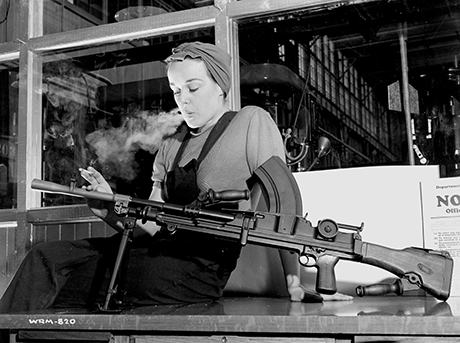
While the McHugh brothers were in Europe fighting the war, Canada was being transformed. Madge Angell, James’ wife, worked in one of the many factories that manufactured armaments for the war effort. She was a riveter and one of the one million Canadian women who worked in plants that produced munitions, weapons, and equipment during the Second World War. Veronica Foster, Ronnie, the Bren Gun Girl, represented these women and became a Canadian icon. Foster worked for the John Inglis Company Ltd. on the production line for the Bren light machine guns. She was photographed for a propaganda campaign under the direction of the National Film Board of Canada. These pictures were used to encourage Canadian women to participate in the war effort.2
Unknown photographer, Veronica Foster, an employee of John Inglis Co. Ltd. and known as “The Bren Gun Girl” posing with a finished Bren gun in the John Inglis Co. Ltd. Bren gun plant, Toronto (May 10, 1941), contemporary print from vintage negative. National Film Board of Canada. Photothèque / Library and Archives Canada e0007604533
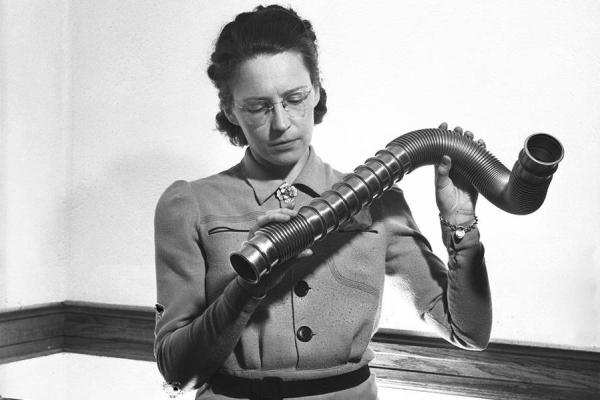
Canada not only needed women to directly support the war and work in the munitions industries; it was also essential that they fill jobs traditionally held by men. Women worked on airfields, in factories, and on farms. They developed a reputation for fine precision work in electronics, optics, and instrument assembly. With the men away from the farms, the women took on the extra work. Lumberjacks became lumberjills. They also drove buses, taxis, and streetcars. Notably, Elsie Gregory MacGill was the first woman in the world to graduate as an aeronautical engineer. She worked for Fairchild Aircraft Limited during the war and in 1940, her team’s design and production methods were turning out more than 100 Hurricane combat aircraft per month.4
Elsie MacGill. Source: Library and Archives Canada 5
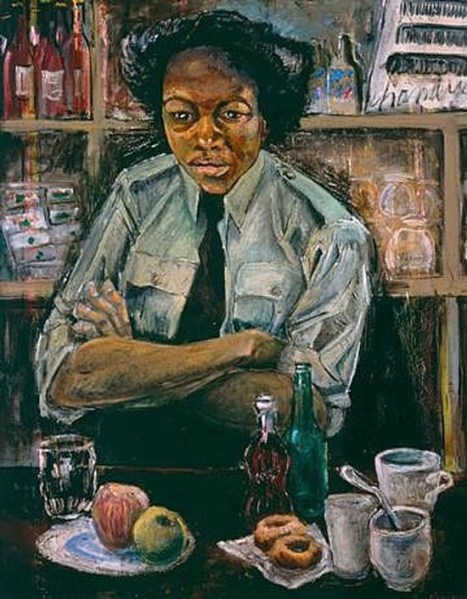
Canadian women wanted to play an active role in the military and lobbied the government. As a result, more than 50,000 women served in the armed forces:
The Canadian Women’s Army Corps;
The Women’s Division of the Royal Canadian Air Force;
The Women’s Royal Canadian Naval Service (Wrens); and
Nursing sisters. 6
Second World War painting, Private Roy, Canadian Women’s Army Corps, by Molly Lamb Bobak.7
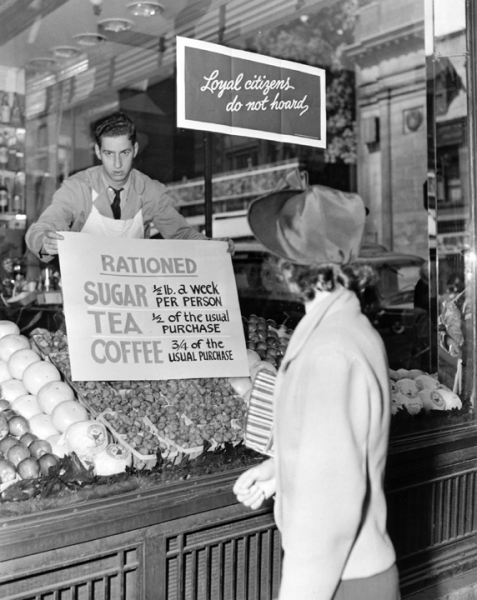
For women who did not work or were not members of the military, there were also many opportunities to contribute to the war effort. Women were asked to reduce their consumption of goods that were in short supply and to recycle. Goals were set to collect tons of rubber products to transform them into tires and other needed items for the war. Ration books were assigned.8 My grandmother, Grace Hunter, loved to cook and bake and she would often speak about the challenges of rationing during the war. At that time, all baking was home made, so the rationing of flour, butter, and sugar was difficult.
Scarcity of food lead to rationing.9
My grandmother also knit socks, gloves, and other knitted clothing for the troops that were delivered by the Red Cross. Women made warm clothing for the soldiers at the front, as well as quilts and bandages. As well, women groups sent books, newspapers, and treats to military hospitals.10 Nana was also active in organizing the “send off” and “welcome home” parties for the Montreal servicemen. My mom, Patricia Deakin, was a teenager during the war and her mother recruited her to help at these parties. She enjoyed these parties and felt that she was doing something for the war effort. An extra bonus was that she thought that the servicemen were very handsome.
The Montreal Star, 4 September 1939, page 1, Newspapers.com, accessed 4 January 2023.
Private Roy, Canadian Women’s Army Corps, painting by Molly Lamb Bobak, Beaverbrook Collection of War Art (online), Canadian War Museum, 19710261 1626, accessed 16 January 2023.
With great sadness, we recently learned of the death of Joan Benoit of Pointe Claire, Quebec in late 2022. Joan was a devoted genealogist and volunteered and helped run the Quebec Family History Society (QFHS) for over thirty years. Ever patient, she helped both the experienced and novice genealogist in their research. She was the “go to” person when anyone had a question. In the words of Claire Lindell:
“It was spring of 2012 when I walked in to the QFHS. Joan greeted me with a smile and made me feel welcome. She offered to help me with my quest for ancestors. She took Rene Jetté’s big blue dictionnaire from the shelf and asked me the names of those I was searching. Within minutes I found my mother’s ancestral family … Claude Jodouin who arrived in Ville Marie in the mid 1600s. I was off to the races and have never looked back, thanks to Joan.”
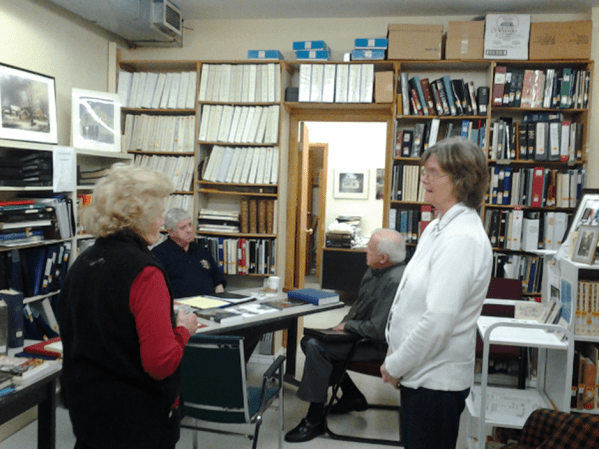
Ruth Dougherty (left) and Joan Benoit (right) chat in front of Earl John Chapman who is seated at the table speaking with Oskar Keller during Military Roots Day, 2012, at the QFHS.
Joan’s extensive knowledge, accompanied by a warm smile, has helped numerous researchers over the years. Many of her fellow genealogists became her friends. As well as being an avid researcher, she also had a vision of what was needed to promote genealogical research and always accepted the challenge to do what was needed. For approximately twenty years Joan was a well-known visitor to the Archives nationales du Québec on Mullins Street in Pointe-Saint-Charles and later the Archives nationales on Viger Square in Old Montreal. She researched hundreds of family lineages.
Jacques Gagné and Joan Benoit enjoyed a friendship of many years, which Jacques says can best be described in Proverbs 27:17, “As iron sharpens iron, so one person sharpens another.” In other words, good friends bring out the best in one another and enhance each other’s strengths.
Joan’s quiet presence, always supportive, will be sorely missed.
As a child, I never imagined what life was like before my parents had my brother and me. But once in a while they would talk about their courtship and what it was like to meet right after World War 2.
When war broke out in 1939, my dad, Edward McHugh, signed up right away. He was stationed in Yorkshire, England and only returned home when the war ended in September 1945. He was already 31 and normally would have been considered a confirmed bachelor.
My mom, Patricia Deakin, would often speak about the day the war ended. She worked for the Sunlife Insurance Company of Montreal. The Sunlife Building was located on Dominion Square in downtown Montreal. When word got out that Germany had surrendered, all of the office workers in downtown Montreal just left their offices and walked out into the streets to express their joy. My mom described it as an amazing outburst of pure joy and celebration of the end of a long and painful war.1
Celebrations in the streets of Montreal at the end of WW2
When Edward went to war, he intended to return to work for his employer, the Canadian Celanese located in Drummondville and his employer had guaranteed his employment. However, my dad decided to stay in Montreal.
At that time, my mom’s brother, Jack Deakin, was dating Norine Scott. Norine and Patricia became great friends. The picture below shows them in the Laurentians for a day of skiing.
Norine Scott (left) and Patricia Deakin at the ski hill
Both the Canadian National and the Canadian Pacific operated trains from Montreal to the Laurentians, known as the “snow trains,” otherwise known as the P’tit train du Nord.2 Below is one of the Canadian Pacific posters.3
Promotional poster for snow trains
It wasn’t long before Norine introduced her young and eligible Uncle Eddie to my mom and that was the beginning of their courtship.
Both Ed and Patricia loved going to the movies and their Saturday night dates were often a meal at Bens Delicatessen, followed by a show. Bens was a well known delicatessen in Montreal that was famous for its Montreal-style smoked meat. In 1908, Benjamin Kravitz and his wife Fanny Schwartz opened a sweet shop on Saint-Laurent Boulevard and then added sandwiches, using Benjamin’s mother’s recipe. In 1929, they moved to 1001 Burnside (now de Maisonneuve), in the theatre and night club district of the city, and then to their final location in 1949.4
Bens Store Front5
My parents were married on May 21, 1949 at St. Columba Anglican Church in Notre-Dame-de-Grace. This church was built in 1920 but has now been sold to a developer.6 My grandparents would have been parishioners of the church as they lived just 10 minutes away.7 The post WW2 period was marked by a housing shortage. Pressure on the housing shortage was due to demobilized soldiers returning home, and the increase in newly created families. My parents, like many post WW2 newlyweds, lived with my grandparents after the wedding.
St. Columba Anglican Church, Notre-Dame-de-Grace, Montreal
The wedding announcement in the Montreal Star on May 30 1949, describes the bride as wearing:
“A gown of white slipper satin made with nylon yoke on Grecian lines and with train. Her veil was of tulle illusion, was finger tip length, held with a bandeau of lilies of the valley and orange blossoms. She carried a cascade bouquet of white carnations and bavardia.”8
The wedding announcement goes on to say that the reception was held at the Montreal West City Hall, in the music room. This photograph of the wedding party is probably taken outside the Montreal West Town Hall.
From left to right: Alistair Lamb, Mary McHugh, Ronald Lamb, John Deakin, James Meikle, Edward McHugh, Patricia Deakin, Melba Jones, Norine Scott, Dorothy Newcombe, Grace Hunter, George Deakin
The wedding announcement continues:
“Mr. and Mrs. McHugh went to Pleasant View Hotel, North Hatley, for their honeymoon, the bride wearing for travelling a three-piece suit of beige Scotch mist, with white straw hat and green accessories and a corsage of white carnations.”9
Founded in 1897 and located on Lake Massawippi, North Hatley is one of the prettiest villages in Quebec.10 Below is a post card of the Pleasant View Hotel:11
Pleasant View Hotel, North Hatley, Quebec, Photogelatine Engraving Co. Limited, 19?, Bibliothèque et Archives nationales du Québec, 0002643996, accessed 28 December 2022.