All posts by Sandra McHugh

Everyone is Irish on St. Patrick’s Day

Everyone is Irish on St. Patrick’s Day.  We all love to be Irish for a day on March 17.  In my case, I treasure my Irish roots.  Today, I will raise a pint of Guinness and toast my ancestors.

Although my grandparents were Scottish, my great-great-grandparents, John McHugh and Mary Garret, were Irish.  They were both born around 1820 in Ireland.  They would have been young adults when the Great Famine, also known as the Great Hunger and the Irish Potato Famine happened between 1845 and 1852, when potato blight ravaged potato crops throughout Europe.  Ireland was significantly affected and, as a result, one million Irish immigrated to other countries. We commonly hear about the Irish that moved to North America and Australia but a significant number of them immigrated to Scotland.1 John and Mary McHugh were among those who decided to go to Scotland.

At the beginning of the 19th century, it was already common for Irish agricultural workers to move to Scotland temporarily to work during the harvesting season.  By the 1840s, the number of these workers had increased from a few thousand per year to 25,000.  By 1851, the Irish-born population in Scotland had risen to 7.2% of the total population.2

The economic difficulties in Ireland, combined with the industrialization of Scotland that included the expansion of coal and iron ore mining, and the building of shipyards and railways, as well as the significant expansion of the textile industry in Scotland, made Scotland an attractive destination for the Irish.3

The Irish were ideally qualified to work in Scotland’s textile industry as many of them already had knowledge and experience in the textile and jute industry.  Linen and yarn production was already established in Ireland.4The economic conditions in the 1840s in both Ireland and Scotland provided John and Mary McHugh with the impetus to move to Scotland to work in the textile factories in Dundee. Not only John, but Mary also, would have been assured of a regular wage, as many of the textile workers were women. 5

While Scotland would have been a choice destination for John and Mary, it would have been a difficult adjustment.  Sadly, this is because of their religion.  They left communities in which everyone was Roman Catholic to go and live in Protestant Scotland. The Irish Roman Catholics did not have an easy time of it in Scotland. “Anti-Catholic Scots were active in the Scottish Reformation Society and sometimes caused riots.”6 These anti-Catholic sentiments probably encouraged the Irish Catholics to remain in their distinct communities and delayed their integration into Scottish communities.

The following quote illustrates that the Irish were victims of discrimination.

“As late as 1923, the Church of Scotland could still publish a pamphlet entitled ‘The Menace of the Irish Race to our Scottish Nationality’. The Irish were seen as drunken, idle, uncivilised and undermining the moral fibre of Scottish society. They were also seen as carriers of disease. Typhus, for example, was known as ‘Irish fever’.”8

Unlike the above quote, we know the Irish to be hard working, disciplined and adaptable.  I am proud to have Irish roots.

So, despite what would have been great adversity, John and Mary settled in Scotland, lived in a Roman Catholic community and had children and grandchildren who worked in the textile industry. The generations of McHughs working in the textile industry in Dundee came to an end when their grandson, my grandfather, Thomas McHugh, could no longer find regular work in the textile industry in Dundee and decided in 1912 to move to Canada.

A toast to the Irish!  I wish you all a very happy St. Patrick’s Day.


1 https://en.wikipedia.org/wiki/Great_Famine_(Ireland)

2 http://www.irish-genealogy-toolkit.com/Irish-immigration-to-Scotland.html

3 https://en.wikipedia.org/wiki/Industrial_Revolution_in_Scotland

4 http://www.irish-genealogy-toolkit.com/Irish-immigration-to-Scotland.html

5 https://en.wikipedia.org/wiki/History_of_Dundee

6 http://www.irish-genealogy-toolkit.com/Irish-immigration-to-Scotland.html

7 Idem.

8http://www.educationscotland.gov.uk/higherscottishhistory/migrationandempire/experienceofimmigrants/irish.asp

Hogmanay

By Sandra McHugh

The Scots call the New Year’s Eve celebration Hogmanay.1 Hogmanay is part of my family’s history.

My grandfather, Thomas McHugh, came to Canada from Scotland with his family in 1912.  The family maintained the Scottish traditions and they celebrated Hogmanay.  My father, Edward McHugh, was usually the “first-footer.” This means that he was the first one to step across the threshold after midnight, bearing gifts.  Traditionally, to ensure good luck, the first-footer is a tall and dark haired male.  Fair haired first-footers were not welcome, as it is believed that fair-haired first-footers were associated with the Viking invasions.2 My father brought gifts of coal and a herring, but some of the other traditional gifts include shortbread, a black bun, and whiskey to toast the new year.3

There are a few theories about the origin of the word Hogmanay.  The Scandinavian word for the feast preceding Yule was Hoggonott. The Flemish words hoog min dag mean great love day. Some believe that the origin of the word Hogmanay can be traced back to the Anglo-Saxon Haleg monath or Holy Month or the Gaelic words for new morning, oge maidne. Many believe that the source is French, homme est né for man is born. In France, the last day of the year when gifts were exchanged, was called aguillaneuf and in Normandy, this was called hoguignetes.4

Hogmanay is an important celebration in Scotland.  It is believed that this festival was first brought to Scotland by the Vikings for whom the passing of the shortest day of the year, the winter solstice, was an event to be celebrated.5 The importance of Hogmanay took on an even greater significance because Christmas was banned in Scotland for about 400 years.  A 1640 Act of the Parliament of Scotland abolished the “Yule vacation and observation thereof in time coming.”6 This Act of Parliament reflected the changing attitudes towards the Christmas Feast Days during the Reformation. Christmas Day only became a public holiday in 1958 and Boxing Day in 1974 .7

The partying and hospitality that goes on at Hogmanay is a way of wishing family, friends, and strangers a Guid New Year.  The old is swept out, sometimes literally by giving the home a good cleaning, and by clearing up any debts before the bells ring at midnight.8

I wish you all a very Guid New Year.

Sources

1 http://www.scotland.org/features/hogmanay-top-facts

2 Idem

3 Idem

4 http://www.rampantscotland.com/know/blknow12.htm

5 Idem

6 https://en.wikipedia.org/wiki/Christmas_in_Scotland

7 Idem

8 Idem

The Wyndies of Arbroath

My grandmother, Elspeth Mill Boggie Orrock was born in 1875 at 32 East Mill Wynd in Arbroath, Scotland.  She was born in the “Wyndies” of Arbroath, specifically built by the spinning mills and factories to house the handloom weavers that flocked to Arbroath from the surrounding rural parishes. “By 1875, there were 134 spinning mills and factories, factories operating 1,400 power looms and producing 450,000 yards of cloth annually.”1 Flax, jute and sail cloth were woven in these mills. Almost 5,000 people were employed in the textile industry in Arbroath at that time and about a third of them were women. 2 Sure enough, between 1851 and 1911, all of the censuses list members of my family as mill workers, jute weavers, flax dressers and doffers, and yarn bleachers.

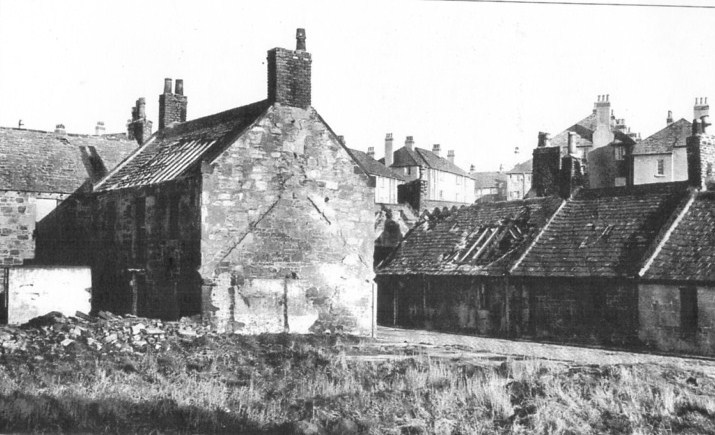
Marcol, a member of The Shoppie, a forum for life in Arbroath, posted this picture of the Wyndies on June 8, 2014.3

Marcol Wyndies

The work days in the mills would have been long, starting at 6:00 a.m. and ending at 7:30 p.m., with a half hour break for breakfast and a half hour break for dinner.  They worked six days a week and Sunday was their day of rest. The mills were kept clean and were well ventilated.  In addition, it was not unusual for the owner of the mill to provide free evening school for children working in the mills.4

By the early 1900s, Arbroath and neighbouring Dundee had suffered a serious decline in the textile industry and more significantly, the jute industry.  Jute was imported from India, however, the mill owners realized that it would significantly lower the cost of production to open mills in India to prepare the jute and import the finished product to Scotland.5 Once mills were established in India, the production of the mills in Arbroath and Dundee declined significantly.

The growth of the textile industry in Arbroath in the 1800s provided an impetus for my grandmother’s family to move into the city so that they could find steady work in the mills and provide for their family.  The decline of steady work in the textile industry in the early 1900s was the reason why my grandmother, with her husband, who had always worked in the mills, and their seven children, decided to move to Canada in 1912.

 1 http://archive.angus.gov.uk/history/features/2004-08-oldarbroath.htm

2 http://www.scottish-places.info/towns/townhistory385.html

3 http://www.theshoppie.com/arbroath/forum/topic.asp?TOPIC_ID=4108&whichpage=4

4 Factories Inquiry Commission submitted to Parliament, 1833, pages 21 to 23

5 https://en.wikipedia.org/wiki/History_of_Dundee

RCAF Iroquois Squadron 431

By Sandra McHugh

In World War II, RCAF Iroquois Squadron 431 executed 2,584 sorties, dropped 14,004 tons of bombs, lost 72 aircraft, and suffered 490 aircrew causalities, including 313 deaths, and 14 operational personnel deaths.1 My father, Edward McHugh, was part of the ground crew of this squadron.  He was an electrician by trade and when he enlisted during the summer of 1940, it was determined that the RCAF needed aircraft electricians. He began his training in Canada as part of the British Commonwealth Air Training Program (BCATP). Prime Minister William Lyon Mackenzie King had agreed that Canada would manage the BCATP at 231 facilities across Canada, mainly at air bases.2

Great Britain’s Royal Air Force’s Bomber Command was formed on July 14, 1936 and became part of the air defence of the country.  It was made up of groups and the Canadians were included in these groups. Group 6 was established on January 1, 1943 and was entirely made up of Canadian squadrons. At its peak, there were 14 squadrons belonging to group 6, including Iroquois Squadron 431.3

Squadron 431 operated Wellington X, Halifax V, and Lancaster X aircraft.  The Halifax and Lancaster aircraft had higher speed and greater bomb loads than earlier aircraft.4 The Canadian squadrons were stationed in Burn, Tholthorpe, and Croft, Yorkshire, allowing them to make sorties out across the English Channel, out into the North Sea, and into mainland Europe. Their targets included military targets, U boats, industrial centres, and Nazi occupied territories. The battle honours of Squadron 431 include the English Channel and North Sea, the Baltic, Fortress Europe (areas occupied by Nazi Germany), France and Germany (1944-45), ports in the Bay of Biscay, the Ruhr valley, Berlin, German Ports, Normandy, and the Rhine.5

My father almost never spoke about the war.  Despite the camaraderie and deep friendships he forged during his time of service, it was a dark period of his life and he wanted to forget about it. The few times he spoke of it, he mentioned the busy work leading up to a mission, whereby the ground crew would be working intensely to ensure that everything was the best it could be.  Each person was acutely aware that a small detail could mean the difference between life and death.  Each team of the ground crew was assigned to one bomber and they would wait for their bomber to come back after the mission.  Sometimes the bay remained empty and the bomber never came back.  My father never got over the pain of waiting for a bomber that would not return.

Sources

A special thanks to W.E. Huron for his publication about Squadron 431: The History of 431 R.C.A.F. Squadron and more, 1942-1945: Burn, Tholthorpe, Croft

1 Heron, W.E., A Yorkshire Squadron, the History of 431 R.C.A.F. Squadron and more, 1942–1945: Burn, Tholthorpe, Croft, General Store Publishing House, 2009, p. 8

2http://en.wikipedia.org/wiki/List_of_British_Commonwealth_Air_Training_Plan_facilities_in_Canada

3 Heron, W.E., A Yorkshire Squadron, the History of 431 R.C.A.F. Squadron and more, 1942–1945: Burn, Tholthorpe, Croft, General Store Publishing House, 2009, pages 3 and 4

4 http://en.wikipedia.org/wiki/RAF_Bomber_Command

5 Heron, W.E., A Yorkshire Squadron, the History of 431 R.C.A.F. Squadron and more, 1942–1945: Burn, Tholthorpe, Croft, General Store Publishing House, 2009, p. 8

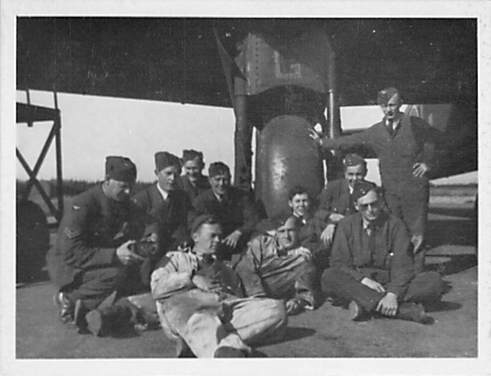
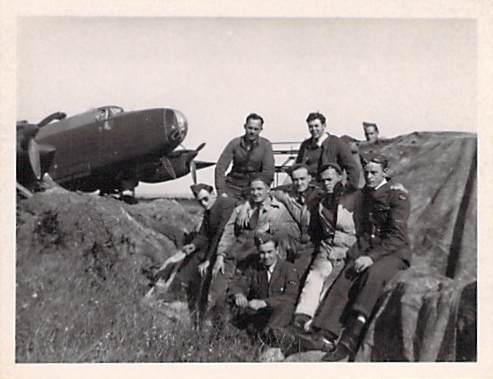
Ground crew. Edward McHugh, wearing overalls, is in the front.
Ground crew.
Ground crew.
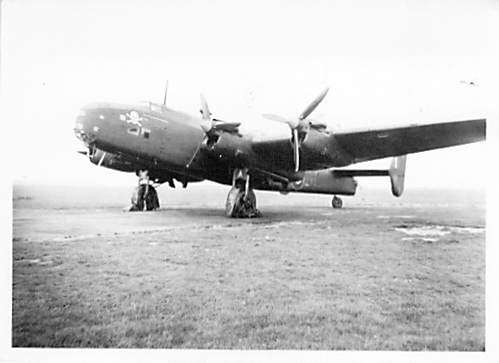
Bomber
Bomber

The Coal Miners of Scotland

By Sandra McHugh

There it is in the 1881 census:  John Hunter, age 13, coal miner.  John Hunter, my great-grandfather, is the last in the line of almost three hundred years of coal miners.1 He was able to change collieries and, later in life, his job.  This was possible because, by the time he was born, the servitude of the coal miners had come to an end.

The generations of coal miners in my family can be traced back to the birth of James Hunter in 1621.  He was a coal miner, born in the town of Alloa, County of Clackmanannshire, Scotland.  Alloa nestles at the foot of the Ochil Hills and has thrived over the centuries because of its location on the Firth of Forth and the many industries that were powered by coal. Today, Alloa’s economy is based on leisure and retail. 2

Coal became an important commodity in Scotland in the 1600s. 3 The rural areas were agricultural communities and coal mining provided employment. Entire families worked in the coal mines. While some children started working in the mines as early as four years old, the usual age of employment was around eight or nine years old.  Both male and female children worked in the mines. 4

As a result of the economic importance of coal in the 1600s, new collieries opened up and, having no skilled workers, attracted workers from other collieries.  The colliery owners who lost workers petitioned Parliament to take action.

The Parliament of Scotland in 1606 passed an Act whereby coal miners were bound to the collieries’ owners:

“no person should fee, hire or conduce and salters, colliers, or coal bearers without written authority from the master whom they had last served.”

This Act effectively ensured that coal miners and their families were bound to the colliery for life.  A collier who deserted was considered to be a thief and punished accordingly. This Act also gave the coal owners and masters the powers to apprehend “vagabonds and sturdy beggars” and put them to work in the mines.  A further Act of 1641 extended those enslaved to include other workers in the mines and forced the colliers to work six days a week.5

The process of emancipation only began with the Colliers and Salters (Scotland) Act of Parliament in 1775, which defined how the colliers could be freed by age-group. Once the father of the family was freed, the entire family was freed.  But still, the process of complete freedom was only achieved with another Act of Parliament in 1799 that declared the colliers “to be free from their servitude.”6 For almost two centuries, colliers and their families had been legally bound to the colliery owners.  Even after the Act of 1799, it was common for the children of coal miners to work in the mine.  It was expected that sons and daughters would follow in their father’s footsteps, as their families needed the income that the children would bring.

In 1842, the findings of the Children’s Employment Commission outlined the dismal conditions under which children worked in the mines.  It was a shocking discovery to learn that children, as young as five or six, worked as trappers, opening and closing the ventilation in the mines, and other jobs, such as carrying coal. The conditions were deplorable and there was a public outcry. On June 22, 1842, Parliament passed the Mines and Collieries Act 1842 (c. 99) with the objective of improving employment conditions for both boys and women in the mines.  Males under the age of 10 were forbidden to be employed in the mines and boys who were not yet 13 years old were limited to 12 hours of consecutive work.  In addition, these boys could not work more than 3 days a week, nor for two consecutive days.  These rules applied even if a boy worked for different owners.  With this Act, women were also forbidden to work in the mine. Women were then employed to work at the pit head, therefore not in the mine.7 The growing public consciousness of the miners’ conditions was a significant step to ensure that mining conditions improved, that working conditions were fair, and that safety became a prority.

1 Family tree in Ancestry.  Common ancestor is William Hunter, coal miner, father of John Hunter.

2 http://en.wikipedia.org/wiki/Alloa

3 http://en.wikipedia.org/wiki/Economic_history_of_Scotland

4 https://www.museumwales.ac.uk/2191/

5 http://www.scottishmining.co.uk/8.html

6 http://www.scottishmining.co.uk/8.html

7 http://en.wikipedia.org/wiki/Mines_and_Collieries_Act_1842

The Harvester Scheme and the Empire Settlement Act

By Sandra McHugh

Who would have thought that finding the immigration records of my grandparents would have led to me to learn about two British government initiatives designed to promote immigration in the 1920s?  I was looking in the Library and Archives Canada web site and found digitized records of Form 30 that recorded the entry of every immigrant between July 1921 and December 1924.1  I was thrilled to find the form that my grandfather, George Thomas Deakin, signed in August 1923, and the one that my grandmother, Grace Graham Hunter, signed in February 1924.

My grandfather’s form indicated that he came to Canada as part of the Harvester Scheme.  In 1923, Canada had a bumper wheat crop and North America could not provide the labour needed to harvest the crop.  Under the Harvester Scheme, the two major Canadian railway companies entered into an agreement with the British government to transport 12,000 workers out west where they would earn $4.00 per day plus board.  This was considered a successful scheme as 11,871 migrants went out west to work, the harvest was successfully completed, and 80% of the harvesters stayed and were considered “successfully assimilated.”2

My grandmother’s passage was paid by the Empire Settlement Act.  This Act was passed by the British Parliament in 1922 and its purpose was to provide an incentive for migrants to settle in the colonies.  Canada badly needed farm labourers and domestic workers.  At that time, the Canadian government favoured immigrants from Great Britain as a means of ensuring the predominance of British values.  In the early 1920s, it was difficult for Canada to attract immigrants from Great Britain as Britain was enjoying a period of prosperity right after World War I.  Another reason was the prohibitive cost of transatlantic transportation.  Even passage in third class would have been expensive for a farm labourer or a domestic worker.3

My grandmother came to Canada to enter into domestic service as a cook and her destination in Montreal was the government hostel.  Hostels were located in major urban areas across Canada.  These hostels were partially funded by the provinces and immigrants from Great Britain were allowed free dormitory accommodation for 24 hours after their arrival.  Young ladies were looked after by the Superintendent of the hostel and referred to a church worker.  They were also referred to Employment Services of Canada who would find them employment.4

Sources

1 Library and Archives Canada:  http://www.collectionscanada.gc.ca

2 Foster, John Elgin, 1983, The Developing West:  Essays on Canadian History in Honor of Lewis H. Thomas, University of Alberta

http://www.pier21.ca/research/immigration-history/empire-settlement-act-1922

4 Crawford, Ruth, 1924, “Canada’s Program for Assimilation”, The Rotarian, May 1924, p. 16

Cherishing memories

My paternal grandparents immigrated to Montreal from Scotland in 1912 and settled in Pointe St. Charles. They moved every few years and, as the family became a little more prosperous, they moved to Verdun. I grew up listening to family stories that took place in Verdun.

Kathryn Harvey, a Montreal historian, has posted this an article about the Verdun Memories project on the web site montrealmosaic.com.

http://montrealmosaic.com/reflection/verdun-memories

Kathryn Harvey and Leila Marshy put together a short film shot about Verdun Memories called Cutting, pasting and remembering. This film is about the memories and also about the joy of sharing these memories with others. You can view this film at:

http://www.verdunmemories.org/