Category Archives: Quebec

Barnabé Bruneau, Why a Protestant?

IMG_9033
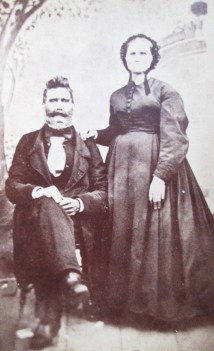
Barnabe & Sophie Bruneau

Whenever I tell someone my ancestors were French Protestants, I always get the reply, “Oh, Huguenots”, but that is not the story. Francois Bruneau came to Quebec in 1659 from France and he was a Catholic. He married Marie Provost a Filles du Roi in 1669 and they began our French Catholic line. The family remained Catholic until Barnabe Bruneau had a bone to pick with the church and became a Baptist. The reasons why depend on who is telling the story.

Barnabé was the son of Antoine Bruneau and Josephte Robichaud. He and his second wife, Sophie Prudhomme, the daughter of Jeramie Prudhomme and Louise Decarie, lived in Sainte Constant Quebec. There they farmed, raised their children and attended the local Catholic Church. Barnabé owned a number of parcels of land, one of which was just inside the border of Sainte-Catherine in the parish of La Prairie. 

In 1856 when the church was collecting the tithe due them from his land, both parishes wanted their tax. Barnabé refused to pay the Curé of Sainte-Catherine. He tried to stop his tithe obligation, by telling the Curé he was leaving the Catholic Church, but they still sued him. With his lawyer Joseph Doutse, who had the reputation of being a great adversary of the Catholic Church, Barnabé went to court and won. With that, he decided to attend the Baptist church, Eglise Baptiste de Saint Constant. He was the first person in the St Constant region to convert to the evangelical faith.

Barnabé’s parents had already died and were safely buried in the crypt of the St Constant Catholic Church, so they were not upset by his conversion. His brother Médard continued to attend the Catholic Church until one Sunday the priest preached that Protestants were devils with cloven hooves, who worshipped Satan and didn’t belong to the true church. Médard came home from church and demanded to see Barnabé’s feet. When they were not cloven, he denounced the priest as a liar and he too left the church and became a Baptist.

As there are notarial documents about the court case this is probably close to the truth but depending on which cousin you ask you will get other stories. One was that the Bruneau brothers learned that the local priest had been “fooling around” with some wives while the husbands were working in their fields and so they left the Catholic Church and became Baptists.

There was another version for those who didn’t want their family to have been involved in any scandals. The Catholics in the area saw that their tithes did not provide for any schooling while the Protestant church was very interested in educating their children and had begun setting up schools. The Catholics in the area tried to persuade the church to start a school but finally, in frustration, the whole congregation walked out of the Catholic Church and joined the Baptist Church.

They certainly did become Protestants. The family committed themselves to the Protestant church as Barnabé’s son Ismael, my great-grandfather had the calling and became a Presbyterian minister.

Bibliography:

Bruneau, Ida. A Short History of the Bruneau – Girod Families. 1993.

Duclos, R.P. Histoire du Protestantisme Francais au Canada et aux Etas-Unis. Montreal, Canada: 1912.

Prévost, Robert. Mon Tour De Jardin. Sillery, Québec: Septentrion, 2002. Print.

Gagné, Jacques. Baptist Churches of Lower Canada & Québec Compiled and researched by: gagne.jacques@sympatico.ca

Photograph of Barnabe and Sophie Marie Prud’homme Bruneau taken by Ayers Photo-Portraits in Jersey City, New Jersey in the 1870s.

This is the link to a story about Barnabe’s son Ismael https://wordpress.com/post/genealogyensemble.com/1237


The Mysterious Charlie G: An Edwardian Era Love Tragedy

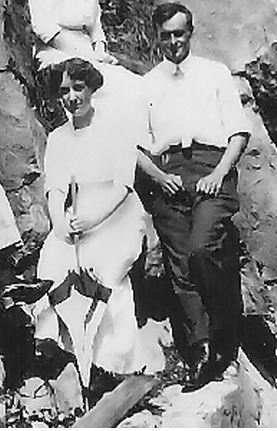
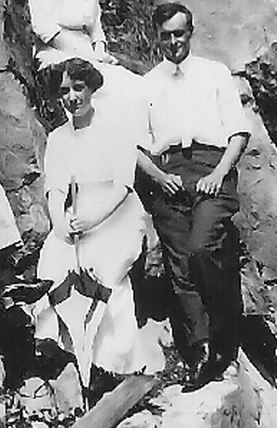
Edith and her beau circa 1909 somewhere near Potton Springs in the Eastern Townships of Quebec

Edith Nicholson (1884-1977), my husband’s Great Aunt Dede, never married. She told her nieces and nephews and great nieces and great nephews that she lost her Great Love in a hotel fire. The couple wasn’t ‘officially engaged’ but there was ‘an understanding’.

Some believed DeDe, some didn’t.

In 2004, I found 300 Nicholson family letters from the 1908-1913 period in an old trunk – and in a letter dated May 3, 1910, Edith writes of this loss to her mother, Margaret:

Your letter received this am. It was so good to hear your voice over the phone. It was quite natural. Oh, how I wish I could talk over everything with you. It seems terribly hard to think it all for the best, when there are so many that are of no use living on and others that are held in esteem cut off in a moment. One thing, I am very thankful for that he wrote me. No doubt one of the last things that he did. I can’t express my feelings. I never felt so badly in my life. But I suppose there are few who have had so pleasant a one as I have, and trouble comes to all.

So the story was true, after all!

Edith mentions many young men in her letters sent from Montreal where she was working as a teacher back to Richmond where her Mom lived. Edith often uses only initials when talking of her romantic life. Apparently, back then, courting was something to be coy about.

It took me long while to figure out but her Great Love was one Charlie Gagne, bank clerk, from Levis, Quebec. A French Canadian man, most likely. Now, that was a surprise.

It seems Edith and this Charlie had an on-again off-again relationship through 1908-1909.

Gagne is a French Canadian name but from the letters it is clear Charlie spent time around Edith’s group of Richmond Protestants. Perhaps he was a convert from Catholicism. In Montreal, Edith worked as a teacher at French Methodist Institute in Westmount, a school where Catholics, mostly French Canadians, were converted to “the Way.”

The Nicholson’s also left behind a photo album from the 1910 era. I have photographs of Edith on a country outing with a handsome young man. If this is Charlie of the May 3, 1910 letter, he is a slim, with a charming smile and a cocky attitude and he is a great dresser. Edith Nicholson would have accepted no less.

There are a few other mysterious mentions of Charlie, or Charlie G or CG in the 1909-10 letters.

In August 1909, Edith writes her Mom saying she managed to ‘show’ Charlie to her father at a train station, (it sounds like a set up) but her father was cool to her young man.

In September 1909, Edith’s mother Margaret writes her father Norman and says “Charlie has gone to Mexico. So that flirtation is over.”

In October 1909, Edith writes her Mom saying she hasn’t heard from Charlie G and that she has no intention of trying to contact him. “He could still be in Mexico, for all I know.”

In February, 1910, Edith writes that she is taking medicine, for ‘her heart has had a jolt’.

Then there’s NOTHING but that May 3 letter about Charlie’s death. Edith writes that she is looking at his picture in the Montreal Star and that “it does not do him justice.”

So I had bits and pieces of a sad love story, but I had to fill in the blanks. I couldn’t even be sure it was Charlie G. who died in the hotel fire.

One sentence in the May 3 missive was especially enigmatic. “It seems if it had only been an accident, it would be easier to understand.”

So, about 5 years ago, I skipped over to the McGill Library to check out the May 1910 Star.

Amidst the pages and pages of stories of Edward VII’s death, I found a story about a Cornwall fire, the Rossmore House Fire, where a Charlie Gagne, bank clerk from Levis, perished.   Proof at last.

Charlie had recently been transferred to the Cornwall branch from the Danville, Quebec branch, which is near Richmond, Edith’s home-base. (The February jolt!)

Only half of Charlie’s body was found at the scene and that was burned beyond recognition. There was only a tie pin to identify him.

The fire had started in a stairwell and, as a boarder who knew the hotel well, Charlie tried to use the stairway to escape the fire, as did a few other boarders, including an entire family.

Most hotel clients had been rescued by fireman at their hotel window, or had frantically jumped to safety.

There was no photograph with this Montreal Gazette newspaper article, though – so I was confused.

Then Google News archives came online and I saw that the Rossmore Fire happened on April 29!

I headed down to Concordia’s Webster Library to check out the January-April reel of the 1910 Montreal Star.

Sure enough, the Cornwall fire was front page news on April 29 as the Star was an afternoon paper.

The next day’s issue had a back of the newspaper follow up article on the fire with a photograph of Charlie Gagne, Levis-born bank teller at the Bank of Montreal.

The photo was of a sober-faced Charlie, but it was without a doubt the man of the family album.

At long last, mystery over.

Then, much later, on Ancestry.ca, I found Charlie’s name on the 1901 Census and his 1910 death certificate that claims he died accidentally in a fire. Charlie, the snappy dresser, was the son of a modiste, a widow, and he had a younger sister. And he was buried as a Roman Catholic!

WHY BAPTISTS?

By René Péron

Religious history tells us that what we call The Reformation was indeed part and parcel of several attempts to reform certain aspects of the once dominant Roman Catholic Church. Be it under the influences of Francis of Assisi, Erasmus, Waldo, Hus, most prior moves towards reform from within said Church lasted but short periods of time. It remained for two convinced and strong willed men, namely Martin Luther and Jean Chauvin (whom we know best as Jean Calvin or John Calvin) to found separate though like-intentioned movements for deep and exacerbating reform.

Out of these said movements there was born a surge of people who became followers of the revised theological thinking as promulgated by each of the above named men, each in his own right and own sphere of influence. Thus the followers of the one became known as Lutherans and those of the other as Calvinists.

As is also well known, homo sapiens being a questioning animal, even the followers of the above two men started questioning some of their theological pronouncements. Over the years, much to the dismay of many, such questionings became points of division within the very core of the first Lutherans or Calvinists. These divisions on doctrinal or other issues within “reformed” Christianity over the last several centuries have led to a multitude of groups, such bearing names which they gave themselves or were given by others to differentiate, separate them from other believers in Christianity. Some of these names were outright fanciful whilst others were based on their beliefs or organizational set-ups. Thus Lutherans, Calvinists, Baptists, Pentecostals, Presbyterians, Brethren, to name a few.

As North America as we know it today was founded by members of these diverse religious groups said members formed communities of like minded folk and their religious entities bore, bear, names borrowed,  adopted, from the movements found in the country of origin, be it the British Isles or the European continent. . Canada, particularly after the Conquest, inherited similar religious names through the migration of people from the British Isles as well as Europe. To these was the added influence of those U.S. citizens known to us as (a) Loyalists, or more simply as (b) people who crossed back and forth over the common border between Canada and the U. S. A., loosely guarded and even more loosely observed or recognized. Some of these latter individuals belonged to splinter religious entities, thus forming dissentient groups in Canada, keeping their identifying religious nomenclatures. Needless to say, further dissenting members of the established groups perpetuated the practice of adopting names to identify themselves.

In all of this one must not lose sight of the historical fact that in the early days, after the conquest, non-French speaking immigrants were most apt to affiliate, join, with the then official state church, namely the Church of England. However many areas soon saw the arrival of itinerant preachers of the then established denominations, some originating in the British Isles, others in the U.S.A., ; these men would often visit communities which were not, or at least not well, served by the state church. Thus there soon were pockets of folk who formed Baptist, Methodist, or other church groups as they gathered around the said itinerant preachers, adopted their way of expressing their religious beliefs and took on the nomenclature which defined their particular approach to “religion”.

Perhaps this modus operandi was most noticeable in those geographical areas where the established state church had not found it expedient to send representatives. Understandably such areas were in the undeveloped hinterland. Those places, distant from the large centres, such as along the U.S./Canada border, were most susceptible to experience this phenomenon.

All of which leads one to remark or note that when the Province de Québec saw the beginnings of its own “reform” movement amidst the French speaking population in the early 1800s the people who converted to Protestantism  were apt to follow the same pattern in joining one particular religious denomination or the other. One can cite as an example the group which many historians recognize as the first to firmly put down roots and later affiliate itself with a recognized denomination, namely the Baptist one. Its founders, from “la Suisse” (Switzerland), namely Louis Roussy and Mrs Henriette (née Odin) Feller  had felt a spiritual calling to come to Québec to evangelize. Supported by a non-conformist missionary /religious society, La société des missions évangéliques de Lausanne, in Suisse, encouraged by a fellow Christian, namely Henri Olivier, who was already trying to evangelize French language Canadians in the Montréal region, they briefly came to that city and endeavoured to convert the local folk to their view or approach to the Protestant faith.

Building the Lachine Canal

The Lachine Canal
The Lachine Canal

by Janice Hamilton

When Stanley Bagg and his business partners began excavating a canal around the Lachine Rapids near Montreal in 1821, they had to deal with more rock and water than they had bargained for.

The Lachine Rapids are a short stretch of white water and submerged rocks in the St. Lawrence River that impede shipping between the port of Montreal and the Great Lakes. According to the legislation that authorized the project, the 14.5-kilometre canal was to be five feet (1.5 metres) deep. On the surface, it was to be forty feet (12 metres) wide so that the long, narrow Durham boats that transported goods and passengers on the river could pass each other. There was to be a towpath beside the water so horses could pull the boats, since it would be impractical to use sails.

The locks were the most impressive part of the project. There was a regulating lock near the canal’s entrance at Lake St. Louis (a broad stretch of the river upstream from the rapids) to allow water into the canal. The other six locks between Lachine and the port raised and lowered boats a total of 13.7 metres. This was nothing compared with the 560-kilometre long Erie Canal, or the Welland Canal with its 90-metre drop over 42 kilometres, but what set the Lachine Canal apart was the fact that all the locks were built of stone, rather than wood, 1.8 metres thick and sealed to prevent leaks. “Nowhere else in North America, or even Britain (with one exception) had locks as large and as solidly built as those on the Lachine ever been constructed,”1 historian Gerald Tulchinksy wrote.

The main contractors, Thomas Phillips, Andrew White, Oliver Wait and Stanley Bagg, were responsible for excavating the canal. Their contract included building the locks and constructing two impressive stone bridges and numerous wooden footbridges so the farmers whose land was crossed by the canal could reach their fields. They had a separate contract to build fences which were supposed to keep grazing cows from damaging the canal banks and workers from scavenging firewood in the nearby farmers’ orchards.

The contractors subcontracted some of the work. For the rest, they hired masons, carpenters, foremen and hundreds of day labourers equipped with picks and shovels, the majority of whom were recent immigrants from Ireland. Horses helped with the heavy hauling.

As treasurer, Stanley Bagg recorded the employees’ pay and kept the account books that listed purchases such as timber and tools.

The canal was designed by Thomas Burnett, a British engineer who had canal building experience in England, but who died before this project was finished. The ten commissioners who had been named by the government to oversee the project visited the work site frequently and met with project leader Phillips whenever problems arose.

Spring flooding was the first major problem the contractors encountered, and it delayed the start of the construction season year after year. The water came mainly from the St. Lawrence River. (This is not an issue today because a dam near Cornwall, Ontario regulates the water level.) In addition, runoff from snow on the Island of Montreal collected in the low, swampy area near the canal’s route. This meant work usually could not start until July, and generally wrapped up around October. Although some work went on in winter, progress was difficult once the ground was frozen.

Soon after they started digging, the contractors discovered a huge area of hard, igneous rock that had to be blasted to make way for the canal, but the men the contractors had engaged to supply gunpowder (one of whom was Stanley Bagg’s brother, Abner,) had difficulty getting hold of it. On October 24, 1822, Abner wrote, “I have just had a most terrible letter from them [the contractors] on the subject, in which they say that no less than 400 men must stop working this day for want of gunpowder….”2

the last lock of the Lachine Canal, 1826

The delays worried the commissioners. On May 19, 1823, they formally notified the contractors “of the heavy responsibility to which they will be liable if the construction of the aforesaid [masonry] works be delayed by their default, and therefore that their utmost exertion is required to effect the rock excavation to its full depth along the middle of the canal ….”3

Another problem arose when they reached the St. Pierre River, also known as the Little River. Normally it was nothing more than a small stream, but it turned into a torrent in the spring of 1824, washing away part of the newly built canal embankment. To prevent further damage, the contractors dug a basin to accumulate some of the spring runoff. They built a tunnel for the river beneath the canal.

All these difficulties were unexpected, and costs skyrocketed. The initial estimate was 78,000 pounds; the final cost came to 107,000 pounds. When the money ran low in 1823 and the government balked at spending more, commission chairman John Richardson arranged a loan from the Bank of Montreal. Eventually, the government funding came through, but the uncertainty must have been of special concern to Bagg, the man who paid the bills.

Stanley Bagg
Stanley Bagg

Part way through the project, the commissioners persuaded the government to approve a shorter and less expensive route. The commissioners decided that the bid from Bagg and his partners for the new section of the canal and a wharf was too high, so someone else did that work.

By August 1824, 11 kilometres of the canal were finished and the waterway opened to commercial navigation as far as the fourth lock. Other builders continued working on the project into 1826, but as far as Bagg and his partners were concerned, the contract was essentially complete in 1825.

This must have been an intense period of Bagg’s life, with dawn to dusk activity during the construction season and year-round worries. He lived near Lachine in the summers since his own house was on Saint Lawrence Street, far from the work site. Furthermore, his task as treasurer must have been challenging: this was the first time such a large civilian project, with so many employees, had been undertaken in Canada.

Meanwhile, ever the entrepreneur looking for additional ways to make money, Bagg also owned a store in Lachine where employees could buy beer, rum and a few groceries. He and several partners also owned a bakery that provided bread to the workers. In addition, the contractors provided bunkhouse accommodations in Lachine for some of the day labourers.

lachine canal map1m_edited-1
the Island of Montreal showing the canal, 1834

In the end, this massive undertaking was a success. “The competence of the engineer, foremen, labourers and skilled hands in building a substantial canal is attested by the fact that it lasted more than twenty years,” observed Tulchinsky. “No major repairs or alterations were necessary and the Lachine Canal proved adequate for handling the growing volume of traffic to and from the Great Lakes region.”4 It carried thousands of new immigrants toward the interior of the continent, and commodities such as grain, flour, salted pork, ash and timber. In the summer, proud Montrealers took cruises on the canal and strolled along its banks.

Eventually, in the 1840s, a larger canal was built alongside the old one to handle the increased traffic; then the cows and orchards disappeared, and industries grew up along its banks

Stanley Bagg and his colleagues could be proud of their accomplishment, but Bagg never took on another project of this scope, working primarily as a timber merchant for the rest of his life.

For the background to this story, see http://writinguptheancestors.blogspot.ca/2015/02/stanley-bagg-and-lachine-canal-part-1_27.html

Sources

  1. Gerald Tulchinsky,“The Construction of the First Lachine Canal, 1815-1826” thesis, 1960, McGill University Department of History, Montreal, p. 77. http://www.collectionscanada.gc.ca/obj/thesescanada/vol2/QMM/TC-QMM-112940.pdf
  2. “Abner Bagg Letterbook, Oct 1821-Sept 1825” P070/A5,1, Bagg Family Fonds, McCord Museum, Montreal.
  3. “Lachine Canal Commission,1821-1842”, Library and Archives Canada, Ottawa.
  4. ibid. p. 109.

Photo credits: Janice Hamilton; John Hugh Ross, ROM 980.104.6 Royal Ontario Museum; private collection; Carte de l’île de Montréal… Iris # 0000083791, Bibliothèque et Archives nationales du Québec.

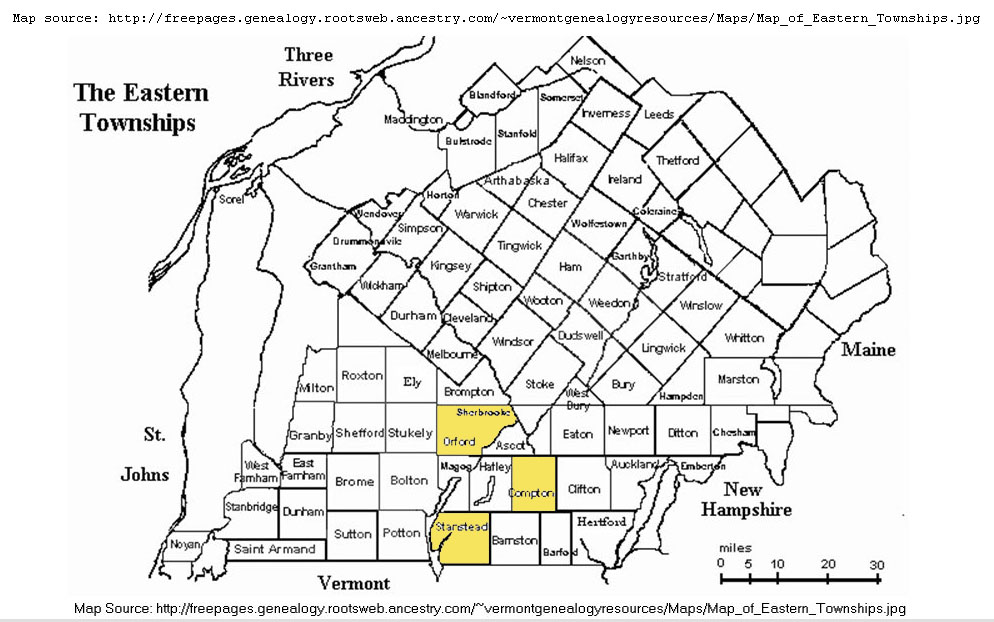
The Loyalists of Stanstead, Sherbrooke and West Compton 2014

images (1)

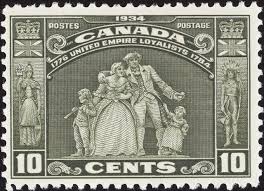
The American Revolution  was time of flux for many citizens who were loyal to the British. These Loyalists sought refuge in towns north of the border in an area known as the Eastern Townships. They settled and formed communities and built their churches

.uel2

In this database you will find the locations of  births, marriages and deaths of these early settlers.

Townships Map

Right Click the title below to open the database in a new window: 

The Loyalist Churches of Stanstead, Sherbrooke and West compton 2014

Loyalist Churches in Brome-Missisquoi – Upper Richelieu Valley – South Shefford

Missisquoi 2_edited-1

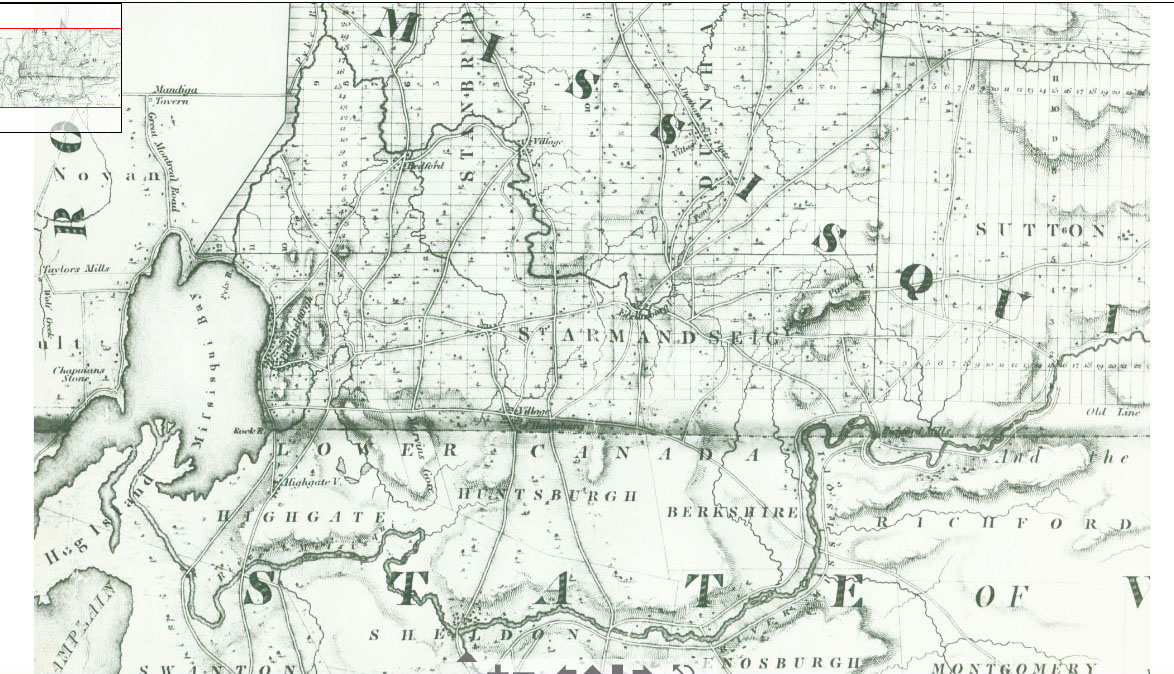
The American Revolution left  profound marks on the development of the areas of Brome-Missisquoi, the Upper Richelieu Valley and South Shefford. The Americans who wished to remain loyal to the British Crown fled the United States. These Loyalists  came from the northern states and settled very close to the border. Within a short period of time they began to develop many small communities, from Abercorn , near what is now the Vermont border to St. Armand near Missisquoi Bay..

This compilation describes the many towns and villages that emerged from the late 1780s to this day. Their churches contained documents of birth, marriages and deaths that have  been preserved and are available in various archives.

The contributions of these Loyalist can be found   throughout the area.  Many of the churches are still standing and are a tribute to their perseverance.

Click on the link: Loyalist Churches in Brome Missiquoi

Upper Richelieu Valley and South Shefford

images (1)

The Loyalist Churches of Sorel, Three Rivers, Saint Johns, Chambly and Surrounding Areas

images (1)


This compilation, prepared by Montreal genealogist Jacques Gagné, looks at the churches frequented by Loyalists who settled in three regions of Quebec in the late 18th century: Trois-Rivières (Three Rivers) and Sorel, east of Montreal on the St. Lawrence River, and Saint-Jean (St. Johns) and Chambly, south of Montreal on the Richelieu River. It outlines the histories of these churches and where to find surviving records.

Click on the link: Loyalists Churches Sorel – Three Rivers

The Loyalist Churches of the Gaspe Peninsula

images (1)

Following the War of the American Revolution, those who had remained loyal to the British felt compelled to leave the newly independent United States. While most settled in what is now Ontario, Nova Scotia and Quebec’s Eastern Townships, some moved to the Gaspé Peninsula of eastern Quebec. This is a region of interior forests and mountains and of fishing villages along the Gulf of St. Lawrence. 

The newcomers settled in towns and villages such as Matapédia, Bonaventure, Percé, Gaspé and New Carlisle. Their neighbours were of French Canadian, Acadian and Micmac ancestry, and most were Roman Catholic. The newly arrived English-speaking, Protestant Loyalists needed their own places to worship and to record their births, marriages and burials.

At first, these needs were met by Anglican, Presbyterian and Methodist missionaries, but eventually the newcomers built churches of their own. This compilation lists the churches they founded and the ministers who served the English-speaking community. It guides the genealogist to the various places where their records are kept, including government and church archives, and the library of the Quebec Family History Society.

The compilation also mentions the records of the Gaspé residents who came from Jersey and Guernsey, in the Channel Isles, and the early settlers from Scotland. The introduction pays tribute to two individuals who researched and documented the lives of the English-speaking residents of the Gaspé, Kenneth Annett and David J. McDougall, and tells researchers where to find their work.

                                                        Click the link to open in a new window:

Gaspe-Loyalist Churches

yorkchurch

The Europeans in Quebec and Their Churches

The Europeans in Québec                         Lower Canada and Québec

Churches of the Scandinavian, Baltic States, Germanic, Icelandic people in Montréal, Québec City, Lower St. Lawrence, Western Québec, Eastern Townships, Richelieu River Valley – The churches of immigrants from Sweden, Norway, Denmark, Finland, Estonia, Latvia. Lithuania, Iceland, Germany, the Netherlands, Belgium, Switzerland, Austria plus those from Eastern European countries – Churches which were organized in Québec from 1621 to 2005. Also included within this document you will find a number of book titles relating to the subject.

Click the link:

The Europeans in Québec

The French Canadians in Western Canada

canewzz


The Archives nationales du Québec in Montréal on Viger Avenue are the repository of a wonderful and unique collection of books of marriages, baptisms, deaths of French Canadian families who left the Province of  Québec between 1840 and 1930 for destinations in Western Canada, especially in Alberta and Manitoba.

Monsieur Daniel Olivier,  former archivist at the Bibliothèque de la Ville de Montréal on Sherbrooke Street East, the latter no longer in operation, referred to for years as Salle Gagnon was responsible with the assistance of his associates for the acquisition of many of the books of marriages, baptisms, deaths, and burials outlined in this research guide.

Madame Estelle Brisson, former archivist at the Archives nationales du Québec on Viger Avenue East in Montréal with the assistance of her associates was also responsible for the acquisition of many of the books of marriages, baptisms, deaths, and burials outlined in this research guide compiled by Jacques Gagné.

Click on the link            The French Canadians in Western Canada