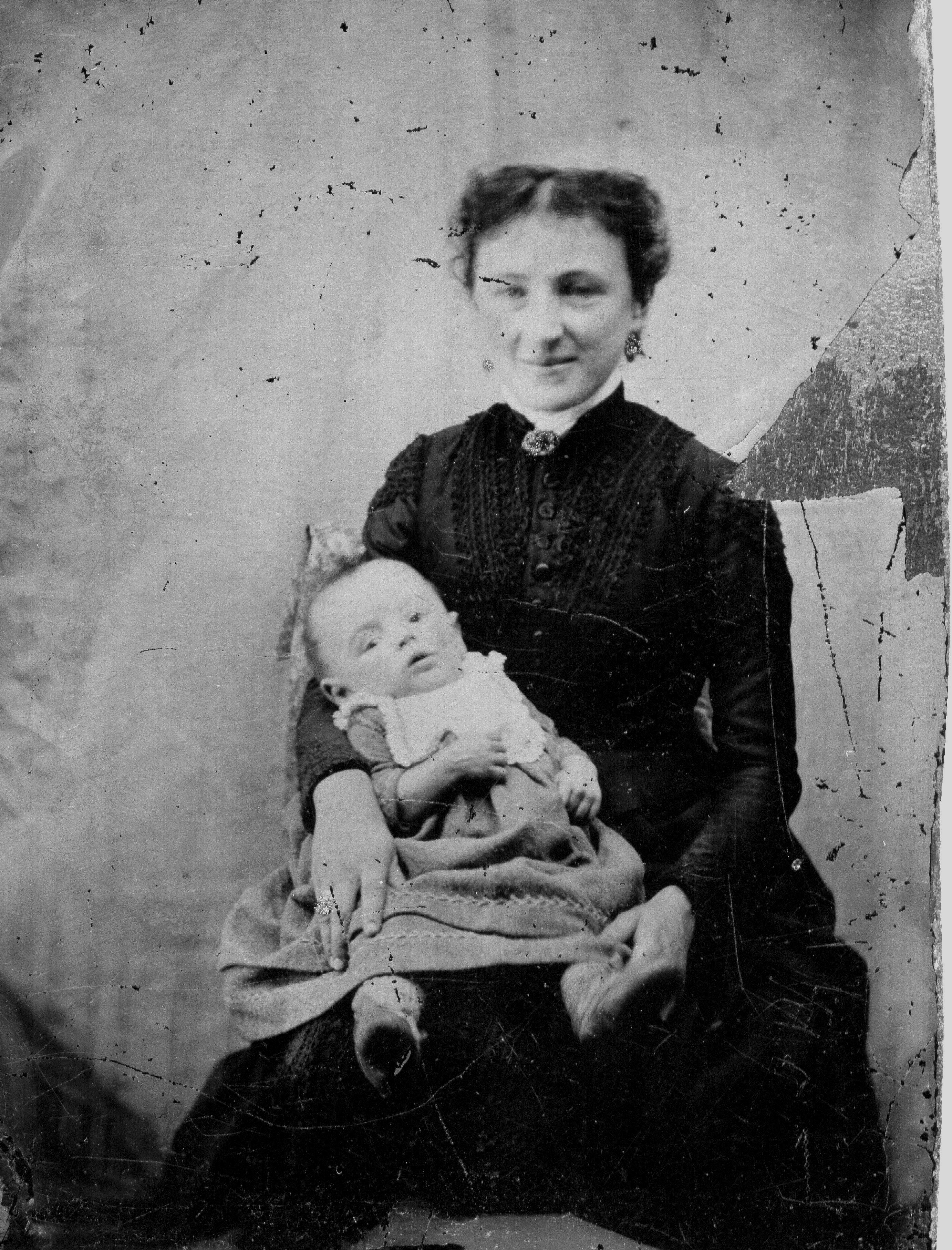
Category Archives: Quebec

The Pitfalls of a Neophyte Genealogist

Who was my third grandmother? Which one of these women married Moyse Hypolite  Fortin? Were they cousins? Were there mistakes in the information I was finding? I needed answers.

Genealogy requires exact details and facts in order to get the story right. As a new genealogist I learned this very quickly.

In the case of my third great grandmother there were conflicting reports. One day I would find Henriette Bertrand in Ile Perrot and then later find an Henriette Bertrand in Vaudreuil. The dates varied by only two years and they fit in with the time frame of my third great grandfather.

The two communities are very close to one another, a matter of only a few kilometers.

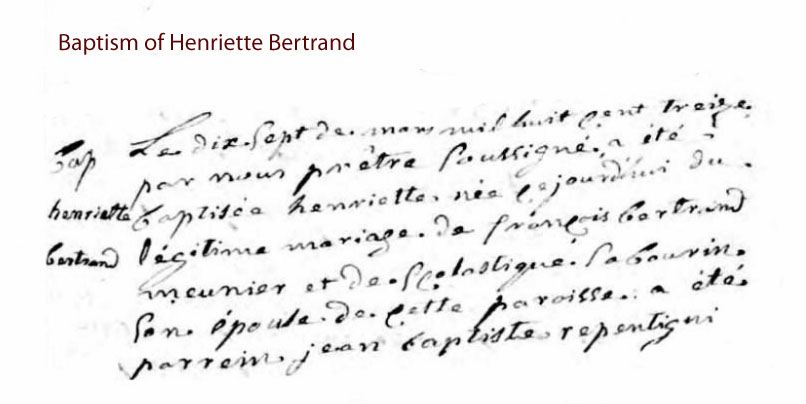
It soon became apparent that there were in fact two Henriettes. I found the baptismal  document on line for Henriette 2. The discovery made me realize that perhaps I had been researching the wrong person.

At this point I needed clarification. I made a visit to Centre d’histoire La Presqu’íle in Vaudreuil and was able with the help of the archivist learn for certain which of the Henriettes was the correct one. Now I had what appeared to be a monumental task ahead. Research had  been done for Henriette 1 thinking she was the right person.  Now, this lineage was of little value as she was not one of my ancestors. This meant  starting over with Henriette 2 and tracing her line.

The archivist was very helpful finding documentation and pointing out the right direction to proceed.

This was indeed a valuable lesson and I am grateful having  learned it early on in my research. It has constantly been a reminder that before making the next move, make certain you have as many exact verified facts as possible  about the particular person you are researching. That way you can avoid  mistakes.

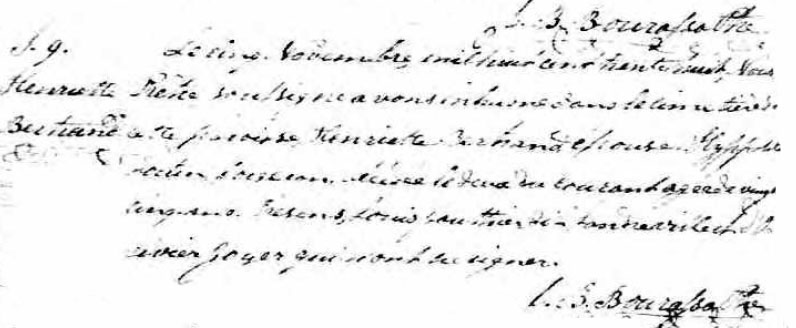
The following two documents were found on Ancestry-Drouin Collection

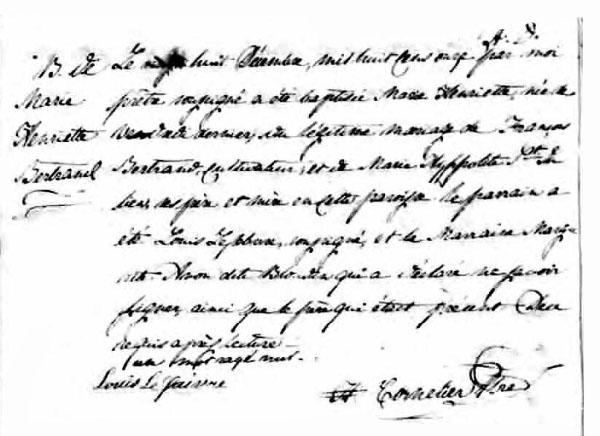
Baptism:

Baptism Henriette Bertrand

Burial

burial

Registres paroissiaux et Actes d’état civil du Québec (Collection Drouin), 1621 à 1967

Name: Henriette Bertrand
Event: Enterrement (Burial)
Burial Year: 1815-1900
Burial Location: Montebello, Québec (Quebec)

Source Information:

Ancestry.com. Quebec, Vital and Church Records (Drouin Collection), 1621-1967 [database on-line]. Provo, UT, USA: Ancestry.com Operations

Inc, 2008.

Original data: Gabriel Drouin, comp. Drouin Collection. Montreal, Quebec, Canada: Institut Généalogique Drouin.

Comparison of data for the two Henriettes

Henriette Bertrand   1                                                                    Henriette Bertrand 2

Born:  December 28, 1811 in Vaudreuil                                  Born March 7, 1813 in Ile Perrot

—————————————                                                       Died November 5, 1838

Mother:  Apoline St. Julien                                                           Mother:  Scholastique Sabourin

Born: Nov 6. 1783 in Vaudreuil                                                 Born:  1789 in Rigaud

Died:  Aug 2, 1834 in Vaudreuil                                                 Died:  July 28 1821 in Rigaud

—————————————                                                       Married: September 12 1831 in Montebello

Father:  Francois Vital Bertrand                                                  Father: Francois Joseph Bertrand

Born:  Jan 4, 1780 in Vaudreuil                                                   Born 1784

Died:  July 11, 1859 in St. Joeph du lac                                      Died:  1832 in Ste Justine de Newton

In 1832 Henriette  2   married Moyse Hypolite Fortin, my third great grandfather. She died November 5, 1838 at the age of twenty-five  in Montebello,  having given him a daughter, Leocadie Fortin, my great-grandmother and a son, Louis.


               Centre d’histoire La Presqu’íle

Achives regionales de Vaudreuil Soulanges

431 BC St. Charles

Vaudreuil-Dorion J7V 2N3

http://www.chlapresquile.qc.ca

Étiennette Alton: A Marriageable Woman

Business people, merchants and the church recruited 262 French woman who agreed to travel to New France and set up families with strangers before Louis IV decided to set up his “filles du Roi” (daughters of the King) project in 1663.

My ancestor Étiennette Alton was among these women, who are now collectively known as “les filles a marier” (marriageable daughters). Étiennette was a 20 year-old orphan[1] living in France’s Loire Valley when she was recruited by Claude Robutel, the 39-year-old Sieur de Saint Andre and one of 95 surviving members of the “Company of 100 Associates”. Three years earlier he had sailed to Quebec as part of the Grande Recrue and settled in Ville Marie to protect it from Iroquois attack. Robutel returned to France in February 1659 to marry Suzanne Gabriel and search for potential spouses for the other soldiers. Étiennette and others agreed to marry, have children, and ensure the future viability of the settlement of Ville Marie. In return, the company paid the cost of her journey and provided her with a small dowry to set up a household. Étiennette joined Robutel and his wife for an ocean voyage to New France. The Saint-André left La Rochelle on July 2, 1659 and arrived in Quebec on September 7. It took another 22 days to get to Ville Marie via a small boat known as a “chaloupe.” [2] Étiennette Alton wed Marin Hurtubese in Notre Dame Basilica on January 7, 1660. Claude and Suzanne were among their witnesses. Ten months later, their first son Pierre was born. Over the following twelve years, the couple had three more boys, including my direct ancestor Louis, and two girls. Marin died either on Valentine’s Day or on May 12, 1672. On June 13 that same year, she wed Berthelemy Vinet dit La Reinte and moved to the fief de Verdun outside of Ville Marie on the Île de Montréal. Vinet worked for Jean-Baptiste Migeon, an activist who went to jail for accusing the Governor of Montreal of breaking fur-trading laws and then was himself accused of breaking the same laws. Vinet died on November 18, 1687 and Étiennette was alone again, but only for a little longer than a year. She signed a contract to marry Claude Garigue, a man 13 years her junior on December 13, 1688. By the following April, she tried to enter a convent but ended up getting married anyway on October 18, 1689. The couple legally separated three years later after Étiennette testified in court about regular spousal abuse. “My husband hit me with sticks, his fists and his feet; he threw me to the ground, and wanted to butcher me by trampling me with his feet.”[3] She ran from this particular incident to the home of her children. Garigue died a year later, four days before Christmas 1693. Étiennette lived for another 29 years. She died just before Christmas in Notre Dame Hospital at 84 years old.


[1] Gagné, Peter J., Before the King’s Daughters: The Filles a Marier, 1634-1663 (Pawtucket, RI: Quintin Publications, 2002,) p 318 Includes a translation of the bride and groom’s marriage contract by Bénigne Basset a clerk in Ville-Marie. In it, Etiennette Alton’s parents, Francois Alton and Étiennette Barillay, are described as “late.”   *Note that a previous version of this story did not include this source.
[2] The dates of Étiennette Alton’s journey to Quebec and Montreal and the ship she sailed on come from a report prepared for my grandmother by genealogiste Paul-André Langelier in 1996. The report also says she was an employee of Claude Robutel. The report also includes the fact that Etiennette was baptised on Saturday November 13, 1638 at the Saint-Thomas a La Flèche church and that six other brothers and sisters were baptised in the same location. Two sisters are apparently buried there.
[3] A court case to consider their separation took place on January 14, 1692.

French Canadian Research tips

To look up French-Canadian Catholics:
1. Plug in the name of your ancestor in to the BAnQ archives directly (refer to our link for the right address): no need to know the church or village name.
2. Remember that in Quebec, women are listed under their birth family name in records, from birth to death, regardless of whether they married or not. There may ‘’wife of’’ or ‘’widow of’’ also included.
3. To make it even easier, parents are listed on marriage records.
You can use the Drouin collection of books, one for men and one for women, with marriages 1760-1935, or online Drouin or Ancestry or Family Search at home or at the Quebec family History Society or at numerous other sources.

Portrait of a Scandal: a Book Review

Portrait of a Scandal: the Abortion Trial of Robert Notman, by Elaine Kalman Naves, is many things: a non-fiction courtroom page-turner, a story about illicit love, a tale of Scottish immigrant families in mid-19th century Montreal, and an exploration of some of the social customs and beliefs of the times. The fact that the book describes abortion practices and life in Kingston Penitentiary makes it all the grittier, while the high-profile identity of the main individual — the younger brother of society photographer William Notman — makes the details all the juicier.

I wanted to learn more about life in 19th century Montreal, home to several of my ancestors. But this real-life story hooked me within a few pages, with the mysterious death of a young physician, Dr. Patton. I won’t be spoiling the book by revealing that Patton committed suicide because he mistakenly believed his patient, a student named Margaret Galbraith, had died as a result of the abortion he performed on her. Her lover, Robert Notman, was charged with procuring the abortion.

The book is full of strong individuals, from the young woman whose hopes of becoming a teacher were doomed the minute she fell for Robert, to the lawyers who argued the case with dramatic flourishes. Their story is in excellent hands. Author Elaine Kalman Naves is an award-winning author, having already written a memoir about her own family, a book about Montreal writers and numerous articles for The Gazette.

Many family historians would relate to Naves’ research process, from her frustration with the red tape she encountered at the McGill University archives to her pleasure following Margaret’s footsteps back to the shores of Loch Lomond in Scotland. Much of the material has been culled from sources familiar to genealogists, including newspaper articles, family papers and city directories. Naves has brought these 150-year-old sources together in a way that makes sense to modern readers. And despite only having fragments of information about Robert’s and Margaret’s lives, she has succeeded in bringing these people back to life.

The bibliographic essay at the end of the book is also worth a look. Two of Naves’ favourite sources, Call Back Yesterdays by Edgar Andrew Collard, and Montreal: Island City of the St. Lawrence by Kathleen Jenkins, are probably on many Montrealers’ bookshelves, while the Dictionary of Canadian Biography Online is only a Google search away.

Elaine Kalman Naves. Portrait of a Scandal: the Abortion Trial of Robert Notman. Montreal: Vehicule Press, 2013.


QFHS has its Certificate of Continuance

The Quebec Family History Society obtained its Certificate of Continuance from Industry Canada on March 6 of this year, according to Industry Canada’s website, https://www.ic.gc.ca/app/scr/cc/CorporationsCanada/fdrlCrpDtls.html?corpId=2362252&V_TOKEN=1405560793699&crpNm=Quebec%20family%20history%20society&crpNmbr=&bsNmbr.

Meanwhile, QFHS members in good standing (meaning those who have paid their dues) are invited to a special general meeting on September 13. There are two items on the agenda: “approval to obtain our Certificate of Continuance” and “discussion for possible future changes to our Constitution.” The certificate of continuance allows the society to continue to exist as a not for profit corporation under the new federal NFP Act, and the bylaws have to be revised to be in compliance with the new act.

Members did not approve the executive decision to obtain the certificate and were not informed by the executive that the certificate has been issued. It is not clear whether the bylaws have already been revised.

If the bylaws have yet to be revised, the society is now operating under the Default Rules provided by Industry Canada. See http://www.ic.gc.ca/eic/site/cd-dgc.nsf/eng/cs04967.html.

In either case, there is still an opportunity for members to respond to the invitation to suggest changes to the bylaws, in writing, by August 13.

To read more about this issue, see Societies – Are they Changing, on genealogycanada.blogspot.com, posted July 20, http://genealogycanada.blogspot.com/2014/07/societies-are-they-changing.html, and the previous article on Genealogy Ensemble, QFHS Invites Members to Submit Recommendations on Bylaw Changes, posted July 8, https://genealogyensemble.wordpress.com/2014/07/08/qfhs-invites-members-to-submit-recommendations-on-bylaw-changes/


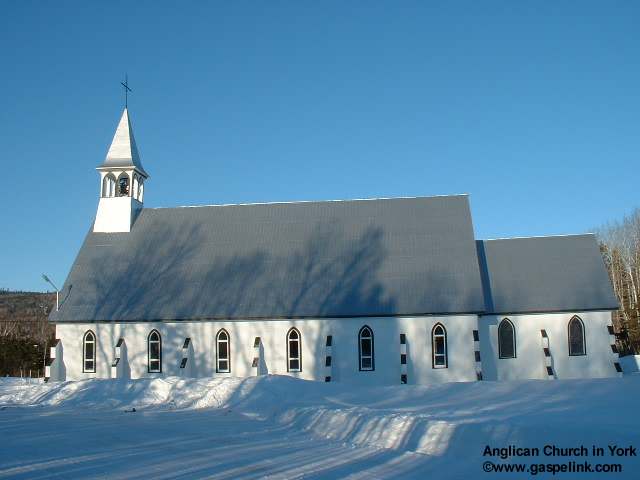
The Irish Catholic Churches of Quebec

St. Brendan Parish in Rosemont


Here’s a guide to the Irish Catholic Churches of Quebec.

Use this guide to find out where the documents you want to find are located. You can also find photos of the church parishes your ancestors attended.

See: the-irish-catholic-churches-of-quebec

This compilation was edited on Nov. 21, 2018. A new version will be coming in 2019.


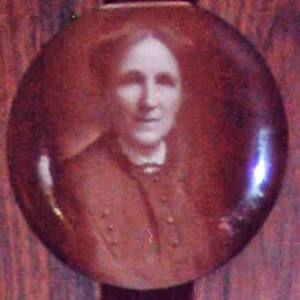
Amarilda Desbiens, Scottish adoptee in Baie-St-Paul? a road-trip up dead ends


Amarilda Desbiens


Amarilda

It is easy to look up a French-Canadian catholic lady for three main reasons:
1. The documents are centralised in the archives: no need to know the church or village name.
2. Women always use their birth family name in records, from birth to death. There may ‘’wife of’’ or ‘’widow of’’ also included.
3. Parents are listed on the marriage record.
You can use the Drouin collection of books, one for men and one for women, with marriages 1760-1935, or online Drouin or Ancestry or Family Search at home or at the Quebec family History Society.

Beginning of the Journey

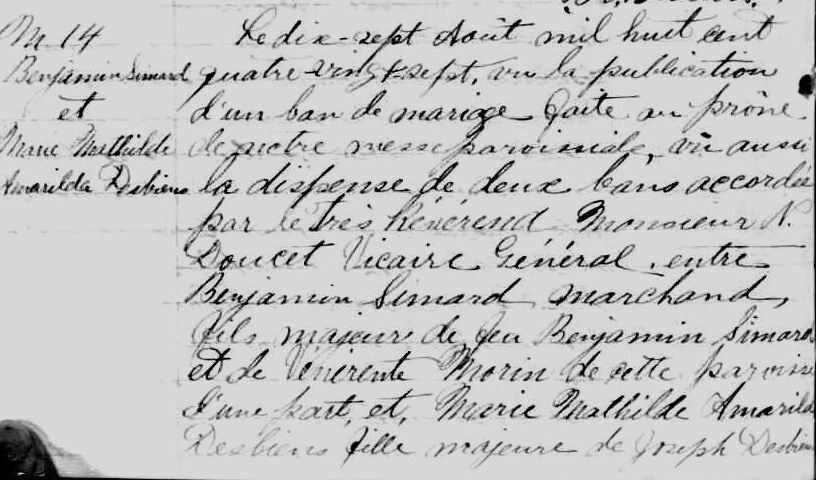
When I started my research, I had my mother in law’s parents and their wedding. Her grand-father Benjamin Simard’s wedding I found : to Amarilda Desbiens, August 17th 1887 in Baie-St-Paul .
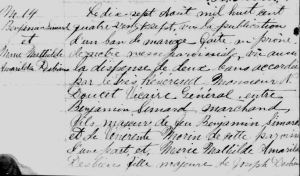
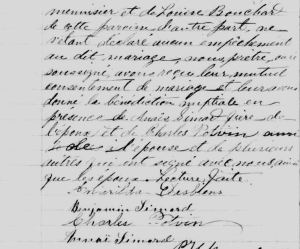
SimardXDesbiens 1887 StPaul1

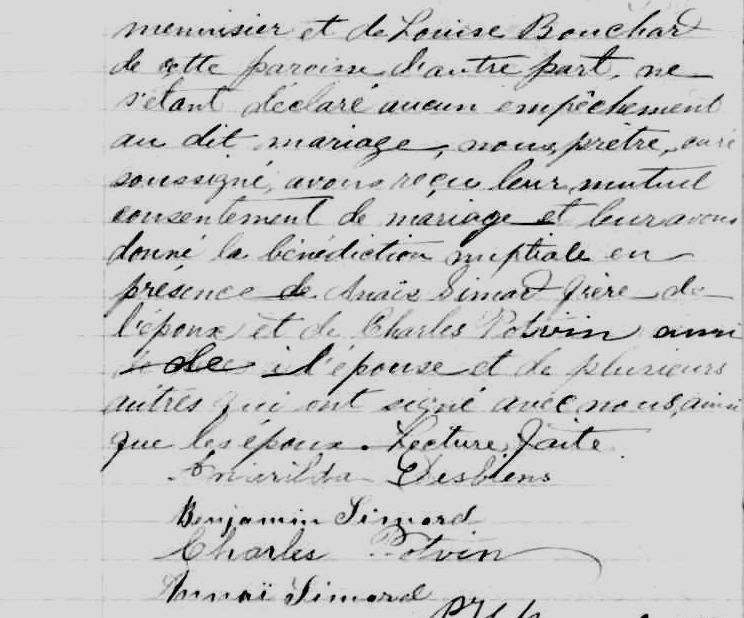
SimardXDesbiens 1887 StPaul2

Amarilda was the daughter of Joseph Desbiens and Louise Bouchard, and on I went in an afternoon, all the way up the tree to France.

Then, with different resources I found birth and death certificates, but no birth date for Amarilda. Even in books where they would list her whole family, ancestors and descendants, there was a marriage and a death, but no birth for her.

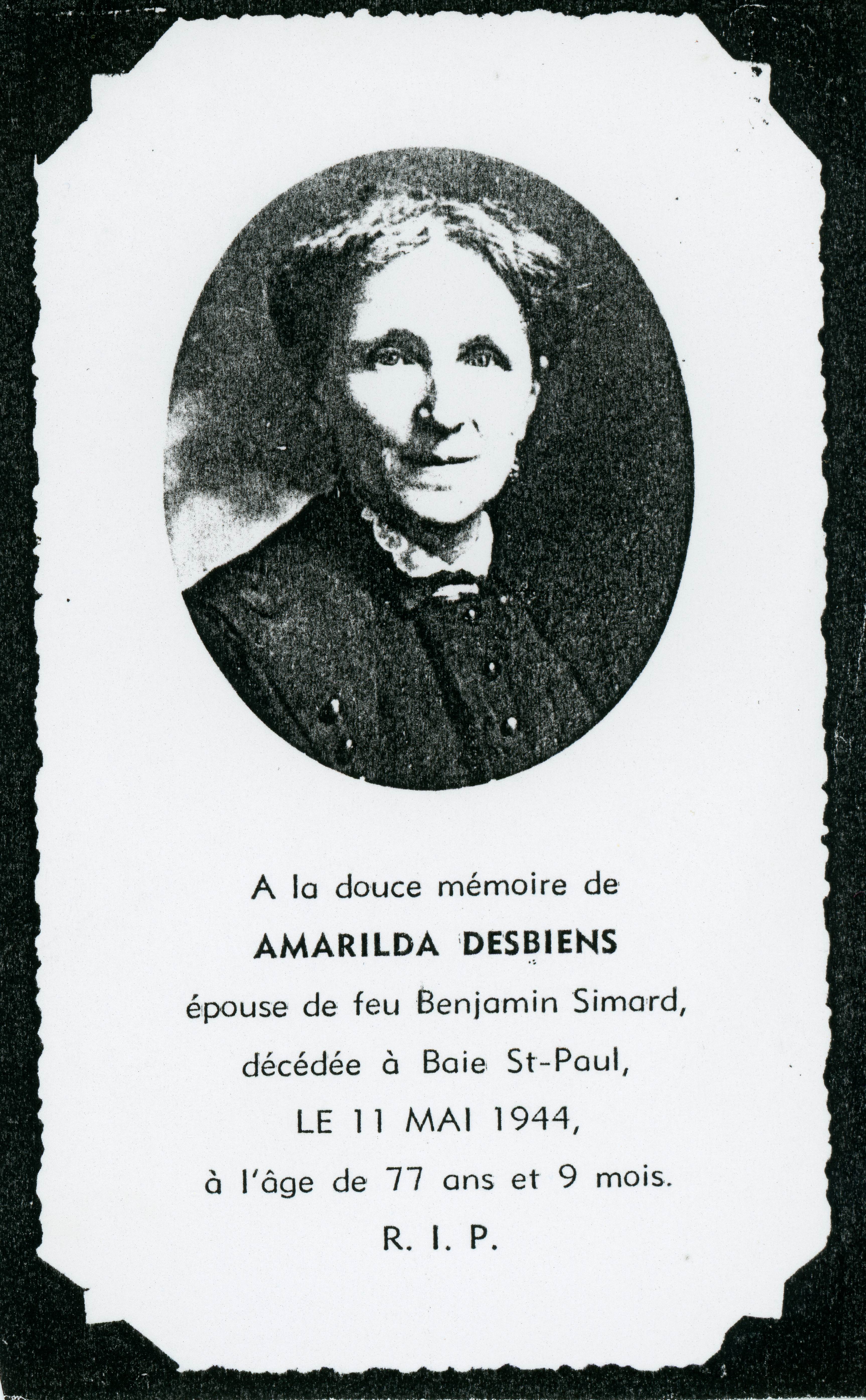
At the Société d’histoire de Charlevoix, her card was in a collection of funeral cards. I got an approximate date of birth of 1866 from the information: died May 11th 1944, at 77 years and 9 months.
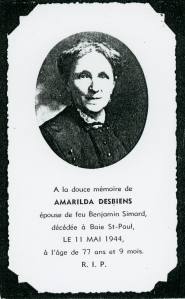
amarilda001

All her sibblings were baptised at Les Eboulements and her father in Ile-aux-Coudres. At the local Quebec Archives Depot of Charlevoix I look at the microfilmed birth registers for 1865, 1866, 1867. No Desbiens birth .

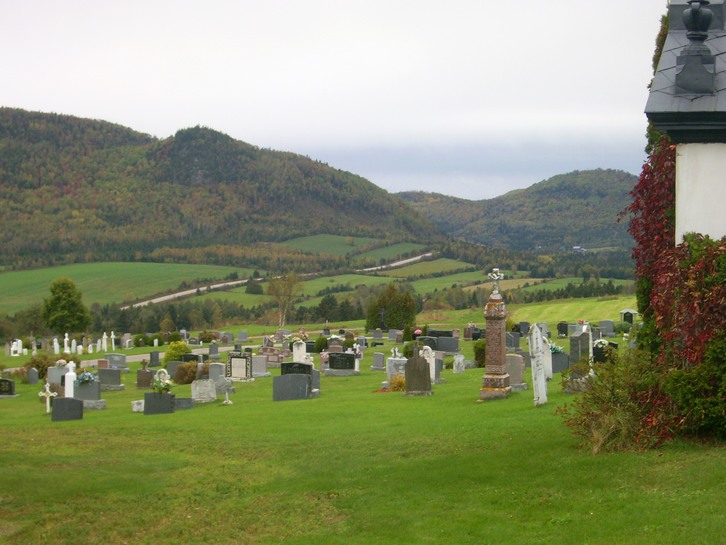
At Baie-St-Paul and Les Eboulement cemeteries: no tombstones for the family.
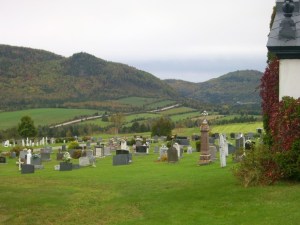
Digital Camera

Les Éboulements

First turn up a mountain road

A friend told the family that Amarilda was adopted and from Scotland. She was supposed to be a Donaldson or Danielson, but I found that her sister married one, nothing about Amarilda.
My mother in law said Amarilda was a really cold and distant grand-mother, sitting very upright in her chair, a cameo at her neck and a blanket on her knees. She only had three kids.
When she was young, my mother in law’s sister was so blond with blue eyes, she was told she was Irish by the neighbours.

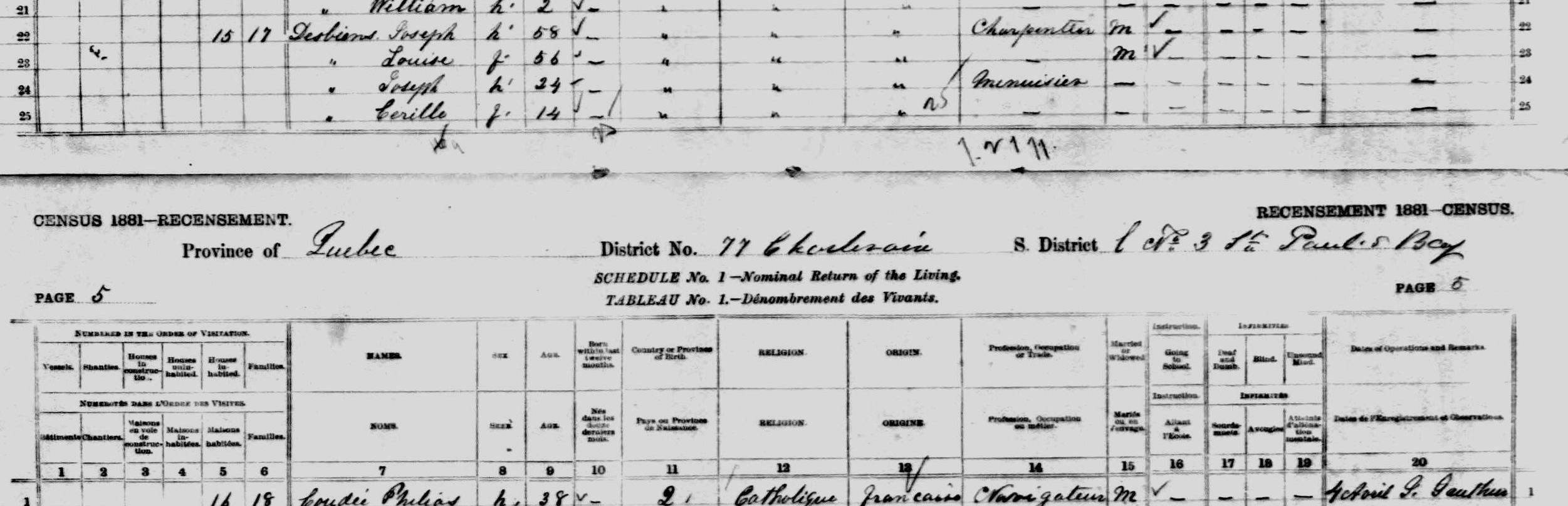
At BAnQ: census on microfilms:
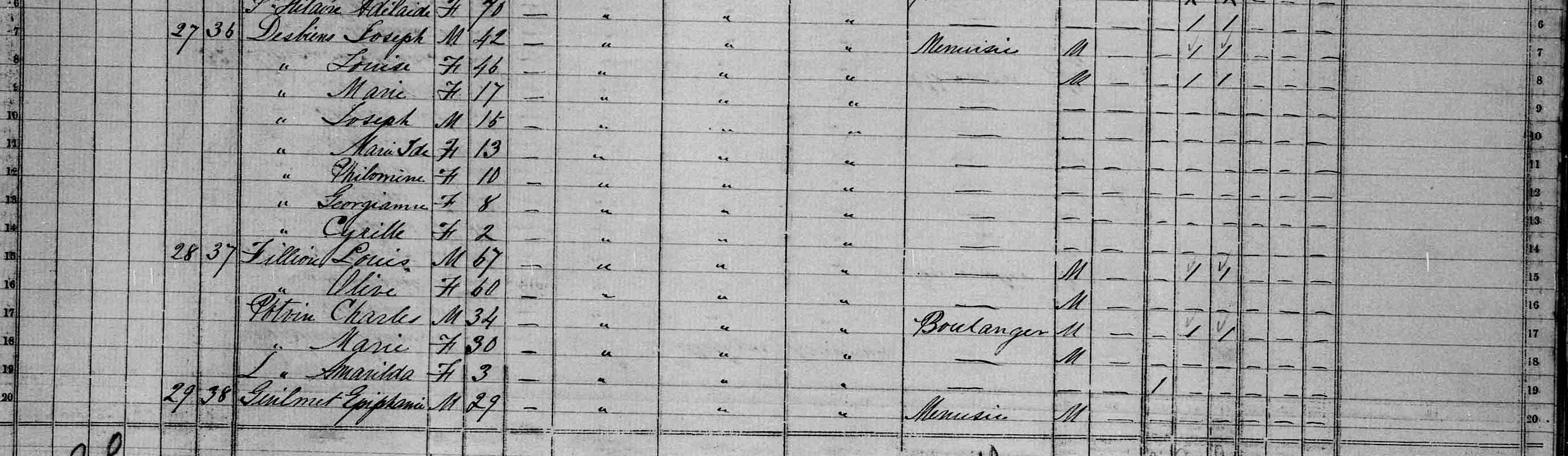
1871, She is not listed with her family. She probably hasn’t arrived yet:
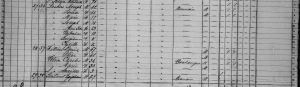
DesbiensMA-Potvin et DesbiensJ REC 1871

1881, still not there:

DesbiensJf REC 1881 BStPaul

1891, she is married and with her husband:

SimardBf REC 1891 BStPaul

So she must have been adopted when she was older than 15 years old.

I started looking up immigration history books, lists… To no avail.

Even now, when I look up online Ancestry, Drouin or Family Search : marriage records only for dear Amarilda.

Now I knew she was laughing watching me go in circles. Every place I went, every book I got my hands on, I looked her up. Not a word on her birth.

Final sretch

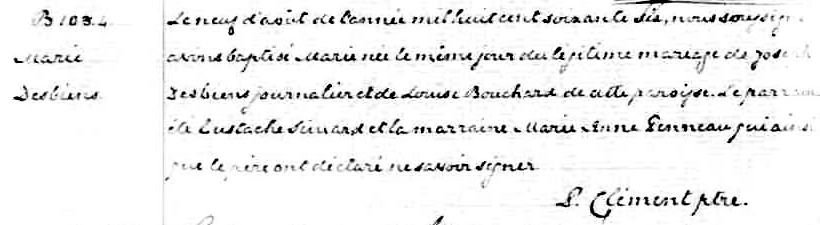
I finally tried at Baie-St-Paul presbytery. In the filing cabinet, the individual’s cards are grouped by family. With husband Benjamin and kids, Amarilda’s card, with three dates: birth, marriage and death! I then looked up her parents, Jospeh Desbiens and Louise Bouchard cards as a group, with their children: there she was, born not in Les Eboulements, but in Baie-St-Paul: MARIE DESBIENS. ONLY Marie! Baptised 9 aout 1866
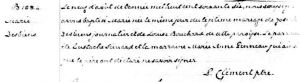
DesbiensMarieAmarilda B 1866 BaieStPaul

Baie-St-Paul register, 1866

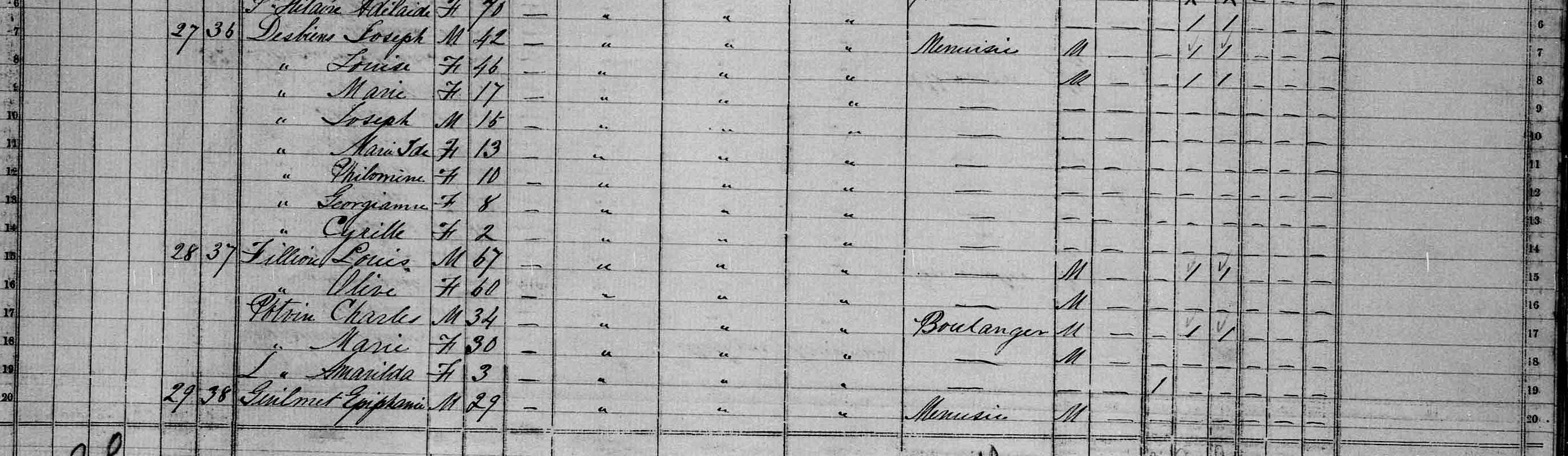
Before she was five, she was adopted by the neighbour Charles Potvin, a baker and merchant, and wife Marie Filion.
She married Benjamin Simard August 17th 1887 in Baie-St-Paul.
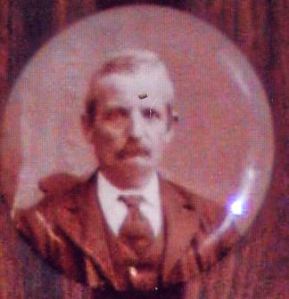
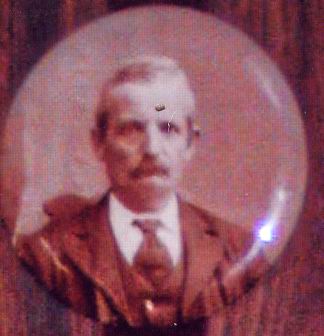
Benjamin Simard

Benjamin Simard, merchant

They had 10 children:
7 died young or at birth, Ambroise died at 18, Florence and Charles became adults.
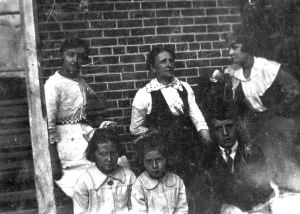
H11 1
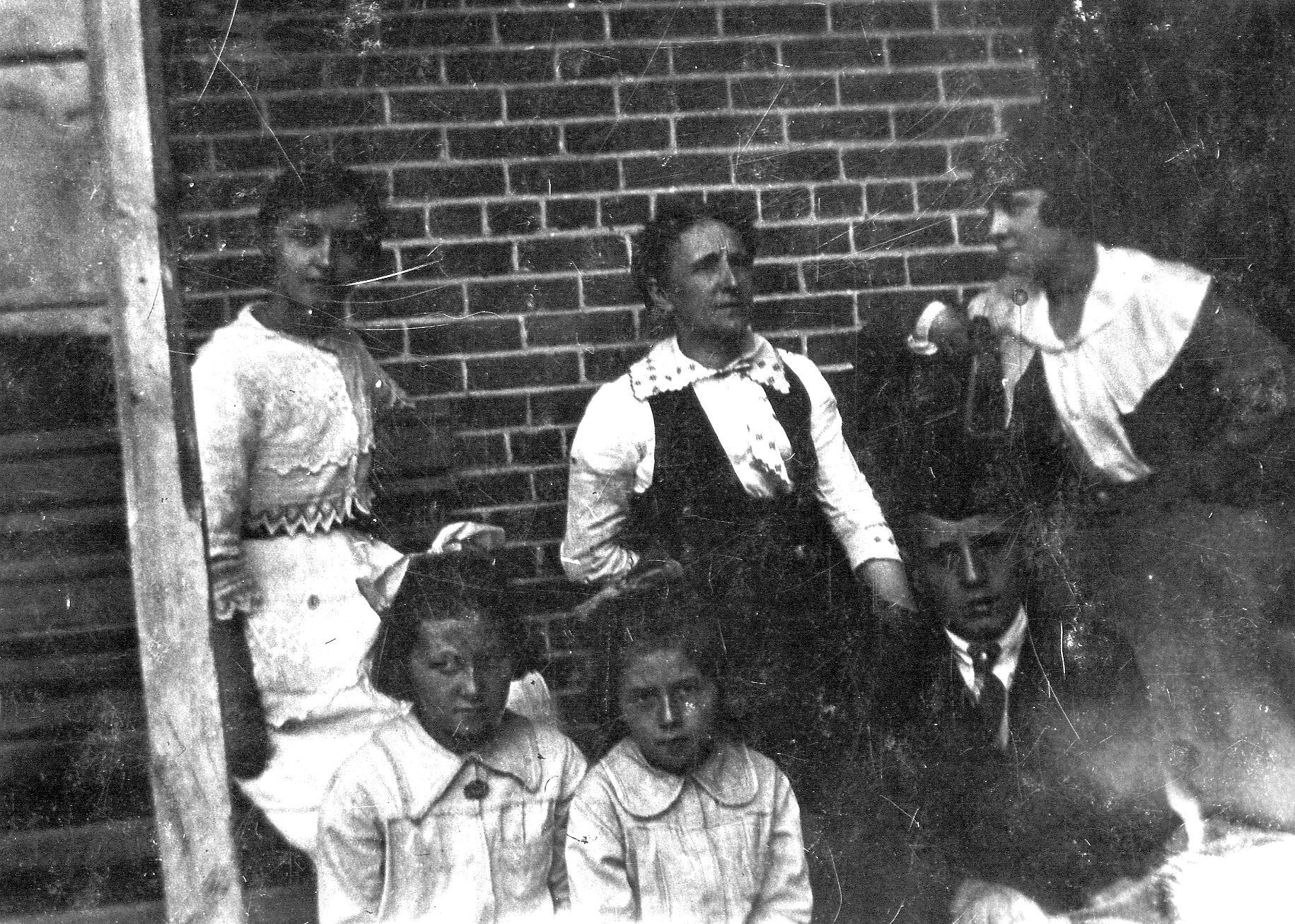
Back L. to R.: Daughter Florence, Amarilda, X. Son Ambroise sitting in front

Amarilda’s eldest son, Charles, took his name from his godfather: Amarilda’s adoptive father.
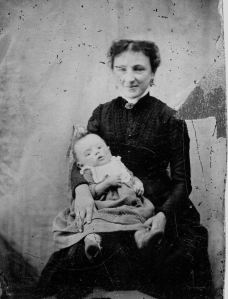
y02

Charles Simard with mother Amarilda

Charles Potvin being a merchant, maybe Benjamin Simard even took over his store.
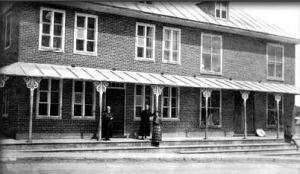
X, Amarilda, Florence
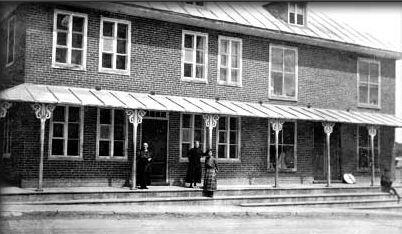
The store of Benjamin then Charles Simard, across from the church in Baie-St-Paul

Looking in the rearview mirror

All those little clues at first could not be taken for proof, but I did keep them on the back burner.

No Scottish, no Irish, not adopted INTO Desbiens family but adopted OUT to a Potvin family. Still I learned a lot even if side tracked.
I find her birth and death dates in Death Index Quebec 1926-1997 but no place of birth.If I had looked up the 1866 Baie-St-Paul register, page by page, I would have found a baby girl born to those parents in August 1866.

1. Census: 1871 she is not there, not because she has not joined the family, but because she has already left it, for…the neighbour: Charles Potvin and who will not children of their own.
When you look at the ditto signs before her name on the census, there is a very nicely formed beginning of a D for Desbiens ( just like her Desbiens family above), it stops, and dittos are put in, saying she’s a Potvin.
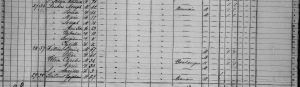
DesbiensMA-Potvin et DesbiensJ REC 1871

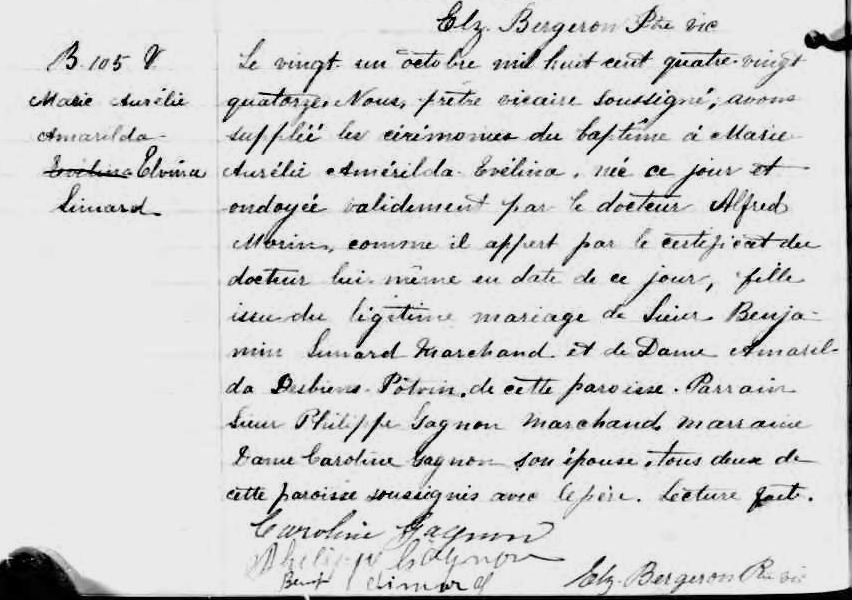
2. On the baptism certificate of Marie Aurélie Amarilda AKA Florence, Amarilda Desbiens Potvin is the mother
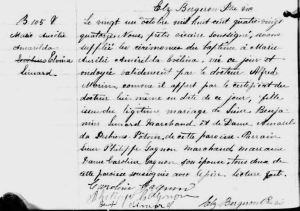
SimardFlorence B 1894 BStPaul

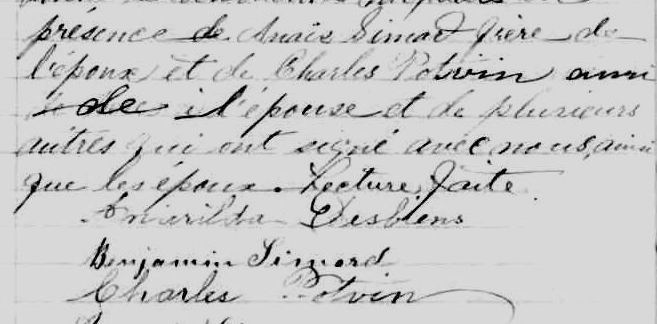
3. At Amarilda’s wedding, Charles Potvin is her witness.
If you look at the line where he is mentioned, ‘’friend of bride’’ is written over a few words that were already written. Father? Adoptive father?
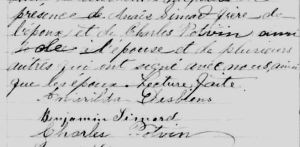
SimardXDesbiens détail

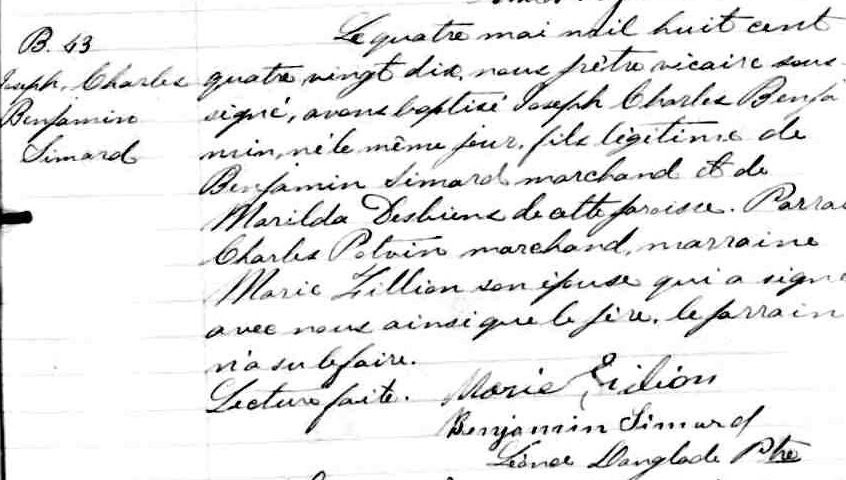
4. Charles Potvin and Marie Filion are godfather and godmother of Charles Simard, first surviving son of Amarilda and Benjamin.
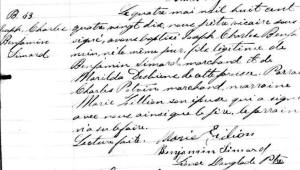
SimardCharlesB N 1890 StPaul

The road up ahead
Why was she adopted?
The first of Amarilda’s siblings was born in 1850, they were 10 children in total, and twins were born in 1863. Maybe mom was getting tired and needed help. Maybe she was sick. Or the twins were a lot to take care of, and she was pregnant with her last child who was born in 1869. Or they took her in when her mom gave birth to the last one? Charles Potvin, no kids, baker and merchant he was probably better off than his neighbours. In the area, in those days, many well off families would pay for less fortunate children’s education, or adopt them. Charles, once a father, paid for education for quite a few children of Baie-St-Paul also.
Eventually, Zoe Potvin, Charles’ sister, even married Eusebe Desbiens, Amarilda’s brother.

Life in New France Was Fraught with Danger

Montreal,  originally known as Ville Marie was founded in 1642 by Paul Chomedy Sieur de Maisonneuve. At the time there were very few inhabitants. Within the next several years ships arrived and the population grew.

In 1663 the company of Saint Sulpice became the owner of the Montreal Island. They built their Seminary in 1684 and starting in 1685 Montreal became more and more of a military stronghold surrounded by a wooden palisade

In 1665 my 7th great Grandfather Claude Jodouin, born in Poitiers, France,  arrived in Ville Marie,  New France. He was a master carpenter and worked for the Sulpicians. Shortly after his arrival1 on March 22,1666 in Notre Dame Church he married Anne Thomas, a King’s daughter. Over the years they had ten children.

Saint-Henri  des Tanneries  was an non-populated wooded area far removed from the walled section of the settlement which is now referred to as Old Montreal. There the workers would tan hides. The odor from the tasks was most unpleasant, to the point of being quite unbearable. This was the reason for establishing the tanneries far from the population. The area today still bears the name Saint Henri.

While working at the tannery Claude Jodouin’s life came to a fateful end. He was fifty years old.

In the Bulletin des Recherches Historiques2 the following describes his death.

“Le sudit document nous apprend encore que, le 16 octobre 1686, un charpentier nomme Claude Jaudouin employe a la tannerie fut inopinement tue par un autre ouvrier. Nicolas Martin dit Jolycoeur. Celui-ci, ignorant que son compagnon etait au bois entendant un froisement de branches imagina qu’un ours venait a lui. Pris de peur, il dechargea son fusil dans la direction de bruit avec le regrettable resultat que l’on sait.”

Translation:        It was in a wooded section outside the tannery, that a fellow worker thought he heard a bear rustling in the bushes, took aim and shot. So ended the life of Claude Jodouin, the master carpenter.

In the Dictionnaires de genealogies des familles du Quebec3  it indicates that Claude Jodouin was killed accidentally. Little did I know that my first trip to La societe de genealogie canadienne francaise in the east end of Montreal would reveal the manner in which he died.

Anne, Claude’s wife was still a young woman with the responsibility of their ten children.  From all accounts she was sought after by many eligible bachelors. Within a short period of time she remarried.4

Sources:

1      POULIN, JOSEPH-PHILIPPE. “Premiers colons du debut de la colonie jusqu’en 1700.” In Programme Souvenir, Sixieme Congres de la Societe Genealogique Canadienne Francaise, Quebec (Oct. 8-10, 1960), pp. 13-22.  Arrival


1      L’Abbe D Tanguay, ADS, Dictionnaire Genealogique des Familles Canadiennes Depuis la Fondation de la Colonie Jusqu’a Nos Jours, Cinquieme Volume, Depuis 1608 jusqu’a 1700, Eusebe Senecal, 1888.

2       Bulletin des Recherches Historiques Vol 41: p 39

3      Dictionnaire degenealogie des familles du Quebec, Jette

4       Ibid

http://www.memorablemontreal.com › accessibleQA

http://en.wikipedia.org/wiki/Timeline_of_Montreal_history


Scottish Gaelic Settlers in Québec

Oatmeal and the Catechism Scottish Gaelic Settlers in Québec Margaret Bennett
QFHS # HG-153.99 B65
345 pages

Oatmeal and the Catechism is the story of emigrants from the Outer Hebrides to Québec in the latter half of the nineteenth century. Most were crofting families from Lewis who had suffered the severe effects of the potato famine of 1846-51. As a solution to the increase pressure on landlords and government relief bodies, they were offered free passage to Lower Canada and given land grants in the Eastern Townships and more precisely within Compton County. To this day place-names such as Stornoway, Tosta, Ness and Dell in Canada testify to the strong links these communities kept with their homeland.

An article in The Clansmen News of 1970, based on local interviews and entitled ‘The Scottish Highlands of Quebec: Gaidhealatachd Chuibeic’, states:

At the time of the first Great War there were approximately two thousand five hundred Gaels in Marsboro (Marston) alone. We were talking with a man who was born in Milan, who told us that he did not know that there was any other language in the world but Gaelic until he was seven years old.

In Compton county, in the Eastern Townships of Québec in the years of 1851 to 1891, the language distribution in the following towns and villages could convincingly be reconstructed as follows:

> Marsboro – Gaelic (c. 75%), French (c. 20%), English (c. 5%)
­> Milan – Gaelic (c. 95%), French (c. 5%), English (c. 0%)
> Scotstown – Gaelic (c. 50%), French (c. 25%), English (c. 25%)
> Springhill – Gaelic (c. 50%), French (c. 25%), English (c. 25%)
> Stornoway – Gaelic (c. 95%), French (c. 3%), English (c. 2%)
> Red Mountain – Gaelic (c. 75%), French (20%), English (c. 5%)

…. a grasp of the history and folk culture of Gaels from the Outer Hebrides who settled this comparatively small area of Canada will contribute to a better understanding of the Eastern Townships and of Québec.
Margaret Bennett
Winner of the 1999 CLIO Award of the Canadian Historical Association

Posted by Jacques Gagné for Genealogy Ensemble

Montreal’s Black Market Babies

In the late 1940s and early 1950s, 1,000 babies were sold to adoptive parents through a black market baby ring that operated in Quebec. Most of the babies were born to unwed French Canadian mothers, most of the adoptive families were Jewish. Some of the children went to homes in Quebec and Ontario, and many grew up in the United States.

In 1984, my husband found out he had been adopted and that his parents had paid about $2,000 for him. About 15 years later, he found out about the black market baby ring that had arranged his adoption. Ever since then, he has been sharing his story with friends, with community groups and through the media. Several years ago, Global television told the story of Harold’s search for his birth mother on the program Past Lives.

This week, the Montreal CTV station aired a news feature about the black market baby ring. It puts Harold’s story in context, explaining how most of the mothers who gave birth out of wedlock had no choice but to give up their babies. Harold counts himself lucky that he ended up in a good home and not in an orphanage.

The ring was broken up 60 years ago this year. Some of the birth mothers have no doubt died, and many of their children are probably still trying to find them. The story is still fascinating.

Here is a link to that six-minute CTV feature: https://www.youtube.com/watch?v=DNKTqkZmIGE

Karen Balcom of McMaster University has written a book that addresses this topic: The Traffic in Babies: Cross-Border Adoption and Baby-Selling between the United States and Canada, 1930-1972 Studies in Gender and History, University of Toronto Press, 2011.

You can learn more about Montreal’s black market baby ring on the Parent Finders Montreal website, http://www.pfmtl.org/BMB/index.html. At the bottom of the page, there is a list of dates, pages and titles of old newspaper articles about the case. Paste in the url for one of these stories from The Gazette, http://news.google.com/newspapers?nid=Fr8DH2VBP9sC&dat=19540215&printsec=frontpage&hl=en, and from there you can easily browse the newspaper to find the other articles.

There is a Montreal Black Market Baby Facebook page.

Feb. 23 2016, this post has been updated. The link to the CTV feature now works.