Category Archives: Quebec

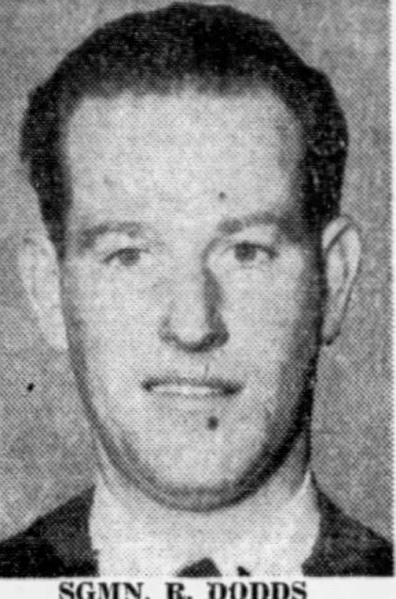
Ralph Dodds, Signalman, Royal Canadian Navy

My aunt, Sarah Jane McHugh, was delighted to host the linen shower to celebrate her daughter, Dawna Day’s upcoming marriage to Ralph Dodds. The happy couple announced their engagement in October 1947. Ralph had recently been discharged after serving in the Royal Canadian Navy for over six years.  The couple’s wedding would take place in Vancouver, Ralph’s home town. Dawna was from Montreal.

Ralph was just 20 when he started his navy career in Esquimalt, British Columbia in 1939.1 With the advent of World War II, the Esquimalt Navy base became the largest naval training center in western Canada. 2 Ralph Dodds trained to become a signalman would have learned all aspects of military communications in the Canadian Navy. He would have used semaphore flags, read and transmitted morse code messages, and assured radio communications.3 During his training, Ralph would not have predicted that he would participate in the sinking of a German U-boat during the Battle of the Atlantic, that he would be on a destroyer that participated in a sea fight on D-Day, or that the destroyer he was on would be shipwrecked off the coast of Iceland.

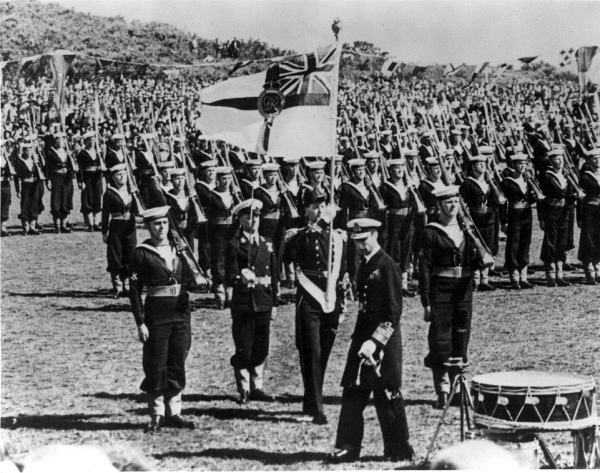
King George VI presents the King’s Colours to the Royal Canadian Navy at Beacon Hill Park, Victoria, 1939. Photo: CFB Esquimalt Naval and Military Museum collection

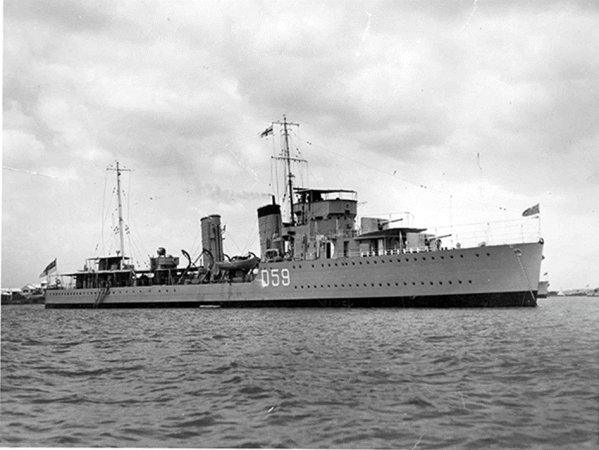
While Ralph was assigned to a naval station, and to a corvette (small destroyer), for most of his naval career, he was assigned to the HMCS Skeena.

HMCS Skeena, D59, Government of Canada website, Ships’ histories

The HMCS Skeena was commissioned in 1931 in Portsmouth, U.K. and was one of the first two ships built to Canadian order. With the outbreak of the war, the Skeena initially performed domestic escort duties. In May 1940, she was sent to Plymouth, U.K. and became part of the Western Approaches Command, taking part in the evacuation of France and escorting convoys in British waters. She was later assigned to continuous convoy duty.

During one of its escort duties in the Atlantic, the Skeena destroyed U-boat U-588. This happened during ON-115 (ON means Outbound to North America).  There were twelve escort ships for a trade convoy of 43 merchant ships that left Liverpool on July 12, 1942. On July 29, seven U-boats of the Wolfpack Wolf had spotted them. This Wolfpack was quickly joined by another six U-boats of the Wolfpack Pirat. The Wolf Pack tactic, or the “Rudeltaktik,” was devised to attack the Allied convoy system by forming into position effecting a massed organized attack.4 This particular battle resulted in the loss of three of the ships in the convoy and significant damage to two of the ships in the convoy. One of the damaged ships returned to the U.K. and one was escorted to St. John’s, Newfoundland. The Skeena, on which Ralph was a signalman, and the HMCS Wetaskiwin, an escort corvette, destroyed U-boat 588 with depth charges (antisubmarine missiles) on July 31. The hostilities lasted until August 3 when the U-boats lost contact with the convoy due to misty weather. The convoy with the remaining ships reached Boston on August 8, 1942.5

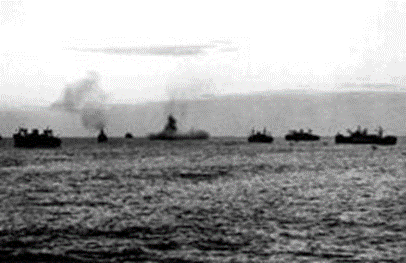
The sinking of American freighters, Edward Rutledge, Tasker H. Bliss and Hugh L. Scott at Fedala Roads, November 12, 1942
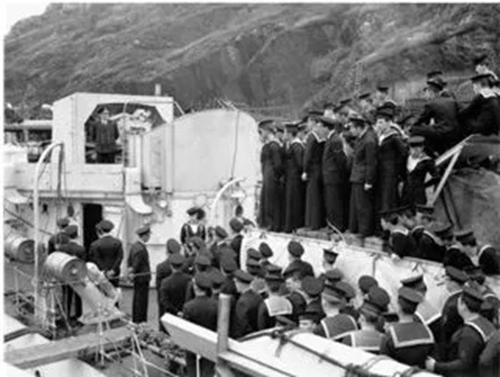
Commodore Leonard Murray congratulating the ship’s companies of HMCS Skeena and HMCS Wetaskiwin for sinking the German submarine U-588 on 31 July 1942. St. John’s, Newfoundland, Aug. 4, 1942. (NAC PA-115347)

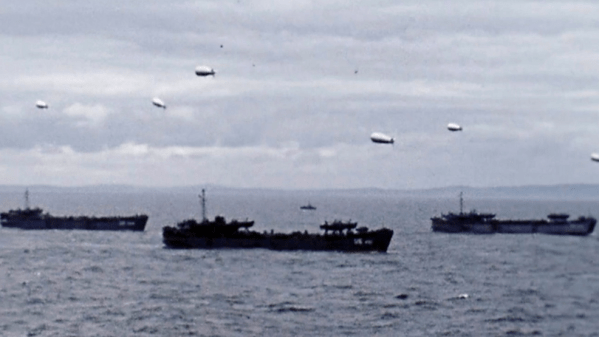
The Skeena also participated in a hot sea fight in the Channel on D-Day. The Skeena’s assignment was to prevent enemy U-boats from attacking Allied ships while the Invasion of France was being carried out.

“Torpedoes were shooting about in the Channel and missed the Skeena by only a matter of feet,” said Ralph in an interview he gave to the Vancouver Sun.

The destroyer also had to contend with German Dorniers (bombers) that were bombing the destroyers in the Channel. One of the aerial missiles fell so close to the Skeena that shrapnel was later found on the deck.6

Ships and blimps sit off the coast of France on D-Day, June 6, 1944. War Footage From the George Stevens Collection at the Library of Congress

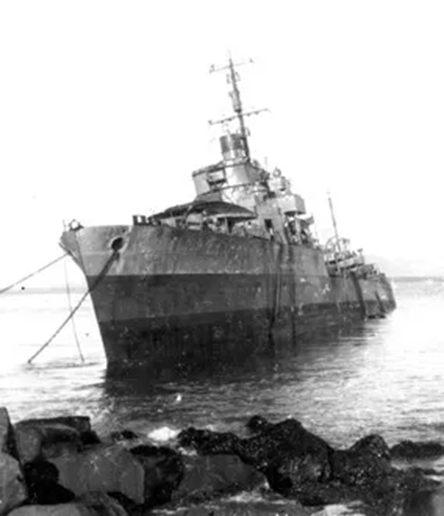
After five years of war, the HMCS Skeena met her end as she sheltered from a violent gale with 15-metre waves off the coast of Iceland, at Videy Island on October 24, 1944. Even though the crew had thrown out a second anchor to secure the ship, the Skeena smashed into the rocks. When the crew abandoned ship, the men were unable to hold the lines. Some crew members were smashed into the rocks, while others were tossed into the sea. Fifteen sailors died.7 Ralph Dodds survived.

HMCS Skeena aground on Videy Island. (Image Source: http://www.forposterityssake.ca/Navy/HMCS_SKEENA_D59.htm#Photos)
  1. Vancouver Sun, D-Day Fight in Channel Recalled by B.C. Sailor, 13 December 1944.
  2. Vance, Emily. Capital Daily, How Canada’s Pacific Fleet Shaped Greater Victoria Over Two Centuries, 1 May 2021, https://www.capitaldaily.ca/news/canadas-pacific-fleet-greater-victoria-two-centuries, accessed 24 July 2023.
  3. Wikipedia, Signaller, https://en.wikipedia.org/wiki/Signaller, accessed 24 July 2023.
  4. Uboataces, German U-Boat, U-Boat Tactics, The Wolf Pack, http://www.uboataces.com/tactics-wolfpack.shtml, accessed 31 July 2023.
  5. Wikipedia, Convoy ON115, https://en.wikipedia.org/wiki/Convoy_ON_115, accessed 26 July 2023.
  6. Vancouver Sun, D-Day Fight in Channel Recalled by B.C. Sailor, 13 December 1944.
  7. Military History Now, HMCS Skeena – Meet One of the Toughest Warships of the Battle of the Atlantic, 12 November 2020, https://militaryhistorynow.com/2020/11/12/hmcs-skeena-meet-one-of-the-toughest-warships-of-the-battle-of-the-atlantic/, accessed 2 August 2023.

The Ugly Vases

Here men and women were working side by side, the women subordinate to the men. All were preoccupied, wrapped up in their respective operations, and there was the sound of irregular whirring movements from every part of the big room. The air was laden with whitish dust, and clay was omnipresent—on the floor, the walls, the benches, the windows, on clothes, hands and faces. It was in this shop, where both hollow-ware pressers and flat pressers were busy as only craftsmen on piecework can be busy, that more than anywhere else clay was to be seen in the hand of the potter.” Anna of the Five Towns by Arnold Bennett.

Family heirlooms are loaded both with history and with sentiment. While an heirloom’s historical significance often grows over time, the sentimental side of it inevitably diminishes down the generations.

A once-cherished heirloom very often becomes something a baffled descendant holds up in the air while wondering “Is this teacup pretty enough to keep?” “Does this glass lamp match my decor?” Or more likely. “I wonder if this hideous silver ladle is worth something.”


In my house, I have many heirlooms from my husband’s side –and have disposed of even more – and only a few from my mother’s side. My mother’s much older sisters got all the delightful bourgeois bric-a-brac from the family, my mother ended up with only a few turn-of-the-last-century vases.

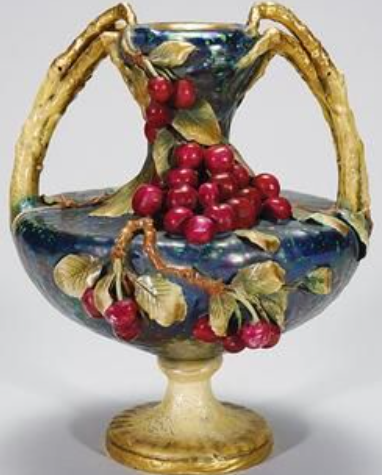
I gave my sister-in law this Austrian Amphora with a cascade of cherries. She has more baroque decorating tastes than I do.

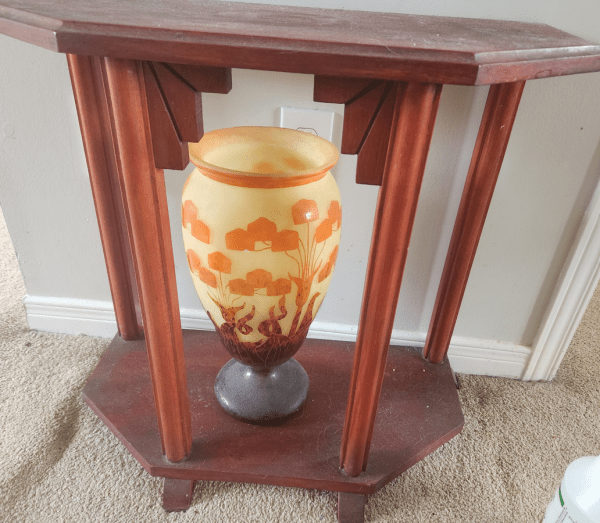
This classic Schneider Verre Francaise I keep in an Art Deco place of honour – on the floor – so my kamikaze cat won’t knock it over.

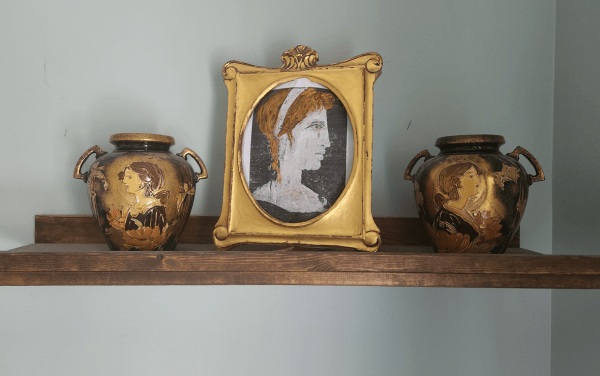
And the two rather ugly portrait vases once belonging to my chere Grandmaman Crepeau, I keep up on a shelf in the spare bedroom

for one reason and one reason only: I was practically born under them.

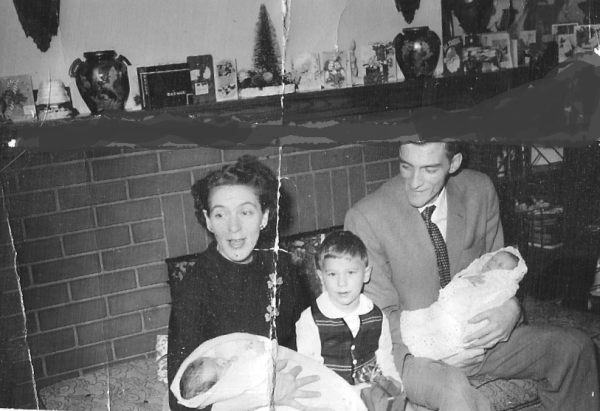
December 1954. That’s me in father’s arms. We are at my Aunt’s home in NDG

Twenty years ago, I investigated the provenance of the ugly vases for my Mom. She had just inherited them from my Aunt. They had a certain Pre-Raphaelite feel, I told her. Maybe they were worth something.

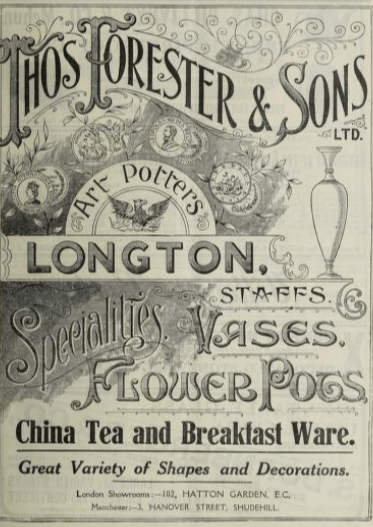
It didn’t take too long to figure out. These vases were English “art nouveau’1 Rembrandt vases out of the Thomas Forester factory in Longton, Stoke-on-Trent, a business supplying “useful and decorative” pottery to the masses.

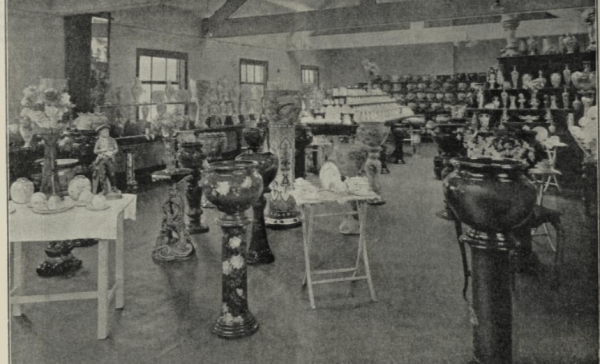
1912 Thomas Forester Showroom, Glasgow. The company specialized in Phoenix ware, a bright blue kind of pottery.

Later, I brought the ugly vases to a woman who was holding a “road show” event locally and she seemed impressed that I knew of their provenance. She said my Rembrandt vases were worth 400 dollars. Well, OK. Today, I can see a nearly identical pair on auction in Yorkshire for a mere 30 British pounds.

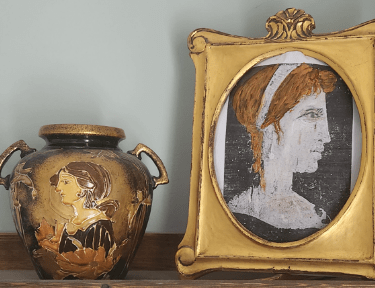
These days, I display the vases beside a print-out of a painting of the Pompeii Cleopatra. (I am a classical history enthusiast which, let’s face it, is largely about pottery – or pottery shards.) There’s a similarity in style, I think, especially with the girl on the left. I’ve always called her the Egyptian girl.

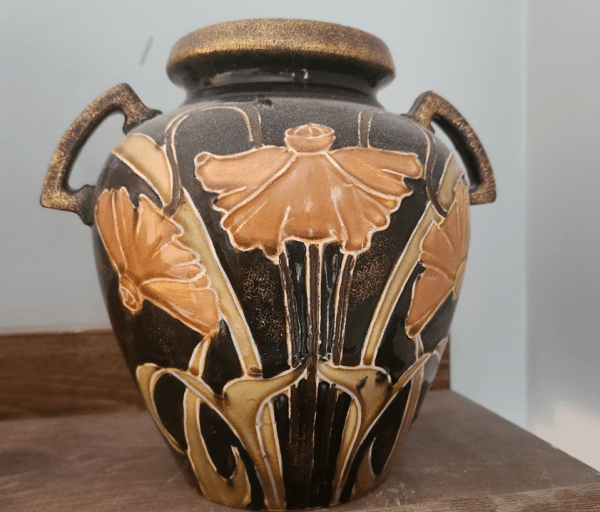
The back of the vases. Poppies? The Road Show lady said all the ugly bleeding is a mark of multiple firings and a good thing.

The designer of the vases is likely one Thomas Deans 2. I wonder if Mr. Deans ever visited Pompeii. Still, I don’t find these vases very appealing. Too chiaroscuro3 for my tastes. Too rough around the edges. The auction sites agree 🙂

Now, wouldn’t you know, Mary, the Queen of England, expressed a fondness for Rembrandt vases in 1913, the very year my vases were thrown. I know because Their Majesties made a tour of the Potteries (five towns in Staffordshire) in April . The tour was recounted in detail in the May 1913 issue of The Pottery Gazette.

The pottery industry was so important in England in 1913 that it warranted a Royal tour.

The King and Queen were also there, I suspect, to help calm down the natives who were upset over muscly new workplace laws threatening their businesses.5

This Royal visit was a PR masterclass, skilfully curated in support of the English pottery industry: The Royal Couple was on a tight schedule but they always seemed to linger longer than permitted, “so interested they were in the orchid paintings of Mr. Dewsbury; such pleasure they took in the engravings of Mr. Wyze; how attentively they watched the Wedgewood throwers at their work.”

And at every turn, Her Majesty revealed a vast knowledge of all things moulded, pressed and thrown.

Their Majesties did not stop at the two Thomas Forester factories in Longton but they did visit another factory-of-the-masses in that town signifying that they were not pottery snobs and very much interested in the ‘utilitarian’ aspect of the products.

They also went upscale. It was at the Doulton Factory toward the end of their tour where Queen Mary expressed a keen interest in my vases, ah, well, similar ones. “The Rembrandtware was singled out by the Queen for special inspection.” I guess, she really liked those gloomy vases gilded with gold.

So, my ugly art nouveau vases do contain a bit of history, even if it can’t be proved that Thomas Dean the designer ever visited Pompeii; even if Queen Mary of Teck, King Charles’ great-grandmother, never set eyes on them. 4

The vases certainly contain loads of sentiment: that photo is the only one I have of me as a baby and I’m in my Dad’s arms. For all I know, I first learned to focus my eyes on one of those gilded West Midlands maidens as my father moved toward the couch for this first-ever family photo-op.

Reminder to self: Put a copy of this story in one of the vases for when my my kids are deciding whether to give it to the VON. Also. Reread Anna of the Five Towns.

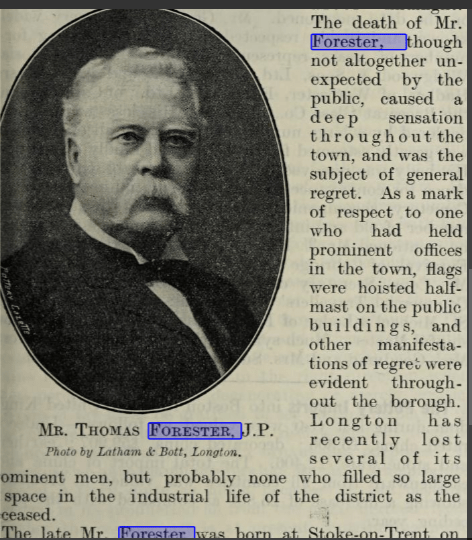
Thomas Forester: A local self-made man with good business sense. He would have two factories on Longton, his home town.

1. Art Nouveau. I love Art Nouveau. But where are the Mucha-like flowers in the hair? Forester produced prettier vases with women adorned like that. Just not here. My vases are a mishmash (miss match) of Dutch Golden Age, Art Nouveau and Classical Antiquity, I think anyway.

2. My vases have no Forester stamp, just a squiggly line, but online at auction an identical vase was designated Deans.

3. Rembrandt style as in clear/dark. I remember the term from an art history lecture in college. Funny what sticks in your head. Doulton Rembrandt vases are worth a fair bit on the auction sites. They have traditional portraits of hoary old men.

4. Maybe she did, after all. To put a stamp on the Royal visit, the Potteries mounted a huge exhibit for the benefit of all citizens.

5. Children under fourteen were banned from the workplace. The glass industry said this would ruin them. Boys needed to start work at 10 or so in order to become apprentices at 14. Not to worry, the children would only work 44 hours a week! There were new laws regarding the unbearable heat in the buildings, too, and lead-poisoning (of women and children) was also a topical issue.

Caught up in Change

When he was twelve years old, the person who answered the census described my great, great grandpa as a French-speaking Roman Catholic person.1 As he grew up, I wonder whether that dual identity became even more firm and important to him, perhaps as a rebellious response to massive societal changes where he lived.

Isadore Azilda Doucet was born in 1869 in Ile Verte, fourteen years after the seigneurial system was officially abolished in Quebec. His home in the Témiscouata Valley on the south shore of the St. Lawrence River east of Quebec City was a key outpost for English-speaking Anglican Lords who purchased manors for colonial purposes and later became Quebec’s most important industrialists.

Researcher Maude Flamand Hubert describes the process underway during great great grandpa’s lifetime as follows:

Dans la première moitié du xixe siècle, l’accession à la propriété seigneuriale constitue encore la voie privilégiée afin d’acquérir ce statut socioéconomique tant convoité. Ce brassage s’effectue tout juste à la veille de l’abolition du régime seigneurial, en pleine période d’essor de l’industrialisation et d’une économie capitaliste de plus en plus orientée vers les marchés. Selon le modèle proposé par Serge Courville, comme de nombreux noyaux paroissiaux issus d’une colonisation seigneuriale timide, L’Isle-Verte prend véritablement son élan dans le deuxième quart du xixe siècle (Courville, 1990, p. 26).

In the first half of the 19th century, accession to seigneurial property was still the privileged way to acquire a coveted socioeconomic status. This mixing took place just on the eve of the abolition of the seigneurial regime, in the midst of a boom in industrialization and an increasingly market-oriented capitalist economy. According to the model proposed by Serge Courville, like many parish centres resulting from a timid seigneurial colonization, L’Isle-Verte really took off in the second quarter of the 19th century (Courville, 1990, p. 26).2

Reminders of the old system remained throughout great great grandpa’s lifetime. The area in which he lived once formed part of the Sieur Charles-Aubert de la Chesnaye manor, which was purchased by Alexander Fraser from Lord Caldwell on August 2, 1801.

Eight different waterfalls and a series of salt marshes attracted visitors to the largest settlement in the region, which served as a natural amphitheatre at the head of the Temiscouata Valley. It became a key military post during the wars of independence and the War of 1812.

Alexander Fraser died in 1837 and passed his manor on to his son, Malcolm Fraser. Malcolm died five years later, passing the region on to his brothers William and Edward.

Lord Elgin baptized the largest settlement in the area “Fraserville” in 1850.3 Settlement rapidly increased over the following decades, with schools, courthouses and communication services established. Canada’s first Prime Minister Sir John A. MacDonald lived in the town during the summers throughout the late 1800s.

By 1870, when great great grandpa was only a year old, the Grand Trunk Railway Company opened a terminal in the town creating a dependence on railways that would last for the following 150 years.

By the time he was 17 years old, the Témiscouata Railway connected his city with New-Brunswick. A big pulp and paper mill opened up shortly after.

Doucet lived in Fraserville Town when he turned 22 years of age, and at that time, he still defined himself as Roman Catholic and French-speaking.4 I don’t know what he did for a living, although perhaps he remained on the family farm, given my grandmothers’ farming life two generations later.

There were many other job opportunities around him, but between 1850 and 1919, the city saw large increases in its anglophone population. Perhaps they were the ones to get the well-paying forestry, paper mill and railway jobs.

By the time great great grandpa died on January 4, 1905, the community he lived in was commercial, secular and an industrial powerhouse. Yet the original Francophone farming community continued to thrive. The city reverted to its original name, Rivière-du-Loup, in 1919 and 98% of the current population speaks French.

Photo caption

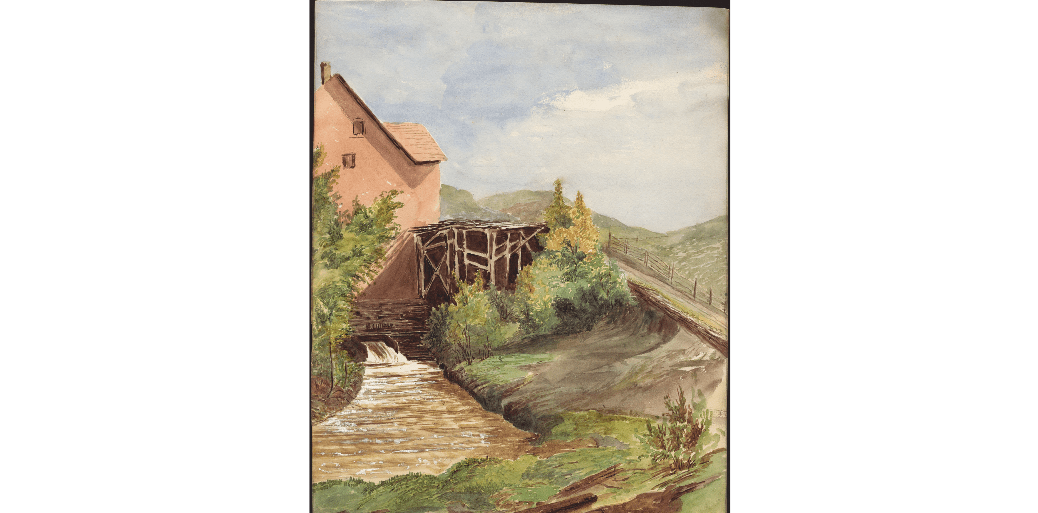
1880 Mill at Rivière du Loup by the Baroness Agnes Macdonald of Earnscliffe (1836-1920) on September 7, 1880, watercolour / aquarelle : watercolour / aquarelle on wove paper, http://central.bac-lac.gc.ca/.redirect?app=fonandcol&id=3007587&lang=eng, accessed on May 30, 2023

Sources

1 Canada Census, 1881, database with images, FamilySearch (https://familysearch.org/ark:/61903/1:1:MVND-LJS : 2 March 2021), Isidore Doucet in household of Alfred Doucet, L’Isle-Verte, Témiscouata, Quebec, Canada; from “1881 Canadian Census.” Database with images. Ancestry. (www.ancestry.com : 2008); citing Alfred Doucet, citing Library and Archives Canada, Ottawa, Ontario.

2 Flamand-Hubert, Maude. Louis Bertrand à L’Isle-Verte (1811-1871): Propriété foncière et exploitation des ressources. PUQ, 2012.

3 Société d’Histoire et de Généalogie de Rivière-du-Loup, https://www.shgrdl.org/rdla.htm

4 Canada Census, 1891, database, FamilySearch (https://familysearch.org/ark:/61903/1:1:MW5P-9L1 : 4 August 2016), Isidore Doucet, Fraserville Town, Témiscouata, Quebec, Canada; Public Archives, Ottawa, Ontario; Library and Archives Canada film number 30953_148224.

The Life and Times of Great-Aunt Amelia

My mother used to tell me that Amelia Norton was her favourite of her four great-aunts on her mother’s side of the family. From what I have learned about Amelia’s life, it appears she was indeed a kind and generous person.

Amelia Josephine Bagg was born in Montreal in 1852. Her father, Stanley Clark Bagg, was a wealthy landowner in Montreal, so Amelia had a privileged upbringing that included a year-long tour of Europe with the whole family in 1868-69, when she was 16.

After her father died in 1873, her brother, Robert Stanley Bagg, took over management of their late father’s real estate, renting out some properties and selling others. Amelia had a strong interest in the Bagg family real estate business, helping to keep the records of sales, and she also owned property in her own name.

Mr. and Mrs. Mulholland. 1891. Wm. Notman and Son, McCord-Stewart Museum, II-95084 1.

Amelia lived with her mother, Catharine Mitcheson Bagg, until she married at age 38. The wedding took place on Dec. 18, 1890 at Christ Church, Montreal’s largest Anglican church. Her husband was Joseph Mulholland, the eldest son of hardware merchant Henry Mulholland and his wife, Ann Workman. Born in Montreal in 1840, Joseph had a twin who died as an infant. Joseph is connected to me in two ways: in addition to being married to Amelia, his sister Jane Mulholland (1847-1938) and her husband, Montreal banker John Murray Smith (1838-1894), were my great-grandparents on my mother’s father’s side.

As a young man, Joseph had worked in the hardware business. Now, as Amelia’s husband, he started a new career in real estate. In 1891, he and his brother-in-law collaborated in a business venture: Joseph and John purchased a vacant piece of land from Robert Stanley Bagg on Saint Charles Borromée Street (now renamed Clark Street) near Pine Avenue and built a row of attached house there.1 The building, designed by architect Eric Mann, survives to this day.

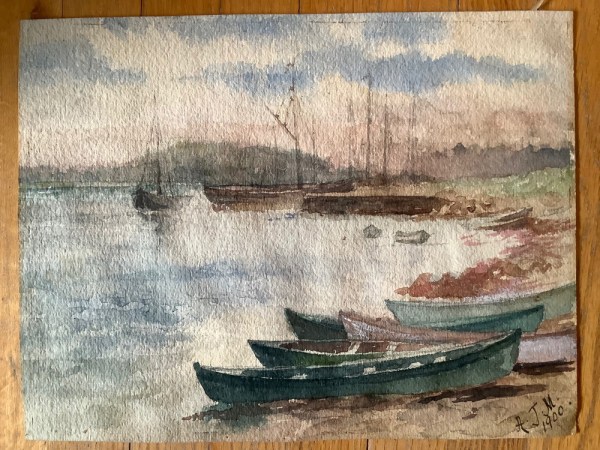
Amelia was known as a talented amateur artist. This watercolour painting of the Montreal waterfront belongs to one of the Bagg family descendants.

Joseph died, age 57, in 1897. Five years later, Amelia married again, this time to Reverend John George Norton, Archdeacon of Montreal.It was a relatively small wedding with only family members and a few close friends present.2 John was born in Ireland in 1840 and he was educated there. He moved to Montreal in 1884 with his wife and two children. His wife died five years later.

As the wife of one of the leading clerics in Montreal’s English-speaking community, Amelia took on a new role, especially in church charities. According to a biography of Archdeacon Norton in The Storied Province of Quebec, “Mrs. Norton is a lady of culture and refinement. Mrs. Norton was a valued ally and helpmate in all the parochial work of the church.”3

At that time, governments gave little funding to health care or social services, so benevolent societies played an essential role in society. As president of the Women’s Auxiliary of Christ Church Cathedral for many years, Amelia was especially interested in its missionary work.4 In addition, her name appeared regularly in lists of donors to various charities published in the local newspapers.

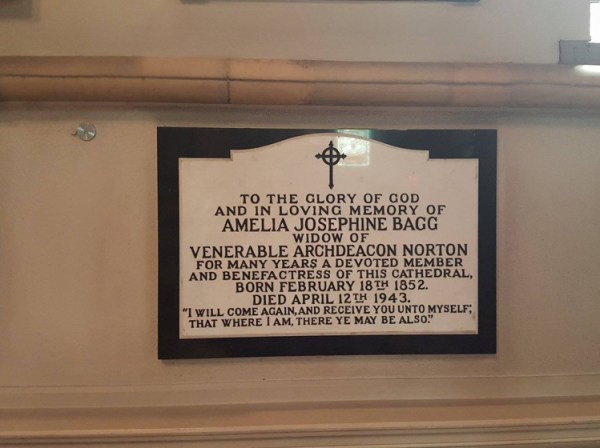
This memorial to Amelia is in Christ Church Cathedral, Montreal. Photo by Genevieve Rosseel.

The couple lived in the church rectory for many years and after John retired, they moved into their own house on McTavish Street, near McGill University. When the Venerable John George Norton, Rector Emeritus and Archdeacon of Montreal John died in 1924 at the age of 84, many people attended his funeral service at Christ Church, where he had officiated for 37 years.

Meanwhile, Amelia seems to have been the go-to person when family members needed help. After Amelia’s Aunt Fanny (Mitcheson) Hague was widowed in 1915, Fanny came to live with the Nortons and remained there until she died in 1919.

My grandparents also went to Amelia for help. They had built a new house just before the Depression hit and my grandfather lost his job. Amelia helped to support the family until my grandfather found a new job after the Depression.

Amelia died in 1943, at age 91, at home on McTavish Street, following a long illness. She is buried with her first husband in the Mulholland-Workman family plot in Montreal’s Mount Royal Cemetery.

Sources

  1. Le Prix Courant: le journal de commerce, 10 Avril 1891, p 13, https://numerique.banq.qc.ca, entry for John Murray Smith, https://numerique.banq.qc.ca/patrimoine/details/52327/2746357?docsearchtext=%22John%20Murray%20Smith%22, accessed June 18, 2023.
  • 2. “Marriage at the Cathedral”, The Gazette, 25 June, 1902, p. 6, Newspapers.com, accessed June 18, 2023.
  • 3. William Wood, editor, The Storied Province of Quebec, Past and Present, Dominion Publishing Company, 1931, vol. 3, p. 118.
  • 4.  “Obituary: Mrs. J. Norton, 91, Dies at Home Here,” The Gazette, April 13, 1943, p. 14, Newspapers.com, entry for Amelia Norton, accessed June 20. 2023.

5.    Mount Royal Cemetery, section F200-c

See also

Frank Dawson Adams, A History of Christ Church Cathedral, Montreal, Montreal: Burton’s Limited, 1941, https://numerique.banq.qc.ca/patrimoine/details/52327/2561503

Janice Hamilton, “Continental Notes for Public Circulation”, April 8, 2020, Writing Up the Ancestors, https://www.writinguptheancestors.ca/2020/04/continental-notes-for-public-circulation.html

Janice Hamilton, “Aunt Amelia’s Ledger”, April 26, 2023, Writing Up the Ancestors,          https://www.writinguptheancestors.ca/2023/04/aunt-amelias-ledger.html

Janice Hamilton, “Henry Mulholland, Montreal Hardware Merchant”, March 17, 2016, Writing Up the Ancestors, https://www.writinguptheancestors.ca/2016/03/henry-mulholland-montreal-hardware.html

Janice Hamilton, “The World of Mrs. Murray Smith”, Feb.24, 2016, Writing Up the Ancestors, https://www.writinguptheancestors.ca/2016/02/the-small-world-of-mrs-murray-smith.html

Janice Hamilton, “Never Too Late for Love,” April 4, 2014.  Writing Up the Ancestors, https://www.writinguptheancestors.ca/2014/04/never-too-late-for-love.html

This article is also posted on the family history blog Writing Up the Ancestors.

Bon Soir et Dors Bien – Good Night Sleep Well

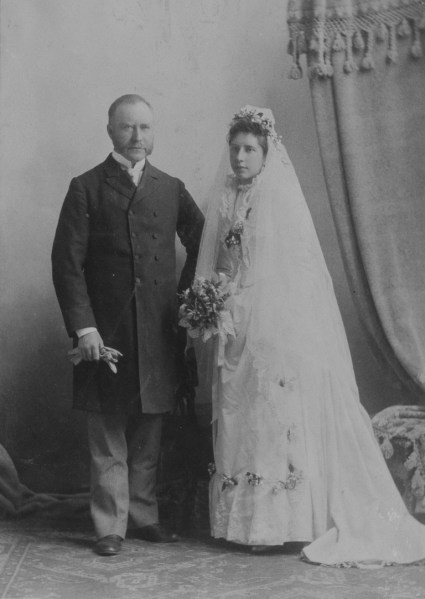
Rene Raguin & Beatrice Bruneau Wedding 1912

“Bonsoir et dors bien”, is how my mother ended her nightly phone calls with her parents. These were some of the few French words I ever heard her speak, which was strange as French was both her parent’s mother tongue. Why did we only speak English?

René Raguin my grandfather, was from Fleurier, Switzerland and came to Canada to teach at the French Protestant school in Pointe aux Trembles, Quebec. He later taught in Trois Rivieres and finished his career at Baron Byng, a school of the English Protestant School Board of Greater Montreal. He also taught teachers how to teach French at McGill University’s summer school.

Beatrice Bruneau met René Raguin when they were both teaching at the Pointes aux Trembles school. This was the one French Protestant school in the Montreal area. Grannie as we called her, descended from French Canadian stock, although born in Green Bay Wisconsin. Her father Ismael Bruneau was a French Presbyterian minister. Her mother Ida Girod was a French speaker from Switzerland and also a Protestant.

René spoke English fluently but with a heavy accent. He always used English when talking with us, his grandchildren and we called him Grandfather. I always wondered why he never communicated with us in French as a French teacher. One much older cousin Don Allchurch, always referred to him as Grandpère as he did speak to him in French.

Beatrice’s father Ismael Bruneau, was “pure laine”, French Canadian through and through. His early ancestors arrived in Quebec from France in the 1630s. His family of Catholics converted to Protestantism in the 1850s and that is where the English crept in. Ismael wasn’t thrilled to speak English as he wrote to his youngest sister Anais, “I write to you in English, dear sister, not to show you I can write a few words in that barbarous language, but for your good as well as mine, for practice makes perfect.” Many of Ismael’s siblings moved to the United States, spoke English and married English speaking spouses.

French was spoken in his home but Ismael’s children all went to English Protestant schools as the French schools were all Catholic and they didn’t even allow Protestants to attend. In the family, religion trumped language. Most of his children also married English-speaking people. His two sons continued to speak to each other in French.

Beatrice Bruneau Raguin

My mother grew up in Dixie on the border of what is now Lachine and Dorval. It was then an English community. Because her father Rene Raguin taught for the English board they didn’t have to pay school fees and so attended English Protestant schools. The children didn’t want to speak that other language. Some evenings her father would say that only French would be spoken at the dinner table. The children wouldn’t say a word and only eat what they could reach.

Rene Raguin

The Scots and Irish immigrants who were my father’s family settled in Toronto and spoke only English. I don’t remember him speaking French to anyone. He always regretted that he couldn’t speak French. He too went to English Protestant schools.

Dorothy, Beatrice, Rene & Mary

We were schooled before French Immersion and though there was some talk about sending us to French Schools, they were still all Catholic and not a choice, so we also attended English Protestant schools.

So in a generation, the French family became English. We didn’t call my mother every night but as we left after a visit she had a new English saying, “Safe home.”

Notes:

A Short History of the Bruneau-Girod Families: Ida Bruneau Ste. Agathe des Monts, Quebec May 1993. Forbes Publications Ltd. Calgary, Canada.

My sister remembers the phrase as “Bonsoir et dors bien Maman” but I said sometimes she was talking to her father.

Old Land Roll in Lower Canada

The database below entitled Old Land Roll in Lower Canada as noted in the BAnQ’s Directory of Townships https://numerique.banq.qc.ca/patrimoine/details/52327/3035112?docref=ydD2bC568QoqleH8sQN1XA was prepared in May of 1966.

Almost 60 years later, Wikipedia in March of 2023 updated a Directory of Townships with basically the same information, plus details relating to today’s current locations and regions.https://en.wikipedia.org/wiki/List_of_townships_in_Quebec

List of townships in Quebec

From Wikipedia, the free encyclopedia

This article lists the townships of Quebec in Canada. The townships (Frenchcanton) no longer represent administrative divisions recognized by the Ministry of Municipal Affairs and Housing (Quebec) (MAMH). Only municipal townships, formed from one or more townships, such as township municipalities and united township municipalities, are recognized.[1] Many geographic townships are still conterminous with municipalities.

Click on the link below to open.

The Great Volunteer Soldier Recruitment of 1653

Next month marks 370 years since my six times great grandfather and his brother volunteered to join a militia to protect the city of Montreal. Their voyage from France to our city would last five months and require two departures. They faced captivity, an epidemic and enough starvation and illness to cause the death of eight of their colleagues, but they survived.

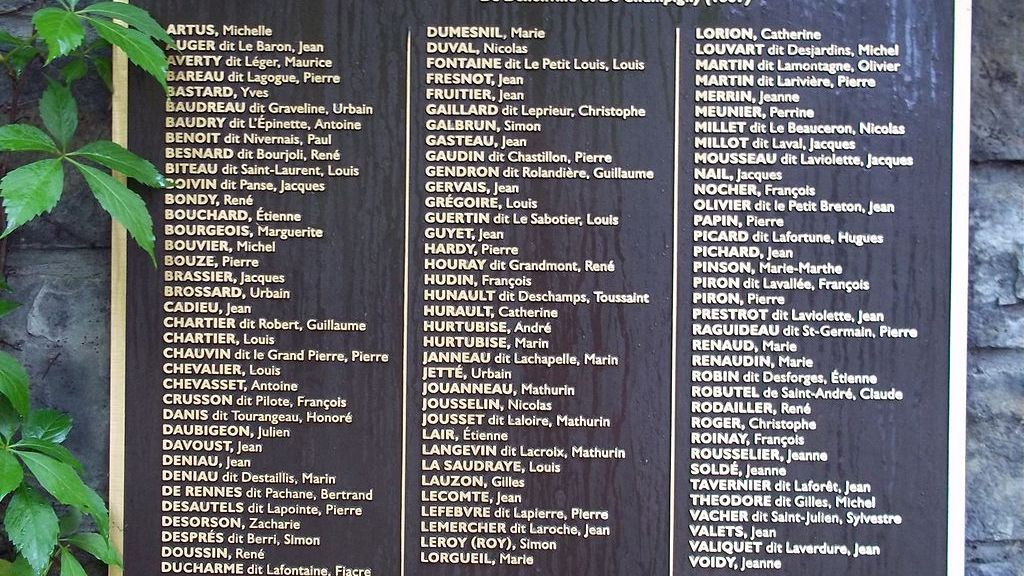
Marin Hurtubise and his brother André were among 154 men recruited by New France Governor Paul Chomedey de Maisonneuve to help protect the Fort Ville-Marie from Iroquois attacks. They signed five-year contracts with the Société de Notre Dame de Montréal to clear uncultivated land in New France for farming at a price of 100 livres per year1. Their employer, also known as the “Company of Montreal,” was originally founded in France in 1639 to establish a colony in Canada.

According to notes left behind by my grandmother, the Hurtubise brothers came from a town known as Sillé-le-Guillaume in Rouesse-Vasse, southwest of Paris in the Sarthe Departement in the Pays de la Loire region.

They travelled to St. Nazaire to join 120 other men and 14 women who set sail for New France on June 20, 1653. Among their ship mates was Marguerite Bourgeoys, a women with a desire to create schools in New France. She also founded the Notre Dame parish and set up housing for the filles du roi. In 1982, Pope Pius XII canonized her as Canada’s first female saint.

The trip in Captain Pierre le Besson’s ‘Saint-Nicolas-de-Nantes’ vessel2 did not go well.

Ships in that era were not the large luxury vessels we cruise on today. According to an unauthored essay that used to appear on the Maison Saint Gabriel website, they measured roughly 25-45 meters long and 8 meters wide. Passengers bunked in a single room at the back of the ship in unsanitary conditions in which everyone slept in their clothes. Buckets collected waste and vomit from those who couldn’t handle seasickness. Meals often consisted of dry biscuits, salt pork and fish.

In this case, the ship also leaked. The ‘Saint-Nicolas-de-Nantes’ took on so much water that after sailing 350 leagues (1600km), the crew had to return to Nantes. Passengers were left on an island off the coast of France to wait for another month until a replacement ship could be found. According to Marguerite Bourgeoys’ diary, some of the recruits deserted their posts and swam back to France.

“Sieur de Maisonneuve and all of his soldiers stopped on an island from which there was no escape. Otherwise, not a single one would have stayed. Some even set about swimming to save themselves since they were furious and believed they had been taken to perdition.”3

On July 20th, after a St. Marguerite’s day mass, the replacement ship set sail for the New World with the Hurtubise brothers and Marguerite Bourgeoys on board. This voyage, which featured many storms, an outbreak of the plague and eight deaths (Jacques Audru, Olivier Beaudoin, René Cadet, Jean Chaudronnier, Louis Doguet, Michel Lecomte, Joachim Lepallier and Pierre Moulières), doesn’t sound any better than the first, save for the sea-worthy vessel.

After 64 days, the ship landed at Cap-Diamant, on September 22, 1653. At that point, it seems that the ship was set on fire in the middle of the river. Bourgeoys’ writings imply that it got stuck so that high tide couldn’t even free it.

For the next two months, New France Governor Jean de Lauzon tried to keep the voluntary soldiers and marriageable women in Quebec to defend that city, in part by refusing to provide the barges needed to sail the Saint Lawrence River to Ville-Marie.

Eventually, de Maisonneuve prevailed. The group arrived at Ville-Marie on November 16th.4 They were all given land grants next to the Saint Laurence River. Later, Marin and five neighbours settled in Côte St. Antoine.5

André Hurtubise died six years after the brothers arrived in Montreal. Marin lasted 19 years, successfully marrying and having six children during that time. He died in Montreal on May 12, 1672.6

Sources

1Aubry, Louis, Famille Hurtubise Gendron, https://www.mes-racines.ca/fichiers/Lign%E9es/H/Hurtubise-Gendron/Hurtubise-Gendron.pdf, accessed May 2, 2023.

2“Ancestors on the World Stage,” https://www.apointinhistory.net/granderecrue.php, accessed May 2, 2023.

3Les Écrits de Mère Bourgeoys, p. 46

4“La Grande Recrue de 1653.” http://louisianalineage.com/recrue1653.htm, accessed May 2, 2023.

5MacKinnon, Janet S. The Settiement and Rural Domestic Architecture of Côte Saint-Antoine, 1675—1874, thesis 2004

6Find a Grave, database and images (https://www.findagrave.com/memorial/144617536/marin-hurtubise: accessed 02 May 2023), memorial page for Marin Hurtubise (26 Oct 1631–12 May 1672), Find a Grave Memorial ID 144617536, citing Ancien cimetière Notre-Dame (1672-1830), Montreal, Montreal Region, Quebec, Canada; Maintained by AW (contributor 47829810).

Photo of commemorative plaque courtesy of Jean Gagnon, CC BY-SA 3.0 https://creativecommons.org/licenses/by-sa/3.0, via Wikimedia Commons.

Aunt Amelia’s Ledger

with additional research by Justin Bur

Some of my female ancestors are almost invisible. They got married, had children and left no other traces of their lives. But a few left paper trails such as letters, journals and drawings. My two-times great-aunt Amelia Josephine Bagg (1852-1943) was one of them. Married twice but with no children of her own, she became deeply involved in the family real estate business.

Amelia was the third of the five children (one boy, four girls) of Montreal landowner Stanley Clark Bagg (SCB) and his wife, Catharine Mitcheson Bagg. The children grew up in the family home, Fairmount Villa, near what is now the corner of Sherbrooke and St. Urbain streets. There, they had a big garden to play in and no doubt a nanny to care for them when they were little and a governess to educate them.

Unlike many women of her time and class, Amelia found the opportunity to use her education.

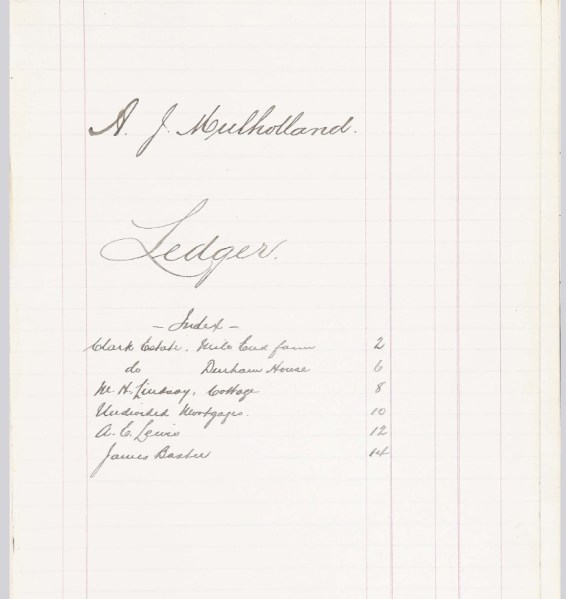
Amelia Mulholland’s ledger, McCord Stewart Museum, https://collections.musee-mccord-stewart.ca/internal/media/dispatcher/261758/preview p. 5.

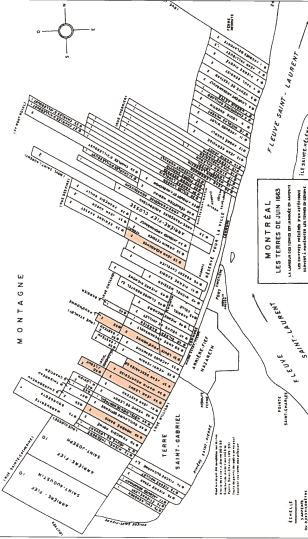
SCB had inherited several large properties on the Island of Montreal, extended along the west side of St. Lawrence Street (now busy Boulevard Saint-Laurent). During his lifetime, this was agricultural land and, although he was trained as a notary, SCB made his income by leasing his properties to farmers.

He died unexpectedly at age 53, in 1873, when Amelia was just 21. SCB named his wife and her brother (who was a Philadelphia lawyer) as executors of his estate.1 Son Robert Stanley Bagg (RSB), a recent law graduate from McGill University, took on the responsibility of managing it. Over the years, the widowed Catharine and her daughters had a great deal of input into decisions about the estate, with Amelia being the daughter who took the greatest interest.    

Around the end of the century, Montreal grew rapidly. Business leaders developed new industries, founded banks and built railways, and immigrants arrived to fill newly created jobs. Property belonging to SCB’s estate could now be divided into lots and sold to people who wanted to build homes or invest in rental housing. Around 1890, some legal hurdles prevented the family from selling the most valuable properties, however, the family managed to resolve these problems. That will be a story for another time.

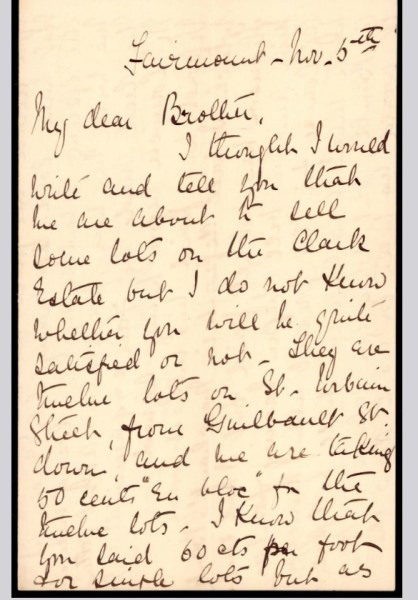
Amelia’s letter to brother Robert Stanley Bagg, McCord Stewart Museum,  https://collections.musee-mccord-stewart.ca/en/objects/416400/correspondance  p. 43

With these issues resolved, Amelia and her siblings divided up some of the land and became owners of lots that they could sell or buildings they could rent out themselves. Amelia became an independently wealthy woman.

She also developed an interest in the details of the family real estate business, keeping track of land prices, interest rates and other factors influencing real estate sales. In the fall of 1890,2 while her brother took his wife and children on an extended trip to England, Amelia coordinated decisions on new property sales. She wrote to ask for his advice and to bring him up-to-date on family news.3

“Fairmount, Nov. 6th

“My dear Brother,

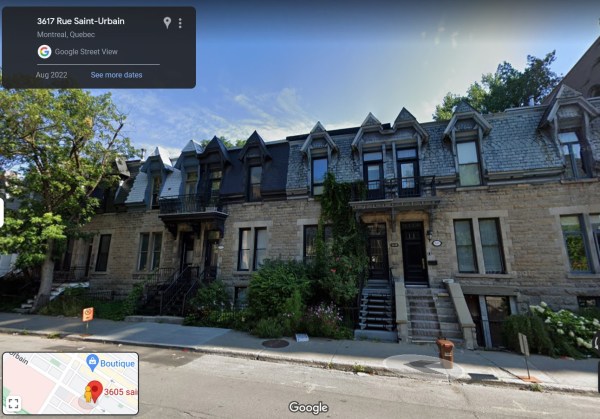
“I thought I would write and tell you that we are about to sell some lots on the ‘Clark Estate’ but I do not know whether you will be quite satisfied or not. They are twelve lots on St. Urbain Street, from Guilbault St. down, and we are taking 50 cents “en bloc” for the twelve lots. I know that you said 60 cents per foot for single lots but as this is for twelve lots we thought perhaps it was better not to lose the sale.4 Bob said that you told him we could take less than the price named, and McMann said he was selling lots of Park Avenue for 45cts.7 I hesitated for a long time as I did not wish to make a sale that you would not approve, but Kate was in favor of selling, so also was Bob, and Helen and I did not know what to do….5

“Vipond has paid his interest today which I will deposit in Merchant’s Bank. Thomson has not yet paid but I had sent him another bill before hearing from you. Of course for the present all money both interest and capital will be deposited in the bank, but when you return we think it would be better for us to draw the interest and leave only the capital in the bank.….”

Row houses on St. Urbain Street near Prince Arthur. Google Street View

Much of the Bagg estate was still leased out to farmers at that time, and one day a month was reserved for tenants to deliver the rent. In the same letter, Amelia referred to this so-called reception day, but she was actually describing the arrival of her sister Mary Heloise Lindsay’s fifth child on Nov. 3, 1890. Mary and her husband Robert Lindsay lived at 436 St. Urbain. Amelia told her brother:

Kate and I made out the Nov. statements of rents due and gave the list to Bob so that when the people paid he could check them off. We were surprised at an unexpected arrival at 436 St. Urbain Street on Monday. It is true that is the reception day there now, but this particular visitor was not expected just then. It was a dear fat little girl! She arrived at 8 o’clock in the evening.”

Amelia also kept track of the sales of lots from the estate between 1890 and 1900 in a hardcover ledger with ruled pages. My mother eventually inherited that ledger. Her cousin had given numerous family letters, business records and other documents to the McCord Stewart Museum (a Montreal museum of social history) some years earlier, but my mother hung on to the ledger. After she died, I found it in a desk drawer in the spare bedroom.

When I started to research the Bagg family and their role in Montreal history, the ledger’s importance as a record of those land transactions became clear, so I donated it to the McCord.6 I hope Amelia would have approved.

This article is also posted on http://www.writinguptheancestors.ca.

See also:

Janice Hamilton, “Stanley Clark Bagg’s Four Forgotten Daughters,” Writing Up the Ancestors, Sept. 30,2017, https://www.writinguptheancestors.ca/2017/09/stanley-clark-baggs-four-forgotten.html

Janice Hamilton, “My Great-Great Aunts, Montreal Real Estate Developers,” Writing Up the Ancestors, Oct. 11, 2017, https://www.writinguptheancestors.ca/2017/10/my-great-great-great-aunts-montreal.html

Janice Hamilton, “John Clark, 19th Century Real-Estate Visionary,” Writing Up the Ancestors, May 22, 2019, https://www.writinguptheancestors.ca/category/john-clark

Notes and Sources

  1. City of Philadelphia (Pennsylvania). Register of Wills Office; Wills, No 772-802, 1887, Ancestry.com. Pennsylvania, U.S., Wills and Probate Records, 1683-1993 [database on-line, entry for Catharine Mitcheson Bagg, accessed April 2, 2023], original data: Pennsylvania County, District and Probate Courts. This is a copy of the will that is very easy to read. It was probably copied in Philadelphia because McGregor J. Mitcheson, Catharine’s brother and an executor of SCB’s will, died in 1886. About a month after SCB’s 1873 death, notary J. A. Labadie deposited at the land registry office in Montreal a copy of the 1866 will and the 1870 codicil and a declaration of death. Bureau d’enregistrement Montréal-Ouest, no 74545, registered 6 September 1873; at Registre foncier du Québec, online.
  2. Amelia did not note the year on her letter, but we know it was written in written in 1890 because that was the year her niece Marjorie Mary Clark Lindsay was born. 

3. Correspondance de la famille Bagg. McCord Museum, Fonds Bagg, P070/B08,  https://collections.musee-mccord-stewart.ca/en/objects/416400/correspondance  p. 43 (accessed April 3, 2023)

4. RSB must have told them to hold out for the full price. The lots were not sold until the following year. On Nov. 18, 1891, real estate agent and furrier Robert Lamb purchased not just the 12 lots mentioned here, but an extended row of 22 lots, paying 60 cents a square foot.

5. The people mentioned here are probably Amelia’s sisters Katherine Sophia Mills and Helen Frances Lewis. Bob was likely Robert Lindsay, her sister Mary’s husband. McCann was a real estate agent.

6. Amelia Josephine Bagg Mulholland, Grand livre, 1891-1927, McCord Museum, Fonds Bagg, P070/B07,1. https://collections.musee-mccord-stewart.ca/en/objects/293626/a-j-mulholland-ledger (accessed April 3, 2023)

Ypres Gas Attack Survivor Returns Home

Part Two of Two

Six months after surviving the battle at St. Julien, Belgium, and the German gas attack in 1915, something entirely different brought Captain Stanley Bagg Lindsay (1889-1965) to his knees. He slipped and fell in the trenches while on active duty, and needed surgery on a hernia on his left side. He was officially declared unfit for duty and was granted sick leave to recover back home in Montreal, Quebec, for the winter.

Stanley Lindsay – winter 1916

Within months of his return to England, the hernia recurred on his right side needing immediate surgery and his health never fully recovered after that. Several bouts of influenza also plagued him throughout the war, before and after his hernias, and weakened him for the rest of his life.

He was 29 when the war ended. He returned to Montreal, but did not resume his studies at McGill University, choosing instead to follow in his father’s footsteps and become a stockbroker. His salary as a Captain had brought in an average of $142 per month during his four years of service. This translates into $3900 per month in today’s dollars. He quite possibly returned to civilian life with a decent nest egg with which to begin his new career.

Stanley’s health issues did not appear to hinder his long career as a stockbroker and eventually he became a partner at Crutchlow, Deare & Co. According to family lore, he purposefully sold off the family’s portfolio of stock investments just before the Great Crash of 1929.1 Perhaps his war experience left him with some kind of sixth sense.

Although Stanley never married, he remained close to his two brothers (and their families) and his three sisters.

Two of his sisters, Marjorie and Marguerite, had been nurses during the war with the Information Bureau,2 a Canadian Red Cross organization in London which cared for Canadian soldiers. Marguerite died young in Cartwright, Labrador, in 1926 while volunteering with the Grenfell Mission.3

Stanley lived with Marjorie and their parents at 455 Sherbrooke Street West (previously known as The Prince of Wales Terrace) until their father’s death in 1931. Then they moved with their mother into an apartment at 1009 Sherbrooke Street West until her death in 1938 and remained there until their own deaths: Marjorie in 1961 and Stanley in 1965. His eldest sister Ada lived in Vancouver with her husband Julius Griffith and their only son, Julius, who became a well known Canadian artist.4

Stanley’s two brothers – my grandfather Sydenham5 (an Anglican priest) and Lionel (a pediatrician) – provided him with ten nieces and nephews to spoil. He absolutely adored my mother Ann and showered her with his love and gifts. He must have been devastated when she died of Hodgkin’s Disease at the age of 36 in November, 1961, having lost his sister Marjorie earlier that year.

Stanley Lindsay (far right) at Ann’s baby’s christening party 1953

Luckily for me, he devoted his free time to the family history. I have pages upon pages of his beautifully (legible!) handwritten notes about that side of our family. All the usual dates and facts were recorded, but in a clear, more descriptive fashion.

One of his pages about his grandmother, Catherine Mitcheson Bagg, recalled a visit to her home as a boy:

We can remember her well sitting at the front drawing room window at Fairmount with her white lace cap on, looking out at the people passing.

We used to play in Granny’s garden. There were apple trees, especially one which was easy to climb and play house in. There was an iron bench under it, painted blue green…. There was a chestnut tree which we loved, the summer house, the white statutes of Adam and Eve with no arms, … the bleeding hearts, snowballs and lilacs … Nora the housemaid and Jessie the cook, who made good ladies fingers and sponge cakes and who we could always see through large sunken window which gave light to the kitchen.

There were the stables, the horses, the rockaway and the brougham and Willis the coachman with white mutton chop whiskers whom we liked and who afterwards drove a wagon for Joyce the confectioner. We were very fond of Odell Comtois who did sewing…. She was practically one of the family.

The garden became very shabby. It seemed a large garden to us. It went as far as our house which was at the corner of Milton Street. The west side adjoined the Wilson-Smith property. Long before our house was built, a large house called Tara Hall stood just north of Milton Street. Mother [Mary Heloise (Bagg) Lindsay] remembers it burning down one night when she was a child. Where the house used to stand is a street called Tara Hall.”

As well as being everyone’s favourite uncle, an excellent family historian and a successful stockbroker, Stanley belonged to several local clubs including the Canadian Club, the University Club and the Royal Montreal Golf Club.6

After almost dying at Ypres during the Great War, Stanley lived another fifty years.

1https://wiki2.org/en/The_Crash_of_1929 – as referenced 2023-02-23

2https://genealogyensemble.com/?s=the+mothering+bureau

3https://genealogyensemble.com/2022/07/27/miss-lindsay-the-early-years/

4https://www.gallery.ca/collection/artist/julius-griffith – as referenced 2023-02-23

5https://genealogyensemble.com/2016/04/05/the-priest/

6Obituary – The Gazette, 1965-03-03

Mathilde Bruneau Career Woman

Marie Mathilde Bruneau

I never expected to find much information about my great-grandfather’s sister, Mathilde Bruneau. I knew her name, dates, the fact she had a twin brother and that she never married. That was all. Then when searching Newspapers.com, Mathilde, born on a farm in southern Quebec appeared on the social page of the Fall River, Massachusetts Daily Herald. It was reported that she had been visiting her brother Aimé Bruneau and then returned to her teaching duties at the Rhode Island Institute for the Deaf in Providence, Rhode Island, only twenty miles from her brother’s home.

Sophie, Helene & Mathilde Bruneau in New York

Mrs. Mary Ann Lippitt founded the school in 1876. Her daughter Jeanie became deaf after a bout of scarlet fever so her mother taught her daughter to speak and read lips, as no schools for the deaf existed at that time. Mary Ann’s husband Henry Lippitt was the Governor of Rhode Island and had political influence, so he persuaded the state to take over the operation of the school. In 1893 the school moved to a large new building which could hold 60 students. This might have been the time Mathilde began teaching there. The school is still operating today.

I don’t know how Mathilde ended up teaching deaf students. Did she answer a newspaper ad while visiting her brother? Before teaching the deaf, Mathilde had been a French teacher in New York City along with her sister Virginie. Virginie didn’t stay there but returned to Quebec to marry.

Mathilde had not yet moved to Rhode Island 1887 when the social page reported on an earlier visit to her brother Aimé, in Fall River. I don’t know where Mathilde obtained her teaching credentials as I haven’t found records of her training. Her sister Virginie attended McGill Normal School. Did Mathilde begin her teaching career in Montreal before moving to New York?

Mathilde was one of thirteen children of Barnabé Bruneau and Sophie Marie Prudhomme, born in St-Constant, Quebec, south of Montreal, in 1844. She had a twin brother Napoleon, one of very few twins in my family tree. In the 1871 Canadian census, she was listed as living with her parents in St-Constant (and two years older than her twin brother), so she was at least 27 when she moved to New York City. Napoleon stayed on the farm but he also had a career as a veterinarian and a Justice of the Peace.

Sisters Sophie, Mathilde& Elmire with Washington Huntley

Although some of her siblings became American citizens, it seems she never did. After Mathilde retired from teaching, she moved back to Quebec. She maintained her independence and didn’t live with her twin brother in St-Constant or even with one of her sisters, instead she was a lodger in John Dooley’s house on Bordeaux Street in Montreal.

Mathilde Bruneau

She appeared again in a newspaper in April 1912, “Miss Matilda Bruneau 68, 1149 Bordeaux St. fell on the sidewalk corner of Mary Ann and Erables last night and broke her left leg. She was taken to the Royal Victoria Hospital” reported the Montreal Gazette. The weather the day before, Easter Sunday, had been very rainy and well above freezing so an icy sidewalk probably wasn’t the cause of her fall.

She died only four months later. PerhapsHer her leg never healed. I didn’t find a death certificate or cause of death, just a certificate of burial signed by two of her sisters. Marie Mathilde Prud’homme Bruneau was buried with her parents in the Baptist cemetery in Grande-Ligne, Quebec.

Notes:

Rhode Island School for the Deaf https://rideaf.ri.gov/AboutUs/index.php

Mabel Hubbard, who later became the wife of Dr. Alexander Graham Bell was deaf and also taught by Mrs. Lippitt. Jeanie Lippitt later went to Dr. Bell for voice training lessons. Dr. Bell had to discontinue these lessons to devote himself full-time to the development of the talking machine.

Fall River Daily Herald June 30 1898, Page 7. Newspapers.com accessed Jan 12, 2023. Miss M P (Prudhomme) Bruneau was an instructor at RI School of the Deaf.

The Providence News February 21, 1893 Newspapers.com accessed Feb 17, 2023. A new school building was dedicated. 35 pupils enrolled with a capacity for 60. 

In the 1911 Canadian census, Matilde was living on Bordeaux Street in the Maisonneuve district of Montreal as a lodger with a Mr John Dooley and his family.

Fell and Broke Leg: Montreal Gazette April 8, 1912, page 3. Newspapers.com accessed Jan 23, 2023.

Her sisters Virginie and Sophie signed her burial record. There is no cause of death April 15, 1912.