Category Archives: Genealogy

Christmases Remembered

Christmas 1955

As Christmas approaches, there aren’t visions of sugar plums dancing in my head, but flashes of my childhood Christmases in Montreal in the 1950s and 60s. There were a few green Christmases but mostly there was snow on the ground.

On my second Christmas, I got a baby brother for a present. He was born on December 19th, and in those days, mothers typically stayed in the hospital for a week. The doctor let my mother out a day early, so she came home with Donnie on Christmas Eve. One had to pay for the stay beforehand, so she received a refund!

Christmas Brother


Excitement mounted as Christmas approached. There was the Santa Claus parade, followed by visits to Santa at Eaton’s Department Store, a ride on the little train with a gift, and then lunch in the 9th-floor restaurant. I still remember the sandwich plate, chicken and egg and clown ice cream (a scoop of ice cream decorated as a face with a little ice cream cone upside down as a hat.) My mother would take the children two by two. First, the older ones and then the younger ones. We knew that the real Santa was at Eaton’s because he climbed down a chimney there at the end of the parade.

Visiting Santa at Eaton’s

We didn’t have a television but listened to a show on the radio where a list of good girls and boys was read from the North Pole. Mary was usually mentioned being a common name but not my friend Dilys’s name. One year we watched Amal and the Night Visitors, an opera by Gian Carlo Menotti on TV at my Grandmother’s. Listening to the record every Christmas became a tradition.


As my mother bought presents, she put them in the linen cupboard and locked the door. We knew that the key was on the moulding above. So, a curious child could climb on a chair, unlock the door and check on the presents. As I got older, the anticipation and surprises were better than sneaking a peek.

The tree was only decorated a day or two before Christmas. Dad would set up the tree and add the lights. My mother would always put on the tinsel, not throwing on handfuls but putting pieces on one by one, as her father had done. We could put on some ornaments. We had some large fragile balls and lights that had bubbling red liquid and everyone’s favourite Sack Santa.

Sack Santa

We could ask Santa for only one thing, as he needed to have presents for all the good boys and girls. That present came unwrapped. Mrs Claus didn’t have time to wrap all the toys. We could play with our Santa present while Mom made breakfast.

We made and bought presents for aunts and uncles. One Christmas I made sachets embroidered with branches and filled with spruce needles for the aunts. My brother once gave everyone a comb from the big package he bought. One uncle was a teacher and he always got a red pencil.

My father didn’t cook but every Christmas he would make chocolate fudge for his Aunt in Toronto.

The years we were in the Junior Choir, we sang at the midnight service. Snowy Flakes are Falling Softly, was a favourite carol. This was a special event as we got to stay up really late. My parents probably didn’t mind tired children, as perhaps we slept in a little on Christmas morning.

What did Mom want for Christmas? Maybe a paring knife or a new wooden spoon. Now I understand her not wanting more stuff.

This Christmas my mother received three wooden spoons.

We didn’t rip into the presents because Mom saved the larger pieces of wrapping paper and ribbons for the next year. We tried to make the opening of presents last but no matter how large the pile of presents was, it was soon demolished.

We were usually six plus Grandma on Christmas day. We had dinner at 1:00 pm. For a few years we went to Chateauguay in the evening, to my mother’s sister’s house because Grannie and Grandfather were there. They preferred a quieter Christmas with fewer children! In later years we often had friends or colleagues who were alone over for dinner.

One Christmas, we were going to spend it at our cottage in the Laurentians, north of Montreal. Dad went up and turned on the heat, then a huge snowstorm prevented us from going. A long, unplowed road led to the house. Later, he had to go back and turn off the heat. We never attempted this again and continued with our traditional Christmases.

Merry Christmas to All!

Notes:

Another Christmas Story

https://genealogyensemble.com/2021/01/20/sugarplum-tree/

Eaton’s department store on Saint Catherine Street in Montreal was a destination. It was one of three department stores, the others being Morgan’s, which became The Bay and Simpson’s. The restaurant on the 9th floor was opened in 1931. It was in Art Deco style, inspired by the dining rooms of luxury ocean liners. After Eaton’s went bankrupt in 1999, the restaurant remained locked up for a quarter-century. It reopened in 2024, restored to its original style. The dining room has been converted into an event space, with a restaurant located in the outer corridor.

The dining room in its former glory

Snowy Flakes are Falling Softly https://www.youtube.com/watch?v=svfu6WcIh84

Amahl and the Night Visitor by Gian Carlo Menotti

My Grandpapa and the Greeks

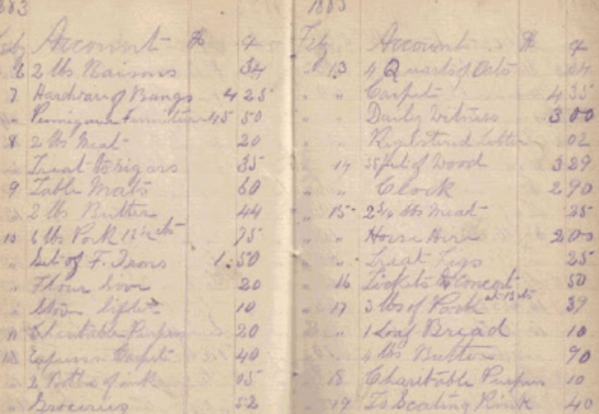
Pages from the WWI era scrapbook my Aunt Flo kept. (I threw out the cover as it was shedding).

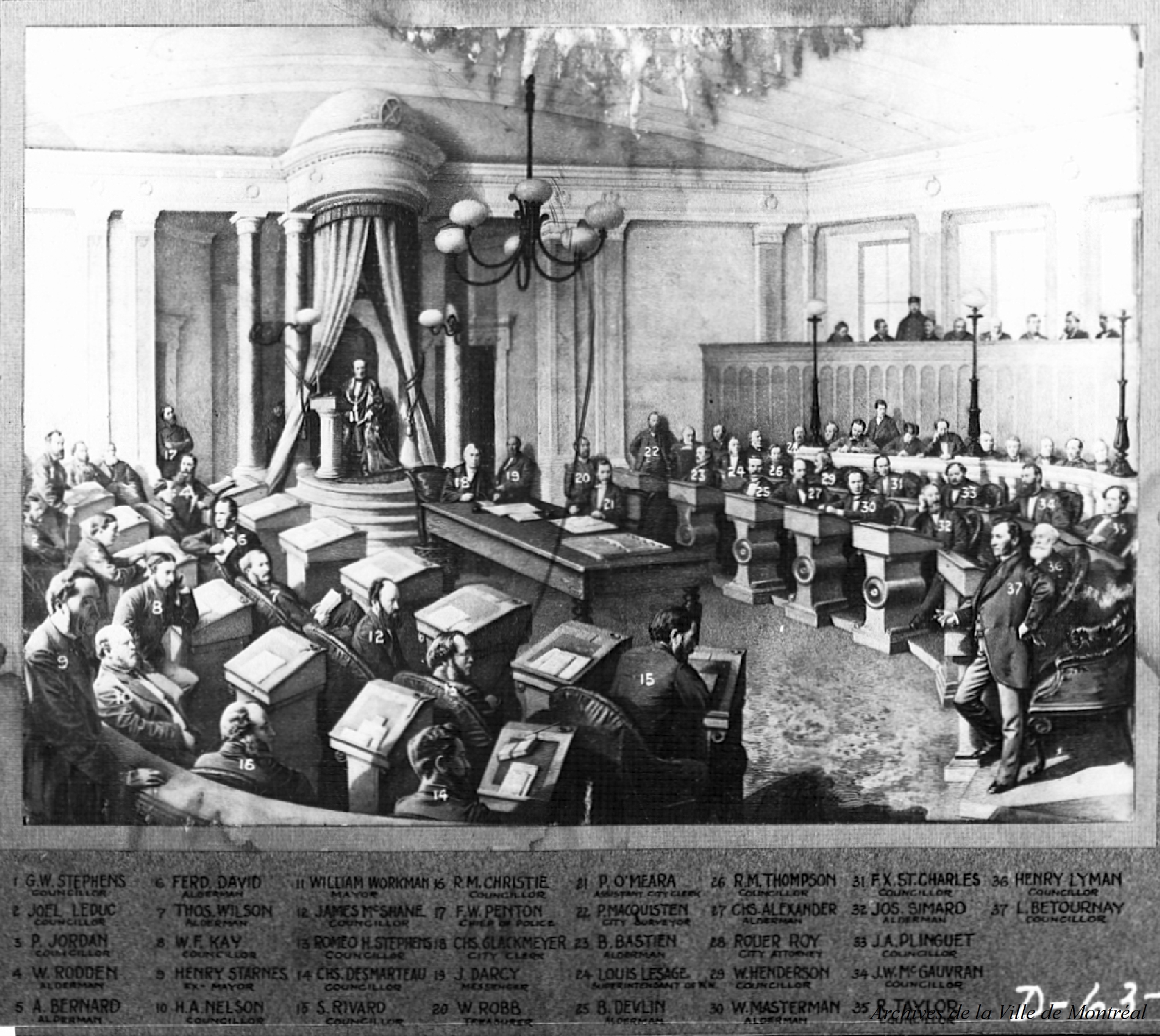
My mom liked to tell me that her father, Jules Crepeau, started work at eight years old in the 1880’s sweeping the floors at Montreal City Hall and that by the Roarin’ Twenties he had risen to be the highest paid civil servant in the city.

This family myth spoke volumes to me: my grandfather was a self-made man and a man of the very highest calibre.

By 1921, when my mother was born, Jules was Director of City Services responsible for just about everything that came down in the city, from the Prince of Wales’ official visits to damage control during typhoid epidemics to the handing out of liquor licenses in the Prohibition Era

All seven city departments were under his control, including and most significantly, the Police Department. My mother said that my grandfather occasionally brought her to work at City Hall. This must have made quite a huge impression on her.

My aunts Alice and Flo and my mom, circa 1922.

My grandfather’s City Hall file reveals that he started out young as an intern in the city Health Department in 1888 and by 1901 he had worked his way up to the position of Second Assistant City Clerk, * aka the person who sees all the paperwork that passes though City Hall.

Jules had complete recall so this was a useful learning experience. In 1921, he landed that plum post of Director of City Services, a new position set up specifically to ensure an even distribution of municipal assets across the wards. Before the post was created, community groups from across the spectrum were invited to give their input on the subject.

I have since learned that Montreal’s burgeoning Greek community most probably had a hand in his promotion.1

A few years after my mom died in 2009, I took a closer look at a disintegrating family scrapbook my Aunt Flo had kept. It contained yellowed news clippings from 1928 and 1930. In 1928, my father was being applauded for his 40 years of stellar service at City Hall. In 1930, he was being forced out by new Mayor Camillien Houde.

I noticed that the dilapidated black volume had originally been a minute book for The Crethan Company, a confectionery/food distribution company run out of Clarke Street by a handful of Greek men as well as my grandfather.

1917 minutes. Crethan Company. The company distributed food, olive oil, fruits, confections. Likely supplying Greek restaurants.
oops. Someone didn’t pay their bills

The President was Harry Pulos aka Harambolous Koutsogiannapoulos, the defacto leader of the early Greek Community in Montreal.2 How interesting.

You see, by that time, I had researched my genealogy and discovered that my mom’s Uncle Isadore Crepeau had been VP of United Amusements, a movie distribution titan founded in the 1910’s by Laconian immigrant George Ganetakos. Ernest Cousins, an Anglo businessman was President..

So, I checked to see if these two men, Harry Pulos and George Ganetakos, were related: the answer is very likely.3

My mother had never mentioned her father’s Greek connections, not once, but she did talk about working in the Montreal movie biz before she was married.

In 1941, right out of Marguerite Bourgeoys secretarial school, my mom got a job at RKO Movie Distribution, a United Amusements affiliate.4 Both companies were located on Monkland Avenue in Notre Dame de Grace, near her family home at the corner of Oxford and Monkland. (LINK to story I Remember Maman)

Taking an even closer look at the Minute/Scrap Book I suddenly noticed the significance of the dates. The Crethan Company was started in 1916 and ran until (at least) 1922 when the minutes end.

Honored by council in 1928, thrown out in 1930.

Grandpapa Jules seems to have aligned himself at just the right time with these ambitious men from Laconia. They probably helped him land his prize post and, in turn, he helped them with motion picture and restaurant licenses. 5I can’t prove it, but Jules almost certainly got his brother Isadore, an insurance salesman, his gig as VP of United Amusements.

How did this get in there? A weird letter, likely my Aunt’s with spelling mistakes.
Dear Ray. How happy I was to receive your news and to hear your voice by telephone. .you can’t imagine how nice it is when a friend extends his hands when you are ‘dans la peigre.” Does she mean piege as in trap.Pegre as in underworld. If she meant Pegre, is she using a metaphor for ‘being grounded’ or does she truly mean ‘in the underworld?

In 1927 came the fatal Laurier Palace Motion Picture House Fire, where 78 children perished in a crush to the door. It was a real game changer in Quebec, and my grandfather got caught smack in the middle. He was blamed for looking the other way when citations were given to movie houses for letting in children unaccompanied by an adult.

George Ganetakos, using the name George Nicolas, immediately set up a fund for the victims. During the inquest my grandfather brought in Earnest Cousins to plead for continued Sunday showings. Isadore also spoke. Sunday showings for adults were allowed to continue.

As it happens, two years before in late 1924 during an inquest into organized crime, corrupt policemen and Montreal’s sex industry, a cop-on-the-take took the stand and accused the Greeks of “corralling” children into movie houses and warned, “one day there’s going to be a fire and no one will be able to get out.” He wasn’t even being asked about movie houses: He brought this up out of the blue. I suspect this cop was a go-between and he was sending a coded message to my grandfather.

My grandfather certainly thought so. He had that same policeman fired the very next day.

Top: 1929 annual report United Amusements. Isadore would ‘fall’ out of his 7th story office window in 1933. Bottom: movie houses owned by UA. The list of these movie palaces would grow. My Great Uncle Isadore was shown on a talkie film at the opening of the Monkland Theatre. Isadore’s glass company would make a mural to adorn the Rivoli. It’s still there today. (Mcgill digital archives.) N.L. Nathanson, an American was in Toronto, head of Famous Players. The two companies were associated.

My grandfather, in turn, was ousted in 1930 by the new Houde administration, but not before negotiating a huge life pension, likely in exchange for his silence. In 1937, during the Depression his hefty pension was rescinded by City Hall as an emergency measure – and just two weeks later my grandfather got run over by a plain clothes policeman near his home in NDG. Hmm. He spent 3 months in hospital and died the next year of complications at the age of 59.

My opinion only: Obviously my grandfather had nothing to do with the fatal fire, but his enemies may have had a hand in it.

The Laurier Palace was owned by Syrians, a group that was often conflated with Greeks back in those days.

Funny, whenever I’d ask my mom why I couldn’t go to the movies as a child she would tell me the story of ‘all the little babies who died in the Laurier Palace Fire’ and she’d pretend to rock an infant in her arms.

She didn’t know the real story.

The End

  1. L.O. David, the patrician head City Clerk, was a scholar who preferred working on his history books over the bureaucracy of City Hall. My eager-beaver grandfather got to do all the work! Montreal had universal male suffrage, but in the century earlier Montreal was an English majority city and the Mayors had to have 10,000 dollars in the bank just to run and the aldermen had to have 2,000 dollars and be fluent in speech and writing. They abolished these rules in and around 1910 as the city grew, absorbing the suburbs. The city became majority French. They also abolished the rule that an English Mayor must follow a French Mayor. Populist mayors, petit bourgeois, were now elected instead of the well-educated professionals of the Victorian Age. It must also be noted that the post of Mayor became less and less powerful, almost a figurehead in the 1920’s with the Executive Committee having all the sway. 1910 saw an immigration boom, so there were important votes to be had among these newcomers.
  1. To Build the Dream, Sophia Florakas Petsalis. 2000 explains that Koutsagiannopoulos was a pre-turn of the twentieth century arrival who had a fruit store across from where Eaton’s would be built, a highbrow location. Phillip’s Square was so ritzy, it was one of the few areas female students from Royal Victoria College up on Sherbrooke, were permitted to venture. According to the book, Pulos made sure to take care of his fellow Laconians, finding them jobs upon landing, etc. Other names on the board: Pappas, Antoniou; Economides; Crethan, Pappadakis, Karalambos and at one point a Forget.
  2. Drouin (Greek EvangelizmosChurch Montreal) reveals that in 1907 a Zarafonity from Dourali Laconia married a Koutsgiannopoulos- a marriage witnessed by Ganetakos, also from Dourali. He likely had a Zarafonitis mother. Koutsogiannopoulos also was godfather to John Zarafonity son.
  3. Lovell’s Directory reveals this fact. She lived on Monkland and Oxford with her Mom and brother and sisters. Her dad died in 1938.

Greek men (mostly from Laconia, many related),were involved in all aspects of the movie distribution industry in Montreal back in the day. Ganetakos was only the most prominent of these movie men. The Syrians who were conflated with Greeks in the newspapers might have been Pontic Greeks from Turkey.

These new Canadians often started out working in the food industry, often pushing carts through the streets, then starting up stalls and then expanding into stores, cafes and restaurants.

The story goes that Ganetakos’s uncle, Demetre Zarafonitis, started playing ‘flickers’ at his fancy uptown café, the Cosy Parlour near Phillips Square, and that George noticed these early movies were more popular than the ice cream.So he started up his own motion picture house, the Moulin Rouge in 1908.

Two decades later, George Ganetakos was working out of his palatial office on Monkland Avenue, distributing Hollywood films for Famous Players and RKO, building architectural masterpieces like the Rialto Theatre on Park Avenue, and getting lots of press in the Hollywood trade journals. (My grandfather got a fair bit of press there as well.)

It seems that George Ganetakos was as much of a self-made man than my grandfather. However, I had contact with a descendant of the Zarafonitis’ and she was told her ancestors got the bum deal.

Greeks were referred to as Syrians in the press and they faced obstacles to their success by established merchants. People complained the cart pushers yelled too much on the street. At one point, the city wanted to tax stall merchants 200 a year as they did regular stores. An alderman, one loyal to my grandfather, spoke up for them saying this would force them out of business.

  1. During the Coderre Inquiry into Police Malfeasance in 1924, a policeman on the stand said that Jules personally forced policeman to look the other way when it came to underage clients of movie houses. He also said Greeks ‘corralled’ young children into the movie houses. He brought this up out of context. No one cared about children and movie houses. In those days, across North America, Sunday showings were often an all- kid affair. (The parents got an afternoon off). And besides, the streets at that time were dangerous with horses and autos running amok with no street rules. The Inquiry was about illegal booze and, mostly, the sex trade. In Juge Coderre’s final report in 1925, published in the Gazette and other places and rehashed for a 1926 US Senate hearing into Prohibition, the testimony getting into a two page spread in the New York Times, Coderre imperiously asked, “Who is this man Jules Crepeau who tells the Chief of Police what to do?”

A strange bit from a May 20,, 1916 Motion Picture World with the guestlist for a bash in honor of a Pathe movie star in town written by a Gazette reporter. Seems to show my Grandfather J. Crepeau with Ernest Cousins of “Independent Amusement”. Is this a typo, supposed to be I for Isadore? Either way a mystery. Did my grandfather dip his toe into the movie business as well as the food business in 1916? Or did Isadore have the movie gig as early as 1916? George Nicholas at top is likely George Ganetakos. (I have to delve deeper. I believe Indepent Amusement became United Amusements.) And is the T Wells my husband’s grandfather? See all the Greek names? Sperdakos, Lerakos etc. and M. Ouimet of the legendary Ouimetoscope.

Dec, 1921.

The Man Behind the Black Cross Temperance Society

What made my ancestor think of using a black cross to mark homes of temperance?

Edouard Quertier (Cartier) launched Quebec’s first official temperance society in 1842 by placing a giant black cross on the top of the escarpment in Saint-Denis-de-Kamouraska. So began an organization that would encompass 400,000 of 900,000 Canadian Catholics eight years later.(1)

The symbol created a tradition that continues in Quebec to this day. If you ever go into a home with a bare black cross hanging in the middle of the living room wall, you’ll know you’re in the house of people who do not drink alcohol.

But what gave him the idea?

1842 Arrival in St Denis

Quertier certainly wasn’t feeling inspired when he first arrived in the tiny hamlet or between 10 and 15 families at the edge of a cliff on the Saint Lawrence’s south shore.

How did I accept this arid rock?,” he wrote. “When I arrived [in October], there was not even a piece of board on which to place a bed or a table. I had to go down the slope and rent a small house, or rather a cabin. No matter! I waited there, until my lodging was acceptable.”(2)

Still, Quertier was no youngster when he arrived in Saint-Denis-de-Kamouraska. At 43 years old, he had had four previous jobs before his priesthood and 12 years of experience serving communities.

Le révérend Édouard Quertier, 1864, Fonds J. E. Livernois Ltée, http://numerique.banq.qc.ca/patrimoine/details/52327/3114297

Previous Jobs

Both of his previous roles as parish priest were stressful.

As curate and then parish priest of Saint-Antoine in Montmagmy, he argued frequently with his patron, Father Charles Francois Painchaud.

His bishop got him out of that situation by appointing him parish priest of Sainte-Georges of Cacouna. There, a new church and presbytery were required, but building them was difficult due to arguments between residents who wanted religious leadership and those who believed in the strong separation of Church and State. Despite the conflict, Quertier was able to build a new church and presbytery within the village. He oversaw the presbytery stonemasons and carpenters and got the church walls well underway before resigning the post. His departure halted the building of the church for a time, but it resumed in 1845 and opened for worship in 1848. The belfry didn’t get added until 1892 and full consecration delayed until 1897, but that’s another story.(3)

The experience simply makes clear that Quertier knew he had to do something important quickly to make an impact on his new neighbourhood.

He decided to promote temperance as a movement.

Temperance in Quebec

The issue already had some momentum in Quebec. Popular people like Bishop Charles-August-Marie-Joseph de Forbin-Janson and Charels-Paschal-Télesphore Chiniquy had been telling stories about the evils of alcoholism in weekly masses since 1839. Community residents saw that frequent imbibing often led to fighting, lethargy, poverty, spousal abuse, theft and neighbourhood violence.

Unlike his predecessors, however, Quertier decided to formalize the movement with an official association he called “The Society of the Black Cross.” He created statutes, oaths for members and procedures for joining the society, including the requirement that each member display a plain black cross on the wall of the family living room.

For the next 15 years, Quertier’s campaign for temperance spread. So many French Canadian families displayed the black cross, it became a decor tradition. The Quebecois de Souche society includes a photo that shows the once prevalent look.(4)

Growth and Departure as Leader

In the meantime, Quertier continued building his parish. The wooden chapel that originally opened on December 24, 1841 got replaced by a stone gothic church in 1850.

Seven years after that, Quertier retired. By then, the Society of the Black Cross included believers in almost every parish in Quebec and Quertier’s own parish had grown to encompass 100 families containing “625 souls.”(5)

Temperance continued to be a key issue, not only in Quebec but across Canada. In Quebec, however, the secularism movement also had great strength in many communities. To avoid angering these groups, the Province of Canada passed the Canada Temperance Act that allowed any county or city to hold referendums to consider whether or not to forbid the sale of liquor. This would ensure that communities who wanted to stay dry could do so without forcing prohibition on the entire country.

Life after Death

Quertier spent the rest of his life in Saint-Denis-de-Kamouraska, which became Saint-Denis-de-la Bouteillerie in 2013. After his death in 1879 at 73 years old, the church entombed his body under the crypt of the church. A tombstone says in French:

Here lies lord Edouard Quertier, first parish priest of St. Denis, one of the first apostles of temperance. Died July 17, 1873, aged 73 years, 10 months, 12 days. For 15 years, he lived for you. Pray for him.”(6)

Quertier’s remains continued to draw enough visitors that the church got entirely rebuilt after a fire damaged it on March 9, 1886. Initially, they built a belfry to hold a 2027-pound bell that cost $425,000 the following spring, and new walls on those of the former church by October. Later, they’d add two more bells to the tower.

Quertiers’ campaign for temperance didn’t end when he died. Members of his Black Cross Society were among 20% of Quebec’s population that supported a federal referendum on prohibition in 1898.
The movement grew substantially during World War I.

Temperance, not Prohibition

The Quebec Government declared prohibition in 1919. Then it made several exceptions by legalizing the sale of light beer, cider, and wine in hotels, taverns, cafes, clubs and corner stores.

The prohibition law got repealed entirely to enable liquor sales through a government-run commission in 1921.

In many ways, by choosing control over strict adherence to abstinence, the government duplicated the practicality Quertier included within the original functioning of the Society of the Black Cross.
Any household that became a member of the temperance organization could get a special dispensation to serve alcohol during celebrations, such as baptisms, birthdays and weddings. If the parish priest agreed that a special occasion merited an exception, he would temporarily replace the plain black cross in a home with a white one. The white cross hung on the wall during the celebration. After the celebration ended, the priest would visit to exchange the white cross with a black one and return the home to a liquor-free location.(7)

This kind of flexibility enabled temperance to continue growing within Catholic communities in Quebec even after 1921. Some of its proponents resurrected Quertier in the form of a statue in front of his former church in 1925. The statue remains in place today.

Sources

(1) Ferland, Jean-Baptiste Antoine, in a report to the Holy See, 1850 as written in section 8, part 98 of Canada and its provinces, edited by Adam Short and Arthur G. Doughty, Glasgow, 1914, https://archive.org/stream/canadaitsprovinc11shoruoft/canadaitsprovinc11shoruoft_djvu.txt, accessed July 19, 2020.

(2) Julienne Barnard, “QUERTIER, ÉDOUARD,” in Dictionary of Canadian Biography, vol. 10, University of Toronto/Université Laval, 2003–,written in 1972, http://www.biographi.ca/en/bio/quertier_edouard_10E.html, accessed on July 18, 2020.

(3) Ouellet, Jean-Baptiste, Municipalité de Saint-Denis-De La Bouteillerie. https://munstdenis.com/municipalit%c3%a9/historique/, accessed July 18, 2020.

(4) Fédération des Québécois de souche, https://quebecoisdesouche.info/la-croix-noire-croix-de-temperance/, accessed July 18, 2020

(5) La Corporation de développement de Mont-Carmel, https://www.mont-carmel.ca/histoire/, accessed July 18, 2020.

(6) Généalogie Abitibi-Témiscamingue, https://www.genat.org/cimetieres/photo.php?idPhoto=2c0bf0249a01fd83b57322e7b7cb3362, accessed July 18, 2020.

(7) Fédération des Québécois de souche, https://quebecoisdesouche.info/la-croix-noire-croix-de-temperance/, accessed July 18, 2020.

Memories of a Bygone Era

Memories of a Bygone Era 

Every year, as the warm summer fades away and the splendour of autumn colours is upon us, my thoughts turn to a specific memory from my childhood. It is almost like clockwork and never fails.  

Mom, Claire and Paul 

circa 1944

When I was about four or five years old, my mom taught me a song that is forever etched in my memory.  

When the trees take on their beautiful fall colours,  and when gentle breezes send brightly coloured leaves of red and gold gently spiralling to the ground, forming, colourful carpets, I am reminded of a song my Mother taught me more than eighty years ago. To this day, I still sing “Come Little Leaves said the wind one day,” when driving along, enjoying the fall season and all its many vibrant colours. This brings back many fond memories of the bygone era. 

Children’s Song 

“Come, little leaves,” 
Said the wind one day, 
“Come over the meadows 
With me, and play; 
Put on your dresses 
Of red and gold; 
Summer is gone, 
And the days grow cold.” 
 
Soon as the leaves 
Heard the wind’s loud call, 
Down they came fluttering, 
One and all; 
Over the meadows 
They danced and flew, 
Singing the soft 
Little songs they knew. 
 
Dancing and flying 
The little leaves went; 
Winter had called them 
And they were content- 
Soon fast asleep 
In their earthy beds, 
The snow laid a soft mantle 
Over their heads. 

“Come Little Leaves” was written by the American poet George Cooper (1838–1927), with music by Thomas J. Crawford. “Come Little Leaves” was written by the American poet George Cooper (1838–1927), with music by Thomas J. Crawford. 

1945: A Year of Endings and Beginnings, at Home and Abroad.

As I approach my 80th birthday, I begin to think about the year I was born. What a year that was, a year of major global transitions and the historical year of my birth. I was fortunate to be born in November of that year, when most hostilities had ceased in the world and my home town.

However, the hardships in Britain and Europe were just beginning. Now, we had to think about rebuilding our shattered lands.

1945. Plymouth, Devon, England, after a Blitz Raid

I have an interest in the ‘Home Front’ events that occurred in Britain during the Second World War, rather than military stories. However, military stories cannot be ignored as 1945 was quite the momentous year in the military and home fronts. Here is a timeline of key events both at home and abroad that occurred in 1945.

January:

World War 2 is in its final phase, even though Germany is in retreat. The British military pressed onward in Germany and Burma. The Battle of the Bulge ended a major German offensive on the Western Front.

It was believed that Plymouth was being singled out for particularly ferocious attacks because it was home to Her Majesty’s Naval Base, Devonport, which was the largest Navy base in Western Europe and the Royal Navy’s repair and refuelling facility. The dockyard was staffed by women during the war, doing what was normally considered to be men’s work, as all the men were away fighting.

On the home front, Britain was impacted by V-2 rocket attacks.

Rationing, especially items like dried and canned fruit, was scarce. The Ministry of Food encouraged households to reduce waste and get creative with recipes. I still practice creating recipes and reducing waste to this day. This story is my 1950 Christmas with rations. Rationing in England lasted until I was 11.

https://genealogyensemble.com/2021/12/29/memories-of-a-1950-british-christmas/

February:

I was conceived!!

Allied bombers begin a major raid on the city of Dresden. Key events in February included the Yalta Conference between the Allied leaders, the beginning of the Battle of Iwo Jima and the final stages of the war in Europe.

The Soviets captured Budapest, Hungary, and also encircled Breslau, Germany (now the modern-day city of Wroclaw, Poland) as Allied forces pushed toward the Rhine in the west.

March:

The 10th British and Allied forces successfully crossed the Rhine, the first time a foreign army had crossed the Rhine since the Napoleonic era.

British forces pushed deeper into Germany with only scattered resistance.

On the 27th and 29th, the final V1 flying bomb fell on Britain.

Remarkable photo of a German V1 fully autonomous early cruise missile hitting the London area in 1945.

April:

1st The Battle of Okinawa continued for 82 days, resulting in heavy casualties for both American and Japanese forces. Japan launched ‘Kamikaze’ attacks against Allied naval forces.

Dr Fritz Klein, an SS doctor, among some of his victims, Belsen, 24 April 1945

Numerous Nazi concentration camps are liberated, revealing the full extent of the Holocaust to the world.

4th Ohrdruf concentration camp, liberated by U.S. Forces.

11th American troops discovered the Buchenwald concentration camp

15th Liberation of the Bergen-Belsen concentration camp, by the British, who found thousands of ill prisoners and corpses.

29th Dachau camp was liberated by U.S. Forces.

Also on the 29th, Adolf Hitler married Eva Braun in the underground bunker.

30th Adolf Hitler commits suicide, shooting himself at the age of 56 years old, whilst Eva Braun takes a poison pill.

German forces, the last fighting force on the Western Front, surrendered en masse.

May:

7th Germany signs an unconditional surrender,

8th VE Day – victory in Europe – Day

On May 7, 1945, Gen. Alfred Jodl signed the surrender of all German forces in Rheims, France. He is flanked by Wilhelm Oxenius (left) of the Luftwaffe and Hans-Georg von Friedeburg, representing Germany’s navy. | AP Photo

23rd Heinrich Himmler commits suicide while in British custody in Lüneburg, Germany.

June:

15th Wartime blackouts ended, and streetlights were turned back on.

The wartime coalition government, led by Prime Minister Winston Churchill, was dissolved, and a general election was held shortly after.

July:

The general election was scheduled to take place on the 5th of July, 1945, the first general election since 1935. However, the results were not announced until the 26th of July, 1945, to allow time for overseas military personnel’s votes to be counted. The Labour Party, led by Clement Attlee, won a landslide victory in the July 1945 election.

August:

The Family Allowances Act was passed to provide financial support to mothers.

15th was Victory over Japan – VJ – day. Celebrating Japan’s surrender after the atomic bombings of Hiroshima and Nagasaki, and the official end to over six years of global warfare

2nd Japan formally surrenders. Now, our country was focused on the return of troops, the beginning of domestic reconstruction and the promises of independence for its colonies.

September:

15th Parades were held in Britain to mark the fifth anniversary of the Royal Air Force’s victory..

16th Hong Kong was reclaimed, ending the four-year Japanese occupation.

The 17th Belsen Trial began for war crimes in Lüneburg, Germany, presided over by a British military court.

18th The Independence of India would be granted “at the earliest possible date”, was announced by Prime Minister Clement Attlee on a worldwide broadcast.

October:

Britain was now fully engaged in the complex aftermath of the Second World War, with the new Labour government pursuing major domestic reforms and the British Army dealing with global instability and the return of war prisoners.

4th An unofficial dock strike began in Britain.

7th The ocean liner SS Corfu docked at Southampton, carrying the first 1,500 prisoners of war to return from Japanese camps in the Far East. Also on the 7th, Rudolf Hess was transferred from Britain to Nuremberg, Germany, to face trial.

The 20th and the 5th Pan-African Congress were held in Manchester, where delegates from across Africa and the diaspora discussed and called for independence from colonial rule, a significant moment in the history of decolonisation.

This month was a period of substantial change as the nation grappled with domestic reconstruction, a new political direction and the challenges of managing a post-war empire and a new global order.

At the end of October, in Palestine, the Jewish Resistance Movement launched the ‘Night of Trains’, a coordinated attack on the British railway network, marking a rise in armed opposition to British authority.

November:

On the 20th, I was born at the Alexandra Maternity Home, below.

At the time, there was no National Health Service (NHS), so no free medical care. I must have been an expensive baby!

The Alex, as it was often called, admitted maternity patients for a period of not less than a fortnight. Fees were charged from 15 shillings (75P) to 42 shillings (£2.20P) per week.. These fees included nursing, food, laundry and all clothing and if necessary, the doctor’s fees. I have no idea of my weight, size or time of birth. Such things were not, unfortunately, recorded.

December:

The government announced its plan for a National Health Service (NHS) to provide free medical care.

1st British military police in occupied Germany arrested 76 Nazi industrialists.

9th, the United States granted Britain a low-interest reconstruction loan of approximately $4.4 billion (US). An additional Canadian loan was for $1.9 billion, scheduled to run for 50 years.

The final payments made in 2006, which settled the debt entirely, were for $83.25 million to the US and $22.7 million to Canada.

Throughout the rest of the year, Allied forces continued to liberate numerous concentration camps, exposing the extent of Nazi atrocities.

In 1945, post-war, Plymouth faced immense devastation from the Blitz, which had destroyed the city’s heart and left thousands homeless. Plymouth was one of the most heavily bombed British cities, due to its status as a major naval port with the large HMNB Devonport dockyard.

The city centre, two main shopping areas, almost all civic buildings, 26 schools, 41 churches, and 3,754 houses were destroyed, with a further 18,000 properties seriously damaged. Around 30,000 people were left homeless, leading to a critical shortage of accommodation. Temporary prefabricated houses were quickly erected to provide immediate shelter. I remember seeing the ‘pre-fabs’ still in use in the 1960s.

The most urgent efforts were to house the population, clear the bombed buildings – which, still, years later, were my playgrounds – and begin an ambitious pre-planned reconstruction project. All the while I was growing up, this building and planning went on. When I left Plymouth at 18, the rebuilding continued until the early 1970s.

Sources:

https://en.wikipedia.org/wiki/Battle_of_the_Bulge

https://www.thedevonseoco.co.uk/plymouth-in-the-blitz/ https://encyclopedia.ushmm.org/content/en/article/liberation-of-nazi-camps

https://www.facebook.com/photo/?fbid=779249228206828&set=gm.1467370817653042&idorvanity=1074810956909032

https://collection.nam.ac.uk/detail.php?acc=1985-11-36-334

Facebook Page: ‘Old Plymouth Society’ Post by Gloria Dixon 7 July 2021

https://www.iwm.org.uk/collections/item/object/205021954

https://www.historic-newspapers.com/en-ca/blogs/timelines/a-year-in-history-1945-timeline?country=CA

Dear Uncle Bill

Dear Uncle Bill,

While rummaging through the Dusty Old Boxes containing family memorabilia, I came upon letters written by you to your only brother, my father, Tom.  There were also letters written to your sweetheart during WWII while you were stationed in England serving with the RCAF. So I thought the best way to remember you would be in the form of a letter.

Please allow me to introduce myself. My name is Lucy and I am one of your nieces.

Our paths never crossed.  I was only born in 1957 and you died in 1943. Your brother had seven children.  I was his fourth.  His eldest son, born in 1949, was named after you – William Sherron Anglin II.

While staying with my family in England in 2016, I visited you in person at your last known address:  Runnymede Memorial[1], Panel 179, Surrey, UK.  My grandchildren, who always enjoy a challenge, accompanied me in my search to find you. It didn’t take them long to find your panel and you – or your name, that is – inscribed on one of several stone walls, along with 20,000 other airmen,  at this dedicated memorial building on Cooper’s Hill overlooking the Thames River.

Your name was too high up for the children to touch but I brushed my fingers lovingly over your name and told you we were there. I am quite sure you knew it. You had an interest in mental telepathy, as did your grandfather, and his story was documented in the family boxes as well.  (Surgeon and Mentalist)

Throughout your letters to Tom, along with childhood memories, you shared and referred to an interest in The Rosicrucian Order which “is a community of mystics who study and practice the metaphysical laws governing the universe”.[2]

You maintained the belief in an ability to “project” yourself and to send mental messages. I can only guess that a feeling of closeness to your brother by any means must have consoled you greatly while away at war in England.

In your letters to your sweetheart, you described England in general (with the usual complaints about the rainy weather), your life with the RCAF, weekend leaves to Scotland and dances in the mess hall “wishing you were there”.  Although I don’t have her letters in response, I am sure you took great comfort in hearing from her.

You were sent on a training course at the end of May 1943 and, while away, your crew went on a mission without you – never to return. In the last letter to your girl, you confided that you were feeling “depressed” at their loss.  On the very next mission, you went missing as well.

Last picture of Uncle William
Last picture of Uncle Bill (far left) – 1943

Not long afterwards, your sweetheart sent a bundle of your cherished letters, wrapped in a bow, to your mother and wrote “I know I want to forget as soon as I am able, everything – and so I am sending you the few letters I had saved from those Bill sent me from England.  I hope that you would rather have them, than not … perhaps they will make you glad to have something more – to know something else of Bill’s life in England … rather than rake up memories you are trying to forget. For while I want to forget, I feel so sure that you will want to remember.”

Your mother never gave up hope that you would return one day.

Wendling & Josephine Anglin and sons Bill and Tom (1940)

Bill, Wendling  (the stock broker), Josephine, Tom and family dog (1940).

The abundant number of photos found with the letters in these boxes show your 27 years filled with family times – gatherings, annual trips, formal portraits, a few pets and a full life.

You will not be forgotten.

Lovingly,

Your niece Lucy

Note:

http://www.aircrewremembered.com/richmond-bruce.html

William Sherron Anglin was an Air/Gunner and Warrants Officer II with the 429 Squadron flying in a Wellington X bomber, Serial no. HZ471.

Reason for Loss:

Took off from R.A.F. East Moor, North Yorkshire at 22.36 hrs joining 719 aircraft attacking the town of Wuppertal, the home of the Goldchmitt firm which produced Tego-Film, a wood adhesive used in the production of the HE162 and TA154 (aircraft).  Around 1000 acres was destroyed in the firestorm that followed – 211 industrial buildings and nearly 4,000 houses were totally destroyed. A figure of 3,400 fatalities on the ground has been recorded. Bomber command did not escape lightly on this operation losing some 36 aircraft.

It is thought “probable” that HZ471 was shot down by Lt. Rolf Bussmann, flying out of Venlo airfield, and attacking this Wellington at 3,700 meters with the aircraft falling into the sea off Vlissingen.

429 Squadron possible loss area

[1] https://wiki2.org/en/Runnymede as at November 19, 2017

[2] https://www.rosicrucian.org/ as at November 19, 2017.

Discovering Family Connections Through Obituaries

Somerled School Kindergarten class 1957/1958

I recently discovered that I am related to my kindergarten teacher’s husband! There are certainly tangled webs of relationships all through our family histories. Following direct ancestor lines often leads you to people you might know about. Exploring other branches of siblings, aunts, and uncles can uncover connections you never knew you had. This is how this one was untangled.

The online death notice for Shirley Harris (1927-2025) in the Montreal Gazette caught my eye. Her name sounded familiar so I started reading her obituary. It mentioned she was 98, had a brother, John and sister, Ann. These names didn’t ring a bell, so I closed it just as my eyes caught the name Paul von Colditz. I remembered that there was a connection with a Shirley von Colditz and our family.

Ida Bruneau, one of my mother’s cousins, wrote a family history, “The Short History of the Bruneaus and Girods”. In it, Ida mentions Shirley von Colditz as a very dear friend of hers. They discovered they were distant cousins. Shirley descended from Medard Bruneau (1811-1892) and Ida and I from his brother Barnabé. They were the sons of Antoine Bruneau (1773-1847) and Marie Robidoux (1775-1847). This meant that Shirley and Ida were third cousins once removed.

My husband and I used to be members of the Montreal Badminton Squash Club. An Eric von Colditz also played badminton there. Years ago, I read Ida’s book. After that, I asked Eric if he thought we were very distant cousins. He said no. Shirley was his stepmother.

I carefully reread the obituary. “Shirley was the devoted wife of the late Paul von Colditz and the loving sister of the late John Harris ( the late Patricia Reynolds).” Patricia Harris was the name of my kindergarten teacher. I knew her maiden name was Reynolds, as my mother knew her sister Moyra Reynolds. Pat’s obituary confirmed she had sisters-in-laws Shirley and Ann. So I was related to her husband John.

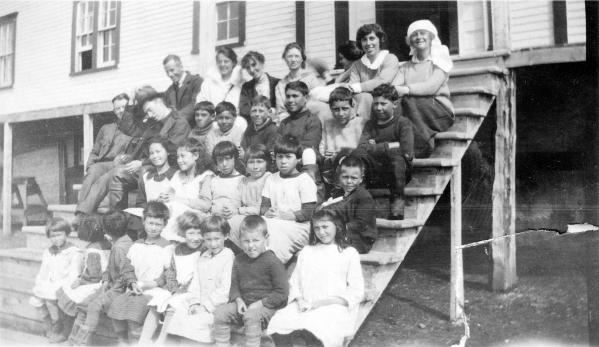
Mrs. Harris and Miss Gael were my two kindergarten teachers at Somerled School in Notre Dame de Grace, Montreal. I started there in the fall of 1957. This school just opened in January 1957. I was in the first class to go through all the grades at Somerled School. I enjoyed kindergarten and remembered my teachers fondly.

John and Pat Harris had two children, Kathy and John. At one time, their son John lived on Percival Ave. in Montreal West, where I also lived. During a street-wide garage sale, my husband returned from down the street. He said, “One of your teachers is selling tea cups in front of a house.” I went and had a chat with Mrs Harris. Her son was someone I recognized but never talked to. He had a wife, three daughters and a dog. I figure John and I are fourth cousins once removed. Unfortunately, he no longer lives on Percival. I can’t tell him of our connection. Not even six degrees of separation.

Notes:

A Short History of the Bruneau Girod Families by Ida Bruneau. Ste. Agathe des Monts, Quebec, May 1993. Page 8. A copy in the hands of the author.

https://montrealgazette.remembering.ca/obituary/shirley-harris-1092955467

https://montrealgazette.remembering.ca/obituary/patricia-harris-1065848692

Shirley Harris was the daughter of Irene Bruneau (1901-1987) and Herbert Harris. 

Irene was the daughter of Eugene Albert Bruneau (1875-1939) and Eliza W. Thompson

Albert was the son of Ophir Bruneau (1848-1920) and Hermaline Piche (1949-1901)

Ophir was the son of Medard Bruneau (1811-1892) and Marie S. Megrette (1822-1853)

Medard was the son of Antoine Bruneau (1773-1847) and Marie J. Robidoux 1775-1847)

Barnabé and Medard were brothers:

Barnabé was the son of Antoine Bruneau (1773-1847) and Marie J. Robidoux 1775-1847).

Ismael was the son of Barnabe (1807-1880) and Sophie Marie Louise Prud’homme (1812-1892).

Sydney was the son of Ismael Bruneau (1852-1918) and Ida Girod ( 1862-1927).

Sydney was my grandmother Beatrice’s brother

Ida Bruneau was the daughter of Sydney Bruneau ( 1893-1979) and Ruth Dawson ( 1894-1971).

This makes Ida and Shirley 3rd cousins once removed!

Moyra Reynolds was on the women’s executive at the Catherine Booth Hospital. She worked alongside my mother, who was also a cousin of John Harris. Moyra and her friend Eileen glued my mother’s little tatted flowers onto hasty notes. These cards were sold for the benefit of the Catherine Booth Hospital. Moyra was living in the Montclair Residence when my mother moved in. They lived on the same floor. Moyra was excited that my mother was coming and hoped to make more hasty notes. Unfortunately, she soon suffered a stroke and was in hospital for a while. She came back to the Montclair. However, her needs were too great for them to handle and she moved to another residence.

One time when I was visiting my mother, a young woman was clearing out Moyra’s room. I thought afterwards that she might have been Moyra’s niece and my kindergarten teacher’s daughter. I am sorry I didn’t speak to her.

There was a family connection with Somerled School and another connection to Percival Avenue. Percival Ave is a street of just three blocks in the town of Montreal West. Ida’s sister Mary Bruneau and her husband George Davidson once lived on Percival. Their home was just across the street from where John Harris later lived. Ed Hawkes married my mother’s cousin Ephese Jousse, also related to John Harris. His parents lived a block south on Percival. I live on Percival now!

Greek Tragedy

Syrian girl with her wares. (National Geographic, November, 1925. Article cited below. This magazine is in the public domain according to Library of Congress. Gervaise Courtellemont. Lumiere company.


Prologue: In my last post I explained how I recently learned, through DNA, that my biological father was likely Pontic Greek on the father’s side. Pontic Greeks are Orthodox Christian Turks who believed they are descended from ancient Greeks, who once lived on the southern coast of the Black Sea in cites like Samsun and Trabzon and who speak either a unique form of Greek or Turkish. In that post, I also wrote about the 1923 population exchange between Greece and Turkey. Here, I elaborate.

In 2010, I visited my older brother who lives in Denmark at his holiday home in Plomari, Lesbos, Greece. The large island of Lesbos is off the northwest coast of Turkey. On a good day you can see Turkey from the capital city of Mytilini. It’s only 17 miles away.

Back in 2010, before I explored my DNA, I naturally assumed I was half French Canadian and half Yorkshire British, just like my older brother, but I also knew, deep down in my heart of hearts, that I resembled the Greek locals, both in looks and in temperament.

Plomari village from the back window of my brother’s place.
The harbour is two streets down.

Today, I understand that I am very likely related to some of those local Greek citizens on Lesbos, perhaps even closely related. I know this because of a photograph I recently discovered in an article from the November, 1925 National Geographic magazine.

Greek refugees arriving in Mytilini. 1923

There is no shortage of online information on the 1923 Greek/Turk ‘population exchange’ that came on the heels of a horrific event referred to back then as ‘The Smyrna Holocaust,’ but I had high hopes that this story entitled History’s Greatest Trek. Tragedy stalks through the near east as Greece and Turkey exchange 2,000,000 of their people, written in real time by a world class journalist in a world class magazine, would shed some light on the path my Pontic bio-father (or grandfather) may have taken to reach Montreal, Canada in 1954.

I have tree matches in Samsun, a port on the Black Sea in northern Turkey. My mother, who lived and worked in the Notre Dame de Grace area of the city, likely knew Greek men whose grandparents fled Smyrna (now Izmir) in 1922, on the west coast of Anatolia on the Mediterranean Sea. Could I connect the two places?

I was not disappointed. Right at the beginning of the sixty page article there’s a picture of a young Greek man from Samsun. The caption reads: A Refugee from Samsun. He took part in the first trek of 100,000 refugees from the Anatolian interior.

According to online sources, post WWI, most elite Greeks in Samsun were killed off and all other able-bodied men sent into the interior to join the Turkish army.

Clearly, some of these Pontic Greek men and women escaped the Turkish hinterland to make it to the Mediterranean coast and Smyrna in 1922, in the hope of catching a ride to safety.

This 60 page article from 1925 is a classic piece of National Geographic reporting. It is workman-like in its execution with a prose style on the flowery side. The article offers readers a succinct historical and political perspective on the infamous 1923 population exchange between Greece and Turkey. The reporting is objective: The Muslim story is discussed with as much respect as the Christian story. And, of course, the article contains many, many photographs, about one hundred of them. Oddly, the prettiest colour ones all depict quiet Turkish life.

There’s a fascination here with exotic dress, from what I can see.


Still, the author, Melville Chater, pulls no punches as he uses his gift with words to capture the true horror of the situation in the port of Smyrna during the late summer of 1922: the hope, despair, death and disease and, eventually, the chaos, the total breakdown of civilized life.

Chater and his companion were in that coastal city when the Greek military lines collapsed in August, 1922, effectively ending the three year old Greco-Turkish war. They were in Smyrna in September to witness the Greek soldiers flee home on their military barques, leaving only ‘neutral’ observer boats in the habour.

Immediately thereafter, they saw the victorious Turkish cavalry enter the city, the riders’ left palms outstretched in a peace gesture, and a few days hence they witnessed the great fire of Smyrna that forced local citizens to flee in chaos to the quay and mix with the tens of thousands of refugees from further afield amassed there. By this time “the city had become a gigantic blast furnace… Affrighted faces mingled with wild-eyed animals, and human cries with the neigh of horses, the scream of camels, and, last, the squeaking of rats, as they scuttled by in droves from the underworld of a lost Smyrna.”

The beginning, late August, 1922.

“Refugees from anywhere within 150 miles inland herded seaward into Smyrna. At first they came in orderly trainloads or in carts, with rug-wrapped bedding, some little household equipment, and perhaps even a few animals, But as the distant military momentum speeded up, the influx became a wild rabble of ten, then twenty, then thirty thousand a day. Their increasingly scanty possessions betokened a mad and yet madder stampede from the scene of sword and fire, until September 7 saw utterly destitute multitudes staggering in, the women wailing over the first blows of family tragedy, whereby mothers with no food for their babies had been forced to abandon their older children in wayside villages….

….By now Smyrna’s broad quay swarmed with perhaps 150,000 exiles who camped and slept there, daily stretching their rugs as makeshift shelters against the sun, whose furnace-like heat was the mere forerunner to a terrible epic of fire.”

The Greek Army flees,the Turkish cavalry arrives.

On September 23rd, a fire breaks out in the Armenian quarter. The Turks give permission for women and children and old men to leave. People are dispatched to Athens to organize a flotilla of rescue boats. The Turks then give the rescuers one week to evacuate the refugees or they will be forced into the interior. Further chaos ensues.

“Uncounted hundreds were crushed to death or pushed over the quayside to drown, on that first day, when eight ships, convoyed by American destroyers left with 43,000 souls aboard. For those left behind there remained but six more chances—a chance a day—then the black despair of deportation into the interior.

These men were not allowed to leave Smyrna after the fire with their families. “Everyone from peasants to bankers” is how these Anatolian Greek refugees are described in the article. Also as “human derelicts” and descendants of ‘those adventurous spirits who had followed Alexander the Great into Asia.” Some men apparently escaped at Smyrna, swimming to rescue boats under the cover of night. Some wealthier men bought their way onto boats. 300,000 thousand people were evacuated in two weeks, including 100, 000 ‘cellar-hiders’ in Smyrna, uncovered by the Turks in a house-to-house search.

The aftermath:

A notification is posted permitting (well, forcing) all non-Muslims to leave Asia Minor before November, 30, 1922. Hoardes of Anatolian Greeks, former prisoners of war, men, women and children, head to the Black Sea coast.

“With ship-deserted quays, as at Smyrna, and with the Black Sea ports glutted with sidewalk-sleeping, disease breeding paupers, who had been thrifty cottagers a few weeks before, the gap was finally bridged by the arrival of Greek ships flying the Stars and Stripes and convoyed by American destroyers….

….”By January, 1923, Athens had slammed its official doors protesting against further expulsions.”

With a big nudge from the US, Britain and the League of Nations, Athens agreed to accept hundreds of thousands more Christian Greek refugees in an exchange for Muslims living in Greece.

The exchange would begin in May, 1923 and be carried out in various ways. Most Greek refugees are funnelled to the Athens region as well as to Thessonaliki in the northern part of Greece and to some Aegean Islands like Lesbos.

They live in refugee camps rife with disease and death. There is little usable land left in Greece due to past wars.

Greece, then a country of 6 million souls, would take in almost a million and a quarter refugees within a year of the Smyrna disaster, increasing its population by 25 percent.

“There is no adequate parallel whereby to convey even remotely a picture of Greece’s plight in 1923,” Chater summarizes.

Pretty heavy stuff – and yet the 1925 magazine article somehow manages to maintain the feel of a breezy travelogue.

Greek refugee camp Macedonia

Epilogue:

In the style of Virginia Woolf’s 1925 masterpiece Mrs. Dalloway, I imagine a comfortably middle class lady, back in the mid 1920’s, perhaps my husband’s grandmother in her favourite club chair in her cottage in Westmount, flipping through this very issue of the National Geographic, cup of tea in one hand. The inky new pages crackle as she turns them with her free hand. “How awful,” she whispers under her breath when she gets to the bit about the Greek women holding their still-born babies at their breasts because they had no place to bury them. And, then, “How pretty,” as she eyes the flowing costumes on the Turkish women, the colourful mosques and the charming minurats. And, then, as she comes to the full-page advertisement for Campbell’s Soup at the end of the article, she perhaps thinks, “Yes, tomato soup for the children, for tomorrow’s lunch.”

Here’s the archive.org link.

https://archive.org/details/nationalgeographic19251101/page/550/mode/2up?q=mosques

Getting the Names Right

In the last mad dash to send Beads in the Necklace to print, we had to make sure that the names in the stories were right. Genealogists struggle with the difficulties of names every day.

There was the question of those pesky hyphens. In French Canada, hyphenated names are common. But not every double name takes a hyphen. Then what about apostrophes that were simply dropped?

And accents. Some French names had accents and others not. There seemed to be no rhyme or reason.

Some of the people in our stories had unusual names. Hermonie? Maybe it was Harmonie? Or even Hermionie? It was Herminie. And is it Catherine or Catharine? Or Isabelle or Isabella?

And how many ways can you spell Jodouin? Each source document seemed to have a different spelling.

And then what about place names. Do we use the French place name or the anglicized place name? With or without accents?

All these variations in the names made me think of my husband’s surname. I asked him, “Why do some people in your family spell their name Delatolas as Dellatolas, with two letter ls?

He shrugged, “I dropped an “l” when I emigrated to Canada.”

“Besides, my father and my brother had already dropped an “l”. Anyway, who cares?”

“Well,” I muttered, “Genealogists care.”

French-Canadian Leadership in WWI

Most history books define the Battle of the Somme as a disaster, but French Canadians can claim it as their first military success.

It also represented the integration of a new kind of leadership in European battle tactics, one in which every soldier counted.

Both of those realities are due to the contribution of the 22nd Regiment, known colloquially as the Van Doos based on its French name “vingt-deux.” Today the unit holds an official French name, the Royal 22e Régiment, an important symbol of its identity and importance.

“It’s arguable that the tactics that the Van Doos taught the Canadians won the war,” said author and historian Desmond Morton, who had authored forty-seven books about Canada by the time he died in September 2019. “It was formed and was trained in a way that was uniquely French-Canadian. The Colonel of the Regiment was an ex-cadet of the Royal Military College…Tremblay had a different philosophy of leadership and he showed it.”

One of the most recognized leaders was Lieutenant Colonel Thomas-Louis Tremblay, who led the Van Doos during their WWI triumphs and left behind his French-language diaries to inspire followers.

Tremblay was the first to use tanks to get over and past enemy dug-outs during an artillery barrage. The tactic relied on every soldier being willing to move through active artillery and kill defenders individually in hand-to-hand combat. The brutal but effective operation enabled his unit to capture the village of Flers-Courcelette from the Germans on September 15, 1916. They held the position for two days.

The 22nd Batallion’s effectiveness in Courcelette persuaded General Sir Arthur William Currie, who was in charge of the Canadian Army, to change his thinking about Vimy Ridge. Tunnels, barbed wire and three rows of trenches protected the strategic site to such an extent that tit was considered largely impregnable by the British and French. The French-Canadian success at Courcelette made them think that maybe someone could capture the strategic site.

The following spring, the Van Doos and three other Canadian divisions moved toward the 14-km-long escarpment at 5:30 a.m. on Monday, April 9, 1917. It took four days, 3,598 deaths and 7,000 wounded men to capture the ridge.

Success was due primarily to training that ensured that every soldier knew what to do and did it, even as commanding officers died.

The Vimy capture may have relied on the Van Doo success at Courcelette, but the Van Doos themselves would never have existed without a private donation by prominent Montreal entrepreneur and philanthropist Arthur Mignault. In 1914, the head of the Franco-American Chemical Company donated $50,000 to create a regiment “composed of and officered by French Canadians.” His offer resulted in the creation of the 22nd Battalion (French Canadian) CEF on October 14, 1914. Mignault and then Opposition leader Sir Wilfred Laurier spent the next month recruiting a full contingent of more than 20,000 men who formed the bulk of Tremblay’s men.

Migneault, who made his fortune selling iron pills to women with anemia, had already enlisted with the 65th Regiment “Carabiniers Mont-Royal” five years earlier. After his 22nd Division success, he went on to subsidize the founding of two additional French-Canadian divisions, but they got folded into the 22e to replace casualties.

Migneault had hoped to be appointed to lead a battalion. Realizing that subsidizing infantry divisions wouldn’t make that happen, he decided to fund military hospitals. Just as the Van Doos were heading to war in early 1915, Mignault succeeded in encouraging the Canadian government to build a French Canadian stationary hospital near the German frontlines in Saint-Cloud. By November 1915, Mignault was on his way to France along with 100 men to set up the hospital.

Laval University followed suit with a second French Canadian Hospital, and both became so important, the French renamed part of Joinville-le-Pont near Paris the “quartier des Canadiens.”

Mignault not only realized his ambition to become a colonel, but a month before his death in 1937, the Royal Canadian Army Medical Corps promoted him to the honorary rank of Brigadier General. He was the first French Canadian to hold that rank.

Members of the Royal 22e Régiment fought in Italy and in the Pacific during World War II, in Korea, in the Gulf War, and in Afghanistan. They were also the first Regular Force regiment to mount the King’s Guard in London in 1940, and repeated the experience again for their hundredth anniversary in 2014. They also served during the Oka Crisis in 1990.

Today, the regiment forms the largest unit in the Canadian Army, with three Regular Force battalions, two Primary Reserve battalions, and a band. Its ceremonial home is La Citadelle in Quebec City, although members are stationed at Valcartier and other bases throughout Quebec.