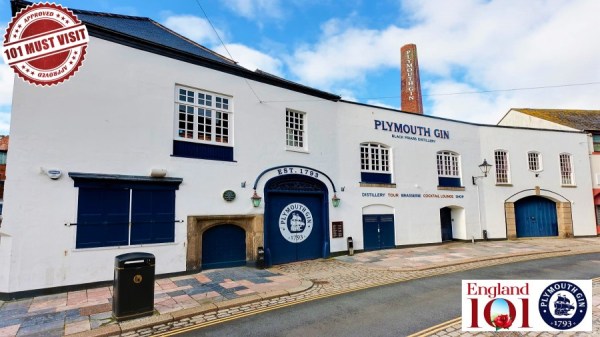
…or, to be historically correct “The Black Friars Plymouth Gin Distillery” however, we locals just call it Plymouth Gin. I was born in historical Plymouth at the end of WW2 and among our history lessons was, of course, the history of England and Plymouth in particular. (1)
Plymouth’s history goes back to very early times. In 1866 several caves were discovered in the Plymouth area, containing the bones of animals that no longer live on these Islands. along with the human remains were the bones of a lion, hyena, cave bear and rhinoceros, which show man lived in this district as far back as the early stone age. Saxons settled in the area and by 926 AD ruled the whole of Devon.
Plymouth was attacked, raided and ruled, by others many more times…but that is another story, this story is about the Plymouth Gin Distillery, the oldest working gin distillery in England.
In the 13th century, friars arrived in Plymouth. Friars were like monks but instead of withdrawing from the world, they went out to preach and help the poor. There were also Carmelites in Plymouth, known as White Friars and Franciscans or Grey Friars. During the middle ages, because the Dominicans wore a black ‘cappa’ or cloak over their white habits they became known as the ‘Black Friars’
The Friar is still used somewhere on every bottle of Plymouth Gin today
The Plymouth Gin distillery building dates back to the early 1400s and was formally a monastery inhabited by the Black Friars. The most intact part of the distillery is the Refectory Room a medieval hall with a hull-shaped timber roof built in 1431 and is one of the oldest buildings in Plymouth.
In 1536 the time of the dissolution of the monasteries, the former home of the Black Friars was put to a variety of other uses including the first non-conformist meeting place, a debtors’ prison, a meeting hall and a centre for Huguenot refugees who fled France and came to Plymouth.
In 1620 It has been suggested that the Pilgrim Fathers spent their last night in England in the distillery and they made the short walk down to the harbour to set sail to America on the Mayflower, where they founded a new Plymouth.
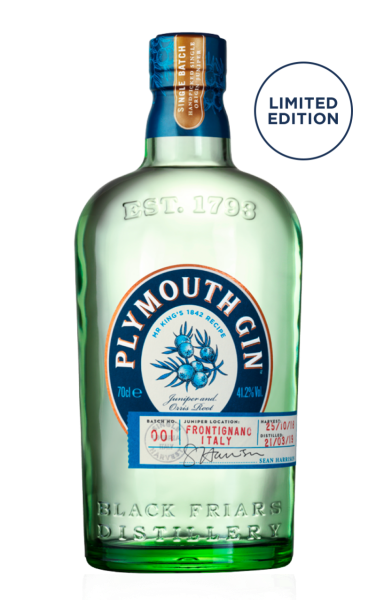
Plymouth Gin Bottle
The original distilling business was owned by Fox and Williamson and in 1793 when a certain Mr Coates joined the establishment, Plymouth Gin started being distilled and soon the business became known as Coates & Co,. until March of 2008, when the French Pernod Ricard took over the company.
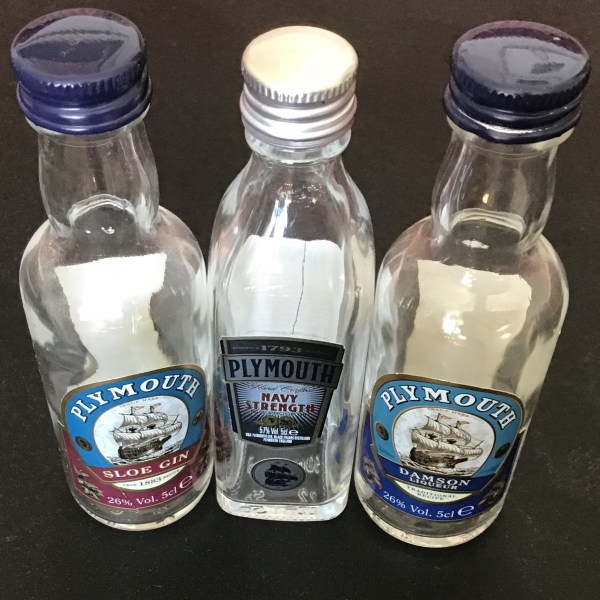
My three miniature souvenir bottles from my last visit to Plymouth – Empty!
Some of the many fascinating botanicals that make up the unique taste of Plymouth Gin are Juniper berries, Coriander seeds, orange and lemon peels, angelica root, green cardamom, and orris root. Its gin is also ‘Appellation Controlee’ meaning it can not be made anywhere, except Plymouth, Devon, England.
Made with single-origin juniper, picked on a single day, from a single mountain location in Frontignano, Italy, only one batch will ever be made.
One of the oldest continuous buyers of Plymouth Gin is the Royal Navy. Almost all Navy Gin is linked to Plymouth thus Plymouth and the Royal Navy have a long history. The Royal Navy’s ‘rum ration’ or ‘tot’ was usually rum for the ratings but the officers drank Gin.
Spot the Friar
This was a huge business for British distillers. By 1850 the Royal Navy was said to be buying over 1,000 barrels of Plymouth Gin a year, and during the Napoleonic Wars, Vice Admiral Horatio Lord Nelson ordered barrels of Plymouth Gin for his officers. However, on the 31 st July 1970, that tradition ended. Modern Naval ships carry sophisticated weaponry where a push of the wrong button or an unsteady hand could result in WW3, so it was decided to end the daily Rum ‘tot’ that the ratings had been drinking for over 300 years!
On that day, sailors, drinking their last free ration of rum, wore black arm bands, drank their tot and threw the glasses into the sea. I have no idea what the officers did with their Gin! (2)
The Mayflower ship forms Plymouth Gin’s trademark label today. Black Friars is indisputably the oldest working gin distillery with records of a ‘mault-house’ on the premises going back to 1697. Today, Plymouth Gin is known worldwide. Just the other day, to my surprise, I heard VPR – Vermont Public Broadcasting Service – advertise Plymouth Gin on its station.
At the moment, no doubt due to the Covid delays, it is hard to find Plymouth Gin in Montréal, as the SAQ (Société des alcools du Québec or Quebec Liquor Corporation) where I usually buy it, is sold out!
Today, Black Friars offers a range of tours, ranging in price from a 40-minute, £7 inspection through to an in-depth, 2.5-hour “Master Distiller’s” outing (£40) where visitors get to create (and take away) their own bespoke gin. The distillery complex also has its own cocktail bar and brasserie. (3)
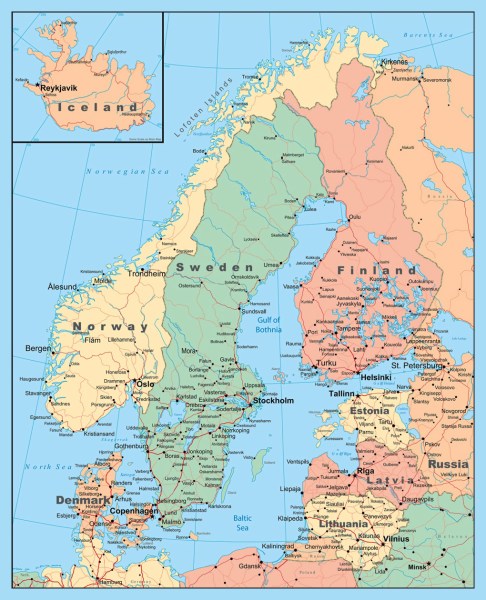
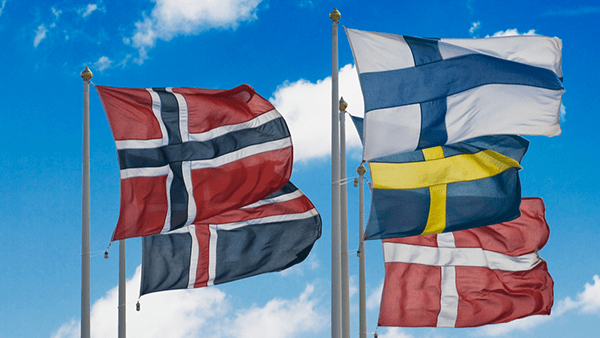
Norway – Sweden – Finland – Denmark – Iceland – Estonia – Latvia & Lithuania
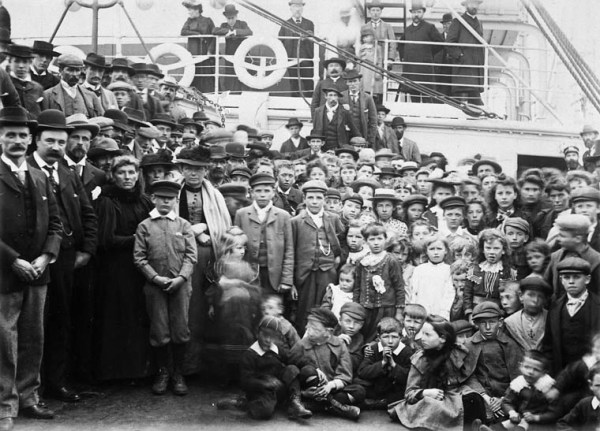
Coming to Canada
Norway
The offer of Canadian land parcels to settlers in the 1890s attracted Norwegians to come to Canada. Before that time, Norwegians would cross the Atlantic Ocean, land in Quebec City, then migrate south to the United States. As the American Midwest and Northwest became more populated, and immigration policies more restrictive, the Canadian Prairies became the next destination for many Norwegians.
Sweden
Swedish immigration to Canada began in the 1870s with the first rural Swedish colony, Scandinavia, near the town of Erickson in Manitoba. Originally named New Sweden, Scandinavia was established by three men who organized dwellings to house the first settlers.
Like their Scandinavian counterparts, Swedish immigrants first arrived and settled in the United States and then travelled north to settle in Canada. A large influx of Swedish immigrants from the states of Minnesota and North Dakota migrated to the Canadian Prairie provinces in the 1920s.
Finland
It is very difficult to determine the exact date of arrival of the first Finnish settler to Canada. However, Finns began settling in large numbers in the 1880s. During this period, many Finns who had arrived in the United States in the 1860s crossed the border into Canada. By 1890, many communities of Finnish Canadians had formed. The largest of those communities were Nanaimo, British Columbia; New Finland, Saskatchewan; Port Arthur, Toronto, and Sault Ste. Marie in Ontario.
Denmark
Although there are early accounts of Danes working as trappers in Canada, little documentation exists that describes their experiences. By the 1860s, political unrest, religious divide, and the promise of a better life in America, all contributed to the migration of Danish people to Canada and the United States.
Iceland
Leif Eriksson was the first Icelander to set foot in what would become Canada. Wineland, the first settlement of Icelandic origin, was established in 1003, and Snorri Þorfinnsson is the first known European born in L’Anse aux Meadows, Newfoundland.
In 1872, Sigtryggur Jonasson traveled to the Muskoka region of Ontario and a group of 100 Icelanders later joined him there. Not satisfied with their settling attempts in Ontario, the Icelanders moved west to Manitoba and established the first lasting Icelandic colony on the continent.
Estonia
From 1900 to 1944, fewer than 3000 Estonians immigrated to Canada. Approximately 72, 000 Estonian political refugees fled to Sweden and Germany in 1944 to escape Russian communism. Of these, nearly 14, 000 immigrated to Canada between 1946 and 1955
Approximately 72, 000 Estonian political refugees fled to Sweden and Germany in 1944 to escape Russian communism. Of these, nearly 14, 000 immigrated to Canada between 1946 and 1955. Balts, mostly Estonians, Latvians, and Lithuanians, were among the first displaced persons selected by Canadian immigration during the Second World War (WWII).
Lithuania
Lithuania is a small country on the southeastern coast of the Baltic Sea. The first recorded Lithuanian immigrants to Canada were soldiers serving in the British army in the early 19th century. The 2016 census reported 59, 285 people of Lithuanian origin in Canada (11, 185 single and 48, 100 multiple responses). At the end of the 19th century and the beginning of the 20th, many Lithuanians, fleeing Tsarist police or to improve their livelihoods, immigrated to Canada and settled in Nova Scotia, Ontario,and western Canada
Latvia Between 1921 and 1945, 409 Latvians arrived to Canada, although in the 1941 census listed 975 people claimed Latvian origin. After the Second World War in 1947, many Latvians moved to Canada as war refugees. This migration, which accounted for 92% of Latvians who immigrated to the country between 1921 and 1965, ended in 1957. Many of these Latvians worked in the agricultural areas during their first years in Canada, but soon settled in cities. By 1961, only 10% of those immigrants lived in rural zones and farms (6% in rural areas and 4% on farms). The majority of Latvian immigrants in Canada in 1991 were women, 775 more women than men.[1 Information : Library and Archives Canada
In the waning years of the 16th century, Pierre Esprit Radisson, my eighth great grandfather was born in France. He was a cloth merchant of modest means living in the parish of Saint Nicolas des Champ, Paris Frances.
In the year 1633, he married Madeleine Henault, the widow of Sebastien Hayet. She brought to the marriage her young toddler, Marguerite. Together they had three more children, Francoise (1636), Elisabeth (1638), and Pierre Esprit, the famous fur trader and explorer (1640).
Recently the following biographical sketches about members of the Radisson family were added to our blog.
Pierre Senior died in 1641 at the age of 51 leaving Madeleine to care for the four children. Within five years she also passed away. (1646) What was going to happen to the youngsters? Marguerite was now 15 years of age, while Francoise, Elisabeth, and Pierre were still very young.
The three sisters, despite their young age, became “marriageable young girls”. They arrived in New France during the summer of 1646 and were welcomed into the community of Three Rivers (Trois Rivieres) that had been settled in 1634 by Samuel de Champlain. The location was ideal, the midpoint between Quebec City and the burgeoning Ville Marie (Montreal1642).
Very little information is known about the early years of Francoise Radisson, other than in 1649 the record shows that she became her nephew Etienne’s godmother. He was the son of her half-sister, Marguerite.
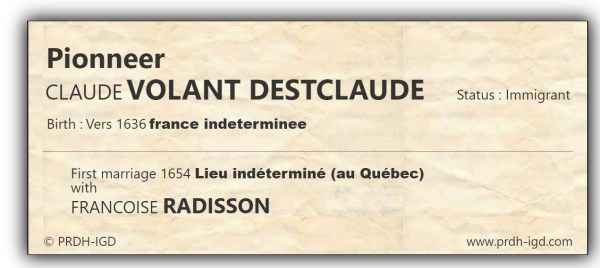
In 1653 at the age of seventeen, Francoise married Claude Volant de Saint Claude, a soldier from France, also 17. No records of their marriage contract nor written records of their marriage have been found.
A typical document containing information about the Volant Family
The young couple set out to have a family and before long they were blessed with a set of twin boys, Pierre, and Claude, born November 8, 1654. Two and half years later, on July 28th, 1657, a daughter, Francoise saw the light of day, but at the age of five and a half, she died. There is no indication of what caused her death, but, typhoid and smallpox were common diseases causing the loss of life.
In November of 1659 another daughter, Marguerite and was welcomed after the pain of losing their first daughter. Four years later in July of 1663, another daughter also named Francoise was born. Her life came to an abrupt end, having lived only three months. In the fall of 1664, the family rejoiced when their healthy young son Etienne joined the family. Almost five years later Jean Francois was born, followed by Nicolas in 1671 and then young fellow Charles Ignace rounded out the family on November 7, 1673.
For nearly twenty years Francoise bore nine children having given birth to three daughters and six sons. No doubt there were moments of deep grief, along with times of jubilation for the family. The childbearing years took a heavy toll on Francoise.
In the last years of her life, she became ill and Claude soon realized the need for help and hired a housekeeper to care for her and the five young children still living at home. When the leaves of autumn are at their finest, most splendid colors, Francoise died October 3rd, 1677at the young age of forty-one.
During her lifetime, she lived to see her two eldest sons become priests, but not long enough to see them ordained, nor to witness their many accomplishments. She must have been quite ill when her daughter Marguerite was married in the summer of 1675 and perhaps unable to attend the celebrations. She may have rejoiced seeing her first granddaughter when Marguerite gave birth before her mother’s passing, but she died before seeing the second granddaughter and was spared knowing that Marguerite died shortly thereafter.
Francoise’s will above was prepared on the 12th of August 1677 prior to her death in October of the same year.
Francoise’s steadfast husband, Claude Volant became a prominent member of the Three Rivers community. He was granted a Seigneury along the St. Lawrence river also named a churchwarden. Numerous interesting notarial records may be found in his name. Perhaps the most important one consisted of his being named tutor of his children still living at home.https://www.prdh-igd.com/
Request from Claude Vollant (Volant), Sieur de Saint-Claude, for the election of a tutor to property and persons at the meeting of May 11, 1678 by Gilles Boyvinet (Boivinet), King’s adviser… (04T, TL3,S11,P1681)1)
Above is a small section of a four-page notarial document naming Claude Volant, the father of the five children as the tutor for his children living at home.
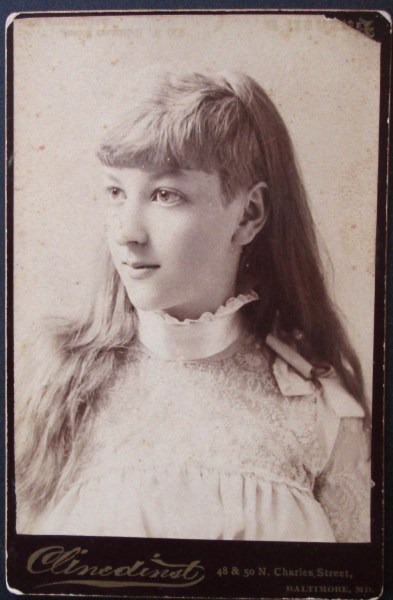
Who was Lavinia Patterson? I found a cabinet photograph of her in one of the boxes from my mother’s cousin. Written on the back, her name, the date and place. It wasn’t in one of the albums, just in an envelope with other pictures. She was a good looking girl with what I thought was an unusual haircut. She had very long hair hanging free with bangs and a short boy cut around her ears. Cutting or shaving some of one’s hair is a style seen now but in 1886?
The first clue was the photographer’s name and address. Barnett M. Clinedinst Sr and Jr had a studio in Baltimore from 1880 to at least 1891. Clinedinst Sr. began as an artist and turned to photography after the Civil War. He built up a prosperous business in Staunton, Virginia and later settled with his wife Caroline McFee and children in Baltimore. His son followed him into the business and they opened a studio in Washington DC where they photographed Presidents, military men and societie’s elite. Barnett Jr became the official White House photographer for three administrations. They were also innovators and were some of the first to use flash lighting.
Much information about the photographers exists but what about Lavinia? In an 1887 Erie PA directory, Lavinia B. Patterson, a student, lived at the corner of 7th and Sassafras, the same address as a Revered James G. Patterson of Park Church. Two years later Rev Patterson resigned as pastor of the 2nd Presbyterian Church of Erie. There was also a Lavinia and Anne Patterson going to a school in 1881 but so far no proof that either is this Lavinia.
This picture was with other photographs that had belonged to my great grandmother, Ida Girod Bruneau. Ida taught school in Baltimore before she married Ismael Bruneau in 1886. Was Lavinia one of her pupils saying goodbye to Ida, a favourite teacher?
Notes:
The photograph was taken on June 8th 136 years ago.
Background Information pertaining toScottish Settlers in Canada
Scots began arriving to Canada as early as the early seventeenth century. Sir William Alexander obtained permission from King James I to establish a Scottish settlement in 1622 named New Scotland or Nova Scotia. The colony failed to flourish, however, and few families settled in Canada before the British conquest in 1759. The majority of these early Scottish settlers were Roman Catholics seeking political and religious refuge, fur traders with the Hudson’s Bay Company, merchants and disbanded soldiers.
After this early period there were also a number of Highland farmers who emigrated from Scotland after being ejected from their land to make way for sheep grazing. The primary destinations for these early settlers were agricultural communities in Upper Canada, Prince Edward Island and Nova Scotia. Cape Breton Island had a significant Scottish population, Gaelic being the only language spoken there. Scottish Loyalists arrived in Canada from the United States in 1783 and settled mainly in Glengarry, Upper Canada, and Nova Scotia. Lord Selkirk also settled over 800 Scottish migrants in Prince Edward Island in 1803 and placed many others in his Red River settlement in Manitoba in 1812. By 1815, there were already more than 15,000 Scots living in Canada.
Between 1815 and 1870, over 170,000 Scots immigrated, with increasing numbers settling in Quebec and Ontario, notably in Lanark County. They were a widely-varied group, including Highlanders and Lowlanders, farmers, teachers, merchants, clergymen and servants. Many were Presbyterian and English speaking. Many Scots were encouraged and supported by the British government and private companies in their effort to emigrate.
Scottish immigration to Canada continued into the twentieth century and increased the Scottish population to over 1 million by 1930. Most of these later Scottish migrants were farmers and farm labourers coming from the Lowland regions, while fewer Highlanders emigrated during that period. There were also many more industrial workers coming after 1900, many in the iron and steel industries. The primary destination for this later settlement of Scots was western Canada, with Manitoba receiving the largest numbers.
After the First World War, many Scots were able to gain passage to Canada under the Empire Settlement Act. Immigration from Scotland to Canada continued in large numbers throughout the twentieth century and between 1945 and 1993 approximately 260,000 settled in Canada. Today, there are approximately 4 million Canadians of Scottish heritage.
British Wesleyan Methodist Church,American Congregational Church,and Other Protestant Denominations During the Lower Canada Period at BAnQ.
St. James Anglican Church – Three Rrivers – Originally built in the mid 1700’s as a Recollet MissionSaint James Anglican Church Three Rivers where the congregation has been worshipping since 1823.
The following database contains books written by numerous authors who have penned books, essays, treatises, dissertations, theses, studies, abstracts, and papers. within the libraries of genealogy societies and at BenQ. These documents may be accessed online and downloaded.
On pages, 69, 70, 71 are listed the leading repositories of Protestant Church Registers in Quebec, Many Protestant Registers cannot be accessed at BAnQ Numérique, Ancestry.ca, Genealogy Quebec (Drouin Institute Online), FamilySearch.org. Very few Protestant Church Registers (baptism, marriage, death) survived during a period of time in New France However, it is possible that Notarial Records may shed light on Protestant families prior to 1759.
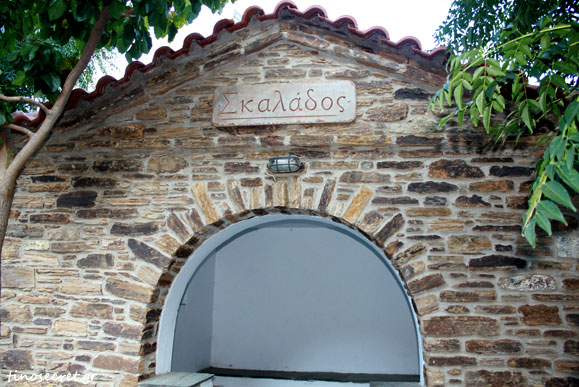
Have you ever been to Greece? Great food, good weather, beaches. I could go on and on. But my favourite part about visiting Greece is staying in the ancestral home of my husband located on the island of Tinos in the beautiful village of Skalados.
My mother-in-law, born in 1932, has lots of stories of growing up in this lovely village. When she was born, the village had no running water, no electricity, and no roads. It is hard to imagine as everyone now has internet, televisions, washing machines, and one or two cars per family.
While she was growing up, the villagers’ took their water from the well located in the village. It was hard work carrying the water that the household needed from the well to the home. They also used the well for washing the clothes. Women would help each other, as washing was heavy and hard work. Everything that they needed had to be carried to the well, including the clothes. To my surprise they used a blue rinse for the whites.
Well in Skalados, Tinos (courtesy Tinosecret)
The village had two wood ovens and these were also shared. On baking days the families would bring their bread and dishes that needed to be cooked in the oven.
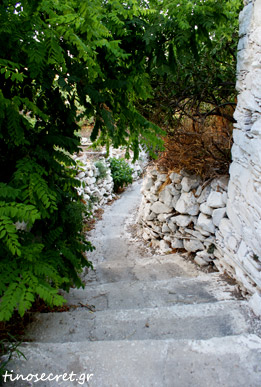
If you have been to Greece, you will have noticed that the stairs in the villages are wide and long, with a small step. These stairs were designed for donkeys, which explains their design. My husband’s grandfather used a donkey as his means of transportation as there was no road to the village until the 1970s. The whole island is crisscrossed with “donkey paths” that are now either overgrown or used as walking paths.
Sisters Margaret (born 1781), Elizabeth (born 1786) and Jane Mitcheson (born 1793) grew up together on their parents’ farm in County Durham, England, but when they became adults, their lives followed very different paths. The eldest married a much older man who provided her with financial security, the middle sister was swept off her feet by a tenant farmer and the youngest married a mariner who was often away at sea.
The daughters of yeoman farmer Joseph Mitcheson and his wife Margaret Philipson, they were baptized at Lanchester Parish Church and grew up in the rolling countryside of northeast England. Their mother died in 1804, when Jane would have been just nine years old.
They had two older siblings, Mary (born 1776) and Robert (born 1779) who both immigrated to North America, and another brother, William (born 1783), an anchor manufacturer who lived near the docks of London. (Mary and Robert were both my direct ancestors since Mary’s grandson, Stanley Clark Bagg, married Robert’s daughter Catharine Mitcheson in 1844, so these three sisters were my 4x and 5x great-aunts.
Their grandfather Robert Mitcheson (-1784) left each of his older grandchildren 50 pounds, part of which could be spent on their care and education and the rest given to them when they turned 21. In his will, written in 1803, their father also left them between 100 and 150 pounds each,1 although he gave the two youngest, Elizabeth and Jane, their inheritances in 1807.
Margaret Dodd
Margaret would have been considered as having married well when she wed gentleman Thomas Dodd (1743-1823) at Whickham Parish Church in 1808.2 The Dodd lineage in northern County Durham can be traced back to 1645, and his family owned a farm called Woodhouse, located in Woodside Ryton Township.
Whickham Parish Church. JH photo.
Thomas was in his sixties and Margaret was 27 when they married. They had five children, three of whom lived to adulthood, although their only surviving son, Thomas Anthony Humble Dodd (1824-1899), was born after his father had died. Thomas grew up to be a well-known Newcastle surgeon and married his cousin, Frances Jane Mitcheson (1824-1898), daughter of the anchor maker.3
Thomas Dodd senior was an early pioneer of Methodism, founded in the 18th century by English minister John Wesley. Wesley often preached to large crowds outdoors. According to the late Durham-based genealogist Geoff Nicholson, John Wesley may have preached in the fields at Dent’s Hall, near Ryton, and Thomas may have met Wesley.4
After her husband’s death, Margaret remained at Woodhouse. In 1824, 1825 and 1827, the property was listed as owned and occupied by the executors of Thomas Dodd’s estate, but according to the 1830 land tax returns, it was “Property of Mrs. Dodd, occupied by Mrs. Dodd.”5
She was also a farmer. A local directory published in 1828 listed Margaret Dodd as a farmer in Woodside Ryton Township,6 and the 1841 U.K. census did the same.
The 1851 census found son Thomas A. H. Dodd as head of the household, living at Woodhouse with his wife and two small children, his mother and two servants. Margaret was listed as an annuitant, meaning she had her own income. The census noted that Thomas was a surgeon, and that the farm had 96 acres and employed two labourers.
When the 1861 census-taker came around, Margaret was once again head of the household, living with her widowed daughter Mary Robson and a house servant. Margaret died in October, 1864, age 83, and was buried with her husband in Holy Cross Parish Churchyard, Ryton.7
Elizabeth Maughan
While researching Margaret was straightforward, finding records of her sister Elizabeth’s life was more challenging. What I did find suggests that Elizabeth’s life was far from easy.
She was just 20 when she married farmer John Maughan, of Shotley, Northumberland, in 1806 at Whickham Parish Church.8 They lived in Shotley, a sparsely inhabited parish in southern Northumberland, located between the River Derwent and the town of Hexham. Its soil consists of sandy clay, and coal, silver, lead and iron have been produced in the area.
Elizabeth might have been lonely on that remote farm, but she probably didn’t have much time to think about it as she gave birth to at least 10 children.9 Several of them died young, but Joseph (b. 1810), Margaret (b. 1814), Isabella (b. 1816), Mary (b. 1817) and possibly William (b. 1823) grew to adulthood.
The family eventually appears to have left Shotley. In 1842, my Montreal ancestor Stanley Bagg and his 21-year-old son Stanley Clark Bagg travelled to England. In an account of the trip, Stanley Clark Bagg mentioned that they visited his great-aunts Mrs. Dodd near Ryton and Mrs. Maughan in Sunderland, in northeastern County Durham.11
Some genealogists suggest Elizabeth died in Hexham, Northumberland in 1839, but in that case, the Baggs would not been able to visit her. The 1841 census counted a John Maughan, agricultural labourer, and Elizabeth Maughan, age 55, in Sunderland, along with 15-year-old Thomas Maughan, so this may have been the family.12 I do not know when Elizabeth died.
As for the youngest sister, Jane, she married master mariner David Mainland in 1812. About 10 years later, the family moved to London. Jane died in London in 1825 and their son David married his widowed cousin Mary Ann (Mitcheson) Eady in 1849. Jane’s family will be the subject of my next post.
Notes:
According to genealogist Geoff Nicholson, Margaret and Thomas Dodd’s children were: Margaret (c.1810-1851) m. John Milburn; Isabella Ann (1815-1822), Mary (1817- ) m. Rob. Robson or Ritson; Anthony Humble (1818-1821) and Thomas Anthony Humble (1824-1899) m. Frances Jane Mitcheson.
Elizabeth and John Maughan’s daughter Mary (born 181712))moved to Montreal, Canada, where her Aunt Mary (MItcheson) Clark lived. Mary Maughan married merchant William Footner in Montreal in September, 1840,13 and she gave birth to one of her three children at Mile End Lodge, a large farmhouse that belonged to her aunt. The Footner family later moved to the United States and Mary died in Minnesota in 1901. (There was another William Footner, an architect, married to another Mary, in Montreal in the mid to late 1800s.)
The Lucy H. Anglin Family Tree on Ancestry Public Member Trees. Numerous members of the Mitcheson family in Durham, including several generations of men named Robert Mitcheson, as well as their descendants in Philadelphia and Montreal, are listed on this tree.
1. Will of Joseph Mitcheson, yeoman, Iveston, Durham, The National Archives, Wills 1384-1858 (http://nationalarchives.gov.uk, search for Joseph Mitcheson, accessed Nov. 18, 2010), The National Archives, Kew – Prerogative Court of Canterbury, 9 February, 1822.
2. England, Select Marriages, 1538-1973, Ancestry.com. (www.ancestry.ca, database on-line, entry for Margaret Mitcheson, accessed April 19, 2022), citing England, Marriages, 1538–1973. Salt Lake City, Utah: FamilySearch, 2013.
3 London and Surrey, England, Marriage Bonds and Allegations, 1597-1921, Ancestry.com (www.ancestry.ca, database on-line, entry for Thomas Anthony Humble Dodd, 1848, accessed April 19, 2022), citing Marriage Bonds and Allegations. London, England: London Metropolitan Archives.
4 E-mail correspondence from Geoff Nicholson about the Dodd family, June 13, 2009.
5 Durham County Record Office. Quarter Sessions – Land Tax Returns, Chester Ward West 1759-1830, www.durhamrecordsoffice.org.uk, search for Dodd, viewed April 19, 2022.
6 The History, Directory and Gazetteer of Durham and Northumberland, Vol 2, by Wm. Parson and Wm. White, W. White and Company, 1828, p. 186, Google Books, search for Margaret Dodd, accessed April 19, 2022.
8. England, Select Marriages, 1538-1973 Ancestry.com (www.ancestry.ca, database on-line, entry for Elizabeth Mitcheson, Whickham, accessed April 10, 2022), citing England, Marriages, 1538–1973. Salt Lake City, Utah: FamilySearch, 2013.
9. England Births and Christenings, 1538-1975, Familysearch.org, database online, entry for John Maughan and spouse Elizabeth, Shotley; accessed April 10, 2022.
10. Letter from Stanley Clark Bagg to Rev. R. M. Mitcheson, Dec. 6, 1842, probably transcribed by Stanley Bagg Lindsay; Lindsay family collection.
11.1841 England Census, Ancestry.com (http://www.ancestry.ca, database on-line, entry for Elizabeth Maughan, Bishop Wearmouth, accessed April 10, 2022), citing Class: HO107; Piece: 310; Book: 4; Civil Parish: Bishop Wearmouth; County: Durham; Enumeration District: 4; Folio: 13; Page: 21; Line: 1; GSU roll: 241353, original dataCensus Returns of England and Wales, 1841. Kew, Surrey, England: The National Archives of the UK (TNA): Public Record Office (PRO), 1841.
13. Quebec, Canada, Vital and Church Records (Drouin Collection), 1621-1968, Ancestry.com (www.ancestry.ca, database on-line, entry for Mary Maughan, accessed April 19, 2022), citing Institut Généalogique Drouin; Montreal, Quebec, Canada; Drouin Collection; Author: Gabriel Drouin, comp.
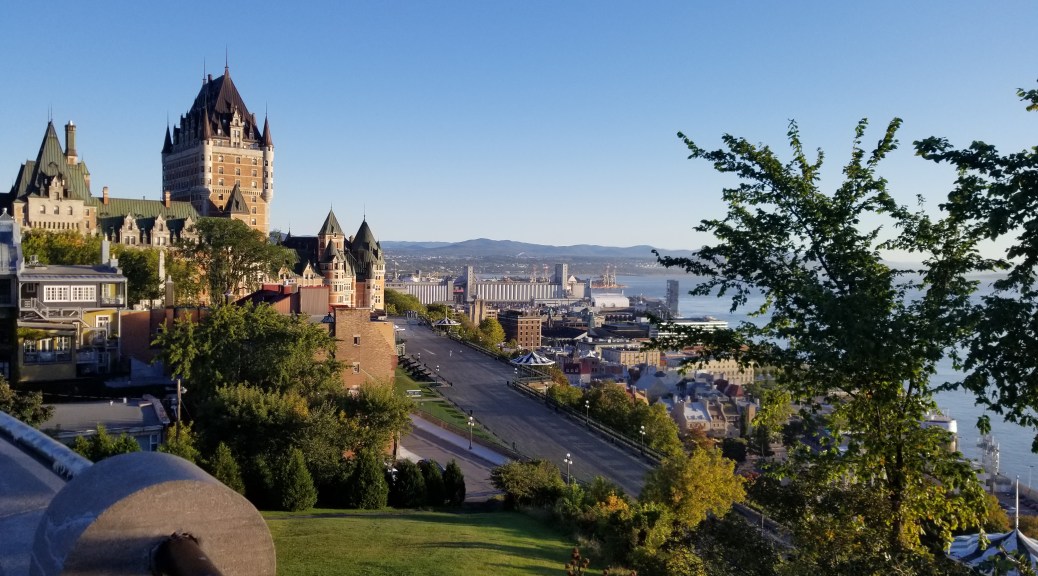
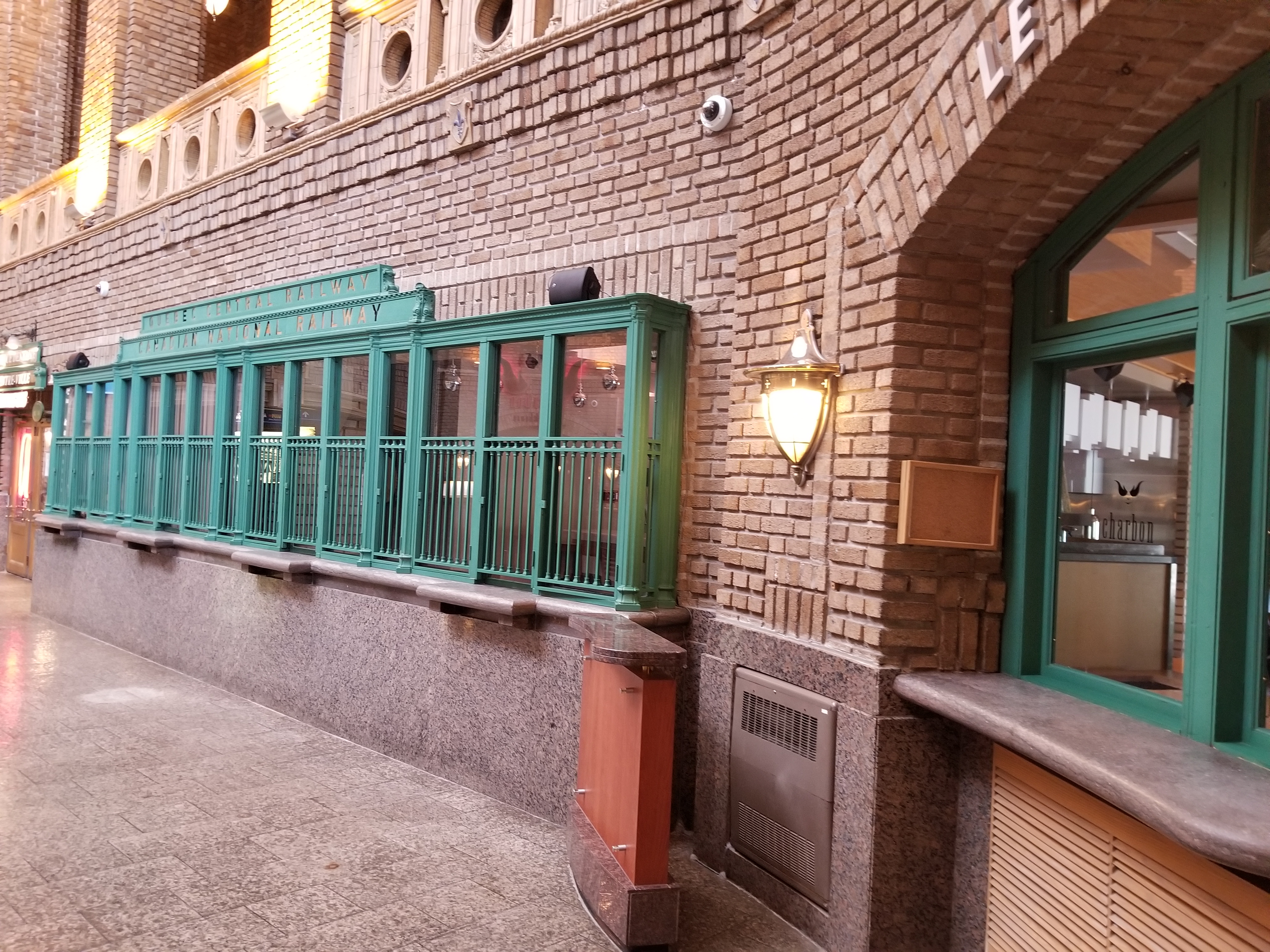
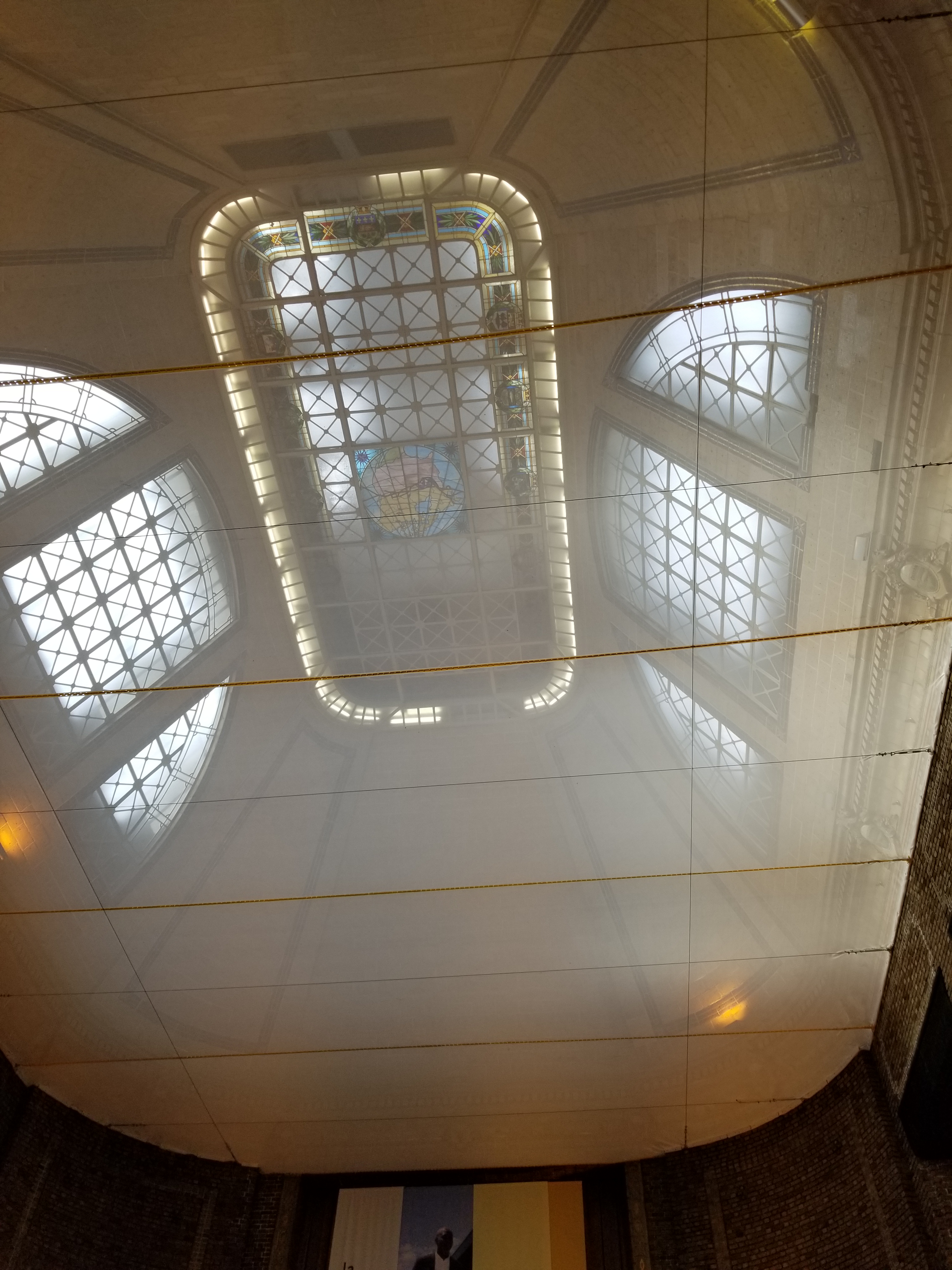
I felt like a time-traveller within ten minutes of arriving in Quebec City by train. The stairs up from the platform led into a resplendent bricked hall with caged windows that looked like something from Queen Victoria’s time. A domed sunlit ceiling of glass and stained glass made the space luxurious and opulent.
A conference presentation brought me to Quebec City, but I also wanted to use the trip to learn more about ten ancestors who once lived there. I wanted to to see if I could get a better sense of my ancestors’ lives by walking in their footsteps even though the city in which they once lived has changed enormously over the ages. If studying history helps us recognize patterns about our lives that are invisible in close context, perhaps I could use my five senses to imagine the lives of people who lived in this Canadian City in previous eras and use the insight gained to learn something needed now.
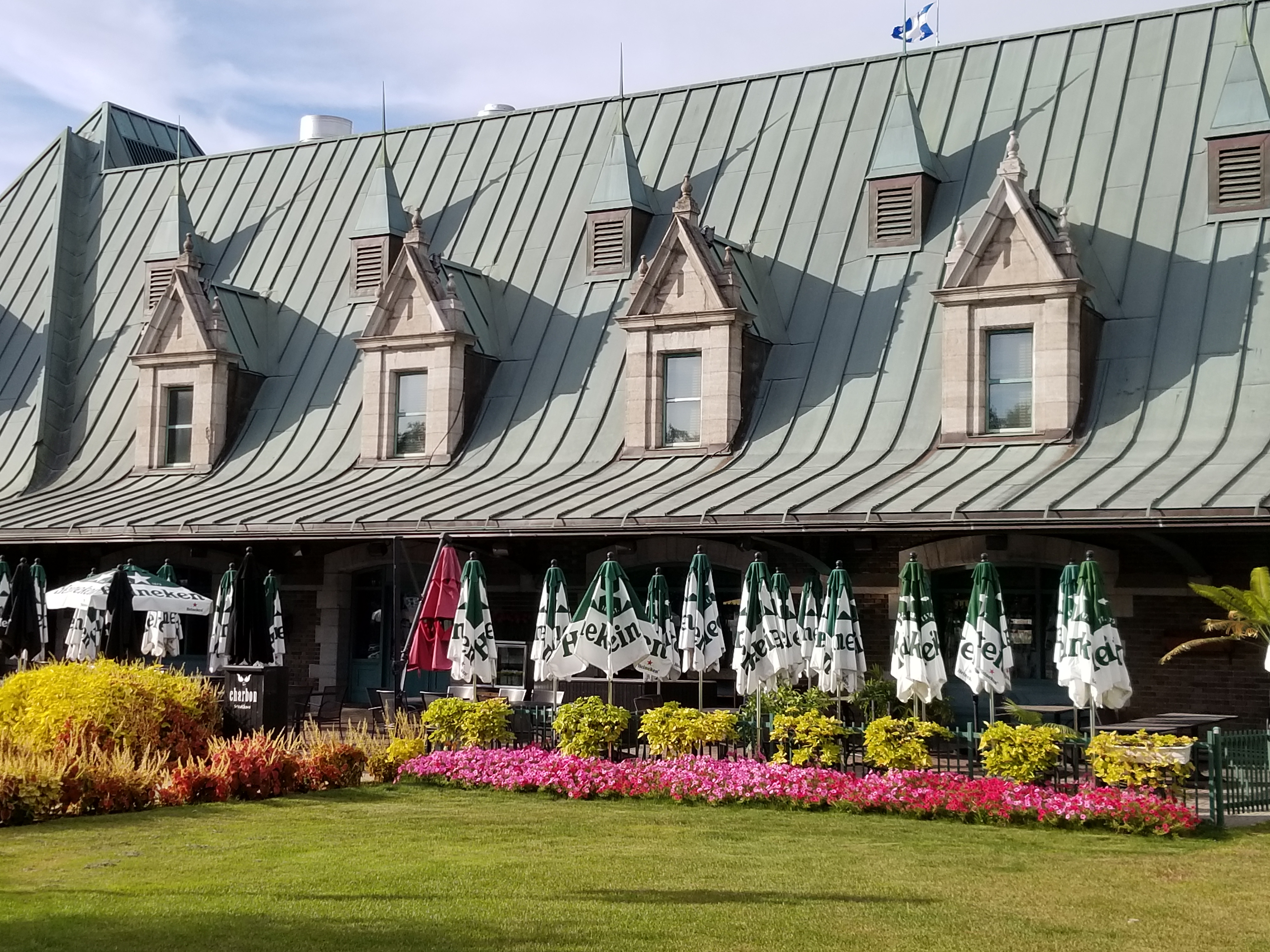
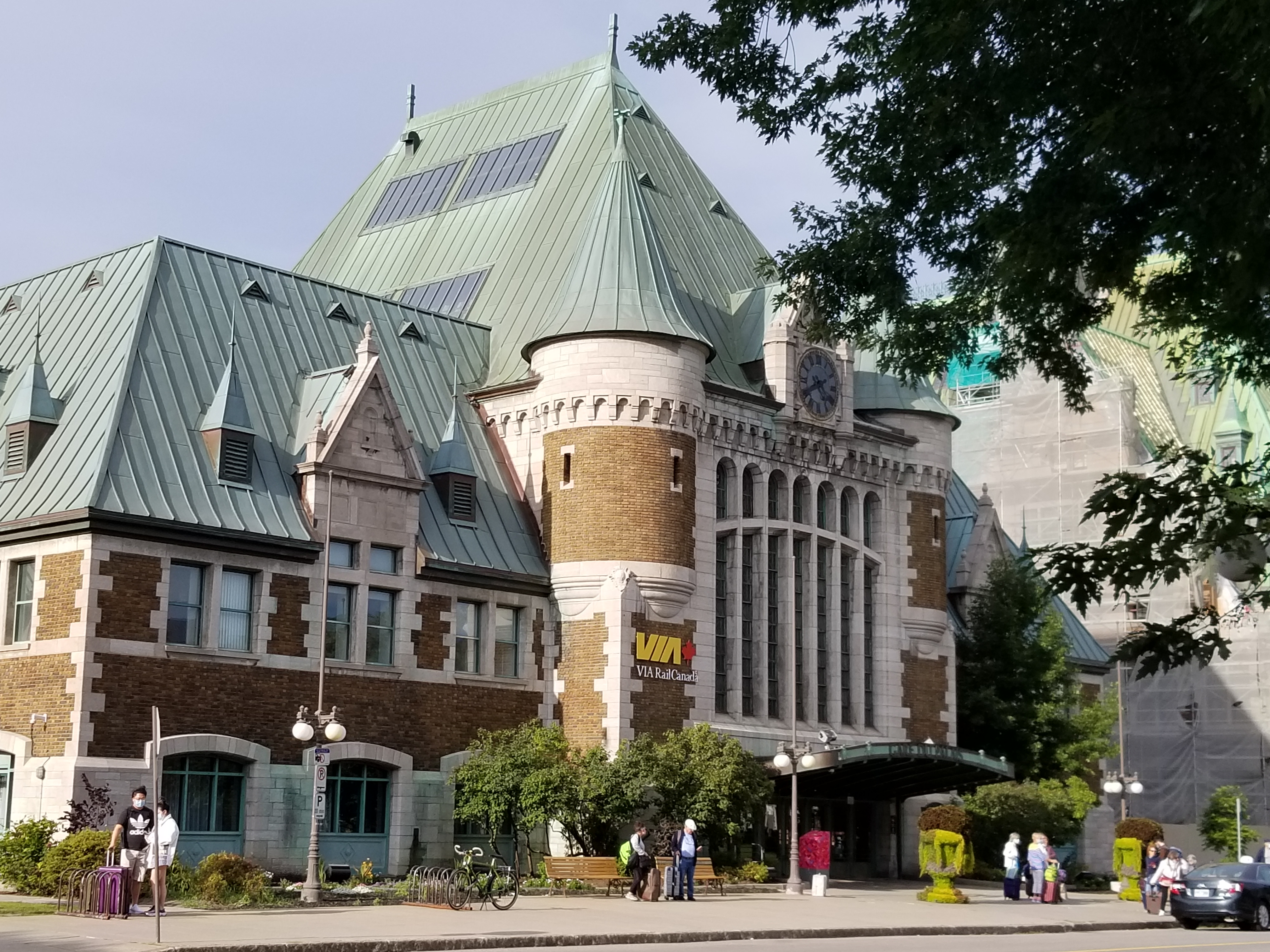
As far as I know, my ancestors had long left Quebec City by the time the train station opened, so beginning my trip in this building didn’t have any personal relevance, but it created a great mood enhancer for the trip. Canadian Pacific opened Union Station in 1916 near the once-famous Boswell Dow Brewery. After the Brewery closed in 1968, archaeological excavations on the site identified it as the one-time palace of the Intendent of the colony of New France, which is why the train station now has the name Gare du Palais.1 The title fits the elegant granite and limestone structure, which was designed by architect Harry Edward Pringle to match the style of the 1893 Chateau Frontenac. The newly renovated building made me enthusiastically embrace my heritage walkabout right away.
Where the River Narrows, 1500s
While on the train, I got an overview of the city with a quick look at it on Google map’s satellite view. The long range view hinted at many of the reasons for the historic strategic importance of Quebec City. The mighty Saint Lawrence River divides in two at Ile d’Orléon (Orlean Island). This is the reason for the Montagnais people’s name of Kebec “the place where the river narrows.” Ships and canoes could be quickly seen before they make landfall, with larger vessels having to unload and transfer to smaller vessels at this spot. A large cliff prevented people from attacking the site without being seen.
When Cartier arrived in Canada in the 1500s, this location housed the village of Stadacona. In July 1534, Cartier brought two people (Taignoagny and Domagaya) from the village back to France, returning them in 1535. In 1536, he kidnapped 10 people, including Donnacona, Taignoagny and Domagaya, all but one of whom died in France.
The village was abandoned and dense forest covered the territory by the time Samuel de Champlain brought 28 men there to build a fort and establish the second settlement in the colony of New France in 1608.
Author Adam Shoalts described the building of Champlain’s fort in his fabulous novel “A History of Canada in Ten Maps.”
The French rowed ashore beneath the towering cliff in their small ship. The soil looked promising, and the butternuts would make an excellent addition to their diet. Under Champlain’s direction, the colonists felled trees, planted gardens, dug cellars, and began work on a palisaded fortress. They erected three two-storey buildings complete with chimneys, interconnecting balconies, a watchtower, and cannons. Outside the palisade, Champlain had a moat dug for additional protection.2
By 1628, 103 colonists lived in Quebec City when Paris business leaders formed the Company of One Hundred Associates to turn New France into an important mercantile and farming colony.
Notre Dame de Québec, 1600s
A year later, despite Champlain’s military defences and Quebec’s strategic location, the Kirk Brothers captured Quebec City, returning it three years later. After that, Champlain rushed to add a chapel to add some spiritual defence to his city. It’s said that Champlain’s remains were buried below the chapel after he died of a heart attack in 1635, although they still haven’t been found.
I appreciated the summary of events provided by Pierre-Georges Roy in a 1925 book about Quebec’s churches.
“Quebec, taken by the English in 1629, was restored to France three years later. On his return in 1633, Champlain hastened to fulfil the vow which he had taken to erect a chapel in honour of the Blessed Virgin, if he came back. In the autumn, the church of Notre Dame de Recouvrance was finished. It was partly situated on the present site of the Cathedral. On the 15th of June, 1640, it was destroyed by fire and with it disappeared the first and oldest original registers of the colony which had to be reconstructed from memory.
Until they could rebuild, services were held in the house of the Hundred Associates which Father Vimont somewhere pompously styled in 1645: ‘church of La Conception de la Bienheureuse Marie à Québec.3
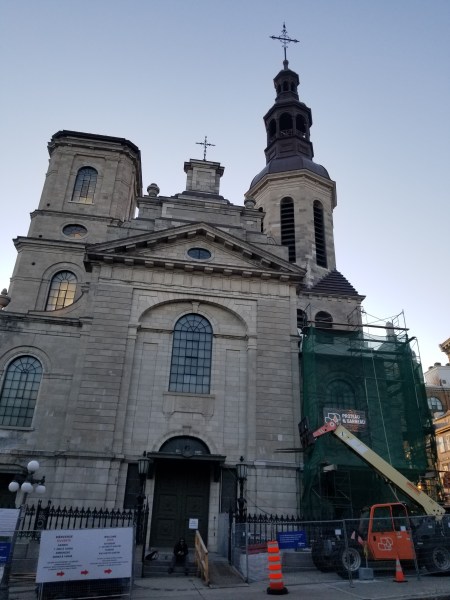
By 1647, the Quebec community of only 355 people had its first stone church, Notre-Dame de la Paix, which became Notre-Dame de Québec in 1664 and a Cathedral in 1674. It’s had to be completely rebuilt twice since then, once after the English bombarded and burned it in 1759 and again after a fire destroyed it in 1922.4
I tried to get a good photo of today’s version, but the structure was too big and too many buildings blocked my long range view. I wanted the photo to include in a story about my ancestors Catherine Clarice and Jacques Lussier. The couple got married in Notre-Dame de Québec with nine other couples on October 12, 1671. The first parish priest of Quebec, Henri de Bernieres, officiated. Toussaint Dubeau, Louis Denis dit Lafontaine and Rene Dumas witnessed the wedding.
The marriage was a second one for the groom, whose previous wife Charlotte Lamarqe died earlier the same year sometime after the baptism of her daughter Marie in February.5
As I walked around the church looking for a decent shot, I imagined my ancestors’ wedding party coming out of the front doors and having rice tossed at them by guests. The roads around the building would have been dirt then, and most of the buildings now hemming the church in didn’t exist. Despite my struggles to get the imagery right, it was pretty cool imagining their special day late in the autumn.
Multiple Battles, 1700s
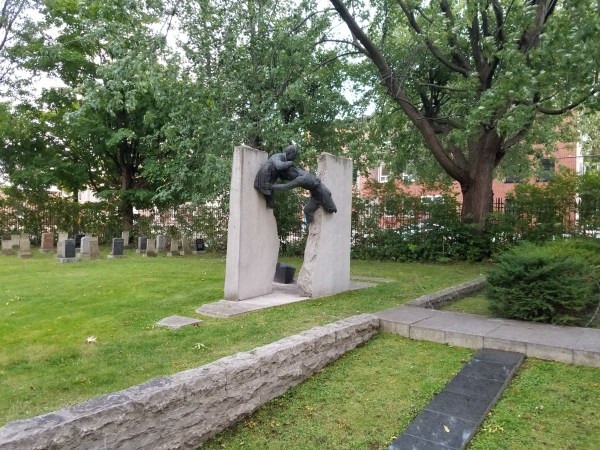
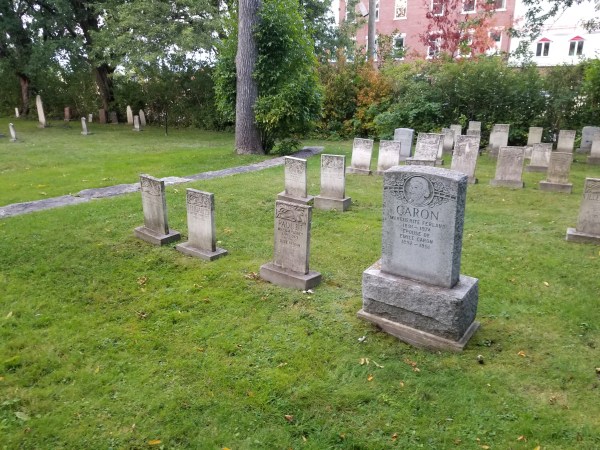
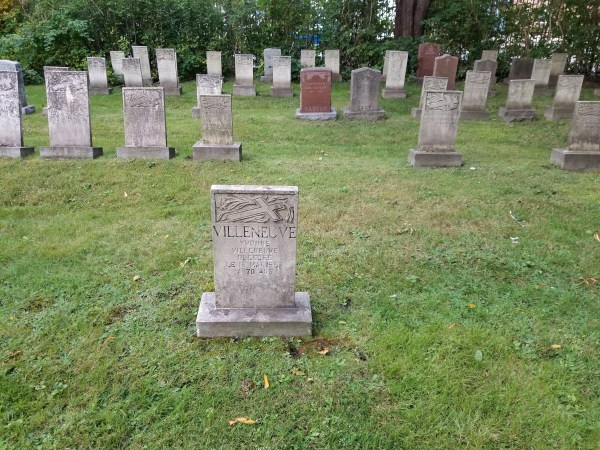
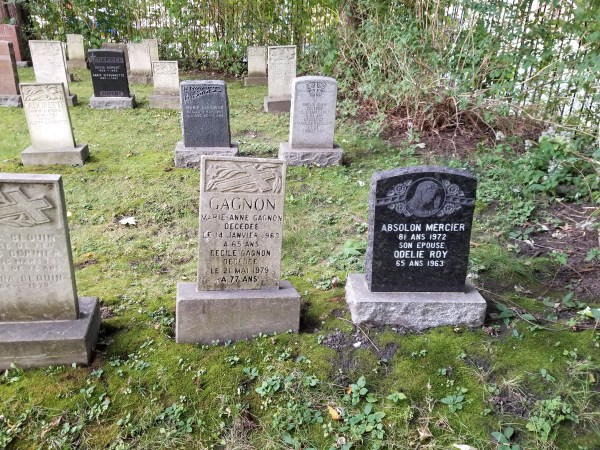
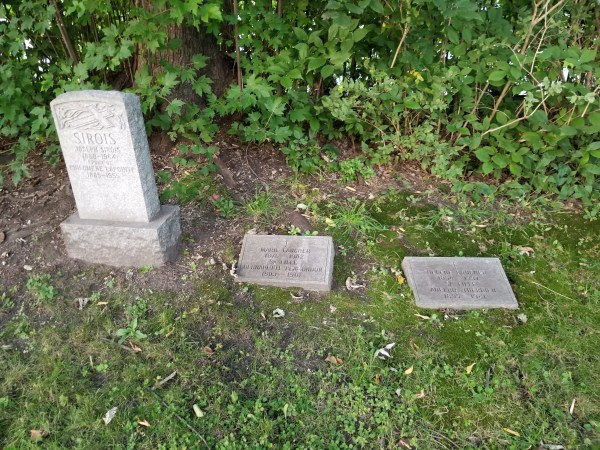
At the end of my first day in Quebec City, I found myself in the Quebec General Hospital Cemetery taking photos.
The remains of more than 1,000 French, British and First Nations soldiers who fought in the Seven Years War are located here. A plaque on site and a heritage web site explains the details.
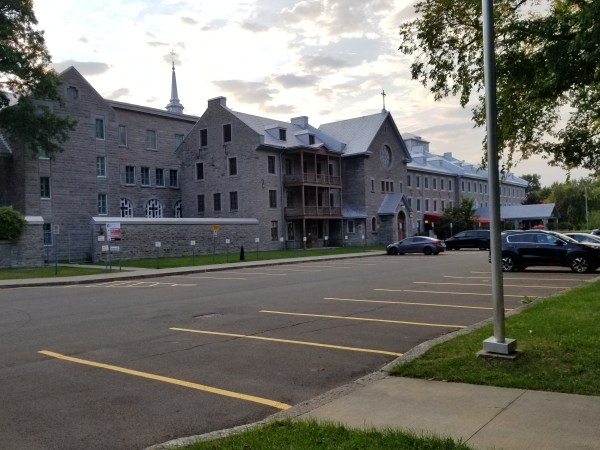
During the fateful battles of the Plains of Abraham and Sainte-Foy in 1759 and 1760, French and British troops fought at Québec’s very doorstep. Since the general hospital was located far from the fighting, it was used to care for the injured from both sides. The Augustinians provided the same assistance to British soldiers as to the French. They also treated Canadian militia and First Nations warriors. However, without access to antiseptics, proper medical procedures, or sufficient staff, the injuries of many combatants proved fatal. The sisters buried the remains of Catholics in a common grave in the parish cemetery, and those of Protestants in another one just next to the cemetery. By 1760 when the fighting ended, 1,058 French, British, and First Nations fighters had been buried at Hôpital général. The Augustinians carefully recorded the name, place of birth, and age of every one of them in the parish register, if that information was known.6
The Seven Years War, a battle between England, France and Spain, lasted from 1756 until 1763, but England and France were fighting over Quebec City as early as 1690.
Walls to protect the city were built in the summer of 1690 after Port Royal fell to the British in May. They were in place by October, when the British arrived and the first Battle of Quebec began. In 1693, the French built the Cap Diamant Redoubt, a protective structure that could have prevented the loss of the City by the French during the Battle of the Plains of Abraham in September 1759. It helped the British protect against seiges by the French in 1760 and the Americans in 1775 and remains an integral part of the Québec Citadel that the British built as a temporary structure in 1789 and then replaced with stone in 1832.
My ancestors Louise Thérèse Lareau and Joseph Beleau dit Larose lived in Quebec City during both of these sieges, first with their parents and then as a newly married couple for the second one. I decided to walk in their footsteps along Cote St. Abraham Road, which travels along the Sainte-Geneviève hillside cliff and links the St. Charles valley with upper town. This is one of the few routes that didn’t include the many fortifications Quebec City has become known for. During their time, between 1774 and 1795, the street was known as Rue St. Georges. Like them, I walked along the edge of the Heights of Abraham, named after boat pilot Abraham Martin “the Scot” (1589-1664) who received 12 acres in what is now known as the Saint-Jean-Baptiste district from the Company of New France in 1635 and another 20 acres as a gift from Navy Surgeon le Sieur Adrien Du Chesne ten years later. It’s said that the road follows the original trail Martin used to bring his cows to drink in the St. Charles River.
While walking, I decided to set aside the modern wars the City faced, and instead consider geology. Quebec City is unusual in that allows you to investigate three diverse geological periods in one location: the Canadian Shield, the St. Lawrence Lowlands and the Appalachian Mountains. Upper Town and the Plains of Abraham along with Lévis and Ile d’Orléans are part of the Quebec promontory, which glaciers moved north from the rest of the Appalachian Mountains, which can be seen in the south. Meanwhile, the cliff between Lower Town and Upper Town forms part of the Laurentian Mountains, which make up youngest part of the Great Canadian Shield. The cliff itself demonstrates Logan Fault, and gave me a chance to imagine the work of plate tectonics while overlooking the vast Saint Lawrence Lowlands, once covered entirely by the glacial Champlain Sea.
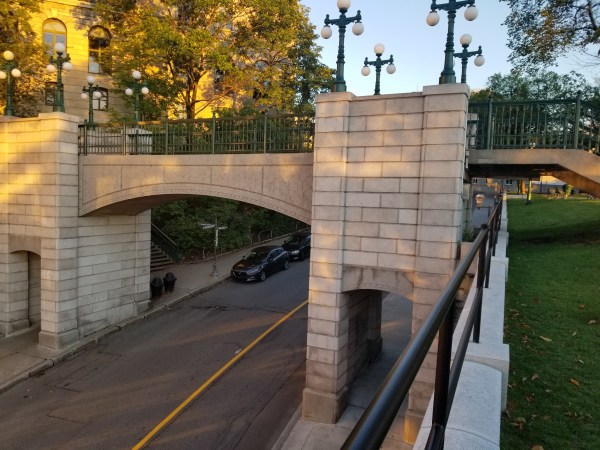
Then I walked up the stairs to get to the earliest suburb outside the City Walls.
The first Fauberg of Quebec: St. Roche Parish 1829
Looking at my notes, I noticed that three of my ancestors lived in the St. Roche Parish. Programming the map finder on my phone to include stop-offs along the walking route, I set off. It took about 15 minutes to walk along Saint Vallier Street. I began looking for number 28, the place where Joseph Belleau and Marie-Anne Ratté lived in 1832.
As I walked, I tried to imagine the internationally-prominent city J Brouchette described that very year.
Québec is also the most important seaport of British America, excepting probably Halifax. Its harbour, situated upwards of 400 miles from the sea in the gulf, is perfectly safe and calculated to receive the largest fleet.7
Today, we call the district through which I walked Saint Roch after the first village set up beyond the walled city of Quebec City in 1829. Tucked between the cliff to Upper Town and the Saint-Charles River, Saint Roch Village housed many working class people, many of whom kept 20 different shipyards active. As a baker8, Joseph probably got lots of work feeding labourers drawn to the area.
I got more hints about how my ancestors might have lived from a wonderful essay by W. H. Parker about life in Quebec in the 1830’s. One paragraph describes Saint Roche.
A third part of the town, distinct from the basse-ville and haute-ville, was the suburb of St. Roch, which had developed between the river St. Charles and the northern side of the Québec platform. It was an industrial district and growing rapidly,9 with accommodation “suited only to the lower ranks”.10
Eventually, I found two lots where Joseph and Marie-Anne may have lived; one to the east of Charest Boulevard Ouest; the other to the west.
The eastern lot sat right across from my lodgings. Today, the space is just an empty lot, but in my head, it contained a tiny house, a bakery and tons of people. For the next two days, I was giddy wondering how this couple with eight children survived. Marie-Anne and Joseph were among 30,000 people who lived in Quebec City in the mid-1800s. Keeping everyone fed, clothed and clean must have been a challenge. How did they feel as they walked up this same street for the first time? What was the weather like? What did they wear? What were their dreams? Confirmation, church register and marriage records display their Catholic heritage, but beyond that, little remains demonstrating their lifestyles.
A wonderful book called “La Vie Quotidienne au Québec” inspired my imagination. The photos reminded me how difficult basic survival was for my ancestors. Their tools took up more space than ours do today, and were difficult to operate. One chapter showed photos of people constructing an oven to bake bread out of sticks, rocks and rope and then covering it with flat boards built to create a peaked roof.11 Did my ancestor bake his bread using such a structure? How big would it have been? Where would he build it? How would he gather the wood needed to make it continually operational in a busy city far from the forest?
Going back to W. H. Parkers’ essay, I learned about the horrible sanitation and garbage issues my ancestors faced, particularly in the spring.
After the melting of the snow in April and May, several streets in the flat suburb of St. Roch are no better than slough; and very offensive sloughs too, from the accumulation of filth that was hidden by the snow in winter. Such places, when acted on by the summer’s sun, must give out very noxious effluvia.12
Luckily, sanitation issues have been long corrected, but they must have made life pretty difficult in their time.
My imagination really got going after reading Parker’s description of the daily food market in Saint Roche in the 1830s.
The crowds of carters, with their wives and families, bringing in the productions of the surrounding country, their brawlings and vociférations in bad French and broken English, from a scène of noise and confusion, amid which appear a few Indian squaws, and the gentlemen of the city and garrison going round to make purchase. Every kind of provision is abundant and cheap, except fish.13
I couldn’t help wondering if Marie-Anne, Joseph or their daughter Judith/Julie brought his bread to sell at the market, something I can well imagine since I run farmers markets today. Certainly their tasks were significantly more time-consuming and difficult than my modern ones are. Still, it’s a link across the ages, and it came from just thinking about an empty lot.
7BOUCHETTE, J., A topographical dictionary of the province of Lower Canada (London, 1832), under Quebec as quoted by W. H. Parker, “Québec City in the 1830’s.” Cahiers de Géographie Du Québec 3, no. 6 (1959): 261. https://doi.org/10.7202/020184ar.
8Archives de la paroisse de Notre-Dame-de-Québec, CM1/F1, 3, vol. 4, p. 36. Visite générale de la paroisse de Québec commencée le 1er octobre 1805, p 36.
9Bouchette, J. The British Dominions in North America (London, 1831), i, p259.
10Willis, Canadian scenery, London, c. 1840, as quoted by W. H. Parker, “Québec City in the 1830’s.” Cahiers de Géographie Du Québec 3, no. 6 (1959): 267.
11Séguin, R. L., R. Bouchard, and Société québécoise des ethnologues. La Vie Quotidienne Au Québec: Histoire, Métiers, Techniques et Traditions : Mélanges à La Mémoire de Robert-Lionel Séguin. Presses de l’Université du Québec, 1983. https://books.google.ca/books?id=RfIUAAAAYAAJ, p355
12Kelly, W., Médical statistics of Lower Canada, 1837, in Transactions of the literary and Historical Society of Québec (Québec, 1837), iii, pp. 210-211.


















 Genealogy Ensemble