Category Archives: Genealogy

Family Reunions

There are moments in time that never seem to disappear from our memory. It is as if they were yesterday. As a fledgling genealogist surfing the internet on Yahoo late into the evening some years ago, I came upon the Finnish American Heritage Society. A tiny photograph caught my eye and sparked interest. Once I read the caption, I realized I had found a treasure I could never have imagined!   

The first thing I did was enlarge it and print it. As my printer went from side to side, I felt like the photographer waiting for the image to take shape in the developing tray. When I saw the printed copy my curiosity was heightened, as I imagined, and perhaps even then realized that all the folks in the photo were most likely relatives.

I could see my father as a young fourteen-year-old wearing a crisp white shirt and long slender tie standing directly behind his grandfather, Johan. Who were all the other people?

The picture on the computer monitor.

Altonen, Kuivinen, Karhu and Lindell Family Reunion 1919 Ashtabula, Ohio

I immediately sent an email to the webmaster inquiring about the picture. Before I knew it, I had a response from a cousin, Chuck Altonen (in Ohio) and he reassured me that all the people in the photo were my relatives, descendants of Johan and Sanna Karhu, my maternal grandmother Ida Karhu’s parents. He informed me that he was the historian in the family.

Growing up in different countries we had little contact with our American relatives.  

Many years passed. I kept in touch with several relatives in Ohio.  During the summer of 2010 I drove to Ashtabula to take part in the Altonen, Karhu, Kuivinen Lindell Family reunion.

2010 Altonen, Kuivinen, Karhu and Lindell Family Reunion Ashtabula, Ohio

Finally, I met long lost cousins. They showed me around Ashtabula Harbour where grandfather had his shop, the family farm outside town, the famous swing bridge and the lighthouse. I visited the original Bethany Lutheran Church that my relatives attended and where my Dad was confirmed.

The little photograph I first saw on the computer screen has been an inspiration over the years. I have dabbled in our family history and the reunion in Ohio in 2010 was the catalyst behind a Canadian Lindell Family reunion during the summer of 2012. Forty direct descendants of our parents, Karl and Estelle Lindell, my siblings and their extended families from across Canada and the U.S. spent the weekend together at our brother Karl’s home at Cedar Farm in Walter’s Falls, Ontario. Unfortunately about twenty family members residing in Nunavut were unable to attend but were with us in spirit.

One of the rooms in the studio had been transformed into a mini-museum with a huge family tree  showing all the descendants of the Canadian Lindells. The younger generation were interested in the family tree which had photographs. Some of the young people were meeting for the first time and relationships were immediately established. Teen-agers and little ones alike.

The weekend passed ever so quickly. Some of the adults enjoyed a sauna, children splashed in the pool and burnt off energy on the huge trampoline. Many of the youngsters took a trip to the the neighboring farm to visit the family horses.  Others tended the bar  and BBQ, so no one went hungry or thirsty. During the  first evening we sat around a campfire, sang and  reminisced about past exploits.

Saturday evening we gathered in a local community hall and shared in a catered meal. As the family historian I was asked to share several stories about our parents and their ancestors.  We adjourned to the main hall where music was provided by the younger set and everyone got in to the dancing spirit.

Sunday morning between rain showers we managed to get the entire group together for a family photograph when the sun made an appearance. Before long it was time for some of us to begin the long drive home, after having spent a wonderful weekend.

It was a simple family weekend. One to remember.

Lindell Family Reunion 2012 Cedar Farm, Walter’s Fall, Ontario


Irish Catholic Churches in Lanaudière and Yamaska

Berthier, Champlain, Joliette, Maskinongé, Montcalm, Nicolet, St-Maurice, Terrebonne, Yamaska Counties

In May, 2014, Genealogy Ensemble posted my research guide to Irish Catholic churches in Quebec. At almost 120 pages, the PDF document is a bit unwieldy, so recently I decided to update the guide and break it into more manageable chunks.

The PDF following this introduction is the first in a series of seven research guides regarding Catholic churches across rural Quebec, Montreal and Quebec City that served the province’s large Irish population.

Irish roots go deep in Quebec. At the end of the 1600s, an estimated five percent of the 2,500 families in New France were Irish. Between 1816 and 1860, a massive number of new immigrants arrived in Canada, and 60 percent of them were Irish. Most of those who were Protestant settled in to Upper Canada or the United States, but most of those who were Catholic remained in Montreal or Quebec City, while others moved into rural areas of Quebec.

The inclusion of a church in this guide does not imply that its parishioners were mostly of Irish descent; rather, it means that, at one point in time, a minimum of 10 percent of the acts of baptism, marriage and death addressed Irish immigrants or their descendants.

This guide focuses on the area that is known today as the Lanaudière, northeast of Montreal on the north shore of the St. Lawrence River, as well as the Nicolet-Yamaska region, between the St. Lawrence and the American border. These are the rural counties of Berthier, Champlain, Joliette, Maskinongé, Montcalm, Nicolet, St-Maurice, Terrebonne and Yamaska, There are several small cities in the area including Trois-Rivières, Joliette and Shawinigan, as well as Saint-Jérôme.

At least one prominent individual who helped to develop this vast area had links with the Irish community. He was businessman Edouard Scallon (1813-1864), whose father immigrated to the Yamaska region from Ireland in 1810.

Scallon moved to L’Industrie (now Joliette) as a young man and went into partnership with the local seigneur, or landowner. He worked primarily as a lumber merchant. He was also involved in a plan to build a railroad, he built a sawmill and a flour mill, and he was a land speculator and money lender.

He died suddenly at age 51, leaving much of his fortune to fund the construction of a trade school, and to the Sisters of Providence for the expansion of the hospital built on land he had already given them.

In 18th century, James Cuthbert (c.1719-1798), a Scottish-born army officer, merchant, justice of the peace, and legislative councilor, touched the lives of many Irish settlers and others.

He first came to Quebec as an officer in the British Army, and remained after the French were defeated and Quebec became a British colony. He left the army in 1765, bought the seigneury of Berthier and had a manor-house built there.

Over the next 25 years, Cuthbert acquired several other seigneuries. Eventually, his land stretched about 50 miles along the St Lawrence River. Irish, Acadian, British, American, French Canadian and a few Germanic families were censitaires, or tenant farmers, on the seigneuries belonging to him.

Cuthbert became a very wealthy man, however, he was often difficult to get along with and had many disagreements with government officials. Because of this, he had little political influence.

Around 1787, Cuthbert, a Presbyterian, built one of the first Protestant churches in the colony, St Andrew’s Church at Berthier. His censitaires were nearly all Catholic, so in 1766, he donated land in the parish of Saint-Cuthbert for a Catholic church there. Several years later, he also supplied stone for the church building, a painting of his patron saint and two bells. In the 1780s he donated land and materials for the construction of the Catholic church of Sainte-Geneviève.

Link to PDF document: Irish Catholic Churches Lanaudiere and Yamaska

For a map of the area, see Google maps, Lanaudière

For more information, see the Dictionary of Canadian Biography online,

Edouard Scallon http://www.biographi.ca/en/bio/scallon_edouard_9F.html  

James Cuthbert   http://www.biographi.ca/en/bio/cuthbert_james_4F.html

The Courtship of Ann and Tommy – Part 3

Wedding bells at last! The long awaited marriage of Ann and Tom took place at The Church of the Advent, in Westmount. on May 31, 1947. They were married by Ann’s father, Canon Sydenham Lindsay, after a passionate four year courtship.

1947 May Wedding - Ann and her Tommy
1947 May Wedding – Ann and her Tommy

After their honeymoon in Bermuda, the newlyweds lived briefly with both sets of parents as there was a shortage of apartments at that time. Lucky for them, however, a friend had to vacate his place on Prince Albert Avenue (only blocks away from their families) and offered it to them. Finally, Ann and Tom had a place of their own, albeit quite small. Two years after they married my brother Bill was born and the apartment was suddenly very crowded.

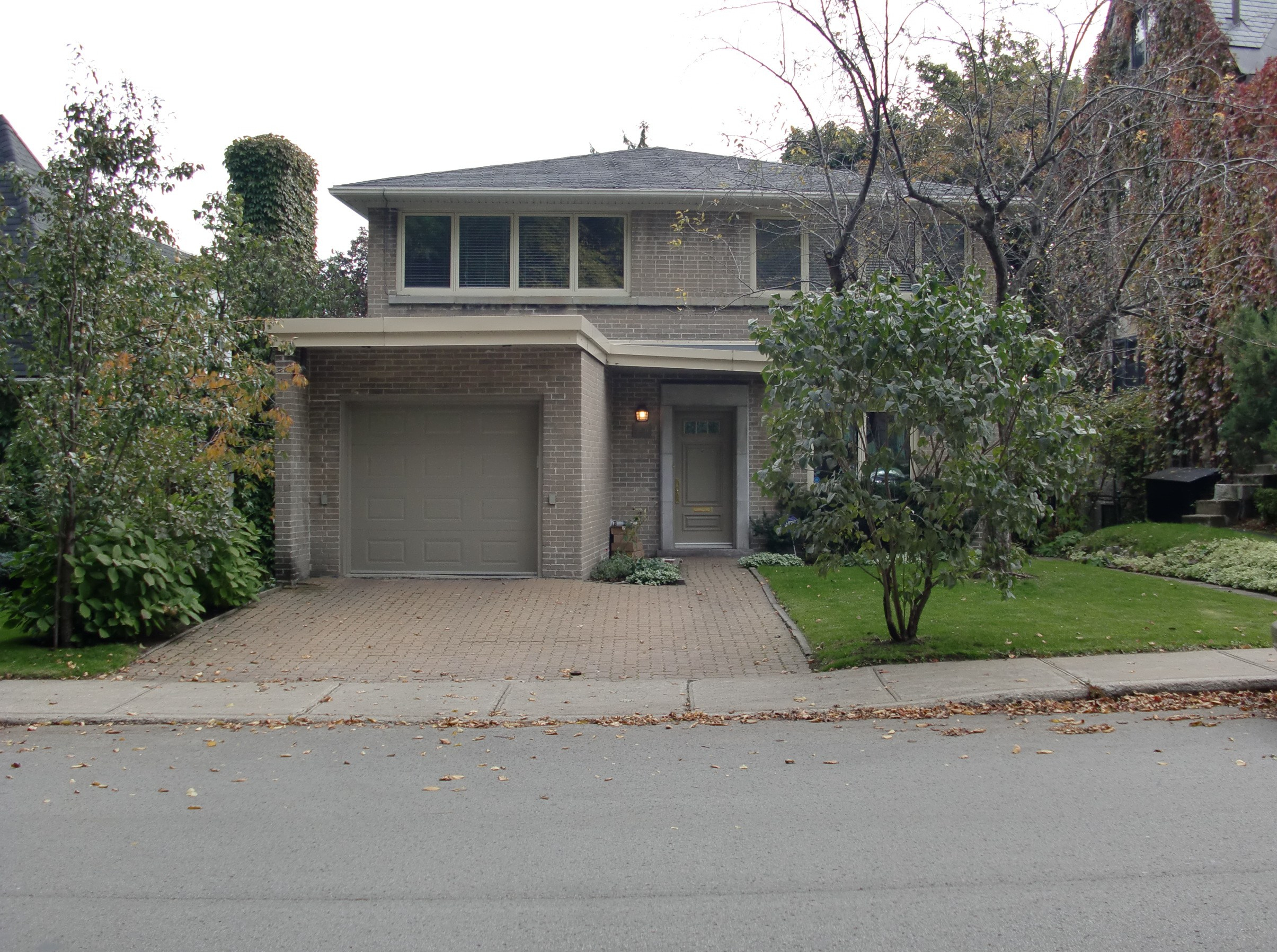
Ann’s parents gave them a piece of land just up the hill from them on St. Sulpice Road in October 1951. Tom designed the house himself to fit the lot and to this day it remains an original and sophisticated design.

3170 St Sulpice - 2010
3170 St Sulpice (2010) – built by Ann and Tom in 1952

In order to proceed with building the house, Tom needed a loan, which was difficult to obtain at that time. Eventually, Standard Life approved the loan and the house was built for about $18,000. According to the financial records, the loan was paid off in five years.

The interior of the house was completed, with Ann’s help, only as needed and in between children.

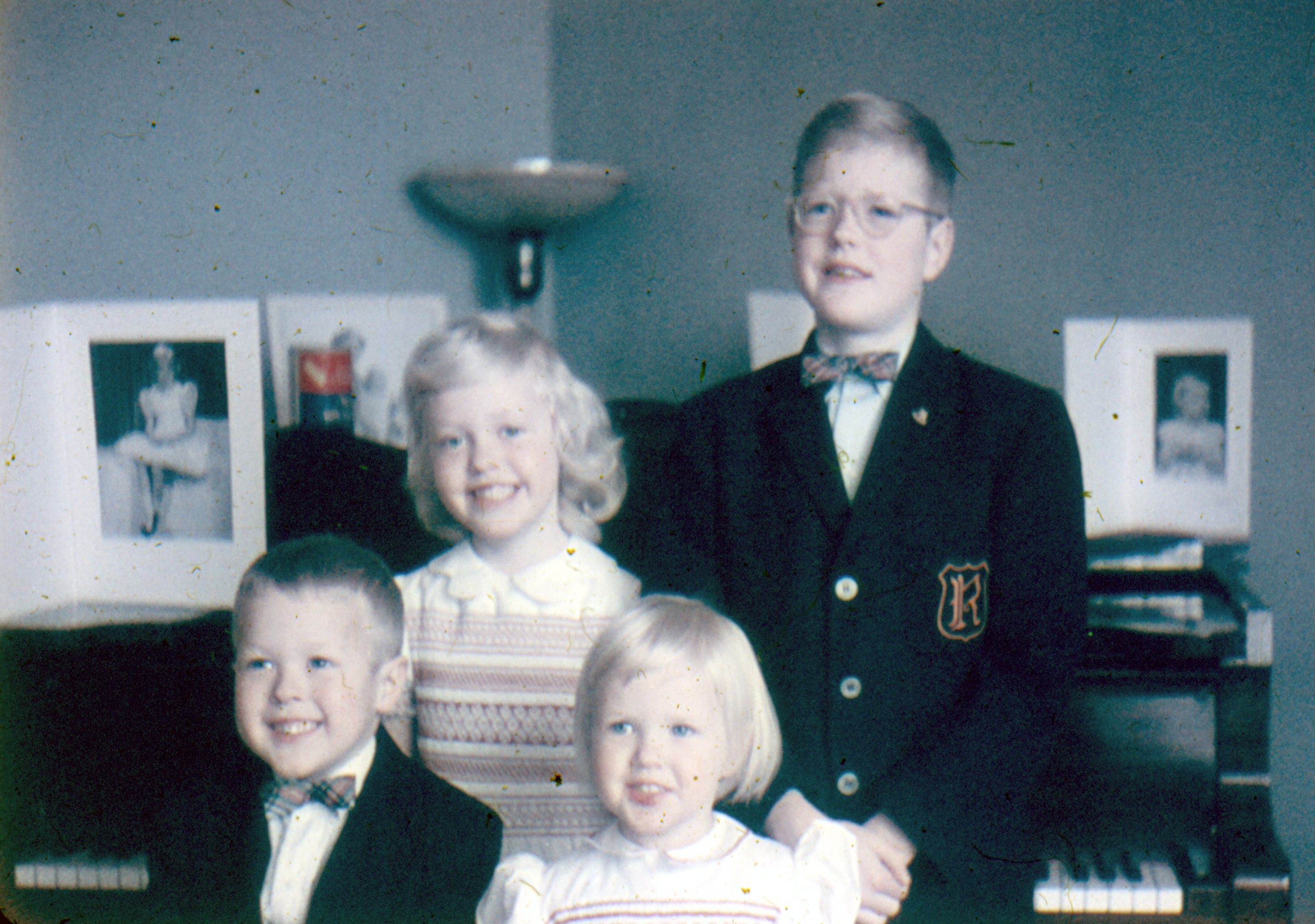
Their first son Bill was not an easy child, according to my father, and my mother found herself consumed by his needs. No small wonder it took five years before they had my sister Margaret. After Margaret was born, they really had their hands full and before they knew it my brother John was on the way. My father said the doctors were concerned but Ann seemed to thrive on motherhood. And three years later, in 1957, I was born.

Somehow during this busy time Ann wrote a short story which described a night in their life with small children:

“…Another wail woke them up. Then another, then tears. John was crying, so was Margaret, yelling hard and Bill was coughing and in tears. They both moaned, hopped out of bed and started laughing. Pandemonium had broken loose! ‘There’s nothing like a good night’s sleep’ she mused. ‘The advantages of bachelorhood are extremely obvious at a time like this’ he chuckled and then each picked up an unhappy child.”  (Ann Lindsay Anglin – March 17, 1955)

1959 - The Anglin Children
1959 – The Anglin Children

As the family grew and thrived during the first twelve years of their marriage so did Tom’s engineering business. Sometimes Ann was able to join him on the odd business trip. It was during one of these trips in March 1960 that she felt ill.

The devastating diagnosis was cancer.

During the year and a half that followed, my father did his best to juggle children and career with taking care of his beloved Ann. He wrote long desperate prayers and took up yoga in an effort to cope. It must have been heart-wrenching for him to watch my mother endure the effects of experimental chemotherapy. Advertisements were submitted to the local newspapers in search of “a capable woman willing to do her best to look after a home and four children”. Both families scrambled to assist in any possible way.

In November 1961, my dear mother and Tommy’s Ann, passed away at the age of thirty-five.

Their love lives on in each and every one of their children, grandchildren and great-grandchildren.

I feel very fortunate to have been part of their extraordinary love story.

The Priest

The Courtship of Ann and Tommy – Part 1

The Courtship of Ann and Tommy – Part 2

Quebec Guardianship Records can help resolve brick walls

Tutelle et Curatelle (guardianships) of the region de Montréal 1791-1807 and of Quebec City, 1639-1930

Life was often short in our ancestors’ times. Epidemics swept through communities, tuberculosis took many, and accidental injuries killed others at a young age. Not every parent lived to see children grow to adulthood.

In Quebec, there was a system to ensure that children who had lost one or both parents, as well as people who were unable to care for themselves, had guardians to look out for them. When a parent died, male family relatives and friends would meet together with a notary and decide who that guardian was to be. The notary would write a legal document known as a tutelle et curatelle to make the guardianship official.

These documents can be very helpful to family history researchers. They can help us understand how a family got through a crisis, and they can also shed light on family networks by identifying the uncles, family friends and so on who were present.

To actually read these documents, you may have to visit the archives. Meanwhile, in this article, I will explain how to find the tutelle et curatelle records that are online.

Tutelle et curatelle records are filed separately from other notarial documents at the Bibliothèque et Archives nationales du Québec (BAnQ). The BAnQ in Montreal alone has more than 300,000 linear meters of these documents, dating from 1658 to 1974, and other branches of the Quebec archives have many more such records.

Definitions

Today, people think of a tutor as a teacher, not a guardian. In this article, we have to understand that both tutors and curators are guardians: tutors are guardians of children, and curators are guardians of young adults.

There were two types of guardianships in Québec:

Tutelle testamentaire – Guardianship governed by a will (testament) issued by a notary in which the surviving parent (father or mother) of the children would assign the guardianship of his or her young children to an adult family member or close friend.

Tutelle légitime – Guardianship governed by the judicial courts, in which full legal tutorship is accorded to the closest adult relative (uncle, aunt, older brother, older sister.) It appears that the majority of guardianships decreed in Québec were this type.

The use of guardianships dates back to the mid-1600s and the first days of the French colony of New France, where the age of majority was 25. After 1783, under British rule, the adult age was 21.

Around 1791, British Laws were implemented in Quebec. The laws governing various judicial jurisdictions were grouped under the general heading of Laws of Canada and among those was one such law governing the tutorship (guardianship) of children and incapacitated adults. The latter dealt with those who could not take care of themselves and needed supervision by others. In 1865, the Civil Code of Lower Canada basically addressed the same issues with slight variations of content.

Searching for the records

If your ancestors lived in the Quebec City region, you are in luck. Familysearch.org has placed online tutelle et curatelle records from 1639 to 1930. Take a look at the wiki page, https://www.familysearch.org/wiki/en/Quebec,_Quebec_Judicial_District,_Guardianships_(FamilySearch_Historical_Records)

You can access the actual records at

https://www.familysearch.org/search/collection/1399459

There are more than 300,000 images and they have not been indexed, so you will need to browse them. They are separated into numbered files by year.

In another, separate database, the BAnQ in Montreal has placed online tutelle et curatelle notarial records from 1791 to 1807. Even within that short time frame, this database contains 22,879 searchable links. In the future, more such records will likely be made available online.

To access this database, go to http://www.banq.qc.ca/archives/genealogie_histoire_familiale/ressources/bd/instr_archives_civiles/tutelle_montreal/index.html

This is what you will see on that page:

Tutelle et curatelle (Tutorships and guardianships)

On this page, click on the blue box on the right side of the page that says Consultation de l’instrument de recherche (Access to the searchable online database.)

The next page will indicate: Nouvelle recherche (New Search), and one line below in the colour blue, Chercher par (research by):

Nom (family name)

Prénom (first name)

Titre (title) – Enter Tutelle

Acte (Tutorship Act) – Enter Tutelle

Date – Enter the date of the date of event.

If your family name was not a common one in Quebec, you can simplify your search. Go to the page https://applications.banq.qc.ca/apex/f?p=148:2::::::  Then, next to Nom, just enter the family name you are researching.

The database includes the following information:

Pupille (First name of child)

Date tutelle (Date of Tutorship decreed (judicial order))

Défunt (Deceased person) In most cases, the name of the father or mother

Tuteur (Tutor), the person described on line 1 and line 2

Autre (Other) – In rare cases in which limited information is available in regard to a particular act of Tutorship

The Next Step in Your Research

Unfortunately, the information obtained in this online database is basic at best. By clicking on Détails on the right hand side of each name, you will access another page indicating the family, first name of the child, and the date of the tutorship.

For example, I entered the name of Smith under Nom. This search resulted in 25 results from 1796 to 1807. I picked one, Enos Smith, and the results obtained online under Détails read as follows:

Nom: Smith

Prénom: Enos

Titre: Pupille

Acte: Tutelle

Date tutelle: 1804-02-07

At the bottom of the page, a box will appear:

> Seul le contenu sécurisé s’affiche (Only the secured information will be posted) >> Afficher tout le contenu (Access to content of file)

The results obtained are precisely the same as the previous page. This most likely indicates that you can only see the full content of the original document by visiting the BAnQ.

For the closest branch of the BAnQ, see

http://www.banq.qc.ca/archives/entrez_archives/centres_archives/index.html

There are 10 branches of the BAnQ across Québec. The repository in Montréal is listed on the website under Vieux Montréal; the archives in Quebec City under BAnQ Québec, the branch in Sherbrooke in the Eastern Townships under BanQ Sherbrooke, and the branch in western Quebec near Ottawa is called BAnQ Gatineau.

Always contact by email the archives branch to confirm whether the record you wish to access is actually stored at that branch. Emails written in the English will be answered in the English language.

I recommend for the initial requests to be sent by email. Once you have obtained the name of the technician assigned to your dossier (file), telephone calls are in order. And once you reach the archives, you may need help locating the tutelle et curatelle files.

Compiled, adapted and researched by Jacques Gagnégagne.jacques@sympatico.ca

Polio in the Family

My Auntie Elsie McHugh was quite a chatterbox and so were her budgies. When we used to visit her, the budgies filled the room with the sound of their chatter, competing to be heard. Unless it was time to go to bed, or someone was coming in the door, the budgies were free to fly around the apartment. It was quite an adventure to go there.

My Uncle Jimmy Scott was usually sitting in his favourite chair, not saying a word.

Certainly when I remember Elsie, I think about her continual stream of conversation and story-telling. But I also remember that she had a distinct limp.  This didn’t stop her from being a snazzy dresser or wearing fancy shoes.

Scott, Jimmy and Elsie McHugh

Jimmy Scott and Elsie McHugh

As an adult, I learned that Auntie Elsie limped because she was stricken with paralytic polio when she was an infant living in Dundee, Scotland at the beginning of the 1900s.1 While today, polio is almost eradicated, at that time it would have been a frightening disease.

Only Elsie, out of the family of seven children, contracted poliomyelitis, the medical term for polio. Dr. Ivar Wickman of Sweden proved that polio was contagious in 1905. This was probably after Elsie was sick. And it was not until the 1930s that it was discovered that it was an intestinal infection and spread by the oral-fecal route, and not an airborne virus, as previously thought.2

During Elsie’s childhood, the family lived in a tenement in industrial Dundee, near the jute factories. There was overcrowding and poor sanitation.

In children, paralysis from polio occurs one in a thousand cases. Most children are simply sick and consequently develop an immunity to it.3 It is probable that Elsie’s siblings were also exposed to polio, but they suffered from no permanent consequences.

Because young Elsie limped and probably could not run or jump very well, she was considered disabled or “crippled.” As a result, she attended a special school to learn cooking, needlework and housekeeping. The other girls in the family resented the special education that Elsie received.

In Scotland, children had to attend school between the ages of five and thirteen. In addition, the morals and tenets of the Church of Scotland were influential. The church believed that children should be taught to be self-sufficient.4 Therefore, there was considerable pressure on educational institutions to provide for all children, including the blind, deaf and physically disabled.

Throughout the 1800s, institutions for the blind and deaf were opened in the major cities in Scotland.5 It is likely that Elsie attended one of these institutions as some of them expanded to include “cripples.”

The family immigrated to Montreal, Canada in 1912. Elsie was fourteen and would have finished her schooling by then. As far as I know she always worked in a department store as a saleslady, but like many women at the time, she quit her job when she married Jimmy Scott in 1926.6 Her daughter, Norine Scott, was born the next year. 7

Many people who have had polio in childhood experience symptoms of fatigue, weakness in the muscles, pain and breathing problems later on in their lives.8 I remember Auntie Elsie used to have difficulty breathing but she always said that it was old age.  Elsie never let anything get in the way of her enjoying life and she lived to the respectable age of 91.9

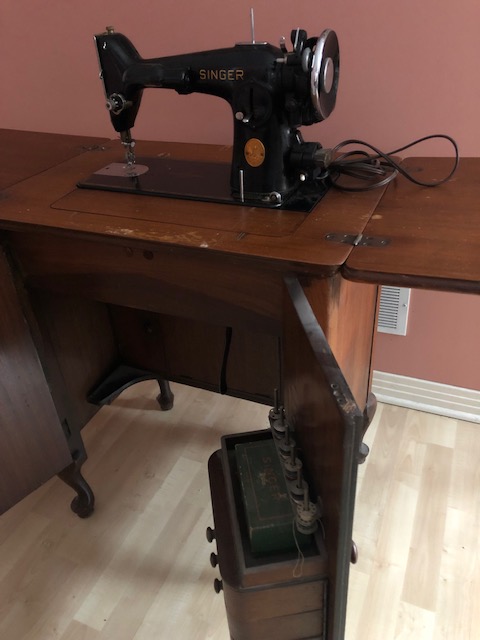
She did put her skills to good use at home, cooking for the family and sewing. I have inherited her Singer sewing machine, although I don’t sew at all. The machine works by pushing on a lever with your knee. It is a lovely piece of furniture in my home and, more importantly, a beautiful keepsake of my Auntie Elsie.

sewing machine


  1. Birth register of Elsie McHugh, November 10, 1898, District of St. Mary, Burgh of Dundee, National Records of Scotland, Scotland’s People web site, accessed December 1, 2017.
  2. Post-Polio Health International, History of Acute Polio, Tony Gould, unknown date, http://www.post-polio.org/edu/aboutpol/hist.html, accessed January 28, 2019.
  3. Wikipedia, History of Poliomyelitis, https://en.wikipedia.org/wiki/History_of_poliomyelitis, accessed January 28, 2019.
  4. The Semantic Scholar, Voices from the Past, Early Institutional Experience of Children with disabilities – The case of Scotland, Iain Hutchison, https://pdfs.semanticscholar.org/f5d8/80cd842c518f3bc8a2dd3f5fb4e359eecf7e.pdf, accessed January 28, 2019.
  5. Ibid.
  6. Personal notes of author.
  7. Personal notes of author.
  8. Post-Polio Health International, History of Acute Polio, Tony Gould, unknown date, http://www.post-polio.org/edu/aboutpol/hist.html, accessed February 6, 2019.
  9. Personal notes of author.


The Protestant Churches of Quebec City, 1629-1759

Some 15 or 20 years ago, someone asked me to research and compile a document addressing the earliest Protestant churches in Quebec and find out where the church registers are. Listed here are Quebec City region Protestant missions organized from 1629 to 1759. None of the church registers have survived.

A number of Huguenot merchants from La Rochelle, Bordeaux and Rouen, France were present in Quebec City in September, 1759 when the British army conquered the French forces at the BattIe of the Plains of Abraham. More than a century before those events, Huguenot merchants were members of a small Calvinist church in Quebec City.

1629 Lutheran Chapel – It is on record that the Kertk (Kirke) brothers, and a small group of French Protestants (Huguenots from France), who captured Québec in the name of King Charles I of England on the 20th of July, 1629, built a Lutheran Chapel in Nouvelle France at the time. David, Louis, Thomas Kertk (Kirke), their wives, plus two other women and an undisclosed number of men worshipped until 1633 in Québec.

1631 – Temple Calviniste – A small community of Huguenots (Reformed Church of France) established a Calvinist Temple in the old city of Québec in the early 1630s or shortly after. The small temple would have been located near the Couvent des Ursulines. Most of the Huguenots at the time in Québec were traders who imported goods from French ports such as Auray, Bayonne, Bordeaux, Brest, Caen, Calais, Cherbourg, Dieppe, Dunkerque, Fecamp, Le Havre, Honfleur, La Rochelle, Lorient, Nantes, Paimboeuf, Port Louis, Rochefort, Rouen, Royan, Les Sables d’Olonne, Saint Brieuc, Saint-Malo and Vannes. These same Huguenots were also merchants, mainly in the purchasing and exporting of fine furs and selected hardwoods in New France. This small but thriving Protestant community was instrumental in opening-up trade partnerships between Nouvelle France and fellow Huguenot associates in France and other European countries including Belgium, the Netherlands, Germany, Switzerland and the British Isles.

1759 – Chapel of the Ursulines  – First Anglican Church service in Québec on September 27th 1759 – Rev. Eli Dawson, presiding – Chaplain of the British Forces headed by the late General James Wolfe, Commander in Chief of the British Imperial Army – In attendance were French speaking Huguenots from the Québec region.


A Soldier’s Fortunate Care

Lawrence Tarrant, known as Larry, was forever thankful to a young female doctor in England for saving his arm during the First World War. He was left with a permanent crook at the elbow where four inches of bone had been destroyed and an inverted hand missing the index finger. Of critical importance was that the skillful repair allowed him sufficient mobility in the arm to later hold down a job and raise a family.

Larry, the grandfather my son never knew, signed up for service on March 25th, 1916 in Magog, Quebec and was assigned to the 117th Battalion of Canada’s Expeditionary Force. He was a teenage boy of eighteen. Lance Corporal Larry arrived in England in August of 1916 but once there requested to be reverted to the rank of private. He knew this move would enable him to proceed immediately to France with the 24th Battalion His brother Lloyd had been killed at Mount Sorrel two months earlier. It would seem that Larry was determined to “get them” who had killed him.

On August 28, 1918, Larry was injured at the Battle of Arras. Canada’s 2nd and 3rd Divisions had been led into this battle by the British General Sir Arthur Currie. Currie’s questionable strategy was to launch successive frontal attacks on the German trenches in order to exhaust the enemy. Although very successful, the cost to Canadian soldiers was huge. Arras was the start of “Canada’s Hundred Days”, the series of offensives led by Canadians that culminated in the Allied final victory at Mons in November. At Arras, however, Larry was shot in the head, legs, and left arm, and was evacuated to England. Although badly wounded, he was actually one of the lucky ones. The total loss to the Canadian Corps during the Hundred Days was eleven thousand men.

In England, Larry was sent to Endell Street Military Hospital in London, another stroke of luck as it was one of the most remarkable hospitals of the war. Entirely staffed by women and the only women’s unit operated by militant suffragists, it was known not only for the skill of its surgeons but for its highly distinctive nurturing care. The staff concentrated on the psychological as well as the physical needs of their patients. Larry claimed that his doctor never gave up on saving his arm but it is just as likely that his doctor never allowed him to give up on himself.

Larry spent almost two years in England recovering from his wounds, first at Endell and then in Epsom, Surrey. His recovery was compromised by influenza so severe that he was hospitalized for weeks in yet another hospital at Hardelot. In August of 1919 he returned to Canada and a military hospital in Toronto. He was ultimately discharged from the army in 1920 as medically unfit for further service  He was only twenty-two years old, hardly yet a man but with four years of hell behind him.

On his return to civilian life Larry found work as a machinist at a paper mill in LaTuque, Quebec where he spent his entire career. He married Flora Tremblay in 1939 and fathered three sons and a daughter. He died in 1962 of a blood clot following routine gall bladder surgery. He was sixty –four. His eldest child, Lloyd, my son’s father, was nineteen. Today my son carries his grandfather’s name: Stephen Lawrence Tarrant.

001 (2)

Larry with wife Flora, two of his three sons (Lloyd and Gerry), his daughter Linda, and a the daughter of a cousin (Susan). His third son (Gordon) was born later.

The National Archives of France

The National Archives of France is not the most advanced institution in terms of its digitized holdings, however, if you are researching French culture and history, you should be aware of it, and it may be helpful if your French ancestors were among the upper classes.

The Archives nationales (France) is making efforts to facilitate its online research process. You can find an introduction to the catalogue online in French, English and Spanish, and access it from there. For English, see http://www.archives-nationales.culture.gouv.fr/en/web/guest/salle-des-inventaires-virtuelle. Also go to http://www.archives-nationales.culture.gouv.fr/en_GB/web/guest/faire-une-recherche

Examples of the archives’ holdings include maps, photographs, documentation from the two world wars, and the records of Paris notaries. In addition, the archives has research centres focusing on topics such as place names and heraldry.

For many years, people with French Canadian or Acadian family lineages who wanted to know more about the research process in France have asked me whether the Archives nationales (France) in Paris was the place to conduct a family search. I have always replied that, if your ancestors in France were considered as nobility (familles nobles), yes, the Archives nationales de France is an online address you should consider. To check out the archives’ holdings on the ”bourgeois families” of France prior to the French Revolution, see https://www.siv.archives-nationales.culture.gouv.fr/siv/rechercheconsultation/consultation/pog/consultationPog.action?pogId=FRAN_POG_05&existpog=true&preview=false

However, if your ancestor was from the working class, you should conduct your online searches in the 95 Archives départementales de France. See my article https://genealogyensemble.com/2018/09/23/finding-ancestors-in-french-municipal-archives/

At the bottom of the following Archives nationales page, you will find links to a number of sites related to genealogy in France: http://www.archives-nationales.culture.gouv.fr/web/guest/signets-sciences

For many years the navigation process on the Archives nationales site was burdensome, and results posted from an online search would only indicate the dossier numbers (“fonds”) and a brief description of the fonds, followed by the ”série” (category of fonds) and the ”cote” (shelf  number). If you one wanted additional information on the content of a dossier, you had to send an email to Paris.

As of September, 2018, even if you find your family name, in order to access the biographical material of that family, you must visit the Archives nationales (France) in Paris. To further complicate matters, the Archives nationales has more than one repository in Paris, and you must first determine in which repository the records you want to see are kept. You also need to determine the spelling of the family name in France at the time. For example, my name, Gagné, was spelled Gasnier.

Discovering Scottish and Irish Roots

My former red hair often had people asking where in Scotland I’m from. For years, I knew of no Scottish blood relatives. Now, I’ve finally found Scottish and Irish roots on my mom’s side.

Turns out that great granny Keziah Charlotte Mcmaster Charboneau, whose birth took place almost exactly a hundred years before mine, identified as ‘Scotch’ even though she never lived in Scotland.

Keziah’s heritage demonstrates a clear cultural tradition in my family of identifying children with their father’s heritage.

She could have identified as Canadian, given that her birth took place in Orangeville Ontario. She might have been Irish, because her mom Mary Willard’s birthplace was Ireland. Still, it was her dad Robert Mcmaster’s birthplace that was important. He was born in Scotland, although I don’t know where.[1]

Even though her parents had different heritages, Keziah identified as “Scotch.”

1901 Census

Yet, some crossed-out hashtags next to her eldest child on the 1901 census indicate that someone wanted to make sure her children were seen as French.

The enumerator probably initially assumed the children shared their mother’s heritage of ‘Scotch’ because the entire family was English-speaking and practiced the Brethren religion. Many of the people he interviewed in the village of Weston, Ontario practiced the protestant denomination stemming from a German movement that began in 1708.

His mistake got corrected, however, presumably by 38-year-old Keziah herself.

Clear hashtag marks indicating that Etta was Scotch were scratched out to write in the word “French” to match the heritage of their father, Paul Charbonneau, who appears in a 1917 Weston resident list as “the caretaker who lives in the house on the east side of Cross street.”

The rest of the hashtags identify all ten children—from two-year-old Wilbert, through six-year-old John, eight-year-old Zelia, nine-year-old Charlotte, 15-year-old Paul, 16-year-old Henry, 18-year-old Latton, 19-year-old Maggie and 20-year-old Etta—as French like their father, not Scotch like their mom.[2]

Keziah and Paul’s first son, Matthew Dalton Charbonneau[3] doesn’t appear at all, perhaps because he lived elsewhere on March 31, 1901 (the day the census is supposed to represent). He’s on earlier and later censuses though. Eight summers later, he married Edith Daniels in Toronto.[4]

Death Certificate

Even when family members had more information, they carried on the tradition of father-centred heritage. Kezia’s son, J.P. Charbonneau described her as “Scotch” on her death certificate just a few lines before identifying her parents’ birthplaces.

Keziah’s death took place in her son’s home at 111 St. Johns Road in Toronto. She died there of chronic myocarditis (heart failure) on July 30, 1932, at the age of 76 years old.[5]

She’s buried in Weston’s Riverside Cemetery, 1567 Royal York Rd, Etobicoke, ON M9P 3C4. I plan to look for her gravesite when next in Toronto.


[1] “Ontario Deaths, 1869-1937 and Overseas Deaths, 1939-1947,” database with images, FamilySearch (https://familysearch.org/ark:/61903/3:1:S3HY-DC6K-4G?cc=1307826&wc=3LV1-DP8%3A1584243504%2C1584252301%2C1584254001 : 19 May 2015), Deaths > 1932 > no 3918-5556 > image 1593 of 1748; citing Registrar General. Archives of Ontario, Toronto.
[2] “Canada Census, 1901,” database with images, FamilySearch(https://familysearch.org/ark:/61903/1:1:KHPQ-6NG : 18 March 2018), Keziah Charboneau, York (west/ouest), Ontario, Canada; citing p. 8, Library and Archives of Canada, Ottawa.
[3] Ontario Births, 1869-1912,” database with images, FamilySearch(https://familysearch.org/ark:/61903/1:1:VNL1-HYW : 16 July 2017), Matthew Dalton Charboneau, 30 Nov 1882; citing Birth, Weston, York, Ontario, Canada, citing Archives of Ontario, Toronto; FHL microfilm 1,845,583.
[4] “Ontario Marriages, 1869-1927,” database with images, FamilySearch(https://familysearch.org/ark:/61903/1:1:KSZV-DMR : 11 March 2018), Dalton Charboneau and Edith Daniels, 22 Jul 1909; citing registration , Toronto, York, Ontario, Canada, Archives of Ontario, Toronto; FHL microfilm 1,871,870.
[5] “Ontario Deaths, 1869-1937 and Overseas Deaths, 1939-1947,” database with images, FamilySearch (https://familysearch.org/ark:/61903/3:1:S3HY-DC6K-4G?cc=1307826&wc=3LV1-DP8%3A1584243504%2C1584252301%2C1584254001 : 19 May 2015), Deaths > 1932 > no 3918-5556 > image 1593 of 1748; citing Registrar General. Archives of Ontario, Toronto.

Tips on Researching Gaspé Ancestors

Over the centuries, Quebec’s Gaspé Peninsula has been home to a mix of residents including the Micmac First Nations people, French settlers, Acadians and Loyalists. The Gaspé is surrounded by water on three sides — the estuary of the St. Lawrence River, the Gulf of St. Lawrence and the Bay of Chaleur – so in the past, many Gaspé residents made their living by fishing, however, the fishing industry has changed and suffered in recent years. The interior of the peninsula features mountains, forests and rivers.

If you had ancestors from the Gaspé, the idea of researching their lives might seem daunting. It is a long way from central Canada, and many people in the region do not speak English today. However, there are a number of databases and other resources online, and you can contact the archives there to ask for help.

The attached PDF has links to a variety of resources, including background on the Loyalists who came from the United States after the revolution and settled in the area. The major part of this document lists the notaries who practised in the Gaspé. Their records should help you find your ancestors’ land transactions, business agreements, wills, inventories, and other records.

One of the best researchers to have studied the people of the Gaspé was Michel Émard, a medical doctor, historian and author. This research guide tells you where to find the books he wrote. It also tells you how to contact the main archives serving the area.

Here is the link to the PDF: notaries of the gaspé peninsula guide