
Since time immemorial parents have lost children to the far flung reaches of the globe. They left home to serve their country, to preach the Word, to better their own lives or to simply seek adventure.
Today, advances in transportation and modern technology allow families to keep in close touch no matter how far apart they find themselves. Not so in the time of my great grandfather. When five of his seven sons left Scotland at the turn of the twentieth century he knew he would likely never see them again.
My great grandparents, David Angus (1842-1929) and Ann Rankine, had themselves left their families to seek employment elsewhere. David was a shoemaker. They settled in the Glasgow district of Partick a short day’s journey from their home village of Kincardine. Of the nine children born to them in Partick only two were girls, the younger dying in infancy.
By the end of the nineteenth century Glasgow had become a heavy industry and shipbuilding center. The influx of workers into many Scottish cities was so rapid that housing, city planning and provisions for health care couldn’t keep up. This unplanned growth created squalor and over-crowding on a massive scale. Two-thirds of Scots were living in one- or two-roomed houses compared with only 7 per cent in England. Poverty was widespread, wages were low in comparison with other parts of the UK and infant mortality rates were alarmingly high. (1)
Two of David’s sons, David and Ebenezer, escaped this desperate social situation when they immigrated to Australia, David to Melbourne and Ebenezer to Sydney. They both raised families the descendants of which live in Australia today. Both brothers are buried in Australia
Thomas settled in Malaysia as a missionary. He was likely inspired, as were many others at the time, by the legendary African exploits of David Livingston from nearby Blantyre (2). Although the family lived in Kuala Lumpur, Thomas sent his daughters, Kathleen, Joan and Margery, to a missionary boarding school in southern India, the same school I attended years later when my own father worked in East Pakistan. Typically missionaries went on furlough every five years so Thomas may have seen his homeland again.
Andrew did not stray far from home. He lived and died in East Bourne, England and we can presume he returned to Scotland frequently.
My grandfather James (1879-1964) immigrated to Canada and settled in Quebec City. It was many years after his father had died before he was able to return home. He took his Canadian “bride” to Glasgow for their fiftieth wedding anniversary. His only sister Rachel, with whom he had faithfully corresponded over the years, suffered from dementia at the time of their visit and hid from him. A sad ending to their long distance relationship.
The two sons who remained in Scotland, John and William, died in middle age. It was Rachel who cared for their widowed father in the last years of his life. My father and his two brothers spent time with their aunt at her home in Steppes when they were stationed in England during World War II. Their visits were too late for their grandfather.
Today there are more people of Scottish descent living in countries around the world than there are Scots in Scotland. My family is part of this diaspora.
- http://www.educationscotland.gov.uk/Images/MigrationandEmpire1830- 1939_tcm4-571546.doc
- http://protestantism.enacademic.com/389/Livingstone,_David
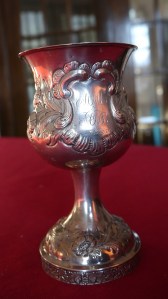 Research revealed that MJM was MacGregor Joseph Mitcheson (1828-1886), and AJB was his 10-month-old niece Amelia Josephine Bagg (1852-1938). This must have been a gift MacGregor sent Amelia for her first Christmas. A fancy goblet seems like a rather strange present for a young man to give a baby, so perhaps it was a tradition, or his parents’ idea.
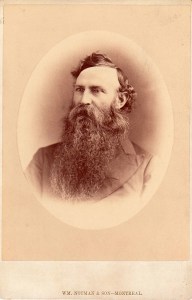 MacGregor must have been an unforgettable house guest. His blue-grey eyes and long brown beard give him a rather wild appearance.1 He also had a forceful personality. In a book on Philadelphia lawyers, written some 30 years after MacGregor’s death, a former colleague recalled, “There never was an advocate who fought harder, or who merged his excessively egotistic personality more completely in that of his client. In another important sense was he entitled to great praise. He had a ready and instinctive perception of every essential fact in a case, in all its bearings, and a fine gift of memory for retaining them …..”2





 Genealogy Ensemble