Category Archives: Genealogy

Transportation carries people west

It constantly amazes me how technology can influence where people live.

When I was examining the lives of my great great grandparents and their predecessors on my fathers’ side for instance, I noticed that their moves usually followed easier travelling circumstances.

In 1815, for example, a small settlement known as Bear Brook arose along the border of a small creek by the same name. The area is now in Russell County. Initially, settlers from Montreal used the waterway to get there. By 1820, a new road from Montreal replaced it to link then-Bytown (Ottawa) through Cumberland, Clarence Point, Plantagenet Mills, L’Orignal and Hawkesbury.

My great great great grandparents were among many French-Canadian families from Lower Canada who travelled along the new road to settle in the area in 1854 to farm.

There must have been some Irish among them too, because part of the community was renamed Sarsfield twenty years later to honour Irish hero Patrick Sarsfield.

By then, loggers used the old creek and to float timber to mills in Carlsbad Springs. They were still doing so when Gustave Hurtubise was born in Sarsfield in 1884. Gustave, the elder brother of my great great grandfather was the first child from our family born in the town. Two years later, our cousin Sévère D’Aoust built the Roman Catholic Church in the village where my great grandfather Jean-Baptist would be christened. That same year, the community lobbied for a local stop along J.R. Booth’s Railway line in 1886. They built a small building to entice Booth.

Jean-Baptist Hurtubise arrived in Sarsfield on February 16, 1889. His future wife, Marie-Berthe (known as Martha) Gourdine, was born in a neighbouring town, Clarence Creek, October 3 the same year.

The year the youngsters turned eight, the Old Montreal Road got paved and engineers constructed the Canadian Northern Railroad through Cumberland to Hawkesbury.

They were only 16 years old when the two got married in Clarence Creek on January 7, 1915

My grandmother, Anne Marguerite Hurtubise was born in the same town the following November. Her sister Donna came a year and a half later.

The family left Sarsfield and moved to Cluny, Bow River, Alberta, sometime between Donna’s birth in 1917 and the 1921 Canadian Census. By this time, the train was established across the country, so they and others took it to go west.

For some great shots of various buildings in the town from that period, refer to the images on http://www.prairie-towns.com/cluny-images.html.

Somehow, the couple got land and a home. In 1921, the Census reported that 31-year-old Jean owned a farm with a three-bedroom wooden house on it.1 It was located in section 7, township 22, range 21, Meridian 4. His wife Martha and the two girls didn’t work.

Unfortunately, they arrived just in time for five successive droughts that we now know as the Prairie Dry Belt Disaster.

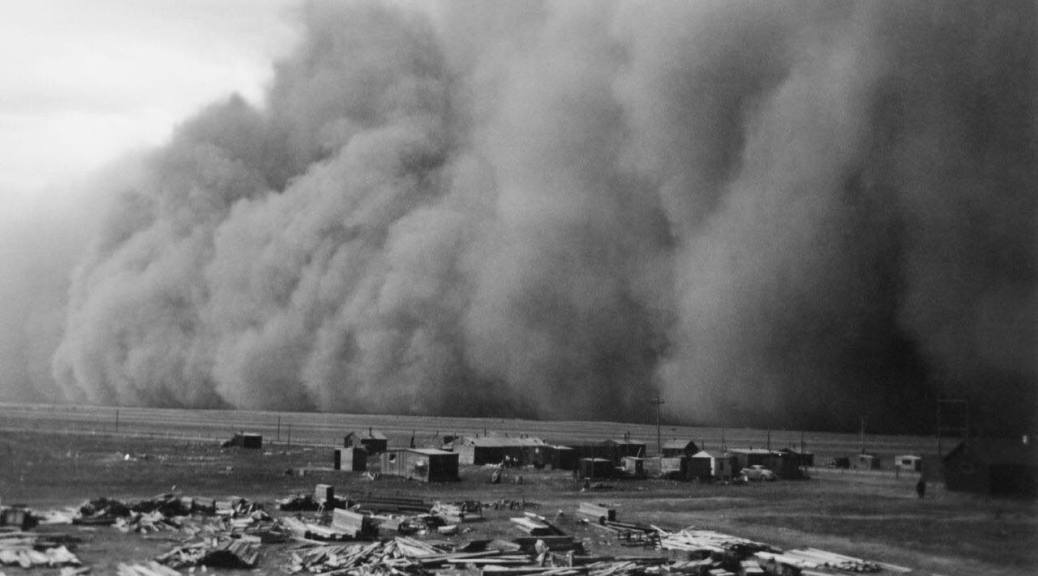
In 1931 and 1932 they suffered from the dustbowl, when top soil was so dry that it blew into homes.

Then the locusts came in 1933.

I grew up listening to stories about those times, but got a better understanding of what they faced when looking at the photos on a University of Saskatchewan website https://drc.usask.ca/projects/climate/.

My great great grandparents were among 750,000 farmers who had to abandon their farms between 1930 and 1935.

By 1938, the family had moved to Edmonton and my grandfather and his wife had to depend on the incomes from their daughters’ jobs, my grandmother as a nurse and her sister as a clerk, to survive.

1Data from the 1921 Census of Canada, Enumeration District 2, Bow River, Alberta, section 7, township 22, range 21, Meridian 4, page 6, line 28.

The Needlework Sampler

Edited 2024-09-09

(I am very fortunate to have my 3x great grandmother’s needlework sampler hanging on my wall.)

I can hardly contain my excitement! Mother says it is time that I learn my stitches and embroider my very own sampler. And I am only ten years of age! 

What a shame, though, that I must complete my daily chores before I am allowed to work on my sampler!  I wish my little brother would help out a bit more.  However, I must remember that Mother and Father work so very hard and we must do our part without complaint.

Creating the border around the outside edge has been excellent practice getting used to the needle and thread.  I have quickly mastered this simple first stitch.  Oh, how I love the stiffness of the cotton fabric! The silk threads feel heavenly but are annoying when they get tangle too easily. And it’s a shame that their colours aren’t somewhat brighter. Mother says the important thing is to learn the stitches and never mind complaining about the rest.  She has many to teach me  – the cross-stitch, the slipstitch, the whip stitch, the satin stitch and eventually the French knot!

Sometimes it’s difficult to pay attention during my classes at school.  The headmaster tells us that James Madison is our President and that we have 15 stars and 15 stripes on our flag which represent all our states.  The British are restricting our local trade and making our young American men join their Royal Navy which doesn’t seem fair.  And what about the Indians…is America ours or theirs?  It’s very hard to concentrate and be a good pupil when I’d rather work on my sampler!

I’ve started sewing my alphabet letters now.  Capitals first and then the lower case ones.  They are quite tricky and take a lot of patience.  Oh, how I wish I had more patience!  But Mother says that I am doing very well and that some girls are two or three years older than I am before they begin their samplers.

The other day, my brother put a huge beetle in my sewing basket!  Ewww! Why do boys have to be so silly? Maybe if he did more chores, he wouldn’t have time for pranks!

Numbers are wonderful. Stitching twelve numbers is much simpler than all those upper case and lower case alphabet letters!

It’s hard to believe the number of stitches that I’ve already completed  when there so are many more to go.  Much patience is needed.

…and less chores!  Just think how quickly I could finish my sampler if I didn’t have my daily chores!

Hurry! The daylight won’t last much longer and it’s too difficult to see my stitching by candle light.

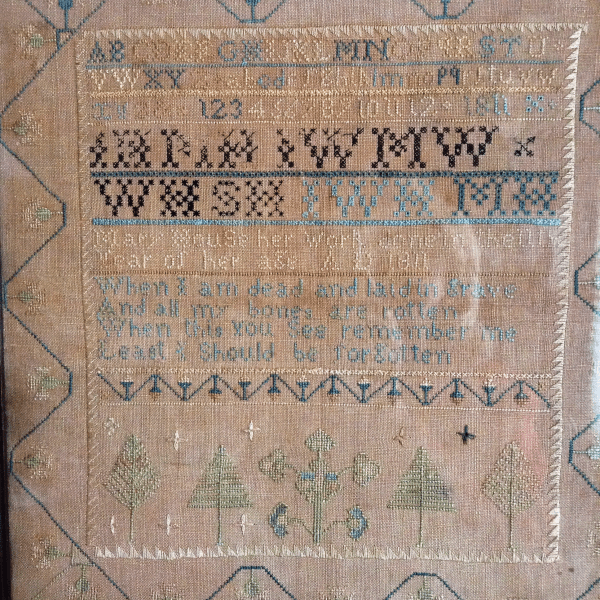
I am focusing on stitching my name now.  I like my name.  Mary House.  It looks and sounds very neat and tidy – like a row of my very best stitching.

Beside my name, I am now slipstitching the date.  It takes quite a while to create a sampler so the only the year is sown in: “my eleventh year” and 1811 A.D.  “My eleventh year” sounds so much grander than “ten years old”.  I know A.D. stands for the number of years since the death of Jesus.  Ah! Maybe I should pray for more patience.

My stitches are improving and I haven’t had to undo as many lately.  Undoing stitches is almost worse than doing chores!

Now I am working on the short poem and it is as follows:

                          When I am dead and laid in grave

                          And all my bones are rotten

                          When this you see remember me

                          Lest I should be forgotten

I wonder who wrote this poem.  It makes me sad.  And can you imagine someone admiring my sampler after I die?

At last I am finished my sampler!  Mother praised me saying that I did a very fine job indeed.  I am thrilled with it and very proud of myself. I will store it safely under my bed until I grow up.

NOTES:

 Mary was my 3x great grandmother. She died in 1830 at 29 years old.  Her sampler hangs proudly in our home.  She is not forgotten! 

The excerpt is a verse from the famous poem “To His coy Mistress” by Andrew Marvell (1621-1678)

More William Sutherlands

There are many William Sutherlands in my family. My great-great-grandfather William Sutherland ( 1816-1887) son of William Sutherland (1749-1840) came to Canada in 1845 with his wife Elizabeth Mowat. They followed the Scottish naming pattern of calling the first son after the husband’s father so his eldest son was William and then his eldest son was also William.

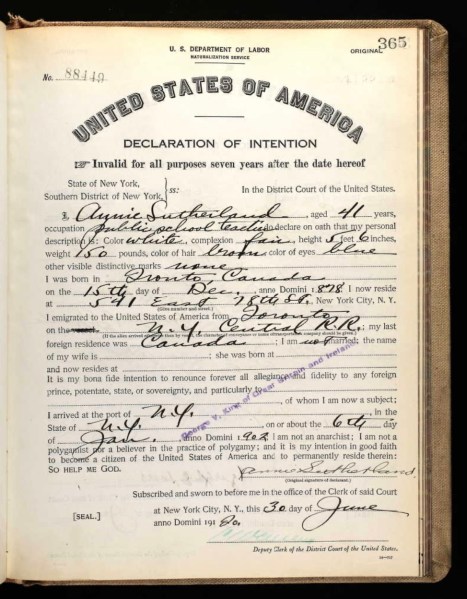
My grandfather, son of Donald was also named William. He thought the family had way too many Williams, Willies, Wills and even a Bill so he took the second name, Harkness, after his mother. There was just one mention of his first cousins, William Sutherland and his sister Annie in my grandfather’s diary. “Went to Rose Ave, Annie was there from N.Y. but Willie away in Florida.” That’s all I knew.

Luckily, cousin William also seemed to have added a middle name maybe Everard or Ewart. So instead of the thousands of William Sutherlands, he can be found as William Everard or William E Sutherland.

William first crossed the border into the United States in 1889 when he was just 16. He probably went for a job or maybe an adventure. He was born in Mildmay, Bruce County, Ontario. His grandfather and then his father owned the family farm which his father sold and moved the family to Toronto when he was a child.

William is then found in New York City, where his sister Annie later joins him.

William married Ida Priscilla Sterne in New York in 1913. Priscilla was also a Canadian from Carrick, Bruce County. She and William must have known each other growing up. Priscilla immigrated to the US by herself in 1899. She was a milliner and had her own business making hats. After her father’s death in 1905, her mother came to the US, along with a sister and a brother.

The couple didn’t have any children, having married later in life. William was 39 and Priscilla 35.

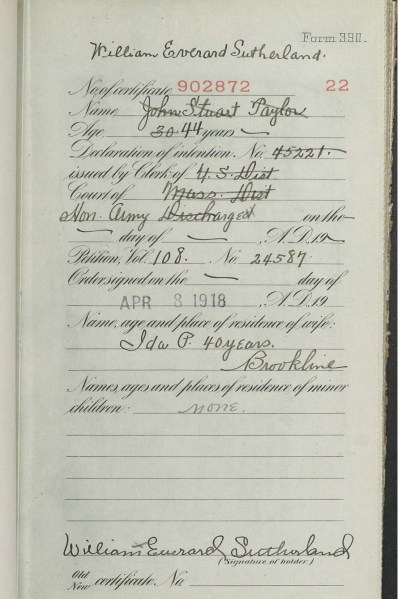
William became a naturalized American in April 1918 through the Alien Soldier’s Naturalization Act. He joined the US Army in 1899 during the Spanish-American war. Any alien who enlists in the US armed forces and is honourably discharged could apply for citizenship without a previous declaration of intention and with only one year of residence. His proof of service and discharge is the strangest document I have ever seen. It had a name crossed out and William Everard Sutherland written above. Other information was also crossed out. This document was accepted as there is a copy of his Naturalization certificate. I don’t know why he never made a declaration of intention as he had been in the US for almost 40 years. Priscilla also became an American.

This was the proof that he was honorably discharged from the US Army which allowed him to become a Naturalized US citizen under the Alien Soldiers Naturalization Act; Section 2166.

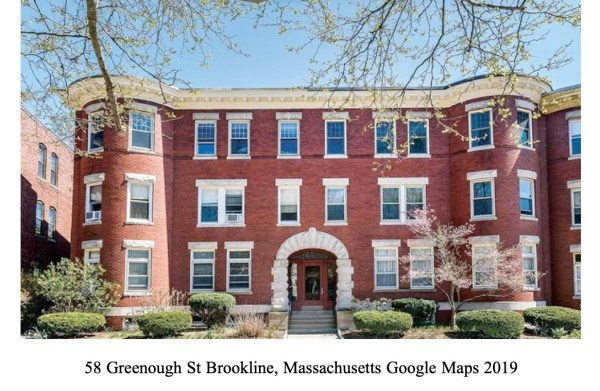
Around 1917, he and Priscilla moved to Brookline Massachusetts, They lived at 58 Greenough Street. A three story apartment (now condo) building is at that address according to Google maps. It is a very nice red brick building with bay windows. The condos now sell for a million dollars. The couple had done well as Priscilla was no longer working and William was the boss working in construction as an electrician. They even had room for Priscilla’s mother to spend time with them.

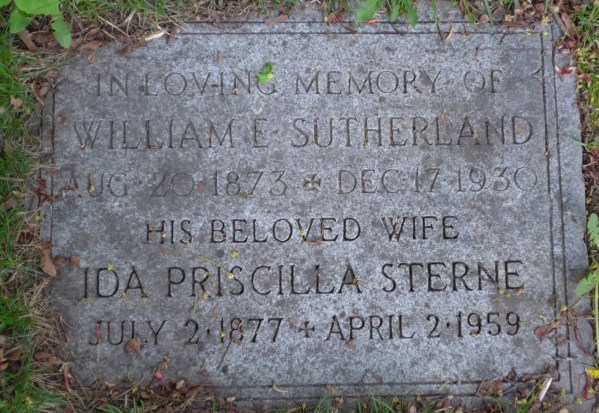
They finally ended up in Florida, around Miami and Palm Beach. William was president of a building company so they were not early retirees. He later had health problems, stopped working and applied for an invalid’s pension from the US Army. When William died of heart disease in 1930 his body was sent back to Canada for burial. Priscilla applied for a widow’s pension and continued to live in Palm Beach until her death 29 years later. Her body was also returned to Canada and is buried with her husband in Toronto’s Mount Pleasant Cemetery.

Now I have to find his sister Annie.

Notes:

William’s parents William Sutherland and Jessie Johnson lived at 21 Rose Ave in Toronto. His siblings, Agnes, Isabel, Jessie and Davison were all living at home in the 1920s.

William H. Sutherland’s diary 1920-1924 in the hands of the author.

William registered for the draft during the First World War even though he was 45 years old. I don’t think he served again, as the war ended less than three months later.

My grandfather William Harkness Sutherland called his only son Donald after his father but added William as a second name!

Year: 1910; Census Place: Boston Ward 24, Suffolk, Massachusetts; Roll: T624_625; Page: 13a; Enumeration District: 1634; FHL microfilm: 1374638Ancestry.com. 1910 United States Federal Census [database on-line]. Lehi, UT, USA: Ancestry.com Operations Inc, 2006. Mar 20, 2020.

Year: 1920; Census Place: Brookline, Norfolk, Massachusetts; Roll: T625_721; Page: 4A; Enumeration District: 172 Ancestry.com. 1920 United States Federal Census [database on-line]. Provo, UT, USA: Ancestry.com Operations, Inc., 2010. Images reproduced by FamilySearch.

Ancestry.com. U.S., City Directories, 1822-1995 [database on-line]. New York City 1922. Lehi, UT, USA: Ancestry.com Operations, Inc., 2011.

National Archives and Records Administration (NARA); Washington, D.C.; Index to Naturalization Petitions and Records of the U.S. District Court, 1906-1966, and the U.S. Circuit Court, 1906-1911, for the District of Massachusetts; Microfilm Serial: M1545; Microfilm Roll: 24Ancestry.com. U.S. Naturalization Records Indexes, 1794-1995 [database on-line]. Provo, UT, USA: Ancestry.com Operations, Inc., 2007. Accessed March 20, 2020.

National Archives and Records Administration (NARA); Washington D.C.; NAI Number: M1368Ancestry.com. Massachusetts, State and Federal Naturalization Records, 1798-1950 [database on-line]. Provo, UT, USA: Ancestry.com Operations, Inc., 2011. accessed March 20, 2020.

New England Historic Genealogical Society; Boston, Massachusetts; Massachusetts Vital Records, Marriage Record 1911–1915; Volume: 621 accessed on Ancestry March 20, 2020. 

Fat Sandwiches and Cathedral Gongs

Turning the tables on genealogy writing.

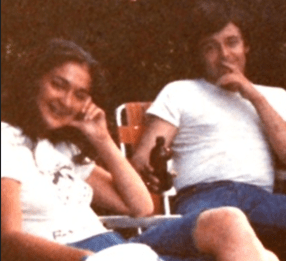
My talented high school friend Gary and me circa 1980. He recommended me for the job at the radio station.


( A long time ago, I was asked by someone who knew I dabbled in genealogy why I didn’t write stories about myself for future generations so they wouldn’t have to ‘guess’. Back then, I didn’t see the point – but now I have grandchildren. )


It was sometime back in 1983 – imagine. Every Breath You Take by The Police was blaring over the airwaves and the beautiful FM secretary sprinted out of her stuffy office cubicle and ran down the hall pumping her skinny arms over her head in a victory dance. She was simply over the moon: The stodgy radio station she worked for was entering the modern age!

I was employed as an advertising copywriter for the same easy-listening FM station as well as for its affiliate, a once-proud but struggling sports talk station on the AM dial.

The FM station was by far the more successful of the two stations, keeping the owners afloat with its middle-of-the-road Paul Mauriat instrumentals aimed at an older audience.

But their faithful clientele were retiring and moving away to live near their children in Ontario or just plain passing away. (Ironically, a retirement community just over the Quebec border in Ontario was a major advertiser.) Hence the jarring format change.

That day, I overheard a staffer callously joke about how the station’s geriatric listeners were now frantically stumbling out of their easy chairs to turn the radio dial back to ‘their’ station.

Back then I didn’t pay much attention to demographics or ratings but I did have a singular role in this FM station’s public profile.

Hourly ID’s in portfolio, typed on my Selectric.

I wrote dozens and dozens of their ‘lyrical’ hourly ID’s.

Originally penned by a veteran on-air personality, these ID’s were nothing but extra work for me and they came with no extra pay either, but I didn’t work in radio copy for the money (minimum wage) or for the praise (we got none). I worked for a chance to make a living, however meagre, as a writer and for the camaraderie among creatives and, yes, for the adrenaline rush.

(In those days, it seemed as if every advertising contract the salespeople brought into the copy office had to be conceived, written and produced “yesterday.” English Montreal radio salespeople were fighting over an ever-diminishing slice of the advertising pie – and in recessionary times. The clients were getting smaller and smaller – and pickier and pickier. These hourly ID’s allowed me to be creative (and corny) on my own terms – at my own rhythm.)

In the early 1980’s, our English FM Station was the “MUZAK” station of choice in Montreal, airing continuously in elevators all over town.

So, every lunch hour, when thousands of office workers spilled out of their own stuffy cubicles to score a coffee and sandwich and maybe a little city sunshine down below, they could not escape hearing one of my midday ID’s voiced in a warm creamy tone by one of our talented station announcers.

I kept these three “midday” ID’s for my portfolio.

Number 1: Midday in Montreal is when the babies come out. Winter newborns, bundled in their mother’s arms, rosy-cheeked cherubs, bright eyes wide in wonder. They are seeing the world for the very first time. The mystery of a budding flower, the majesty of a skyscraper, a lot for little eyes to take in. Midday in Montreal with the beautiful music of CICK. (I changed the name of the station, but you might know which one it is.)

Ok. I was 28, and although I strongly denied it back then, I was clearly wanting a family. But, if you consider I had held an infant in my arms only twice in all of my young life, both times while babysitting, I think I got it right. I know I got it right. I have a four month old granddaughter and she’s just as described.

Number 2: Midday in Montreal. School children straggle home from lunch in groups of two or three. Never taking the shortest route, they stop to pet a stray or to kick a stone around, forgetting as children often do, about time. Wandering home in zigs and zags,they finally arrive to steaming bowls of soup and fat sandwiches. Midday in Montreal. With the beautiful music of CICK.

This was a bit of a nostalgia, for sure. I, myself, in the 1960’s, had been a latchkey kid and I often had to make my own lunch, sometimes grilling POM bread over the blue flame of the gas stove. Yummy! By the 1980’s, I suspect even fewer kids went home for lunch. Still, judging from the meandering path my five year old granddaughter likes to take on our walks together, I think I nailed the dilly-dallying part.

Number 3: Midday in Montreal. The circular days are cut in half by the sound of a thousand clocks: ornate cuckoos in residential parlours, church bells and cathedral gongs, those quiet, creeping clocks in offices. As the sun reaches its highest point in the sky, a million pairs of eyes turn to the clock, acknowledging midday in Montreal, with the beautiful music of CICK.

I still like this one, although a smart-alek booth operator questioned whether cathedrals gonged at all. I directed him to Byzantium, my favourite Yeats poem. I had borrowed the phrase, you see.

The unpurged images of day recede;

The Emperor’s drunken soldiery are abed;

Night resonance recedes, night-walkers’ song

After great cathedral gong;

A starlit or a moonlit dome disdains

All that man is,

All mere complexities,

The fury and the mire of human veins.

Midnight, with the beautiful music of CICK 😉


Do you think Yeats would have been a better radio copywriter than me? Would the insomniac crowd have been seriously disturbed by Midnight ID’s in the style of his poem?

Anyway, after a year of dutifully tapping out these hourly ID’s on my trusty IBM Selectric typewriter (the one with the snazzy white “Correcto-type” band that enabled me to churn out my 30 and 60 second commercial scripts apace) I asked to be relieved of the task.

Like so many of my colleagues, I quit my copy job to try my luck in Toronto. Somehow, I ended up back in Montreal with a family – just as the economy was improving. What bad timing! For the next decade, I mostly worked remotely as a freelance writer -for rather good pay- for sundry commercial magazines producing quote-anecdote-statistic style articles on non-controversial topics that didn’t scare off the advertisers.

Occasionally, I got creative and punched out a timely satirical piece like Beat the Biological Clock for Salon Magazine. That number was written, yikes, over 20 years ago. Time sure does fly!

I guess I should get busy writing more of my ‘ancient histories’ for the girls.

End

Bicycles over Time

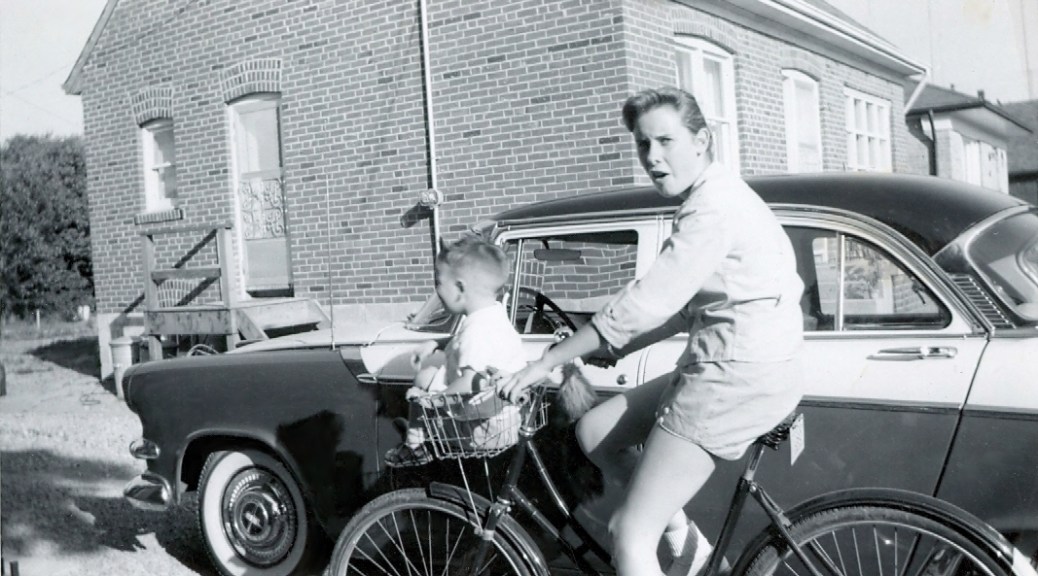
Bicycles have been on my mind this month. I’m trying to ride 1000 km to raise money for the Great Cycle Challenge in memory of my mom. One of the photos I use to describe her features her on her bike with her little brother in the basket.

The photograph is dated 1956 and there are some unusual elements about the bike, beyond how easily my uncle fits in that basket.

The first odd-looking thing is the license plate on the seat. Turns out that Toronto, where they lived, forced cyclists to buy license plates between May 20, 1935 and February 4, 1957. According to the City website,

The licensing process was quite complicated:

  1. An individual was first required to apply for a license at City Hall.
  2. They were then required to bring their bicycle to a police station, where a police officer would inspect the bicycle and complete the required paper work.
  3. The paper work was returned to City Hall and a license was granted.
  4. The individual would then submit a duplicate license to the same police station where the bicycle was examined.
  5. Finally, a metal plate was issued for the year and affixed to the mudguard of the bike.

Moving to a new address, or transferring or exchanging a bicycle would require an individual to file updated information with the City. The cost of the yearly license was 50 cents, while the fine for not having a license on their bicycle was $5.00.1

The other interesting element is how hard it is to tell which manufacturer created this bike. Today, it would have at least one key decal to identify CCM, Humphrey, Schwinn, Standard Cycle or Raleigh. Still, I suspect it was probably a Canada Cycle and Motor Co. (CCM) product, given that that company purchased most of the other Ontario-based bicycle manufacturers in the preceding years.2

I remember when I wanted to get my first bike, my parents spoke about CCM as though there were no other choices for a solid bicycle. Given their preference, my second bike, and the first one I chose, was a CCM. We got it at Canadian Tire.

According to John McKenty, author of Canada Cycle & Motor: The CCM Story, the company began in Toronto in 1899, when Massey-Harris Manufacturing Co. president Walter Massey “bought four Canadian bike companies and merged them into one.”3

By 1983, interest in the company’s products had waned and it declared bankruptcy. The brand still exists, but it now belongs to Adidas.

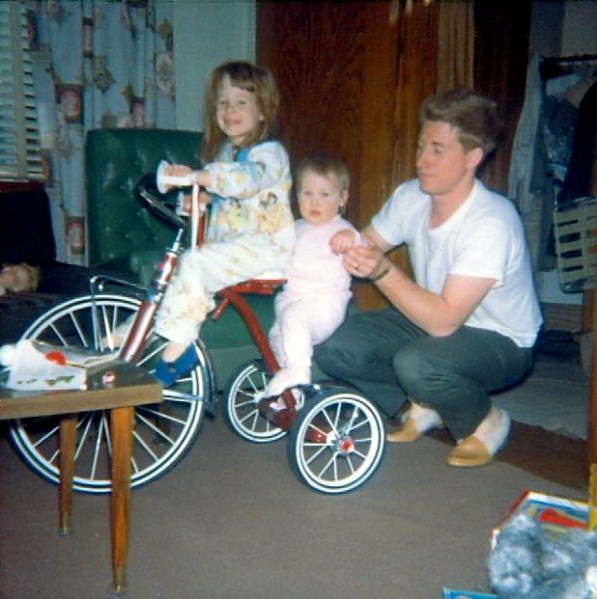
It’s astonishing how radically the style of bicycles has changed in the last fifty years. My first bike had three wheels, one of which was huge.

The one I chose had tall handlebars and a banana seat, something I can’t imagine riding these days.

Modern styles are significantly closer to the practical one that my mother rode.

Sources

1Toronto, City of. “Bicycle Licensing.” City of Toronto. City of Toronto, November 17, 2017. Toronto, Ontario, Canada. https://www.toronto.ca/services-payments/streets-parking-transportation/cycling-in-toronto/cycling-and-the-law/bicycle-licencing/, accessed August 13, 2024.

2Vintage CCM | Forum | Canadian Bicycle Manufacturers 1927-1959.” Accessed August 14, 2024. https://www.vintageccm.com/content/canadian-bicycle-manufacturers-1927-1959.

3Olafson, Karin. “The Story of Canada’s World-Class Bike Company – CCM.” Momentum Mag (blog), December 12, 2014. https://momentummag.com/story-of-canada-world-class-bike-company-ccm/.

Horses, Snowshoes and Social Life

Horses were a common part of daily life in turn-of-the-century Montreal. Tradesmen delivered milk and other items by horse and cart, fire engines were horse-drawn, and many people got around the city in horse-drawn carriages in summer and sleighs in winter. For those who could afford it, horseback riding, horse racing and horse shows were also popular.

My great-grandfather Robert Stanley Bagg (1848-1912) was a skilled rider and every spring in the early 1900s, he and his wife, Clara, attended the Montreal horse show, held in suburban Westmount. Hunters, jumpers, harness horses and ponies competed for honours, but the show seems to have been more of a social activity than a sporting one, and proceeds from a tea served during the afternoon’s events were donated to the Society for Prevention of Cruelty to Animals.

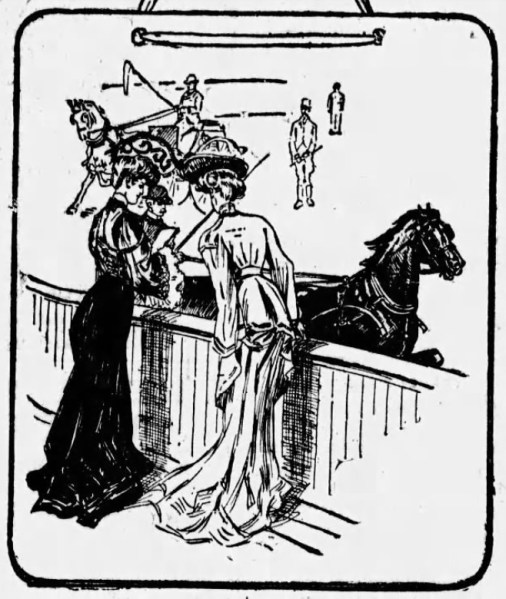
Illustration of ladies enjoying the Horse Show, 1904. Source: The Montreal Star, May 7, 1904, p. 20

The Montreal Star published columns of names of attendees, and in 1904, the paper noted that R. Stanley Bagg had a private viewing box. Perhaps, like other boxholders, he and Clara entertained guests at dinner prior to the evening events.

Two years later, the Star reported that Clara, dressed in green tweed with a black hat trimmed with white, attended the show with her sister-in-law Amelia Norton, in a purple dress and a white hat, and her daughter Evelyn, in a grey homespun dress and a pale blue hat, trimmed with white.1

Stanley was still riding at age 59 when was injured in an accident on Mount Royal, the mountain that rises behind the city center. The Star reported that he was riding on rough ground near the park ranger’s house when his horse stumbled on a rock, fell and rolled over on one side, pinning Mr. Bagg beneath him. Two men who happened to be nearby helped him get up and encouraged him to rest for a few minutes before riding home. Stanley had sprained his shoulder, hit his head and his face was badly scraped, however, he soon recovered.2

Snowshoeing was also a popular sport in Montreal, and one of Stanley’s favourite winter activities. Between the end of November and the beginning of March, the city’s rival snowshoeing clubs competed in races, held weekly “tramps” over the mountain and organized longer excursions to other locations on the Island of Montreal. Club social activities usually included an annual dinner, charity fundraisers and lots of singing. Stanley was a member of the St. George Snowshoe Club, and it had its own club song with a chorus that began, “Hurrah! Hurrah! It’s jolly on the snow. Hurrah! Hurrah! The stiffest storm may blow.…”3

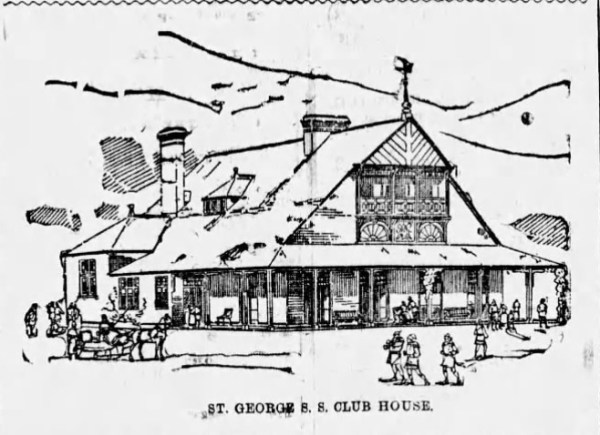
Stanley was on his club’s building and furnishing committee, overseeing the construction of a new clubhouse at Côte St. Antoine. The building was constructed in the early English stye of architecture, with spacious verandas on all sides, a high-pitched roof with dormers and a square entrance hall that gave way to an assembly room with a huge fireplace and large windows overlooking the veranda. When the club house held its grand opening on the evening of December 21, 1887, Stanley was among those who led the way from the Windsor Hotel downtown to the new building.4

The St. George Snowshoe Club’s new clubhouse. Source: The Montreal Star, Feb. 12, 1887, p. 6

When he wasn’t enjoying sports, Stanley, a lawyer, worked in the Bagg family real estate business.  Family life was also important, especially when they were travelling together or on summer holida

Stanley was married to Clara Smithers (1860-1946). One of eleven children, she was the daughter of Charles Francis Smithers, president of the Bank of Montreal, and his wife, Irish-born Martha Bagnall Shearman. When he started pursuing Clara in 1880, Stanley was age 32 and living at home at Fairmount Villa with his mother and sisters. (His father had died in 1873.) Stanley and Clara were married on June 8, 1882 at St. Martin’s Anglican Church in the presence of guests who included “the elite of our inner social circles.”5

The couple’s eldest child, Evelyn St. Clare Stanley Bagg, was born in 1883, and another daughter – my future grandmother – Gwendolyn Stanley Bagg was born in 1887. Their third child, Harold Fortesque Stanley Bagg, arrived in 1895.

Having started a family, Stanley and Clara must have realized it was time to own a house of their own, so Stanley hired architect William McLea Walbank to build a house at 436 Saint-Urbain, near his mother’s home. It was completed in 1884. 

According to a newspaper report, it was a handsome, well-finished brick villa of the Early English style of architecture, on Upper St. Urbain Street. The house contained all the modern conveniences of the time and was heated by Spence’s patent hot water furnace throughout. It claimed to be rat-proof. The bricks were all of Montreal manufacture and compared favorably with imported pressed bricks.

The family did not stay there long, however. In 1890, Lovell’s city directory listed Stanley as living in Georgeville, Quebec, while his sister Mary, the wife of stock broker Robert Lindsay, was living in the house on St. Urbain. Stanley had purchased a large house in Georgeville, on Lake Memphremagog, although it was probably a summer residence. Montreal was a very dirty and unhealthy city, especially in the heat, so many Montrealers left town during the summer months.

The Bagg family on summer holiday. Source: Gwendolyn Catherine Stanley Bagg, Portrait of the Family, Cacouna, 1903, McCord-Stewart Museum, M2013.591.134

It does not appear that the Baggs owned the Georgeville house for many years. My grandmother acquired a camera around 1901 and her snapshots showed family summer vacations at Cacouna on the lower St. Lawrence River, at a rented a house on a lake near Ste. Agathe in the Laurentian Mountains, and at a summer hotel at Kennebunk Beach, Maine.

As for their city home, perhaps Stanley and Clara realized that their house on St. Urbain was not in the city’s most desirable neighbourhood. The place to live in Montreal was on the southwest slope of Mount Royal, an area known as the Golden Square Mile. Montreal was the financial and industrial capital of Canada, and businessmen were making fortunes and building mansions in that part of the city.

Stanley purchased a lot at the western edge of the Golden Square Mile, the corner of Sherbrooke Street and Côte des Neiges Road, and architect Walbank designed a new red sandstone house for him. Construction started in 1891, and the Baggs were living there by 1892. It was Stanley’s home until his death from cancer in 1912.6 Clara then divided the house into two apartments and remained there until she died in 1946.

Sources:

  1. “Horse Makes Farewell Bow Tonight,” The Montreal Star (Montreal, Quebec), May 12, 1906, p. 12, digital image, https://www.newspapers.com/image/738949773; accessed Aug. 4, 2024.
  • “Snowshoeing; The Red Cross Knights; St. George’s Snowshoe Club Inaugurated Last Night,” The Gazette, (Montreal, Quebec), Dec. 21, 1887, p. 8, digital image, https://www.newspapers.com/image/419349867; accessed Aug. 3, 2024.
  • “Marriage Chimes: Fashionable Wedding at St. Martin’s Church Yesterday,” The Gazette, (Montreal, Quebec), June 9, 1882, p. 3.

Devon, Alberta, Devon, England.

My eldest Grandson is called Devon. His full name is Devon John Charles. Named after both his grandfathers. His parents initially, wanted to name him Even. However, there is already a cousin in our family of that name. His mum suggested Devon which suited both parents.

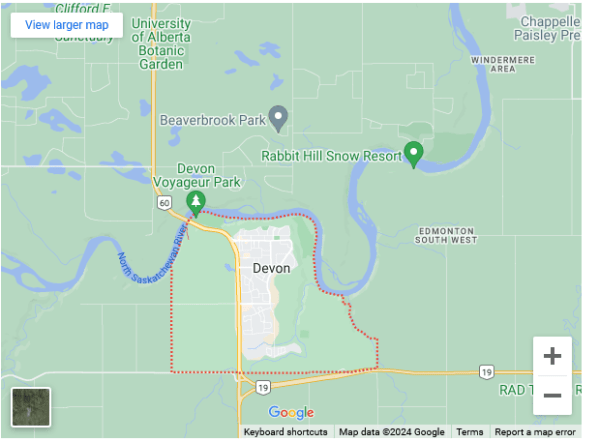
When Devon’s family moved to Alberta, we were surprised to learn he and his family were moving to Devon, Alberta! I was keen to learn the history of Devon, Alberta and here is what I found.

Devon, Alberta Canada

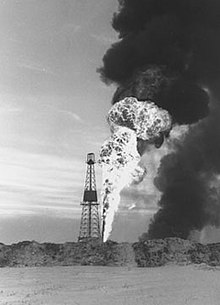
One of the largest oil discoveries in the world was discovered on February 13th 1947 (I would have been two years old). Leduc No 1 well struck oil and the new town of Devon was constructed by Imperial Oil to accommodate its workers.

Leduc Oil No. 1. Devon, Alberta Canada

The company wanted a well-planned town so Devon holds the distinction of being the first Canadian community to be approved by a regional planning commission.

The town was planned according to modern town-planning principles by the Edmonton District Planning Commission and CMHC. It was labelled “Canada’s Model Town” since it was the first municipality in Canada to be approved by a regional planning commission. The town grew extremely quickly, but because of planning controls, its development was orderly”. (1)

Devon was named after the Devonian formation seen in the strata tapped in the Leduc No. 1 oil well, which in turn is named for the county of Devon in England. Its economy is still based on the oil and gas industry; however, the addition of the Devon Coal Research Centre is helping to diversify the economy (2)

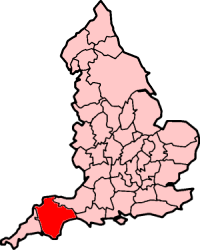
I was born in Plymouth, Devon but its history goes back millennia. Situated in South West England and bordering Cornwall, there is evidence of occupation from the Stone Age onwards. Recorded history begins in the Roman period when it was a ‘Civitas(3) meaning a social body of citizens united by law. (3) It was then a separate kingdom for centuries until it was incorporated into early England. A largely agriculture-based region, tourism is now vital.

Ancient Extent of Devon, England

The name “Devon” derives from a tribe of Celtic people who inhabited the South-West peninsula of Britain at the time of the Roman invasion.

The last time I visited Plymouth, Devon I was tickled to be able to send my grandson a letter addressed to Devon, in Devon Alberta, from Devon, England. The lady in the Post Office even pointed out how amusing that was.

(1) (2) https://www.thecanadianencyclopedia.ca/en/article/devon

(3) https://en.wikipedia.org/wiki/Civitas

Sherron and his Texas Betty

“Pop” Sherron and “Texas Betty” (his air-conditioned travelling mobile theatre bus) must have been a welcome sight whenever they pulled into small towns in and around Phoenix, Arizona, in the 1940’s.

Sherron, my great-uncle, charged admissions of 40 cents per adult and 20 cents per child to enjoy “two feature picture comedies nightly” and “a different show nightly” on his travelling mobile theatre bus.

Sherron’s Advertisement Flyer

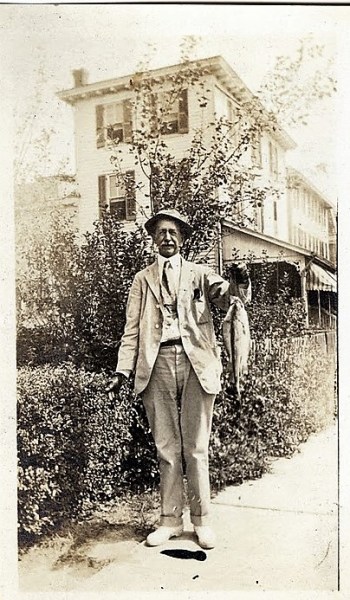
Roger Sherron (1895-1963) was a somewhat “reclusive” man or what one might consider a “hermit” and, according to a phone conversation with his nephew, his own family labelled him as “odd.” These opinions were supported on his WW1 registration (and rejection) in 1917 (age 22) with “arrested development mentally” entered by hand in the exemption section by officials.

Fortunately, we have come to better identify and understand mental conditions nowadays.

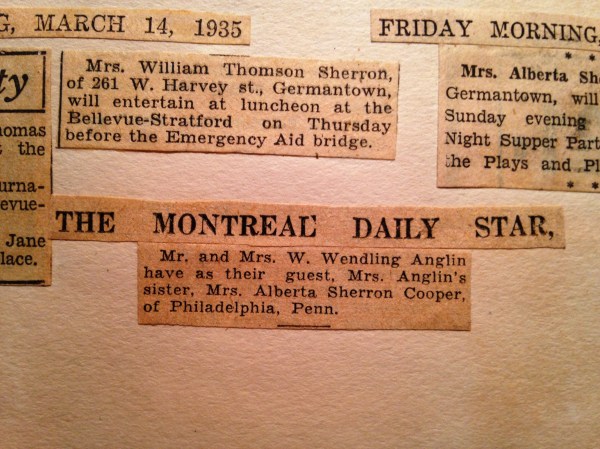
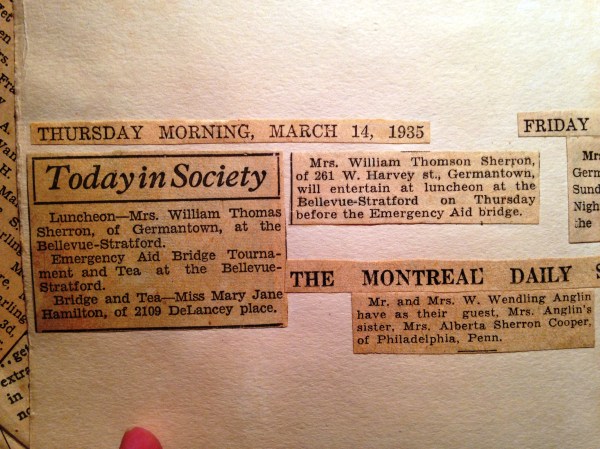
The Sherron family belonged to Philadelphia’s high society. Roger’s father owned and operated a wholesale grocery business while his mother and two sisters were frequently featured in the society pages of the local newspapers with their luncheons, tea parties, bridge games, fundraisers and such. This was not Roger’s “cup of tea” so to speak.

Roger, Alberta and Josephine Sherron (my grandmother) – 1906

Young Roger briefly attended the Wenonah Military Academy in New Jersey, a private secondary school “where a diploma entitled the graduate admission to West Point, Annapolis, or one of the best colleges or universities in the country, usually without qualifying tests.” He left school before he finished his studies but luckily could read and write by then even if his handwriting remained somewhat childish.

According to the censuses, Roger sometimes worked at odd jobs (in 1920 – grocery sales at age 25 and in 1930 – game warden for the State Government at age 35) but otherwise he was listed as “unemployed.”

Roger and his sisters Alberta and Josephine circa 1910

He never married, living with his parents in Philadelphia until 1940 when his mother died. His father passed away in 1932. His younger sister Alberta also remained nearby with her family but his older sister Josephine (my grandmother) moved to Montreal, Quebec, with her stockbroker husband, Wendling Anglin, and her two sons (my father, Tom, and his brother Bill).

Roger was 44 years old when his mother died, alone in the world for the first time and without a place to live.

Roger and his nephew Donnie – 1932 – visiting his sister Alberta after his father died

Sometime, after the death of his mother, he moved west to a very different world and a warmer climate.

Once in Arizona in 1942, at 47 years old, and possibly homeless and jobless, he tried yet again to enlist with the WWII Draft. According to the registration form, he stood at 5’7” tall and 125 lbs with tattoos on his left arm. Unsurprisingly, Uncle Sam didn’t accept him this time either.

He must have inherited some money from his parents’ estate because this is where he acquired a retrofitted theatre bus he named “Texas Betty” which enabled him to start a rather unique business and support himself. At some point, it appears he might have attempted to expand his business as I have a piece of printed letterhead stating:

POP SHERRON’S FAMILY

Travelling Amusement Center and Big Free Circus

In Route – Pop Roger Sherron

Texas Betty Sherron

Owners

Texas Betty

Again, according to my phone conversation with his nephew, Roger’s home in Phoenix was just “a shack.” He lived in the Hispanic part of town and it is likely the entire neighbourhood consisted of similar housing.

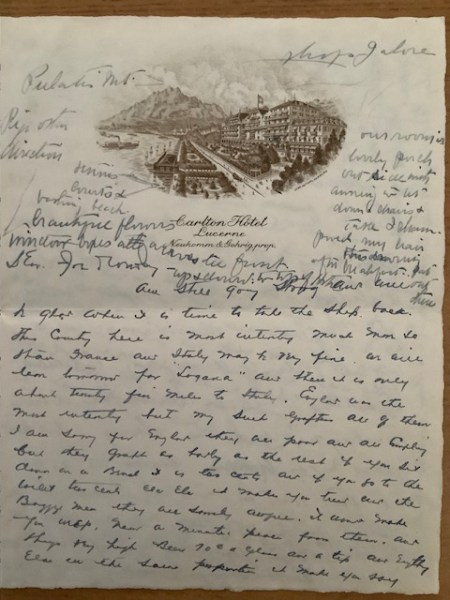
At the age of 50, some six years after he left Philadelphia, he wrote a Christmas letter to his older sister Josephine from Tempe, Arizona, which is half way between Phoenix and Mesa. He settled in this new community (and dare I say new family) who it seems wholeheartedly accepted him.

“I spent Christmas eve with some Spanish friends five houses down the road. They had tamales and Spanish food. They are nice people.”

“I got a lot of Christmas presents. The people next door gave me a fine shirt. The people three houses down gave me some handkerchiefs, a Coke, a comb, pen and ink and envelopes…the Spanish fellow who owns the store gave me a big bag of candy and nuts.”

“The television has come here now. The people next door have a fine set. It don’t hurt your eyes or nothing. Down at the bus station at Mesa, they have a set but it hurts your eyes.”

His neighbours might have struggled but they were rich in love and support for one another.

The letter continued with what might seem like “odd ball” concerns about the ongoing war, the atomic bomb and politics:

“I think the country will go Republican next election. I hope so. People are getting tired of this New Deal bussiness (sp). The Republicans will jump right in and fight Rushea (sp) and China. Lots of Chinese arround (sp) here in Phoenix and Mesa. They are aloude (sp) to run loose. They ought to put them in camps till after the war.”

Paranoia? No, just a typical American way of thinking at the time.

Roger, revealing his good prep school manners and poetic side, continued with a lovely description of his immediate surroundings: “Oranges ripen on the orange trees along the streets of the resodental (sp) part of Mesa. Mesa is the orange center of Arizona. They are still picking cotton arround (sp) here. Roses are still in bloom in Mesa.”

His letter ended with hope the war would end soon, another thank you for the gifts of a sweater and box of candy, and finally Roger wished his sister well and sent his “love to all.”


Roger died of a heart condition in 1963 at the age of 68. So he spent
the last 20 years of his life in the Arizona desert with his one-of-a-kind air-conditioned cinema bus Texas Betty and his kind-hearted friends, no longer considered a hermit, reclusive or even odd.

Sherron in the Pocono Mountains, Pennsylvania in 1939

Elopement … or not?

Social Media – Then and Now

Honesty Pays Off Part 2

In the  Part 1 blog of “Honesty Pays Off” In the following linkhttps://genealogyensemble.com/2024/05/15/honesty-pays-off/we learned of the first leg of my father’s trip to Finland in 1934. He sailed aboard the Empress of Britain and spent some time in London before embarking on the second half of his journey to Petsamo Finland where he was instrumental in opening a nickel mine.

Once Mond Nickel had prepared all the necessary documents, my   Dad set out from London to Helsinki, Finland, It would take two days by car, ferry, and train to reach Helsinki (where he most likely arrived at the station in the capital city of Finland.

From Helsinki he headed to north through Lapland to the Petsamo area with numerous stops along the way. He took many photographs of the people he met and with engineers and workersthose who were involved in searching for the site to develop the mine, as noted in this photographic collection.

All the photographs in this blog were taken by Dad.

A page from Dad’s passport

State bus on the right.

Dad spent the entire summer of 1934 in northern Finland. In early September having accomplished the task set by Mond Nickel: that of opening a nickel mine in Petsamo. He then returned home to Canada.

The trip to England and Finland was the first of his many overseas trips. In some ways it may perhaps be the most important one of his forty year career as a mining engineer. (1930-1970)

Important Facts About Petsamo and the Nickel Industry in relation to Finland as noted in Wikipedia

*************************************************************************

Nickel had been discovered in 1921. In the 1930s Inco had invested several million dollars developing valuable nickel deposits in the Petsamo district of northern Finland. In 1934 the Finnish government awarded the mining rights to the British Mond Nickel Co , then a subsidiary of International Nickel ( Inco) that founded Petsamo. Nickel became commercially available in 1935.

 “Petsamo nickel mine was the second biggest in the world.”

During WW2  (1941-1944 )the area of Petsamo was used for attacking Murmansk and then captured by the Red Army in 1944. In 1947 after the Paris Peace Treaty the area was incorporated into the Soviet Union and became known as Pechanga, As a result of this agreement Finland no longer had access to the Barents Sea, a body of water that did not freeze in wintertime. A huge loss for Finland.

Sophie Bruneau Huntley Not Camera Shy

Sophie Bruneau Bathing Beauty

Would my 19th-century ancestor Sophie Bruneau Huntley be posting pictures on social media, taking selfies and showing off her new purchases if she were alive today? I think the answer is, maybe yes!

Sophie was born in 1847, so all her early pictures were taken in photographic studios. These were not spontaneous pictures but rather specific setups with long exposures. There are several pictures of Sophie in the family photo albums. Many were taken in New York. My favourite is Sophie in a bathing costume displaying her very long hair and bare feet. There were no mischievous smiles but rather hard stares. Still, it appears she had fun during her photo shoots.

Sophie Bruneau

My great-great grandparents Barnabe Bruneau and Sophie Marie Prudhomme had 13 children and Sophie was number eight. She lived with her parents on their farm in St. Constant, Quebec until after the 1871 census. Pictures from New York studios came soon after. I assume Sophie worked in New York as a teacher or a French governess like her sisters, Virginia and Elmire, when she arrived in the United States in 1875 at 27 years old.

Sisters: Sophie, Helene & Mathilde
Sophie in New York

Sophie and her sister Elmire, married two Huntleys, Washington and Wallace? (Walworth). I assumed that they were brothers who married sisters. On family trees and photos he was called Wallace but it seems he was George Walforth Huntley (1854-1933), Washington’s younger brother and seven years younger than Sophie.  Andrew Washington Huntley Elmire Bruneau’s husband was born in Mooers NY to Andrew Huntley and Calista Blodgett and there was a George Walworth Huntley in the family. If this is Sophie’s husband, they could also have met because her sister Aglae was living in Mooers Forks, New York with her husband.

Sophie and George W. Huntley

Sophie, Elmire, and their husbands lived in several places in the United States but ended up in Los Angeles.

Sophie and Walworth lived in Elkhart, Indiana as Sophie is mentioned in the Personal and Society column of the Indianapolis Journal, “Mrs. George W. Huntley is spending a month in Montreal.” The beginning of the column discussed women’s dress which probably interested Sophie. 
“What with shirtwaist blazers, neckties and caps the women, middle-aged and young are fast becoming what Light facetiously denominated “self-made men.” George was a railroad conductor and owned his own house according to the 1900 census. 

Sophie Huntley

They later lived in Toledo, Ohio where George was a customs collector and finally moved to Los Angeles, California. Sophie became a naturalized American because her husband was a US citizen.

They never had any children.

Sophie Bruneau Huntley

Her age was fluid in all the documents. Her husband was seven years younger but sometimes she was younger and sometimes the age difference was much smaller. Her death record in December 1921 said she was 68; in the 1920 census, she was only 63 while actually being 74.

A death notice in a Los Angeles paper, “Sophie B. Huntley died December 28, 1921, beloved wife of George W. Huntley, funeral from residence La Veta Terraces.” Her death notice was also in Elkhart, Indiana and Toledo, Ohio newspapers. George continued to live in Los Angeles with his housekeeper Mary Dietrick until his death in 1933.

Notes:

“Canada Census, 1871”, , FamilySearch(https://www.familysearch.org/ark:/61903/1:1:M4KT-F5V : Sun Mar 10 23:41:04 UTC 2024), Entry for Barnabe Bruneau and Sophie Bruneau, 1871. Sophie 23 at home no occupation.

“United States Census, 1900”, , FamilySearch(https://www.familysearch.org/ark:/61903/1:1:MMBY-BMK : Thu Apr 11 19:55:49 UTC 2024), Entry for George W Huntly and Sophie B Huntly, 1900 Dubois Indiana.

United States Census, 1910″, , FamilySearch(https://www.familysearch.org/ark:/61903/1:1:MLFZ-MKV : Thu Mar 07 18:33:20 UTC 2024), Entry for George W Huntley and Sophie B Huntley, 1910.Toledo, Ohio. 

United States Census, 1920″, , FamilySearch(https://www.familysearch.org/ark:/61903/1:1:MHQD-HJK : Fri Mar 08 21:37:57 UTC 2024), Entry for George W Huntley and Sophie B Huntley, 1920.

California, County Birth and Death Records, 1800-1994″, , FamilySearch(https://www.familysearch.org/ark:/61903/1:1:QG49-NZN3 : Sat Mar 09 23:29:28 UTC 2024), Entry for Sophie B Huntley and Barnabee Barneau, 28 December 1921.

Sophie was said to be 68 in Norwalk Los Angeles.

“United States Census, 1930”, , FamilySearch(https://www.familysearch.org/ark:/61903/1:1:XC8Z-8NW : Sun Mar 10 08:02:55 UTC 2024), Entry for George W Huntley and Mary Dietrick, 1930.

“California Death Index, 1905-1939”, , FamilySearch(https://www.familysearch.org/ark:/61903/1:1:QKS9-QWHL : Sun Mar 10 22:34:41 UTC 2024), Entry for George W Huntley, 7 1933.

“United States Census, 1850”, , FamilySearch(https://www.familysearch.org/ark:/61903/1:1:MCT1-9GL : Sat Mar 09 13:02:44 UTC 2024), Entry for Andrew Huntley and Calista Huntley, 1850.

Indiianapolis Journal Sunday Aug 31, 1890 page 3 in Personal and Society for Elkhart, Indiana Newspapers.com April 22, 2024.

First Deguerreotype in 1837

William Henry Talbot patents the Calotype process, the first negative-positive process making possible the first multiple copies in 1841. 

When the first mass-produced cameras were available in 1900 people started taking snapshots.