
Category Archives: Genealogy societies

Message in a web bottle

You may approach genealogical research like you would fishing — and just to bring it back to French-Canadians — ICE-fishing (OK I wrote the ICE word, but it’s going to warm up today!).  Instead of fishing with one rod, you set up as many lines as you can. The limit is how many you can check at a time… and how many holes you can dig before you are so hot you strip down to your t-shirt.

This is just what  a cousin did:

2001, Welland, Ontario: she sends on RootsWeb * a querry about my great-aunt Simone Viau-McDuff.  And waits.

2011, Laval, Québec: I’m poking around the web, put in Simone’s name into Google and find her message. Wow! For sure it’s the same person, but… the message is 10 years old!  No one keeps their e-mail address for that long. Too bad!

Still, I send my line to the water and reply. Next day, I get a reply.

Geraldine, daughter of my grandfather’s cousin, was jumping up and down in her living room when she got my message (just like I was when I got hers).

Like many Quebecers during the 20th century, her grandfather Philias Viau , had moved from Lachine to work in the Niagara region around 1904. He was my great-grandfather J. Francis Viau’s brother. They lost their French, but there are still some Wellanders that don’t speak English. The Welland canal was of great importance as a link between Lakes  Erie and Ontario. Many industries flourished along the canal, like The Electro Metallurgical Company unit of Union Carbide where Philias worked.

I went to visit Geraldine by train, learned about the region, met some great people. Among them, Renée Tetrault, a founding member of the Welland Branch of the Franco Ontarien Society of History and Genealogy now known as the Réseau du patrimoine franco-ontarien. Renée has served for more than thirty years as the expert who assists researchers at their Centre for Research in the Welland Public Library. She will describe the extensive holdings of their library in and offer suggestions for researching in Quebec.

Which leads me to introduce this French-Canadian resource: there are six regional centers in Ontario.  Three times a year they publish Le Chainon (paper or digital).  They have quite a few online resources (Ontario and other provinces including Quebec, and even American parishes) available to members, among which transcribed notarial records, BMS, cemetaries, family histories, cities and towns, census, archive guides, and a lot more.

Two things to remember:

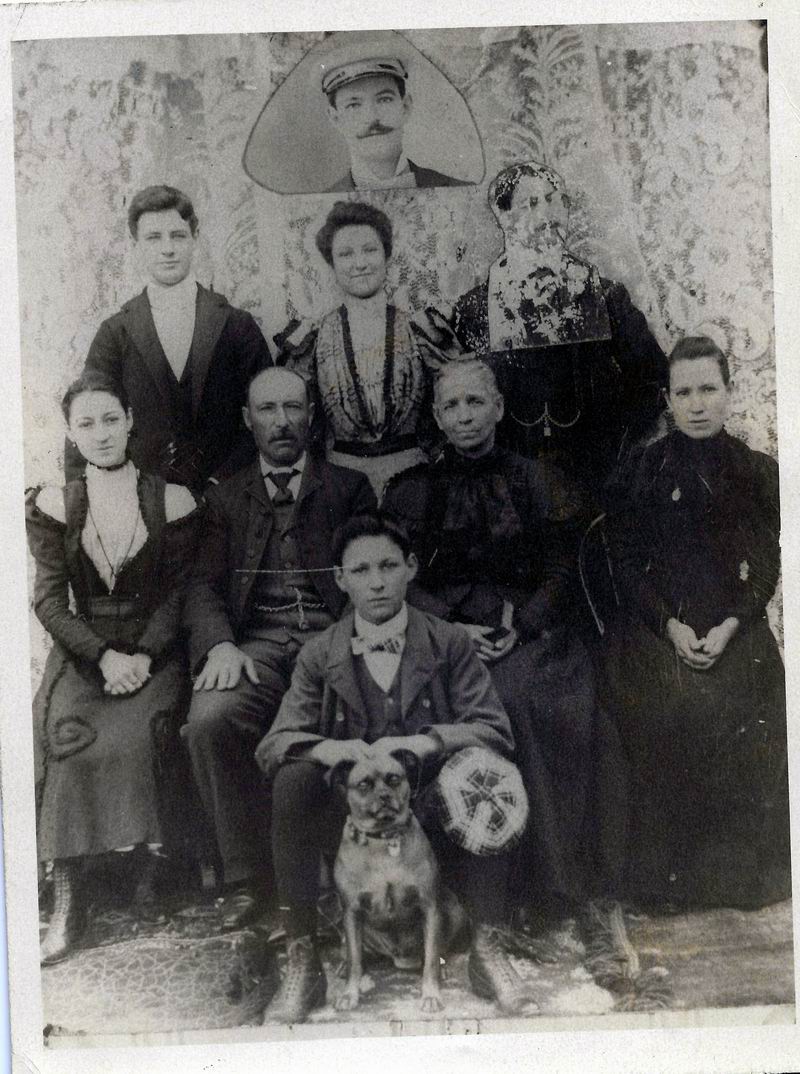
When part of a family moves away, news and pictures are exchanged to keep in touch. Geraldine had pictures of my Montreal family that I had never seen and letters writen by my direct ancestors. The jewel: a cash book kept when Philias’ father Onesime Viau died in Lachine, where all spendings (lots of prayers in church) and income (rents) were described along with after-death inventory  and each child’s share of inheritance. The two of us were able to piece together family stories that individually we couldn’t figure out and dentify people on each other’s pictures.  Finding cousins will help you go up your tree in surprising ways.
Viau p
Onésime Viau and Antoinette Dorais with their children, Lachine, Québec

The other, send a lot of lines out, keep a log, follow up, but be patient. Be courteous, some will never bite, some are not interested. But dream big, don’t be stopped by logic and expect anything…fish come in many shapes and sizes, and even as messages in bottles.

* Rootsweb was one of the first online free cooperative genealogical resources. Ancestry has picked it up, but we can still go into archives or free.
Writing Your Family History

For some people, genealogy is enough. BMDs, children’s names and extended family trees keep them busy. But some of us want more. We want to learn the details of our ancestors’ lives, find out what historical events affected them – and then write about them.

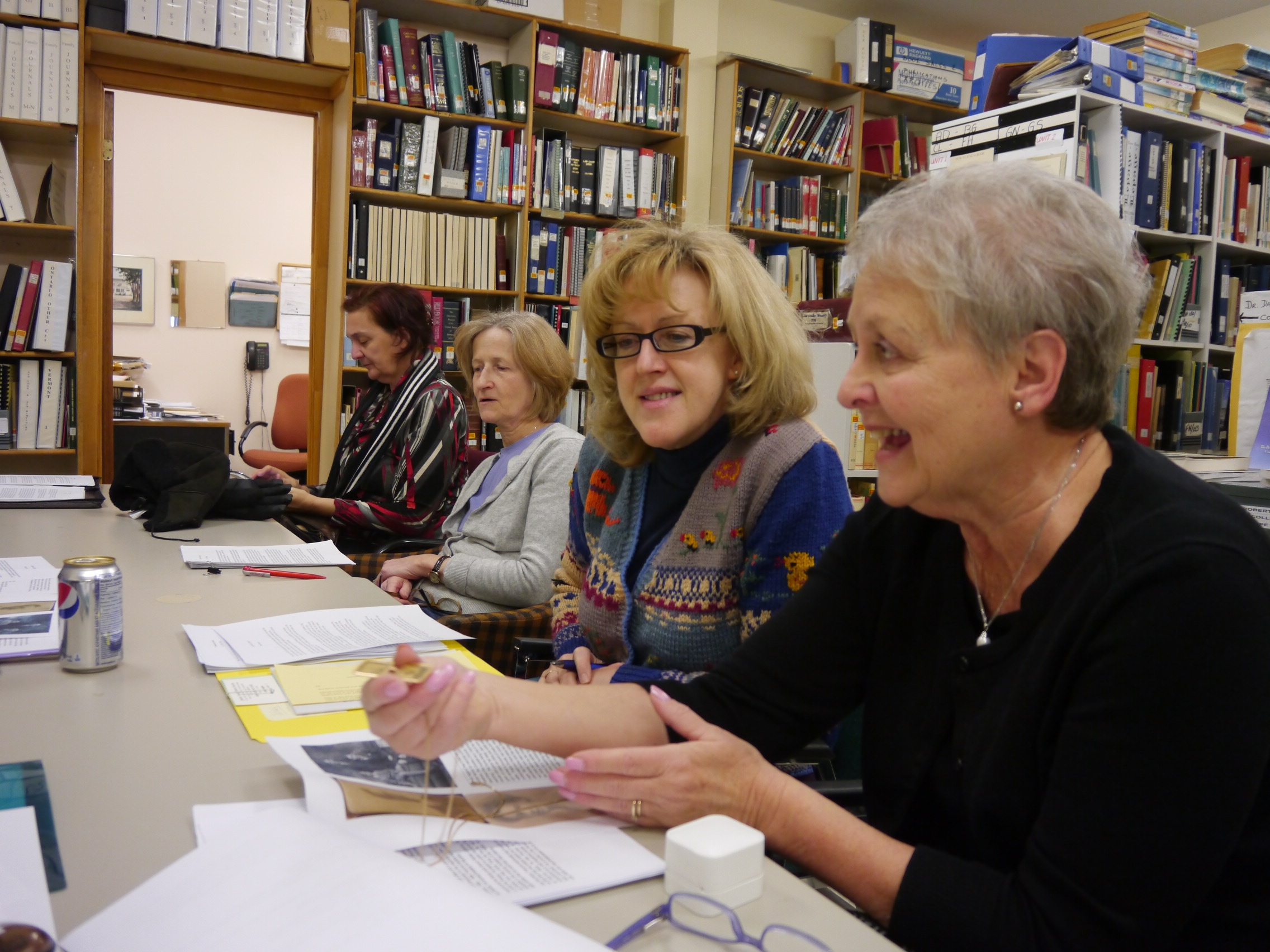
Once a month a group of us meet at the Quebec Family History Society library to share our ancestor’s stories, try to improve our writing skills, and learn from each other. There are two rules: articles are limited to 500 words, and we must list our sources. It isn’t always easy, but it is fun.

Image

This month Claire wrote about her great-grandfather François Evariste Fortin, a merchant and contractor in Pembroke, Ontario who lost and then rediscovered his Catholic faith. Barb’s story was about her grandfather James Rankin Angus, a Scottish carpenter who worked on the construction of the ocean liner Lusitania, then spent 20 years running a book store in Quebec City.

Lucy has been writing about the Hanington family, the first English settlers in Shediac, New Brunswick. Janice’s subject was Robert Hamilton, a Scottish weaver who took up farming in Scarborough, Upper Canada. Mary told the story of great-grandfather Ismael Bruneau, a French-speaking Protestant minister.

Dorothy wrote about Norman Nicholson, her husband’s great-grandfather, an ordinary man who had one extraordinary habit: for five decades he kept track of every aspect of his life, from business expenses to a dating diary.

Oskar focused on Abraham Martin, from whom his granddaughter is descended. The Battle of the Plains of Abraham was fought on his land, but consensus about Abraham’s life ends there. Some stories say he was a farmer, others call him a river pilot. Some accounts say he returned to France for several years, others say he stayed in Quebec. Oskar clarified the confusion even if he didn’t resolve the conflicts.

Ruth wrote about her search for John Morrison. This being a common name, she couldn’t figure out which John Morrison in the 1861 census of Scotland was hers. John’s mother’s name was the less common Robina, and his daughter was also Robina, so she looked for Robina and found John in Illinois.

Next month some of us may do rewrites and others will tackle new subjects, but we are all making progress on writing our family histories, 500 words at a time. To learn more about this Special Interest Group, go to http://qfhs.ca/cpage.php?pt=90.

Genealogy in newspapers

At the Quebec Family History Society’s (QFHS) Brick Wall Solutions special interest group meeting last night, member Geneviève Rosseel led the meeting and made a terrific presentation about how to use newspapers to search for ancestors. Geneviève’s presentation included a handout she had put together that listed webinars, books, magazines, preservation techniques, Society resources, and 12 pages of newspaper websites.

The Brick Wall Solutions group, also known as the Brickers, is one of four special interest groups that QFHS members have formed where like-minded people get together to share ideas and solutions. The Brickers group is the largest and an excellent example of how genealogists work together to learn from each other. Each month, a member volunteers to lead a meeting and talk on one topic. Topics range from creating a research log to genealogical proof standards to mind mapping.

The Society’s other special interest groups are Family History Writing, the French Connection, and Newfoundland and Labrador Research Interest. More information is available on the Society’s website.

Here are some of Geneviève’s favourite websites:

1. Bibliothèque et Archives nationales du Québec for Quebec newspapers –

http://www.banq.qc.ca/collections/collection_numerique/journaux-revues/index.html

2. Map of 1690-2011 US Newspapers –

http://www.stanford.edu/group/ruralwest/cgi-bin/drupal/visualizations/us_newspapers

3. Newspapers around the world –  http://en.wikipedia.org/wiki/Wikipedia:List_of_online_newspaper_archives

4. WorldCat lists newspapers held in libraries around the world – http://www.worldcat.org