Category Archives: Montreal

The Bagg Family Dispute, part 1: Stanley Clark Bagg’s Estate

Written by Janice Hamilton, with research by Justin Bur

Note: there were three generations named Stanley Bagg, so for the sake of brevity I use their initials: SCB for generation two, Stanley Clark Bagg, and RSB for generation three, Robert Stanley Bagg.

   Be careful what you wish for, especially when it comes to writing a will and placing conditions on how your descendants are to use their inheritance. That was a lesson my ancestors learned the hard way.

It took a special piece of provincial legislation in 1875 and what appears to have been a family crisis before these issues were finally resolved many years later. 

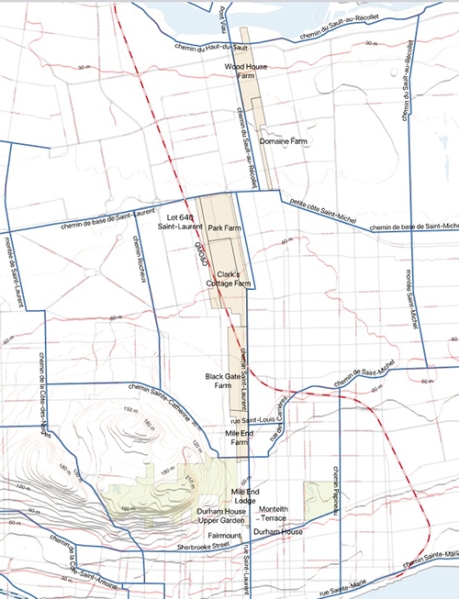
The estate at the heart of these problems was that of the late Stanley Clark Bagg (1820-1873), or SCB. He had owned extensive properties on the Island of Montreal. Several adjacent farms, including Mile End Farm and Clark Cottage Farm, stretched from around Sherbrooke Street, along the west side of Saint Lawrence Street (now Saint-Laurent Boulevard), while three other farms extended along the old country road, north to the Rivière des Prairies. SCB had inherited most of this land from his grandfather John Clark (1767-1827).  Although he trained as a notary, SCB did not practise this profession for long, but made a living renting and selling these and other smaller properties.  

This map shows the extent of the late Stanley Clark Bagg’s properties, shaded in beige, in 1875, when an inventory was made of his estate. These properties are overlaid over a modern map of the island of Montreal. At that time, the actual city of Montreal was south of Sherbrooke Street, extending down to the banks of the Saint Lawrence River. The slope of Mount Royal is just west of the SCB estate. Map created by Justin Bur, based on two open data sources: physical geography from CanVec, Natural Resources Canada and modern streets from Geobase, City of Montreal.

At age 52, SCB suddenly died of typhoid. In his will, written in 1866, he named his wife, Catharine Mitcheson Bagg (1822-1914), as the main beneficiary of his estate, to use and enjoy for her lifetime, and then pass it on to their descendants. He also made her an executor, along with his son Robert Stanley Bagg (RSB, 1848-1912). There were two other executors: Montreal notary J.E.O. Labadie and his wife’s brother, Philadelphia lawyer McGregor J. Mitcheson.

But SCB’s estate was large and complicated, and no one was prepared to handle it. RSB had recently graduated in law from McGill and was continuing his studies in Europe at the time of his father’s death. As for Catharine, she became involved in decisions regarding property sales over the years, but she must have felt overwhelmed at first.

Notary J.A. Labadie spent two years doing an inventory of all of SCB’s properties, listing where they were located, their boundaries, and when and from whom they had been acquired, but he did not mention two key documents. One of these was the marriage contract between SCB’s parents, the other was John Clark’s will.

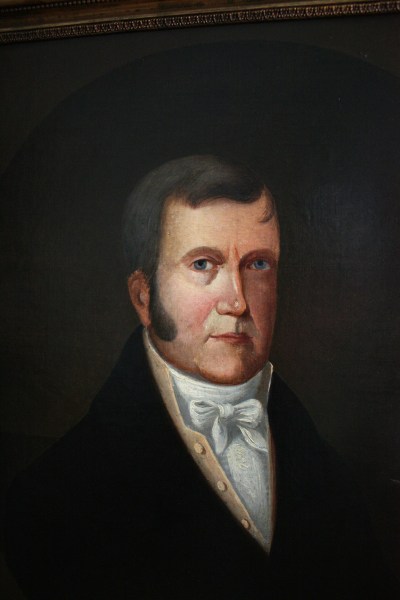
John Clark, a butcher, was born in County Durham, England and came to Montreal around 1797. Bagg family collection.

In the marriage contract, John Clark gave a wedding present to his daughter, Mary Ann Clark (1795-1835), and her husband, Stanley Bagg (1788-1853): a stone house and about 22 acres of land on Saint Lawrence Street. Clark named the property Durham House. But it was not a straight donation; it was a substitution, similar to a trust, to benefit three generations: Mary Ann’s and Stanley’s child (SCB), grandchildren (RSB and his four sisters) and the great-grandchildren. Each intervening generation was to have the use and income from the property, and was responsible for transmitting it to the next generation. That meant SCB could not bequeath it in his will because his children automatically gained possession, and so on, with the final recipients being the great-grandchildren.

In his 1825 will, Clark had made an even more restrictive condition regarding the Mile End Farm. This time the substitution was intended to be perpetual “unto the said Mary Ann Clark and unto her said heirs, issue of her said marriage and to their lawful heirs entailed forever.”

Perhaps Clark imposed these conditions on his descendants for sentimental reasons. Durham House was his daughter’s family home, and Stanley Bagg had probably courted Mary Ann on the Mile End Farm while he was running a tavern there with his father. Or maybe Clark simply believed that these provisions would give the best financial protection to his future descendants. SCB must have thought this was a good idea because his will also included a substitution of three generations.

Clark and SCB did not foresee, however, that the laws regarding inheritances would change. In fact, the provincial government changed the law regarding substitutions a few months after SCB wrote his will. This new law limited substitutions to two generations. Meanwhile, when SCB died in 1873, no one seems to have remembered that the substituted legacies Clark had created even existed. 

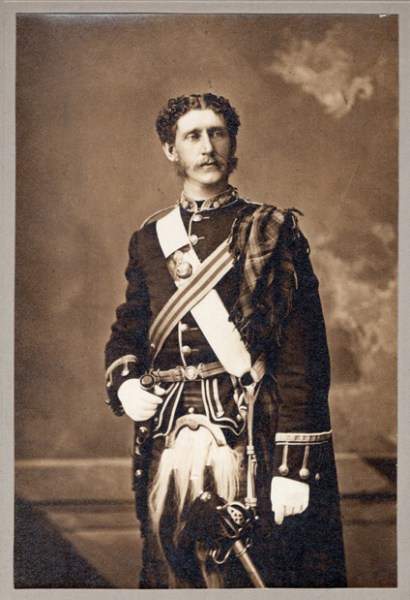
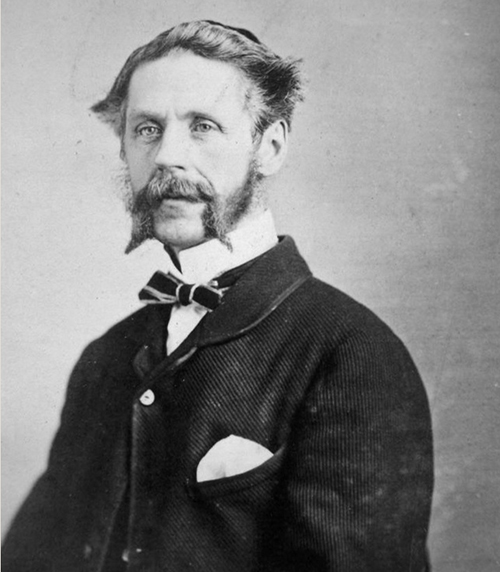
Stanley Clark Bagg, Montreal, QC, 1863, William Notman, McCord Stewart Museum #1-5660.1

Real estate sales practices also changed over the years. Clark had written a codicil specifying that any lot sales from the Mile End Lodge property, where he and his wife lived and which he left to her, were subject to a rente constituée. The buyer paid the vendor an amount once a year (usually 6% of the redemption value), but it was like a mortgage that could never be paid off. In the early 1800s this had been a common practice in Quebec, designed to provide funds to the seller’s family members for several generations.

SCB similarly stipulated that nothing on the Durham House property could be sold outright, but only by rente constituée. By the time he died, some of the properties located near the city outskirts were becoming attractive to speculators and to people wanting to build houses or businesses, but the inconvenience of a rente constituée was discouraging sales. It became clear that the executors had to resolve the issue.

They asked the provincial legislature to pass a special law. On February 23, 1875, the legislature assented to “An Act to authorize the Executors of the will of Stanley C. Bagg, Esq., late of the City of Montreal, to sell, exchange, alienate and convey certain Real Estate, charged with substitution in said will, and to invest the proceeds thereof.” (According to the Quebec Official Gazette, this was one of about 100 acts that received royal assent that day after having been passed in the legislative session to incorporate various companies and organizations, approve personal name changes, amend articles in the municipal and civil codes, etc.)

This act allowed the executors of the SCB estate, after obtaining authorization from a judge of the superior court, and in consultation with the curator to the substitution, to sell land outright, provided that the proceeds were reinvested in real estate or mortgages for the benefit of the estate. In other words, the rente constituée was no longer required, and sales previously made by the estate were considered valid.

No more changes were made until 1889, when family members realized that part of SCB’s property actually belonged to his children, and not to his estate, and a family dispute erupted. The story of how they resolved this issue and remained on good terms will be posted soon.

This article is also posted on my personal family history blog, http://www.writinguptheancestors.ca

Notes and Sources:

I could not have written this article without the help of urban historian Justin Bur. Justin has done a great deal of historical research on the Mile End neighbourhood of Montreal (around Saint-Laurent Blvd. and Mount Royal Ave.) and is a longtime member of the Mile End Memories/Memoire du Mile-End community history group (http://memoire.mile-end.qc.ca/en/). He is one of the authors of Dictionnaire historique du Plateau Mont-Royal (Montreal, Éditions Écosociété, 2017), along with Yves Desjardins, Jean-Claude Robert, Bernard Vallée and Joshua Wolfe. His most recent article about the Bagg family is La famille Bagg et le Mile End, published in Bulletin de la Société d’histoire du Plateau-Mont-Royal, Vol. 18, no. 3, Automne 2023.

Documents referenced:

Mile End Tavern lease, Jonathan Abraham Gray, n.p. no 2874, 17 October 1810

Marriage contract between Stanley Bagg and Mary Ann Clark, N.B. Doucet, n.p. no 6489, 5 August 1819/ reg. Montreal (Ouest) 66032

John Clark will, Henry Griffin, n.p. no 5989, 29 August 1825

Stanley Clark Bagg will, J.A. Labadie, n.p. no 15635, 7 July 1866

Stanley Clark Bagg inventory, J.A. Labadie, n.p. no 16733, 7 June 1875

Quebec legislation: 38 Vict. cap. XCIV, assented to 23 February 1875

See also:

Janice Hamilton, “Stanley Clark Bagg’s Early Years,” Writing Up the Ancestors, Jan. 8, 2020, https://www.writinguptheancestors.ca/2020/01/stanley-clark-baggs-early-years.html

Janice Hamilton, “John Clark, 19th Century Real Estate Visionary,” Writing Up the Ancestors,   May 22, 2019, https://www.writinguptheancestors.ca/2019/05/john-clark-19th-century-real-estate.html
The Trip of a Lifetime

My father, Edward McHugh, didn’t really talk about his family’s trip of a lifetime. After all, Dad wasn’t even born yet. But it must have been discussed by everyone when he was a boy. In 1911, the first member of the family, Mary Ann McHugh, moved from Dundee, Scotland to Montreal.

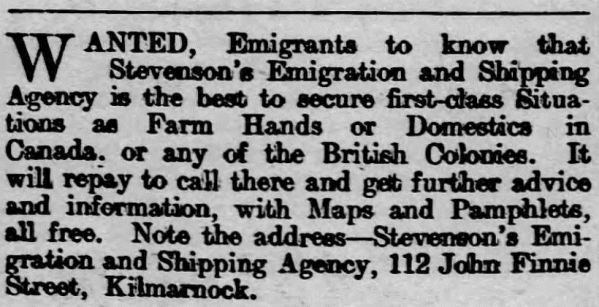
At the time, booking agents in the United Kingdom advertised and recruited potential immigrants to Canada. There was an acute need of domestic help and agricultural workers. Between 1890 and 1920, Canada experienced its third wave of immigration and its peak was between 1911 and 1913, just before World War I.1 The following type of advertisement was common in the newspapers.2

Booking agent advertisement

Maybe one of these advertisements gave the McHugh family the idea to emigrate to Canada. Or maybe Mary was ready for an adventure. She was just 21 when she disembarked from the SS Grampian that had left Glasgow on June 24, 1911 and arrived in Quebec City on July 9, 1911.  She would have had a medical exam when she arrived to ensure that she was in good health and did not have an infectious disease. Conditions for immigration to the colonies were well known in the United Kingdom. The February 11, 1911 edition of the Hamilton Observer, in its article, Canadian Notes, People Prohibited, details the reason some potential immigrants could expect to be refused by Canada. The article explains the booking agent’s liability for the immigrants that arrived in Canada for a period of three years following their arrival:

“The following classes of people are prohibited from landing … feeble minded, idiotic, insane, or who have been insane within five years, afflicted with any loathsome, contagious, or infectious disease; anyone who is a pauper, who is destitute, who is a professional beggar or vagrant.”3

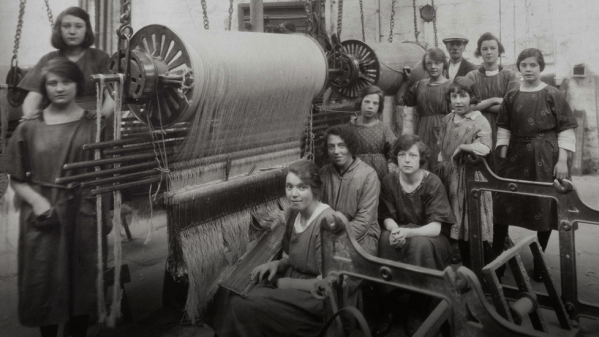
All of the members of the McHugh family worked in the jute mills in Dundee. The 1911 census indicates Mary was a jute weaver, which probably meant that she operated a jute weaving machine.4 She lived with her mother, Sarah Jane McLaughlin, and her brothers, Edward and Francis. They lived at 1 Tait Lane, Dundee. Her other brother, Thomas, my grandfather, lived with his wife and seven children at 9 Tait Lane.

The picture below shows the jute weaving machine.5

Mary must have been satisfied with her new life in Montreal, Quebec. Within a year, her mother and her two brothers, along with my grandfather, had followed her to Canada. Six months later, my grandmother, Elsie Orrock, and her seven children joined her husband, Thomas, in Montreal.

The McHughs lived close together in Dundee and they also lived close together in Verdun, Quebec. While I will never know for sure why they decided to emigrate, I can guess that they wanted a life that was not as hard as the one working in the jute mills. There are a few clues that this was not a spur of a moment decision but a planned family decision.

Mary left first and, if it did not suit her to live in Canada, she would have been able to easily return to Dundee. Her mother and brothers were still there. By the time her mother emigrated, along with her three sons, they arrived with $150 CAD, about $4,750 in today’s dollars. Browsing through the passenger lists, I can see that they had a lot more money than many of their fellow passengers. 6 They were not a rich family, so this amount of money would have taken some time to save up.

Coincidentally my grandfather joined the Freemasons in 1910 and achieved a Master Mason diploma and a Mark Mason diploma.7 By that time, he already had six children. He worked long hours in the jute mill, including Saturdays. Why would he join the masons when he was already a very busy man providing for his family, plus taking care of his widowed mother, and his siblings who still lived at home? There is no evidence that he ever joined the masons when he arrived in Canada. I believe that it is possible that he joined the masons to in case he needed the contacts to find employment. As he quickly found work, his busy family life prevented him from pursuing his membership in the masons.

Only one of my grandfather’s siblings stayed in Scotland, Sarah Jane McHugh. She was not living with the other McHughs at the time of the 1911 census. But she remained close to the family. Surprisingly, she travelled to Montreal to be a witness at her brother’s wedding at the Notre Dame Basilica in Montreal on May 8, 1913.8 That would have been quite a trip for Sarah Jane to make.

  1. Wikipedia, Immigration to Canada, https://en.wikipedia.org/wiki/Immigration_to_Canada, accessed 27 September 2023.
  2. Irvine Herald and Ayrshire Advertiser (Irvine, Strathclyde, Scotland) · 13 Oct 1911, accessed Newspapers.com, downloaded 24 August 2023.
  3. The Hamilton Advertiser (Hamilton, Strathclyde, Scotland) · 11 Feb 1911, accessed Newspapers.com, downloaded 24 August 2023.
  4. Scotland’s People, National Records of Scotland, 1911 Census, Sarah Jane McHugh, downloaded 23 June 2019.
  5. V&A Dundee Design Museum, Women’s Day tweet, 6 March 2020.
  6. Passengers lists for S.S. Grampian arriving in Port of Quebec, May 21, 1912, Library and Archives Canada, https://www.bac-lac.gc.ca/eng/discover/immigration/immigration-records/passenger-lists/passenger-lists-1865-1922/Pages/image.aspx?Image=e003578022&URLjpg=http%3a%2f%2fcentral.bac-lac.gc.ca%2f.item%2f%3fid%3de003578022%26op%3dimg%26app%3dpassengerlist&Ecopy=e003578022, accessed February 3, 2022.
  7. Thomas McHugh, registration of the Grand Lodge of Scotland, dated 25 August 1910.
  8. Registration of marriage of Francis McHugh and Helen Smith, 8 May 1913, downloaded 6 January 2022.

Peacocks and Cherubim: My Mysterious Aunt Cecile

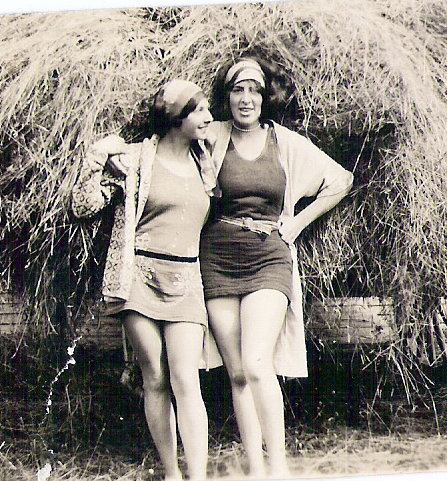
My Aunts Flo and Cecile, circa 1930, in what I assume are bathing suits maybe at Old Orchard Beach Maine where the family vacationed.

It was 1962 or so and my mom, twin brother and I had taken a bus from Old Orchard Beach to Ogunquit, Maine to visit my Aunt Cecile, who was on vacation at the same time as us.

As my brother and I crawled over the jagged and slippery shoreline in front of her hotel we openly wondered why anyone in their right mind would want to vacation in this spot. It was all rocks!

Well, much time has passed and my husband and I love to spend time at picturesque Perkin’s Cove on our short trips to Maine in the spring or fall.

On one such weekend visit, I recall the owners of our b-n-b telling us about pre-WWII Ogunquit: it had once been a bohemian artist’s colony with open air classes and nude models posing on the Marginal Way.

An artist’s colony! Now that explains it. My Aunt Cecile was an artist and a good one at that – but a bohemian, never! I remember her only as sober and serious – and seriously pious. Children were a foreign country to her and her main ambition with regards to me was to convert me to Roman Catholicism.

Marie-Catherine Cecile Crepeau was born in Montreal 1909 to Jules Crepeau and Maria Roy, my grandparents. She had an older brother and sister, Louis and Alice and in 1914 or so another girl her age, Florida, was plucked off the scruffy streets of south central Montreal and brought into the family fold. My mother would appear much later in 1921.

Cecile contracted scarlet fever as a child and suffered severe heart damage. According to her sisters, she was ‘babied’ for most of her childhood, not asked to do very much.

So, it seems she learned to paint.

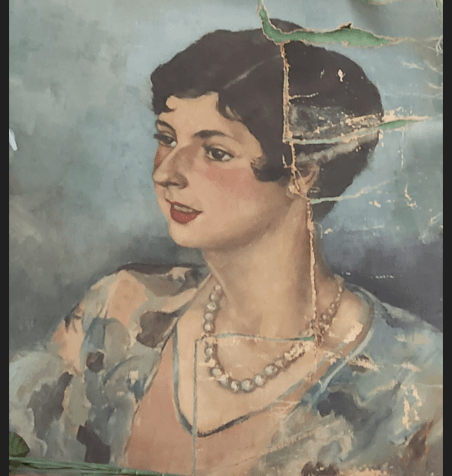
This battered canvas of young Flo is the only one of Cecile’s that I own. It was painted in 1927 when both Cecile and Flo were 18. It is pretty accomplished for so young an artist, I think.

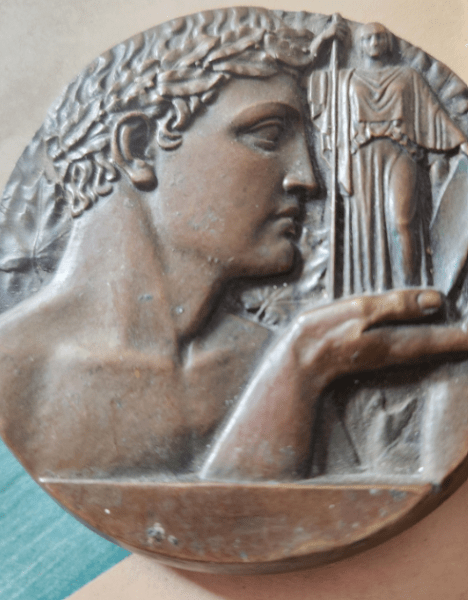
Indeed, in a few years later Cecile would be accepted into the Beaux-Arts in Montreal (perhaps using this portrait in a portfolio) and she would win the first prize for oil painting (considered very much a male domain) in 1937.

I have the medal somewhere and I found this tidbit from a tabloid called “L’illustre” describing the 1937 Beaux-Art exhibition: “Although the Hall of Paintings has little that is very striking, Therese Boucher’s “Reclining Man’ is vigorously treated. Among the angels, Cecile Crepeau’s is most alluring, in large part because of the curious golden tonality of the ensemble. Her study of a face, placed to the right of the entrance, has life and sincerity, despite some weaknesses. Her blue vase beside a pewter bowl also merits a mention. The female nudes are unimpressive.”

The angel picture I remember well. It loomed over Cecile’s living room and, yes, it was very golden. Another tall tall wall hanging I remember was an oil painting of a statue of St John the Baptist holding his own very hairy head.

I don’t recall the still life mentioned in the newspaper article, but I wish she had put some pretty vases behind Aunt Flo in my painting. It seems unfinished somehow.

The gorgeous and heavy ‘gold’ medal. I wish

My aunt was ‘a perfectionist’ (who suffered migraines for it) said my mother, which might account for why she created so few completed canvases..

Again, according to my mother, a teacher at the Beaux-Arts told her she had the technique but to be a superior artist but she had to ‘live a little.” (I wonder if the teacher was hitting on her.)

In the 1940’s, Cecile is listed in Lovell’s Directory as “housekeeper’ at my widowed grandmother’s Oxford Avenue flat. My mother is working as a stenographer at RKO Motion Pictures just down the street and my Aunt Flo as a greeter at Henry Morgan’s department store downtown. They are providing the financial support. My grandfather, former Director of City Services, had died under mysterious circumstances in 1938.

My brother and aunts in Cecile’s garden on Beaconsfield Avenue. It was lined with statuesque poplars and showcased an ornate wrought iron and marble birdbath! 1956 or so.

In 1951 my grandmother passed away. My mother had already married and moved a short distance way. Flo, too, would soon marry, leaving Cecile to figure out what to do with the rest of her life.

The story goes Cecile tried to became a nun but was turned down ‘due to her bad heart.’ Instead, she married a friend’s father, Amedee Buteau, a retired professor almost 30 years her senior. 1They would take a lower duplex apartment in NDG, filling it with my grandparents’ elegant furnishings. It was a marriage of convenience, no doubt, but it worked.

In the 1960’s, I just loved visiting Cecile’s home. Unlike our dingy and unadorned upper duplex apartment not far away, Cecile’s home was spic-n-span, every surface polished to a high sheen. There was no TV blaring Bonanza or Star Trek, just a giant grandfather clock solemnly marking each quarter hour with a click and a ping. The place felt like a museum with all the curio cabinets filled with so many intriguing things.

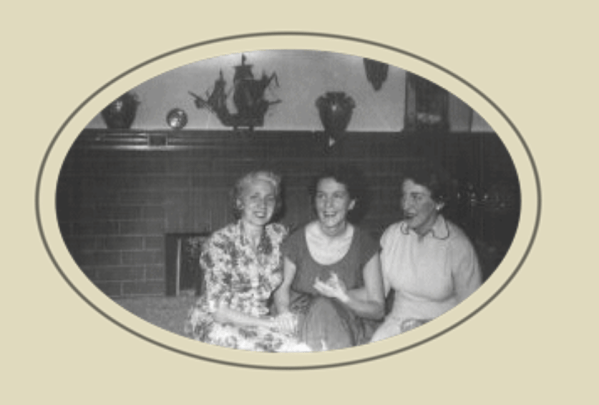
1955, My mom with her sisters.

And mixed in with the fin-de-siecle family treasures were her many multi-media artworks: sculptures, ceramics, watercolours. There were quite a few confusing (to me) religious subjects like bleeding hearts but also some adorable cherubim and many nature studies especially of flowers, birds and butterflies. Indeed, Cecile painted an immense peacock in full display on a wooden blind on the wall behind her bed. The tension between Eros and Thanatos in her beautiful Beaconsfield Avenue abode was quite evident to me, even as a child.

My mother had a very choppy relationship with her sister Cecile so even though we lived but a short bus ride away we didn’t visit her that often. – and I don’t recall her ever visiting us. Cecile’s hair went from red to grey between 1960’s visits I recall.

On at least one occasion I was sent on a sleepover. My aunt was awkward with me and I was determined not to like her, probably picking up on my mom’s vibes. It didn’t help that Cecile brought me to a scary Latin mass at Notre Dame Cathedral, pinning a silly handkerchief to the top of my head. Unfortunately, she did no art with me. Too messy I guess. Too bad as she was a wizard with pastels.

Cecile passed away in 1974 a year or two before her aged spouse. She was 65. My mother sobbed with grief at her passing. “You were always fighting with her,” I recall saying to my mom. “So why are you crying so much?” How naive of me.

All of the family heirlooms fell into the hands of ‘strangers’ upsetting my mother, but one lost canvas pained her in particular. “It was Cecile’s best painting,” she said, “of Alice putting a flower in Florida’s hair before a dance.”

Classic! I can hardly blame my mother for coveting that particular oil painting, one that involved all of her sisters: I wonder who owns it now.

  1. Mon Oncle Amedee was so comically vague in his dotage, seated in his armchair snoozing away with an upside down Le Devoir newspaper folded onto his lap, we children assumed he was expert in some airy-fairy field like ancient philosophy. But, no, quite the opposite. A short search on the Web reveals that in the 1920’s Amadee was a civil engineer, Dean of a Technical College and expert in technical education giving lectures, meeting with policy makers, even writing a book.

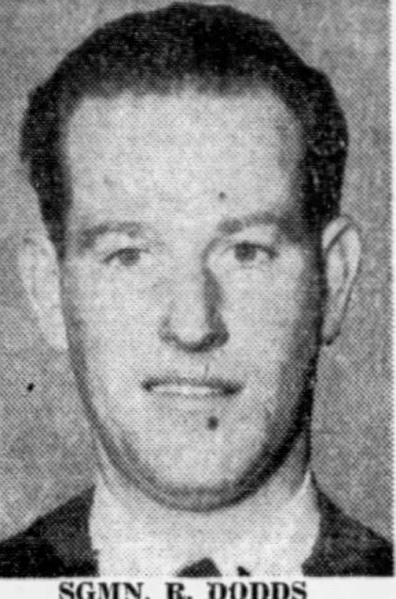
Ralph Dodds, Signalman, Royal Canadian Navy

My aunt, Sarah Jane McHugh, was delighted to host the linen shower to celebrate her daughter, Dawna Day’s upcoming marriage to Ralph Dodds. The happy couple announced their engagement in October 1947. Ralph had recently been discharged after serving in the Royal Canadian Navy for over six years.  The couple’s wedding would take place in Vancouver, Ralph’s home town. Dawna was from Montreal.

Ralph was just 20 when he started his navy career in Esquimalt, British Columbia in 1939.1 With the advent of World War II, the Esquimalt Navy base became the largest naval training center in western Canada. 2 Ralph Dodds trained to become a signalman would have learned all aspects of military communications in the Canadian Navy. He would have used semaphore flags, read and transmitted morse code messages, and assured radio communications.3 During his training, Ralph would not have predicted that he would participate in the sinking of a German U-boat during the Battle of the Atlantic, that he would be on a destroyer that participated in a sea fight on D-Day, or that the destroyer he was on would be shipwrecked off the coast of Iceland.

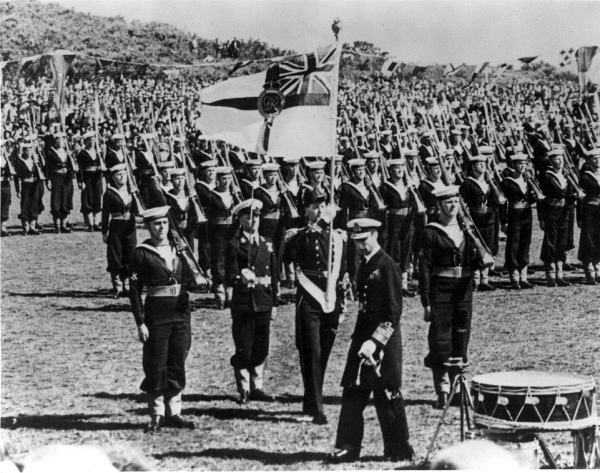
King George VI presents the King’s Colours to the Royal Canadian Navy at Beacon Hill Park, Victoria, 1939. Photo: CFB Esquimalt Naval and Military Museum collection

While Ralph was assigned to a naval station, and to a corvette (small destroyer), for most of his naval career, he was assigned to the HMCS Skeena.

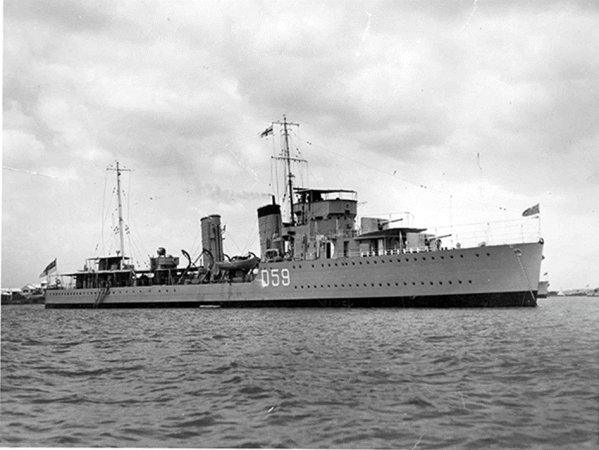
HMCS Skeena, D59, Government of Canada website, Ships’ histories

The HMCS Skeena was commissioned in 1931 in Portsmouth, U.K. and was one of the first two ships built to Canadian order. With the outbreak of the war, the Skeena initially performed domestic escort duties. In May 1940, she was sent to Plymouth, U.K. and became part of the Western Approaches Command, taking part in the evacuation of France and escorting convoys in British waters. She was later assigned to continuous convoy duty.

During one of its escort duties in the Atlantic, the Skeena destroyed U-boat U-588. This happened during ON-115 (ON means Outbound to North America).  There were twelve escort ships for a trade convoy of 43 merchant ships that left Liverpool on July 12, 1942. On July 29, seven U-boats of the Wolfpack Wolf had spotted them. This Wolfpack was quickly joined by another six U-boats of the Wolfpack Pirat. The Wolf Pack tactic, or the “Rudeltaktik,” was devised to attack the Allied convoy system by forming into position effecting a massed organized attack.4 This particular battle resulted in the loss of three of the ships in the convoy and significant damage to two of the ships in the convoy. One of the damaged ships returned to the U.K. and one was escorted to St. John’s, Newfoundland. The Skeena, on which Ralph was a signalman, and the HMCS Wetaskiwin, an escort corvette, destroyed U-boat 588 with depth charges (antisubmarine missiles) on July 31. The hostilities lasted until August 3 when the U-boats lost contact with the convoy due to misty weather. The convoy with the remaining ships reached Boston on August 8, 1942.5

The sinking of American freighters, Edward Rutledge, Tasker H. Bliss and Hugh L. Scott at Fedala Roads, November 12, 1942
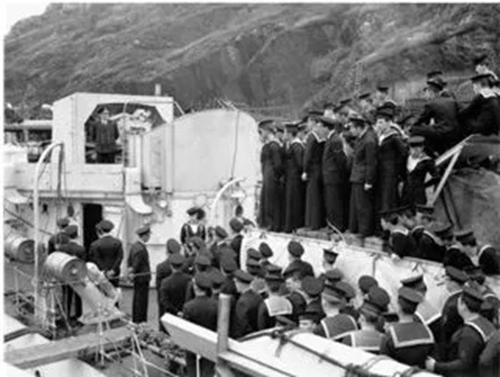
Commodore Leonard Murray congratulating the ship’s companies of HMCS Skeena and HMCS Wetaskiwin for sinking the German submarine U-588 on 31 July 1942. St. John’s, Newfoundland, Aug. 4, 1942. (NAC PA-115347)

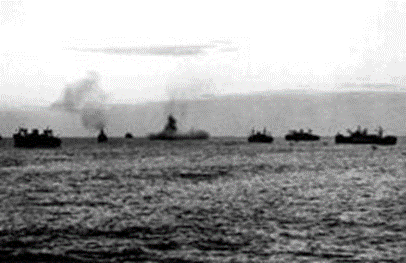
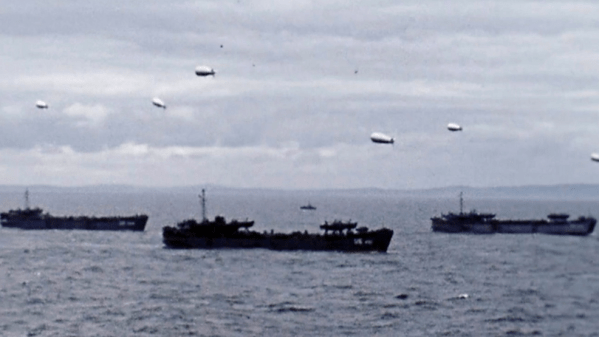
The Skeena also participated in a hot sea fight in the Channel on D-Day. The Skeena’s assignment was to prevent enemy U-boats from attacking Allied ships while the Invasion of France was being carried out.

“Torpedoes were shooting about in the Channel and missed the Skeena by only a matter of feet,” said Ralph in an interview he gave to the Vancouver Sun.

The destroyer also had to contend with German Dorniers (bombers) that were bombing the destroyers in the Channel. One of the aerial missiles fell so close to the Skeena that shrapnel was later found on the deck.6

Ships and blimps sit off the coast of France on D-Day, June 6, 1944. War Footage From the George Stevens Collection at the Library of Congress

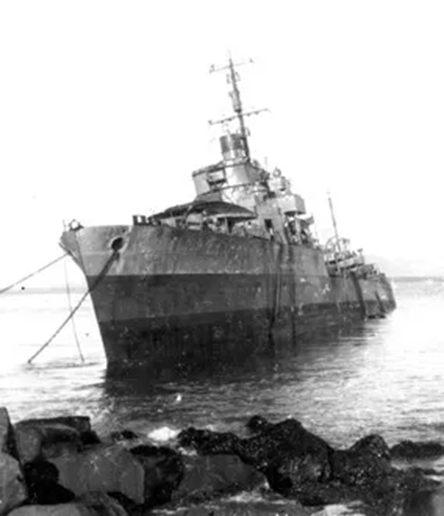
After five years of war, the HMCS Skeena met her end as she sheltered from a violent gale with 15-metre waves off the coast of Iceland, at Videy Island on October 24, 1944. Even though the crew had thrown out a second anchor to secure the ship, the Skeena smashed into the rocks. When the crew abandoned ship, the men were unable to hold the lines. Some crew members were smashed into the rocks, while others were tossed into the sea. Fifteen sailors died.7 Ralph Dodds survived.

HMCS Skeena aground on Videy Island. (Image Source: http://www.forposterityssake.ca/Navy/HMCS_SKEENA_D59.htm#Photos)
  1. Vancouver Sun, D-Day Fight in Channel Recalled by B.C. Sailor, 13 December 1944.
  2. Vance, Emily. Capital Daily, How Canada’s Pacific Fleet Shaped Greater Victoria Over Two Centuries, 1 May 2021, https://www.capitaldaily.ca/news/canadas-pacific-fleet-greater-victoria-two-centuries, accessed 24 July 2023.
  3. Wikipedia, Signaller, https://en.wikipedia.org/wiki/Signaller, accessed 24 July 2023.
  4. Uboataces, German U-Boat, U-Boat Tactics, The Wolf Pack, http://www.uboataces.com/tactics-wolfpack.shtml, accessed 31 July 2023.
  5. Wikipedia, Convoy ON115, https://en.wikipedia.org/wiki/Convoy_ON_115, accessed 26 July 2023.
  6. Vancouver Sun, D-Day Fight in Channel Recalled by B.C. Sailor, 13 December 1944.
  7. Military History Now, HMCS Skeena – Meet One of the Toughest Warships of the Battle of the Atlantic, 12 November 2020, https://militaryhistorynow.com/2020/11/12/hmcs-skeena-meet-one-of-the-toughest-warships-of-the-battle-of-the-atlantic/, accessed 2 August 2023.

The Life and Times of Great-Aunt Amelia

My mother used to tell me that Amelia Norton was her favourite of her four great-aunts on her mother’s side of the family. From what I have learned about Amelia’s life, it appears she was indeed a kind and generous person.

Amelia Josephine Bagg was born in Montreal in 1852. Her father, Stanley Clark Bagg, was a wealthy landowner in Montreal, so Amelia had a privileged upbringing that included a year-long tour of Europe with the whole family in 1868-69, when she was 16.

After her father died in 1873, her brother, Robert Stanley Bagg, took over management of their late father’s real estate, renting out some properties and selling others. Amelia had a strong interest in the Bagg family real estate business, helping to keep the records of sales, and she also owned property in her own name.

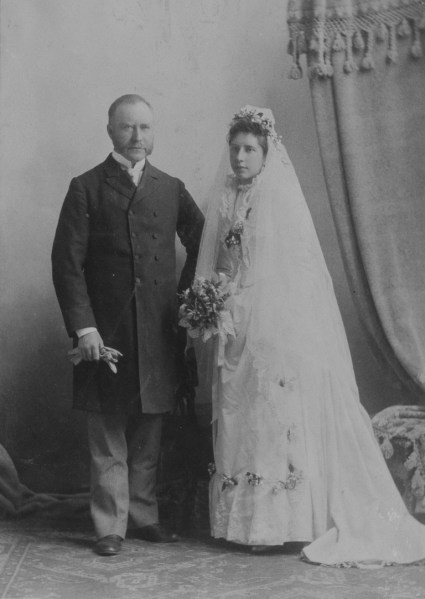
Mr. and Mrs. Mulholland. 1891. Wm. Notman and Son, McCord-Stewart Museum, II-95084 1.

Amelia lived with her mother, Catharine Mitcheson Bagg, until she married at age 38. The wedding took place on Dec. 18, 1890 at Christ Church, Montreal’s largest Anglican church. Her husband was Joseph Mulholland, the eldest son of hardware merchant Henry Mulholland and his wife, Ann Workman. Born in Montreal in 1840, Joseph had a twin who died as an infant. Joseph is connected to me in two ways: in addition to being married to Amelia, his sister Jane Mulholland (1847-1938) and her husband, Montreal banker John Murray Smith (1838-1894), were my great-grandparents on my mother’s father’s side.

As a young man, Joseph had worked in the hardware business. Now, as Amelia’s husband, he started a new career in real estate. In 1891, he and his brother-in-law collaborated in a business venture: Joseph and John purchased a vacant piece of land from Robert Stanley Bagg on Saint Charles Borromée Street (now renamed Clark Street) near Pine Avenue and built a row of attached house there.1 The building, designed by architect Eric Mann, survives to this day.

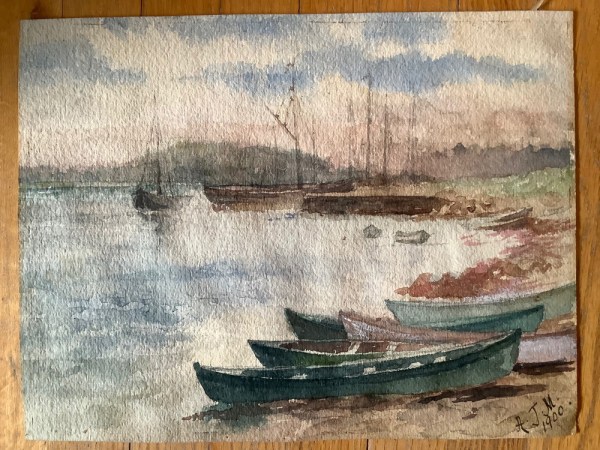
Amelia was known as a talented amateur artist. This watercolour painting of the Montreal waterfront belongs to one of the Bagg family descendants.

Joseph died, age 57, in 1897. Five years later, Amelia married again, this time to Reverend John George Norton, Archdeacon of Montreal.It was a relatively small wedding with only family members and a few close friends present.2 John was born in Ireland in 1840 and he was educated there. He moved to Montreal in 1884 with his wife and two children. His wife died five years later.

As the wife of one of the leading clerics in Montreal’s English-speaking community, Amelia took on a new role, especially in church charities. According to a biography of Archdeacon Norton in The Storied Province of Quebec, “Mrs. Norton is a lady of culture and refinement. Mrs. Norton was a valued ally and helpmate in all the parochial work of the church.”3

At that time, governments gave little funding to health care or social services, so benevolent societies played an essential role in society. As president of the Women’s Auxiliary of Christ Church Cathedral for many years, Amelia was especially interested in its missionary work.4 In addition, her name appeared regularly in lists of donors to various charities published in the local newspapers.

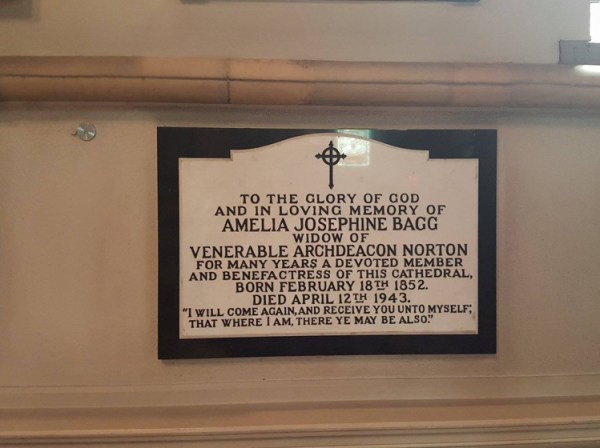
This memorial to Amelia is in Christ Church Cathedral, Montreal. Photo by Genevieve Rosseel.

The couple lived in the church rectory for many years and after John retired, they moved into their own house on McTavish Street, near McGill University. When the Venerable John George Norton, Rector Emeritus and Archdeacon of Montreal John died in 1924 at the age of 84, many people attended his funeral service at Christ Church, where he had officiated for 37 years.

Meanwhile, Amelia seems to have been the go-to person when family members needed help. After Amelia’s Aunt Fanny (Mitcheson) Hague was widowed in 1915, Fanny came to live with the Nortons and remained there until she died in 1919.

My grandparents also went to Amelia for help. They had built a new house just before the Depression hit and my grandfather lost his job. Amelia helped to support the family until my grandfather found a new job after the Depression.

Amelia died in 1943, at age 91, at home on McTavish Street, following a long illness. She is buried with her first husband in the Mulholland-Workman family plot in Montreal’s Mount Royal Cemetery.

Sources

  1. Le Prix Courant: le journal de commerce, 10 Avril 1891, p 13, https://numerique.banq.qc.ca, entry for John Murray Smith, https://numerique.banq.qc.ca/patrimoine/details/52327/2746357?docsearchtext=%22John%20Murray%20Smith%22, accessed June 18, 2023.
  • 2. “Marriage at the Cathedral”, The Gazette, 25 June, 1902, p. 6, Newspapers.com, accessed June 18, 2023.
  • 3. William Wood, editor, The Storied Province of Quebec, Past and Present, Dominion Publishing Company, 1931, vol. 3, p. 118.
  • 4.  “Obituary: Mrs. J. Norton, 91, Dies at Home Here,” The Gazette, April 13, 1943, p. 14, Newspapers.com, entry for Amelia Norton, accessed June 20. 2023.

5.    Mount Royal Cemetery, section F200-c

See also

Frank Dawson Adams, A History of Christ Church Cathedral, Montreal, Montreal: Burton’s Limited, 1941, https://numerique.banq.qc.ca/patrimoine/details/52327/2561503

Janice Hamilton, “Continental Notes for Public Circulation”, April 8, 2020, Writing Up the Ancestors, https://www.writinguptheancestors.ca/2020/04/continental-notes-for-public-circulation.html
Janice Hamilton, “Aunt Amelia’s Ledger”, April 26, 2023, Writing Up the Ancestors,          https://www.writinguptheancestors.ca/2023/04/aunt-amelias-ledger.html

Janice Hamilton, “Henry Mulholland, Montreal Hardware Merchant”, March 17, 2016, Writing Up the Ancestors, https://www.writinguptheancestors.ca/2016/03/henry-mulholland-montreal-hardware.html

Janice Hamilton, “The World of Mrs. Murray Smith”, Feb.24, 2016, Writing Up the Ancestors, https://www.writinguptheancestors.ca/2016/02/the-small-world-of-mrs-murray-smith.html

Janice Hamilton, “Never Too Late for Love,” April 4, 2014.  Writing Up the Ancestors, https://www.writinguptheancestors.ca/2014/04/never-too-late-for-love.html

This article is also posted on the family history blog Writing Up the Ancestors.

Aunt Amelia’s Ledger

with additional research by Justin Bur

Some of my female ancestors are almost invisible. They got married, had children and left no other traces of their lives. But a few left paper trails such as letters, journals and drawings. My two-times great-aunt Amelia Josephine Bagg (1852-1943) was one of them. Married twice but with no children of her own, she became deeply involved in the family real estate business.

Amelia was the third of the five children (one boy, four girls) of Montreal landowner Stanley Clark Bagg (SCB) and his wife, Catharine Mitcheson Bagg. The children grew up in the family home, Fairmount Villa, near what is now the corner of Sherbrooke and St. Urbain streets. There, they had a big garden to play in and no doubt a nanny to care for them when they were little and a governess to educate them.

Unlike many women of her time and class, Amelia found the opportunity to use her education.

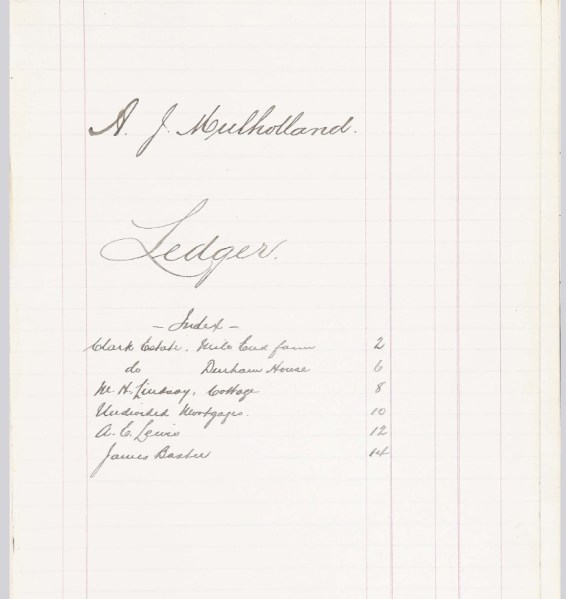
Amelia Mulholland’s ledger, McCord Stewart Museum, https://collections.musee-mccord-stewart.ca/internal/media/dispatcher/261758/preview p. 5.

SCB had inherited several large properties on the Island of Montreal, extended along the west side of St. Lawrence Street (now busy Boulevard Saint-Laurent). During his lifetime, this was agricultural land and, although he was trained as a notary, SCB made his income by leasing his properties to farmers.

He died unexpectedly at age 53, in 1873, when Amelia was just 21. SCB named his wife and her brother (who was a Philadelphia lawyer) as executors of his estate.1 Son Robert Stanley Bagg (RSB), a recent law graduate from McGill University, took on the responsibility of managing it. Over the years, the widowed Catharine and her daughters had a great deal of input into decisions about the estate, with Amelia being the daughter who took the greatest interest.    

Around the end of the century, Montreal grew rapidly. Business leaders developed new industries, founded banks and built railways, and immigrants arrived to fill newly created jobs. Property belonging to SCB’s estate could now be divided into lots and sold to people who wanted to build homes or invest in rental housing. Around 1890, some legal hurdles prevented the family from selling the most valuable properties, however, the family managed to resolve these problems. That will be a story for another time.

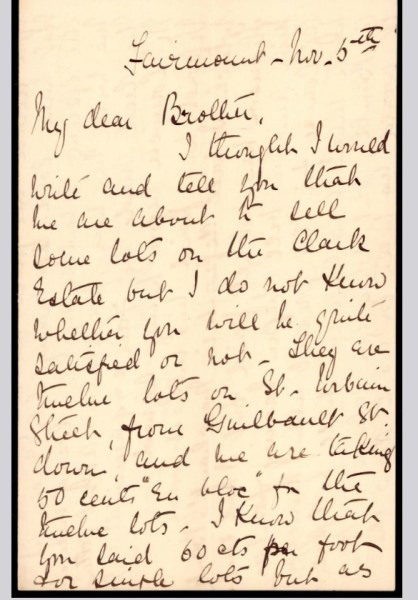
Amelia’s letter to brother Robert Stanley Bagg, McCord Stewart Museum,  https://collections.musee-mccord-stewart.ca/en/objects/416400/correspondance  p. 43

With these issues resolved, Amelia and her siblings divided up some of the land and became owners of lots that they could sell or buildings they could rent out themselves. Amelia became an independently wealthy woman.

She also developed an interest in the details of the family real estate business, keeping track of land prices, interest rates and other factors influencing real estate sales. In the fall of 1890,2 while her brother took his wife and children on an extended trip to England, Amelia coordinated decisions on new property sales. She wrote to ask for his advice and to bring him up-to-date on family news.3

“Fairmount, Nov. 6th

“My dear Brother,

“I thought I would write and tell you that we are about to sell some lots on the ‘Clark Estate’ but I do not know whether you will be quite satisfied or not. They are twelve lots on St. Urbain Street, from Guilbault St. down, and we are taking 50 cents “en bloc” for the twelve lots. I know that you said 60 cents per foot for single lots but as this is for twelve lots we thought perhaps it was better not to lose the sale.4 Bob said that you told him we could take less than the price named, and McMann said he was selling lots of Park Avenue for 45cts.7 I hesitated for a long time as I did not wish to make a sale that you would not approve, but Kate was in favor of selling, so also was Bob, and Helen and I did not know what to do….5

“Vipond has paid his interest today which I will deposit in Merchant’s Bank. Thomson has not yet paid but I had sent him another bill before hearing from you. Of course for the present all money both interest and capital will be deposited in the bank, but when you return we think it would be better for us to draw the interest and leave only the capital in the bank.….”

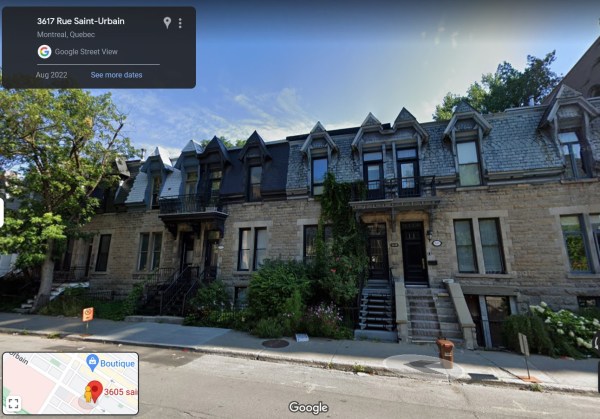
Row houses on St. Urbain Street near Prince Arthur. Google Street View

Much of the Bagg estate was still leased out to farmers at that time, and one day a month was reserved for tenants to deliver the rent. In the same letter, Amelia referred to this so-called reception day, but she was actually describing the arrival of her sister Mary Heloise Lindsay’s fifth child on Nov. 3, 1890. Mary and her husband Robert Lindsay lived at 436 St. Urbain. Amelia told her brother:

Kate and I made out the Nov. statements of rents due and gave the list to Bob so that when the people paid he could check them off. We were surprised at an unexpected arrival at 436 St. Urbain Street on Monday. It is true that is the reception day there now, but this particular visitor was not expected just then. It was a dear fat little girl! She arrived at 8 o’clock in the evening.”

Amelia also kept track of the sales of lots from the estate between 1890 and 1900 in a hardcover ledger with ruled pages. My mother eventually inherited that ledger. Her cousin had given numerous family letters, business records and other documents to the McCord Stewart Museum (a Montreal museum of social history) some years earlier, but my mother hung on to the ledger. After she died, I found it in a desk drawer in the spare bedroom.

When I started to research the Bagg family and their role in Montreal history, the ledger’s importance as a record of those land transactions became clear, so I donated it to the McCord.6 I hope Amelia would have approved.

This article is also posted on http://www.writinguptheancestors.ca.

See also:

Janice Hamilton, “Stanley Clark Bagg’s Four Forgotten Daughters,” Writing Up the Ancestors, Sept. 30,2017, https://www.writinguptheancestors.ca/2017/09/stanley-clark-baggs-four-forgotten.html

Janice Hamilton, “My Great-Great Aunts, Montreal Real Estate Developers,” Writing Up the Ancestors, Oct. 11, 2017, https://www.writinguptheancestors.ca/2017/10/my-great-great-great-aunts-montreal.html

Janice Hamilton, “John Clark, 19th Century Real-Estate Visionary,” Writing Up the Ancestors, May 22, 2019, https://www.writinguptheancestors.ca/category/john-clark

Notes and Sources

  1. City of Philadelphia (Pennsylvania). Register of Wills Office; Wills, No 772-802, 1887, Ancestry.com. Pennsylvania, U.S., Wills and Probate Records, 1683-1993 [database on-line, entry for Catharine Mitcheson Bagg, accessed April 2, 2023], original data: Pennsylvania County, District and Probate Courts. This is a copy of the will that is very easy to read. It was probably copied in Philadelphia because McGregor J. Mitcheson, Catharine’s brother and an executor of SCB’s will, died in 1886. About a month after SCB’s 1873 death, notary J. A. Labadie deposited at the land registry office in Montreal a copy of the 1866 will and the 1870 codicil and a declaration of death. Bureau d’enregistrement Montréal-Ouest, no 74545, registered 6 September 1873; at Registre foncier du Québec, online.
  2. Amelia did not note the year on her letter, but we know it was written in written in 1890 because that was the year her niece Marjorie Mary Clark Lindsay was born. 

3. Correspondance de la famille Bagg. McCord Museum, Fonds Bagg, P070/B08,  https://collections.musee-mccord-stewart.ca/en/objects/416400/correspondance  p. 43 (accessed April 3, 2023)

4. RSB must have told them to hold out for the full price. The lots were not sold until the following year. On Nov. 18, 1891, real estate agent and furrier Robert Lamb purchased not just the 12 lots mentioned here, but an extended row of 22 lots, paying 60 cents a square foot.

5. The people mentioned here are probably Amelia’s sisters Katherine Sophia Mills and Helen Frances Lewis. Bob was likely Robert Lindsay, her sister Mary’s husband. McCann was a real estate agent.

6. Amelia Josephine Bagg Mulholland, Grand livre, 1891-1927, McCord Museum, Fonds Bagg, P070/B07,1. https://collections.musee-mccord-stewart.ca/en/objects/293626/a-j-mulholland-ledger (accessed April 3, 2023)

Captain Stanley Lindsay

Part One of Two

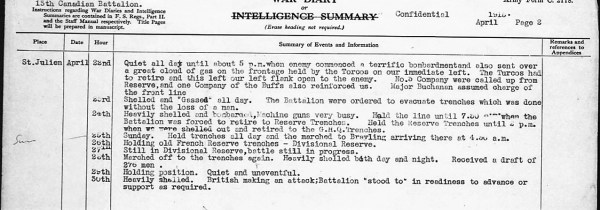
Somehow my great-uncle Stanley survived the Battle of St. Julien1 which was part of the larger Second Battle of Ypres (22 April – 25 May 1915). There were around 100,000 casualties in that battle alone.

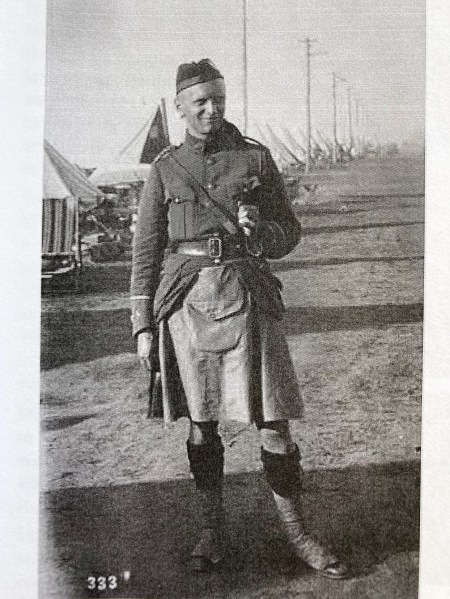
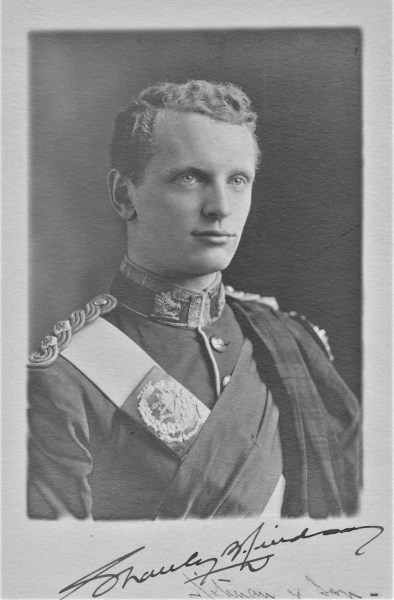
Stanley Bagg Lindsay (1889-1965) fought in The Great War with the 13th Battalion, Royal Highlanders of Canada (RHC). The Germans deployed poisonous chlorine gas in Ypres, Belgium, against the Allied armies (Belgium, French, British Expeditionary and Canadian Expeditionary Forces) for the first time.

This is the letter he wrote home to Montreal on April 27, 1915, from the trenches in Ypres, Belgium:

You must know by now that we have been getting a rather exciting time of it and it is honestly beyond me to understand why I am still alive.

I will tell you briefly what took place.

On the evening of the 21st we took over the trenches from the 14th Battalion. Everything was very quiet. The French were right next to us on our left. About 5 PM on the afternoon of the 22nd bombardment such as I never thought possible began by the Germans. Shells (coal boxes) shrapnel for about two hours, and then the Germans attacked and captured the French trenches which brought them right next to us on our left.

Stanley signed up to to serve with the Canadian Over-Seas Expeditionary Forces (CEF) on September 23,1914, according to his attestation papers. He left his studies at McGill University at age 25 to do so.

Seven months later, he witnessed the horrors of the German war machine first hand. His letter home continued:

During the night they rushed troops through this gap and next morning were right in behind us. We, however, held onto the trenches for 24 hours in spite of the fact that they had machine guns behind us, and shelled us heavily. The night of the 23rd we had orders to evacuate those trenches, and dig-in in another position which we did. The next morning we were shelled and shelled and finally shelled out of the trenches. By this time the casualties were high. I took up on a position with MacTier and a few men and stayed there for sometime till we had orders to evacuate. Since then the biggest battle ever fought has been going on. I am afraid the casualties will be very high.

Guy Drummond, Major Norsworthy and Lees are killed and some are wounded. You might telephone to Mrs. C.K.2that he is alright.

Many of these men’s families knew each other socially before the war as they all lived near one another in Montreal’s “Golden Square Mile”. 3 Hence, his suggestion to let their friend, Mrs. Clark-Kennedy, know that her son was still alive.

The events that took place next, with these men specifically mentioned, were written up in – Montreal and the Battle of Ypres 1915 One Hundred years4 – in a book on Canadian Military History.

With German infantry hot on their heels, Captain Clark-Kennedy, with Lieutenants Stanley Lindsay and William MacTier, conducted a resolute rear guard. But the new battalion position proved as hazardous, for it was quickly taken under observed fire from the Germans in occupied Canadian trenches.

Numerous individual and section duels took place during the two long nights when the 13th held the division flank unsupported by artillery, low on ammunition and without food or water. How these exhausted men, without sleep for over seventy-two hours, managed again and again to march, dig, and do battle is the stuff of regimental legend and legacy.

Somehow, during this chaos, Stanley found the time and energy to write his letter home and described the same experience in his own words:

I believe that the authorities think we did well and are pleased with us. The conduct of my own men was absolutely splendid, and I am sorry to say that many of them have been killed and wounded.

I don’t know when I shall be able to write again, so don’t worry. Just now we are in a dugout with heavy shell fire going on. The fight up ahead is heavy. We hope to get a rest soon, as we are all pretty much all (done) in.

The total cost of the battle to the 13th Batallion was 483 all ranks or 49 percent5.

The waiting crowd at Southampton docks burst into cheers when some of these remaining Canadians disembarked the train.

Even the normally reserved Imperials took notice and embraced their colonial brethren. Recruiting posters in Glasgow and Edinburgh for Scotland’s Black Watch, now proudly added, “with which is allied the 13th Canadian Battalion, RHC.” 6

1https://wiki2.org/en/Battle_of_St_Julien – as referenced 2023-02-08

2Captain Clarke-Kennedy fought with Lieutenant Stanley Lindsay.

3https://wiki2.org/en/Golden_Square_Mile – as referenced 2023-02-09

4Roman Jarymowycz (2015) “Montreal and the Battle of Ypres 1915 One Hundred Years,” Canadian Military History: Vol. 24: Iss. 1, Article 11. Available at: http://scholars.wlu.ca/cmh/vol24/iss1/11

5Roman Jarymowycz (2015) “Montreal and the Battle of Ypres 1915 One Hundred Years,” Canadian Military History: Vol. 24: Iss. 1, Article 11. Available at: http://scholars.wlu.ca/cmh/vol24/iss1/11

6Roman Jarymowycz (2015) “Montreal and the Battle of Ypres 1915 One Hundred Years,” Canadian Military History: Vol. 24: Iss. 1, Article 11. Available at: http://scholars.wlu.ca/cmh/vol24/iss1/11

My Parents’ Courtship

As a child, I never imagined what life was like before my parents had my brother and me. But once in a while they would talk about their courtship and what it was like to meet right after World War 2.

When war broke out in 1939, my dad, Edward McHugh, signed up right away. He was stationed in Yorkshire, England and only returned home when the war ended in September 1945. He was already 31 and normally would have been considered a confirmed bachelor.

My mom, Patricia Deakin, would often speak about the day the war ended. She worked for the Sunlife Insurance Company of Montreal. The Sunlife Building was located on Dominion Square in downtown Montreal. When word got out that Germany had surrendered, all of the office workers in downtown Montreal just left their offices and walked out into the streets to express their joy. My mom described it as an amazing outburst of pure joy and celebration of the end of a long and painful war.1

Celebrations in the streets of Montreal at the end of WW2

When Edward went to war, he intended to return to work for his employer, the Canadian Celanese located in Drummondville and his employer had guaranteed his employment. However, my dad decided to stay in Montreal.

At that time, my mom’s brother, Jack Deakin, was dating Norine Scott. Norine and Patricia became great friends. The picture below shows them in the Laurentians for a day of skiing.

Norine Scott (left) and Patricia Deakin at the ski hill

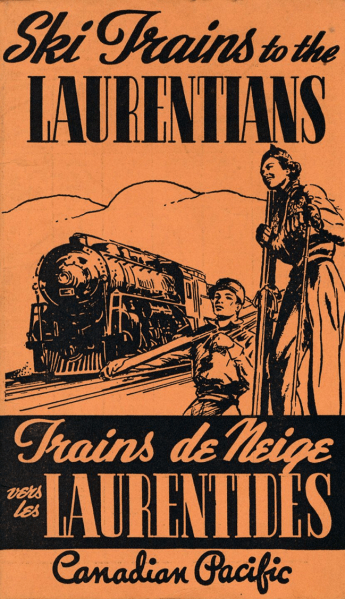
Both the Canadian National and the Canadian Pacific operated trains from Montreal to the Laurentians, known as the “snow trains,” otherwise known as the P’tit train du Nord.2 Below is one of the Canadian Pacific posters.3

Promotional poster for snow trains

It wasn’t long before Norine introduced her young and eligible Uncle Eddie to my mom and that was the beginning of their courtship.

Both Ed and Patricia loved going to the movies and their Saturday night dates were often a meal at Bens Delicatessen, followed by a show. Bens was a well known delicatessen in Montreal that was famous for its Montreal-style smoked meat. In 1908, Benjamin Kravitz and his wife Fanny Schwartz opened a sweet shop on Saint-Laurent Boulevard and then added sandwiches, using Benjamin’s mother’s recipe. In 1929, they moved to 1001 Burnside (now de Maisonneuve), in the theatre and night club district of the city, and then to their final location in 1949.4

Bens Store Front5

My parents were married on May 21, 1949 at St. Columba Anglican Church in Notre-Dame-de-Grace. This church was built in 1920 but has now been sold to a developer.6 My grandparents would have been parishioners of the church as they lived just 10 minutes away.7 The post WW2 period was marked by a housing shortage. Pressure on the housing shortage was due to demobilized soldiers returning home, and the increase in newly created families. My parents, like many post WW2 newlyweds, lived with my grandparents after the wedding.

St. Columba Anglican Church, Notre-Dame-de-Grace, Montreal

The wedding announcement in the Montreal Star on May 30 1949, describes the bride as wearing:

“A gown of white slipper satin made with nylon yoke on Grecian lines and with train. Her veil was of tulle illusion, was finger tip length, held with a bandeau of lilies of the valley and orange blossoms. She carried a cascade bouquet of white carnations and bavardia.”8

The wedding announcement goes on to say that the reception was held at the Montreal West City Hall, in the music room. This photograph of the wedding party is probably taken outside the Montreal West Town Hall.

From left to right: Alistair Lamb, Mary McHugh, Ronald Lamb, John Deakin, James Meikle, Edward McHugh, Patricia Deakin, Melba Jones, Norine Scott, Dorothy Newcombe, Grace Hunter, George Deakin

The wedding announcement continues:

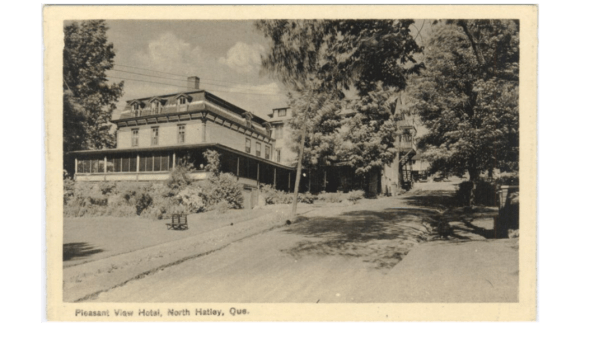
“Mr. and Mrs. McHugh went to Pleasant View Hotel, North Hatley, for their honeymoon, the bride wearing for travelling a three-piece suit of beige Scotch mist, with white straw hat and green accessories and a corsage of white carnations.”9

Founded in 1897 and located on Lake Massawippi, North Hatley is one of the prettiest villages in Quebec.10 Below is a post card of the Pleasant View Hotel:11

Pleasant View Hotel, North Hatley, Quebec
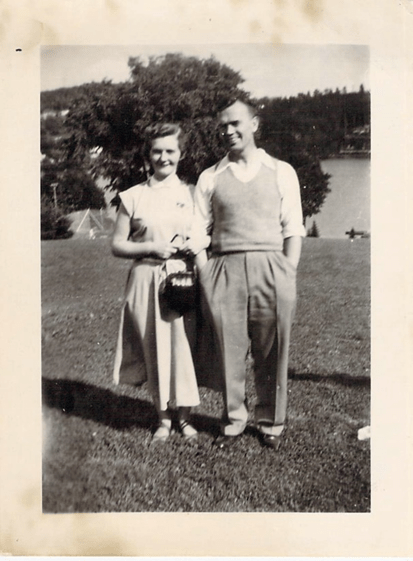
Patricia Deakin and Ed McHugh, North Hatley
  1. Courtesy Cadeau, C, All About Canadian History, The End of World War II in Canada, Montrealers celebrate VE Day, https://cdnhistorybits.wordpress.com/2015/11/11/ve-day-vj-day-canada/, accessed 29 November 2022.
  2. Baladodiscovery.com, Saint-Sauveur History, https://baladodiscovery.com/circuits/900/poi/10159/saint-sauveur-history, accessed 27 December 2022.
  3. Pinterest, Kirill Blinov, accessed 26 December 2022.
  4. Wikipedia, Bens De Luxe Delicatessen, https://en.wikipedia.org/wiki/Bens_De_Luxe_Delicatessen_%26_Restaurant, accessed 7 December 2022
  5. Stanton, Michael, 2005
  6. Memento Heritage Montreal, St. Columba Church, https://memento.heritagemontreal.org/en/site/st-columba-church/#:~:text=Built%20in%201920%2C%20the%20church,the%20Polish%20and%20Korean%20communities, accessed 27 December 2022.
  7. Lovells Directory, 1949, Deakin, page 1120, accessed December 20, 2022.
  8. Newspapers.com, McHugh-Deakin wedding announcement, 30 May 2022, accessed 22 November 2022.
  9. Ibid.
  10. Eastern Townships, North Hatley, Things to Do in North Hatley, https://www.easterntownships.org/towns-and-villages/45050/north-hatley#:~:text=Founded%20in%201897%2C%20the%20village,village%20centre%20are%20all%20unique., accessed 28 December 2022.
  11. Pleasant View Hotel, North Hatley, Quebec, Photogelatine Engraving Co. Limited, 19?, Bibliothèque et Archives nationales du Québec, 0002643996, accessed 28 December 2022.

A Montreal Landmark

The Robert Stanley Bagg home at the corner of Sherbrooke Street West and Cote-des-Neiges. My grandmother, Gwen Bagg, took this photo in 1903 and it is now in the possession of the McCord Museum.

The old house at the corner of Sherbrooke Street West and Cote des Neiges in downtown Montreal pops up regularly on the internet sites devoted to historical photos of the city, but often the information that accompanies those photos is incorrect. Frequently, people erroneously identify the owner as Montreal landowner Stanley Clark Bagg (1820-1873). In fact, the house belonged to his son, Robert Stanley Clark Bagg (1848-1912).

The building is prominently located on the corner of Sherbrooke Street West and Côte-des-Neiges, which leads up the hill toward Mount Royal. Thousands of people pass by daily, and it is hard not to notice the four-story red sandstone building with its pink tiled top floor.

It has gone through several reincarnations over the years. When it was built in 1891, it formed the south-west anchor of the Golden Square Mile, the neighbourhood where Canada’s wealthiest businessmen, manufacturers and bankers lived. Today it is a commercial building, surrounded by other small businesses and medical offices.

The original owner, R. Stanley Bagg (I will refer to him as RSB), grew up in a house called Fairmount Villa that was at the corner of Sherbrooke Street and Saint-Urbain. His father, Stanley Clark Bagg (SCB), was one of the largest landowners on the Island of Montreal, having inherited several adjoining farm properties along St. Laurent Boulevard from his grandfather, John Clark.

RSB studied law at McGill University and went abroad to continue his studies after graduation, but when his father died of typhoid in 1873, RSB came home. He practised law in Montreal for a short time, but quit to manage the properties belonging to his father’s estate, a position he held until 1901.

He married Clara Smithers (1861-1946) in 1882, and for several years the couple lived just around the corner from Fairmount Villa, where RSB’s mother still resided. Eventually they decided to build a new house in a more fashionable part of the city. When they moved, they had two daughters, Evelyn (1883-1970) and Gwendolyn (1886-1963)—my future grandmother. Their only son, Harold Stanley Fortescue Bagg (1895-1945), was born a few years after the move.

Many houses in Montreal were built of locally quarried grey limestone because it was abundant and cheap, but RSB chose red sandstone, probably imported from Scotland. Originally designed by architect William McLea Walbank, the house was renovated twice in the eleven years RSB lived there, with a major addition constructed in 1902 and other changes in 1906.

It was a large, even for a family of five, but the Baggs employed at least two live-in domestic servants—a cook and a maid—and perhaps a man to do the heavier chores. The interior was ornately furnished, as shown in photos my grandmother took of the drawing room, with a carved mantlepiece over the fireplace, heavy floor-to-ceiling drapes, and pillows and knickknacks everywhere. She also took photos of the interior of the tower on the Côte-des-Neiges side of the building. It must have been a sunny spot for reading and a good place to watch people struggle up the hill during a snowstorm.

The drawing room (living room) of the house was ornate. This is another photo from my grandmother’s 1903 album, now at the McCord Museum.

RSB died of cancer while on vacation in Kennebunkport, Maine in 1912. Clara (who was usually identified as Mrs. Stanley Bagg) divided the house into two apartments and continued to live there until her death, at age 85, in 1946.

After she died the house was sold and renovated, with a new entrance facing Côte-des- Neiges, and Barclay’s Bank (Canada) moved in. Many of Montreal’s elite families became customers of this British-based institution. In 1956 the Imperial Bank of Canada took over Barclay’s (Canada) and five years later, it became the Canadian Imperial Bank of Canada (CIBC). In 1979 CIBC decided it could no longer upgrade the old Bagg building to the modern requirements of banking and it moved its customers to a branch down the street at the Ritz Carlton Hotel.

For the next few years, the building was home to a jazz bar on the main floor and a bookstore upstairs, until a fire destroyed the interior in 1982. It may have been that fire that destroyed the cone-shaped roof of the tower. Many years earlier, my mother noticed that a stained-glass window displaying the Bagg family crest had disappeared.

The building was restored in 1985-86 and two art galleries moved in, but the interior featured bare brick walls, a style that was popular at the time in some older parts of the city, but was not appropriate for this Victorian-era building. An oriental carpet store rented the main floor in the mid-1990s.

Today, Adrenaline Montreal Body Piercing and Tattoos has been located there for many years. I suspect my great-grandparents would not be impressed.

Note: Lovell’s Directory of Montreal shows the address of this building changed several times over the years. It was at 1129 Sherbrooke in 1894-97, and 739 Sherbrooke W. in 1908-1910. The attached house, on the right, had a separate address – 737 Sherbrooke West—and belonged to another family. The Bagg house had been divided into apartments 1 and 2 at 739 Sherbrooke W. by 1927-28, and the address had changed to 1541 Sherbrooke W. apartments 1 and 2 by 1935-36.

Sources:

Edgar Andrew Collard, “A sandstone house on Sherbrooke St.”, The Gazette, October 20, 1984.

Répertoire d’architecture traditionnelle sur le territoire de la communauté urbaine de Montréal. Les residences. Communauté urbaine de Montréal, Service de la planification du territoire, 1987.

Charles Lazarus, “Farewell to Landmark”, The Montreal Star, April 30, 1979.

This article is simultaneously posted on my family history blog, https://writinguptheancestors.ca.

Entertaining Edwardian Montrealers

Dominion Park postcard circa 1912 (era of the big hat). Is that my husband’s grandmother looking at the camera?

Everyone has heard of Coney Island, the legendary thrill park in New York, but have you ever heard of Dominion Park, Montreal’s Coney Island?

Not likely. The Montreal Amusement Park ran from 1906 to 1938 and is all but forgotten.

Map of Dominion Park in Montreal’s East End

However, colourized photos like the one at top are widely available on the Internet thanks to Valentine and Sons.

Judging from the newspaper record, the ‘official’ opening of Dominion Park was in 1908, but I have hard evidence of a 1906 opening. In 1906, Herbert Nicholson, 21, my husband’s great uncle, working in Montreal, wrote a letter to his younger sister, Flora, 17, a student in Richmond, Quebec.

June 3, 1906

Dear Flora,

I suppose you have to be careful how you speak now that you are living with a model school teacher. I have not much news to give. I was down at Dominion Park last night. This is the new one that you may have heard so much about, or at least read so much about. Well, there is everything that you have ever heard of in your life.  They take you way up on a slide and then slide you down in a boat into a little lake made just for the purpose. And then they have a railroad that goes down and up hill and around curves and through all kinds of places so fast that you loose your breath.  Then there are other places where the stairs move and the wind blows and the floor jumps and I couldn’t tell you what all things do happen. There is a place where you lose yourself and then places where the looking glasses show you every way but the way they should. There are lots of other things, too, that I saw and many more I did not see.

I will tell you more about it when I see you,

 Love, Herb.

Herb appears to have been thrilled with his visit.

The newspaper record notes the attractions featured at Dominion Park. Some of them, like the roller-coaster, water slide and Fun House or “House of Nonsense” are familiar to Boomers.

There was also the Bump the Bumps, (bumper cars?) the trained wild animal show, the ‘Frisco Earthquake (just one year after the real thing happened) as well as a merry-go-round.

Some exhibits were frankly bizarre: the booth where young men could break crockery for a price (and get back at their mothers and wives, I imagine) as well as the Infant Incubator Exhibit where preemies were cared for by competent nurses in full view of the festive crowd.(Shades of the Dionne Quintuplets fiasco to come.)

There were travelling side shows, of course, many of which were colourfully ‘ethnic’ that would be considered in poor taste -even racist – today.

There were also vaudeville acts and circus acrobats as well as fancy sit-down concerts, stealing the mojo of another, more refined, Montreal entertainment venue, Sohmer Park.

Dominion Park, like Coney Island, was a place where all entertainment options came together.

Judging from those Valentine and Sons postcards, Dominion Park was a place young men brought their ladies, whether courting or married, all of these men wearing their epoque signature straw boater hats (the kind we see in Renoir paintings) the women, in the 1910 era, in their puffy white dresses.

Herbert, a ladies man, discretely does not mention with whom he went. I doubt his sisters, young unmarried Edith, Marion and Flo, could go without an escort of some kind.

But in 1912, Marion Nicholson had someone to escort her to Dominion Park: her new beau Hugh Blair.

Her sister Edith writes her mother who is visiting Marion in Mile End: “Don’t let the villains, Marion and “Romeo” (Hugh) take you to Dominion Park.”

It’s true that Edith enjoyed ‘high-brow’ activities more than her younger sister Marion, but she liked to have fun as much as anyone, so I assume she is joking.

When I first saw the picture at top, I thought the woman looking into the camera might be Marion. She is wearing exactly the same white dress Marion wears in many pictures.

Here’s a blow up of Marion taking tea on the lawn of her home in Richmond, Quebec 1912.

Marion Nicholson Blair, my husband’s grandmother taking tea in around 1912.
Marion certainly had a similar hat to the one in the Valentine and Son postcard pic at top. 1912 was the year of the big big hat. But trendsetters like Colette in Paris were already wearing the cloche – as a bold countermove to this increasingly ludicrous hat fashion.

I have positive proof that Marion Nicholson visited Dominion Park around 1920 with Hugh Blair, now her husband, and both her sisters, Edith and Flora, as well as her brother Herb who was making a rare visit home from out West. It comes in the form of a novelty postcard.

Novelty postcard, circa 1920 Dominion Park. Hugh Blair and unknown man hovering over Edith, Marion and Flo Nicholson and unknown woman, probably cousin May Watters. Man at right is brother Herb Nicholson making perhaps his only visit back home to Montreal after leaving for out west in 1914.

From news reports I can glean that Dominion Park struggled through the Depression and closed without fanfare after the season in 1938.

­Here’s likely the reason why: 1938 was the first year of BELMONT PARK located in Cartierville. Belmont Park was a rickety place when I went there as a kid in the early 1960’s and was, in its turn, usurped by La Ronde at Expo 67, a bigger, brighter and more expensive amusement park.

When it comes to entertainment, new is best.

1.In 1906, entertainment in the big cities ranged from vaudeville and circuses to high-end theatre with 100’s of small venues, especially along Ste Catherine East, showing “flickers” on the wall during the day, and featuring live acts at night. In Montreal, there was only one large venue devoted entirely to motion pictures, the 500 seat Ouimetoscope. By 1910 there were scores of small entertainment venues lining Ste Catherine, most places offering a mixed bag of live shows and flickers and sometimes ice cream. A May 26, 1906 Gazette newspaper reveals entertainment options: A Kipling play with a well known actor at his Majesty’s Theatre; the Georgia Minstrels at the Academy of Music; The Holy City, a religious drama at Le Francais; The London Gaeity Girls at the Royal; ‘improved’ music and lotsa vaudeville at Sohmer Park: Miller’s elephants and other midway attractions at Riverside Park (a small amusement park also on Notre Dame Steet that would close in 1906.) Also Dominion Park opening June 2 with the Duss Band. Something for everyone – especially for the young people from rural areas flocking to the city to find work.Most of these wonderful entertainment options (excluding theatre plays) were considered out-of-bounds for respectable middle class women, especially if unattended.

Herbert’s sister, Marion, was also living in the city, having just graduated from McGill Normal (teaching) School and taken a job at Royal Arthur Elementary School in Little Burgundy. The year previous, she had boarded at the YWCA on Dorchester, a cold, leaky place with “too many rules.” Her words.

The city elite, including the Refords, the Birks’, and Julia Parker Drummonds, were planning a woman’s hotel where ‘respectable’ women from out of town would stay – and where bible readings would be their main nighttime recreation.

Still, Marion went to many a theatre play with her sisters and to Vaudeville shows with her beaus. After 1914, movies became more respectable for the middle class because that is where you could get your war news.

One movie house, the Royal, advertised itself as a safe venue for women.

2. There were two fires at Dominion, 1913 and a fatal one in 1919. Journalist Edgar Andrew Collard, known for his Montreal history column in the Gazette newspaper, was saved from the conflagration by his father, according to a very personal story he wrote in 1977.


When the fire broke out, They were riding the Mystic Rill, a ‘water-maze’ boat ride through a tunnel lined with flammable material designed to look like rock. His father saw a high window and managed to push his son through it.

Only magnificent strength could have accomplished what he did: he not only had to keep a grip on the window but he had with his legs and feet to keep the boat from being carried away by the current.”.

Even way back in 1977, the Park was all but forgotten: “Only a few older people remember Dominion Park,” wrote Collard in this same article.

https://www.youtube.com/watch?v=JAFkxSVlSCk Coney Island 1918 Americans at Play