Category Archives: Scotland

Did they travel on the same ship?

It has always bothered me that on the passenger lists of the S.S. Grampian, sailing from Glasgow to Quebec City, my grandfather, Thomas McHugh, was not listed with his wife, Elsie McHugh and their seven children.

My father was always clear that Thomas arrived ahead of his large family in the early 1900s. The plan was that Thomas would have time to find work and a place to live, and get settled in.

I first found my grandmother, Elsie McHugh and the seven children listed on the passenger list of the S.S. Grampian, leaving Glasgow and arriving in Quebec City. The year was 1912.  I knew that I also had to find out when Thomas arrived. I returned again and again to passenger lists for travel between Scotland and Canada in 1910 and 1911. No luck. It was only when I started to research my great-uncle, Edward McHugh that I discovered Thomas also on the passenger list of the S.S. Grampian in 1912, leaving Glasgow and arriving in Quebec City. Thomas was accompanied by his mother and two brothers.

Harrumph. It seemed as if Thomas didn’t leave ahead of time. But why in the world were Elsie and the children not listed with Thomas? Were they separated because of the children? This didn’t make sense. Elsie would have needed all the help she could get. Little Adam was just three and his brother, Thomas was one year old.

I kept going back to these entries. There was something about them that bothered me. I looked up potential reasons to be separated on a ship. I looked up whether families would be divided for any reason in the list of passengers. No luck.

Also, I kept getting mixed up whether it was May or October 1912. I would look at my notes and if it said May, I realized that the date was October and I would change it. I would then go back later and change it back to May. Argh. I needed to get it right.

This week I decided to establish definitely whether Thomas came over to Canada first. Perhaps he came to Canada and then went back to Scotland for his mother, his brothers, his wife, and his children. This would make perfect sense. This would explain why my father was so sure that he came ahead of the family and all the evidence that I had said that he came over with his family.

Well, I could find no trace of Thomas on passenger lists of 1910 or 1911. He wouldn’t have come before 1910, I would think.  I did find him again on the passenger list of the S.S. Grampian, May 1912. And I found Elsie again. Wait a minute. October 1912! The penny dropped. They both travelled over on the S.S. Grampian but at different times of the year. I was so blinded by the name of the ship that I did not realize that even though they were on the same ship, they travelled on different dates.

While this was not a brick wall, it was certainly a puzzle for me. A puzzle of my own making. Once again, this reaffirms that, while primary genealogical research is important, it is also valuable to revisit assumptions, documents, and notes. Look and look again and again.  Most genealogists I know enthusiastically forge ahead and tend to neglect reviewing previous finds. I am no exception.


“Those of us already deep in the accumulation may also benefit from revisiting our past research.”

Brenda Dougall Merriman, Genealogical Standards of Evidence: A Guide for Family Historians


Heatwaves and Victory Gardens


socialnotespotato

On Sunday, October 1, 2017, some members of Genealogy Ensemble will be participating in the Culture Days event at the Verdun Farmer’s Market, in promotion of Beads in a Necklace, our  book of family stories to be published in November.   My talk will focus on WWI Victory Gardens and the rising cost of living during that period.

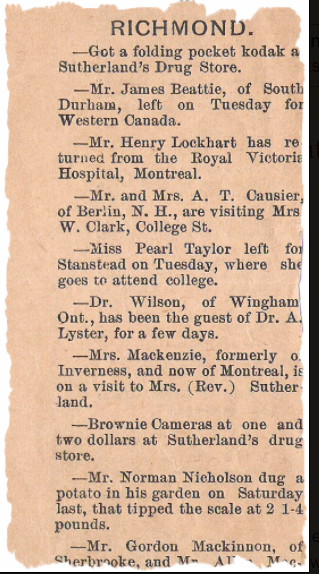
The newspaper clipping, above, is from the social notes column of the Richmond-Times Guardian, (Richmond, Quebec) circa 1905. The very silly item about a big potato is probably my husband’s great-grandfather’s way of poking fun at small town pretensions.  Or is it?

The Nicholson family’s vast vegetable garden behind their charming red-brick house in the Eastern Townships of Quebec was no joke to them, not even in an era when pre-prepared foods like Heinz Beans, Jello, and Quaker Oats, were fast becoming house-hold names.*(1)

In 1911, with their four children were grown up, the large backyard garden that produced corn, beets, sweet peas, etc., was critical to the diet of this frugal Scottish Canadian family.

The potato patch was a particular concern:

“I put the Paris Green on the potatoes twice. Mrs. Montgomery came over to tell me that the bugs were eating up my potatoes. I was waiting to get someone to do it for me, as that was one thing I never attempted.

“But when she interfered thought we would try it. So one dark night, Flora (daughter) got the lantern and we went out when the bugs were asleep and gave them their dose. We dressed ourselves in the shed. You ought to have seen us. When we got through left our clothes there. Went to bed and dreamed all night that the bugs were crawling over us.”

So writes Margaret Mcleod Nicholson, in a July, 9, 1911 to husband Norman, who was away in Northern Ontario working as a railway inspector.

You have to admire Margaret’s style. Although her letters were often penned in haste and full of household concerns, ‘the local news’  as in gossip, and much high anxiety over finances, she certainly could paint a word picture when she wanted to.*(2)

In the spring of 1911, it was 57 year old Margaret’s job to care for the garden because her two older girls, Edith and Marion, were away teaching in Montreal, and her youngest, Flora, was very busy studying for final exams. Margaret and Flora were living alone for most of the year.

Although her daughters returned to Richmond for the summer, they came and went as they pleased, often in motorcars owned by wealthier neighbours. *(3)

Norman, in his letters home,  warned his wife not to work too hard out in the backyard, especially in hot weather, and the summer  of 1911, as it happens, was very, very hot.*(4)

tighsnapcorn

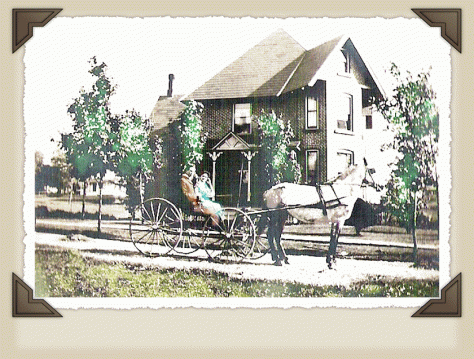
An ‘old-fashioned’ carriage in front of Tighsolas, the Nicholson home, circa 1910. A hire. The Nicholsons couldn’t afford to keep a carriage, let alone buy an automobile, like so many of their neighbours.

The same  letter continues:

“We have had dreadful hot weather. Just fancy, one night we slept out on the veranda. Took our mattresses down. The Skinners (other neighbours) were sleeping in theirs so that we were not afraid and we had Flossie (the dalmatian) with us but yesterday afternoon it rained so last night was cool.

We all had a good sleep and today is fine. We feel like working. I hope you did not have this extreme heat. We had quite a cold wave about the 24th but no frost.”

This sounds like typical Quebec  weather, doesn’t it?  So up and down.  It’s not easy cultivating a garden in this province. It takes perseverance.

Six years later, in the spring of 1917, most everyone in the west end of the city of Montreal was out on the street digging their wartime Victory Gardens.*(5)

Marion Nicholson, now a mother and homemaker living on York Street in lower Westmount, describes the scene in a letter home to Mom:

“Every vacant lot around the city has been utilized for gardens and I think it is more common to see people out digging and planting in these gardens than in a small town like Richmond. Some I think are making their first attempt.”

Her small family is no exception.  “Hugh (husband) and Willie (cousin) are making a garden. What success they will have I do not know. One thing for sure, the beds are straight (her underline) and square. I myself would prefer more in them.”

Marion (who is six months pregnant) then describes how she has hardly slept all week while tending her very sick toddler. She begs her mom to send as many crates of eggs as she can on the next train.

It certainly was an era of high-anxiety about food, nutrition  – and so many other things.

butterbill1917

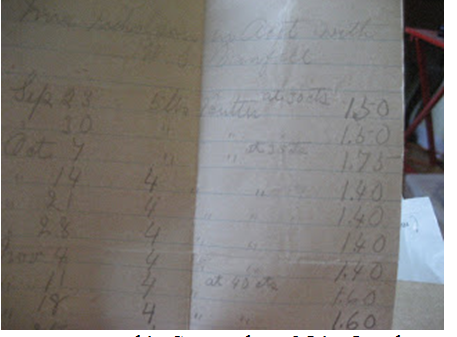
Margaret’s 1917 butter bill. Inflation. The price of butter goes up from 30 to 40 cents from September to October.* (6)

Still, Marion closes her letter to her Mom by praising her comfort food:  “So, now to get a taste of your home-made bread. When I eat it, I close my eyes and I feel as if I were home. Thank you for all the good things you sent.”

orchard[1]

Edith, young Margaret, and Marion, far right, in summer of 1918 in an orchard in Richmond, possibly behind the Nicholson home as they had apple trees. (The newborn is in other pics.) This was the year of the Spanish Flu. It was safer in the countryside. Marion stayed an entire month in Richmond, until her husband, Hugh, begged her to come home in a letter. “The ice in the icebox has melted all over the floor, there’s no food in the house, the windows are kept open and it’s hot as Hades in here. Please come home and take care of me!” He was in the care of his sisters-in-law, who had better things to do in wartime Montreal  than to baby their brother-in-law. Edith, a Sun Life employee, volunteered in Soldiers’ Aid for the YMCA and for the Navy League.

  • 1. Most of the famous food brands of the 20th century got their start in 1900-1910 by advertising in magazines like the Ladies’ Home Journal with happy-family lifestyle ads with bigger graphics and fewer printed promises. “Pure” was the adjective of the day.

It was understood, even back then, that the home was evolving from a center of production to a center of consumption. Margaret, born in 1853, made everything from scratch, on a woodstove, with recipes she kept firmly locked in her head; Marion Nicholson, born 1886, would cook on a gas stove relying on her Fanny Farmer Cookbook; her daughter, also Marion, born 1917,  living in middle class comfort in 1950’s suburbia, would feed her brood nothing but canned vegetables, even canned potatoes, which she warmed on an electric stove.

  • 2. Norman was tickled by an anecdote from a November, 1909 letter, where Margaret vividly describes a back-and-forth argument she has had with a male relation over woman suffrage. The relation invokes St. Paul as was the custom. She replies “St. Paul has been dead for a long time. I don’t live in those days, milking cows and making fires.” Norman, who is active in local politics, replies in support of his wife: “Too absurd to think that a woman cannot exercise her franchise with as much intelligence as some of the male sex. And when you have to drag some of these supposedly intelligent men to the polls as you would cattle.”
  • 3. Margaret disliked motor cars. From 1909. “Mr. Montgomery is selling his horse and buying a car. Don’t you think he is foolish?” But, she was happy to go on drives when invited.
  • 5.  http://www.thecanadianencyclopedia.ca/en/article/victory-gardens. Apparently, Victory Gardens weren’t only a way to add to the food supply; they were about improving morale on the home-front by making people feel useful.


  • 6. A Chicago Agency sent a very fancy direct mail advertisement out to Richmond homemakers in 1916 on behalf of a new product called Crisco Shortening asking, “Do you like the taste of fresh buns in the morning? Try Crisco.” A coupon was attached.


Border Raiding Ruffians

Border Raider and Reivers Public Domain

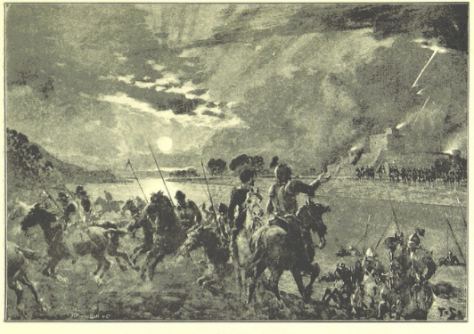
  Border Reivers: They were often romanticized in art.*

Growing up in Montreal in the late 1960’s and early 70’s, I was often asked, “Are you related to HIM?”  They were referring to Richard Nixon, President of the United States from 1969 to 1974, also a Vice-President from 1953 to ’61.  To this I would reply an emphatic “No! I’m English.  He’s Irish.” I always wanted to add, “Do you ask everyone named Johnson if they are related to Lyndon?”

My father was the one who insisted we were not related to Richard Nixon. Dick was an Irish Nixon, Daddy said. Our Nixons were English. My father also told me, with a sly self-effacing wink, that our Nixons were sheep stealers.  It all sounded a bit cockeyed to me.

Today, 50 years on, I am engaged in working out my genealogy. I’ve had my DNA tested at Ancestry and I’m growing a tree. It seems that my dad was right on two points, about the sheep and, possibly, about Richard Nixon’s Irishness, but not about our family’s relationship to the late American President.

We probably do come from the same ancient stock.

I’ve just learned the Nixons of Northern England are descended from Border Reivers, families from the lawless, burnt out Scottish/English border regions of the British Isles  (Cumberland and Northumberland) who raided other people’s livestock for a living. If you are a Nixon, Forster, Graham, Armstrong, Bell, Eliot, Robson, Crozier, Kerr, and yes, Johnson, you might be descended from these 13th to 17th century outlaws.  Apparently, the Nixon Administration was full of them.

As it happens, I am both a Nixon and a Forster.  An alleged ancestor of mine, illustrious Border Reiver Sir John Forster of Northumberland, was knighted for his service to Queen Elizabeth I in 1557. Sir John was lucky to be on the winning side of two key battles. His castle was in a strategic location on the “middle march” section of the border, so, apparently, he enriched himself with his share of the spoils from all local cattle raids, in England and Scotland.

The Nixon Clan has an even sketchier reputation. According to some accounts, they were “rude borderers” from Carlisle, Cumberland, who held no allegiances (except to the Armstrong Clan) and felt at home on either side of the border.  They were real baddies who were exiled to Ireland and, then, kicked right back to England. Many in the clan were hanged for their transgressions at Carlisle Castle.

That is likely where my father got the idea that Richard Nixon was an Irish Nixon.  I suspect my great grandfather, Robert Nixon ( 1863-1937), a sawmill worker in Helmsley, Yorkshire in the 1920’s, filled his young grandson’s head with many a grand, romantic tale of their burly, bearded ancestors, skilled light horsemen on  fleet-footed stallions, engaging in strategic, daring cattle raids on the Scottish border.

It appears that these Border Reiver families can be described as reckless ruffians on horseback and/or heroic defenders of the monarchy; scoundrels or heroes; charming rascals or organized crime. It’s only point of view.

Just don’t blame these people for their wild way of life.  In the 13th to 17th centuries, the area around the English/Scottish border was ravaged by warfare and not suitable for farming. Raiding sheep and cattle was just a way to earn a living. Also, the exact location of the border was disputed.

The BBC paid homage to these Border Reiver families with a TV show in 1968 called “The Borderers,” featuring a young and handsome Michael Gambon. The adventure series never came to North America, but I have found it on YouTube. If the BBC series had come to Canada back in 1968, when I was 13, I doubt it would have appealed to me any more than any other small screen horse opera.

But my father would have been mightily impressed.

* Illustration at top from book  Border Raids and Reivers, Robert Borland. Available on Archive.org and in the public domain.

Here’s  Sir John Forster’s Wikipedia page.

https://en.wikipedia.org/wiki/John_Forster_(soldier)

You can read more about the Border Reivers on the Historic UK website, where I got some of my info.

http://www.historic-uk.com/HistoryUK/HistoryofScotland/The-Border-Reivers/

Read about their connection with the Nixon Adminstration here.

http://articles.latimes.com/1996-02-11/news/mn-34692_1_border-reivers

Finding Great Great Grandmother: Elizabeth Mowat Sutherland

img_4691

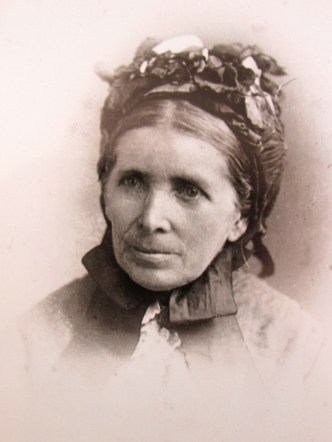
Elizabeth Mowat is my great great grandmother. I didn’t even know her name before I began my genealogy quest. I still don’t know much about her but I now have a photograph, a portrait of her in her “go to church clothes” with the requisite black bonnet.

There were no pictures of her in the box that started my family history search, although there was a family photograph of her husband William, her son Donald, his wife Alice and three of their children, William, Mary and James Dickson. I originally thought Elizabeth was alive at the time, so why on such an occasion was she not with them at the photographers? It later turned out she died in 1883 and not the assumed 1888.

It was through the internet and RootsWeb that I finally saw her face. Robert Harkness, from her daughter-in-law Alice’s line, said his family had lost all their old photos and information in a house fire but his uncle might know some family history. I wrote to his uncle, Bruce Harkness but did not hear anything. Then a couple of months later I received a letter from a George Dickson with photos and stories. He was also a relative of Alice’s and lived in the same apartment building as Bruce, in Belmore, Ontario. Bruce had shared my letter and it was George who responded. In the package was a picture of Elizabeth.

She was born in 1829 in Pulteneytown, Caithness, Scotland. Her parents were James Mowat and Isabelle Houston. It doesn’t appear that she had any siblings or at least any that survived to the 1841 census.

She married William Sutherland a shoemaker and 13 years her senior, May 1845, in Pulteneytown and they set out for Canada soon after. They sailed with two of William’s nephews and their wives so he had some family with him, but Elizabeth left her family and her life, never to see them again. There are Sutherland letters that have survived which reported on all the neighbours and friends so I assume the Mowats also heard about their daughter’s new life and family.

Elizabeth and William had seven children, William, James, Donald, Christina, Isabella, George, and John. They moved from Toronto to West Gwillimbury and finally to their own land in Carrick, Bruce County Ontario. After clearing the land and farming for a number of years they gave up the hard work and moved back to Toronto.

Elizabeth died in 1883 and William died in 1887. My sister Jeannie and I visited Mount Pleasant Cemetery and found their tombstone. The names were readable but not the inscription. As Jeannie went to the car to get some paper to try a rubbing, the sun came out and it’s angle made the inscription jump out,“The dead in Christ shall rise first”.

Notes:

Ancestry.com. Scotland, Select Births and Baptisms, 1564-1950 [database on-line]. Provo, UT, USA: Ancestry.com Operations, Inc., 2014.Original data: Scotland, Births and Baptisms, 1564-1950. Salt Lake City, Utah: FamilySearch, 2013

Extracts of entries in an Old Parochial Register. Proclamations of Banns and marriages Parish of Wick, County of Caithnes general register Office, New Register House Edinburch on 26 September 2000.

Archives of Ontario; Toronto, Ontario, Canada; Series: MS935; Reel: 36 Source InformationAncestry.com. Ontario, Canada, Deaths, 1869-1938, 1943-1944, and Deaths Overseas, 1939-1947 Provo, UT, USA: Ancestry.com Operations, Inc., 2010.Cert.

“The dead in Christ shall rise first.” 1 Thessalonians 4:16

The story of Elizabeth’s daughter Christina can be found at:   https://wordpress.com/post/genealogyensemble.com/2743

The Cipher

By Sandra McHugh

When I say that my grandfather, Thomas McHugh, worked as a cipher, Bletchley Park, MI5, and Russian spies immediately come to mind. He was neither a Russian spy nor did he work as a cipher during the war. His employer was the Bank of Montreal and it was his first job when he came to Canada in 1912.

The decision to immigrate to Canada was not easy for Thomas. He was in his mid-30s and already had seven children, between the ages of one and fifteen. For over 40 years, the jute manufacturers of Dundee, Scotland had been providing employment for his parents, aunts, uncles, siblings, wife, and for him. However, by the early 1900s, he was facing a precarious future for his children.

By the early 1900s, Dundee had suffered a serious decline in the textile industry and more significantly, the jute industry.  Jute was imported from India, however, the mill owners realized that it would significantly lower the cost of production to open mills in India to prepare the jute and import the finished product to Scotland. Once mills were established in India, the jute production in the mills in Dundee decreased substantially.1

So when Thomas arrived in Canada, a little ahead of his wife and his children, he was eager and prepared to do any job so that he could. The Bank of Montreal had its headquarters in Montreal, Quebec. In the early 1900s, the bank had significant dealings with Great Britain and there were correspondence and banking instructions back and forth between Canada and Great Britain daily. These instructions were mainly sent by telegraph overnight. There were two reasons for this. Some of these instructions were confidential and it was preferred that they remain so. Overnight instructions reduced the number of people who would have access to them. Another reason was the time difference between Montreal and the United Kingdom. The banks in London and Edinburgh were open for business while Montreal was still asleep.

Even in those days, the banks were concerned about security, privacy, and confidentiality. The banking instructions and transactions were submitted by telegraph and were encrypted. It was the job of the cipher clerk to decipher them so that the bank staff could then ensure that the instructions were carried out as required.

To be a cipher clerk, one had to be reliable, meticulous, and honest, and ensure the confidentiality of the bank’s business. The cipher clerk used a cipher handbook to decipher the information. Also, the cipher clerk worked overnight, so it was a difficult job for a man with a family.

So while my grandfather, the cipher, did not work in espionage, I still think that his first job in Canada was rather interesting.2

1 https://en.wikipedia.org/wiki/History_of_Dundee

2 As related by my father, Edward McHugh

The Stobos of Lanarkshire

(This story is slightly complicated because of the similar names: generation one was Robert Stobo and his wife Elizabeth Hamilton; generation two was Elizabeth Stobo and her husband Robert Hamilton.)

p1040119
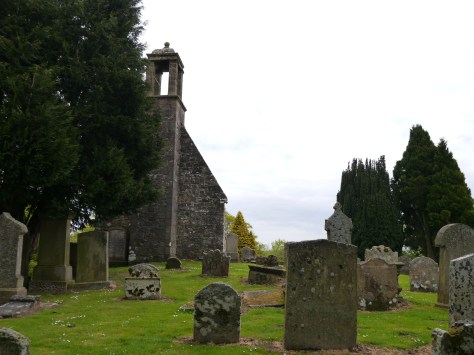
Avondale Parish Church, Strathaven, Lanarkshire. jh photo

The story of my two-times great-grandgrandparents’ move from Scotland to Canada is legendary in my branch of the Hamilton family. Robert Hamilton (1789-1875), a weaver from Lesmahagow, Lanarkshire, moved to Glasgow with his wife, Elizabeth Stobo (1790-1853), and children to earn money for the move to North America. They boarded a ship bound for New York in the spring of 1830, and reinvented themselves as farmers in Scarborough Township, Upper Canada.

In 2012, my husband and I visited Lesmahagow, about 20 miles south of Glasgow. We looked for my Hamilton ancestor’s grave in Lesmahagow parish cemetery, gazed at the sheep grazing on the rolling hillsides and breathed in the cool Scottish air. From Lesmahagow, we drove to Avondale Parish Church in nearby Strathaven, where Elizabeth Stobo was baptized in 1790, “lawful daughter of Robert in Braehead.” We also visited Stonehouse parish, where Elizabeth and Robert were married in 1816.

All I knew about Elizabeth’s background was her place of birth and her parents’ names, Robert Stobo and Elizabeth Hamilton. Recently, I delved into the Stobo family tree and came up with a few surprises, notably that Elizabeth’s father led the way to Canada when he was 60 years old, and that several of her siblings also immigrated.

Robert Stobo was probably born in Avondale parish on July 16, 1764, the son of James Stobo in Braehead. When he married Elizabeth Hamilton in 1789, the marriage proclamations were read at both Avondale Parish Church and at Dalserf Parish Church, the bride’s parish.

Robert and Elizabeth moved several times during their child-rearing years, although they did not leave a relatively small area in southern Lanarkshire. Their children’s baptismal records show they lived in Braehead in Avondale parish, Dalserf parish, and Auchren in Lesmahagow parish. According to a reference letter from their minister that they brought with them to Canada, they also lived in Stonehouse parish for about nine years before leaving Scotland.

The minister who baptized Robert’s daughter Janet in 1792 usually noted each father’s occupation in the parish register. On the page where Janet was listed were a labourer, a shoemaker, a servant and a weaver. Unfortunately, the minister did not mention Janet’s father’s occupation. Robert may have been a tenant farmer, or he may have worked in the lime kilns around Braehead. Lime was quarried in the region and burned in kilns before it could be used to improve soil for agriculture, or in mortar for building.

p1040113
Old St. Ninian’s Kirkyard, Stonehouse. jh photo

Meanwhile, the early years of the 19th century were difficult ones. The Scottish economy was experiencing a recession, the weather was poor and, if Robert was a farm labourer, wages were low.  Many families in lowlands Scotland, especially in Lanarkshire and Renfrewshire, were dependent on charity for survival. The government began offering assistance with travel costs to people who wanted to relocate to Canada. Perhaps Robert decided to take them up on the offer. The Stobo family left Lanarkshire in the spring of 1824.

The Stobos were one of the first families from Lanarkshire to arrive in Scarborough Township, settling on a piece of land near the Scarborough Bluffs overlooking Lake Ontario. Daughter Elizabeth and her family followed them to Scarborough six years later.

Robert Stobo was 60 when he started his new life in Canada, and his wife was 61. Several of their children were already adults, so some family members remained in Scotland while others left. According to “The Stobo Family: Scarborough, 1824 –“  (see note below) their children were:

Elizabeth, b. 25 June 1790; m. Robt Hamilton 15 April 1816, Stonehouse; d. 15 April, 1853, Scarborough. They had six children, the youngest of whom, James Hamilton, was my great-grandfather.

Janet b. 3 March, 1792, m. Coppy, d. 30 April 1816.  Her birth in Braehead, Avondale parish, is included on Scotland’s People, but I have not confirmed her marriage or her death.

Barbara, christened 14 March 1794, Dalserf parish; m. Borwick. The marriage information comes from The Stobo Family manuscript. Two genealogy entries on Familysearch.org say Barbara married Thomas Borwick, 22 October 1832, Scarborough Township.

James, b. 7 Feb. 1896, m. Jean Muir, Scotland. His date of birth is confirmed in Lesmahagow parish on Scotland’s People. Ancestry.ca lists James Stobo m. Jean Muir, June 1827, Culter, Lanark.

Robert, b. 3 Feb 1798, according to The Stobo Family manuscript, however, I have not found a church record of his baptism. According to The Stobo Family manuscript and a letter from William McCowan in Lesmahagow to his nephew Robert McCowan in Scarborough, dated 9 March, 1836, Robert Stobo jr. was probably lost at sea.

Helen, b. 6 February 1800, m. 1. James Stobo of Bog, m. 2. Neil McNeil. Her baptism in Lesmahagow is listed on Scotland’s People. Her marriage, 6 April 1823, to James Stobo, Stonehouse, and her marriage to Neil McNeil, 1 Sept. 1839, Stonehouse, are listed on Ancestry.ca. According to The Stobo Family, she had four sons, three whom remained in Scotland.

Margaret, b. 10 May 1805; m. Adam Carmichael. While her birth is recorded in the old parish records of Lesmahagow, I did not find a marriage record. The Stobo Family manuscript says she and Adam had several children. More research is needed.

Jean (Jane) b. 10 July 1807, Lesmahagow; m. 25 April 1834 Archibald Glendinning, Scarborough; d. 2 Sept, 1893, Scarborough. Archibald was a well-known farmer and merchant in Scarborough, and they had a large family.

John, b. 18 May 1811, Lesmahagow; m. 12 July 1836, Scarborough, Frances Chester; d. 16 May 1889, Scarborough. John was a farmer and had a large family.

See also:

From Lesmahagow to Scarborough, http://writinguptheancestors.blogspot.ca/2013/12/from-lesmahagow-to-scarborough.html, posted Dec. 13, 2013, revised Dec. 27, 2016

The Glendinnings of Westerkirk, http://writinguptheancestors.blogspot.ca/2016/12/the-glendinnings-of-westerkirk.html, posted Dec.3, 2016

The Missing Gravestone of Robert Hamilton and Janet Renwick, http://writinguptheancestors.blogspot.ca/2015/10/the-missing-gravestone-of-robert.htmlposted Oct. 28, 2015, revised Dec. 27, 2016

Notes and sources

“The Stobo Family: Scarborough, 1824 –“  is a typed family tree manuscript by Stobo descendant Margaret Oke. It can be found in the Ontario Genealogical Society collection housed at the Toronto Reference Library. Mrs. Oke said the references used were family recollections, family bibles and census records in the National Archives (now Library and Archives Canada.) This document was originally prepared by Miss Ethel Glendenning (1880-1976), who was a United Church missionary in India for many years. Miss Glendenning gave it to Miss Marjorie Paterson (1901-1980), and Mrs. Oke transcribed it in 1986. I have used this tree as a starting point, checking the names and dates it gives with other sources including the Scotland’s People website, Ancestry.ca, and Familysearch.org.

The Stobo Family says Robert senior’s date of birth was 16 July 1764. Scotland’s People lists two Robert Stobos born in Avondale in 1764: one is the above individual, son of James, and the other was born 5 October 1764, son of Robert, but both index listings lead to the same image: son of James, born in July. The Stobo Family manuscript has proved accurate in all the dates I was able to verify, so the July date is probably correct.

I have not been able to find any information on Robert’s wife Elizabeth. The name Hamilton was very common in Lanarkshire.

This article is also posted on writinguptheancestors.blogspot.ca


The Cook at the McGill University Faculty Club

by Sandra McHugh

I particularly like the series Downton Abbey.  It portrays the upstairs and downstairs of the upper classes during the beginning of the twentieth century. I like to imagine what it would have been like to work as part of the domestic staff.  In 1922, my grandmother, Grace Graham Hunter, worked as a domestic, probably a cook, in Edinburgh for Dr. W. Kelman MacDonald, an osteopath.1 She was young and unmarried and looking for adventure.

Her experience as a cook in one of the homes of the upper class of Edinburgh surely stood her in good stead when she became head cook at the McGill University Faculty Club in Montreal.  When my grandmother was looking for adventure, Canada badly needed domestic workers.  The Canadian government favoured immigrants from Great Britain to ensure the predominance of British values.  The British Parliament passed the Empire Settlement Act, which entitled my grandmother to free third-class passage from Scotland to Canada.2

Given that the need for domestic workers was acute, government hostels, partially financed by both the Canadian government and the provinces, welcomed these immigrants to the major urban centres of Canada and referred them to Employment Services of Canada who then found them employment.3

The McGill University Faculty Club was established in 1923. I assume that my grandmother was one of the first employees as this is the year she met my grandfather and she used to tell me stories of letting him come in the back door to eat a dessert or two.

My grandmother also used to tell me many stories of the people who were members of the Faculty Club and their guests and of the pressure of preparing the food just right. I used to wonder about the famous people who dined there, who they shared their meals with, and what they discussed.

The Faculty Club was originally located on University Street.  It was only in 1935 that it was moved to its current location in the Baumgarten House on McTavish Street, the former resident of Sir Arthur Currie. 4 It was only when it moved that the Faculty Club allowed women members.  Notably, Maude Abbott became the first woman member of the Faculty Club.  She was a remarkable Montreal citizen.  She started practising medicine in 1894.  In 1910, McGill University awarded her an honorary degree and a lectureship in the Department of Pathology.5 In 1924, she founded the Federation of Medical Women of Canada. 6 Somehow, it seems fitting that such an extraordinary woman should be the first woman member of the McGill University Faculty Club.


1 This is derived from my grandmother’s address on the passenger list of the S.S. Montclare that sailed from Greenock, Scotland to Saint-John, New Brunswick on February 16, 1922.  Her address was listed as 41 Drumshegh Gardens, Edinburgh.  Dr. W. Kelman MacDonald, Osteopath, is listed as the owner linked to architectural drawings of work that was done in 1922. As my grandmother’s job was a domestic, I assume that she worked for Dr. MacDonald.

2Immigration Form 30-A of Grace Graham Hunter.

3 Crawford, Ruth, 1924, “Canada’s Program for Assimilation”, The Rotarian, May 1924, p. 16

4https://www.mcgill.ca/facultyclub/history

5https://www.mcgill.ca/about/history/features/mcgill-women

6https://en.wikipedia.org/wiki/Maude_Abbott


The Gospel Singer

By Sandra McHugh

During his lifetime, Edward McHugh made several trips back and forth across the Atlantic Ocean, but there was a world of difference between his first trip and his last.1

Edward was 19 when he immigrated from Scotland to Canada in 1912 with his widowed mother, his two brothers, his sister-in-law and his brother’s seven children. Destined for Montreal, they traveled on the steamship S.S. Grampian in third class, or steerage. Edward would have slept on a bunk bed and shared his room with other family members, and meals would have been served at long communal tables in the dining room.2

Forty years later, in 1951, he traveled first class from Southampton to New York on the luxurious R.M.S. Queen Elizabeth ocean liner.3 He would have enjoyed a spacious stateroom, first class lounges and formal dining. He could have ordered anything he wanted from room service.4 There would have been plenty of space to store his eleven pieces of luggage.5

By that time, Edward had retired and was able to afford first class passage because of his successful career as a musician. This is the story of how a talented, working-class young man from Scotland and Montreal became famous in America as the Gospel Singer.

Edward, born in 1893 in Dundee, Scotland, came from a family of jute-factory workers of Irish heritage. His father was a yarn dyer.6 When the family arrived in Canada, they settled in Verdun, a district of Montreal located close to the factories that would have provided employment for the three McHugh brothers. Edward worked as a manual labourer in the rail yards on the locomotives.7

Shortly after his arrival in Canada, he made his public singing debut at Montreal’s Hunt Club, singing God Save the King. The Duke of Connaught, then the Governor General of Canada, heard him sing and was instrumental in sending him to study at London’s Royal College of Music.8 This college accepted both students who paid tuition and students who won entry through competitions.9 Given Edward’s humble background, it is probable he had a scholarship.

By 1919, Edward had decided to pursue a musical career so he left Montreal, settled in New York City and continued his studies .10

It took a few years for Edward’s career to take off, but in 1927, Edward was invited to sing The Old Rugged Cross, an evangelical hymn written in 1912,11 on Boston radio station WEEI.12 The next day, the station received 2,300 letters praising Edward’s baritone voice. His choice of hymn and the timing were excellent. Gospel songs had become increasingly popular as they were easier to sing than traditional hymns. 13

In 1938, Edward published a compilation of gospel hymns and poems.14 His fame grew and, by the 1940s, he was nicknamed the Gospel Singer and he was a regular on NBC radio.16

In 1947, an ad for Edward’s 15-minute radio program appeared in Billboard Magazine. It claimed, “Edward MacHugh, Your Gospel Singer, [. . .] who is said to have the most perfect diction of any singer without sacrificing warmth . . . ”19

It wasn’t just the quality of his voice that made him popular; he seems to have tapped into a need for comfort in troubled times. During World War II, his fans often requested he sing God Will Take Care of You,17 a song that must have soothed people whose loved ones were risking their lives serving their country.

When asked about gospel music, Edward replied, “A lot of people think that hymn-singing is ‘corny.’ That’s okay with me. I get my satisfaction in giving real pleasure to a great number of people and perhaps in being some small help in times of trouble and affliction.”18

It is clear that Edward’s beautiful baritone voice moved many listeners. He popularized hymns and gospel songs through his radio shows, compilations, records and concerts,20 and he sang songs of simplicity, devotion and encouragement in times of pain.

After he retired in the 1940s, Edward and his wife Jennie lived a quiet life in Norwalk, Connecticut. They had no children. During his retirement, Edward continued to make records and take part in religious festivals and church anniversaries. He passed away in 1957 at the age of 63 in Fort Lauderdale, Florida.21


Add footnote about change in name

  1.  “UK, Outward Passenger Lists, 1890-1960,” database, Ancestry.com, Edward McHugh, Grampion,  Glasgow to Quebec, leaving May 11, 1912.
  2.  Gjenvik, Paul K., Glenvick Gjonvik Archives (GG Archives), Collection of Travel Brochures, online <http://www.gjenvick.com/HistoricalBrochures/CunardLine/FranconiaAndLaconia/1912/05-ThirdClassAccommodations.html#axzz4ZumLRf5j>, accessed 13 February 2017.
  3.  “UK, Outward Passenger Lists, 1890-1960,” database, Ancestry.com, Edward McHugh, Queen Elizabeth, Southampton to New York, leaving October 6, 1951.
  4.  The National Railway Museum, York, England, U.K., photo and description of a first-class cabin on the Queen Elizabeth, 1950, online < http://www.nrm.org.uk/ourcollection/photo?group=British%20Transport%20Commission&objid=1996-7038_BTF_837_P_43>, accessed 13 February 2017.
  5.   “UK, Outward Passenger Lists, 1890-1960,” database, Ancestry.com, Edward McHugh, Queen Elizabeth, Southampton to New York, leaving October 6, 1951.
  6.  McIntyre, Alistair, “Significant Scots, Edward McHugh.” Unknown posting date. Electric Scotland, online < http://www.electricscotland.com/history/other/mchugh_edward.htm&gt;, accessed 13 February 2017.
  7. “Edward MacHugh,” obituary, Ottawa Journal, 6 February 1957, p. 5.
  8.  “E. MacHugh Ex-Gospel Singer Dies.”Undated clipping, ca.1957, from unidentified newspaper. Privately held by Sandra McHugh, Montreal, Quebec
  9. Wikipedia, Royal College of Music, Early Years,  https://en.wikipedia.org/wiki/Royal_College_of_Music , accessed 13 February 2017.
  10. 1920 United States Federal Census, 1920, Manhattan, New York City, New York, Enumeration District (ED) 829, sheet 2, Ward 11 a.d., Dwelling 250, apt. 39, Edward McHugh: digital image, Ancestry.com (http://www.ancestry.com: accessed 27 February 2017)
  11. Wikipedia, The Old Rugged Cross, https://en.wikipedia.org/wiki/The_Old_Rugged_Cross, accessed February 13, 2017.
  12. McIntyre, Alistair, “Significant Scots, Edward McHugh.” Paragraph xx http://www.electricscotland.com/history/other/mchugh_edward.htm
  13. Wikipedia, Gospel music,  https://en.wikipedia.org/wiki/Gospel_music#19th_century, accessed February 13, 2017.
  14. MacHugh, Edward, compiler. Treasury of Gospel Hymns and Poems.  Winoa Lake, Indiana: The Rodeheaver Hall-Mack Co., 1938.
  15.  “U.S. Border Crossings from Canada to U.S. 1825 1960, database, Ancestry.com, Edward McHugh, Buffalo, New York, U.S.A, June 16, 1935.
  16. McIntyre, Alistair, “Significant Scots, Edward McHugh.” 
  17. “E. MacHugh Ex-Gospel Singer Dies.” Privately held by Sandra McHugh.
  18. E. MacHugh Ex-Gospel Singer Dies.” Privately held by Sandra McHugh.
  19. The Billboard Magazine, 7 June 1947, p. 11.
  20. Concert poster Jordan Hall, October 15, year unknown.
  21.  “Edward MacHugh,” Ottawa Journal, 6 February 1957.

*Sometime during his career, Edward McHugh changed his name to Edward MacHugh.

If you would like to hear Edward sing, here are two of his recordings:

1 http://www.electricscotland.com/history/other/mchugh_edward.htm

2 idem

3 idem

4 idem

5 idem

6 The Billboard Magazine, June 7, 1947, p. 11

Hogmanay

By Sandra McHugh

The Scots call the New Year’s Eve celebration Hogmanay.1 Hogmanay is part of my family’s history.

My grandfather, Thomas McHugh, came to Canada from Scotland with his family in 1912.  The family maintained the Scottish traditions and they celebrated Hogmanay.  My father, Edward McHugh, was usually the “first-footer.” This means that he was the first one to step across the threshold after midnight, bearing gifts.  Traditionally, to ensure good luck, the first-footer is a tall and dark haired male.  Fair haired first-footers were not welcome, as it is believed that fair-haired first-footers were associated with the Viking invasions.2 My father brought gifts of coal and a herring, but some of the other traditional gifts include shortbread, a black bun, and whiskey to toast the new year.3

There are a few theories about the origin of the word Hogmanay.  The Scandinavian word for the feast preceding Yule was Hoggonott. The Flemish words hoog min dag mean great love day. Some believe that the origin of the word Hogmanay can be traced back to the Anglo-Saxon Haleg monath or Holy Month or the Gaelic words for new morning, oge maidne. Many believe that the source is French, homme est né for man is born. In France, the last day of the year when gifts were exchanged, was called aguillaneuf and in Normandy, this was called hoguignetes.4

Hogmanay is an important celebration in Scotland.  It is believed that this festival was first brought to Scotland by the Vikings for whom the passing of the shortest day of the year, the winter solstice, was an event to be celebrated.5 The importance of Hogmanay took on an even greater significance because Christmas was banned in Scotland for about 400 years.  A 1640 Act of the Parliament of Scotland abolished the “Yule vacation and observation thereof in time coming.”6 This Act of Parliament reflected the changing attitudes towards the Christmas Feast Days during the Reformation. Christmas Day only became a public holiday in 1958 and Boxing Day in 1974 .7

The partying and hospitality that goes on at Hogmanay is a way of wishing family, friends, and strangers a Guid New Year.  The old is swept out, sometimes literally by giving the home a good cleaning, and by clearing up any debts before the bells ring at midnight.8

I wish you all a very Guid New Year.

Sources

1 http://www.scotland.org/features/hogmanay-top-facts

2 Idem

3 Idem

4 http://www.rampantscotland.com/know/blknow12.htm

5 Idem

6 https://en.wikipedia.org/wiki/Christmas_in_Scotland

7 Idem

8 Idem

The Missing Gravestone of Robert Hamilton and Janet Renwick

Robert Hamilton & Janet Renwick Gravestone imp

Writing a family history blog is a lot of work, but the effort is rewarding in many ways. Since I started writing my own blog and contributing to http://www.genealogyensemble.com, I have heard from several relatives I never knew I had. A distant relation in Australia is helping me break through a brick wall in Ireland. A researcher in Vancouver has provided information about a great-great aunt who moved there from Montreal. And a distant cousin in Ontario forwarded some of the letters our newly immigrated Hamilton ancestors sent home to Scotland.

Another breakthrough came through the kindness of the parish archivist in Lesmahagow, Scotland, hometown of those Hamilton ancestors. He ran across the article I posted about my three-times great-great grandfather Robert Hamilton, a tailor in the town Lesmahagow near Glasgow. Robert’s son and grandchildren left Scotland in 1829 and settled as farmers in what is now Scarborough, a suburb of Toronto. Robert, an elderly widower, stayed behind and died in Lesmahagow two years later.

My uncle did some research on the family in the 1950s and copies of the documents he collected eventually made their way into my hands. One of the items I acquired was a sketch of the parish cemetery in Lesmahagow, showing the location of the grave of Robert Hamilton and his wife Janet Renwick. When my husband and I visited in 2012, there was only grass in that spot, so I was delighted when the parish archivist recently emailed me a photograph of the missing Hamilton gravestone. The photo was taken in 1999. Since then, the stone must have fallen over and been covered by dirt, or perhaps it became unstable and had to be removed for safety reasons.

The text shown in the photo says: Erected in memory of Robert Hamilton tailor of Abbey Green who died 18th Nov. 1831, aged 77 years, and of Janet Renwick, his spouse, who died 2nd May 1821, aged 63 years, and of their son Archibald, who died in infancy.

Most Scots could not afford gravestones in those days, and I am sure the Hamiltons were no different. Tailors did not make much money. This is a nice big stone, and I suspect it was erected by family members many years later, perhaps with money sent to Scotland from the farm in Canada.

Lesmahagow churchyard

See also: Robert Hamilton, Tailor of Lesmahagow, http://writinguptheancestors.blogspot.ca/2013/12/robert-hamilton-tailor-of-lesmahagow.html

This article is simultaneously posted on writinguptheancestors.blogspot.ca