Dusty Old Boxes

*Note: This seemed like the perfect time to publish this story again. If you’re lucky, you may inherit a box of family papers someday…and if you’re smart, you will take the opportunity to ask for them when you see everyone over the holidays!

************************************************************************

The latest de-cluttering expert tells us to keep only things that give us “joy”1. All other items should be thanked for their purpose or memories and then given away. At the end of this challenge all that should remain are the things that spark joy in us!

We are told to start with clothes, then books, kitchen cupboards and desktops. Only then, after all that practise detecting feelings of joy over an item, will we be ready to tackle family photos and personal memorabilia.

On the highest shelf of my largest cupboard were three dusty old boxes that I inherited many years ago. They were to be the last step of my de-cluttering project!

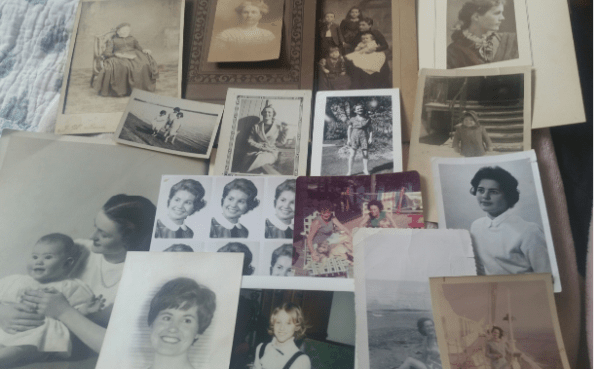
I slowly opened the lid of the first box finding lots of old photographs, mostly black and white, some labelled and others not. The first handful of photos was mostly of loving couples and family reunions at the dinner table. Others showed groups of people standing proudly on the front step of a house (a new home perhaps?). The next scoopful were of children at play – sometimes holding family pets in their arms. Another handful produced proud young adults smartly dressed in various uniforms – perhaps starting a new job or ready to go to war. The last bunch showed lazy days on sandy beach holidays, numerous birthday party celebrations and Christmas gatherings.

Frozen moments captured in time from so long ago for me to enjoy now. It all felt so precious. I very gently placed the photographs back, undisturbed, into that first box.

Nothing to be given away.

The second box was filled to the brim with letters and cards. Some still neatly tucked into their envelopes, others held together with yellowing scotch tape and looking well fingered. Most of them had handwritten messages in big loopy writing that was difficult to read. The stamps alone told another story postmarked from places and dates from years ago. Among the letters were also children’s drawings, thank you notes, lists of party guests, festive menus and various well loved recipes.

But my very favourite find in this box were the love letters, written with such passion and lovingly folded into perfect little rectangles and decorated with doodled hearts.

Nothing to be given away.

The last box contained newspaper clippings announcing family births, deaths, weddings and other special events from all my ancestors over the years. And then, underneath all that newspaper, I discovered more treasures!

First, my grandmother’s monogrammed lace handkerchief with a tiny baby’s christening dress complete with a lock of hair tied in a ribbon and stored in a small envelope. Then I picked up the old school primer (book) and several dried flowers fell to the floor. Neatly stored in the bottom were numerous diaries filled with daily messages with the writing continuing up the sides of each page. Finally, carefully folded in tissue paper was an old sampler stitched by my ancestor, as a young girl two hundred years ago. Several of my family’s treasures (and perhaps a little piece of them?) had been lovingly preserved in this last box.

Nothing to be given away.

As I closed the lid on the last box, it dawned on me that someone had already sorted the family memorabilia into those three separate boxes, leaving me to find…three dusty old boxes of pure joy.

1 Spark Joy by Marie Kondo

Fur Trading in Northern Canada – Part 1

Royal Charter 1.

“Have you in the past ever shopped at Morgan’s Department store in downtown Montreal or at a major department store in downtown Toronto? Maybe you ventured to New York City and made a purchase at Saks Fifth Avenue or Lord and Taylor? “

“Did you know that all these stores have a distinct connection? One company that has been in existence for many years owns these stores. Have you any idea what company that might be?”

“If you ventured a guess and came up with The Hudson Bay Company, you would be right-on.”

The famous fur traders, Medard Chouart Des Groseilliers and Pierre Esprit Radisson, my eighth great uncle, were both born in France and arrived in New France in the mid- 1600’s. Fate brought them together and their explorations were instrumental in developing the fur trade in the young colony. Through their efforts they were the driving force leading to the creation of the Hudson Bay Company more than 350 years ago.

The Early Beginnings of the Company

In 1660, Prince Rupert introduced Pierre-Esprit Radisson and Médard Chouart Des Groseilliers to his cousin, King Charles II of England who eventually received them in his court. They informed him of the “great store of beaver” in an area far north of the St. Lawrence River 2.

The explorers proposed a trading company where they would be able to access the northern interior of the continent by sailing into the waters of Hudson Bay and James Bay. Prince Rupert financed a trip for Des Groseilliers and Radisson to sail to Hudson Bay. Radisson’s ship was forced to turn back off the coast of Ireland. He managed to return to London,3 while Des Groseilliers continued to Hudson Bay and into James Bay where he traded furs with Cree hunters. He returned with a boatload filled with beaver pelts and  noted that “Beaver is plenty”.3.

A map of Hudson Bay

The Charter:

Desgroseilliers’ successful voyage led Prince Rupert to urge the King to grant a royal charter to the Hudson’s Bay Company. (HBC) 4.

The Royal Charter of the Hudson’s Bay Company

 granted by King Charles II of England – May 2, 1670

To this day HBC is the oldest merchandising company in the English-speaking world.

“Under the charter establishing The Hudson’s Bay Company, the company was required to give two elk skins and two black beaver pelts to the English king, then Charles II, or his heirs, whenever the monarch visited Rupert’s Land.

The exact text from the 1670 Charter reads:5. 6.

“Yielding and paying yearly to us and our heirs and successors for the same two Elks and two Black beavers whensoever and as often as We, our heirs and successors shall happen to enter into the said Countries, Territories and Regions hereby granted.”

With the royal charter a legal commercial monopoly was established, prohibiting others from availing themselves of the eight million square kilometres including the 1.5 million square kilometres, lands of the Inuit and First Nations.

Today, the original Royal Charter is preserved in HBC’s Corporate Head Office in Toronto and is both the premier artifact and primary record of the Company.7

The land granted in the charter became known as Rupert’s Land, the name given to an exclusive HBC trapping area, a large expanse of northern wilderness roughly a third of today’s Canada. From 1670 to 1870, it became the exclusive commercial domain of HBC.

 For 250 years from the 17th century to the 19th century the demand for beaver pelts was most profitable for HBC. The pelts were used to make felt hats. European elite sought these hats. 8.

The Hudson Bay company established trading posts staffed predominately by British and Scottish personnel, while traders bartered with Indigenous trappers for manufactured goods, such as knives, tools, guns, blankets and foodstuffs. 9.

“The English-made wool point blanket — cream, with thick coloured stripes — harkens back to the 18th century, when it was the company’s most popular traded good”. 10.

Hudson’s Bay Company hired labourers, voyageurs, tradespeople, and professionals such as accountants, clerks and surgeons who were under contract to HBC. These people were called “servants” of the company. They were mostly men from England, Scotland and also French-Canadian voyageurs from New France who were skilled in the fur trade, along with contracts for a few women who served as cooks.11.

The contracts were usually between I and 5 years beginning June 1 and ending May 31. Free return passage was often in the contract. Those who chose to remain in the north were given 25 acres of land from the Hudson’s Bay Company.

The company rules banned men from marrying indigenous women, until it became apparent that local officers and governors of the company had taken indigenous women as their wives. The company revoked the ban while noting that these marriage ties with indigenous communities were beneficial. The indigenous people played a distinct role teaching the employees how to adapt to life in the north. 11.

The marriage of an employee with an indigenous woman was known as the “custom of the country” rather than the traditional European marriage custom.12.

“Until the early 19th century and the founding of Manitoba’s Red River Colony, HBC had strict policies for employees. They prevented employees from remaining in Rupert’s Land once they were no longer working for HBC.

When the employee’s contract was over many of the men returned to their homelands. The indigenous family members remained behind in their communities.

Notes:

In a recent blog for Genealogy Ensemble, (https://genealogyensemble.com/2020/03/11/allegiancesI wrote a biographical sketch  “Allegiances”. It describes the exploits of my eighth great uncle Pierre Esprit Radisson. He was an explorer involved in the fur trade in New France. His accounts are a main source of the explorations he undertook in partnership with his brother-in-law, Medard Chouart des Groseilliers who was married to Pierre’s half sister Marguerite.

In the process of researching his story my curiosity was piqued by the partnership of these explorers and their contributions which influenced King Charles II of England’s decision to grant a royal charter creating The Hudson’s Bay Company.

“Fur Trading in Northern Canada”, is the result of the research that has answered the questions arising from “Allegiances”.

Footnotes:

  1. https://www.thecanadianencyclopedia.ca/en/article/hudsons-bay-company#:~:text=The%44 7%27s%20Bay%20Company%20(HBC,and%20the%20development%20of%20Canada
  2. Ibid
  3. https://en.wikipedia.org/wiki/Hudson%27s_Bay_Company#17th_century
  4. . https://www.hbcheritage.ca/things/artifacts/the-royal-charter
  5. . https://www.thecanadianencyclopedia.ca/en/article/hudsons-bay-company#:~:text=The%44 7%27s%20Bay%20Company%20(HBC,and%20the%20development%20of%20Canada
  6. . https://www.google.com/search?q=beaver+hats+fur+trade&rlz=1C1YT UH_enCA1032CA1032&oq=beaver+hats&aqs=chrome.1.69i57j0i512l2j0i20i263i512j0i512l6.8034j0j15&sourceid=chrome&ie=UTF-8#imgrc=AMzUgiB_WH6tTM
  7. . https://en.wikipedia.org/wiki/Hudson%27s_Bay_Company
  8. Ibid
  9. .https://www.google.com/search?q=HBC+and+indigenous+marriages&rlz=1C1YTUH_enCA1032CA1032&oq=HBC+and+indigenous+marriages&aqs=chrome.69i57j0i546l3.13967j0j15&sourceid=chrome&ie=UTF-8
  10. .https://en.wikipedia.org/wiki/Hudson%27s_Bay_Company
  11. .https://www.gov.mb.ca/chc/archives/hbca/name_indexes/understanding_servants_contracts_index.html#:~:text=Hudson%27s%20Bay%20Company%20servants%27%20contracts,women%20who%20served%20as%20cooks
  12. .https://www.google.com/search?q=HBC+and+indigenous+marriages&rlz=1C1YTUH_enCA1032CA1032&oq=HBC+and+indigenous+marriages&aqs=chrome.69i57j0i546l3.13967j0j15&sourceid=chrome&ie=UTF-8

A Montreal Landmark

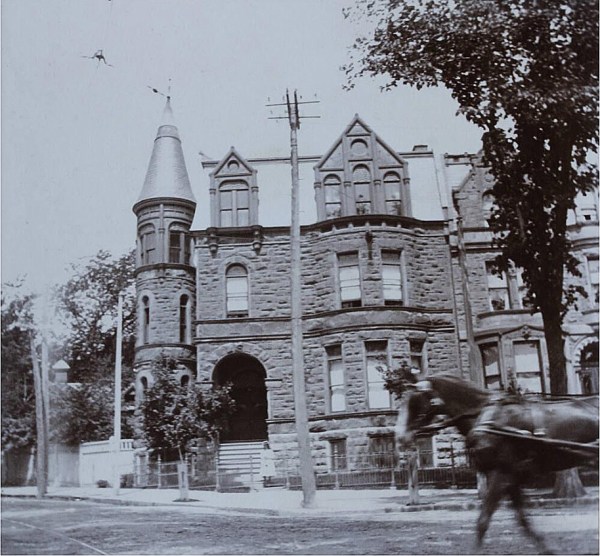
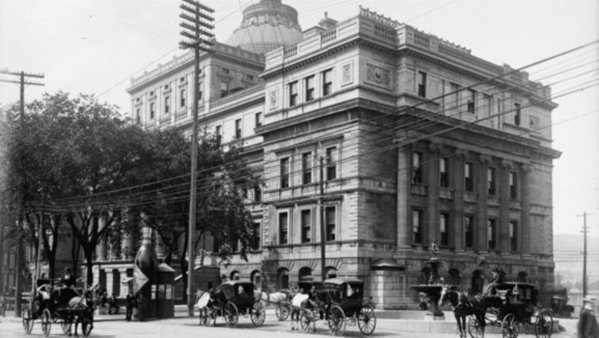
The Robert Stanley Bagg home at the corner of Sherbrooke Street West and Cote-des-Neiges. My grandmother, Gwen Bagg, took this photo in 1903 and it is now in the possession of the McCord Museum.

The old house at the corner of Sherbrooke Street West and Cote des Neiges in downtown Montreal pops up regularly on the internet sites devoted to historical photos of the city, but often the information that accompanies those photos is incorrect. Frequently, people erroneously identify the owner as Montreal landowner Stanley Clark Bagg (1820-1873). In fact, the house belonged to his son, Robert Stanley Clark Bagg (1848-1912).

The building is prominently located on the corner of Sherbrooke Street West and Côte-des-Neiges, which leads up the hill toward Mount Royal. Thousands of people pass by daily, and it is hard not to notice the four-story red sandstone building with its pink tiled top floor.

It has gone through several reincarnations over the years. When it was built in 1891, it formed the south-west anchor of the Golden Square Mile, the neighbourhood where Canada’s wealthiest businessmen, manufacturers and bankers lived. Today it is a commercial building, surrounded by other small businesses and medical offices.

The original owner, R. Stanley Bagg (I will refer to him as RSB), grew up in a house called Fairmount Villa that was at the corner of Sherbrooke Street and Saint-Urbain. His father, Stanley Clark Bagg (SCB), was one of the largest landowners on the Island of Montreal, having inherited several adjoining farm properties along St. Laurent Boulevard from his grandfather, John Clark.

RSB studied law at McGill University and went abroad to continue his studies after graduation, but when his father died of typhoid in 1873, RSB came home. He practised law in Montreal for a short time, but quit to manage the properties belonging to his father’s estate, a position he held until 1901.

He married Clara Smithers (1861-1946) in 1882, and for several years the couple lived just around the corner from Fairmount Villa, where RSB’s mother still resided. Eventually they decided to build a new house in a more fashionable part of the city. When they moved, they had two daughters, Evelyn (1883-1970) and Gwendolyn (1886-1963)—my future grandmother. Their only son, Harold Stanley Fortescue Bagg (1895-1945), was born a few years after the move.

Many houses in Montreal were built of locally quarried grey limestone because it was abundant and cheap, but RSB chose red sandstone, probably imported from Scotland. Originally designed by architect William McLea Walbank, the house was renovated twice in the eleven years RSB lived there, with a major addition constructed in 1902 and other changes in 1906.

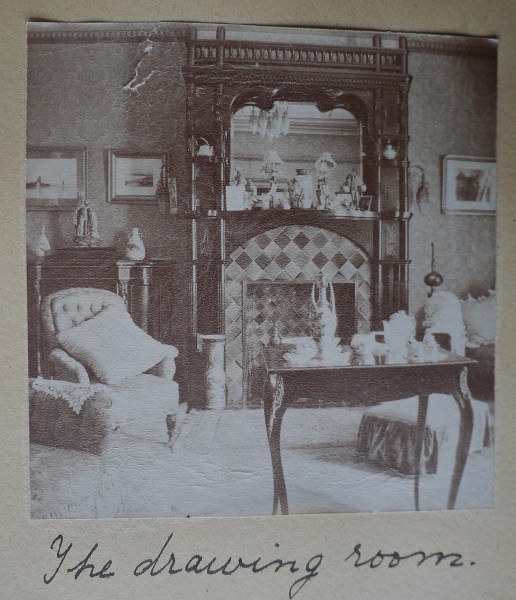
It was a large, even for a family of five, but the Baggs employed at least two live-in domestic servants—a cook and a maid—and perhaps a man to do the heavier chores. The interior was ornately furnished, as shown in photos my grandmother took of the drawing room, with a carved mantlepiece over the fireplace, heavy floor-to-ceiling drapes, and pillows and knickknacks everywhere. She also took photos of the interior of the tower on the Côte-des-Neiges side of the building. It must have been a sunny spot for reading and a good place to watch people struggle up the hill during a snowstorm.

The drawing room (living room) of the house was ornate. This is another photo from my grandmother’s 1903 album, now at the McCord Museum.

RSB died of cancer while on vacation in Kennebunkport, Maine in 1912. Clara (who was usually identified as Mrs. Stanley Bagg) divided the house into two apartments and continued to live there until her death, at age 85, in 1946.

After she died the house was sold and renovated, with a new entrance facing Côte-des- Neiges, and Barclay’s Bank (Canada) moved in. Many of Montreal’s elite families became customers of this British-based institution. In 1956 the Imperial Bank of Canada took over Barclay’s (Canada) and five years later, it became the Canadian Imperial Bank of Canada (CIBC). In 1979 CIBC decided it could no longer upgrade the old Bagg building to the modern requirements of banking and it moved its customers to a branch down the street at the Ritz Carlton Hotel.

For the next few years, the building was home to a jazz bar on the main floor and a bookstore upstairs, until a fire destroyed the interior in 1982. It may have been that fire that destroyed the cone-shaped roof of the tower. Many years earlier, my mother noticed that a stained-glass window displaying the Bagg family crest had disappeared.

The building was restored in 1985-86 and two art galleries moved in, but the interior featured bare brick walls, a style that was popular at the time in some older parts of the city, but was not appropriate for this Victorian-era building. An oriental carpet store rented the main floor in the mid-1990s.

Today, Adrenaline Montreal Body Piercing and Tattoos has been located there for many years. I suspect my great-grandparents would not be impressed.

Note: Lovell’s Directory of Montreal shows the address of this building changed several times over the years. It was at 1129 Sherbrooke in 1894-97, and 739 Sherbrooke W. in 1908-1910. The attached house, on the right, had a separate address – 737 Sherbrooke West—and belonged to another family. The Bagg house had been divided into apartments 1 and 2 at 739 Sherbrooke W. by 1927-28, and the address had changed to 1541 Sherbrooke W. apartments 1 and 2 by 1935-36.

Sources:

Edgar Andrew Collard, “A sandstone house on Sherbrooke St.”, The Gazette, October 20, 1984.

Répertoire d’architecture traditionnelle sur le territoire de la communauté urbaine de Montréal. Les residences. Communauté urbaine de Montréal, Service de la planification du territoire, 1987.

Charles Lazarus, “Farewell to Landmark”, The Montreal Star, April 30, 1979.

This article is simultaneously posted on my family history blog, https://writinguptheancestors.ca.

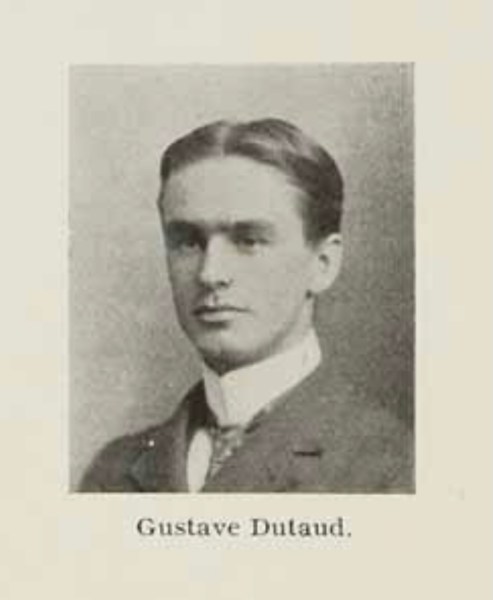
Gustave Dutaud The Lawyer

Gustave Dutaud, a member of the Bruneau family, was my grandmother, Beatrice Bruneau Raguin’s first cousin. I hope they knew each other as both lived in Montreal and from what I have found out, Gustave was worth knowing!

He was well-liked and well-respected as per messages in newspapers after his death. “There is a sense of loss when good men die, something goes from the richness of the world, something we can ill spare. Such is the feeling aroused by the death of Gustave Dutaud.” according to Marguerite Cleary.

“ If he was not conventionally religious he was a fine example of a French Canadian Christian, whom to know was a rare privilege.” said George Hosford.

His mother Virginie Bruneau, was 38 when she married Francois Dutaud and they only had one child. Gustave attended the Feller Institute, in Grande Ligne, Quebec south of Montreal, the school founded by Henriette Feller for French Protestants. She along with Louis Roussy came to Canada from Switzerland as missionaries, to convert the French Catholics. Gustave’s grandparents, Barnabé Bruneau and Sophie Marie Prudhomme heard their gospel and converted in the 1850s along with their children.

Gustave later entered McGill University where he obtained a BA in 1903 and a Bachelor of Civil Law (BCL) in 1909. He worked as a reporter for the Montreal Gazette while completing his law degree. He was a KC (Kings Consul), an official interpreter for the Court of Kings Bench and practised from his own law firm.

“He had a lion’s heart for anyone who suffered under injustice.” Much of his legal practice concerned a number of social welfare organizations including the Society for the Preservation of Women and Children. He was interested in the troubles of the poor and used his legal training to help them out of difficulties. Gustave won a case for a woman hit by a car on Sherbrooke Street and McGill College, where the driver blamed the pedestrian for the accident.

He lead a busy life. He was a member of the Montreal Reform Club, the goal of which, according to its 1904 constitution, was “the promotion of the political welfare of the Liberal party of Canada.” Also a member of the Knights of Pythias organization which believed, “It is important to promote cooperation and friendship between people of goodwill. One way to happiness is through service, friendship, charity, benevolence and belief in a supreme being.”

In 1923 Gustave took his first trip to Europe. He accompanied the Montreal Publicity Association to a London convention as their honorary legal adviser. Aside from his time in England he also toured France and Scotland. “He returned to Canada more than ever convinced of the desirability of this country as a place in which to live.” He was amazed at the poor living conditions of the French peasant farmers. He described the French Chateaux as, “picturesque but uncomfortable, much nicer in pictures than as places to live.” The French wanted to replace war-damaged stone buildings with the same and not live in stick-built houses common in Canada.

Europe was still suffering after World War I. The group visited the battlefields of France. Gustave found “Verdun a sinister expanse of horrors surrounding a miserable medieval town, which had been destroyed by shell fire. There were still many ghastly reminiscences of the war. A trench where many of the French troops had been buried alive and where the soldiers still stood buried, with the tips of their riffles and bayonets protruding from the ground.”

“The finest things he saw in Europe were the masterpieces at the Louvre while the beauty of Scotland entranced him, as quite the most lovely country visited, more so even than his ancestral France.”

His compassion for people included his parents. They moved to Montreal to live with him after his father became ill. His mother stayed with him after his father’s death, until she died in 1926. Unfortunately, Gustave never married or had children, so when he died in 1949, another line of the Bruneau family ended.

Notes:

Montreal Star, 11 July 1949 page 10. Newspapers.com accessed April 22, 2022. George Hosford. George Hosford roomed with Gustave and later was warmly received at his home and office.

Montreal Star July 7. 1949 Letters to the Editor page 10. Newspapers.com accessed April 22, 2022. Marguerite Cleary. She recalled Gustave Dutaud as a man with a mind that was noble, not conventionally religious, a lover of Anatole France, he expected little from humanity and sided by nature with the underdog, a gentleman.

Gustave Dutaud Obituary: Gazette, Montreal Quebec, Canada. June 25, 1949. Page 15. Accessed from Newspapers.com April 19, 2022.

Old World Living Conditions Poor: The Gazette (Montreal, Quebec, Canada) · 12 Mar 1925, Thursday, Page 6. Accessed from Newspapers.com April 19, 2022. Gustave’s trip to Europe.

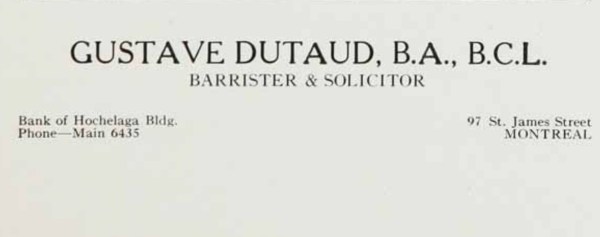
McGill Year Books: https://yearbooks.mcgill.ca/browse.php?&campus=downtown&startyear=1901&endyear=1910 Accessed November 21, 2022. Gustave Dutaud McGill BA 1903. He was also in the Drama club while obtaining his BA, and one of only seven students in third year law. Gustave advertised in the 1916 year book as Barrister and solicitor.

Quebec Heritage News: 

The Montreal Reform Club, at 82 Sherbrooke St West, used the building as its city headquarters for half a century. Established on June 17, 1898, the Reform Club was the social wing of the Liberal Party of Canada, and its provincial wing in Quebec. By 1947, the club counted a remarkable 850 members, 670 French-speaking and 180 English-speaking. 

The irony, of course, is that since April of 1973 the building has belonged to the nationalist and pro-independence Société Saint-Jean-Baptiste de Montréal. On May 17, 1976, the SSJB renamed the property La Maison Ludger Duvernay, in honour of the founder of the Society. The Société Saint-Jean-Baptiste de Montréal has never complained of the presence of frightening federalist ghosts within its walls!

https://en.wikipedia.org/wiki/Anatole_France accessed November 27, 2022.

Anatole France: French poet, journalist, and novelist with several best-sellers. Ironic and skeptical, he was considered in his day the ideal French man of letters. He was a member of the Académie Française, and won the 1921 Nobel Prize in Literature, in recognition of his brilliant literary achievements, characterized by a nobility of style, profound human sympathy, grace, and a true Gallic temperament.”

Montreal, Quebec City, Trois-Rivières in the Early Days of British Canada

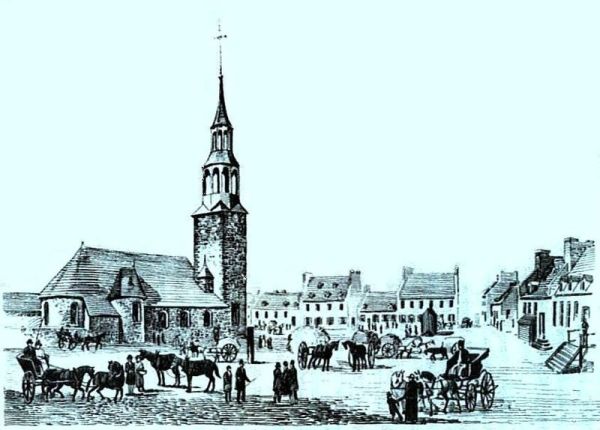
Early View of Montreal

Montreal Today

Above photo found at https://www.edrawmind.com/article/history-of montreal.html

Ordinances, proclamations, etc. issued by the military governors
of Quebec, Montreal, Trois-Rivieres, from the capitulation of
Quebec until the establishment of civil government on
August 10, 1764

The following database contains links to authors who have written on the subject of the Capitulation of Quebec and the aftermath. Also included are numerous biographies of the people who played a major role during that period.

Click the link below to access the database in a new window,

From Daguerreotype to Digital in Four Generations

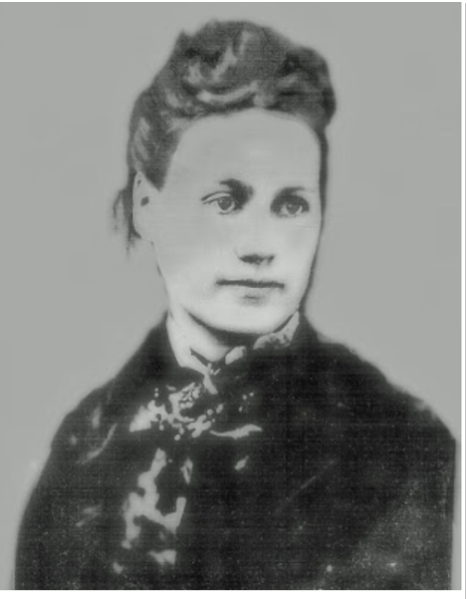
Sarah Maclean Macleod : Daguerrotype or Tintype

The above picture is a digital reproduction of a tintype or daguerreotype portrait of Sarah Marion McLean, my husband’s great great grandmother, taken (most probably) around the time of her marriage in 1849 in Flodden, Quebec. I scanned the metal photograph to computer over 10 years ago.

The pic above is composite montage of Sarah’s 4 times great granddaughter, Nora, my granddaughter born 2018, stored on my cellphone. The collage consists of photos snapped from the moment of her birth until her 1st birthday. These pics are but a fraction of the pictures existing of Mademoiselle Nora, now 4 years old, on various cellphones belonging to family.

I have in my possession only two other photos of Nora’s 4x great granny, Sarah, one where she stands beside her seated husband (Isle of Lewisman John Mcleod ) looking very pregnant. Another cardboard studio photo of her is from her final year. At the back of the photograph someone wrote in her name and dates. Sarah Marion McLean McLeod 1825-1912. She may actually be dead in the photo.

Unfortunately, I have misplaced the metallic originals, so I can’t test whether they are daguerreotypes or tintypes. (Tintypes are slightly magnetic.) They must be in a box somewhere in the garage with the other ‘important’ family photos I am missing. I mean, it has to be, right? I would never have thrown out such precious mementos.

The Macleods emigrated to Quebec in 1838, before so many others in their clan were pushed out in the infamous ‘clearances.’ Sarah Maclean from Coll arrived in Quebec a little later, after her parents and two brothers died back home. She had a sister in the province. Sarah, who was born at the height of the Industrial Revolution, led a long life in southern Quebec before passing away just as the motor car was making life in the Eastern Townships much more exciting. Too bad. Apparently, she loved to travel about.

Sarah is oft mentioned in family letters I have on hand from the 1908-1913 period. The family is feuding over her care in old age. Apparently, she speaks only ‘the Gaelic.’

A few years ago, I digitally enhanced her portrait. There was a white ‘hole’ in her forehead. I scanned the dag/tintype into the computer (afraid that any residue from harsh chemicals on the photo might be harmful to me) and filled in the hole using Photoshop.

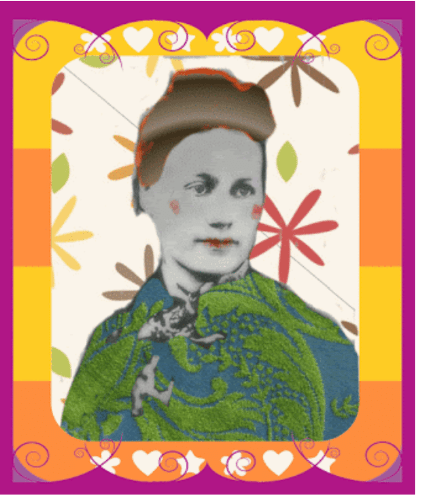
Later on I embellished the photo of this Scottish ancestor whose face has passed down through the generations.

So, in the almost 200 years between the births of Sarah and Nora, the photographic world has gone from solid metal daguerreotype to a multiverse of ephemeral digital media – with the act of taking photographs becoming progressively easier.

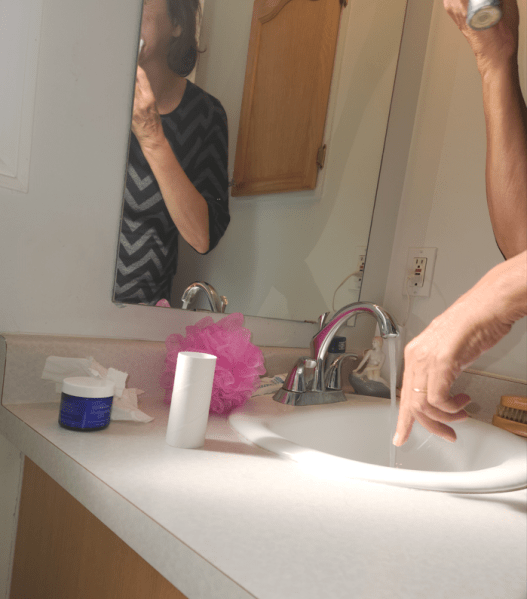
Photographers in the Victorian Age were well-heeled trailblazers and techno-enthusiasts in possession of a great deal of very expensive -and very cumbersome – equipment. Today taking pictures is, no, exaggeration, mere child’s play. Nora is already pretty adept with a cellphone. I imagine in a very few years she’ll be taking candid photos of me as I crawl out of bed and creating instant animations with my dishevelled image and posting them online. Well, she already is.

Nora is already taking candid photos of her grandmother.

Sarah Marion McLean McLeod saw great advances in photography within her very own lifetime.

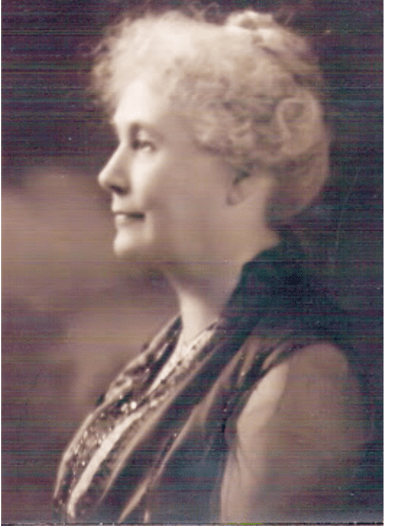
Although I have only three photographs of Sarah, I have many more of her daughter, Margaret McLeod Nicholson, my husband’s great grandmother 1853-1942 , perhaps 15 in total, and even more, around 75, of her granddaughter Marion Nicholson Blair, my husband’s grandmother, 1887-1947.

Margaret Macleod Nicholson, Sarah’s daughter. 1912. “I have the new pictures. I do not think they make me very good-looking.” (Letter)
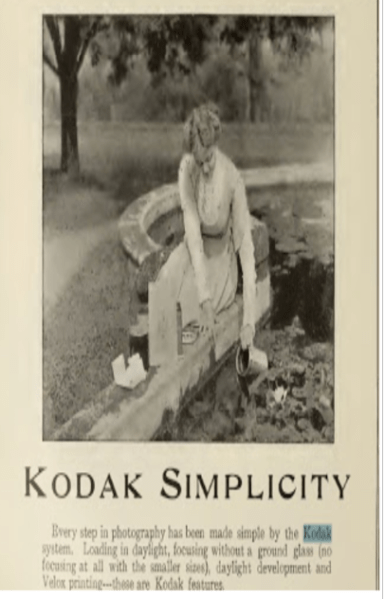
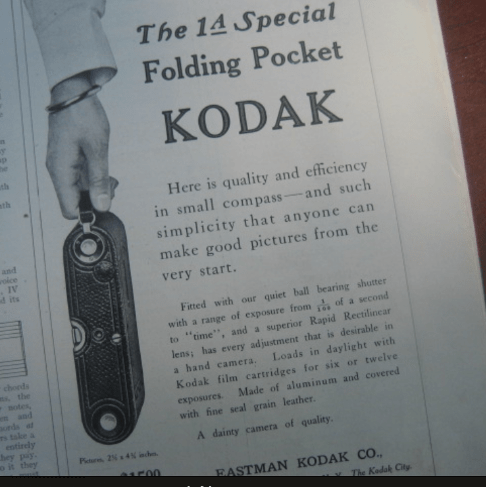
Advert for Kodak, aimed at women, without the technical jargon in camera ads aimed at men.
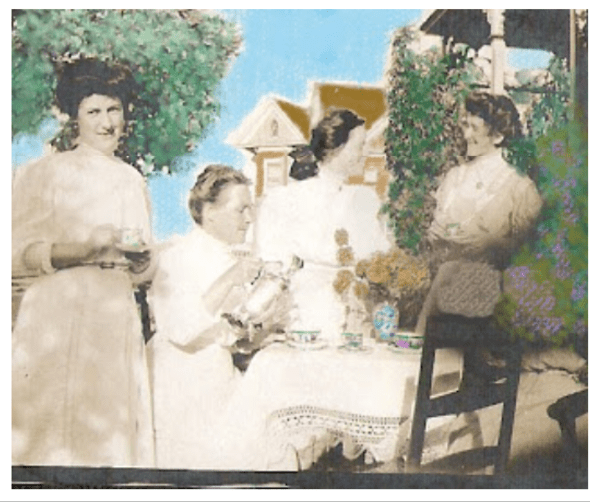
Photo of Margaret, her daughters Edith and Flo and a neighbour taking tea on the lawn circa 1912. Colourized by me. Taken by Marion as she is in another pic from the same day.

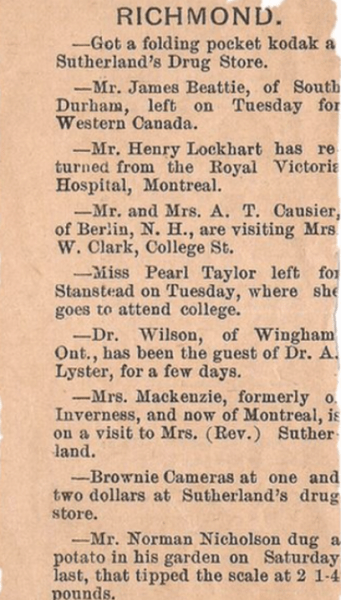
According to her 1906 diary, Marion Nicholson (my husband’s grandmother) who was a teacher liked ‘to fool around taking Kodaks’ during her summer vacations. The Nicholson likely purchased their camera at Sutherland’s drug store in their home town of Richmond.

This was clipped because of the final potato entry, I imagine.
1910 Ad from the Delineator Women’s Magazine.
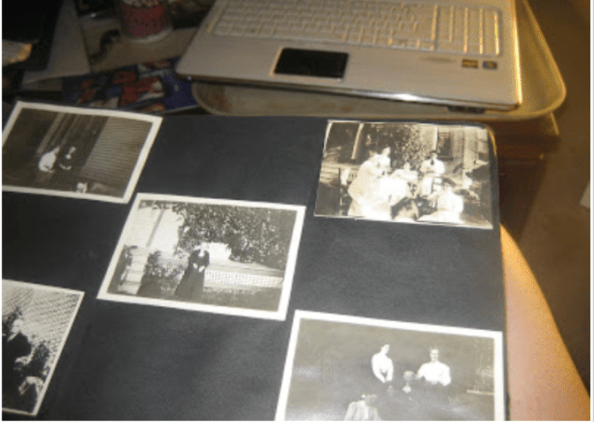
The Nicholson family photo album with the ‘tea on the lawn’ in upper right corner with Marion on the ground in her white dress. The album is full of pics of unnamed people,too. Alas!
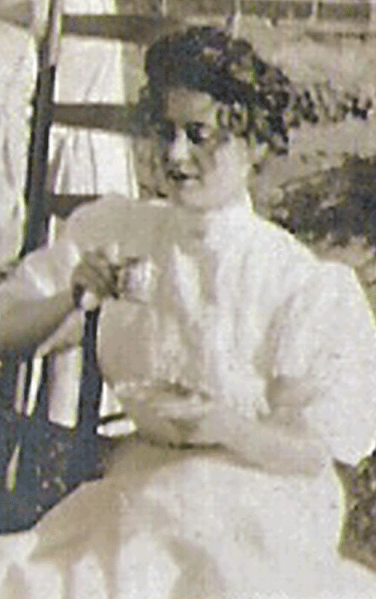
Marion, detail from pic above.
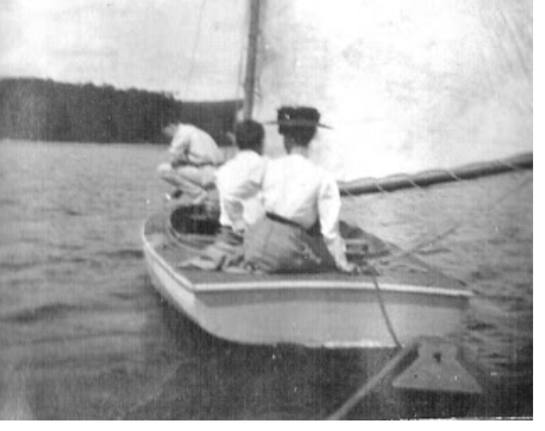
My fave photo from album: Sailing in Hudson, Quebec.
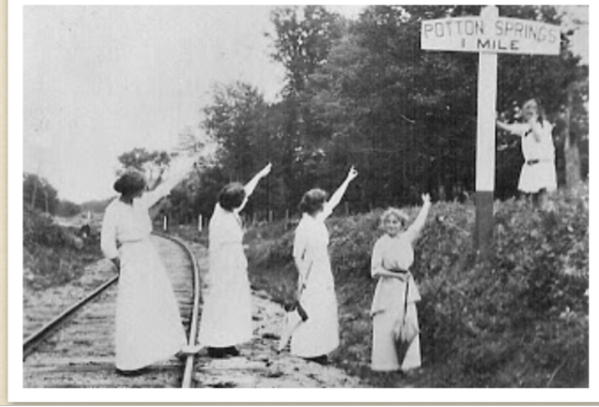
Trip to Potton Springs. I love this pic. It looks like a still from an old movie. Where’s Lillian Gish?
Collage of Sarah’s female descendants up until the 1970s. That’s the ‘death’ photo of Sarah top left.

And the family photographs just keep on coming throughout the 20th century. There was that first decade, the era of shirtwaists and silly-looking BIG hats; then the roaring twenties with Sarah’s descendants in home-made flapper dresses sporting crude bobs; then the 30s with the Nicholson women wearing tonnes of movie star makeup to emulate their favourite big screen thespians; then the 40’s with the women in suits with big shoulders or, yes, even military garb; the 50’s ladies in A-line floral sun dresses sporting wing-tipped sunglasses; the 60’s gals reclining in frilly one piece bathing suits at the cottage, all puffing on cigarettes.

Nora will likely have thousands and thousands of photos taken of her in her lifetime. Still, I wonder, will any of these photographs be accessible to HER four times great granddaughter? Or will they have vanished over the years into the Cloud? I have already lost many many valued pics and videos when my ‘ancient” Note 2 suddenly expired.

Should I, as the family genealogist, be printing out all of the best photos on glossy paper with a colour printer with permanent ink, putting them into a giant album – a real album – for these future generations? (Always making sure to put names and birth dates to the pictures.)

(This would be an extremely costly proposition considering the price of colour ink.)

Or, do I merely create an enormous virtual album and put it on a key and into the safety deposit box and hope against hope that it won’t be casually tossed out one day – and that the info on the key will remain accessible?

Maybe all that will be left of the bazillions of photos of Nora, my granddaughter, will be on novelty items like coffee cups and calendars given to me each Christmas.

Or perhaps her image will exist only on this blog post, ready to be extracted from the ether in 2300 by some self-styled cyber-archaeologist.

I’m no fortune teller but I can hazard a good guess…but, first, I have to find that box of precious old photos down in the garage.

Possibly my favorite pic from the Nicholson collection. Waiting for the bus in Richmond, circa 1908. Edith Nicholson standing at front with young cousin Stanley Hill in front of her. Flora seated at left. Could be a scene from the Music Man. What is that decoration on Edith’s hat?

Years ago I wrote an essay for the Globe and Mail on the same topic. It was very well received and often reprinted. Gone with the WIndows.

The Judicial Archives during the French Regime of New France 1644-1693

Montreal’s Old Courthouse

Along the north side of Notre Dame East near Jacques-Cartier Square, three courthouses stand together. The most interesting is the neoclassical Old Courthouse, Montreal’s oldest palace of justice (1856) which is now an annex of the Montreal City Hall, and a preferred spot for wedding photos. The “New Courthouse”  from the 1920s, used for criminal trials before being turned into a conservatory and later a court of appeal, and the oversized Palais de Justice, built in 1971 when concrete and smoked glass were the rage. by  Dick Nieuwendyk  of The Montreal Times

The Judicial Archives during the French Regime of New France

1644-1693  &  1693-1769

In 2022, students at McGill University, Université de Montréal, Université Laval, Concordia University, UQAM (Université du Québec à Montréal), Université de Sherbrooke, Université du Québec à Trois-Rivières and at Chicoutimi, these students would be in a position to attend classes which in part address the Judicial Archives during the French regime of New France (1644-1759).

 Among genealogical societies across Québec, the following societies:

Société de généalogie de Québec at Quebec City, Société généalogique canadienne-française in Montréal, Société de généalogie de l’Estrie at Sherbrooke, are most likely teaching their members about the Judicial Archives of New France.

************

The content of the link was constructed for family lineage researchers who have graduated from traditional genealogy search engines. It is a powerful dossier for family lineage searches who have graduated from the traditional Church & Civil Registers of acts of birth, baptism, marriage, death, and burials.

Contents of the database link below:

Royal Jurisdiction of Montreal 1693-1769

Guide to Court Records

Bailiwick Dossiers of Montreal

Transcripts of trial proceedings

Inventories of judgments of the High Judiciary Council of New France 1717-1760

Inventories of Ordinances issued by the Government Stewards of New France

Inventory of insinuations of the Provost of Québec

Bailiwick Dossiers of Montréal recorded by Notaries

Inventories of notary registries of the French Regime

Notaries & Clerk Registrars of the Court – Judicial District of Montreal – 1668-1760

Repositories in Canada

Understanding Mary, My Protestant Irish Ancestor

Can I learn anything about my great great great grandmother’s life, despite having only a name, a birthplace and a rough idea of where she lived as she raised her children?

That challenge led me to a fascinating thesis about the Irish Protestant Identity in Ontario written in 2010 by Brenda Hooper-Goranson. Hooper-Goranson’s research describes how many Irish women of Mary’s time ensured a lasting Irish identity in Canada that differed from that in the homeland.

Thanks to Ms. Hooper-Goranson, I have been able to imagine the life of women like my ancestor in general terms even if her actual life and personality remain obscure.

An Irish Protestant identity was transferred to Canada as solidly intact as any Irish Catholic identity was and it can even be argued that the former outlasted the latter with regard to late nineteenth-early twentieth century Canadianizing influences,” wrote Hopper-Goranson in the introduction of her thesis. “That distinctive presence was changed or softened in only one regard. In time, with the space and distance that Canada afforded, abrading homeland identities might be abridged, and Irish Protestant and Irish Catholic on new soil found opportunities to simply be ‘Irish’.1

People like Mary maintained connections to family in Ireland, helped foster relationships with neighbours, brought recipes, seeds, textiles and furniture from their home country to their new communities and fostered religious practices and apprenticeships in their children.

Whether Mary herself did such things isn’t certain. We do know that she was born in Ireland, thanks to the 1932 death certificate of her daughter.2 That same document mentions her husband’s Scottish roots, the family religion of Brethren, their daughter’s 1856 birth in Orangeville, Canada West and her death in Weston, Ontario.

Those facts allowed me to make several assumptions about my great great grandmother’s life that enabled me to read Hooper-Goranson’s thesis with an eye to imagining more. We know for sure that Mary Willard travelled from Ireland to Canada West at some point, and the decision probably wasn’t hers. A father, a husband—in those days, women didn’t often get to set their own destinies.

Where she lived in Ireland, whether she lived in other places too, whether she married her Scottish husband in Europe or elsewhere, whether they met on a specific journey or after separately travelling to North America isn’t clear. All I know for sure is that Mary Willard identified as Irish; her faith was Protestant; and she and her husband lived in Canada West when her daughter was born. Given that her daughter died in the Grand River region not far from her birth, it’s likely that her parents lived in the same region for most of their lives.

We do know that in the 1800’s, Canada attracted more migrants from Ireland than any other country in the world. When possible, these migrants tended to settle together with others of the same religion, many in Canada West, which became Ontario.

Irish hostilities between Protestants and Catholics became prevalent late in that century. Fenians raided Canada West from Irish communities in the northern states beginning in 1866. Riots broke out in Toronto in 1875, during the Jubilee March and in 1878, when O’Donavon Rossa visited the city to give a speech.

In most Canada West communities, however, Hooper-Goranson argues that the challenges of felling forests, building homes, subsistence farming and mourning the losses from fevers and disease blurred the lines between groups. Often, a general homesickness for Ireland linked Catholic and Protestant settlers together into a common identity.
Class structures brought to the New World from Europe when Mary Willard lived fell apart in a matter of months, primarily to the amount of work required just to stay alive. Women of all stations did everything required to run a household, including helping grow crops for food, making candles, producing soap, grinding sugar, baking bread, milking cows, knitting or spinning clothes and preparing flour or wool. People offering domestic assistance had so many possible positions, they could be choosy.

…the observations of lrish Protestant immigrant James Reford show that he too, took note of a change in the social climate in America when he complained that even Irish Catholic servants “from the bogs of Connoght” expected certain comforts and conveniences far different from Home. “If you want a girl to do housework the first question is have you got hot and cold water in the house, stationary wash tubs, wringer? Is my bedroom carpeted [with] bureau table wash stand and chairs … and what privileges and the wages? … The writer makes the charge that such girls are too ambitious, and deceitful about their previously humble origins.3

Despite the amount of hard work, Irish women in Upper Canada worked hard to match the fashion trends back in Ireland.

After joining her husband in Canada in 1836, Margaret Carrothers wrote several years later from London, Upper Canada, encouraging her mother to make the journey herself with the remittance pay she sent home. Part of her enticement was the reassurance that her mother could look the part of the Irish lady even on the frontier. Although Margaret requested her mother bring the latest patterns of capes, sleeves, cloaks, and bonnets she delighted that ” … Dress of every kind is worn the same here as with you only much richer and gayer …… this has become a very fashionable place you would see more silks worn here in one day than you would see in Maguires bridge in your lifetime and could not tell the difference between the Lady and the Servant Girl as it is not uncommon for her to wear a Silk Cloak and Boa and Muff on her hands and her Bonnet ornamented with artificial flowers and vail.4

Whether hostilities arose or not often depended on whether communities included nationalities beyond Catholic and Protestant Irish. In those cases, rather than differentiating between themselves, Irish settlers saw themselves as a common group against the others.

There were many occasions where Irish Protestants and Irish Catholics found cause with one another enough to march together in support or defiance of Tenants Leagues, Famine Relief, Confederation, Fenianism, Irish politics and personages, and of course, St. Patrick’s Day was held sacred to both.5

Generations of women built up and maintained national communities as religious differences diminished. They married Irish men, stayed in contact with family members in Ireland, collected Irish recipes, crafted Irish patterns onto clothing and household items, learned Irish Dancing and celebrated holidays with neighbours.

Traditionally, Irish families make their plum pudding on the last Sunday in November before the beginning of Advent. Everyone in the household is supposed to stir the mixture, which contains 13 ingredients to represent Christ and his Disciples.

My great granny Charlotte used to make one every year. I remember it being blacker than fruit cake and with a yummy rum topping.

Sadly, her recipe either was never written down or, if it was, it has since been lost. I’ve been trying to duplicate the flavour ever since.

Haven’t managed to get it right yet, but here’s my closest guess so far.

Christmas Plum Pudding

Ingredients

  • 1 cup (250g) brown sugar
  • Grated zest and juice of 2 oranges
  • 1 cup (250g) dried currants
  • 2 cups (500g) raisins, ideally different colours
  • 1/2 cup (125g) candied cherries
  • 1 can (350ml) stout (I use Buckwheat beer because I can’t eat gluten)
  • 2 cups (250g) all-purpose flour
  • 2 tsp. ground cinnamon
  • 2 tsps nutmeg
  • ground cloves
  • 1 cup (250g) butter, softened
  • 4 eggs, lightly beaten
  • 1 small apple, peeled, cored, and shredded

Directions

  1. Grease and line three pudding bowls or the cooking vessels of your choice.
  2. Mix everything together except for the eggs and the stout.
  3. Beat the eggs and slowly add them to the mixture.
  4. Pour the stout in slowly, mixing the whole time. This is a good time to get the family involved.
  5. Cover with a clean tea towel and leave overnight.
  6. The next day, preheat the oven to 350 degrees F (130C).
  7. Pour the mixture into the pudding bowls.
  8. Place deeper pans full of water in the oven. Put the bowls into the water so that they are about 2/3rds covered.
  9. Steam for 6 hours.
  10. Set aside in a cool dark place to dry.
  11. On Christmas day, steam the puddings for about 3 hours or until cooked through.
  12. Cut and serve with rum topping.

Rum Topping

Ingredients

  • 1/ cup softened butter
  • 1 cup sugar
  • 2 eggs, beaten
  • 3/4 cup rum, brandy or sherry
  • 1/4 tsp nutmeg

Directions

  1. Combine the sugar and butter with a hand mixer until fluffy and light.
  2. Beat in eggs.
  3. Add rum, brandy or sherry and nutmeg.
  4. Cook over boil water for 5 minutes or so, stirring constantly past the curdling point until the sauce looks smooth.
  5. Pour over the Christmas pudding.

Sources

1Hooper-Goranson, Brenda C. 2012. “No Earthly Distinctions : Irishness and Identity in Nineteenth Century Ontario, 1823-1900.” Dissertation, Library and Archives Canada = Bibliothèque et Archives Canada. McMaster University.

2 “Ontario Deaths, 1869-1937 and Overseas Deaths, 1939-1947,” database with images, FamilySearch (Ontario Deaths, 1869-1937), Deaths > 1932 > no 3918-5556 > image 1593 of 1748; citing Registrar General. Archives of Ontario, Toronto.

3Hooper-Goranson
4Linen Hall Library, Belfast, Edward N. Carrothers, “Irish Emigrants Letters From Canada, 1839-1870”, (Belfast Northern Ireland, 1951), pp.4-5. Margaret Carrothers, London, U.C. to Mrs. Kirk [Patrick?] Maguiresbridge, Ireland, December 25, 1839.

5Hooper-Goranson
Seigneuries of New France and of Quebec 1654-1854

An aerial view of the seigneurial system in New France

The database below consists of the following:

Introduction to Seigneuries & Seigneurs of New France – 1654-1854

Table of Contents:

    Introductionp.   1-11
    Censitaires Recordsp. 11-12
    Inventory of Concessionsp. 12-14
    Notariesp. 14
    Authorsp. 14 – 124
    History Linksp. 124- 140
    Regional Genealogy Links by Countyp. -140 161
    Repositories in Francep. 161-163
    Repositories in Canadap. 163-166


The authors’ section consists of bilingual notations:

  • numerous biographical sketches of the seigneurs
  • published books, articles and theses on the subject
  •  regional studies
  • immigration
  • habitants and merchants

The Debutante

This month a Montreal tradition will resume after a two-year pandemic break: the annual St. Andrew’s Ball will take place at the Windsor Hotel on November 18. The event promises to be “a gala evening of dining, dancing and Scottish pageantry, celebrating Scottish heritage in Montreal,” featuring the Black Watch Pipes and Drums and highland dance performances.

My mother attended this event in 1937, the year that, despite her protests, she was a debutante. Writing under her married name, Joan Hamilton, she recalled that experience 40 years later, and her article, published in Montreal Scene magazine on November 26, 1977, described the endless social gatherings she and her teenage friends attended.

In those days “coming out” didn’t mean what it does today. Then it meant that a young woman of 18 was introduced to society, and to members of the opposite sex, which was important because my mother and most of her friends attended separate private schools for girls or boys.

She wrote, “For a tightly-knit group of Montrealers whose growing up took place in the mid-30s, life consisted of a round of parties that started with events called sub-deb dances and progressed to coming-out balls. Actually, they weren’t as grand as they sound. Life was simpler then, and one lived by a strictly prescribed social code. The sub-deb parties were given at private homes, primarily during the Christmas holidays, and the ages of the future debutantes ranged from 14 to 17.” When the girls became debutantes, the parties became balls.

Although many Canadians were suffering economically during the Depression, my mother recalled that there were dozens of debutantes each season, and there was a ball at least once, and sometimes twice a week from October until February. Many debutantes came out at their own parties, but others were presented at either the St. Andrew’s Ball or charity balls put on by the Royal Victoria Hospital Auxiliary. At that time, most of the balls were held at the Winter Club on Drummond Street, the Hunt Club on Côte Ste-Catherine Road, or the ballroom of the Ritz-Carlton Hotel. The St. Andrew’s Ball took place at the Windsor Hotel.

In Montreal the St. Andrew’s Ball was first held in 1848, but some members of the society preferred a dinner for the men only, and the next ball wasn’t held until 1871. When it next took place, it was described as “the social event of the year,” probably because Queen Victoria’s daughter Princess Louise and her husband were the guests of honour. Over the following years, Montreal’s Scots sometimes celebrated St. Andrew’s Day with a banquet or a concert, and the society did not choose a ball as its principal event until 1896.

According to the Montreal Daily Star, more than 900 people—a record—attended the 1937 edition of the St. Andrew’s Ball, including the Governor General of Canada and his wife, Lord and Lady Tweedsmuir. “Merriment reigns as sons and daughters of auld Scotia lay aside their cares,” the newspaper headline announced.

In the ‘30s, the debutantes wore long white evening dresses and white, elbow-length kid gloves, while their escorts were in white tie and tails. The evening began with dinner parties, with cocktails and wine served. On arriving at the ball, the guests went through a receiving line so the proud parents of the debutante in whose honour the party was being held could introduce her. Then the dancing began, with music provided by an orchestra. Supper was served around midnight, accompanied by champagne.

“One’s partner at dinner was supposed to, and usually did, have the first and last dance and escort you to supper, as well as take you home,” she recalled. “It was a good security blanket.” My mother was not one of those girls who was so popular with the boys that her dance card for the evening was always full. In fact, she hinted that she spent a fair amount of time in the ladies’ room, pretending to be invisible. Nevertheless, she wrote that her teen years were a lot of fun, going to movies, picnics and corn roasts in the summer and taking the train to the Laurentians to go skiing in winter, after the party season had wrapped up.

Two years later life changed for everyone, and some of the young men who had attended those parties went off to war and never came back. Nor did my mother marry one of the boys she was introduced to as a debutante; my parents met in Ottawa, where they were both working, just as the war was ending.

This article also appears on https://writinguptheancestors.ca

Working together to help genealogists discover their ancestors