An Outstanding Pioneer

This image has an empty alt attribute; its file name is perche-modif.jpg

What do the following people have in common?

Hillary Rodham Clinton, Justin Trudeau, Prince Charles’ wife, Camilla Parker-Bowles, Justin Bieber, Angelina Jolie, Madonna, Ryan Gosling, Celine Dion, and me.

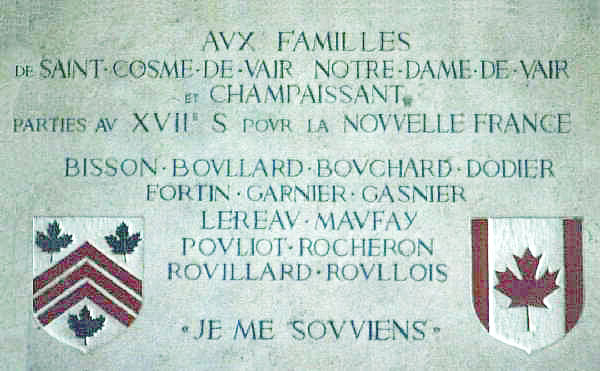
 This year (2021) is the 400th Anniversary of the baptism of our common ancestor. Julien Fortin saw the first light of day on February 9th, 1621 in the village of Saint Cosme-de-Vairais in the old province of Perche. Julien’s parents were Marie Lavye and Julien his father, a butcher by trade. 1. & 2.

At the age of seven young Julien’s mother died. The young fellow had a good relationship with his grandfather, Gervais Lavye, the owner of L’Auberge du Cheval Blanc. In 1634 at that inn, Julien, now a lad of thirteen first heard Robert Giffard speak at the request of the French King Louis XIV. Giffard’s mission was to recruit settlers, in particular tradesmen and their families to join him in developing a colony in New France.

It was at this point that maybe a seed was planted in his memory as he listened to the adventures of Giffard, that he too, would someday be able to participate in this endeavour?

L’Auberge -du- Cheval-Blanc

Robert Giffard, proprietor of the Seigneurie of Beaupré went back to New France with a small number of settlers and later, around 1650 he returned to Saint Cosme-de-Vairais with the same mission, to recruit more settlers. Julien, now an adult with a bright future ahead, chose to join the group taking on the challenge of an adventure into the unknown. What lay ahead? Could they possibly imagine?


The enthusiastic families made their way perhaps with a certain degree of skepticism to Dieppe    where they boarded a ship for a long three-month arduous, perilous voyage, arriving in Quebec City in late August of 1650.           

Young Julien had worked as a butcher and would appear to have saved some money. When he arrived in New France, his savings were sufficient that his first notarial act took place on December 26, 1650 when he purchased a prime lot of waterfront property along the Saint Lawrence River in Ste-Anne de Beaupré. It was the first notarial transaction of more than 85 notarial records prepared during his lifetime.

Over the years he became an astute businessman buying and selling land, often using beaver pelts as payments for these transactions.  He soon became known as Julien ‘de Bellefontaine”, a name given when he bought his first property which had a source of fresh spring water.

                                   Marriage contract of Julien and Genevieve
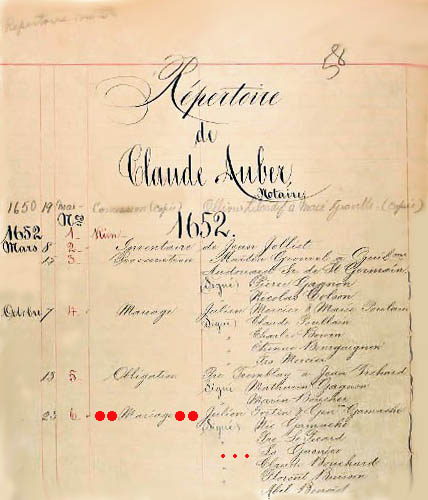
Julien, now in his thirties, settled in his new environment and the time came for him to consider marriage. He chose his bride to be, a young seventeen-year-old, Genevieve Gamache, a ’fille a marier’, a marriageable young woman, who had arrived in New France with the hope of finding a suitable husband. At the time many young women were sponsored. She arrived before King Louis XIVs program of “les filles du roi” or King’s daughters who arrived during the years 1663-1673. These young women sponsored by the King came with the intention of marrying and developing the new colony.

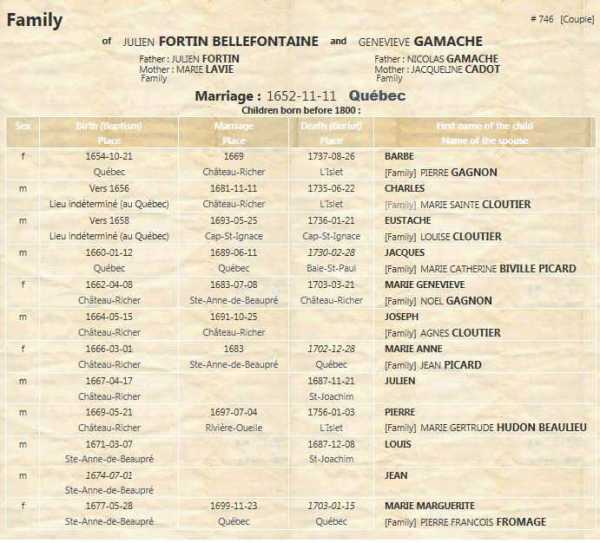
Genevieve came to New France accompanied by her brother, Nicolas Gamache dit Lamarre. A marriage contract was drawn up by Claude Auber and signed on the 22nd of August 1652 in the future home of Toussaint while the celebration of the marriage and blessing took place in the chapel of Saint Joachim de Montmorency in Cape Tourmente on the 11th of November 1652. A festive gathering followed at the home of Louis Gagné, whose name appears on the notarial contract, a friend of Julien’s. Both men came from the same village in France.3. & 6.                                             

It was not long before there was a family celebration, one of great joy. Julien and Genevieve had given birth to a daughter, Barbe. She was the first of twelve children, eight boys and four girls from their union.4. Over the years there were many occasions for family festivities. The twelve children were all healthy at birth.

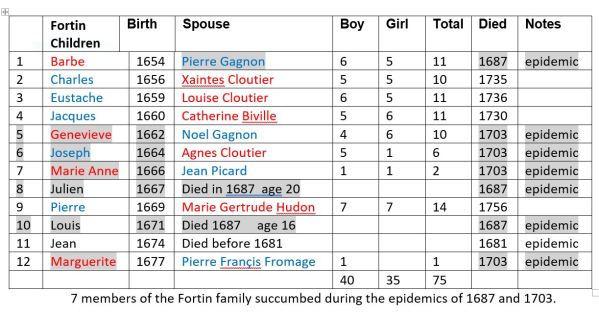
The fate of six of Julien Fortin and Genevieve Gamache’s children.
This image has an empty alt attribute; its file name is chart-epidemic-copy.jpg
Chart prepared by the author.

The above chart indicates the devastation that the epidemics of 1687 and 1703 brought on the Fortin family. Some of the younger children contracted scarlet fever, measles and later in 1703 others were taken by smallpox.  Julien, the son, died at the age of 20 in 1687, as did Louis at 16. Around 1681 Jean had also succumbed to an epidemic and in 1703 when another outbreak of smallpox occurred Marguerite, Genevieve, Marie-Anne, and Joseph also lost their battles with these devastating diseases. Along the way Barbe lost her first husband, Pierre also due to an epidemic.

On a positive note, it shows the progeny of Julien and Genevieve. They had a total of 75 grandchildren. Julien certainly upheld his part of the bargain in developing and populating New France.

Despite trials, tribulations and the loss of family members and the constant attacks by the Iroquois, life in the new colony continued to thrive. By 1668, Cape Tourmente with its fertile plains along the St. Lawrence River had become an agricultural hub that provided the settlers with plenty of food.

Julien was a generous, prosperous, and deeply religious man with a strong devotion to Saint Anne. He gave to the churches of Chateau Richer and Sainte Anne. He bestowed a house near the church, and a bake house to be used by the two churches. He donated a monetary gift of 20 sous and 2.1 bushels of wheat to the church. He owned several guns, several beasts and twenty acres of land.

The exact death of Julien Fortin is unknown. Archivists have concluded that he was not present at the second marriage of his daughter, Barbe on the 16th of April 1690. The date of his death appears in a document and that the death occurred at Hotel-Dieu hospital in Quebec City August 10, 1692.
Julien Fortin de Bellefontaine faced the unknown, undaunted by the challenges and adventures that lay before him as he set sail for New France in 1650. He was a man of honour and integrity. As he and his wife were among the early pioneers that survived hardships’ They worked diligently and produced a long prolific line of Fortin descendants in North America. Approximately 90% of the Fortins are related to Julien and Genevieve Fortin.5.

Are you a descendant of Julien Fortin dit Bellefontaine?”

I am a proud to be a descendant of this honorable man and his family.

Louisa Seraphina Fortin, my mother’s mother, my grandmother was a direct descendant of Julien Fortin, my 7th great grandfather.

7.
7.

Note:

There is a distinction between ‘dit’ names and ‘de’ names. “dit” names were given to people by giving them an additional second name to distinguish them from others with the same family name.

https://www.genealogiequebec.com/blog/en/2019/06/05/french-canadian-dit-names-and-nicknames/ with the same

Footnotes:

  1. http://www.albertfortin.ca/Fichiers%20Web/lancetre%20julien.pdf     
  2.  Ibid.
  3. 1997-2018 Ancestry.com , Bibliotheques et Archives nationales de Quebec
  4. https://www.perche-quebec.com/perche/individus/fortin-julien-en.htm
  5. http://www.afgs.org/jeme3.pdf      page 21
  6. Suite de Julien Fortin | Association des Fortin d’Amérique (afafortin.com)
  7. https://afafortin.com/suite-de-julien-fortin%E2%80%8E/
  8. http://www.afgs.org/jeme3.pdf      page 21

Sources for reference:
https://www.francogene.com/qc-res/dgfq.php

The 106 Year Old Postcard

So, just who was the mystery man who sent my Gran a postcard in 1915?  For many years, I have held in a box of family history memorabilia a small item – a postcard.

Life, (bringing up children, and work), prevented me from finding out more about this postcard before now- sent by a stranger to my Gran who, born in 1900 was just 15 years old.  Who was this mystery man, I wondered? Now, in the second year of the COVID-19 pandemic, I have no excuse and plenty of lockdown time.

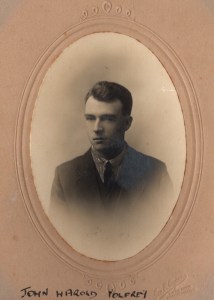
I had often looked at this flimsy piece of history over the years and wondered… And so, at last, I started my research into Pvt. John Harold Polfrey.

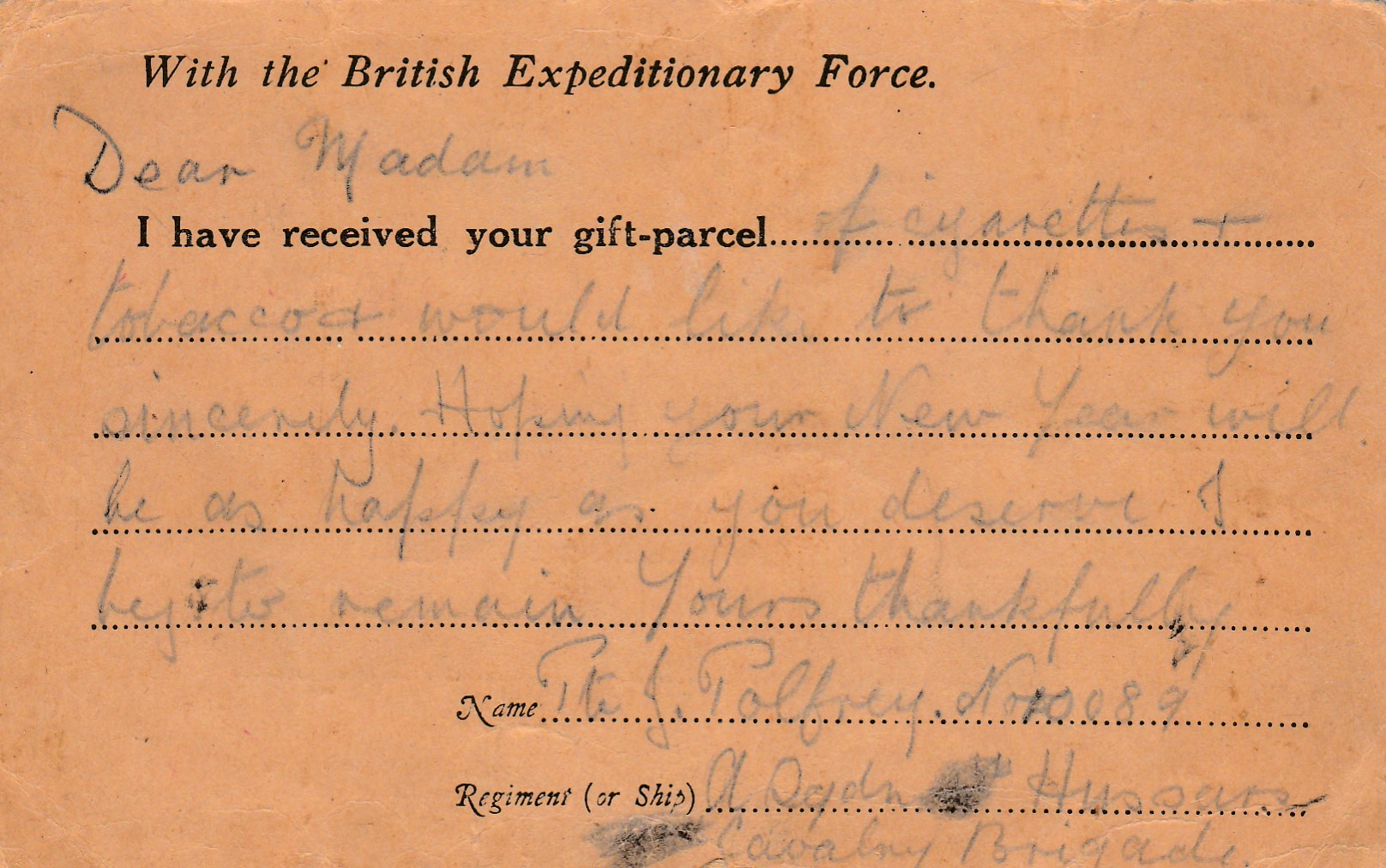
As it happens, all the information I needed was on the postcard that my maternal Gran, Edith Bevan had received  106 years ago.

World War 1 was in its second year and during this  ‘War to end all Wars’ citizens, even children, were asked to send to the soldiers at the front gift parcels of random gifts. So, Edith had sent a gift parcel of cigarettes and tobacco to an anonymous soldier serving with the British Expeditionary Force.

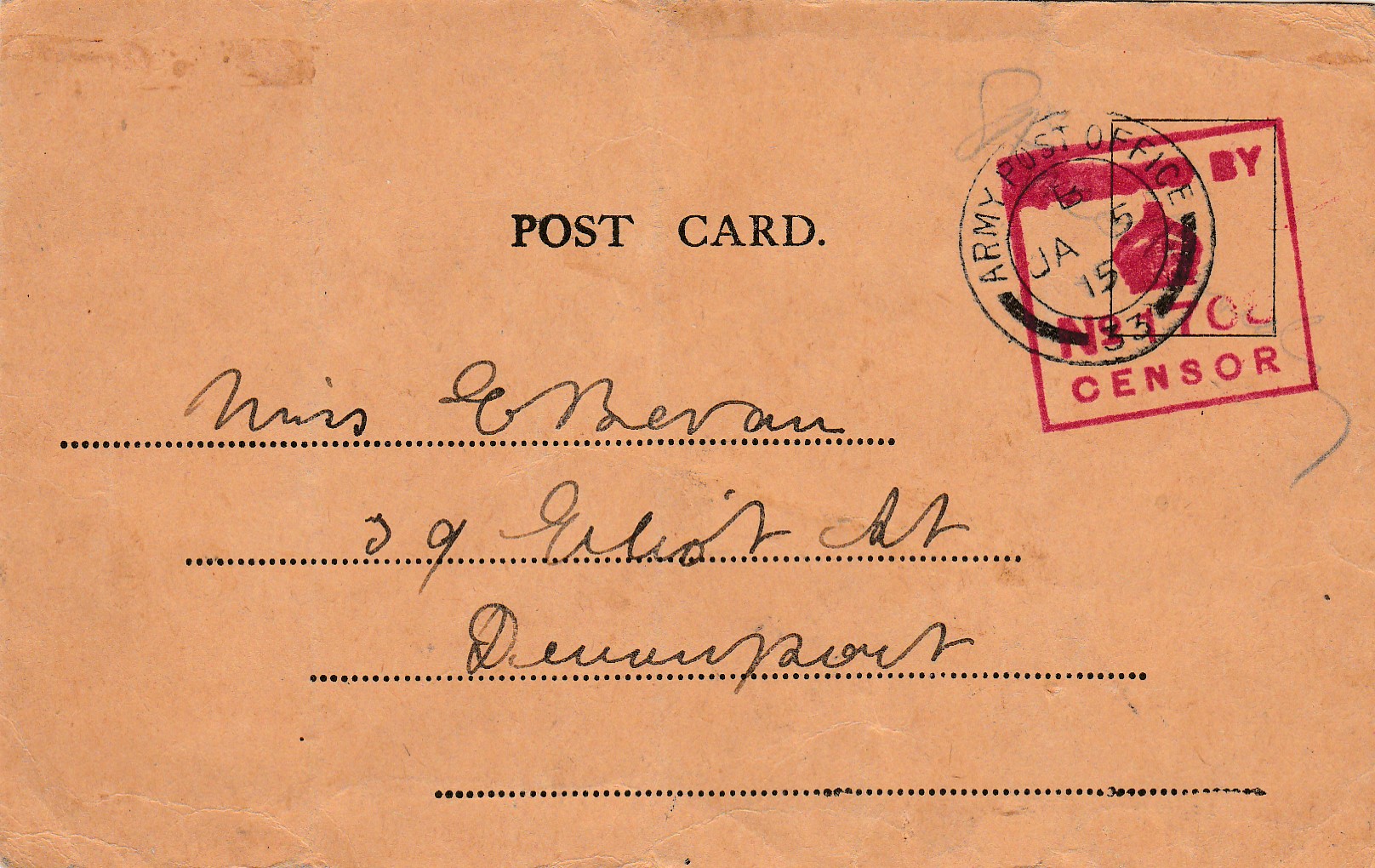
In due course, Gran received a reply to her gift.  It was written in pencil on a flimsy khaki coloured postcard addressed to:

Miss E. Bevan,  29 Elliot St.  Devonport.

No County or Country was added but the county was Devon, in England and on the front of the Post Card, is the Censor’s stamp. The first word is blurred, but I assume it reads ‘READ by the censor. There is no stamp, but it is francked [1]  ‘Army Post Office 33’ and the date is 5th Jan 1915.


The message reads:  ‘Dear Madam, I have received your gift parcel of cigarettes and tobacco and would like to thank you sincerely. Hoping your New Year will be as happy as you deserve, I beg to remain yours thankfully

Name: Pte. J. Polfrey No. 10089

Regiment (or ship) A Sqdn. ? Hussars? Calvary Brigade

Black dots can be seen on the postcard, and I believe these are the censor blacking out the number of the Hussars and Calvary Brigade, so you would not know where the soldier was serving.  After scanning the postcard and editing with the photos, I think the numbers are 4th Hussars and 2nd Cavalry.  I thought his name was PALFREY but again, with today’s photo scan software, I was able to read it as POLFREY.

John H. Polfrey was born in Fulham, in the southwest of London, England on the 5th of July, 1894 and enlisted on 20th May 1913. He would have been about 19 years old.

He joined the 2nd Cavalry Depot, 4th Hussars (The Queen’s Own).

The 4th Queen’s Own Hussars was a cavalry regiment in the British Army. First raised in 1685 it saw service for three centuries, including the First World War and the Second World War. The Colonel-in chief was Sir Winston Churchill.  The 4th Hussars deployed from Ireland to the Western Front in 1914, remaining there for the entire First World War (1914-18).

They took part in the Retreat from Mons, the First and Second Battles of Ypres (1914 and 1915) and several other engagements. In 1958 the 4th amalgamated with the 8th King’s Royal Irish Hussars and became The Queen’s Royal Irish Hussars. [2]

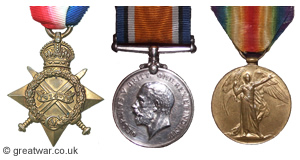
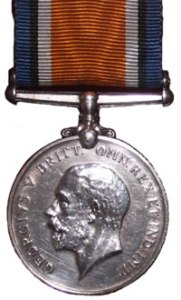
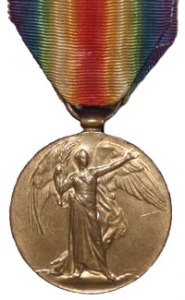
Pvt. John Polfrey would have seen a great deal of action in his young life and was awarded three medals for his services. The 1914-15 Star (or Silver War Badge),  The British War Medal, and the Victory Medal These three medals are also known as ‘The Trio’ **

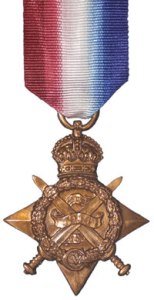
1914-1915 Star (Silver War Badge)

This collection includes records of British soldiers who survived World War I and were discharged from the ranks for honourable reasons of illness or injury. In September 1916 such men were honoured by King George V with the institution of a special award, the Silver War Badge.  Also known as the Mons Star, the medal is a bronze star with a red, white and blue ribbon, reflecting the French Tricolore. It was issued to British forces who had served in France or Belgium from 5 August 1914 (the declaration of war) to midnight 22 November 1914 (the end of the First Battle of Ypres).   [3] [4]
 
The British War Medal:
The silver or bronze medal was awarded to officers and men of the British and Imperial Forces. [3]
 
The Victory Medal:

The British version depicts the winged figure of Victory on the front of the medal and on the back, it says ‘The Great War for Civilisation 1914-1919’.  To qualify, an individual had to have entered a theatre of war (an area of active fighting), not just served overseas. Their service number, rank, name and unit were impressed on the rim. [3]

 
Some men sent home after sickness or injury came under the close scrutiny of the public since many were perceived to be shying away from their duties to the country and were treated with contempt and sometimes violence.
 
The 1914-1915 Star (Silver War Badge, that Pvt. Polfrey was awarded) was intended to be worn with civilian clothes.  It had been the practice of some women in England to send white feathers, a traditional symbol of cowardice within the British Empire, in an attempt to humiliate men, not in uniform.  [4]


Pvt. Polfrey was discharged on 11 December 1917 and although I searched,  I could not access the reason for his discharge, although receiving the British War Medal meant that he was “discharged from the ranks for honourable reasons of illness or injury”.  So, I concluded the records possibly could have been burnt in the London Blitz of WW2.

After the War in the 1939 Register of England and Wales Mr Polfrey was living in Uxbridge, Middlesex, England, (where, coincidentally, I was posted as a Medic to RAF Uxbridge, Uxbridge, Middlesex in the 1960s). His occupation was a Catering Manager.

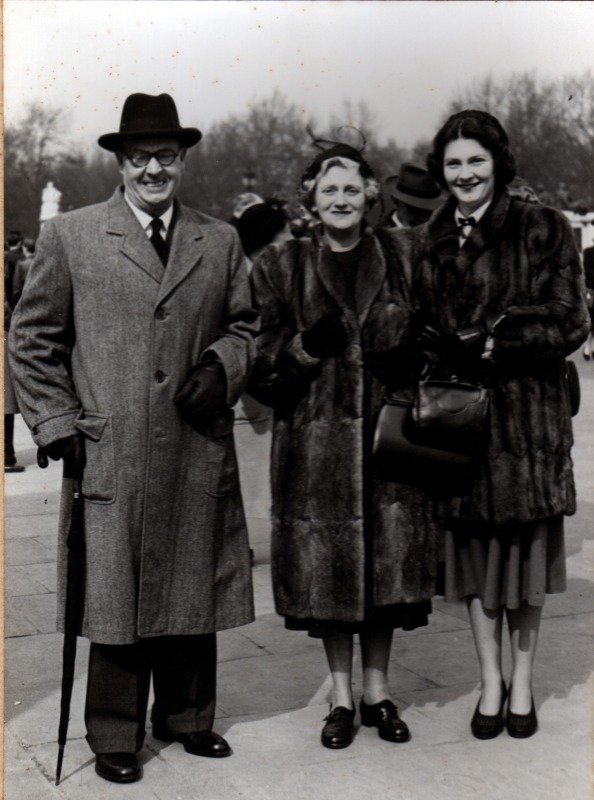
In addition, on the My Heritage site, there is a family photo of Mr Polfrey, with the caption ‘Pop receiving the OBE with his wife and daughter’ there is no date, but it looks to be the mid-1950’s. I was curious as to what Mr Polfrey had received the Order of the British Empire Medal for, so further searching provided the following information.
 
“1952 New Year Honours (section Officers {OBE]  John Harold Polfrey, lately Catering Manager, Festival of Britain”. [5]
 

After 14 years of war rationing, which did not end until  4th July 1954, the Festival of Britain opened six years after WW2, on the 4th of May 1951. It celebrated the inventiveness and genius of British scientists and technologists probably in an effort to allow the citizens of Britain to feel that life was going to be better. [6]

What a valuable member of society Mr Polfrey proved to be!

Mr Polfrey died at the age of 92 in May 1986 in Torbay, Devon England, my home county.

RIP Mr Polfrey.

Notes

[1]  https://www.britannica.com/topic/franking

Franking, a term used for the right of sending Letters or postal packages free of charge. The word is derived from the French affranchir (“free”). The privilege was claimed by the British House of Commons in 1660 in ‘A bill for erecting and establishing a Post Office,” their demand being that all letters addressed to or sent by members during the session should be carried free.  https://www.britannica.com/topic/frankin

[2] www.nam.ac.uk/explore/4th-queens-own-hussars

[3 ] https://www.iwm.org.uk/history/first-world-war-service-medals

[4]  https://www.forces-war-records.co.uk/blog/2015/12/10/the-silver-war-badge-and-kings-certificate-of-discharge

[6] https://en.wikipedia.org/wiki/Festival_of_Britain

** Acknowledgements

Image of Silver War Badge courtesy of Martin Fore.   greatwar.co.uk/index.htm

https://www.researchingww1.co.uk/ww1-wound-stripes

*** All photos with permission of the Polfrey Family.

An additional informative link:

https://www.researchingww1.co.uk/ww1-wound-stripes

Sheriff Sales in Lower Canada from 1783 onward at BAnQ Advitam / BAnQ Numérique / ETRC – Eastern Townships Resource Centre

Old Counties in the Province of Quebec

Advitam is a powerful new search engine that has replaced Pistard at BAnQ. It contains documents, files photos. etc in their archives

Instructions for using Advitam are found in this article, including detailed descriptions of the type of information available.

Instructions

List of Sheriffs

Landowners 1783-1854

British Land Developers

Shareholders in British America Land Co.

Genealogy Ensemble articles

Sheriffs

Repositories

Highlight the link below

The Three William Lindsays

As the family genealogist, I research my ancestors and write their stories. Recently, I found three generations of ancestors with the same name and the same role in an evolving Canada.

Their birth and death dates were vital as the first step to sorting them out. I noticed, however, that previous genealogists also struggled to sort them, as two of the three were sometimes labelled “Senior” and “Junior” (and sometimes in reverse order) and then “The Elder” and “The Younger” were assigned to another two. To keep things simple in my story, I will label them first, second and third – in the order of their births.

How the First William (Robert) Lindsay Founded a Public Service Dynasty

Like many first generation Canadians, my 4x great grandfather established an impressive personal and professional life in his adopted homeland. I can’t help but wonder, however, if he paid too heavy a price for his success.

In November 1828, a doctor confined him to his room writing that he needed more “rest, mentally and physically, than he has had up till now.”1

How could such a thing happen?

The First William Lindsay (1761-1834) came to Quebec, Canada from England in 1773 as a 12-year old boy to live with his uncle. Ten years later, at the age of 22, he opened a dry goods business with a partner near the St. Lawrence River harbour in Quebec City.2 At the age of 29 years in 1790, he married Marianne Melvin and they had nine children in 14 years.

While still operating his retail business, William also served as Justice of the Peace for the district of Quebec. Then he entered the public service in 1792 as clerk assistant of the new Lower Canadian House of Assembly, after the Constitutional Act of 1791 divided the British colony called the Province of Quebec,3 into Upper and Lower Canada.

William Lindsay’s Signature

In 1805, he assumed the role of registrar for the newly founded Quebec Trinity House which oversaw the safety management of the burgeoning port facilities and navigation in the harbour of Quebec.4 Also during this time, he held a position of Grand Officer with the Free Masons in Quebec, eventually becoming their Grand Secretary by 1807.5

And then life got really busy.

This first William was known above all for his role in the assembly. At the age of 48, and having gained sixteen years experience as clerk assistant since 1792, he was commissioned as clerk in 1808 and was the second person to hold that office in Lower Canada.

Initially, he received the oaths of allegiance of the members of the Legislative Council and the House of Assembly, revised and printed the rules and regulations as instructed and produced numerous reports.

Before long, his duties included purchasing needed items, hiring workmen and overseeing their work, collecting debts, and paying accounts. By 1812 the clerk’s job had become more administrative than secretarial. This new job description, however, did not include an increase in his salary.

By the time William finally received his requested wage hike three years later, he also had the added responsibility of overseeing a staff of extra workers needed to complete the required duties.

Ten years later, in 1824, when William’s obligations were already overwhelming, the salaries of all officials and writers were cut by 25 per cent and he had to enforce the work schedules as well as prevent his employees from attending to personal matters during working hours. A few years after that, William also became responsible for “filling the empty positions in the house.” However, the assembly members reserved the right to approve or reject appointments!6

Although William always managed to satisfy the members of the House of Assembly, there was a heavy price to pay. The stress from his job wreaked havoc on 67-year old William’s health. In 1828, his doctor ordered immediate bed rest, and delivered a medical certificate to the speaker.

Nowadays, we call it “burnout.”

The prestige of the job must have outweighed the ill effects on his health because, around this time, the first William recommended his son, William (Burns) Lindsay, to the assembly for the deputy clerk position. In September 1829, the second William Lindsay officially succeeded his father who then died five years later at the age of 73.

The first William Lindsay not only faithfully served the assembly for half his life but left a dynasty of loyal hard working clerks for, first his son and then his grandson, succeeded him in that very same public office.

Next: Why the second William Lindsay changed careers (to be published May 5, 2021)

1Yvon Thériault, “LINDSAY, WILLIAM,” in Dictionary of Canadian Biography, vol. 6, University of Toronto/Université Laval, 2003–, accessed February 23, 2021

 http://www.biographi.ca/en/bio/lindsay_william_6E.html.

2Yvon Thériault, “LINDSAY, WILLIAM,” in Dictionary of Canadian Biography, vol. 6, University of Toronto/Université Laval, 2003–, accessed February 23, 2021

 http://www.biographi.ca/en/bio/lindsay_william_6E.html.

3https://wiki2.org/en/Province_of_Quebec_- accessed 2021-03-04

The Province of Quebecwas a colony in North America created by Great Britain in 1763 after the Seven Years’ War. During the war, Great Britain’s forces conquered French Canada. As part of terms of the Treaty of Paris peace settlement, France gave up its claim to Canada and negotiated to keep the small but rich sugar island of Guadeloupe instead. By Britain’s Royal Proclamation of 1763, Canada (part of New France) was renamed the Province of Quebec. The new British province extended from the coast of Labrador on the Atlantic Ocean, southwest through the Saint Lawrence River Valley to the and beyond to the confluence of the Ohio and Mississippi Rivers. Portions of its southwest (south of the Great Lakes) were later ceded to the United States in the Treaty of Paris (1783) at the conclusion of the American Revolution although the British maintained a military presence there until 1796. In 1791, the territory north of the Great Lakes was divided into Lower Canada and Upper Canada.

4Ancestry, Canada – Quebec Past and Present: A History of Quebec, 1608-1876, in two parts, by J.M. Le Moine, (Augustin Cote & Co., 1876), 241.

5Ancestry, Canada – Outlines of the history of freemasonry in the Province of Quebec, Chapter V, “Ancient Freemansonry in Lower Canada”, by John H. Graham, (John Lovell and Son, 1892), 75.

6 Yvon Thériault, “LINDSAY, WILLIAM,” in Dictionary of Canadian Biography, vol. 6, University of Toronto/Université Laval, 2003–, accessed February 23, 2021  http://www.biographi.ca/en/bio/lindsay_william_6E.html.

A Useful Reference List

The following reference list is extracted from a larger database to be posted. Sheriff Sales in Lower Canada from 1783 onward at BAnQ Advitam ‘prepared by Jacques Gagne.

The database lists website addresses for a variety of

Archives

Book stores

Canadian Biographies

Historical Associations and Societies

Libraries

Publishers

Universities

Click the link below to access the database:

Love in the Jute Factory

Sarah Jane McHugh was the only member of her family who stayed behind in Scotland. I believe she must have stayed to be with her sweetheart, Thomas Adams.

In 1911, Sarah’s sister, Mary McHugh, was ready for adventure. She decided to leave Dundee, Scotland and set out for Canada on her own to work as a domestic. Mary arrived in Montreal in the summer of 1911.1 She must have liked her new home because her widowed mother, Sarah McLaughlin, and her three brothers, Thomas, Edward, and Francis, followed in May 1912.2 Thomas’ wife, Elsie Orrock and their seven children, Annie, Elsie, Sarah, Thomas, Francis, Mary and Adam also came later that year.3

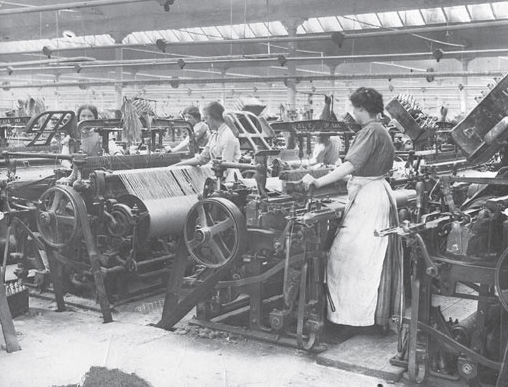
But Sarah? Sarah, a young woman of 24, stayed behind in Dundee. The McHughs had been workers in the jute factories of Dundee for three generations. When the McHughs left for Canada, leaving behind Sarah, the jute mills were the biggest employer in the city. Almost half the city worked in the jute industry. 4 But the working conditions were difficult. The wages were lower for women and children than for men. The constant noise from the machines was deafening and the dust damaged the lungs. Wages in Dundee were the lowest in the country and Dundee had the highest cost of living, possibly due to the pressure on housing, caused by overcrowding. Mill workers had a bleak future ahead of them.5 Only a compelling reason could make Sarah stay and that reason must have been Thomas.

OpenLearn, Open University, Photo courtesy of University of Dundee Archive Services 6

Sarah and Thomas probably met at mill where they worked. As they lived close to each other, they would have worked at the same mill.7 Both Sarah and Thomas would have started working in the mills as soon as they finished school, at age 13. Although it was not uncommon for younger children to work alongside their mothers. Children under nine worked as pickers, cleaning the dust from beneath the machines.8

But Sarah and Thomas did not work in the mills all their lives. By the time they were in their mid twenties and Sarah’s family had left to settle in Canada, Thomas and Sarah had also moved away from Dundee to Glasgow. Glasgow is about 130 km from Dundee, so this would have been quite a move. It is probable that Thomas went first as his parents and siblings also moved to Glasgow. 9

From left to right, Thomas Adams, Sarah Jane McHugh, Ronald Maddocks (cousin)

  1. Ancestry, Canada, Arriving Passenger Lists, 1865-1935, Library and Archives Canada, Mary Ann McHugh, The Grampion, July 1911.
  2. Ancestry, Canada, Arriving Passenger Lists, 1865-1935, Library and Archives Canada, Thomas McHugh, The Grampion, May 21, 1912.
  3. Ancestry, Canada, Arriving Passenger Lists, 1865-1935, Library and Archives Canada, Elsie McHugh, The Grampion, October 1912.
  4. Dundee and the Jute Industry, Natural Bag Co. website, https://naturalbagcompany.co.uk/jute-news/dundee-and-the-jute-industry/, accessed February 23, 2021.
  5. Dundee History Archive, Workers of the mills, September 16, 2014, https://www.ddtours.co.uk/archive/workers-of-the-mills/#:~:text=Constant%20noise%20from%20the%20machines,breathing%20problems%20were%20also%20common, accessed February 23, 2021.
  6. OpenLearn, Dundee, jute, and empire, https://www.open.edu/openlearn/history-the-arts/history/dundee-jute-and-empire/content-section-5.2, accessed March 3, 2021.
  7. Scotland’s Places, Ordnance Survey Name Books, Watsons Lane, https://scotlandsplaces.gov.uk/digital-volumes/ordnance-survey-name-books/forfarshire-angus-os-name-books-1857-1861/forfar-angus-volume-34/20, accessed February 23, 2021, and Taits Lane, https://scotlandsplaces.gov.uk/digital-volumes/ordnance-survey-name-books/forfarshire-angus-os-name-books-1857-1861/forfar-angus-volume-33/8, accessed February 23, 2021.
  8. Verdant Works web site, Dundee Industrial Heritage Ltd., Working in the Mills,https://www.verdantworks.co.uk/exploration-article/working-in-the-mills/, accessed March 3, 2021.
  9. Scotland’s People, Death registers, Thomas Adam (father of Thomas), accessed February 23, 2021.
  10. Scotland’s People, Marriage registers, Sarah McHugh and Thomas Adam, January 1, 1915. Thomas is a railway engine driver and both Sarah and Thomas are living with Thomas’ widowed mother in the Possilpark District of Glasgow City, accessed August 21, 2019.
  11. Family Search, History of the Railways, https://www.familysearch.org/wiki/en/England_Occupations_Railway_Employees_(National_Institute), accessed February 23, 2021.
  12. Scotland’s People, Statutory Births, Sarah Jane McHugh, accessed August 20, 2019.
  13. Scotland’s People, Statutory Deaths, Adams, Thomas, accessed February 2, 2021.

Catholic Parish Registers- Auvergne – Bearn – Gascogne – guyenne 17th-18th centuries

Features of this dossier (research guide)

Regional archives  11

Municipal archives 25

Genealogical solution providers 39

Revues savantes BnF Gallica – Bibliotheque de France  16

What to expect while researching online at about 92 Archives départementales de France; Free Online Searches with free downloads of original Church Registers or original Civil Registers or original Notarial acts through the web or smart phones. No memberships are required except for one archive Filae.com and it permits and an online research process which is also free to see what  documents are available, however, a membership is required to view these documents.These are indicated with $$$

Click the link below to access the database:

Fly Me to the Moon: Why I am not an Astronaut

This week Perseverance landed on Mars, the latest rover sent to explore the Red Planet. The excitement of space exploration always stimulates my imagination.

When the first astronauts went up in space I attended elementary school. Televisions on tall carts were wheeled into our classrooms and we watched wide eyed as the rockets took off. The excitement of the count down kept us all on the edge of our seats; three, two, one, blast off!

With only male astronauts, most little girls didn’t even consider going into space, myself included. Still, as men first circled the earth and then the moon, finally landing there in 1969, dreams of space travel were limitless.

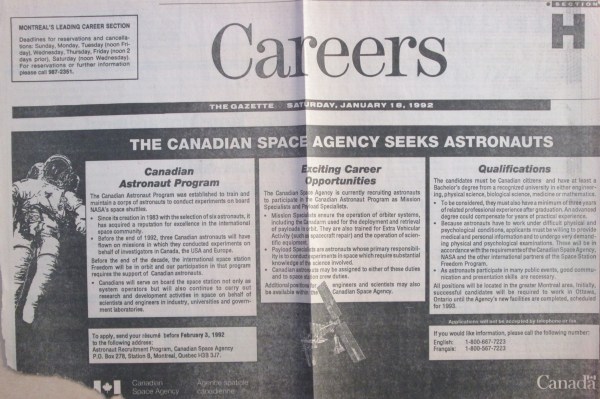
In 1983, Canada chose their first astronauts and among the men, a woman, Roberta Bondar. She followed Marc Garneau as the second Canadian in space flying on the Space Shuttle Discovery. In 1992, the Canadian Space agency wanted a new group of astronauts. How did they look for astronauts? They put advertisements in local papers. There in the Career’s section of the Saturday Gazette it said, The Canadian Space Agency Seeks Astronauts.

I had been working as a technician in a cancer research laboratory. My boss’s research grants were not going to be renewed and so I needed another job. A fellow at the camera club who applied on to be an astronaut in the previous search expressed pride at his rejection letter. So I thought, why not.

Surprisingly, I could say yes to all the qualifications to become an astronaut. You had to be a Canadian citizen, have at least a Bachelor’s degree from a recognized university in engineering, physical science, biological science, medicine or mathematics. They only required at least three years of related professional experience, and the candidate needed to possess good communication and presentation skills. Additionally, they would undergo demanding physical and psychological examinations. So, I applied, highlighting my background in a scientific lab, where I gained expertise working with instruments, conducting biological and immunological assays, designing experiments, troubleshooting, and collaborating both independently and as part of a team. These abilities are all suitable for a payload specialist.

When I received the ‘we regret to inform you letter’ from the Canadian Space Agency, I expected it. Over 5000 Canadians applied and according to the letter; “ the Agency has had the challenging task of selecting a relatively small number of candidates from among the many diverse and interesting applications received. Your submission was carefully considered, but we are unfortunately unable to offer you employment. However, your application form will be kept on file for a period of six months. Should a suitable position become available within this period we will be pleased to communicate with you again.” I had no further communication.

The Canadians chosen to train as astronauts in 1992 included Chris Hadfield, Michael McKay, Julie Payette and Dave Williams but not me.

I must admit in my heart of hearts I didn’t really want to go into space. It is fun imagining being there but after training for years, the end result of all your work is to climb into a tiny capsule above a bomb to be blasted into space. I will be happy to watch from my armchair as a Canadian astronaut flies to the moon in 2023 on the Artemis II mission.

Write What You Know

Write what you know. That is good advice, but it can be hard to follow if you have poor health and seldom travel or even explore your own neighbourhood. This was the case for my mother. Nevertheless, several of her articles about her hobbies and personal memories were published in the local media.

As I write this, snow is falling outside my office window and, in the midst of a pandemic, the government has advised people to stay at home. These restrictions feel much like the limitations my mother experienced, so I dug out some of her articles to see what inspired her.

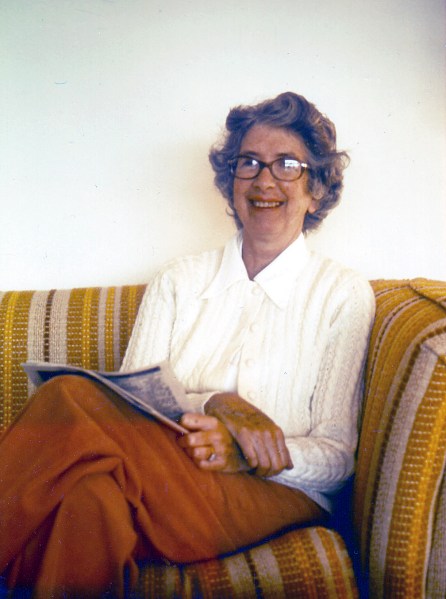
Joan Hamilton (1918-1994) was a prolific letter-writer: letters to the editor of The Montreal Star, letters to the newspaper’s television critic, and letters to federal and provincial politicians on a variety of topics. But what she really wanted was to write magazine articles, so she was very proud when several of her stories appeared in Montreal Scene, a magazine inserted every Saturday in The Montreal Star. It generally featured four or five articles, along with the weekly television listings, and there was always a painting of a local scene on the cover.

“Feathered Fun” by Joan Hamilton, which appeared in the January 15, 1977 issue, was about her own favourite pastime, armchair bird-watching.

My parents’ house had a sunroom with picture windows overlooking the backyard where a large crab-apple tree, laden with wizened fruit, attracted many birds in winter. “If you are lucky, anytime after mid-January, a group of evening grosbeaks or common redpolls may discover your garden treats,” she wrote, adding, “There is no better pick-me-up for the winter blues than to spot the beautiful yellow, black and white grosbeaks feeding on the snow.” Mother also attached small bird feeders to the sunroom windows and kept them full of seeds so she could watch the chickadees up close.

This photo was taken in Naples, Florida in 1977. After she returned to Montreal, Joan Hamilton wrote a travel article about Naples. photo by Janice Hamilton

In another article, “Winters Remembered,” in the March 25, 1978 issue, she suggested that Montrealers were getting soft, no longer able to cope with snow and cold weather. She recalled that the postman called twice a day when she was young, and if there was a time when he couldn’t get through the drifts, she didn’t remember it. Furthermore, “in those days, many deliveries were still made by horse-drawn sleighs, which always seemed to triumph over the highest snowbanks.”

She wrote, “We must have got our first car in the late ‘20s. A Hupmobile with glass flaps for windows, it didn’t have a heater, that’s for sure. Maybe that is why in those days nearly everyone put their car ‘up’ for the winter…. We relied on the trusty old streetcars. We lived near the crest of Côte-des-Neiges, and I don’t remember a time when they were not able to make the hill. They had cowcatchers that acted as snowplows in front, and during big snowstorms, there were special snow plow cars clearing the tracks, trailed by a string of streetcars, power lines crackling with light and windows steamed, but making it up the hill.”

Travel, both short and long distance, was by the invincible train, she recalled. “Trains may have been delayed, but at least you always got where you were going.” She had particularly fond memories of the Laurentian ski train which carried Montrealers to the slopes north of the city in the winter. “The gaiety on board was as much a part of the fun as skiing.”

She continued, “We never worried about freezing or starving during power failures. First of all, we had a coal furnace which, although it had to be stoked morning and night, was not subject to breakdowns…. We cooked with gas, so there was no worry about being unable to have a hot meal if the electricity went off. Lots of people still had wood or coal stoves.”

Towards the end of the article, Mother asked, “Was it really better back then, or has time blocked out the bad memories and left only the good?” Perhaps she did block out some of negative aspects of winter in the 1930s and 1940s, but her memories nevertheless made for entertaining reading.

Note: this article also appears in my family history blog, Writing Up the Ancestors, http://writinguptheancestors.blogspot.com.

My new book, Reinventing Themselves: A History of the Hamilton and Forrester Families, by Janice Hamilton, will be published this spring.

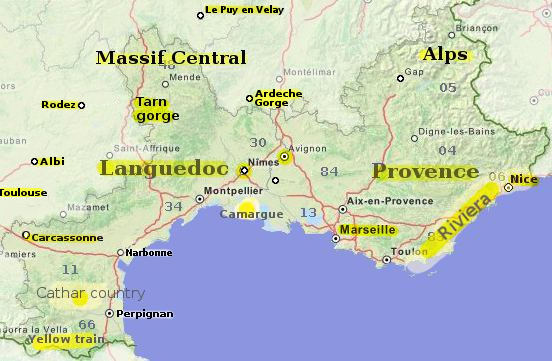
Catholic Parish Registers in Dauphiné – Languedoc – Provence of the 17th & 18th centuries

What to expect while researching online at about 92 Archives départementales de France; Free Online Searches with free downloads of original Church Registers or original Civil Registers or original Notarial acts through the web or smart phones. No memberships are required except for one archive Filae.com and it permits and an online research process is also free to see what  documents are available, however, a membership is required to view these documents.

 Features:

24 scholar journals in history (revues savants)

20 regional archives

54 municipal archives

62 genealogy solution providers

Click to access Database

Working together to help genealogists discover their ancestors