Buried In Woollen

‘Buried in Woollen’ What an odd sentence!

So I thought, whilst indexing very old, late 17th century documents for the church of Jesus Christ of  Latter Day Saints. I was indexing English burials and once started on the list, nearly every name was also accompanied by an affidavit stating that the person was  ‘Buried in Woollen’

It seemed to be very important to state this on the burial affidavits. I wondered about this unusual practice and decided to find out.

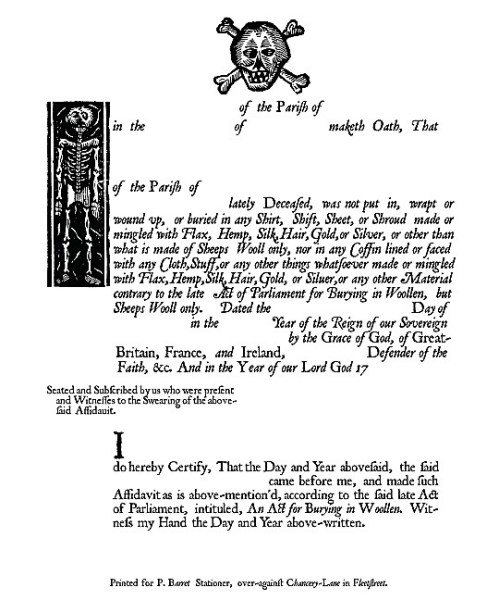
The museum in Hungerford, Berkshire England shows an affidavit similar to the one I was indexing.

I have written it out as it states on the affidavit.  Note that the letter ‘F” reads as an ‘S” in Old English.
It says:

Name of deceased……….of the Parifh of………….maketh Oath that…………………of the Parifh of lately deceased, was not put in, wrapt or wound up, or buried in any Shirt, Shift Sheet or Shroud made or mingled with Flax, Hemp, Silk, Hair God or Silver, or other than what is made of Sheeps. Wooll only nor in any Coffin lined or face with any Cloth, Stuff, or any other things whatforever made or mingled with Flax, Hemp, Silk, Hair, Godld or Silver or any other Material contrary to the late Act of Parliament for ‘Burying in Woollen, but Sheeps Wooll only.    Dated the…………..Day of….. in the………….Year of the Reign of our Sovereign By the Grace of God, of Great Britain, France and Ireland,               Defender of the Faith, etc. And in the Year of our Lord God 17……..Seated and Subfcribed by us who were prefent and Witnesses to the Swearing of the above faid Affidavit.

I do hereby Certify That the Day and Year abovefaid, the faid Affidavit as is above mention’d according to the faid late act Act of Parliament intituled, An Act for Burying in Woollen. Witnefs my Hand the Day and Year above-written.

(Printed for P. Barret Stationer, over-againsf Chancery-Land in Fleetfreet). [1]

Only those with the plague or who were destitute escaped this law. So much for the rules of burying in woollen. But why?

Between 1665 and the turn of the century, wool became a national symbol of importance in England,  but new materials and foreign imports were coming into the country and the industry was under threat as linen, silk, and satin were readily available and the need for woollen dropped away. Workers who specialised in silks, satins, and linens flocked into the country and the need for wool waned.

Most of the wealthy depended on wool for their lifestyles, and some of these wealthy sat in Parliament, Members whose constituencies depended on the woollen industry, and was an essential part of their fortunes. These Members depended on rents paid by tenants who worked in the woollen trade, and so they changed the laws.

Most people were buried in linen shrouds. It was the custom and older than Christianity itself, but it also benefited England’s greatest rival across the Channel, the French, who provided most of all England’s linen. So, to stymie the French and preserve the woollen trade in England, Parliament developed the law of burying in Woollen only.

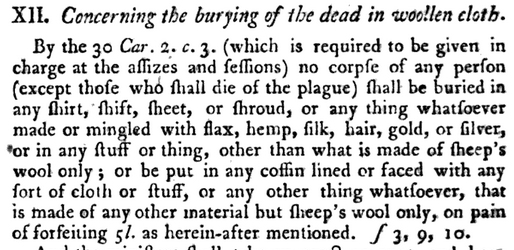
The first Act was passed in 1666 and the second, and rather more famous, in 1678 repealing the first  Its aims were “for the lessening the importation of linen from beyond the seas, and the encouragement of the woollen and paper manufacturer of the kingdom.” [2]

Below is an extract from the Act.

For more of the legislation see The Justice of the Peace, and Parish Officer, Volume 5, 1814 on Google Books

The Act was not without its protesters as a more wealthy set wanted to be buried in their finery, not woollen.

“At first nothing could be more shocking,” wrote philosopher Bernard Mandeville, “to Thousands of People than that they were to be Buried in Woollen.”

“Our Savior was buried in Linnen,” protested Edward Waller, the representative for Hastings. “‘Tis a thing against the Customs of Nations and I am against it.”

Henry Coventry, Secretary of State for the Southern Department, was harsher, suggesting that “men of the Romish Religion” (Romish belonging or related to, Rome as Catholics) prefer woollen burials to linen. “I fear this Bill may taste of Popery,” he sneered.

Citizens were fined five pounds if they did not obey the law but many would pay the fine rather than be ‘seen dead in wool’  In 1678 this was an enormous sum of money about $1,000 in today’s money. [3]

The Act was repealed in 1814, although long before then it had been largely ignored.

Sources:

[1] www.hungerfordvirtualmuseum.co.uk/index.php/10-themes/961-buried-in-woollen

[2] http://www.historyhouse.co.uk/articles/buried_in_wool.html

[3] https://www.atlasobscura.com/articles/england-wool-burial-shrouds

[4] Eric W. Nye, Pounds Sterling to Dollars: Historical Conversion of Currency, accessed Monday, March 25, 2019, http://www.uwyo.edu/numimage/currency.htm.


Irish Catholic Churches of Rural Quebec:   Beauce, Bellechasse, Dorchester, Lévis, Lotbinière Counties

This is the seventh in a series of research guides to Irish Catholic churches in Quebec posted on Genealogy Ensemble over the past several months. This guide is designed to help you find the churches where Irish Catholics were baptized, married and buried in the region that is between the St. Lawrence River and the border of Maine.

When tens of thousands of Irish immigrants flooded into Lower Canada (Quebec) in the 19th century, they settled on farms and in cities everywhere. Most of them were Catholic; Irish Protestant immigrants usually settled in Upper Canada and other English-speaking regions of North America.

Please note: The term Irish Catholic churches does not imply within this research guide that parishioners were mostly of Irish descent. I mean that, at one point in time, a minimum of 10% of the acts of baptism, marriage and death addressed Irish immigrants or their descendants.

The earliest church record I was able to trace in regard to the Irish in this region was in 1794 in the parish of Saint-Joseph, in what was then the village of Lévis.

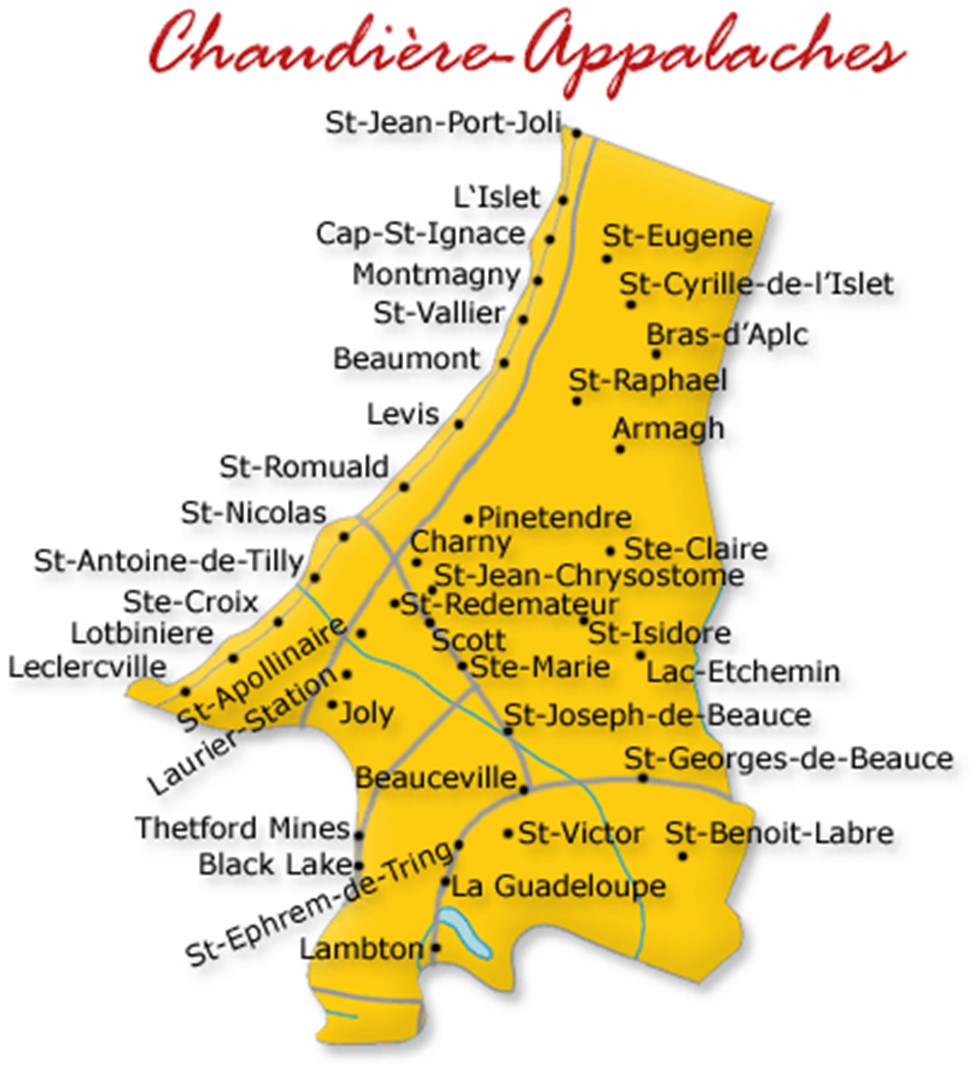
Region of Chaudìère-Appalaches

chaudiere appalachesThe modern region of Chaudière-Appalaches comprises the former counties of Beauce, Bellechasse, Devon, Dorchester, Frontenac, Hertford, Lévis, L’Islet, Lotbinière, Mégantic, Montmagny. See https://en.wikipedia.org/wiki/Electoral_districts_of_Lower_Canada
Within this research guide, I have addressed the parishes situated in all of these former counties, with the exception of L’Islet and Montmagny. I will address them in a future compilation on Irish parishes of the Lower St. Lawrence.

In the counties of L’Islet and Montmagny, the Scottish Catholic presence might have been greater than the Irish Catholic presence during the 18th and 19th centuries.

The Irish, Scottish and French Catholic families in this region lived in harmony during the 19th century. However, the few Irish Protestant families from Northern Ireland who settled in this region had difficult moments with the Irish, Scottish and French families of the Catholic faith, so some of them moved to Mégantic County during this period.

The county of Bellechasse was created between 1829 to 1838 by the British authorities from a former seigneury of the same name that existed under the French regime. Dorchester County, next to Bellechasse, was created by the British between 1792 and 1829. Some of the villages and churches of these neighbouring counties are sometimes found with two names. For example, Sainte-Claire-de-Bellechase and Sainte-Claire-de-Dorchester are the same parish in the village of Sainte-Claire de Bellechasse. Other villages and parishes are similarly named Dorchester and/or Bellechasse.

Similar situations can be found in Dorchester and Lotbinière counties. The villages and churches did not move, the boundaries changed in the 19th century.

See the listing of towns, villages, cities within Chaudière-Appalaches.

See also my post on Genealogy Ensemble of June 24, 2018, “The Seigneuries of Beauce, Lotbiniere, Dorchester and Bellechasse.” It explores the area during the French colonial period and the British period.  https://genealogyensemble.com/wp-content/uploads/2018/06/the_seigneuries-of-beauce-lotbiniere-dorchester-and-bellechasse.pdf

The PDF research guide linked below includes a list of Catholic parishes in the region, links to the region’s cemeteries, a list of recommended reading and links to archives and online resources that could be useful to researchers.

Irish Catholic Churches – Counties of Lévis – Lotbinière – Dorchester – Beauce – Bellechasse


My Husband, a Rare Type of Greek

My husband is funny, thoughtful, generous, and kind.  Is this why he is a rare type of Greek? No, it is actually because of his religion.

The population of Greece is 11 million and the Greek constitution recognizes the prevailing religion of the country as Eastern Orthodox.  In fact, 81 to 90% of the population are practicing Orthodox.1  My husband is Roman Catholic, of which there are only 50,000 to 70,000 in Greece, or less than 1%. 2

My husband’s family comes from the Cyclades Island of Tinos. In 1207, Tinos came under Venetian rule and was ruled by the Venetian overlord Ghizi, a relative of the Doge of Venice.  Constantinople was a significant trading partner with Venice and Tinos is located on the trading route.3 My husband’s great-grandmother’s name was Concepta Ghizi.  This does not mean that she was necessarily a descendant of the overlord. It was common for people working for the overlord to have taken his name.

Today, the Island of Tinos has a significant Roman Catholic population, with entire villages being Catholic.  When I was in Tinos two summers ago, I visited the Cathedral of My Lady in the village of Xinara.  This is where a portion of the Roman Catholic records are kept.

What a privilege it was to meet the Archivist, Irini Fyrigou.  Each village on the island maintained and still maintains registers of births, marriages, deaths, and other events and she consulted the register for the natal village of my husband’s family.  She also cross referenced to the register of the main town of the island.  It was such a thrill to see the original entries in Italian, with the older entries in Latin.

The meeting with the Archivist confirmed what we always suspected.  These Roman Catholics are the descendants of Venetians who have managed to maintain their religion for centuries.

Florakis E. Alekos is an historian whose speciality is the Island of Tinos and he has researched the origins of the surnames.  My husband’s last name is Delatolas.  The first time this name was registered on the island, it was written De La Tolla (from Tolla).  Tolla was apparently a village near Venice.  My mother-in-law’s maiden name is Fyrigos.  This name designates someone from the island of Kythera, located south of the Peloponnese Peninsula as this island was known as Cerigo during the period of Venetian domination.  The person from Cerigos would have been designated as o Σερίγος (Cerigos), becoming 0 Φυρίγος (Fyrigos) over time. This island was also on the trading route between Venice and Constantinople. 4

So this is why my husband, a Roman Catholic, is indeed, a very rare Greek.


  1. Wikipedia web site, Demographics of Greece, http://en.wikipedia.org/wiki/Demographics_of_Greece#CIA_World_Factbook_demographic_statistics, accessed April 10, 2019
  2. Wikipedia web site, The Catholic Church in Greece, http://en.wikipedia.org/wiki/Roman_Catholicism_in_Greece, accessed April 10, 2019
  3. Tinos 360o web site, 3 http://www.tinos360.gr/istoria_eng.html, accessed April 10, 2019
  4. As explained by Irini Fyrigou, June 2016.


Grosse Île and the Irish

Thousands of Irish immigrants came to Canada, especially in the 1800s. They came by ship, travelling up the St. Lawrence River to Quebec City, but many got sick and some died during the long voyage across the Atlantic.

After a cholera epidemic swept England in 1831, a quarantine station was built on Grosse ÎIe, an island in the St. Lawrence downriver from Quebec City. All ships were required to stop there so passengers could be checked by doctors to ensure they were not sick. Government authorities did not want people to bring disease to the busy port cities of Quebec City and Montreal.

The worst years were between 1845 and 1849, when the terrible potato famine hit Ireland. Many of those who fled Ireland, optimistic about starting new lives in North America, never made it. Most of them succumbed to typhus, a disease caused by bacteria carried by fleas and lice. More than 7,000 people are buried in three large cemeteries on Grosse Île.

The quarantine station continued from 1832 until 1937. Today, Parks Canada runs Grosse Île and the Irish Memorial National Historic Site. This moving historic site, including several buildings and cemeteries, is open to visitors from the beginning of May until mid-October. See https://www.pc.gc.ca/en/lhn-nhs/qc/grosseile/index.

There are a number of books about this place and the tragic events that happened there. One of the most moving volumes I have read is Eyewitness, Grosse Isle, 1847 (note the alternative spelling), by  Marianna O’Gallagher & Rose Masson Dompierre, published in 1995 by Livres Carraig Books of Ste-Foy, Québec. You may be able to find it in a library or online.

This superb book begins with a map of Ireland indicating the places that sent 10 or more ships to Quebec in 1847 with Irish immigrants: 53 ships from Limerick, 33 from Cork, 32 from Belfast, 27 from Dublin, 27 from Sligo and 18 from Londonderry.

The authors got the idea for this book after reading letters that the chaplains of the quarantine station wrote to their superiors during the summer of 1847. The authors wrote, “In order to present a full portrait of the dramatic events that unfolded at Grosse Isle, and in order to distinguish between myth and reality, this book will be the forum where eyewitnesses speak. The priests’ letters, little known until today, but which are very significant, contain descriptions of everyday occurrences, prevailing conditions at ‘the Quarantine’ in 1847. The situation proved to be dramatic and arduous, and the missionaries, faced with the spiritual and physical needs of the immigrants, felt powerless and besieged. Very soon their letters elicited response from many quarters.”

For example, Rev. Armine W. Mountain, Church of England, Acting Chaplain Quarantine Station, wrote:

Buried: Meek, Catherine, daughter of James Meek, mason, late of the parish of Whiteburn, County Linlithgow, Scotland, and of France, by her maiden name Somerville, his wife, aged two years, died on the twenty-second and was buried on the twenty-fourth day of May in the year of our Lord one thousand eight hundred and forty-seven, by me – Armine W. Mountain – Present: Robert Armstrong, Joh X. Armstrong.

Rev. Charles Morice, Catholic Priest, Officiating Chaplain Grosse Isle, wrote:

Buried: Heatherington, Taylor, Craig, White, McCray, McCray, Smyth

Hugh Heatherington, aged forty, from Ship Dykes

Margaret Taylor, aged twenty three per ship Maria Soames

Elizabeth White, age sixty-three from ship Emigrant

Margaret McKay, age forty two years per ship Eliza

Alexander McKay, age fifty-two per ship Eliza

Robert Smyth, age two years per Sir Henry Pottinger died sixth October. All died, except the last, on the seventh of October and were buried on the evening of the same day in the year of our Lord one thousand Eight hundred and forty-seven by me – Charles Morice – Present: John Fitzgerald, Patrick Dolan

 https://www.amazon.ca/Eyewitness-Grosse-Isle-Marianna-OGallagher/dp/096908059X

Other suggested reading:

John Boileau, “The Dead of Grosse Île,” Legion: Canada’s Military History Magazine, March 1, 2006, https://legionmagazine.com/en/2006/03/the-dead-of-grosse-ile/

You can read a list of some of those who died on Grosse Île at https://www.pc.gc.ca/en/lhn-nhs/qc/grosseile/decouvrir-discover/natcul4.

To search Library and Archives Canada’s records, see “Immigrants at Grosse Ile Quarantine Station, 1832-1937,” https://www.bac-lac.gc.ca/eng/discover/immigration/immigration-records/immigrants-grosse-ile-1832-1937/Pages/immigrants-grosse-ile.aspx

Aunt Madge’s Quilt

IMG_3441

The incomplete quilt, carefully wrapped in tissue paper, had been shunted from pillar to post for almost eighty years during the many household moves my parents made. Rarely did it see the light of day, stuffed away as it was in linen closets and basement trunks, so none of the colours faded. My mother could quilt but she never finished it. Perhaps she felt the memories would be too painful. Mum finally gifted it to me during one of her downsizing periods. I couldn’t quilt but I did collect antique linens. Once again it was stored away in a box.

With the quilt came the story of its beginning. I remember few of the details and my mother is no longer here for me to ask. It was evidently begun by Madge, my mother’s oldest sister. My mother and my Aunt Vi helped her. There were two Violets in the family, a sister and a sister-in- law, but whether one or both helped is unclear.

I never knew my Aunt Madge. She died in 1941 before I was born. I. heard the tragic story again and again growing up. She was only thirty-nine and left behind two small boys, boys I finally met when we were adults.

Madge, born in 1902, was the first of George and Isabella Willett’s seven children to leave the farm overlooking the Chaleur Bay on the Gaspe Coast. She earned a teaching certificate at MacDonald College in Montreal and took her first job in Abbottsford in Quebec’s Eastern Townships. There she met Albert Whitney, an apple farmer. They married in 1934 and she happily settled into a familiar life as a farmer’s wife. The family quickly grew with the births of my cousins, David and Paige.

Then illness struck. Madge was diagnosed with cancer. My mother, now a surgical nurse working at the Veteran’s Hospital in Ste. Anne de Bellevue, traveled to Abbottsford on her days off to help with her sister’s care and with the two lively boys. Both Violets were also living in Montreal and they too were able to help. During this time, the last months of Madge’s life, they worked on the quilt together, faithful doulas accompanying her on her final journey.

Today the quilt has been completed. Two women from the Victoria Quilts branch in the Laurentian Mountains village of Arundel did the work. The Victoria Quilts organization makes beautiful lap quilts and gives them to cancer patients to keep them warm during their chemotherapy. Elizabeth Wood selected and purchased the backing and border fabric along with the batting. Pat Thomas did the hours of hand quilting. She claimed that the original stitches on the quilt were the tiniest she had ever seen and said she did her very best to match them.

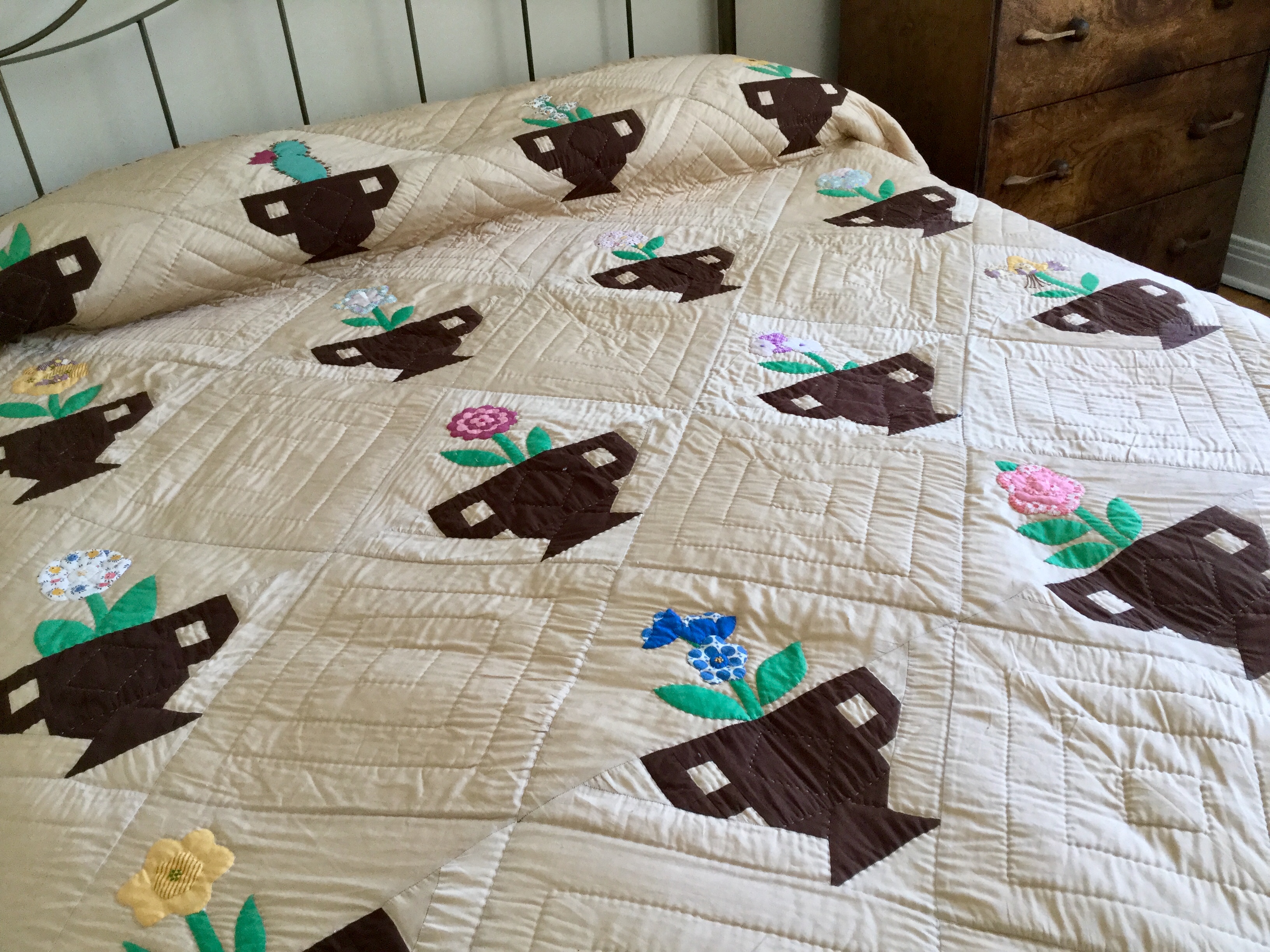
The quilt fits the queen size bed in our guest room. The simple motif, repeated twenty times, is a flower pot made of brown triangles pieced together and appliqued to a beige background. Each pot holds a single brightly coloured flower with green leaves, all pieced and then appliqued. It has a modern, stylized look yet with a feeling of fresh growth.

Aunt Madge 001 (2)


Irish Catholic Churches in Montreal

Every year, the city of Montreal hosts a huge St. Patrick’s Day parade that brings people by the thousands to the downtown streets to celebrate their real or imagined Irish heritage. In fact, many Montrealers do have Irish roots that go back centuries.

In 1700, around 130 of the 2,500 families in New France, or roughly 5%, were Irish, and there was massive immigration from Ireland to North America between 1816 and 1860. By 1871, the Irish were the second largest ethnic group in Canada after the French.

The year 1847 was a tragic one as the Irish fled poverty and starvation in their homeland and died of disease before they arrived in Canada. Almost 3900 are buried at Grosse Île, an island in the St. Lawrence River northeast of Quebec City; another 5,000 are buried at the so-called fever sheds near the Montreal waterfront. Many children who became orphans at this time were adopted by French families, but kept their Irish names.

The early Irish of Montreal resided in the central part of the city. Over time, they moved westward, eastward and northward into Saint Ann’s, Saint Mary’s, Saint Antoine’s, Saint James’, Saint Lawrence’s and Saint Louis Wards. They were the primary residents in districts such as Griffintown, Point-St-Charles, St. Henry, Verdun and Ville Émard. Other Irish families eventually moved east into the Rosemount and Hochelaga districts.

Prior to the establishment of St-Patrick’s church in 1847 and St-Ann in 1854, the main churches of the Irish in Montreal were Notre Dame de Bon Secours, the Church of the Récollet Fathers and Notre Dame Basilica.

When I identify a church as being Irish Catholic in this research guide, I do not mean to imply that parishioners were mostly of Irish descent. It does suggest that, at one point in time, a minimum of 10% of the acts of baptism, marriage and death records addressed Irish immigrants or their descendants.

Especially during the early years, acts of baptism, marriage and death that took place at most of the smaller parishes in the Montreal region were registered in the records of Notre-Dame Church. For example, a baptism or marriage might have been held in Griffintown, but the act would have been included in the Notre-Dame-de-Montréal records.

The attached research guide lists the churches in which the Irish presence was appreciable, or parishes that were inaugurated by members of the Irish community. The years in brackets reflect the year I was able to ascertain as being the beginning of the Irish-Scottish-British presence in these Catholic churches. I reached my conclusions following several years of research on more than 3,000 books addressing marriages and baptisms at the Archives nationales du Québec (BAnQ) in Old Montreal.

This research guide includes descriptions of the parishes where Irish Catholics attended church in the Montreal region, as well as a list of the cemeteries where many of them were buried. It also includes a list of recommended books and articles, and a list of repositories including archives and museums, online resources and other local sources of information. It is part of a series of research guides to Irish family history resources across the province of Quebec.

To access the PDF research guide to Irish Catholic Churches of Montreal, click on the link:

Irish Catholic Churches in Montreal from 1815

La Cadie before Evangeline

Ten generations before I was born, and for at least three generations before that, my French-speaking ancestors settled in Port Royal on the Annapolis River.

They probably arrived as colonizers in 1603. That’s when France’s King Henri IV set up “La Cadie” between the 40th and 46th parallels south of the Saint Lawrence River. For a good idea of how they lived, visit the Port-Royal National Historic Site.

Just before, or just after, the birth of François Allard III, his parents left the region for Quebec.

I imagine they refused to swear allegiance to the British monarch.

For at least three generations, French settlers like them fought with local Mi’kmaq people against British settlers in New England. Throughout the years, many cross-border conflicts and trade ship privateering occurred. The worse early incident led to Port Royal’s destruction by fire in 1613. It was rebuilt and skirmishes continued for a century, with the French and Mi’kmaq remaining strong.

Siege of Port Royal

The siege of Port Royal in 1710 marked the beginning of the end of French dominance in the region.

On October 5, 1,880 British and New England soldiers arrived at Goat Island just south of Port Royal in five warships with accompanying transport and bomb galleys. First, they blockaded supplies, food and water from getting into the town. Then they began moving men and equipment into the Annapolis River to get ready to attack the fort. One transport capsized killing 23 men. After that, they moved more carefully, landing safely.

Canons attacked the fort for a week. By the end of the day on October 12, the French gave up. The terms of surrender were signed the following day.

According to the University of Moncton researcher N.E.C. Griffiths, surrender terms said:

that the Inhabitants within Cannon shot of the Fort of Port Royal, shall remain upon their estates, with their Corn, Cattle and Furniture, During two years in case they are not Desirous to go before, they taking the Oaths of Allegiance & Fidelity to Her Sacred Majesty of Great Britain.” [1]

Over the next three years, Port Royal became Annapolis Royal and La Cadie became Nova Scotia. Sometime during this period, my family shed their maritime roots for landlubber status.

1714 Acadian Census

The 1714 Acadian Census shows a family headed by François Allard living in Port Royal with his wife, one son and two daughters. If these are my ancestors, François was either a second son who came later or his birthdate is wrong.

More likely this was a different family.

According to my grandmother’s records, my nine times great grandfather Jean-Baptiste Allard and his wife Anne Elisabeth Pageau had François III on February 3, 1719.

It’s hard to figure out why her records show him as the third person to hold the name “François” with his father clearly identified as Jean Baptiste. She does show his grandfather as Jean François but his great grandfather’s name was Jacques. He doesn’t get it from the other side for sure. The men in Anne Elisabeth’s family were Thomases going back at least two generations.

When did they move to Quebec?

My grandmother’s notes show François III’s birthplace as Port Royal, although I found a family tree online that shows a man with the same name born to parents with the same names in Charlesbourg, Quebec.[2]

Either way, by the time François III got married in November 1741, he and his wife Barbe Louise Bergevin definitely lived in Charlesbourg, Quebec. Their daughter, Marie Louise Allard, would be born on November 3, 1742, at Notre Dame de Quebec. Any links to the shores of the Annapolis River were lost forever.

Meanwhile, Acadians in Nova Scotia refused to swear allegiance to the Queen of Britain. Wars continued in the region until 1758. The expulsion of the Acadians, which began in 1755 and continued until the British Conquest, led to Longfellow’s famous poem about Evangeline and Gabriel.

By then, my ancestors were well-established in Quebec.

We have none of the deported Acadians in the family; only people who originally settled La Cadie.

[1] Griffiths, N.E.S. (2005). From Migrant to Acadian: A North American Border People, 1604-1755, ISBN 978-0-7735-2699-0. University of Moncton, McGill-Queen’s University Press. p235.

[2] https://www.nosorigines.qc.ca/GenealogieQuebec.aspx?genealogie=Allard_Francois&pid=70804

Irish Catholic Churches of Arthabaska, Compton, Frontenac, Mégantic, Wolfe Counties, Quebec

The research guide below is part of a series of seven compilations designed to help you find your Irish immigrant ancestors in mostly French-speaking Quebec. It explores Arthabaska, Compton, Frontenac, Megantic and Wolfe counties, the most easterly of the province’s Eastern Townships.

Few Irish people came to this primarily rural area until the late 1800s. The earliest church record I was able to trace in regard to the Irish of these counties was 1829, within the parish of Saint-Jacques in the then village of Leeds, Megantic County.

Parish records can help you find traces of the Irish setters who came to North America by the tens of thousands during the first half of the 19th century. Please note: The inclusion of an Irish Catholic churches in this research guide does not imply that parishioners were mostly of Irish descent, but implies that at one point in time, a minimum of 10% of the acts of baptism, marriage, death addressed Irish immigrants or their descendants.

A good place to start looking for English-speaking settlers in the Eastern Townships is the Eastern Townships Resource Centre, http://www.etrc.ca/. The Eastern Townships Resource Centre preserves the documentary heritage of the Eastern Townships and serves as an archival expertise resource for local heritage organizations. While its Archives Department concentrates on the acquisition of private archives related to the English-speaking community, the Centre’s mission, mandate and on-going activities are meant to be inclusive of all communities present in the Eastern Townships.

Thousands of documents such as diaries, letters, minute books, photographs, postcards, maps, plans and audio-visual material are made available to researchers. Assistance is also provided to genealogists tracing their family roots. You will find contact information for this organization at the end of the PDF research guide below.

Another research guide I prepared a few years ago may also be helpful to your search. See “British, Irish, Scottish, Loyalist, American, German, Scandinavian, Dutch and Huguenot families in Lower Canada and Québec” by Jacques Gagne, https://genealogyensemble.com/wp-content/uploads/2015/04/british-irish-scottish-loyalist-american-german-scandinavian-dutch-in-quebec2.pdf

townships map

This guide mentions a number of books about Quebec’s large Irish population. Two additional articles of interest are, “Pioneer English Catholics in the Eastern Townships” by T.J. Walsh, http://www.cchahistory.ca/journal/CCHA1939-40/Walsh.html  and “A.C. Buchanan and the Megantic Experiment: Promoting British Colonization in Lower Canada” by J.I. Little, https://hssh.journals.yorku.ca/index.php/hssh/article/viewFile/40265/36450

The attached research guide is an expanded and improved version of a similar guide I posted on Genealogy Ensemble in 2014. It includes a detailed list of the Catholic parish churches in these five counties where people with Irish names worshiped. It also includes links to help you find the cemeteries where they were buried, a recommended reading list and a list of archives and other repositories where further records can be found.

Click on the link to open the PDF:  Irish Catholic Churches of Arthabaska, Compton, Megantic, Frontenac, Wolfe counties


T. G. Hamilton’s Busy Life

Dr. Thomas Glendenning Hamilton (1873-1935) became internationally famous because of his investigations into psychic phenomena.1 But his more mundane activities probably had a greater impact on the lives of his patients, friends and colleagues than his psychic research did.

HamiltonThomas Glen young
undated photo of TGH

TGH, or T. Glen Hamilton, as he was known, grew up in a farming family, first in Ontario and then in Saskatchewan. He graduated from Manitoba Medical College in 1903, at age 30. After interning for a year, he set up a practice in medicine, surgery and obstetrics in Elmwood, a suburb of Winnipeg. Several years later, he and his wife, Lillian, moved into a large house in the neighbourhood. They raised their family there, and he had an office on the ground floor.

Elmwood’s first doctor, he was the kind of old-fashioned physician who made house calls (by horse and buggy in the early years) and delivered babies at home.3 According to his daughter, Margaret, his outstanding quality was his genuine concern for people: “To his many patients, he was not only the beloved physician, but he was the staunch friend and wise counsellor as well.”4

He plunged into community involvement and was elected to the Winnipeg Public School Board in 1907. Perhaps his experience as a teacher before he went to medical school inspired his interest in education. He remained on the school board for nine years, serving as chairman in 1912-13 and helping to guide the board as it built several new schools in the fast-growing city. He helped to establish fire drills and implement free medical examinations for public school students, and he believed in the benefits of playground activities.

He was a member of Elmwood Presbyterian Church (later known as King Memorial United Church) from the time he settled in Elmwood. An elder for 28 years, he was chairman of the building committee and helped raise funds for the construction of the church.5

In 1915, TGH resigned from the school board after he was elected to the Manitoba Legislature as the Liberal member for Elmwood. At that time, his riding stretched all the way to the Ontario border.

These were times of social change. Manitoba’s Liberals brought in several landmark bills, including the right to vote for women, the mother’s allowance act and workmen’s compensation. Nevertheless, a strong Labour vote swept the Liberals from power in the 1920 provincial election and TGH lost his seat.

He then shifted his energies to the medical field. He was a lecturer in the University of Manitoba’s Faculty of Medicine, and a member of the surgical staff of the Winnipeg General Hospital. He wrote several articles that were published in the Canadian Medical Association Journal on the treatment of hand injuries, on the incidence of goiter (enlarged thyroid) in children, and on ulcerative colitis. He served as president of the Manitoba Medical Association in 1921-1922, and he was a member of the executive committee of the Canadian Medical Association from 1922 to 1931. He founded the Manitoba Medical Review and he was the first president of the alumni association of the University of Manitoba.6

All these volunteer activities in addition to his medical practice must have made him a very busy man. Nevertheless, after the death of his three-year old son Arthur from influenza in 1919, he found time for a new passion: psychic phenomena. His ultimate question was whether some part of the human mind, consciousness, or personality survives bodily death.

For more than a decade, he and Lillian organized weekly séances at their home, watching tables that moved on their own and communicating with spirits. He tried to take a scientific approach to his observations and to prevent fraud, so he took hundreds of photos of these events.

When TGH addressed an audience of Winnipeg physicians about his research in 1926, he was afraid he would lose his professional reputation as a result, but they listened to him with what he later acknowledged was “a tolerant and good-natured skepticism.”Most of them probably did not agree with his comments, but he had accumulated a bank of good will through his many professional and volunteer activities, and he had a strong reputation for integrity.8

When he died of heart attack in 1935, at age 61, hundreds of people filled King Memorial United Church, where he had been active for so long, to say goodbye to this man who had been such an important part of the community.9

This article is also posted on https:writinguptheancestors.blogspot.com

See also:

“Tales of a Prairie Pioneer” Writing Up the Ancestors, Feb. 1, 2019, http://writinguptheancestors.blogspot.com/2019/02/tales-of-prairie-pioneer.html

“Five Brothers,” Writing Up the Ancestors, Dec. 1, 2018,   http://writinguptheancestors.blogspot.com/2018/12/five-brothers.html

“The Legacy,” Writing Up the Ancestors, Jan. 4, 2019,   http://writinguptheancestors.blogspot.com/2019/01/the-legacy.html

“Arthur’s Baby Book,” Writing Up the Ancestors, March 29, 2017, http://writinguptheancestors.blogspot.com/2017/03/arthurs-baby-book.html

Sources and Notes:

1 The Hamilton Fonds at the University of Manitoba Archives includes photos, letters, lecture notes, newspaper clippings and other documents related to TGH’s life and research interests. See “Hamilton Fonds” University of Manitoba Libraries, http://umanitoba.ca/libraries/units/archives/digital/hamilton/index.html

2 Although TG was my paternal grandfather, I never met him. He died many years before I was born.

3 “Elmwood’s First Doctor,” The Elmwood Herald, June 10, 1954.

4  Margaret Hamilton Bach. “Life and Interests of Dr. T. Glendenning Hamilton.” Proceedings of the First Annual Archives Symposium. University of Manitoba Department of Archives and Special Collections, 1979, p 89-90.

5 For more information about the church, see “Historic Sites of Manitoba: Elmwood Presbyterian Church / King Memorial Presbyterian Church / King Memorial United Church / Gordon-King Memorial United Church,” Manitoba Historical Society, http://www.mhs.mb.ca/docs/sites/gordonkingmemorialunited.shtml, accessed Feb. 22, 2019.

6 Ross Mitchell, M.D. “Dr. T. Glen Hamilton, the Founder of the Manitoba Medical Review,” The Manitoba Medical Review, vol. 40, no. 3, p 219.

7 Margaret Hamilton Bach, Ibid, p. 92.

8 Dr. Charles G. Roland, “Glenn – the Mystical Medic from Manitoba,” Ontario Medicine, May 18, 1987, p. 29.

9  “Death of Dr. T. Glen Hamilton Ends Life of Marked Achievements,” The Elmwood Herald, April 11, 1935.

Working together to help genealogists discover their ancestors