If your ancestors date back to Nouvelle France, as Quebec was known in its early days as a colony of France, you will be happy to hear about this wonderful New France research portal created by Library and Archives Canada. The New France Archives site can be found at http://nouvelle-france.org
The project brings together results from four archives in France and Canada: LAC – Library Archives Canada / Bibliothèque et Archives Canada, A.N.O.N – Archives nationales d’outre-mer (France), Archives nationales (France) and BAnQ – Bibliothèque et Archives nationales du Québec. It also accesses digitized documents in several other governmental and private archives centres.
Researchers with French Canadian, Acadian, Franco-American, Franco-Manitoban, Cajun, and Huguenot heritage will be able to use this one search engine, and voilà. The collection may not help with genealogy questions, but it will give access to a vast array of documents dating from New France.
First, spend some time on the home page learning how to search. Then explore the list of themes and LAC’s online exhibition, New France, New Horizons.
You can use the basic or advanced search and you can search in English or French, but a search in French brings much better results.
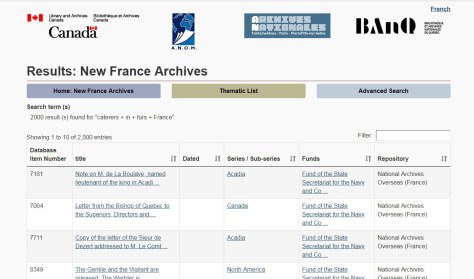
For example, I searched for the words “traiteurs+en+fourrures+France” (fur traders France, although the word traiteur now generally means caterer,) and found links to some 2000 documents stored in Canadian and French archives. A search for “commerçants en fourrures” or “commerçants de fourrures” also brought hundreds of results, but a search for “fur traders” only brought a handful. Try using Google translate before you put in your search term.
The results were in French, but a box appeared in the upper right hand corner, offering to translate into English. The page then looked like this:
Before my father, Tom Anglin (1919-1995) began his four-year courtship of my mother, Ann Lindsay (1926-1961), he went out with her older sister. It must have been awkward when he showed up on the Lindsay doorstep the first time asking for their younger daughter Ann instead of her sister Mary! Tom was 24 years old and Ann was only 17.
Who was this Ann Lindsay who would become Tom’s wife and my dear mother?
Her best childhood friend, Jean, wrote: “She had a beautiful inner soul that shone out through her eyes. A kind of pure innocence, a kind of angelic aura that surrounded her and there wasn’t a mean or selfish streak in her.”
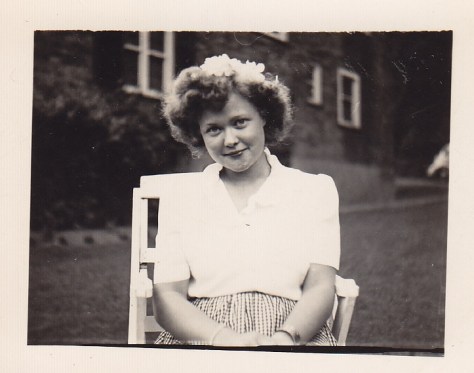
Ann Lindsay (1945) – 19 years old
Ann was affectionately described in the “Netherwood School for Girls” magazine in 1943:
Someone giggles ingratiatingly – it is Ann Lindsay … “Look at my hair!” she cries, and all behold her golden locks standling up on end, a memorable sight! … What would we do without her? What would we do without the dependable giggler who sees that every joke gets a laugh? Whose sense of humour appears unexpectedly in the middle of the staidest lesson? …We may wonder how Ann will enjoy McGill, but we know McGill is going to enjoy her!
Her sister, Kay, wrote: “…your mom wrote the entrance scholarship exam to Dalhousie University (although already accepted to McGill) on a dare from her maritime roommates. She just did it for a lark never dreaming she would win!”
The Anglins and the Lindsays lived right across the street from each other which enabled their relationship to flourish. Her friend Jean recalled “… your mom was lucky to find your dad when she was so young … all I remember was how HOT this romance was and they both wore their hearts on their sleeves.”
Ann’s parents insisted that she finish her college degree before she married Tom. Consequently, Ann was kept “busy” and out-of-town during the summer breaks in her schooling.
Her friend Jean wrote: “One summer, Ann and I went to a camp for underprivileged children as volunteer counsellors. Your dad spent his weekends visiting your mom. The air fairly crackled with fireworks when those two got down to smooching.”
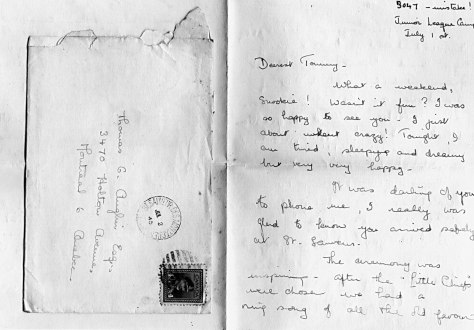
Letter from Ann – July 1st, 1945
During these summers they wrote letters to each other almost daily. He always signed his letters lovingly with “Tom” and she invariably always addressed hers with “Dear Tommy” or “Darling Tommy”. In fact, all through her diaries she refers to him as “Tommy”. As far as I know, no one else ever called him anything but “Tom”.
After a bit of practice, my father got the hang romantic letter writing and on July 3, 1946, he wrote:
“You are lovely in every way – beautiful, charm, wit, kind, companionable are all yours plus many things too spiritual, for me anyway, to put into words. I love you with all my heart and mind and may we always be happy together throughout both calms and storms of life.”
Ann’s 1947 McGill Yearbook entry summed up her recent years nicely:
“To laugh, to love, to live.”
Attended Trafalgar and Netherwood Schools- for girls only.
So went to McGill in 1943 to study the “Arts” of men. This proved to be successful!
Ann and her “Tommy” were married just weeks after her graduation keeping their promise to her parents.
I originally wrote this research guide to the seigneuries of the Trois-Riviè,res region, on the north shore of the St. Lawrence River between Montreal and Quebec City, several years ago, but it was not posted at that time. Recently I improved and expanded it.
The portion about the seigneurs has been expanded by about 80% and the content of notarial acts has increased by 30%. In addition, I expanded the research process to also include local history groups, including scholars associated with the Université du Québec à Trois-Rivières (UQTR), and information from sources such as Persée, Érudit, Université Laval, University of Toronto, Ciéq, Scap and Séminaires de Nicolet.
When I began researching seigneuries of New France through Google, I usually confined the research process to Canadian-based organizations, archives and research groups. I ignored research results addressing seigneurs and seigneuries of New France which Google indicated could also be found among the 95 Archives départementales de France, the Archives nationales de France in Paris, the Archives de la Marine (France), Archives nationales d’outre-mer (France).
During the 155-year period from 1604 to 1759 when New France was a French colony, thousands of records were simply sent to France, including documents addressing the creation of a seigneury or the appointment of a bourgeois or military officer to the post of seigneur. These original documents are still in France.
Finally, by reading all of the biographies of the seigneurs listed within the attached compilation, I realized that many, if not most, of the explorers and military officers who were assigned seigneuries were also merchants, exporters, and sometimes ship owners. Most of them derived their incomes from the fur trade industry, and Trois-Rivières was a port of departure for destinations in France.
Following the British Conquest of 1759 and the arrival of Scottish immigrants, the fur industry moved from the Trois-Rivières region to Montréal and the creation of the Scottish Fur Barons of Montreal had its birth.
The contents of this 97-page guide are as follows:
page 1, The seigneurs, governors, explorers, military officers, fur traders and leaders of the Jesuit, Recollet and Ursuline religious orders in the area, from the beginning of the colony to the British conquest.
page 16, The seigneuries found in the following areas: on the north shore: Trois-Rivières, Maskinongé, Sainte-Anne-de-la-Pérade, Saint-Maurice, Yamachiche; on the south shore: Nicolet, Saint-Francois-du-Lac, Yamaska, Gentilly, Bécancour, Baie-du-Febvre
page 44, Regional cemeteries.
page 45, Notaries who worked in the area from the beginning of settlement until 1953, and where to locate their acts.
page 93, Links to information about the Acadians and Loyalists who came to the region.
page 94, Repositories for archival material and other resources, such as books and genealogical databases.
The local Police Constable (PC) was tired. It was early morning and he had been on duty all night.
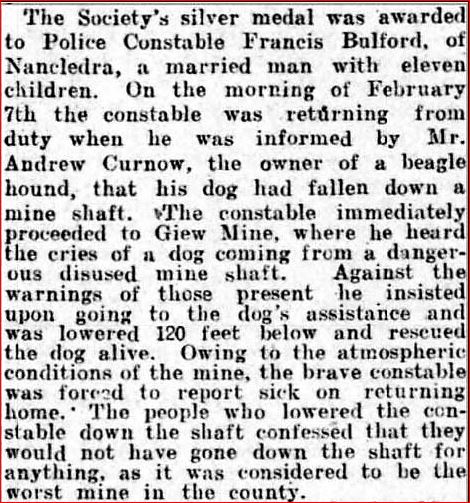
Time for home and he was looking forward to a nice cup of tea and a big breakfast with his wife. Maybe a chat with some of his children, before they departed for school. Then a nice long sleep.
It was a beautiful day, the 7th February 1923 in West Cornwall, England. The PC was riding home from his night shift on his bike to his village of Nancledra, so although the wind was brisk, he was warm.
He was coming home from the Police Station at Porthleven and was half a mile from home when he heard someone shouting. It was Mr Andrew Curnow a local farmer. He was waving his arms shouting something and beckoning to the PC. “Here we go again”, thought the Constable.
A few of the villagers were gathered at the top of a large disused mine shaft peering down. This was the Giew Tin Mine the only active tin producer in 1921 and 1922 but closed just that year, in 1923.
The PC rode over to Mr Curnow who was by now agitated and excited. ‘Quick! he shouted ‘ My dog has fallen down the Giew mineshaft!”
They could hear the dog’s frantic barking. The tall PC strode into the knot of people and they stepped aside to let him see what they were all peering at, down the long, dark shaft.
The PC looked down the steep shaft but could see nothing. Quickly he decided to enter the shaft and rescue the beagle. ‘Get me a rope, quickly’ he shouted.
Mr Curnow was aghast……..this was a disused narrow, crooked vertical shaft and who knew how far down the dog was. But the PC insisted and Mr Curnow ran off. The PC took off his jacket and rolled up his sleeves. he knelt on the grass and peered down. This shaft was a twisted one, but he could hear the frantic yelps and barking of the beagle.
Mr Curnow ran back with a farm hand and by now attracted by the shouts and activity more locals were gathered around the hole. Together, they roped up the PC and lowered him into the shaft. It was very dark so that after a few minutes they could only hear the PC’s voice. ‘Lower’ he kept shouting ‘Lower’
They continued obeying his instructions until…….silence. They all looked at each other faces grave. Suddenly the rope moved and the PC shouted ‘Got ‘im’ Pull me up!
With renewed vigour and a newfound strength the men, by now sweating with the effort of keeping the rope steady, heaved and pulled until the head of the PC and the beagle appeared at the top of the shaft!
Everyone grabbed both the PC and the dog. The beagle jumped up on his master barking hysterically whilst the PC lay on the grass sweating and panting. Everyone cheered. They all agreed that the old mineshaft should be covered over to prevent another accident.
This brave Police Constable was my Grandad, Francis Bulford. Born 28 October 1884 died 25 March 1963. RIP.
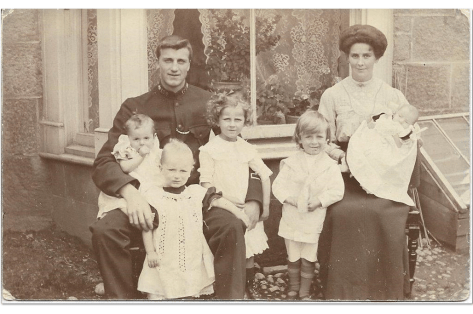
PC Francis Bulford with his wife, Emily Marion, and five of his eleven children
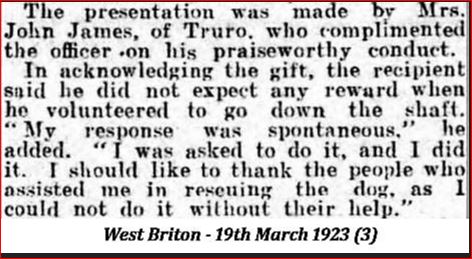
Below, the newspaper account of the rescue.
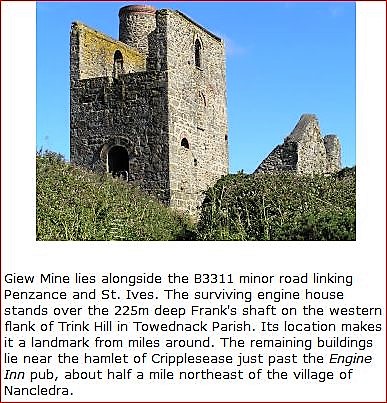
Giew Mine, near Nancledra Cornwall, England
Notes Of Interest On Cornish Mining
The closure of the tin mines in Cornwall was never about running out of resources – it was in response to competition from cheaper tin from abroad. South America and China are still major players in tin extraction and production. The collapse of the world tin cartel in 1986 being the last nail in the coffin of tin mining.
The Giew mine is known to have been working from the mid-eighteenth century. In its time Giew has been known as Gew, Reeth Consols, Trink and St. Ives Consols. The remaining buildings centered around Frank’s Shaft are only the easternmost of a number of shafts all working the area. The engine house dates from 1874.
This was part of the re-working of Giew Mine started in 1869 by Thomas Treweeke. Other shafts, running from east to west include Blackburn’s, Robinsons Engine, Martins, Ladock Shaft and Giew Engine Shaft where it joined Billia Consols Mine. It produced tin up until 1922.
In Cornwall, the ingression of water was the worst problem in shaft mining. A deep mine is a bit like a water well. You have to pump the water out constantly. The steam engine driving a pump was the answer to allowing deep mining in Cornwall.
You may wonder why Cornwall had the mineral mines that the rest of Britain missed out on. There is a simple geological explanation. During the late stages of the cooling of the mass of granite that makes up a lot of Cornwall, fissures opened up in the granite when it was still molten, and more hot molten rocks bubbled up through the granite from the earth’s interior. These new rocks contained many minerals, and as they crystallized they formed mineral lodes – tin, copper, zinc, lead and iron with some silver.
Because the ore-bearing rocks formed in this way, rather than being sedimentary rocks like coal (hence coal is laid down in great flat plates), they have to be mined vertically rather than horizontally.
Each fissure has to be mined straight down into the earth. Each fissure needed a separate mine. Therefore a great many vertical shafts were needed, rather than the one shaft that was used in coal mining.
There were no other substantial buildings in a typical mine. Given that many of the mines were small and vertical, they did not invest in cages to haul the miners up and down, instead, access to the mine was by ladder, a tiring part of the daily toil of the miners.
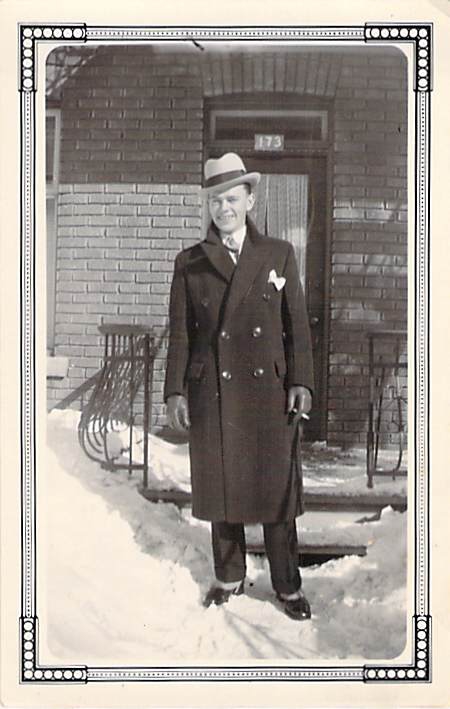
“Damn!” My dad, Edward McHugh, cursed to himself. He thought ruefully that his great idea to change his job ten months ago did not work out very well. His first job after school was in the office of Henry Birks & Sons. While he was working there, he decided to take a bookkeeping class at night at Sullivan College and the A.R. Whittell Can Company thought that he showed initiative, was a snappy dresser, and would make a good salesperson. So they hired him. It was now 1931 and he had just been laid off because sales were dropping.1
Edward McHugh in Verdun, Quebec, in the 1930s
Now what? Edward knew that the prospects of getting a job were bleak. Luckily Edward still lived at home with his parents and his father was a foreman at the Atlas Absestos Company.2 Still, it was worrisome.
It would be two years before Edward would find employment. He spent many evenings with his brothers and sisters, playing cards. During these evenings, their supper was sandwiches, made out of a loaf of white bread, some butter, and one can of salmon. 3
Maybe the idea to go altogether to Drummondville was hatched at one of the card parties. In any event, in 1933, in the depth of the Depression, the McHugh siblings, Edward, Thomas, Sarah Jane, and Sarah’s husband Jack, decided to move to Drummondville, Quebec to find work.
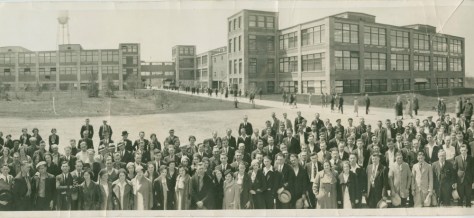
At that time and even though Quebec was hard hit by the Depression, the Canadian Celanese Company in Drummondville was a significant employer in the province, with 1,757 employees. The picture below shows the employees of the Canadian Celanese Company in that year.4
Moving to Drummondville would have been equivalent to immigrating to a new country. None of the members of the family would have had an automobile so the trip from Montreal to Drummondville would have had to be by train. As with many immigrants, their motives were financial.
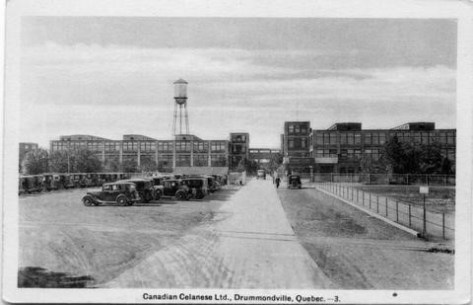
As far as I know, they were all employed by the Canadian Celanese Company. The Celanese Corporation was founded in 1915 by two Swiss chemists, Camille and Henri Dreyfus and enjoyed significant success during WWI because of its development of synthetic fiber. The Canadian plant was built in 1926 in Drummondville. This location was chosen due to its proximity to a large expanse of forest, it was close to Montreal that was the centre of the textile industry at the time, and inexpensive hydro power supplied by Southern Canadian Power was available.5
This picture of the Celanese, taken in the 1920s, shows that it was a significant manufacturing plant: 6
My dad was hired as an electrician and worked in what was called the silk factory.7 The Celanese required electricians to work full time to ensure that the machines were never idle.
My dad and his siblings settled in and made a life in Drummondville. Both my dad and his brother, Thomas, played on the Celanese football team.8 Thomas married Simone Cloutier in 1937 and then died a year later in 1938 of an illness. Thomas is buried in the cemetery of the St. Frederic Church in Drummondville.9
Edward continued to work for the Celanese until the outbreak of the war. He signed up for duty in August 1940 at the Ste. Hyacinthe recruiting centre. The Celanese agreed to hire him once the war had finished but he did not go back.10
Military records from WWII, Edward McHugh, Royal Canadian Air Force Attestation Paper. This information was in his employment records. It states that he left Henry Birks and Sons for a better job and that he was let go from A.R. Whittell because of lack of work.
Although Thomas McHugh, Edward’s father, was deceased when the RCAF Attestation Paper was filled out, Thomas’ job at his death was noted. It is an assumption that he was working there in 1933. There is no indication that he was out of work during the Depression.
Military records from WWII, Edward McHugh, Royal Canadian Air Force Attestation Paper.
Death of Thomas McHugh, “The Drummondville Spokesman,” “Thomas McHugh Passes Away,”May 27, 1938, accessed March 19, 2015. This article states that Thomas McHugh was on the Celanese football team. It is assumed that Edward was also on that team as his Attestation Paper said that he played football extensively.
Marriage and death certificates of Thomas McHugh. Drouin Collection. St. Frederic Parish, Drummondville, Quebec.
Military records from WWII, Edward McHugh, Royal Canadian Air Force Attestation Paper.
Some family history researchers complain that Pistard, (pistard.banq.qc.ca), the online search tool for documents stored at the Bibliothèque et Archives nationales du Québec (BAnQ), is too complicated difficult to use because it is only in French. I beg to disagree.
The site offers its own online translation tool, users can buy their own French/English dictionaries or they can use online translation tools such as Google Translate. As for the complaint that Pistard is too complicated, I think that is a myth. Pistard by BAnQ is easy to navigate in both the normal search option and the advance search option.
Nor does Pistard address notarial acts including marriage contracts, land purchases and sales, after-death inventories or guardianship of minors after the death of both parents. BAnQ has a superb online search engine addressing notaries. See http://bibnum2.banq.qc.ca/bna/notaires/ You can search each notary’s index of acts and, when there is an asterisk beside the notary’s name, the acts have been digitized. (Ancestry.ca also has a collection of Quebec notarial records. For hints on using it, see the blog Genealogy a la carte, Oct. 6, 2016, http://genealogyalacarte.ca/?p=16520)
Pistard does include archival resources including letters and other text documents, diagrams, land surveys, photographs, drawings and items on microfilm. It includes an online database addressing issues that were dealt with by judicial courts, judicial appointees by Governors or Lieutenant-Governors of New France or by Intendants of New France and appointees of the latter who acted on behalf of the King of France on subjects such as fraud, breach of contracts, unpaid debts, illegal transactions such as the sales of liquor to first nation people, or simply the removal of a fence.
Let me give a couple of examples using, with her permission, several ancestors of my friend and fellow genealogist Claire Lindell. Two of her pioneer ancestors were Claude Jodoin and Julien Fortin. I searched for each name in Pistard.
Jodoin was a neighbour of two farmers in the Seigneurie de La Chevrotière. When thesetwo farmers argued about the location of a fence between two farms, the regional Justice of the Peace had to settle the issue.
This is a screen shot of the search result for Claude Jodoin, translated by the BAnQ
The second case I have selected deals with the children of Julien Fortin and Suzanne Quenneville. It appears that, after the death of both parents, their daughter Marie was placed under the care of a Jean-Baptiste Lachaise and/or a Pierre Charbonneau. This one is not clear: only the actual document could clarify the reason the judicial system had to solve the issue.
A search in Pistard for Julien Fortin brought up this result, and I then applied the BAnQ’s online translation tool.
The online description of each document posted on Pistard is only a recap of the real document, which is stored in one of the 12 branches of the BAnQ across Quebec. In some cases, Pistard will link you to an image of the original document and a brief description of the case. If not, you can obtain the complete file through an email request.
For each query on Pistard, search results indicate the Cote (Shelf) #, the Judicial District or Region and the Dossier (file) #. Then, through an email to the repository where the document is kept, you can obtain a download within a few days, for free.
A few months back, I had a telephone conversation with a clerk at BAnQ Vieux-Montréal. I asked her, if you receive an email in the English language, will you reply in English? She replied yes, adding that she was then working on a query from Australia. The person said his ancestor, who had been a Quebec Patriot during the Rebellions of 1837-1838, had been deported to Australia. The BAnQ clerk sent this researcher numerous documents about his ancestor at no charge.
During the First World War, 2,504 nursing sisters served in the Overseas Military Forces of Canada. Unlike the British nursing sisters, Canadian nurses were actually part of the army, not an auxiliary unit. They were given the military rank of lieutenant to ensure the respect of the men. 1
There were forty-six Canadian nursing sisters who gave their lives while serving. Six were killed or mortally wounded on land; fifteen met death from enemy action at sea. Eighteen died of disease. 2 Ella Edna Willett, my great-aunt, survived illness not once but three times during her service in France between 1915 and 1919. 3
Ella was born on January 21st, 1892 in Dimock Creek, Quebec, 4 the tenth and youngest child of Alexander Willett and Susan Barter. She trained as a nurse at the Montreal General Hospital in Montreal. 1 On June 3rd 1915 at age twenty-three she enlisted in the Canadian Expeditionary Force. 5 She apparently came from an adventurous family. Three of her older brothers including my grandfather, locally known as the Wild Willet Boys, left home to seek their fortune in the Yukon. Ella may have felt she could match their adventures by going overseas with the army.
Ella served in two Canadian Stationary Hospitals in France, #2 in Outreau and #3 in Boulogne. She also served in two Canadian General Hospitals, #7 in Etaples and #11 in Liverpool, as well as a transport ship sailing between England and Canada. 6
The process to save the wounded began at a casualty clearing station, the patients having been brought from the front by field ambulance. The stations were nearly always situated on a railroad siding. Some patients required immediate surgery, others were moved quickly by ambulance train to better equipped stationary hospitals and still others to general hospitals for long-term care. Some of Canada’s most brilliant and experienced surgeons served in the stationary hospitals. To be one of the nursing sisters who served with them was said to be the highest ambition of most Canadian nursing sisters. 7
The responsibilities of the nursing sisters were long and arduous under grueling conditions: blood and gore everywhere, rats often underfoot, the cries of the wounded, planes soring overhead and the shrieking of dropping bombs. The sisters had to shorten their skirts to keep them out of the ever present mud. 8
By far the greatest emotional drain on the sisters must have been the huge numbers of casualties arriving day after day and the triage system: deciding who needed immediate attention, who could wait, and who had no hope to survive and had to be left to die. Through all of this the sisters were said to work calmly and remain cheerful and comforting. 9
On September 2nd, 1916 Ella was struck down with appendicitis and underwent surgery herself in Boulogne’s General Hospital. She was given three weeks sick leave to England (at half pay!) before returning to her unit. 10
Two years later, on October 31st, 1918, Ella was again admitted to hospital, this time in Rouen. She was diagnosed with measles complicated by bronco- pneumonia. These were the days before anti-biotics. On November 6th she was listed as dangerously ill and remained on the list for eighteen days. Upon recovery, she was sent to a hospital in the south of France to recuperate (likely once again at half pay). She returned to duty on January 9th, 1919. 11
The final blow for Ella was the Spanish Flu, one of the deadliest diseases in human history.
Spanish Flu attacked young adults and moved with grim speed. Victims’ lungs filled with bloody, frothy liquid and their faces turned blue as they drowned in their own fluids, often overnight. It killed 2.5% of those infected as opposed to roughly 0.1% of previous flu outbreaks. 12
The military provided an ideal incubator for Spanish Flu. The soldiers were in the age group that was particularly vulnerable and they lived in conditions conducive to its spread. Stressed, dirty, hungry, wet and cold, massed in camps, huddled in trenches and tents or jammed into troop trains and ships, soldiers were easy prey. 13 Ultimately they spread the disease to the doctors and nurses who cared for them
Ella was admitted to #4 Canadian General Hospital in Basingstoke, England with Spanish Flu on March 6th, 1919. She was hospitalized a full month but amazingly she survived. 14
Ella returned to Canada in August 1919 under the general demobilization of troops. 15 She married William Boyt, an American, and had one son. William died in in Florida in 1978 at age ninety- one. Ella died in 1985 in Vancouver at age ninety-three. 16
Nicholoson, G.W.L. Canada’s Nursing Sisters. Canadian War Museum, 1975.
Ibid
Willett, Ella. Service File Accession 1992-93-166, Box 10376. Archives Canada
Willett, Peggy. Personal Family Tree
Willett, Ella. Service File Accession 1992-93-166, Box 10376. Archives Canada
Ibid
Nicholson, G.W.L. Canada’s Nursing Sisters. Canadian War Museum, 1975.
Ibid
Ibid
Willett, Ella. Service File Accession 1992-93-166, Box 10376. Archives Canada
The attached 43-page PDF addresses the Archives communales de France, also known as the Archives municipales de France. This is the second most important group of archives in France for tracing the families of New France and Acadia. The 95 Archives départementales de France are the number one source of information addressing French Canadians, Acadians, Franco Americans, Franco Ontarians and others. (See also, Researching Your French Ancestors Online, posted May 13, 2018, https://genealogyensemble.com/2018/05/13/researching-your-french-ancestors-online/)
There are some 400 municipal archives. I have selected the 124 largest, including archives that offer online access to some files, or at least an online description of the contents.
In 1792, the Assemblée législative de France (The Legislative Assembly of France) took away the responsibility for issuing birth, marriage and death registers from the curés (priests) and gave these duties to local mairies (city halls). At about the same time, a new civil register of France was created addressing acts of birth, marriage, divorce and death. This register was named the Registre de l’état-civil, and the documents were issued by the city halls.
Subsequently, when many cities and towns created their own archives communales (municipal archives), these local municipal archives were assigned responsibility to safeguard the civil registers.
After the creation of the 95 Archives départementales de France, a great number of the local archives communales (municipal archives) turned over their actes de l’état-civil, or copies of these records, to the regional archives départementales. Other municipal archives did not do so. As a result, some of the files found in municipal archives of France can also be found in the regional archives départementales, while other dossiers cannot be found anywhere else.
The majority of genealogy societies in France work closely with their local archives communales. Many of these genealogy societies share the same building or adjacent building to the archives communales of their region.
The Bibliothèque et Archives nationales du Québec (BAnQ), the Quebec provincial library and archives, is making some changes to its online search tool that will impact you if you are looking for some books about history.
Pistard pistard.banq.qc.ca will continue to be the primary search tool if you are searching for documents owned by BAnQ. For example, Pistard is the place to search for records of non-criminal offenses such as unpaid purchases of goods, as well as letters and various documents, maps, diagrams and photographs. You can also find documents that were issued by Judicial Districts of New France, Quebec under British Military Rule, Quebec under Lower Canada and Quebec under Confederation.
What the BAnQ has removed from the Pistard search tool is published books which are not owned by BAnQ. You must now look for such books through the Cataloguecap.banq.qc.ca
A search for the name Bagg through Pistard, for example, brings up a list of 24 documents, several of which are plans (diagrams) of property that belonged to a member of the Stanley Bagg family. You can view images of some documents returned by a Pistard search by clicking on the word Coll. on the far right-hand side of the list of results. You can also try researching this database directly from Google by searching, for example, the words Pistard and Bagg together.
One result from Pistard refers to the records of notary Stanley Clark Bagg, but it just describes the collection. To see the index of his notarial acts, you must search on http://bibnum2.banq.qc.ca/bna/notaires/
A search for the name Bagg through the Catalogue brings up 123 results, only one of which is a book that refers to the family – an archaeological report on the house of Abner Bagg, built in 1821.
If you wish to borrow the excellent book by John Francis Bosher, Négociants et navires du commerce avec le Canada de 1660 à 1760, you would now (2018) conduct your online search through the BAnQ Catalogue.
If you want to borrow the English-language version of the same book by J.F. Bosher, Men and ships in the Canada Trade, 1660-1760 – A biographical dictionary by J.F. Bosher, the online search process is also done through the new BAnQ Catalogue.
The publisher of these two books, Canada Environment – Canadian Parks Services, has discontinued the sales of the English-language version of this superb book. According to the policy of BAnQ in regard to Canadian authors and Canadian publishers, once a book has been removed from the marketplace, BAnQ will digitize that book and the digitized version can be viewed at two of the 12 repositories of the BAnQ: the Collection nationale within the Grande Bibliothèque de Montréal; and BAnQ Québec – Archives nationales du Québec at Université Laval in Quebec City.
You must reserve such digitized books by email. Only the person who has ordered a book by email can have access to these precious and discontinued books. I did so about a month ago, but I have yet to visit the Collection nationale. At my next visit, I will be reminded politely by one of the librarians or technicians that I have not yet reviewed that book on one of the four library computers reserved for such services.
I will explain other aspects of searching on Pistard in future posts.
World War II was raging across Europe and the Pacific and the newspaper headlines were dire, but for my mother, the war years may have been the best of her life. After a sheltered childhood, she finally moved out from her parents’ house and found a job. Best of all, towards the end of the war, she met my father.
Joan Murray Smith was born in Montreal in 1918. She grew up an only child and attended a small, all-girls private school a short distance from her house. She was a good student, but shy and unsure of herself.
After finishing high school, she enrolled in art and typing courses. She kept up with her old school friends and there were always lots of parties to attend. In 1937, she and her parents boarded The Empress of Australia and sailed to England and Scotland for a short holiday. It was to be her only trip abroad. Two years later, the war broke out and such vacations became impossible.
A few years later, Joan joined the war-effort in her usual quiet way: she found a clerical position with the National Film Board of Canada (NFB). At that time, the NFB was in its infancy. It was headed by John Grierson, a Scottish-born pioneer in documentary film-making, and my mother was thrilled to work there. She later told me that she helped set up the film library at the film board. She was well-organized, and no doubt she found the job both interesting and rewarding.
Many of NFB’s early films were morale-building movies focused on Canada’s role in the war. They also produced documentaries informing people about civilian defence and the roles of different branches of the armed services. Other films were short educational documentaries about food and agriculture, and there was a series of films targeted at women to help homemakers deal with shortages of consumer goods. These were shown in movie theatres across Canada, while libraries made them available to school and church groups. In rural areas, they were shown in community centres, using travelling projectors supplied by the NFB.
The NFB’s head office was located in Ottawa, a two-hour train trip from Montreal. Joan lived with her friend Denny and Denny’s father for a year, then she moved into a house with several other young women. Using the office typewriter, she wrote to a friend, “I am enjoying myself hugely. I got caught up in a round of small gaiety and am finding housekeeping wonderful fun. Not that I do anything but wash up as all the other girls have earlier hours than I do and always have the food ready for me at breakfast and dinner, which is very lucky for all concerned.”
Ottawa is a quiet city, but it was probably more interesting during the war. One of its chief advantages for a young single woman was that it was full of officers. As Joan wrote in another letter, “I have discovered a very nice captain whose chief virtue is that he is a wonderful dancer, but who unfortunately isn’t stationed here.”
Then she met Jim Hamilton, her husband-to-be. He too was working for the NFB. He had a science background and was making a film to educate members of the armed forces about sexually transmitted diseases.
Intelligent and something of a non-conformist, Jim was shy with women, while Joan was looking for someone different from the conservative sons of wealthy Montreal families she had grown up with. My vision of my future parents in their dating days comes from a photo, taken in the Gatineau hills on what looks to be a warm day in early spring 1946 in which they looked happy and carefree.