



‘Here it comes’ Dad yells out and we all rush to the front door with our brooms. Sweeping frantically we try to stop the floodwater from creeping into the house but to no avail.
With all the news about the Harvey Irma and Jose hurricanes and the resulting floods and damage, I was reminded of our house when I was about 9 years old in 1954. We lived in Watts Cottages, St. Levan Road Plymouth in Devon England. There were four cottages situated in a small park, in a pretty grassy ‘dip’. and St Levan Road outside the park’s elegant metal railings was the main road for cars and buses. Upon opening our garden gate it led directly to the grass and the park. It was idyllic, except for one thing…..It flooded when it rained heavily. Plymouth is a very hilly area and our cottages were situated in that dip.
Shortly after my father bought the house, our neighbours could not wait to tell Dad that the four cottages flooded when rain was particularly heavy. Of course, nowadays a sale like that would never happen but this was only 9 years after WW2 and housing in our Naval city was in crisis. Thousands of people lived in prefabs – prefabricated homes built quickly after the war, intending to last for 10 years – and many families lived together, due to the bomb damage and shortages of homes, so for my Dad to find this pretty cottage, next to a recreation field and a main bus route was wonderful.
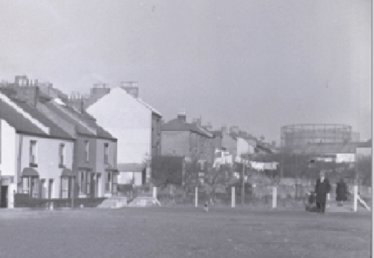
Side view of the Cottages in the park from the recreation ground, Our cottage was the third from the left.
We had lived in our home for about a year before it flooded. It had rained heavily all day and suddenly, the garden had a few inches of water in it, which rapidly became two feet. It crept towards the front door. When Dad had heard about the flooding from the neighbours, he had built a waist-high cement wall and a wooden door to slot in place when it rained. He was hopeful that this would keep the water out of the house – it didn’t.
After our frantic efforts to sweep the water out, it was obviously a useless exercise so my Dad made Mum me and my baby sister all go upstairs, whilst he waded out the front door to try and clear the sewer drain, which was outside our gate in the park area. He was over 6 feet tall, but soon, the water reached his chest. We all watched the drama unfold from our bedroom window. He managed to get the drain cover off, and a huge fountain of water shot up into the air! It kept going for ages and we waited for the floodwaters to recede but it did not happen and I must admit that at nine years old, it was kind of exciting to see! All the neighbours across the street were watching too. Buses stopped on the main road to watch the huge fountain of water cascading over the park. Such drama! What excitement!
The aftermath the next day was not so much fun though. No kind of help from anyone in those days. We just waited for the floodwaters to subside, and then started the usual clean up. No Fire Engines to help pump out the water, no help from the local city officials, no shelters no home insurance just us, Dad Mum and me sweeping out all the stinking mud and trying to dry everything out.
None of the surrounding homes (pictured below) suffered flooding as those four cottages did, and always afterwards, the place smelled of mould and dampness. No wonder I was always sick with bronchitis. It took many years – 18 actually – before those cottages were officially condemned and boarded up.
Long before then the residents including us had just moved out and left behind their dreams and investment. It took another 7 years before they were bulldozed and grassed over. Once officially condemned, the local council paid residents a nominal fee but nothing like the money put into our homes.
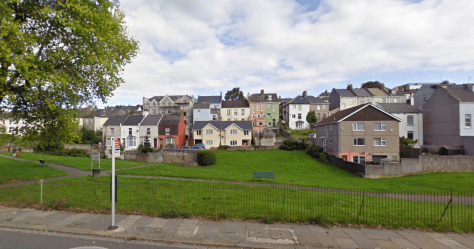
Front view of the site today, after the demolition of the Cottages, still a pretty site. for cottages. The bare green area was where the cottages were situated. You can see how the area slopes downwards.
I have to admit that when I went back to England one year and visited the park, it was a shock to see the houses gone and an empty spot grassed over. It did make me sad and although the victims of the recent Hurricanes had a far, far worse time of it than we ever did, I do know exactly what they went through afterwards…..
 Feedspot has included Genealogy Ensemble among their top 100 blogs for genealogy researchers. Thank you Feedspot!
“Someday I’m going to write a book!” How often have you said that, or heard a friend or relative make a similar statement? You probably didn’t hold your breath until it appeared.
So it comes as a surprise to the nine members of Genealogy Ensemble, the family history writing group of which I am a member, that we are actually doing it. In November, we will launch Beads in a Necklace, a book of collected short stories based on our family research.
These real-life stories include a young Scot who immigrated to Canada and became a famous gospel singer, memories of queueing up for food rations in post-war England, and a young girl who was kidnapped from her home in southern Maine by the Abenaki Indians in 1692 and spent the rest of her life in Quebec.
Now that it’s about to be published, I thought it would be worthwhile to look back at some of the lessons we learned that might help potential authors.
Grow Organically
The genesis of Beads in a Necklace goes back to 2012 or so when we decided to write about our families and share our stories. Since then, we have met once a month to critique each other’s work, improve our story-telling skills and gain confidence.
After a while, our stories were so good, we wanted to share them more widely. We began taking turns posting them on our blog, Genealogy Ensemble. The book authors among us kept talking about the possibility of publishing something, but the idea always seemed far away.
Last year, we got serious about the idea. With 2017 being the 375th anniversary of the City of Montreal, where we all live, and Canada’s 150th birthday, we decided it was time to publish a collection our stories: a 250-page book, with a proper binding and a beautiful cover, that we will be able to give to friends and relatives for Christmas.
Start with Structure
We started discussing the project last September. The first step was to each choose our five favourite stories. Each article had to be about 500 words long and include endnotes citing the sources of our facts. Apart from that, there were no rules.
After considerable debate, we agreed on the title Beads in a Necklace, and we came up with a logical way of organizing the stories into sections.
Collaborate
We all pitched in to help at various stages of the process, depending on our areas of expertise. I did most of the editing, with help from Tracey. I had worked as a journalist, and Tracey and Dorothy are also professional writers. That helped a lot: we know how to tighten a longwinded sentence, spot a good first paragraph and structure a story so it flows smoothly. Several members of our group have natural writing talent that they never knew they had, but they are still learning the skills that come from writing on a daily basis. And sometimes writers have to let go of their egos and allow changes. Of course, everyone could say yes or no to editing suggestions, and we always managed to find compromise solutions.
Sandra, who has experience preparing annual reports in the corporate world, did most of the layout, with Claire’s assistance. Claire also knows her way around digital photography and she cleaned up the often scratched or faded photos we wanted to use.
Ask for Help
We even got friends involved: one friend who is a proof reader is making sure there are no typos or missing punctuation marks, while another friend who is a graphic designer has agreed to do the cover.
There have been many details to consider. The people responsible for the layout had to decide on the size of the book and the fonts to use and get quotes from a local printer. Someone has to look after making a digital version available, and we have to crank up our marketing strategy. Last but not least, we had to find a place that is big enough but not too expensive for our celebratory book launch. We found a church hall that is perfect!
Persevere through glitches
Most of the glitches we have encountered have been computer-related. For example, we tried both Google Drive and Dropbox so we could upload files that everyone could edit. Both did the job, but we found Google Drive to be a bit unstable, while for a reason I still don’t understand, I can’t see many of the changes that Sandra and Claire have made to the layout in Dropbox.
This has been a long process. We were editing in January and the book will be launched in November. But we are all thrilled about it. Furthermore, I hope to apply the lessons I have learned from this experience when I write a book about my own family’s history. Just don’t hold your breath until it appears.
This article is also posted on writinguptheancestors.blogspot.ca
Summer is slowly waning, days are getting shorter, the sun is slipping below the horizon earlier each day and at times there seems to be a slight chill in the wind. The playgrounds are silent. Schools are back in session.
Where did the summer go? How did you spend your summer? Did you travel to faraway places, relax on a beach, or stay right here in the city and enjoy some of the festivities while celebrating our 375th Anniversary?
The island of Montreal has been my home since the mid-60’s. This summer I became a tourist in my hometown. Several organized guided day tours were a pleasant way of seeing and learning about the many hidden gems tucked away in unusual places.
Did you know that there is a large piece of the Berlin wall in the International Trade Center in Old Montreal, or that there were guided tours of the Seminary?
Recently on a Saturday afternoon, after a lengthy detour and a drive between orange construction cones another genealogist and I arrived late for a guided tour of the Seminary in Old Montreal. We joined the group in the courtyard adjacent to Notre Dame Basilica where the Sulpician Priests during this anniversary year have opened their doors to the public. The last time that happened was during Expo 67, fifty years ago.
The young guide, Gabriel, was describing the French clock, (from France) noting how the original mechanisms were made of wood. Over the years there were many changes and today it runs on electricity. The bells ring every fifteen minutes, although they are often drowned out by the bells of the Basilica. 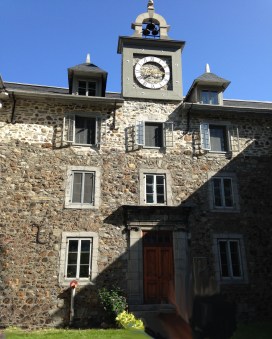
The Priests of Saint Sulpice arrived in Montreal in 1657. From 1663 until 1840 were the owners of the island of Montreal. They were the Seigneurs. They began building the Seminary in 1685 and today it is the second oldest building on the island of Montreal and the oldest building standing that has retained its original purpose.
As you walk by the courtyard on Notre Dame Street it is possible to see where the restoration of the building is ongoing, beginning with the upper third floor which is currently vacant. The restoration team has done their utmost to retain the same look as the lower levels.
From the clock tower in the courtyard our group moved through a narrow passage between buildings and in to the garden, a large spacious area where for many years it provided produce for the Seminary. Today it is a quiet, serene wide expanse of grass, walkways and large trees, several that are over one hundred years old. Recently they planted almost two dozen young trees at the far end of the garden.
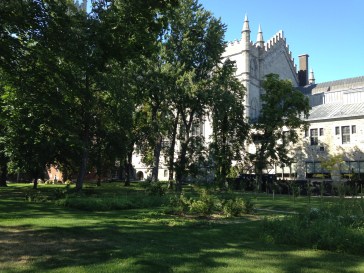
The tour ended in the garden. However, because we arrived late and missed the visit to the museum we were permitted to go in and view the numerous artifacts found within. The main theme focused on the founding of the Sulpician priests and their mission in New France. One of the items that caught my eye was a hand drawn map of the island of Montreal dating back to 1702 that showed all the different settlements on the island.
Perhaps the most important part of the event was when several people asked about the archives and the possibility of visiting them. The response was surprising as it had always been noted that it was next to impossible to access the archives. The guide noted that there are two permanent archivists and two students working during the summer months. If someone wishes to visit the archives they must have a specific purpose, along with names and dates. The archivist will give your request consideration and inform you if they are able to assist you in your request or they may recommend where you might find answers. He also noted that there is much work to be done in the organizing of all the data they have.
Being a tourist in one’s hometown has been an interesting experience. A cruise on the St. Lawrence gave us a bird’s eye view of the port of Montreal. A full day bus tour with six different stops along the way covered most of the prominent areas of the city, Old Montreal, up the mountain along Camillian Houde Parkway, a drive up to Mile End area, a brief stop in Welinsky’s and a visit to Fairmont Bagel, just to name a few.
Each of the day trips were rewarding. Although it was strange at first to be a tourist in one’s hometown there were many other Montrealers with the same idea.
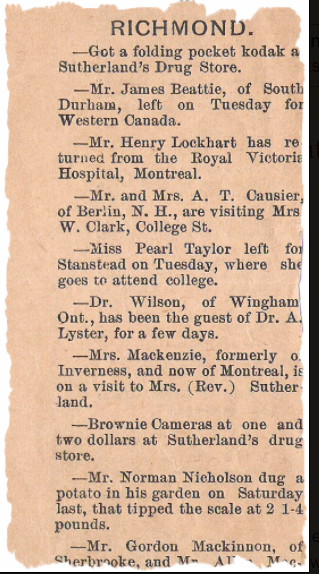
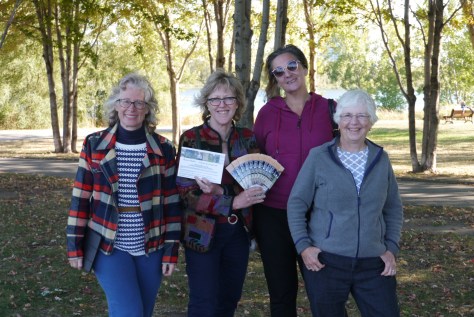
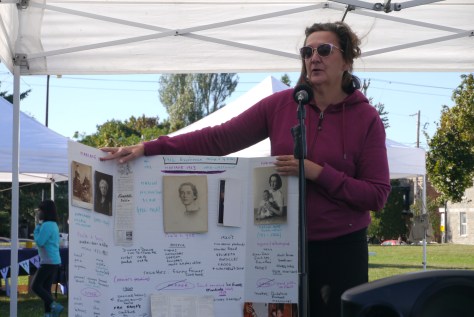
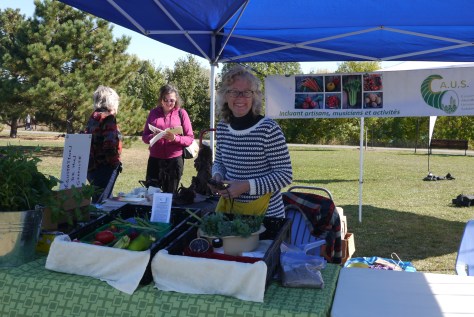
On Sunday, October 1, 2017, some members of Genealogy Ensemble will be participating in the Culture Days event at the Verdun Farmer’s Market, in promotion of Beads in a Necklace, our book of family stories to be published in November. My talk will focus on WWI Victory Gardens and the rising cost of living during that period.
The newspaper clipping, above, is from the social notes column of the Richmond-Times Guardian, (Richmond, Quebec) circa 1905. The very silly item about a big potato is probably my husband’s great-grandfather’s way of poking fun at small town pretensions. Or is it?
The Nicholson family’s vast vegetable garden behind their charming red-brick house in the Eastern Townships of Quebec was no joke to them, not even in an era when pre-prepared foods like Heinz Beans, Jello, and Quaker Oats, were fast becoming house-hold names.*(1)
In 1911, with their four children were grown up, the large backyard garden that produced corn, beets, sweet peas, etc., was critical to the diet of this frugal Scottish Canadian family.
The potato patch was a particular concern:
“I put the Paris Green on the potatoes twice. Mrs. Montgomery came over to tell me that the bugs were eating up my potatoes. I was waiting to get someone to do it for me, as that was one thing I never attempted.
“But when she interfered thought we would try it. So one dark night, Flora (daughter) got the lantern and we went out when the bugs were asleep and gave them their dose. We dressed ourselves in the shed. You ought to have seen us. When we got through left our clothes there. Went to bed and dreamed all night that the bugs were crawling over us.”
So writes Margaret Mcleod Nicholson, in a July, 9, 1911 to husband Norman, who was away in Northern Ontario working as a railway inspector.
You have to admire Margaret’s style. Although her letters were often penned in haste and full of household concerns, ‘the local news’ as in gossip, and much high anxiety over finances, she certainly could paint a word picture when she wanted to.*(2)
In the spring of 1911, it was 57 year old Margaret’s job to care for the garden because her two older girls, Edith and Marion, were away teaching in Montreal, and her youngest, Flora, was very busy studying for final exams. Margaret and Flora were living alone for most of the year.
Although her daughters returned to Richmond for the summer, they came and went as they pleased, often in motorcars owned by wealthier neighbours. *(3)
Norman, in his letters home, warned his wife not to work too hard out in the backyard, especially in hot weather, and the summer of 1911, as it happens, was very, very hot.*(4)
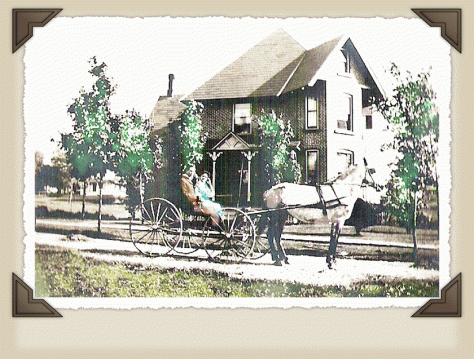
An ‘old-fashioned’ carriage in front of Tighsolas, the Nicholson home, circa 1910. A hire. The Nicholsons couldn’t afford to keep a carriage, let alone buy an automobile, like so many of their neighbours.
The same letter continues:
“We have had dreadful hot weather. Just fancy, one night we slept out on the veranda. Took our mattresses down. The Skinners (other neighbours) were sleeping in theirs so that we were not afraid and we had Flossie (the dalmatian) with us but yesterday afternoon it rained so last night was cool.
We all had a good sleep and today is fine. We feel like working. I hope you did not have this extreme heat. We had quite a cold wave about the 24th but no frost.”
This sounds like typical Quebec weather, doesn’t it? So up and down. It’s not easy cultivating a garden in this province. It takes perseverance.
Six years later, in the spring of 1917, most everyone in the west end of the city of Montreal was out on the street digging their wartime Victory Gardens.*(5)
Marion Nicholson, now a mother and homemaker living on York Street in lower Westmount, describes the scene in a letter home to Mom:
“Every vacant lot around the city has been utilized for gardens and I think it is more common to see people out digging and planting in these gardens than in a small town like Richmond. Some I think are making their first attempt.”
Her small family is no exception. “Hugh (husband) and Willie (cousin) are making a garden. What success they will have I do not know. One thing for sure, the beds are straight (her underline) and square. I myself would prefer more in them.”
Marion (who is six months pregnant) then describes how she has hardly slept all week while tending her very sick toddler. She begs her mom to send as many crates of eggs as she can on the next train.
It certainly was an era of high-anxiety about food, nutrition – and so many other things.
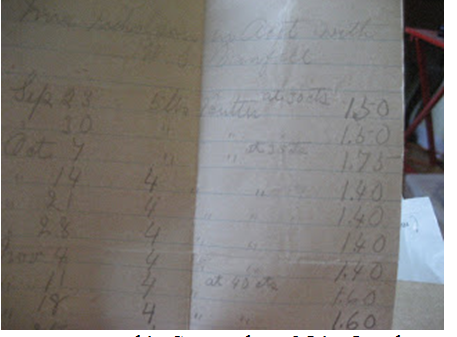
Margaret’s 1917 butter bill. Inflation. The price of butter goes up from 30 to 40 cents from September to October.* (6)
Still, Marion closes her letter to her Mom by praising her comfort food: “So, now to get a taste of your home-made bread. When I eat it, I close my eyes and I feel as if I were home. Thank you for all the good things you sent.”
![orchard[1]](https://genealogyensemble.com/wp-content/uploads/2017/08/orchard1.jpg?w=474)
Edith, young Margaret, and Marion, far right, in summer of 1918 in an orchard in Richmond, possibly behind the Nicholson home as they had apple trees. (The newborn is in other pics.) This was the year of the Spanish Flu. It was safer in the countryside. Marion stayed an entire month in Richmond, until her husband, Hugh, begged her to come home in a letter. “The ice in the icebox has melted all over the floor, there’s no food in the house, the windows are kept open and it’s hot as Hades in here. Please come home and take care of me!” He was in the care of his sisters-in-law, who had better things to do in wartime Montreal than to baby their brother-in-law. Edith, a Sun Life employee, volunteered in Soldiers’ Aid for the YMCA and for the Navy League.
It was understood, even back then, that the home was evolving from a center of production to a center of consumption. Margaret, born in 1853, made everything from scratch, on a woodstove, with recipes she kept firmly locked in her head; Marion Nicholson, born 1886, would cook on a gas stove relying on her Fanny Farmer Cookbook; her daughter, also Marion, born 1917, living in middle class comfort in 1950’s suburbia, would feed her brood nothing but canned vegetables, even canned potatoes, which she warmed on an electric stove.
I spent my entire career writing corporate documents. I could spin with the best of them. It is very different from writing family history stories. When I joined the Genealogy Ensemble family history writing group, I had to learn a whole new way of writing.
In a corporate document, you are always trying to get something from someone. It could be funding, agreement on how to proceed, approval for a project, agreement with your point of view, or understanding and approval of why you did what. The list goes on and on. Your objective is to sway your audience to your point of view.
When I would write corporate documents, it was important that I provide the reader with the context of the request. I usually started with the background, then the current situation, followed by a description of the issue, and concluding with the desired outcome.
Family history stories should start with a lead that will grab the reader’s attention, much like a news story. Simply put, a good lead will incite the reader to continue.
Writing family history stories is intensely personal. After all, you are writing about your own family. Your voice must come through. When I would write corporate documents, I was always the anonymous writer. No one knew me personally, even if I signed the document. The corporation always spoke in the document, not me. Family history writing is all about you and your journey discovering your ancestors. Your family history stories are an important part of the family archives.
Corporate writing is full of the third person. Organization X believes. Organization Y has decided. Organization Z recommends. When it is your family, feel free to put your emotion into it. Writing about your ancestors is a way to bring them alive and to celebrate their struggles and achievements. You can bring compassion and understanding to stories of their lives.
Most importantly, have fun writing about your ancestors. In a way, it’s a little like writing about yourself.
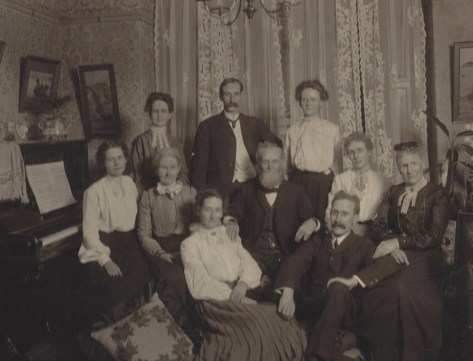
Sarah Ann and her children were known as the Berkeley Street Eagles. They lived at 339 Berkeley Street in Toronto, just a couple of blocks from Seaton Street where her brother-in-law William Eagle lived. He was said to have kept an eye on the family but Sarah Ann seemed to be a strong woman and didn’t need looking after. She had an imposing figure and at some point a glass eye that stared at you when she talked.¹
Sarah Ann was widowed in 1876 when her husband Alexander Eagle was killed at work. He was just 40. Alexander was a teamster and he was loading a wagon with salt barrels when one fell on him.
His wife was left to raise seven children. The oldest, Amelia was 14 and baby Frederick only one year old. Sarah Ann had already lost two children, Eliza Jane at seven and Alfred, Frederick’s twin at only one-month-old. The family continued to live in Goderich, Ontario for a while but then moved to Toronto.
Sarah Ann Esten McMillan was born in Ireland and came to Canada with her family when she was about 14, in 1849. It was a six-week sea voyage in a sailing ship and then the family had to continue from Kingston to Goderich by stage coach. According to her obituary, she used to boast that she made the first salt in Goderich and saw the first train that came into Toronto.²
The eldest child, Amelia was known as Millie. She was a good daughter. She lived with her mother, worked as a tailor and never married. When her brother Frederick and his wife had their first child she moved in with them and was there until her death in 1943.
Martha Ellen the second daughter was said to be the wild one, although at 18 she was still living with her mother and working as a milliner. She left home after she married Harry Shepard, moved to Chicago and had a family. She seemed to turn out well. Her brother William became a baker and he too moved to Chicago. He married and ended up in Los Angeles.
David Eagle, also never married. He lived with his mother and worked as a cabinet maker and house builder. His sister Sarah Ann, known as Annie kept house for everybody at 339 Berkeley Street. After she died in 1949, the house was sold and Dave went to live with his brother Fred in Hamilton.
Emily was a school teacher. She married Edgar Bent when she was 40 and went to live in New London, Connecticut. They had no children and after her husband died she returned to Berkeley Street.
Frederick Eagle the youngest, lived at Berkeley Street until his marriage to Mildred Campbell in 1904. It appears he was lucky to get her. A write up about their wedding stated; “Mr Eagle is a former Goderich boy who is well known and much esteemed in his native town. The bride whom he has been so fortunate in winning is one of the most popular young ladies, an especial favourite with her friends and one who will be missed in the work of the church of which she has been a member from young girlhood.” They had three sons.
Eagles continued to come and go from Berkeley Street even after Sarah Ann’s death at 84 in 1919. Sarah Ann’s favourite saying according to grandson Fred was, “a mickle is a muckle.” This Scotish saying can be a mickle or a pickle but with a muckle generally, means many small things can make something large. I think Sarah Ann would be surprised but pleased to know her house on Berkley Street is now worth almost a million dollars!
Notes:
Upon seeing the farm after so many years the first words out of my mouth were, “I remember it being much bigger!”
“You were much smaller when you spent childhood summers here”, was my husband’s response.
Yes, I had been smaller but there were certainly changes. The perimeter of the property has been slashed. The trans-Canada highway now cuts through the apple orchard behind the house. That night I watched the lights of the big transport trucks where once there were only fireflies lighting up the darkness. The barn is gone, its aged wood sold off as reclaimed wood for trendy furniture. The big vegetable garden is gone, too. No one has time anymore to preserve vegetables. The trees and bushes along the brook are thickly overgrown. There is no sign of the headstones in what was a small family cemetery.
The lilac tree, however, still stands as it has for decades. Beside it now is a large sign: La Gite des Lilas, Caplan, Quebec. It was at this B&B that I had made reservations for two nights.
My grandfather, George Hudson Willett, bought the farm in 1900 following his return from the Klondike Gold Rush. My grandmother, Isabella Maria Gilker, came here as a bride in 1901. Seven children were born and raised in the house, the youngest being my mother. This was where my grandmother died in 1933 when my mother was only fifteen.
My grandfather raised pigs and chickens along with beef and dairy cattle. His eldest son Keith became a butcher, slaughtering the animals and those of their neighbours. Father and son worked together until my grandfather’s death in 1961.
Various siblings left their city homes each summer to return to the farm with their families. The cousins spent sun-filled days playing in the barn, riding the hay wagon, catching brook trout, picking big juicy strawberries, and splashing in the jelly-fish infested waters of the Bay de Chaleur.
Little has changed inside today’s B&B. The four guest rooms were once the family bedrooms. A second bathroom has been added. The original bathroom (missing the large “footed” tub), the fifth bedroom, and a section of the hallway has been closed off to form a small suite. Vintage furniture and quilts evoke the end of 19th century when the house was first built. The tilting hardwood floors are testament to the two hundred years the house has stood overlooking the bay.
The upstairs was once warmed, through grates in the floor, by a huge wood stove in the kitchen. My cousins and I would huddle by these openings straining our ears to hear the adults’ conversation long after we should have been in bed. Today the house is heated by electricity and all the rooms are comfortably warm. Guests are free to watch television with the owners in the “parlor” and are served breakfast in the dining room.
The kitchen has undergone the most change. Gone is the big wood stove. Gone are the chairs and the long table where my aunt would serve a full noon meal to any number of farm hands. Gone are the two cots where my uncle and grandfather napped before returning to the fields. Gone is summer kitchen off to the side where each day the milk was separated from the cream. The summer kitchen is now the owners’ bedroom.
As I drifted to sleep each night in a bedroom where I had once slept as a child, memories emerged, memories all but forgotten. Layers of summers unfold in my mind to be enjoyed once again in the telling.
My husband was an appreciative listener.
Today my own grandchildren are collecting summer memories at a lake in the Laurentions. I had a farm, they have a cottage, but both embody the enduring history of family.
Before 1900, photography was the domain of the expert. Cameras were complicated, film was bulky. That year, the Eastman Kodak company introduced the Brownie camera, a simple box with a lens, loaded with a roll of film, and photography became available and affordable to the general public. My grandmother’s family were early adopters of this new technology, and my grandmother, Gwendolen Bagg (1887-1963), became an enthusiastic photographer.
One of her first subjects was her own house in Montreal’s Golden Square Mile. She photographed not only the exterior, but also the drawing room (living room), with its ornate mantelpiece and heavy drapes.
The majority of photos were taken during summer vacations with the family. Many Montrealers left the city in the summer, not only to escape the heat, but also to avoid the outbreaks of disease that plagued the city in those years. In the early 1900s, the Bagg family went to Cacouna, on the shores of the St. Lawrence River, and they also spent time at a lake near Ste. Agathe, in the Laurentians, north of Montreal.
Gwen photographed her father stretched out on the lawn at Cacouna, her mother in a wide-brimmed hat, and her older sister on horseback and in a canoe. Her little brother, Harold, was a favourite subject. In one picture, taken when he would have about five years old, he posed with his two girl cousins. According to the custom of the day, he had long hair and was dressed exactly like the girls in what appears to be a dress. The following year, his blonde hair remained long, but Harold wore a sailor suit.

In her late teens, Gwen photographed her friends, wearing elaborate bathing costumes on the beach near Kennebunk, Maine. On the porch at the hotel where they stayed, all the young women wore light dresses that reached the ground and covered their arms to their wrists. They must have been very hot.
In 1913, Gwen photographed her mother, by now a widow and dressed in black, leaning up against a big log at Kennebunk Beach, chatting with a friend. By this time, her sister Evelyn was married, and Gwen liked to photograph her little niece, Clare.
The camera must have been a good one, and whoever Gwen shared it with (probably her mother), was also a good photographer. All these photos were in focus, well exposed and tightly composed. Most importantly, Gwen put her photos into albums and identified most of the people, places and years they were taken. She got married in 1916, and after that, although she continued take family photos, the prints ended up in a box, loose and unidentified.
Gwen kept these albums and my mother inherited them and then passed them on to me. Several years ago, I asked the McCord Museum in Montreal whether they would like them. The McCord already had a collection of letters and business ledgers that had belonged to the Bagg family, so these photos shed light on another aspect of their past. The albums are now part of the Bagg Family Fonds, and a few of them have been digitized and can be viewed on the McCord’s website at http://collections.musee-mccord.qc.ca/scripts/explore.php?Lang=1&tableid=18&tablename=fond&elementid=31__true (go to the very bottom of this page).
This article is also posted on http://writinguptheancestors.blogspot.ca
Notes:
I cannot say for certain that my grandmother had a Brownie, but she certainly had some type of simple box camera. The square photos in her album are approximately 3 ½” x 3 ½”, corresponding to the Kodak film sizes 101 and 106. This chart on the Brownie website describes the different sizes of film that Brownie cameras used over the years: http://www.brownie-camera.com/film.shtml. If she did have a Kodak, it was probably similar to the camera described on this website: http://www.historiccamera.com/cgibin/librarium/pm.cgi?action=display&login=no2bullet
 Genealogy Ensemble