The Driving Lesson

I pace the floor nervously. Where IS he? How much longer do I have to wait? He is already 30 minutes late!

It is 23 January 1979 and I have been in Quebec, Canada for all of three months and today is my first driving lesson – EVER. I have never even sat behind the driving wheel of a car. In England, I walked everywhere pushing the children in my Silver Cross upright pram and later, we caught a bus. In Geneva where we had been living previously, we had a small VW Beetle and my husband drove it. Here, we have what to me is a huge car, and I am supposed to learn how to drive it? I am a nervous wreck. My son Owen, aged 5 has to come with me, as I do not know anyone to care for him, and the thought of Owen in the back seat with ME and my first driving lesson has me really worried.  My appointment was for 10 am. At 10:30 I call the school to ask where he is. They tell me he should be there, and to make alternative arrangements when he arrives.

WHAT? All that worry and a sleepless night to make alternative arrangements?! My fear makes me angry. The driving instructor eventually arrives 40 minutes late, claiming to have been ‘ringing the bell’ and I was not answering. I tell him he is very late and I called the school to ask where he was. Then, HE gets annoyed and informs me he has to go or the other client will be ‘tearing his hair out’ plus, I cannot expect him exactly on time in ‘these conditions’ These conditions being heavy snow, wind and ice which is not ideal  for a first ever driving lesson, but what do I know?

I tell him to leave and I am going to cancel future lessons with this school. I shut the door and cry and cry I feel like a failure. I’ll never learn to drive. Eventually, I mop up and call the school and demand a refund. The director was very kind and said the instructor was wrong trying to justify his lateness.  He would make another appointment. ‘Not with HIM’ I rage. No, another person he soothes. I put the phone down, have another cry. I feel so frustrated, angry nervous and very alone. I wept for most of the day. Two days later, after 2 and half hours of snow clearing another strange ritual, I have my first driving lesson.

The instructor this time is a Welsh man and he is very patient telling me to relax. Ha! relax? No way! The sweat is actually running down my back and I can’t stop trembling. How do I work the window wipers in this snow? Put the heater on? Which side of the road am I supposed to be on? Why is there a ‘Stop’ sign at every corner? I manage to get to the next street and it is covered in thick ice. A water main has burst, and the street is like an ice rink or what I would imagine an ice rink to be, having never seen one. Oh! the anxieties and fears of being a newcomer.

Eventually, I do get my driving license, and today I love to drive but those few fraught months of learning is something I will never forget but the bonus is, that driving in snowy icy weather here in Quebec is a breeze for me now! I have no fear.



A Dedicated Life

We were sitting on a bench at a short par three at our local golf course, waiting for the green to be free. Louise and I struck up a conversation that turned out to be serendipitous. We had known each other for more than seven years. The name of Soeur St. Emile had never been mentioned. She began talking about her great aunt, Tante Soeur St. Emile, a Grey Nun of the Cross in Ottawa., also known as the Sisters of Charity of Ottawa. Hearing this, my curiosity was piqued.  My mother often talked about her aunt, Soeur St. Emile, a grey nun who was the Superior of the boarding school in Alymer where she had been a student. Could it possibly be the same person? What were the chances of that?

Louise and I chatted and came to the conclusion that her grandmother and my grandfather were brother and sister!  Soeur St. Emile was their sister.  Indeed it was the same person and we were related.

Marie Louise Jodoin  (Soeur St. Emile) was born November 16th, 1862 in Montebello, Quebec, a community on the Ottawa River not far from Hull. As a youngster she attended the local convent school where the Grey nuns taught. Her family moved to Hull and she remained in Montebello as a boarder until the new school in Hull was completed in 1870.

Louise was eight and a half years old when her mother died and a year later her father remarried. No doubt this must have had a strong impact on the little  girl. Music became her passion at this very young age.  She took piano and singing lessons and had a talent for both. At the age of sixteen she entered religious life through the doors of the Mother House of the Grey Sisters of Ottawa  on Bruyère  Street  and for the next 75 years she lead a  life of prayer and dedication along with  an active life devoted to teaching piano and singing lessons. She was also called upon to serve as a Superior during 37 of those years in various schools and hospitals under the jurisdiction of the community.

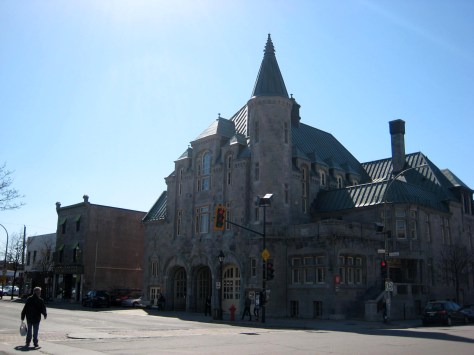
Mother House
Mother House –  Bruyère Street, Ottawa

August 15th, 1940 after 62 years of active service to the community she walked through the same door as day the she had  entered the convent. She had come full circle. She was coming home. On April 14th 1942 the community rejoiced as they celebrated her Diamond Jubilee.

Through out her latter years, Soeur St. Emile devoted much of her time to prayer, however, she continued to maintain contact through correspondence with many of the people whose lives she had touched. “La petite Estelle”, my Mom, was one of those people and even after all those years she would always ask her about the children.

She was truly an intelligent and  remarkable women who excelled at everything she did. She died in her 91st year and in her 75th year of religious life.

I would be remiss if I did not tell you the following: When I saw my parents shortly after my conversation with Cousin Louise on the golf course that summer afternoon  of 1984, I asked them a few questions. My mother was a little perplexed and my father piped up and told me the story about meeting Soeur St. Emile in September of 1930 while he and my Mom were on their honeymoon. They had stopped in Hull to see her on their way to Quebec City. Dad pointed out that she was a  rather buxom lady who took him in her open arms and welcomed him in to the family. Needless to say, it was a very meaningful gesture he never forgot. He made a gesture of open arms and said, “ Elle ma embracé.”He then proceeded to tell me the names of all the relatives he had met during that visit and this was almost 50+ year later!

Soeur St. Emile left a lasting impression with him and most likely with many of the people she had met over the years.

bruyere
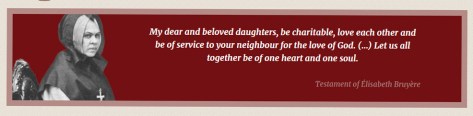
Words to live by — Elizabeth Bruyère

Source:

With gratitude to my cousin, Louise Pinault for giving me a copy of a short biography that was written a year after the death of our Great Aunt. It was penned  by a member of the Grey Nuns of Ottawa on the 8th of August 1953.


Border Raiding Ruffians

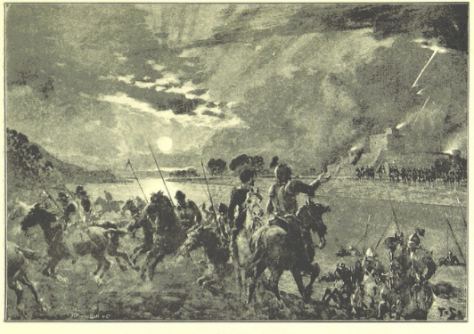
Border Raider and Reivers Public Domain

  Border Reivers: They were often romanticized in art.*

Growing up in Montreal in the late 1960’s and early 70’s, I was often asked, “Are you related to HIM?”  They were referring to Richard Nixon, President of the United States from 1969 to 1974, also a Vice-President from 1953 to ’61.  To this I would reply an emphatic “No! I’m English.  He’s Irish.” I always wanted to add, “Do you ask everyone named Johnson if they are related to Lyndon?”

My father was the one who insisted we were not related to Richard Nixon. Dick was an Irish Nixon, Daddy said. Our Nixons were English. My father also told me, with a sly self-effacing wink, that our Nixons were sheep stealers.  It all sounded a bit cockeyed to me.

Today, 50 years on, I am engaged in working out my genealogy. I’ve had my DNA tested at Ancestry and I’m growing a tree. It seems that my dad was right on two points, about the sheep and, possibly, about Richard Nixon’s Irishness, but not about our family’s relationship to the late American President.

We probably do come from the same ancient stock.

I’ve just learned the Nixons of Northern England are descended from Border Reivers, families from the lawless, burnt out Scottish/English border regions of the British Isles  (Cumberland and Northumberland) who raided other people’s livestock for a living. If you are a Nixon, Forster, Graham, Armstrong, Bell, Eliot, Robson, Crozier, Kerr, and yes, Johnson, you might be descended from these 13th to 17th century outlaws.  Apparently, the Nixon Administration was full of them.

As it happens, I am both a Nixon and a Forster.  An alleged ancestor of mine, illustrious Border Reiver Sir John Forster of Northumberland, was knighted for his service to Queen Elizabeth I in 1557. Sir John was lucky to be on the winning side of two key battles. His castle was in a strategic location on the “middle march” section of the border, so, apparently, he enriched himself with his share of the spoils from all local cattle raids, in England and Scotland.

The Nixon Clan has an even sketchier reputation. According to some accounts, they were “rude borderers” from Carlisle, Cumberland, who held no allegiances (except to the Armstrong Clan) and felt at home on either side of the border.  They were real baddies who were exiled to Ireland and, then, kicked right back to England. Many in the clan were hanged for their transgressions at Carlisle Castle.

That is likely where my father got the idea that Richard Nixon was an Irish Nixon.  I suspect my great grandfather, Robert Nixon ( 1863-1937), a sawmill worker in Helmsley, Yorkshire in the 1920’s, filled his young grandson’s head with many a grand, romantic tale of their burly, bearded ancestors, skilled light horsemen on  fleet-footed stallions, engaging in strategic, daring cattle raids on the Scottish border.

It appears that these Border Reiver families can be described as reckless ruffians on horseback and/or heroic defenders of the monarchy; scoundrels or heroes; charming rascals or organized crime. It’s only point of view.

Just don’t blame these people for their wild way of life.  In the 13th to 17th centuries, the area around the English/Scottish border was ravaged by warfare and not suitable for farming. Raiding sheep and cattle was just a way to earn a living. Also, the exact location of the border was disputed.

The BBC paid homage to these Border Reiver families with a TV show in 1968 called “The Borderers,” featuring a young and handsome Michael Gambon. The adventure series never came to North America, but I have found it on YouTube. If the BBC series had come to Canada back in 1968, when I was 13, I doubt it would have appealed to me any more than any other small screen horse opera.

But my father would have been mightily impressed.

* Illustration at top from book  Border Raids and Reivers, Robert Borland. Available on Archive.org and in the public domain.

Here’s  Sir John Forster’s Wikipedia page.

https://en.wikipedia.org/wiki/John_Forster_(soldier)

You can read more about the Border Reivers on the Historic UK website, where I got some of my info.

http://www.historic-uk.com/HistoryUK/HistoryofScotland/The-Border-Reivers/

Read about their connection with the Nixon Adminstration here.

http://articles.latimes.com/1996-02-11/news/mn-34692_1_border-reivers

“Supercalifragilisticexpialidocious”

“Supercalifragilisticexpialidocious” called out my grade two teacher as the last word on our daily spelling test. It was the surest way to get our full attention on that April Fool’s Day!

When I begin to work on a story about one of my ancestors, it is not always clear on how to best start the story.  One very helpful tip, from the Genealogy Ensemble writers group, has been to find a way to capture the reader’s interest in the first few sentences.

Dick Francis, a famous British jockey and thriller writer (and one of my favourite authors), began almost all of his books in this fashion.

Here are some examples of excellent openers from stories posted on our website Genealogy Ensemble:

  1. A Small Life by Barb Angus – https://genealogyensemble.com/2015/10/21/a-small-life/

“I hold the documents as gently as I would the child for whom I have searched for so long. A birth certificate. A death certificate. Four days apart.”

  1. Call me Ismael by Mary Sutherland- https://genealogyensemble.com/2015/11/04/call-me-ismael/

“He arrived when the service was almost over. He walked to the pulpit and announced the last hymn “Seigneur Tu donne Ta Grace.” As the organ played he collapsed to the floor. So ended the life of Ismael Bruneau, my great grandfather.”

  1. The Cipher by Sandra McHugh – https://genealogyensemble.com/2017/02/08/the-cipher/

“When I say that my grandfather, Thomas McHugh, worked as a cipher, Bletchley Park, MI5, and Russian spies immediately come to mind. He was neither a Russian spy nor did he work as a cipher during the war. His employer was the Bank of Montreal and it was his first job when he came to Canada in 1912.”

  1. No Fairy Tale Ending by JaniceHamilton https://genealogyensemble.com/2015/02/11/no-fairy-tale-ending/

It must have been a happy wedding. For a girl from relatively humble American roots to marry the owner of one of Quebec’s vast seigneuries, this must have seemed like a wonderful match. And the groom had recently lost his parents, so family members were no doubt pleased to see him marry. Unfortunately, there was no fairy-tale ending to this story.”

  1. Like Father, Like Son by Lucy H. Anglin – https://genealogyensemble.com/2016/06/01/like-father-like-son/

“My husband was mesmerized by the photo of a young man hanging in a sling close to the giant propeller of the airplane he was repairing.  He had never seen it before.  It was a photo of his father, Allan, in his early twenties.”

Nonsensical words are great fun for children, but I think the opening sentences of these stories are excellent examples of how to capture my interest as an adult reader.

Aren’t Birthday Parties Fun?

By Sandra McHugh

Aren’t birthday parties fun? I was thinking this recently when we celebrated my daughter’s 30th birthday at the Auberge Saint-Gabriel in Montreal. I was also thinking how a birthdate is such an important indicator in genealogy research.

A birthdate and a place of birth places a family member in a period of time and in a location that can tell us a lot about the social context in which the person lived. Buildings and their uses can also tell us a lot about a place.

The Auberge Saint-Gabriel in Montreal is one of the oldest buildings in the city.  It was built by Etienne Truteau, a French soldier in 1688. 1 In 1754, it was the first inn in North America to be issued a liquor license. 2 Over the centuries it has had many vocations, including the Beauchemin printing press operation founded in 1860 and that printed the newspaper Le Patriote.3

And who doesn’t love a good ghost? It is said that the Auberge Saint-Gabriel is haunted by a little girl who lost her life when a fire raged through the ground floor, trapping her and her grandfather upstairs while her grandfather was teaching her to play the piano.4

Today, the Auberge Saint Gabriel is a trendy restaurant and reception centre right in the middle of Old Montreal. If you go inside, you can see that the owners continue to maintain the building as much as they can in the style that it was built. You can appreciate the thick brick walls, stained glass windows, and the many antiques that grace its rooms. If you like, you can go down to the basement to visit the place where there was a fur trading post. Today, this fur trading post is a speakeasy, called The Velvet.5

I am quite confident that almost all of my ancestors who lived in Montreal would have at least walked by or had business in or around the Auberge Saint Gabriel.  And who knows? Maybe our descendants would be pleased to know that we dropped off our car at the door of the Auberge Saint Gabriel for a fun-filled night at the speakeasy.

What buildings are important to your family’s history?

  1. L’Auberge Saint-Gabriel web site. <http://aubergesaint-gabriel.com/historique/>, accessed June 12, 2017.
  2. Wikipedia article on Auberge Saint-Gabriel. <https://en.wikipedia.org/wiki/Auberge_Le_Saint-Gabriel>, accessed June 12, 2017.
  3. Wikipedia article on Auberge Saint-Gabriel, accessed June 12, 2017.
  4. Benoit Franquebalme, “Garou : Propriétaire d’une auberge hantée !”, France Dimanche, January 1, 2016, <http://www.francedimanche.fr/infos-people/musique/garou-proprietaire-dune-auberge-hantee/>, accessed June 12, 2017.
  5. L’Auberge Saint-Gabriel web site, accessed June 12, 2017.


New Book Tells History of Mile End

Hundreds of special events are taking place in 2017 to mark the City of Montreal’s 375th birthday, but the one that means the most to me is the publication last month of a history of the Mile End district of Montreal. Some 200 years ago, that was where my three- and four-times great-grandparents lived.

There, at the intersection of the only two roads for miles around, Stanley Bagg and his father Phineas ran an establishment called the Mile End Tavern. Their landlord and future in-law, an English-born butcher named John Clark, probably came up with the name Mile End. The tavern was at the corner of what is now Saint-Laurent Boulevard and Mont-Royal Avenue, and the whole area eventually acquired the same name.

Mile End has no formal boundaries, but it is essentially just to the northeast of Mount Royal, as far as the railroad tracks. Some of the area’s streets are known far beyond Montreal: Saint-Urbain, for example, was made famous by author Mordecai Richler, and both Saint-Viateur and Fairmount streets have bagels named after them. Other well-known streets include Laurier, Parc, Saint-Joseph and Jeanne-Mance.

IMG_8942
This fire station at Laurier and Saint-Laurent was once town hall of the suburban Ville de Saint-Louis. jh photo.

It is a vibrant neighbourhood, home to musicians, teachers and software developers, trendy restaurants, second-hand shops and rows of triplex and duplex dwellings, often featuring Montreal’s iconic outdoor staircases.

Histoire du Mile End, the first book to focus on the area’s history, was written by former journalist Yves Desjardins. His journalism background shows: he has researched his subject thoroughly in newspaper accounts, archival sources and academic articles, and pulled it all together in clear, concise language. I can attest to how readable it is because, although the book is in French, I have had no trouble reading it. It helps that the book is generously illustrated with historic photos and maps.

Over the decades, Mile End has been home to waves of immigrants, starting with French Canadian job-seekers who moved to the city from the Laurentians, and including Jewish immigrants from Eastern Europe, Italians, Portuguese and Greeks. Many of the area’s residents worked in the nearby Peck Building, labouring in low-paying jobs in the garment industry; today, the Peck Building is home to Ubisoft, a major player in the video game industry.

Just as it takes a village to raise a child, sometimes it takes a community to write a book. Yves had help from friends and neighbours — many of them members of the local history group Mile End Memories — who gave him access to their own research and expertise. I provided him with information about my ancestors the Baggs and the Clarks, and the collaboration paid off for both of us: I was able to fill in family information he didn’t have, and he helped me understand the historical context of my ancestors’ lives.

I learned that Saint-Laurent Boulevard, the traditional dividing line between the western part of the city, where the majority of English-speaking Montrealers live, and the eastern part, which is overwhelmingly French-speaking, was the only road leading north out of the city in the early 1800s. The Baggs owned much of the land on the western side of Saint-Laurent, and it remained primarily rural until the 1890s. Much of the land on the east side was owned by the Beaubien family, and early residents worked in local tanneries and quarries.

At the end of the 19th century, a group of real estate promoters from Toronto tried to develop a “strictly high class suburb” in Mile End called the Montreal Annex. While they did manage to attract a few professionals and their families, the scheme eventually failed. For decades, most of Mile End’s residents were strictly working class, or worked at skilled trades such as shoe-making and carriage-making.

carriage drive
Carriages, not cars, once used this entrance between row houses. jh photo.

Meanwhile the area experienced many growing pains as politicians argued over taxes and infrastructure, and promoters battled to provide the public transportation (by electric tram and rail) that was key to the area’s growth.

Today, as the city of Montreal rebuilds its infrastructure and controversy surrounds plans for future residential projects and transportation corridors, it seems that some things haven’t changed much.

Yves Desjardins. Histoire du Mile End, Québec: Éditions du Septentrion, 2017.

See also:

Janice Hamilton, “The Mile End Tavern”, Writing Up the Ancestors, Oct. 21, 2013, http://writinguptheancestors.blogspot.ca/2013/10/the-mile-end-tavern.html

Mile End Memories, http://memoire.mile-end.qc.ca/en/ This site includes articles in English and in French, photos, an interactive map that indicates the location of many historic buildings, including the Auberge du Mile End (Mile End Tavern), and a link to summer walking tours of the area.

This article was simultaneously posted on http://writinguptheancestors.blogspot.ca


Ida Girod Bruneau

scan0145

Ismael Bruneau wanted a biblical family, one child for each of the 12 tribes of Israel. His wife Ida didn’t share that ambition, but still, they had 10. When one of her daughters was getting married she asked her mother what she could do to prevent the arrival of so many children and Ida answered, “If I knew, do you think I would have had all of you?” 

Ida herself came from a very large family. She was born in 1862 in Les Convers, Switzerland, to Gustave Girod and Sophie Balmer, the sixth of 16 children. Her favourite aunt, Celine Balmer was teaching at a private girl’s school in Baltimore, Maryland and arranged a job for Ida at the same school. In 1882 Ida sailed to the United States for the teaching position.

After a particularly bad year, with many deaths in the family, her parents decided to emigrate to America. Another son tragically died on the voyage and was buried at sea. The Girods were farmers and settled in the French community of Kankakee, Illinois. When Ida went to visit, she met the Minister, Ismael Bruneau. He was taken with her and they were soon married.

Ismael and Ida then lived in Green Bay Wisconsin where their first three children, Edgar, Beatrice and Hermonie were born. A French Protestant minister moved frequently and the next charge was in Holyoke Massachusetts, where Helvetia was born. Next was a move back to Canada. Sydney, Fernand, and Edmee were born in Quebec City and Renee, Herbert and Gerald in Montreal. All the children survived except Fernand. My Grandmother Beatrice said it was his name that killed him but we didn’t understand why as we thought the other siblings had stranger names. They played funeral with him and pulled him around in a wagon covered with flowers.

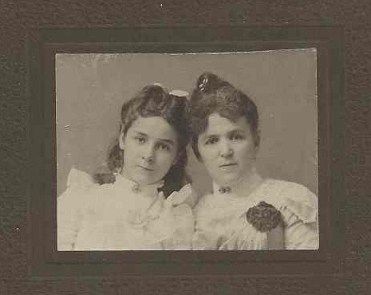
Beatrice and Ida
Beatrice Bruneau and mother Ida 1900


Although a minister’s salary was meagre the family survived and flourished. The first two sons went to McGill. One became a doctor and the other a lawyer. All the girls finished high school, went to Normal school and became teachers except Renee who attended Business school. The two youngest boys were still at home when their father died. There wasn’t the money to send them to university but they both became successful businessmen.

Ismael’s death was a shock to Ida. He had preached at an earlier service in Portneuf and ran uphill from the station in Quebec City, as the train was 50 minutes late. He arrived at the end of the service and died of a heart attack. Her heart was broken, “ I must realize that my dear husband of nearly 32 years has left me forever.” She moved to her daughter Helvetia’s home in Lachute, a town Ismael had felt would be a good place to retire. She went back to Switzerland because her aunt Celine had returned, but Celine was suffering from dementia and with all other friends and family gone Ida decided her life was in Canada.

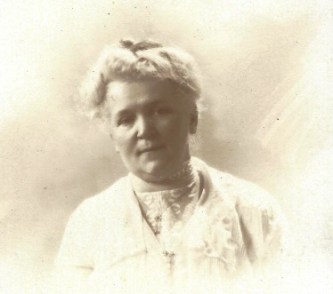
scan0144
Ida Girod Bruneau Frechette 1925


One of her husband’s brothers-in-law, Emilien Frechette, whose wife Emilina Marie Bruneau had died, proposed that as they were both alone they get married. He had built himself a large house in Iberville south of Montreal and wanted company. My Aunt Aline remembered hating her mother’s visits to Iberville because she would come back with large baskets of gooseberries, red and black currents, which had to be cleaned for jam and pies. Aline’s other memory of her grandmother Ida was teaching her to play rummy and seven up. Aline said, “ She liked the little games they played and thought the ‘Devil’s plaything’ was a misnomer.” It was fine to play cards, just not on Sunday.

Ida developed cancer and spent her last days in the Montreal General Hospital. She was buried in Mount Royal Cemetery in the Frechette plot with Emilien’s first wife Marie. After Ida’s death in 1927, he married Emilie Beauchamp Bruneau, the widow of Napoleon Bruneau, Ismael’s brother. Emilien certainly looked after the women in the Bruneau family. My mother remembered him as a nice old man. She didn’t remember her grandmother who died when she was five but she did remember visiting Monsieur Frechette in Iberville, going to the toilet and thinking, “My grandmother sat here!”

Endnotes:

Bruneau, Ida. A Short History of the Bruneau – Girod Families. 1993.

Bruneau, Ida. letter to Mes Frere et Soeur. February 5, 1918. Quebec City, Quebec. A copy in the author’s possession.

Aline Raguin Allchurch. Letter to Mary Sutherland. 2002. Author’s possession.

Dorothy Raguin Sutherland’s Stories. Personal interview. 1998.

Ancestry.com. Quebec, Canada, Vital and Church Records (Drouin Collection), 1621-1968 [database on-line]. Provo, UT, USA: Ancestry.com Operations, Inc., 2008. Original data: Gabriel Drouin, comp. Drouin Collection. Montreal, Quebec, Canada: Institut Généalogique Drouin.

Here is a link to Ismael Bruneau, Ida’s husband.

https://wordpress.com/post/genealogyensemble.com/1237

Solving Brick Walls


Sherlock Holmes, Dr. Watson and Dick Tracy were fictional detectives who most likely would have been great genealogists. These detectives solved crimes searching for clues. In the case of genealogists, they solve their problems by perusing through records pertaining to their ancestors. These records are available through church records, court record, land grants and  many other sources to answer their queries with the utmost accuracy and develop family trees. In today’s world  a wealth of computer programs are available to help the genealogists in their research

Researchers in genealogy often encounter what are referred to as “brick walls”, where they are unable to find the vital  information they need to verify a source in order to continue their research. Such was the following case.

Records showed that Moyse Hypolite Fortin was married to Henriette Bertrand. However, there were two separate records for the birth of an Henriette Bertrand. The first was born in Vaudreuil in 1811 while the second was born in Ile Perrot several kilometres away in 1813. Which of these might be his wife?

Over several months  searches of various records were done to find a possible answer, one that would  clarify which Henriette was his wife. Some of the records were hardly read-able making it that much more difficult. It was a major problem and a setback.

Finally a record was found that could possibly be the answer to our question?. To verify this find and  to be certain it was the correct person, a visit was made to Centre d’histoire La Presqu’ile in Vaudreuil where the young archivist  showed me the documents indicating that it was Henriette Bertrand, daughter of Joseph François Bertrand and Scholastique Sabourin,  born in Ile Perrot on March 7th 1813.

Finally, one more “brick wall” scaled. Persistence paid off!  On to the next one!

498201332

Tears of Remembrance

Remembrance Day services always bring me to tears.
My childhood was spent in the shadow of World War II. My father, Douglas Ian Rankin Angus, and my uncle, James Oswald Stewart Angus returned home from overseas but they left an older sibling in a grave in Germany 1. My grandparents grieved for the rest of their lives.
My earliest memory of Remembrance Day is of my father parading down Quebec City’s Grand Allee to the cenotaph with his head held high, so handsome in his RCAF uniform. No tears then, just a stiff upper lip.
The first tears I remember were shed when I was fifteen. On the way home to Canada from a contract in East Pakistan, my father took his family to Hong Kong. At the Sai Wan Bay War Cemetery, my dad stood by the graves of many of his high school classmates who had served with the Royal Rifles of Canada in the defense of Hong Kong and sobbed. It was the first time I had seen my father cry and I was shocked. 2
In school that September my history teacher was one of the men who survived the horror of a Japanese POW camp. “He was never the same”, claimed my grandmother. Was my father also not the same man who joined the air force in 1940?
Dad never spoke of his war-time experiences. When discharged from service he returned to his old job at Price Brothers in Quebec City, bought a house and started a family. I often wonder how he and my mother were able to resume a marriage after four years separated by war. Dad spent additional periods of time in a military hospital following his discharge. All I knew is that while hospitalized, he made wonderfully big stuffed felt rabbits for my brother and me.
Every year without fail Dad took part in Remembrance Day services. He joined the Canadian Legion and sold poppies; he presented scholarships to the children and grandchildren of veterans at graduation ceremonies ; he attended squadron reunions and, following several medical procedures, convalesced at the Veteran’s Hospital in St. Anne de Bellevue .
I struggled to push my father’s wheelchair over the bumpy lawn at the Field of Honour in Pointe Claire on what would be his last Remembrance Day. Tears streamed down his face throughout the entire service and he sobbed uncontrollably during the Last Post. At his funeral seven months later, at age eighty- three, friends and colleagues who had also served overseas hobbled up to the altar in tears and laid poppies on his urn.
It was only after his death that I learned of dad’s war time service. I found his Pilot’s Flying Log Book, his service file, his discharge papers, a scrapbook of newspaper clippings my mother had complied, various certificates and a bundle of letters.3
Dad began his military service as a Wireless Air Gunner and was discharged to the Reserves as a Flight Lieutenant. He was trained to fly Hampdens, Elbacores, Wellingtons, Tiger Moths, Ansons and the Link C. He served in the Swordfish Squadron #415 and, when deployed oversees, he was assigned first to the RAF Costal Command and then to Bomber Command. He flew out of air force bases at Thorney Island, North Coates and St. Eval in England, Tain and Leuchars in Scotland, and Sumburg in the Shetland Islands.

The average expectation of life for nine crews out of ten was less than six months.
In one of the articles my mother clipped from the Quebec Chronicle Telegraph, Dad was listed as a Dambuster having participated in the 1943 bombing of the Mohne Damn and the Eder Damn which destroyed the heart of Industrial Germany in the Ruhr Valley: the factories, roads, railroads, mines, bridges and power stations.4.
One journalist attempted to interview a returning Dambuster and was told that the men had been ordered not to talk about it. It would seem that Dad never disobeyed order. In the his book Bomber Country, Daniee Swift refers to the “forgetting” by the bombers, “For in the place of a full record of the bombing, there is a curious absence.” 5
More than 500,000 German civilians were either killed or drowned in the raids on the damns. Immediately following the war the politicians of the day argued that to honour Bomber Command for their enormous contribution and sacrifice towards defeating Hitler was too politically charged because of the deaths. It was not until 2012, sixty-seven years “too late” that a memorial to Bomber Command was unveiled in Green Park, London. By then, Dad had been dead for nine years and with him the loss of the stories he never told.
And of the Remembrance Tears? They are shed for the bombers and for the bombed.

1. Service Record of Sergeant David Colin Brodie Angus, Library and Archives Canada
2. http://www.veterans.gc.ca/eng/remembrance/history/second-world-war/canadians-hong-kong
3. Documents on file with author
4. http://www.dambusters.org.uk/
5. Daniel Swift. Bomber Country: The Poetry of a Lost Pilot’s War. New York: Farrar, Straus and Giroux, 2010

Fact and Fiction in Family History

The conclusion of one of the stories on Vita Brevis, the New England Historic Genealogical Society blog, demonstrates a typical family historian dilemma.

“We still don’t, of course, know who wrote down the story, when, or how likely they were to know the true facts of the case, but someday the original family version may surface.”

Alicia Crane Williams’ conclusion to her post about a man whose ancestor’s wife allegedly received a dowry equal to her weight in gold (http://vita-brevis.org/2017/01/poor-man-in-london/, Jan 9, 2017) was exactly as it should be. An important part of our job as family historians is to clearly make the distinction between history and story, fact and myth. Williams came across the story while researching a sketch of Henry Lamprey of Hampton, New Hampshire, but as far as she could tell, it was just that: a family story. She read it in an 1893 history of the town and traced an earlier reference, but she was still trying to figure out how much – if any – of the tale was based on fact.

As family historians, we all run across family stories, some amusing, others tragic. We are usually thrilled to find these stories since they help fill in some of the blanks between our ancestors’ birth and death dates. But that does not make them true.

Accounts written at the end of the 19th century are often suspect. Many towns in North America published books featuring profiles of prominent members of their communities. These accounts were usually provided by the families and they tended to emphasize the positive rather than relying on solid research.

My ancestor Stanley Clark Bagg is a good example. After he died in 1873, several Montreal “historians” wrote about his family’s roots. My research has proved that they made an error and this misinformation has been perpetuated until today in the Dictionary of Canadian Biography. (See “The Biography of Stanley Clark Bagg: Don’t Believe Everything You Read”, Genealogy Ensemble, Dec. 2, 2015, https://genealogyensemble.com/2015/12/02/the-biography-of-stanley-clark-bagg/

Also common is the story about families being descended from royalty, aristocracy or the very wealthy. My MacGregor ancestor was supposedly descended from the clan chiefs and my Hamilton ancestor, a tailor, was – you guessed it – allegedly related to the Dukes of Hamilton. None of my research has showed either claim to be true.

Our job as family historians is not to just to repeat family stories as facts but to try to verify them and to correct the record when necessary, or at least indicate that there is doubt about a story. Many family stories do contain kernels of truth, and it is often helpful to put our ancestors’ lives into historical context. But if we can’t sort out what is fact and what is fiction, we have to be clear that we are recounting an unverified story.

Working together to help genealogists discover their ancestors