Who would have thought that finding the immigration records of my grandparents would have led to me to learn about two British government initiatives designed to promote emigration to Canada in the 1920s? I was browsing the Library and Archives Canada web site and found digitized records of Form 30 that recorded the entry of every immigrant between July 1921 and December 1924.1 I was thrilled to find the form that my grandfather, George Thomas Deakin, signed in August 1923, and the one that my grandmother, Grace Graham Hunter, signed in February 1924.
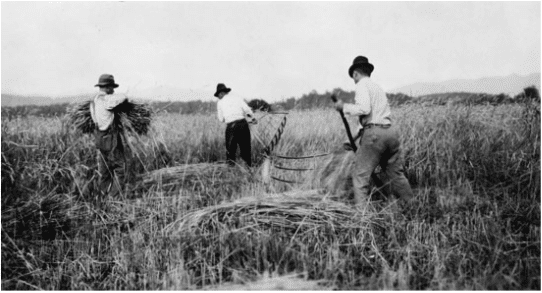
My grandfather’s form indicated that he came to Canada as part of the Harvester Scheme. In 1923, Canada had a bumper wheat crop and North America could not provide the labour needed to harvest the crop. Under the Harvester Scheme, the two major Canadian railway companies entered into an agreement with the British government to transport 12,000 workers out west where they would earn $4.00 per day plus board. This was considered a successful scheme as 11,871 migrants came to Canada to work on the farms in Western Canada. The harvest was successfully completed and 80% of the harvesters stayed and were considered “successfully assimilated.”2
Source: The Farm Collector
Like the Harvester Scheme, The Empire Settlement Act was also an initiave to provide Canada with badly needed labour. It was passed by the British Parliament in 1922 and its purpose was to provide an incentive for migrants to settle in the colonies. Canada badly needed farm labourers and domestic workers. At that time, the Canadian government favoured immigrants from Great Britain as a means of ensuring the predominance of British values. In the early 1920s, it was difficult for Canada to attract immigrants from Great Britain as Britain was enjoying a period of prosperity right after World War I. Another reason was the prohibitive cost of transatlantic transportation. Even passage in third class would have been expensive for a farm labourer or a domestic worker.3
My grandmother came to Canada to enter into domestic service as a cook and her destination in Montreal was the government hostel. Hostels were located in major urban areas across Canada. These hostels were partially funded by the provinces and immigrants from Great Britain were allowed free dormitory accommodation for 24 hours after their arrival. Young ladies were looked after by the Superintendent of the hostel and referred to a church worker. They were also referred to Employment Services of Canada who would find them employment.4
On September 26, 1912, a tall, slim, beautiful and well-dressed young woman stepped off the train at Viger Station in Montreal to be met, well, by no one.
There was a group of local reporters on the platform but they were waiting for someone else to arrive, someone far less fetching, as it were.
The journalists were expecting Barbara Wylie, a British suffragette. Wylie was one of Mrs. Pankhurst’s radical troops and British suffragettes were mostly manly, weren’t they?
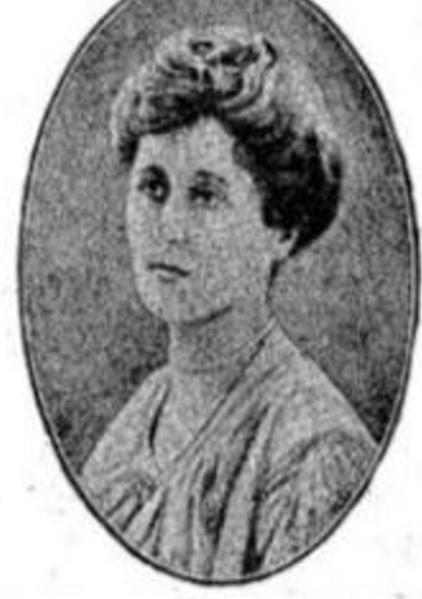
Barbara Wylie 1912.
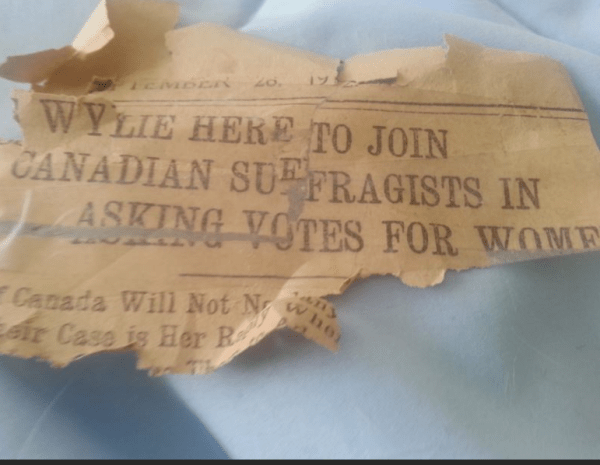
When the reporters realized that this stylish beauty was, indeed, Miss Wylie it caused quite a commotion according to a newspaper article in the Montreal Witness clipped by my husband’s great aunt Edith Nicholson.
The reporters immediately raced over and encircled the lovely lady.
Barbara Wylie did not disappoint on the radical front. The Scottish firebrand brashly answered questions about her reason for coming to Canada and glibly defended a British suffragette who recently had thrown a hatchet at British Prime Minister Asquith. “Had it hit the mark, it might have knocked some sense into him.”
Whoa!
Remnant of the Montreal Witness clipping.
When I first found the Witness newspaper report among Edith’s massive stash of yellowed newspaper clippings on the suffrage movement, it did not make an impression on me. I had heard of the British suffragettes, for sure. Who hadn’t? But, the name of Barbara Wylie meant nothing.
And I knew zilch about how, around 1910, some of Emmeline Pankhurst’s troops visited Montreal to try and convince “inert”1 Canadian suffragists that not-so-peaceful protest was actually the way to go.
Lets’ face it: there was nothing about Canadian women suffrage in my 1968 high school history book.
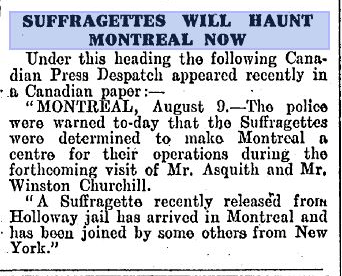
Haunt. Hmmm. Interesting choice of verb. Suffragettes were technically banned from coming to Canada. So the two suffragettes who did come,Caroline Kenney and Barbara Wylie, had Canadian relations and came on family visits.
Miss Barbara Wylie was head of the Edinburgh Chapter of Mrs. Pankhurst’s Women’s Social and Political Union. She came to Canada in 1912 on a year-long country-wide tour, but her loose-cannon ways did not get her far.
In Montreal, on November 4, 1912, Wylie climbed the speaker’s platform at the YMCA as a guest of the Montreal Local Council of Women. News reports say she was wearing a pretty powder blue silk dress, but her rhetoric was of the red-hot variety.2 “Why speak of men as brave and women as pure? Would it not be better to bring the idea into society that men can be pure and women brave?”
The meeting had to be adjourned early when a fist fight nearly broke out – between two men.
Edith Nicholson, 27, didn’t attend Wylie’s rowdy Montreal speech. A family letter reveals Edie returned home from Montreal to Richmond, Quebec on November 2. But the Montreal Witness clipping isn’t the only document I have that suggests Edie, an over-worked, under-paid teacher at Ecole Methodiste Westmount, was all for the “hysterical” window-smashing suffragettes.
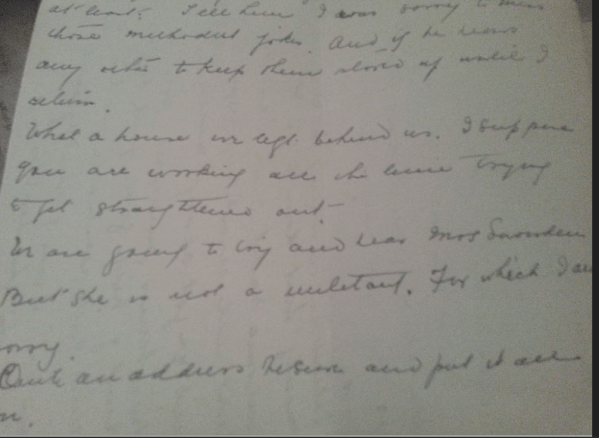
“So sorry” Mrs. Snowden was NOT a militant. May 1913 letter to Mom
On May 2, 1913, Edie is in Montreal with her two sisters, Marion and Flo, and she writes this in a letter home to her mom, Margaret: “We are going to hear Mrs. Snowden speak. But she is not a militant for which I am very sorry.”
This sentence, too, I might well have over-looked had it not been for that Wylie newsclipping because that fragile disintegrating memento prompted me to conduct more in-depth research on the messy, all-but-forgotten Montreal suffrage movement.
The first British suffragist brought in by the Montreal Council of Women was Mrs. Ethel Snowden, in 1909. Snowden was the young wife of a British Labour M.P. She spoke at Stevenson Hall.
Described in one report as “a daughter of the gods, divinely fair,” Snowden’s oratorical skills also impressed that day. She condemned the British militants, who were just beginning their ‘deeds, not words” path, saying “Mrs. Pankhurst has unleashed a Frankenstein monster.”
The Council soon passed an ambiguous resolution somewhat in favour of women suffrage.
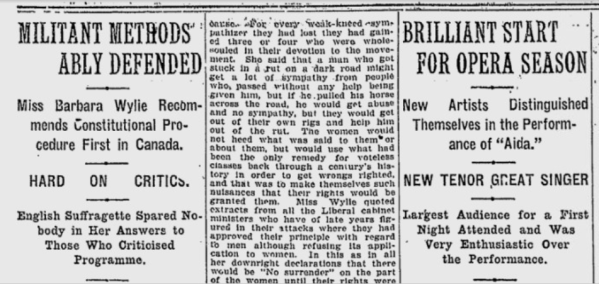
Montreal Gazette places suffragette news beside opera news. You can make what you want of that.
Emmeline Pankhurst, herself, visited Montreal in December, 1911. She was brought in by Council President, Miss Carrie Derick (a closeted suffragette sympathizer) “so that women could hear the other side of the suffrage story.”
In her speech at Windsor Hall, the famed feminist, looking tired and frail, stated her case with eloquence but she made sure to avoid provocative language.
So afraid were Montrealers of Mrs. Pankhurst (whose troops back home were angry at Asquith over a broken promise) that the Council had to give away 200 tickets at the last minute and only broke even on the night. Mrs. Pankhurst’s fee was considerable too. After all, she was on the tour to raise money for lawyers.
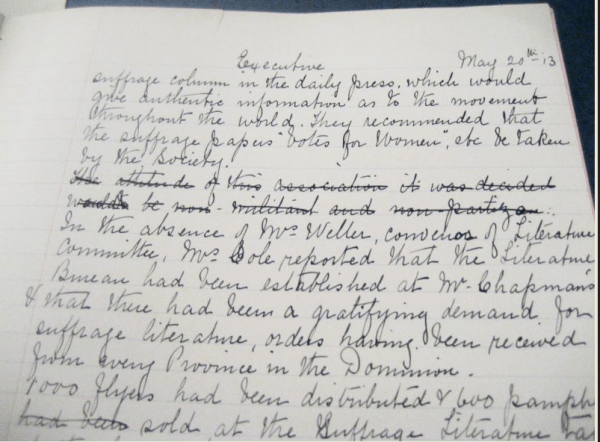
Minutes of MLCW launching Montreal Suffrage Associationat at the time of Mrs. Snowden’s second visit. Someone has crossed out the line where it says the organization is non-militant.(“Not relevant” Professor Derick said in the press.) They also intend to subscribe to WSPU Votes for Women Magazine and make money selling brochures. BANQ archives.
May, 1913 saw Mrs. Snowden’s second visit to Montreal. This time she spoke at St. James Methodist Church.
In the spring of 1913, Mrs. Pankhurst’s militants in England were in full battle mode, setting fire to post boxes, hunger-striking in prison and playing ‘cat and mouse’ with the police.
Mrs. Snowden calmed the fears of Montrealers in the audience, telling them not to worry, women wouldn’t suddenly want to run for Parliament with the vote (sic). “All men care about is money, but women care about the home, children and humanity,” she proclaimed. The vote for women, it seems, was all about saving babies.
This is exactly what the majority of women in the Montreal suffrage movement wanted to hear. These ladies were mostly well-off middle-aged matrons or unmarried teachers of a certain age. They were maternal suffragists, not equal-rights suffragettes, and they had worked very hard to keep any young, excitable unmarried women (even of their own class) out of the local movement.
These matrons did not like what they saw coming out of the UK or the U.S: the spontaneous marches in sundry small towns; the highly-publicized cross-country tramps; the gigantic uber-organized parades in major cities, including one with10,000 people that swept down 5th Avenue in New York led by a young suffragette goddess on horseback. They were especially afraid for/of their own daughters: A lengthy editorial in the Montreal Gazette described women’s colleges like McGill’s Royal Victoria College as”suffragette factories” churning out de-sexed females.
So, in March, 1913, they started up the Montreal Suffrage Association, an elite organization with a mandate to provide a ‘quiet and peaceful education of the people’ led reluctantly by, who else, Miss Carrie Derick – with a membership by invitation only.4
Ethel Snowden ended her 1913 speech by calling Mrs. Pankhurst’s troops “cavemen” giving the reporters their headline for the next day.
If Great Aunt Edie was in attendance that night in the large landmark Gothic Revival church on Ste. Catherine Street in Montreal, and I have no proof one way or another, she must have been mightily dismayed.
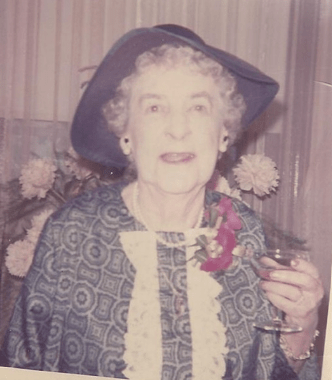
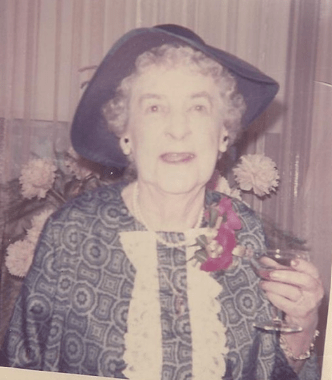
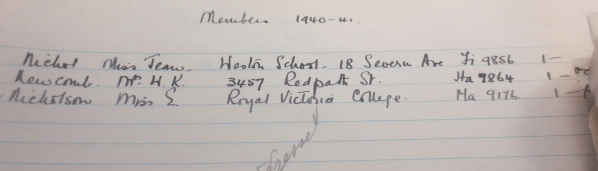
Great Aunt Edie 1971 toasting her niece’s marriage. In the 1920’s, she stepped out with Miss Carrie Derick according to a letter. They were both at McGill. Edith’s name on membership list for Therese Casgrain’s provincial suffrage association, The League of Women’s Rights in 1940-41. Edie was by then respectable, working at Royal Victoria College, McGill as Assistant to the Warden. Of course, back in 1913, Edie wasn’t listed as a member of the Montreal Suffrage Association, but that doesn’t mean she didn’t join the more inclusive and militant-minded Montreal Suffrage League started up by Caroline Kenney, another British suffragette. But, soon War broke out and everything kind of fell apart, but that’s a whole other story.
Originally published in Beads in A Necklace, Genealogy Ensemble’s compilation of family stories.
Furies Cross the Mersey is my story about the British Suffragette Invasion of 1912 from 3 different points of view. This era was a study in Media Literacy, that’s for sure. Journalists broke every rule of their trade covering the ladies of the suffrage movement. (For example: Were young suffragette sympathizers ‘manly and desexed’ or ‘excitable and hormonal?) Suffragists and Suffragettes wanted to take away men’s alcohol (overt)and their right to have sex before marriage with prostitutes (tacit). “Why can’t men be pure.” Mrs. Pankhurst, a doctor’s wife, was upset at the fact so many virginal women contracted veneral disease as a wedding present.(Hence the law requiring blood tests before marriage.). Also, many of her husband’s patients in the north of England arrived at his surgery pregnant by incest.
Margaret Votes published on this website. (How did Margaret Nicholson feel about voting for the first time in 1920? Very happy! Her neighbours not so much:) ) Most Canadian women won the right to vote in 1918. (Some with men in the military, earlier, in 1917) Quebec women in their province only in 1940.
“Inert” was the word used by Carrie Derick to describe the Canadian Suffrage Movement in 1912.
The British suffragettes, many of them young, were careful to dress well, knowing that it is easy to diss a woman on her appearance. This lead to news reports on the various marches in the UK and US sounding like fashion news.
The Montreal Local Council of Women launched the MSA in 1913, despite the fact this was not their mandate. They were supposed to be an umbrella for the various women’s organizations that had sprung up from the grass roots. I believe they launched the MSA because some other British Suffragettes, namely Caroline Kenney, sister of Annie Kenney, Emmeline Pankhurst’s working class lieutenant, were trying to start up a militant group (open to all) and even planning a march to Ottawa in the style of Rosalie Jones’s tramp. I know this because the Ottawa press covered their story, not the Montreal press. Another Kenney sister, Nell, had moved to Montreal (Verdun) with her journalist husband, Frank Randall Scott, in 1910, after he had swept her away to safety during a police action at a UK rally with Sir Winston Churchill, then the Home Secretary! His fonds are in the McCord Museum and include photographs of all the Kenney women – as well as the Royal Princes who came to visit in 1924. If you want to read more of their story read Furies Cross the Mersey, my book.
4. Carrie Derick is, famously, Canada’s first female university professor. A few other McGill professors were brought onto the Board of the Montreal Suffrage Association as well as some clergymen. The clergymen in particular hated – and feared – Mrs. Pankhurst. Many women on the Board secretly supported her, especially a Mrs. Weller, wife of a prosperous Westmount business man (electrical systems) who had made it a point to study the question in detail. She had invited Barbara Wylie into her home and she had visited the Suffragettes in England and had even given a speech about her visit.
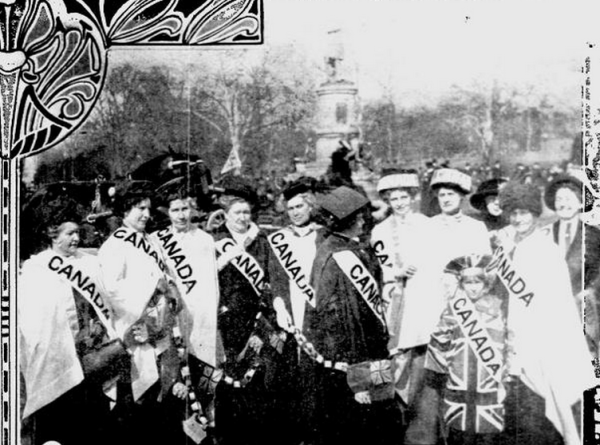
The Canadian Contingent at the 1913 Suffrage Parade in New York City. Older matrons all with ‘token’ child, the niece of Flora Macdonald Denison. From the Toronto Sun.
Recently, I’ve been wondering about the white slave who successfully escaped after allegedly burning down New France’s third Hotel-Dieu hospital and 45 homes in what is now Old Montreal in 1735.
I can’t help feel sorry for the man who was brought to Canada as an indentured slave (engagé or trente-six mois due to the thirty-six month duration of his contract) primarily because he was young, healthy, strong enough to serve as a labourer and poor. In return for his work, he got room and board, clothing and a salary, but he had no rights beyond that. His employers could send him anywhere to do just about anything; and according to New France law he had little recourse.
A brief summary of his life appears online in the Canadian Mysteries series dedicated to the fire.
Originally from Butenne in Franche-Comté, Claude Thibault was found guilty of salt trafficking [illegal sale of salt]. Condemned to end his days in the king’s galleys, his sentence was commuted to a life in exile in Canada. He arrived in Québec with a dozen other salt traffickers, including Jacques Jalleteau, in September 1732.
On the night of April 10, he was seen at the site of the fire, but disappeared when Angélique was arrested the following day. Despite warrants issued for a wanted person throughout the colony, Thibault was never again seen.1
I imagine he used his acumen to create a new life under a new name, perhaps in the fur-trading industry. After all, as a faux-saunier (salt smuggler), he had to develop a lot of entrepreneurial skills. As someone who purchased salt in low-tax regions and sold it on the black market in high tax regions, he had to be skilled at finding clients and creating a distribution hub without being caught by the King’s agents.
The King’s decision to set up an unfair tax regime began in 1680, when he decided to pass a law varying the taxes (gabelle) on salt per region. Salt was an important commodity at the time, and controlling it was an important economic lever. In addition to using it to spice and cure food, people in France also needed enough salt to tan animal skins. In some regions, such as Brittany, people could buy one “minot” (about 37 litres) of salt for as little as 1 livre, while citizens of Main, Anjou and other “high gabelle” regions had to pay as much as 61 livres per minot. The law even forced them to buy a minimum quantity of salt every year, whether they needed it or not.
Smugglers thrived in the seeming injustice, but if they were caught, punishment was severe. They faced fines beginning at 300 livres and leading to jail time of anywhere from 10 days to three months. At first, only the most serious convicts were exiled to New France, but in 1730, Jean Frédéric Phélypeaux, the Comte de Maurepas, began insisting that convicted faux-sauniers should be sorted, with the most healthy or those with useful skills be sent overseas as enslaved labourers on three-year contracts. Eventually, the scheme ended in when King Louis XV of France removed Maurepas from his job in 1749.
Unfortunately, Thibault was caught when Maurepas’ scheme was fully underway, and he had few other ressources to avoid exile.
Alain Racineau, who has studied salt traffickers like Thibault at length, describes most of them as poor rural people, primarily day labourers and small merchants struggling to survive.
They were recruited from the poorest levels of society: casual agricultural labourers, petty artisans and traders, unemployed vagabonds. They frequently affirmed that they had taken up smuggling “pour gagner leurs vies.”2
Thibault’s life didn’t get any easier once he arrived in New France. His contract was purchased by fur-trader and merchant Francois Poulin de Francheville and his wife Thérèse de Couagne, who owned several slaves. After M. Francheville died in late 1733, the widow decided to sell Thibault’s girlfriend to a friend in Quebec City. Plans were established for her to be sent away in the spring of 1734, after the ice melted from the Saint Lawrence River.
On February 22, 1734, Thibault and his lover decided to run away, setting fire to her bed as a distraction. They had hoped to reach the English colonies, but bad weather stopped them. They got stuck in Châteauguay and were eventually captured by three militia captains.
Thibault was thrown into jail on March 5 for breaking his contract. He was released on April 9, just one day before the large fire that began in the Francheville home on St. Paul Street.
Thibault disappeared just before his girlfriend got arrested, was convicted and executed. On April 19, authorities set up a manhunt
…given that we are in no State at present to forward the description of the said Thibault with the present order, the Said Captains will take care to arrest and Interrogate all Young men who are unknown vagabonds coming from the direction of Montréal toward Québec and passing through their area, to ask of Them their names and surnames, who they are, where they come from, and where They are going; and upon failure by the said passers-by to provide adequate Information on their persons, And for the slightest doubt or suspicion regarding their responses, And in consideration of public safety, We expressly ordain that the said Captains have them arrested Immediately, and taken under sound and due guard to the gaols of This city;3
They never found him.
Two years later, authorities officially took him off the most wanted list.
2Racineaux, Alain, ‘Du faux-saunage à la chouannerie, au sud-est de la Bretagne’, Mémoires de la Société d’histoire et d’archéologie de Bretagne, 1989.
3Archives nationales du Québec, Centre de Québec, Fonds des Ordonnances des intendants de la Nouvelle-France, E1, S1 P2622, Hocquart, Gilles, Ordinance given to the captains of the militia for the arrest of Claude Thibault, April 19, 1734, https://canadianmysteries.ca/sites/angelique/proces/rumeurcircule/1889en.html .
In the1600s my ancestors left France and embarked on an adventure to New France. In 1651 Julien Fortin de Bellefontaine settled in Chateau Richer, near Quebec City, and built a home, while Claude Jodouin landed in Ville Marie (Montreal) in 1666 and remained in the area.
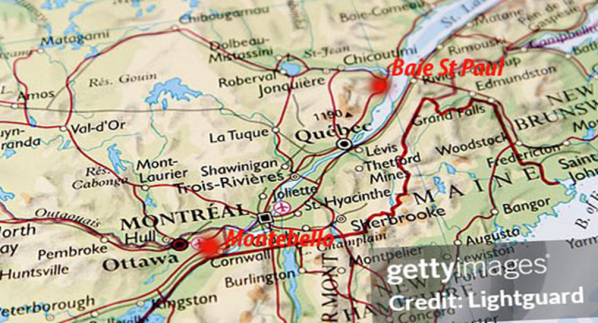
The Jodouin descendants moved east of Ville Marie (Montreal) to Varennes and Verchères on the south side of the St Lawrence River. Fortin descendants settled east of Quebec City in the Charlevoix, Baie St. Paul, Cap St. Ignace region on the north shore of the St. Lawrence River.
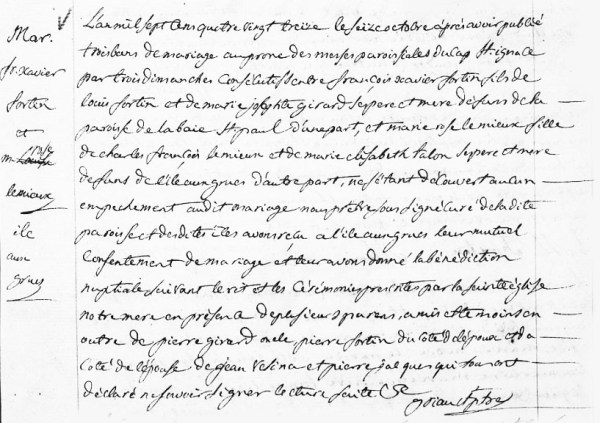
My third great-grandfather Francois Xavier Fortin (1755-1853) was born and baptized in Saint Pierre and Saint Paul church in Baie St. Paul and married Marie Rose Lemieux (1773-1853) at Saint Ignatius of Loyola Church in Cap St Ignace in 1793.
Marriage of Francois Xavier Fortin and Marie Rose Lemieux
Francois was a blacksmith and a farmer. While living in Cap St Ignace, they had two children. The births of their other nine children reveal that they moved four times over the years. I don’t know why they moved so often. Perhaps, the community required a blacksmith.
Their third child, Francois Xavier died in 1800 in St. Hyacinthe. Three more children were born in that community. Research does not enlighten us about the events that led to their next move. In 1808 they were living in Rigaud where their son Moyse Hypolite was born. The family settled in 1810 in the Seigniory de la Petite Nation in Montebello.
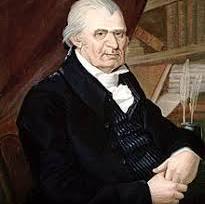
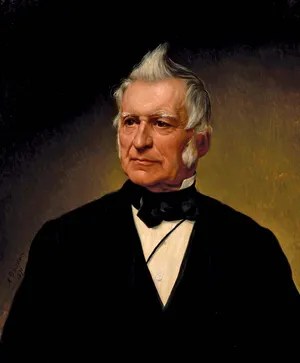
Joseph Papineau (1752-1841) became the first Seigneur de la Petite Nation in Montebello. He was a notary, surveyor, and landowner, who had bought land from the seminary in Quebec between 1801 and 1803.
Joseph Papineau -first Seigneur de la Petite Nation
In 1810 Papineau sold land to Francois Xavier Fortin who built a home where the family finally settled in Montebello, Seigneury de la Petite Nation on the shores of the Ottawa River. For over fifty years the Fortin family farmed the land. Today this home is known as The Fortin House. It played a significant role in the history of the area.
Louis Joseph Papineau
Joseph Papineau’s son Louis Joseph (1786-1871) purchased land from his father and began to build on the property. During the construction (1848-1850) of the Manoir Papineau, Louis Joseph and his family “borrowed” Francois Xavier Fortin’s home and they lived in his house while the manoir was being built. Changes were made to the Fortin house to accommodate the large Papineau family.
The Fortin House “borrowed by Louis Joseph Papineau
Louis Joseph had an interesting career as a politician, a leader of the Patriot movement, a speaker of the House at the National Assembly, and for a time, was exiled due to his involvement in the Rebellion of 1837.
An aerial view of Manoir Papineau
The Manoir is situated on Cap de Bonsecours
Parks Canada manages Manoir Papineau.
It is a National Historic site.
Research does not tell us where Francois Xavier and Rose were living while the manoir was being built and the Papineau family were in the Fortin home, however, one might surmise that the Fortin children were married and living in the area. Perhaps, as was the custom at the time they cared for their elderly parents.
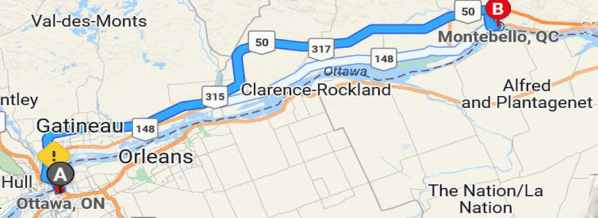
Route from Montebello to Ottawa
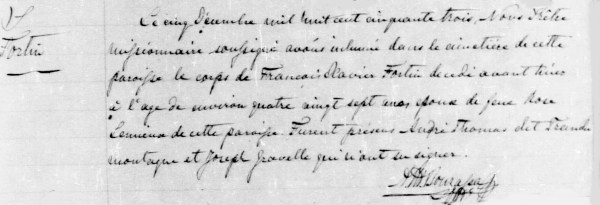
In November 1853 Rose passed away, and within two short weeks, Francois Xavier followed in December. Both are buried in the Notre Dame de Bonsecours cemetery in Montebello.
The Burial of Francois Xavier Fortin
In 1900 The Fortin House and surrounding farm were purchased by the Huneault family who continue to farm the land.
My 2X great-grandfather, George Murray Boggie, born in 1826 in Old Deer, Aberdeen, Scotland,1 spent his whole life in the Royal Navy. This was a life of adventure, variety, and camaraderie, but also homesickness, hard work, long hours, and sometimes sickness.
George didn’t start out wanting to be a sailor. When he was 15, and perhaps earlier, he and his brother, James worked as apprentice writers in Peterhead, Aberdeenshire. They lodged with John Bradie, a newsroom keeper. 2 John probably worked at the same newsroom as George and James.
It turned out that writing was not the job for George. George started volunteering in the navy when he was 20. He served on about 14 ships between 1846 and 1854. In January 1854, he was serving on the HMS Euryalus. He then signed his indenture papers on 13 February 1854, which committed him to ten years of continuous service in the Royal Navy.3 The HMS Euryalus was commissioned in 1853 and soon after George joined the crew, it was deployed to the Baltic to take part in the Baltic Campaign as part of the Crimean War.4 The HMS Euryalus was part of an Anglo-French fleet that entered the Baltic to attak the Russian naval base of Kronstadt.5
While I do not have a picture of Great-Grandfather George, Royal Navy Form 95 says that he was 5 ft., 7.5 inches tall, with a ruddy complexion, dark hair, and blue eyes. He had a tattoo on his left arm, his initials: G.M.B. 7
George was already married and a father with two children when he started his indentureship. His daughter, Mary, was 4 and my great-grandfather, Henry was just two years old. His wife, Elspeth Milne would have had her hands full with a young family and an absent husband. Elspeth would also have been worried about George as he was in active military service. As George remained a member of the Royal Navy his entire working life, it is probable that he participated in many battles.
Sailors were constantly at work when at sea. All ships were dangerous workplaces and injuries and death as a result of injuries were common. Their sleeping quarters were cramped, the sailors’ sleep was often disturbed, and their meals were neither copious nor balanced. Although some ships did issue a daily ration of lime juice and sugar, but in quantities not exceeding one ounce of each, assumably to prevent scurvy. The ships were cold, damp, and uncomfortable and their clothes could be damp for months at a time. Most ships did not have a physician or surgeon on board so some health conditions could not be addressed quickly. Sailors’ wages were usually paid in arrears as a deterrent to desertion.8
Sailors were susceptible to tropical diseases and while dysentery can be caught anywhere, It’s a more common condition in tropical areas of the world with poor water sanitation. The Royal Navy sailed the world over, often in tropical waters. Dysentery on board was common. It is contagious and can be contracted from eating food prepared in unsanitary conditions or by drinking contaminated water. 9
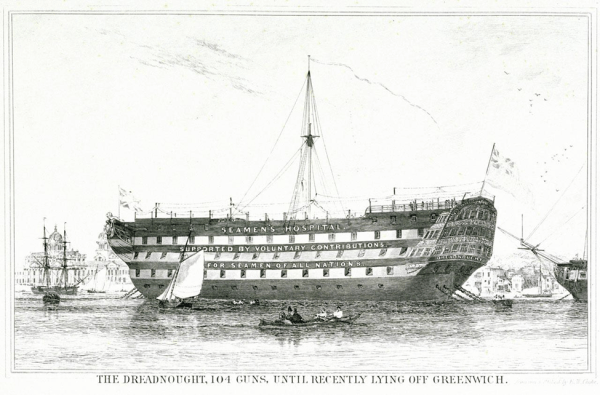
As George worked on 14 ships before he signed up for continuous service in 1854, he already had a good idea of what he was getting into. On 5 February 1847, George was admitted to the Dreadnought Seaman’s Hospital to treat dysentery.10 The registration indicates that he was victualled for 46 days which, I believe means that he was paid for the 46 days that he was in the hospital.
The Dreadnought Seamen’s Hospital provided seafarers with hospital care for 150 years. It started in 1821 as a wooden warship moored in the River Thames at Greenwich, England. After 1870, the hospital transferred to dry land at the former Greenwich Hospital Infirmary, and the hospital continued to treat sailors in Greenwich until its closure in 1986.11 In 1987, a Dreadnought Unit opened at St. Thomas Hospital in London.12
George was a member of the Royal Navy during the second half of the 19th century and, at that time, naval warfare underwent a complete transformation due to steam propulsion and metal ship construction. While Britain was required to replace its entire naval fleet, it managed to do so through unparalleled shipbuilding capacity and financial resources.13 When George started his career, he served on a wooden hulled steam frigate. By the time he completed his career, he would have seen great leaps of technological improvements.
Scotland’s People, Old Parish Registers, Boggie, George Murray, 1826, Old Deer, Aberdeenshire, accessed 7 June 2024.
Scotland’s People, 1841 Census, Boggie, George Murray, Peterhead, Aberdeenshire, accessed 12 June 2024.
Form 95, Indentured royal navy papers, Boggie, George Murray, dated 13 February 1854, National Archives, accessed 3 July 2024.
Arthur Symons, Private,56th Battalion, Canadian Over-Seas Expeditionary Forces.
I once had a great-granduncle, Arthur. Until I started doing Genealogy, I had no idea there was such a title, but there it is, and I had one.
Of course, I never met him, but, as it is Remembrance Day I wanted him to be remembered.
My Granny’s mother, Lilian, had a family of five siblings, and Arthur was her younger brother. He was four years younger than her. Granny told me that Arthur immigrated to Canada in the early 1900s.
Despite many searches. I could find no information on his immigration. However, months after I started my research, I came across a border crossing Manifest from Canada to Sweetgrass, Montana.
It had all the information I had been searching for!
At this point, I was not sure he was even married, but the info on the border crossing gave me missing details and Arthur was beginning to become a real person.
The Manifest stated Arthur was 50 years old, accompanied by his wife, Catherine, son Alexander, and daughter Dorothy. It was dated the 18th of July, 1936. The family were visiting Yellowstone Park and Glacier Park. it gave Arthur’s address in Calgary, Alberta and his occupation as a Postal Porter. (1) It stated that he arrived in Canada at Halifax, Nova Scotia on the 19th of March, 1901 on the SS. Soman.
I haven’t yet found the passenger list for the SS Soman, but I keep looking.
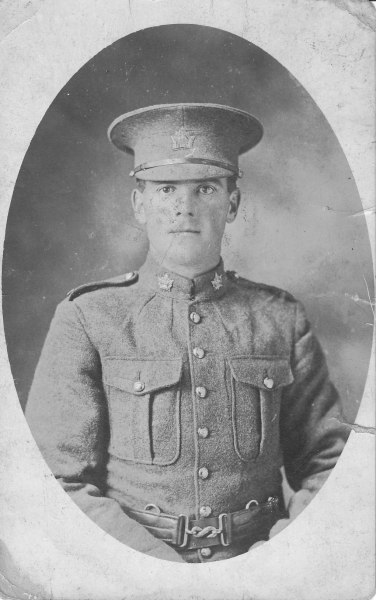
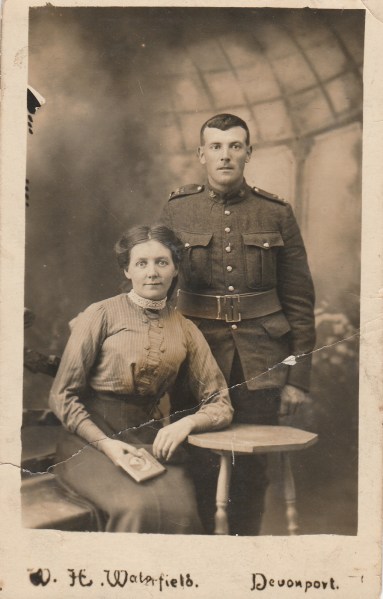
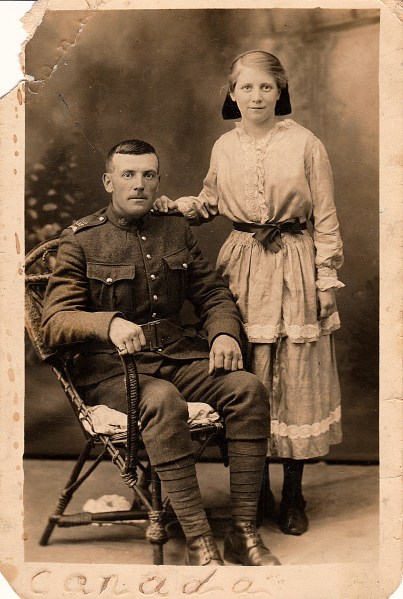
When WWI broke out, he enlisted in the 56th Battalion Canadian Over-Seas Expeditionary Forces on May 3, 1915, in Calgary, Alberta. He was shipped back to the UK for training. While ‘back home’, he visited his sister Lilian – my great-grandmother – and had these photos taken with his sister and my Granny, Edith Bevan O’Bray.
Arthur Symons with his sister Lilian Symons Bevan. C. 1914-18
Arthur Symons with my Granny, Edith Bevan C. 1914-18.
Arthur Symons was born in Leicester, Leicestershire, England, in 1886. His siblings were Lilian Mary Symons—my great-grandmother; Thomas, who died in infancy; Arthur, Olive, and Ada, who was my Gran’s favourite Aunt, and only two years older than her.
Aunt Ada was also my Godmother. Together, they joined the WRNS (Women’s Royal Naval Service) in 1918 (2)
Great-grand-uncle Arthur fought at the Battle of Passchendaele and was severely wounded in the right leg, right hand and left foot. He was transferred to the Granville Special Hospital, located in Ramsgate, Kent, England. An orthopaedic facility to treat soldiers with damaged limbs. Later because of air raids on the Kent coast, the hospital was moved to Buxton. He was medically discharged on 28th August 1919.
In part Two, I will explore his stay in the Granville Special Hospital for Canadian troops. The first line of his medical records, dated November 29, 1917, stated he was “Dangerously ill.”
(1) Canadian Postal Porter – Porter – Worker having manual handling duties, typically at a large sorting office or railway station in London. Tasks included the loading, unloading, segregation and transfer of mailbags or other containers. Porters were also employed at some other locations, such as the PO Savings Bank.
After my great grandfather retired from a successful 40-year career in the wholesale food business, he took an active interest in the stock market and managed his own investments during the time of the Great Stock Market Crash of 1929. Would he lose his life savings like so many unfortunate others at the time?
In a letter to his eldest daughter Josephine, my grandmother, dated June 2, 1932, he wrote:
“…if we could get rid of a lot of these Rotten Banks and Stock Market thieves the world would come around all right in no time. A person has no show with that New York Stock Exchange. Just a lot of crooks and I don’t think these common stocks have any value at all, not worth the paper they are written on, most of them, but all this will come (out) all right but people have got to lose a lot of money and that’s that.”
William Thomson Sherron (1863-1932) was born in Salem, New Jersey, the son of Albert Wood Sherron and Eveline Stokes Gaunt Githens. His wife, Gertrude Gill, (1869-1940), born in Philadelphia, was the daughter of Thomas Reeves Gill and Josephine Love.
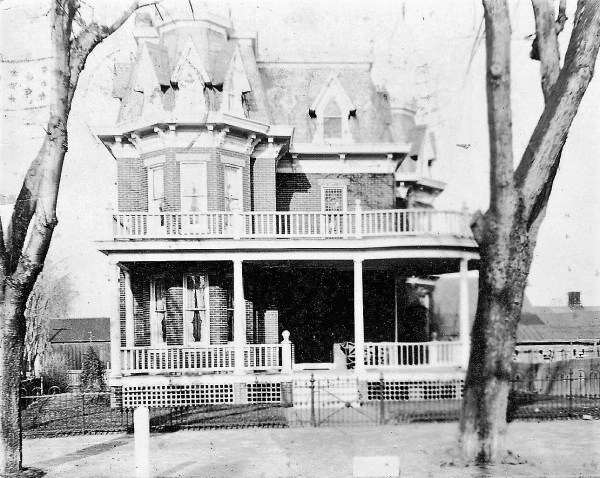
In November 1891, William and his bride settled in their new family home at 100 W. Broadway, Salem, New Jersey, where they stayed for the next twenty years. This beautifully refurbished Queen Anne style Victorian house still proudly stands today.
(Their first home -100 W. Broadway, Salem, New Jersey)
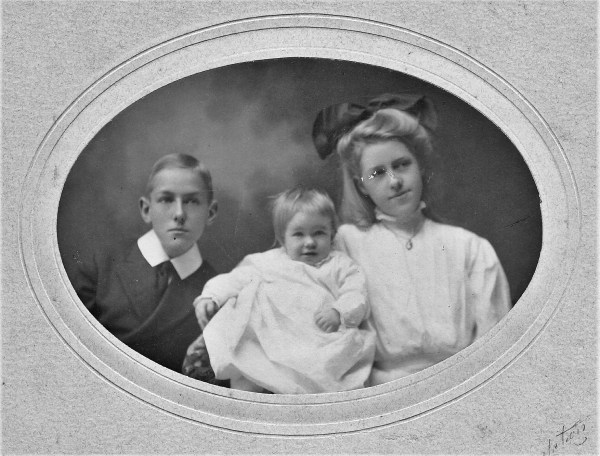
The couple had three children – Josephine (1893-1964) Social Media – Then and Now, Roger (1895-1963) Sherron and his Texas Betty and Alberta (1906-1992) Elopement … or not?. Josephine, my grandmother, her stockbroker husband and their two sons eventually settled in Montreal, Quebec. Their son Roger had mental health issues and lived with them until their deaths. Alberta married very young, had a son nine months later and remarried happily a while after that and had three more children.
(Roger, Alberta and Josephine Sherron – 1906)
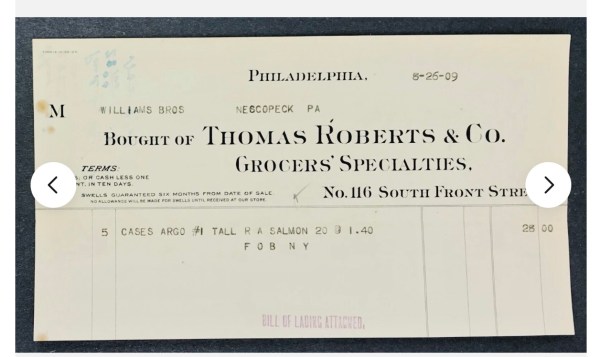
William first worked for Thomas Roberts & Co. in the wholesale grocery business for 25 years in Philadelphia before going into the same business for himself in 1905 at the age of 42. He opened his own office at no. 37 South Front Street, Philadelphia, about a half mile from their new home at 261 W. Harvey where they lived for the another twenty years.
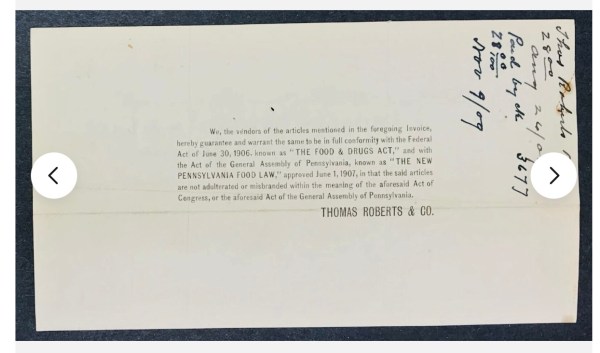
ScreenshotScreenshot
(Invoice – front and back from the grocery wholesale business)
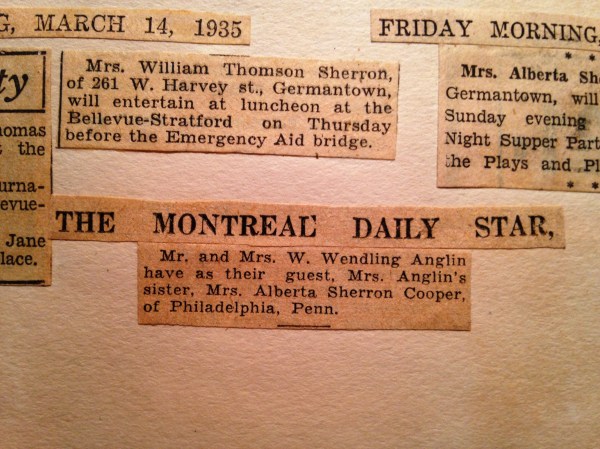
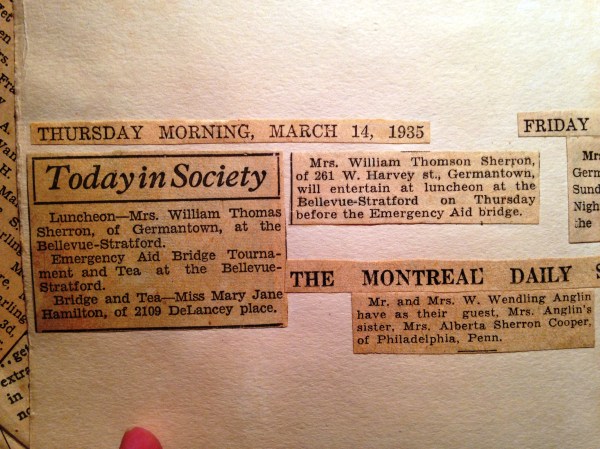
His wife and daughters took an active role the local Germantown social scene. Their endless teas, luncheons, bridge parties and charity fundraisers were regularly featured in the social pages of the local newspaper.
(Gertrude Sherron and her daughters in the Society Pages)
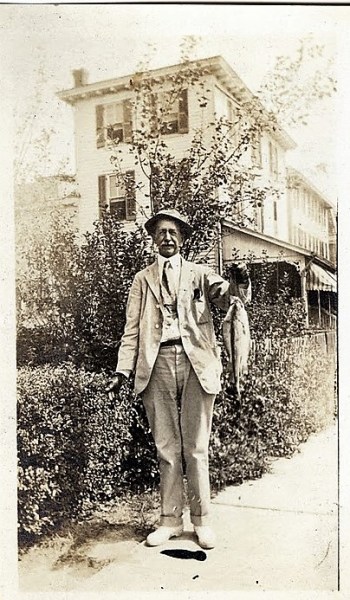
Along with the usual collection of family posed photographs in my dusty old boxes, I found a delightful photo of 55-year old William. He is holding up a string of sizable fish, possibly bass, outside “the Windsor Avenue cottage” (which looks more like an old country inn). He is wearing a light coloured baggy jacket and matching pants with a proper shirt and tie, white shoes and a floppy “fishing” hat. The smile on his face reflects pure joy for the day’s “catch”.
(William and his catch of the day!)
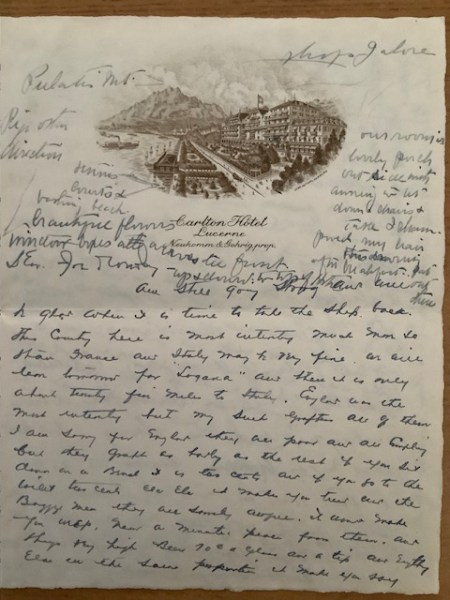
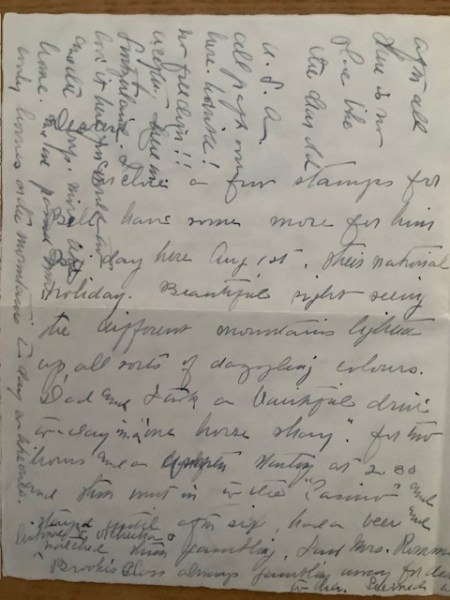
In 1930, just a couple of years before William’s death, the couple enjoyed an extended trip to Europe. They stayed at the famous luxurious Carlton Hotel in Lucerne while visiting Switzerland and I have the note sent to their daughter Josephine. William began the correspondence writing at a slant that became a little more difficult to maintain as he ran out of room on the notepaper. Then Gertrude took over filling every remaining inch of the note – to the bottom, up the sides and finishing up at the top of the page! Nevertheless, I could just barely make out from their undecipherable scrawls that they “adored Switzerland”, the hotel was “a dream” and “Interlaken was perfect”. As for Paris, Gertrude didn’t mince words when she exclaimed “Paris is a horribly dirty city.” However, she “loved London” and thought the people dressed “heaps better than in Paris.” At one point in the note, William generously invited their daughter to join them and wrote “I will pay the fare.”
(Excerpt of their note to their daughter Josephine)
So, it seems that William didn’t lose his money in the stock market after all, and had plenty to splurge on a once-in-a-lifetime trip to Europe with his wife.
Philadelphia lawyer McGregor J. Mitcheson (1829–1886) had a reputation as a passionate and eloquent defender of his clients’ interests in the courtroom, so it comes as no surprise that he was also a persuasive fundraiser. In 1864, he was one of many volunteers who helped to raise money to improve sanitary conditions, food and medical care for government soldiers during the American Civil War.
When the Civil War broke out in April 1861, thousands of men signed up to fight for the Union army. Soon, however, the filth and poor diets in the camps where the soldiers were housed led to outbreaks of disease. People realized that the government was not equipped to shelter and feed so many soldiers.
Civilians in the northern states responded by founding the United States Sanitary Commission (USSC) in the summer of 1861, as well as other charitable relief organizations. These groups raised money for the Union cause and distributed supplies, including food, clothing and bandages, to military camps and hospitals. A branch of the USSC was set up in Philadelphia by some of the city’s leading male citizens, while the women set up their own organization to receive donations from church groups and other small, local aid societies2.
The Great Central Fair in Logan Square, Philadelphia, 1864.
These organizations held a variety of fundraising events, including concerts, plays and floral fairs, but the biggest and most successful event In Philadelphia was the Great Central Fair. It was held for 21 days in June, 1864 at downtown Logan Square. Volunteers built a vast central hall featuring Gothic arches, outbuildings, interconnecting corridors and a 216-foot flagpole. A range of donated goods were for sale including fine arts, lingerie, umbrellas and canes, arms and trophies and children’s clothing, while available services included a horse shoe machine and a button-riveter.
A number of northern cities hosted sanitary fairs between 1863 and 1865, but the only one that raised more money than Philadelphia was New York City. In total, the Philadelphia Great Central Fair raised more than a million dollars – $20 million in today’s money.
This huge endeavor required many hours of organization by hundreds of volunteers. An executive committee oversaw dozens of smaller departments and committees that were in charge of soliciting contributions of goods, money and services from members of every trade, profession and business in the city.
My three-times great-uncle McGregor J. Mitcheson dedicated many hours to the cause as secretary of the fair’s Department of Labor, Income and Revenue. Involvement in that department was something of a family affair: at one time, McGregor’s brother Duncan M. Mitcheson was assistant treasurer, and his sister Mary F. Mitcheson was a member of the women’s committee. McGregor was also chairman of a hard-working sub-committee, the Committee on Organization.
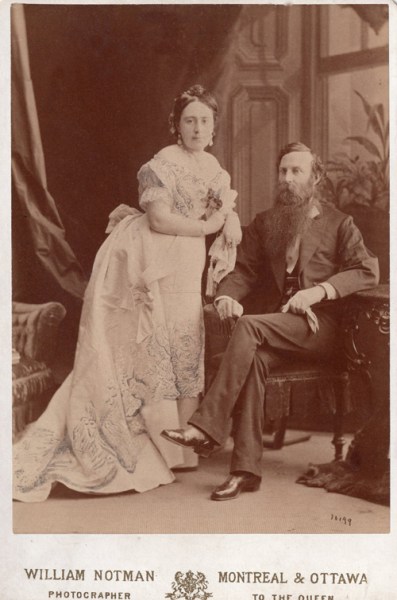
McGregor J. Mitcheson and his wife Ellen Brander Alexander, probably taken when they were visiting his sister Catharine Mitcheson Bagg in Montreal.
The Department of Labor, Income and Revenue was one of the busiest of the Sanitary Fair organization, and it succeeded in raising nearly a quarter of a million dollars, or one-fourth of the fair’s proceeds. Its goal was to raise donations equivalent to the wages of one day’s labor from working people in every branch of industry, one day’s income from their employers, and one day’s revenue from all corporations. Railways and coal mining companies proved to be the most generous donors. This committee also had a large table at the fair where a variety of goods were sold, bringing in $7228.
Committee members personally visited company worksites such as iron works and large mills. Owners would tell their employees to stop work and call them together to hear a speech about the need to help the soldiers. Most employees were so inspired that they agreed to donate a full day’s wages, and their employers also gave generously. Official fair historian Charles J. Stille credited this success with the fact that the organizing committee had nothing to do with partisan politics, and had no specific religious affiliations. Everyone was free to give or not to give.
The committee raised funds in Philadelphia, in smaller Pennsylvania cities such as Bethlehem, Harrisburg and Reading, in rural parts of the state and in neighbouring New Jersey. Members of this committee were so hard-working that it acquired the nickname the laborious committee.
Stille singled out McGregor J. Mitcheson for his hard work. “Through spirited explanatory addresses by Mr. Mitcheson, at the invitation of the proprietors of the leading establishments, six eight, and even twelve manufacturers have been thus visited by the officers and committee; the works stopped, the people collected and addressed, as we have stated, within one day.”3
McGregor also played a memorable role in the fair’s closing ceremony. A large crowd turned out on the evening of June 28 to watch as members of the fair’s executive committee marched onto a platform in the square. The bishop offered a prayer of thanksgiving, then McGregor J. Mitcheson led the singing of the Doxology,4 a hymn of praise. After that, McGregor invited the crowd to sing the Star-Spangled Banner, and finally the crowd broke into an enthusiastic rendition of Yankee Doodle.
Photo Sources:
Queen, J. F. (1864) Buildings of the Great Central Fair, in Aid of the U.S. Sanitary Commission, Logan Square, Philadelphia, June. United States of America Philadelphia Pennsylvania, 1864. Philadelphia: P.S. Duval & Son Lithography, -07. [Photograph] Retrieved from the Library of Congress, https://www.loc.gov/item/2021670451/
Cabinet card photo by William Notman, Montreal. #70199. Bagg family collection.
Notes and Sources
McGregor J. Mitcheson (born Joseph McGregor Mitcheson) was the youngest son of English-born merchant Robert Mitcheson and his Scottish-born wife Mary Frances McGregor. His older sister, Catharine Mitcheson Bagg, was my direct ancestor. McGregor grew up in Philadelphia and practised law there for many years. He married Ellen Brander Alexander Bond, a widow, in 1869, and they had three children.
The Doxology is a four-line hymn often sung during church services The version sung at the fair’s closing ceremony: Praise God, from whom all blessings flow; Praise him, all creatures here below; Praise him above, ye heavenly host; Praise Father, Son, and Holy Ghost. Amen.
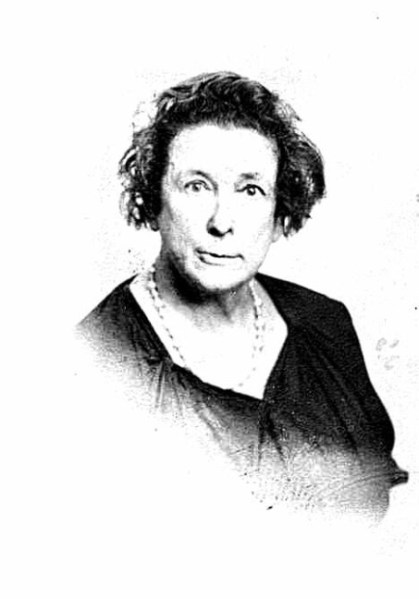
For many of my ancestors, I have a name, a date of birth and sometimes a death date. That doesn’t tell you much about their lives, who they were or what they looked like. Who resembles them? Having a picture that you can document of them is a treasure. I still have many images of unidentified people. Some you can guess at but still you aren’t sure.
I have no pictures of Annie Sutherland (1878-1953) or much information about her except for one entry in my grandfather William Harkness Sutherland’s diary, “ Annie visiting from New York”. Annie was his first cousin, the daughter of his uncle William Sutherland and Jessie Johnston.
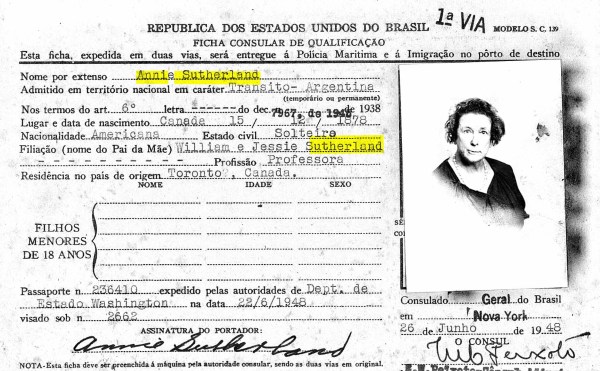
I thought I would try again to find Annie after researching her brother William. Annie is not a unique name so I didn’t have many expectations when I entered her name, birth year, and parent’s names in Ancestry. Up popped her visa for entry into Brazil in 1948! This document had her date of birth, her nationality, her parent’s names, her occupation and her picture! There she was for all to see at 69 years of age.
Annie Sutherland disappeared from Canadian records after the 1901 census when she was living with her parents at 21 Rose Ave along with her sisters Agnes, Isabel and Jessie and her brother Davison.
Single women at the turn of the century had few career choices open to them, one being a teacher. Annie and two of her sisters taught school. I imagine Annie wanted a little excitement in her life, so she immigrated to New York City in 1902 and moved in with her brother William. She continued to teach school.
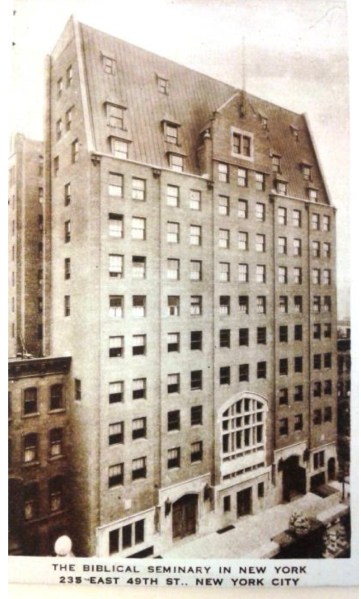
She originally taught at regular public schools. Religion was important in the family, like many Scottish Presbyterians at the time. They attended services regularly and were involved in the church life. The males, like my grandfather, were encouraged to become ministers but none had the calling. So, it is not surprising that at some point Annie began teaching at the Biblical Seminary of New York (which became the New York Theological Seminary).
Wilbert White founded the Prostatant nondenominational school to train Bible teachers, missionaries and YMCA (Young Mens Christian Association) workers. This was a ministry for the “real world” with the Bible being the centre of the curriculum. Women formed a large part of the diverse cultural student body and the staff. In 1921 the school moved downtown to East 49th Street. There, in a nine-story building, students, staff and other borders lived together. Annie lived at the school and according to the 1940 census was a teacher making $4,764 a year, a large salary for anyone at the time.
Teachers have the advantage of summers off, and Annie Sutherland travelled the world. While she taught others to be missionaries, perhaps she did missionary work herself during her vacations. She can be found on many ship manifests as she sailed to Brazil, Argentina, Mexico, England, France and the Mediterranean, being away for two months at a time.
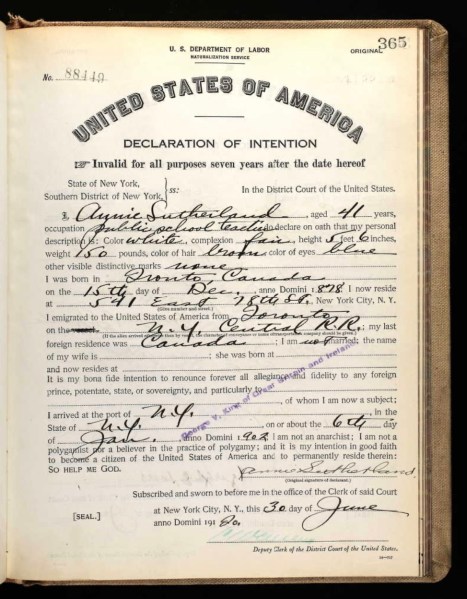
She, like her brother, decided to become an American citizen. She filed her declaration of intention in 1920, which included her renouncing her allegiance to George the V, King of Great Britain and Ireland. She received her naturalizing certificate five years later.
I last found her alive in New York City in 1950, living at the Prince George Hotel, having returned from another trip.
There is an Annie Sutherland buried in Mount Pleasant Cemetery in Toronto, who died in 1953 at 74 years of age. Is that Annie’s final resting place? Did she eventually return home from her travels?
Notes:
“Rio de Janeiro Brazil, Immigration Cards, 1900-1965”. Family Search, Salt Lake City, Utah, 2013. Index entries derived from digital copies of original and compiled records. Accessed on Ancestry March 10, 2020.
Mount Pleasant Cemetery: Annie Sutherland age 74 died 1953. Land, Section 33 lot 2650. accessed October 18, 2024.
New York Theological Seminary Records 1895-2005-https://library.columbia.edu/content/dam/libraryweb/locations/burke/fa/misc/ldpd_11693150.pdf
Year: 1901; Census Place: Toronto (Centre) (City/Cité) Ward/Quartier No 3, Toronto (Centre) (City/Cité), Ontario; Page: 2; Family No: 17 Ancestry.com. 1901 Census of Canada [database on-line]. Lehi, UT, USA: Ancestry.com Operations Inc, 2006. Original data: Library and Archives Canada. Census of Canada, 1901. Ottawa, Ontario, Canada:
Year: 1940; Census Place: New York, New York, New York; Roll: m-t0627-02648; Page: 61A; Enumeration District: 31-1008 Ancestry.com. 1940 United States Federal Census [database on-line]. Provo, UT, USA: Ancestry.com Operations, Inc., 2012.
The National Archives at Philadelphia; Philadelphia, PA; NAI Title: Declarations of Intention For Citizenship, 1/19/1842 – 10/29/1959; NAI Number: 4713410; Record Group Title: Records of District Courts of the United States, 1685-2009; Record Group Number: 21 Ancestry.com. New York, U.S., State and Federal Naturalization Records, 1794-1943 [database on-line]. Lehi, UT, USA: Ancestry.com Operations, Inc., 2013.








 Genealogy Ensemble