Dissenters and Poets


john

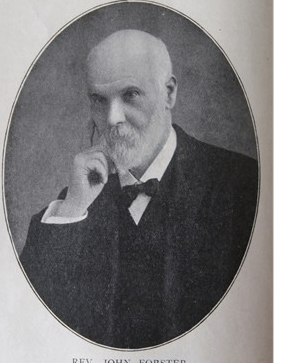
Reverend John Forster. Published with the permission of the Primitive Methodist Ancestor Website.

Late in his life, Somebody Forster, my great-grandfather, awakened from his night’s sleep to ask his wife of many decades, ‘Woman, what are you doing in my bed?”  It was dementia.

Until lately, this serio-comic anecdote was the only thing I knew about my father’s mother’s father, other than that he was a Methodist Minister from the North of England. But, just last month, I accessed the 1901 UK Census, (for free, yea) and it took me about thirty minutes to find out all I could want about my great-grandfather Somebody.

First, I looked up my grandmother, Dorothy Forster, who I knew was born in 1895 in Middleton-on -Teesdale, County Durham, UK,  to see that her father was a Reverend John from Knockburn, Northumberland; her mother Emma, a former Cowen from Crook,  and, more importantly, that John was a Primitive Methodist Minister. (I checked. PM’s were dissenters; socialists and pacifists, apparently.) *1

Then, googling the keywords “John Forster” and “Primitive Methodist,”  I  landed on a webpage from a genealogy site, myprimitivemethodistancestors.org , with a short biography of Great-granddad John, with  grainy photos of him and wife Emma taken in 1914.

Apparently, John Forster, a bookish, self-educated son of a farmer, was an accomplished essayist who penned over fifty articles for the Connexions Magazine of the Primitive Methodists on sundry weighty topics including “Heredity in Relation to Morals” and “Primitive Methodism and the Labour Question.”(He also served as a Temperance Committee; amusing, as his daughter, my Grandma Dorothy*, could really slug back the gin!)

I was most intrigued, though, to see that John had published a book of poetry, in 1923, shortly after my father, his grandson, was born at the European Hospital near Kuala Lumpur, Malaya. The author claims that Reverend John’s poems ‘contain lyrics of extraordinary charm and grace.’

(Well, I know the Wasteland was published in 1922, ushering in modernity, it is claimed, but no one said anything as nice about T.S. Eliot’s poem 😉

Curious, of course, about these verses, I contacted the Primitive Methodism Website’s administrator, asking for help. She immediately emailed me back a longer biographical article about John Forster, but no examples of his poems.  The volume in question, Pictures of Life in Verse seems to have gone missing from the church/museum library.

Quelle Bummer!

There’s good news, though. This longer article lists Reverend John’s assignments or ‘circuits’ in chronological order.  The Forster family moved often, it seems, around the area:  Thornley, Crook, Middleham, Bradford, Middleton-in-Teesdale, (a very pretty sheepy village) about six other towns, then, it said, “his present one (1912) being Helmsley.”

Bingo!  I know from the 1911 UK Census, that Helmsley is the hometown of my grandfather, Robert Nixon.  Clearly, alliances were made in that era that resulted  in the marriage of John and Emma’s second daughter, Dorothy, to Robert Nixon, son of a delver in the local Rievaulx quarry, although a Great War would delay official matrimony.

Dorothy would have been 17 in 1912 and fresh out of her co-ed Quaker boarding school and Robert Nixon just 22, and working in service as a footman.3

Perhaps Robert’s prospects weren’t good enough for the righteous Reverend John. In 1913, according to online records,4 Robert, travelled to Malaya to work as a labourer in a rubber plantation. During WWI, Dorothy worked as a land girl, leading enormous Clydesdales through the woods, a comical sight as she was only 5 foot tall.*5

The same records also reveal that Robert returned to England in 1916, now the plantation’s Assistant Manager. This trip home was very likely to secure a wife for real as rubber company officials insisted their employees return to the UK to find respectable British (see: white) wives.

Whatever transpired back in Helmsley, North Yorkshire in 1916,  on December, 1921, *6 Reverend John Forster, perhaps taking time off from penning one of his charming verses, sent his second daughter, Dorothy  off to  Selangor, Malaya. She’d become pregnant almost immediately upon arrival. I know because my father, Peter, was born on October 23, 1922.7


  1. Checking into Emma Cowan’s parentage, I see that her ancestors belonged to this same church, Redwing Chapel, that has an online presence! United Congregation of Red Wing Chapel, Garrigill, and Low Chapel, Alston, Cumberland; http://www.fivenine.co.uk/family_history_notebook/source_extracts/parish_registers/cumberland/redwing_registers.htm
  2. Website: Myprimitivemethodistancestors.org
  3. UK Census 1911
  4. UK Immigration and Transportation Records http://www.familysearch.org
  5. Family Lore
  6. UK Immigration and Transportation Records. After WWI, there were many, many more unmarried women than men in England, so perhaps this had something to do with Dorothy’s decision to go to Malaya to marry Robert Nixon. They did not get married in the UK, or at least I can’t find any record of a marriage.
  7. Family lore, (my Aunt Denise, who died last month) said that Robert kept his Asian mistress after marriage. Dorothy eventually got her own boyfriend, a colonial lawyer who remained faithful to her until her death in 1971. Both Dorothy and Robert were interned at Changi Prison in Singapore during WWI. Dorothy was Women’s Camp Commandant for a term. I only met my grandmother once in 1967, when she came to visit. Robert  died while she was at our house in Montreal’s Snowdon district.  He fell off a ladder at his daughter’s, Denise, in Farnborough, Hants, UK.  I recall the telegram. I recall, also, that my grandmother managed to wipe a tear or two from her eyes. I’ve written about my Colonial Grandmother in a play Looking for Mrs. Peel, which makes it all the more amusing that my great-grandparents were named John and Emma.
German-speaking Quebecers in the Trois Rivières area

German-speaking individuals and families have been immigrating to Quebec for almost 350 years. The first German-speaking family in New France was that of Hans Bernhardt, who arrived in 1663. A few more families settled in New France between 1668 and 1690 and the first small wave of emigration from the Palatinate (German Rheinpfalz) region to North America occurred in 1673.

Following the War of 1812-1814, some soldiers and officers of the Regiment of Watteville and the Regiment de Meuron, who had fought alongside the British against the Americans, settled in central Quebec, primarily in Drummond, Arthabaska, Wolfe and Bagot counties.

Between 1815 and the creation of Germany in 1871, people emigrated from various germanic principalities, dukedoms and electorates. These German-speaking families settled in Montreal, Quebec City, Western Quebec, the Eastern Townships, the Laurentian Region and the south shore region of Montreal.

Much of this information comes from Dictionnaire des souches allemandes et scandinaves au Québec, by Claude Kaufholtz-Couture & Claude Crégheur, published by Septentrion, 2013. This book includes 4,500 biographies of Germanic settlers, identifies where they came from in Continental Europe, notes their marriages in Quebec and the marriages of their children.

This link leads to a short compilation of information on the records of German-speaking Quebecers in the Trois Rivières area, northeast of Montreal:

The German Presence in the Trois Rivieres area

Earlier posts include:

The German Presence in the Montreal Region (Feb. 7, 2016) https://genealogyensemble.com/2016/02/07/the-german-presence-in-the-montreal-region/

the Germanic Presence in Quebec City (Jan. 24, 2016) https://genealogyensemble.com/2016/01/24/germanic-presence-in-quebec-city/

German Churches and Cemeteries in Western Quebec and the Upper Ottawa Valley (Jan. 17, 2016) https://genealogyensemble.com/2016/01/17/german-churches-and-cemeteries-of-western-quebec-and-the-upper-ottawa-valley/

There are three more compilations on Germanic records to come.

A Death-Forged Bond

On August 18, 1943 Royal Canadian Air Force (RCAF) Flight Sergeant Colin Angus was posted as missing and presumed dead following a devastating air raid made on the missile research laboratories at Peenemunde, Germany. Forty one bombers and one fighter plane were lost that night. Colin’s plane did not return.

Peenemunde was Colin’s second mission. He was initially rejected by the Air Force on medical grounds – a damaged mastoid bone, the legacy of a childhood illness. As the war took its toll, the physical requirements were downgraded. Colin was accepted and trained as a navigator.

The target of Colin’s first mission was Cologne, Germany’s military command center. Other comrades and other aircraft did not return that night.  “We can only hope for them”, Colin wrote in a letter to his brother Ian.

Two days before Colin flew his second and final mission, he wrote in another in another letter that should he “take a cropper”‘ would Ian, also a RCAF pilot stationed in England, send from his personal effects “such stuff as should go home”.

The family of the missing exist in a liminal zone. How long did my grandparents hold out hope that their son would be found? They may have reasoned that he lay wounded and yet unidentified or that he would soon be listed as a prisoner of war.

How powerless they must have felt during the days and weeks and months that followed. When Colin had hovered between life and death as a child, they could hold him, soothe and tend to him. Now they could do nothing but wait. Did they rant at the unfairness? Did they make pacts with God? How did they get through the long nights when daytime activities could no longer offer a sense of normalcy and hold the pain at bay? Were they able to share their fears and support each other, or did they suffer alone, neither willing to expose their despair to the other?

It took seven months for the RCAF to confirm their son’s death. On April 30th, 1944, a memorial service was held providing the family a semblance of closure. There was no coffin. His body, along with those of his crew members, had been buried in German soil far from loved ones.

“Such stuff that should go home” eventually reached my grandparents. It was a very small package that included Colin’s watch and glasses.

When I was sixteen, my grandmother was chosen to be Mother of Honor at the annual Armistice ceremony in Quebec City. The night before the event she carefully unwrapped the package. As I watched, she stroked each item, tears streaming down her cheeks. I was yet too young to fully understand her grief. I could only fixate on the glasses, so very fragile, and marvel that they could survive the crash that killed the uncle I would never know.

Yet that uncle left me a treasured gift. The bond I had with my grandmother was forged because of his death. I have since come to understand that her joy in the birth of a grand-daughter the year following her son’s death enabled her to move beyond her sorrow. I believe that I was her salvation and the reason she held me close all her days.

Sources

Service Record of Sergeant David Colin Brodie Angus, Library and Archives Canada

Personal letters between Colin and his brother Ian – on file with author, Ian’s daughter

Service Held for Colin Angus, Quebec Chronicle Telegraph, May 1, 1944 – clipping on file with author

Great Granny Bagg (Kittens on the Wedding Dress)

Mary Heloise Bagg Lindsay (1854-1938)

The Anglican Church and her philanthropy were most likely what grounded Mary Lindsay and enabled her to properly cope with her family. It is my belief that as the educated daughter of a wealthy Montreal family, the wife of a successful Montreal stockbroker and a busy mother – she appreciated the solitude of her Sunday morning church service and the rewarding challenges of her chosen charities. Her obituary, in 1938, summarized Mary Heloise Bagg Lindsay’s life as having “been a life member of the Women’s Auxiliary of the Church of England, Governor of the Royal Victoria Montreal Maternity Hospital and Children’s Memorial Hospital and greatly involved in a great many charities. She also regularly attended services at The Church of St. John the Evangelist1.

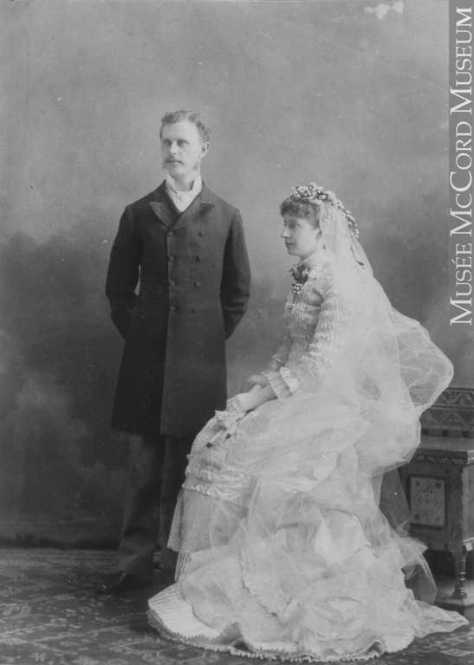
My great grandmother, Mary, was one of four surviving daughters of Stanley Clark Bagg and Catherine Mitcheson. Born in 1854 at the Fairmount Villa, in the Golden Square Mile of Montreal, she grew up to marry Robert Lindsay in 1881. Her only brother, Robert Stanley Bagg, was heir to the family fortune, her two older sisters married men in the clergy and her younger sister married a scandalous real estate tycoon who mysteriously disappeared when his debts caught up with him.

Robert and Mary Heloise Wedding day
Mr and Mrs Robert Lindsay -1881

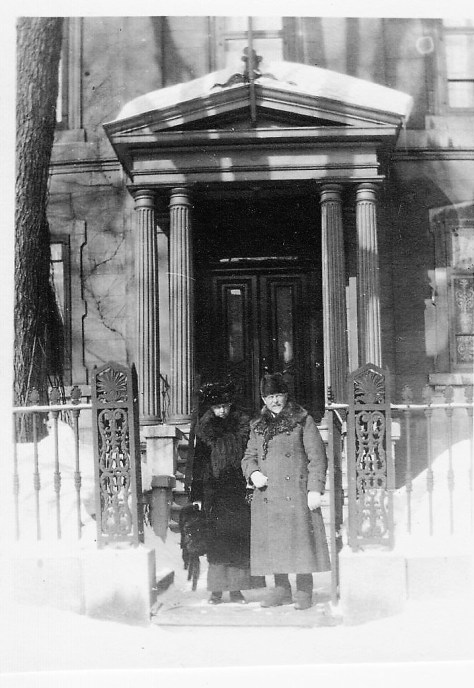
Her first matrimonial home, in 1881, was located at 436 St-Urbain2, which was a subdivision of a very large villa lot stretching down to Sherbrooke, near the Fairmount Villa where her mother still lived. Eventually she and Robert moved to 6 Prince of Wales Terrace3, at 455 Sherbrooke Street West (the address later became 1009 Sherbrooke Street West) where she raised her family and lived there until she died in 1938 at age 84.

Mr & Mrs R Lindsay - 6 Prince of Wales Terr -1917
Mr & Mrs R Lindsay – 6 Prince of Wales Terrace – 1917

Although Mary was petite in size and considered “frail” she and Robert had six healthy children.

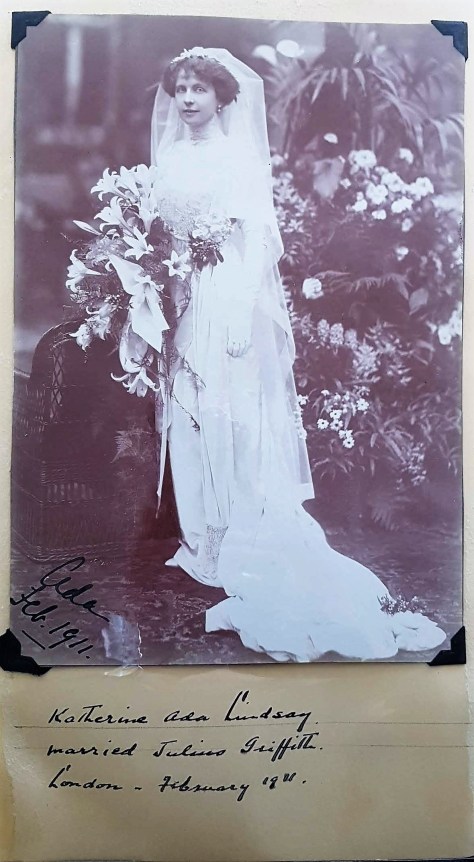
Ada was her firstborn child. On her wedding day, it was discovered that the family cat had had her litter of kittens on the wedding dress that had been laid out on the bed!4 Somehow they were able to acquire another dress.  

This still remains one of my favourite family tales.

Ada - wedding - 1911
Ada Lindsay Griffith – 1911

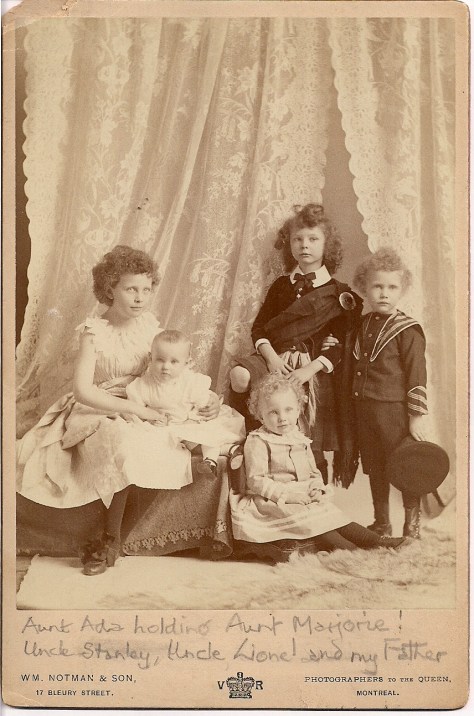
Lionel, her eldest son, studied medicine all over Europe and became a well-loved family doctor in Montreal after he retired from the Canadian Army Medical Corps in 1915. Her second son, Sydenham, (my grandfather) The Priest became a well known Anglican Priest in the Montreal area, despite the warning from his stockbroker father that there was “Not much money in it!”

Her last three children did not marry.

1891-Children of RobertLindsay&MaryHBagg
Ada, Marjorie, Lionel, Stanley and Sydenham – 1891 (Marguerite was born in 1896)

Stanley served as a captain in WWI and survived the Battle at Ypres in 1915. Afterward he returned home to follow in his father’s footsteps and became another successful Montreal stockbroker. He remained the bachelor uncle who enjoyed doting on his nieces (especially my mother) and nephews. Beautiful Marjorie, however, remained a spinster when permission to marry her one true love across the Atlantic was denied for her own safety5. And sadly, Mary’s youngest child, Marguerite, died at age 26 as a summer volunteer with the Grenfell Mission in Labrador.Miss Lindsay – Part 1

Mary must have drawn great strength and comfort from her faith to support her adventurous children in their respective challenging worlds.

Updated and edited – 2023-03-27 by author

1 The Montreal Gazette, August 15, 1938.

2 Lovell’s 1890 – 1906.

3Commissioned 1860 to honour the Prince of Wales, Prince of Wales Terrace consisted of a row of nine houses which presented a unified, Montreal limestone facade in the Classical Greek style.

4 As told to me by my aunt, Katharin Lindsay Welch, telephone conversation – June 2013

5 As told to me by my aunt, Katharin Lindsay Welch, telephone conversation – June 2013

The German Presence in the Montreal Region

The first German-speaking families probably came to Montreal around 1700. While this community has never been large, it has been well-organized: the German Society of Montreal was set up in 1835 and St. John’s Lutheran Church was established in 1853. Many families of German origin attended Protestant and Catholic churches along with their English, Scottish and French Canadian neighbours. This compilation lists many of the city’s churches and the repositories where their birth, marriage and burial records are kept.

German Presence in Montreal Feb 1

Tracking Montreal Ancestors: Images of the Past

Many genealogists are aware that the Montreal’s McCord Museum has a large collection of digitized photographs taken in the 19th century studios of William Notman (1826-1891). Although it is best known for its photographs of Montreal’s English-speaking elite, the collection goes far beyond the studio, including pictures of Montreal’s Victoria Bridge, the Canadian Pacific Railway, First Nations people across the country and ordinary Montrealers at work and at leisure.

This is only one image collection of potential interest to genealogists researching Montreal. As you try to try to imagine the people and places that would have been familiar to your ancestors in what was once Canada’s largest city, here are some other resources that might inspire you.

The place to start exploring the McCord Museum’s images is http://www.musee-mccord.qc.ca/en/keys/collections/. This page links to the museum’s online collection of more than 122,000 images, including paintings, prints, drawings and photos. There are documents such as diaries, letters and theatre programs, as well as costumes and archaeological objects. While the museum’s collections focus on Montreal, they include images and objects from the Arctic to Western Canada and the United States. You can search the McCord’s online collection for an individual name, or you can browse time periods, geographic regions and artists.

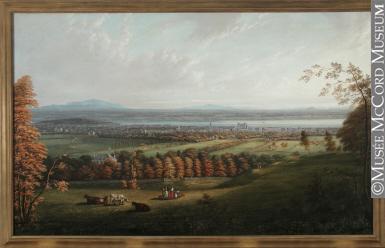
Montreal from the Mountain
This is a view of Montreal from Mount Royal, near my ancestor’s house, around 1830.

The McCord also has a flickr page, https://www.flickr.com/photos/museemccordmuseum/albums.The historically themed albums on the flickr page include old toys, Quebec’s Irish community and an homage to women.

The Bibliothèque et Archives nationales du Québec (BAnQ) is another excellent source of digital images, including photographs, illustrations, posters (affiches) and post cards (cartes postales) from the past. To start exploring these collections, go to http://www.banq.qc.ca/collections/images/index.html.

There are two collections of special interest to people with Montreal roots. The first is a collection of 22,000 photos taken by Conrad Poirier (1912-1968), a freelance photojournalist who worked in Montreal from the 1930s to 1960. He covered news (nouvelles), celebrities, sports and theatre, and he did family portraits, weddings, Rotary Club meetings and Boy Scout groups. I even found a photo of myself at a 1957 birthday party (fêtes d’enfants). You can search (chercher) the collection by subject or by family name.

The other collection of interest to people researching Montreal is the BAnQ’s Massicotte collection (http://www.banq.qc.ca/collections/collection_numerique/massicotte/index.html?keyword=*). Edouard-Zotique Massicotte (1867-1947) was a journalist, historian and archivist. The online collection mainly consists of photos and drawings of Montreal street scenes and buildings between 1870 and 1920. Some illustrations come from postcards, while others are clippings from periodicals. There are also a few blueprints and designs. The accompanying text is in French. You can search this collection by subject, by location, date of publication or type of image, or you can put in your own search term.

Philippe du Berger’s flickr page https://www.flickr.com/photos/urbexplo/albums is a gold mine of Montreal images. He includes contemporary photos of the city, including neighbourhoods that have recently been changed by big construction projects such as the new CHUM hospital. There are old photos of neighbourhoods such as Griffintown, Côte des Neiges and Hochelaga-Maisonneuve and he illustrates the transformation of the Hay Market area of the 1830s that eventually became today’s Victoria Square. Some albums include old maps to help the viewer put locations into geographic context.

The City of Montreal Archives has uploaded thousands of photos to its flickr page, https://www.flickr.com/photos/archivesmontreal/albums/. They are arranged in albums on various topics, ranging from city workers on the job to lost neighbourhoods, newspaper vendors, sporting activities and cultural events.

Photo:

James Duncan. Montreal from the Mountain, 1830-31. M966.61, McCord Museum. http://collection.mccord.mcgill.ca/en/collection/artifacts/M966.61?Lang=1&accessnumber=M966.61

This article is also posted on writinguptheancestors.blogspot.ca


Poor Little Children

IMG_0424

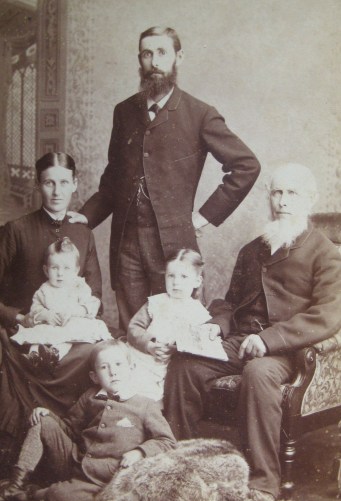
I always thought that my grandfather, William Sutherland was one of three children. He and his brother Wilson died before I was born and his sister Mary when I was a baby, so I never heard any information first hand. There is a picture of the family with three children, parents and grandfather. I always assumed the baby sitting on Alice Dickson Sutherland’s lap was Wilson, until one day I realized the eyes were light coloured. Wilson the youngest son definitely had brown eyes confirmed in many other pictures.

Thinking this was a child who had died, I searched through the Ontario Birth, Marriage and Death indexes. I found a James Dickson Sutherland who died at fourteen months, in January 1886, of bronchial pneumonia and thought he was a possible match. This was confirmed in a letter from Alice to a cousin Jessie McIntosh, where she mentioned little James Dickson. “Baby is growing he is pretty plump but not so big and fat as Willie was when he was his age. We call him James Dickson, he has dark hair, blue eyes and a deep dimple in his chin.”

It was certainly not unusual for young children to die before the discovery of antibiotics and vaccines. In my search I had noticed a Mowat Sutherland, who had died of diphtheria in 1891. Unfortunately, Ontario death certificates don’t give the parents names. No one else in the family had been called Mowat, but that was my great great grandmother’s maiden name. Then a “Knowat” Sutherland age two, was found in the 1891 census living with my great grandfather’s brother William and his wife Jessie Sutherland.

There was also an Elizabeth Mowat Sutherland, who died in 1890. I thought she was probably Mowat’s sister but hadn’t found any birth record. Then, in the LDS database I found both Mowat, Elizabeth Mowat and James Dickson buried in Mount Pleasant cemetery, plot M5120 owned by my great great grandfather William Sutherland.

I kept looking through the records. I searched through the birth records putting in different parents names and then just Sutherland, as I knew the death date and age, 9 months. I finally found a record of the birth of an Elizabeth Maud Sutherland whose parents weren’t William and Jessie Sutherland but rather Donald Sutherland and Alice Dixon (Dickson). This little girl was my great great aunt. She was born July 26, 1888 and died of bronchial pneumonia, April 22, 1889.

Imagine, three babies buried in plot M 5120 with their grandparents, but then there were four. Recently a Dickson baby boy was found to be buried in this plot. He was still born and probably the son of Alice’s brother James Dickson.

Donald and Alice lost two children before the youngest, Wilson was born. As the baby of the family he was spoiled according to all sources. His mother babied him and the explanation was undoubtedly the two children she lost. It was said he never had to learn the value of money and would buy a newspaper every day!

There was one more baby who was never mentioned. My grandmother Minnie Eagle Sutherland and her sister Amy had another younger sister. Elizabeth Martha Eagle, known as Bessie was born October 1, 1886 and died July 18, 1887 of cholera . Her mother Eliza Jane Eagle said, “God knew she could only cope with two children and took Bessie to heaven.”

Are there other little children to find so they too will be remembered?

IMG_3854
Robert Wilson Sutherland          Abt 1905
IMG_3866
Robert Wilson Sutherland                  Abt. 1920

Bibliography:

Ancestry.com. James Dickson Sutherland – Archives of Ontario. Registrations of Deaths, 1869-1938. MS 935, reels 1-615. Series: MS935; Reel: 45

 Year: 1891; Census Place: St Johns Ward, Toronto City, Ontario; Roll: T-6371; Family No: 3.

Archives of Ontario. Registrations of Births and Stillbirths – 1869-1913. MS 929, reels 1-245. Toronto, Ontario, Canada: Archives of Ontario.

“Ontario, Toronto Trust Cemeteries, 1826-1989,” index and images, FamilySearch (https://familysearch.org/pal:/MM9.1.1/KH6C-BDS : accessed 07 Mar 2014), Elizabeth Mowat Sutherland, 1889.

“Ontario, Toronto Trust Cemeteries, 1826-1989,” index and images, FamilySearch (https://familysearch.org/pal:/MM9.1.1/KH6C-FP9 : accessed 07 Mar 2014), Mowat Sutherland, 1891.

“Ontario, Toronto Trust Cemeteries, 1826-1989,” index and images, FamilySearch (https://familysearch.org/pal:/MM9.1.1/KH6H-378 : accessed 05 Apr 2014), Eliza M Eagle, 18 Jul 1887; citing Toronto, Ontario, Canada, section and lot T 94, line 11917, volume Volume 07, 1883-1891, Superintendent of Administrative Services; FHL microfilm 1617041.

Ontario, Toronto Trust Cemeteries, 1826-1989,” index and images, FamilySearch (https://familysearch.org/pal:/MM9.1.1/24MZ-7G5 : accessed 19 May 2014), Wm Sutherland in entry for Dickson, 05 Oct 1888; citing Toronto, Ontario, Canada, section and lot M 51 20, line 5000, volume Volume 01, 1876-1896, Superintendent of Administrative Services; FHL microfilm 1617049.

Personal communication with Elizabeth Sutherland Van Loben Sels. 2000.

Family letters from Carol MacIntosh Small. All the original letters were donated by Carol to the Bruce County Archives in Southampton, Ontario.

Letter from Alice Sutherland to Jessie McIntosh March 18, 1885.

Germanic Presence in Quebec City

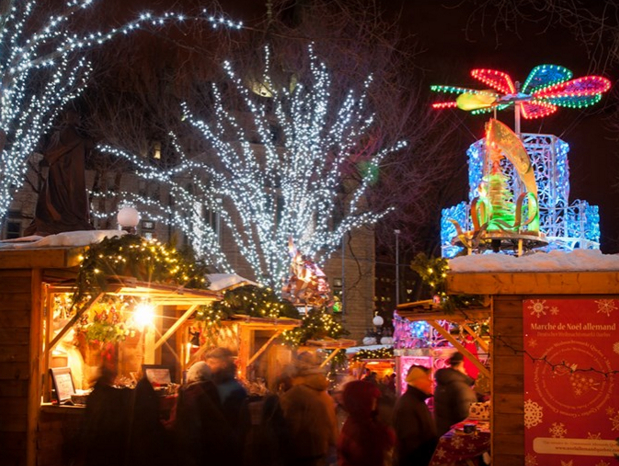
The 2015 German Christmas Market in Quebec City, http://www.noelallemandquebec.com/
The 2015 German Christmas Market in Quebec City

Jacques begins his latest compilation, The German Presence in Quebec City, with a translated quote by German Quebec expert University of Montreal Professor Manuel Meune. In this quote, Meune describes the context of German immigration to Quebec over the years.

The circumstances Meune describes challenge family researchers with ancestors from Germany who might wonder where original records might be stored. To help sort out the information, Jacques has highlighted books and document collections in churches, libraries, schools and societies in and around the Quebec City area.

He’s also included Facebook or other contact information for each repository so researchers can visit these locations to explore what might be available.

German Churches and Cemeteries of Western Quebec and the Upper Ottawa Valley

This compilation is designed to help researchers find German-speaking ancestors in Western Quebec and the Upper Ottawa River Valley area of Ontario. It identifies several books that cover the topic, the towns where German-speaking immigrants settled, the Lutheran churches that served their spiritual needs and the cemeteries where they were buried. It also lists repositories where the archives of these institutions can be found and genealogical societies in these areas.

The German Churches and Cemeteries in Western Quebec January 12, 2016


Protestant Churches of Beauharnois, Chateauguay, Huntingdon, Napierville, Soulanges and Vaudreuil

This compilation covers an area south and west of Montreal, Quebec, in a triangle between the St. Lawrence River, the United States border and Ontario. Today many English-speaking Quebecers know the region as the Chateauguay Valley, but on a map of Quebec, you’ll find it as the Haut-Saint-Laurent region, or part of the Montérégie. This is an attractive area of orchards, farms and small towns.

Archaeologists have found traces of occupation by Iroquoian First Nations people dating from the 14th century. As of 1729, it became the Seigneury of Beauharnois, but at that time there were few inhabitants.

Some Americans and immigrants from Scotland and Ireland arrived in the area around the early 1800s, with most pioneers establishing themselves along the banks of the Chateauguay, Trout and English Rivers. Brick making, which took advantage of the area’s extensive clay deposits, began. Other early industries included agriculture, logging and potash.

If you had Protestant ancestors in this region, this compilation should help you begin to understand the histories of the area’s communities and counties. It outlines the histories of the churches and visiting preachers who served the religious needs of the area’s Protestant residents. It will help you search for the cemeteries where your ancestors might have been buried, and find the church records of your family’s baptisms, weddings and burials.

Thank you to Claire Lindell for editing this compilation and adding the table of contents and maps.

Protestant Churches of Beauharnois, Chateauguay, Huntingdon, Napierville, Soulanges & Vaudreuil

Working together to help genealogists discover their ancestors