Am I My Father’s Son, or Genealogy Revisited

By René Péron, Ottawa, 2015

Have you ever considered? At a certain point did you ever imagine that ………………?

We are inclined to approach our genealogical research in a manner which may not be quite exact, if not incorrect! That is particularly so in our present day context, with our so-called free lifestyle, not to say libertine one, when words such as marriage and spouse seem to have lost their importance, their value as transmitted to us by our ancestors.

I would say that we are all guilty! In this our twenty-first century, it would seem less important and more difficult to try to find out who is the father of a given child, often for reasons of divorce or of couples splitting up. Children are bounced hither and thither, given the father’s or the mother’s family name, or even the name of a new father or mother.

And what can one really say about those new partnerships between women where one of the two, or even both, claim the right to have or to bring up children, to adopt one or to pass on their name? All of this over and above the present system when one can adopt a child whose mother is perforce almost always known by the very nature of things, but where the father may be anonymous. Etc…. Etc….

However, let us not cast stones on our current era or on the twentieth century only. Take an honest look at the past here in North America, as well as in Europe. Without casting that same stone on any one of our female or male ancestors, what do we perceive through the ages?

So many children were born of incest, of concubinage, of adulterous unions! How does one view the matter of those children born during a gestation period which does not at all correspond with the presence of the father, or whose features or other characteristics have a strange resemblance to those of the village priest, of the uncle, of……..and so on?

And now we have come into an era where one openly discusses the merits of the egg being fertilized by frozen, donated or bought sperm, supplied through a sperm bank. In such an event, because of requested anonymity or confidentiality, the biological father or mother are often unknown.

Facing this situation, would it not be more logical to trace the ascendancy of a person or the descendancy of a family from one female to the other? Save but in a few rare occurrences today, the biological mother is nearly always known in the normal course of events. The father?????

And just as such a solution seems simple, we now find ourselves in a period where one woman’s egg, fertilized via the sperm of a man, either known or unknown, may be inserted into the body of another woman known as a surrogate. Tackling the question head on, who would be the mother, who would be the father, what should be the child’s name?

In The Seven Daughters of Eve (New York: W.W. Norton, 2001), author and scientist Bryan Sykes describes how all humans share one ancient mother in Africa: Mitochondrial Eve. In the future, where will our descendants find themselves in their genealogical searches? Already some researchers have hit an almost insurmountable wall in the past, dates which did not correspond with reality in timing, or mysteries hidden in confidential orphanage records.

For the last twenty years or so, authors relate for us that very obscure past which was that of our ancestors here and abroad. And what can one say of the situation, mainly in the United States, where, in order to clarify a dubious lineage, people have begun to use the new science of DNA? What normally confidential situations will be encountered there?

Will the future bring clarification as well as problems to the field of genealogy? It will be up to the younger generations to watch for this, as the whole matter risks becoming clouded at the expense of serious genealogical research. At least that is what I surmise, whilst hoping that I am in error.
Granny-Lin

Millicent Thorpe Hanington (1895-1982)

Millicent’s one indulgence in later life was watching “Hockey Night in Canada” on television.  She was a committed fan and watched every game without fail.  One night during the game, Sydenham, her husband, felt light headed and fainted.  She gave him a gentle slap to wake him up, got him to swallow a couple of aspirins and warned him with:  “Don’t you dare die during my hockey game!”[1]

The birth of this sixth daughter, Millicent, in 1895, could have been in celebration of James Peters Hanington ’s graduation from McGill Medical School a year earlier, at the ripe old age of 49.  Millicent (my grandmother) was the baby of this family of girls, and eventually looked after all her sisters in their old age.

The Hanington family had strong roots in Shediac, New Brunswick, given that William Hanington (Millicent’s great grandfather) founded the town in 1784.  Millicent grew up spending the summers at her father’s cottage in Shediac Cape and soon after she married, she bought her own summer cottage there and named it “Iona Cottage”.  The family story told was that she was so thrilled, that the name was really code for “I own a cottage”!

Sydenham Bagg Lindsay, an Anglican priest in Montreal, actively pursued Millicent with marriage proposals until she finally accepted him ….on the condition that he look after all her sisters as well.[2]  Poor guy got six women for the price of one! Two of her sisters, however, were married and only three were spinsters.

Married in 1918, Millicent was a young bride of 23 years and Sydenham, a frail young man of 29.  She led a demanding life as a full time minister’s wife in addition to having four children of her own.  Their first child was born in 1920, a frail little girl called Mary Thorpe who strengthened as she grew and was talented in art and theatre.  In 1923, their son, Paul, was born, a jolly little fellow who was to be their life long tower of strength.  In 1926, their daughter Ann (my mother) appeared, a sweet tranquil baby, who was to become a marvellous mother.  Finally, in 1930, came Katharin, a whirlwind if there ever was one. [3]

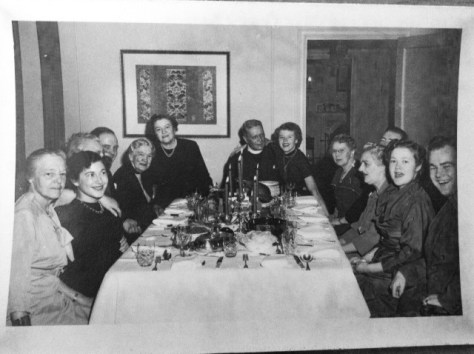
Millicent’s lively spirit and sense of humour carried her through many a trial. As they moved from parish to parish, her fame preceded her.  Her superb cooking kept the whole family well and strong, including their parents and all her sisters!  There are photos galore of a dozen or so family members around her Sunday table. When Sunday lunch after church became too much for her to manage, the family began a new tradition of eating Sunday lunch regularly at Murray’s Restaurant, which she thought was the closest thing to her own cooking.Dodo, Mary, Bob, Mrs JP Hanington, Granny, Grampa, Kay, guest, Tom, Tootie, Ann, friend Bobby

She kept an eye on her mother and her sisters as they aged and needed attention.  In 1950, her mother died in her 99th year and Millicent missed her terribly the rest of her life.

With the strain of WWII, parish duties and his family, Sydenham’s health suffered.  As his strength waned so did that of his daughter, Ann, who had developed Hodgkin’s disease.  Both parents suffered through her illness and death and the problems that beset her grieving husband and their four children.

Seven years after Sydenham died in 1975, Millicent felt ill and didn’t know why.  She had leukemia.  Six weeks later she died, still the gallant lively Spirit she’d always been.

[1] Personal recollections in a telephone interview October 2013 – with Katharin Lindsay Welch. (her youngest daughter)

[2]Personal recollections in a telephone interview October 2013 – with Katharin Lindsay Welch. (her youngest daughter)

[3] Personal recollections by Mary Thorpe Kerr – Victoria, BC – 1993

Turkeys

IMG_7959

The mention of Thanksgiving or Christmas always brings up thoughts and smells of roasting turkey with stuffing, mashed potatoes covered with gravy, turnips, bright red cranberry sauce and fizzy cranberry drink with ginger-ale. There are also the family hors d’oeuvres; crackers, often Ritz, with cheese and an olive slice or just an anchovy. This is our traditional holiday dinner and apparently my ancestors also enjoyed turkey.

I am lucky to have a few letters written by my great grandparents, Donald and Alice Sutherland and funnily enough, most of them mentioned turkeys. They might have raised turkeys at one time, on their farm in Bruce County. William Sutherland obtained crown land in Carrick, Ontario in 1855. He and his family cleared the land and began farming but they later realized that farming wasn’t in their blood. Donald and some of his siblings had left for Toronto before William sold the farm in 1876 to his son William. Even this William preferred the big city and by 1879 the farm was sold again and all the Sutherlands were living in Toronto. They  still had ties to the country as many cousins remained farmers in Bruce County. Although they preferred urban life, it seems they would rather have farm fresh produce on their table.

The first note written by Donald on January 6, 1899 said, “We received the butter and turkeys alright. They are very nice. We will forward the amount next week.”

On December 17th 1900, Donald writes a long letter about his trip to Scotland and London and in closing says, “I want to know if you can send us three or four good fat turkies for Christmas. If you can please ship them by express early on Saturday before Christmas and I think we will get them on Monday, address to store 288 Yonge Street. We will give whatever price is going.” One can just picture a crate of gobbling turkeys in the middle of the book store. Mail service must have been very reliable at the time! There was no haggling over the price.

The third letter was written by his wife Alice, December 19, 1901. Christmas was again approaching and and she wanted to know, “well what about turkeys if you have any to sell you might send us three or four, they were fine last year, if you have none to sell let us know as soon as you can.” She continues giving a little news about other family members and closes with“hoping you can let us have some turkey I remain your cousin Alice.” It seemed late to place a turkey order but they probably received them.

There was another letter in Carol’s book and of course it also mentioned turkeys. January 7, 1904, “Dear Cousins, I must apologize for delay in answering. The Turkeys came alright and was very acceptable. Thanks for same. We weighed the two largest ones but the smaller one was missed however as the two weighed 9 lbs each and the other not any more we will reckon 27 lbs @ 12 c = $3.24. You will find enclosed a P.O. Order for $3.25 to cover the three turkeys. If you have any more left and could send us other three we could use them. We never get beat eating Turkey although a little more expensive than ordinary meat yet they are good.”

When I received copies of the letters, I sent them on to my siblings. We all had a good laugh and this prompted, in many subsequent emails the mention of turkeys in every way shape and form. We thought these letters were really funny and have continued telling turkey jokes. It’s only a little thing but they bring the ancestors to life.

Bibliography:

Small, Carol A. The McIntoshes of Inchverry. Denfield, Ont.: Maple Hurst, 2008. Print.

Sutherland, Donald. Letter to Gordon McIntosh. 06 Jan. 1899. MS. 204 Younge Street, Toronto, Ontario, Canada.

Sutherland, Donald. Letter to McIntosh Cousins. 17 Dec. 1900. MS. 288 Yonge Street, Toronto, Ontario, Canada.

Sutherland, Alice. Letter to McIntosh Cousins. 19 Dec. 1901. MS 167 Seaton Street, Toronto, Ontario, Canada

Sutherland, Donald. Letter to McIntosh Cousins. Jan 7, 1904. MS 167 Seaton Street, Toronto, Ontario, Canada

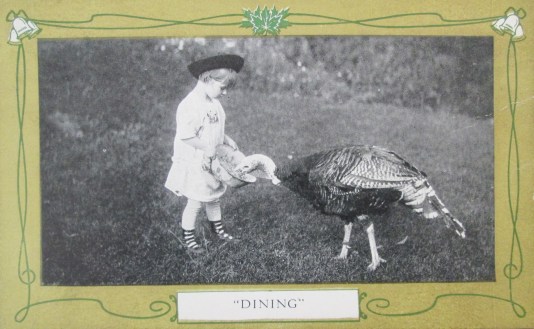
Postcard: The Montreal Standard’s Christmas Greeting card No. 9 printed in Canada

Protestant Churches of Arthabaska, Bagot, Drummond, Nicolet, Richmond, Wolfe, Yamaska

This compilation looks at the Protestant churches in seven counties of Quebec east of Sherbrooke and north toward the St. Lawrence River, including the cities of Drummondville, Victoriaville and Richmond. The guide includes a list of names of Protestant families who settled in this area, a list of ministers who served these congregations and brief descriptions of the towns and villages where these churches were located. It guides researchers to the repositories where the records of these churches can be found. Protestant cemeteries in these counties are also listed.

Protestant Churches of Arthabaska, Bagot, Drummond, Nicolet

The Biography of Stanley Clark Bagg

Don’t Believe Everything You Read

­As a well-known Montreal land-owner, writer and philanthropist, my great-great grandfather Stanley Clark Bagg (1820-1873) was profiled in the Dictionary of Canadian Biography (DCB). Unfortunately, several errors appeared in that article and, when researchers look to the DCB as a reliable source of information, these mistakes are perpetuated.

SCB

The DBC is correct in saying that SCB, as I like to call him, was the only son of Stanley Bagg, a Montreal merchant, and his wife, Mary Ann Clark. The entry adds that SCB was a notary, large landowner and president of the Numismatic and Antiquarian Society of Montreal and of the English Workingmen’s Benefit Society.

Then it states, “The Bagg family claimed to be of Norman descent. At the end of the 18th century Stanley Clark’s grandfather emigrated from England to America. At his death he left large estates in Durham County, England to his son Stanley.” This paragraph seems to refer to SCB’s grandfather Bagg. In fact, it was SCB’s maternal grandfather, John Clark, who emigrated from Durham, England. A butcher by trade, Clark owned property in Durham and he purchased a number of farm properties in Montreal that his grandson inherited.

Far from being wealthy, SCB’s paternal grandfather, Phineas Bagg, brought his family to Canada after he lost his farm in Pittsfield, Massachusetts to pay off his debts. On this side of the family, SCB’s immigrant ancestor was John Bagg, possibly from Plymouth, England, whose marriage in Springfield, Massachusetts was recorded in 1657.

The DCB was correct in saying that Stanley Clark Bagg married Catharine, eldest daughter of Robert Mitcheson and Frances MacGregor of Philadelphia in 1844, however, it went too far in adding that Frances was descended from the chiefs of the MacGregor clan and the old Scottish kings. This is a family story that may or may not be true. My research on Mary Frances MacGregor’s ancestry has come up against a brick wall.

The Dictionary says that SCB and Catharine “had one son, Robert Stanley.” True, Robert Stanley Clark Bagg was their only son, but they also had four daughters: Katharine Sophia, Amelia Josephine, Mary Heloise and Helen Frances.

The final inaccuracy in the DCB article was the statement that “his family was one of the oldest English families on Montreal Island .…” Both the Bagg and Clark families arrived in Montreal in the late 1790s, three decades after the British conquered New France and after many English, Scottish and Loyalist families had made their way here.

These errors may be minor (although the descendants of SCB’s daughters might consider them quite important), but the online version of the DCB should be corrected quickly when issues are brought to their attention. The home page of the DCB (http://www.biographi.ca/en/index.php) invites readers to suggest corrections or additions, so I assume SCB’s biography will eventually be fixed. Meanwhile, in 2013, I wrote them and included extensive footnotes so they could verify my sources. Not long after that, without changing a word, they highlighted Stanley Clark Bagg as the Biography of the Day. Two years later, the corrections have yet to be made.

The takeaway from this article: even if you read about your ancestor in a source you consider reliable, check as many details as possible and be skeptical about sweeping or grandiose claims.

Photo: Stanley Clark Bagg, portrait by William Raphael; private collection.

Related articles:

Janice Hamilton, “John Clark of Durham, England,” http://writinguptheancestors.blogspot.ca/2014/05/john-clark-of-durham-england.html

Janice Hamilton, “An Economic Emigrant,” http://writinguptheancestors.blogspot.ca/2013/10/an-economic-emigrant.html

Janice Hamilton, “The MacGregors: Family Legend or True Story?” http://writinguptheancestors.blogspot.ca/2014/03/the-macgregors-family-legend-or-true.html

Notes:

The wording I have quoted here is from the online version of SCB’s biography: Pierre Landry, “Bagg, Stanley Clark” in Dictionary of Canadian Biography, vol. 10, University of Toronto/Université Laval, 2003–, http://www.biographi.ca/en/bio/bagg_stanley_clark_10E.html, accessed November 29, 2015. This is a rewrite of the original print version of SCB’s biography, published in Volume X of the DCB in 1972, which had even more errors.

I decided to blog about this after a friend showed me an article about Robert Stanley Bagg and Stanley Clark Bagg in a book edited by Col. William Wood, William Henry Atherton and Edwin P. Conklin, The Storied Province of Quebec, Past and Present, vol. IV, Toronto: Dominion Publishing Company Ltd., 1931, 435; http://www.ourroots.ca/page.aspx?id=3660140&qryID=7ac7b13a-a7be-4ef4-9eb9-ab5b20789894, accessed Nov. 29, 2015. That article not only invented a military career for SCB, it also erroneously stated that Stanley Bagg was born in England.

The most extensive biography of SCB was written shortly after his death and appeared in the journal to which he had been a regular contributor. The article is “In Memoriam, Stanley Clark Bagg, Esq, J.P., F.N.S.”, The Canadian Antiquarian and Numismatic Journal, vol. II, no. 2 (Montreal, Oct. 1873), p. 73, accessed through Google Books, Nov. 29, 2015.


French Protestant Churches in Quebec

Among the first European settlers who came to Quebec in the 1600s were some 300 Protestants, most of them fleeing religious persecution in France. If they hoped to find religious freedom on this side of the Atlantic, they were disappointed: the Catholic Church controlled all religious matters in New France and Protestants could not even baptize their children or buy land.

Many quietly gave in and became Catholic, and families forgot that their ancestors had been Calvinists or Huguenots. Those who maintained or adopted Protestant beliefs were discriminated against by both their English-speaking neighbours and by French-speaking Roman Catholics. Many of them left Quebec. For those who remained, their churches became the centers of their lives.

This compilation includes a list of books and articles about the history of French-speaking Protestants in Quebec and a list of Protestant churches, chapels and missions in Quebec since 1600. It tells you where to find the records of these institutions and how to contact the archives of the Anglicans, Presbyterians and other denominations.

French Protestant Churches in Quebec)


Night Flight

dadmom

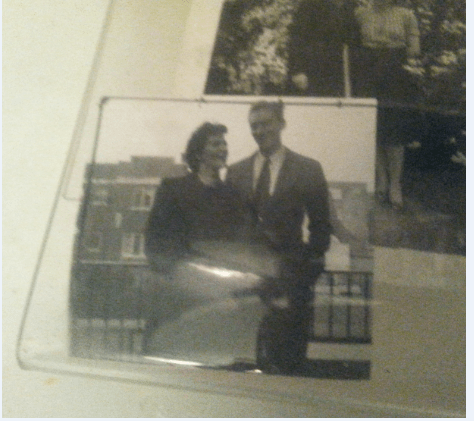
Peter Nixon, former RAF Ferry Command pilot, and new wife Marie-Marthe circa 1949.

My father had flown over the Nile.

The Nile River. In Africa.

And, even better, he had flown over the Nile…at night.

Weren’t we impressed, my two brothers and I, way back when in the 1960’s, to learn that particular spine-tingling fact.

Of course, we knew that our father had been in the War (well, duh) as part of something called the Ferry Command (ZZZzzzz) that moved planes back and forth over the ocean.

To us, our father’s Air Force career seemed dull and boring and highly unromantic and, obviously, not dangerous at all.

But, then, we kids ferreted out his black leather WWII log book.  We deciphered his compact, prep-school handwriting to see that he had been over the Nile at night and, now, our already strapping  6 foot 4 inch British Pater suddenly seemed taller in our eyes.

(How ever did he fit that huge Yorkshire farmer frame into those tiny mosquito planes, I now wonder.)

I write about this because yesterday my husband came to pick me up at Trudeau Airport in Dorval.

My plane from New York City had been delayed by  half an hour and he had wandered the premises for a bit.

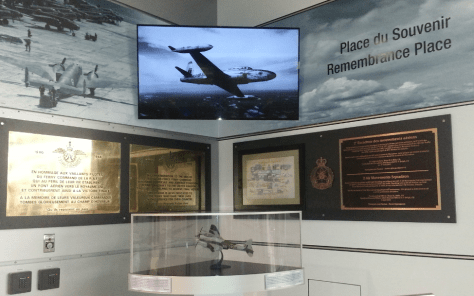
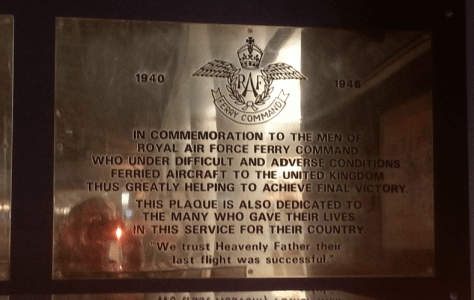
“Do you know there’s a section of the airport devoted to the Ferry Command,” he asked me as we walked back to the car.

“No,” I said.

“And they show some of the airmen involved,” he continued. “Maybe your dad is one of them.”

But, I was too tuckered out from travelling all of one hour in a cramped commuter jet to take a look at said installation. Luckily, my husband had snapped some pictures on his phone.

Ferrycommand1.PNG

ferrycommand2

Half a century has now passed since the day we kids first perused that enigmatic leather log book.

My father has been dead for 10 years, succumbing in 2005 to Alzheimer’s in the Veteran’s Hospital at Ste. Anne de Bellevue.

While he was sick, a couple of books were (finally) written about the Ferry Command. I read them.

I came to realize that the Ferry Command is the reason I am here, on Earth and in Montreal.

The Ferry Command, you see, was headquartered at Dorval.

(Hence, the installation. Hence, IATA headquarters being in Montreal.)

My father never mentioned it, or, more likely, I wasn’t paying attention, but the Ferry Command was an important part of the WWII effort.

There was nothing safe about being a Ferry Command pilot. Ferry Command planes, I discovered, were shot down and/or crashed regularly, and some crashes (the ones that made headlines, anyway) involved planes that were taking a dozen or more Ferry Command pilots, huddled together like so many human popsicles in the frigid belly of the machine, back to Canada from an overseas mission.

What exactly was this Ferry Command? Well, before the US officially entered WWII, skilled American pilots were hired on the sly, at sky-high pay, to ferry planes from Canada to England.

Planes, secretly being manufactured in the States, were literally pushed over the Border, and, then, these Yankee flying aces would take them over to England.

When the US officially entered WWII,  enlisted men from the RAF were brought into the Ferry Command, my father among them.

My father, a British child of the Raj, was 19 in 1941, either having just finished prep school at St Bees on the coast of Cumberland, or a year into his Oxford studies.

He had been a top athlete at St Bees, captain of all the school teams. I’m guessing that’s why he was funnelled into the RAF.

Anyway, I read  that the Ferry Command pilots partied hard in the Mount Royal Hotel between assignments. I’m guessing my father met my French Canadian mother at one of these gatherings.

(Too late to ask either of them.)

Lately, I also learned something else of acute interest to me: that Ferry Command planes were serviced by young women maintenance workers at Keswick Airport in England.  I’ve seen certain alluring pictures on the RAF website. (I suspect they only chose the prettiest Screen Gems style women for these promo pics.)

Now, my father never mentioned that. That, certainly, would have stuck in my brain, way back when, in the optimistic era of the Beatles, Emma Peel and Women’s Lib; a time when WWII, to us Boomer children anyway,  seemed so many, many lightyears away.

The Family Secret

By Marian Bulford

My Gran told me that her mother Lilian, did not like her very much and was not very nice to her, and consequentially for some peculiar reason Lilian did not like my mother or me, either.

I remember Lilian as a very stern presence so I steered clear of her. She did live with my Gran for a time, but by the time I was a teen, she had moved to another daughter’s house to live, so I never had much contact with her.

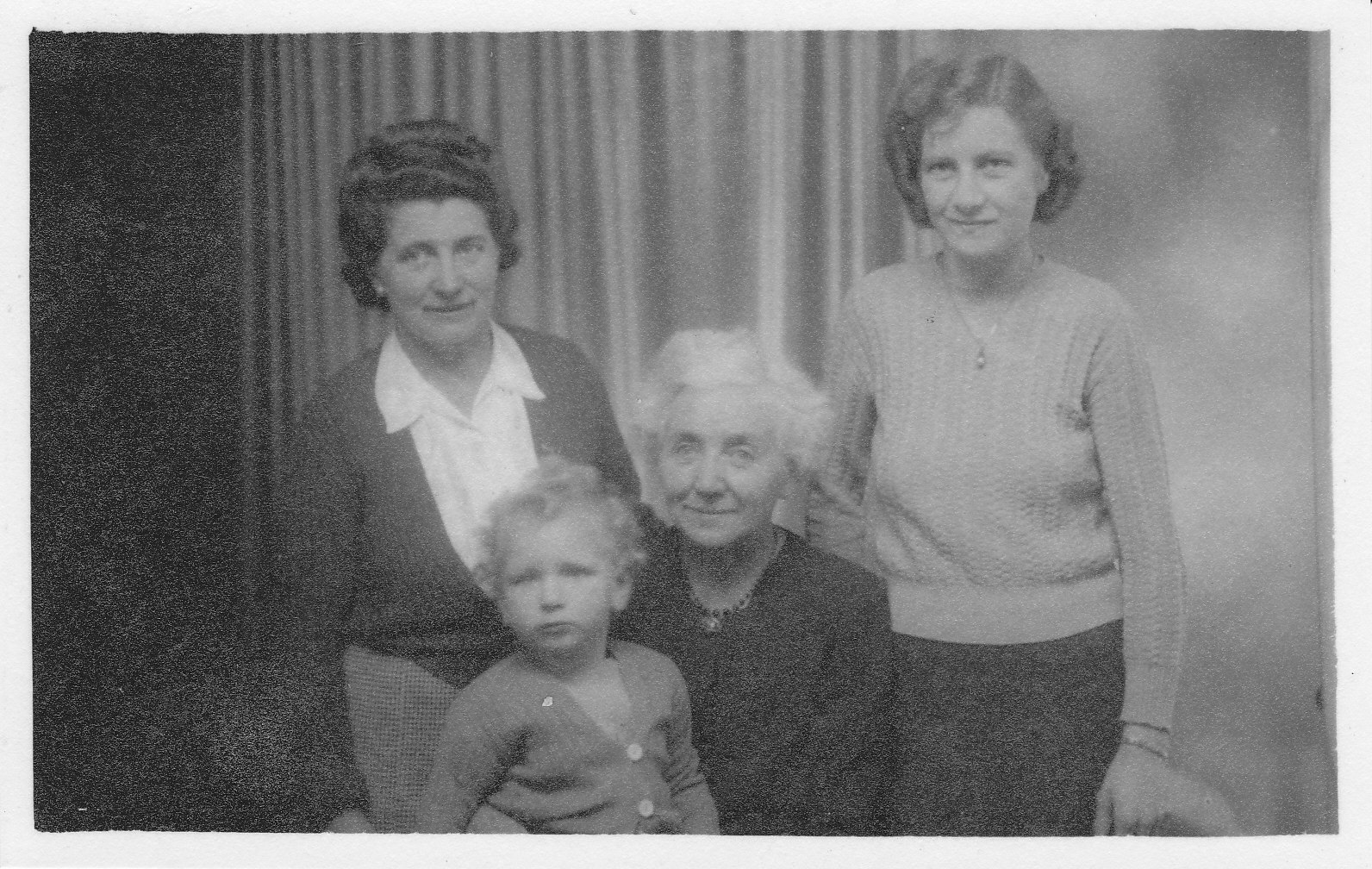
A photo below shows the four generations myself, Gran Mum and Lilian and I do not look very happy to be in this photo!

When my mother found out she was pregnant with me, 2 years after being married, she told me that Lilian said “Well, you made your bed now you have to sleep in it” Not a very nice thing to say about becoming a Great Grandmother! I never did understand why she did not like us and what she meant by that remark but years later, I was to find out.

For a while, I lived with my Grandparents from 11 years to 14 years. They were very strict but loving and Gran and I went everywhere together, to church the church fétes and shopping trips. Gran taught me to cook and bake.

One day, Gran wanted to go and see her mother who was living in Okehampton, Devon, a train ride away from us in Plymouth.

A train ride, what a treat! I was about 14 and we lived a very quiet life. Off we went, sandwiches and tea packed for the two-hour train journey to visit great-grandmother Lilian.

After my  Gran’s meeting with her mother lunch with the cousins and visiting, it was time to go. We had the train carriage to ourselves.

‘That was a lovely day, wasn’t it Gran?’ In answer, Gran burst into tears I was astounded, my Gran crying? She never cried.

I put my arm around her and asked her ‘Gran! What is the matter are you sick?” she cried some more, blew her nose and then said “I am a bastard”

Well! You could have knocked me down with a feather. Gran NEVER swore let alone say THAT word.

Eventually, she calmed down and I asked her what she was talking about. She must have been very very upset to divulge her mother’s secret to her young grand-daughter.

Apparently, Gran wanted to be baptized in the Church of England, and needed her birth certificate and to eventually claim her Old Age Pension, she also needed this document. That was the purpose of our visit.

When Lilian heard that Gran wanted her Birth Certificate SHE burst into tears and said that she hoped she would be dead by the time her secret came out.

Then, she had to reveal the reasons why she was so upset. Lilian was by then in her late 80’s and told Gran that she had given birth to her in the Leicestershire work house, because she was an unmarried mother. When she received Gran’s birth certificate it had stamped across it, in very large letters the word ‘ILLEGITIMATE’  Lilian had ripped it up and threw it away.

Lilian had, like many before and since, become pregnant at 17. The father Thomas was a Royal Navy Cooper a master carpenter. They met and she became pregnant. My Gran told me years later, that Lilian told her that she ‘fell off the style (or kissing gate) and never got up’ When Thomas did eventually come home from sea, they married. Gran was then three years old so yes, she WAS illegitimate for a while, but the parents had married, just a little late!

This seemed to be the reason Lilian did not like my Gran very much and Lilian did show a great deal of resentment towards Gran, my mother and me.


The four generations

IMG_0002
Standing, left Gran. Standing right my mother Front: Marian and Great Grandmother Lilian, 1948

This article is a continuation of a previous story, called “Illegitimate”

https://genealogyensemble.com/2015/07/13/illegitimate-2/


Remembering Ed Johnson, the visionary behind the North Wall

Ed Johnson and Ric Gidner, July 2005

As I watch the memorial service today, I’ll be thinking of my friend Ed Johnson, the visionary behind the North Wall.

Ed and I met first late in 1995, six months or so after the North Wall (officially known as the Canadian Vietnam Vet Memorial) was erected in Windsor, Ontario. We met again the following July and then again ten years later during the tenth anniversary of the monument.RicEdWindsorWall

In our first meeting, Ed told me how a chance meeting with a woman at the Wall in Washington in 1986 led him on a long journey to create the North Wall. The Canadian woman told Ed that she served as a nurse in Vietnam. Later he found out she lied about that, but her comments made him curious about all Vietnam veterans from Canada. He remembered serving with a Canadian in 1969/70 with the 2/47 Mechanized Infantry.

“During that time, it just never registered,” he said. “I didn’t know what that would mean or where it was. I mean, how many American lives did they save? I’m forever grateful for what they did.”

Johnson began looking for information about Canadian Vietnam Veterans. He found out that some associations existed in Canada, but that most veterans in our country were still isolated and on their own. He learned that many had to cross the border multiple times a year to get health treatment for injuries received during the Vietnam War.

“So I organized a committee here in the Detroit area and called it the Canadian Vietnam Veterans’ Welcome Home Committee. We began working to organize a Welcome Home event for them. The event took two years in the planning and I personally went out and signed a contract with the Michigan State Fair Grounds for $48,000.”

The Welcome Home party took place on July 4, 1989, but internal fighting between veteran’s organizations meant that two other similar events took place in Michigan the same weekend. The pressure also caused fighting at home. By Sunday night that weekend, Johnson had lost $12,000, his house, his credit rating and his wife.

Despite the turmoil, Johnson continued his efforts to bring the Canadians home. He, his buddy Ric Gidner and his brother-in-law Chris Reynolds began building a mini-version of the Washington monument for the Canadians. With the help of the associations in Canada, they researched 100 names to inscribe on the granite.

In March 1993, Johnson and Gidner started a non-profit association called the Michigan Association of Concerned Veterans to offer their monument to the Canadians.

Both the National Capital Commission and the City of Ottawa refused the offer, as did the ministries of Veteran’s Affairs and Public Works.

That led the Americans to split with the Ottawa and Toronto groups that wanted an Ottawa site and look for an alternate site instead.

In the end, the City of Windsor offered land in Assumption Park, right next to the Ambassador Bridge. The monument was dedicated on July 2, 1995 and continues to be dedicated annually every year.

Ed attended all of those dedications until he died from cancer on August 24, 2010. He was only 61 years old. There’s a neat memorial postcard in his memory.

I tried to find an official death notice for my friend, and found one for Edward George Johnson IV, who also lived in Farmington Hills and was born and died on the same dates as the Ed I knew. The picture looks like Ed to me. If this is indeed Ed, it’s nice to see that he built a strong relationship with family before dying despite his commitment to leaving a legacy for Canadian Vietnam Veterans.

Quebec City Directories

City directories contain a wealth of information for the genealogist, historian, urban geographer and the just plain curious. Quebec City directories are no different: they list residents, merchants and city streets, churches, courts, hotels, banks, charitable organizations and much more.

The link included in the PDF below will take you to the website of Quebec’s provincial library and archives, Bibliothèque et Archives nationales du Québec. It has digitized Quebec City directories (annuaires) from 1822-1976. If you had ancestors living in Quebec City or suburbs (banlieue) such as Beauport and Lévis during these years, you will probably find them in the directories. Some years include listings in what was known as the Huron Village.

The directories are at least partly written English until 1955; after that, they were published in French, but shouldn’t be hard to follow with the help of a free online translator such as Google Translate.

Thanks to Jacques Gagné for putting this listing together, and to Claire Lindell for editing.

Quebec City People

Working together to help genealogists discover their ancestors