Free public archives

No, it’s not just to get your attention, Archives publiques libres  is a group of people who believe archives should be free to search to all, and that, by the same token, if you put your information online to share with others, it is not so a company grabs your info to sell to others.

gratuit genealogieFollow them on Facebook 

On their webpage, they explain their position, list actions they take or that we can take to maintain a genalogical world accessible to all…

I really appreciate their inventory of free genealogical resources: simply click on maps and access lists fromFrance and around the world.  You can also find press releases, tips for using internet etc.

Hiding to read that kind of newspaper?

Readers always loved those stories, but…they would rather not admit it.

Shocking News

Vicky Lapointe, graduate historian from Sherbrooke University, signs a special newspaper blog.  She combs through Quebec old newspapers to present us with crimes and catastrophies, francophones from outside Quebec and some pictures, medicine, history and patrimonial buildings.

It is suprising to see what kind of news would make the paper a century or two ago, how people responded, and yes…what strange crimes were being commited.  I also enjoy reading about events that are now part of history, as they happened.

Read Patrimoine, Histoire et Multimédia


Empty Boxes

A sense of dread enveloped me on hearing David’s words: “Paige is the first of our generation with Alzheimer’s.” David and Paige are my cousins, the sons of my mother’s eldest sister Madge. Alzheimer’s has long held a dark grip on my family.

Madge died young as did her brother Clark. The remaining five siblings lived to seventy and beyond and all died with Alzheimer’s. Family clusters like this are unusual, my doctor assures me, and likely linked to something in the environment. The Willetts were born and raised on a farm in the Gaspe. Perhaps the trigger was something like drinking unpasteurized milk, my doctor suggested. Good, I’m a city girl and have always consumed pasteurized milk. But wasn’t that also true of Paige?

I was witness to the slow progression of the disease in my two aunts and my mother. Violet was the first to be moved to a nursing home when her sister Kathleen could no longer care for her. Eventually she appeared to have forgotten everything, even how to eat. She died when a feeding tube perforated her throat.

Kathleen was next. Frequently she tried to escape her home. Once she was found wandering miles away in a seedy section of the city. Someone drove her to the address on a letter in her purse, her old apartment. The new tenant invited her in to wait while the police searched their missing people’s files. Evidently the two women had a lovely afternoon chatting about their world travels, the tenant seemingly unaware of my aunt’s dementia. Social skills are said to be the last to disappear. Kathleen died of pneumonia, “the old people’s friend” my mother called it. Years later it was difficult for me to give my consent for mum to have a pneumonia vaccine.

My mother’s Alzheimer’s accelerated rapidly following my father’s death. For a while she was aware of her confusion struggled to regain control. She railed against going to a home and accused me of kicking her out of her house. “Take me home” she would cry again and again. “That’s where my umbrella is. And my memory.” In the end, she forgot who I was and that she was ever angry with me. Time and memory became short circuited. She searched for her own mother in the rooms of the home asking constantly why she hadn’t come to visit her.

My mother died peacefully at the age of ninety-four. By that time she too would not eat or drink and her words made no sense. But Alzheimer’s treatment had advanced. There was no force feeding, just gentle care and comfort from family and staff in her own room and in her own bed with soft music in the background. We no longer prolong the dying of Alzheimer’s patients but travel with our loved ones on their final journal. I held my mother’s hand as she took her last breath.

A few years earlier my husband and I had emptied mum’s house and put it on the market. I’m still haunted by the image of the empty boxes we found stored in the basement: big boxes and small boxes, cardboard boxes and boxes covered in velvet, blue Birks boxes and boxes from the St. Hubert Barbeque. The boxes were the remainders of a lifetime of experiences. But the boxes were empty, a very powerful metaphor for the effects of Alzheimer’s. Today I am healthy and my memory boxes are full. So I write of memories, my own memories and the stories of my family that I have researched. If one day my memories are lost, my boxes will hold the record.

Madge Alexandra Willett Whitney 1902-1941 (39 years)
Clarke Stanford Willett 1912-1960 (48 years)
Violet Gwendolyn Willett 1903-1983 (80 years)
Kathleen MacDonald Willett 1907-1991 (84 years)
Marion Geraldine Willett Angus 1917 -2011 (94 years)

Also:
George Ralph Willett 1905-1983 (78 years)
Keith Arthur Willett 1910-1980 (70 years)

To grow a life-size tree, you grow a family

My good friend Joel Bergeron’s grand-father moved to Temiscamingue early in the 20th century.

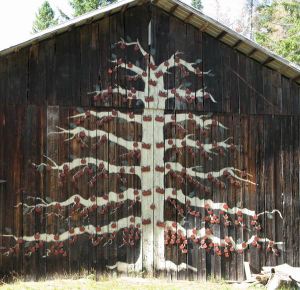
Their descendants still meet annually at their cousin’s farm.  The most beautiful tree grows on this farm.

It’s painted on the side of the barn; its trunk has their grand-parents’ names at the base.

arbreP

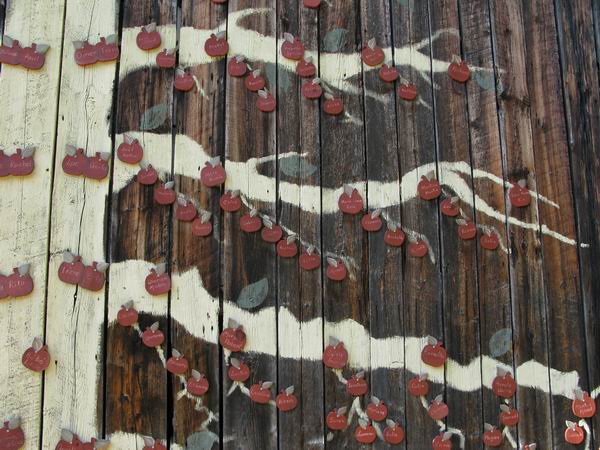
Wooden apples sit at the base of the main branches:  each pair of apples represents a couple and another branch on the tree.  Along each branch sits an apple for each child and his or her spouse. From each of these grows a smaller stem that in turn holds apples for each of their kids.

arbrdetp

Every year, the entire family comes to the farm from Ontario, Quebec, where-ever they live… to feed that tree with joy.

Un arbre généalogique pleine grandeur!  C’est celui des Bergeron qu’on retrouve sur la grange d’un cousin.  Les grand-parents se sont installés au Témiscamingue au début du 20e siècle.  Leurs noms sont à la base du tronc.  A chaque embranchement, deux pomme pour un de leurs enfants avec son conjoint.  La branche qui y pousse, contient les pommes des enfants de ceux-ci, et les petites branches, de leurs petits enfants.  Et toute cette famille se réuni chez ce cousin, quelques jours, chaque année, parce que la famille, ça se cultive!

Cherishing memories

My paternal grandparents immigrated to Montreal from Scotland in 1912 and settled in Pointe St. Charles. They moved every few years and, as the family became a little more prosperous, they moved to Verdun. I grew up listening to family stories that took place in Verdun.

Kathryn Harvey, a Montreal historian, has posted this an article about the Verdun Memories project on the web site montrealmosaic.com.

http://montrealmosaic.com/reflection/verdun-memories

Kathryn Harvey and Leila Marshy put together a short film shot about Verdun Memories called Cutting, pasting and remembering. This film is about the memories and also about the joy of sharing these memories with others. You can view this film at:

http://www.verdunmemories.org/

Researching Your Ancestors in France

Map of France 1740
Map of France 1740

 Are you researching your ancestors? Do you want to know what part of France they came from;  where they began their journey to New France?  If so, you might be interested in the new group formed by members of the Quebec Family History Society (QFHS).

The France Research Special Interest Group meets every 4th Sunday of the month at 1:00 pm to 3:00 pm at the QFHS Library and Center at 173 Cartier Avenue in Pointe-Claire, Quebec  just off of Highway 20 (opposite the CLSC).

QFHS members are welcome  to join  these monthly meetings.  Together, in a friendly and informal setting, new and experienced genealogists gather to discuss our French ancestors. The focus of the group is to share researching techniques available on the Internet. France has a wealth of free websites containing numerous databases and extensive archives  for each of the 95 departments dating back in time to  the 1500s.

If you are not a member and are interested in joining the group or want know more about QFHS, visit the website at www.qfhs.ca.

Remembering the 9.5 Million Dead of World War I

Canadian actor and playwright R. H. Thomson has undertaken a remarkable project to commemorate the names of the more than nine million people who died in World War I, individually, and at the exact time of each person’s death, no matter what the person’s nationality or military rank.

Over the next four years, those names will appear in various ways. They will be streamed to computers, tablets and cell phones. They will be displayed on the walls of buildings or in public spaces. And they will be distributed in an app to museums, schools and universities.

Among the many nations participating are Canada, the U.K., Germany and France. Russia, where more people died than anywhere else, is considering its participation, but may have difficulty because some of the archives were destroyed. Some countries have declined to take part.

To learn more, go to http://theworldremembers.ca. You can listen to Michael Enright’s Feb. 23, 2014 interview with R. H. Thomson at www.cbc.ca/thesundayedition/.

Old Weaving Loom In Use

weaving loomI took this photo of a weaving loom at the National Museum of Scotland (www.nms.ac.uk)  in Edinburgh two years ago. My interest stems from the fact that my great-great grandfather was a weaver in Lesmahagow, near Glasgow, before he came to Canada. Even though I have seen quite a few old looms, I wasn’t sure how they operate.

Today I found a short video on the BBC News website that shows a loom in operation. This loom, rescued from an old barn in Wales, is powered by the weaver’s feet to make cloth for fashion designers. The video can be seen at www.bbc.co.uk/news/magazine-26179200.

To read my article about Robert Hamilton, a Lesmahagow weaver who emigrated to Scarborough, Upper Canada, in 1829, see http://writinguptheancestors.blogspot.ca/2013/12/from-lesmahagow-to-scarborough.html

Friday factoid: Project Gutenberg

On a summer day in 1971, Michael Stern Hart typed the U.S. Declaration of Independence into his computer and shared it freely online via the University of Illinois at Urbana-Champaign.

That moment was the beginning of Project Gutenberg.

As of today, Project Gutenberg contains 44,847 books and texts in the public domain that can be searched via keyword, title or author. I’ve already written about finding a book mentioning one of my ancestors. This is a great way to find out context about various time periods or simply find some great texts to download to your electronic book reader.

Visit the site for your own searches at http://www.gutenberg.org/.

Working together to help genealogists discover their ancestors