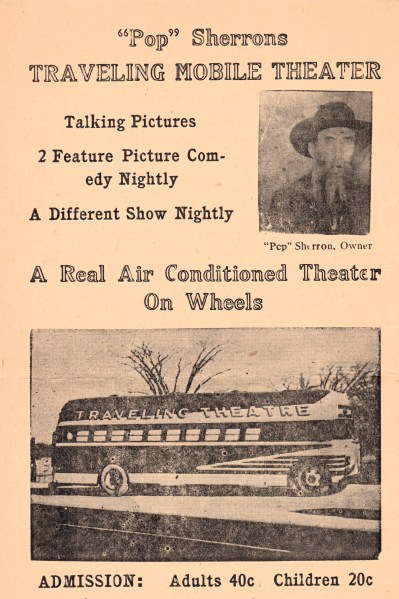
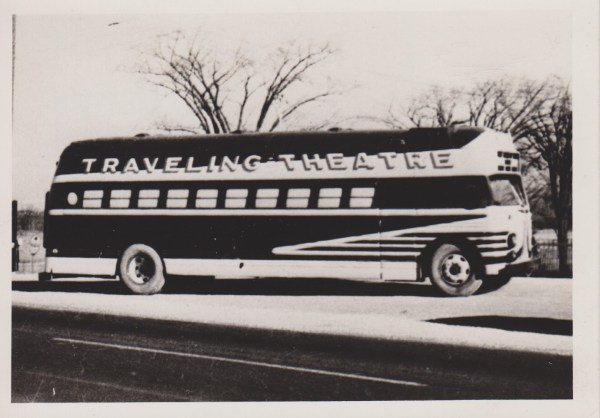
“Pop” Sherron and “Texas Betty” (his air-conditioned travelling mobile theatre bus) must have been a welcome sight whenever they pulled into small towns in and around Phoenix, Arizona, in the 1940’s.
Sherron, my great-uncle, charged admissions of 40 cents per adult and 20 cents per child to enjoy “two feature picture comedies nightly” and “a different show nightly” on his travelling mobile theatre bus.
Sherron’s Advertisement Flyer
Roger Sherron (1895-1963) was a somewhat “reclusive” man or what one might consider a “hermit” and, according to a phone conversation with his nephew, his own family labelled him as “odd.” These opinions were supported on his WW1 registration (and rejection) in 1917 (age 22) with “arrested development mentally” entered by hand in the exemption section by officials.
Fortunately, we have come to better identify and understand mental conditions nowadays.
The Sherron family belonged to Philadelphia’s high society. Roger’s father owned and operated a wholesale grocery business while his mother and two sisters were frequently featured in the society pages of the local newspapers with their luncheons, tea parties, bridge games, fundraisers and such. This was not Roger’s “cup of tea” so to speak.
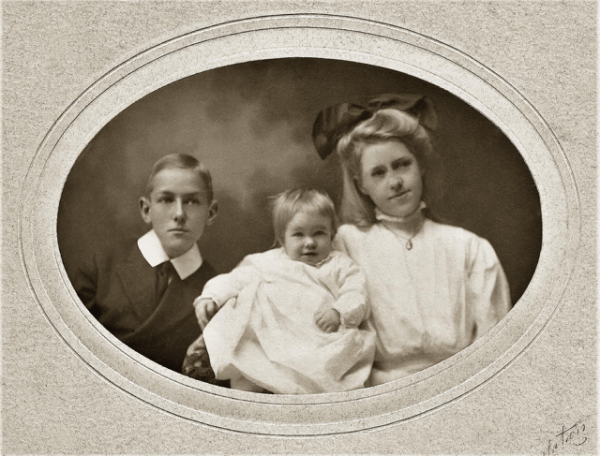
Roger, Alberta and Josephine Sherron (my grandmother) – 1906
Young Roger briefly attended the Wenonah Military Academy in New Jersey, a private secondary school “where a diploma entitled the graduate admission to West Point, Annapolis, or one of the best colleges or universities in the country, usually without qualifying tests.” He left school before he finished his studies but luckily could read and write by then even if his handwriting remained somewhat childish.
According to the censuses, Roger sometimes worked at odd jobs (in 1920 – grocery sales at age 25 and in 1930 – game warden for the State Government at age 35) but otherwise he was listed as “unemployed.”
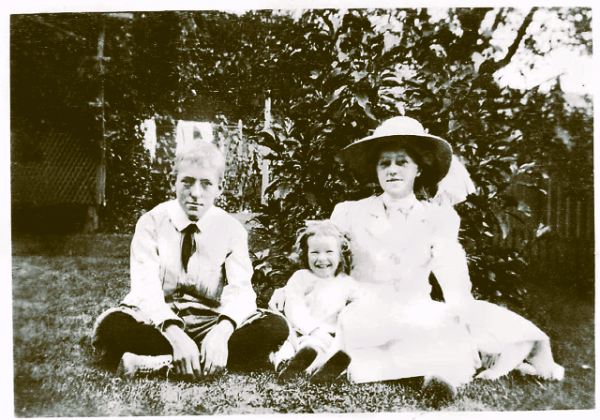
Roger and his sisters Alberta and Josephine circa 1910
He never married, living with his parents in Philadelphia until 1940 when his mother died. His father passed away in 1932. His younger sister Alberta also remained nearby with her family but his older sister Josephine (my grandmother) moved to Montreal, Quebec, with her stockbroker husband, Wendling Anglin, and her two sons (my father, Tom, and his brother Bill).
Roger was 44 years old when his mother died, alone in the world for the first time and without a place to live.
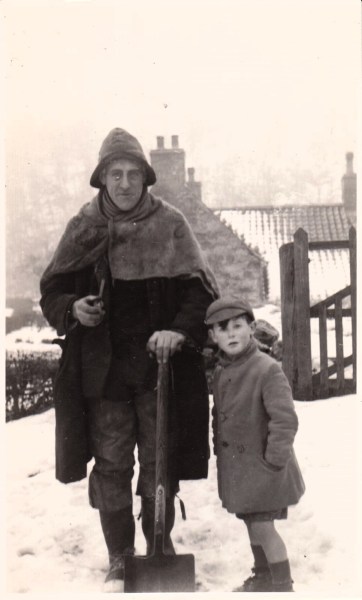
Roger and his nephew Donnie – 1932 – visiting his sister Alberta after his father died
Sometime, after the death of his mother, he moved west to a very different world and a warmer climate.
Once in Arizona in 1942, at 47 years old, and possibly homeless and jobless, he tried yet again to enlist with the WWII Draft. According to the registration form, he stood at 5’7” tall and 125 lbs with tattoos on his left arm. Unsurprisingly, Uncle Sam didn’t accept him this time either.
He must have inherited some money from his parents’ estate because this is where he acquired a retrofitted theatre bus he named “Texas Betty” which enabled him to start a rather unique business and support himself. At some point, it appears he might have attempted to expand his business as I have a piece of printed letterhead stating:
POP SHERRON’S FAMILY
Travelling Amusement Center and Big Free Circus
In Route – Pop Roger Sherron
Texas Betty Sherron
Owners
Texas Betty
Again, according to my phone conversation with his nephew, Roger’s home in Phoenix was just “a shack.” He lived in the Hispanic part of town and it is likely the entire neighbourhood consisted of similar housing.
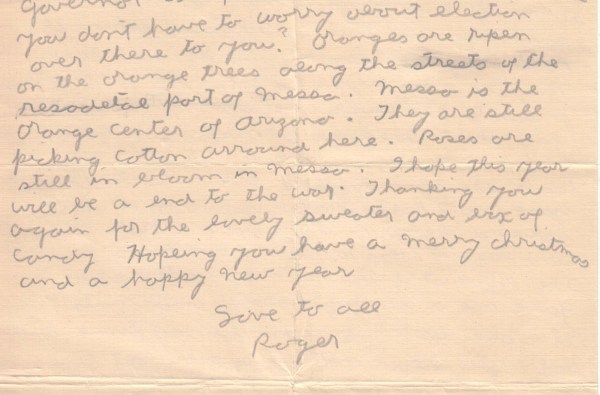
At the age of 50, some six years after he left Philadelphia, he wrote a Christmas letter to his older sister Josephine from Tempe, Arizona, which is half way between Phoenix and Mesa. He settled in this new community (and dare I say new family) who it seems wholeheartedly accepted him.
“I spent Christmas eve with some Spanish friends five houses down the road. They had tamales and Spanish food. They are nice people.”
“I got a lot of Christmas presents. The people next door gave me a fine shirt. The people three houses down gave me some handkerchiefs, a Coke, a comb, pen and ink and envelopes…the Spanish fellow who owns the store gave me a big bag of candy and nuts.”
“The television has come here now. The people next door have a fine set. It don’t hurt your eyes or nothing. Down at the bus station at Mesa, they have a set but it hurts your eyes.”
His neighbours might have struggled but they were rich in love and support for one another.
The letter continued with what might seem like “odd ball” concerns about the ongoing war, the atomic bomb and politics:
“I think the country will go Republican next election. I hope so. People are getting tired of this New Deal bussiness (sp). The Republicans will jump right in and fight Rushea (sp) and China. Lots of Chinese arround (sp) here in Phoenix and Mesa. They are aloude (sp) to run loose. They ought to put them in camps till after the war.”
Paranoia? No, just a typical American way of thinking at the time.
Roger, revealing his good prep school manners and poetic side, continued with a lovely description of his immediate surroundings: “Oranges ripen on the orange trees along the streets of the resodental (sp) part of Mesa. Mesa is the orange center of Arizona. They are still picking cotton arround (sp) here. Roses are still in bloom in Mesa.”
His letter ended with hope the war would end soon, another thank you for the gifts of a sweater and box of candy, and finally Roger wished his sister well and sent his “love to all.”
Roger died of a heart condition in 1963 at the age of 68. So he spent the last 20 years of his life in the Arizona desert with his one-of-a-kind air-conditioned cinema bus Texas Betty and his kind-hearted friends, no longer considered a hermit, reclusive or even odd.
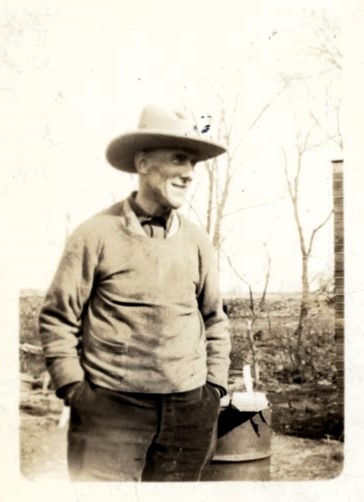
Sherron in the Pocono Mountains, Pennsylvania in 1939
In the Part 1 blog of “Honesty Pays Off” In the following linkhttps://genealogyensemble.com/2024/05/15/honesty-pays-off/we learned of the first leg of my father’s trip to Finland in 1934. He sailed aboard the Empress of Britain and spent some time in London before embarking on the second half of his journey to Petsamo Finland where he was instrumental in opening a nickel mine.
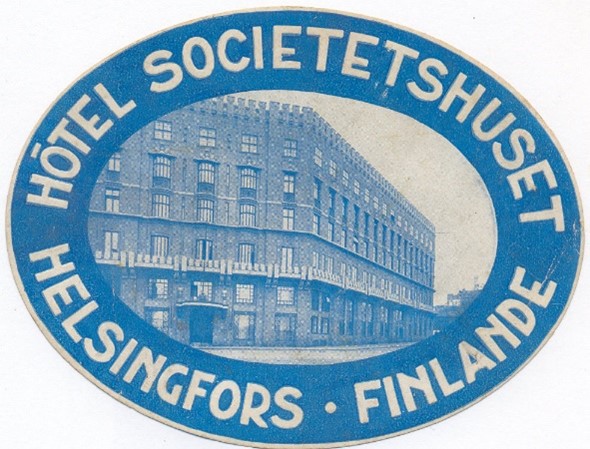
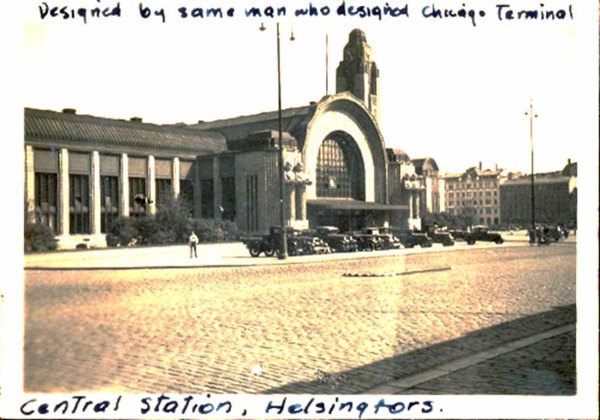
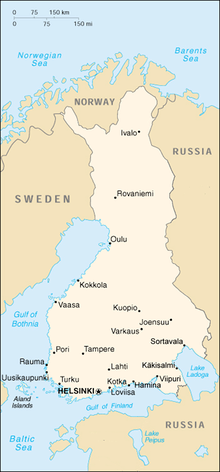
Once Mond Nickel had prepared all the necessary documents, my Dad set out from London to Helsinki, Finland, It would take two days by car, ferry, and train to reach Helsinki (where he most likely arrived at the station in the capital city of Finland.
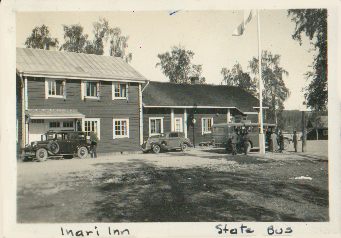
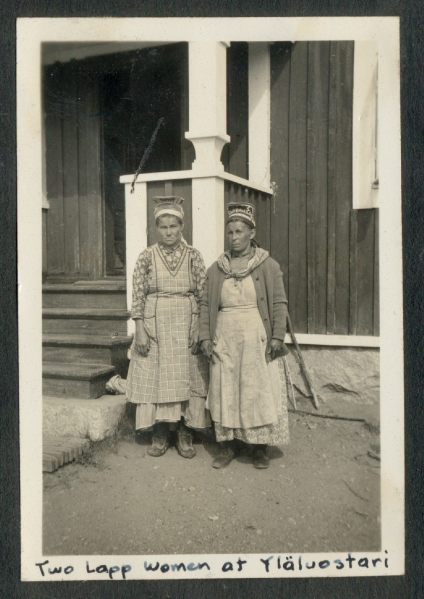
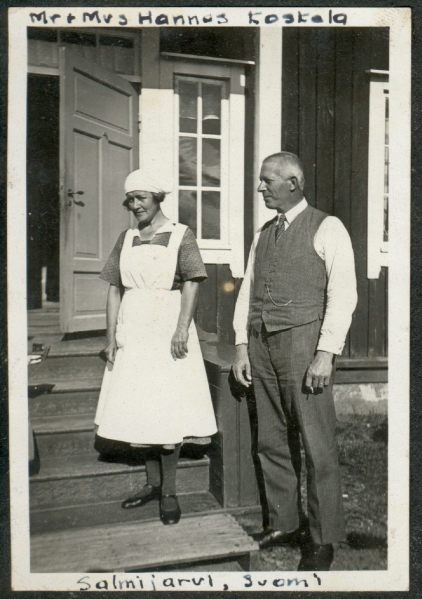
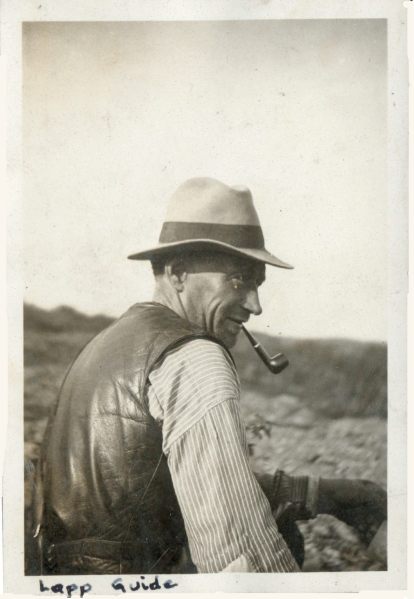
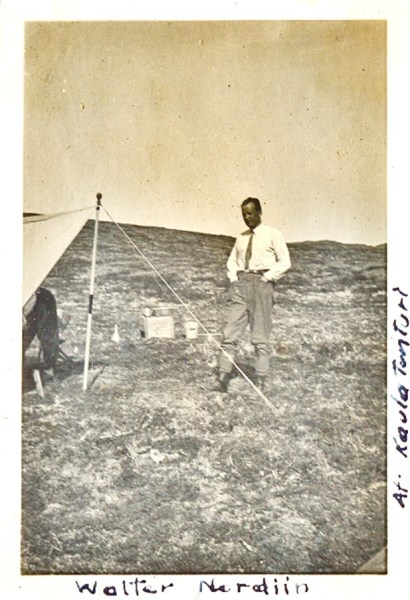
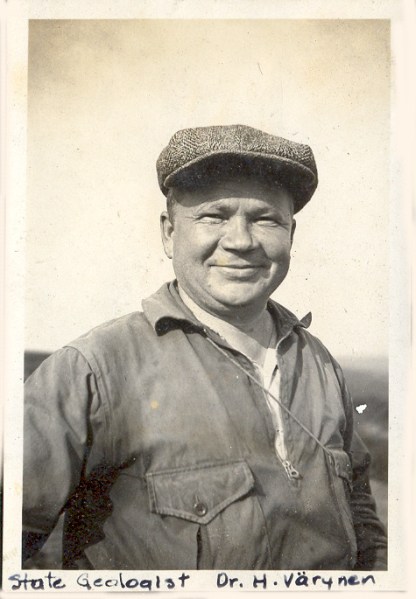
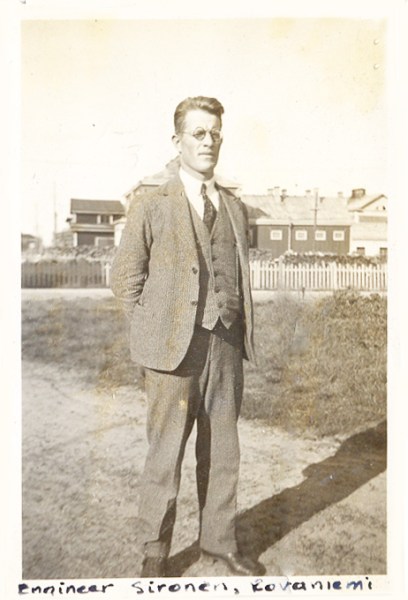
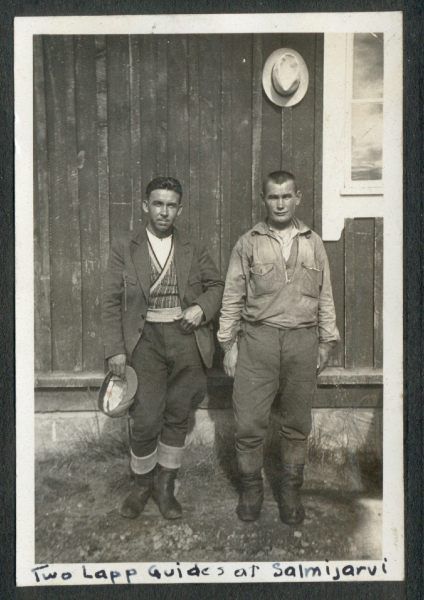
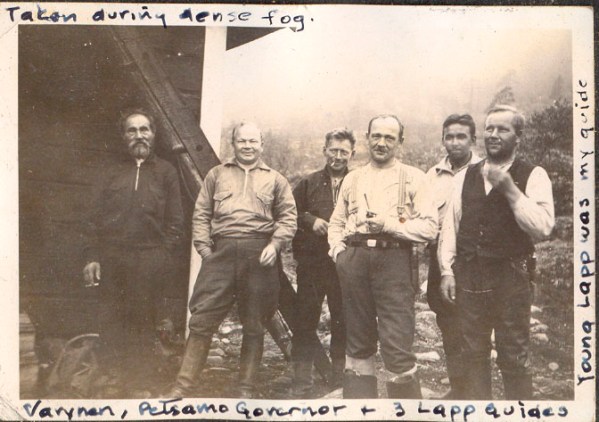
From Helsinki he headed to north through Lapland to the Petsamo area with numerous stops along the way. He took many photographs of the people he met and with engineers and workersthose who were involved in searching for the site to develop the mine, as noted in this photographic collection.
All the photographs in this blog were taken by Dad.
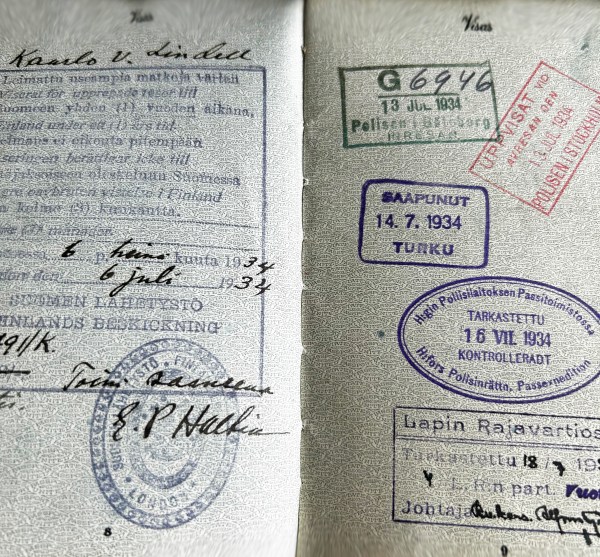
A page from Dad’s passport
State bus on the right.
Dad spent the entire summer of 1934 in northern Finland. In early September having accomplished the task set by Mond Nickel: that of opening a nickel mine in Petsamo. He then returned home to Canada.
The trip to England and Finland was the first of his many overseas trips. In some ways it may perhaps be the most important one of his forty year career as a mining engineer. (1930-1970)
Important Facts About Petsamo and the Nickel Industry in relation to Finland as noted in Wikipedia
Nickel had been discovered in 1921. In the 1930s Inco had invested several million dollars developing valuable nickel deposits in the Petsamo district of northern Finland. In 1934 the Finnish government awarded the mining rights to the British Mond Nickel Co , then a subsidiary of International Nickel ( Inco) that founded Petsamo. Nickel became commercially available in 1935.
“Petsamo nickel mine was the second biggest in the world.”
During WW2 (1941-1944 )the area of Petsamo was used for attacking Murmansk and then captured by the Red Army in 1944. In 1947 after the Paris Peace Treaty the area was incorporated into the Soviet Union and became known as Pechanga, As a result of this agreement Finland no longer had access to the Barents Sea, a body of water that did not freeze in wintertime. A huge loss for Finland.
Would my 19th-century ancestor Sophie Bruneau Huntley be posting pictures on social media, taking selfies and showing off her new purchases if she were alive today? I think the answer is, maybe yes!
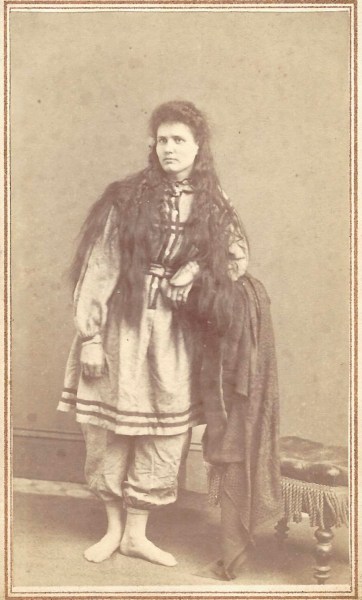
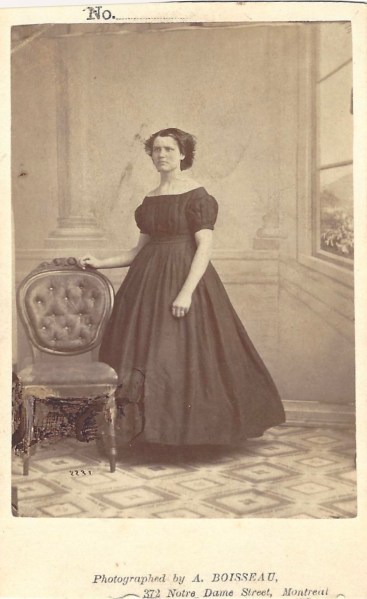
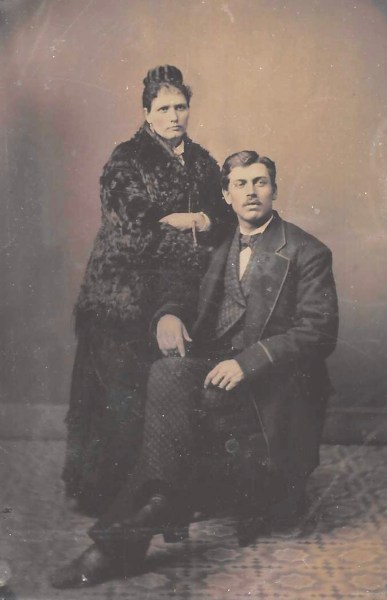
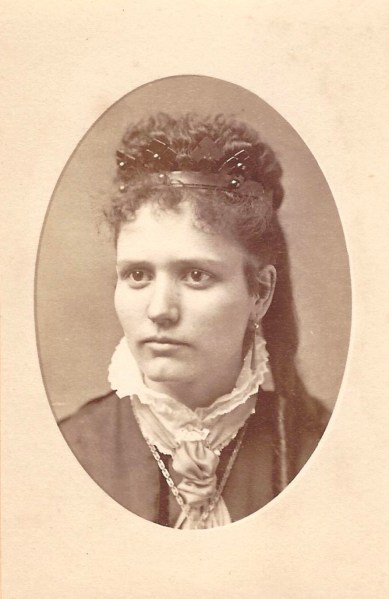
Sophie was born in 1847, so all her early pictures were taken in photographic studios. These were not spontaneous pictures but rather specific setups with long exposures. There are several pictures of Sophie in the family photo albums. Many were taken in New York. My favourite is Sophie in a bathing costume displaying her very long hair and bare feet. There were no mischievous smiles but rather hard stares. Still, it appears she had fun during her photo shoots.
Sophie Bruneau
My great-great grandparents Barnabe Bruneau and Sophie Marie Prudhomme had 13 children and Sophie was number eight. She lived with her parents on their farm in St. Constant, Quebec until after the 1871 census. Pictures from New York studios came soon after. I assume Sophie worked in New York as a teacher or a French governess like her sisters, Virginia and Elmire, when she arrived in the United States in 1875 at 27 years old.
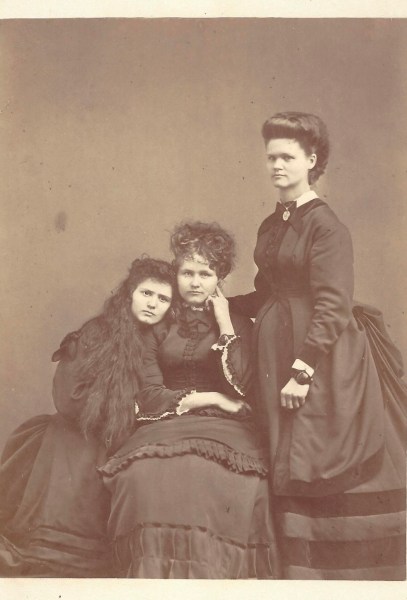
Sisters: Sophie, Helene & Mathilde
Sophie in New York
Sophie and her sister Elmire, married two Huntleys, Washington and Wallace? (Walworth). I assumed that they were brothers who married sisters. On family trees and photos he was called Wallace but it seems he was George Walforth Huntley (1854-1933), Washington’s younger brother and seven years younger than Sophie. Andrew Washington Huntley Elmire Bruneau’s husband was born in Mooers NY to Andrew Huntley and Calista Blodgett and there was a George Walworth Huntley in the family. If this is Sophie’s husband, they could also have met because her sister Aglae was living in Mooers Forks, New York with her husband.
Sophie and George W. Huntley
Sophie, Elmire, and their husbands lived in several places in the United States but ended up in Los Angeles.
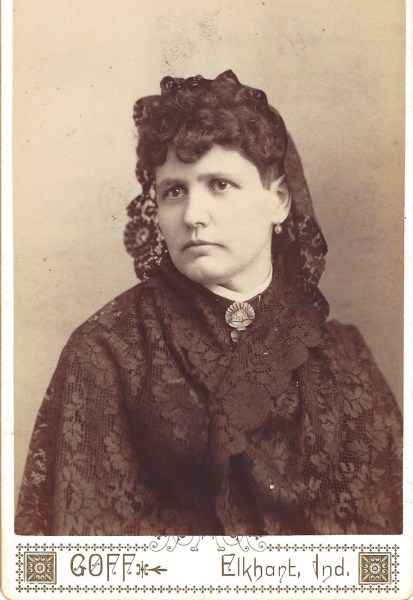
Sophie and Walworth lived in Elkhart, Indiana as Sophie is mentioned in the Personal and Society column of the Indianapolis Journal, “Mrs. George W. Huntley is spending a month in Montreal.” The beginning of the column discussed women’s dress which probably interested Sophie. “What with shirtwaist blazers, neckties and caps the women, middle-aged and young are fast becoming what Light facetiously denominated “self-made men.” George was a railroad conductor and owned his own house according to the 1900 census.
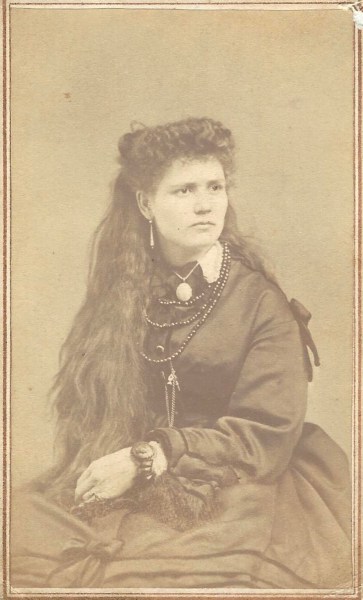
Sophie Huntley
They later lived in Toledo, Ohio where George was a customs collector and finally moved to Los Angeles, California. Sophie became a naturalized American because her husband was a US citizen.
They never had any children.
Sophie Bruneau Huntley
Her age was fluid in all the documents. Her husband was seven years younger but sometimes she was younger and sometimes the age difference was much smaller. Her death record in December 1921 said she was 68; in the 1920 census, she was only 63 while actually being 74.
A death notice in a Los Angeles paper, “Sophie B. Huntley died December 28, 1921, beloved wife of George W. Huntley, funeral from residence La Veta Terraces.” Her death notice was also in Elkhart, Indiana and Toledo, Ohio newspapers. George continued to live in Los Angeles with his housekeeper Mary Dietrick until his death in 1933.
Notes:
“Canada Census, 1871”, , FamilySearch(https://www.familysearch.org/ark:/61903/1:1:M4KT-F5V : Sun Mar 10 23:41:04 UTC 2024), Entry for Barnabe Bruneau and Sophie Bruneau, 1871. Sophie 23 at home no occupation.
California, County Birth and Death Records, 1800-1994″, , FamilySearch(https://www.familysearch.org/ark:/61903/1:1:QG49-NZN3 : Sat Mar 09 23:29:28 UTC 2024), Entry for Sophie B Huntley and Barnabee Barneau, 28 December 1921.
Antonia Willoughby, ancestor of Mr. Lumley Hodgson on his mom’s side.1
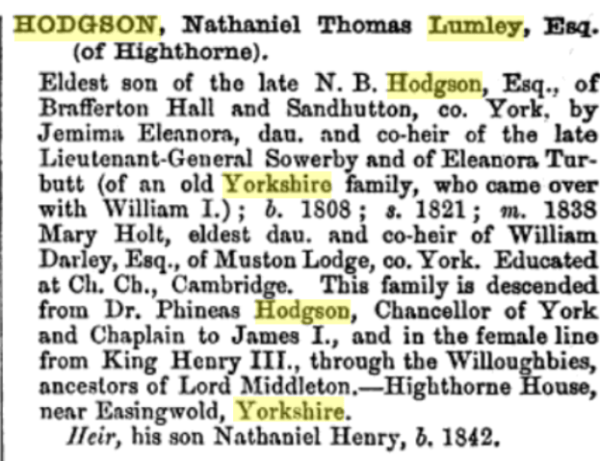
As is typical, I know little about the life of my great great grandmother, Ann Nesfield, a cook from North Yorkshire, UK except the basics: birth (1838), death (1912) marriage (1861) and children (10) but thanks to the Internet I know a great deal about her employer, Nathaniel Thomas Lumley Hodgson, a member of the landed gentry. So, just for fun, I have strung together this little fiction about my great great grandmother from some intriguing facts about Mr. Lumley Hodgson found online.
August 23, 1861. “Happiness in marriage in entirely a matter of chance.” I read that in a book by Miss Austen.
As it happens, I am getting married in less than a week to a tailor from the tiny village of Rievaulx, a man I hardly know, a Mr. Thomas Richardson. He visits my place of employ twice a year in the spring to make up my Master’s riding clothes.
Although most of my Master’s clothing is bought in London, he prefers Mr. Richardson, who lives only 12 miles away, for his country apparel.
My name is Ann Nesfield. For many years now, I have been engaged as a cook at Mr. Nathaniel Thomas Lumley Hodgsons’ farm estate, Highthorne, near Husthwaite. It is a leisurely employment. I feed his small family, the household staff and the three farmhands. It is rare that important visitors come to stay, and if they do they come on business and sup at the local inn where they can haggle in manly fashion.
You see, Mr. Lumley Hodgson is a breeder of fine horses, of field hunters and of race horses. He trades mostly in the strong reliable Cleveland Bay, a local breed of which he is reet fond.
The Cleveland Bay, he informs everyone, was originally bred centuries ago by the local Cisterian Monks as a pack horse. Later, after the dissolution, the Cleveland was bred with some fleet and graceful Turkman stallions.
Today the Cleveland Bay is used in the field, both to hunt and to plow.
Mr. Hodgson seldom fails to tell his customers how 30 years ago he rode his own Cleveland Bay the one hundred and seventy five miles to and from Cambridge where he attended university.
If that doesn’t impress, he then relates the story of how another local man rode his Cleveland mare 70 miles a day for a week for jury duty in Leeds. Or how another man once burdened his beast with 700 pounds and rode 45 miles to Ilkley and back.
“The breed is being ruined,” Mr. L.H. likes to say, “by the London fashion for flashy carriage horses of 16.5 or 17 hands. Leggy useless brutes they are. All action and no go.”
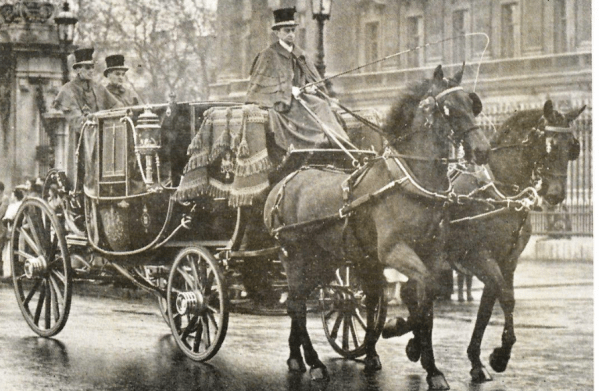
Leggy Cleveland Bay Carriage Horses.
Mr. L.H. calls himself a farmer but he is a gentleman-farmer with a pedigree as impressive as his osses’. At Cambridge he shared lodgings with the great scientist Charles Darwin. This is also summat he usually tells a prospective client, for Mr. L.H. is a canny businessman and this association can only help him, considering his occupation.
There are rows and rows of stables on his 107 acre farm near Husthwaite that sits on one of the seven hills in the area. The main house, they say, was given as a reward many years ago to one of William the Conqueror’s faithful knights.
As I said, my Master’s household is small, made up of his wife Mary Darley (whose family owns many yackers of land in Yorkshire) two daughters, Julia, 22 and Emma, 8, as well as a nurse, a housemaid and a cook, yours truly.
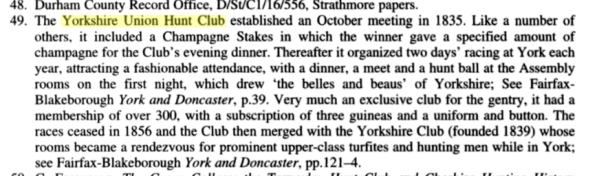
At 23, I have been summat of a sister to Julia, who is sharp-witted but shy in company. She is destined never to marry. At least, there is never any talk of it, not since 1857 and the bachelor’s ball at the Yorkshire Union Hunt Club. So, on fine evenings, I am the one to accompany Julia out riding. We take two bay mares who she says are descended from the Darley Arabian, the daddy of all Thoroughbreds.
I am told I have a better seat than she does, but only by the groom, a Mr. Jack Bell. At breakfast time he likes to call out to me “Mornin’ Milady, grand day i’n’it”- a bit of a jape – and then he laughs showing a great gap where his front teeth should be.
A signed copy of the Voyage of the Beagle lies in a place of honour in Mr. Lumley Hodgson’s private library and has for decades. You can be sure I have never read it, but Julia has and told me all about it. She is the one who had me read Pride and Prejudice. She likes to lend me her favourite novels so she can explain them to me.
Over the years, I have heard (mostly overheard) so much about this Beagle book I feel as if I have read it and even been on the great sea voyage myself to the GA-LA-PA- GOS Islands and seen with my own eyes the strange and colourful creatures there.
Mr. Darwin has lately published another book called, I think, the Origin of Species. A copy arrived by messenger to Highthorne late last year.
This new book of Mr. Darwin’s has caused quite a stir locally. At a Methodist church service a month ago the minister bellowed that Darwin’s theory of evolution is blasphemous. Flippin’ ‘eck! The theory says we all come from monkeys! Mr. Lumley Hodgson – not in attendance – later told the minister that the theories in the book apply only to animals not to humans, but the minister was not satisfied. He said the question of the origin of all species was decided long ago and by an infallible source. He meant the Bible, of course. “God made the animals of the earth after their species as explained by Noah’s Ark.”
So, my Master, who can’t escape this connection with Mr. Darwin now, has decided to quit the farm for a while.
A few days ago he assembled the staff in the south hall and told us he is selling off his best hunters and other stock (including Emma’s comely Cobb pony and his prize Nag stallion) and moving his family to town for the winter. His excuse is that some of his horses have the equine flu (two have already been put down) and he thinks it might be catchin’ to humans.
No matter what the real reason for his takin’ his family to town, the result is that I am left in the lurch with no employment and no place to stay.
But just yesterday, Mrs. L. H. called me into her sitting room, the one with all the paintings of Julia’s frightsome-lookin’ ancestors, and pronounced, “Ann, you must marry Mr. Richardson, the tailor from Rievaulx. He is a respectable man who needs a wife. His sister, who has been housekeeping for him, has suddenly left for abroad. He says he is comfortably settled now in his own cottage and ready to marry and raise a family.”
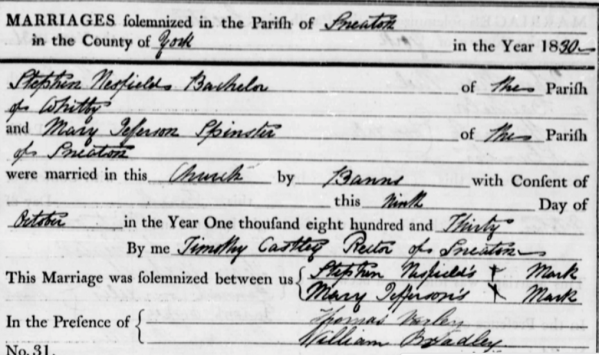
X marks the spot where my illiterate ancestors Mary Jeferson (Jefferson)of Sneaton and Stephen Nesfield of Whitby, Ann Nesfield’s parents, signed their marriage certificate in 1830.)
I must have looked very confused because she continued: “You remember Mr. Richardson from the spring? He waxed ecstatic over your Lamb’s Tail Pie and Tipsy Trifle.” (I did. Seems to me he had eyes for Julia back then.) “He says he needs a wife schooled in numbers to help him keep the accounts. And as Rievaulx is an isolated place, he requires a strong healthy girl who can walk the trails back and forth to Helmsley herself on market day. He is often on the road, so you will not have the use of his carriage as you do here to go to market in Easingwold. Yes, you must marry Mr. Richardson and very soon, too. We can have the ceremony right here in Husthwaite. But first you must visit him in Rievaulx. You can stay at our cousins the Lumleys who have a big farm there.”
So, it is set. My days of making simple Yorkshire meals for a small, ‘appy family in a reet bonnie setting near Husthwaite- and cantering over the dales at darkening with my almost sister Julia – are over.
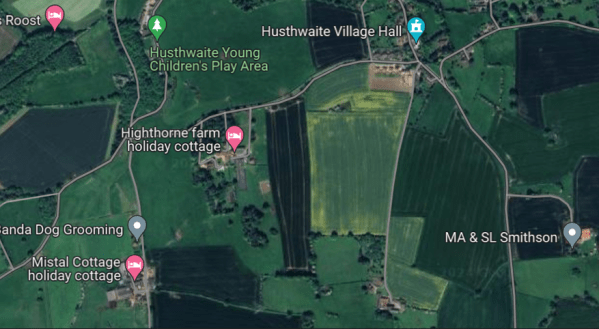
Highthorne Farm is now a holiday destination, as is Birdsall rectory Manor, near Malton, North Yorkshire where Emma and Julia Hodgson, both unmarried, spent their old age with their brother, Captain Lumley Hodgson, according to 1911 UK Census. Lumley Hodgson’s mother’s relations, the Middletons (Willoughby) owned that place. On that census, Ann Nesfield Richardson was a widow living with her youngest daughter at New Cottage, Rievaulx, running a grocery. She died a year later.
I am off to Rievaulx to marry and make childer with a stranger. Otherwise, all that is left for me is to flit home to Whitby and that I cannot do. My mother is long dead and my father is in line to finish off his days at the workhouse should none of my half-siblings take him in.
Mr. Lumley Hodgson, his ‘ead filled with other worries, has no objections and no opinions on the subject either, although he jokes, “It’s either Mr. Richardson or Mr. Bell for you, I fear.”
But, I ‘ave watched Mr. Bell as he slips the belly-band around the more skittish horses in his care with a firm but gentle hand, keepin’ his voice soft and melodious all the while and I ‘ave noticed how his muscular shoulders glisten after an honest day’s work and I do not think the joke to be as funny as that.
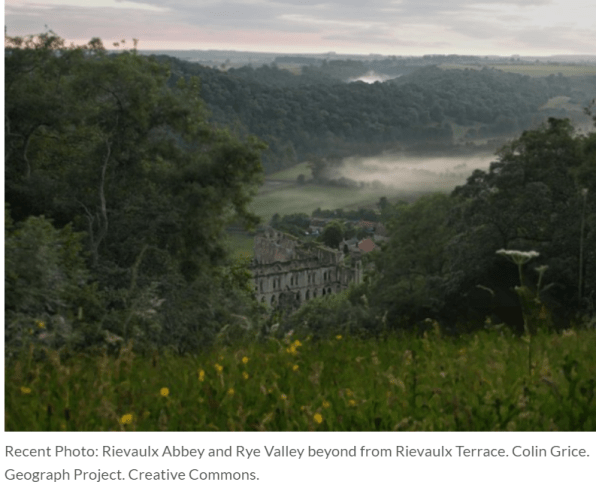
But Jack is a lowly farmhand and Mr. Richardson is a country tailor with a ready clientele and a sweet sunny cottage of his own, Abbot’s Well, with a fine prospect of the Rievaulx Monastery ruins. As I trot along on foot to Helmsley, my poke brimmin’ with dragonwort balm, tansy oil and other home-made potions to sell at market, I can watch from a distance as the Earl of Feversham’s family and friends go a-huntin’ o’er the heathery moors outfitted in all their finery on their own spirited Cleveland Bay/Thoroughbred crosses.
That is the selling point, according to Mrs. Hodgson: The cottage (complete with a little garden for growing my special herbs) and the mannerly profession.
But as Mrs. L. H. was quick to explain, this alliance is a major step up for me. I am but the daughter of a day labourer.
So, I hope Miss Austen is right, that it is ‘best to know as little as possible about the defects of your marriage partner,’ because I know almost nowt about this Mr. Thomas Richardson, except that he enjoys my tipsy trifle. (The trick is to use a lot of high quality whiskey). Still, that is as good a start as any, I reckon.
END
childer: children
Summat: something
Poke: bag
darkening: dusk
reet: very
nowt: nothing
Almost all of the entries for the Lumley-Hodgson’s in the press, mostly Yorkshire press, were related to Mr. L. H.’s businesses, horse and cattle breeding. By the 1870’s he was considered an expert ‘from the old school’ so his curmudgeonly opinions on the ‘horse question’ were much in demand and have left a long paper trail.
Yes, a notice in the paper in August 1861 said Mr. Lumley Hodgson was leaving Highthorne for ‘the health of his daughters.” (The girls were likely not frail, since Julia lived to a ripe old age and Emma was playing competitive doubles tennis in her thirties, I think.) And, yes, a week later, my great great grandmother, Ann Nesfield got married at Husthwaite.
There aren’t many entries in the ‘social notes’ for the ladies of the family despite their good breeding; In 1857, Julia Lumley-Hodgson attended the last? hunt and supper at the Yorkshire Union Hunt Club, (a horse-racing club) where the fashionable young could mingle.
A hunt ball was given in 1867 at Highthorne. And in 1875, Mrs. Lumley Hodgson and Miss Hodgson (likely the much younger Emma) attended a bachelor’s ball in York.
Mr. Lumley-H died in 1886. A notice to creditors was put in the paper, his farm stock, ‘valuable hunters’, and effects put up for auction and his farm “in excellent condition” advertised for let… perfect “for a gentleman fond of rural pursuits.” In 1891 his wife (and girls?) were at Birdsall Manor near Malton (owned by Lord Middleton, a L.H. relation) and Mrs. L.H. was seeking a groom of good character, who must be single to work there. In 1911, her son Captain Hodgson, a widower, was at Birdsall Manor with Julia and Emma, both still single ladies with “private income’ listed where occupation should be.
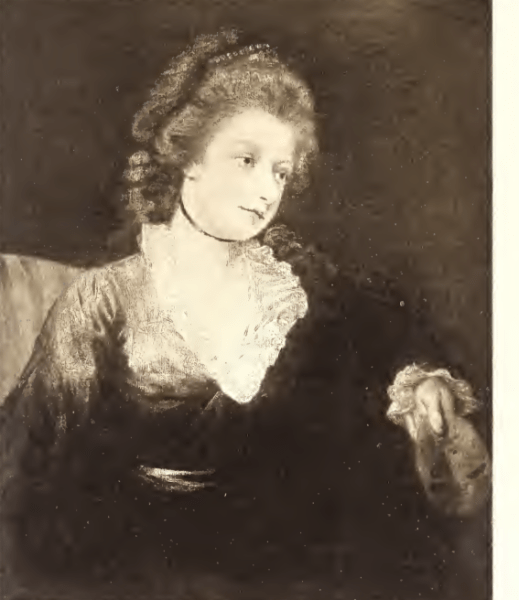
A few reports suggest Mrs. Lumley Hodgson dealt in fine art. The portait above was owned by her, found on Archive.org in A History of the Works of Sir Joshua Reynolds, Getty Museum publication. The weirdest entry about Lumley-Hodgson was that as an infant he sued his mother, Jemima, for land. Another online entry about Highthorne says he leased it in 1815. He would have been seven!
The Darley Arabian was brought to England from the East by the Alton, Yorkshire branch of Darley’s. Mary was from the Muston Lodge branch. They come from the same family originally.
Can the trajectory of Canada’s development be shown in miniature by looking at the life of a small community on the shores of the Seine River between Winnipeg, Manitoba and Grand Forks, North Dakota?
I hope so because the twists and turns in the nature of the town offer me hints about who my ancestors were and how they lived during a crucial period in the history of our country.
The town, which is now known as Ste. Anne, has served as a haven for Aboriginal, Métis, French, Immigrant, and Catholic peoples over the years. It changed its name to match the most important value held by a majority of its settlers and has been known as Oak Point, Pointe-des-Chênes, St. Alexandre, Ste.-Anne, Sainte-Anne-Pointe-des-Chênes and Ste.-Anne des Chênes.
I’m curious about the place because a family tree my grandmother left me says that my four-times great grandmother Marie Sophie (or Séraphie) Henault-Canada was born and died there. I haven’t found anything to confirm her data, but the 1870 Manitoba Census shows Sophie and her husband farming in the community. It also indicates Charles Enault was her father.[1] The Hudson Bay Company Archives show Charles Henault being in the community as of 1810.[2]
Ste. Anne’s location between the boreal forests of the Canadian Shield and the flat plains of the Red River always made it prime real estate for settlement. Nomads sought good hunting grounds and shelter from high winds close to the era’s key transportation infrastructure along the river and via trails. Later, the plains made for good year-round farming sheltered by high oak. Eventually, the area attracted entrepreneurs and became a bustling pioneer town. Gathering settlers attracted Catholic missionaries who turned the town into a full-blown Catholic parish. Today, the same community sits at the junction of two major highways and has become a suburban community of Winnipeg.
Sophie’s birth on April 6, 1818 may have taken place within a local First Nation. I’ve found traces of several in the area, including the Rouseau River Band, the Oak Point First Nation, the Saultaux First Nation and the Upper Fort Garry First Nation.[3]
It’s also possible that her father was a Voyageur who came to the area from another First Nation elsewhere in North America.
Her father and mother may also have been among Métis settlers known to winter in the area during that period.
As early as 1820, Métis families were wintering at Pointe-des-Chênes, southeast of St. Boniface on the Seine River. The area had a mix of mature forest and grasslands suitable for farming. The large oak groves served as a source of income for the settlers — lumber cut in the parish in 1820 was used for building a large chapel at St. Boniface.[4]
A combination of forests and plains enabled the family to pasture farmed livestock, cut timber for building materials and fuel, and hunt wild game.[5]
Scottish settlers who came under Lord Selkirk’s Red River Settlement plan were attracted by similar amenities, with many establishing farms and businesses in the region during Sophie’s childhood. Métis workers set up local farms after losing their jobs when the North Western and Hudson Bay companies merged in 1821.
Over the next thirty years, the lifestyles of the settlers and First Nations began to clash. By 1852, Oak Point settlers and the chief of the local First Nation, Saulteaux Chief Na-sa-kee-by-ness/ Na-sha-ke-penais/ ‘Flying Down Bird’/ Grandes Oreilles (son of Les Grandes Oreilles) had negotiated a treaty so that First Nations groups would move out of the area.[6]
My ancestors stayed put and continued to farm as the town grew rapidly. By 1856, when the Government of Canada chose to purchase Rupert’s Land from the Hudson’s Bay Company, it boasted a trading post, hotel, general store and jail.
The St. Alexander chapel opened in 1861 and began attracting Catholics. In the following decade, the town became the parish of Sainte Anne to attract additional settlers.
Still, my ancestors stayed and continued farming. The 1870 Hudson Bay Census shows Sophie and her husband Dominique Ducharme-Charron living on lot 27 with four of their children Johnny 19, Roger 17, Joseph 13 and Marie, 12. [7]
During the 1870s, Ste. Anne served as a stopover for travellers on their journey to Winnipeg along the famed Dawson Trail, a path linking Northern Ontario and the Red River Settlement. It was so heavily developed by 1881, Dominion surveyors maintained its traditional French-style long river-side lots instead of breaking it up into square lots.
If my grandmothers’ notes are accurate, Sophie died in Sainte Anne in 1882 at the age of 64 years, five months and ten days.
Today, 2,114 people live in her community and the land she once farmed has been paved over by the #12 and Trans Canada highways.
In this article I refer to Robert Stanley Bagg by his middle name since it was the name by which he was best known. In other articles I have referred to him as RSB to differentiate him from his father, Stanley Clark Bagg (SCB) and his grandfather, Stanley Bagg.
My great-grandfather Robert Stanley Clark Bagg, or R. Stanley Bagg (1848-1912), was born with the proverbial silver spoon in his mouth, however, working in the family real estate business was not what he really wanted to do in life. It wasn’t until after he retired that he was able to follow his true passion: politics.
I never heard any family stories about Stanley, perhaps because he died several years before my mother was born. It wasn’t until Montreal’s two major English-language newspapers were digitized a few years ago that I learned about his various interests and activities. In fact, his name appeared in Montreal newspapers frequently, especially after the late 1890s when he became active in the Conservative party.
Portrait of Robert Stanley Bagg by Adam Sheriff Scott. Private collection.
Stanley was the second child of Montreal notary and land-owner Stanley Clark Bagg (1820-1873) and Philadelphia-born Catharine Mitcheson (1821-1914). The couple’s first child died before Stanley was born. Three younger sisters, Katharine, Amelia and Mary, were born in 1850, 1852 and 1854, and a fourth sister, Helen, arrived in 1861. Even as a child, Stanley must have been told that he would have a leadership role in the family, not only as the eldest, but also as the only male.
According to his obituary in the Montreal Gazette,1 Stanley studied law at McGill University and passed the bar in 1873. He then left Montreal for England, intending to further his studies, however, his father died unexpectedly in August of that year and Stanley came home. For a short time, he was in partnership with lawyer Donald Macmaster, sharing an office on St. James Street, in the old business heart of the city, but he gave up his legal practice to concentrate on the administration of his late father’s real estate. Nevertheless, throughout his life, Stanley identified himself as a lawyer or an advocate, a term used to refer to the practice of Quebec’s civil law.
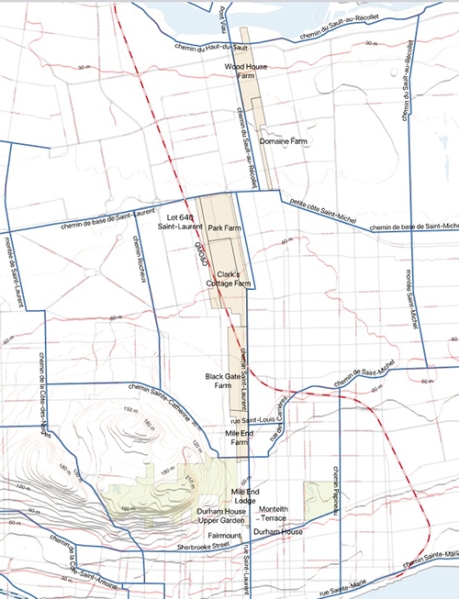
The job Stanley undertook as administrator of his father’s estate was not an easy one. Montreal was growing rapidly, with thousands of new immigrants arriving, manufacturing, railroads and industries expanding and construction of new residences ongoing. The farmland that comprised the vast S. C. Bagg Estate, mostly located on the west side of St. Laurent Boulevard in a corridor north of Sherbrooke Street, increased in value as the city grew. Sales, mainly of residential properties, became a profitable business.
This map shows the extent of the late Stanley Clark Bagg’s properties, shaded in beige, in 1875, when an inventory was made of his estate. These properties are overlaid over a modern map of the island of Montreal. At that time, the actual city of Montreal was south of Sherbrooke Street, extending down to the banks of the Saint Lawrence River. The eastern slope of Mount Royal is adjacent to the Mile End properties. Map created by Justin Bur, based on two open data sources: physical geography from CanVec, Natural Resources Canada and modern streets from Geobase, City of Montreal.
Stanley does not seem to have been interested in developing and promoting housing or commercial real estate projects himself, but he did decide which pieces of land to subdivide into lots and he supervised sales. The Estate also rented small residential and commercial buildings, and some of the land was sold to the city for civic projects such as parks.
He encountered many unexpected headaches over the years. He had to ask the provincial government to pass a special law in 1875 to override a provision in SCB’s will in order to make the lot prices competitive.2 There were misunderstandings in 1889-91 over which properties were part of the estate and which belonged to the five children. And sister Helen’s husband disappeared under mysterious circumstances in 1897, owing the family large sums of money.
Although Stanley was the main administrator of his father’s estate, several family members acted as advisors. His mother had a great deal of input, and sister Amelia kept track of some of the property sales. When a major decision had to be made, family members got together to discuss it, or if that was not possible, they communicated through letters.
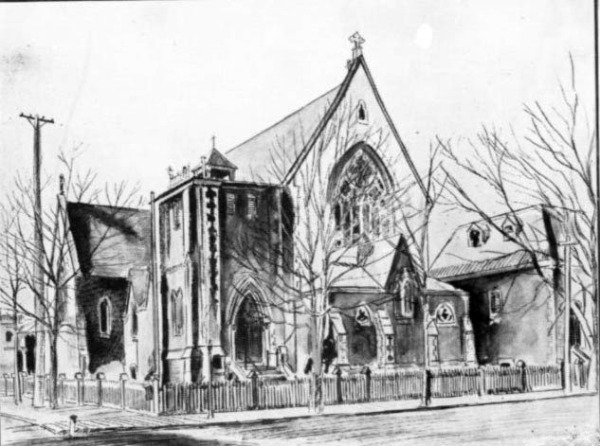
Robert Stanley Bagg and Clara Smithers were married in 1882 at St. Martin’s Anglican Church, on what was then the corner of Saint Urban and Bagg Streets. Bagg Street was later renamed Prince Arthur and the current Bagg Street is located several blocks further north. St. Martin’s never acquired a spire and it was eventually demolished. Image source: St. Martin’s Church, Historical Sketch of St. Martin’s Church : 1874-1902, Montreal, Canada, 1902?; Canadiana, https://www.canadiana.ca/view/oocihm.85997 Accessed June 14, 2023.
When Stanley announced his retirement as of January, 1901, his mother arranged to hire someone to succeed him, and she wrote Stanley a thank-you letter.3 She described her husband’s unexpected death as a calamity for the family, especially for Stanley who was “so young and inexperienced in the ways of the world.” She commended him for the “able, honourable and efficient manner” in which he had performed his arduous duties for 27 years. She added, “I am most anxious that you should have a complete rest from all the worry and anxiety that is unavoidably connected with the responsible position you have occupied for such a long time – and while personally I shall greatly miss you, I hope that your absence and a complete change will allow you to regain your usual health and strength.”
One activity Stanley found helped to restore his health was travel, especially ocean voyages. Perhaps he got the travel bug when he was 20 and spent a year exploring the highlights of Europe with his parents, his aunt and his sisters.
In 1875, Stanley visited England again with his mother and one of his sisters, and he returned to Europe with his new wife, Clara Smithers, on their two-month-long honeymoon in the summer of 1882.
In 1891, he and Clara spent an extended period of time in England, taking along their two young daughters. That year’s Census of England showed Stanley, Clara, the children, a governess and a cook staying in a lodging house in St. George Hanover Square, in central London. Ten years later, after his retirement, Stanley returned to Europe, this time touring for eight months.
While real estate management, legal training and travel seem to have been family traditions, so was military service. Stanley’s father had served in the military, and his grandfather had been a major in the 1st Battalion Loyal Volunteers during the Rebellion of 1837. His great-grandfather Phineas Bagg had served during the American Revolution ((1775-1783) before immigrating to Canada.
In 1877, the Canada Gazette reported that R. Stanley Bagg, gentleman, began his military service as an ensign with the 5th Battalion, Royal Fusiliers, Montreal. When he retired in 1882, he retained the rank of captain from what had become the Royal Scots Fusiliers. Although his military career was relatively short, it appears to have been a success. TheMontreal Star quoted the following article about Stanley that had appeared in the paper 30 years earlier:4
“There are few better-known figures in Montreal than Captain Stanley Bagg. He was an enthusiastic volunteer and belonged to the old 5th Royals before and after they had become a kilted regiment. At the time of the ship labourers’ riots in Quebec, when several regiments of Montreal were sent to restore order and liberate the regular garrison, who were practically prisoners in the Citadel, the 5th Royal Scots were marched up Mountain Hill and the honour of leading them was conferred by the colonel of the regiment on Captain Bagg owing to his height and commanding presence. Captain Bagg has always been an ardent supporter of and participant in athletic sports. A good rider and one of the old Dowell school of boxers, he kept himself in such first-class condition that he can stand almost any fatigue.”
I had read the letter written by Stanley’s mother about his retirement many years ago, and it had left me with an image of my great-grandfather as a tired and anxious man. This newspaper article made me realize that he had indeed once been a strong leader and an good athlete.
1. “R. Stanley Bagg Died Yesterday,” The Gazette, July 23, 1912, p. 4, accessed June 9, 2024.
2. “38 Vict. cap. XCIV, assented to 23 February 1875”, Statutes of the Province of Quebec passed in the thirty-eighth year of the reign of Her Majesty Queen Victoria, part 1, p. 474, https://books.google.ca, accessed June 9, 2024.
For my last story, (link above), three children of my great grand uncle died within days of each other. I had tried to find which, if any, diseases were present in that year and area, but I could find none. Of course, diseases were present at all times in the 1800s with no vaccinations or protection available.
The only way to find out the cause of the girl’s deaths was to obtain their Death Certificates which did not arrive in time to add to my last story. Now, I have received the girls’ Death Certificates from The General Register Office (GRO) of England and Wales and I know that the three girls died of scarlet fever.
The first daughter to die was their eldest, Isabella O’Bray aged 13 years It states she died at the Infectious Hospital Gillingham, Kent on the 6th of March, 1890. The cause of death was written as:
“Malignant Scarlatina’ (or Scarlet Fever).
The term ‘Malignant Scarlatina’ is not used today, although I did find an article from 1846 in the New England Journal of Medicine which used the term ‘malignant’ (1)
Margaret was 11 years old and also died of Malignant Scarlatina at the Infectious Hospital, Gillingham, Kent.
Minnie, aged three, their youngest child, died of Scarlet Fever exhaustion, at home.
I noticed that the deaths were registered by the children’s Uncle who lived nearby. We can only imagine the shock the parents were suffering and registering not one but three deaths of their beloved girls must have been a task they were just not up to.
Images of Measles and Scarlet Fever
In 1946 (a year after I was born), penicillin became available for the first time in the UK for public use, it transformed medicine worldwide and ushered in the age of antibiotics.
I had Scarlet Fever as a child, however, I was fortunate as antibiotics were available to me. It is a bacterial illness that develops in some people who have had strep throat. Also known as scarlatina, the disease features a bright red rash that covers most of the body., which includes a sore throat and a high fever. It is most common in children 5 to 15 years of age.
Although it was once considered a serious childhood illness, antibiotic treatments have made it less threatening. Still, if left untreated, it can result in more serious conditions that affect the heart, kidneys and other parts of the body.
On 15 March 1945, Penicillin was made available over the counter in US pharmacies, although it would not be available to British civilians – as a prescription drug – until the 1st of June, 1946, a year after Howard Florey and Ernst Chain received a Nobel prize for their work.
These two doctors began work on penicillin in 1938 at Oxford University, England. Details of their work are here:
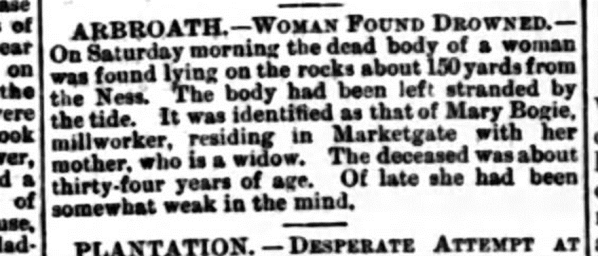
This sad sentence concludes the obituary of Mary Boggie who died by drowning on September 6, 1884 when she was just thirty-four years old.1 Her death was a suicide and this one sentence tries to explain why. Of course, no one will ever know why she jumped off a cliff into the cold and inhospitable waters of the North Sea. What we do know is that it was a desperate and definitive act.
Mary Boggie was Henry Boggie’s sister. Henry, my great-grandfather, was taken to court by my great-grandmother, Annie Orrock, in a paternity suit. He never lived with Annie and, as far as I know, did not participate in bringing up my grandmother, Elspeth Orrock. Mary and Henry were the only children of George Boggie and Elspeth Milne. The Boggie family lived all their lives in Arbroath, Scotland. Arbroath is a coastal town located on the North Sea, about 26 km northeast of Dundee and 72 km southwest of Aberdeen.2 In the 19th century, Arbroath experienced a rapid growth in population with an influx of workers needed for the expansion of the jute and sailcloth industry.3 George was a member of the merchant navy and would have been absent from home most of the time. Both Mary and Henry lived at home, with their mother, all of their adult lives.
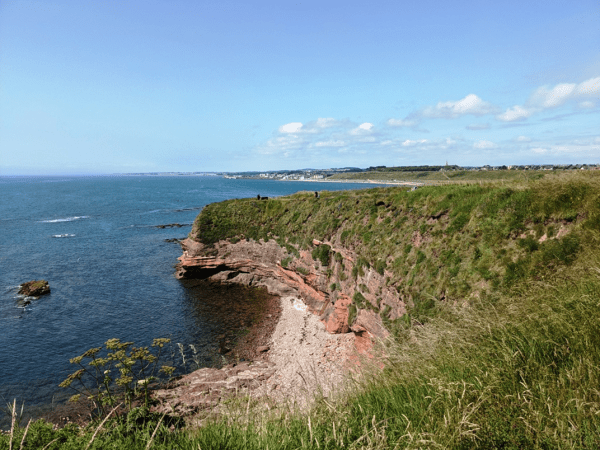
The registration of Mary’s death indicates that Henry was one of the “finders” of her body. The cause of death was “mental disturbance.”4 Who knows how long he and others were searching for her? She was found at the bottom of Whiting Ness, a cliff in Marketgate, Arbroath.
Part of the cliff face on Whiting Ness walk, James Herring, James Herring c10 Day Blog, Whiting Ness walk: The Needle’s E’e, The Deil’s Heid and Castle Gate, September 7, 2021
In 1884, sudden deaths in Scotland were referred to the Procurator Fiscal, known in other jurisdictions as the public prosecutor. The inquiry found that that the cause of Mary’s death was drowning and that she had committed suicide. The corrected entry notes that Mary had not been certified, meaning that she had never been certified as being mentally ill.5 The newspaper article implies that she was suffering from some mental affliction. And this is in accordance with the thinking at the time; that suicides were thought to be temporarily insane, thus being innocent of “self-murder.”6 Committing suicide was not considered a crime in Victorian and Edwardian Scotland. Citizens were free to take their own life, but it was assumed they would be answerable to God. This was not the case in England and Wales, where suicide was decriminalised only in 1961 with the passing of the Suicide Act. Prior to this, anyone who attempted suicide could be imprisoned and if they were successful and died, their families could be prosecuted. 7
No matter what the attitudes towards suicide at the time, Mary’s death was a tragedy. She could have been suffering from any number of mental or physical afflictions that would cause her to take her life. We can only imagine the anxiety and agony that Henry and Elspeth were feeling as people were desperately trying to find her. The trauma of finding her must have been almost more than Henry could bear. It would then be up to him to tell his mother. The suddenness and the violence of Mary’s death would have been a shock and difficult to understand. Henry and Elspeth were faced with an investigation and they would have had to deal with the press. Sadly, they may have had to deal with shame and the stigma of mental illness in the family.
Obituary for Mary Boggie, Glasgow Daily Mail, 8 September 1884, newspapers.com, accessed 23 May 2024.
Scotland’s People, Registration of Deaths 1884, Mary Boggie, accessed 3 April 2024.
Scotland’s People, Page 105, Register of Corrected Entries, Mary Boggie, signed by the Procurator Fiscal’s Office, 24 September 1884, accessed 3 April 2024.
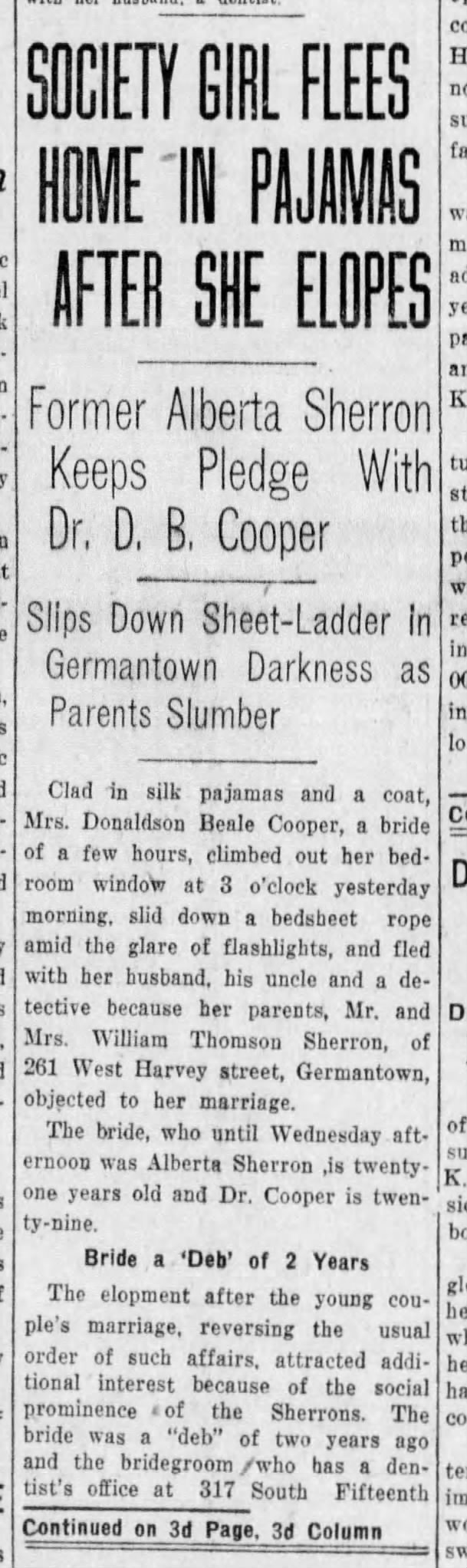
– “Society Woman flees home in pyjamas after she elopes”
– “Former Alberta Sherron keeps pledge with Dr. D.B. Cooper”
– “Slips down sheet ladder in Germantown darkness as parents slumber”
The Philadelphia Inquirer dated November 18, 1927, covered my great-aunt’s private life in great gossipy detail for its hungry readers. Alberta Sherron (1906-1992), my grandmother’s younger sister by 13 years, was just a girl in love at 21. Her 29-year old dentist boyfriend must have been equally enamoured as they couldn’t wait for the expected high society wedding that their well established families would have insisted upon.
Alberta graduated from Miss Irwin’s School1 and made her debut at the Acorn Club2 two seasons before her wedding. On her paternal side, she descended directly from Sir John of Gaunt, Duke of Lancaster, and on her maternal side, she descended from Sir Anthony Loupe, who was knighted under Mary, Queen of Scots3, in the mid-sixteenth century.
Donald Cooper’s grandfather was the late Senator Thomas V. Cooper of Media. On his paternal side, the groom descended from Andrew Griscom, who came to the USA with William Penn in 1682, and maternally from Richard Sanger, the Puritan, who settled in Massachussetts in 1632.
Unbeknownst to the both sets of parents, the wedding took place at the Church of the Holy Trinity4 on the Wednesday afternoon of November 16, 1927, with Reverend Dr. Floyd W. Tomkins5 officiating. It was a simple ceremony with only a few friends invited.
According to the Philadelphia Inquirer – “The bride was a “debutante” two years ago and the bridegroom who has a dentist’s office at 317 South 15th Street, is a graduate of the Germantown Friend’s School6 and the University of Pennsylvania – where he was president of the senior class – and is a former instructor in bacteriology at the Evans Institute of the University of Pennsylvania.”
After the wedding, Alberta returned home to her family as usual and prepared for her “elopement” that evening.
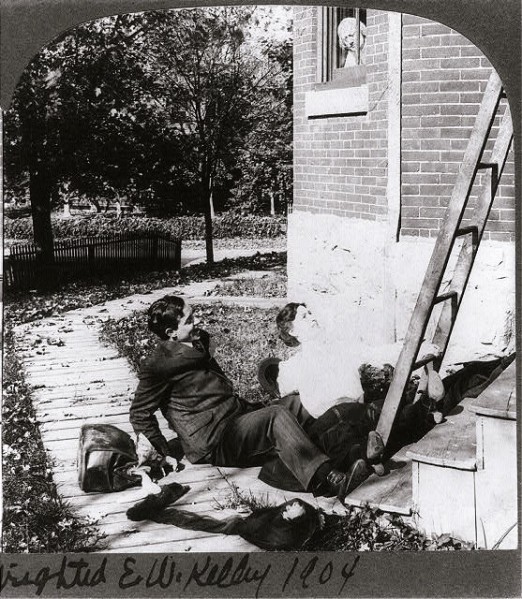
I don’t think the tabloids could resist using the word “elopement” in their sensational coverage of the events that took place that evening (given that the marriage had already taken place) and how did they even know the details? What a great “tip-off”! The couple went the extra mile (an added bonus for the paper) when she climbed out her window and descended using a knotted sheet instead of the traditional ladder.
(“Elopement-A Hasty Descent” by E.W. Kelley)
According to the newspaper, the couple left a note for her parents to find in the mailbox the next morning after “she eloped with her new husband.” Her parents, when interviewed, flatly denied ever locking their daughter in her room nor did they object to her marrying Dr. Cooper. That stopped any rumour that they had some young millionaire in mind for their daughter to marry. They finished their comment saying that they think the couple will be very happy and “Dr. Cooper is a fine young man.”
Thankfully, the destination of their month long honeymoon remained a mystery to all. And, nine months later, Donalson Beale Cooper, Jr. was born!
Alberta Sherron Cooper (24) and her son Donald (2-1/2) – 1931
Unfortunately, the marriage didn’t last and Donald remarried nine years later in 1936 and then so did Alberta in 1938.
By the time Alberta married her second husband, Bruce Lewis (1903-1971) in 1938, her son Donald was already 10 years old. Alberta and Bruce had three more children together – two daughters and a son. The last one born in 1950 when Alberta was 44 years old! Donald and his younger brother were 22 years apart.
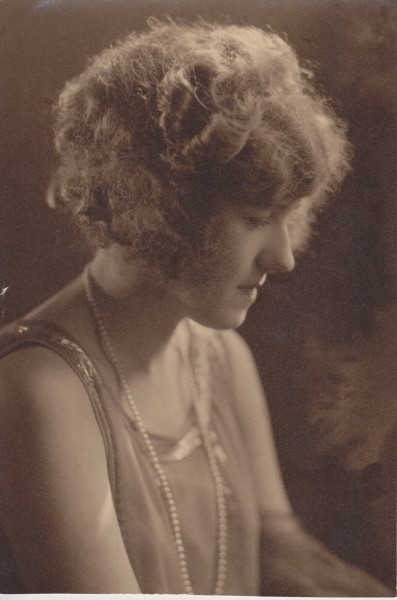
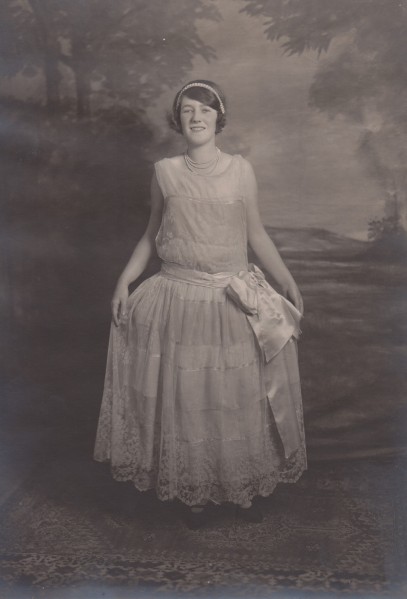
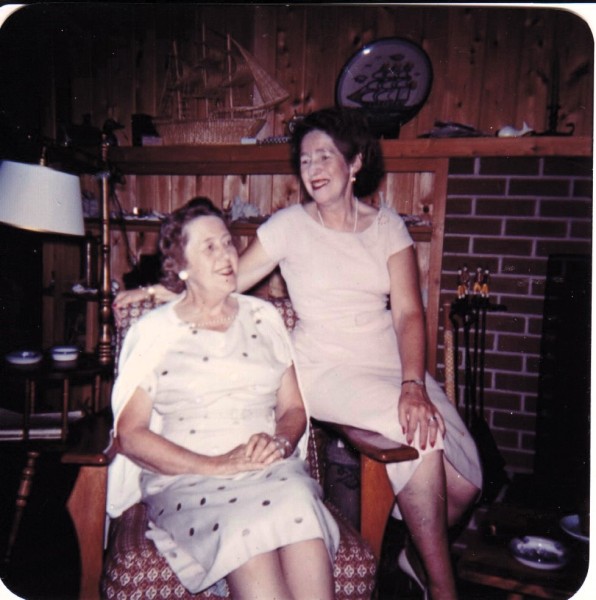
My grandmother Josephine (left) and her younger sister Alberta.
In January 1929, my Dad drove west to Tiger, Colorado where Royal Tiger Mines had hired him. It was his first job after completing his engineering studies. He was employed there for a mere two weeks. His honesty cost him his job.
A page from the Mariner Harbor High Yearbook 1923
My Dad, Kaarlo Victor Lindell was born November 14, 1905, and grew up in Ashtabula, Ohio, the son of Finnish immigrants where Finnish was spoken in the home. He attended Ashtabula Harbor High School. He was a go-getter. He went about town reading meters, ran the projector in the local movie theatre, worked as an assistant cook on the ore boats on the Great Lakes, and consequently made his way to Houghton, Michigan where he graduated in 1928 as a Mining Engineer at Michigan College of Mines, now known as Michigan Technological University – MTI) in Houghton, Michigan.
Upon graduation he drove to Tiger, Colorado where he had been hired by Royal Tiger Mines. Below are two articles written about his very short time in Colorado.
Once more he set out on the long drive back east after contacting his Alma Mater in Michigan.. They suggested that the International Nickel Company (Inco) in Copper Cliff, Ontario had positions for newly minted mining engineers. His next goal was to head north in his 1928 Ford Model T to the Canadian Border where he entered Ontario, Canada January 31, 1929. It was the beginning of a stellar mining career that took him around the globe.
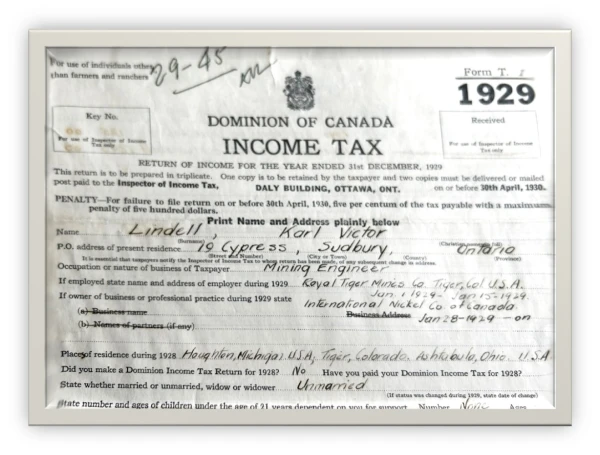
On Dad’s 1929 Canadian Income Tax form indicates the time he was employed by Royal Tiger Mines in Tiger, Colorado. Jan 1,1929 – Jan 15,1929
Times were difficult with the depression (1929-1941) looming on the horizon and employment at an all-time low, and certainly not the ideal time to be seeking a job. Dad was among the fortunate ones.
While driving back east from Colorado to Ohio, he must have imagined the path ahead. His future was before him. He had taken the necessary steps to secure another job.
He began working for Inco in the Sudbury area where the company recognized his work ethic and ability to speak fluent Finnish. In 1934 Inco seconded him to Mond Nickel an International company (England) with offices in London.1, The purpose of the trip: to explore the possibilities of opening a nickel mine in northern Finland. At the time, there were rumblings and talks of a war brewing in Europe, and nickel was deemed essential in manufacturing tanks and artillery.
Kaarlo Victor Lindell’s Passport
Dad being an American citizen had his United States of America passport issued in Toronto, Ontario June 25, 1934 before he departed for England and Finland.
The Empress of Britain .2
In June 1934 Dad set sail on the Empress of Britain and made his way from Southampton to the London offices of Mond Nickel. During his stay as the necessary arrangements were being prepared for the next leg of his trip to Finland he took advantage of this time to enjoy the city. He attended the famous Henley Regatta 3. and took the delightful photograph of people enjoying Trafalgar Square.
Once all the all the necessary Mond Nickel documents were completed Dad was ready to make his way to Helsinki, the capital located in the southern tip of Finland and then by car to Petsamo, one of the most northern villages in the country.
This trip to England and Finland was the first of many overseas trips to mining sites around the world. In many ways, it may perhaps be the most important one of his forty-year career as a mining engineer. 1930-1970.
To be continued in Part 2The Exploration Trip tp Finland










 Genealogy Ensemble