
Tag Archives: John Thomas Deakin

A Moment of Inattention

My great-grandfather, John Deakin, wrote that Thomas Deakin (1853-1935), my 2 times great-grandfather led a “great life of integrity and honour, was stern but kind, true as steel in uprightness in all his dealings, a pattern of level sober thought.” This was in a letter sent to his son, George Deakin, my grandfather, who lived in Canada, far from the rest of his family in England. The purpose of the letter was to let my grandparents know that Thomas had died on May 10, 1935. John explained that the medical staff had telephoned John on Jubilee Monday (Silver Jubilee of the reign of George V)1 to come to be by his father’s side as there was no hope. A few days later, Thomas ended the “grand innings of 83 years” on May 10, 1935.2

“Aged Man Killed in Tram Accident” was the headline of the article that described Thomas’ accident that led to his death.3 Like many accidents, it happened because of a moment of distraction or inattention. He was 83, of sound mind, and probably physically quite strong. At the inquest into the accident, Thomas’ daughter, Alice Phillips, testified that he was in good physical condition, although he had lost his left eye.4 On May 4, 1935, he crossed Waterloo Road, at the junction of Shireland Road in Birmingham, England. An eye witness noted that Thomas had stepped out into the road to get to an island in the middle of the busy thoroughfare and walked smack into a tram. The tram driver had sounded his gong but Thomas continued. The lights were against Thomas, not the tram, and the coroner ruled it an accidental death.5

The photograph below shows the junction where the accident happened.6 I assume that Thomas was walking towards the island that we can see in the middle of the junction. He was carrying a shopping bag and was looking away from the tram.7
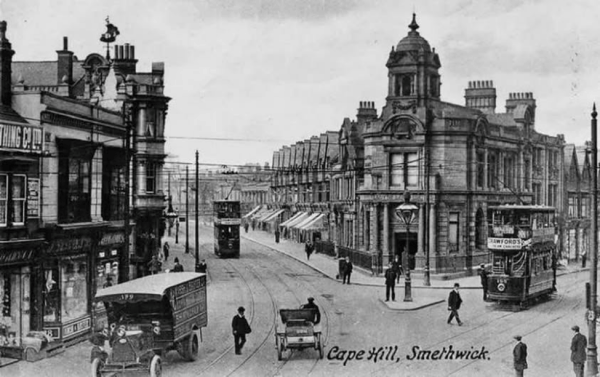
Junction of Waterloo and Shirewood Roads, Birmingham, England, U.K.

Thomas was born in Tipton, Staffordshire, England in 1852.8 Tipton is an industrial town located in the West Midlands, about 25 km northwest of Birmingham. Tipton was noted for coal mining and ironworks.9 and Thomas’ father was a shingler or hammer man, a highly skilled labourer. The task was a crucial step in the iron manufacturing process. The shingler used heavy tongs to place glowing-hot iron balls under amechanical hammer that was often called a “shingling hammer). 10
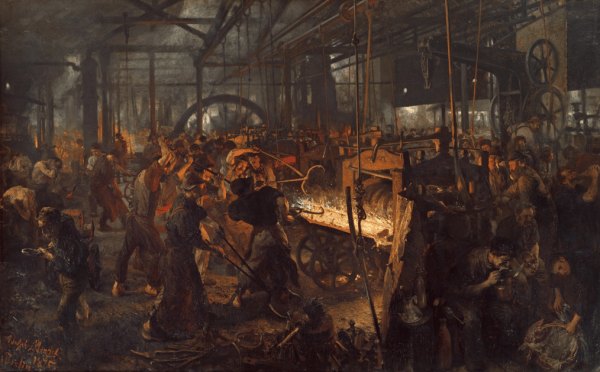
The Iron Rolling Mill (Eisenwalzwerk), 1870s, by Adolph Menzel11

By the time Thomas was a young adult, the family lived in Smethwick (Birmingham) Thomas also became a shingler, like his father.  In 1871 the family lived at Brasshouse Lane,12 which takes it name from the Brasshouse, the first brass foundry established in Smethwick in the 18th century.13 Both Thomas and his father probably worked there. And Brasshouse Lane must have been where Thomas met his future wife, Harriet Hanes. In 1871, Harriet’s father was a grocer at 139 Brasshouse Lane and Thomas lived at 172 Brasshouse Lane.14 Everyone would have known the grocer’s daughter who most probably helped out in the shop. In those days, the customer would hand the list to the person behind the counter, where the purchases were weighed, measured, and packaged.15 Thomas and Harriet married on May 3, 1874. 16
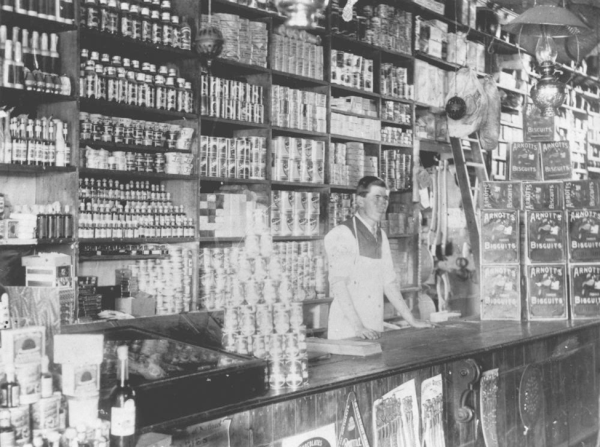
Victorian grocer17

Sadly, Harriet died eight years after their marriage, on May 13, 1882. She was just 26 and left four young children under seven. Her youngest son, George was under the age of one. Harriet’s death certificate indicates that she died of gastritis and diarrhea. Given the state of public sanitation at the time, it is probable that Harriet died of a waterborne infection, such as cholera or typhoid fever.18

As Thomas had four young children, it is not surprising that Thomas remarried fairly quickly. Thomas and Jane Stokes were married in Harborne on 9 February 1885.19 It would seem that Thomas and Jane never had children of their own. In the letter that John Deakin wrote to my grandfather, John refers to Jane as Grandma so she was always considered the mother of her husband’s children. John goes on to describe Grandma as a “game Old Lady of 84 years, and has stood up to her sad loss very bravely.” John continues to say that they will take care of her, as promised to Granddad (Thomas). John would have had to take care of her as Thomas left his savings to his four children, John, George, Maria and Alice and not to his wife, Jane. John closes the letter, signing off as “your loving Dad and Mother and Sister.”20

  1. Wikipedia, Silver Jubilee of George V, https://en.wikipedia.org/wiki/Silver_Jubilee_of_George_V, accessed 7 October 2026.
  2. Handwritten letter from John Thomas Deakin to George Deakin dated May 26, 1935, in the possession of the author.
  3. Newspapers.com, Birmingham Gazette, May 16, 1935, accessed 23 September 2026.
  4. Ibid.
  5. Ibid.
  6. Once Upon the Time in the Black County by Thomas J.R. Dearn, 1908, accessed on Facebook page 28 September 2026.
  7. Newspapers.com, Birmingham Gazette, May 16, 1935, accessed 23 September 2026.
  8. 1852, Registration of Births, Deakin, Thomas, District of Tipton, County of Stafford, England, accessed 28 April 2026.
  9. Wikipedia, Tipton, https://en.wikipedia.org/wiki/Tipton, accessed 1 June 2026.
  10. North Lanark Museums, So Your Ancestor Worked in the Iron Industry?, https://www.northlanmuseums.co.uk/story/so-your-ancestor-worked-in-iron-industry/, accessed 1 June 2026.
  11. The Iron Rolling Mill (Eisenwalzwerk), 1870s, by Adolph Menzel.
  12. England and Wales 1871 census, Thomas Deakin.
  13. British History Online, Smethwick: Economic History, https://www.british-history.ac.uk/vch/staffs/vol17/pp107-118, accessed 25 June 2026.
  14. England and Wales 1871 census, Harriet Haines.
  15. The Genealogist, Time Traveller Michelle Higgs takes us on a Victorian shopping trip, Higgs, Michelle, March 2014,  https://www.thegenealogist.co.uk/featuredarticles/discover-your-ancestors/periodical/11/counter-intelligence-4394/, accessed 7 October 2026.
  16. England and Wales, Register of Marriages, 1874, Parish of Harborne, County of Stafford, Thomas Deakin and Harriet Haines.
  17. Digital Research Library of Illinois History Journal, explanation of historical terms, http://livinghistoryofillinois.com/explanations/word_grocery_means.html, accessed 4 October 2026.
  18. England and Wales, Register of Deaths, Deakin (Haines), Harriet, 1882, Harborne, Stafford.
  19. England and Wales, Register of Marriages, John Deakin and Jane Stokes, 1985, Harborne, Stafford.
  20. Handwritten letter from John Thomas Deakin to George Deakin dated May 26, 1935, in the possession of the author.

Mary Died of a Broken Heart

I have no doubt that the real cause of my great-grandmother’s death was a broken heart. She had experienced one grief too many and after the death of her daughter, she gave up and her heart gave out.

Alice Mary Knight, my great-grandmother, was born in the small village of West Bromwich, Staffordshire in 1875.1 Mary’s love story started in Birmingham, about six miles away. She went to Birmingham to work and met John Deakin at the rooming house where they were living.2 John also came from a nearby village. They were single, away from their families, and most certainly lonely. They married in 1900 and almost immediately moved to Sheffield, 90 miles away.3

The move to Sheffield would have been difficult. While Mary and John had each other, they would certainly have been homesick. Especially as their son, my grandfather, George Deakin, was born soon after they moved. In a strange city with a newborn, far from her mother and sisters, Mary would certainly have missed living in the village.

John found a mining job in Sheffield and he possibly worked for the Tinsley Park Collieries, situated very close to where John and Mary lived.Mary would have been alone most of the day as miners often worked 12-hour shifts. This young couple could have no inkling that the mine would unravel their lives.

In 1905, their little family was complete with the birth of George’s sister, Alice Gertrude Deakin.4

When George finished school, he went on to apprentice as a fitter, also at a mine, and possibly the one his father worked at.5 Fitters repaired and maintained machinery. George always worked at the surface of the mine. But he knew that it would not be long before he would be asked to work below ground. He was a short man and therefore an ideal size for moving around in the close spaces below ground. “I did not want to work below ground in the mine,” Gramps would say every time someone asked him why he came to Canada.

When George came to Canada in 1922, he had not yet decided whether he would stay.6 As soon as he arrived, he went out west by train to work on the wheat farms, to bring in the harvest. When the work dried up on the farms, he returned east to Montreal and met my grandmother, Grace Hunter. He was content living in Montreal. He married my grandmother and they had two children, Jack and Patricia. He had a job he enjoyed and worked there all his life, even during the Great Depression. George went on with his life but I cannot help but think that his mother must have been sorry he was so far away. Mary must have regretted George’s job at the mine, the catalyst for his emigration to Canada. It is unlikely that George ever went back to England for a visit, possibly because he may have felt that he could not take the time off work. A week to get there, a day’s journey by train to get to his parents’ house, and then the return. My grandparents were not rich, so money would have also been a consideration.

In 1935, John and Mary received more bad news. John had laryngeal cancer. At the time they did not know it, but mining is now considered a risk factor for laryngeal cancer. John underwent surgery to address the cancer, but he had heart failure from the shock of the operation and died on the operating table.7

After the death of her husband, Mary and her daughter, Alice, decided to move back to the village of Smethwick, John’s birthplace. Both John and Mary’s family were in the area. At least Mary would be close to some family members. Mary purchased a house and Alice found a job as a timekeeper at W&T Avery, a spring balance manufacturer.8

Tragedy struck again about ten years later when Alice was diagnosed with a brain tumour. Alice Gertrude died in the Queen Elizabeth Hospital in Birmingham on November 1, 1951. Alice’s friend and neighbour, Marie Evans, was the informant on the death certificate.9

Within a week of Alice’s death, Mary changed her will.10 She must have already been seriously ill and, although we don’t know for sure, the urgency would have been to dispose of the house. Mary died of a heart attack less than two months after the death of her daughter. She was a widow, her son lived far away, and her daughter had died. The sorrow would have been overwhelming.  Mary died at home on New Year’s Eve in 1951, in the company of her younger brother, Benjamin.10

Mary’s new will left 20£ to her brother, Benjamin, for being the executor of her estate. She left a few bequests of 5£ to some of her friends and to the Firth Alms House in Sheffield, Yorkshire. Mary required that all of her other possessions, including her house, be sold and bequeathed to her son, George, in Canada.11

Mary must have felt that she lost her son to Canada and that when her daughter died in 1951, that the future was bleak. When death gently came to claim her just two months after her daughter’s death, Mary did not fight back.

  1. Certified copy of an entry of birth, Alice Mary Knight, born April 17, 1875, extract dated May 4, 2021.
  2. Certified copy of an entry of marriage, John Thomas Deakin and Alice Mary Knight, November 25, 1900, St. Paul’s Church, Aston, Harwick, extract dated May 25, 2021.
  3. 1901 census, Tinsley, Yorkshire, John Deakin and Mary Deakin, referenced January 1, 2016.
  4. Copy of an entry of birth, Alice Gertrude Deakin, born July 19, 1905, referenced July 27, 2021.
  5. Declaration of passage, George Thomas Deakin, Form 30A, referenced October 2, 2009.
  6. Idem.
  7. Copy of an entry of death, John Thomas Deakin, died July 8, 1935, referenced October 29, 2021.
  8. 1939 Register, Findmypast, Deakin, Alice G. and Deakin, Alice M., Alice is registered as a timekeeper at a balance manufacturer. Mary is registered as unpaid domestic help, referenced June 24, 2017. 
  9. Copy of an entry of death, Alice Gertrude Deakin, died November 1, 1951, referenced August 29, 2021.  The informant was Marie Evans, neighbour and friend. The law is specific about who can register a death in England: a relative, someone who was present at the death, an employee of a public house where the death occurred, or the person making the funeral arrangements. As Marie Evans was not a relative, she was allowed to register the death if she made the funeral arrangements. As such, the death certificate states that Marie Evans was “causing the body to be buried.” This way Marie Evans was able to allow her to register the death.
  10. The Last Will and Testament of Alice Mary Deakin, dated November 1, 1951 and probate, dated February 6, 1952, referenced August 12, 2021.
  11. Copy of an entry of death, Alice Mary Knight, died December 31, 1951, referenced August 8, 2021.