Tag Archives: Kingston

Not Just A Kingston Girl

My great-grandparents, Harriet Eva Gould and William Gardiner (WG) Anglin shared 48 years of marriage together, and their lives exemplify the saying “Behind every great man is a great woman.” In many cases, when we look into our family history, finding information about our female ancestors can be tough. After they marry, their maiden names are often forgotten, their careers aren’t recorded, and their lives tend to be defined by their roles as wives, mothers and community participants. Such was the case for Harriet too, as is clear from her obituary.

Mrs. Harriet Anglin – there passed away at her home on 52 Earl Street, on Saturday evening, Mrs. Anglin wife of Dr. W.G. Anglin, deceased, who was before her marriage Harriet Eva Gould, had lived in Kingston since her girlhood days. For the past year and a half, she had been ill. Mrs. Anglin who was of retiring nature, was most widely known through her membership in Sydenham Street United Church.

Surviving her are two sons, Douglas Anglin of Anglin-Norcross Construction Company, Montreal, and Wendling Anglin of the Johnston and Ward firm, Montreal; also three daughters Mrs. McLaren Ewert of Moosejaw, Sask.; Mrs. R. M. Horsey of Montreal and Miss Mary Anglin, secretary to the Principal of Queen’s University; also one sister, Mrs. John Hunter of Goderich and three brothers, George, Harry and William Gould. Ten grandchildren also survive.

Prior to meeting each other, Harriet and WG gained experiences that would serve them well when they married.
Harriet Joins Kingston Society

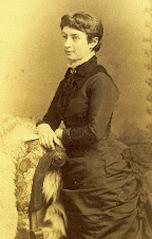
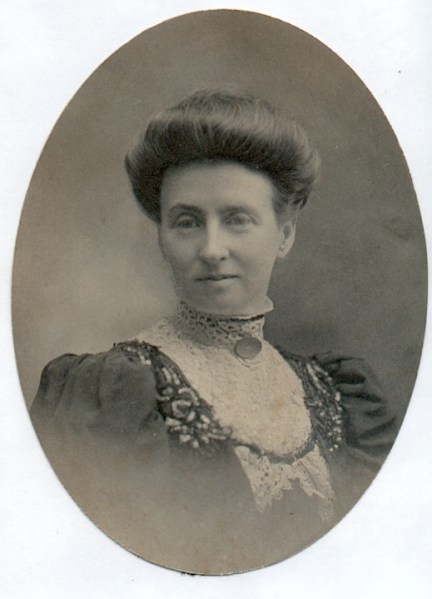
For the first decade of her life, Harriet grew up as the eldest child of William Gould and Mary Wartman in Ancaster, Ontario. When she was about 11 years old, according to the 1871 census, her parents sent her to Kingston, Ontario, to live with her mother’s sister Susanna, who was married to a wealthy businessman named James Richardson. It’s not clear why they made this decision, but it’s believed that the Gould family couldn’t support all their children. At the same time, Aunt Susanna, who had only sons, longed for a daughter. 

The arrangement worked well for everyone: Harriet was raised in a comfortable home and Aunt Susanna got the daughter she always wanted. While living with her aunt, Harriet received a good education and was introduced to Kingston society. She became known for her connections to the prominent Richardson family and her Loyalist heritage through her mother’s side. This social standing would play a part in her future, especially when she married.
William Gardiner (WG) Becomes a Surgeon

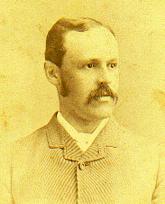
Before their marriage in 1886, WG went to Edinburgh, Scotland, where he learned new surgical techniques from Dr. James Lister, a pioneer in antiseptic surgery. After his return and marriage to Harriet, WG was invited to teach at Queen’s Women’s Medical College. Surgeon and Mentalist

Career and Family Life

WG’s skill and dedication quickly earned him a spot on the prestigious faculty at Queen’s University. By 1887, he was appointed as a Professor of Pathology and head of the Clinical Surgery department. He shared the groundbreaking techniques he had learned in Edinburgh with his students, shaping the future of surgery in Canada. 

He and Harriet had their first daughter, Mary (1888-1979), that same year. In the following years came Susan (1889–1982), Douglas (1890–1955), Wendling (1892–1955) The Stock Broker, and Ruth (1895–1976). It’s believed that Mary and Susan were named after Harriet’s Aunt Susanna.
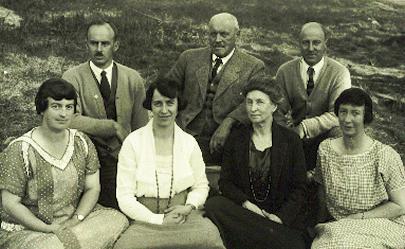
1923 – Douglas, WG, Wendling, Susan, Ruth, Harriet, Mary

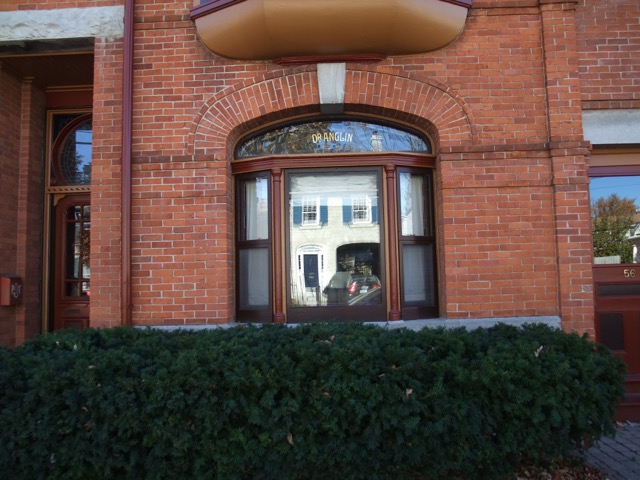
Throughout these years, W.G. ran a private medical practice from their home on Earl Street, which allowed him to spend time with the family. His name was even etched in stained glass in the window of their office building.
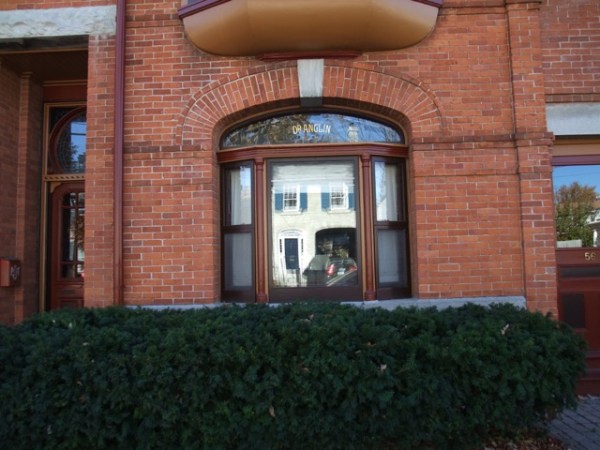
52 Earl Street with “Dr. Anglin” etched in top glass


Going to War

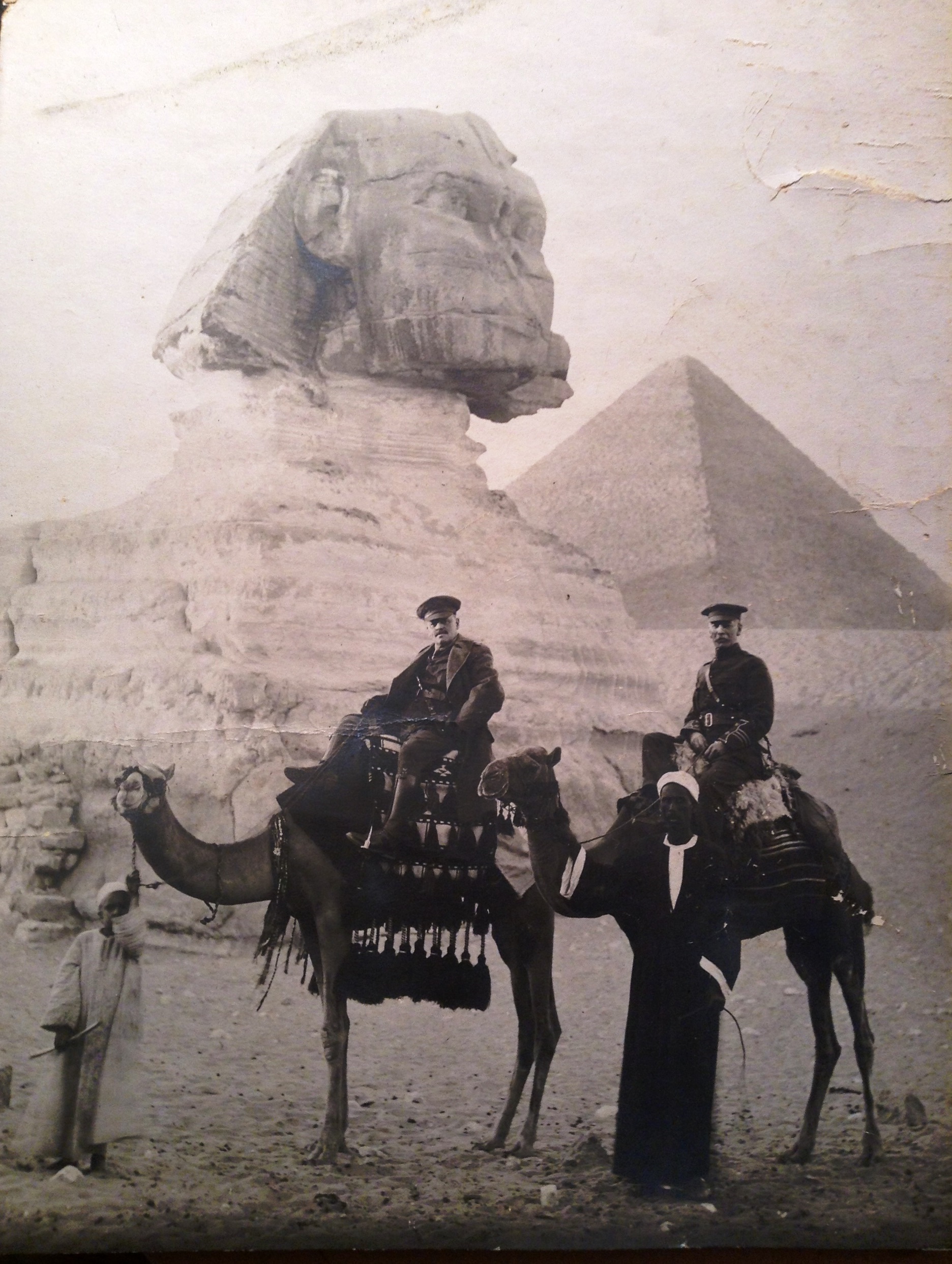
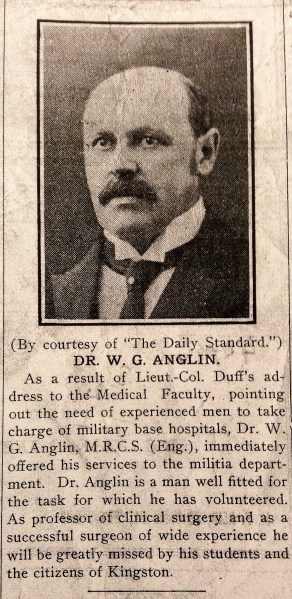
In 1915, WG left his teaching job and volunteered to go to Cairo, Egypt, with the Queen’s Stationary Hospital at 59 years old, in response to a plea from Lieutenant Colonel H.R. Duff, who needed someone with “experience and wisdom.” He caught Malta Fever and had to return to Canada a year later. Although he recovered a bit, the illness affected his health for the rest of his life. Duff, however, died of pneumonia in Cairo.
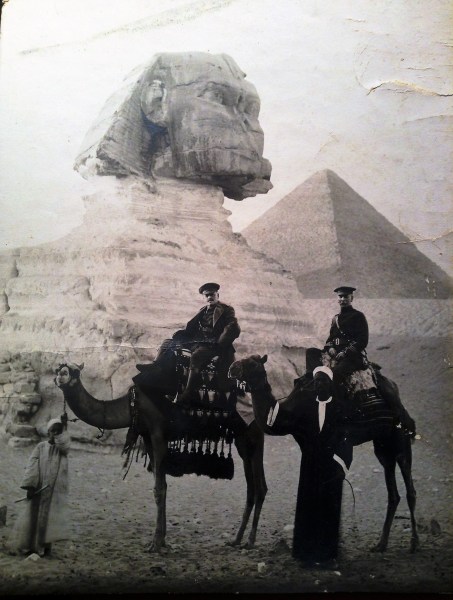
1915 – Cairo, Egypt, WG on the left camel

Community Leaders

After the war, WG continued working in medicine on a limited basis and served as an examiner for the Canadian Pension Board. He also worked at Kingston Penitentiary, where he introduced medical and administrative improvements and treated the inmates with dignity until he retired in 1928. 

Harriet remained dedicated to her children, their families and her church. As a proud grandmother, she tucked a newspaper clipping of a photo of my father and his brother into a random book where it slipped out 90 years later into the hands of a distant cousin who then made contact with me!
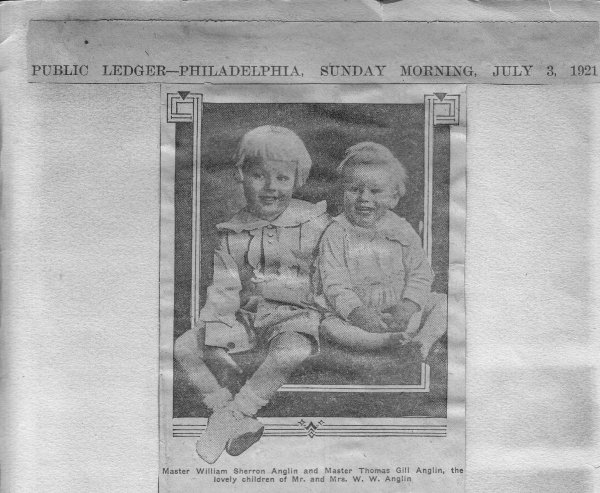
1921 newspaper clipping of my Uncle Bill and my father Tom Social Media – Then and Now

In their later years, Harriet and WG were well-respected members of their Kingston community until he died in 1934. She died only two years later and they are now buried together in the Anglin plot at Cataraqui Cemetery.
Finding the Family Farm in Ireland

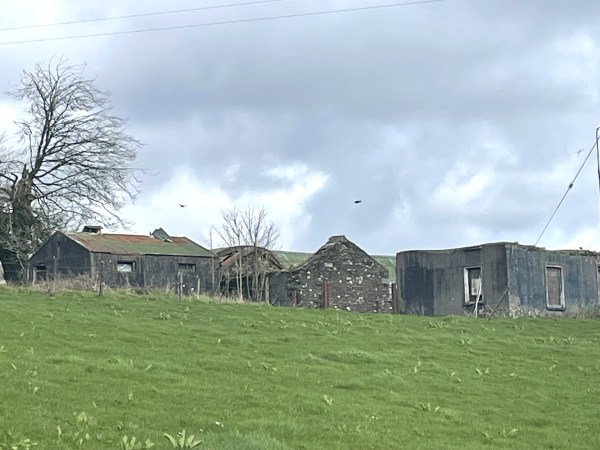
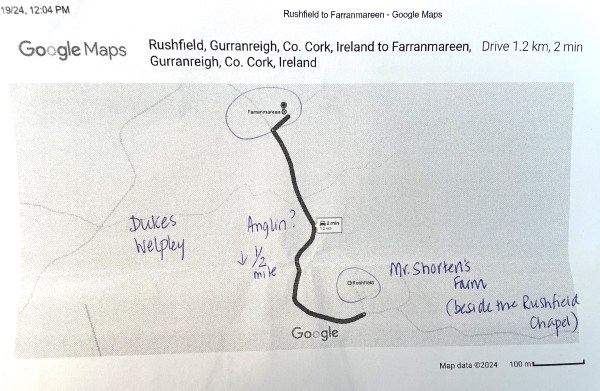
On a recent family trip to Cork, Ireland, we detoured briefly looking for the Anglin Family farmhouse ruins from the early 1800’s. Several Anglin cousins over the years recorded and shared their trips so that with copious precious notes in hand we thought we were well equipped for our adventure!

An Anglin letter from 1963 pinpointed the location of the family home somewhere between Farranmareen in the north and Rushfield (one kilometre further south) “near Bandon” just 36 kilometres west of Cork. We looked up the two geographic latitude and longitude (GPS) coordinates for the two markers so … how hard could it be?

All eyes were focused left and right as we drove the kilometre between the two points. Alas! Nothing to see but green fields everywhere and a scattering of houses. Where were the signs with “The Anglin Farm was HERE”?

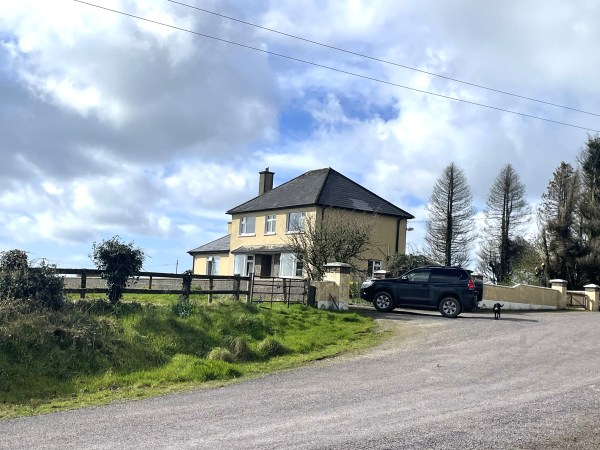
Upon reaching Rushfield, my notes referred to a chapel not far from a farmhouse on the corner. Spying a farmhouse nearby, we made our way through the barking dogs and knocked on the door, but no one answered. We persevered as there was a vehicle in the driveway and a huge transport truck parked nearby. Another knock. Suddenly a farmer walked around from the side of the house munching on a bit of lunch.

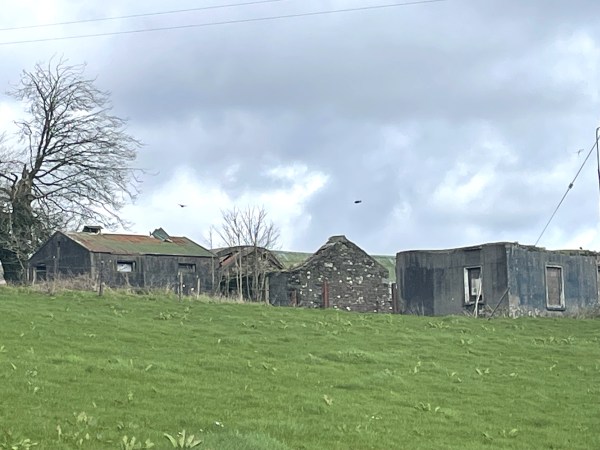
I introduced myself as an Anglin and referred to the cousins over the years who had made the same pilgrimage. The farmer looked puzzled. So I inquired about the whereabouts of the Rushfield Chapel to which in reply he pointed to some ruins across the road that barely even looked like a building anymore. Disappointed but refusing to give up, I checked my notes and inquired if he knew a Mr. Shorten who was helpful to my cousin in 1963. He smiled and introduced himself as … Mr. Shorten!

Rushfield Chapel ruins

This Mr. Shorten didn’t recognize the Anglin name (it must have been his father in 1963) but guessed where the Anglin farm might have been. Back up the road to Farranmarren we drove to knock on a few more doors. The next stop was a bungalow with another barking dog. A middle-aged lady came to the end of the drive and thought the Anglin farm might have been in the field beside her. However, she suggested that her elderly neighbour across the road might know more and brought me to meet her.

“Looking for the farm some years ago, with my wife and two Anglin cousins, we could not find any buildings. But we knocked on a door at a corner where you leave the main road. The door was answered by an older lady whose maiden name turned out to be Duke. She gave us tea and said that our Anglin ancestors operated mixed farming and would have been comfortable during the famine.” (Perry Anglin)

After a brief introduction, I couldn’t resist asking her: “Is your maiden name ‘Duke’ by any chance?” Well her eyes lit up and she smiled saying: “Yes!” My great great grandfather William’s oldest brother John Anglin married Sarah Duke in 1836 in Cork. I was speaking with my (very) distant cousin!

William and John’s parents, Robert Anglin and Sarah Whelpley, had four sons and one daughter. All four sons emigrated to Kingston, Ontario, one by one, with my great great grandfather William (the youngest son) leaving Ireland in 1843 just before the Great Famine. John eventually joined the others in Kingston but only after the death of their parents. Their sister emigrated to the States possibly not wanting to stop in Kingston to care for four brothers!

William married Mary Gardiner in 1847 in Kingston and had two daughters (both died young) and two sons (William and James) who both became doctors and surgeons.

It appears likely that over the years Mother Nature reclaimed the Anglin Family farm with its defining stone walls having disappeared completely beneath the greenery. However, I can attest to the fact that the view described by my cousin remains the same:

“It is a stunning view from the farm down into the Bandon River and beyond to a coastal range tinted mauve in the distance.”

I would like to finish my little story by sharing some helpful information with my Anglin cousins! Here are the GPS coordinates of the Anglin Family farm: 51°47’00.3″N 8°56’09.8″W

https://genealogyensemble.com/2017/02/01/the-anglin-brothers/: Finding the Family Farm in Ireland https://genealogyensemble.com/2016/07/13/surgeon-and-mentalist/: Finding the Family Farm in Ireland

Social Media – Then and Now

My hitherto unknown relative pulled open an old book of Tennyson poems from the bookshelf and out fluttered a newspaper clipping that had been there almost 100 years.

The clipping was a photo of two small boys posed in their Sunday best from a Philadelphia newspaper published in 1921[1]. The names of my father, Thomas Anglin, and his brother Bill were printed at the bottom.

Jenn Garro, who found the clipping, Googled the names and my recent story about Uncle Bill Dear Uncle Bill on the Genealogy Ensemble website was the first hit. She located me on Facebook and sent me a message:

Was I the daughter or niece of one of these boys? My answer – Yes!

The boys’ mother, my grandmother, Josephine Eveline Sherron, married William Wendling Anglin The Stock Broker, of Kingston, Ontario in 1915 in Philadelphia.

Not only do I have a copy of this newspaper clipping, I also have the original photo. My grandmother relished the world of the newspaper social pages and this early photo of her boys was their introduction into that world.

Another photo, taken six years later, captured the boys lovingly looking over their mother’s shoulder while she read to them. It was first published in the Philadelphia Inquirer in December, 1927[2], and then again in the June 1930 issue of Mayfair Magazine.[3]

Josephine began modeling from an early age. She modeled hairdos, hats and fashions of the day, and the photos were widely distributed. One such photo, published in the December 11, 1915 issue of the Philadelphia Evening Ledger[4], featured her wearing a black lamb’s wool hat and muff with matching coat. The caption announced that her marriage had taken place that day.

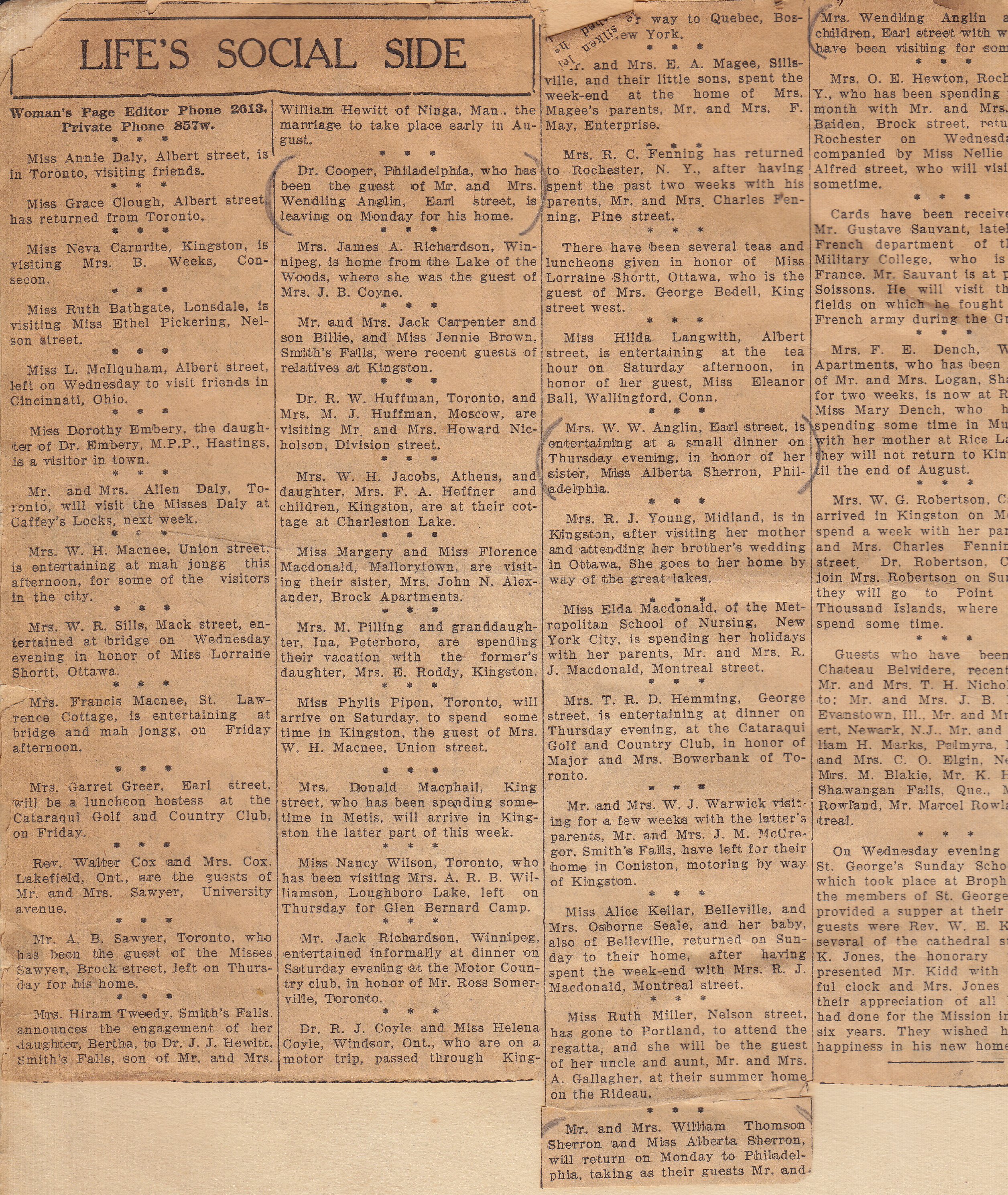
Like many other people at that time, her mother and sister contributed regularly to the newspaper’s social pages, with announcements of teas, luncheons and bridge parties. Special events, such as the 1924 June Ball at the Royal Military College near Kingston, provided eager readers with short descriptions of the ball gowns that the “distinguished guests at the social event of the season” were wearing: “Mrs. Wendling Anglin, rose georgette beaded.”[5]

Most surprising, however, were detailed announcements of the comings and goings of the family.

“Mr. and Mrs. W.W. Anglin, Westmount, Montreal, Canada, will be the guests over this week-end of Mrs. Anglin’s mother, Mrs. William Thomson Sherron, in Germantown.  Mr. and Mrs. Anglin will leave by motor on Sunday for a several weeks’ trip to Florida.”[6]

Then, a short while later:

“Mrs. Sherron has as her guests over the week-end her son-in-law and daughter, Mr. and Mrs. W. W. Anglin, of Montreal, Canada, who arrived in this city Friday from Florida, after spending several weeks in the South.”

IMG_0006

One visit from her sister was followed so thoroughly that it was announced on four separate occasions!

To begin with, it was announced twice in her local Germantown paper:

”Alberta Cooper Lewis will leave next Wednesday for a visit of several weeks with her brother-in-law and sister, Mr. and Mrs. W.W. Anglin, of Westmount, Montreal, Canada.”

And then,

“Alberta Cooper Lewis has left for Montreal, Canada, where she will remain for several weeks as the guest of her sister…”[7]

Again, on the receiving end of the visit, in the Montreal Daily Star:

“Mr. and Mrs. W.W. Anglin have as their guest, Mrs. Anglin’s sister Alberta Cooper Lewis of Philadelphia, Penn.”

And finally, home again:

“Alberta Cooper Lewis who has been spending a month with her brother-in-law and sister, Mr. and Mrs. W.W. Anglin, in Montreal, Canada, taking part in the winter sports, recently returned to this city.”[8]

Any decent burglar could have seized these well publicized opportunities to plan the perfect theft!

These newspaper articles from 80 years ago are very similar to posts that enthusiastic friends might share on today’s social media networks. Nowadays, anyone can share family activities and photos with the whole world in a similar fashion. Nevertheless, I wonder whether any family photos will flutter into a distant relative’s inbox 100 years from now.

Meanwhile, my newly discovered relative Jenn lives in Bolivia, and we are keeping in touch by messaging on social media.

Note: 

On the inside cover of Tennyson’s Poems is written the name “Lizzie Gould”. Lizzie (Elizabeth) Gould was the sister of Harriet Gould (Josephine’s mother-in-law and my great grandmother, Mrs. W.G. Anglin Surgeon and Mentalist). Their brother Harry (Henry) Gould was the father of Pearl, who was Jenn Garro’s great-grandmother.  It appears Lizzie kept the clipping of her sister Harriet’s grandchildren in the book of poems. Jenn inherited the book and the clipping.

[1] Public Ledger – Philadelphia, Sunday Morning, July 3, 1921

[2] The Philadelphia Inquirer – December 19, 1927

[3] The Mayfair Magazine – June 1930

[4] Evening Ledger- Philadelphia, Saturday, December 11, 1915

5  The Kingston Standard – June 17, 1924 

[6] Local newspaper, January 28, 1938

[7] Germantown local newspaper, January 4, 1935

[8] Germantown local newspaper, about February 4, 1935

The Anglin Brothers

When Robert left Ireland for Canada in 1829, young William Anglin (my great-great-grandfather) missed his older brother terribly. For the next 14 years, he wrote letters frequently as the only way to keep him close to his heart. Upon hearing of the rebellions in 1838 in Upper Canada and near Kingston, Ontario, where Robert had settled with his family, William wrote a worried letter:

Another reason why I have not written is the very disturbed state of your country – you cannot think the feelings of my mind on account of you my dear brothers and family for fear you should suffer loss of property, or life. I pray that you may receive this and that it will find you all well. I was afraid that a letter may not pass from here to you, and was kept in awful suspense to know how it would terminate – and anxiously waiting for every account – and you cannot imagine what joy it gave me to hear that the Rebels are in a great measure defeated.      ..…     I was glad to know from the papers that they did not get up to Kingston, and I hope that you in that city do still enjoy peace. We were glad to hear the stand the Protestants have made with the Army against them. Things may be worse than we know with you but do hope our next account will bring us satisfactory news. A good deal of the Army sailed from England and Ireland for America and do hope they have safely arrived before this date. I forbear to say any more on this, to me, painful subject, and know that you are better acquainted with it than I can be. I only mention what I have said to let you know what I have heard about the agitated state of your country. Under such circumstances as these I hope you will write as soon as you receive this, for I long to hear from you or to see you. 

 – Excerpt from a letter from William to his brother Robert in Kingston – Feb 23, 1838                                         

In 1843, William at age 28, arrived in Kingston, Ontario, where he finally joined two of his older brothers, Robert and Samuel, in business.  William, the youngest of four brothers and one sister, was born in 1815 in Bandon, County Cork, Ireland. He hadn’t seen his brother Robert in 14 years.

Before long William branched out into business for himself, partnering with an iron-gray pony named ‘Fanny’.  He travelled along the Rideau Canal as far north as Big Rideau Lake, and also along Lake Ontario to Hay Bay near Adolphustown, purchasing cordwood as fuel for the mail boats operating between Toronto and Montreal – steamers named ‘Passport’, ‘Spartan’, ‘Corsican’, ‘Corinthian’, and ‘Algerian’[1].

Later he purchased his own powerful tug, named ‘Grenville’, as well as two barges and continued to manage the cordwood contract with his young son’s help.  The cordwood was then freighted up on scows and barges, and piled on the Long Wharf in Kingston, later known as Swift’s Wharf.[2]

In 1847, four years after his arrival in Kingston, William married Mary Gardiner who had been born in County Durham, England, in 1817, and had also immigrated to the Kingston area with her family.

William and his wife first had two daughters, Mary Frances, who died shortly after her birth in 1850, and Annabella ‘Annie’ Jane.

Annie was born in 1853. Sadly, on July 1, 1878, while watching a fireworks display in the Cricket Field from the roof of a neighbors’ house, she took ill and developed pulmonary tuberculosis.  She was only 26 years old when she died on April 18, 1879.[3]

Then came two sons, William Gardiner Anglin (my great-grandfather), in 1856, and James Vickers Anglin, in 1860. They grew up in the house at 56 Earl Street where they moved as young boys with their parents in 1865.

Both sons eventually studied medicine at Queen’s University and became well respected surgeons in Kingston. William, however, also built an extension on his father’s house at 56 Earl Street which served both as his own home and medical office.  To this day, the name “Dr. W.G. Anglin” is still etched on the window at 56 Earl Street.[4]

When William’s mother died in Ireland, in 1863, twenty years after William’s arrival in Kingston, his eldest brother, John, was finally able to move to Upper Canada to join the rest of the family.

The Anglin brothers were re-united once again.

[1] http://www.Images.maritimehistoryofthegreatlakes.ca

[2] The Anglin Family Story – Part 2 – www.billanglin.com

[3] The Anglin Family Story – Part 2 – www.billanglin.com

[4] Helen Finlay, owner-operator of  52 Earl Street Cottages, Kingston, Ontario

Surgeon and Mentalist

Shortly before graduation from medical school at Queens University in Kingston, Ontario in 1883, William G. Anglin (my great grandfather) and a few fellow medical students attended the performance of a “thought-reader”, English mentalist Stuart Cumberland[1]. So impressed with what they had seen, they went back to their place and tried one of the simpler experiments.

 The operator was blindfolded, and the Medium, placing the back of the fingers of one hand on the operator’s forehead was to think intently as to what was required to be done. For instance – pick up an article from some position and place it in another position – the operator having previously gone out of the room while the experiment was being agreed upon. Everyone singly failed, and I was the last one to try. Immediately I went across the room and picked up a small object from the mantelpiece – crossed the room and placed it on the middle of a chair. Tore off the handkerchief from my eyes and said: “That’s what you wanted done”. “By George, you’re right, Anglin, we will try you again”, and I did correctly five or six other experiments – each a little more difficult than the last. Could not account for the success, but in every experiment I was conscious that I was doing the right thing. When my fingers touched the desired object, I closed on it with a feeling of certainty.[2]

The next week William left for Halifax to sail for Liverpool to continue his medical studies in England. He met a fellow doctor and, eventually the conversation turned to “thought-reading”.

It proved to be a very entertaining voyage for the passengers, as he successfully performed time and time again. A passenger would say – “Well, Doctor, I hid a pin somewhere on the ship – an hour ago” and blindfolded, William would take the passenger’s right hand and, holding the fingers to his forehead, he would say, “Think where it is”, and they would start upstairs and downstairs, and along corridors to the spot, and he would pick up the pin from a curtain or a chair wherever it had been placed.[3]

Later in life, his son Douglas, referring to his father’s diary, lamented “End of Diary – too bad – I wish we could have heard about my father’s time studying in London and Edinburgh, where he was entertained at many high society places on account of his thought-reading.”[4]

Following his medical degree from Queen’s in 1883, William spent eighteen months as the house surgeon at the Royal Infirmary, the Sick Children’s Hospital, and the Royal Maternity Hospital in England. Then he successfully completed the M.R.C.S. exam (Member of the Royal College of Surgeons) in England.

When he returned to Kingston, in the fall of 1885, he lectured for a session in surgery at the Women’s Medical College. A year later, he became Professor of Pathology and finally head of the department of Clinical Surgery.

Around that time, William built an addition to his parents’ home at 52 Earl Street in Kingston, which provided him with both office and home. 3

This is where he brought his childhood sweetheart and bride, Harriet (Hattie) Eva Gould, in 1886. The name ‘Dr. Anglin’ remains embossed in the upper portion of the glass of the front window to this day.[5]

He remained a member of the Medical Staff at Queen’s until May 1915 when he departed with the Queen’s Stationary Hospital for Cairo, at age 59. Cairo, Egypt - Dec 7, 1915 - Lt Col AnglinHe served as a civil-surgeon with the rank of Lieutenant Colonel until 1916 when he became ill with Malta fever and phlebitis. He was given a medical discharge and sent back home.
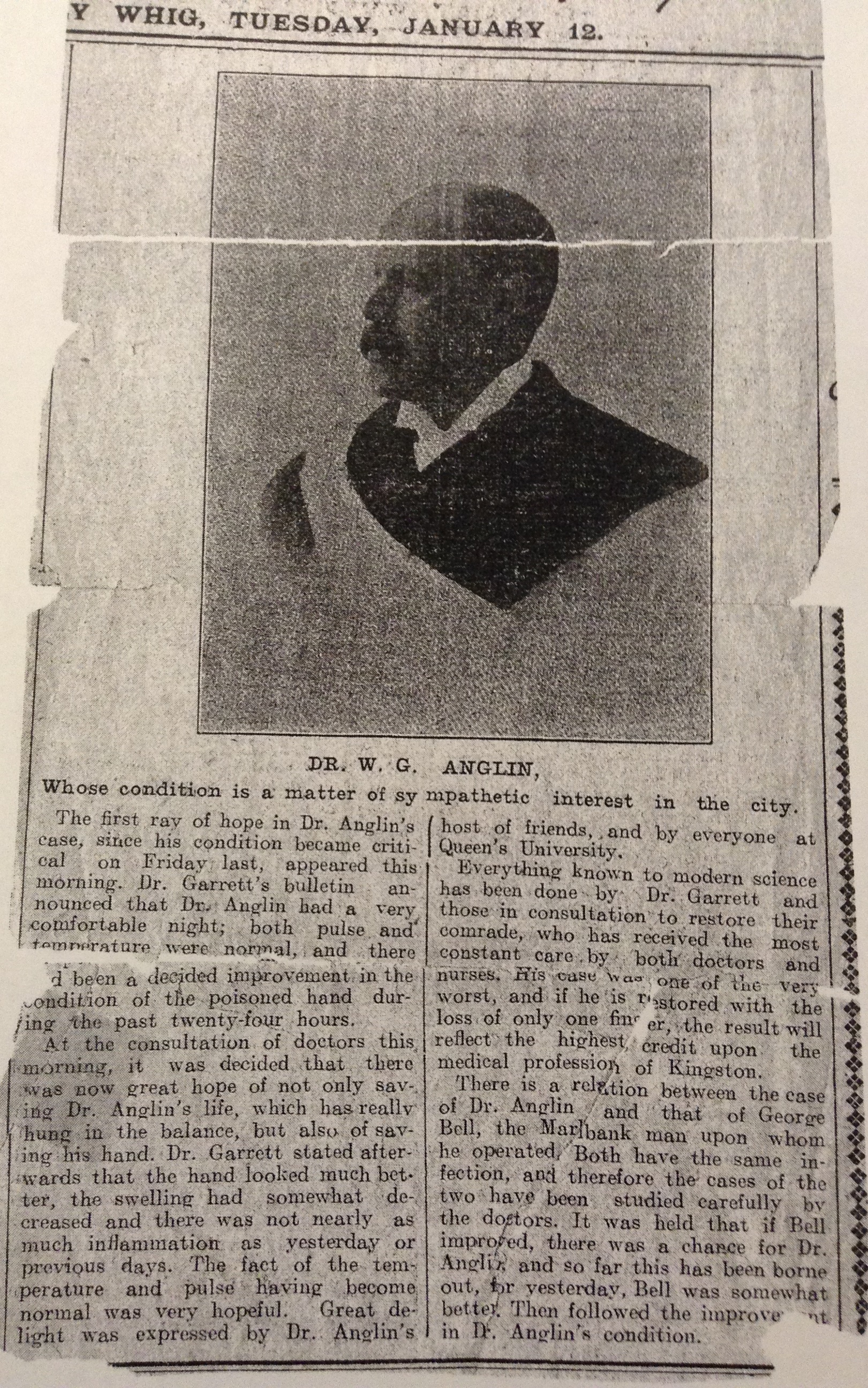
William’s attestation papers, dated May 1st 1915, declared that he was fit for duty but noted a missing middle finger on his right hand.  In 1904, it was reported that Dr. William G. Anglin was severely ill, and lost a finger due to this illness. There was much relief when it was announced that he would live.[6] Middle Finger The story told was that by using his “thought-reading” skills, he was able to physically draw down the infection in his right arm to his middle finger. The amputation of that one finger removed all traces of infection from his body probably saving his life… and enabling him to continue his work as a surgeon.[7]


[1] Wikipedia-Stuart Cumberland (1857–1922) English mentalist known for his demonstrations of “thought reading”.

[2] Personal recollections – W.G. Anglin, 52 Earl Street, Kindston, Ontario – November 14, 1927

[3] Personal recollections – W. G.Anglin, 52 Earl Street, Kingston, Ontario – November 14, 1927

[4] Written note from Douglas Anglin at the end of Personal recollections – W.G. Anglin, 52 Earl Street, Kingson, Ontario – November 14, 1927.

[5] Helen Finlay, owner-operator of  52 Earl Street Cottages, Kingston, Ontario

[6] The Kingston Whig, January 12, 1904,

Queen’s archives, Biographical History – Anglin, William Gardiner (1856-1934)

[7] As told to Lucy Anglin from Thomas Gill Anglin, grandson of W.G. Anglin, who read his grandfather’s diary