Tag Archives: Mitcheson

The Great Central Fair of Philadelphia, 1864

Philadelphia lawyer McGregor J. Mitcheson (1829–1886) had a reputation as a passionate and eloquent defender of his clients’ interests in the courtroom, so it comes as no surprise that he was also a persuasive fundraiser. In 1864, he was one of many volunteers who helped to raise money to improve sanitary conditions, food and medical care for government soldiers during the American Civil War.

When the Civil War broke out in April 1861, thousands of men signed up to fight for the Union army. Soon, however, the filth and poor diets in the camps where the soldiers were housed led to outbreaks of disease. People realized that the government was not equipped to shelter and feed so many soldiers.

Civilians in the northern states responded by founding the United States Sanitary Commission (USSC) in the summer of 1861, as well as other charitable relief organizations. These groups raised money for the Union cause and distributed supplies, including food, clothing and bandages, to military camps and hospitals. A branch of the USSC was set up in Philadelphia by some of the city’s leading male citizens, while the women set up their own organization to receive donations from church groups and other small, local aid societies2.

The Great Central Fair in Logan Square, Philadelphia, 1864.

These organizations held a variety of fundraising events, including concerts, plays and floral fairs, but the biggest and most successful event In Philadelphia was the Great Central Fair. It was held for 21 days in June, 1864 at downtown Logan Square. Volunteers built a vast central hall featuring Gothic arches, outbuildings, interconnecting corridors and a 216-foot flagpole. A range of donated goods were for sale including fine arts, lingerie, umbrellas and canes, arms and trophies and children’s clothing, while available services included a horse shoe machine and a button-riveter.

A number of northern cities hosted sanitary fairs between 1863 and 1865, but the only one that raised more money than Philadelphia was New York City. In total, the Philadelphia Great Central Fair raised more than a million dollars – $20 million in today’s money.

This huge endeavor required many hours of organization by hundreds of volunteers. An executive committee oversaw dozens of smaller departments and committees that were in charge of soliciting contributions of goods, money and services from members of every trade, profession and business in the city.

My three-times great-uncle McGregor J. Mitcheson dedicated many hours to the cause as secretary of the fair’s Department of Labor, Income and Revenue. Involvement in that department was something of a family affair: at one time, McGregor’s brother Duncan M. Mitcheson was assistant treasurer, and his sister Mary F. Mitcheson was a member of the women’s committee. McGregor was also chairman of a hard-working sub-committee, the Committee on Organization.
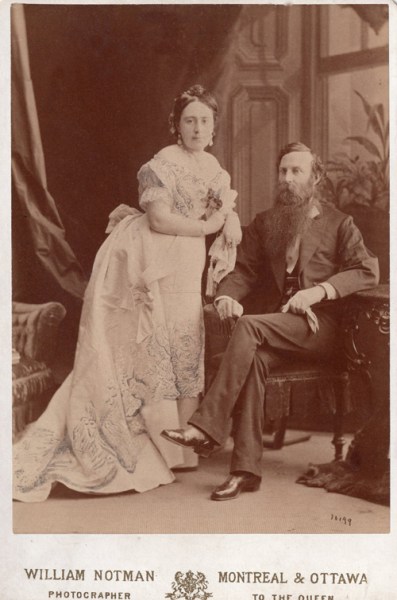
McGregor J. Mitcheson and his wife Ellen Brander Alexander, probably taken when they were visiting his sister Catharine Mitcheson Bagg in Montreal.

The Department of Labor, Income and Revenue was one of the busiest of the Sanitary Fair organization, and it succeeded in raising nearly a quarter of a million dollars, or one-fourth of the fair’s proceeds. Its goal was to raise donations equivalent to the wages of one day’s labor from working people in every branch of industry, one day’s income from their employers, and one day’s revenue from all corporations. Railways and coal mining companies proved to be the most generous donors. This committee also had a large table at the fair where a variety of goods were sold, bringing in $7228.

Committee members personally visited company worksites such as iron works and large mills. Owners would tell their employees to stop work and call them together to hear a speech about the need to help the soldiers. Most employees were so inspired that they agreed to donate a full day’s wages, and their employers also gave generously. Official fair historian Charles J. Stille credited this success with the fact that the organizing committee had nothing to do with partisan politics, and had no specific religious affiliations. Everyone was free to give or not to give.

The committee raised funds in Philadelphia, in smaller Pennsylvania cities such as Bethlehem, Harrisburg and Reading, in rural parts of the state and in neighbouring New Jersey. Members of this committee were so hard-working that it acquired the nickname the laborious committee.

Stille singled out McGregor J. Mitcheson for his hard work. “Through spirited explanatory addresses by Mr. Mitcheson, at the invitation of the proprietors of the leading establishments, six eight, and even twelve manufacturers have been thus visited by the officers and committee; the works stopped, the people collected and addressed, as we have stated, within one day.”3

McGregor also played a memorable role in the fair’s closing ceremony. A large crowd turned out on the evening of June 28 to watch as members of the fair’s executive committee marched onto a platform in the square. The bishop offered a prayer of thanksgiving, then McGregor J. Mitcheson led the singing of the Doxology,4 a hymn of praise. After that, McGregor invited the crowd to sing the Star-Spangled Banner, and finally the crowd broke into an enthusiastic rendition of Yankee Doodle.

Photo Sources:

Queen, J. F. (1864) Buildings of the Great Central Fair, in Aid of the U.S. Sanitary Commission, Logan Square, Philadelphia, June. United States of America Philadelphia Pennsylvania, 1864. Philadelphia: P.S. Duval & Son Lithography, -07. [Photograph] Retrieved from the Library of Congress, https://www.loc.gov/item/2021670451/

Cabinet card photo by William Notman, Montreal. #70199. Bagg family collection.

Notes and Sources

  1. McGregor J. Mitcheson (born Joseph McGregor Mitcheson) was the youngest son of English-born merchant Robert Mitcheson and his Scottish-born wife Mary Frances McGregor. His older sister, Catharine Mitcheson Bagg, was my direct ancestor. McGregor grew up in Philadelphia and practised law there for many years. He married Ellen Brander Alexander Bond, a widow, in 1869, and they had three children.  
  • The Doxology is a four-line hymn often sung during church services The version sung at the fair’s closing ceremony: Praise God, from whom all blessings flow; Praise him, all creatures here below; Praise him above, ye heavenly host; Praise Father, Son, and Holy Ghost. Amen.

This article is also posted on my personal family history blog, http://www.writinguptheancestors.ca
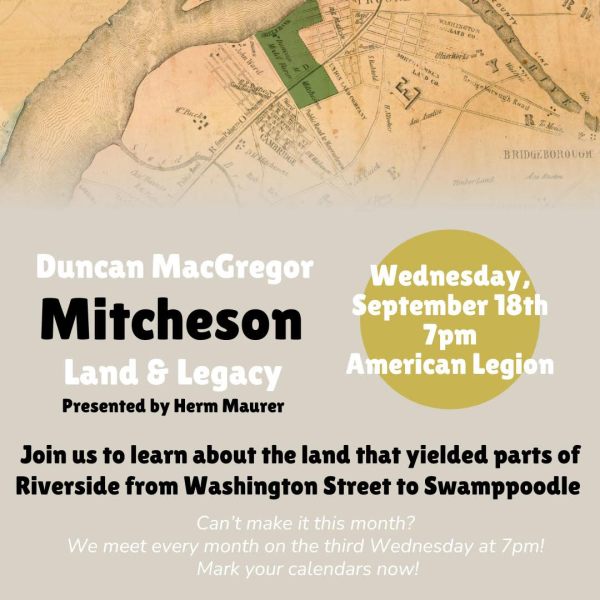
Duncan M. Mitcheson, Real Estate Agent

with research from the Riverside Historical Society

updated Nov. 11, 2024

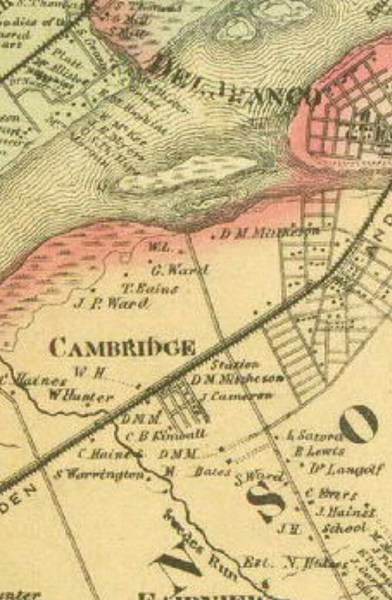
The New Map of the Consolidated City of Philadelphia, published in 1855 by R.L. Barnes. In 1854, various small, incorporated towns located outside the original old City of Philadelphia became incorporated into the City of Philadelphia. Now Philadelphia was not only a city but also known as the County of Philadelphia. Image courtesy RHS (see note below)

Occasionally someone who knows more about one of my ancestors than I do finds my family history blog and gets in touch. That is what happened this summer when Herman Maurer, a member of the Riverside Historical Society in New Jersey, reached out to tell me that my ancestor had founded his town. 

Three years ago, Herman wrote a book called Progress to Riverside: A Story of Our Town’s Past to mark Riverside Township’s 125th anniversary. In the course of his research, he ran across 19th century Philadelphia real estate agent Duncan M. Mitcheson.1

Riverside, New Jersey is a suburban township located across the Delaware River from Philadelphia. In the early 1850s, Duncan and his brother McGregor J. Mitcheson purchased property next to Riverside and subdivided it into cottage lots. This area became the village of Cambridge. Duncan planned the street layout, including today’s busy Chester Avenue, Front Street, Brown, Main and Arch Streets still carry the names that Duncan chose 170 years ago.

Numerous Cambridge deed transfers recorded in the local county clerk’s office between the 1850s and mid-1880s, with the signatures of both Mitcheson brothers on them, convinced Herman that Duncan and his brother McGregor were the primary developers of the village of Cambridge.

This was a surprise to me since I knew very little about Duncan. Now it became clear that he was a successful businessman who embraced modern ideas at a time of rapid changes in society.   

Duncan McGregor Mitcheson (1827-1904) was the middle child of Robert Mitcheson and Mary Frances McGregor. Born in northern England and in Scotland, they were married in Philadelphia around 1818. Duncan’s older sister, Catharine Mitcheson Bagg, was my two-times great-grandmother.

The Mitcheson family lived in Spring Garden, in the northern part of Philadelphia. The family’s home was large and, after their parents died around 1860, Duncan’s older brother, Reverend Robert M. Mitcheson, and his wife and children lived there. Duncan lived with them until Robert died in 1877. In the 1880 census, when he was age 53, Duncan appears to have been staying in a rooming house. Later Philadelphia city directories show that he lived on Spruce Street, near the old part of the city, and had an office nearby on Walnut Street. He never married.  Like his two brothers, Duncan attended the University of Pennsylvania, but unlike them, he did not graduate.3 He dropped out in 1842, at the end of his second year.  University attendance was rare then: there were only 26 students, all male, in Duncan’s freshman class.

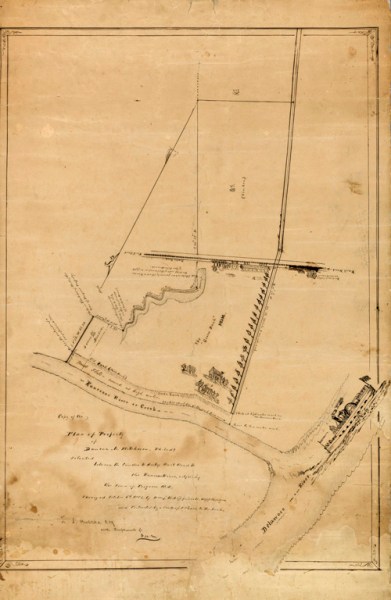
Map, dated Oct. 6, 1853, showing Duncan’s Green Bank Farm overlooking Roncocas Creek and the Delaware River. Duncan sent this map to another Philadelphia real estate developer, Samuel Bechtold Jr., as a complimentary copy. Bechtold was the developer of Progress (now known as Riverside). This map has recently been conserved.

Duncan began his career as a merchant, but an 1861 Pennsylvania business directory identified him as a conveyancer: someone who draws up deeds and leases for property transfers. He was listed as a real estate agent for most of his career.

The Riverside Historical Society’s research revealed that Duncan invested $5000 in land in New Jersey, with an initial purchase of 80 acres, in 1853. He and his brother then formed a real estate partnership to develop the village of Cambridge. An advertisement for these building lots appeared in the Philadelphia newspaper Public Ledger on March 24, 1853. The lots were “located on the Camden and Amboy Railroad, about one mile below Rancocas Creek and the Town of Progress and within a quarter of a mile of the River Delaware, upon a very healthy, dry and level site that will require no filling up, nor grading and can be reached in about half an hour from the Walnut Street Wharf.”

The lots were advertised at the “remarkably low rates” of $25 and $30 each. The $30 lots were 20 feet by 100 feet, while the $25 lots were slightly smaller. A few larger lots were available at $60 and $100 each. 

On November 4, 1854, another ad in the Public Ledger noted that the Cambridge lots were near the water, opposite the splendid riverside mansions of Philadelphia’s 23rd Ward. Duncan also reassured potential buyers that the lots were a safe investment. “From the continued increase of the population of Philadelphia, and the consequent increased demand for Houses and Lots, and as well as from the fact that thousands now living in this city could not only have more room, enjoy better health, but live less expensively at Cambridge.”

Duncan also owned farmland on three sides of Cambridge, and he was one of the larger landowners in the town of Progress in the 1850s. In January, 1854 he purchased 180 acres of vacant land for $15,000. That property, located between Rancocas Creek, the railroad, Chester Avenue and Tar Kiln Run, was known as Green Bank Farm, or Duncan M. Mitcheson’s Model Farm.

This was a period of technological and scientific innovation. The Great Exhibition, held in London, England in 1851, had showcased developments in many fields, including agriculture. These advances were badly needed: food production had to become more efficient to feed growing urban populations. Duncan’s model farm may have featured agricultural innovations such as a McCormick reaper that could rapidly harvest large quantities of crops. And perhaps Duncan was a member of the Model Farm Association, formed in 1860 to establish a model farm, botanic garden and agricultural school in Pennsylvania.

In the spring of 1854, Duncan purchased another 80 acres of vacant land for $6000, extending Green Bank Farm past the railroad tracks. In addition, he, or possibly his brother, owned a nearby property named Rob Roy Farm, after the famous Scottish outlaw and folk hero Rob Roy McGregor.  

How the Mitcheson brothers acquired the funds to buy so much land is not known, but their father owned properties in England and in Philadelphia. Robert Mitcheson senior died in 1859 and in his will, he forgave an $8000 mortgage he held on Duncan’s farm.

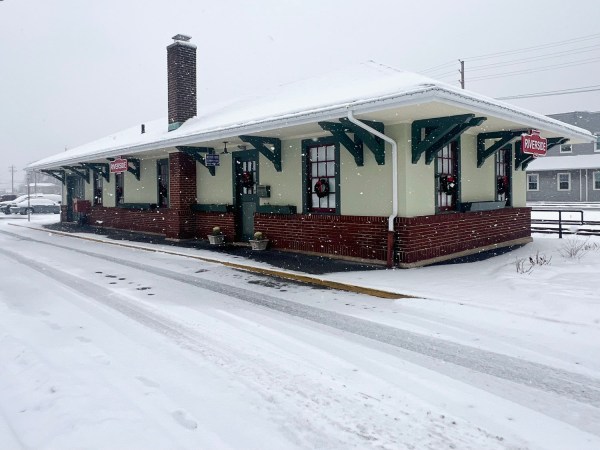
Riverside Train Station. photo by Herman Maurer

In 1859, the Drake Well, the first commercial oil well in the U.S., was drilled in north-western Pennsylvania. That well sparked the first petroleum boom in the United States, creating a wave of investment in drilling, refining and marketing. Duncan saw an opportunity to make money. In February, 1865 he placed the following ad in the Philadelphia Inquirer: “OIL LANDS FOR SALE—located in Venango and Clarion Counties (Pennsylvania). Companies are about to be formed, secure choice lands by addressing or writing to: Duncan M. Mitcheson, real estate office at the northeast corner of Fourth and Walnut Streets, Philadelphia. Also 1,000, 20,000 and 50,000 acres in West Virginia.”

He placed another ad a month later: “CHOICE Oil Tract…Eighty Acres. For sale in fee simple lots situated on the Bennyhoff Creek, Venango County, of which the greater part is boring grounds. This eighty-acre tract will be divided to suit and sold fee simple, with unquestionable titles…”

In July, 1866 Duncan advertised another speculative deal in the Philadelphia Inquirer: 1250 interests, valued at $100 each, in The Virginia Gold Mining Company of Colorado. The company’s property was located near Central City, Colorado, founded in 1859 during the Pike’s Peak Gold Rush.  

In 1893, when he was 70 years old, Duncan sold almost 1000 vacant building lots in Cambridge for the sum of one dollar to his deceased brother McGregor’s two grown children, Joseph McGregor Mitcheson and Mary Frances Mitcheson. During the first two decades of the 20th century, they sold many of the Cambridge properties to families who had recently emigrated from Poland.

Joseph, a bachelor, was a Philadelphia lawyer and a commander in the U.S. naval reserve. Mary Frances married accountant Arthur L. Nunns in 1904. The couple were childless and when she died in 1959, at age 84, she gave a million dollars to the Protestant Episcopal Diocese of Pennsylvania. It was the largest bequest it had ever received.4 During my 2013 visit to Philadelphia, the head of St. James School, a tuition-free, private Episcopalian middle school, told me that gift Is still benefiting the community.

As for Duncan, the 1900 census showed that he had retired. He died in 1904 and was buried, along with his parents and other family members, at St. James the Less Episcopal Church Cemetery in Philadelphia.

Note: The images of both maps were provided by the Riverside Historical Society. The Green Bank Farm map was recently conserved through a 2023 grant funded by the Burlington County Board of Commissioners.

See also:

Janice Hamilton, “Robert Mitcheson, Philadelphia Merchant”, Writing Up the Ancestors, March 1, 2023, https://www.writinguptheancestors.ca/2023/03/robert-mitcheson-philadelphia-merchant.html

Janice Hamilton, “The MacGregors: Family History or True Story?” Writing Up the Ancestors, March 21, 2014, https://www.writinguptheancestors.ca/2014/03/the-macgregors-family-legend-or-true.html

Janice Hamilton, “Philadelphia and the Mitcheson Family” Writing Up the Ancestors, Nov. 22, 2013, https://www.writinguptheancestors.ca/2013/11/philadelphia-and-mitcheson-family.html

Sources:

  1. Herman Maurer, Progress to Riverside: A Story of Our Town’s Past, Riverside Historical Society Inc. 2020, p. 13.
  2. Philadelphia, Pennsylvania, City Directory 1889, entry for Mitcheson, Duncan M., Ancestry.com, citing U.S. City Directories, 1822-1995 (online database), accessed Oct. 1, 2024.
  3. University of Pennsylvania, 1894. entry for Duncan MacGregor Mitcheson. Ancestry.com, citing US. College Student Lists, 1763-1924 (online database), accessed Oct. 1, 2024.
  4. The New York Times, May 6, 1959.

This article is also posted on http://www.writinguptheancestors.ca
Joseph Mitcheson, Yeoman Farmer

We reached Whickham Parish Church in County Durham, England at the end of a long day of exploration. I knew that two of my ancestors had been baptized in the little Norman-style church, but I didn’t know whether any family members were buried in its surrounding large cemetery. The weather was cool and rainy and the church was locked, so, after giving the cemetery a quick glance, we turned to leave. At that point, our guide drew our attention to an old gravestone to the left of the church door. 

“What you say the family name was?” he asked.

“Mitcheson,” I replied.

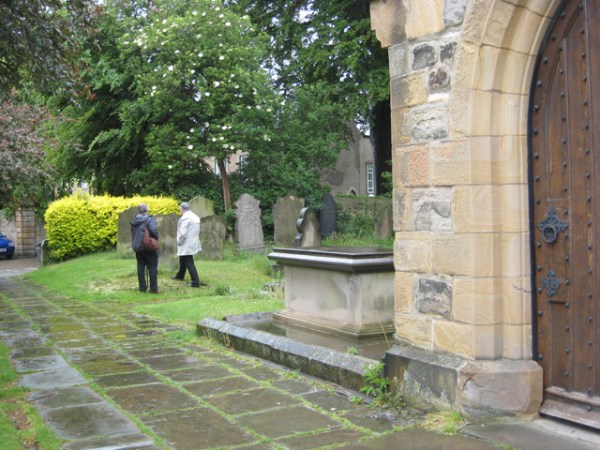
The Philipson/Mitcheson headstone, Whickham Parish Church. JH photo

Only part of the inscription was legible, but enough remained to identify the couple buried there. This was the grave of my ancestors Joseph Mitcheson (1746-1821) and his wife Margaret Philipson (1756-1804). I like to imagine that, knowing we had come all the way from Canada, Joseph and Margaret were trying to get our attention. They didn’t want us to leave without finding them.

This couple is of special significance to my family tree.  Two of their children, Mary Mitcheson Clark and Robert Mitcheson, moved to North America, and both are my direct ancestors. In 1844, Mary’s grandson, Stanley Clark Bagg, of Montreal, married his first cousin once removed, Catharine Mitcheson, daughter of Robert Mitcheson, of Philadelphia.1 This makes Joseph and Margaret simultaneously my four-times and five-times great-grandparents.

I know almost nothing about Margaret, and only a few bare facts about Joseph. He was born and baptized in Lanchester Parish, County Durham, in 1746, the youngest son of gentleman farmer Robert Mitcheson and his wife, Mary..2

When Robert died in 1784, he left most of his estate to Joseph.3 Joseph became what is known as a yeoman farmer, meaning he owned a small amount of property. Socially, a yeoman was notch above a tenant farmer, but below a gentleman.

Joseph Mitcheson, of Lanchester Parish, married Margaret Philipson, of Whickham Parish, by licence at Whickham Parish Church in 1774.4 They eventually had six children – four girls and two boys.

Before his father’s death, Joseph’s family seems to have moved frequently. According to family notes, Mary (1776-1856) was born at Stowe House in the hamlet of Cornsay, Lanchester Parish. Again according to family stories, Robert (1779-1859) was born at Eland Hall, Ponteland, near Newcastle. I can’t confirm either of these accounts, but both children were baptized in Whickham. All of the couple’s other children – Margaret (1781-1864), William (1783-1857), Elizabeth (1786-?) and Jane (1793-1825) — were baptized at Lanchester Parish Church, so the family must have been living in the Lanchester area by 1781.

Fortunately, County Durham has kept its records of land tax returns. These lists showed who owned each property, who lived on it and whether the occupant was the owner or a tenant. In 1789, Joseph was living in Lanchester Parish on a property owned by John Stephenson, Esq., who may have been the husband of his aunt Jane Mitcheson. Meanwhile, Joseph was getting income from three properties that he rented out: a farm in Iveston that he had inherited from his father, and another farm in Witton Gilbert,5 both located in Lanchester Parish.

In addition, his wife had inherited property in the town of Swalwell from her parents. Married women’s property belonged to their husbands, so legally it belonged to Joseph and he collected rent from the house, or houses, on this land. Swalwell, a township in Whickham Parish on the River Derwent, was an important iron manufacturing center in the 18th century.

The tax records show that, by 1798, Joseph and his family had moved to the Iveston, where It appears he farmed the land: in the will, written in 1803, he bequeathed his “implements of husbandry”, as well as the household goods and furniture, to his wife.6

Margaret died in 1804 and perhaps Joseph decided to give up farming after her death and move into town. The Durham tax records of 1810 show the farm properties at Iveston and Witton Gilbert were occupied by renters and Joseph was living on his Swalwell property, although it now belonged to his son Robert, an iron manufacturer.

Harold and Geoff take a close look at the family gravestone. JH photo

When Joseph died in 1821, he left cash to his daughters and the farm in Witton Gilbert to his middle son, William. William lived in London, so he rented the farm to a tenant farmer. Joseph left the bulk of his estate to his older son, Robert, although by this time, Robert had settled in Philadelphia. The 1824 land tax records show that Robert rented out both the properties in Swalwell and in Iveston.

Two final remarks:  I suspect that Joseph Mitcheson and Margaret Philipson’s grave was in a prominent location in Whickham Parish Cemetery because of her family’s prominence. The grave is near the front door of the church where everyone coming and going could see it.  (See the link below to the story of the Philipson family, “Can Two Wrongs Make a Right?”)

My other thought is that, while Joseph was a farmer like his father, his children were the first generation to break new trails. In Montreal, Mary and her husband, John Clark, invested in real estate. In Philadelphia, Robert was involved in several different business ventures as a merchant, a manufacturer and a landlord. Meanwhile, son William was an anchor manufacturer. Did Joseph and Margaret encourage their children to be adventurous and to leave County Durham, or were the next generation just fortunate to live at a time when new opportunities beckoned? That is a question I can’t answer.

See also:

Janice Hamilton “Can Two Wrongs Make a Right?” Writing Up the Ancestors, May 4, 2022, https://www.writinguptheancestors.ca/2022/05/can-two-wrongs-make-a-right.html

Janice Hamilton “Robert Mitcheson’s Last Will and Testament” Writing Up the Ancestors, March 1, 2022, https://www.writinguptheancestors.ca/2022/03/robert-mitchesons-last-will-and-testament.html

Janice Hamilton “Mary Mitcheson Clark” Writing Up the Ancestors, May 16, 2014, https://www.writinguptheancestors.ca/2014/05/mary-mitcheson-clark.html

Janice Hamilton “The Mitcheson Family of Limehouse” Writing Up the Ancestors, Jan. 21, 2015, https://www.writinguptheancestors.ca/2015/01/the-mitcheson-family-of-limehouse.html

Janice Hamilton “The Mitcheson Sisters” Writing Up the Ancestors, May 18, 2022, https://www.writinguptheancestors.ca/2022/05/the-mitcheson-sisters.html

Janice Hamilton “Master Mariners in the Family” Writing Up the Ancestors, June 13, 2022,  https://www.writinguptheancestors.ca/2022/06/master-mariners-in-the-family.html

This article is also posted on Writing Up the Ancestors.

Notes:

My husband and I made that trip in 2009. Our guide that day in Durham was retired professional genealogist Geoff Nicholson. Later, Geoff e-mailed me the whole memorial inscription, copied by the Northumberland and Durham My Family History Society in 1995. It said, “In memory of Margaret, wife of Joseph Mitcheson of Swalwell who died June 23 1804 aged 49? years. The above Joseph Mitcheson died June 1821 aged 77 years”

Sources:

1. Historical Society of Pennsylvania; Philadelphia, Pennsylvania; Historic Pennsylvania Church and Town Records; Reel: 1078, database, Ancestry.com (http://:Ancestry.ca, accessed Dec. 22, 2019,) entry for Stanley Clark Bagg, 9 Sept. 1844; citing Historic Pennsylvania Church and Town Records. Philadelphia, Pennsylvania: Historical Society of Pennsylvania.

2. England, Select Births and Christenings, 1538-1975, Ancestry.com (www.ancestry.ca, database on-line, entry for Joseph Mitchinson, Lanchester, accessed May 2, 2022), citing England, Births and Christenings, 1538-1975. Salt Lake City, Utah: FamilySearch, 2013.

3. Robert Mitcheson’s will is stored at Durham University Archives and can be viewed online. Search for it at http://familyrecords.dur.ac.uk/nei/data/simple.php and view it on Familysearch.org. “England, Durham, Diocese of Durham Original Wills, 1650-1857,” images, FamilySearch (https://familysearch.org/ark:/61903/3:1:S3HT-67DQ-481?cc=2358715&wc=9PQL-ZRH%3A1078415794 : 7 July 2014), DPRI/1/1784/M5 > image 3 of 3; Special Collections, Palace Green Library, Durham University, Durham. (accessed Feb. 28, 2022).

4 England, Select Marriages, 1538-1973 Ancestry.com (www.ancestry.ca, database on-line, entry for Joseph Mitcheson, accessed May 2, 2022), citing England, Marriages, 1538–1973. Salt Lake City, Utah: FamilySearch, 2013.

5. Durham County Records Office. Quarter Sessions – Land Tax Returns, Chester Ward West 1759-1830, www.durhamrecordsoffice.org.uk, search for Mitcheson, viewed April 19, 2022.

6. Will of Joseph Mitcheson, yeoman, Iveston, Durham, The National Archives, Wills 1384-1858 (http://nationalarchives.gov.uk, search for Joseph Mitcheson, accessed Nov. 18, 2010), The National Archives, Kew – Prerogative Court of Canterbury, 9 February, 1822.

The Mitcheson Sisters

Sisters Margaret (born 1781), Elizabeth (born 1786) and Jane Mitcheson (born 1793) grew up together on their parents’ farm in County Durham, England, but when they became adults, their lives followed very different paths. The eldest married a much older man who provided her with financial security, the middle sister was swept off her feet by a tenant farmer and the youngest married a mariner who was often away at sea.

The daughters of yeoman farmer Joseph Mitcheson and his wife Margaret Philipson, they were baptized at Lanchester Parish Church and grew up in the rolling countryside of northeast England. Their mother died in 1804, when Jane would have been just nine years old.

They had two older siblings, Mary (born 1776) and Robert (born 1779) who both immigrated to North America, and another brother, William (born 1783), an anchor manufacturer who lived near the docks of London. (Mary and Robert were both my direct ancestors since Mary’s grandson, Stanley Clark Bagg, married Robert’s daughter Catharine Mitcheson in 1844, so these three sisters were my 4x and 5x great-aunts.

Their grandfather Robert Mitcheson (-1784) left each of his older grandchildren 50 pounds, part of which could be spent on their care and education and the rest given to them when they turned 21. In his will, written in 1803, their father also left them between 100 and 150 pounds each,1 although he gave the two youngest, Elizabeth and Jane, their inheritances in 1807.

Margaret Dodd

Margaret would have been considered as having married well when she wed gentleman Thomas Dodd (1743-1823) at Whickham Parish Church in 1808.2 The Dodd lineage in northern County Durham can be traced back to 1645, and his family owned a farm called Woodhouse, located in Woodside Ryton Township.

Whickham Parish Church. JH photo.

Thomas was in his sixties and Margaret was 27 when they married. They had five children, three of whom lived to adulthood, although their only surviving son, Thomas Anthony Humble Dodd (1824-1899), was born after his father had died. Thomas grew up to be a well-known Newcastle surgeon and married his cousin, Frances Jane Mitcheson (1824-1898), daughter of the anchor maker.3

Thomas Dodd senior was an early pioneer of Methodism, founded in the 18th century by English minister John Wesley. Wesley often preached to large crowds outdoors. According to the late Durham-based genealogist Geoff Nicholson, John Wesley may have preached in the fields at Dent’s Hall, near Ryton, and Thomas may have met Wesley.4

After her husband’s death, Margaret remained at Woodhouse. In 1824, 1825 and 1827, the property was listed as owned and occupied by the executors of Thomas Dodd’s estate, but according to the 1830 land tax returns, it was “Property of Mrs. Dodd, occupied by Mrs. Dodd.”5

She was also a farmer. A local directory published in 1828 listed Margaret Dodd as a farmer in Woodside Ryton Township,6 and the 1841 U.K. census did the same.  

The 1851 census found son Thomas A. H. Dodd as head of the household, living at Woodhouse with his wife and two small children, his mother and two servants. Margaret was listed as an annuitant, meaning she had her own income. The census noted that Thomas was a surgeon, and that the farm had 96 acres and employed two labourers.

When the 1861 census-taker came around, Margaret was once again head of the household, living with her widowed daughter Mary Robson and a house servant. Margaret died in October, 1864, age 83, and was buried with her husband in Holy Cross Parish Churchyard, Ryton.7

Elizabeth Maughan

While researching Margaret was straightforward, finding records of her sister Elizabeth’s life was more challenging. What I did find suggests that Elizabeth’s life was far from easy.

She was just 20 when she married farmer John Maughan, of Shotley, Northumberland, in 1806 at Whickham Parish Church.8 They lived in Shotley, a sparsely inhabited parish in southern Northumberland, located between the River Derwent and the town of Hexham. Its soil consists of sandy clay, and coal, silver, lead and iron have been produced in the area.

Elizabeth might have been lonely on that remote farm, but she probably didn’t have much time to think about it as she gave birth to at least 10 children.9 Several of them died young, but Joseph (b. 1810), Margaret (b. 1814), Isabella (b. 1816), Mary (b. 1817) and possibly William (b. 1823) grew to adulthood.

The family eventually appears to have left Shotley. In 1842, my Montreal ancestor Stanley Bagg and his 21-year-old son Stanley Clark Bagg travelled to England. In an account of the trip, Stanley Clark Bagg mentioned that they visited his great-aunts Mrs. Dodd near Ryton and Mrs. Maughan in Sunderland, in northeastern County Durham.11

Some genealogists suggest Elizabeth died in Hexham, Northumberland in 1839, but in that case, the Baggs would not been able to visit her. The 1841 census counted a John Maughan, agricultural labourer, and Elizabeth Maughan, age 55, in Sunderland, along with 15-year-old Thomas Maughan, so this may have been the family.12 I do not know when Elizabeth died.

As for the youngest sister, Jane, she married master mariner David Mainland in 1812. About 10 years later, the family moved to London. Jane died in London in 1825 and their son David married his widowed cousin Mary Ann (Mitcheson) Eady in 1849. Jane’s family will be the subject of my next post.

Notes:

According to genealogist Geoff Nicholson, Margaret and Thomas Dodd’s children were: Margaret (c.1810-1851) m. John Milburn; Isabella Ann (1815-1822), Mary (1817- ) m. Rob. Robson or Ritson; Anthony Humble (1818-1821) and Thomas Anthony Humble (1824-1899) m. Frances Jane Mitcheson.

Elizabeth and John Maughan’s daughter Mary (born 181712))moved to Montreal, Canada, where her Aunt Mary (MItcheson) Clark lived. Mary Maughan married merchant William Footner in Montreal in September, 1840,13 and she gave birth to one of her three children at Mile End Lodge, a large farmhouse that belonged to her aunt. The Footner family later moved to the United States and Mary died in Minnesota in 1901. (There was another William Footner, an architect, married to another Mary, in Montreal in the mid to late 1800s.)

See also:

This article has simultaneously been posted on http://www.writinguptheancestors.ca.

The Lucy H. Anglin Family Tree on Ancestry Public Member Trees. Numerous members of the Mitcheson family in Durham, including several generations of men named Robert Mitcheson, as well as their descendants in Philadelphia and Montreal, are listed on this tree.

Janice Hamilton, “Mary Mitcheson Clark”, Writing Up the Ancestors, May 16, 2014, https://www.writinguptheancestors.ca/2014/05/mary-mitcheson-clark.html

Janice Hamilton, “Philadelphia and the Mitcheson Family,” Writing Up the Ancestors, Nov. 22, 2013, https://www.writinguptheancestors.ca/2013/11/philadelphia-and-mitcheson-family.html

Janice Hamilton, “Robert Mitcheson’s Last Will and Testament”, Writing Up the Ancestors, March 1, 2022, https://www.writinguptheancestors.ca/2022/03/robert-mitchesons-last-will-and-testament.html

Sources:

1. Will of Joseph Mitcheson, yeoman, Iveston, Durham, The National Archives, Wills 1384-1858 (http://nationalarchives.gov.uk, search for Joseph Mitcheson, accessed Nov. 18, 2010), The National Archives, Kew – Prerogative Court of Canterbury, 9 February, 1822.

2. England, Select Marriages, 1538-1973, Ancestry.com. (www.ancestry.ca, database on-line, entry for Margaret Mitcheson, accessed April 19, 2022), citing England, Marriages, 1538–1973. Salt Lake City, Utah: FamilySearch, 2013.

3 London and Surrey, England, Marriage Bonds and Allegations, 1597-1921, Ancestry.com (www.ancestry.ca, database on-line, entry for Thomas Anthony Humble Dodd, 1848, accessed April 19, 2022), citing Marriage Bonds and Allegations. London, England: London Metropolitan Archives.

4 E-mail correspondence from Geoff Nicholson about the Dodd family, June 13, 2009.

5 Durham County Record Office. Quarter Sessions – Land Tax Returns, Chester Ward West 1759-1830, www.durhamrecordsoffice.org.uk, search for Dodd, viewed April 19, 2022.

6 The History, Directory and Gazetteer of Durham and Northumberland, Vol 2, by Wm. Parson and Wm. White, W. White and Company, 1828, p. 186, Google Books, search for Margaret Dodd, accessed April 19, 2022.

7 Find a Grave (www.findagrave.com, database online, search for Margaret Dodd, accessed April 19, 2022), https://www.findagrave.com/memorial/231216340/margaret-dodd.

8. England, Select Marriages, 1538-1973 Ancestry.com (www.ancestry.ca, database on-line, entry for Elizabeth Mitcheson, Whickham, accessed April 10, 2022), citing England, Marriages, 1538–1973. Salt Lake City, Utah: FamilySearch, 2013.

9. England Births and Christenings, 1538-1975, Familysearch.org, database online, entry for John Maughan and spouse Elizabeth, Shotley; accessed April 10, 2022.

10. Letter from Stanley Clark Bagg to Rev. R. M. Mitcheson, Dec. 6, 1842, probably transcribed by Stanley Bagg Lindsay; Lindsay family collection.

11.1841 England Census, Ancestry.com (http://www.ancestry.ca, database on-line, entry for Elizabeth Maughan, Bishop Wearmouth, accessed April 10, 2022), citing Class: HO107; Piece: 310; Book: 4; Civil Parish: Bishop Wearmouth; County: Durham; Enumeration District: 4; Folio: 13; Page: 21; Line: 1; GSU roll: 241353, original dataCensus Returns of England and Wales, 1841. Kew, Surrey, England: The National Archives of the UK (TNA): Public Record Office (PRO), 1841.

12 “England Births and Christenings, 1538-1975”, database, FamilySearch (https://familysearch.org/ark:/61903/1:1:JWVX-TMS : 20 March 2020), entry for Mary Maughan, accessed April 19, 2022).

13. Quebec, Canada, Vital and Church Records (Drouin Collection), 1621-1968, Ancestry.com (www.ancestry.ca, database on-line, entry for Mary Maughan, accessed April 19, 2022), citing Institut Généalogique Drouin; Montreal, Quebec, Canada; Drouin Collection; Author: Gabriel Drouin, comp.

Frances McGregor’s Notebook

The old notebook has a scuffed brown cover, but its pages are full of poetry, transcribed in neat handwriting. Clearly, this notebook once belonged to a woman who admired Lord Byron and other early 19th century English poets. Her name was Frances – or Fanny – McGregor, and she may have been my ancestor.

I came across it while searching for the name McGregor in the online catalogue of the Historical Society of Pennsylvania. The first result to pop up was “Frances McGregor autograph book, 1825.” In response to my query, the society forwarded a digitized copy of the entire notebook.

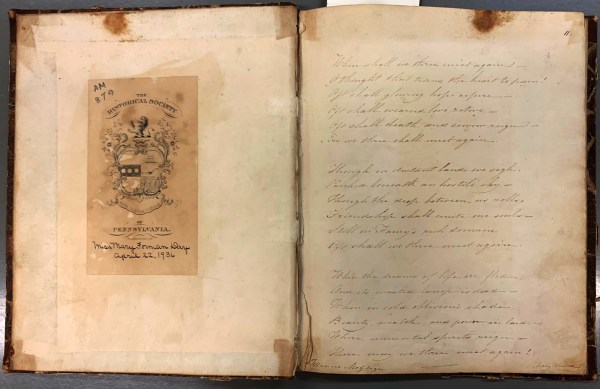
There’s a note clipped to the front, “Frances McGregor? selections from English poets,” which is a more accurate description of it. The label inside the cover indicates it was given to the historical society by “Miss Mary Forman Day, April 22, 1936,” more than 100 years after the last entry was made in 1829.

the donation plate and first page (page 11) of the notebook

Who was Mary Forman Day? She could have been a friend of one of Fanny’s grandchildren.1 Born in Philadelphia in 1860, and died in 1950 in Washington, D.C., she was probably the person who gave many documents pertaining to her Forman ancestors — early Maryland settlers — to area historical societies.2

As for my three-times great-grandmother Mary Frances McGregor, she was born near Port of Menteith, Perthshire, Scotland around 1792. She usually went by her nickname, Fanny. According to family lore, she finished her education in Edinburgh and then came to America. She married English-born Philadelphia merchant Robert Mitcheson, and the census shows they lived in the Spring Garden district, on the outskirts of Philadelpia. I am descended from her eldest daughter, Catharine, who was born in 1822.

I tried to eliminate the possibility that another Frances McGregor owned this notebook, but that proved difficult. Only the head of the household was named in census records and city directories at that time, making women especially hard to find.

If a title page ever existed, someone tore it out long ago, and the notebook begins on page 11.  Nevertheless, Frances’s name appears three times: she signed “Fanny” on a small botanical painting on the last page, and she wrote “Frances” on the inside back cover.

Her name also appears on page 11, at the bottom of a poem that begins, “When shall we three meet again?” Those words were spoken by the three witches in Shakespeare’s Macbeth, but this is a different poem, expressing the sadness of friends about to be parted. Perhaps Fanny included this poem because she knew she would be leaving her life in Scotland for a new one in the United States.

Many of the poems Frances included in the notebook were written by Lord Byron. She also included a passage from Milton’s Paradise Lost, a short excerpt from an opera and “A Canadian Boat Song, written on the River St. Lawrence”, written by Irish poet Thomas Moore and first published in 1805. The notebook ends with several poems about England’s Princess Charlotte. In 1817, her baby was stillborn and the princess also died. These tragic events inspired much public sympathy at the time.

Frances seems to have written at least one of the notebook’s entries herself. “A Poem – On Home, written by a Young lady at School in the Year 1814” described memories of a loving mother and a happy childhood, but complained of loneliness and disillusionment as the young author moved toward adulthood.  

Besides poetry, Frances included several “puzzles” such as, “Why are your eyes like coach horses?” and “Why is a washerwoman like a church bell?” and “How is a lady of loquacity like a lady of veracity?” She did not include the answers.

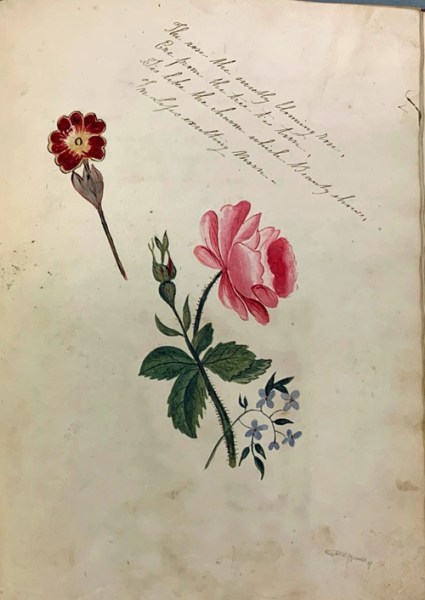
One of the botanical sketches in the notebook.

My other favourite entries are the botanical paintings: simple but colourful images of wild geraniums, wild violets and roses.

Whoever created this notebook, it is clear that she was well educated, probably from the upper middle class, and had a quirky sense of humour. The more I think about it, the more strongly I suspect it belonged to my Frances McGregor, but I can’t prove it.

Photo credits: “Frances McGregor autograph book, 1825,” courtesy the Historical Society of Pennsylvania

Notes

1. Grandchildren of Fanny McGregor Mitcheson who could have known Mary Forman:
Joseph McGregor Mitcheson (1870-1926) WW1 navy officer and Philadelphia lawyer;
Mary Frances (Mitcheson) Nunns (1874-1959);
Robert S. J. Mitcheson (1862-1931) Philadelphia physician and art collector;
Helen Patience Mitcheson (1854-1885);
Fanny Mary (Mitcheson) Smith (1851-1937) wife of Philadelphia lawyer and collector of historical documents Uselma Clarke Smith.
Fanny had five other grandchildren in Canada through daughter Catharine Mitcheson Bagg.

2. For example, Mary donated the Forman papers, MS 0403. H. Furlong Baldwin Library., Maryland Center for History and Culture, https://mdhistory.libraryhost.com/repositories/2/resources/49

This article is also posted to https://writinguptheancestors.ca