Tag Archives: Montreal

Christmases Remembered

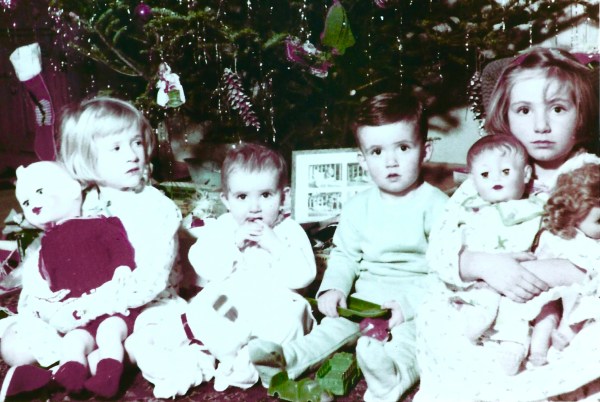
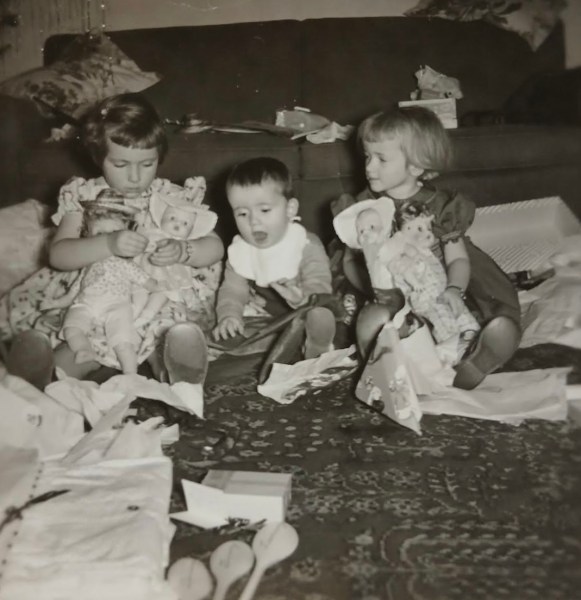
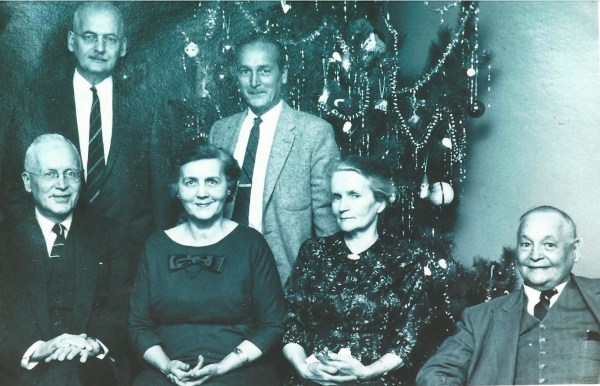
Christmas 1955

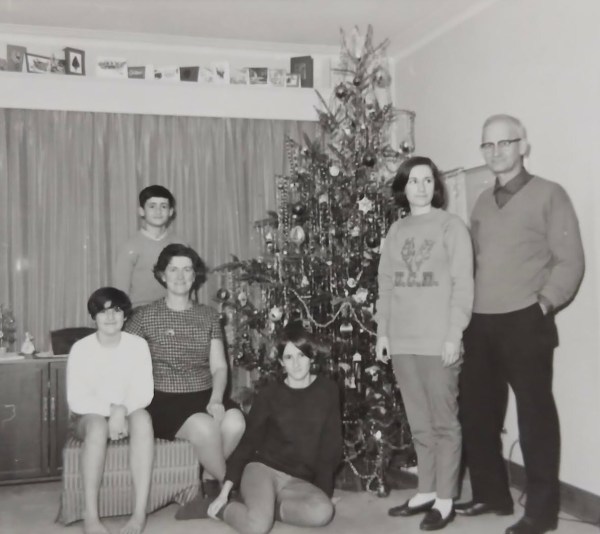
As Christmas approaches, there aren’t visions of sugar plums dancing in my head, but flashes of my childhood Christmases in Montreal in the 1950s and 60s. There were a few green Christmases but mostly there was snow on the ground.

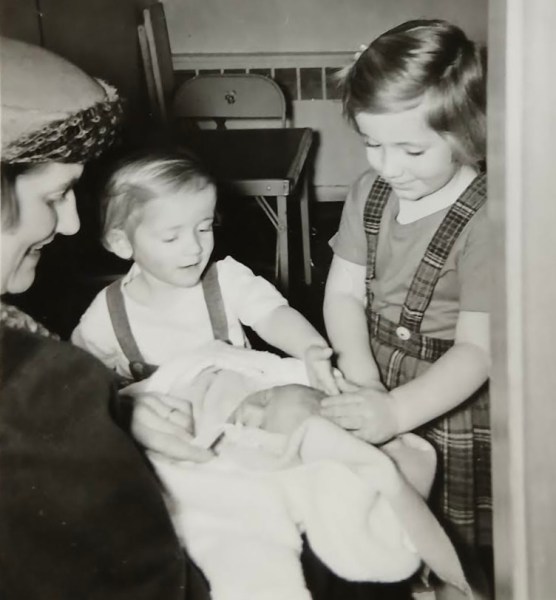
On my second Christmas, I got a baby brother for a present. He was born on December 19th, and in those days, mothers typically stayed in the hospital for a week. The doctor let my mother out a day early, so she came home with Donnie on Christmas Eve. One had to pay for the stay beforehand, so she received a refund!

Christmas Brother


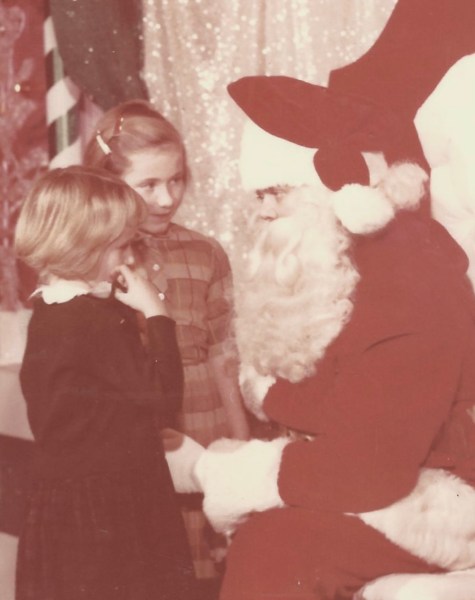
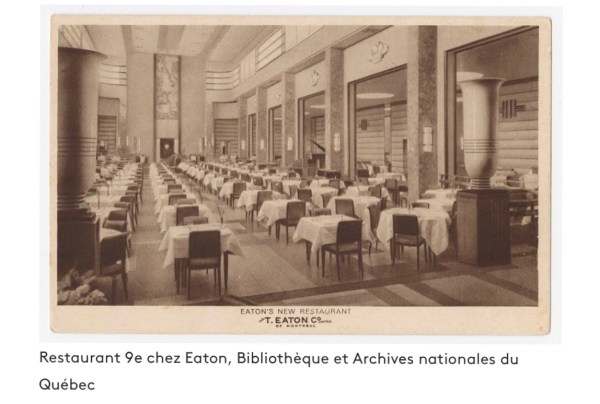
Excitement mounted as Christmas approached. There was the Santa Claus parade, followed by visits to Santa at Eaton’s Department Store, a ride on the little train with a gift, and then lunch in the 9th-floor restaurant. I still remember the sandwich plate, chicken and egg and clown ice cream (a scoop of ice cream decorated as a face with a little ice cream cone upside down as a hat.) My mother would take the children two by two. First, the older ones and then the younger ones. We knew that the real Santa was at Eaton’s because he climbed down a chimney there at the end of the parade.

Visiting Santa at Eaton’s

We didn’t have a television but listened to a show on the radio where a list of good girls and boys was read from the North Pole. Mary was usually mentioned being a common name but not my friend Dilys’s name. One year we watched Amal and the Night Visitors, an opera by Gian Carlo Menotti on TV at my Grandmother’s. Listening to the record every Christmas became a tradition.


As my mother bought presents, she put them in the linen cupboard and locked the door. We knew that the key was on the moulding above. So, a curious child could climb on a chair, unlock the door and check on the presents. As I got older, the anticipation and surprises were better than sneaking a peek.

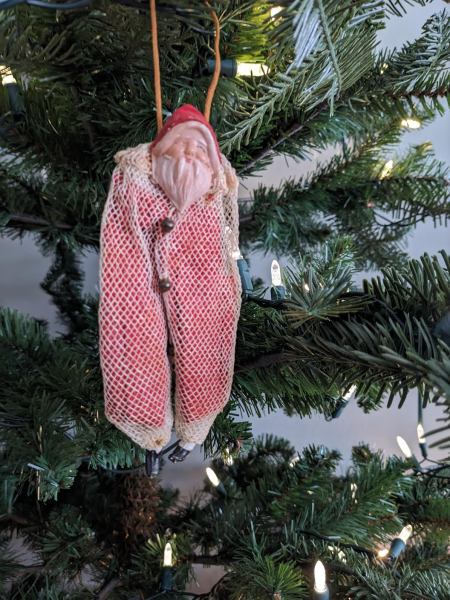
The tree was only decorated a day or two before Christmas. Dad would set up the tree and add the lights. My mother would always put on the tinsel, not throwing on handfuls but putting pieces on one by one, as her father had done. We could put on some ornaments. We had some large fragile balls and lights that had bubbling red liquid and everyone’s favourite Sack Santa.

Sack Santa

We could ask Santa for only one thing, as he needed to have presents for all the good boys and girls. That present came unwrapped. Mrs Claus didn’t have time to wrap all the toys. We could play with our Santa present while Mom made breakfast.

We made and bought presents for aunts and uncles. One Christmas I made sachets embroidered with branches and filled with spruce needles for the aunts. My brother once gave everyone a comb from the big package he bought. One uncle was a teacher and he always got a red pencil.

My father didn’t cook but every Christmas he would make chocolate fudge for his Aunt in Toronto.

The years we were in the Junior Choir, we sang at the midnight service. Snowy Flakes are Falling Softly, was a favourite carol. This was a special event as we got to stay up really late. My parents probably didn’t mind tired children, as perhaps we slept in a little on Christmas morning.

What did Mom want for Christmas? Maybe a paring knife or a new wooden spoon. Now I understand her not wanting more stuff.

This Christmas my mother received three wooden spoons.

We didn’t rip into the presents because Mom saved the larger pieces of wrapping paper and ribbons for the next year. We tried to make the opening of presents last but no matter how large the pile of presents was, it was soon demolished.

We were usually six plus Grandma on Christmas day. We had dinner at 1:00 pm. For a few years we went to Chateauguay in the evening, to my mother’s sister’s house because Grannie and Grandfather were there. They preferred a quieter Christmas with fewer children! In later years we often had friends or colleagues who were alone over for dinner.

One Christmas, we were going to spend it at our cottage in the Laurentians, north of Montreal. Dad went up and turned on the heat, then a huge snowstorm prevented us from going. A long, unplowed road led to the house. Later, he had to go back and turn off the heat. We never attempted this again and continued with our traditional Christmases.

Merry Christmas to All!

Notes:

Another Christmas Story

https://genealogyensemble.com/2021/01/20/sugarplum-tree/

Eaton’s department store on Saint Catherine Street in Montreal was a destination. It was one of three department stores, the others being Morgan’s, which became The Bay and Simpson’s. The restaurant on the 9th floor was opened in 1931. It was in Art Deco style, inspired by the dining rooms of luxury ocean liners. After Eaton’s went bankrupt in 1999, the restaurant remained locked up for a quarter-century. It reopened in 2024, restored to its original style. The dining room has been converted into an event space, with a restaurant located in the outer corridor.

The dining room in its former glory

Snowy Flakes are Falling Softly https://www.youtube.com/watch?v=svfu6WcIh84

Amahl and the Night Visitor by Gian Carlo Menotti

Discovering Family Connections Through Obituaries

Somerled School Kindergarten class 1957/1958

I recently discovered that I am related to my kindergarten teacher’s husband! There are certainly tangled webs of relationships all through our family histories. Following direct ancestor lines often leads you to people you might know about. Exploring other branches of siblings, aunts, and uncles can uncover connections you never knew you had. This is how this one was untangled.

The online death notice for Shirley Harris (1927-2025) in the Montreal Gazette caught my eye. Her name sounded familiar so I started reading her obituary. It mentioned she was 98, had a brother, John and sister, Ann. These names didn’t ring a bell, so I closed it just as my eyes caught the name Paul von Colditz. I remembered that there was a connection with a Shirley von Colditz and our family.

Ida Bruneau, one of my mother’s cousins, wrote a family history, “The Short History of the Bruneaus and Girods”. In it, Ida mentions Shirley von Colditz as a very dear friend of hers. They discovered they were distant cousins. Shirley descended from Medard Bruneau (1811-1892) and Ida and I from his brother Barnabé. They were the sons of Antoine Bruneau (1773-1847) and Marie Robidoux (1775-1847). This meant that Shirley and Ida were third cousins once removed.

My husband and I used to be members of the Montreal Badminton Squash Club. An Eric von Colditz also played badminton there. Years ago, I read Ida’s book. After that, I asked Eric if he thought we were very distant cousins. He said no. Shirley was his stepmother.

I carefully reread the obituary. “Shirley was the devoted wife of the late Paul von Colditz and the loving sister of the late John Harris ( the late Patricia Reynolds).” Patricia Harris was the name of my kindergarten teacher. I knew her maiden name was Reynolds, as my mother knew her sister Moyra Reynolds. Pat’s obituary confirmed she had sisters-in-laws Shirley and Ann. So I was related to her husband John.

Mrs. Harris and Miss Gael were my two kindergarten teachers at Somerled School in Notre Dame de Grace, Montreal. I started there in the fall of 1957. This school just opened in January 1957. I was in the first class to go through all the grades at Somerled School. I enjoyed kindergarten and remembered my teachers fondly.

John and Pat Harris had two children, Kathy and John. At one time, their son John lived on Percival Ave. in Montreal West, where I also lived. During a street-wide garage sale, my husband returned from down the street. He said, “One of your teachers is selling tea cups in front of a house.” I went and had a chat with Mrs Harris. Her son was someone I recognized but never talked to. He had a wife, three daughters and a dog. I figure John and I are fourth cousins once removed. Unfortunately, he no longer lives on Percival. I can’t tell him of our connection. Not even six degrees of separation.

Notes:

A Short History of the Bruneau Girod Families by Ida Bruneau. Ste. Agathe des Monts, Quebec, May 1993. Page 8. A copy in the hands of the author.

https://montrealgazette.remembering.ca/obituary/shirley-harris-1092955467

https://montrealgazette.remembering.ca/obituary/patricia-harris-1065848692

Shirley Harris was the daughter of Irene Bruneau (1901-1987) and Herbert Harris. 

Irene was the daughter of Eugene Albert Bruneau (1875-1939) and Eliza W. Thompson

Albert was the son of Ophir Bruneau (1848-1920) and Hermaline Piche (1949-1901)

Ophir was the son of Medard Bruneau (1811-1892) and Marie S. Megrette (1822-1853)

Medard was the son of Antoine Bruneau (1773-1847) and Marie J. Robidoux 1775-1847)

Barnabé and Medard were brothers:

Barnabé was the son of Antoine Bruneau (1773-1847) and Marie J. Robidoux 1775-1847).

Ismael was the son of Barnabe (1807-1880) and Sophie Marie Louise Prud’homme (1812-1892).

Sydney was the son of Ismael Bruneau (1852-1918) and Ida Girod ( 1862-1927).

Sydney was my grandmother Beatrice’s brother

Ida Bruneau was the daughter of Sydney Bruneau ( 1893-1979) and Ruth Dawson ( 1894-1971).

This makes Ida and Shirley 3rd cousins once removed!

Moyra Reynolds was on the women’s executive at the Catherine Booth Hospital. She worked alongside my mother, who was also a cousin of John Harris. Moyra and her friend Eileen glued my mother’s little tatted flowers onto hasty notes. These cards were sold for the benefit of the Catherine Booth Hospital. Moyra was living in the Montclair Residence when my mother moved in. They lived on the same floor. Moyra was excited that my mother was coming and hoped to make more hasty notes. Unfortunately, she soon suffered a stroke and was in hospital for a while. She came back to the Montclair. However, her needs were too great for them to handle and she moved to another residence.

One time when I was visiting my mother, a young woman was clearing out Moyra’s room. I thought afterwards that she might have been Moyra’s niece and my kindergarten teacher’s daughter. I am sorry I didn’t speak to her.

There was a family connection with Somerled School and another connection to Percival Avenue. Percival Ave is a street of just three blocks in the town of Montreal West. Ida’s sister Mary Bruneau and her husband George Davidson once lived on Percival. Their home was just across the street from where John Harris later lived. Ed Hawkes married my mother’s cousin Ephese Jousse, also related to John Harris. His parents lived a block south on Percival. I live on Percival now!

A Neighbourhood of Rural Villas

In collaboration with Justin Bur

Montreal in 1832, painting by James Duncan. McCord Stewart Museum.

This view of the city of Montreal from the slope of Mount Royal was painted by artist James Duncan in 1832. In the distance, the city lay on the banks of St. Lawrence River, while in the foreground, the foot of the mountain was rural and traversed by only one road – today’s Saint-Laurent Boulevard.  

This area is now a dense neighbourhood of homes, shops and commercial buildings, but 200 years ago, it was described as a neighbourhood of rural villas. Several of those buildings belonged to my ancestors, including butcher John Clark (1767-1827) and merchant Stanley Bagg (1788-1853). These homes were all torn down years ago, but fortunately, artists and photographers captured them before they disappeared. This article tells their stories.  

Saint-Laurent Boulevard began as a country road passing through a landscape with a mix of rural functions. In the 1700s, a large tannery was located nearby, to the east along Mount Royal Avenue. Later, numerous quarries were excavated to provide the grey limestone used for much of Montreal’s Victorian architecture – churches, civic buildings, places of business and attractive houses. The Beaubien family acquired a large tract of land along the east side of the road in 1842, as well as property in what later became the municipality of Outremont. A railway line was built across the Bagg and Beaubien land in 1876, along which an industrial corridor emerged in the early 1900s.

During the lifetimes of the Clarks and Baggs, their property, on the west side of Saint-Laurent, was farmland. The soil was mostly sandy and rocky. Hay to feed cattle and horses was the main crop, but vegetables and fruit trees could be grown in fertile areas. Back from the road, rising up toward the side of the mountain, there were a handful of rural villas belonging to the Baggs and a few neighbours, including the Perrault-Nowlan and the Hall families.

Butcher John Clark, my four-times great-grandfather, was the first member of my family to live in this area. He brought his wife and young daughter to Montreal around 1797 from County Durham, in northern England, and began investing in land. In 1804, Clark purchased a farm on the west side of Saint-Laurent, and over the next few years, he added adjacent parcels of land. He called the property Mile End Farm, probably inspired by Mile End in London, England.1 His choice of name is still familiar today, as this neighbourhood is known as Mile End. In 1810, he leased the farm to American-born Phineas Bagg (c. 1751-1823) and his son Stanley,2 and they ran an establishment called the Mile End Tavern there until 1818.

Montreal Hunt Club at Mile End Road, Montreal, QC, 1859. photograph by J. Henry, MP-1978.29.8, McCord Stewart Museum. The corner of the building on the right is likely the Mile End Tavern.

After Phineas retired and Stanley moved on to other business interests, various tenants operated the Mile End Tavern. It was demolished in 1902 when the local municipality expropriated the land to widen Saint-Laurent Boulevard. New owners purchased the lot in 1905, and the following year a department store opened on the corner of Saint-Laurent and Mount Royal Avenue, where the tavern had stood for so long.3 The department store was converted into a commercial building during the Great Depression. Today, a Couche Tard convenience store and a Tim Horton’s coffee shop are on its ground floor.

By 1891, both Stanley Bagg and his son Stanley Clark Bagg had died and most of the Mile End Farm property was sold by the late Stanley Clark Bagg’s five adult children to developers McCuaig and Mainwaring.4 An economic depression and lack of basic services such as sewers and tramways delayed development for a few years. Meanwhile, the most valuable lots – the ones that faced Saint-Laurent Boulevard – were divided into five equal shares and allocated at random to the five Bagg siblings.5

Map of Mile End Farm and the locations of Mile End Tavern, John Clark’s Mile End Lodge, Stanley Bagg’s Durham House and Stanley Clark Bagg’s Fairmount Villa, prepared by Justin Bur, 2024.

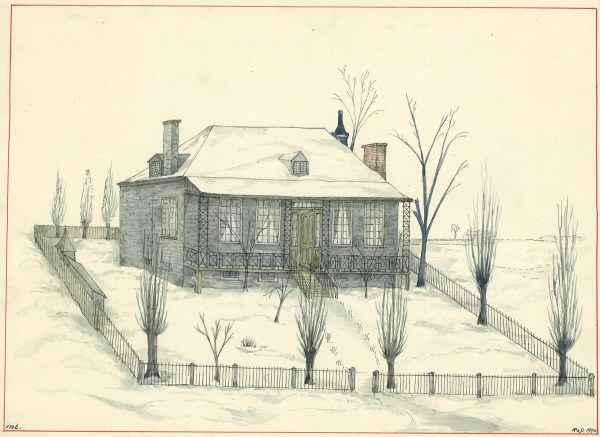
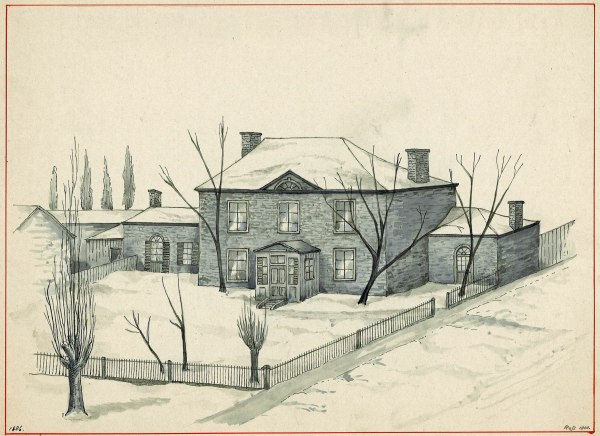
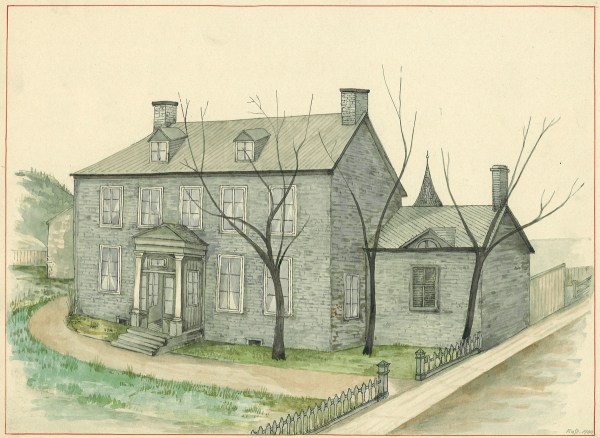
John Clark’s house was not as well known as the nearby tavern. In 1815, Clark sublet a 16-acre square of land back from the Baggs, a “piece of ground on which is erected a new house of butchery called by the said John Clark, Mile End Lodge”6 – in reality, a two-storey stone house for his family. Facing south, toward the city and the river, it was located between the current Bagg and Duluth Streets, just above what was then the Montreal city limit.

After Clark’s death in 1827, his widow, Mary Mitcheson Clark, moved to a smaller house at the current northwest corner of Bagg and Clark Streets. An inscription noting that this was once the location of the Mitcheson Cottage can still be seen on the foundation of the house that stands there today,

Mrs. Mitcheson’s Cottage, watercolour painting by John Hugh Ross, Stewart Museum collection, McCord Stewart Museum, Montreal.

As for Mile End Lodge, although it remained in the hands of Clark’s descendants, no family members ever lived there again. Various tenants rented it over the years. The land around it was subdivided, with a chunk sold in 1873 and the rest in 1893, but the house itself was not sold until 1914. The badly deteriorated building was demolished soon after that, and there is now a large commercial building in that location.7

Mile End Lodge, watercolour painting by John Hugh Ross. Stewart Museum collection, McCord Stewart Museum, Montreal.

Durham House, the home of my three-times great-grandparents Stanley Bagg and Mary Ann Clark, was located south of the tavern and Mile End Lodge. John Clark purchased the property in December, 1814 and gave it to his daughter as a wedding present in 1819. Durham House was on Saint-Laurent Boulevard, at the current southwest corner of Prince Arthur. Early references describe its address as Côte à Baron.

Durham House, watercolour painting by John Hugh Ross, Stewart Museum collection, McCord Stewart Museum, Montreal.

This two-storey stone building also faced south. There was a covered well on the property, a barn and several other outbuildings. The original Durham House property measured 6 ¾ x 4 arpents, so it was a large piece of land, including property between Prince Arthur and Guilbault Streets, known as the Upper Garden.

After Stanley Bagg’s death in 1853, Durham House was briefly used as a school, then it housed a fruit store for a number of years. Meanwhile, the large property that surrounded it was one of the first to be subdivided for building lots. Stanley Clark Bagg subdivided it in 1846, and the Upper Garden was subdivided by his heirs in 1889. The house was demolished in 1928 to allow for the expansion of the modern TD Bank branch which sits on the spot today.

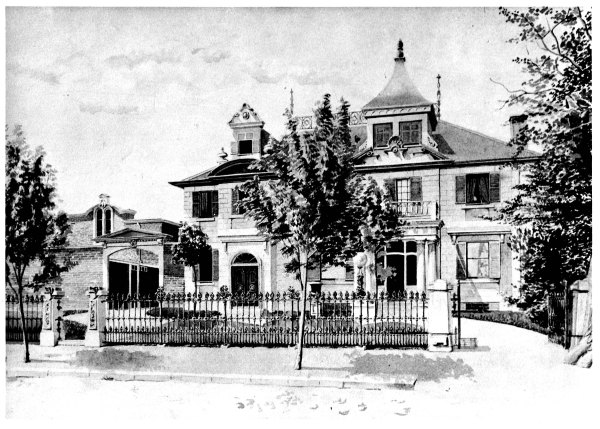
Stanley Bagg also purchased land near the corner of Sherbrooke Street and St. Urbain at a sheriff’s sale in 1837, and sold it to his son in 1844. Stanley Clark Bagg and his wife, Catharine Mitcheson Bagg (1822–1914), built a large house they called Fairmount Villa on that lot and raised their five children there. The house included a small chapel, while the irregularly shaped property, which extended to the boundary of the Durham House land, had a garden with lilac trees, statues and flower beds. The house was likely named after Fairmount Park in Philadelphia, where Catharine grew up.

Fairmount Villa. photograph, Bagg family collection.

Stanley Clark Bagg died in 1873, but Catharine remained at Fairmount Villa for the rest of her life. The house was sold in 1915, and it was demolished in 1949 when Saint-Urbain Street was widened.

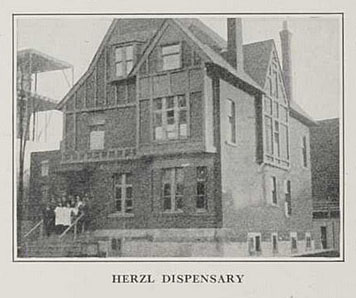
The Fairmount property (lot 100 of the cadastre of St. Lawrence Ward) was subdivided in 1872, then redivided in 1922. In 1884, Stanley Clark Bagg’s son, Robert Stanley Bagg (1848-1912), built a house on one of the subdivided lots, at 436 (later 3470) Saint-Urbain. He and his young family moved to a bigger house in a more exclusive neighbourhood on Sherbrooke Street West a few years later, and his sister Mary Heloise Lindsay and her family lived in the house on Saint-Urbain from 1890 until 1906. The house changed street numbers several times, then changed vocations: it became part of the Herzl Jewish Hospital, was subdivided into apartments, and was finally demolished in the early 1960s.
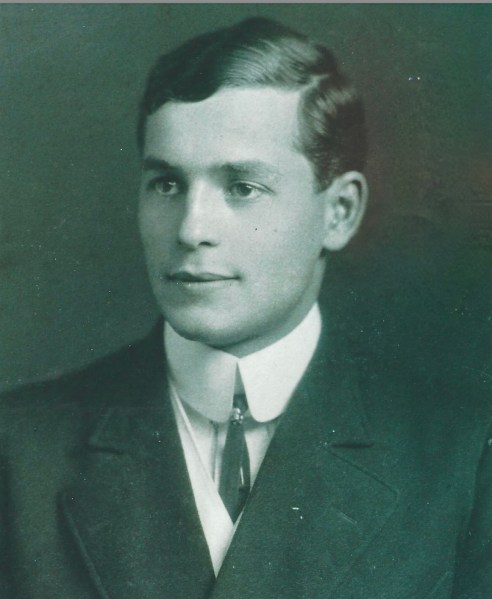
This house on St. Urbain Street was designed for Robert Stanley Bagg by architect William McLea Walbank. When this photo was taken the building was a medical clinic known as the Herzl Dispensary.

Today, two large buildings that once housed Montreal’s school of fine arts are located on the former Fairmount property. The smaller one, of yellow brick, at 3450 Saint-Urbain, was designed by celebrated architects Omer Marchand and Ernest Cormier in 1923 for the École des beaux arts de Montréal. It will soon be home to Montreal’s new Afro-Canadian Cultural Centre.

The larger building, at 125 Sherbrooke St. W., a heritage building constructed in 1905 as the Commercial and Technical High School, later became the Marie-Claire Daveluy building of the Bibliothèque nationale du Québec (1982–1997). It has housed l’Office québécoise de la langue française since 1999. 

Notes

Built by the Sulpician priests in 1717, Saint-Laurent Boulevard was initially known as a grand chemin du Roy – Great King’s Highway. Over the years it has been known by many names, both English and French, including Chemin Saint-Laurent, St. Lawrence Street and “the Main”. Since 1905, it has been designated Boulevard Saint-Laurent.

The name Côte à Baron, or Coteau Baron, cannot be found on today’s city maps, but in the late 19th century, this was the name of a sloping stretch of Saint-Laurent Boulevard just below Sherbrooke Street and extending a short distance north of there. Côte à Baron was described as a neighbourhood of rural villas. The first-ever Lovell’s city directory for Montreal, published in 1842, listed Stanley Bagg’s home at Côte à Barron.  (https://numerique.banq.qc.ca/patrimoine/details/52327/3652365). Another building with a Côte à Baron address, at the northwest corner of Sherbrooke Street and Saint-Laurent, was an extravagant mansion nicknamed Torrance’s Folly. It was built around 1815 by businessman Thomas Torrance and sold to John Molson in 1832. A gas station is now located at that corner.

An arpent is a French unit of measurement that can refer to either area or length. It is equivalent to an acre of land, or about 58 metres in length. It has been replaced by metric measures since 1970, but can still be found in old property records.

Source of the photo of the Herzl Dispensary: The Jew in Canada: a complete record of Canadian Jewry from the days of the French régime to the present time, ed. Arthur Daniel Hart, 1926 (on BAnQ numérique).

This article is also posted on my personal family history blog, Writing Up the Ancestors. It was updated on Sept. 16, 2025 to add the photo of the Herzl Dispensary.

See also:

Janice Hamilton, “The Mile End Tavern”, Writing Up the Ancestors, October 21, 2013   https://www.writinguptheancestors.ca/2013/10/the-mile-end-tavern.html

Janice Hamilton, “John Clark, 19th Century Real Estate Visionary”, Genealogy Ensemble, May 22, 2019, https://genealogyensemble.com/2019/05/22/john-clark-19th-century-real-estate-visionary/

Janice Hamilton, “The Life and Times of Stanley Bagg, 1788-1853”, Writing Up the Ancestors, October 5, 2016, https://www.writinguptheancestors.ca/2016/10/the-life-and-times-of-stanley-bagg-1788.html

Janice Hamilton, “A Home Well Lived In”, Writing Up the Ancestors, January 21, 2014, https://www.writinguptheancestors.ca/2014/01/a-home-well-lived-in.html

Janice Hamilton, “Fairmount Villa”, Writing Up the Ancestors, Dec. 18, 2019, https://www.writinguptheancestors.ca/2019/12/fairmount-villa.html

Janice Hamilton, “Bagg Family Dispute Part 2: Stanley Clark Bagg’s Estate”, Genealogy Ensemble, Feb. 14, 2024, https://genealogyensemble.com/2024/02/14/the-bagg-family-dispute-part-2/

Janice Hamilton, “History of a Downtown Montreal Property”, Writing Up the Ancestors, Dec. 31, 2022, https://www.writinguptheancestors.ca/2022/12/history-of-a-downtown-montreal-property.html

Justin Bur, “À la recherche du cheval perdu de Stanley Bagg, et des origines du Mile End.” A la recherche du savoir: nouveaux échanges sur les collections du Musée McCord; Collecting Knowledge: New Dialogues on McCord Museum Collections. Joanne Burgess, Cynthia Cooper, Celine Widmer, Natasha Zwarich. Montreal: Éditions MultiMondes, 2015.

Mile End Memories, http://memoire.mile-end.qc.ca/en/

sources:

1.  Justin Bur, Yves Desjardins, Jean-Claude Robert, Bernard Vallée, Joshua Wolfe, Dictionnaire historique du Plateau Mont-Royal (Montreal, Éditions Écosociété, 2017), p 256.

2.  J.A. Gray, n.p. no 2874, 1810-10-17

3.  Justin Bur, Yves Desjardins, Jean-Claude Robert, Bernard Vallée, Joshua Wolfe, Dictionnaire historique du Plateau Mont-Royal (Montreal, Éditions Écosociété, 2017), p 258.

4.  William de Montmollin Marler n.p. no 17571, 1891-11-20

5.  John Fair n.p. no 3434, 1892-05-18

6.      Henry Griffin, n.p. no 931, 1815-04-15

7.   Justin Bur, Yves Desjardins, Jean-Claude Robert, Bernard Vallée, Joshua Wolfe, Dictionnaire historique du Plateau Mont-Royal (Montreal, Éditions Écosociété, 2017), p 259.

Genealogy Rabbit Hole

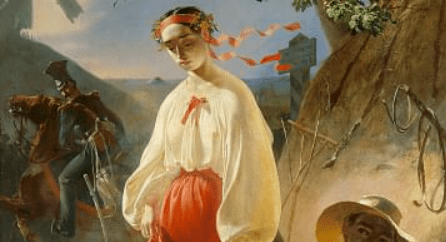
Kataryna, Serf. Taras Shevchenko. (Taras Shevchenko Museum) World History .ORG Creative Commons
Yes, the street in Lasalle is named after this celebrated Ukrainian painter/poet!

Exploring your genealogy is something of a luxury. You need the knowledge to do it, the time to do it, sometimes the money to do it. And you need the ancestors to do it, that is to say ancestors who came from relatively stable, peaceful places; countries where good records were kept.

People in North America and Western Europe sometimes have this luxury, the rest of the world, well, not so much.

My ‘official’ family tree is half French Canadian and half North of England, so easy to put together. My biological tree is half French Canadian and, let’s say, something not Western European, something very, very complicated and sometimes hopelessly obscure.

On Ancestry, the record makes clear that most of my mother’s people hail from the Lachenaie seigneury, north of Montreal. That’s a very small area. There are hundreds of cousin trees to prove this.

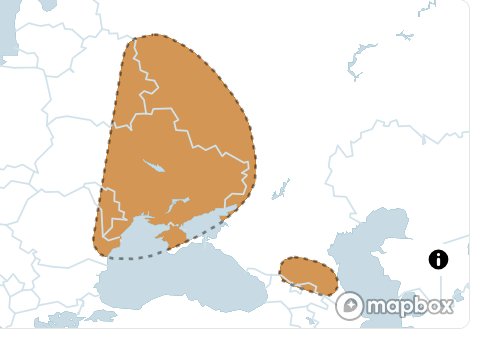
My unknown bio-father’s side is from all around the Black Sea and Eastern Mediterranean. That’s the crux of it, anyway.

My Ancestry Ancestral regions. Not an exact science by any stretch but getting better. The Green is “French”, my Mom. 46% She has a touch British and Norway. My bio-father, a colourful mix of Germanic Europe, Anatolia and the Caucasus and Southern Italy and Eastern Mediterranean, with touches of Balkan, Greece and Albania, Eastern Europe, Persia, Romani, Mongolia, China. Some Crimean Tatars online who have done their DNA have similar mixes without German.

We’re talking an enormous area that for centuries was home to myriad populations, myriad cultures that for economic and/or political reasons moved around a lot.

On Ancestry, my mother’s side has 28,000 matches, none of them that close, but that doesn’t matter because I know who my mother is.

My bio-father’s side has but 1,800 matches, only one match at 60 centimorgans, likely a third cousin, and the rest at 20 centimorgans and below. 1

Still, using Ancestry’s various tools to analyze my paternal side’s origins, my best guess is that my bio father was half Protestant Black Sea German (maternal side) and half Pontic Greek (paternal side.)2

YourDNAPortal’s 1000 year old ethnicity estimate is bang on for my French Canadian side and it gives me 11-20 percent Crimean Tatar from the bio-father’s side!

Incredibly, it has taken me a full seven years to figure this out. I must have the equivalent of a Master’s degree in Black Sea Studies. 🙂

I won’t make fun of you if you don’t know what a “Black Sea German” is, although some of the descendants of these people now live in the Dakotas in the United States and in Western Canada.3

They were people from Baden-Wurrtemburg and Alsace (many winemakers) who took their horse drawn wagon trains to Southern Russia (sometimes by way of Galicia, that is the Poland/Ukraine border or Swabia, the Hungary/Romania border) in the late 18th century at the invitation of Catherine the Great who offered them free land, no taxes, and no conscription in order to re-populate areas formerly held by Turks. Catherine didn’t want those nasty Turks coming back. Later, Alexander I opened up Bessarabia (today’s Moldova) to Germans, offering similar incentives.

It was a difficult life (if you survived the journey) but many of these disciplined, hard-working farmers prospered – until they didn’t. Many ‘extra’ sons or cast-outs were constantly on the move looking for a benevolent, fertile piece of land to call home. Young unmarried women sometimes moved away for work.

Some Black Sea Germans, Protestant and Catholic, moved on from Southern Russia/ Bessarabia to settle in the Crimea on land once held by Tatars.4 In later years, Bessarabian German settlers spread out southward to Dobrucha in today’s Romania at the invitation of the Turks who were still in charge there. Ironically, this is where the displaced Crimean Tatars were now living.

The North American descendants of these Black Sea Germans have done a remarkable job chronicling their ancestors’ migrations and daily lives on various websites and databases. This information includes village censuses.

The most intriguing documents, I think, are the anecdotal “village histories” written down by a leading citizen and/or self-styled local historian. Apparently, there was lots of praying as these people were pious; also lots of drunken brawling, as most every town had a tavern; and lots of hardship, too, death from disease and famine, earthquakes and plagues of all kinds. Meeting your end at the bottom of a well was quite common. Hmm.

Initially, there were a handful of ‘orderly’ villages, 25 to 100 and that number grew to around two to three thousand. Although overwhelmingly populated with Germans in extended family clusters, many Besserabian villages also harboured a few Turks, Bulgarians, Romanians and Jews.

Ancestry’s Beresen and Leibmental enclaves of Black Sea Germans, covering Ukraine mostly.(Some ventured to Caucasus because they felt Mount Ararat to be the site of the Second Coming of Christ.)

Black Sea German citizens were so mobile they often named the last village in which they lived as their ‘homeland.’

Since the borders in Austria-Hungary changed so often, even an officially listed nationality like Polish or Austrian means little.

Nationality back then was very fluid.

That’s why delving into the ‘Germanic’ side of my unknown bio-father’s genealogy, although illuminating in one sense, usually sends me down a dizzying rabbit hole.5

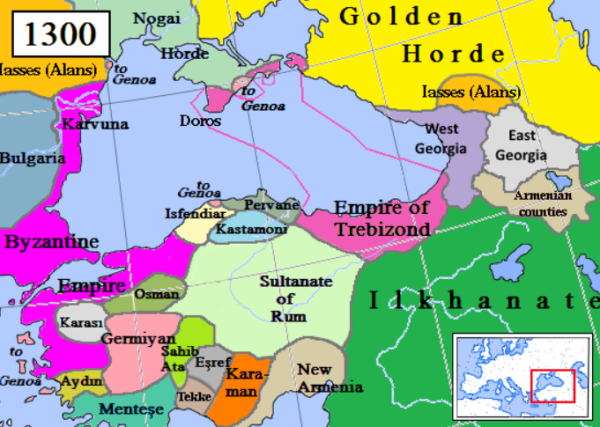
Empire of Trebizond, Wikipedia Creative Commons. “A remote and isolated splinter of the Byzantine Empire.”10
This map goes a long way towards explaining my wonky heritage.

The Pontic Greek side is even more obscure. Pontic Greeks are people who believe they are descendants of the original Greek settlers on the Black Sea in the Classical period. 6

They practised Eastern Orthodox Christianity brought in from Byzantium at a later date, lived in vibrant port cities like Samsun and Trabzon in North Eastern Anatolia, and spoke either a form of Greek or sometimes even Turkish. They mixed up their genes with Armenians. Some dressed like Tatars. Many converted to Islam.

Post WWI, these Christian Greeks were forced by the Turks to leave the Pontus, as it is called, in a series of expulsions and death marches, mostly pushed to the Anatolian interior or towards the Caucasus. (This coincided with the Armenian genocide.)

In 1923, Greeks in Turkiye (mostly Pontic) were exchanged for Muslims in Greece. These Greeks primarily went to Thessaloniki in Northern Greece.7

I know I am derived from Pontic Greeks because I have over fifty matches on Ancestry with that particular “journey.”8 Some of these matches live in Turkiye and have Turkish names and when I contact them they seem very upset to discover they are even a small part Greek. Others are merely perplexed.

Many of my Pontic cousin matches have the tell-tale suffix IDIS at the end of their surnames and identify as Greek. They live in the United States and their immediate ancestors hail from Thessaloniki or southern Russia. 6

A handful have Russian surnames.13

Southern Russia! I have a theory. My male Pontic Greek ancestor from Samsun in Northern Anatolia (where I almost certainly have antecedents) took a boat across roiling Black Sea waters to the Crimea, maybe by way of Sochi, where I have a tree match, and met up with my female Black Sea German ancestor. The mountains of southern Crimea had a climate good for growing grapes. I have many sure-fire ancestors in the village of Huffnungstal, near Odessa. Some of these Hoffs, Bollingers, Lutz’s, and Berreths went on to Crimea.

This is more than a stab in the dark. Call it an ‘educated guess.’

The essential point is this: Because of the complex history of Eastern Europe and the Black Sea area, my bio father back in 195412 Montreal may have identified as a Ukrainian (most likely) or a German or a Greek or maybe even a Turk or a Tatar. Or perhaps a Pole or a Hungarian, or even a Romanian Jew14. Or just a Canadian. His ancestors might have been Steppe nomads, serfs or slaves, farmers, vintners, blacksmiths, soldiers,sailors, shopkeepers, shipping magnates, Romani gypsies, noblemen – or all of the above.

Yes, researching genealogy is challenging for most people but next to impossible for people in my situation, with roots around the Black Sea, even if you know who your parents are.

In Soviet society, post WWII, elders kept family history and stories AWAY from their descendants rather than passing the stories on, according to an academic paper I read.9

This was for their protection.

“The less people knew about their family history the better.”

The Pontic Greek diaspora in Europe and North America now struggles to keep its cultural identity. Persons who went to Thessonaliki or other parts of Greece in the 1923 exchange were often slighted by natives and not considered ‘true’ Greeks, so they didn’t showcase their past.

The other surviving descendants of the citizens of the once dazzling Empire of Trebizond now live in Ukraine (Mariupol) and Kazakstan and Turkiye and many likely don’t know (or want to know) their ethnic heritage.

It’s no wonder I can’t figure out who my bio-father is – and probably never will. His relatives, if they exist at all, reside in places where they don’t do DNA – and sometimes for good reason. But, thanks to modern science and copious online sources, I do know an awful lot about his very mixed-up ethnic heritage.

THE END SON Кінець Das Ende Τέλος Koniec Sfârşit

Footnotes

1. I only get one or two new matches on that side a week, or maybe a month. Most are Americans or Brits with some Romani. (I’m 1 or 2 percent Romani) or distant descendants of Black Sea Germans (Eberhard from North Carolina!) and an occasional Pontic Greek.

2. I only know this because I have a twin who did his Y DNA and the one match had a Turkish name. J2A.. My 3rd cousin match, a Turkish woman, is a stand-alone match, with no mutual matches. Her ethnicity profile mirrors my bio-father’s, though, suggesting to me Crimean Tatar roots. See Note 4. Bob Dylan, apparently has a similar ancestry.

3. I am almost certainly related to the Hemmerlings of Gimli, Manitoba. Are you?

Most Black Sea Germans were repatriated to Germany or Poland during WWII. As the borders changed during the war some had to go back to Russia. A few of these Germans lobbying to return to Germany had ‘mixed marriages,’ according to records kept by the Germans. The mates were mostly Russian, but quite often Moldavian (sometimes referred to as Gagauz, a kind of Christian Turk native to Romania) and but rarely Hungarian, Polish, Bulgarian or Greek.

4. Ancestry doesn’t acknowledge Tatars or Crimean ‘journeys’ but on many other platforms the algorithms give me Crimean Mountain Tatar, at least way back. These people were a mix of Northern Italian (Genoa) Southern Italy and Greece, (Sicily), Allans (Persia) and Goths (Germany) with Nogai, as in Steppe Tatars who in turn have Central Asian and Mongolian. (I have all of these things 🙂 I have only one distant match with a tree totally from Crimea and, yes, the surnames are Tatar.

5. I have a cluster of family trees with people from a town called Hoffnungstal in Bessarabia (Odessa area). I also have a cluster in Galicia (Poland-Ukraine border)in a town called Bruckenthal. There was a trade route between these two areas and smack in the middle was a town called Botosani, Northern Romania, where I also have a tree match- a Jewish match with people who moved to Montreal. Yikes! (Any ideas? Contact me, please!)Added a week later: The immigration path of the Black Sea Germans in my trees seems to go from Baden area to Poland down to Galicia north of Lviv, around Moldova to that bit of Ukraine west of Odessa where Hoffnungstal and Kloestitz (my villages) are. The researcher says there were many long stops along the way. Works perfectly. Bruckenthal Rava Ruska is north of L’viv.

6. The Euripides play Iphigenia in Taurus speaks to this. Iphigenia, daughter of Agamemnon, is saved from death by the goddess Artemis and hidden in the land of the Taurians (Crimea). The Greeks have a long history in Russia. Rich shipping families from the Aegean ran the grain trade there in the 1800s. Many of these rich Greeks assimilated into Russian society. At the founding of Odessa, that became a bustling multicultural economic center, there were already many Greek families, who often were the wealthiest citizens there. At one point the Mayor of Odessa was a Greek.(Odessa Recollected; The Port and the People. Patricia Herlihy. 2018 Boston)

7. According to one online source, the Asia Minor and Pontus Hellenic Research Centre at Chicago, Illinois: In the city of Samsun, where I very likely have some ancestors, 72 Greek community leaders were arrested and sentenced to death in 1921. Other Greek men were killed, imprisoned or conscripted into the army and the women and children sent into exile or deeper into Turkiye where they were forced to change their Greek surnames to Turkish ones.

8. Ancestry gives me no journey on the paternal side, but there is a function that allows me to see the journeys of my paternal matches. These include: all parts of Germany; Black Sea Germans/ Leibenthal Beresen Enclaves; Pontic Greek; Eastern European Roma; North Eastern Hungary/Slovak Border. (That’s on edge of Ukraine near L’viv.) I appear to be connected to Szekelers, a sect of Hungarians who moved to Northern Romania, Bukovina.

9. A. Pahl and Thompson. 1994. Family history was dangerous even for families who left for North America.

10. https://www.grhs.org/pages/Villages A concise list of Black Sea German villages. Many descendants of Black Sea Germans and of French Canadians mixed it up in the Dakotas or Western Canada later on, so I have hundreds of distant ‘unassigned’ matches with both these heritages.

11.https://providencemag.com/2017/09/forgotten-christian-history-turkey-review-byzantiums-empire-trebizond-book-review/

12. In 1954 Crimea was returned by the Russian Soviet Socialistic Republic to the Ukraine SSR. The Russians felt that the Crimea fit more naturally with them.

13. In Family Tree’s public Pontian Greek Y database, the vast majority of subscriber surnames are Russian. This appears to show the extent these people were absorbed into Russian society.

14. MDLP algorithm, that is supposed to be best for people of my bio-father’s ancestry, is unequivocal. I am Romanian. And sometimes a Romanian Jew or Gagauz (that’s the Turkish bit). Lots of Romanian Jews immigrated to Montreal. That would mean perhaps that my closest community is not Black Sea German but Danube Swabian, Wurrtemburg Germans who lived for generations in Romania, Serbia, until expelled after WWII.

This video says genetic studies prove Pontic Greeks are descendants of Ancient Greeks. Indeed, their mountain monasteries preserved elements of Ancient Greek culture long after Byzantium died out. Also, family history information was ‘encoded’ in their dress, the fabrics and patterns of their clothings, every day and ceremonial. Now, that ‘s interesting. Because of their cohesive social system and the make up of their terrain, Pontic Greeks in North Central and Northeast Anatolia largely resisted Turkish invasions.
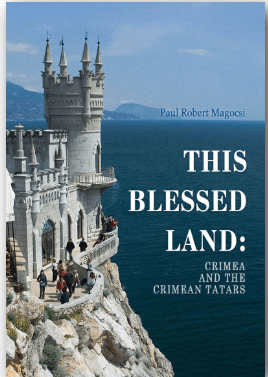
This book, from the University of Toronto Press, 2014 by Paul Robert Magocsi, is available on Archive.org. It contains pics of a Taurian Burial Ground 300 BC; Greek Amphitheatre; a cave village/Jewish Karaite; early 4th Century Christian Basilica; 14th Century Armenian Church; a Genoese Castle, and many mosques, attesting to the rich, complex history of the Crimea, a place still very much in the news for the usual reasons. This was the home of the sedentary TAT Tatars (as opposed to Steppe Tatars) as well as the Northern Pontic Greeks – as distinguished from the Pontic Greeks on the southern coast of the Black Sea in Northern Anatolia.

Mom’s Recipe Book

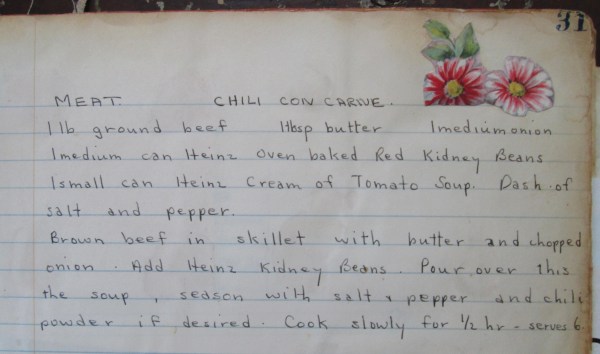
One of my favourite recipes in Mom’s recipe book is for chilli con carne. It has only a few ingredients: hamburger, kidney beans, onions, Heinz tomato soup, salt, pepper and chilli powder but only if desired. With fresh rolls and tomato slices, it was a meal we often had at the cottage, without the chilli powder. I was surprised to see that there was no Campbell’s tomato soup in the recipe.

Mom’s famous Chilli Con Carne!

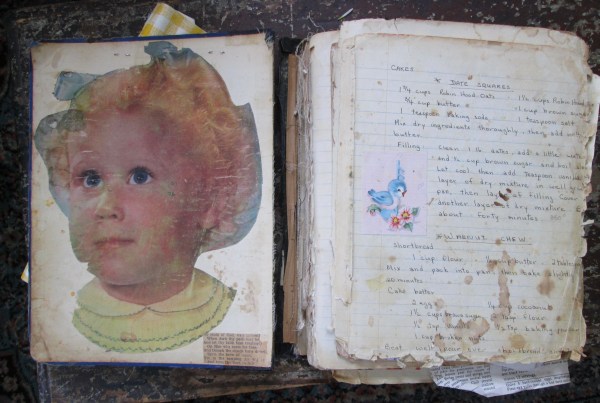
Mom started this book when she got married in 1948. It contains recipes cut out of magazines and newspapers, her handwritten recipes and ones collected from friends and family. In her later years, she mostly cooked from memory but sometimes would open the book just to check.

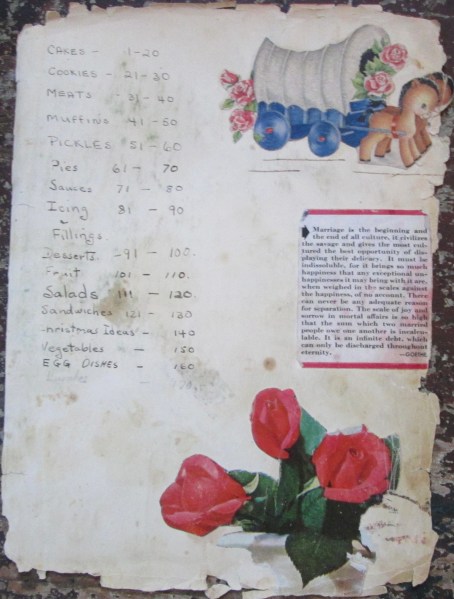
The indes page

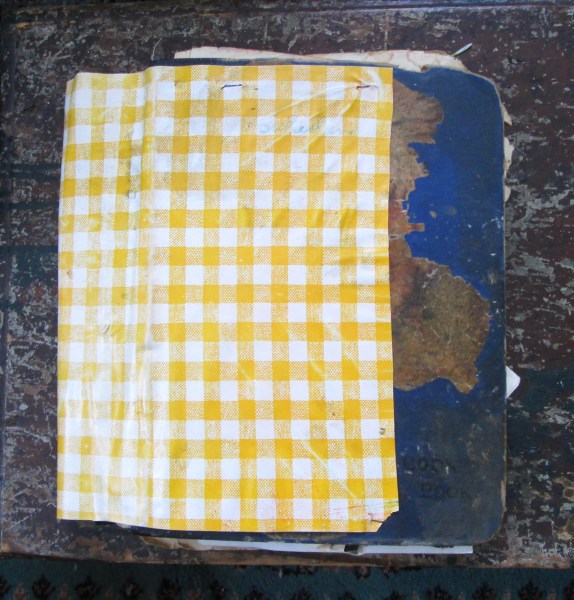
The book is now falling apart. It has been taped and covered with mactac but those adhesives don’t hold forever. The favourite recipes are worn, smudged with sticky fingerprints and ingredients. The newspaper clippings are starting to disintegrate.

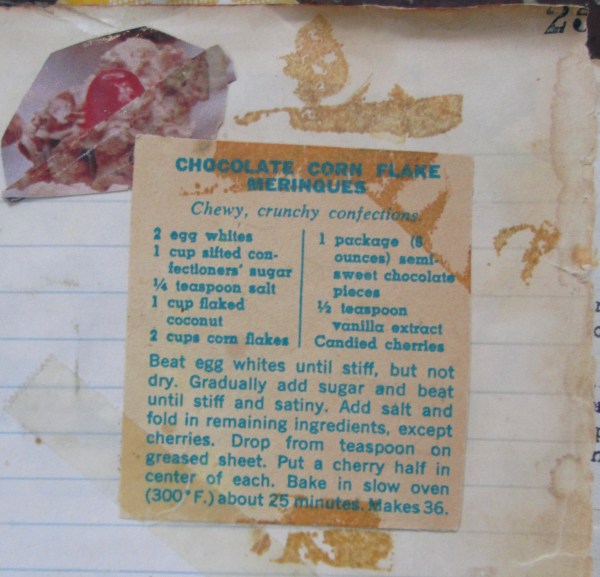
A favourite Christmas treat

My mother’s recipe book used to travel back and forth from Montreal to our cottage in the Laurentians. When Mom moved into a senior residence, it remained in Dunany. I then took charge of it, not wanting to leave it to the mice over the winter.

I thought I would make a book or calendar of some of the recipes as they all have stories to tell. Funny how most of them are for sweets. Main dishes at home were mostly roasted meat and boiled potatoes, which didn’t require recipes.

As kids, we would ask Mom what was for supper but all we really wanted to know was what was for dessert. Would it be a cake, a pie, a pudding, a cobbler, squares, cookies and ice cream or my least favourite, canned fruit? We had to eat our dinner before we got dessert but we always had dessert.

Inside front cover and sweets

Mom’s planned menus were similar each week. She would make a list and only buy what was on the list. On Sundays, we had a roast at noon with potatoes, vegetables, gravy and then omelet, pancakes or bread broiled with cheese and bacon for supper. Monday was usually chicken, with one cut up for six people. Tuesdays meant leftover roast and on Wednesdays the menu varied with veal patties, liver, sausages or pork chops. We ate leftover roast again on Thursdays, sometimes being shepherd’s pie. On Fridays, we always ate fish even though we were not Catholic. This was our least favourite meal as it mostly consisted of frozen white fish, sometimes with a soup sauce. On Saturdays, we had hamburgers, usually without buns.

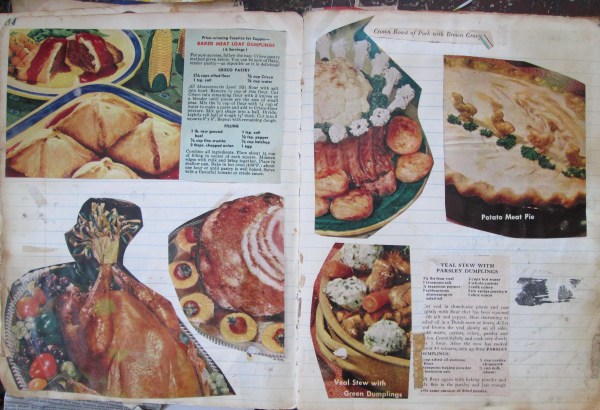
Our meals didn’t look like these pictures

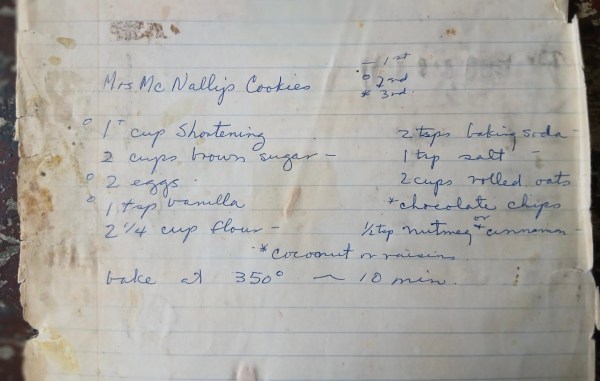
Mrs McNally’s cookie recipe came from the mother of a university friend of mine. Eileen’s mother used to send cookies back with her daughter, much to the enjoyment of her roommates. It is a basic oatmeal cookie with raisins, nuts, chocolate chips, cinnamon and nutmeg. It became my mother’s go-to recipe and she added whatever was in her pantry. The cookies were often stored in a ceramic cookie jar in the kitchen. Dexterity was needed to quietly raise the top and sneak a cookie.

Mrs McNally’s Cookies

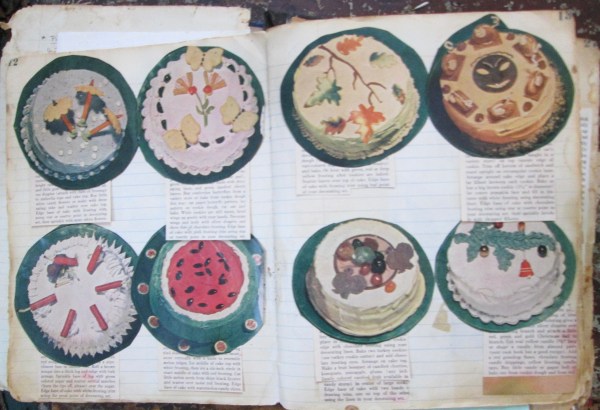
There are many pictures of decorated cakes. Mom took a class but only made a few very fancy cakes. Most were just plain iced layer cakes. She made some doll cakes with a Tammy or Debbie doll (we never had a Barbie doll) in the center of an angel food cake with fancy icing for her skirt. She also put money between the layers of cake, wrapped in wax paper. Pennies, nickels and dimes with one quarter. She would mark on the cake plate where to find the quarter and show the Birthday person.

Very fancy decorated cakes

Rhubarb upside-down cake replaced pineapple upside-down cake when my mother got the recipe from her sister. We always had this dessert in the spring and summer with rhubarb from the garden. Rhubarb and chives were the only edible things my mother grew.

Mom was an excellent pie maker. Her book does contain a booklet on how to make pie crust. She mastered this skill in no time. She would make all her fruit pies without looking at a recipe. I preferred blueberry and raspberry pies made from berries she picked around our cottage. Apple was my father’s favourite. One day, she anxiously watched as he cut into a pie and asked if it was ok. “When is your pie not alright? ” answered my father.

There would often be a little sugar pie made with the leftover pie crust sprinkled with sugar, cinnamon and little pats of butter. Pieces were eaten right out of the oven if you were lucky enough to be around.

There were definitely things we didn’t like, such as porridge every morning before school but we were well fed!

Women Heroines at La Poudrière during WWI

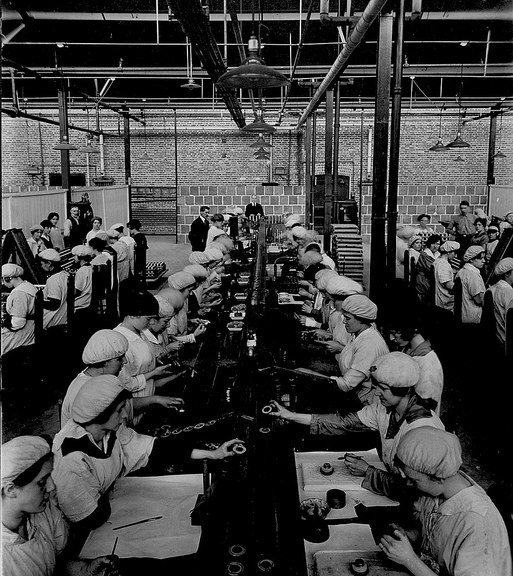
During World War I, 4,000 people, many of them women,  assembled eight million fuses in a building locally known as “La Poudrière.” Given that the job required mounting a detonator cap over a gunpowder relay charge and attaching a safety pin (read more about WWI fuses here), the job was risky and monotonous at the same time.

Who were these people? How can we honour their work?

Recently, while looking through the records of World War I soldiers, I realized that their records may offer us ways to discover our homefront heroines.  Several women moved to Verdun and lived within walking distance of the armament plant while their husbands or brothers served overseas.

Patrick Murray

When Ethel Henrietta Murray’s husband Patrick volunteered for the Canadian Over-Seas Expeditionary Force on Wednesday, April 12, 1916, the couple lived at 80 Anderson Street, in downtown Montreal.[1]

According to his military records, he died on October 29, 1917, driving with the 4th Brigade of the Canadian Field Artillery. She went by the first name Henrietta. Initially, she had moved to 1251 Wellington Street. Later, she lived at 956 Ethel Street.[2]

None of her addresses exist anymore, nor have I yet found any evidence explaining why she moved to Verdun. Based on her address and circumstances, however, I suspect that she—and three other women who lived nearby—worked at “la poudrière.”

La Poudrière

Locals call a building that currently houses 64 units for senior citizens “La Poudrière,” which means powder keg. The Canadien Slavowic Association (l’Association canadienne slave de Montréal) operates the space.

I haven’t yet looked into the records of the company to find out if there is a list of employees so that I can see if Ethel or Henrietta Murray appears on their rolls.

Other women I’d like to verify include Marjorie Victoria Stroude Luker, Ellen or Helen Elizabeth Winsper, and Mrs. John Sullivan. These three women also lived within walking distance of la poudrière between 1916 and 1919.

Military records include the addresses of these women because all of them received telegrams about loved ones being wounded or killed overseas.

Arthur Stroude

Marjorie’s husband Arthur was wounded in Italy on August 20, 1917, and then died of the flu in Belgium on December 2018. Although the couple lived in Point St. Charles when he signed up, her benefits were sent to her at 714 Ethel Street by the time he died.[3]

George Winsper

Ellen or Helen Elizabeth Winsper, the wife of George Winsper who died on November 7, 1917, had moved from Rosemont to 196 St. Charles Street in Pointe St. Charles by the time he died.[4]

William Wright

Two records mention the grief of Mrs. John Sullivan when Private William Wright, a steamfitter from Scotland, died in action at St. Julien on April 24, 1915. Neither have her first name. One document describes William, who was 21 when he died as the adopted child of Mr. and Mrs. John Sullivan. The one I think is correct mentions that she is his sister. Her address at the beginning of the war was 9 Farm Street, Point St. Charles, the same as his when he enlisted. His medals were sent to her at 431A Wellington St., Point St. Charles.[5]

If these women worked together, as is possible, they too risked their lives.

Employees with the British Munition Supply Company–which was created by The British Government under the auspices of The Imperial Munitions Board–faced the possibility of accidental explosions. Britain paid $175,000 in 1916 to construct a building that could contain shockwaves. It also included a saw-tooth roof to prevent sunlight from entering.[6]

British Munitions Limited

One description of their work comes from the biography of Sir Charles Gordon, who led the team that arranged for building construction.

The IMB had inherited from Sir Samuel Hughes’s Shell Committee orders for artillery shells worth more than $282 million, contracts with over 400 different factories, and supervision of the manufacture of tens of millions of shells and ancillary parts. Its most serious problem was acquiring time and graze, or percussion, fuses for the shells produced by its factories. There was no capacity to create and assemble these precision parts in Canada, and contracts with American companies had proved dismal failures.

The problem was given to Gordon to solve. He recommended that fuse manufacturing be done in Canada. The IMB set up its own factory in Verdun (Montreal) to make the delicate time fuses. Skilled workmen and supervisors were quickly brought over from Britain to train Canadian workers. British Munitions Limited, the IMB’s first “national factory,” was open for business by the spring of 1916. The last order from Britain, for 3,000,000 fuses, came in 1917 and the last fuses were shipped in May 1918. British Munitions was then converted by the IMB into a shell-manufacturing facility.[7]

Another source I read said that Dominion Textile Company purchased the site for its textile operations when the war ended in 1919. Two decades later, Defence Industries Limited revived the site for a shell factory during World War II, between 1940 and 1945. David Fennario’s book “Motherhouse” offers a good look at the women’s lives during this second wartime era.

[1] Attestation Paper, Library and Archives Canada, RG 150, #347740, Patrick Murray, a derivative copy of the original signed by Patrick.

[2] Address card, ibid.

[3] Attestation Paper and address card, Library and Archives Canada, RG 150, #1054006, Arthur Luker.

[4] Attestation Paper and address card, Library and Archives Canada, RG 150, #920146, George Winsper.

[5] Library and Archives Canada, RG 150, #26024, William Wright.

[6] “Usine à munitions pour retraités slaves” by Raphaël Dallaire Ferland,  ttps://www.ledevoir.com/societe/354100/usine-a-munitions-pour-retraites-slaves, accessed September 22, 2018.

[7] Biography – GORDON, SIR CHARLES BLAIR – Volume XVI (1931-1940) – Dictionary of Canadian Biography, http://www.biographi.ca/en/bio/gordon_charles_blair_16F.html, accessed September 22, 2018.

Is There a Doctor in the House?

Ismael Edgard Bruneau

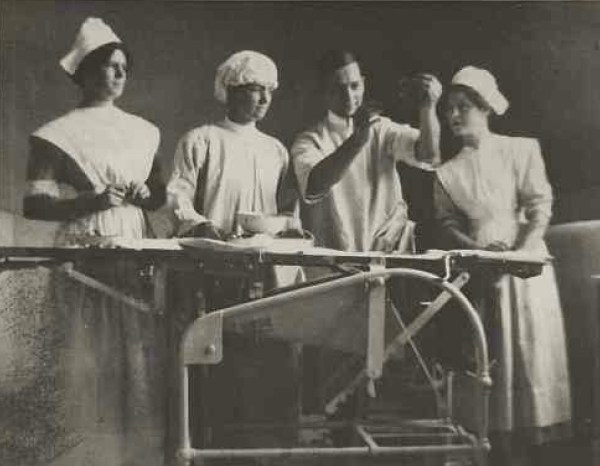
As far as I can tell, Ismael Edgard Bruneau (1887 – 1967), my great uncle, was the first doctor in our family and maybe still the only doctor. His father wanted him to follow in his footsteps and become a minister, so when Edgar entered McGill in 1907, he registered for an Arts degree. During his university years, he decided he would rather be a doctor. He finished his Arts degree in 1910 while concurrently studying medicine and received that degree in 1912.

Edgar, as he became known, was the first of ten children of Ismael Bruneau and Ida Girod, my great-grandparents. He was born in Green Bay, Wisconsin, where his father served as a French Presbyterian minister. The family moved to Holyoke, Massachusetts, Quebec City and Montreal, where he did most of his schooling.

Ismael & Ida Bruneau with children Edgar top left, Hermonie, Helevetia, Sydney and Beatrice

He interned in Montreal and Ottawa and then practiced for a short time in Swift Current, Saskatchewan.

Dr Edgar Bruneau demonstrating techniques

When WWI began, he joined up with friends from McGill in the McGill Machine Gunners unit and was sent overseas in 1915. His father was unhappy with his decision to be a regular soldier and thought he should at least use his medical degree. Soon after arriving in England, he transferred to the Royal Army Medical Corp as a first lieutenant. This certainly didn’t keep him safe, as he served in France and Italy, being wounded twice and also severely gassed. Captain Bruneau was sent home to Canada in mid-1918. While in England, he visited with his Uncle Ernest Girod and became engaged to his cousin Marie but that relationship was over before he sailed home.

Edgar opened an office in Montreal as a general practitioner where he stayed his whole career. He lived on Park Avenue and had an office in his house with reception rooms on the ground floor and living space on the upper floor.

He also volunteered at the Montreal Dispensary through the 1920s. This clinic, established in 1850, gave health care to the poor. It was in downtown Montreal on St. Antoine Street, run by volunteer doctors and supported solely by donations. In the late 1920s, the Dispensary had financial difficulties and nearly closed but survived when it received a bequest of $10,000.

In the late thirties, Edgar suffered from a tubular disease in which the kidneys were damaged by lack of oxygen and blood flow, and so, for three years, he had to give up his practice. He was a much-loved doctor, as his patients visited him whether or not they needed care.

Edgar married Marie Eveline Lemoine in 1923. Before their marriage, they were in a car accident. He was driving on a street with streetcars when the traffic policeman gave him the signal to proceed. Unfortunately, the way was not clear and the car was hit by a streetcar. Eveline was thrown against the windshield, badly cut and she lost vision in one eye. Edgar felt responsible for her, so they married. Still, the marriage lasted 31 years until her death in 1954. Edgar was very social and attended all family gatherings but Eveline never did..

Six of the Bruneau children; Back row, Herbert & Gerald. Front row, Sydney, Edmee, Helvetia & Edgar ~1960.

One night, in the late 1950s, Edgar fell, going downstairs to his basement to fix the furnace. He broke his leg and wasn’t discovered until his housekeeper arrived in the morning. His brother Herbert wrote that when he was found, his leg was black and although the doctors saved it at that time, it resulted in gangrene. Edgar, like most of his siblings, had developed type II diabetes, which resulted in poor circulation in his legs. He first had his toes removed, then later, after many operations, most of his leg was amputated.

Edgar spent his final years at the St Anne’s Veteran’s Hospital in St Anne de Bellevue, Quebec. My sister said she never wanted to visit him as one of us told her he hung his leg in a stocking on his door at Christmas. Edgar is buried in Montreal’s Mount Royal Cemetery alongside his wife

Notes:

Recollections by Victor Herbert Bruneau , May 19, 1976.

Edgar was a keen fisherman.

He joined the Masonic Order and became a Shriner.

He was very musical; played the organ for his father’s services from the age of ten and he could play any tune he heard on the piano. He was popular with his comrades during the war and a good host afterwards.

I have no pictures of Evelyn. Edgar went to all the family functions and was very social but never Evelyn. She did play bridge and was mentioned in the newspaper as an attende at Karnac bridges put on by the Shriners.

All in the Family: The Butchers of Montreal

Marche St Laurent. Flicker Public domain

Every country has a foundation myth and so, too, have some families.

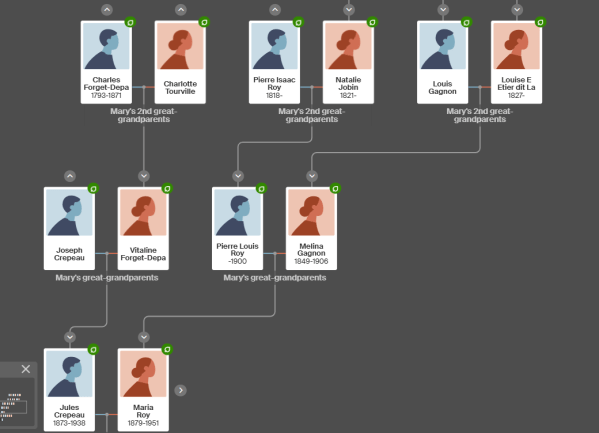
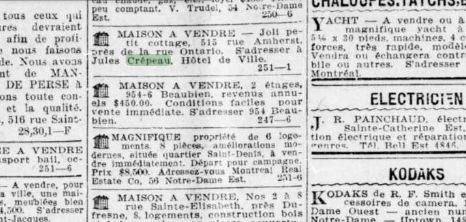
My mother’s family foundation myth was that her mother, Maria Gagnon Roy, was the daughter of a ‘master butcher’ and that she brought an enormous dowry of 40,000 dollars to her 1901 marriage to Jules Crepeau, a hardworking and ambitious 27 year old clerk at Montreal City Hall.

“Jules started out sweeping the floors at City Hall at eight years old,” my mom often said with a tear in her eye but according to his file there his first official post was in 1888 at 15 years old as messenger boy in the Health Department.*

My mother put so much store in this family myth that she even attributed her 5 foot 8 and a half inch height (tall for a French Canadian) to the fact she came from butchers. All that good steak they ate!

Left to right, Aunt Flo, my mom Marthe, Maria and Jules 1927ish.


The Father-in-Law: Maria’s Dad

My great-grandfather, Louis Roy, (circa 1843 to 1900) was the son of Pierre Isaac Roy and Natalie Jobin of Montreal and he worked as a butcher from 1860 to 1900. He came from a long line of butchers. In 1865 Louis Roy married Melina Gagnon, whose mother, Eleanore Ethier dit Lamalice,1 came from butchers as well.

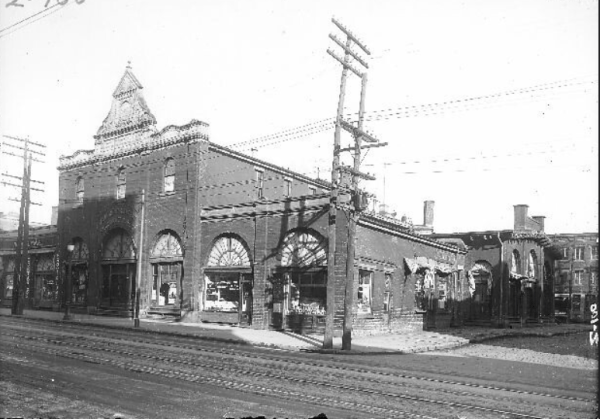
At first Louis worked alone at St. Laurent Market and then from 1881 to 1896 he partnered with a J. Lamalice, likely his cousin. Roy et Lamalice had two stalls, 16 and 17, at that market in the south central part of the city near what is now Chinatown. Their partnership was dissolved in 1896 when Louis’s son, also Louis, entered the profession.

Louis Gagnon was a mason, all other men on Maria’s side were butchers.

L. Roy and J. Lamalice paid a good sum of money, perhaps 200 dollars a year a piece,2 to have these two stalls at St. Laurent Market.

According to a University of Laval thesis,4 butchers in Montreal were politically influential. Public markets were designed around their needs, in large part because of the slew of health regulations around the slaughter and sale of meat. Retail butchers also profited greatly at these public markets, more so than their private counterparts, sometimes only having to work 2 or 3 days a week to pay the bills.

Louis Roy and his ‘small’ French Canadian family, wife Melina, son Louis and daughters Eugenie and Maria, lived at various addresses early on, then moved to 357 Amherst around 1880 and then in 1890 to 515 Amherst, a brand new ‘small cottage.’

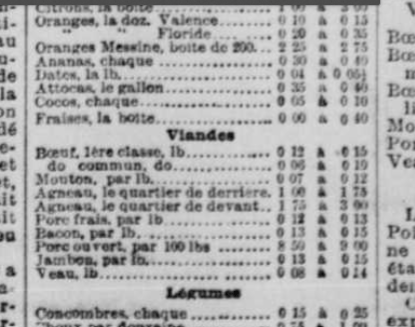
Price of meat Bonsecours Market, 1893


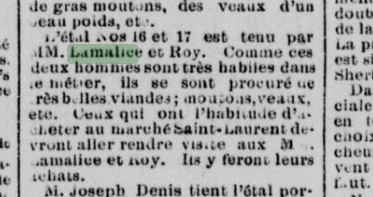
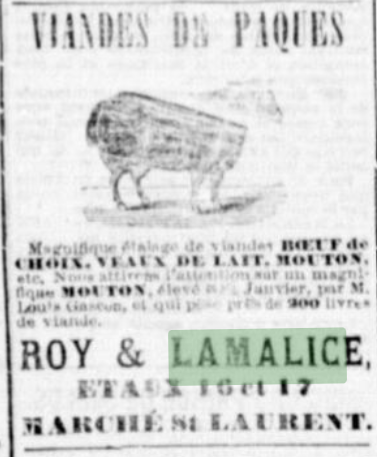
L. Roy et J Lamalice advertised regularly in all the Montreal papers, usually a little blurb like this.

Roy and Lamalice are very capable with very nice mutton, veal etc. Other ads focused on how beautifully the stall was decorated. (Clearly ladies did the shopping.)


They sometimes put in bigger ads

Choice beef, milk fed veal and mutton for Easter.


And they gave to charity, as well, Notre Dame Hospital and the Public Welfare are two examples I discovered.

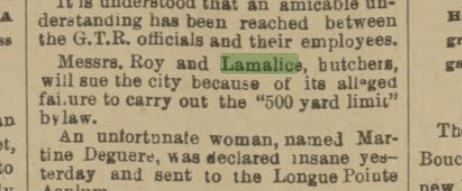
It may be significant that in 1891 Roy et Lamalice brought the City of Montreal to court. They complained that the City wasn’t doing enough to keep private butchers the mandated 500 yards away from the public markets.

They pay a license fee for a stall of 200 dollars, say Roy and Lamalice, as reported in Le Minerve.

I have to wonder if this is where Louis Roy, master butcher, first met – or maybe locked horns with – the City Hall up-and-comer Jules Crepeau, messenger boy in the Health Department – but a boy gifted with a superb memory for regulations and by-laws.3


In 1896, Jules Crepeau, Second Assistant City Clerk, was assigned the post of Secretary of Public Markets, a suitable promotion considering his Health Department roots.

In 1900, a year before his marriage to Maria Roy, he would be involved in his first scandal at City Hall, one that involved butchers. Men in that trade claimed that aldermen were illegally charging them 50 dollars to have their stalls moved at the prestigious Bonsecours Market. Jules testified in Court and denied knowing anything about it.


In 1900/1901, the newly widowed Melina Roy rented out her Amherst house (yes, to a butcher) and moved to Notre Dame street to live with her married daughter, Eugenie, her husband Jacques (James) Deslauriers (son of a butcher who was deceased). She brought her young adult children Maria and Louis along. The Census man came around while she was there.

The 1901 census has my grandmother Maria and her brother Louis erroneously listed under Deslauriers. Laura Lacombe is an orphaned cousin. She would live with Maria and Jules until her death in 1921, just a few months before my Mom’s birth.


The Marriage of Jules and Maria

After my grandparents Maria and Jules got married on July 1, 1901, widow Melina and her grown up son Louis moved back into 515 Amherst with the newlyweds.

In late 1901, Jules applied for a permit to build a three story brick building worth 3,000 dollars at 513 Amherst next door and the next year he would rent it out to three different families.

Maria would very soon give birth to my Uncle Louis. (Louis was baptized exactly nine months after the wedding.) My Aunt Alice would arrive a year after that and in 1905 the Crepeau family would move to St. Hubert Street near Marie-Anne.

Melina Roy and her son Louis, Melina’s orphaned niece Laura, and possibly the Deslauriers would stay at 515 Amherst for a year until Melina’s death in 1906 upon which time Jules would sell the ‘small cottage.’


The Dowry

A notarial record reveal there was, indeed, a 1901 marriage contract for Jules and Maria from June 27, a few days before the marriage, but of course there are no details so no proof of a 40,000 dollar dowry.

It does look like Jules came into some money early in his marriage. He builds that brick triplex and then moves in 1905 to what is still a very tony area with tall elegant stone townhouses.

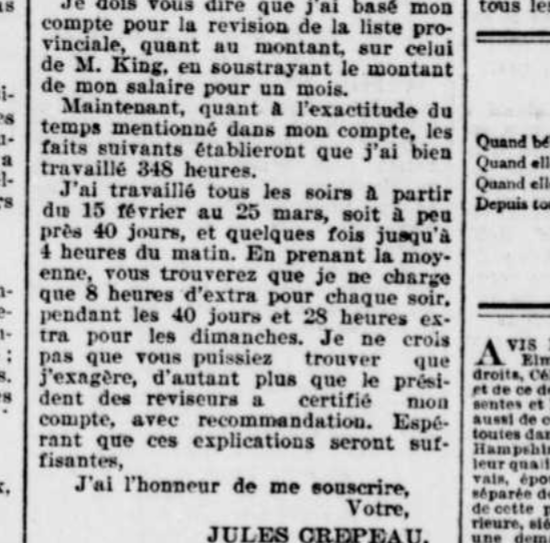
Before his marriage, Jules was making around 700 dollars a year at City Hall, a middling/good salary for a family man although at one point he asked for 248 dollars in overtime because “over a forty day period I worked 348 hours until four in the morning and on Sundays.”*

Still, a 40,000 dollar diary for Maria’s marriage seems highly unlikely. (That’s 1,500,000 in today’s money.)

I am doubly skeptical about the big dowry because I did not find any contract listing for the 1897 marriage of Maria’s older sister, Eugenie, to Jacques (James) Deslauriers, merchant. This suggests Eugenie received no formal dowry.

Why the second daughter and not the first?

Also, If Louis Roy, successful master butcher, left behind a large estate why did Melina Roy rent out her modest Amherst home after he died and move in with her daughter Eugenie and the husband. To help with the grandchildren?

A modest street in 1900, Amherst today is called Attikan. The only remnant of an early era is this little ‘French Canadian” cottage on the corner where everyone lived in 1901.


Lovell’s Directory to the Rescue.

When I first looked for Jules and Maria on the 1901 automated census I found neither one. Maria was erroneously listed under Deslauriers and Jules wasn’t there.

So, it took me years, but eventually I consulted Lovell’s to discover that prior to his marriage Jules was living on Mentana Street in the Le Plateau Mont Royale with his widowed mother, Vitaline Forget Despaties Crepeau, and his three brothers, the older Isadore and the younger Roderick and Paul.

Isadore in that era is already working in insurance – as he would for the rest of his life. In 1898 Roderick is listed as a plumber, then a year later as a butcher. His brother Paul makes the Lovell’s listing in 1899 and is listed as a butcher working at “R. Crepeau and Freres.”

It’s all very suspicious because the highly regulated butcher trade wasn’t something you could jump in and out of. I suspect older brother Jules, son of a mere house painter, pulled some strings to get his younger brothers a short cut into that lucrative trade. (Neither man would remain a butcher for long.) If my grandmother’s family tree proves anything, it’s that the butchers of Montreal liked to keep it in the family!

So, I still have no concrete proof but it would not surprise me if my grandmother Maria’s dowry, whatever the true amount, was provided by a group of butchers (perhaps all members of her extended family) in return for Jules’ support at Montreal City Hall.

Prior to his marriage to my grandmother, Maria Roy, as I said, Jules had had plenty of chance to interact with these ‘politically influential’ tradesmen.

Anyway, that was simply business as usual in those days.

  1. Eleanore Ethier dit Lamalice was also a distant relation of Jules Crepeau through the Ethier line of Lachenai Seigneury. See my Why My Grandfather had a lot of Gaul on this site.
  2. This is the sum that Louis Roy cites in his 1896 complaint as reported in the French papers. It’s called a license of 200 dollars to have a stall at St Laurent Market. In the 1920’s the sum is just 50 dollars a stall, I discovered in another online item but by then the butchers are paying hefty income taxes, so they mention how high this income tax is in their complaints.
  3. Le Devoir says Jules’ mind was like a bank vault holding within all the city by-laws. This was in his 1938 obituary.
  4. YVES BERGERON:LES ANCIENNES HALLES ET PLACES DE MARCHÉ AU QUÉBEC :ÉTUDE D’ETHNOLOGIE APPLIQUÉE. University of Laval Thesis Canadian Thesis portal

5. Newsy items courtesy of BANQ newspaper archive.

Mulholland Bros. Hardware Merchants

In 1878, two brothers from Montreal opened a hardware store in Winnipeg, Manitoba. The Prairie city, known as the “gateway to the west,” was growing rapidly, and for several years the store appears to have been profitable, however, it went bankrupt in 1889. After that, the brothers’ lives took very different paths.

Mulholland Bros. Hardware Merchants was owned by Joseph Mulholland (1840-1897) and his younger brother Henry (1850-1934). Hardware must have been an easy choice for them since their father and several of their uncles had been very successful in the hardware business.  

Their father, Henry Mulholland (1809-1887), was born in Lisburn,1 near Belfast in the north of Ireland, and immigrated to Montreal as a young man. He soon found employment with a wholesale and retail hardware firm owned by Benjamin Brewster. By 1851 he was a partner in the Brewster and Mulholland hardware company. He later went into partnership with a member of the extended Workman family, Joel C. Baker. The hardware firm of Mulholland and Baker was in business from 1859 to 1879.

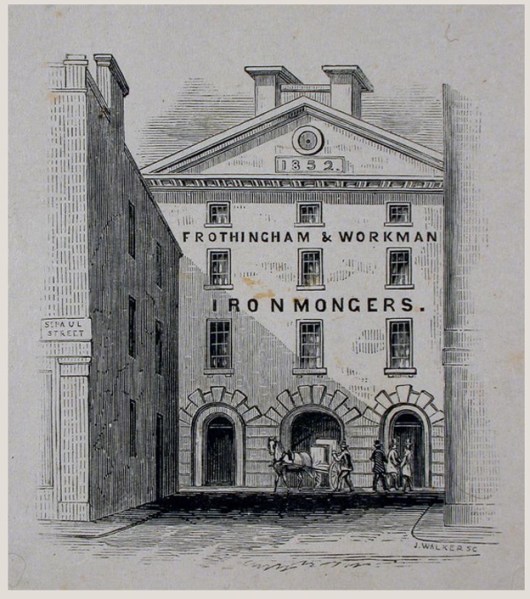
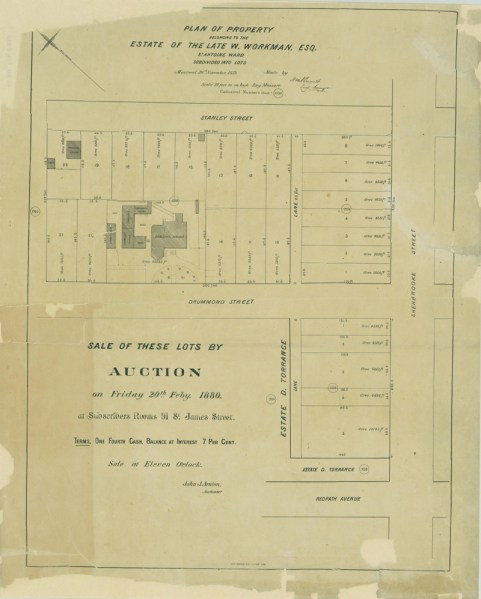
Henry Mulholland senior married Ann Workman (1809-1882) in Montreal in 1834. The Workman family had also come from the Lisburn area. Four of Ann’s brothers were in the hardware business, including William Workman (1807-1878) and Thomas Workman (1813-1889),who were partners in the firm of Frothingham and Workman, reputed to be the largest wholesale hardware company in Canada. The country’s population was growing, and hardware and building materials were in great demand.  

Henry and Ann Mulholland had several children who died very young, but two daughters (Ann and Jane) and three sons (Joseph, Henry and Benjamin) lived to adulthood. Both daughters remained in Montreal. Ann married Dr. George Henry Wilkins, while Jane and her husband, banker John Murray Smith, were my great-grandparents. Son Benjamin died of tuberculosis in Toronto in 1882.

The 1870 Canadian census found Joseph, 29, and Henry, 19, living in Montreal with their parents. Joseph was identified as a merchant, probably employed by his father’s firm. According to one newspaper account, he lived in Guelph, Ontario for a time prior to going to Winnipeg.2 Henry also worked for the family-owned hardware companies at the beginning of his career. Then, in 1878, Joseph and Henry headed to Manitoba. Many families were doing the same thing, attracted by the vast expanses of prairie farmland

The city of Winnipeg, incorporated in 1873, was a service center for the surrounding grain farms and, about a decade later, it became an important stop on the newly built Canadian Pacific Railway. The first CPR train steamed into the city in 1886. Optimists envisioned Winnipeg as a future “Chicago of the North”. In 1873, the city had a population of about 1900 people; that had risen to 8000 by 1881 and 42,000 in 1901.

When Joseph and Henry opened their Winnipeg store in 1878, it faced stiff competition, and the large newspaper advertisement announcing the opening of Mulholland Bros. ran alongside ads from several other hardware stores. Over the next few years, the newcomers focused on basic items like fencing wire and wood stoves.

The store advertised regularly in the local newspapers. source: Manitoba Free Press, p. 4, May 26, 1880, Newspapers.com

Running a business with a sibling had its challenges. In a letter to his father in 1884, Henry must have mentioned that he and Joseph did not see eye to eye on a bookkeeping entry. Henry senior replied, “Joseph is a good-hearted, generous fellow, and I trust that you and he will get on cordially together, as it will be for your natural interest to continue the business without any wrangling and refer any differences of opinion between you and him to your Uncle Thomas [Workman] and me who have had long experience in co-partnership businesses and in keeping accounts between the copartners.”3

Henry senior continued to offer sensible advice and encouragement: “I am glad to hear that you are making no bad debts and that you have no large accounts due to you in the books and that your stock is well selected and next to this never be tempted to offer any customer to increase his indebtedness by selling him more goods on credit in hope of obtaining payment of a past due debt.”

It appears that Joseph was the more outgoing sibling. His name appeared frequently in Winnipeg newspapers as he was involved with the Board of Trade. He was for a time president of the Winnipeg Liberal-Conservative Association, and he was briefly a candidate for mayor of Winnipeg, but withdrew his name. Several newspaper clippings following his death described him as a very likeable fellow. 

Meanwhile, Henry’s name never appeared in the newspapers, so perhaps he was the quiet one, busy running the store. It is also possible he was distracted by family obligations. Henry was married to Ontario-born Christina Maria Shore and the couple had six children.

Henry and Christina Mulholland and five of their six children. source: Mulholland family collection.

On June 25, 1885, Mulholland Bros. ran an ad in the Manitoba Daily Free Press listing the many new items they had in stock, including blacksmith and livery stable supplies as well as articles for barbers, butchers, hunters and gardeners. They also carried bird cages and ivory-handled table knives.

Few of Winnipeg’s citizens were wealthy, the local economy was dependent on a good grain harvest, and shipping costs to Winnipeg were high. The business may have over-extended its inventory. In February 1889, a bankruptcy sale notice for Mulholland Bros. appeared in the paper, listing egg boilers and dog collars among the many items to be disposed of.4

Joseph returned to Montreal and, in 1890, he married Amelia Bagg (1852-1943). Amelia had inherited Montreal real estate from her father, Stanley Clark Bagg, and she was an independently wealthy woman. She was generous to family members in need, and in return, she was loved and respected by members of both the Bagg and Mulholland families. For Joseph, marriage to Amelia not only brought companionship, it also brought him a job in the Bagg family business as a real estate agent.

Joseph Mulholland, Montreal, QC, 1865, source: William Notman, I-1757421, McCord Stewart Museum

His good fortune did not last long, however. Joseph died of heart failure brought on by extreme heat in Montreal on July 15, 1897.5

As for Henry, after the Winnipeg store failed, he remained in Manitoba for a time — the family was still there in 1891 when the census was taken — but they eventually moved to Toronto, where Henry continued to work as a hardware merchant. After his death, his youngest son, Toronto lawyer Joseph Nelson Mulholland, commented that Henry had never regained his stride following the bankruptcy.6 When Henry died in Toronto in 1934, at age 84, his obituary did not mention the Winnipeg venture.7

A special thank you to a distant cousin who reached out to me recently with a question about his ancestor Henry Mulholland. Until then, I had never heard about Henry and had no idea Joseph had run a hardware store in Winnipeg.

This article is also posted on my personal family history blog, http://www.writinguptheancestors.ca

See also:

Janice Hamilton, “Henry Mulholland, Montreal Hardware Merchant”, Writing Up the Ancestors, March 17, 2016, https://www.writinguptheancestors.ca/2016/03/henry-mulholland-montreal-hardware.html

Janice Hamilton,  “The Life and Times of Great-Aunt Amelia”,  Writing Up the Ancestors, June 21, 2023, https://www.writinguptheancestors.ca/2023/06/the-life-and-times-of-great-aunt-amelia.html

Janice Hamilton, “The World of Mrs. Murray Smith”,  Writing Up the Ancestors, Feb.24, 2016, https://www.writinguptheancestors.ca/2016/02/the-small-world-of-mrs-murray-smith.html

Sources

  1. “The Late Mr. Mulholland”, The Montreal Star, Feb. 19, 1887, p. 8, Newspapers.com, https://www.newspapers.com/image/740882983/?match=1&terms=Henry%20Mulholland
  • 3. Letter from Henry Mulholland sr. to Henry Mulholland jr., Dec. 8, 1884, Mulholland family collection.
  • 5. “Late J. Mulholland. a man who was cordially liked by many friends in this city”, The Winnipeg Tribune, July 10, 1897, p. 5, Newspapers.com,
  • 6. Letter from Nelson Mulholland to Fred Murray Smith, June 22, 1943, Mulholland family collection.

7. “Henry Mulholland Dies in Toronto”, Montreal Daily Star, Nov. 12, 1934, p. 17, Newspapers.com, https://www.newspapers.com/image/741983911/?match=1&terms=Henry%20Mulholland

A Little About Helene Bruneau

Helene in New York City

I have written stories about twelve of Barnabé Bruneau and Marie Sophie Prudhomme’s thirteen children. That just leaves Helene (1849 -1929). Helene was child number nine or perhaps number ten. I just realized that she and Selene Joseph were the second set of twins in the family. They were born on December 20, 1849.

I haven’t found much information about Helene other than she appeared to be a devoted wife and mother. She married at twenty-six but before, had spent some time in New York City as photographs can attest. Was she also a French teacher or governess like her sisters?

Sophie, Helene and Matilde Bruneau, New York City

Helene married Célestin Pépin dit Lachance ( known as Lachance). He was born in Joliette (1847-1915) to Celestin Lachance and Elisabeth Payette. His parents converted to Protestantism in 1852 when he was a young child. He attended the l’Institute Evangelique Francais de Pointe-aux-Trembles. After he graduated, he became a Colporteur for two years for the French Canadian Missionary Society. He had aspirations of becoming a minister

Celestin & Helene Lachance

In 19th century America, the word colporteur (the borrowing of a French word meaning “peddler”) came to be used for door-to-door peddlers of religious books and tracts and is still used today. The Missionary Society trained the colporteurs and future pastors as there wasn’t a French Protestant seminary. Celestin abandoned his studies in 1867, possibly because he had tuberculosis and his doctor recommended he only work outside in the fresh air. If he did have TB, the fresh air did him good as he lived almost another 50 years. He worked all over Quebec in the logging and forestry industry. Helene accompanied him everywhere during their marriage.

Helene & Celestin Lachance and Helen’s sister Anais

Although he gave up missionary work he remained a religious Presbyterian the rest of his life. He read the Bible every morning and night. During his last illness, he read the whole Bible twice in nine months. 

Helene was originally a Baptist as her parents also converted to Protestantism when she was a child. She is later recorded as being a Presbyterian.

Celestin and Helene had only one daughter, Helene Marie Antoinette (1876 – 1916). This curly-haired child grew up but never married. She attended Royal Arthur School in Montreal. Antoinette attended English schools because the family was Protestant, so she couldn’t attend French Catholic schools. In 1892, she won the prize in French for second intermediate girls, besting Nellie Wilson, who won the awards for most of the other subjects. She didn’t have Antoinette’s advantage of a French background. At the closing of the ceremony, the commissioner said, “It was well to be clever but still better to be good.” Antoinette died at only forty years of age. She lived with her parents her whole life and never seemed to have an occupation.

Antoinette Lachance

After Celestin and Antoinette died, Helene lived in Verdun, Quebec until her death, on June 4, 1929. The family is buried in Mont-Royal cemetery in Montreal along with Helene’s brother Napoleon.

Mount Royal Cemetery Montreal

Notes:

In the back of the little photo album in a list of the children, it actually said twins, which had never registered with me. 

Back page of photo album

1871 Census: Celestin was 22 and living with his parents and sibling in St Charles Borromée, Joliette, Quebec. Year: 1871; Census Place: St Charles Borromée, Joliette, Quebec; Roll: C-10036; Page: 15

Helene and Celestin were married in 1875 and recorded as French Evangelicals.

Antoinette was born in October 2, 1876 and baptized at 9 years old in 1885.

According to Find a Grave: her full name was Helene Marie Antoinette Lachance born in St Constant Quebec.Ancestry.com. Canada, Find a Grave® Index, 1600s-Current [database on-line]. Lehi, UT, USA: Ancestry.com Operations, Inc., 2012.Original data: Find a Grave. Find a Grave®. http://www.findagrave.com/cgi-bin/fg.cgi accessed August 28, 2024.

1891 Census: The Lachances were living in Ste. Conegonde Hochelaga, Quebec. Celestin was a Commis au Bois, a wood clerk, Helene was a wife and both members of the Free Church. 

Year: 1891: Census Place: Ste Cunégonde Town, Hochelaga, Quebec, Canada; Roll: T-6396; Family No: 227Ancestry.com. 1891 Census of Canada [database on-line]. Lehi, UT, USA: Ancestry.com Operations Inc, 2008. Aug 28, 2024.

1901 Census: Celestine, Helene and Antoinettte (Marie-A ) were living in Ottawa, where Celestin was listed as a foreman and Antoinette, had no occupation. Year: 1901; Census Place: Ottawa (City/Cité) Dalhousie (Ward/Quartier), Ottawa (City/Cité), Ontario; Page: 19; Family No:189 Source InformationAncestry.com. 1901 Census of Canada [database on-line]. Lehi, UT, USA: Ancestry.com Operations Inc, 2006. Aug 28, 2024.

Montreal Star: Royal Arthur Closing Exercises, June 22, 1892 Wednesday, pg. 3. Newspapers.com accessed Sept 9, 2024.

Le Devoir: Celestin Lachance obituary, March 26, 1915 pg 2. Newspapers.com accessed September 9, 2024

Montreal Star Obituary: Helene Lachance, June 6, 1929 page 11. Accessed Oct 22, 2024.

Jean-Louis Lalonde: Lachance, Celestin (1849-1915) SHPFQ Societe d’Histoire du Protestantisme Franco-Quebecois. Octobre 12, 2020.

All the photographs are family photos in the hands of the author.