Tag Archives: poetry

Not…Quite…Forgotten

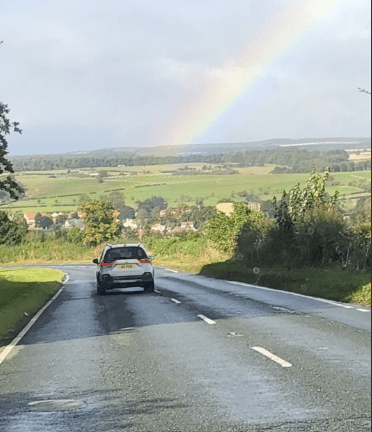
Driving into Helmsley.

The North Yorkshire town

Where my ancestors toiled

In the nearby fields

And laboured

In the limestone quarry

Or – in one case – bent over smartly

As footman to the local Earl

Is now a pristine tourist destination

For posh Londoners

(Who like to hunt partridge, grouse and pheasant)

With high-end clothing shops

And luxury gift boutiques

Lining the old market square

Two wellness spas

And at least one pricey Micheline-recommended restaurant

Serving up the likes of Whitby crab

(with elderflower)

Or herb-fed squab

On a bed of

Black Pudding.

The oh-so pretty North Yorkshire town

Where my two-times great-grandmother

A tailor’s wife

Bore her ten children

And worked ‘til her death at 71

As a grocer

(So says the online documentation)

Now has food specialty shops as eye-pleasing as any in Paris or Montreal

With berrisome cupcakes and buttery French pastries

(Some gluten-free, some vegan)

Mild Wendsleydale cheese

(From the udders of contented cows)

Locally-sourced artisanal game meats

Hormone-free, naturally

And free-range hen’s eggs with big bright orange yolks

That light up my morning mixing bowl like little suns gone super-nova.

And, for the culturally curious

Packages of the traditional North Country oatcakes

(Dry like cardboard if you ask me.)

It cannot be denied

Nary a wild rose nor red poppy is out of place

In this picturesque

Sheepy place

3000 years old!

(Apparently)

Where my great-grandfather

During WW1

Managed the Duncombe saw mill

Supplying timber for telephone poles

And trench walls.

Where because of the highly variable weather

(I’m assuming)

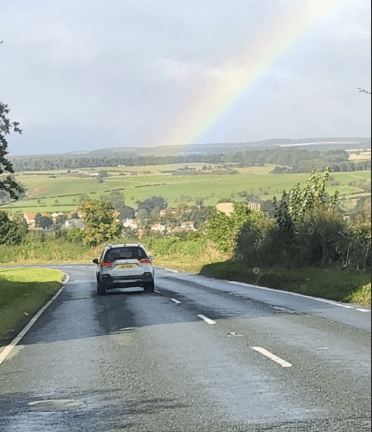
Rainbows regularly arched over the hills and dales

From Herriotville to Heathcliffetown,

Back then

As they

Do now.

(At least I met with one as I drove into my ancestral town– and thought it a good sign.)

Off-season,

This is a town for locals

Not for overseas imposters like us.

I was told…

The natives drive only short distances as a rule

From dirtier, busier places

like Northallerton

(but an hour away)

Through the awesome

(no hyperbole here)

Primeval forests and heathery plateaus

Of the much storied Moors

On narrow snaking highways.

Wearing rainproof quilted jackets in boring colours

They walk their well-behaved dogs

Spaniels mostly

In and out of ice cream shops

And cafes

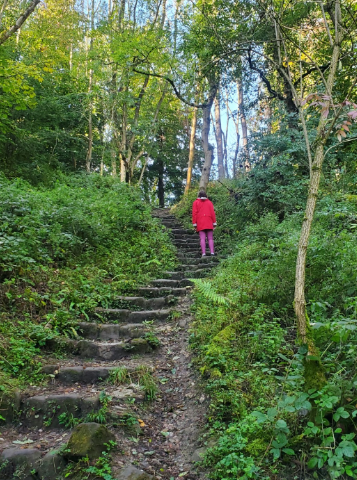
Or up and down

the daunting (to me)

muddy

….medieval

…………..Fairy

…………………….Staircase

…………………………………..along

…………………………………………..the Cleveland

…………………………………………………………………….Way.

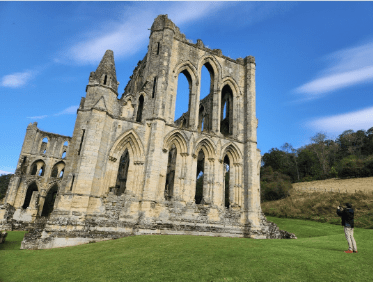
To visit quaint Rievaulx

And admire the Grade II Heritage cottages

With their bewitching thatched roofs

And wisteria-laced windows

Where the skeleton of the old Cisterian monastery

Rules the blue horizon

Like a giant antique crustacean trapped in grim History.

(Unlike myself, they do not pay the ten plus pounds to visit the Monastery ruins.

“And would you like to donate an extra 75p to the National Trust?”

Sure. Why not?)

They just like to walk their dogs.

Yes, all is picture-perfect these days

(It’s early October in 2024)

In my ancestral town

In the North of England

Where at least two in my family tree

Travelled the Evangelical Circuit

From Carlisle to Whitby

Preaching thrift and abstinence

And other old-fashioned values

To men and women with calloused hands

And a poor grasp of the alphabet.

Except, maybe, for the Old Methodist Cemetery

*no entrance fee required

Just around the corner from our charming air bnb

Where the crows, flocking for winter (I guess)

Caw maniacally in the moulting trees

And a black cat might cross your path

(It did for me)

And the old tombstones jut out helter-skelter like crooked mouldy teeth

From the soft-sinking Earth under which some of my ancestors lie,

Mostly

,,,,,,,But

Not ,,,,,,,,

,,,,,,,,,Entirely

Forgotten.,,,,,,,,,,
Frances McGregor’s Notebook

The old notebook has a scuffed brown cover, but its pages are full of poetry, transcribed in neat handwriting. Clearly, this notebook once belonged to a woman who admired Lord Byron and other early 19th century English poets. Her name was Frances – or Fanny – McGregor, and she may have been my ancestor.

I came across it while searching for the name McGregor in the online catalogue of the Historical Society of Pennsylvania. The first result to pop up was “Frances McGregor autograph book, 1825.” In response to my query, the society forwarded a digitized copy of the entire notebook.

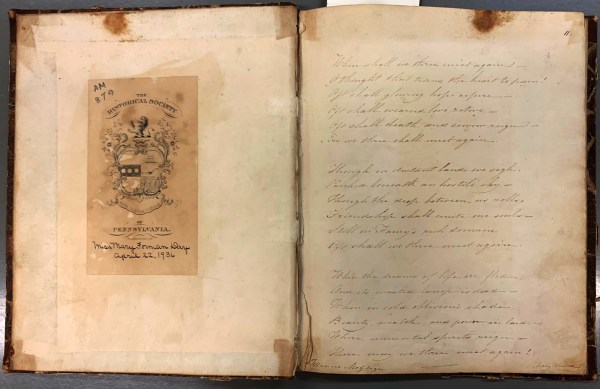
There’s a note clipped to the front, “Frances McGregor? selections from English poets,” which is a more accurate description of it. The label inside the cover indicates it was given to the historical society by “Miss Mary Forman Day, April 22, 1936,” more than 100 years after the last entry was made in 1829.

the donation plate and first page (page 11) of the notebook

Who was Mary Forman Day? She could have been a friend of one of Fanny’s grandchildren.1 Born in Philadelphia in 1860, and died in 1950 in Washington, D.C., she was probably the person who gave many documents pertaining to her Forman ancestors — early Maryland settlers — to area historical societies.2

As for my three-times great-grandmother Mary Frances McGregor, she was born near Port of Menteith, Perthshire, Scotland around 1792. She usually went by her nickname, Fanny. According to family lore, she finished her education in Edinburgh and then came to America. She married English-born Philadelphia merchant Robert Mitcheson, and the census shows they lived in the Spring Garden district, on the outskirts of Philadelpia. I am descended from her eldest daughter, Catharine, who was born in 1822.

I tried to eliminate the possibility that another Frances McGregor owned this notebook, but that proved difficult. Only the head of the household was named in census records and city directories at that time, making women especially hard to find.

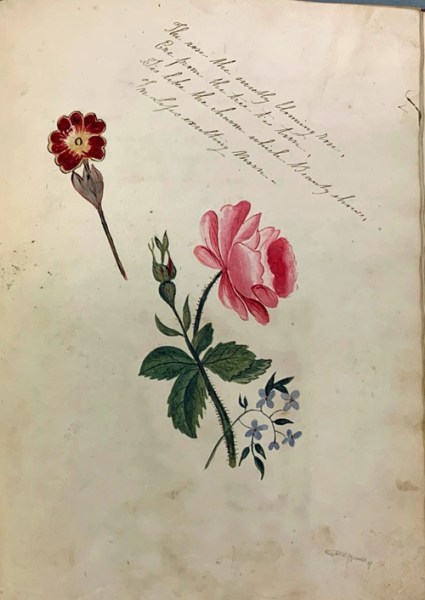
If a title page ever existed, someone tore it out long ago, and the notebook begins on page 11.  Nevertheless, Frances’s name appears three times: she signed “Fanny” on a small botanical painting on the last page, and she wrote “Frances” on the inside back cover.

Her name also appears on page 11, at the bottom of a poem that begins, “When shall we three meet again?” Those words were spoken by the three witches in Shakespeare’s Macbeth, but this is a different poem, expressing the sadness of friends about to be parted. Perhaps Fanny included this poem because she knew she would be leaving her life in Scotland for a new one in the United States.

Many of the poems Frances included in the notebook were written by Lord Byron. She also included a passage from Milton’s Paradise Lost, a short excerpt from an opera and “A Canadian Boat Song, written on the River St. Lawrence”, written by Irish poet Thomas Moore and first published in 1805. The notebook ends with several poems about England’s Princess Charlotte. In 1817, her baby was stillborn and the princess also died. These tragic events inspired much public sympathy at the time.

Frances seems to have written at least one of the notebook’s entries herself. “A Poem – On Home, written by a Young lady at School in the Year 1814” described memories of a loving mother and a happy childhood, but complained of loneliness and disillusionment as the young author moved toward adulthood.  

Besides poetry, Frances included several “puzzles” such as, “Why are your eyes like coach horses?” and “Why is a washerwoman like a church bell?” and “How is a lady of loquacity like a lady of veracity?” She did not include the answers.

One of the botanical sketches in the notebook.

My other favourite entries are the botanical paintings: simple but colourful images of wild geraniums, wild violets and roses.

Whoever created this notebook, it is clear that she was well educated, probably from the upper middle class, and had a quirky sense of humour. The more I think about it, the more strongly I suspect it belonged to my Frances McGregor, but I can’t prove it.

Photo credits: “Frances McGregor autograph book, 1825,” courtesy the Historical Society of Pennsylvania

Notes

1. Grandchildren of Fanny McGregor Mitcheson who could have known Mary Forman:
Joseph McGregor Mitcheson (1870-1926) WW1 navy officer and Philadelphia lawyer;
Mary Frances (Mitcheson) Nunns (1874-1959);
Robert S. J. Mitcheson (1862-1931) Philadelphia physician and art collector;
Helen Patience Mitcheson (1854-1885);
Fanny Mary (Mitcheson) Smith (1851-1937) wife of Philadelphia lawyer and collector of historical documents Uselma Clarke Smith.
Fanny had five other grandchildren in Canada through daughter Catharine Mitcheson Bagg.

2. For example, Mary donated the Forman papers, MS 0403. H. Furlong Baldwin Library., Maryland Center for History and Culture, https://mdhistory.libraryhost.com/repositories/2/resources/49

This article is also posted to https://writinguptheancestors.ca