Tag Archives: Quebec

Grandfather’s Diary

The Diary

My grandfather, William Harkness Sutherland, kept a small red leather diary from January 1st, 1920, to December 31, 1924. During those five years, he regularly jotted down notes. Not his deepest thoughts or a record of history, just about his family and his life.

The Diary begins, “Thursday, January 1st 1920, “Very cold went to Monks for dinner and tea.” Minnie his wife and the children were still in Toronto for a Christmas visit to her mother and sister. When Grandfather was home alone, he was often invited out to eat as no mention is made of him preparing his own meals.

The first page of the diary

William was married with three children, lived in Westmount, Quebec, attended church regularly, worked as a civil engineer, owned a car, played golf and often visited friends for the afternoon and tea.

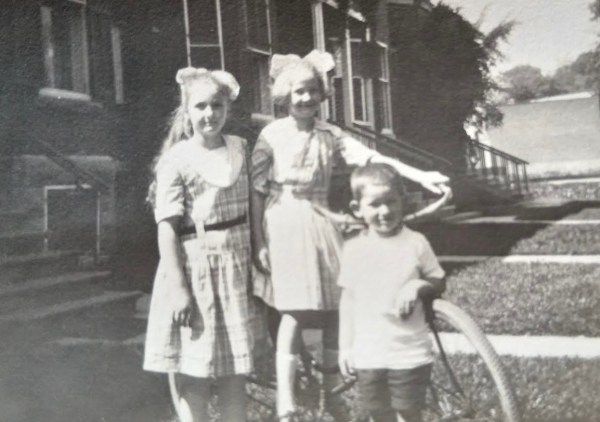
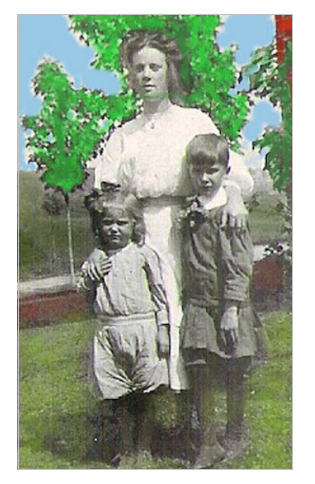
Donald, Bessie and Dorothy Sutherland about 1920

My father, Donald Sutherland, was two to seven years old during those years. It is interesting to see how often he and his two older sisters, Bessie and Dorothy, were sick. They had all the childhood diseases, chicken pox, measles, mumps, whooping cough, as well as colds, flu and bilious complaints that lasted many days. They also had their tonsils and adenoids removed, but they had doctors who came to their house!

According to one entry, Minnie, my grandmother, was diagnosed with tonsilitis and Donald’s sore neck became mumps as he continued to have a swollen gland. “Tuesday, March 30, 1920, Drs. Craig and Shaw saw Donald this morning and Craig says the gland must be opened. Dr. Shaw brought Dr Bourne in the afternoon and they gave Donald an anesthetic and opened it, removing quite a considerable quantity of pus.” Amy, Minnie’s sister, came down from Toronto as most of the family was sick.

A few days later, Amy also became ill, so William called in Dr. Smythe. The doctor also checked Donald’s neck, which was again inflamed. “April 4, 1920, brought Dr Smythe home with us (from church) to dress Don’s neck. It was not necessary to probe it for when the bandage came off, it discharged freely. Dr, S. pressed it firmly and Donald kicked up a great fuss.” Imagine, four doctors visited the house within a week!

The children were better during the summer. Although one time, Donald cut his foot at the cottage while swimming, but luckily, there was a doctor just across the lake. Dr. Swaine came over, sewed it up and gave Donald a dollar.

Swimming in Brome Lake

The family often went for drives all around the city. William enjoyed having a car and would pick up friends and drive them all over Montreal, as not many people had cars or could drive.

Driving on Mount Royal, Montreal

A few incidents outside the family were written about, such as when Victoria Hall burned down on March 8, 1924. Some of the family were at their new home on Arlington Ave, which was being renovated, when “About 4:15 heard fire wagons went out and saw Victoria Hall burn. Watched until 6:30 and then went home for tea.” There was mention of another fire, the burning of the Sacre Coeur Hospital, March 15, 1923. “ Fire destroyed the Hospital on Decarie Boul. All patients were taken safely out, but the building was totally destroyed. Minnie went out to see it and then called at Donnelleys.”

It was a busy time in his life. The family moved from Grosvenor to Arlington Avenue. Then they built a cottage in Dunany, near Lachute, fifty miles north of Montreal. Two hours and twenty minutes was a quick trip, although many took three to four hours to the cottage, which can now be reached in just over an hour.

Bessie, Dorothy and Donald

Grandfather enjoyed playing golf. There are many entries about his games played at different golf courses, including who he played with and how he practiced indoors in warehouses during the winter. The Dunany Country Club was his favourite, where he was one of the founding members.

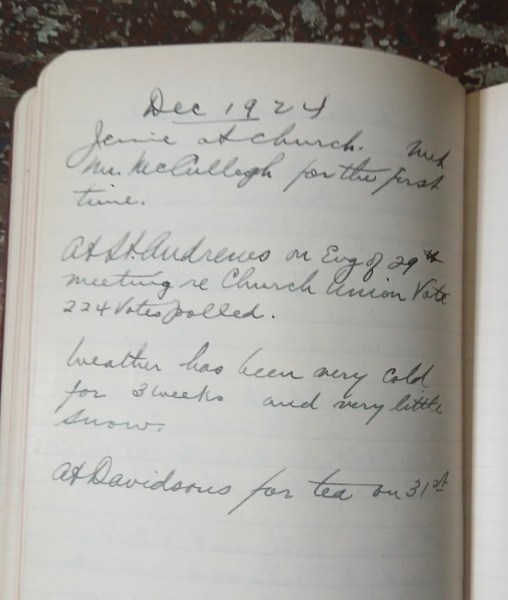
What would a diary be without talking about the weather. “October 31, 1920. Oct was an exceptional month, warm, an average of 7 degrees above normal. March 31, 1923. “Coldest March on record by about 10 degrees on average, still mid winter weather.” The last entry ,”December 1924 “Weather has been very cold for three weeks. At Davidson’s for tea on the 31st.”

The last page

The diary concludes at the year’s end but since there were still many empty pages, I wonder why he stopped writing. Most likely, life got in his way. I am glad he wrote if even for a short time. By reading his diary, I learned a lot about a grandfather I never knew.

Notes:

The Diary is in the hands of the author. All the pictures are in the possession of the author.

Hôpital Sacré-Cœur: Architectural Gem in Montréal

Recently, for a minor medical reason, I was referred to Hôpital Sacré Coeur de Montréal, located in the Ahuntsic/Cartierville neighbourhood, North of Montréal. Instead of using the major highway, we decided to travel via Gouin Boulevard. Motoring along a pleasant country road, filled with all manner of houses, trees, flowers and bushes, it was a very enjoyable route.

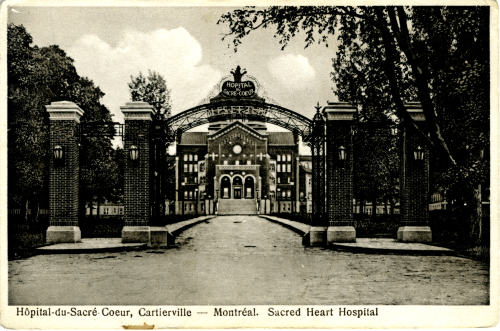
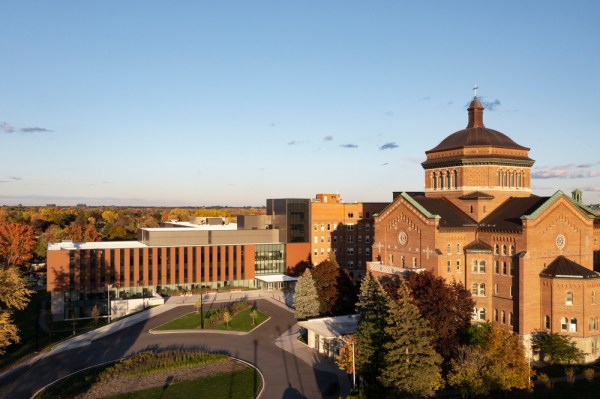
The reason I wanted to write about this hospital I had never seen before was because when we arrived and I saw the majestic gateway that led up to the main entrance, I thought at first the building may have once been a cathedral.

Although the photo below was taken C. 1940, it looks exactly the same today.

Publisher: Novelty Manufacturing and Art Co. Ltd., Montreal


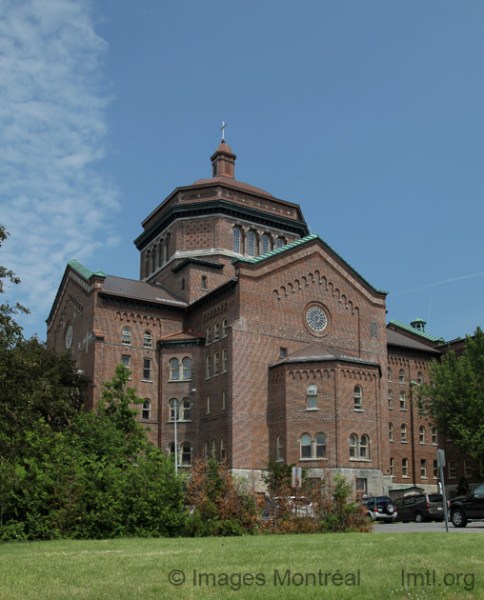
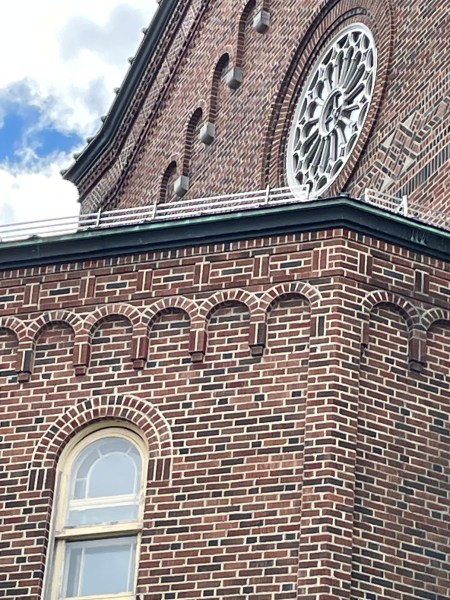
It intrigued me so much that I wanted to learn about the history of this striking building. As we approached the parking lot, I could see the huge cross on the top of the building. The original stonework, which was masterly, really stood out to me.

Picture Alexis Hamel

The original stonework would reflect the architectural styles popular in the late 19th and early 20th centuries, potentially incorporating elements of the Victorian or Beaux-Arts styles common for public buildings of that era.

Picture Marian Bulford

Excited to begin researching, I found a lot of interesting information. For instance, did you know that the institution was originally founded on June 1, 1898, the day of the Feast of the Sacred Heart, by a small group of women located in a building in downtown Montréal? (1)
They named it the Hôpital du Sacré-Cœur de Montréal, and the women cared for a dozen ill individuals, deemed the ‘incurables’. An unfortunate name, but cancer and patients with serious diseases were incurable then. By 1902, support care was provided by the Sisters of Providence.

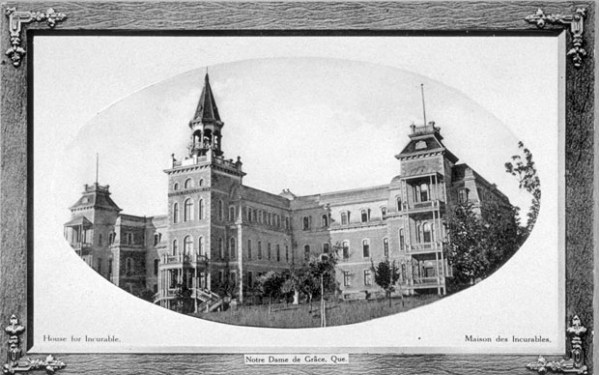
In 1900, the hospital moved to a larger building on Décarie Boulevard in Notre-Dame-de-Grâce (NDG). and was known as the Hôpital des Incurables.

Hôpital des Incurables.

This building was destroyed by fire in March 1923, and in 1926, a new building was built on Gouin Boulevard in Cartierville, where it still stands today. With the new building, the administration reverted to using the original name, Hôpital du Sacré-Cœur de Montréal.

Initially, it specialised in the treatment of tuberculosis. This was soon followed by the development of orthopaedic surgery (Dr. Édouard Samson, 1931) and thoracic surgery (Dr. Norman Bethune, 1933). In 1973, the Hospital became a tertiary care trauma centre for Western Quebec, together with the Institut Albert-Prévost, to provide psychiatric care and was affiliated with the University of Montreal as a research and teaching centre.(2)

In 2022, an expansion by Provencher_Roy and Yelle Maillé was completed, adding 16,252 square meters, which complements this heritage structure.  (4)

Although a visit to a hospital is sometimes an anxious experience, the building and staff at Hôpital du Sacré-Cœur de Montréal were most helpful and attentive. Young volunteers are situated on each floor, ready to give directions to various parts of this now vast hospital.

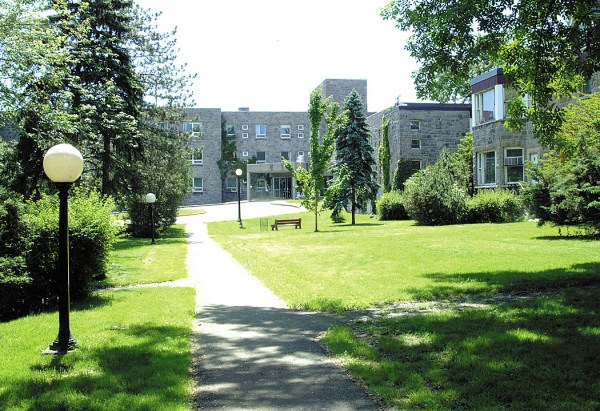
Along Gouin Boulevard, we passed the affiliated Institut Albert-Prévost, set in a pleasant park-like area, before reaching the Hôpital du Sacré-Cœur de Montréal.

Entrance to the Institut Albert-Prévost

Before becoming a hospital, Albert-Prévost may have changed names from sanatorium to pavilion, but never its vocation: it has been treating mental health problems for over 100 years. This influence is due as much to the teaching it provides as to the care it gives.

Who was Albert Prévost?

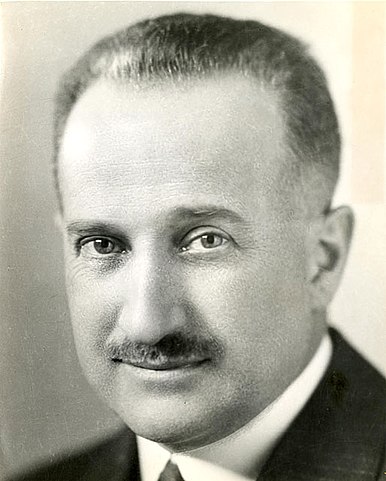
Albert Prévost

He was a Quebec neurologist and forensic physician, born in 1881 and died in 1926. He was the first holder of the chair of neurology at the Université Laval in Montreal and the founder of the institute that bears his name. (5)

SOURCES

(1) (2) https://en.wikipedia.org/wiki/H%C3%B4pital_du_Sacr%C3%A9-C%C5%93ur_de_Montr%C3%A9al

(3 ) https://www.mcgill.ca/medicalmuseum/exhibits/postcard-collection/post-cards/sacre-coeur


(4) https://www.archdaily.com/995774/sacre-coeur-de-montreal-hospital-provencher-roy-plus-associes-architectes-plus-yelle-maille-et-associes-architectes


(5) https://fondationhscm.org/fhscm-1/hospital-albert-prevost

A Little About Helene Bruneau

Helene in New York City

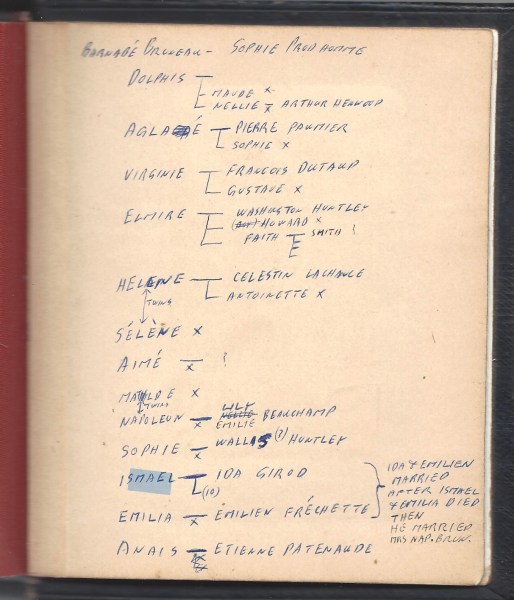
I have written stories about twelve of Barnabé Bruneau and Marie Sophie Prudhomme’s thirteen children. That just leaves Helene (1849 -1929). Helene was child number nine or perhaps number ten. I just realized that she and Selene Joseph were the second set of twins in the family. They were born on December 20, 1849.

I haven’t found much information about Helene other than she appeared to be a devoted wife and mother. She married at twenty-six but before, had spent some time in New York City as photographs can attest. Was she also a French teacher or governess like her sisters?

Sophie, Helene and Matilde Bruneau, New York City

Helene married Célestin Pépin dit Lachance ( known as Lachance). He was born in Joliette (1847-1915) to Celestin Lachance and Elisabeth Payette. His parents converted to Protestantism in 1852 when he was a young child. He attended the l’Institute Evangelique Francais de Pointe-aux-Trembles. After he graduated, he became a Colporteur for two years for the French Canadian Missionary Society. He had aspirations of becoming a minister

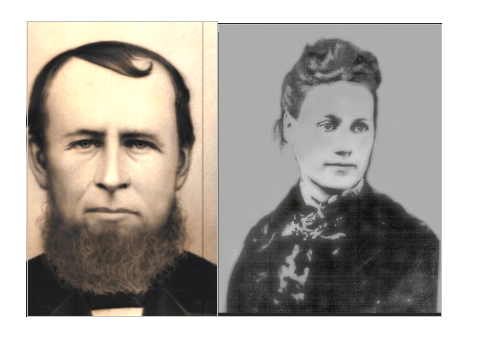
Celestin & Helene Lachance

In 19th century America, the word colporteur (the borrowing of a French word meaning “peddler”) came to be used for door-to-door peddlers of religious books and tracts and is still used today. The Missionary Society trained the colporteurs and future pastors as there wasn’t a French Protestant seminary. Celestin abandoned his studies in 1867, possibly because he had tuberculosis and his doctor recommended he only work outside in the fresh air. If he did have TB, the fresh air did him good as he lived almost another 50 years. He worked all over Quebec in the logging and forestry industry. Helene accompanied him everywhere during their marriage.

Helene & Celestin Lachance and Helen’s sister Anais

Although he gave up missionary work he remained a religious Presbyterian the rest of his life. He read the Bible every morning and night. During his last illness, he read the whole Bible twice in nine months. 

Helene was originally a Baptist as her parents also converted to Protestantism when she was a child. She is later recorded as being a Presbyterian.

Celestin and Helene had only one daughter, Helene Marie Antoinette (1876 – 1916). This curly-haired child grew up but never married. She attended Royal Arthur School in Montreal. Antoinette attended English schools because the family was Protestant, so she couldn’t attend French Catholic schools. In 1892, she won the prize in French for second intermediate girls, besting Nellie Wilson, who won the awards for most of the other subjects. She didn’t have Antoinette’s advantage of a French background. At the closing of the ceremony, the commissioner said, “It was well to be clever but still better to be good.” Antoinette died at only forty years of age. She lived with her parents her whole life and never seemed to have an occupation.
Antoinette Lachance

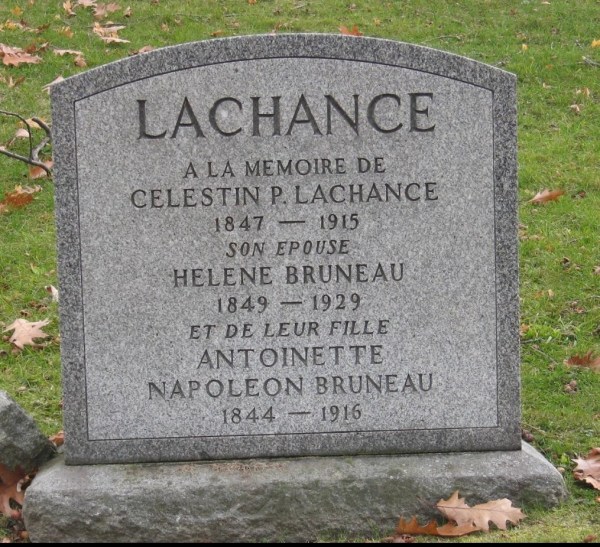
After Celestin and Antoinette died, Helene lived in Verdun, Quebec until her death, on June 4, 1929. The family is buried in Mont-Royal cemetery in Montreal along with Helene’s brother Napoleon.
Mount Royal Cemetery Montreal

Notes:

In the back of the little photo album in a list of the children, it actually said twins, which had never registered with me. 

Back page of photo album

1871 Census: Celestin was 22 and living with his parents and sibling in St Charles Borromée, Joliette, Quebec. Year: 1871; Census Place: St Charles Borromée, Joliette, Quebec; Roll: C-10036; Page: 15

Helene and Celestin were married in 1875 and recorded as French Evangelicals.

Antoinette was born in October 2, 1876 and baptized at 9 years old in 1885.

According to Find a Grave: her full name was Helene Marie Antoinette Lachance born in St Constant Quebec.Ancestry.com. Canada, Find a Grave® Index, 1600s-Current [database on-line]. Lehi, UT, USA: Ancestry.com Operations, Inc., 2012.Original data: Find a Grave. Find a Grave®. http://www.findagrave.com/cgi-bin/fg.cgi accessed August 28, 2024.

1891 Census: The Lachances were living in Ste. Conegonde Hochelaga, Quebec. Celestin was a Commis au Bois, a wood clerk, Helene was a wife and both members of the Free Church. 

Year: 1891: Census Place: Ste Cunégonde Town, Hochelaga, Quebec, Canada; Roll: T-6396; Family No: 227Ancestry.com. 1891 Census of Canada [database on-line]. Lehi, UT, USA: Ancestry.com Operations Inc, 2008. Aug 28, 2024.

1901 Census: Celestine, Helene and Antoinettte (Marie-A ) were living in Ottawa, where Celestin was listed as a foreman and Antoinette, had no occupation. Year: 1901; Census Place: Ottawa (City/Cité) Dalhousie (Ward/Quartier), Ottawa (City/Cité), Ontario; Page: 19; Family No:189 Source InformationAncestry.com. 1901 Census of Canada [database on-line]. Lehi, UT, USA: Ancestry.com Operations Inc, 2006. Aug 28, 2024.
Montreal Star: Royal Arthur Closing Exercises, June 22, 1892 Wednesday, pg. 3. Newspapers.com accessed Sept 9, 2024.

Le Devoir: Celestin Lachance obituary, March 26, 1915 pg 2. Newspapers.com accessed September 9, 2024

Montreal Star Obituary: Helene Lachance, June 6, 1929 page 11. Accessed Oct 22, 2024.

Jean-Louis Lalonde: Lachance, Celestin (1849-1915) SHPFQ Societe d’Histoire du Protestantisme Franco-Quebecois. Octobre 12, 2020.

All the photographs are family photos in the hands of the author.

Sundays and the Great Depression

I used to hate Sundays. I had to go to Sunday school. I really didn’t understand why I had to attend because my parents just dropped me off. That’s right. They didn’t even go to church. And no one asked me if I wanted to go.

After they picked me up, things got worse. It was homework time until lunch. Of course, I could have done my homework on Friday night but Fridays were reserved for movies on the television and reading in bed with a flashlight until all hours.

And worst of all, some Sunday afternoons were for Visiting the Elderly Relatives. In my mind, my aunts and uncles were ancient. Plus my brother, being a boy and older than me, was apparently able to take care of himself, as he always seemed to be absent from these visits. So I would sit in the living rooms of my aunts and uncles, with no toys or any other amusements, and listen to the adults talk.

I now cherish the memories of these visits because they provided me with an appreciation of the social history of Montreal, as well as significant events such as the Depression and World War II.

The stories about the Depression are the ones that struck me the most. During the Depression, a quarter of Canada’s workforce was unemployed.1  My dad, Edward McHugh, was a young man out of work in Montreal and he joined his older brother and sister in Drummondville, to work for the Celanese. At the peak of the Depression, the Celanese employed 1,757 workers.2

None of the McHughs had cars in those days so they must have travelled back and forth to Drummondville by train. And Uncle Thomas McHugh married a local girl. I can just imagine the McHughs, from Verdun, arriving in Drummondville for the wedding. I doubt very many people spoke English in Drummondville at the time. The culture shock must have been intense.

My aunts and uncles, even into the 1960s, were thankful that they were able to have had some work during the Depression. Uncle Al Scott worked for the Northern Telecom for 40 years, although with reduced hours during the Depression. Luckily Uncle Frank McHugh worked for the Montreal Tramway Company so he was able to keep working during the Depression. He was a tram driver for tram number 24 that started in Montreal West and crossed the city on Sherbrooke Street. His job was safe.

Dad’s siblings loved to have a good time and the Depression did not stop them. My Aunt Elsie used to describe their card parties. There was only one bottle of scotch, some ginger ale, one can of salmon and one loaf of sliced white bread. My aunt was able to spread the salmon so thinly that she could make sandwiches out of the whole loaf of bread.

It was very clear to me that the Depression was a very frightening time in their lives. During this period, the future must have seemed bleak. Life was a struggle to make ends meet. But they made the most of it and persevered. Today I feel lucky to have listened and to remember their stories.

1 https://en.wikipedia.org/wiki/Great_Depression_in_Canada

2 http://www.patrimoine-culturel.gouv.qc.ca/rpcq/detail.do?methode=consulter&id=14311&type=pge#.WSNY7Gg1-Uk

Montreal and the Ville Marie Fire of 1734

Update: January 24, 2024

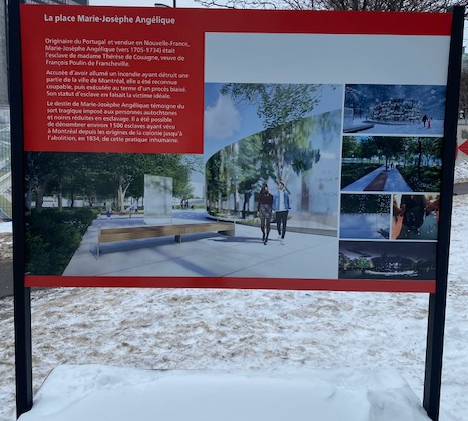
Since this story was originally published, the City of Montreal has added a poster next to Metro Champs de Mars to make it clear that Marie-Josèphe Angélique’s park will be within the Place de Montrealais!

Thanks to Annie for letting me know, and thanks for everyone who made sure that her story is not forgotten!

Original Story

For an hour on the first cold day of the year last month, I wandered around City Hall looking for the memorial park named after an enslaved woman whose torture led to her conviction for arson in 1734. She was then ridiculed, hanged, and her body was burned to ashes and thrown to the wind.

I couldn’t find it.

I’m not sure what happened from the time the park was created in 2012 to today, thirteen-and-a-half years later, but the one-time park still appears on Google Maps. In person, I couldn’t find anything to indicate where it might be.

According to various articles on the web, a green space just west of Champs de Mars métro station honours Marie-Josèphe Angélique’s memory. The official inauguration of the park took place on Aug. 23, International Day for the Remembrance of the Slave Trade and its Abolition, 2012.

As I walked through the area last month, the one-time park seemed to be encompassed in a massive construction site underway for Place des Montréalais, a new public space being created next to the Champ des Mars metro on Viger Street. The posters on site explaining the current project included nothing about Marie-Josèphe Angélique.

Despite being honoured with an award-winning film, a bronze plaque, lilies and a presentation by Governor General Michaelle Jean in 2006, and a public park created by the city of Montreal in 2012, she’s disappeared again.

Before this experience, I was already struggling to see Angélique as the symbol of freedom and resistance she serves for many, but I don’t want her to be forgotten. Did she set the fire or was she a convenient scapegoat? If she didn’t, who did? As I began exploring her story last month as part of a project for NANOWRIMO (the National Novel Writing Month), she served as a reminder of the kind of unnecessary suffering a biased political, policing and justice system can create. Despite the fact that she was a victim of slavery, hatred, spite, racism, class bullying and the worst that a mob could throw at her, her spirit remained strong and unrelenting.

Angélique proclaimed her innocence until the day she was tortured, throughout the court case, and through questioning. Despite that, three weeks after the fire, she was hanged, ridiculed publicly, then burned with her ashes tossed into the wind. Clearly, the authorities at the time wanted her punishment to be seen and remembered.

I read the details about Marie-Josèphe Angélique’s case on Torture and the Truth, a fabulous website set up in 2006 by multiple people, including one of my genealogical mentors, Denyse Beaugrand-Champagne and one of my historian mentors, Dorothy W. Williams. Both of these women have researched, written, spoken and taught many people about the history of Montreal and why studying it is so important.1

The site is one of thirteen different “historical cold cases” established for classrooms across Canada. It was created through the work of six writers, a photographer, an artist, and two translators collaborating with six funding agencies, seven production partners, and 15 archive and museum partners.

It is one of the best historical websites I’ve ever read. If you do nothing other than read through this site, you will get a good overview of the community, the victim arsonist, and life in early Montreal.

As I read about Angélique’s story, she sounded like just the kind of person anyone would like to get rid of. She was a woman who told people she would burn them alive in their homes. She said so to her owner for refusing to grant her freedom, to other slaves for making her work harder than she wanted and to others too. To anyone who slighted her, she threatened the worst thing she could think of. She would burn their homes down.

When 45 houses in her small community did in fact burn down, people blamed her. In retrospect, it may have been an accidental kitchen fire that caused the flames, but her words came back to haunt them all.

The fire began at 7 p.m. on a Saturday evening in spring, April 10, 1734. In only three hours, it destroyed 45 homes and businesses on Rue Saint Paul. Even the Hôtel-Dieu hospital and convent, where people initially took shelter, burned to the ground. Hundreds of people were left in the cold; supplies from many merchants burned, never to be seen again.

Plus, who knows how many caches of fur got wiped out. At that time, Montreal was the centre of the fur trade, more than half of which was illegal trading with the Dutch and English communities in Albany, Boston and other communities to the south. According to a 1942 thesis by Alice Jean Elizabeth Lunn, furs were stored in the backs of shops and even buried just beyond the Montreal wall, which was still under construction at that time, in order to be shipped without being seen by New France authorities. A lot of money went up in smoke that day.2

Everyone in Montreal knew about the fire, given that all the church bells throughout the city began ringing when it started and continued until it was over and people were safe again. Although stone buildings existed at the time, most of the buildings were made of wood; fire could destroy them all.

I had ancestors who lived in Montreal then, the Hurtubise clan on my father’s mothers side. One of them, Jean Hurtubise, the grandson of Étiennette Alton and Marin Hurtubese, was thirty-nine years old, ten years older than Angélique when the fire took place. He and his wife Marie-Jeanne (Marie-Anne ou Marianne) Tessereau had been married for seven years in 1734.

Jean was born in Ville Marie and lived in Montreal for his entire lifetime, so he and his family would have experienced the fire, at least from a distance. They certainly would have seen the ordinance compelling witnesses to appear, given that “it was posted and cried out everywhere in the city and its suburbs.”

Jean and his family farmed a 3×20 arpent property they bought three years earlier from Raphael Beauvais and Elisabeth Turpin on Rue Côte Saint-Antoine.”3 The property was in a part of Montreal that was considered the countryside at that time. Their home was then one of four wood houses on Côte Saint-Antoine in 1731.4

Given that the area was still very rural, and on a major hill, I can’t help but wonder. Did they see the smoke rising into the sky as the hospitals and 45 other buildings in Ville Marie were destroyed?

They certainly had strong links to Ville Marie, particularly the hospital. His grandmother, Etionnette Alton, had died there in her 84th year twelve years earlier. They couldn’t have helped wondering what would happen to others like her, being treated in the hospital that the fire destroyed. Were they among the crowd clamouring for revenge? Did they go to Ville Marie to see Angelique hanged? Did they watch her corpse burning? Did they see her ashes spread into the wind? Did they care at all?

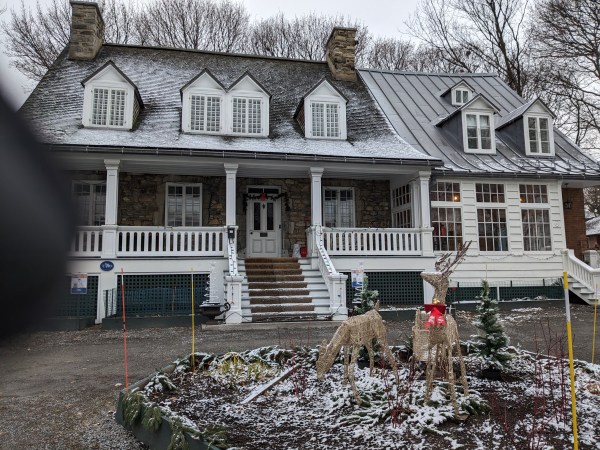
I can’t help but imagine that the controversial hanging effected all 2000 people who lived on the island that year. Five years after Angélique’s death, Jean built Hurtubise House, a storey-and-a-half fieldstone structure on land originally rented by his father in 1699 on Mount Royal. The family built the gabled home out of stone to protect themselves from fire, as required by a law passed the summer after Angelique’s death. You can still visit the home today.5

Sources

1 Beaugrand-Champagne, Denyse, Léon Robichaud, Dorothy W. Williams, Marquise Lepage, and Monique Dauphin, “Torture and Truth: Angélique and the Burning of Montreal,” the Great Unsolved Mysteries in Canadian History Project, 2006, https://www.canadianmysteries.ca/sites/angelique/accueil/indexen.html.

2 Lunn, A. J. E. Economic Development in New France, 1713-1760. McGill University, 1942, https://books.google.ca/books?id=rtcxvwEACAAJ.

3 Roy, Pierre-Georges,, Inventaire des greffes des notaires du Régime français, Québec, R. Lefebvre, Éditeur officiel du Québec, 1942, 28 vol. ; 25-27 cm, Collections de BAnQ.

4 MacKinnon, J. S. The Settlement and Rural Domestic Architecture of Côte Saint-Antoine, 1675-1874. Université de Montréal, 2004. https://books.google.ca/books?id=IEJ4zQEACAAJ.

5 https://hcq-chq.org/the-hurtubise-house/

Bon Soir et Dors Bien – Good Night Sleep Well

Rene Raguin & Beatrice Bruneau Wedding 1912

“Bonsoir et dors bien”, is how my mother ended her nightly phone calls with her parents. These were some of the few French words I ever heard her speak, which was strange as French was both her parent’s mother tongue. Why did we only speak English?

René Raguin my grandfather, was from Fleurier, Switzerland and came to Canada to teach at the French Protestant school in Pointe aux Trembles, Quebec. He later taught in Trois Rivieres and finished his career at Baron Byng, a school of the English Protestant School Board of Greater Montreal. He also taught teachers how to teach French at McGill University’s summer school.

Beatrice Bruneau met René Raguin when they were both teaching at the Pointes aux Trembles school. This was the one French Protestant school in the Montreal area. Grannie as we called her, descended from French Canadian stock, although born in Green Bay Wisconsin. Her father Ismael Bruneau was a French Presbyterian minister. Her mother Ida Girod was a French speaker from Switzerland and also a Protestant.

René spoke English fluently but with a heavy accent. He always used English when talking with us, his grandchildren and we called him Grandfather. I always wondered why he never communicated with us in French as a French teacher. One much older cousin Don Allchurch, always referred to him as Grandpère as he did speak to him in French.

Beatrice’s father Ismael Bruneau, was “pure laine”, French Canadian through and through. His early ancestors arrived in Quebec from France in the 1630s. His family of Catholics converted to Protestantism in the 1850s and that is where the English crept in. Ismael wasn’t thrilled to speak English as he wrote to his youngest sister Anais, “I write to you in English, dear sister, not to show you I can write a few words in that barbarous language, but for your good as well as mine, for practice makes perfect.” Many of Ismael’s siblings moved to the United States, spoke English and married English speaking spouses.

French was spoken in his home but Ismael’s children all went to English Protestant schools as the French schools were all Catholic and they didn’t even allow Protestants to attend. In the family, religion trumped language. Most of his children also married English-speaking people. His two sons continued to speak to each other in French.

Beatrice Bruneau Raguin

My mother grew up in Dixie on the border of what is now Lachine and Dorval. It was then an English community. Because her father Rene Raguin taught for the English board they didn’t have to pay school fees and so attended English Protestant schools. The children didn’t want to speak that other language. Some evenings her father would say that only French would be spoken at the dinner table. The children wouldn’t say a word and only eat what they could reach.

Rene Raguin

The Scots and Irish immigrants who were my father’s family settled in Toronto and spoke only English. I don’t remember him speaking French to anyone. He always regretted that he couldn’t speak French. He too went to English Protestant schools.

Dorothy, Beatrice, Rene & Mary

We were schooled before French Immersion and though there was some talk about sending us to French Schools, they were still all Catholic and not a choice, so we also attended English Protestant schools.

So in a generation, the French family became English. We didn’t call my mother every night but as we left after a visit she had a new English saying, “Safe home.”

Notes:

A Short History of the Bruneau-Girod Families: Ida Bruneau Ste. Agathe des Monts, Quebec May 1993. Forbes Publications Ltd. Calgary, Canada.

My sister remembers the phrase as “Bonsoir et dors bien Maman” but I said sometimes she was talking to her father.

Dolphis Bruneau – Life in North Adams

Many French Canadians left the farms of Quebec and migrated to the mills of New England in the mid 1800s. Some worked and then returned home while other like Dolphis Bruneau settled in the United States. 

Dolphis was the eldest son of Barnabé Bruneau (1807-1880) and Sophie Marie Prud’homme (1812-1892) my great great grandparents. One would think he would inherit the family farm in Saint Constant, Quebec but he had moved to North Adams, Massachusetts, long before his father’s death.

North Adams, a mill town in Berkshire County, grew at the convergence of two branches of the Hoosic River, which gave the town excellent water power for the developing industries. Dolphis arrived there 1864, at the end of the Civil War. He first lived in a rooming house and worked as an operative, presumably in a mill. At the same time, his younger brothers, Aimé and possibly Napoleon also lived and worked there.

He married Nellie Saunders the daughter of an Irish immigrant Thomas Saunders. She worked in a shoe factory. They started a family with Maude born in 1871 and another daughter Nellie three years later. Tragically, his wife died during that childbirth so Dolphis was left to raise his two daughters alone. He must have had help from Nellie’s family, as he didn’t move back to Quebec like his brother Napoleon and applied for his United States Naturalization Petition in 1895.

Dolphis’ wife Nellie Saunders

Dolphis continued his quiet life in North Adams. He worked as a carpenter possibly not at a mill but for for a cabinet maker. He kept in contact with his family in Quebec. Some pictures of his growing girls were taken in Montreal so they certainly went north to visit. He didn’t move much as his address, a rental property, is listed as 15 N Holden St for most of his life. His daughters continued to live with him. Maud seems to have kept house and Nellie worked as a bookkeeper.

Dolphis remarried eleven years after his wife died to a widow, Ester Mary Halse Tingue. Information about his second wife is scant and rather confusing. Ester received a Civil War pension from her first husband and so had some income. The census and city directories show them living apart although listed as married. He lived with his daughters and she lived with her daughter Emma Tingue. Dolphis died in 1909 and Ester in 1924. In her obituary she is refered to as Mrs. Ester T. Bruneau, living at 108 Quincey Street and survived only by Emma. “Her death will bring deep sorrow to her many acquaintances,” it said. Dolphis and Ester were buried in different cemeteries.

The year after her father’s death, Nellie married Arthur Henwood. They moved in with her sister Maud at 15 N Holdon Street. Nellie and Arthur never had any children. Arthur kept a steady job working for James Hunter Machinery as a machinist. His draft registration cards for both WWI and WWII showed him working at the same company. Nellie continued to work as a bookkeeper and Maude continued to keep house. Both sisters had a close involvement with the First Baptist Church.

Maude never married and after her sister’s death in 1939, she and her brother-in-law continued to live together for the next twenty plus years, still at 15 N Holden Street. Arthur died in 1960 and Maude then moved to the Sweet Brook Nursing Home in Williamstown, Massachusetts where she died two years later. Maude’s death ended the Bruneau line in North Adams although most of the family are buried in Maple Street Cemetery.

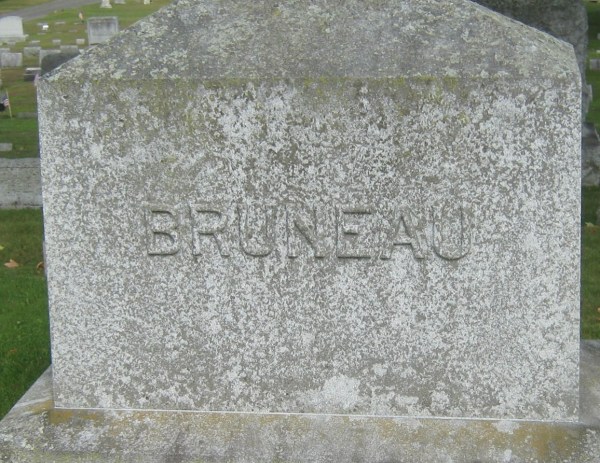
Bruneau Family Tombstone North Adams, MA

Notes:

Dolphis Bruneau Massachusetts, U.S., Death Records, 1841-1915 [database on-line]. Provo, UT, USA: Ancestry.com Operations, Inc., 2013. Original data:Massachusetts Vital Records, 1840–1911. New England Historic Genealogical Society, Boston, Massachusetts.Massachusetts Vital Records, 1911–1915. New England Historic Genealogical Society, Boston, Massachusetts. Accesses March 15, 2022.

Dolphis Bruneau – Massachusetts, U.S., State and Federal Naturalization Records, 1798-1950 [database on-line] NAI Number: 4752894; Record Group Title: Records of the Immigration and Naturalization Service, 1787-2004; Record Group Number: R G 85.  Provo, UT, USA: Ancestry.com Operations, Inc., 2011. Accessed Mar 12, 2022.

Nellie Bruneau Henwood Obituary.The North Adams Transcript (North Adams, Massachusetts) December 27,1939, Page 3. Accessed on Newspapers.com Mar 27, 2022.

Maude L Bruneau Obituary. North Adams Transcript (North Adams, Massachusetts) March 17, 1962, Page 3. Accessed on Newspapers.com Mar 23, 2022.

Mrs Ester T Bruneau Obituary. North Adams Transcript (North Adams, Massachusetts) Dec 19, 1924, page 14. Accessed on Newspapers.com Mar 30, 2022.

1900 Census: North Adams Ward 3, Berkshire, Massachusetts;Roll:632;Page:7;Enumeration District:0051;FHL microfilm:1240632Ancestry.com.1900 United States Federal Census[database on-line]. Provo, UT, USA: Ancestry.com Operations Inc, 2004. Original data: United States of America, Bureau of the Census. Twelfth Census of the United States, 1900. Washington, D.C.: National Archives and Records Administration, 1900. T623, 1854 rolls. Accessed Mar 2, 2022.

Arthur Henwood: Draft Card H. Registration State:Massachusetts; Registration County: Berkshire Source Information Ancestry.com. U.S., World War I Draft Registration Cards, 1917-1918.Imaged from Family History Library microfilm M1509, 4,582 rolls. Provo, UT, USA: Ancestry.com Operations Inc, 2005. Accessed April 5, 2022.

Margaret votes

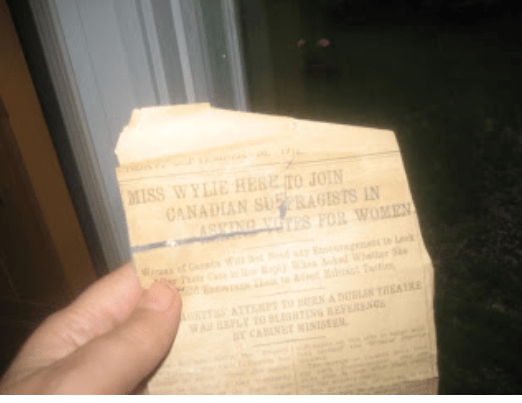
Nicholson Clipping of the 1912 visit to Montreal of militant British suffragette, Barbara Wiley. At least one Montreal society lady, a Mrs. Weller, wife of an electricity magnate, openly admired the suffragettes. She visited them in London and soon after invited Miss Wiley to speak at her Westmount home. where she got many of her friends to subscribe to Votes for Women, Mrs. Pankhurst’s militant -minded magazine. Most upper crust women who admired Pankhurst kept it under wraps. Mrs. Pankhurst was simply despised by many people, especially men.

Suffragist: A person who advocates for votes for women.

Suffragette: Someone who advocates militant methods to win the vote for women.

If you come from Protestant Canadians, especially Presbyterians or Methodists, it is likely you have a female ancestor or two from 100 years ago who believed that women should have the vote.

It’s safe to say, however, that none of these ancestors ever marched in a suffrage parade, as did some American women. They likely didn’t throw hatchets at store windows, either, as did some British suffragettes. Nor did they ransack golf courses or go on hunger strikes in jail like the most militant suffragettes in England.

The Canadian Woman Suffrage Movement was much more tame (dull and boring) than in the UK or even in the US. In 1913, in Canada, the movement was controlled by a group of elite matrons, most with wealthy husbands, who were highly invested in the status quo. They did not want working class women or even ‘excitable’ young women of their own class to enlist in their suffrage associations. Most of them weren’t ‘equal rights’ suffragists.

Some of these ladies wanted the vote solely to cleanse society of its undesirable elements – to impose their values on others. Some wanted to clean up or “purify” what they saw as a corrupt City Hall, that allowed prostitution (the social evil) and alcohol consumption to flourish. Others wanted the vote to improve the lives of children of all classes because they believed men only cared about money. These were maternal suffragists and probably in the majority.

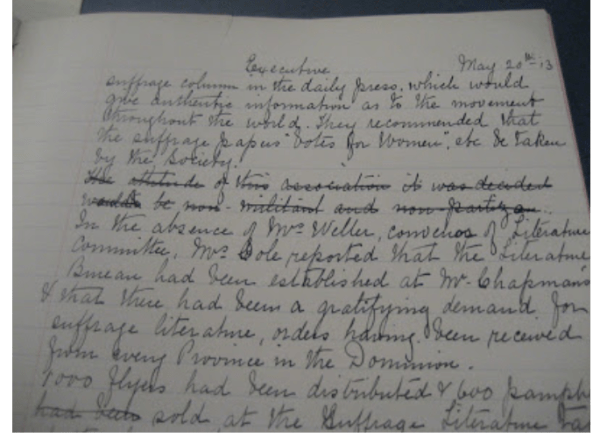
Page from minute book of Montreal Suffrage Association at BANQ.. Hmm. Someone has crossed out a line claiming the association is non-militant. Ha ha. They also want to subscribe to Pankhurst’s Votes for Women magazine.

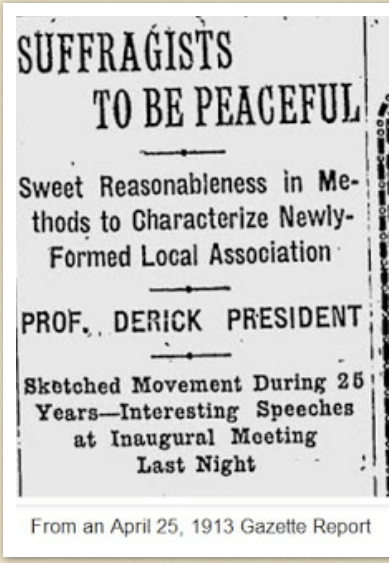
The Montreal Suffrage Association was launched in March 1913 at the height of the Canadian movement. The MSA was led by Miss Carrie Derick, McGill Botany Professor and the former President of the Montreal Local Council of Women. Two other McGill profs were on the Board of the MSA, they were male, of course, along with two church ministers (one of whom was a real Pankhurst hater) and socialite and philanthropist Julia Parker Drummond.

At their inaugural meeting, the MSA promised to conduct a ‘ sweet and reasonable education of the people.”

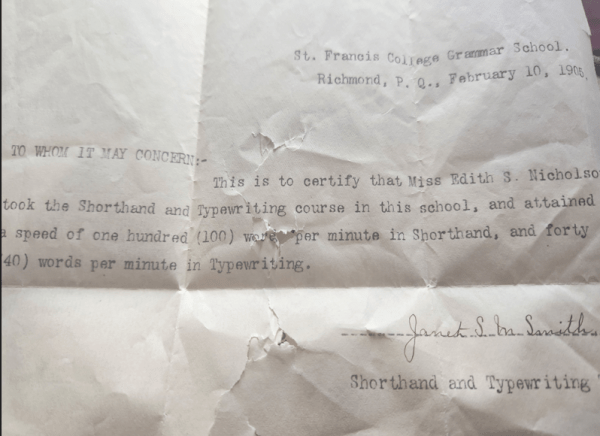
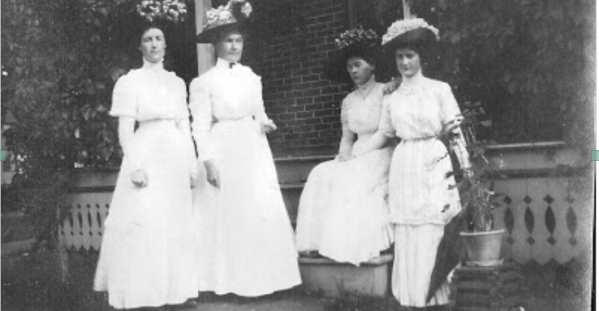
My husband’s great grandmother, Margaret Nicholson of Richmond, Quebec and her three daughters, Edith, Marion and Flora, were not invited to join the MSA, even if the girls lived and worked in Montreal. Even though they attended suffrage evenings sponsored by the MSA.

Still, they were avid supporters of woman suffrage. They left behind (for my own education) many newspaper clippings like the one at top covering all aspects of the topic.

I also have a 1908 letter from Margaret to her husband, Norman, recounting a huge argument she had about the vote with an anti-suffrage preacher relative. ‘I told him we don’t live in St Paul’s time and I don’t milk cows out in the field. ” St Paul was often invoked to prove women’s place is in the home.

Edith writes this in a 1913 letter from Montreal. “We are going to hear Mrs. Snowden (moderate suffragist from England) speak at St James Methodist Church, but she is not militant and for this I am very sad.”

So, she was all for the militant suffragettes, who were at their naughtiest and noisiest in 1913, employing incendiary and sensational tactics “deeds not words” to get their point across and making all the North American news feeds.

Canadian women finally won the vote, in May 1, 1918. A select few, those women with men active at the war front, had been allowed to vote in the infamous – and very undemocratic – conscription election of 1917.

Margaret Nicholson did not have a close relative in the war. She voted for the first time in December, 1921.

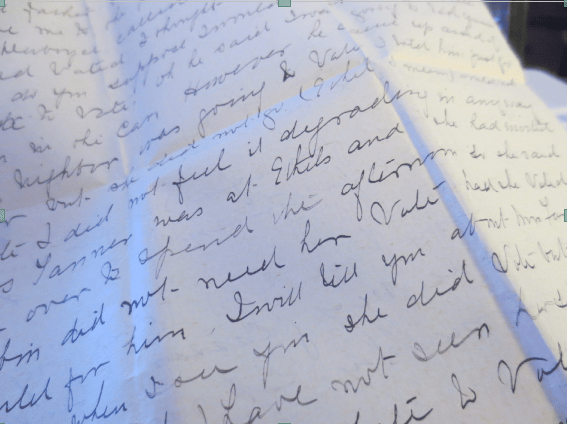
I have that letter too. Here is what she wrote:

December 7, 1921, Richmond, Quebec.

Mr. Fraser and I went down to vote at around 11:30. I did not want anyone calling of me and asking to drive me to the poll. I wanted to go independently. Mr. Duboyce called at about 3:30 and asked me if I had voted. I said, “ Do you suppose I would wait until this late hour to vote?” He was going to take me down in the car. He then came up and asked if my neighbour, I mean Ethel, would go to vote. Well, she would not. Later, I was invited over to Ethel’s. She said Tobin did not need her vote, but if she was going to vote, she would vote for him. Mrs. Farquarson did vote, but seemed ashamed. I have not seen her since. Mrs. Montgomery came last night, but too late to vote.

Of, I am so delighted with this country!

It did not feel degrading in any way.

Margaret Nicholson and her daughters, circa 1910 in their fancy white dresses.
Margaret’s 1921 letter to her husband. “How I love this country..”

If you would like to read more on the weird Montreal Suffrage Movement in 1913, you can find Furies Cross the Mersey on Amazon.ca.

I mix the story of the Nicholsons with the story of Carrie Derick and the Kenney sisters, Sarah and Caroline, who moved from England to Montreal and tried to start a militant movement. They were the sisters of Annie Kenney, Mrs. Pankhurst’s famous first lieutenant. I believe I was the first person to figure this out..thanks to Google News Archives.

If you want to read more about the Canadian suffragists and their involvement in the Conscription election, read my Service and DIsservice, also on Amazon.ca KINDLE.

The Family Genealogist


letterpic

The truth is, family genealogists haven’t changed that much over the years. They are still the one in the family with time on their hands and the fierce determination to stick with it through all the brick walls and misinformation and family myth muddles. They still wonder, when all is said and done, if anyone in the future will value their hard work.

Well, I think future generations will care and something happened to me lately to prove it:

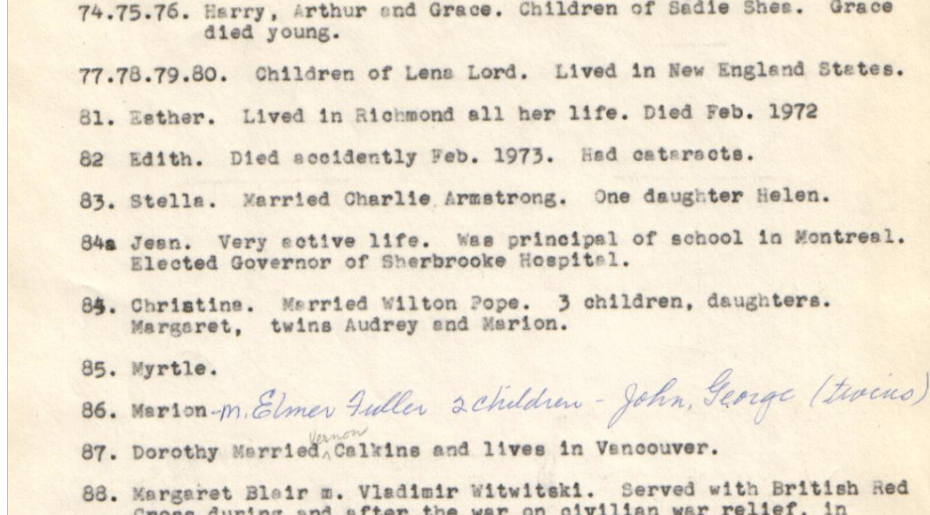
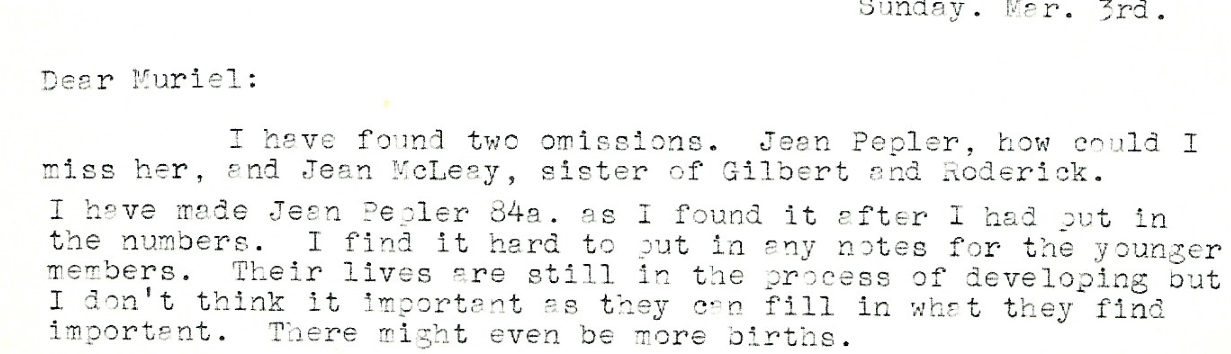
The evidence comes in the form of a letter dated only March 3rd, but I know it must be from the 1970’s. It is from a certain Isabel to a Muriel. The type-written missive appears to be the last in a series on the subject of creating a family tree– and, without ceremony, after the “Dear Muriel” salutation, the letter gets right to the point.

“I have found two omissions, Jean Pepler, how could I miss her? and Jean McLeah. I have made Jean Pepler 84a as I found it after I had put in the numbers.”

Jean Pepler is my husband’s great grandmother’s niece. I know this from a family tree I once had on hand, the McLeod Family Tree, and more particularly from about 300 family letters from the 1908-1913 period, letters I long ago transcribed and published in an online book, A FAMILY IN CRISIS.

But, until recently, when I received this 50 year old note, I did not know anything about Isabel or Muriel

Isabel, the genealogist of the letter, discovers another error. “I just found another error in these family notes. The Millers have two daughters. I forgot Annie…I’ll have to correct it before I send it.”

Yes, like all genealogists, past and present, Isabel has poured a lot of energy into her family project and after she’s typed out the family tree, just when she thinks she’s finished, she finds some errors!

Not wanting to retype the whole tree chart, Isabel merely creates an in-between number for Jean Pepler, an esteemed Quebec educator, to use on the summary list at the of her document.

This wonderful letter was sent to me by my husband’s cousin, Debbi who still lives in Quebec. We didn’t know about Debbi either, not before then.

You see, when my husband got his DNA done a few years ago on Ancestry, he immediately discovered two first cousins (whom he knew very well) and a third cousin, Jean, he didn’t know at all.

He assumed this person was a third cousin because he shared 60 centimorgans of DNA with her, the average amount for third cousins. I contacted the woman to confirm the exact relationship.

My husband and Jean were second cousins once removed, related through my husband’s two times great grandparents John McLeod and Sara Maclean of Uig Carnish, Isle of Lewis Scotland. My husband’s great grandmother, Margaret Nicholson and Jean’s grandmother, Isabella Hill, were sisters living around the corner from each other in Richmond, Quebec in early 1900.

mcleod

John McLeod of Uig Carnish Isle of Lewis, Scotland (Crayon Drawing) and his wife Sarah McLean McLeod, tintype.

These days, due to the Coronavirus, Jean is hunkering down with her daughter, Debbi, and they are passing the time exploring genealogy. Debbi saw my years old note on Ancestry.

“ I’m the one who is most interested in family,” Debbi wrote me. “Can you tell me more?”

So, I sent Debbi my compilation of Nicholson Family Letters that contain numerous mentions of Clayton and Isabella Hill. Clayton was a prosperous stone mason in Richmond who lived in a big house on ritzy College Street. Their son, Stanley, is Jean’s father. Their daughter Isabel (Hill Knott) is Jean’s aunt and Muriel (the letter’s recipient) is Jean’s mother, Stanley’s wife.

Isabel and Muriel were sisters-in-law.

Floraa

Flora Nicholson (1895-1978) my husband’s great aunt, with Stanley Hill and future family genealogist Isabel Hill Knott circa 1906

“Were there any other siblings in the McLeod Richmond family?” Debbi enquired of me. “ I’ve heard of Dan and Flora. Maybe a Mary-Jane, too?”

“I think I remember Mary-Jane from the letters, “ I replied. “ There was also a Christie in Illinois and a Sarah in Sarnia. But, I can’t remember any other siblings.”

I then explained to her that I once in my possession a McLeod family genealogy, neatly tied with shoelaces in a sturdy flip-board cover, but I’ve since misplaced it. Sad!

But, only a few days later, checking out some stored data on some random memory sticks, I stumbled upon some gifs of that same McLeod genealogy. (And, yes, we had missed some siblings!)

I emailed the gifs off to Debbi and that’s when she emailed me back a scan of her Great Aunt Isabel’s March 3rd letter from the 1970’s.

“As you can see, it’s the same genealogy. Jean Pepler is there at 84a!” Debbi wrote in the email.

What a serendipitous string of events had to unfold to marry these two documents, once again, almost half a century later!


peppler

Isabel’s Pepler page with new info added by a relation.

Today, with electronic communications, genealogists have so many tools at their disposal it is simply dizzying. Isabel’s letter reminds us that in the good old days it could take years and years of correspondence by mail or telephone to build a family tree – and typing it out before the age of White Out and word processors was an especially arduous task.

Isabel did, indeed, take a long, long time researching the tree:

“You should see my desk in the kitchen. At least now I can clean it up, getting rid of all the bits of notes I have gathered over the years.”

Isabel says that she spent three weeks at her kitchen table to type out the seven page genealogy.

“As this is all I have done for the past three weeks, I have no news….This has been hard work and has taken a lot of time but that is something I have plenty of.”

Isabel wasn’t sure, in the end, if she had done a good enough job:

“I find it hard to put in any notes for the younger members. There lives are still in the process of developing, but they can fill in what they find important. There might be even more births.”

And like many genealogists, then and now, she wondered if it was all worth the effort.

“What a job! Probably nobody will be interested because we have to accept that the world has changed.”

Well, it was worth the time and effort, Isabel, I can tell you that. Fifty years later many of us still do care. So, thank you for all the hard work you put into piecing together your (well, our) family tree.


Biology and Ambition

marioncanoing

Marion canoeing circa 1907

Marion Nicholson, first year teacher at Sherbrooke High School in 1906-07, is serious about having a career. She is not focused, like so many of her colleagues, on finding a husband or ‘a pupil of one’ as soon possible. Or so she says in her letters home to her mom.

However, Marion’s “strictly private’ pocket diary  from 1907 suggests something else: that the young Richmond-born woman is very much torn between her biology and her ambition. In this little brown journal, eighteen year old Marion often comes off like a flighty Scarlett O’Hara type.

January 12: “Went to a card party and dance at Mrs. Griggs’. Had a grand time. Played cards with Mr. Watson, danced with Mr. Avery, had supper with Mr. Davidson and Mr. Sampson came home with me.” Marion even reflects on this coquettish behavior in a February 19th entry: “I believe I think too much of boys and am a flirt.”

Marion’s busy social life centers around skating parties at a Sherbrooke rink where she obliges many potential suitors – and turns down some others.

That Edwardian winter there are two young men fighting over the ultimate privilege to take Marion home from the ice rink, or the snow shoe club or the local youth hangout: Monty and Gordon.  It does get complicated.

Here’s the entry for January 28: “I slighted Monty by taking off my skates before his turn. He was quite huffy. I guess I will have to go skating with him tomorrow instead of driving with Gordon.”

For Feb 3: “Went to the theatre with Monty. I did not tell Gordon. Gordon was there by himself. He did not look our way the whole time.”

Eventually, this juggling act becomes too much for Marion. “I have decided who I like best and G is the one. I am tired of having two.”

In the spring of 1907, Gordon takes Marion canoeing.  The couple gets caught in a storm on the river and has to take shelter on shore. How romantic!  How promising!

By the time June rolls around,  Marion is getting anxious for the school year to end. It isn’t her work. She is exhausted from all the late nights and ‘dissipation’, as she refers to it in her diary. She returns to Richmond, 30 miles away, to spend the summer with her Mom and sisters.  Here, her social activities center on family friends: the Pepplars, the Clevelands, the McCoys, the Sutherlands and the Crombies.  In 1907, Richmond is a town without any eligible young men. They have all moved away to find jobs.

Marion helps support the family, so she isn’t expected to do work around the house. Most days she is bored silly.  She often sleeps in until noon. She sometimes spends afternoons taking ‘crazy’ photos with her Kodak.

Marion gets down on herself for this: “I think I am about the laziest person alive. All I have the gumption to do is sit and dream of what I would do if I tried. I have wasted two weeks of my vacation doing nothing, when I could have been practicing music or sewing. I hope I improve.”

In Richmond, Marion can go to church, twice a day if she wants. There are frequent afternoon teas hosted by society matrons, daily walks downtown to the mail to see if Gordon has written her, ice cream socials, croquet, tennis, strawberrying and country drives to places like Windsor and Kingsbury by horse drawn carriage.

Town tycoon Mr. Wales is the only Richmond citizen who has an automobile, but that will soon change.

Yes, it is the summer of 1907 (a year on the cusp of some game-changing technological changes)  and the living is far too easy for Miss Marion Annie Nicholson, an energetic young woman who, one day, will lead the PAPT teachers union while supporting four children as a single mom.

According to Marion’s 1907 diary, the most interesting thing to happen to her that summer is when some kittens get into the barn.­­

Oh, and there’s this entry for July 13th :“Lily Lyper nearly murdered. Great excitement.”

Even sleepy Richmond, Quebec had its share of scandals 100 plus years ago.

Mariaon1906sherbrooke

Marion, seated bottom and other Sherbrooke High Teachers 1906

tighsolas

Marion and beau in front of Tighsolas, their house in Richmond, Quebec

Afterward: (added March 14)

Marion did not see much more of Gordon, the son of a wealthy Sherbrooke merchant who would  be making a very good salary, 3,000 a year, in 1911 at the age of 26, this according to the Census.

Gordon married a friend of Marion’s, it seems.  In 1913, Marion married Hugh Blair, the son of a prosperous Three Rivers lumber merchant,  although his parents did not favour the marriage because by that time the Nicholsons were broke.

Marion’s in-laws did not attend the October wedding at the Nicholson residence on Dufferin in Richmond. Marion’s marriage contract was a nasty piece of work  saying she got nothing but the furniture should the marriage break up FOR ANY REASON.

As it happens, Hugh died in 1927. Marion was left high and dry cut out of the Blair family business, so she rolled up her sleeves and went back to work becoming a Master Teacher and WWII era President of the Provincial Association of Protestant teachers in Quebec.

She never re-married, despite having many suitors, such was her sex appeal even in old age. She died of a heart attack in 1948, a few months after representing the Canadian Teachers Association at an UNICEF education conference in Sevres, France. The Editor of the Montreal Gazette (another admirer apparently) wrote her an editorial page eulogy: “With the death of Marian A N Blair, education in Quebec, indeed the entire nation, has suffered  a serious loss. ”

In the end, Marion did have it all, love, work and family. It just came with some major trials and tribulations. Apparently, she never complained.