Regular and Irregular Marriages in Scotland

My dad always said that my grandmother, Elspeth Orrock McHugh, was warm and generous and ready to do anything for the family. I was not surprised to find out that she hosted her sister’s wedding in her home in Dundee, Scotland on November 1, 1901.1 They would have just moved into this home2 and it would have been quite an event in her already busy life.

Elspeth had three young daughters, Anne and Elsie, aged three and two, 3 and Sarah Jane who was just 3 months old.4 Imagine hosting a wedding with three children under the age of three. Then again, the extended family would have been there to help.

Elspeth’s sister, Jemima Kinnear Orrock and Duncan McMillan Bissett had a regular marriage even though it took place in a private home. The certificate of marriage states that it was performed in accordance with the rites of the Church of Scotland and after banns were read,5 sometimes referred to as “crying the banns” or “crying the siller.”6 Banns or proclamations of marriage were read in the church three weeks in a row in case there was an impediment to the marriage.7 It is clear from the information on the marriage registration that this marriage was religious and therefore regular. This is just one of the ways that couples could legally marry in nineteenth century Scotland. In England, marriage was a religious sacrament whereas in Scotland it was a legal contract.8

Scotland’s distinctive marriage laws were based on mutual consent, rather than religious ceremony.9   Even so, the most common type of marriage took place in accordance with the rites of the Church of Scotland. The Marriage Act of 1836 also allowed priests and ministers of other churches and religious groups to perform marriage ceremonies.10 Marriages in accordance with the rites of other religions were also considered regular marriages.

Unlike England, Scotland did not allow civil marriages until an Act of Parliament in 1939.11

Interesting enough, Scotland also allowed other distinctive marriage arrangements, termed irregular marriages, that were considered legally binding and, as noted above, based on mutual consent.

A couple could simply pronounce themselves married in front of witnesses. They could also just pronounce themselves married, but it was more common to have witnesses in case they needed to prove it at some point.12

A promise of marriage, followed by a sexual relationship was also considered a binding legal marriage. Although this had to be backed up by some sort of proof, often by a written promise of marriage.13

And there was also the marriage by ‘habit and repute’ whereby the couple simply presented themselves in public as man and wife. 14

Even though the Church of Scotland frowned upon irregular marriages, it was preferable to ‘living in sin.’ Therefore these irregular marriages were tolerated. Their children were considered legitimate and were entitled to inherit property.15

Any irregular marriage could be registered if the couple presented themselves before the sheriff or magistrate. They usually had to pay a fine. Even though Scotland was tolerant of irregular marriages, they were not common in the 19th century. Most citizens preferred to be married either in church or in accordance with the rites of the church in a private home.16


  1. Scotland’s People web site, Statutory registers Marriages, marriage registration of Jemima Kinnear Orrock and Duncan McMillan Bisett, November 1, 1901, accessed July 31, 2018.
  2. The 1901 census, taken on the night of March 31/April 1, 1901 gives the family’s address as Milbank Road. The registration of Sarah Jane McHugh to Elpeth and Thomas McHugh on August 10, 1901 gives the Fleuchar Street address, the same as the address at which Jemima and Duncan were married. Therefore they would have had to have moved between March and August 1901. See references 3 and 4 below.
  3. Scotland’s People web site, 1901 Census, National Records of Scotland, entry for Thomas McHugh, accessed April 6, 2018.
  4. Scotland’s People web site, Statutory registers Births, birth of Sarah Jane McHugh, August 10, 1901, accessed December 1, 2017.
  5. Scotland’s People web site, Statutory registers Marriages, marriage registration of Jemima Kinnear Orrock and Duncan McMillan Bisett, November 1, 1901, accessed July 31, 2018.
  6. Rampant Scotland web site, Did you know? – Marriage customs in Scotland, http://www.rampantscotland.com/know/blknow_marriage.htm, accessed August 19, 2018.
  7. National Records of Scotland web site, Old Parish Registers – Marriages and Proclamation of Banns, https://www.nrscotland.gov.uk/research/guides/birth-death-and-marriage-records/old-parish-registers/marriages-and-proclamation-of-banns, accessed August 22, 2018.
  8. University of Glasgow web site, School of Social and Political Sciences, Scottish Ways of Birth and Death, Marriages, https://www.gla.ac.uk/schools/socialpolitical/research/economicsocialhistory/historymedicine/scottishwayofbirthanddeath/marriage, accessed August 20, 2018.
  9. Ibid.
  10. Ibid.
  11. Ibid.
  12. Ibid.
  13. Ibid.
  14. Ibid.
  15. Ibid.
  16. Ibid.

Uncle Paul to All

(Updated – “Be Kind” is my new motto and Uncle Paul was one of the kindest people ever!)

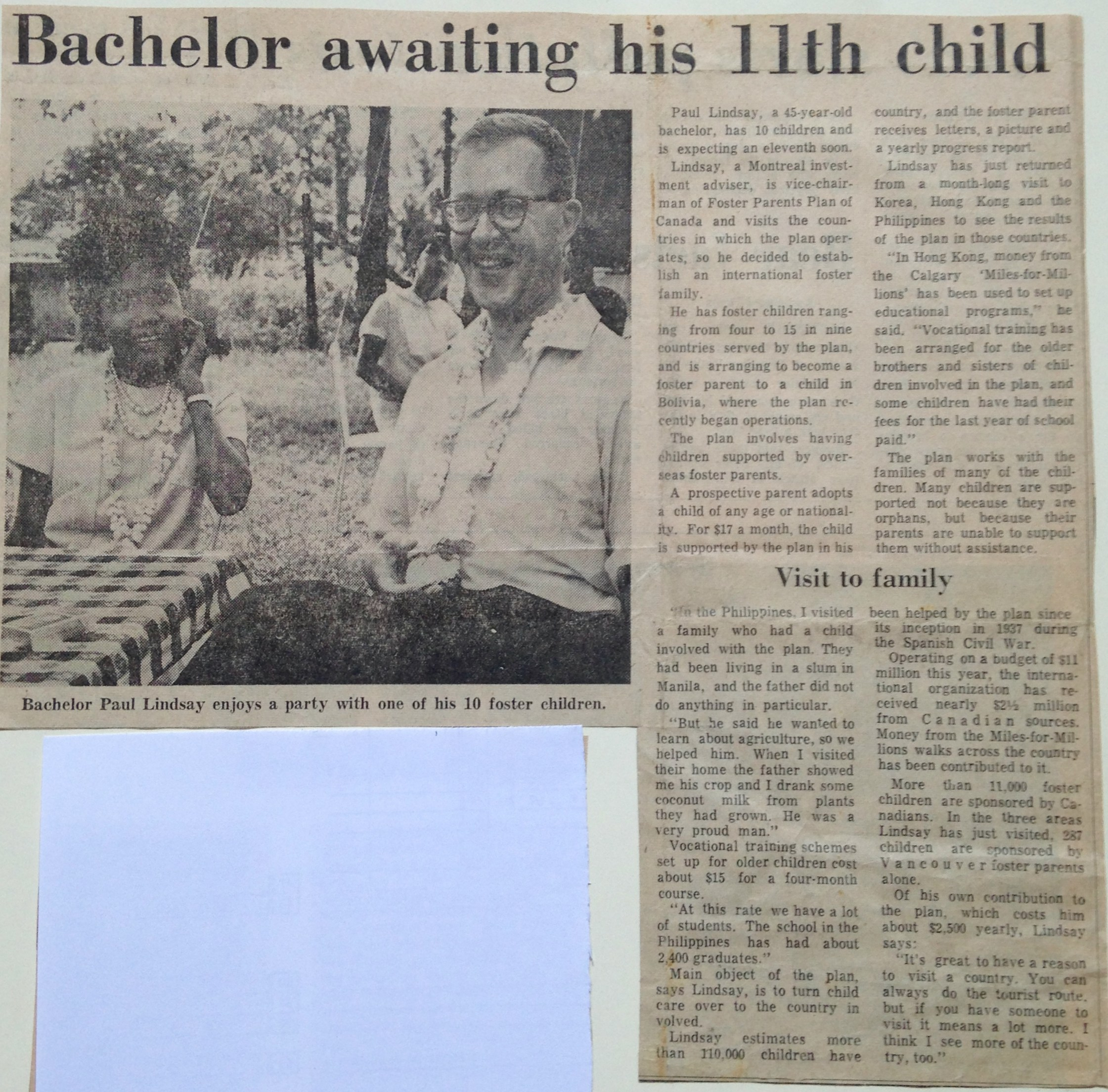
The headline read: “Bachelor awaiting his 11th child”. The 1969 newspaper article covered my Uncle Paul’s month-long trip to Korea, Hong Kong and the Philippines to visit “all his children”[1]. He sponsored his first foster child in 1961 and, eight years later, he had 11 foster children.

IMG_3028
1969 – Uncle Paul travels internationally to visit his foster children.

My uncle, Paul Lindsay (1923-1987), was my mother’s only brother. He was interested in how the money raised by the Foster Parents Plan[2] was spent helping children and their families in developing countries. So, in 1969, he booked the first of several trips at his own expense and visited all his foster children in person. He was greeted like a hero everywhere – sometimes with a banner across the main street reading “Welcome Uncle Paul”.

Foster Kids 1969
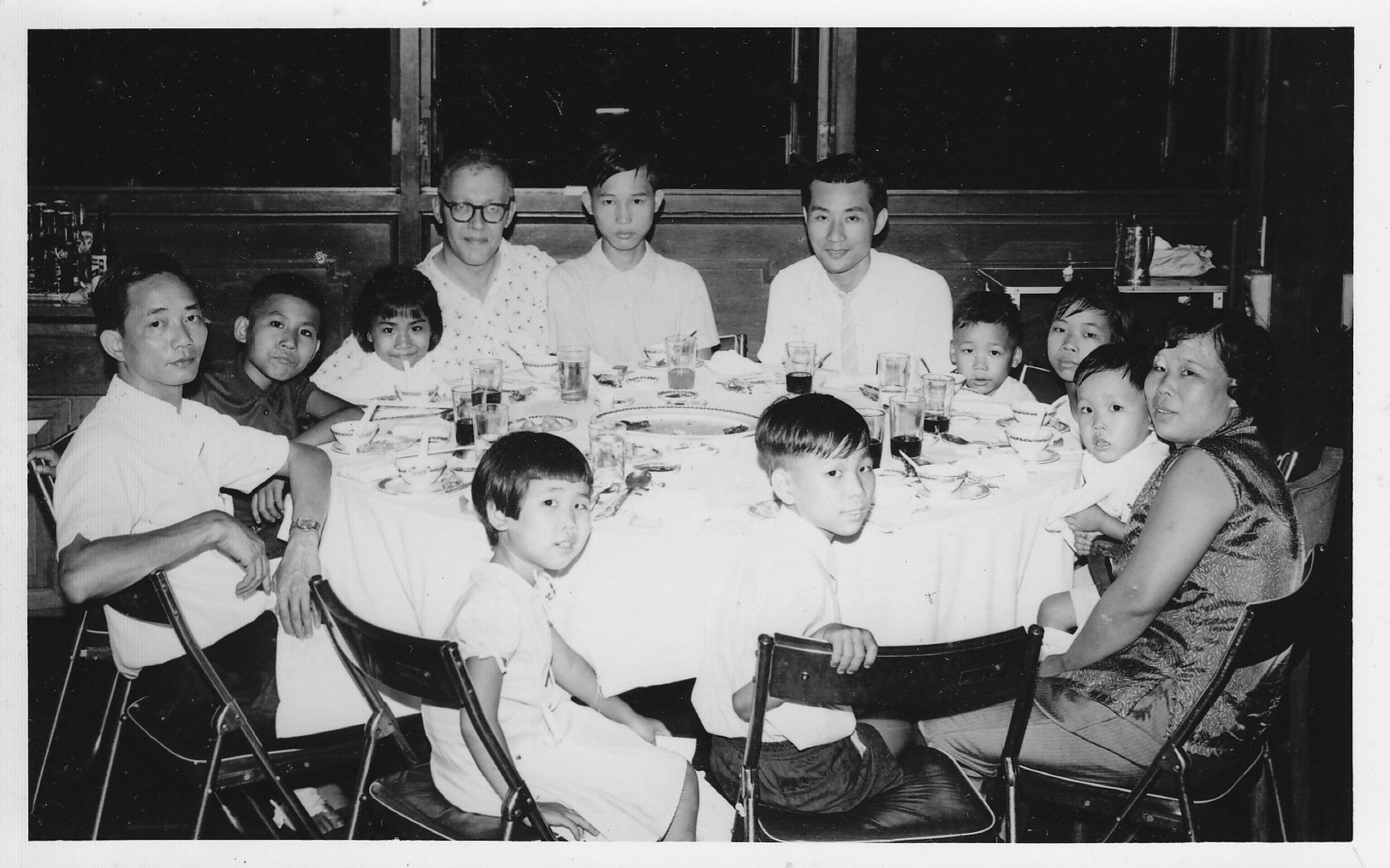
Uncle Paul with some of his foster children and their family.

He served for 20 years as a director of both the Canadian and international organizations of Foster Parents Plan (now known as Plan International).  His ultimate dream was to have two children, a boy and a girl, in each of the areas served by the organization.

Uncle Paul worked as a stockbroker with the Montreal brokerage firm MacDougall, MacDougall, MacTier.  Every weekday afternoon, he left work early and volunteered two hours of his time at The Montreal Children’s Hospital, playing with the kids in the orthopaedic ward. He was much appreciated and recognized as one of their principal volunteers during that time. Years later, I wrote and dedicated a children’s book to him called Bonnie – The Car with a Heart.[3] All proceeds from the sale of the book were donated to the Montreal Children’s Hospital in his memory. But not even “Bonnie” had a heart as big as Uncle Paul!

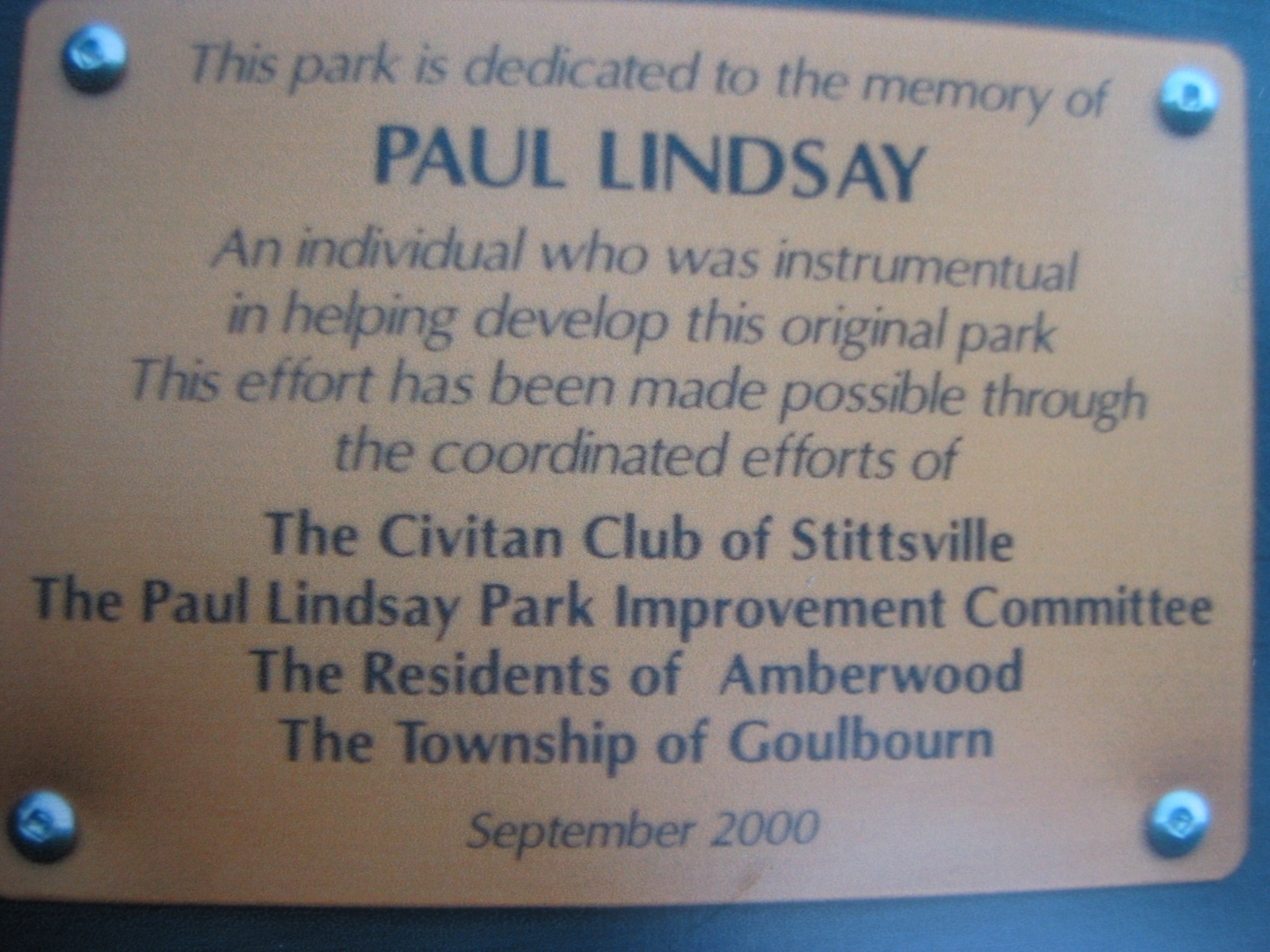
After his retirement in 1983, he moved from Montreal to Amberwood, a small community in Stittsville  just west of Ottawa. He quickly became a well-known member of his new community. One of his proudest moments was being approved as a “block parent” with their official sign posted in his window. In the year 2000, shortly after his death, the local park he helped develop for the neighborhood children was named after him.

Paul Lindsay memorial
Paul Lindsay Park Dedication
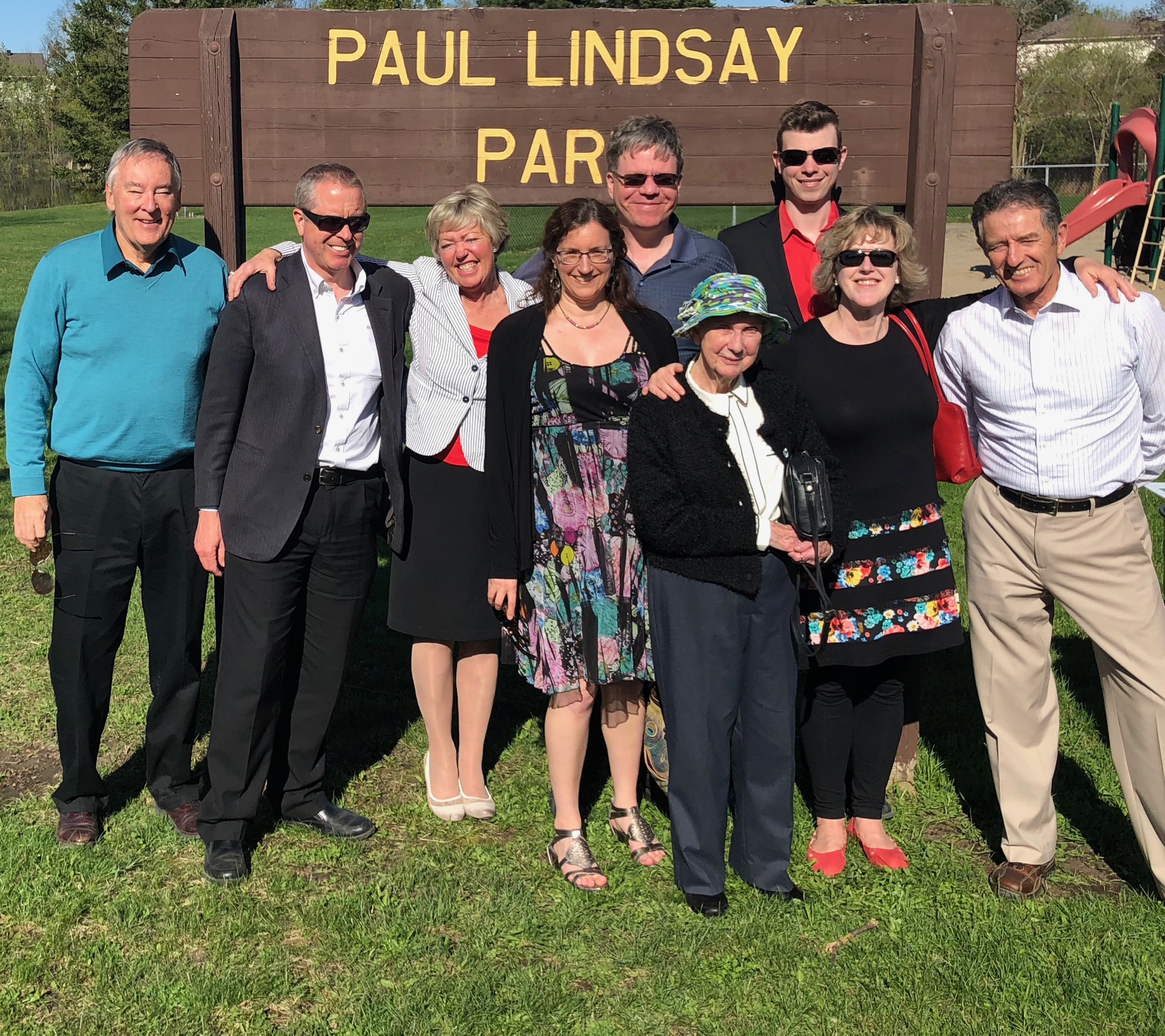
IMG_0839
Uncle Paul’s Nieces, Nephews and Family – May 2018

Another of his passions in life was music, listening to his high-end audio system as well as singing with the Montreal Elgar Choir for 30 Years[4]. When I was very little, he would cup my ear and say my pet name, “Little Lou”, in his deep baritone voice. The vibration tickled and made me shiver with delight.

Uncle Paul loved games! Perhaps it was the child in him. All kinds of games: golf, bowling, cards, Scrabble … and betting games at racetracks and casinos! He had a holiday apartment in the French Riviera (possibly purchased with his casino winnings? Who knows!) When in town, the French children would gather at the local café waiting for “Oncle Paul,” eager for the promised coin or two. I stayed there with him one night in 1974 while backpacking around Europe with a friend. The next day, he bid us “au revoir” both of us with our own bottle of French perfume as a gift.

My cousins and siblings all have fond memories of our Uncle Paul.  We never minded sharing him though; after all, he was Uncle Paul to all!

[1] The Province, Vancouver, BC – August 12, 1969

[2] https://wiki2.org/en/Plan_Canada – as referenced August 12, 2018

[3] Bonnie – The Car with a Heart, written and published by Lucy H. Anglin – September 2010

[4] https://www.thecanadianencyclopedia.ca/en/article/montreal-elgar-choirchorale-elgar-de-montreal-emc/ – as referenced August 12, 2018

Hattie’s Story


IMG_9139
Hattie, Admiral, Hollis, Norman and Jack Bailey abt. 1904.

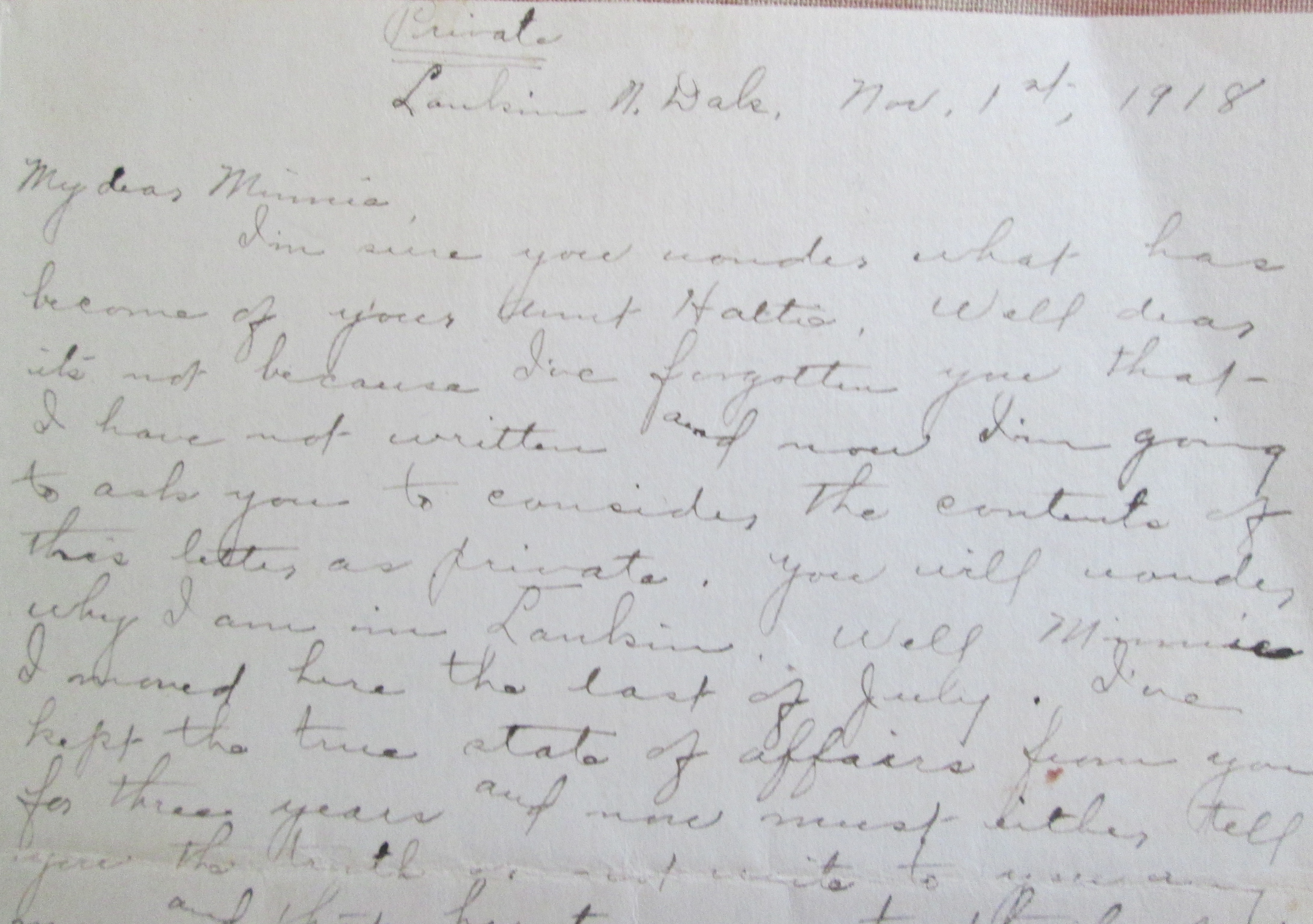
In 1918 Hattie Bailey wrote a letter to her niece, Minnie Eagle Sutherland and marked it “private”. What would you do if you found such a letter? I read it!

My dear Minnie, I am sure you wondered what has become of your Aunt Hattie. Well dear it is not because I have forgotten you that I have not written.”

I had never heard of Hattie until I found her letters. Harriet Anne Stuart was born in Canada in 1876. A few years later her family immigrated to North Dakota. There, Hattie met and married William John Bailey. Jack as he was known, was my great grandmother’s brother. He was born in Toronto and also immigrated to the United States where he began his career in the lumber industry.

IMG_9493
Hattie’s “Private” letter

Jack was a successful man. He started with a carpentry business, then operated a small sash and door factory and later opened a lumber yard in Inkster, North Dakota. He was an Inkster councilman on the 1st council and a pioneer retail lumberman in the upper Mississippi Valley. He was much older than Hattie. They had three sons, Norman, Admiral and Hollis. Jack’s business did well, they had a nice house and life was good or was it?

Jack’s sister Isabella “Bella” Bailey came for a visit. While in Inkster she was ill and bedridden for a number of weeks. The minister, Mr Richmond would often come to the house as his visits really cheered up Bella. Hattie also enjoyed the visits as he was a good listener. “Well the sad thing happened that comes into many lives, we became very fond of each other.” She and Jack had already gone through some rough times, mostly to do with Jack’s drinking. Then one day, Jack came home and overheard the minister comforting his wife. He was “wild with jealousy”. He made Hattie write down everything they had said to each other. Although she thought that was to be the end of it, he then forced the minister to leave the church without even saying goodbye to the congregation. Hattie thought she was forgiven but, “The fire of jealousy burned day and night”. “He fancied that I was immoral and accused me of dreadful things. Never during the friendliness with Mr Richmond was there ever a thought of wrongdoing”.

They continued to live together for a couple of years. Jack never gave her even a dollar and she was forced to earn money by sewing, baking and doing fancy work. Finally, her sons encouraged her to leave Jack as everyone was unhappy. “The boys said I must have the home and their father must live elsewhere.”

Then Jack became sick, he moved back home and she nursed him back to health. During that time he was “his dear old self again”, but as soon as he was well and back to his drink and old associates, life for Hattie became unbearable once more.

 It was hard to avoid Jack in a small place like Inkster so Hattie moved away to Larkin, North Dakota, near her sister Cora. In Larkin, she had a number of boarders to help make ends meet. When she left the family house her youngest son was still in school so he stayed with his father. The two older boys were away, serving in the Army and Airforce during WWI and both parents continued to have close relationships with their sons.

Through all the years Hattie continued to love Jack, they just couldn’t live together. He was on route to spend Thanksgiving with his son Norman when he had a heart attack. He was taken off the train and died in hospital. Hattie was devastated as now they would never get back together. She dreamed about them sitting on the porch in their rocking chairs. “As long as he was living I hoped that someday we would sit side by side and forget all our mistakes of the past.”

Notes:

Letter from Hattie Bailey to Minnie Sutherland from Larkin, North Dakota, November 1, 1918. In possession of the author.

Letter from Hattie Bailey to Minnie Sutherland from Walker, Minnesota December 17, 1930. In possession of the author.

Letter from Norman Bailey to Eliza Jane Bailey Eagle, Amy Eagle and Jim Bailey, Duluth, Minnesota, November 23, 1930. In possession of the author.

Harriet Anne Stuart 1874 -1947.

William John Bailey 1854 – 1930.

Stanley Anthony Savaryn, Staff Sergeant USAF

In the fall of 1945 World War II had drawn to a close. The troops were coming home, rationing was over. It was hoped that the war  was behind us. Nations from around the world gathered together to form the United Nations, their goal, to establish peace in the world, yet there was still unrest on the horizon. Before long, there was another war. This time it was in the Korean Peninsula, which even today, 70 years later has not been resolved. Treaties have not been signed by the North Koreans, the South Koreans and the United States of America, although discussions are still ongoing.
mige

Stanley Anthony Savaryn

Stanley Anthony Savaryn was born on the 16th of August 1931 in South Bound Brook, New Jersey, the son of Stanley Savaryn Sr., a cabinet maker and Rose Luta. Shortly after completing High School, Mige, as he was known by his friends and family joined the United States Air Force. He became a mechanic and served his country for four years. (1950-1954). During this time he was an in-flight refueling operator.

The Americans had a base in Kevlafik, Iceland and most of the refueling of aircrafts was done over Greenland during the Korean War.

planes                                                   In Flight Refueling Operator

“In Flight Refueling Operator – Operates air refueling systems aboard aircraft tanker to refuel airborne aircraft: Confers with receiver aircraft pilot to direct aircraft into air refueling position, using radio. Presses buttons and switches on control panel to extend in-flight boom and connect tanker and receiver aircraft. Presses button to start refueling process. Monitors control panel light to detect equipment malfunctions. Contacts receiver aircraft pilot, using radio to inform pilot of progress being made during refueling, to advise pilot of action necessary to maintain safe refueling position, and inform pilot of steps to be taken during equipment malfunction or emergencies. Calculates in-flight weight and balance status of aircraft and notifies tanker pilot of necessary flight correction..”

 After his tour of duty in the Air Force, Mige returned home and worked as a mechanic. In the summer of 1957 he married my sister, Ruth and they settled in Martinsville, New Jersey and had two sons, Peter and Joey. Mige was a handy man. In his spare time he could be found in his workshop or in fine weather tending to his huge vegetable garden. One of Ruth’s loves was their in-ground pool. Mige kept it pristine.

Mige began working as a purchasing agent for a chemical company and although it was a long daily commute, it still gave him more time to work on projects. He always had a project on the go and if he didn’t, you can be sure Ruth would find one.

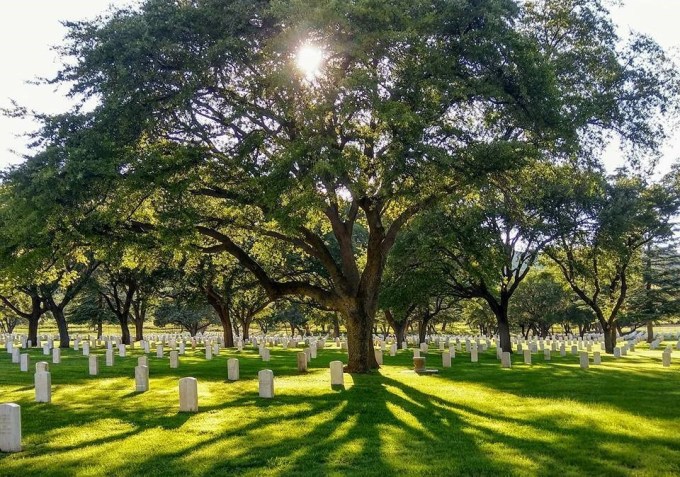
Years went by and Mige never talked about his time in the service and it was only in his later years that he would often think about his buddies who didn’t come home. He informed his sons that he wished to be buried in Arlington National Cemetery outside of Washington, DC. and that my sister, Ruth was to be buried with him.
arl cem

Arlington National Cemetery Photograph by Paul Lindell

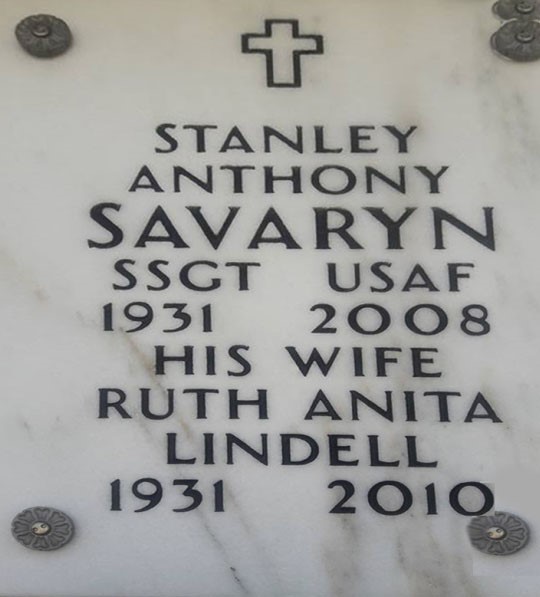
Mige passed away in November of 2008 and Ruth followed him in February 2010. It took quite some time to plan the burial ceremony. November 1, 2012, a bright sunny autumn day, we gathered in Arlington National Cemetery to witness an emotional ceremony. There was a twenty-one gun salute, the playing of taps in the distance and the traditional folding and presentation of the flag to the oldest family member of the immediate family. In this case it was my nephew Peter, their oldest son. We then made our way to the columbarium section and placed several items within. I asked nephew Joe to place a Canadian dime with the ‘Bluenose’ in the columbarium for the couple to sail away to Paradise and in honour of Mige’s service, a Canadian Quarter with the bright red poppy in the centre was also placed beside the dime.

 colum

Photograph by Claire Lindell

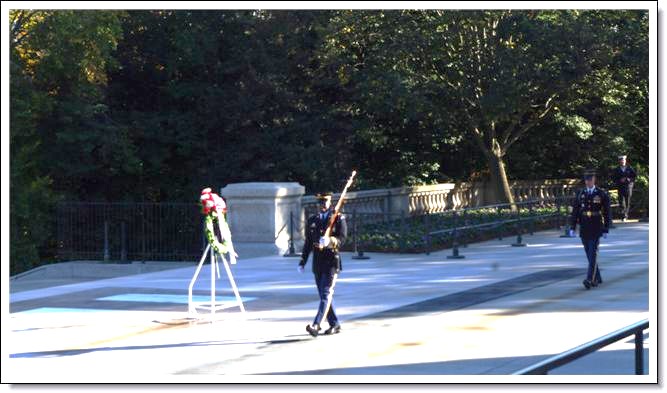
Our day was not over. We made our way to the Tomb of the Unknown Soldier and the Changing of the Guard. There, while witnessing the changing of the guard we experienced tearful moments watching, with many others, as the soldiers honoured their fallen comrades. It was a very moving tribute that is repeated continuously day in day, day out.

 unknown

Tomb of the Unknown Soldier  –  Changing of the Guard

Photograph by Claire Lindell

 Sources:

https://higginsfuneralhome.com/tribute/details/1844/Stanley-Savaryn/obituary.html 

https://www.bing.com/search?q=public+photos+of+aircraft+refueling&form=EDGSPH&mkt=en-ca&httpsmsn=1&refig=12e67f9c30554fce80eaddba38630a75&sp=-1&ghc=1&pq=undefined&sc=0-19&qs=n&sk=&cvid=12e67f9c30554fce80eaddba38630a75 

https://arlingtoncemetery.mil/Explore/Changing-of-the-Guard

https://arlingtoncemetery.mil/Portals/0/Web%20Final%20PDF%20of%20Brochure%20March%202015.pdf