All posts by Janice Hamilton

Janice Hamilton is a Montreal-based writer, genealogist and photographer.

The Miller of Moneymore

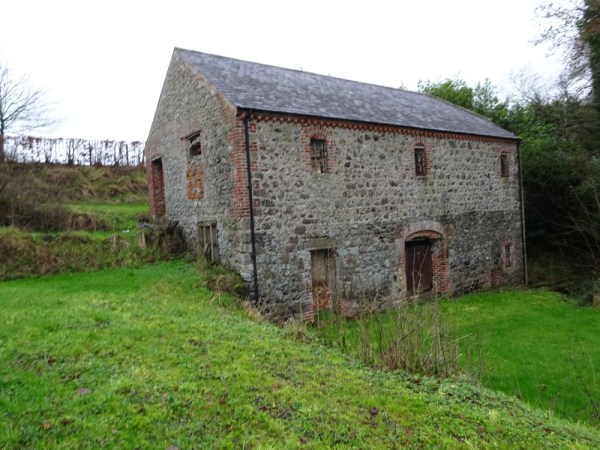
If you are looking for the old corn mill in Moneymore, Northern Ireland, turn off High Street in the village centre and go to the end of Mill Lane. It’s right there, although you might not guess that old stone building was once a busy mill since the water wheel has gone and the water that powered it flows in an underground river.

the old corn mill at Moneymore. Photo courtesy Sebastian Graham, http://www.millsofnorthernireland.com

Long ago, this corn mill (corn refers to oats in Ireland) was a very important building in the community: this was where people brought their oats, wheat, barley, and rye to be ground into flour. In the mid-1700s, my five-times great-grandfather Benjamin Workman was probably well-known in Moneymore because he was the local corn mill operator.

His great-grandson recounted the family’s history in a journal, written around the 1850s.1 He explained that Benjamin’s father, William, had a mill (probably a flax mill) and a farm at Brookend, County Tyrone, several miles south of Moneymore. Benjamin inherited the Brookend property from his father, but he was unhappy there because he didn’t get along with the neighbours.

When Moneymore needed a new miller, Benjamin left Brookend and took the job in town. He was not the owner – he rented the mill from the Drapers’ Company of London, which owned most of the property in the area – but everyone paid him to grind their flour.

It was a good move for Benjamin, and for the area residents. According to the journal account, when he died around 1767, he was mourned by Protestants and Catholics alike.

This story may be backed up by historical data: the 1766 Religious Census of County Derry confirms that Benjamin Workman, Protestant Dissident (in other words, Presbyterian,) was a landholder in Moneymore Townland, Barony of Loughinsholin, Derry County.2 An earlier census of Protestant householders in Ulster, carried out in 1740, showed there were several individuals with the name Workman in the area.3

Benjamin Workman, miller of Moneymore, and his wife (whose name is unknown) had at least one son, also named Benjamin. According to the journal, he succeeded to the business and property interests in Moneymore, and, like his father, he died at an advanced age.

This Benjamin married Ann Scott and the couple had four sons and two daughters. All but one of them left Ireland, although two returned and settled in other parts of the island. Only daughter Letitia stayed in Moneymore. According to the journal, she married, first, a man named Scott, with whom she had a daughter, and second, a man named McIvor. Letitia had five more children with her second husband. She died in Moneymore in 1832.4

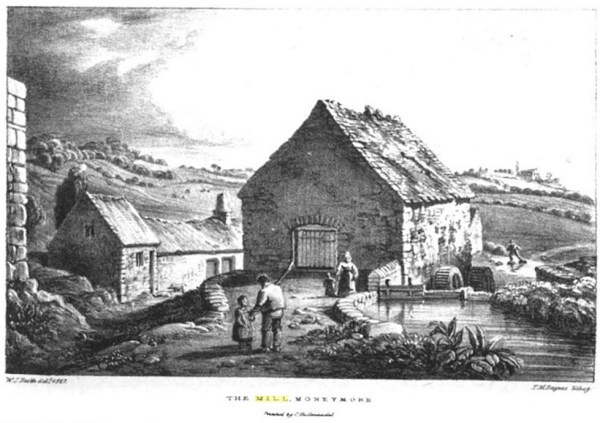
Caption: This illustration of the Moneymore corn mill accompanied an 1817 report on the plantation. The mill had a thatched roof and two water wheels, which was unusual and ineffective.

That is all I was able to discover about the Workman family in eighteenth-century Moneymore, so my curiosity turned to the mill and the town itself

More than 5000 mills were built in Northern Ireland, including 510 in County Derry (Londonderry) and 573 in neighbouring County Tyrone. There were several types, including corn, or grist mills, flax mills (flax is the plant that is used to make linen) and tuck mills (used to remove impurities from woolen cloth). Today, many have been demolished while others lie neglected, but studying them reveals much about the industrial and architectural history of the area.    

Moneymore’s corn mill was originally built around 1615, about the time Moneymore was founded. One and a half storeys high and 34 feet long, it was built almost entirely of wood, with a shingled roof. The smith at Moneymore provided most of the iron nails and fittings, the spindle shaft was manufactured in Ireland and other components were imported from London.5

It was rebuilt in 1785, but when a report was prepared on the plantation at Moneymore in 1817, the mill was found to be inefficient and in need of more repairs.Now, Sebastian Graham of the Mills of Northern Ireland heritage group, told me in an e-mail, “the mill is technically still there, but heavily changed. It became a flax mill as well as a corn mill around 1860 or so, and then a creamery.”

As for the village of Moneymore, located west of Lough Neagh, it was founded in the early 1600s as a part of a scheme to populate Ulster with Protestant settlers from England and Scotland. Ulster was the name of the northeastern part of the island of Ireland, now Northern Ireland and part of the United Kingdom. For decades, the English army fought the native Irish forces, but things turned in favour of the English at the end of the 16th century. The English confiscated the properties of the Irish chieftains in Ulster and, in 1608, launched a plan to create the Plantation of Ulster.

English and Scottish landlords were granted vast estates. In return, they were required to build towns, fortifications and houses, and to bring settlers to the area. They leased out properties of about 15 acres each, including cultivated land, turf-bogs and rough pastures, to tenant farmers.

The project required investors with deep pockets. The plantation of Moneymore was the property of the Drapers’ Company, a London trade association of wool and cloth merchants that had been founded in medieval times.

Like several other plantation-era villages, Moneymore was planned in a cruciform shape, with a marketplace at the intersection of two main streets. Proclamations were read out to the residents next to a tall wooden pole located beside the marketplace.  

From the beginning, however, the Drapers did not meet all the goals the government in London had set out. The fortifications at Moneymore were poorly built, the houses were tiny and the native Irish population remained larger than the number of settlers. Surveys carried out in the early 1800s found the manor house was in bad shape, as were the mill and the tenants’ cottages.

Today, the manor house has been restored and Northern Ireland is peaceful. As I researched this topic, I discovered my husband and I visited the area near Moneymore in 2008, before I began researching my family history. If only I had known!

This story is also posted on my family history blog, http://www.writinguptheancestors.ca

Sources

1.  Dr. Benjamin Workman, A Family Orchard: Leaves from the Workman Tree, Part 1. The Determinate Branch of the Compiler. Family History, Branch Introduction. https://freepages.rootsweb.com/~database/misc/WORKMAN.htm, accessed May 6, 2025. 

2.  1766 Religious Census for some parishes in Co. Derry, https://www.billmacafee.com/1766census/1766religiouscensusderry.pdf, Bill Macafee’s website, Family and Local History, Databases compiled from 18th Century Census Substitutes, https://www.billmacafee.com/18centurydatabases.htm, accessed May 6, 2025.

3.  Ireland, Ulster, Census of Protestant Households, 1740, results for Workman, Ancestry.com, https://www.ancestry.ca/search/collections/62769/?name=_Workman&count=50, accessed May 6, 2025.

4.  Death notice for Letitia McIver; Belfast, Northern Ireland, The Belfast Newsletter, Birth, Marriage and Death Notices, 1735-1925, notice for Letitia McIver, Ancestry.com,  accessed May 7, 2025, https://www.ancestry.ca/family-tree/person/tree/117115991/person/432122459458/facts

5.  Philip Robinson, The Plantation of Ulster, Belfast: The Ulster Historical Foundation, 1994, p. 146.

6.  Reports of the Deputations of The Drapers’ Company of Jan. 23, 1817, … Estates of the Company in the County of Londonderry, in Ireland. Google Books. Accessed May 7, 2025. P. 32.

Benjamin Workman, MD: Leading the Way

One spring day in 1819, a young man named Benjamin Workman stood on the dock at Belfast, Ireland, trying to decide where he should immigrate to in North America. He had relatives in the United States, but before he booked his passage, he wanted to check on the safety of the vessels that were scheduled to leave soon.

He noted that the captain of the New Orleans-bound ship appeared to be drunk, the mate of the ship going to New York swore profusely, and the crew of vessel going to Philadelphia ignored his questions, but the captain of the Sally, bound for Quebec, impressed him favourably, so that’s the ship he chose. He later noted that this had been a lucky choice since yellow fever was widespread in American port cities that year.1

Benjamin left Ireland on April 27 and arrived in Montreal a few weeks later. He was 25 years old and had 25 guineas (a coin worth one pound, one shilling) in his pocket.

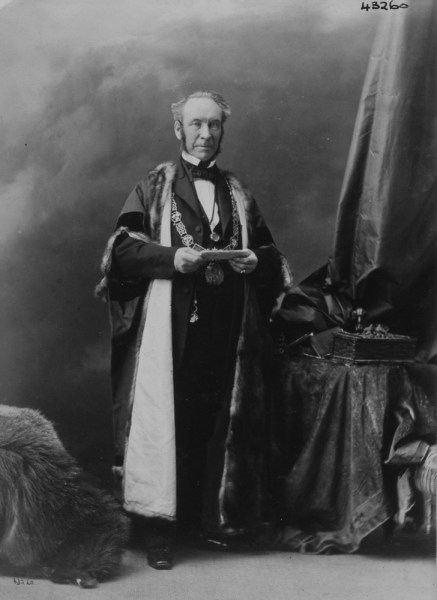
This photo of Dr. Ben Workman appears in Christine Johnston’s book The Father of Canadian Psychiatry, Joseph Workman

His choice of Canada turned out to be a good decision: within 10 years, all of his eight younger siblings and both of their parents had followed him. The Workmans were all hard-working, ambitious and smart, and they took advantage of the opportunities available to them in their new homeland. Four of Ben’s brothers (Alexander, Joseph, William and Thomas) became prominent in business, medicine and politics. His only sister, Ann (1809-1882), married Irish-born Montreal hardware merchant Henry Mulholland and was my great-great-grandmother.

Benjamin’s parents were Joseph Workman (1759-1848) and Catherine Gowdey (1769-1872). Ben was born on Nov. 4, 17942 in the village of Ballymacash, County Antrim, near Lisburn, where the family lived in a small house near the top of a hill.  

Joesph was a teacher in Ballymacash, but he left teaching for a job as a manager for a local landowner, and as a deputy clerk of the peace for the area. Without its only teacher, the local school had to close, so young Ben started studying on his own, reading the Bible and geography books while his father helped him with arithmetic. When Ben was 11, Joseph apprenticed him to a linen weaver, but it soon became clear that Ben had no talent in that field. What he really wanted to do was study. Eventually, Ben went back to school, where he excelled in grammar and the classics. After he graduated, he found a teaching job in Belfast, then another position near Lisburn.   

Ben’s decision to leave Ireland was influenced by an event that took place in 1817. As he was eating his evening meal at his parents’ home, a dozen beggars came in the gate and asked for food and money. Perhaps realizing how widespread poverty was in Ireland, he began to think about going to North America.3

Montreal suited Ben well: other Irish and Scottish immigrants arrived there around the same time, and there were work opportunities for all. He immediately found a teaching job, but after that school’s owner disappeared with its funds, several parents who had noticed what a good teacher Ben was started a new school, with Ben as headmaster.

The Union School, as it was called, was unique. For one thing, girls were admitted, although they were taught separately by a female teacher. It was also successful. By the spring of 1820, it had 120 pupils, and it remained the largest English school in Canada for 20 years.4 Several of its graduates went on to have distinguished careers in business and politics. In 1824, Ben became the sole owner of the school, but he eventually turned over the responsibility of running it to his brother Alexander, who had come to Montreal in 1820.

In 1829, Benjamin switched careers and became a newspaper editor, partnering with a friend to purchase a weekly Montreal newspaper, the Canadian Courant. It had been founded in 1807 as the Canadian Courant and Montreal Advertiser. Ben published the newspaper until 1834, using it to promote his liberal religious views, social welfare issues, and the temperance movement. When the paper ceased publication, Ben blamed distillers, saying that their advertising had dried up because of his support for temperance.

Meanwhile, Ben experienced several tragedies in his personal life, as he was married twice and became a widower twice. He married Margaret Manson, a teacher at the Union School, in 1823. The couple had no children and Margaret died seven years later. He married Mary Ann Mills on October 14, 1838, in Franklin, Michigan, and the couple had three children: Mary Matilda, born in July 1840; a son, Joseph, who was born in November 1841 and died at age 10 months; and Annie, born in July 1843. Mary Ann died two months after Annie’s birth, and Ben’s mother, Catherine, looked after his two daughters.

Soon after that, Ben took up his third career — as a druggist. For several years in the 1840s, Lovell’s city directory of Montreal listed “B. Workman & Co., chemists and druggists”, located at 172 St. Paul Street, corner Customs House Square.5 Meanwhile, he studied medicine at McGill University, graduating in 1853, at age 59. He was henceforth known as Benjamin Workman M.D., which helps differentiate him from several other Benjamins in the family.

During these years as a pharmacist and doctor, Ben demonstrated compassion and generosity, often providing care to people who were too poor to pay. Then, in 1856, he reinvented himself again and moved to Toronto, where he assisted his brother Joseph run the Provincial Lunatic Asylum, the largest and most progressive psychiatric hospital in Canada at the time.

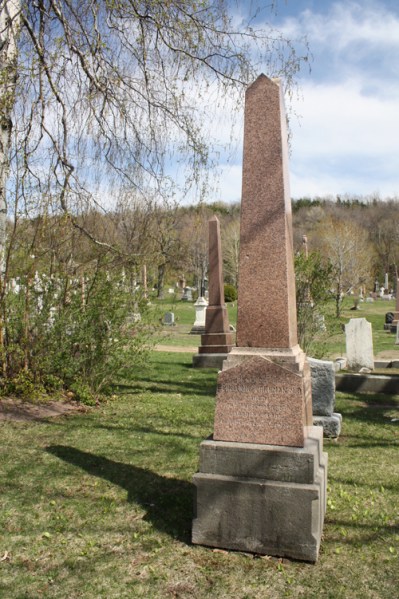
Benjamin is buried in Montreal’s Mount Royal Cemetery, near the Workman family plot. JH photo.

Benjamin Workman is probably best remembered as the founder of the Unitarian Congregation in Montreal.  In Ireland, the Workman family had attended the Non-Subscribing Presbyterian Church of Ireland in Dunmurry. Its members strongly believed in freedom of thought in religion.6

When Ben first arrived in Montreal, there were not enough Unitarians to organize a congregation, so he attended the St. Gabriel Street Presbyterian Church. When the city’s Unitarian congregation was permanently established in 1842, he played a key role.7

In 1855, Ben got into a disagreement with the congregation’s minister, Rev. John Cordner, a man he himself had recruited for the job. Benjamin argued that Cordner had excessive authority, and when the rest of the congregation sided with their minister, Ben withdrew from the church. Soon after, he moved to Toronto, joining the Unitarian congregation his brother Joseph had helped to found there. He got along well with the Toronto congregation’s members and their minister, and he ran the Sunday School there for many years.

Ben lived with his daughter Anne in Uxbridge Ontario at the end of his life, dying there on Sept. 26, 1878, several weeks short of his 84th birthday. He was buried a few days later next to the large Workman family plot at Montreal’s Mount Royal Cemetery.

This article is also posted on http://www.writinguptheancestors.ca.

See also:

Janice Hamilton, “Dr. Joseph Workman, Pioneer in the Treatment of Mental Illness” Writing Up the Ancestors, Oct 26, 2017, https://www.writinguptheancestors.ca/2017/10/dr-joseph-workman-mental-health-pioneer.html

Janice Hamilton, “Henry Mulholland, Hardware Merchant” Writing Up the Ancestors, March 17, 2016,  https://www.writinguptheancestors.ca/2016/03/henry-mulholland-montreal-hardware.html

Notes:

The children of Joseph and Catherine Workman were: Benjamin (1794-1878), Alexander (1798-1891), John (1803-1829), Joseph (1805-1894), William (1807-1878). Ann (1809-1882), Samuel (1811-1869), Thomas (1813-1889), Matthew Francis (1815-1839).

Benjamin kept a journal in which he recorded his memories of growing up in Ballymacash, and an account of the Workman family’s 200-year history in Ireland.  A large online database called A Family Orchard: Leaves from the Workman Tree, https://freepages.rootsweb.com/~database/misc/WORKMAN.htm, includes a family history going back to the 1600s, that was part of Ben’s journal. The late Calgary researcher Frederick Hunter prepared this site and database. 

Catherine Gowdey’s name has been spelled in various ways, including Gowdie and Gowdy.

Thank you to Christine Johnston, former archivist and historian of the First Unitarian Congregation of Toronto, and author of a biography of Ben’s brother Joseph.

Sources: 

1. Christine I. M. Johnston, The Father of Canadian Psychiatry: Joseph Workman, Victoria: The Ogden Press, 2000, p. 16.

2. A Family Orchard: Leaves from the Workman Tree, https://freepages.rootsweb.com/~database/misc/WORKMAN.htm, accessed Jan. 31, 2025.

3. The Digger, One Family’s Journey from Ballymacash to Canada, Lisburn.com, http://lisburn.com/history/digger/Digger-2011/digger-19-08-2011.html, accessed Jan. 31, 2024.

4. Nicholas Flood Davin, The Irishman in Canada, London: S. Low, Marston, 1877, p. 334, Internet Archive, https://archive.org/details/irishmanincanada00daviuoft/page/334/mode/2up, accessed Jan. 31, 2025.

5. Lovells Montreal Directory, 1849, p. 246, Bibliothèque et Archives nationales du Québec (BAnQ), https://numerique.banq.qc.ca/patrimoine/details/52327/3652392, accessed Jan. 31, 2024.

6. Christine Johnston, The Father of Canadian Psychiatry: Joseph Workman, p. 15.

7. Christine Johnston. “The Irish Connection: Benjamin and Joseph and Their Brothers and Their Coats of Many Colours,” CUUHS Meeting, May 1982, Paper #4, p. 2.

Mulholland Bros. Hardware Merchants

In 1878, two brothers from Montreal opened a hardware store in Winnipeg, Manitoba. The Prairie city, known as the “gateway to the west,” was growing rapidly, and for several years the store appears to have been profitable, however, it went bankrupt in 1889. After that, the brothers’ lives took very different paths.

Mulholland Bros. Hardware Merchants was owned by Joseph Mulholland (1840-1897) and his younger brother Henry (1850-1934). Hardware must have been an easy choice for them since their father and several of their uncles had been very successful in the hardware business.  

Their father, Henry Mulholland (1809-1887), was born in Lisburn,1 near Belfast in the north of Ireland, and immigrated to Montreal as a young man. He soon found employment with a wholesale and retail hardware firm owned by Benjamin Brewster. By 1851 he was a partner in the Brewster and Mulholland hardware company. He later went into partnership with a member of the extended Workman family, Joel C. Baker. The hardware firm of Mulholland and Baker was in business from 1859 to 1879.

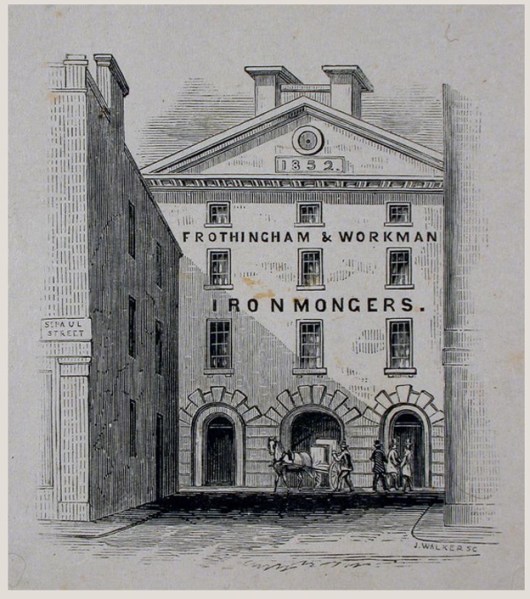
Henry Mulholland senior married Ann Workman (1809-1882) in Montreal in 1834. The Workman family had also come from the Lisburn area. Four of Ann’s brothers were in the hardware business, including William Workman (1807-1878) and Thomas Workman (1813-1889),who were partners in the firm of Frothingham and Workman, reputed to be the largest wholesale hardware company in Canada. The country’s population was growing, and hardware and building materials were in great demand.  

Henry and Ann Mulholland had several children who died very young, but two daughters (Ann and Jane) and three sons (Joseph, Henry and Benjamin) lived to adulthood. Both daughters remained in Montreal. Ann married Dr. George Henry Wilkins, while Jane and her husband, banker John Murray Smith, were my great-grandparents. Son Benjamin died of tuberculosis in Toronto in 1882.

The 1870 Canadian census found Joseph, 29, and Henry, 19, living in Montreal with their parents. Joseph was identified as a merchant, probably employed by his father’s firm. According to one newspaper account, he lived in Guelph, Ontario for a time prior to going to Winnipeg.2 Henry also worked for the family-owned hardware companies at the beginning of his career. Then, in 1878, Joseph and Henry headed to Manitoba. Many families were doing the same thing, attracted by the vast expanses of prairie farmland

The city of Winnipeg, incorporated in 1873, was a service center for the surrounding grain farms and, about a decade later, it became an important stop on the newly built Canadian Pacific Railway. The first CPR train steamed into the city in 1886. Optimists envisioned Winnipeg as a future “Chicago of the North”. In 1873, the city had a population of about 1900 people; that had risen to 8000 by 1881 and 42,000 in 1901.

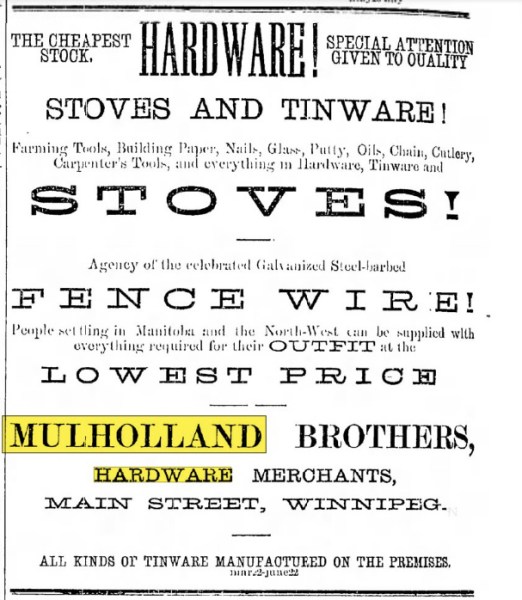
When Joseph and Henry opened their Winnipeg store in 1878, it faced stiff competition, and the large newspaper advertisement announcing the opening of Mulholland Bros. ran alongside ads from several other hardware stores. Over the next few years, the newcomers focused on basic items like fencing wire and wood stoves.

The store advertised regularly in the local newspapers. source: Manitoba Free Press, p. 4, May 26, 1880, Newspapers.com

Running a business with a sibling had its challenges. In a letter to his father in 1884, Henry must have mentioned that he and Joseph did not see eye to eye on a bookkeeping entry. Henry senior replied, “Joseph is a good-hearted, generous fellow, and I trust that you and he will get on cordially together, as it will be for your natural interest to continue the business without any wrangling and refer any differences of opinion between you and him to your Uncle Thomas [Workman] and me who have had long experience in co-partnership businesses and in keeping accounts between the copartners.”3

Henry senior continued to offer sensible advice and encouragement: “I am glad to hear that you are making no bad debts and that you have no large accounts due to you in the books and that your stock is well selected and next to this never be tempted to offer any customer to increase his indebtedness by selling him more goods on credit in hope of obtaining payment of a past due debt.”

It appears that Joseph was the more outgoing sibling. His name appeared frequently in Winnipeg newspapers as he was involved with the Board of Trade. He was for a time president of the Winnipeg Liberal-Conservative Association, and he was briefly a candidate for mayor of Winnipeg, but withdrew his name. Several newspaper clippings following his death described him as a very likeable fellow. 

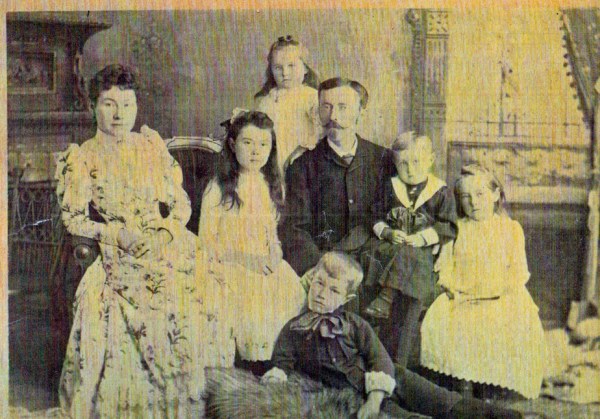
Meanwhile, Henry’s name never appeared in the newspapers, so perhaps he was the quiet one, busy running the store. It is also possible he was distracted by family obligations. Henry was married to Ontario-born Christina Maria Shore and the couple had six children.

Henry and Christina Mulholland and five of their six children. source: Mulholland family collection.

On June 25, 1885, Mulholland Bros. ran an ad in the Manitoba Daily Free Press listing the many new items they had in stock, including blacksmith and livery stable supplies as well as articles for barbers, butchers, hunters and gardeners. They also carried bird cages and ivory-handled table knives.

Few of Winnipeg’s citizens were wealthy, the local economy was dependent on a good grain harvest, and shipping costs to Winnipeg were high. The business may have over-extended its inventory. In February 1889, a bankruptcy sale notice for Mulholland Bros. appeared in the paper, listing egg boilers and dog collars among the many items to be disposed of.4

Joseph returned to Montreal and, in 1890, he married Amelia Bagg (1852-1943). Amelia had inherited Montreal real estate from her father, Stanley Clark Bagg, and she was an independently wealthy woman. She was generous to family members in need, and in return, she was loved and respected by members of both the Bagg and Mulholland families. For Joseph, marriage to Amelia not only brought companionship, it also brought him a job in the Bagg family business as a real estate agent.

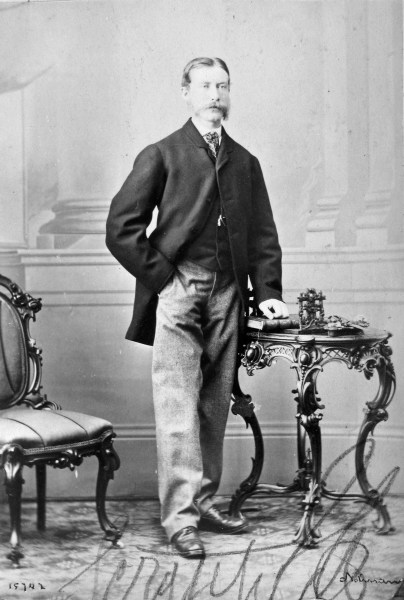
Joseph Mulholland, Montreal, QC, 1865, source: William Notman, I-1757421, McCord Stewart Museum

His good fortune did not last long, however. Joseph died of heart failure brought on by extreme heat in Montreal on July 15, 1897.5

As for Henry, after the Winnipeg store failed, he remained in Manitoba for a time — the family was still there in 1891 when the census was taken — but they eventually moved to Toronto, where Henry continued to work as a hardware merchant. After his death, his youngest son, Toronto lawyer Joseph Nelson Mulholland, commented that Henry had never regained his stride following the bankruptcy.6 When Henry died in Toronto in 1934, at age 84, his obituary did not mention the Winnipeg venture.7

A special thank you to a distant cousin who reached out to me recently with a question about his ancestor Henry Mulholland. Until then, I had never heard about Henry and had no idea Joseph had run a hardware store in Winnipeg.

This article is also posted on my personal family history blog, http://www.writinguptheancestors.ca

See also:

Janice Hamilton, “Henry Mulholland, Montreal Hardware Merchant”, Writing Up the Ancestors, March 17, 2016, https://www.writinguptheancestors.ca/2016/03/henry-mulholland-montreal-hardware.html

Janice Hamilton,  “The Life and Times of Great-Aunt Amelia”,  Writing Up the Ancestors, June 21, 2023, https://www.writinguptheancestors.ca/2023/06/the-life-and-times-of-great-aunt-amelia.html

Janice Hamilton, “The World of Mrs. Murray Smith”,  Writing Up the Ancestors, Feb.24, 2016, https://www.writinguptheancestors.ca/2016/02/the-small-world-of-mrs-murray-smith.html

Sources

  1. “The Late Mr. Mulholland”, The Montreal Star, Feb. 19, 1887, p. 8, Newspapers.com, https://www.newspapers.com/image/740882983/?match=1&terms=Henry%20Mulholland
  • 3. Letter from Henry Mulholland sr. to Henry Mulholland jr., Dec. 8, 1884, Mulholland family collection.
  • 5. “Late J. Mulholland. a man who was cordially liked by many friends in this city”, The Winnipeg Tribune, July 10, 1897, p. 5, Newspapers.com,
  • 6. Letter from Nelson Mulholland to Fred Murray Smith, June 22, 1943, Mulholland family collection.

7. “Henry Mulholland Dies in Toronto”, Montreal Daily Star, Nov. 12, 1934, p. 17, Newspapers.com, https://www.newspapers.com/image/741983911/?match=1&terms=Henry%20Mulholland

The Spiritualist Prime Minister: a book review

It has been 150 years since William Lyon Mackenzie King (1874-1950), Canada’s longest serving prime minister, was born in what is now Kitchener, Ontario. The anniversary of his birth passed with little fanfare, possibly because of King’s reputation as “weird Willie.” A new book called The Spiritualist Prime Minister: Volume I, William Lyon Mackenzie King and the New Revelation, by Anton Wagner, reveals what was weird about him.

Born Dec. 17, 1874, King was the grandson of William Lyon Mackenzie (1795-1861), leader of the failed Rebellion of 1837 in Upper Canada. King’s mother, Isabel, was his daughter. King grew up in Ontario with his parents and three siblings in what has been described as a happy family. He obtained several degrees from the University of Toronto and graduate degrees from Harvard University. In 1900, he was appointed Deputy Minister of Labour in Wilfred Laurier’s federal Liberal government. He was elected as a member of Parliament for the first time in 1908 and was appointed to cabinet a year later, but lost his seat in 1911 when the Liberals were defeated. He became leader of the Liberal Party in 1919, following Laurier’s death.

Over the next 21 years, he was prime minister for three stretches: 1921 to 1926, 1926 to 1930, and 1935 to 1948. During this time Canada went from having a primarily agricultural economy to becoming industrialized. King was prime minister during the difficult years of the Depression in the 1930s, and during the World War II.

Although he is said to have been a boring public speaker, King succeeded in keeping the country united through these tumultuous times. Today, many historians acknowledge him as Canada’s greatest prime minister. But King had interests and beliefs that the public did not know about. It is these activities, not his political accomplishments, that are the focus of Wagner’s book.

Raised a Presbyterian, King was a deeply religious man, but in addition to his Christian beliefs, he became a spiritualist: he was convinced of the continuity of life after death, and in the existence of a spiritual world that interacted with and guided him in the material world.

Such beliefs were not uncommon at that time. Many people had lost loved ones in World War I and in the great flu epidemic of 1918, and sought to communicate with them on the other side. While it may have been acceptable for ordinary people to try to contact deceased loved ones, it was another thing for the prime minister to do so. Meanwhile, Wagner writes, King was convinced he was “an agent of God, working out His will ‘on Earth as it is in Heaven.’”

Some people have suggested that King was on the brink of insanity. Wagner speculates he may have been suffering from prolonged grief disorder. King was unmarried and had few close friends. Both his parents and two of his siblings had died by 1922, and he was undoubtedly lonely. He was particularly attached to his mother, believing that she was “pure and holy and Christ-like” and was watching over him. A large portrait of her hung in his Ottawa study, and she regularly appeared to him in dream visions. 

Around 1917, King began consulting a fortune teller, having his horoscope read and consulting phrenologists, numerologists and palm readers. He participated in a séance for the first time in 1932 with the medium Etta Wriedt, and from then on took part in dozens of seances in the United States, England and Canada. At home, he began to act as a medium himself and, along with his “spiritual companion”, the married Joan Patteson, had regular table rapping conversations with spiritual entities over “the little table.”

King also met and corresponded with my grandparents, psychical researchers Dr. T.G. Hamilton and his wife, Lillian, of Winnipeg. It was because of this connection that I was asked to review Wagner’s book.

A few people knew about these activities, but they were not public knowledge. King kept a diary in which he recorded his daily activities, including his occult beliefs and practices. He intended these diaries to become the basis of his memoirs, but he died before he got a chance to write them. After he died, the instructions he left concerning the diaries were unclear. Some of his executors wanted to burn them in order to preserve King’s reputation but, in the end, they were not destroyed. In fact, they were eventually transcribed, with some omissions, and the 30,000-page typed copy is available online from Library and Archives Canada.

One of the first historians to write about King’s inner life was C.P. Stacey. In A Very Double Life: the Private world of Mackenzie King, published in 1976, Stacey wrote that King often frequented prostitutes. This information, as well as revelations about King’s spiritualist beliefs, led to his reputation as being weird. But until Wagner’s book was published in 2024, those occult activities had not been studied in depth. Volume I is an exploration of King’s life as a spiritualist, while Volume II takes a closer look at the many mediums he interacted with.  I have not read volume II.

Wagner is not an expert on Canadian political history. He has doctorates in drama and theatre, and has produced documentary films on arts and culture. He did, however, do extensive research for this book, not only from the primary sources of King’s diaries and letters; volume I includes a 15-page bibliography.

Volume I includes several examples of how King’s occult beliefs impacted his political decisions. Early in his political career, King consulted a fortune teller before choosing an auspicious date for an election – and he was disappointed when the prediction proved wrong. In 1937, King’s belief that he was part of a divine plan to save the world from war took him to Germany, where he badly misjudged Hitler and his intentions. And at the end of the war, King asked for advice from the recently deceased Franklin Delano Roosevelt regarding a spy scandal and what he should reveal to the Soviet Union about the development of the atom bomb.

Unfortunately, interesting as the topic is, I found the text hard to follow. So many people and events were included that the contents might have benefitted from better organization and an index, although a chronology at the end of volume I does help.

The Spiritualist Prime Minister, by Anton Wagner, PhD, is published by White Crow Books in association with the Survival Research Institute of Canada.

This article also appears on my personal family history blog, http://www.writinguptheancestors.ca.

The Great Central Fair of Philadelphia, 1864

Philadelphia lawyer McGregor J. Mitcheson (1829–1886) had a reputation as a passionate and eloquent defender of his clients’ interests in the courtroom, so it comes as no surprise that he was also a persuasive fundraiser. In 1864, he was one of many volunteers who helped to raise money to improve sanitary conditions, food and medical care for government soldiers during the American Civil War.

When the Civil War broke out in April 1861, thousands of men signed up to fight for the Union army. Soon, however, the filth and poor diets in the camps where the soldiers were housed led to outbreaks of disease. People realized that the government was not equipped to shelter and feed so many soldiers.

Civilians in the northern states responded by founding the United States Sanitary Commission (USSC) in the summer of 1861, as well as other charitable relief organizations. These groups raised money for the Union cause and distributed supplies, including food, clothing and bandages, to military camps and hospitals. A branch of the USSC was set up in Philadelphia by some of the city’s leading male citizens, while the women set up their own organization to receive donations from church groups and other small, local aid societies2.

The Great Central Fair in Logan Square, Philadelphia, 1864.

These organizations held a variety of fundraising events, including concerts, plays and floral fairs, but the biggest and most successful event In Philadelphia was the Great Central Fair. It was held for 21 days in June, 1864 at downtown Logan Square. Volunteers built a vast central hall featuring Gothic arches, outbuildings, interconnecting corridors and a 216-foot flagpole. A range of donated goods were for sale including fine arts, lingerie, umbrellas and canes, arms and trophies and children’s clothing, while available services included a horse shoe machine and a button-riveter.

A number of northern cities hosted sanitary fairs between 1863 and 1865, but the only one that raised more money than Philadelphia was New York City. In total, the Philadelphia Great Central Fair raised more than a million dollars – $20 million in today’s money.

This huge endeavor required many hours of organization by hundreds of volunteers. An executive committee oversaw dozens of smaller departments and committees that were in charge of soliciting contributions of goods, money and services from members of every trade, profession and business in the city.

My three-times great-uncle McGregor J. Mitcheson dedicated many hours to the cause as secretary of the fair’s Department of Labor, Income and Revenue. Involvement in that department was something of a family affair: at one time, McGregor’s brother Duncan M. Mitcheson was assistant treasurer, and his sister Mary F. Mitcheson was a member of the women’s committee. McGregor was also chairman of a hard-working sub-committee, the Committee on Organization.

McGregor J. Mitcheson and his wife Ellen Brander Alexander, probably taken when they were visiting his sister Catharine Mitcheson Bagg in Montreal.

The Department of Labor, Income and Revenue was one of the busiest of the Sanitary Fair organization, and it succeeded in raising nearly a quarter of a million dollars, or one-fourth of the fair’s proceeds. Its goal was to raise donations equivalent to the wages of one day’s labor from working people in every branch of industry, one day’s income from their employers, and one day’s revenue from all corporations. Railways and coal mining companies proved to be the most generous donors. This committee also had a large table at the fair where a variety of goods were sold, bringing in $7228.

Committee members personally visited company worksites such as iron works and large mills. Owners would tell their employees to stop work and call them together to hear a speech about the need to help the soldiers. Most employees were so inspired that they agreed to donate a full day’s wages, and their employers also gave generously. Official fair historian Charles J. Stille credited this success with the fact that the organizing committee had nothing to do with partisan politics, and had no specific religious affiliations. Everyone was free to give or not to give.

The committee raised funds in Philadelphia, in smaller Pennsylvania cities such as Bethlehem, Harrisburg and Reading, in rural parts of the state and in neighbouring New Jersey. Members of this committee were so hard-working that it acquired the nickname the laborious committee.

Stille singled out McGregor J. Mitcheson for his hard work. “Through spirited explanatory addresses by Mr. Mitcheson, at the invitation of the proprietors of the leading establishments, six eight, and even twelve manufacturers have been thus visited by the officers and committee; the works stopped, the people collected and addressed, as we have stated, within one day.”3

McGregor also played a memorable role in the fair’s closing ceremony. A large crowd turned out on the evening of June 28 to watch as members of the fair’s executive committee marched onto a platform in the square. The bishop offered a prayer of thanksgiving, then McGregor J. Mitcheson led the singing of the Doxology,4 a hymn of praise. After that, McGregor invited the crowd to sing the Star-Spangled Banner, and finally the crowd broke into an enthusiastic rendition of Yankee Doodle.

Photo Sources:

Queen, J. F. (1864) Buildings of the Great Central Fair, in Aid of the U.S. Sanitary Commission, Logan Square, Philadelphia, June. United States of America Philadelphia Pennsylvania, 1864. Philadelphia: P.S. Duval & Son Lithography, -07. [Photograph] Retrieved from the Library of Congress, https://www.loc.gov/item/2021670451/

Cabinet card photo by William Notman, Montreal. #70199. Bagg family collection.

Notes and Sources

  1. McGregor J. Mitcheson (born Joseph McGregor Mitcheson) was the youngest son of English-born merchant Robert Mitcheson and his Scottish-born wife Mary Frances McGregor. His older sister, Catharine Mitcheson Bagg, was my direct ancestor. McGregor grew up in Philadelphia and practised law there for many years. He married Ellen Brander Alexander Bond, a widow, in 1869, and they had three children.  
  • The Doxology is a four-line hymn often sung during church services The version sung at the fair’s closing ceremony: Praise God, from whom all blessings flow; Praise him, all creatures here below; Praise him above, ye heavenly host; Praise Father, Son, and Holy Ghost. Amen.

This article is also posted on my personal family history blog, http://www.writinguptheancestors.ca

R. Stanley Bagg, Tory Politician

Robert Stanley Bagg (1848-1912), was a Montreal businessman, sportsman and life-long Tory. A newspaper report of his death noted, “He was a staunch Conservative both in and out of power, and some years ago was president of the Liberal-Conservative Club giving a great deal of his time to the work of organizing as well as well as to public discussion. He was well known amongst the French-Canadian people and spoke French almost as fluently as his mother tongue.”1

My great-grandfather’s interest in politics was not limited to reading about the issues of the day in the newspaper (The Gazette was a die-hard Conservative-leaning publication) or debating issues privately with his friends. Stanley became actively involved in the Liberal-Conservative Club after it was founded in 1895 as a rallying point for English and French-speaking Conservatives in Montreal. The club took a leading role in the Dominion (federal) election of 1896, and the Quebec campaign of 1897. No doubt to Stanley’s dismay, the Conservatives lost in both elections.

The Conservatives had been the party of Canada’s first prime minister, Sir John A. MacDonald, who is said to have been a personal friend of Stanley’s father, Stanley Clark Bagg (1820-1873). They were in power until 1896, when Sir Wilfrid Laurier’s Liberals defeated them, and Laurier remained prime minister for the next 15 years. One of the main differences between the two parties was that the Conservatives promoted loyalty to the British Empire, independence from the United States and protectionism in trade, while the Liberals were in favour of free trade.

Robert Stanley Bagg, portrait by Adam Sheriff Scott. Bagg family collection.

Stanley played a role in many party activities, especially after his retirement from the family real-estate business at the turn of the century. Trained as a lawyer, he frequently chaired public meetings, he served for several years in the early 1900s as president of the Liberal-Conservative Club, and he twice attempted to run for a seat in the House of Commons in Ottawa. The first time was during the Dominion election of 1896 in the St. Lawrence riding, east of Mount Royal. This was the area where Stanley’s ancestors had lived and owned property for almost a century. Stanley was the third candidate in the riding, and the nomination papers he submitted showed he had considerable support among both English and French-speaking party members. However, four days later, when it became apparent that the other Conservative candidate had broader support, Stanley withdrew his name.

In 1905, The Gazette anticipated that Mr. R. Stanley Bagg might run as an independent candidate for the provincial legislature vacancy in the St. Lawrence division caused by the death of the incumbent.2 The newspaper’s prediction was wrong, however, and he did not run. A few years later, in the federal election of 1908, Stanley did put his name in for the Conservative nomination for the St. Lawrence division. This time, Henry Archer Ekers, the outgoing mayor of Montreal, won the nomination by a narrow margin, and Stanley called on the meeting to make the choice unanimous.

Although he never did run for office, Stanley appears to have been a popular speaker at Conservative party functions, and the newspapers reported on his speeches on several occasions.

When he addressed a meeting during the 1897 provincial campaign, The Montreal Star summed up his remarks:

“Mr. R. Stanley Bagg was the last speaker. In a really eloquent and polished speech this gentleman drew a picture of the possibilities of the Province of Quebec under good government. Especially strong were his commendations of the Flynn educational programme, which would bestow that priceless boon of education upon the poor as well as upon the rich. This education would enable the growing generation to intelligently study the questions appertaining to the government of the province, and when the young people became enfranchised, such study would enable them to vote for honest government, for the party and platform that best represented the best interests of Quebec.“3

In January 1900, Stanley was president-elect of the Liberal Conservative Club and a general election was coming soon. In remarks to a meeting, he pledged to put forward the interests of the club, the Conservative party and the county, adding that the Conservative party was the “true patriotic party of Canada.”4

Later that year, during the Dominion election campaign, The Montreal Star quoted his remarks to a Tory campaign rally: “Never in the history of Canada has there been an election so important, so fraught with vital interest in the whole Dominion, as that in which the people of this country are now engaged. The relations between Canada and the Mother Country are, at the present time, peculiar. The South African (Boer) war afforded Canada an opportunity to demonstrate Canadian loyalty and Canadian valour, and today we have as a result an exceptional chance to secure favours from the Mother Country, which never before presented itself. The Imperial sentiment is strong throughout the Empire and the British people are disposed to accord to the colonies trade concessions the value of which to ourselves cannot be overestimated.

“There is but one way in which Canada can benefit from this opportunity, and that way lies through the return of the Conservative party to power. The Conservative party is pledged to use its best efforts to secure a mutual imperial preferential tariff …. The Conservative party stands for protection, for stability in the tariff, for patriotism and for progress.…”5

Eleven years later, Stanley again focused on the topic of reciprocity (free trade) with the U.S. In an hour-long address, he noted that, as someone who had taken part in a large number of election campaigns and given close and continuous study to public affairs, he had been invited to give his views on the great question now before the voters. He “emphatically urged that reciprocity be thrown out. He not only showed that the pact would be commercially injurious to Canada, but appealed to the patriotism of the electors, their spirt as Canadians and Britons. He reminded them, amidst ringing applause, how Sir John A. Macdonald had denounced the attempts of Liberal leaders to bring about unrestricted reciprocity in 1891 as ‘veiled treason’.”6

These accounts of Stanley’s speeches may seem old fashioned today, but I was pleased to discover them as they provided a window into my ancestor’s thoughts. He clearly identified as Canadian and British, although his ancestors also included Americans and Scots.

This story is also posted on http://www.writinguptheancestors.ca

See also:

Janice Hamilton, “Horses, Snowshoes and Family Life”, Writing Up the Ancestors, Sept 21, 2024, https://www.writinguptheancestors.ca/2024/09/horses-snowshoes-and-family-life.html

Janice Hamilton, “The Silver Spoon”, Writing Up the Ancestors, ”, June 12, 2024, https://www.writinguptheancestors.ca/2024/06/the-silver-spoon.html

Sources:

  1. “R. Stanley Bagg Died Yesterday,” The Gazette, (Montreal, Quebec), July 23, 1912, digital image, https://www.newspapers.com/image/419604976 accessed Aug. 4, 2024.
  • “St. Louis Division; Mr. Parizeau’s Supporters Enthusiastic.” The Montreal Daily Star (Montreal, Quebec), 10 May, 1897, p. 4, digital image, https://www.newspapers.com/image/740883625 accessed Oct. 1, 2024.

Horses, Snowshoes and Social Life

Horses were a common part of daily life in turn-of-the-century Montreal. Tradesmen delivered milk and other items by horse and cart, fire engines were horse-drawn, and many people got around the city in horse-drawn carriages in summer and sleighs in winter. For those who could afford it, horseback riding, horse racing and horse shows were also popular.

My great-grandfather Robert Stanley Bagg (1848-1912) was a skilled rider and every spring in the early 1900s, he and his wife, Clara, attended the Montreal horse show, held in suburban Westmount. Hunters, jumpers, harness horses and ponies competed for honours, but the show seems to have been more of a social activity than a sporting one, and proceeds from a tea served during the afternoon’s events were donated to the Society for Prevention of Cruelty to Animals.

Illustration of ladies enjoying the Horse Show, 1904. Source: The Montreal Star, May 7, 1904, p. 20

The Montreal Star published columns of names of attendees, and in 1904, the paper noted that R. Stanley Bagg had a private viewing box. Perhaps, like other boxholders, he and Clara entertained guests at dinner prior to the evening events.

Two years later, the Star reported that Clara, dressed in green tweed with a black hat trimmed with white, attended the show with her sister-in-law Amelia Norton, in a purple dress and a white hat, and her daughter Evelyn, in a grey homespun dress and a pale blue hat, trimmed with white.1

Stanley was still riding at age 59 when was injured in an accident on Mount Royal, the mountain that rises behind the city center. The Star reported that he was riding on rough ground near the park ranger’s house when his horse stumbled on a rock, fell and rolled over on one side, pinning Mr. Bagg beneath him. Two men who happened to be nearby helped him get up and encouraged him to rest for a few minutes before riding home. Stanley had sprained his shoulder, hit his head and his face was badly scraped, however, he soon recovered.2

Snowshoeing was also a popular sport in Montreal, and one of Stanley’s favourite winter activities. Between the end of November and the beginning of March, the city’s rival snowshoeing clubs competed in races, held weekly “tramps” over the mountain and organized longer excursions to other locations on the Island of Montreal. Club social activities usually included an annual dinner, charity fundraisers and lots of singing. Stanley was a member of the St. George Snowshoe Club, and it had its own club song with a chorus that began, “Hurrah! Hurrah! It’s jolly on the snow. Hurrah! Hurrah! The stiffest storm may blow.…”3

Stanley was on his club’s building and furnishing committee, overseeing the construction of a new clubhouse at Côte St. Antoine. The building was constructed in the early English stye of architecture, with spacious verandas on all sides, a high-pitched roof with dormers and a square entrance hall that gave way to an assembly room with a huge fireplace and large windows overlooking the veranda. When the club house held its grand opening on the evening of December 21, 1887, Stanley was among those who led the way from the Windsor Hotel downtown to the new building.4

The St. George Snowshoe Club’s new clubhouse. Source: The Montreal Star, Feb. 12, 1887, p. 6

When he wasn’t enjoying sports, Stanley, a lawyer, worked in the Bagg family real estate business.  Family life was also important, especially when they were travelling together or on summer holida

Stanley was married to Clara Smithers (1860-1946). One of eleven children, she was the daughter of Charles Francis Smithers, president of the Bank of Montreal, and his wife, Irish-born Martha Bagnall Shearman. When he started pursuing Clara in 1880, Stanley was age 32 and living at home at Fairmount Villa with his mother and sisters. (His father had died in 1873.) Stanley and Clara were married on June 8, 1882 at St. Martin’s Anglican Church in the presence of guests who included “the elite of our inner social circles.”5

The couple’s eldest child, Evelyn St. Clare Stanley Bagg, was born in 1883, and another daughter – my future grandmother – Gwendolyn Stanley Bagg was born in 1887. Their third child, Harold Fortesque Stanley Bagg, arrived in 1895.

Having started a family, Stanley and Clara must have realized it was time to own a house of their own, so Stanley hired architect William McLea Walbank to build a house at 436 Saint-Urbain, near his mother’s home. It was completed in 1884. 

According to a newspaper report, it was a handsome, well-finished brick villa of the Early English style of architecture, on Upper St. Urbain Street. The house contained all the modern conveniences of the time and was heated by Spence’s patent hot water furnace throughout. It claimed to be rat-proof. The bricks were all of Montreal manufacture and compared favorably with imported pressed bricks.

The family did not stay there long, however. In 1890, Lovell’s city directory listed Stanley as living in Georgeville, Quebec, while his sister Mary, the wife of stock broker Robert Lindsay, was living in the house on St. Urbain. Stanley had purchased a large house in Georgeville, on Lake Memphremagog, although it was probably a summer residence. Montreal was a very dirty and unhealthy city, especially in the heat, so many Montrealers left town during the summer months.

The Bagg family on summer holiday. Source: Gwendolyn Catherine Stanley Bagg, Portrait of the Family, Cacouna, 1903, McCord-Stewart Museum, M2013.591.134

It does not appear that the Baggs owned the Georgeville house for many years. My grandmother acquired a camera around 1901 and her snapshots showed family summer vacations at Cacouna on the lower St. Lawrence River, at a rented a house on a lake near Ste. Agathe in the Laurentian Mountains, and at a summer hotel at Kennebunk Beach, Maine.

As for their city home, perhaps Stanley and Clara realized that their house on St. Urbain was not in the city’s most desirable neighbourhood. The place to live in Montreal was on the southwest slope of Mount Royal, an area known as the Golden Square Mile. Montreal was the financial and industrial capital of Canada, and businessmen were making fortunes and building mansions in that part of the city.

Stanley purchased a lot at the western edge of the Golden Square Mile, the corner of Sherbrooke Street and Côte des Neiges Road, and architect Walbank designed a new red sandstone house for him. Construction started in 1891, and the Baggs were living there by 1892. It was Stanley’s home until his death from cancer in 1912.6 Clara then divided the house into two apartments and remained there until she died in 1946.

Sources:

  1. “Horse Makes Farewell Bow Tonight,” The Montreal Star (Montreal, Quebec), May 12, 1906, p. 12, digital image, https://www.newspapers.com/image/738949773; accessed Aug. 4, 2024.
  • “Snowshoeing; The Red Cross Knights; St. George’s Snowshoe Club Inaugurated Last Night,” The Gazette, (Montreal, Quebec), Dec. 21, 1887, p. 8, digital image, https://www.newspapers.com/image/419349867; accessed Aug. 3, 2024.
  • “Marriage Chimes: Fashionable Wedding at St. Martin’s Church Yesterday,” The Gazette, (Montreal, Quebec), June 9, 1882, p. 3.

The Silver Spoon

In this article I refer to Robert Stanley Bagg by his middle name since it was the name by which he was best known. In other articles I have referred to him as RSB to differentiate him from his father, Stanley Clark Bagg (SCB) and his grandfather, Stanley Bagg.

My great-grandfather Robert Stanley Clark Bagg, or R. Stanley Bagg (1848-1912), was born with the proverbial silver spoon in his mouth, however, working in the family real estate business was not what he really wanted to do in life. It wasn’t until after he retired that he was able to follow his true passion: politics.

I never heard any family stories about Stanley, perhaps because he died several years before my mother was born. It wasn’t until Montreal’s two major English-language newspapers were digitized a few years ago that I learned about his various interests and activities. In fact, his name appeared in Montreal newspapers frequently, especially after the late 1890s when he became active in the Conservative party.  

Portrait of Robert Stanley Bagg by Adam Sheriff Scott. Private collection.

Stanley was the second child of Montreal notary and land-owner Stanley Clark Bagg (1820-1873) and Philadelphia-born Catharine Mitcheson (1821-1914). The couple’s first child died before Stanley was born. Three younger sisters, Katharine, Amelia and Mary, were born in 1850, 1852 and 1854, and a fourth sister, Helen, arrived in 1861. Even as a child, Stanley must have been told that he would have a leadership role in the family, not only as the eldest, but also as the only male.

According to his obituary in the Montreal Gazette,1 Stanley studied law at McGill University and passed the bar in 1873. He then left Montreal for England, intending to further his studies, however, his father died unexpectedly in August of that year and Stanley came home. For a short time, he was in partnership with lawyer Donald Macmaster, sharing an office on St. James Street, in the old business heart of the city, but he gave up his legal practice to concentrate on the administration of his late father’s real estate. Nevertheless, throughout his life, Stanley identified himself as a lawyer or an advocate, a term used to refer to the practice of Quebec’s civil law.  

The job Stanley undertook as administrator of his father’s estate was not an easy one. Montreal was growing rapidly, with thousands of new immigrants arriving, manufacturing, railroads and industries expanding and construction of new residences ongoing. The farmland that comprised the vast S. C. Bagg Estate, mostly located on the west side of St. Laurent Boulevard in a corridor north of Sherbrooke Street, increased in value as the city grew. Sales, mainly of residential properties, became a profitable business.

This map shows the extent of the late Stanley Clark Bagg’s properties, shaded in beige, in 1875, when an inventory was made of his estate. These properties are overlaid over a modern map of the island of Montreal. At that time, the actual city of Montreal was south of Sherbrooke Street, extending down to the banks of the Saint Lawrence River. The eastern slope of Mount Royal is adjacent to the Mile End properties. Map created by Justin Bur, based on two open data sources: physical geography from CanVec, Natural Resources Canada and modern streets from Geobase, City of Montreal.

Stanley does not seem to have been interested in developing and promoting housing or commercial real estate projects himself, but he did decide which pieces of land to subdivide into lots and he supervised sales. The Estate also rented small residential and commercial buildings, and some of the land was sold to the city for civic projects such as parks.

He encountered many unexpected headaches over the years. He had to ask the provincial government to pass a special law in 1875 to override a provision in SCB’s will in order to make the lot prices competitive.2 There were misunderstandings in 1889-91 over which properties were part of the estate and which belonged to the five children. And sister Helen’s husband disappeared under mysterious circumstances in 1897, owing the family large sums of money.

Although Stanley was the main administrator of his father’s estate, several family members acted as advisors. His mother had a great deal of input, and sister Amelia kept track of some of the property sales. When a major decision had to be made, family members got together to discuss it, or if that was not possible, they communicated through letters.

Robert Stanley Bagg and Clara Smithers were married in 1882 at St. Martin’s Anglican Church, on what was then the corner of Saint Urban and Bagg Streets. Bagg Street was later renamed Prince Arthur and the current Bagg Street is located several blocks further north. St. Martin’s never acquired a spire and it was eventually demolished. Image source: St. Martin’s Church, Historical Sketch of St. Martin’s Church : 1874-1902, Montreal, Canada, 1902?; Canadiana, https://www.canadiana.ca/view/oocihm.85997  Accessed June 14, 2023.

When Stanley announced his retirement as of January, 1901, his mother arranged to hire someone to succeed him, and she wrote Stanley a thank-you letter.3 She described her husband’s unexpected death as a calamity for the family, especially for Stanley who was “so young and inexperienced in the ways of the world.”  She commended him for the “able, honourable and efficient manner” in which he had performed his arduous duties for 27 years. She added, “I am most anxious that you should have a complete rest from all the worry and anxiety that is unavoidably connected with the responsible position you have occupied for such a long time – and while personally I shall greatly miss you, I hope that your absence and a complete change will allow you to regain your usual health and strength.”

One activity Stanley found helped to restore his health was travel, especially ocean voyages.  Perhaps he got the travel bug when he was 20 and spent a year exploring the highlights of Europe with his parents, his aunt and his sisters.

In 1875, Stanley visited England again with his mother and one of his sisters, and he returned to Europe with his new wife, Clara Smithers, on their two-month-long honeymoon in the summer of 1882.

In 1891, he and Clara spent an extended period of time in England, taking along their two young daughters. That year’s Census of England showed Stanley, Clara, the children, a governess and a cook staying in a lodging house in St. George Hanover Square, in central London. Ten years later, after his retirement, Stanley returned to Europe, this time touring for eight months.

While real estate management, legal training and travel seem to have been family traditions, so was military service. Stanley’s father had served in the military, and his grandfather had been a major in the 1st Battalion Loyal Volunteers during the Rebellion of 1837. His great-grandfather Phineas Bagg had served during the American Revolution ((1775-1783) before immigrating to Canada.

In 1877, the Canada Gazette reported that R. Stanley Bagg, gentleman, began his military service as an ensign with the 5th Battalion, Royal Fusiliers, Montreal. When he retired in 1882, he retained the rank of captain from what had become the Royal Scots Fusiliers. Although his military career was relatively short, it appears to have been a success. The Montreal Star quoted the following article about Stanley that had appeared in the paper 30 years earlier:4

“There are few better-known figures in Montreal than Captain Stanley Bagg. He was an enthusiastic volunteer and belonged to the old 5th Royals before and after they had become a kilted regiment. At the time of the ship labourers’ riots in Quebec, when several regiments of Montreal were sent to restore order and liberate the regular garrison, who were practically prisoners in the Citadel, the 5th Royal Scots were marched up Mountain Hill and the honour of leading them was conferred by the colonel of the regiment on Captain Bagg owing to his height and commanding presence. Captain Bagg has always been an ardent supporter of and participant in athletic sports. A good rider and one of the old Dowell school of boxers, he kept himself in such first-class condition that he can stand almost any fatigue.”

I had read the letter written by Stanley’s mother about his retirement many years ago, and it had left me with an image of my great-grandfather as a tired and anxious man. This newspaper article made me realize that he had indeed once been a strong leader and an good athlete.

This article is also posted on http://www.writinguptheancestors.ca

Footnotes:

1. “R. Stanley Bagg Died Yesterday,” The Gazette, July 23, 1912, p. 4, accessed June 9, 2024.

2. “38 Vict. cap. XCIV, assented to 23 February 1875”, Statutes of the Province of Quebec passed in the thirty-eighth year of the reign of Her Majesty Queen Victoria, part 1, p. 474, https://books.google.ca, accessed June 9, 2024.

3. Catharine Mitcheson Bagg, Correspondence, P070/B6.4, Bagg Family Fonds, McCord Stewart Museum, https://collections.musee-mccord-stewart.ca/en/objects/details/176488; classification scheme; personal documents; correspondence. Accessed June 14, 2024.

4. “From the Star Files 30 Years Ago Today” The Montreal Star, Sept. 17, 1909, p. 10, www.newspapers.com, accessed June 9, 2024.

See also:

Janice Hamilton, “Bagg Family Dispute part 1: Stanley Clark Bagg’s Estate”, Writing Up the Ancestors, Dec. 13, 2023, https://www.writinguptheancestors.ca/2023/12/bagg-family-dispute-part-1-stanley-clark-baggs-estate.html

Janice Hamilton, “The Bagg Family Dispute part 2”, Writing Up the Ancestors, Feb. 14, 2024, https://www.writinguptheancestors.ca/2024/02/the-bagg-family-dispute-part-2.html

Janice Hamilton, “Helen Frances Bagg: A Happy Exile”, Writing Up the Ancestors, Jan. 6, 2016, https://www.writinguptheancestors.ca/2016/01/helen-frances-bagg-happy-exile.html

Janice Hamilton, “Continental Notes for Public Circulation”, Writing Up the Ancestors, April 8, 2020, https://www.writinguptheancestors.ca/2020/04/continental-notes-for-public-circulation.html

Janice Hamilton, “Aunt Amelia’s Ledger”, Writing Up the Ancestors, April 26, 2023, https://www.writinguptheancestors.ca/2023/04/aunt-amelias-ledger.html

Clara Smithers Weds R. Stanley Bagg, Writing Up the Ancestors, March 2, 2014, https://www.writinguptheancestors.ca/2014/03/clara-smithers-weds-r-stanley-bagg.html

Janice Hamilton, “The Life and Times of Stanley Bagg, 1788-1853”, Writing Up the Ancestors, Oct. 5, 2016, https://www.writinguptheancestors.ca/2016/10/the-life-and-times-of-stanley-bagg-1788.html

The Art of Ectoplasm: a Book Review

When I was a teenager, I came across a book in my parents’ house called Intention and Survival, written by T. Glen Hamilton, my grandfather. Inside a plain beige cover, the text was illustrated with grainy black and white photographs. Many of them showed a middle-aged woman, her eyes closed, with a white substance coming from her mouth or nostrils. Tiny images of the faces of deceased individuals seemed to be embedded in this substance.

Those photos gave me nightmares, and for decades, I have been trying to figure out what to make of them. Now, a new book called The Art of Ectoplasm: Encounters with Winnipeg’s Ghost Photographs is helping me understand them.

Edited by Serena Keshavjee, a professor of art and architectural history at the University of Winnipeg, and published by the University of Manitoba Press, The Art of Ectoplasm looks at the context in which my grandparents researched and photographed psychic phenomena, including that white substance called ectoplasm. The book describes their work and the many artistic projects it has inspired.   

Published on large-format paper, the book itself is a work of art. The black and white, sepia and contemporary colour photographs almost glow. Most of the old photos were taken during séances held at the Hamiltons’ Winnipeg, Manitoba home 100 years ago. Shot in a darkened room, lit by flash, with large-format cameras, these are sharp, high-contrast images that can be seen as both documentary photos and as art. Meanwhile, the 300-page text explores the history of these séances and includes an extensive bibliography. 

Dr. Thomas Glendenning Hamilton (1879-1935), known to most of his friends as T.G., was a family physician and surgeon, president of the Manitoba Medical Association and member of the Manitoba Legislative Assembly. He was a strict Presbyterian and elder of his church. He and his wife, Lillian (Forrester) Hamilton (1880-1956), had four children, including twin boys. Everyone in the household got sick during the 1918-1919 influenza pandemic, and one of the twins, three-year-old Arthur, died of the flu.

At the time, many people were strongly religious and believed in personal survival after death. Some tried to communicate with deceased loved ones. Alhough T.G.’s experiments in telepathy date from 1918, before the influenza pandemic, Arthur’s death may have stimulated the Hamiltons’ interest in the psychic field. Lillian started experimenting with table movements and rapping, and eventually T.G. was encouraged to participate. He decided to take a scientific approach. He prepared a room in the family home where the conditions could be carefully controlled and, in 1923, he began to conduct a series of experiments related to telekinesis, trance and mediumship that included the appearance of ectoplasm. These séances took place once or twice a week over a twelve-year span.

Lillian encouraged and collaborated with her husband, conducted research to make sense of alleged trance communications, did much of the organizing and often chaperoned the mediums. After T.G.’s death, she compiled the notes taken during the séances, as well as the photographs, her husband’s speeches and other material. She also continued to attend séances. She has received little public credit for her contributions, but that is beginning to change as Katie Oates, of Western University in London, Ontario, contributed a chapter in this book that focuses on Lillian’s role.

In 1979, T.G. and Lillian’s daughter, Margaret Hamilton Bach (1909-1986), donated the original photographic plates and documents to the archives at the University of Manitoba. Since then, the university has received many other collections of material related to psychical research and, as archivist Brian Hubner writes in The Art of Ectoplasm, the city has become known as “weird Winnipeg, an unlikely centre of the paranormal”.

Shelley Sweeney, archivist emerita and retired head of the University of Manitoba Archives and Special Collections, notes that the Hamilton Family Fonds has inspired a variety of projects, including books, plays and visual arts. It is the most utilized collection of personal records held by the archives, and photographs from the Hamilton collection have been exhibited in museums around the world.

In another article, Esyllt W. Jones, a professor of history and community health sciences at the University of Manitoba, puts the Hamiltons’ séances into the context of the couple’s grief following their child’s death. She also shows how their experience was an example of the trauma caused by the pandemic and the loss of loved ones during World War I.

Miniature face in ectoplasm of C.H. Spurgeon, with medium Mary Marshall, taken by T.G. Hamilton, May 1, 1929. UMASC H.A.V. Green Fonds

Thanks to the movie Ghostbusters, the word ectoplasm became popular in the 1980s, long after T.G.’s research involving ectoplasm took place between 1928 and 1934. Ectoplasm has been described as a vaporous substance that appears from the mouth or other orifices of a medium. Formless at first, it can change to resemble muslin or cotton batting before being reabsorbed into the medium’s body. T.G. thought of it as a living thing, directed by an internal intelligence. Ectoplasm has not been tested in a laboratory and, since World War II, it has not been considered a topic for credible scientific study.

The scientific methods that T.G. used in his “laboratory” are outdated today, but during his lifetime, as editor and contributor Keshavjee writes, psychical research was considered within the bounds of accepted scientific inquiry. There was a large body of literature on the topic and a number of well-respected scientists of the era accepted that strange things happened in the séance room. But, Keshavjee suggests, when the Hamilton séance activities began to be directed by an unseen personality called Walter, T.G.’s claims that he followed scientific methods lost credibility.

Today, questions about fraud hang over many psychic activities. Some people are convinced the Hamilton séances were fraudulent, others believe they were genuine. For the most part, this book accepts the Hamilton séance photographs without trying to address the issue.

In his chapter defending the Hamilton family psychical research legacy, Walter Meyer zu Erpen, founder of the Survival Research Institute of Canada and an archivist who has spent more than 30 years investigating these events and the people involved, concludes that the ectoplasm photographed by the Hamiltons was genuine.

Whether the appearance of ectoplasm was proof of survival after death is another question. In general, Keshavjee writes, there is little basis for belief that psychic phenomena inherently provide evidence of life after death. Meyer zu Erpen admits he is taking a middle-of-the-road position when he suggests that, in the Hamilton séances, only the ectoplasm samples with miniature faces of the deceased contribute to evidence for survival of human personality beyond death.

T.G. was convinced, however, that what he experienced in the séance room could only be the work of surviving spirts. For him, and for Lillian, survival was a fact.

The Art of Ectoplasm did not answer all my concerns, but for anyone interested in the Hamilton séances from an artistic, historical or psychical research perspective, it is worth going beyond the amazing photos and reading the text.

This article was simultaneously posted on my personal family history blog, http://www.writinguptheancestors.ca

Notes:

Full disclosure: as family historian, my research has been quoted several times in The Art of Ectoplasm and my father edited Intention and Survival.

The Art of Ectoplasm is available from the University of Manitoba Press, https://uofmpress.ca/books. It can also be ordered from Amazon, Indigo and other booksellers.

See also:

Hamilton Family Fonds, University of Manitoba, UM Digital Collections, Archives and Special Collections, https://digitalcollections.lib.umanitoba.ca/islandora/object/uofm%3Ahamilton_family

Walter Meyer zu Erpen, “Hamilton, Thomas Glendenning” in Dictionary of Canadian Biography, vol. 16, University of Toronto/Université Laval, 2003–, http://www.biographi.ca/en/bio/hamilton_thomas_glendenning_16E.html

Janice Hamilton, “Reinventing Themselves Has Been Launched”, Writing Up the Ancestors, June 23, 2021, https://www.writinguptheancestors.ca/2021/06/reinventing-themselves-has-been-launched.html

The Bagg Family Dispute, part 2

In collaboration with Justin Bur

When my great-great grandfather Stanley Clark Bagg died in 1873, his wife and five children inherited large tracts of farmland on the island of Montreal, land that they made a family business of selling.1 But misunderstandings over who owned what and how to keep track of the income created a lot of difficulties. 

Stanley Clark Bagg (I usually refer to him as SCB to differentiate him from his father, Stanley Bagg, and his son, Robert Stanley Bagg,) had inherited most of this property from his grandfather John Clark (1767-1827).2 But there were conditions attached to some of these bequests: Clark’s 1825 will stated that land that comprised the Durham House property, and land comprising Mile End Farm, should pass down through three generations of descendants before it could be sold. The legal term for this, in civil law, is a substitution. However, a change in the law, passed in 1866, limited substitutions to two generations.3 That meant that the generation of Robert Stanley Bagg and his sisters Katharine, Amelia, Mary and Helen were the last generation affected by the substitutions and they could do what they liked with these properties.

The substitution clause referring to Durham House was part of the 1819 marriage contract between SCB’s parents, in which John Clark gave that property to his daughter as a wedding present.4 (It is shown in dark green on the map below.)

Robert Stanley Bagg, # II-57308.1, 1880, Notman & Sandham, McCord-Stewart Museum; Bagg family collection.

When SCB died at age 53, none of his family members was ready to manage these properties. His only son, Robert Stanley Bagg, or RSB, (1848-1912) had recently graduated in law, but he had no experience in renting or selling properties. Furthermore, neither the notary who completed the inventory of SCB’s estate in 1875,5 nor SCB’s widow, nor his children were aware of the substitutions. The Durham House and Mile End Farm properties were treated as though they were no different than the other properties belonging to the late SCB’s estate.

The 22-acre Durham House property (lots 19–28 and 101–115, cadastre of the Saint-Laurent ward) was located north of Sherbrooke Street, on the west side of today’s Saint-Laurent Boulevard. SCB had subdivided part of it and sold lots from it as early as 1846. In 1889, RSB, who was an executor of his father’s estate, subdivided the Upper Garden of Durham House (lot 19, Saint-Laurent ward) and began to sell those lots. He signed the property documents as “R. Stanley Bagg for the estate,” and his mother, Catharine Mitcheson Bagg, also signed.

But the Durham House property actually belonged jointly to the five Bagg siblings. It was not part of SCB’s estate, and his widow could not inherit this land, sell lots from it or acquire income from it. Yet that is what she did: the name Dame Catharine Mitcheson, widow of Stanley Clark Bagg, appeared on five deeds of sale in 1889.  

It is not clear who discovered the error, but perhaps someone close to the Bagg family took a good look at the property documents and noticed these details. SCB’s middle daughter, Amelia Bagg, was to marry Joseph Mulholland the following year, and he worked as a real estate agent for the Stanley Clark Bagg Estate. Also, Joseph’s brother-in-law, John Murray Smith, was about to purchase several of the Durham House lots. Any one of these people could have discovered the marriage contract and John Clark’s will, which SCB had registered at the provincial land registry office.6

This map shows details of several of the late Stanley Clark Bagg’s properties in 1875, when an inventory was made of his estate. Durham House and its upper garden, as well as a small part of the Mile End Farm and SCB’s home, Fairmount Villa, are overlaid over a modern map of the island of Montreal. Mile End Lodge had been John Clark’s home. At that time, the densely populated part of Montreal was south of Sherbrooke Street. Mount Royal Park, opened in 1876, is on the left. Map created by Justin Bur, based on two open data sources: physical geography from CanVec, Natural Resources Canada and modern streets from Geobase, City of Montreal.

As soon as they became aware of the situation, the Bagg siblings tried to remedy it with a notarized document called a Ratification.7 It said that, as the actual owners, they ratified and approved the five sales made by their mother. A few weeks later, in January and April of 1890, the Bagg siblings sold five lots to John Murray Smith and four to James Baxter, and this time, the vendors named in the deeds were correct.

Next, Catharine and her five children took a step to sort out the income from lots from the Durham House property that SCB had sold in his lifetime. They did not involve a notary, but tried to look after the issue as a family, signing a document called an Indenture on May 12, 1890.8

The indenture stated that neither Catharine nor her children had known about the marriage contract until December, 1889. The Bagg children (by now all were adults) declared the love and affection they had for their mother and their desire to settle the matter amicably, and released her from all claims and demands. For her part, Catharine agreed to repay to her children the capital sums she had received from the sale of these properties. Because she had paid taxes and expenses on them, the children made no claim for the interest payments she had received.

Action Demanded

No doubt confident that everything had been resolved, RSB took his wife and two young daughters on an extended trip to England, leaving his mother and sisters to handle offers for land sales during his absence. After his return, however, the family dispute blew up once more, this time over the Mile End Farm property. Two of the married sisters, Katharine Sophia Mills and Mary Heloise Lindsay, hired a notary to represent their interests.

Notary Henry Fry sent a complaint on their behalf to the three living executors of SCB’s will — Catharine Mitcheson Bagg, Robert Stanley Bagg and notary J.E.O. Labadie – demanding immediate action. Dated July 22, 1891 and titled Signification and Demand,9   this document stated that the executors of SCB’s will were bound, upon his death, to deliver over the Durham House and Mile End Farm properties to his children, and to produce an account of the administration of these properties.

Catharine Mitcheson Bagg, #71147, 1883, William Notman & Son, McCord-Stewart Museum; Bagg family collection.

It stated that the executors “have wholly failed and neglected to render such account, but on the contrary, have, since the death of the said Stanley Clark Bagg, continued in possession of the said substituted property and have even sold and alienated portions thereof and have received the consideration money of such sales and have received and retained the entire revenues therefrom and that although they have been recently requested to render such account, the said executors have neglected and refused to do so.”

The executors had until August 10 to provide an account of the property belonging to the substitutions. They must have met this demand because no further complaints have turned up. Furthermore, the Bagg siblings seem to have found a better solution to their dilemma: they partitioned the Durham House property and sold a large chunk of the Mile End Farm.

In September 1891, the remaining unsold lots of the Durham House property were grouped into five batches, and the five siblings pulled numbers out of a hat to determine who got which ones.10 They could then sell these lots, or keep them, as they pleased.

Two months later, the five siblings sold 145 arpents of land, including most of the Mile End Farm and a section of the adjoining Black Gate Farm, to Clarence James McCuaig and Rienzi Athel Mainwaring,11 These Toronto land developers had plans to develop an exclusive housing development they called Montreal Annex in the area.12

As for keeping track of property sales, Amelia, the middle Bagg sibling who was now married to Joseph Mulholland, took on that responsibility. Starting in 1892, she kept a ledger in which she wrote down the dates, names of purchasers and prices paid for each of the lots that were part of the Mile End Farm and Durham House properties.13

This article is also posted on my personal family history blog, www.writinguptheancestors.ca

See also:

Janice Hamilton, “Bagg Family Dispute Part 1: Stanley Clark Bagg’s Estate”, Writing Up the Ancestors, Dec. 13, 2023, https://www.writinguptheancestors.ca/2023/12/bagg-family-dispute-part-1-stanley-clark-baggs-estate.html

Janice Hamilton, “Aunt Amelia’s Ledger” Writing Up the Ancestors, April 26, 2023,  https://www.writinguptheancestors.ca/2023/04/aunt-amelias-ledger.html

Janice Hamilton, “Stanley Clark Bagg’s Family”, Writing Up the Ancestors, Feb. 29, 2020,  https://www.writinguptheancestors.ca/2020/02/stanley-clark-baggs-family.html

Janice Hamilton, “My Great-Great Aunts, Montreal Real-Estate Developers”, Writing Up the Ancestors, October 11, 2017, https://www.writinguptheancestors.ca/2017/10/my-great-great-great-aunts-montreal.html

Janice Hamilton, “A Home Well Lived In”, Writing Up the Ancestors, Jan. 21, 2014, https://www.writinguptheancestors.ca/2014/01/a-home-well-lived-in.html

Notes:

The Indenture, the Deed of Ratification and several other documents mentioned in this article were donated to the archives of the McCord Stewart Museum in Montreal around 1975 by my cousin.

This article was written in collaboration with urban historian Justin Bur. Justin has done a great deal of historical research on the Mile End neighbourhood of Montreal (around Saint-Laurent Blvd. and Mount Royal Ave.) and is a longtime member of the Mile End Memories/Memoire du Mile-End community history group (http://memoire.mile-end.qc.ca/en/). He is one of the authors of Dictionnaire historique du Plateau Mont-Royal (Montreal, Éditions Écosociété, 2017), along with Yves Desjardins, Jean-Claude Robert, Bernard Vallée and Joshua Wolfe. His most recent article about the Bagg family is La famille Bagg et le Mile End, published in Bulletin de la Société d’histoire du Plateau-Mont-Royal, Vol. 18, no. 3, Automne 2023.

Sources:

  1. Stanley Clark Bagg will, J.A. Labadie, n.p. no 15635, 7 July 1866
  2. John Clark will, Henry Griffin, n.p. no 5989, 29 August 1825
  3. In 1866 the government of Lower Canada enacted the Civil Code. This was a compilation and revision of the civil law inherited from the French regime; article 932 of the code put a two-generation limit on substitutions.
  4. Marriage contract between Stanley Bagg and Mary Ann Clark, N.B. Doucet, n.p. no 6489, 5 August 1819
  5. Stanley Clark Bagg inventory, J.A. Labadie, n.p. no 16733, 7 June 1875
  6. John Clark’s will and the marriage contract between Stanley Bagg and Mary Ann Clark are still publicly available at the Registre foncier du Québec. John Clark’s will had been transcribed there in 1844 (Montréal ancien #4752). The marriage contract (Montréal Ouest #66032) was transcribed in 1872. SCB’s will was transcribed into the register (Montréal Ouest #74545) in 1873.
  7. Deed of Ratification, Adolphe Labadie, n.p. no 2063, December 12, 1889, register Montreal Est #25109, McCord Stewart Museum (P070/66,3) This notary was a son of notary J.E.O. Labadie, who was an executor of the will, and grandson of notary J.A. Labadie, who had handled SCB’s will and the inventory of his estate.
  8. Indenture, May 12, 1890, McCord Stewart Museum (P070/B6,3).
  9. Signification and Demand, Henry Fry, n.p. no. 2234, 22 July 1891, McCord Stewart Museum (P070/B6,3).
  10. Deed of Partition, John Fair, n.p no 3100, Sept. 10, 1891, register Montreal Est #29503, McCord Stewart Museum (P070/B8,4).
  11. Deed of Sale, William de Montmollin Marler, n.p. #17571, 20 November, 1891, register Hochelaga-Jacques-Cartier #40225
  12. Justin Bur, Yves Desjardins, Jean-Claude Robert, Bernard Vallée, Joshua Wolfe, Dictionnaire historique du Plateau Mont-Royal (Montreal, Éditions Écosociété, 2017), p 271.
  13. Amelia Josephine Bagg Mulholland, Grand livre, 1891-1927, McCord Museum, Fonds Bagg, P070/B07,1. https://collections.musee-mccord-stewart.ca/en/objects/293626/a-j-mulholland-ledger (accessed April 3, 2023)