Category Archives: Canadian Province

Seigneuries in the Quebec City Region

This research guide explores the seigneuries of New France from about 1626 to 1759 in the Quebec City region, including Lévis, Lauzon, Côte-de-Beaupré, Île-d’Orléans, Charlesbourg, Portneuf, Sainte-Foy, Sillery and other locations within a 50-mile radius of the city.

The PDF below links to a variety of resources describing historical individuals and seigneurs (landlords) in the area, the histories of the seigneuries themselves and a list of the Catholic churches and cemeteries in the towns.

The compilation includes the names of the notaries who worked in this region. Notaries prepared land transfers, leases, business agreements and protests following disagreements, apprenticeships, marriage contracts, wills and even travel arrangements. These documents are kept in the provincial archives and can be read on microfilm. At the end of the compilation you will find contact information for the Bibliothèque et Archives nationales du Québec in Quebec City and the Société de généalogie de Québec.

If your ancestors were living in rural Quebec before 1854, chances are they lived on a seigneury. The seigneur granted the land to tenants, who were usually called habitants or censitaires. The seigneurs and the habitants owed certain obligations to each other. The system, based on a feudal one, dates back to the mid-1600s when the government of France was trying to ensure its colony of New France would be settled in a systematic manner.

Seigneurs were usually people of noble backgrounds, military leaders or civil administrators, or they were religious institutions. The seigneurial system was abolished in 1854 and the tenants were allowed to acquire the land they farmed.

The seigneuries had a lasting impact on Quebec society and geography and the names of many seigneuries and seigneurs live on in the names of towns and streets, while the agricultural fields along the shores of the St. Lawrence River are still divided into the long, narrow strips that were created for the habitants.

Many of the links in this compilation are in French. If you can’t understand them, copy and paste the text into a translation app such as Google Translate. In some cases, you may have to search (rechercher) further. Que cherchez vous? means, what are you looking for? So put in the name of the seigneurie or the arrondissement (borough).

Seigneuries of Quebec City and Region


A Life Well-Lived

Recently a much-loved member of our family passed away. She decided that she didn’t want a traditional funeral, but preferred to have friends and family gather in her home to celebrate a life well-lived.

Family and friends came from near and far to pay tribute.

Usually at a funeral someone gives a eulogy to honour the deceased. In this case, there was no funeral, so perhaps it would be appropriate to write a eulogy.

Pierrette Laurence Valiquette was born in the small town of La Minerve, Quebec, in the northern Laurentian Mountains, on October 20th, 1932, when the leaves were probably ablaze with dazzling autumn colours. She was one of six children of Laurence Bruneau and Philippe Valiquette.

The family moved to Outremont and Pierrette began working as a pattern maker. Her employer soon realized she had artistic talent. He sent her to New York City where she gathered information about the latest fashions. Her work was awarded first place in one of the local fashion design competitions.

Her marriage to my brother, John, took place in the Sacred Heart Chapel of Notre-Dame Basilica in Montreal on January 30th, 1960. It is interesting to note that most marriages took place in the chapel because the long walk down the aisle in the Basilica made young brides too nervous.

The couple started a family while John studied to be a chartered accountant. His career took the family away from Montreal, but it didn’t matter whether they were in Toronto, Calgary or Edmonton, Pierrette always adapted to her environment. She continued to sketch and paint. When Pierrette and John returned east the family was delighted. They settled in Perth, Ontario, a heritage town just beyond Ottawa, much closer to the rest of the family.

Adjusted Stewarat Park.jpg


Pierrette learned to play golf, something she continued to enjoy all of her adult life. She also was a member of the Raging Grannies, a golden-age protest group. She was determined to stop smoking. She attended Smoke Enders and later became a spokesperson for the cause.

At Christmas one year she joined a group of bell-ringers.

Pierrette was a member of several art associations in and around Perth. She participated in countless local exhibitions.

Bouquet-1

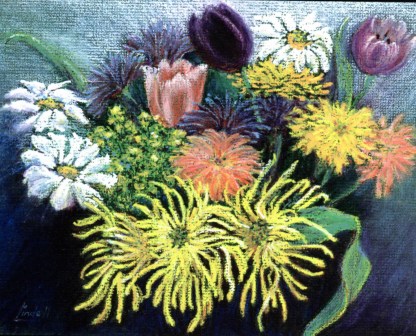
 Bouquet in acrylic by Pierrette

Although her family came first, she nurtured her passion in art in its many forms. She would sketch people, create pen and ink drawings of local scenes. Acrylics were most likely her favourite medium. “Pitou” as John called her, painted beautiful scenes of the rolling hills of the Charlevoix area beyond Quebec City on the north shore of the St. Lawrence River.

When my sister-in-law was widowed at the age of 67, she decided to travel and pursue her art. One summer she went to Giverny, France, home to the Impressionist Monet, to study. Another year, it was a trip to Florence, Italy to study the Masters.

Other summers, she and some of her artist friends stayed closer to home. They went to Baie St. Paul, a beautiful part of Quebec. There she would truly be in her element.

In her home, the studio and kitchen were her favourite places. She was a good cook and she often had her father-in-law over for a meal. She would hand him his plate and say “Leave what you like” and he who loved to play on words would respond, “Eat what I don’t like?” There was never anything left on his plate at the end of the meal. He liked to tease her. She would give him a big smile.

We will miss Pierrette: her laughter, her smile, her talents, her compassion and kindness. She was a good wife, mother, friend and sister-in-law. We are all better off for having had her in our lives.

Rest in peace, my friend.

Notes: During the celebration in her home, family and friends were treated to an exhibition of many of her works.


The Maiden Aunts

Aunt Kay and Aunt Vi. Their names were always said as a unit for as children we saw them as inseparable. Their lives were also lived as a unit, lives devoted to family, career and an insatiable love for travel.

Violet, born 1904 1, and Kathleen, born 1907 2, were the daughters of George Hudson Willett and his wife Isabelle of Caplan, Quebec. George was a farmer and a seasonal guide for hunters and fishermen 3. Money was tight. From the beginning the girls wanted more than a life on the Gaspe coast.

By the time she was seventeen Violet was living in Montreal with her older sister Madge and working as a stenographer 4. Kathleen joined her a few years later. In 1927 Kay signed her first contract with the Lachine School Commission, later to become part of the Protestant School Board of Greater Montreal 5. Kay’s career was that of a teacher, a consultant, a principal and ultimately an adjunct professor at McGill. Violet spent her entire career at the Bank of Montreal retiring as an executive secretary.

Initially the sisters lived in a lodging house in downtown Montreal 6. Early in my childhood they moved to an apartment in Montreal West. The apartment was small: living room, kitchen and one bedroom with twin beds. Beautiful rugs, furniture, and treasures from their travels made the space appear luxurious. Kay kept a meticulous inventory of their possessions 7. The sisters entertained friends and family simply but elegantly. A drop leaf table at one end of the living room opened to seat six with place settings of silver, crystal and fine china. As children we learned to eat with proper table manners when visiting our aunts!

The sisters never married although family legend claims that Violet left a heart-broken suitor in the Gaspe, a man who wrote to her every Christmas until her death. Kathleen had many male friends and colleagues but there were no rumours of love affairs. Both women were slim and beautiful and dressed with style. Vi was a redhead; Kay was a brunette with a distinctive white streak. Later in life she dyed her hair and the streak became blue, an idiosyncrasy that fascinated me.

Both women were devoted to their nine nieces and nephews. They spent time with each one, individually or in family groupings, in the city or at the farm in the Gaspe. Family photos are witness to cousins and aunts enjoying time together at the beach 8.

More than the beach, however, I loved going to lunch with them in Montreal at the Eaton’s dining room on the ninth floor. It always included a shopping trip! Their joint gifts to all of us over the years included clothes, books, educational toys, university fees, and travel experiences. They gave me a piece of the silverware every birthday and Christmas from the time I was very young. You can imagine how excited I was as a four year old opening the gift of a fork! Today that silverware is a treasured memory of their love.

The sisters lived together their entire lives except for the four years that Kay taught in Germany. Even then Vi joined Kay to holiday with her in Europe. In the end it was Alzheimer’s disease that separated them. Vi succumbed first. When Kay could no longer look after her, she was placed in a home where she died in 1983 at the age of eighty 9. As in their youth, Kay followed several years later. She died in a nursing home in 1991 at the age of eighty five 10.

Thus ended the era of the maiden aunts. Their legacy lives on in the achievements of their nieces and nephews, achievements fueled in large part by the values they imbued in us.


 Research Notes

This family story is based on my own memories of my aunts and the stories my mother told of her older sisters in conversation with me. Where I can document specific facts, I have used the Evernote Clipper and stored the clips in an Evernote notebook labeled Family History.

  1. Violet Gwendolyn Willett – Quebec Vital and Church Records (Drouin Collection) 1621-91967
  2. Kathleen MacDonald Willett – Quebec Vital and Church Records (Drouin Collection) 1621-91967
  3. Library and Archives Canada. Sixth Census of Canada, 1921. Ottawa, Ontario, Canada: Library and Archives Canada, 2013. Series RG31. Statistics Canada Fonds. Reference Number: RG 31; Folder Number: 108; Census Place: St Charles de Caplan West (Parish), Bonaventure, Quebec; Page Number: 1
  4. Library and Archives Canada.Sixth Census of Canada, 1921. Ottawa, Ontario, Canada: Library and Archives Canada, 2013. Series RG31. Statistics Canada Fonds. Reference Number: RG 31; Folder Number: 124; Census Place: Outremont (Town), Montreal (Laurier-Outremont), Quebec; Page Number: 11
  5. Teacher’s Engagement document – on file with author
  6. Library and Archives Canada.Sixth Census of Canada, 1921. Ottawa, Ontario, Canada: Library and Archives Canada, 2013. Series RG31. Statistics Canada Fonds. Reference Number: RG 31; Folder Number: 124; Census Place: Outremont (Town), Montreal (Laurier-Outremont), Quebec; Page Number: 11
  7. Handwritten inventory of apartment at 7455 Sherbrooke Street West, Montreal – on file with author
  8. Family photos – on file with author
  9. & 10. Death announcements, Montreal Gazette – on file with author


Do You Believe in Ghosts?

margsword

I’m sitting on the fence, myself.

Over a decade ago, I discovered an old trunk of  paper memorabilia once belonging to Nicholson family of Richmond, Quebec, my husband’s mother’s ancestors. It contained 1000 letters, 300 from the pivotal 1908-1913 years.

From these missives, I learned a great deal about these  Canadian- born Scots, whose parents were  Hebridean Scots, cleared from the land in the 1800’s and forced to come to Canada. And, because of a rather weird series of coincidences I learned all about a certain Masonic sword.

One  evening back in 2004, about a  year after I first found the trunkload of letters, I received an email.It was from Matthew Farfan, editor of Townships Heritage WebMagazine.

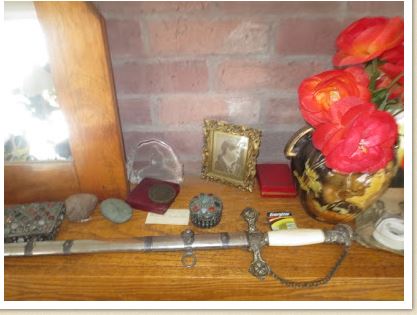
It seems that a  couple in the Okanagan Valley of BC, we’ll call them the C’s, wanted to get in touch with me.  They had Norman Nicholson’s sword!   Norman is my husband’s great grandfather.

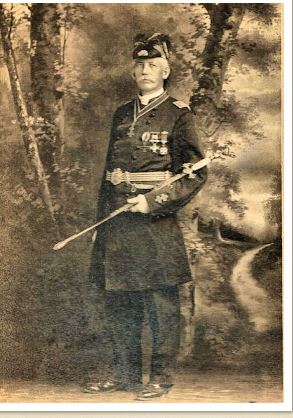
I had very recently posted an article about the Nicholsons on Matthew’s webmag with a big pic of Norman in Mason regalia front and center.  The family papers revealed that old Norman Nicholson was a member in good standing of the Sussex Preceptory No. 9, Knights Templar, Sherbrooke.

I immediately emailed this Mr. C. “How in Heaven do you know it is Norman’s sword?”

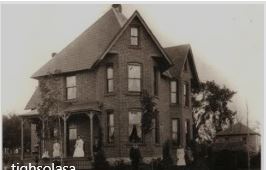
He explained.   In the early 60’s, his family had rented the Nicholson home, in Richmond, Quebec,  from  Edith Nicholson, Norman’s daughter.  Somehow,  Norman’s sword had been swept up in the bustle when the family moved out around 1965.

Mr. C had adored that house with its steep basement stairs and wondrous attic filled with fantastical (see : old fashioned) things. Mr C remembers  using the silver sword to ‘terrorize’ his sister.

tighsolas

 Tighsolas, built by Norman  in 1896, the year Sir Wilfrid Laurier came to power for $2,700. 


« Phone my wife, » Mr.C  further instructed. « She’ll tell you all about the sword. »

So I did, on the jump, and what a story Mrs. C. related! The sword had been hanging on the BC couple’s wall since the death of her in-laws. Prior to that it had traveled all over North America, as far as California.

In 2004,  Mr. C’s sister visited them. She mentioned, out of the blue, that the silver sword on the wall had a name engraved on it. They checked : the name was ‘Norman Nicholson.

A few months passed. Mrs. C had a sudden impulse to return the heirloom to its rightful owners. (What impeccable timing on her part!)  Her husband’s childhood stampbook provided some clues. Apart from many stamps,  it contained a picture of an old man with handlebar moustache decked out in Masonic garb with said blade at his side, and one envelope addressed to Mrs. Margaret Nicholson, Richmond, Quebec.

Normanregalia

 Norman in full Masonic regalia. This photo was in the stamp book and returned with the sword in 2004.

normanmargregalia

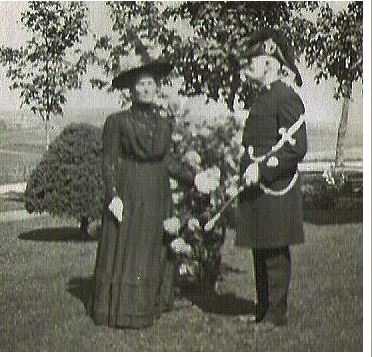
Margaret and Norman on Tighsolas lawn. A photo in the Nicholson photo album

Mrs. C googled ‘Norman Nicholson’, but no luck. There were too many people with that name .  She then he entered “Margaret Nicholson” into the search engine and, presto, she  fell upon the Eastern Townships Heritage website with my story and, plunk in the middle, she saw another picture of Norman in his Masonic regalia.

I can see it clearly in my mind’s eye. Over 50 years ago, in the age of Beatlemania and go go boots, an imaginative little boy living in Richmond, Quebec, plumbed the depths of that Nicholson treasure chest full of letters and memorabilia – the same one I discovered  in 2003 at my in-laws’ – and this little boy snitched some stamps and an envelope for his collection and glued it into a page beside an appealing photograph of a snowy-haired swashbuckler, who was really a down-on-his-luck Eastern Township hemlock bark dealer.

A little later,  he took the very sword the old man in the picture was posing with!

 stanps

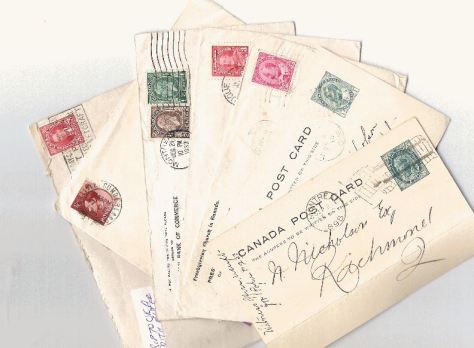
(Some Nicholson letters. Many letters in the 1000 envelope stash  had the stamps carefully cut out. I now know where these stamps are!  )

There’s more.

Norman ’s sword arrived at my house  soon after. I showed it to my husband and my sons, Norman’s heirs, then placed it on the mantel.

That very night, as we all watched TV downstairs, we  heard a loud thump in the living room.

We went upstairs to find the Nicholson binder I had put on the coffee table had exploded open. Its cellophane pages were strewn on the floor. Atop the pile was Norman’s death certificate. I kid you not.

It was likely the dog nosing around that caused this to happen, right?  The binder had been filled to bulging with Nicholson documents. Still,  I took no chances. I placed a portrait of Margaret on the mantel beside the Masonic sword.

I like to think that is what Norman was looking for.


PS. Although perpetually cash-strapped due to the crash of the hemlock bark industry in the Eastern Townships around 1900, Norman always found the 3 dollars to pay his monthly fees to the Masons.  Norman’s records reveal he paid a hefty initiation fee, too, in 1888. Fifty dollars!

Clearly it was important to be a Mason in the ET. Apparently, the Presbyterian Church frowned up the society, saying Masons were encouraged to keep secrets from their wives. I know because the Nicholsons clipped a bit from a newspaper, likely the Montreal Witness, claiming as much!

In 1912, Margaret and their daughter, Edith, join the Order of the Eastern Star Chapter in Richmond. Edith became the Secretary. This OES was a female version of the Masons.


This is an updated version of a story published on the Eastern Townships Heritage Webmagazine in 2005.

He Couldn’t Serve

IMG_9105

If you weren’t in uniform you weren’t doing your part.” This was a quote from a veteran on Remembrance Day 2017.

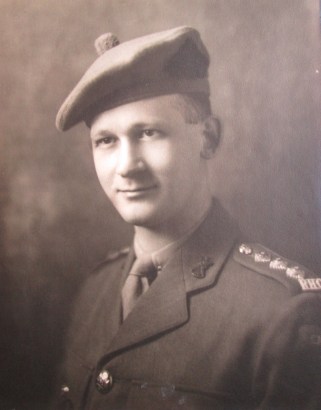
My father, Donald Sutherland volunteered for service at the beginning of WWII but was twice rejected for medical reasons. He had to sit out the war working as an accountant and serving in the Blackwatch reserve.

“ Dear Mother, I had my medical test today. It went fairly satisfactorily except that as usual, my heart was a little fast and I have to go in again Thursday am to have a recheck. They do everything under the sun to you and it takes about an hour and a half. Everything else went well and I suppose I’ll be accepted if my heart steadies down next time. I am supposed to go to bed very early on Wednesday night to soothe my nerves. I just expected to have the interview today but they buzzed me right through the whole works, Love Don”

Donald graduated from McGill University in the spring of 1939. He had just turned 22 and he and all his classmates expected to find jobs and begin their adult lives but war was on the horizon. Germany invaded Poland on September 1, 1939, three days later Britain declared war on Germany, followed by Canada a week later. Personal lives were put on hold as young men volunteered for military service.

With his new commerce degree, my father had begun working for Ritchie Brown and Company as an auditor  Once war was declared, he signed up for the McGill Canadian Officers Training Corp (C.O.T.C.). The McGill C.O.T.C. was quickly expanded from 125 to more than 1,400 cadets and 50 instructors. The need for a drill hall spurred the construction of the Arthur Currie Gymnasium. New recruits were trained in map reading, military law, organization, administration and upon completion sent to a branch of service in which they could best contribute their talents and skills.  

In August of 1940, he registered with the Dominion of Canada National Registration Regulations expecting he would soon be in military service. He went in for his medical examination without a thought and was rejected. He later tried again.

Twice he received a certificate of rejection from the Canadian Army. The doctors said he was not able to do strenuous work because of his high blood pressure and mitral valve insufficiency. He also received a rejection notice from the Airforce because that application wasn’t completed.

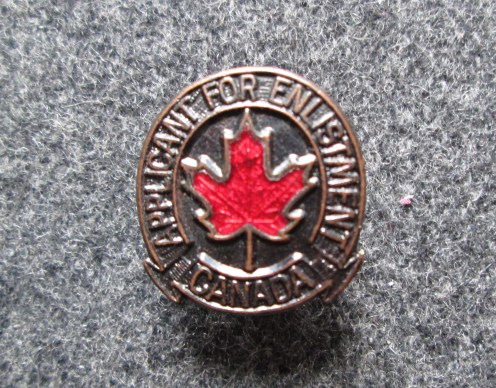
With his second rejection letter from the army came an Applicant for Enlistment badge and card to identify him as an applicant who had failed to meet the minimum medical standards. The lapel badge was to be worn to show the public he had volunteered.

IMG_9118
Applicant for Enlistment Lapel Pin


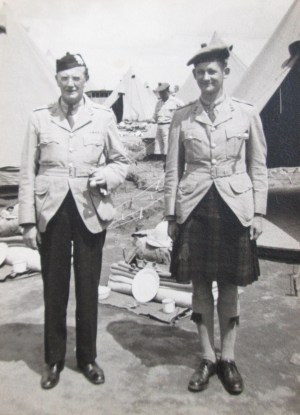
He served in the Black Watch Reserve to the end of the war. As a reservist, he was a part-time soldier while he continued at his day job. He trained raw recruits at camps in Mount Bruno and Farnham, Quebec and garnered high praise from his commanding officer. The battalion’s modified trooping of the colours was written up in the Montreal Gazette, pointing out Lt. D.N. Gatehouse and Lt. D. Sutherland, bearing the flags.

IMG_9095
Commanding Officier & Donald Sutherland Black Watch Camp, Mount Bruno, Quebec  1941


I can only imagine how my father felt, staying home, receiving letters from all his friends serving overseas, while he travelled in Canada auditing company books and marched in Montreal.

Notes:

2017 was the 100th Anniversary of my father’s birth and in his memory, I wrote this story. This is a companion piece to my mother Dorothy Raguin’s war service https://wordpress.com/post/genealogyensemble.com/4470

Letter from Donald Sutherland to his mother Minnie Eagle Sutherland July 28, 1942.

Letter from Major D.L.Carstairs to Lt Gatehouse and Lt. Sutherland July 19, 1942.

Black Watch Stages Colourful Ceremony – The Gazette, Montreal July 20, 1942. The full trooping of the colours was not done in wartime. According to other newspaper clippings my grandmother saved, he marched in a number of parades and ceremonies.

Served under Lieut Col. H.A. Johnston 4th (Reserve) Battalion of the Black Watch.

Here is a link to my mother Dorothy Raguin’s war years.

https://wordpress.com/post/genealogyensemble.com/4470

Happy on the farm

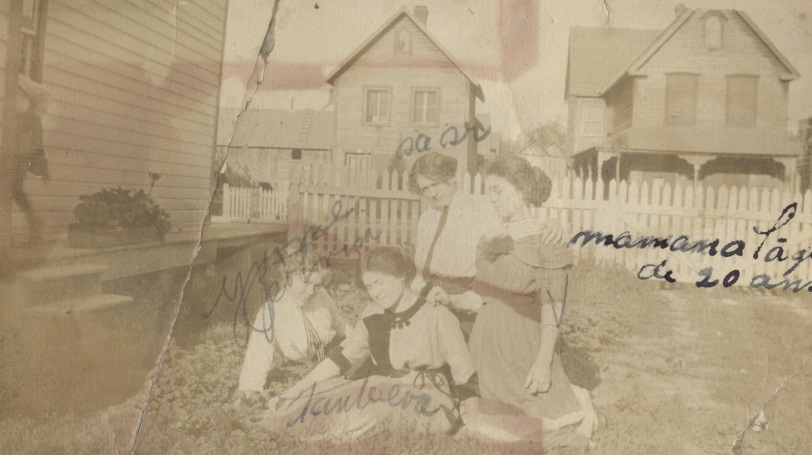
When my aunt turned ninety-six a few years ago, I prepared a short bio of her life, including photos of the farm where she grew up, baptism`s, confirmations and a wonderful photo of four people working in a farm yard.

Handwriting on the photo says “maman a l’age de 20 ans” and “papa” to identify my great grandmother, Marie-Berthe Charette and my great grandfather,  with her two sisters “tante Eva” and “tante Ida.”

They are all on their knees, looking at the photographer. Jean is staring towards Marie-Berthe, who was also called Martha, with an extremely happy look on his face.

The shot is the only happy photo I have of the couple. In every other shot, they look solemn or downright miserable.

Martha was born on October 3, 1889, so if the note about her age is correct, the photo would have have been taken in 1909 or 1910, five years prior to their marriage. There’s no indication where the photo was taken. It could have been his parents’ farm, her parents’ farm, or given that they are also in the shot, perhaps even the farm where his brother Gustave and her sister Ida moved after they were married.[1]

Both Charette farms were in Clarence Creek, where their families had lived since at least 1891. His family farm was located in Sarsfield, a town right next door near the current Ottawa, Ontario.

The first Hurtubese/Charette couple was already married by the time of the happy photo in my grandmother’s photo album. Later, it would be Jean-Baptiste and Martha’s turn, then his younger brother Francois and her younger sister Dora.

All three couples would eventually follow middle Charette son Ernest, who began farming in Alberta.

My cousin says his mother used to talk about a horse and buggy ride after their family lost a farm due to a train expropriation. My aunt spoke to him about remembering her mom’s tears. I don’t know whether that trip precipitated their move to Alberta or took place afterwards.

All I know for sure is that after this photo was taken, the couple had two little girls, Donna and Marguerite. Then, sometime after their second daughters’ birth in 1917 and the 1921 Canadian Census, they bought a farm with a three-bedroom wooden house on it in Bow River, Alberta.[2]

After that, their life took a turn for the worse, and they lost everything. The dust bowl, the Depression, locusts…take your pick, they saw it all.

By 1941, the family was renting part of a house in Edmonton. He did odd jobs to get through the war years and beyond. They remained in Edmonton until her death in 1957 and his in 1959.

————————-

[1] Data from the 1911 Census of Canada, Enumeration District 21, Cumberland Township, Russell, Ontario, Sarsfield Village, Léonard Village, Bear Brook Village, page 7, line 48.

[2] Data from the 1921 Census of Canada, Enumeration District 2, Bow River, Alberta, section 7, township 22, range 21, Meridian 4, page 6, line 28.

A Contrast in Character

DrHenry

Dr. Henry Portrait.

He looks like one of the clan in the snapshot, with a trim athletic body, a handsome, rugged face, full-lips, sturdy chin, prominent brow over deep set eyes. He is confident in his posture as well as a snappy dresser.

He is Dr. Henry Watters of Kingsbury, Quebec and Newton, Massachusetts, first cousin to my husband’s grandmother, Marion Nicholson, the son of her Aunt Christina on her father, Norman’s, side.

That also makes him first cousin to Herbert Nicholson, Marion’s older brother.  And although the two young men resembled each other in build and facial features, they could not have been less alike!

Dr. Henry , by all accounts, was a near-perfect man, a  high-achiever, a man who rose to the top of his profession at the Newton Hospital near Boston, but who remained devoted to family (and that includes his cousins) throughout his life.

Despite his busy vocation, he corresponded with all of his extended family, regularly, with letters than demonstrated uncommon empathy. When writing his youngest cousin, Flora, who apparently had complained of boy troubles in her letter, “I don’t have much experience in these matters, but I can only say, if he doesn’t want you, he isn’t worthy of you.”

Herb, well, what can I say?  As the only son of Norman and Margaret Nicholson of Richmond, Quebec, great things were expected of him. A whopping FIVE dollars was put aside at his birth in 1885 to start a bank account for his future medical career. But, upon graduation from St Francis College in 1905, he went to work as a clerk at the Eastern Townships Bank.

A ladies man and/or a gambler, Herbert immediately got into debt, borrowing money off all of his relations, until, in 1910,  he got into such a desperate situation that he filched 60 dollars from the till at work.

Herbert didn’t go to jail: The Nicholsons were too well connected for that, but even Norman’s patron, E.W. Tobin, the Liberal MP for Richmond, Wolfe, couldn’t help Herbert’s cause.

  Herbert was forced to skulk out West. His already cash-strapped dad had to come up with the huge sum of 500 dollars to help pay his sons debts and travel expenses.

Herbert was a teeny bit ashamed. “Don’t tell anyone where I am,” he wrote to his parents from Saskatchewan, where he was staying with Norman’s former partner in the hemlock bark business.

Out West, Herbert worked in a series of jobs in, yes, banking, then insurance, and then with a the farm equipment company, Massey-Harris.

At one point he devised a scheme to dupe immigrant farmers out of their hard-earned cash.

“I also made a 100 dollars yesterday in the shape of a man’s note due in a year’s time. I sold a threshing outfit that I repossessed from a party that could not pay for it.  For 3300 and as there was only 3000 against the rig to the company; I am 300 dollars to the good.  In doing this I had to divide up with two others who assisted me and knew what I was doing so we get 100 each.  Have to keep these things quiet, of course.”


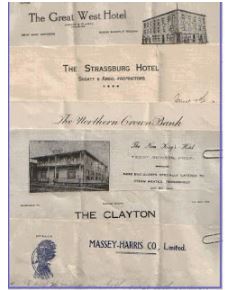
Herbletterhead

Herb’s letterhead from 1911-12 illustrating his roving ways

His other letters home were full of complaints about his workload, the freezing cold weather, etc. – and no shortage of insights into how capitalism works. “You have to already be rich to get rich out here,” he said.

Later, Herbert settled down in ‘real estate’ in Vancouver, got married twice to wealthy women, and then moved on to California.  He died in 1967, childless.

Beside his name in the Nicholson family genealogy it says “Successful Banker.” sic.

Dr. Henry ,whose dad, Alexander Watters,  was a Kingsbury, Quebec farmer, never married.  Henry employed his younger sisters, Christina then Anna, as his housekeeper in his comfortable clapboard Colonial in Newton, Massachusetts.

Henry may not have been a ladies man in the usual sense of the word, but he certainly had a way with the young ladies in his family. In the 1910 period, he indulged the Nicholson women no end with trips to Wellesley College in his flashy Stanley Steamer, with sea-bathing at Nantucket, box seats at Red Sox games, theatre plays, and dinners at the posh Windsor Hotel in Montreal, when at home visiting.

His younger sister, May, got new shirtwaist suits and fancy hats from him as gifts on a regular basis. Henry once used his  vacation time to drive his Aunt Margaret up and down the E.T to visit old friends.

And much to his Uncle Norman’s admiration, he paid his own father, Alexander, a trip “home” to the Old Country in 1911. “Not many sons would do that,” wrote an envious Norman to his wife.

Unlike Herbert, who found nothing good to say about any of his employers, the banks, the railway or insurance,  Dr. Henry never complained about work as a doctor and surgeon in his letters to family, even when suffering from a fatal disease at a relatively young age.

From his obituary in the New England Journal of Medicine: “When stricken with what he knew meant the shortening of his days and the limiting of his activities, he carried on cheerfully and uncomplainingly. He was the friend as well as the associate of those  with whom he worked, the friend and the physician of his patients.

Dr. Henry died 1937 and is buried at home, of course, in the clan cemetery in Melbourne, Quebec.  Herbert died in 1967 and is buried somewhere in a Long Beach cemetery. His last visit home to Richmond was in the 1920’s.

Herbnicholson1910

 Herbert Nicholson 1910ish

The information comes from the Nicholson Family letters of the 1910 period. The Watters clan of Kingsbury, Quebec is written down as Waters on the 1911 Canadian Census. Henry had a younger brother, William, who died in 1910. A photo on Ancestry claims this 21 year old William is an MD too. He must have been a recently graduated one, or still a student.

I have a short obit cut out left by the Nicholsons. It says the family is shocked at William’s death in Montreal, but nothing  else. A man could catch a cold and die in a day in those days, but this very short obit suggests something else more nefarious.

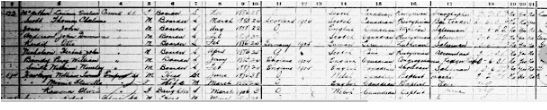
Below: 1911 census showing Herbert Nicholson living in a boarding house in Qu’Appelle Saskatchewan, with two recent immigrants, one from Germany, one of Scotland (a bartender, no less) and a female (!!!) stenographer. His temperance-minded parents would have passed out, had they known. 


quappelle

*This post was originally published on Writing Montreal, my blog.

A Wren’s Story: Dorothy Isabel Raguin

IMG_9015

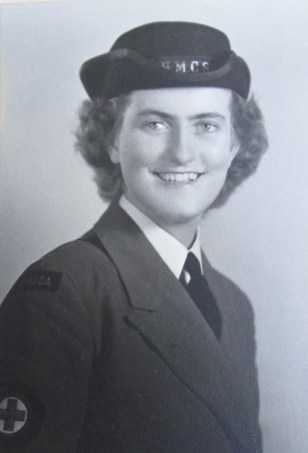
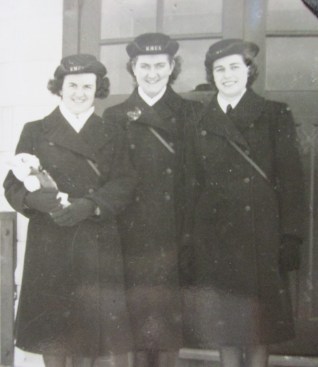
Dorothy Raguin my mother, joined the Women’s Royal Canadian Naval Service (WRCNS) known as the Wrens in April 1943. She left a job teaching grade three at Berthelet School in Montreal to help in the war effort and to look after her brothers, Robert and Arthur Raguin, both serving in the Navy.

She had graduated from The High School of Montreal Girls School in 1939 and then attended MacDonald College for teacher’s training and began her teaching career.

War was declared in September 1939, but it wasn’t until three years later that the Women’s Royal Canadian Naval Service was formed. Dorothy was one of over 6000 women who joined the navy, allowing the shore-based men to go to sea. The navy was the last of the forces to admit women. The first recruits were cooks, clerks and laundry maids but by the end of the war, women filled 39 trades including communication operators, signalman, coders and radar plotters. Their pay was also raised from two-thirds of a man’s to eighty percent. The Navy found women were useful.

The Wrens were inundated with applications even though the Army and Airforce had been recruiting women for two years. These women wanted to join the Navy. As the smallest of women’s services, it claimed to be the most selective. The Wrens were known to have recruited a “better type” of girl. They were ladies, not sailors and kept their hats on indoors.

There was a short three-week course at the WRCNS training centre HMCS Conestoga, in Galt Ontario. This facility which had been a girls reform school was referred to as a “stone frigate.” The women put on the Wren uniform and had a rapid transition into military life. They were given physical training, drill practice and learned about naval traditions and customs.“ They all seemed anxious to serve and do something constructive to help win the war. I found them very receptive to naval tradition and amenable to discipline, said Superintendent Carpenter. ”¹

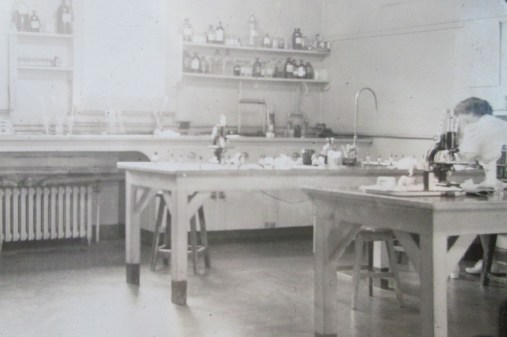
Dorothy was drafted to HMCS Cornwallis September 1943. Mom’s first posting was to a hospital base, Stadacona in Halifax, Nova Scotia. A family friend, Miss Fellows was in charge of the women and had two sick berth attendant positions available. These were prime positions working in the laboratories. One was in haematology and the other in urinalysis. Mom chose blood and a friend got the other position.


IMG_8721
Lab in Halifax 1944


It wasn’t all work, marching and standing in lines. In their free time, they visited the scenic places around Halifax including Peggy’s Cove and Chester NS. There were always men coming and going from the ships and the Wrens used to take some of the patients rowing on the Arm. As innocent women, they were warned to be careful walking on Gottingen Street which had buildings right to the sidewalk, as they could be grabbed from the doorways! Dorothy celebrated her 21st birthday in the Navy with a lobster dinner at the Lord Nelson Hotel, a treat by her cousin Richard Scrivner who was then a Navy Commander. It was her first lobster and she never had another. There was also trip with other Wrens to New York City. They didn’t have to pay for their hotel and received meals for free as a thank you for their service.

IMG_8727
Doreen, Dorothy, Gwen

One of her teaching friends Mary Hawkins wrote in May 1943 from Halifax. “Dorothy Raguin and I met at the ANA (Army, Navy, Airforce) Club yesterday. She looks fit and is getting a kick out of the Wrens. She was in the School for Teachers the year before I was and was teaching at Berthelet. She left a month after I did – to join the Navy. I asked her if the Wrens get their tot of rum and she said, No, but apart from that everything is just the way Nelson left it. I know what she meant.”²

She finished her duty doing discharge physicals at the Royal Canadian Naval Hospital (RCNH) St Hyacinthe, Quebec. Her transfer was mentioned in the Tiddley Times, the Wrens newsletter. “Our hospital staff have been lucky in the acquisition of Dorothy Raguin, Aileen Fee and P.O. Anne Hawke, all lab. technicians with first-hand experience from Halifax.”³ The WRCNS disbanded in August of 1946 as women were not needed in peacetime.

Dorothy saw her brothers only once while she was in the Navy. She arranged dates for them when their ship came into Halifax. Happily, they managed to survive without her care and returned home safely.

IMG_8784
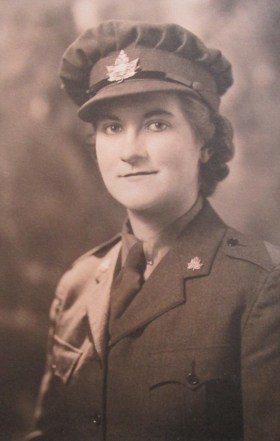
Dorothy Raguin in the Women’s Volunteer Reserve Corps before 1943.


My mother Dorothy Raguin Sutherland, died recently, at 95. She was proud of her service in the Navy and so to honour her and her service to Canada I am posting this story.

Notes:

  1. Superintendent Carpenter on Navy Radio, Recorded10 June 1943 for broadcast 14 and 16 June on CBC. Library and Archives Canada: MG30 E 391 Volume 1.
  1. Buch, Mary Hawkins., and Carolyn Gossage. Props on Her Sleeve: The Wartime Letters of a Canadian Airwoman. Toronto: Dundurn, 1997. Print.
  1. Tiddly Times May – June 1945 Wrens Newsletter page 26.
  1. Huba, Diane., The Wrens 70th Anniversary 2012. Starshell Volume VII No. 58, Spring 2012.
  1. Dorothy Raguin Sutherland reminiscences as told to the author.
  1. www.navaireview.ca/wp-content/uploads/public/vol3num3/vol3num3art5.pdf
  1. www.thecanadianencyclopedia.ca/en/article/wmens-royal-canadian-naval-service/
  2. In the third picture, Dorothy Raguin is not wearing a Wren’s uniform but rather the Women’s Volunteer Reserve Corp (W.V.R.C.) uniform. The main goal of this organization was to fundraise for the war efforts and train women in war-related tasks.

Here is a link to my father Donald Sutherland’s war years.

https://wordpress.com/post/genealogyensemble.com/4615

Dr. Joseph Workman, Pioneer in Treating Mental Illness

If you have been watching the miniseries “Alias Grace” on CBC television or Netflix, you may remember a scene featuring a grey-haired gentleman with long sideburns. That character was based on the real-life physician Dr. Joseph Workman, known as the Father of Canadian Psychiatry.

The television show is based on the book of the same name by Margaret Atwood, a fictionalized account of the life of Grace Marks, an Irish-born servant girl convicted in 1843 of a double murder near Toronto. Grace was held at the Provincial Lunatic Asylum in Toronto at about the time that Dr. Workman became superintendent of the asylum.

Neither the book nor the television show makes it clear whether Grace was insane, or whether she was guilty of murder. There is little doubt, however, that Joseph Workman was a kind and intelligent man who made important contributions to the treatment of mental illness. In fact, he came from quite an extraordinary family.

Joseph (1805-1894) was born in Ballymacash, near Lisburn, County Antrim, Ireland (now Northern Ireland). His parents were Joseph Workman Sr. (1759-1848) and Catherine Gowdie (1769-1872). Joseph Jr. was the fourth of nine children — eight boys and one girl. His only sister, Ann Workman (1809-1882), who married Montreal hardware merchant Henry Mulholland, was my direct ancestor.

The Workmans brought up their children to value hard work, education and Christian charity. Holding liberal views, they were members of the Non-subscribing Presbyterian Church of Ireland and they eventually became Unitarians.

The Workmans were not wealthy and they lived in a cozy cottage in the village, surrounded by fields and farmland. Joseph Sr. worked as a miller and as a teacher, then as land steward (manager) for a local landowner.

Joseph Jr. attended school around Lisburn and, after graduation, worked as a land surveyor for three years. In 1819, his oldest brother, Benjamin, immigrated to Montreal, where he became a teacher and newspaper publisher. Over the next 10 years, the Workman siblings, tired of the poverty, poor harvests and religious strife around them, all left Ireland for Canada. Joseph and his parents arrived in Montreal in 1829.

Joseph taught school and studied to become a doctor at the same time, obtaining a medical degree from McGill University in 1835. His thesis focused on the infectious nature of cholera (a radical idea at the time) after he watched the deadly disease sweep through the city in 1832 and 1834.

He married Elizabeth Wasnidge in 1835 and the couple eventually had 10 children, four of whom died young. In 1836, they moved to Toronto, where Joseph ran the Wasnidge family hardware business. For 10 years, he kept up his reading on medicine before finally leaving the business to concentrate on medicine. He built up a busy practice and taught at the Toronto School of Medicine.

He was appointed superintendent of the Provincial Lunatic Asylum in 1853 and remained there until 1882. At first, Joseph knew little about mental illness, but it was easy to see that the asylum was filthy and overcrowded, and that the patients were neglected. He improved the institution’s efficiency and made sure the patients had good food and generous amounts of alcohol. His treatment approach focused on moral therapy:  kindness, truthfulness, social entertainment and religious instruction. Although cure rates did not improve, he did make progress in the humane treatment of the mentally ill.

The Workman brothers all achieved success in Canada. Alexander Workman became mayor of Ottawa, William was a successful hardware merchant and mayor of Montreal, Thomas became a prosperous businessman, and Benjamin had several careers, including teaching and medicine. Joseph and Benjamin were instrumental in establishing the Unitarian Church in Toronto and Montreal.

But biographer Christine L.M. Johnston considered Joseph to be the greatest of them all “because he radically changed the whole field of psychiatry, and not just in Canada. He influenced as well American superintendents of Lunatic Asylums…. Like most pioneers, he did not claim to be totally original – he introduced the new ideas initiated in Europe. Yet he was constantly exploring new avenues on his own after that.”1

This story is also posted on http://writinguptheancestors.blogspot.ca

See also:

Janice Hamilton, “Henry Mulholland, Montreal Hardware Merchant,” Writing Up the Ancestors, March 17, 2016, http://writinguptheancestors.blogspot.ca/2016/03/henry-mulholland-montreal-hardware.html

Footnotes:

  1. Christine Johnston. “The Irish Connection: Benjamin and Joseph and their Brothers and their Coats of Many Colours,” CUUHS Meeting, May 1982, Paper #4, p. 6.

Other sources:

Christine I. M. Johnston, The Father of Canadian Psychiatry: Joseph Workman, Victoria: The Ogden Press, 2000.

Thomas E. Brown, “Joseph Workman,” Dictionary of Canadian Biography, vol. 12, University of Toronto Press/Université Laval, 1990, http://www.biographi.ca/en/bio/workman_joseph_12E.html, accessed Oct. 23, 2017.

The Digger, One Family’s Journey from Ballymacash to Canada, Lisburn.com, http://lisburn.com/history/digger/Digger-2011/digger-19-08-2011.html, accessed Oct. 20, 2017.

There is an extensive database of the Workman family online called A Family Orchard: Leaves from the Workman Tree, http://freepages.misc.rootsweb.ancestry.com/~database/WORKMAN.htm


What is a Limonadier?


When you are lucky enough to find original documents pertaining to your ancestors do you really read everything on them or do you just glance through them, copy them and file them for later? One thing I have recently learned is to thoroughly read all documents. What a novel tip for genealogy research!

I was sending information to a fellow writing about my grandfather, Rene Raguin. He told me that Rene’s father Marie Joseph Raguin had been a Limonadier. What kind of occupation is that I wondered? I wrote back and asked him how he knew that information. He responded that it was on my grandparent’s marriage licence.

I had never looked up their documents as I knew when and where they were married. One of my great uncles, Herbert Bruneau had done a lot of Genealogy research and I had his family tree. I was more interested in people I didn’t know and had put off confirming other’s research. The document was easy to find and there under “profession of father of husband” was “Limonadier”. There is a lot of information on Ontario, Canada marriage certificates.

What was this profession? It sounded like someone who made lemonade. The marriage was in 1912 when bottled soft drinks were not available. According to Wikipedia, a Limonadier made and sold lemonade, could also make and sell alcohol or run a cafe.

Aside from being an interesting occupation, this explained some of our family traditions. My mother had a recipe that we called “Grandfather’s Lemon Syrup”. It was a lemon syrup that when added to water made lemonade. My mother used to make it and on visits to my grandparents, we had the lemon drink in little glasses that once contained cream cheese and home-baked sugar cookies. My cousins called my aunt’s version of it, “Grannie’s Lemon Drink” but they were obviously wrong about the origin.

It is also possible that Marie Joseph did run a cafe in Fleurier, Switzerland. One story that we heard growing up was that grandfather used to take a big pan of plum pie to the bakery to have it cooked as the pan didn’t fit in their oven. Why would a family of four need such a big pie? So making it for a cafe makes sense. It was a simple dish, pie crust covered by half plums with sugar sprinkled on top, a dessert that my mother also used to make.

It is amazing how much information one can get from a single word.

Notes:

Ontario Marriages, 1869-1927,” database with images, FamilySearch (https://familysearch.org/ark:/61903/1:1:KS8D-G3N : 10 April 2015), René Emile Raguin and Cecile Béatrice Bruneau, 09 Jul 1912; citing registration, Cornwall, Stormont, Ontario, Canada, Archives of Ontario, Toronto; FHL microfilm 1,906,765. On Feb 22, 2017.

https://fr.wikipedia.org/wiki/Limonadier accessed Feb 22, 2017.