Category Archives: Canadian Province

Did Louis Riel hide in my ancestor’s basement?

riel rebellion battoche

Family lore says that my ancestor Joseph Arial had many meetings with Louis Riel in the basement of a hotel he owned. The story might be about a hotel in St. Boniface that may have served as a hide-away for the Métis hero and later burned to the ground or it may be referring to a hotel owned by his son Joseph Gabriel, who ran his own hotel in Gleichan* (near Cluny), Alberta.

How does a genealogist go about proving such a story? The family legend might refer only to my great great great grandfather or his son, or it may combine the exploits of both.

My first challenge was figuring out the timing. Louis Riel was born in the Red River Valley in 1844 and was hanged for treason on November 16, 1885.[1]

Then I began searching through the names and dates of my ancestors’ lives.[2]

Joseph Arial was the first of my ancestors who left Quebec. He was born in 1812 in St. Roch and died on November 4, 1880 in St. Boniface, Manitoba, where he is buried. His wife was Julie Belleau dit LaRose who was born the year before he was. The two were married in St. Roch on September 4, 1832. St. Boniface is on the south side of the Red River, so the location is correct, although he would have been much older than Riel.

His son, Joseph Gabriel was married to Marie Sophie Bernard in St. Boniface, Manitoba on August 8, 1887. Their hotel would be too late to have anything to do with Riel. Joseph’s wife is important to my story, however, because her mother was born in 1838 in St. Anne-des-Chênes (Oak Point), just down the river from where Riel would be born six years later. Her mother, Sophie Henault Canada was also born in the Red River Valley, so there were roots that went back years. The possibility that Sophie’s parents, Charles-Henault-Canada and Marie Gris, knew Louis Riel’s parents, Julie Lagimodières and Jean-Louis Riel, who were married in the chapel of St. Boniface Cathedral on January 21, 1844 were high.

That isn’t proof though.

My next step will be to verify the guests at the marriages of Joseph Gabriel and Marie Sophie and the marriage of Julie Lagimodières and Jean-Louis Riel, but in the meantime, perhaps what happened after Riel’s death will tell us more.

So far, the only information I have comes from Fred Jones in his story called “Blackfoot Reserve. ” He speaks about Gabriel Arial running a hotel. He writes:

My first impression of Gleichen was when we arrived by way of Calgary from the Blood Reserve. We stayed in the Palace Hotel, owned by a French Canadian named Mr. Gabriel Arial, and I think he built it. Some of the Old Timers seem to think it was originally build of logs, but I had seen parts of it torn down and repaired here and there with no logs under the sheeting, but the rough boards were hand-sawn with the old, long ripsaw, and iron nails were used. The style was what you might call early Western, and no luxuries were provided. The rooms contained a bed, chair, washstand and plain dresser, a big jug full of cold water and a smaller jug, for drinking. If you needed more water you took your jug downstairs and outside, to the well. A kerosene lamp provided light.

The Arials welcomed us, and were very hospitable. So were the cockroaches and bed bugs, but that was the usual thing in any dwelling in those days. There were no insect repellents, except kerosene and pyrethrum powder and these failed to attain victory. A a standoff was the best to be hoped for, as the walls were hollow and the plaster cracked so the enemy could retreat and fight another night.

I went to school later with the Arial boys and girls. The hotel was later sold to Brosseau Brothers, and the Arials moved to Edmonton.

I think we arrived in Gleichen about 1896 or 1897, as the C.P.R. roundhouse was still there and I think it was moved to Calgary in 1898. (As I recount these many events, please consider that they happened over seventy years ago. They may be kind of sketchy and not follow in proper sequence and some that made an impression then, may not have been as important as others that might have been forgotten.)[3]

Is this Gabriel my grandfather? I don’t know for sure yet, but I think so. My grandfather was called Gabe after his father and he grew up in Edmonton. My grandmother also moved to Cluny as a child and that’s where they met. This Gabriel Arial may also have been a cousin though, so I still have much more verification to do.

[1] All the facts about Louis Riel and his life in this story come from Maggie Siggins’ book “Riel A Life of Revolution” Harper Collins, Toronto, 1994.

[2] For this part, I relied on the handwritten notes of Mary Alice Kite and my grandmother, Ann Marguerite Arial. My grandmother learned how to do genealogy from Mary Alice and she knew my great grandparents personally. She would have confirmed their parents’ and grandparents’ names with them. She also collected photos of the family, which I now have. Few of the people can be easily identified now.

[3] The Prairie Hub, by John Julius Martin, Rosebud, Alberta, The Strathmore Standard, 1967, p. 160.


*An earlier version of this story spelled Gleichen incorrectly.

The Pitfalls of a Neophyte Genealogist

Who was my third grandmother? Which one of these women married Moyse Hypolite  Fortin? Were they cousins? Were there mistakes in the information I was finding? I needed answers.

Genealogy requires exact details and facts in order to get the story right. As a new genealogist I learned this very quickly.

In the case of my third great grandmother there were conflicting reports. One day I would find Henriette Bertrand in Ile Perrot and then later find an Henriette Bertrand in Vaudreuil. The dates varied by only two years and they fit in with the time frame of my third great grandfather.

The two communities are very close to one another, a matter of only a few kilometers.

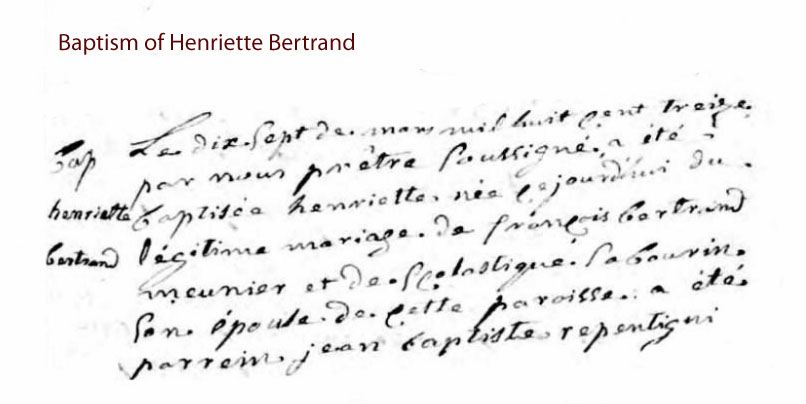
It soon became apparent that there were in fact two Henriettes. I found the baptismal  document on line for Henriette 2. The discovery made me realize that perhaps I had been researching the wrong person.

At this point I needed clarification. I made a visit to Centre d’histoire La Presqu’íle in Vaudreuil and was able with the help of the archivist learn for certain which of the Henriettes was the correct one. Now I had what appeared to be a monumental task ahead. Research had  been done for Henriette 1 thinking she was the right person.  Now, this lineage was of little value as she was not one of my ancestors. This meant  starting over with Henriette 2 and tracing her line.

The archivist was very helpful finding documentation and pointing out the right direction to proceed.

This was indeed a valuable lesson and I am grateful having  learned it early on in my research. It has constantly been a reminder that before making the next move, make certain you have as many exact verified facts as possible  about the particular person you are researching. That way you can avoid  mistakes.

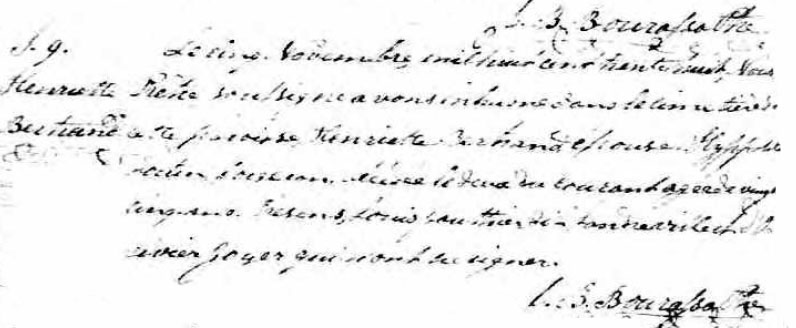
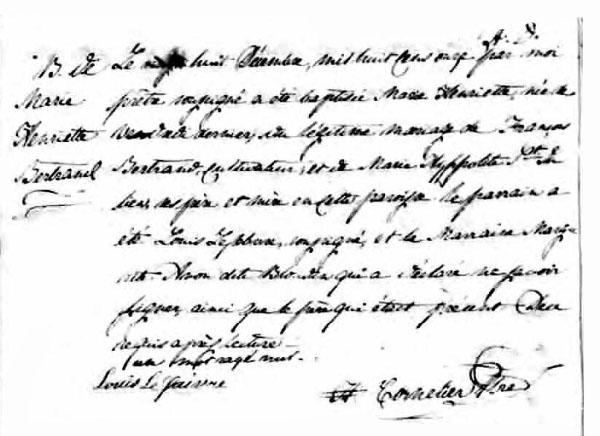
The following two documents were found on Ancestry-Drouin Collection

Baptism:

Baptism Henriette Bertrand

Burial

burial

Registres paroissiaux et Actes d’état civil du Québec (Collection Drouin), 1621 à 1967

Name: Henriette Bertrand
Event: Enterrement (Burial)
Burial Year: 1815-1900
Burial Location: Montebello, Québec (Quebec)

Source Information:

Ancestry.com. Quebec, Vital and Church Records (Drouin Collection), 1621-1967 [database on-line]. Provo, UT, USA: Ancestry.com Operations

Inc, 2008.

Original data: Gabriel Drouin, comp. Drouin Collection. Montreal, Quebec, Canada: Institut Généalogique Drouin.

Comparison of data for the two Henriettes

Henriette Bertrand   1                                                                    Henriette Bertrand 2

Born:  December 28, 1811 in Vaudreuil                                  Born March 7, 1813 in Ile Perrot

—————————————                                                       Died November 5, 1838

Mother:  Apoline St. Julien                                                           Mother:  Scholastique Sabourin

Born: Nov 6. 1783 in Vaudreuil                                                 Born:  1789 in Rigaud

Died:  Aug 2, 1834 in Vaudreuil                                                 Died:  July 28 1821 in Rigaud

—————————————                                                       Married: September 12 1831 in Montebello

Father:  Francois Vital Bertrand                                                  Father: Francois Joseph Bertrand

Born:  Jan 4, 1780 in Vaudreuil                                                   Born 1784

Died:  July 11, 1859 in St. Joeph du lac                                      Died:  1832 in Ste Justine de Newton

In 1832 Henriette  2   married Moyse Hypolite Fortin, my third great grandfather. She died November 5, 1838 at the age of twenty-five  in Montebello,  having given him a daughter, Leocadie Fortin, my great-grandmother and a son, Louis.


               Centre d’histoire La Presqu’íle

Achives regionales de Vaudreuil Soulanges

431 BC St. Charles

Vaudreuil-Dorion J7V 2N3

http://www.chlapresquile.qc.ca

French Canadians in Ontario

French Canadians in Ontario

This compilation “French Canadians in Ontario” consists of lists of the many of the churches throughout Ontario where our French Canadian ancestors migrated and explains where the document of births, marriages and deaths are located for the many parishes.

This compilation is a useful tool for those who may not know exactly where these records are now located. Many can be found at BanQ, the national archives located on Viger Street in Montreal, Quebec.

fleur-de-lis-377307

Highlight the file below and right click to open link in a new window

The French Canadians in Ontario

Life Decisions

A simple act followed by a statement can be life-changing. Such was the case for Kaarlo.

Several  years of study at Michigan College of Mines in Houghton, Michigan had prepared Kaarlo, a young Finnish boy from Ashtabula, Ohio  for a career in the mining industry. He had worked as a cook on the ore boats on the Great Lakes and knew he wanted something more fulfilling, much as he loved sailing the lakes.

In 1928 he graduated with a degree in Mining  Engineering. There was a job waiting for him at  Royal Tiger Gold Mines in Breckenridge, Colorado. He packed his Model T Ford and set out for the west with high hopes and dreams of creating a good life, doing something he truly enjoyed.

It wasn’t long after arriving at the mines that he found the owner-manager tampering with the assays (the device used to measure gold). Once the owner realized that the young man was aware of his actions, he ordered him to be “out of town by sundown!”.  Kaarlo didn’t back down and stated that he would leave as soon as he could get his car on a railroad car to carry it  over the mountains.

Dreams of working in the gold mines were crushed. Being young and a go-getter,  he immediately contacted the College to see if they knew of any openings for newly graduated engineers. They responded that there were openings in Canada in the nickel mines in Copper Cliff, Ontario.  It was time to head north.

300px-BigNickel

                                    The Big Nickel in CopperCliff, Ontario,  now part of Greater Sudbury

Kaarlo Victor Lindell crossed in to Canada on the 31st of January 1929 at Bridgeburg, Ontario1 with hopes and dreams of a rewarding career and a new challenge. He found a room in a boarding house and began working for the  International Nickel  Company(INCO) and never looked back. He spoke Finnish and soon made friends with his coworkers, among them many Finns. His employer took advantage of his knowledge of Finnish and in 1934 was sent to Northern Finland where he was actively involved in opening a nickel mine in Petsamo. In 1939 that part of Finland was seized by the Russians.

Along the way he met a pert, pretty, vivacious young lady, named Estelle (Esty) and sought her hand. They were married on September 6th 1930 in Sudbury. In the meantime Kaarlo had legally changed his name to Karl and took religious instruction in the Catholic faith having been a Lutheran all his life.

In 1939 with WW11 on the horizon Karl wanted to serve his new country. He became a naturalized citizen on the 8th of August 19392, however, with four children and a fifth on the way,  (me) his services were needed in the nickel  industry. He remained at work for INCO. Nickel production was crucial for ammunition during the war years.

7f8387d73db3917a06b23e636e118174

Royal Tiger Gold Mines thrived from 1918 and into the 1930s, however, it declared bankruptcy in 1938 and in 1973 the town and all the buildings in it were torched to keep the “hippies” from squatting.

Northern Ontario, on the other hand has over time developed  and prospered.

It is interesting to speculate how Kaarlo’s life might have been, especially  if he had stayed in Colorado?


I would not be here to tell the story!


Étiennette Alton: A Marriageable Woman

Business people, merchants and the church recruited 262 French woman who agreed to travel to New France and set up families with strangers before Louis IV decided to set up his “filles du Roi” (daughters of the King) project in 1663.

My ancestor Étiennette Alton was among these women, who are now collectively known as “les filles a marier” (marriageable daughters). Étiennette was a 20 year-old orphan[1] living in France’s Loire Valley when she was recruited by Claude Robutel, the 39-year-old Sieur de Saint Andre and one of 95 surviving members of the “Company of 100 Associates”. Three years earlier he had sailed to Quebec as part of the Grande Recrue and settled in Ville Marie to protect it from Iroquois attack. Robutel returned to France in February 1659 to marry Suzanne Gabriel and search for potential spouses for the other soldiers. Étiennette and others agreed to marry, have children, and ensure the future viability of the settlement of Ville Marie. In return, the company paid the cost of her journey and provided her with a small dowry to set up a household. Étiennette joined Robutel and his wife for an ocean voyage to New France. The Saint-André left La Rochelle on July 2, 1659 and arrived in Quebec on September 7. It took another 22 days to get to Ville Marie via a small boat known as a “chaloupe.” [2] Étiennette Alton wed Marin Hurtubese in Notre Dame Basilica on January 7, 1660. Claude and Suzanne were among their witnesses. Ten months later, their first son Pierre was born. Over the following twelve years, the couple had three more boys, including my direct ancestor Louis, and two girls. Marin died either on Valentine’s Day or on May 12, 1672. On June 13 that same year, she wed Berthelemy Vinet dit La Reinte and moved to the fief de Verdun outside of Ville Marie on the Île de Montréal. Vinet worked for Jean-Baptiste Migeon, an activist who went to jail for accusing the Governor of Montreal of breaking fur-trading laws and then was himself accused of breaking the same laws. Vinet died on November 18, 1687 and Étiennette was alone again, but only for a little longer than a year. She signed a contract to marry Claude Garigue, a man 13 years her junior on December 13, 1688. By the following April, she tried to enter a convent but ended up getting married anyway on October 18, 1689. The couple legally separated three years later after Étiennette testified in court about regular spousal abuse. “My husband hit me with sticks, his fists and his feet; he threw me to the ground, and wanted to butcher me by trampling me with his feet.”[3] She ran from this particular incident to the home of her children. Garigue died a year later, four days before Christmas 1693. Étiennette lived for another 29 years. She died just before Christmas in Notre Dame Hospital at 84 years old.


[1] Gagné, Peter J., Before the King’s Daughters: The Filles a Marier, 1634-1663 (Pawtucket, RI: Quintin Publications, 2002,) p 318 Includes a translation of the bride and groom’s marriage contract by Bénigne Basset a clerk in Ville-Marie. In it, Etiennette Alton’s parents, Francois Alton and Étiennette Barillay, are described as “late.”   *Note that a previous version of this story did not include this source.
[2] The dates of Étiennette Alton’s journey to Quebec and Montreal and the ship she sailed on come from a report prepared for my grandmother by genealogiste Paul-André Langelier in 1996. The report also says she was an employee of Claude Robutel. The report also includes the fact that Etiennette was baptised on Saturday November 13, 1638 at the Saint-Thomas a La Flèche church and that six other brothers and sisters were baptised in the same location. Two sisters are apparently buried there.
[3] A court case to consider their separation took place on January 14, 1692.

French Canadian Research tips

To look up French-Canadian Catholics:
1. Plug in the name of your ancestor in to the BAnQ archives directly (refer to our link for the right address): no need to know the church or village name.
2. Remember that in Quebec, women are listed under their birth family name in records, from birth to death, regardless of whether they married or not. There may ‘’wife of’’ or ‘’widow of’’ also included.
3. To make it even easier, parents are listed on marriage records.
You can use the Drouin collection of books, one for men and one for women, with marriages 1760-1935, or online Drouin or Ancestry or Family Search at home or at the Quebec family History Society or at numerous other sources.

Portrait of a Scandal: a Book Review

Portrait of a Scandal: the Abortion Trial of Robert Notman, by Elaine Kalman Naves, is many things: a non-fiction courtroom page-turner, a story about illicit love, a tale of Scottish immigrant families in mid-19th century Montreal, and an exploration of some of the social customs and beliefs of the times. The fact that the book describes abortion practices and life in Kingston Penitentiary makes it all the grittier, while the high-profile identity of the main individual — the younger brother of society photographer William Notman — makes the details all the juicier.

I wanted to learn more about life in 19th century Montreal, home to several of my ancestors. But this real-life story hooked me within a few pages, with the mysterious death of a young physician, Dr. Patton. I won’t be spoiling the book by revealing that Patton committed suicide because he mistakenly believed his patient, a student named Margaret Galbraith, had died as a result of the abortion he performed on her. Her lover, Robert Notman, was charged with procuring the abortion.

The book is full of strong individuals, from the young woman whose hopes of becoming a teacher were doomed the minute she fell for Robert, to the lawyers who argued the case with dramatic flourishes. Their story is in excellent hands. Author Elaine Kalman Naves is an award-winning author, having already written a memoir about her own family, a book about Montreal writers and numerous articles for The Gazette.

Many family historians would relate to Naves’ research process, from her frustration with the red tape she encountered at the McGill University archives to her pleasure following Margaret’s footsteps back to the shores of Loch Lomond in Scotland. Much of the material has been culled from sources familiar to genealogists, including newspaper articles, family papers and city directories. Naves has brought these 150-year-old sources together in a way that makes sense to modern readers. And despite only having fragments of information about Robert’s and Margaret’s lives, she has succeeded in bringing these people back to life.

The bibliographic essay at the end of the book is also worth a look. Two of Naves’ favourite sources, Call Back Yesterdays by Edgar Andrew Collard, and Montreal: Island City of the St. Lawrence by Kathleen Jenkins, are probably on many Montrealers’ bookshelves, while the Dictionary of Canadian Biography Online is only a Google search away.

Elaine Kalman Naves. Portrait of a Scandal: the Abortion Trial of Robert Notman. Montreal: Vehicule Press, 2013.


Acadian research guide contains hundreds of resource links

On this 259th anniversary of the Acadian deportation, those researching their Acadian heritage might find the research guide, Acadians of Nova Scotia, New Brunswick, Prince Edward Island, Newfoundland of interest. It consists of Acadian Parish Registers under the French and British regimes in addition to the modern-day period under Confederation.

Click on this link, Acadians of Nova Scotia, New Brunswick, Prince Edward Island, Newfoundland, to see a 162-page downloadable document that will help you find your family’s name in community parish records, etc.

2014 Acadian Congress
The Acadian Congress takes place August 8 to 24, 2014. The map below indicates the areas where many of the Congress activities will take place.

Carte3RegionsPetit

“Then uprose their commander, and  spake from the steps of the altar. Holding aloft in his hands, with its seals, the royal commission. “You are convened this day,” he said, “by his Majesty’s orders… Painful the task is I do, which to you I know must be grievous. Yet must I bow and obey, and deliver the will of our monarch; Namely, that all your lands, and dwellings, and cattle of all kinds, forfeited be to the crown; and that you yourselves from this province be transported to other lands. God grant you may dwell there. Ever as faithful subjects, a happy and peaceable people! “

“Prisoners, now I declare you; for such is his Majesty’s pleasure!”

Silent a moment they stood in speechless wonder, and then arose louder and ever louder a wail of sorrow and anger. “

Source: Henry Wadsworth Longfellow, Évangéline and other selected poems Penguin Books, 1988.

QFHS has its Certificate of Continuance

The Quebec Family History Society obtained its Certificate of Continuance from Industry Canada on March 6 of this year, according to Industry Canada’s website, https://www.ic.gc.ca/app/scr/cc/CorporationsCanada/fdrlCrpDtls.html?corpId=2362252&V_TOKEN=1405560793699&crpNm=Quebec%20family%20history%20society&crpNmbr=&bsNmbr.

Meanwhile, QFHS members in good standing (meaning those who have paid their dues) are invited to a special general meeting on September 13. There are two items on the agenda: “approval to obtain our Certificate of Continuance” and “discussion for possible future changes to our Constitution.” The certificate of continuance allows the society to continue to exist as a not for profit corporation under the new federal NFP Act, and the bylaws have to be revised to be in compliance with the new act.

Members did not approve the executive decision to obtain the certificate and were not informed by the executive that the certificate has been issued. It is not clear whether the bylaws have already been revised.

If the bylaws have yet to be revised, the society is now operating under the Default Rules provided by Industry Canada. See http://www.ic.gc.ca/eic/site/cd-dgc.nsf/eng/cs04967.html.

In either case, there is still an opportunity for members to respond to the invitation to suggest changes to the bylaws, in writing, by August 13.

To read more about this issue, see Societies – Are they Changing, on genealogycanada.blogspot.com, posted July 20, http://genealogycanada.blogspot.com/2014/07/societies-are-they-changing.html, and the previous article on Genealogy Ensemble, QFHS Invites Members to Submit Recommendations on Bylaw Changes, posted July 8, https://genealogyensemble.wordpress.com/2014/07/08/qfhs-invites-members-to-submit-recommendations-on-bylaw-changes/


The Irish Catholic Churches of Quebec

St. Brendan Parish in Rosemont


Here’s a guide to the Irish Catholic Churches of Quebec.

Use this guide to find out where the documents you want to find are located. You can also find photos of the church parishes your ancestors attended.

See: the-irish-catholic-churches-of-quebec

This compilation was edited on Nov. 21, 2018. A new version will be coming in 2019.