Category Archives: Canadian Province

Amarilda Desbiens, Scottish adoptee in Baie-St-Paul? a road-trip up dead ends


Amarilda Desbiens


Amarilda

It is easy to look up a French-Canadian catholic lady for three main reasons:
1. The documents are centralised in the archives: no need to know the church or village name.
2. Women always use their birth family name in records, from birth to death. There may ‘’wife of’’ or ‘’widow of’’ also included.
3. Parents are listed on the marriage record.
You can use the Drouin collection of books, one for men and one for women, with marriages 1760-1935, or online Drouin or Ancestry or Family Search at home or at the Quebec family History Society.

Beginning of the Journey

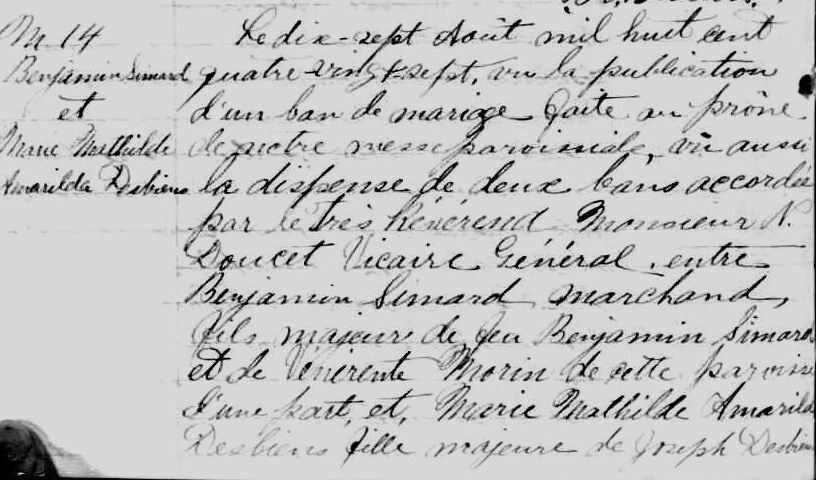
When I started my research, I had my mother in law’s parents and their wedding. Her grand-father Benjamin Simard’s wedding I found : to Amarilda Desbiens, August 17th 1887 in Baie-St-Paul .

SimardXDesbiens 1887 StPaul1

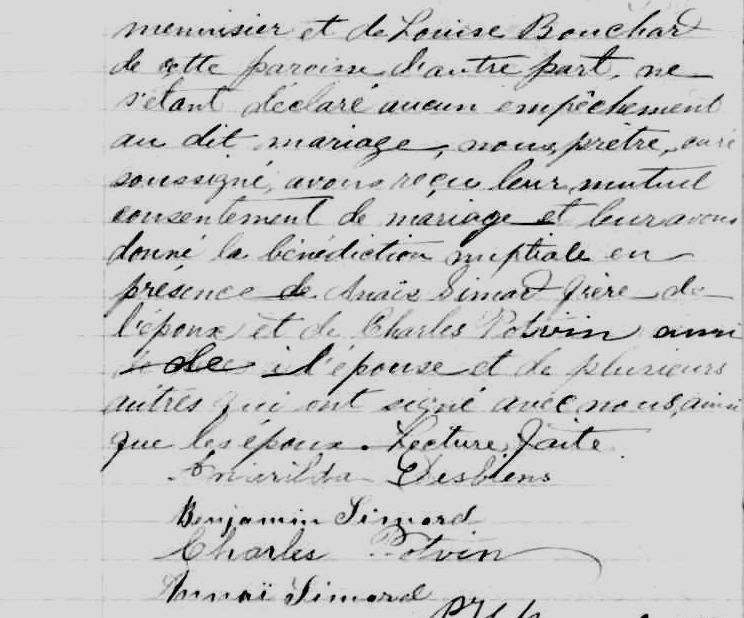
SimardXDesbiens 1887 StPaul2

Amarilda was the daughter of Joseph Desbiens and Louise Bouchard, and on I went in an afternoon, all the way up the tree to France.

Then, with different resources I found birth and death certificates, but no birth date for Amarilda. Even in books where they would list her whole family, ancestors and descendants, there was a marriage and a death, but no birth for her.

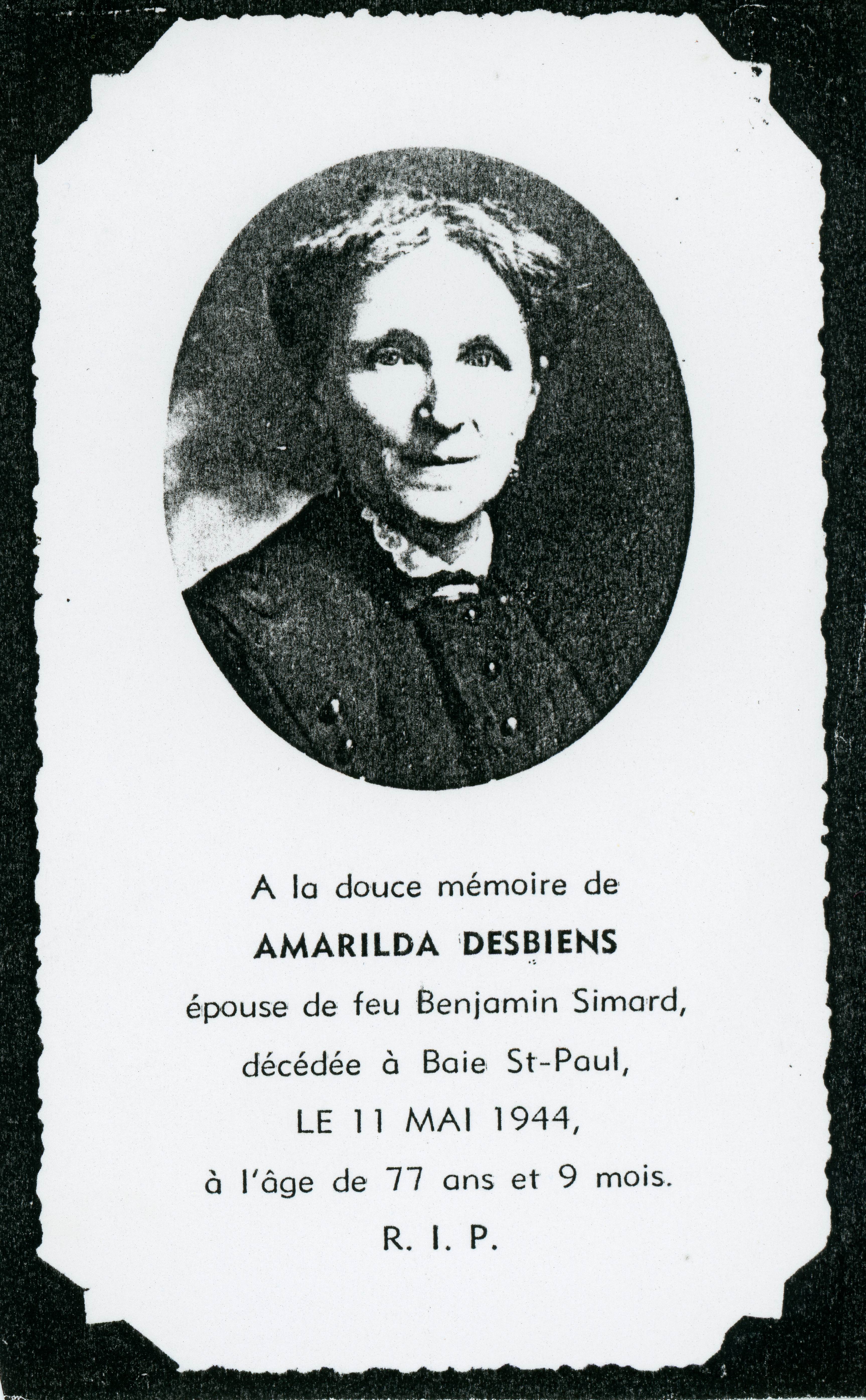
At the Société d’histoire de Charlevoix, her card was in a collection of funeral cards. I got an approximate date of birth of 1866 from the information: died May 11th 1944, at 77 years and 9 months.

amarilda001

All her sibblings were baptised at Les Eboulements and her father in Ile-aux-Coudres. At the local Quebec Archives Depot of Charlevoix I look at the microfilmed birth registers for 1865, 1866, 1867. No Desbiens birth .

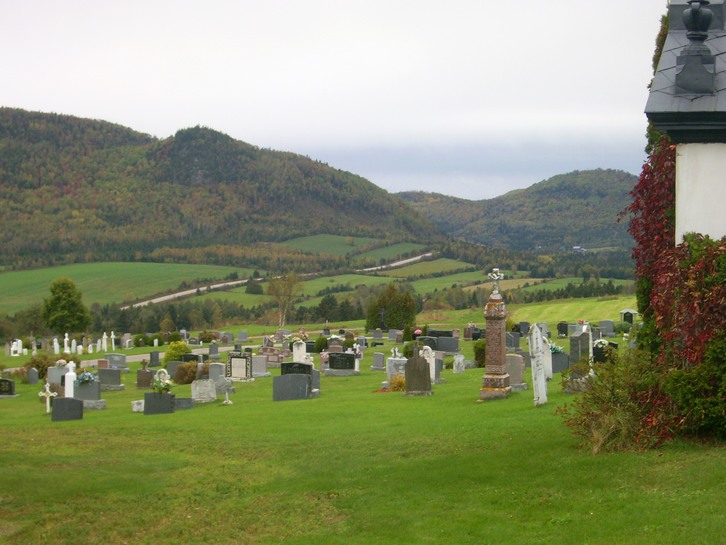
At Baie-St-Paul and Les Eboulement cemeteries: no tombstones for the family.

Digital Camera

Les Éboulements

First turn up a mountain road

A friend told the family that Amarilda was adopted and from Scotland. She was supposed to be a Donaldson or Danielson, but I found that her sister married one, nothing about Amarilda.
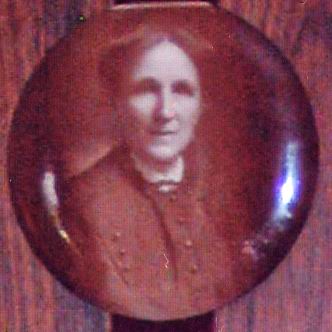
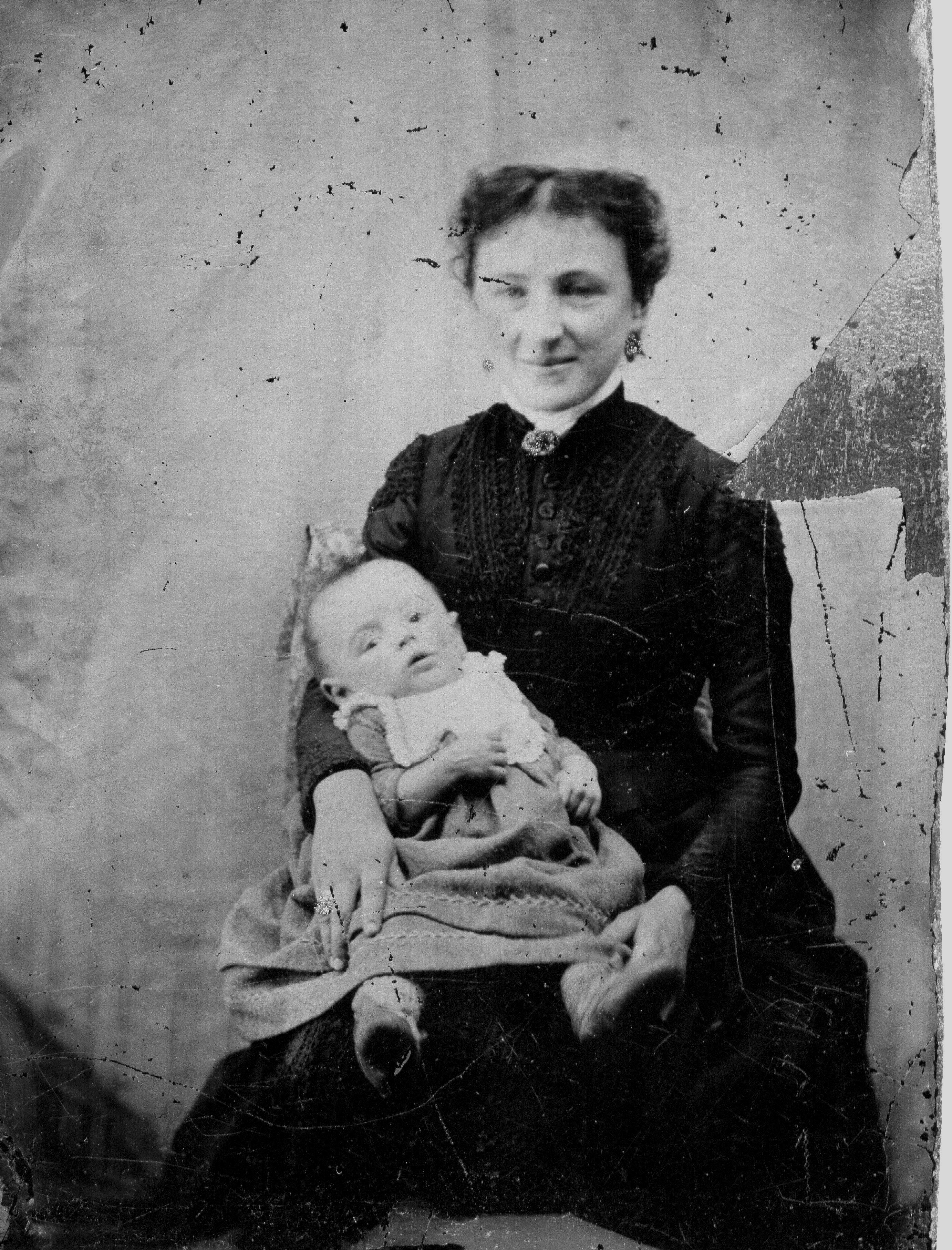
My mother in law said Amarilda was a really cold and distant grand-mother, sitting very upright in her chair, a cameo at her neck and a blanket on her knees. She only had three kids.
When she was young, my mother in law’s sister was so blond with blue eyes, she was told she was Irish by the neighbours.

At BAnQ: census on microfilms:
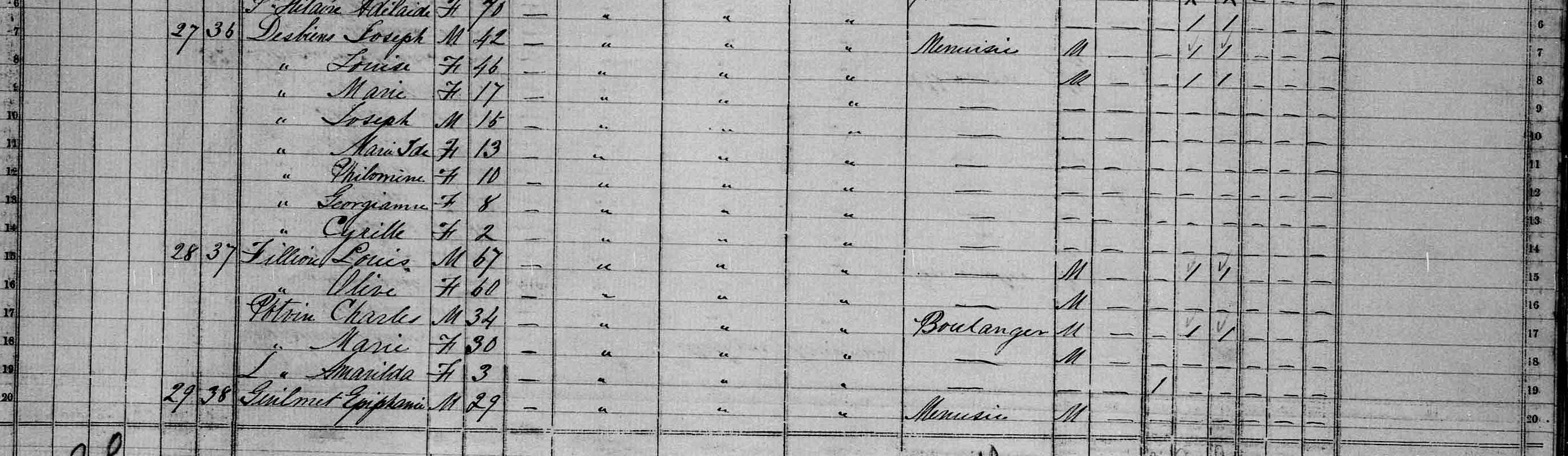
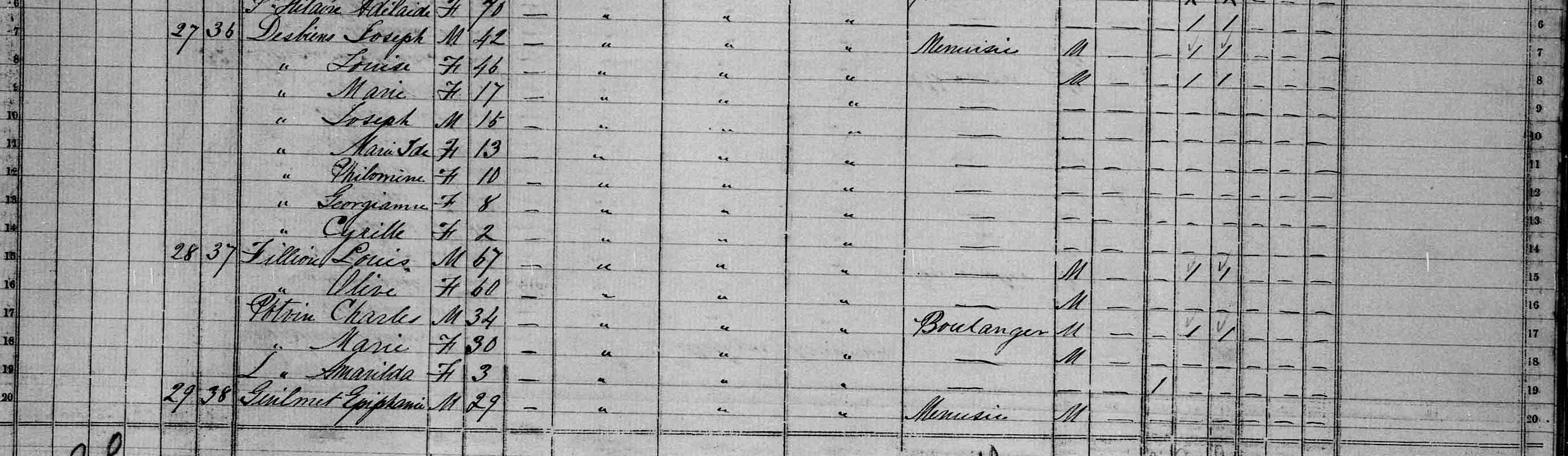
1871, She is not listed with her family. She probably hasn’t arrived yet:

DesbiensMA-Potvin et DesbiensJ REC 1871

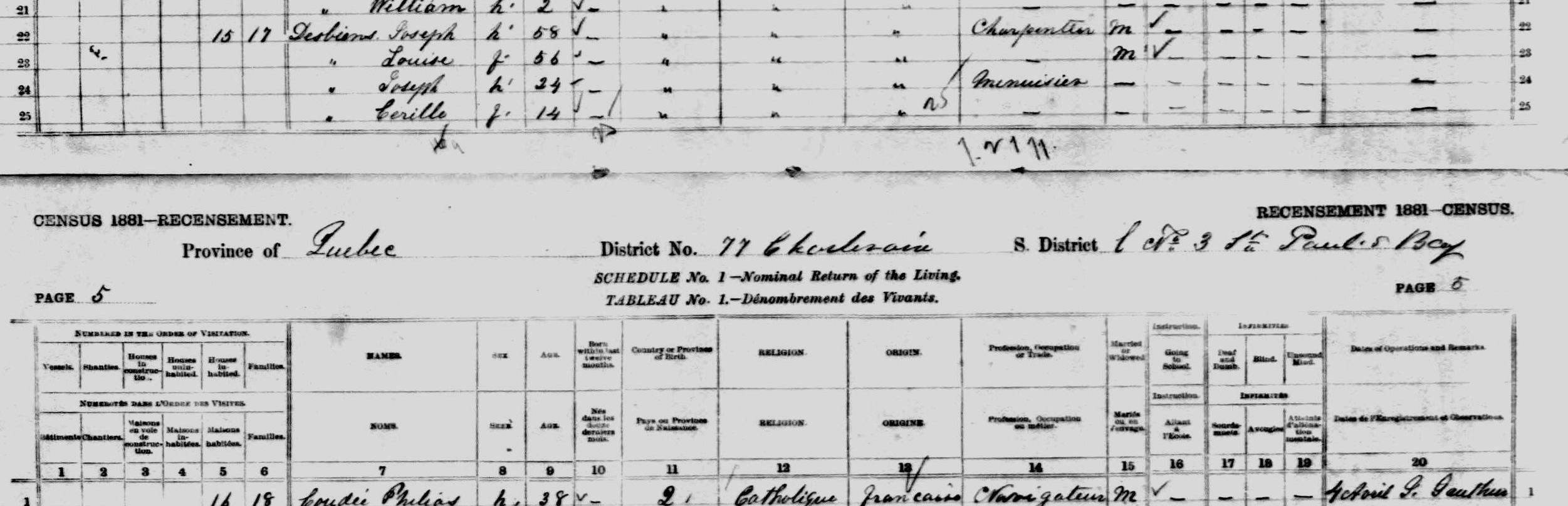
1881, still not there:

DesbiensJf REC 1881 BStPaul

1891, she is married and with her husband:

SimardBf REC 1891 BStPaul

So she must have been adopted when she was older than 15 years old.

I started looking up immigration history books, lists… To no avail.

Even now, when I look up online Ancestry, Drouin or Family Search : marriage records only for dear Amarilda.

Now I knew she was laughing watching me go in circles. Every place I went, every book I got my hands on, I looked her up. Not a word on her birth.

Final sretch

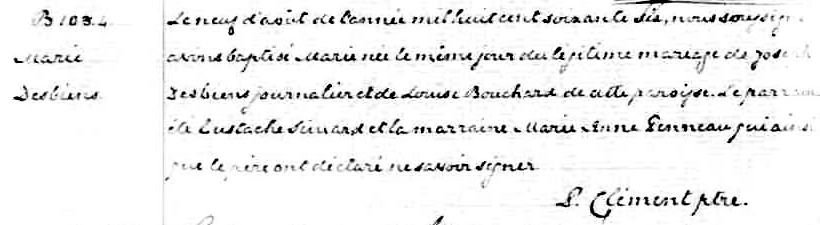
I finally tried at Baie-St-Paul presbytery. In the filing cabinet, the individual’s cards are grouped by family. With husband Benjamin and kids, Amarilda’s card, with three dates: birth, marriage and death! I then looked up her parents, Jospeh Desbiens and Louise Bouchard cards as a group, with their children: there she was, born not in Les Eboulements, but in Baie-St-Paul: MARIE DESBIENS. ONLY Marie! Baptised 9 aout 1866

DesbiensMarieAmarilda B 1866 BaieStPaul

Baie-St-Paul register, 1866

Before she was five, she was adopted by the neighbour Charles Potvin, a baker and merchant, and wife Marie Filion.
She married Benjamin Simard August 17th 1887 in Baie-St-Paul.

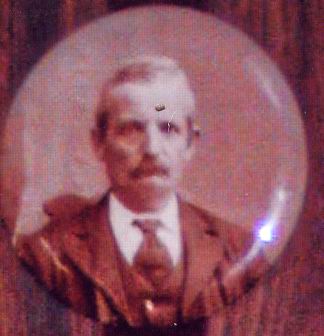
Benjamin Simard

Benjamin Simard, merchant

They had 10 children:
7 died young or at birth, Ambroise died at 18, Florence and Charles became adults.

H11 1
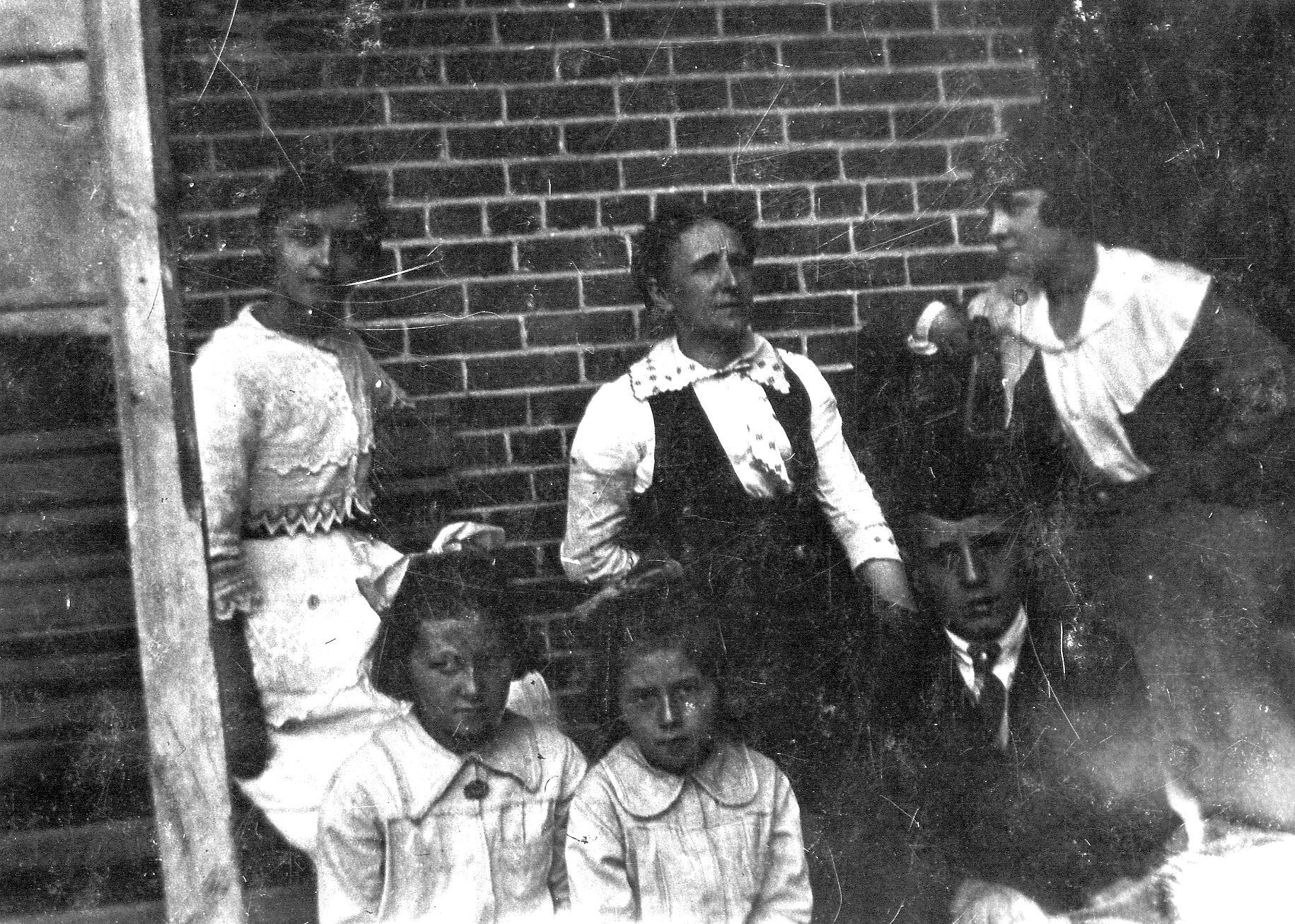
Back L. to R.: Daughter Florence, Amarilda, X. Son Ambroise sitting in front

Amarilda’s eldest son, Charles, took his name from his godfather: Amarilda’s adoptive father.

y02

Charles Simard with mother Amarilda

Charles Potvin being a merchant, maybe Benjamin Simard even took over his store.

X, Amarilda, Florence
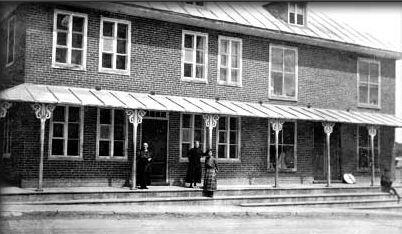
The store of Benjamin then Charles Simard, across from the church in Baie-St-Paul

Looking in the rearview mirror

All those little clues at first could not be taken for proof, but I did keep them on the back burner.

No Scottish, no Irish, not adopted INTO Desbiens family but adopted OUT to a Potvin family. Still I learned a lot even if side tracked.
I find her birth and death dates in Death Index Quebec 1926-1997 but no place of birth.If I had looked up the 1866 Baie-St-Paul register, page by page, I would have found a baby girl born to those parents in August 1866.

1. Census: 1871 she is not there, not because she has not joined the family, but because she has already left it, for…the neighbour: Charles Potvin and who will not children of their own.
When you look at the ditto signs before her name on the census, there is a very nicely formed beginning of a D for Desbiens ( just like her Desbiens family above), it stops, and dittos are put in, saying she’s a Potvin.

DesbiensMA-Potvin et DesbiensJ REC 1871

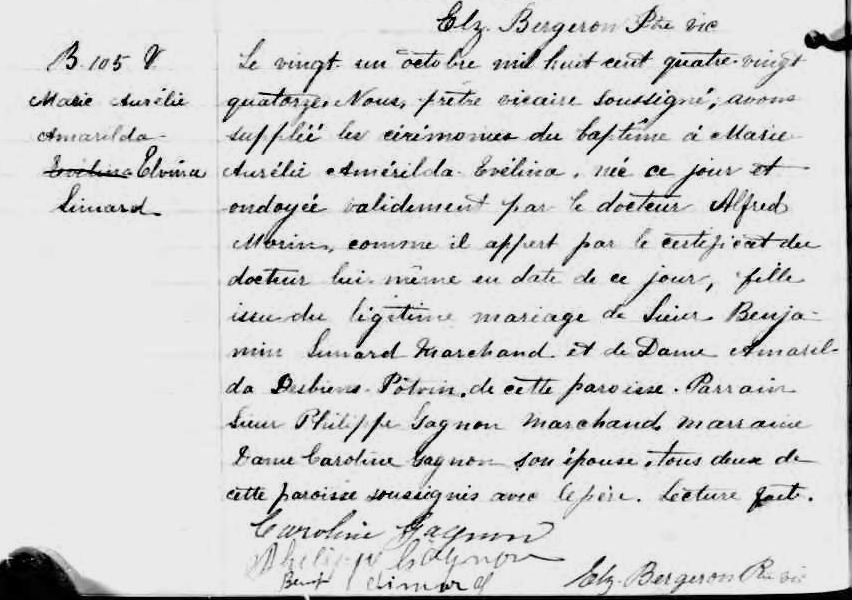
2. On the baptism certificate of Marie Aurélie Amarilda AKA Florence, Amarilda Desbiens Potvin is the mother

SimardFlorence B 1894 BStPaul

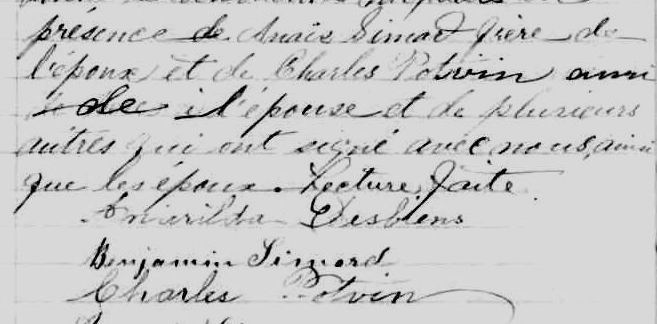
3. At Amarilda’s wedding, Charles Potvin is her witness.
If you look at the line where he is mentioned, ‘’friend of bride’’ is written over a few words that were already written. Father? Adoptive father?

SimardXDesbiens détail

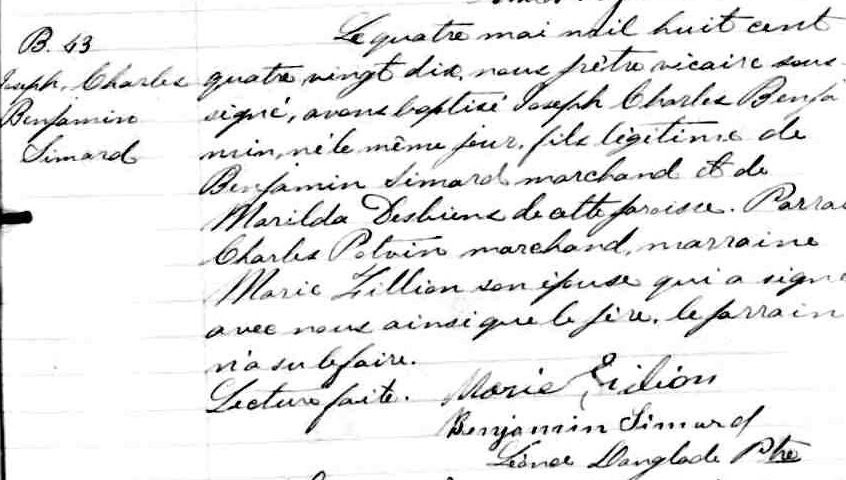
4. Charles Potvin and Marie Filion are godfather and godmother of Charles Simard, first surviving son of Amarilda and Benjamin.

SimardCharlesB N 1890 StPaul

The road up ahead
Why was she adopted?
The first of Amarilda’s siblings was born in 1850, they were 10 children in total, and twins were born in 1863. Maybe mom was getting tired and needed help. Maybe she was sick. Or the twins were a lot to take care of, and she was pregnant with her last child who was born in 1869. Or they took her in when her mom gave birth to the last one? Charles Potvin, no kids, baker and merchant he was probably better off than his neighbours. In the area, in those days, many well off families would pay for less fortunate children’s education, or adopt them. Charles, once a father, paid for education for quite a few children of Baie-St-Paul also.
Eventually, Zoe Potvin, Charles’ sister, even married Eusebe Desbiens, Amarilda’s brother.

Life in New France Was Fraught with Danger

Montreal,  originally known as Ville Marie was founded in 1642 by Paul Chomedy Sieur de Maisonneuve. At the time there were very few inhabitants. Within the next several years ships arrived and the population grew.

In 1663 the company of Saint Sulpice became the owner of the Montreal Island. They built their Seminary in 1684 and starting in 1685 Montreal became more and more of a military stronghold surrounded by a wooden palisade

In 1665 my 7th great Grandfather Claude Jodouin, born in Poitiers, France,  arrived in Ville Marie,  New France. He was a master carpenter and worked for the Sulpicians. Shortly after his arrival1 on March 22,1666 in Notre Dame Church he married Anne Thomas, a King’s daughter. Over the years they had ten children.

Saint-Henri  des Tanneries  was an non-populated wooded area far removed from the walled section of the settlement which is now referred to as Old Montreal. There the workers would tan hides. The odor from the tasks was most unpleasant, to the point of being quite unbearable. This was the reason for establishing the tanneries far from the population. The area today still bears the name Saint Henri.

While working at the tannery Claude Jodouin’s life came to a fateful end. He was fifty years old.

In the Bulletin des Recherches Historiques2 the following describes his death.

“Le sudit document nous apprend encore que, le 16 octobre 1686, un charpentier nomme Claude Jaudouin employe a la tannerie fut inopinement tue par un autre ouvrier. Nicolas Martin dit Jolycoeur. Celui-ci, ignorant que son compagnon etait au bois entendant un froisement de branches imagina qu’un ours venait a lui. Pris de peur, il dechargea son fusil dans la direction de bruit avec le regrettable resultat que l’on sait.”

Translation:        It was in a wooded section outside the tannery, that a fellow worker thought he heard a bear rustling in the bushes, took aim and shot. So ended the life of Claude Jodouin, the master carpenter.

In the Dictionnaires de genealogies des familles du Quebec3  it indicates that Claude Jodouin was killed accidentally. Little did I know that my first trip to La societe de genealogie canadienne francaise in the east end of Montreal would reveal the manner in which he died.

Anne, Claude’s wife was still a young woman with the responsibility of their ten children.  From all accounts she was sought after by many eligible bachelors. Within a short period of time she remarried.4

Sources:

1      POULIN, JOSEPH-PHILIPPE. “Premiers colons du debut de la colonie jusqu’en 1700.” In Programme Souvenir, Sixieme Congres de la Societe Genealogique Canadienne Francaise, Quebec (Oct. 8-10, 1960), pp. 13-22.  Arrival


1      L’Abbe D Tanguay, ADS, Dictionnaire Genealogique des Familles Canadiennes Depuis la Fondation de la Colonie Jusqu’a Nos Jours, Cinquieme Volume, Depuis 1608 jusqu’a 1700, Eusebe Senecal, 1888.

2       Bulletin des Recherches Historiques Vol 41: p 39

3      Dictionnaire degenealogie des familles du Quebec, Jette

4       Ibid

http://www.memorablemontreal.com › accessibleQA

http://en.wikipedia.org/wiki/Timeline_of_Montreal_history


Scottish Gaelic Settlers in Québec

Oatmeal and the Catechism Scottish Gaelic Settlers in Québec Margaret Bennett
QFHS # HG-153.99 B65
345 pages

Oatmeal and the Catechism is the story of emigrants from the Outer Hebrides to Québec in the latter half of the nineteenth century. Most were crofting families from Lewis who had suffered the severe effects of the potato famine of 1846-51. As a solution to the increase pressure on landlords and government relief bodies, they were offered free passage to Lower Canada and given land grants in the Eastern Townships and more precisely within Compton County. To this day place-names such as Stornoway, Tosta, Ness and Dell in Canada testify to the strong links these communities kept with their homeland.

An article in The Clansmen News of 1970, based on local interviews and entitled ‘The Scottish Highlands of Quebec: Gaidhealatachd Chuibeic’, states:

At the time of the first Great War there were approximately two thousand five hundred Gaels in Marsboro (Marston) alone. We were talking with a man who was born in Milan, who told us that he did not know that there was any other language in the world but Gaelic until he was seven years old.

In Compton county, in the Eastern Townships of Québec in the years of 1851 to 1891, the language distribution in the following towns and villages could convincingly be reconstructed as follows:

> Marsboro – Gaelic (c. 75%), French (c. 20%), English (c. 5%)
­> Milan – Gaelic (c. 95%), French (c. 5%), English (c. 0%)
> Scotstown – Gaelic (c. 50%), French (c. 25%), English (c. 25%)
> Springhill – Gaelic (c. 50%), French (c. 25%), English (c. 25%)
> Stornoway – Gaelic (c. 95%), French (c. 3%), English (c. 2%)
> Red Mountain – Gaelic (c. 75%), French (20%), English (c. 5%)

…. a grasp of the history and folk culture of Gaels from the Outer Hebrides who settled this comparatively small area of Canada will contribute to a better understanding of the Eastern Townships and of Québec.
Margaret Bennett
Winner of the 1999 CLIO Award of the Canadian Historical Association

Posted by Jacques Gagné for Genealogy Ensemble

Montreal’s Black Market Babies

In the late 1940s and early 1950s, 1,000 babies were sold to adoptive parents through a black market baby ring that operated in Quebec. Most of the babies were born to unwed French Canadian mothers, most of the adoptive families were Jewish. Some of the children went to homes in Quebec and Ontario, and many grew up in the United States.

In 1984, my husband found out he had been adopted and that his parents had paid about $2,000 for him. About 15 years later, he found out about the black market baby ring that had arranged his adoption. Ever since then, he has been sharing his story with friends, with community groups and through the media. Several years ago, Global television told the story of Harold’s search for his birth mother on the program Past Lives.

This week, the Montreal CTV station aired a news feature about the black market baby ring. It puts Harold’s story in context, explaining how most of the mothers who gave birth out of wedlock had no choice but to give up their babies. Harold counts himself lucky that he ended up in a good home and not in an orphanage.

The ring was broken up 60 years ago this year. Some of the birth mothers have no doubt died, and many of their children are probably still trying to find them. The story is still fascinating.

Here is a link to that six-minute CTV feature: https://www.youtube.com/watch?v=DNKTqkZmIGE

Karen Balcom of McMaster University has written a book that addresses this topic: The Traffic in Babies: Cross-Border Adoption and Baby-Selling between the United States and Canada, 1930-1972 Studies in Gender and History, University of Toronto Press, 2011.

You can learn more about Montreal’s black market baby ring on the Parent Finders Montreal website, http://www.pfmtl.org/BMB/index.html. At the bottom of the page, there is a list of dates, pages and titles of old newspaper articles about the case. Paste in the url for one of these stories from The Gazette, http://news.google.com/newspapers?nid=Fr8DH2VBP9sC&dat=19540215&printsec=frontpage&hl=en, and from there you can easily browse the newspaper to find the other articles.

There is a Montreal Black Market Baby Facebook page.

Feb. 23 2016, this post has been updated. The link to the CTV feature now works.

The Trail of the Huguenots in Europe, the U.S.A and Canada

The Trail of the Huguenots in Europe, the United States, South Africa and Canada
Author: G. Elmore Reaman
QFHS #UEL-REF HG 010.01 R4 1972
Total pages: 318
From page 137 to page 205, this section of the book address the Protestant families in Nouvelle France (New France)
Being a book owned by the United Empire Loyalist’ Association of Canada, it cannot be taken out of the library.

The following is an excerpt from this superb book by G. Elmore Reaman.

It is a generally accepted point of view in Canada that Frenchmen have always been Roman Catholics and that Protestantism has had little or no reliationship with France. It has been further accepted that there was no connection between Protestant French and the exploration of Canada by the French. A careful study of both of these points of view will show that they are untenable. It may come as a surprise to learn that historians of this period state on good authority that, if it hadn’t been for the business enterprise of Huguenots in France and their desire to found a colony where they could remain loyal to the King of France and yet enjoy freedom of worship, it is doubtful if there would be many French in Canada today. Furthermore, it is quite possible that had the French allowed Huguenots to migrate to Canada in the seventeenth century, England would have stood a slim chance of conquering Canada.

Such information does exist in authentic sources, but few persons in Europe or America—and that includes Canada—have any knowledge of it. French Roman Catholics have naturally advanced their point of view and Protestants have never thought it worth while to investigate it. Huguenot Societies in France, England, and the United States are not aware that from 1534 until 1633 Canada was practically Huguenot controlled nor do they know that many of the earliest settlers in Upper Canada (Ontario) were descendants of émigrés from France, some of whom first went to the British Isles, then to the United States, and finally to Ontario.
G. Elmore Reaman

G. Elmore Reaman (1889-1969) was born in Concord, Ontario, he received his education at the University of Toronto, McMaster University, Queen’s University, Cornell University.

Dr. Reaman’s materials are found at the University of Waterloo Archives.

Posted by Jacques Gagné for Genealogy Ensemble

Borderland Religion 1792-1852 by J.I. Little

Borderland Religion – 1792-1852 – The emergence of an English-Canadian identity – J.I. Little
QFHS Library #HG-100.44 L5 – 385 pages

In December 1811 ‘A Poor Farmer’ in Shipton Township wrote the following plaintive words to the editor of the Québec Gazette:
Eleven years have elapsed since I first entered these woods, with my family, and seven years since my residence in this Township … On my first arrival in these woods, with my wife, both of us about the age of Twenty, we had one child, at present we have six, and have lost three. Our first care and inquiry was, in what manner shall we have our children Baptized, Educated, and taught the true Religion of Christianity. Hope led us to believe, living under so good a Government, we shall shortly have men placed among us for these purposes. Alas, Eleven years are now gone over, and I dont see the least prospect of these blessings.
With what sorrow do I declare that in the Townships, in this District, it is estimated that near Two thousand Children live without Baptism, upward of Six hundred men and women live together without lawful marriage; and that the greatest part of these people have not, for the last Ten years, heard the Word of God on a Sabbath day; as for our dead, they are disposed of in the same manner that most people dispose of a favorite Dog who dies, by placing him quietly under a Tree.

In the 1831 census the largest cohort in the Eastern Townships declared no religious affiliation whatsoever. By this time, however, British missionary societies had been attempting to fill the religious vacuum for more than a decade. Many who declared affiliation with the Church of England were probably doing so because it was the only one available to provide the basic services of baptism, marriage, and burial.
J.I. Little

Other books by J.I. Little, on the subject of the Eastern Townships of Québec;
> Loyalties in Conflict: A Canadian Borderland in War and Rebellion, 1812-1840
> The Other Quebec: Microhistorical Essays on Nineteenth-Century Religion and Society
> State and Society in Transition: The Politics of Institutional Reform in the Eastern Townships 1838-1852
> Crofters and Habitants: Settler Society, Economy, and Culture in a Quebec Township, 1848-1881
> Nationalism, Capitalism, and Colonization in the Nineteenth Century Quebec: The Upper St Francis District

Posted by Jacques Gagné for Genealogy Ensemble

History of Compton County by L.S. Channell

History of Compton County in the Eastern Townships of Québec by L.S. Channell
QFHS Library #UEL-REF HG-153.01 C46
295 pages large format – Two copies available at the Library.

Being a U.E.L. Reference book, said books cannot be taken out of the Library.

The history of 400 pioneer families of Compton County plus those in Sherbrooke County and those within the district of St. Francis from the birth of the region in 1782.

At the close of the Revolutionary War in 1782, many thousand United Empire Loyalists were offered lands in Canada by the British Government. A few hundred families came to the townships of Eastern Canada.

There can be no doubt that United Empire Loyalists took up their residence in our Townships before 1792, but the official records of such are missing.

The first settlers are heard of on Missisquoi Bay and Lake Memphremagog. At the head of the Connecticut River in the township of Hereford, Colonel John Pope settled as early as 1792, and there is not much doubt but that settlers were there for several years previously.

In the year 1796 the first lands in Lower Canada were granted in free and common soccage.

In 1803 the courts of Montréal rendered a decision that no right of property in slaves could exist in Lower Canada, and the few slaves in this country were thus manumitted. The people in the Townships were too poor to own slaves in those days, and two only are known to have been in what is now Compton County. They belonged to Colonel John Pope, and remained with him until their death when they were sent back to the old plantation in Massachusetts for burial.

L.S. Channell

Posted by Jacques Gagné for Genealogy Ensemble

W. Stanford Reid, An Evangelical Calvinist in the Academy

ReidMy copy of this 401 page-tome by A. Donald MacLeod has a few coffee stains and a few highlighted portions but overall it’s still in good shape.

Rev. W. Stanford Reid was a leading Presbyterian Minister in Montreal after World War 2 – He was a Professor at McGill University – He was associated with the Presbyterian College at McGill University.

He was the son of another Presbyterian Minister, he was the grandson of another Presbyterian Minister, the latter born in Scotland who settled with his family  in Compton County and opened a large Church of Scotland for the Hebridean Scots of the region.

He was a Pastor at some of the leading Presbyterian Churches in Montreal and Westmount after WWII.

At one point in time at the Presbyterian College in Montreal, he was influenced by the teachings on Calvinism by Rev. Donald Harvey MacVicar,  at the time, a leading Presbyterian Minister in Montreal and also a distinguished professor at the Presbyterian College at McGill University.

Pastor W. Stanford Reid as indicated above and for the rest of his life embraced the teachings of John Calvin (Huguenots) which was taught and promoted by Rev. Donald Harvey MacVicar and others in Québec and other parts of Canada, especially Ontario at the time.

Pastor W. Stanford Reid eventually opened one of the largest Presbyterian Churches in Montréal in the Town of Mount-Royal. It’s now a United Church of Canada parish.

This book is not for your average reader but if one wants to understand fully why there were so many variations to the Church of Scotland and later the Presbyterian Church in Québec and in the rest of Canada, this explains it.

A copy of the book is available for purchase at

http://www.mqup.ca/w–stanford-reid-products-9780773528185.php.

Jacques Gagné’s book review

M Jacques Gagné est un chercheur en généalogie, bénévole depuis plus de dix ans à la Quebec Family History Society.  Il a compilé plusieurs dizaines de listes de ressources pour les chercheurs.  On en retrouve en ligne,  dans la section des membres de la QFHS, certaines de ses nombreuses compilations.  On en nretrouve en bibliothèque aussi à la société.  Il a travaillé, entre-autres, sur les actes manquants des églises protestante du territoire que couvre le Québec contemporain pour la période 1759-1899.  Il a travaillé sur maints projets, dont les églises des missions des premières nations, sur les Huguenots, tant en Europe qu’en Amérique, sur les missionnaires itinérants, sur les ressources disponibles sur les Acadiens, les Canadiens- Français et en ce moment  sur les départements français.

M Gagné a écrit une série de critiques de livre dont voici la première que nous vous présentons.

Members of QFHS know him, and in the members only section of the QFHS you find some of his compilations.  Many of his works are available at the QFHS library.  He has been working hard for years to provide tools to help us look up and find genealogical information on French, Huguenots, First Nations….

”Jacques Gagné has been a volunteer genealogical researcher at the Quebec Family History Society for the past ten years, handling a wide variety of genealogical cases. For several years, Jacques has conducted in-depth research on the missing Protestant Church Registers for what is now the province of Quebec, from 1759 to 1899. To date, more than 1,000 churches are listed. Now he has provided an extensive guide to Family Searches on the Internet.”

Here is one of a series of book reviews he has prepared for the French Research Group at QFHS.

Marcel Trudel
Catalogue des immigrants 1632-1662
569 pages
QFHS #REF HG-150.99 T7

Trudel

Marcel Trudel (1917-2011) was a longtime professor at the Université Laval in Québec City and at the University of Ottawa. Recipient of many awards during his lifetime as an historian. In 1971 he was made Officer of the Order of Canada – In 2004 he was made a Grand Officer of the National Order of Québec.

Within this 569 pages detailed research guide, Marcel Trudel has addressed 3,000 immigrants from 1632 to 1662 who had settled in Nouvelle France.

Monsieur Trudel in comparison to Marcel Fournier and René Jetté has taken a different approach in his work.

All three historians in my opinion are offering a different perspective to the research process of one’s ancestor in France.

I have never taken the time to compare the results posted by Marcel Trudel or by René Jetté or by Marcel Fournier, but in my opinion, all three have researched and compiled superb material.

Marcel Trudel as part of is excellent dictionary has spent considerable time in offering his readers, precise details such as the age of an immigrant, the type of work he or she did in France, from where they came from, were these immigrants capable of signing their names to documents such as acts of baptism, marriage, death or notarial records and what type of work they did once they settled into Nouvelle France.

Jacques Gagné


French and French-Canadian resources at QFHS

L’association Quebec Family History Society, à Pointe -Claire dans l’ouest de l’ile de Montréal, a une groupe de recherche francophone en plus de toutes les activités orientées vers les recherches anglophones.  M Jacques Gagné, un membre de la société et chercheur chevronné du côté de la recherche française, nous offre quelques mots et conseils:
” En plus de posséder un des plus grands dépôt de revues et publications anglophone des iles britanniques et du Canada, à part de celui du BAnQ sur Viger  à Montréal, la société reçoit plusieurs publication en français.  Le plus importantes étant:
>> Mémoires de la Société généalogique canadienne-française
>> L’Ancêtre de la Société de généalogie de Québec
>> L’Entraide généalogique de la Société de généalogie des Cantons de l’est
Les membres de la QFHS qui désirent devenir des experts en recherches d’ancêtres de France, devraient commencer par les publications à la QFHS.
C’est en fait comment j’ai débuté il y a plusieurs années”
Jacques Gagné
La QFHS a même un spécial pour nouveaux membres jusqu’en juillet 2014
QFHS_Logo

The Quebec Family History Society in Pointe-Claire (West Island of Montreal) has a wonderful library that is opened quite a few hours a week, and from which members from out of town may even borrow books by mail.

Jacques Gagné, one or our members for quite a few years, our local French research expert supports the  France Research Group at

QFHS.  Here’s his two cents worth about starting some French Quebec research:

”Periodicals at QFHSOver the years under the leadership of Claire LindellMary Plawutsky, Daphne PhillipsBruce HendersonTed Granger, Diane Bissegger, the QFHS Library has been a primary repository of periodicals from the British Isles and from most provinces of Canada.To my knowledge, only the Archives nationales du Québec on Viger has a larger collection of genealogical magazines.This article will only address the aspect of research tips dealing with France.

Three periodicals in Québec, all three kept at the QFHS Library are superior to others in regard to the French Canadians and Acadians;
>> Mémoires de la Société généalogique canadienne-française
>> L’Ancêtre de la Société de généalogie de Québec
>> L’Entraide généalogique de la Société de généalogie des Cantons de l’est

Others revues (periodicals) dealing with the French Canadians and Acadians are also stored within the shelves of the QFHS Library.

QFHS members who wish of becoming experts in the research process of ancestors in France, should begin their expertise journey with the French language periodicals kept at the QFHS Library.

This is basically how I started a number of years back.”

Jacques Gagné

The QFHS is even having a new-members special until July 2014