Category Archives: french-canadian

Is There a Doctor in the House?

Ismael Edgard Bruneau

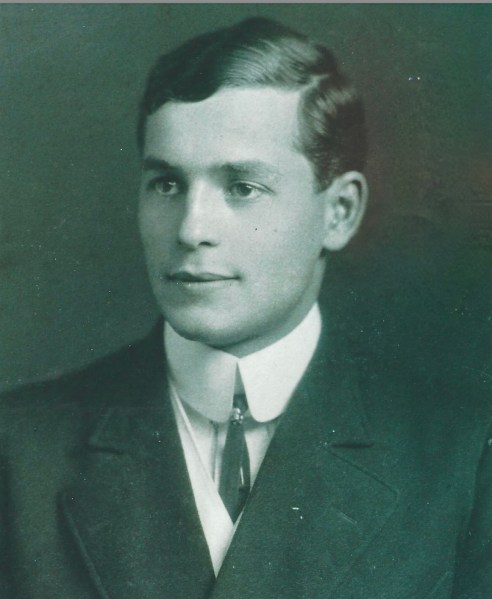
As far as I can tell, Ismael Edgard Bruneau (1887 – 1967), my great uncle, was the first doctor in our family and maybe still the only doctor. His father wanted him to follow in his footsteps and become a minister, so when Edgar entered McGill in 1907, he registered for an Arts degree. During his university years, he decided he would rather be a doctor. He finished his Arts degree in 1910 while concurrently studying medicine and received that degree in 1912.

Edgar, as he became known, was the first of ten children of Ismael Bruneau and Ida Girod, my great-grandparents. He was born in Green Bay, Wisconsin, where his father served as a French Presbyterian minister. The family moved to Holyoke, Massachusetts, Quebec City and Montreal, where he did most of his schooling.
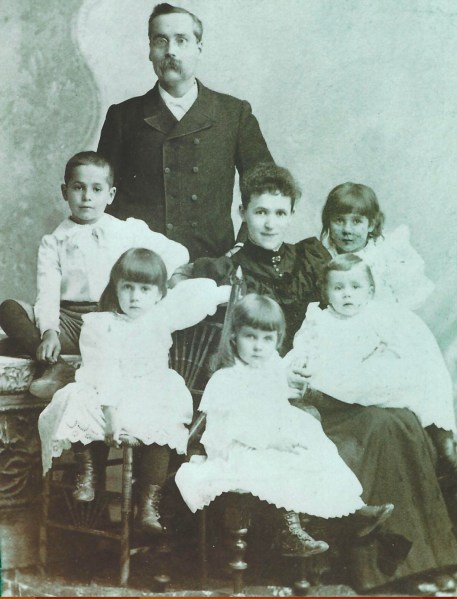
Ismael & Ida Bruneau with children Edgar top left, Hermonie, Helevetia, Sydney and Beatrice

He interned in Montreal and Ottawa and then practiced for a short time in Swift Current, Saskatchewan.
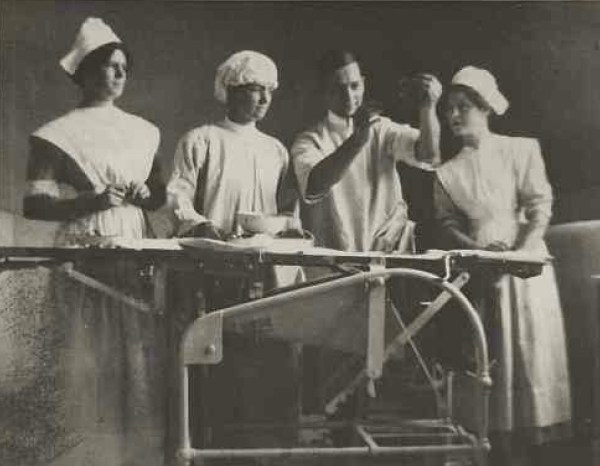
Dr Edgar Bruneau demonstrating techniques

When WWI began, he joined up with friends from McGill in the McGill Machine Gunners unit and was sent overseas in 1915. His father was unhappy with his decision to be a regular soldier and thought he should at least use his medical degree. Soon after arriving in England, he transferred to the Royal Army Medical Corp as a first lieutenant. This certainly didn’t keep him safe, as he served in France and Italy, being wounded twice and also severely gassed. Captain Bruneau was sent home to Canada in mid-1918. While in England, he visited with his Uncle Ernest Girod and became engaged to his cousin Marie but that relationship was over before he sailed home.

Edgar opened an office in Montreal as a general practitioner where he stayed his whole career. He lived on Park Avenue and had an office in his house with reception rooms on the ground floor and living space on the upper floor.

He also volunteered at the Montreal Dispensary through the 1920s. This clinic, established in 1850, gave health care to the poor. It was in downtown Montreal on St. Antoine Street, run by volunteer doctors and supported solely by donations. In the late 1920s, the Dispensary had financial difficulties and nearly closed but survived when it received a bequest of $10,000.

In the late thirties, Edgar suffered from a tubular disease in which the kidneys were damaged by lack of oxygen and blood flow, and so, for three years, he had to give up his practice. He was a much-loved doctor, as his patients visited him whether or not they needed care.

Edgar married Marie Eveline Lemoine in 1923. Before their marriage, they were in a car accident. He was driving on a street with streetcars when the traffic policeman gave him the signal to proceed. Unfortunately, the way was not clear and the car was hit by a streetcar. Eveline was thrown against the windshield, badly cut and she lost vision in one eye. Edgar felt responsible for her, so they married. Still, the marriage lasted 31 years until her death in 1954. Edgar was very social and attended all family gatherings but Eveline never did..
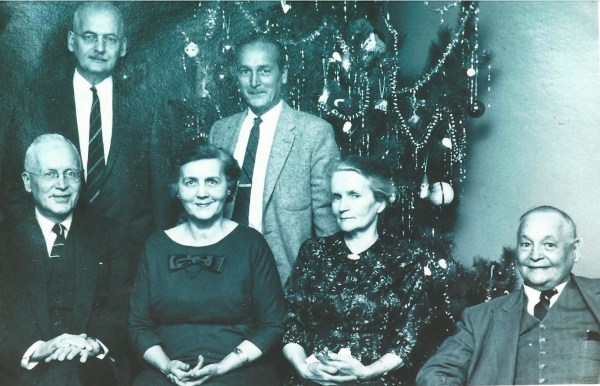
Six of the Bruneau children; Back row, Herbert & Gerald. Front row, Sydney, Edmee, Helvetia & Edgar ~1960.

One night, in the late 1950s, Edgar fell, going downstairs to his basement to fix the furnace. He broke his leg and wasn’t discovered until his housekeeper arrived in the morning. His brother Herbert wrote that when he was found, his leg was black and although the doctors saved it at that time, it resulted in gangrene. Edgar, like most of his siblings, had developed type II diabetes, which resulted in poor circulation in his legs. He first had his toes removed, then later, after many operations, most of his leg was amputated.

Edgar spent his final years at the St Anne’s Veteran’s Hospital in St Anne de Bellevue, Quebec. My sister said she never wanted to visit him as one of us told her he hung his leg in a stocking on his door at Christmas. Edgar is buried in Montreal’s Mount Royal Cemetery alongside his wife

Notes:

Recollections by Victor Herbert Bruneau , May 19, 1976.

Edgar was a keen fisherman.

He joined the Masonic Order and became a Shriner.

He was very musical; played the organ for his father’s services from the age of ten and he could play any tune he heard on the piano. He was popular with his comrades during the war and a good host afterwards.

I have no pictures of Evelyn. Edgar went to all the family functions and was very social but never Evelyn. She did play bridge and was mentioned in the newspaper as an attende at Karnac bridges put on by the Shriners.
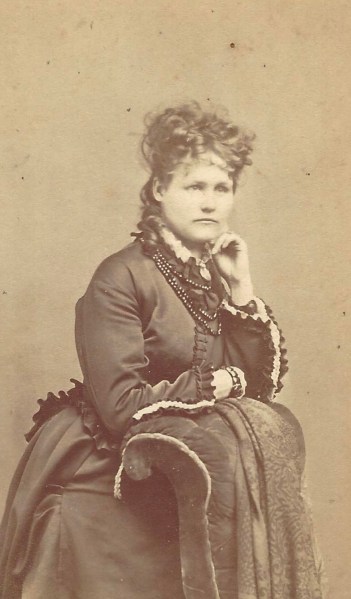
A Little About Helene Bruneau

Helene in New York City

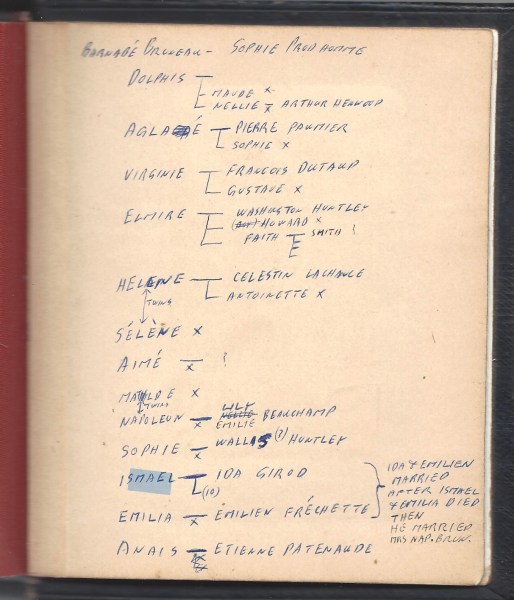
I have written stories about twelve of Barnabé Bruneau and Marie Sophie Prudhomme’s thirteen children. That just leaves Helene (1849 -1929). Helene was child number nine or perhaps number ten. I just realized that she and Selene Joseph were the second set of twins in the family. They were born on December 20, 1849.

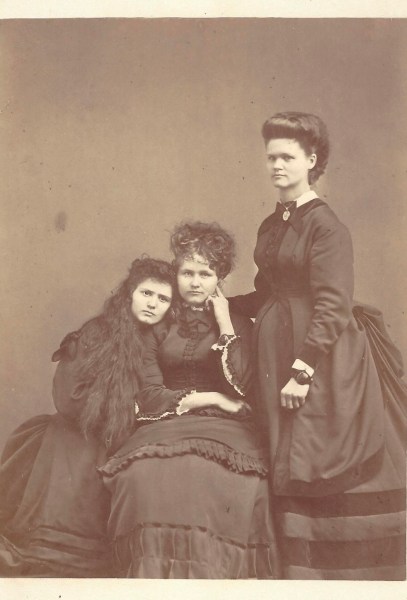
I haven’t found much information about Helene other than she appeared to be a devoted wife and mother. She married at twenty-six but before, had spent some time in New York City as photographs can attest. Was she also a French teacher or governess like her sisters?

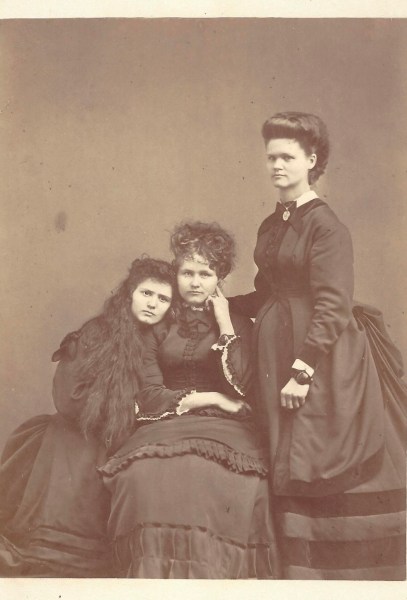
Sophie, Helene and Matilde Bruneau, New York City

Helene married Célestin Pépin dit Lachance ( known as Lachance). He was born in Joliette (1847-1915) to Celestin Lachance and Elisabeth Payette. His parents converted to Protestantism in 1852 when he was a young child. He attended the l’Institute Evangelique Francais de Pointe-aux-Trembles. After he graduated, he became a Colporteur for two years for the French Canadian Missionary Society. He had aspirations of becoming a minister

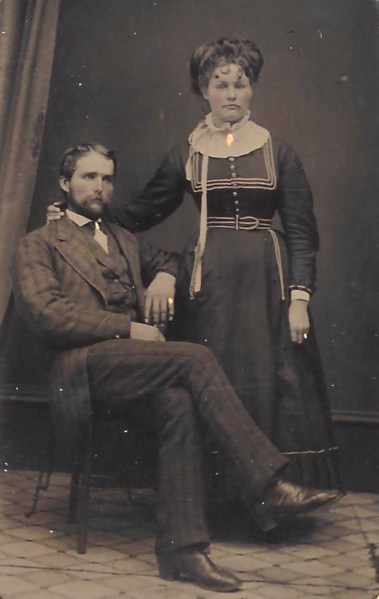
Celestin & Helene Lachance

In 19th century America, the word colporteur (the borrowing of a French word meaning “peddler”) came to be used for door-to-door peddlers of religious books and tracts and is still used today. The Missionary Society trained the colporteurs and future pastors as there wasn’t a French Protestant seminary. Celestin abandoned his studies in 1867, possibly because he had tuberculosis and his doctor recommended he only work outside in the fresh air. If he did have TB, the fresh air did him good as he lived almost another 50 years. He worked all over Quebec in the logging and forestry industry. Helene accompanied him everywhere during their marriage.

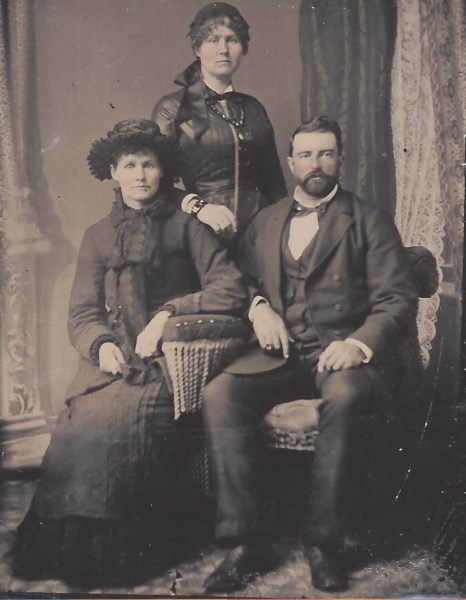
Helene & Celestin Lachance and Helen’s sister Anais

Although he gave up missionary work he remained a religious Presbyterian the rest of his life. He read the Bible every morning and night. During his last illness, he read the whole Bible twice in nine months. 

Helene was originally a Baptist as her parents also converted to Protestantism when she was a child. She is later recorded as being a Presbyterian.

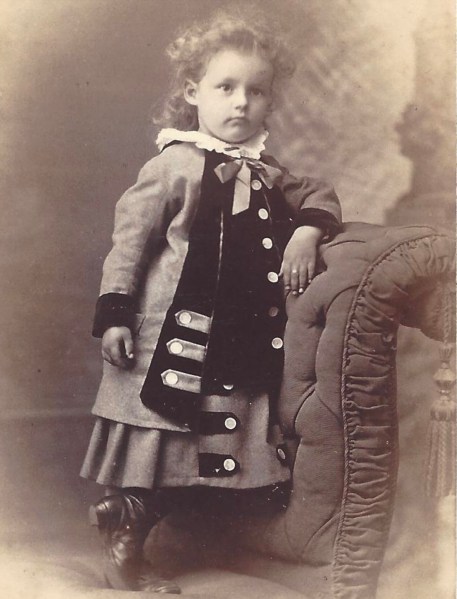
Celestin and Helene had only one daughter, Helene Marie Antoinette (1876 – 1916). This curly-haired child grew up but never married. She attended Royal Arthur School in Montreal. Antoinette attended English schools because the family was Protestant, so she couldn’t attend French Catholic schools. In 1892, she won the prize in French for second intermediate girls, besting Nellie Wilson, who won the awards for most of the other subjects. She didn’t have Antoinette’s advantage of a French background. At the closing of the ceremony, the commissioner said, “It was well to be clever but still better to be good.” Antoinette died at only forty years of age. She lived with her parents her whole life and never seemed to have an occupation.

Antoinette Lachance

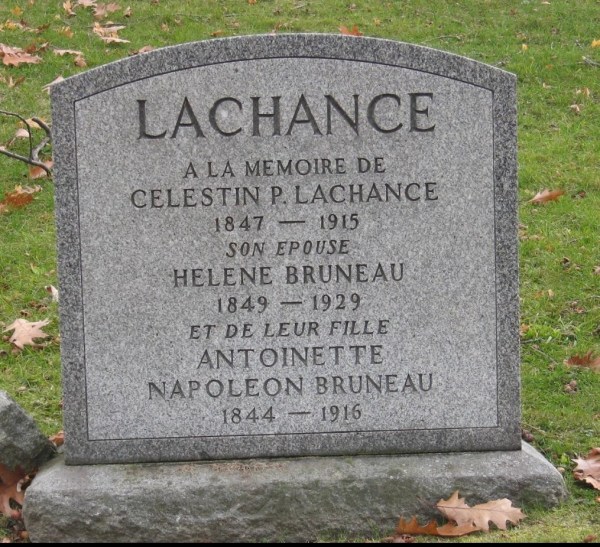
After Celestin and Antoinette died, Helene lived in Verdun, Quebec until her death, on June 4, 1929. The family is buried in Mont-Royal cemetery in Montreal along with Helene’s brother Napoleon.

Mount Royal Cemetery Montreal

Notes:

In the back of the little photo album in a list of the children, it actually said twins, which had never registered with me. 

Back page of photo album

1871 Census: Celestin was 22 and living with his parents and sibling in St Charles Borromée, Joliette, Quebec. Year: 1871; Census Place: St Charles Borromée, Joliette, Quebec; Roll: C-10036; Page: 15

Helene and Celestin were married in 1875 and recorded as French Evangelicals.

Antoinette was born in October 2, 1876 and baptized at 9 years old in 1885.

According to Find a Grave: her full name was Helene Marie Antoinette Lachance born in St Constant Quebec.Ancestry.com. Canada, Find a Grave® Index, 1600s-Current [database on-line]. Lehi, UT, USA: Ancestry.com Operations, Inc., 2012.Original data: Find a Grave. Find a Grave®. http://www.findagrave.com/cgi-bin/fg.cgi accessed August 28, 2024.

1891 Census: The Lachances were living in Ste. Conegonde Hochelaga, Quebec. Celestin was a Commis au Bois, a wood clerk, Helene was a wife and both members of the Free Church. 

Year: 1891: Census Place: Ste Cunégonde Town, Hochelaga, Quebec, Canada; Roll: T-6396; Family No: 227Ancestry.com. 1891 Census of Canada [database on-line]. Lehi, UT, USA: Ancestry.com Operations Inc, 2008. Aug 28, 2024.

1901 Census: Celestine, Helene and Antoinettte (Marie-A ) were living in Ottawa, where Celestin was listed as a foreman and Antoinette, had no occupation. Year: 1901; Census Place: Ottawa (City/Cité) Dalhousie (Ward/Quartier), Ottawa (City/Cité), Ontario; Page: 19; Family No:189 Source InformationAncestry.com. 1901 Census of Canada [database on-line]. Lehi, UT, USA: Ancestry.com Operations Inc, 2006. Aug 28, 2024.

Montreal Star: Royal Arthur Closing Exercises, June 22, 1892 Wednesday, pg. 3. Newspapers.com accessed Sept 9, 2024.

Le Devoir: Celestin Lachance obituary, March 26, 1915 pg 2. Newspapers.com accessed September 9, 2024

Montreal Star Obituary: Helene Lachance, June 6, 1929 page 11. Accessed Oct 22, 2024.

Jean-Louis Lalonde: Lachance, Celestin (1849-1915) SHPFQ Societe d’Histoire du Protestantisme Franco-Quebecois. Octobre 12, 2020.

All the photographs are family photos in the hands of the author.

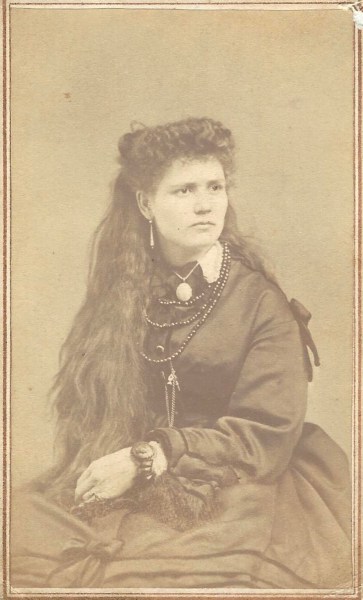
Sophie Bruneau Huntley Not Camera Shy

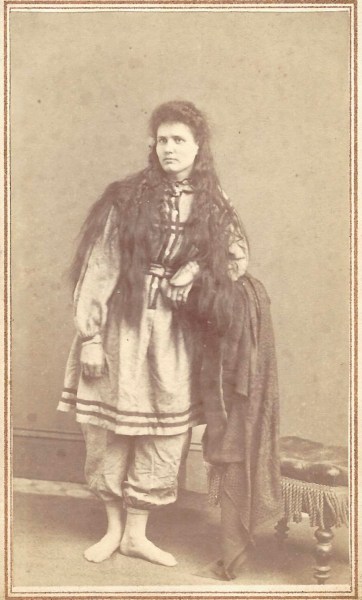
Sophie Bruneau Bathing Beauty

Would my 19th-century ancestor Sophie Bruneau Huntley be posting pictures on social media, taking selfies and showing off her new purchases if she were alive today? I think the answer is, maybe yes!

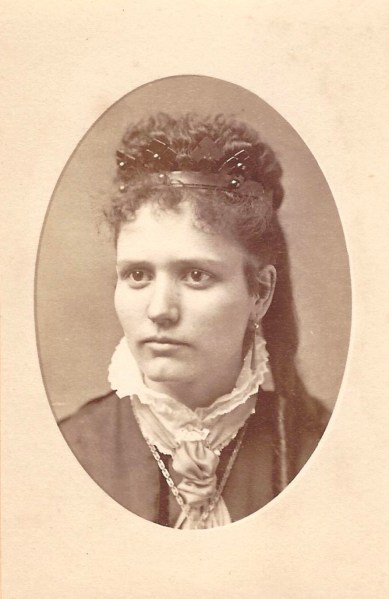
Sophie was born in 1847, so all her early pictures were taken in photographic studios. These were not spontaneous pictures but rather specific setups with long exposures. There are several pictures of Sophie in the family photo albums. Many were taken in New York. My favourite is Sophie in a bathing costume displaying her very long hair and bare feet. There were no mischievous smiles but rather hard stares. Still, it appears she had fun during her photo shoots.

Sophie Bruneau

My great-great grandparents Barnabe Bruneau and Sophie Marie Prudhomme had 13 children and Sophie was number eight. She lived with her parents on their farm in St. Constant, Quebec until after the 1871 census. Pictures from New York studios came soon after. I assume Sophie worked in New York as a teacher or a French governess like her sisters, Virginia and Elmire, when she arrived in the United States in 1875 at 27 years old.

Sisters: Sophie, Helene & Mathilde
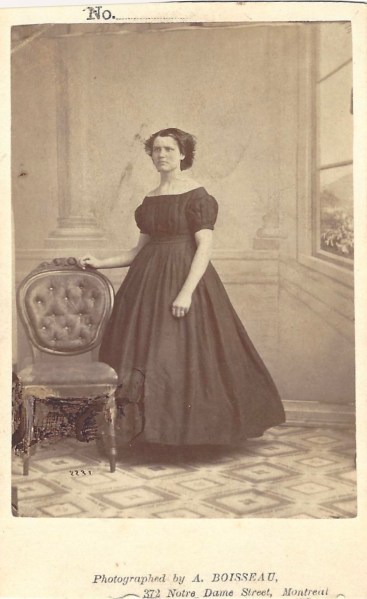
Sophie in New York

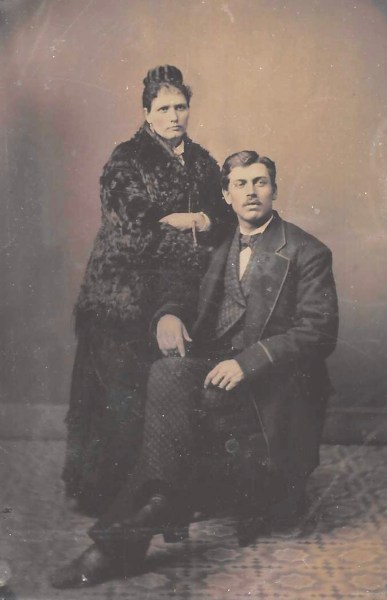
Sophie and her sister Elmire, married two Huntleys, Washington and Wallace? (Walworth). I assumed that they were brothers who married sisters. On family trees and photos he was called Wallace but it seems he was George Walforth Huntley (1854-1933), Washington’s younger brother and seven years younger than Sophie.  Andrew Washington Huntley Elmire Bruneau’s husband was born in Mooers NY to Andrew Huntley and Calista Blodgett and there was a George Walworth Huntley in the family. If this is Sophie’s husband, they could also have met because her sister Aglae was living in Mooers Forks, New York with her husband.
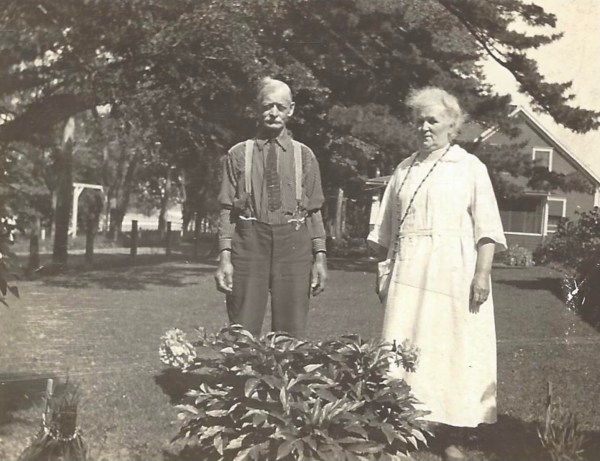
Sophie and George W. Huntley

Sophie, Elmire, and their husbands lived in several places in the United States but ended up in Los Angeles.

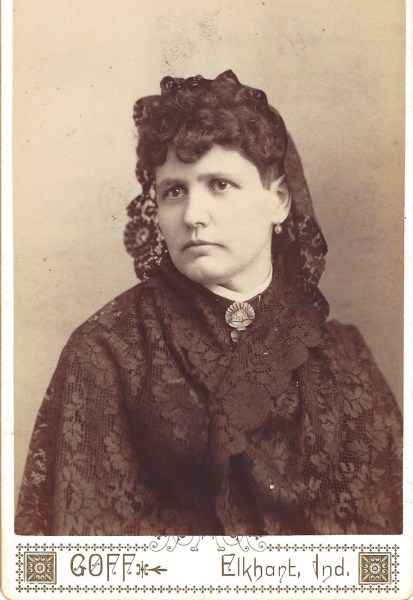
Sophie and Walworth lived in Elkhart, Indiana as Sophie is mentioned in the Personal and Society column of the Indianapolis Journal, “Mrs. George W. Huntley is spending a month in Montreal.” The beginning of the column discussed women’s dress which probably interested Sophie. 
“What with shirtwaist blazers, neckties and caps the women, middle-aged and young are fast becoming what Light facetiously denominated “self-made men.” George was a railroad conductor and owned his own house according to the 1900 census. 
Sophie Huntley

They later lived in Toledo, Ohio where George was a customs collector and finally moved to Los Angeles, California. Sophie became a naturalized American because her husband was a US citizen.
They never had any children.

Sophie Bruneau Huntley

Her age was fluid in all the documents. Her husband was seven years younger but sometimes she was younger and sometimes the age difference was much smaller. Her death record in December 1921 said she was 68; in the 1920 census, she was only 63 while actually being 74.

A death notice in a Los Angeles paper, “Sophie B. Huntley died December 28, 1921, beloved wife of George W. Huntley, funeral from residence La Veta Terraces.” Her death notice was also in Elkhart, Indiana and Toledo, Ohio newspapers. George continued to live in Los Angeles with his housekeeper Mary Dietrick until his death in 1933.

Notes:

“Canada Census, 1871”, , FamilySearch(https://www.familysearch.org/ark:/61903/1:1:M4KT-F5V : Sun Mar 10 23:41:04 UTC 2024), Entry for Barnabe Bruneau and Sophie Bruneau, 1871. Sophie 23 at home no occupation.

“United States Census, 1900”, , FamilySearch(https://www.familysearch.org/ark:/61903/1:1:MMBY-BMK : Thu Apr 11 19:55:49 UTC 2024), Entry for George W Huntly and Sophie B Huntly, 1900 Dubois Indiana.

United States Census, 1910″, , FamilySearch(https://www.familysearch.org/ark:/61903/1:1:MLFZ-MKV : Thu Mar 07 18:33:20 UTC 2024), Entry for George W Huntley and Sophie B Huntley, 1910.Toledo, Ohio. 

United States Census, 1920″, , FamilySearch(https://www.familysearch.org/ark:/61903/1:1:MHQD-HJK : Fri Mar 08 21:37:57 UTC 2024), Entry for George W Huntley and Sophie B Huntley, 1920.

California, County Birth and Death Records, 1800-1994″, , FamilySearch(https://www.familysearch.org/ark:/61903/1:1:QG49-NZN3 : Sat Mar 09 23:29:28 UTC 2024), Entry for Sophie B Huntley and Barnabee Barneau, 28 December 1921.

Sophie was said to be 68 in Norwalk Los Angeles.

“United States Census, 1930”, , FamilySearch(https://www.familysearch.org/ark:/61903/1:1:XC8Z-8NW : Sun Mar 10 08:02:55 UTC 2024), Entry for George W Huntley and Mary Dietrick, 1930.

“California Death Index, 1905-1939”, , FamilySearch(https://www.familysearch.org/ark:/61903/1:1:QKS9-QWHL : Sun Mar 10 22:34:41 UTC 2024), Entry for George W Huntley, 7 1933.

“United States Census, 1850”, , FamilySearch(https://www.familysearch.org/ark:/61903/1:1:MCT1-9GL : Sat Mar 09 13:02:44 UTC 2024), Entry for Andrew Huntley and Calista Huntley, 1850.

Indiianapolis Journal Sunday Aug 31, 1890 page 3 in Personal and Society for Elkhart, Indiana Newspapers.com April 22, 2024.

First Deguerreotype in 1837

William Henry Talbot patents the Calotype process, the first negative-positive process making possible the first multiple copies in 1841. 

When the first mass-produced cameras were available in 1900 people started taking snapshots.

Bon Soir et Dors Bien – Good Night Sleep Well

Rene Raguin & Beatrice Bruneau Wedding 1912

“Bonsoir et dors bien”, is how my mother ended her nightly phone calls with her parents. These were some of the few French words I ever heard her speak, which was strange as French was both her parent’s mother tongue. Why did we only speak English?

René Raguin my grandfather, was from Fleurier, Switzerland and came to Canada to teach at the French Protestant school in Pointe aux Trembles, Quebec. He later taught in Trois Rivieres and finished his career at Baron Byng, a school of the English Protestant School Board of Greater Montreal. He also taught teachers how to teach French at McGill University’s summer school.

Beatrice Bruneau met René Raguin when they were both teaching at the Pointes aux Trembles school. This was the one French Protestant school in the Montreal area. Grannie as we called her, descended from French Canadian stock, although born in Green Bay Wisconsin. Her father Ismael Bruneau was a French Presbyterian minister. Her mother Ida Girod was a French speaker from Switzerland and also a Protestant.

René spoke English fluently but with a heavy accent. He always used English when talking with us, his grandchildren and we called him Grandfather. I always wondered why he never communicated with us in French as a French teacher. One much older cousin Don Allchurch, always referred to him as Grandpère as he did speak to him in French.

Beatrice’s father Ismael Bruneau, was “pure laine”, French Canadian through and through. His early ancestors arrived in Quebec from France in the 1630s. His family of Catholics converted to Protestantism in the 1850s and that is where the English crept in. Ismael wasn’t thrilled to speak English as he wrote to his youngest sister Anais, “I write to you in English, dear sister, not to show you I can write a few words in that barbarous language, but for your good as well as mine, for practice makes perfect.” Many of Ismael’s siblings moved to the United States, spoke English and married English speaking spouses.

French was spoken in his home but Ismael’s children all went to English Protestant schools as the French schools were all Catholic and they didn’t even allow Protestants to attend. In the family, religion trumped language. Most of his children also married English-speaking people. His two sons continued to speak to each other in French.

Beatrice Bruneau Raguin

My mother grew up in Dixie on the border of what is now Lachine and Dorval. It was then an English community. Because her father Rene Raguin taught for the English board they didn’t have to pay school fees and so attended English Protestant schools. The children didn’t want to speak that other language. Some evenings her father would say that only French would be spoken at the dinner table. The children wouldn’t say a word and only eat what they could reach.

Rene Raguin

The Scots and Irish immigrants who were my father’s family settled in Toronto and spoke only English. I don’t remember him speaking French to anyone. He always regretted that he couldn’t speak French. He too went to English Protestant schools.

Dorothy, Beatrice, Rene & Mary

We were schooled before French Immersion and though there was some talk about sending us to French Schools, they were still all Catholic and not a choice, so we also attended English Protestant schools.

So in a generation, the French family became English. We didn’t call my mother every night but as we left after a visit she had a new English saying, “Safe home.”

Notes:

A Short History of the Bruneau-Girod Families: Ida Bruneau Ste. Agathe des Monts, Quebec May 1993. Forbes Publications Ltd. Calgary, Canada.

My sister remembers the phrase as “Bonsoir et dors bien Maman” but I said sometimes she was talking to her father.

Aime Bruneau- Jewels and Glasses

The Fall River Daily Evening News reported in Our Folks and Other Folks Column, “ He sustained an accident and narrowly escaped serious injury in Brookline on Saturday, by jumping from an electric without signalling for a stop. A sliver in the platform step caught in his shoe heel and threw him, as he jumped, and he was dragged some distance. He sustained severe bruises, his clothes were badly torn and his shoe, one of a new pair, was ripped from his foot.” This is one of the more interesting things written about my two times great uncle, Aimé B. Bruneau.

Aimé was a jeweller and studying to be an optometrist in 1897 when the accident happened. He must have been attending the Klein School of Optics in Boston’s South End. The school, founded three years earlier by ophthalmologist Dr. August Klein, was one of America’s first formal training programs in optics and refraction. After one year of study, Aimé could make glasses as well as jewellery.

He had travelled far from his roots. Aimé Benjamin Bruneau was born in Saint Constant, Quebec to Barnabé Bruneau and Sophie Marie Prud’Homme. He grew up on the family farm but as the seventh of 13 children, he had to find employment elsewhere. He left home as a teenager and went with his brother Dolphis to Adams, South Berkshire, Massachusetts where they were probably attracted by jobs in a mill.

I am not sure where he met Mary Floretta Mann. She lived in Rutland Vermont. Her husband, Steven Mann had died in 1869 and the widow was living with her three children. Four other children had died in early childhood. Mary couldn’t have been looking for financial support as she had real estate worth $16,000 and a personal estate of $5,000. When they married in 1871 Aimé was 26 and Mary 43.

The couple soon moved to Fall River, Massachusetts, which after the Civil War was the leading textile city in America. Aimé didn’t work in a mill but as a clerk in Fred Macomber’s jewellery store and eventually bought him out. It was a prosperous business in the Granite Block, a block-long commercial building in downtown Fall River and one of the leading jewellery stores in the area for almost twenty years.

Aime Bruneau on right in front of his jewellery store, Fall River MA.

Mr. Bruneau was of a very social nature and made many friends here (Fall River). He greatly lived out of door life and was noted as a walker, covering all the country about this city in his tramps. A walk to Newport or Providence, (almost 20 miles away) on a pleasant Sunday was an ordinary thing with him.

Then in 1897, his business fell off, he closed his store, sold his stock at auction and studied to be an optometrist. A year later he re-established in a smaller way as an oculist. In the next few years, he can be found in Leominster, Massachusetts, Dover New Hampshire and finally in Auburn, Maine with Aime’s occupation listed as a jeweller but also as an Insurance Agent working for the Manhattan Company Federal Street, Boston. During this time Mary appeared to be living in Fall River.

Aimé died unexpectedly of an internal hemorrhage in January 1910. He was 65 and still living in Auburn, Maine. His wife continued to live in Fall River, Massachusetts with her daughter Ida. Mary died there, just six months later at the age of 82. I can speculate about why he wasn’t living with his wife but the long and painful illness noted in her obituary might be the story.

Notes:

Aime B. Bruneau Obituary, The Evening Herald, Fall River Massachusetts. Tuesday 18 January 1910 pg 4. Newspapers.com December 25, 2021. The only Bruneau family member mentioned in his obituary was his brother Ismael as a Congregationalist minister in Montreal.

Our Folks and Other Folks column. Fall River Daily Evening News, Fall River Massachusetts. Tuesday, August 24, 1897. Page 1. Newspapers.com Dec 23, 2021. 

Death of Mrs. Mary F. Bruneau: Fall River Daily Evening News, Fall River Massachusetts. Tuesday Aug 23, 1910. Page 8. Newspapers.com Dec 23, 2021. 

The New England College of Optometry, NECO was founded as the Klein School of Optics by Dr. August Klein in 1894. Located at 2 Rutland Street in Boston’s South End, the Klein School offered a one-year program that centred on optics, anatomy, and refraction. As optometry quickly became a more established profession, the school’s name changed in 1901 to the Massachusetts School of Optometry. The school began offering a two-year program in 1909, and that same year the National Board of State Examiners in Optometry was established as other new optometry schools sprang up around the country.

The Mass School of Optometry also began requiring incoming students to have completed four years of high school and to possess “good moral character.”

Lydia and the Mill

Jacques et Gilles work at the mill;

That stands beside the water;

Could be Lowell, could be Lawrence;

Or Nashua, New Hampshire;

Jacques et Gilles, they hate the mill;

But they’ve too many sons and daughters.

(Jccques et Gilles: McGarrigles from Matapaedia Album)

Sulloway Mill, Franklin, NH

Lydia Morrisette, my granddaughter’s 2nd great grandmother on her mom’s side, was a real Americanophile, or so Lydia’s daughter, Irene, told me just the other day. Lydia always raved to Irene about life the US despite the fact she had lived and worked there for a mere seven years in her youth, in Franklin, New Hampshire from 1903 to 1910.

Why do you think your mother loved the United States so much, I asked Irene. After all, work in New England textile mills by most accounts was no picnic, not even at the best of times, what with the long hours, the lack of respect, the bad ventilation and lint and dust flying everywhere, the dangerous machines that could ‘jump’ at any time and the NOISE. Oh, the noise! Let’s not forget the institutionalized racism against French Canadians, often referred to as pea-soupers, or the paternalistic behavior of the French Canadian overseers.

“She liked the independence,” said Irene. “She liked the money.”

So, it seems that Marie-Leonie Ledia Morrisette, like so many other Edwardian women out in the workforce in the big cities of the Western World, valued her independence and enjoyed having an occupation in which she took some pride. After all, the Sulloway Mill up on the hill produced top-of-the-line men and women’s hosiery.

Irene agrees. “They made nice socks,” she says.

Maria-Leonie Lydia (Ledia) Morissette was born in 1889 (with the help of Dr. Harel1) in Ste Gertrude, Becancour, Quebec, a short ferry ride across the St Lawrence to Three Rivers, to farmer Eugene Morrisette and his wife, Clarisse Heon.

In 19032 The Morrisettes and their children, four five girls and two boys, set out to work in Franklin Mills, a smaller, happier sort of industrial town of around 6,000 people on the Miramack River.

Lydia and her sisters on the 1910 US Census. Few French workers made the Census for some reason (including Lydia’s parents) but the 1906 Franklin Annual Report reveals there were many French Canadians in the town. They just weren’t enumerated, perhaps seen as temporary workers. The Morrisette family is on the 1911 Canada census but Eugene and Clarisse and a son and daughter returned to the US.

With four girls and two boys (including a newborn with “muscular atrophy” ) moving to a mill town where the older children could help support the family was a logical step for a Quebec subsistence farmer.

The 1910 United States Federal census has Lydia and her two sisters, Antonia and Elivina (Alvina) working in a “hosiery mill” (almost certainly the Sulloway Mill) as helpers/top hand and boarding in Ward 2, up from the river and the mill, with teamster M. Poirier and his family.

Lydia, as young “Canadiennes” were instructed to do by the community patriarchs (wherever they happened to be living) ceased work in 1910 to marry handsome Quebecker Henry Hamel. Of course, biology likely had its part in this 🙂 The couple moved back to Drummondville, Quebec and raised a large family. Irene, born in 1918 (and the last surviving child, needless to say) is the among the youngest of their brood.

Lydia was the only female member of the strong-willed Morrisette girls to marry. A sister Alvina remained a mill worker in Franklin and two of her sisters became nuns.3

Perhaps because Franklin was a smaller, kinder New England textile town with fewer workers; perhaps because Franklin is where Daniel Webster of dictionary fame was born; perhaps because the Morrisettes lived in Franklin during an era of exponential change, Lydia and her sisters were different from many New England mill workers from Quebec – who usually kept to themselves. The women took pride in integrating and learning English.

Indeed, their one healthy brother, Horace, was of a similar stamp. He stayed in New Hampshire with his parents, Eugene and Clarisse, and his sister Alvina and married an English girl, Mary Murray.

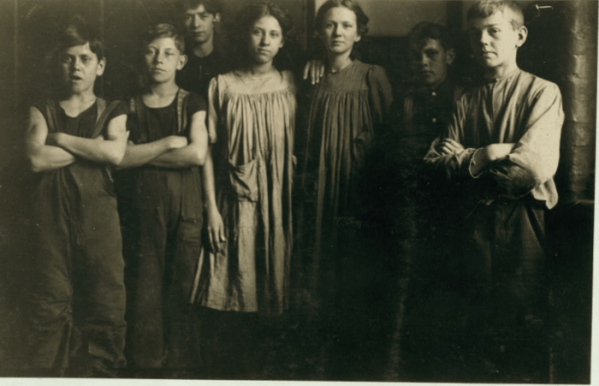
French Canadian child workers at the enormous oppressive Amoskeag Mill in Manchester New Hampshire 1909. LIbrary of Congress. in Franklin NH, at least in boom times, there were Company picnics and baseball games and parades to compensate for the gruelling work in the mills.

1. This is the first time I have seen something like this on the Drouin records. Was the birth difficult?

2. This 1903 date is given on the US Federal Census, shown above and on Eugene Morrisette’s death certificate in 1937.

3, Alvina is listed in the 1930’s as a working as a finisher, which might mean sewing toes and heels into socks or applying chemicals and pressing the socks. Another sister, Antonia, joined a Catholic order back home, but moved to Ontario as she spoke good English. Another sister, Aurore, became a nun in Africa, much to her parents’ displeasure.

325,000 Quebecers left between 1860 and 1900. Just 100,000 between 1900 and 1910 with 40,000 returning. ­ This 2020 YouTube Video from Rhode Island Genealogy Society explains: https://www.youtube.com/watch?v=LyWu46jbauk Country life was very hard for Quebeckers in the Victorian Age. The burgeoning New England textile industry proved most alluring to many farm families. As industry competition increased over the decades, some New England Textile Corporations actively sought out French Canadian workers who, because of their large families who could pool their income, could toil for less money and were less inclined to agitate. French Canadians were also valued for their excellent work ethic.

Dolphis Bruneau – Life in North Adams

Many French Canadians left the farms of Quebec and migrated to the mills of New England in the mid 1800s. Some worked and then returned home while other like Dolphis Bruneau settled in the United States. 

Dolphis was the eldest son of Barnabé Bruneau (1807-1880) and Sophie Marie Prud’homme (1812-1892) my great great grandparents. One would think he would inherit the family farm in Saint Constant, Quebec but he had moved to North Adams, Massachusetts, long before his father’s death.

North Adams, a mill town in Berkshire County, grew at the convergence of two branches of the Hoosic River, which gave the town excellent water power for the developing industries. Dolphis arrived there 1864, at the end of the Civil War. He first lived in a rooming house and worked as an operative, presumably in a mill. At the same time, his younger brothers, Aimé and possibly Napoleon also lived and worked there.

He married Nellie Saunders the daughter of an Irish immigrant Thomas Saunders. She worked in a shoe factory. They started a family with Maude born in 1871 and another daughter Nellie three years later. Tragically, his wife died during that childbirth so Dolphis was left to raise his two daughters alone. He must have had help from Nellie’s family, as he didn’t move back to Quebec like his brother Napoleon and applied for his United States Naturalization Petition in 1895.

Dolphis’ wife Nellie Saunders

Dolphis continued his quiet life in North Adams. He worked as a carpenter possibly not at a mill but for for a cabinet maker. He kept in contact with his family in Quebec. Some pictures of his growing girls were taken in Montreal so they certainly went north to visit. He didn’t move much as his address, a rental property, is listed as 15 N Holden St for most of his life. His daughters continued to live with him. Maud seems to have kept house and Nellie worked as a bookkeeper.

Dolphis remarried eleven years after his wife died to a widow, Ester Mary Halse Tingue. Information about his second wife is scant and rather confusing. Ester received a Civil War pension from her first husband and so had some income. The census and city directories show them living apart although listed as married. He lived with his daughters and she lived with her daughter Emma Tingue. Dolphis died in 1909 and Ester in 1924. In her obituary she is refered to as Mrs. Ester T. Bruneau, living at 108 Quincey Street and survived only by Emma. “Her death will bring deep sorrow to her many acquaintances,” it said. Dolphis and Ester were buried in different cemeteries.

The year after her father’s death, Nellie married Arthur Henwood. They moved in with her sister Maud at 15 N Holdon Street. Nellie and Arthur never had any children. Arthur kept a steady job working for James Hunter Machinery as a machinist. His draft registration cards for both WWI and WWII showed him working at the same company. Nellie continued to work as a bookkeeper and Maude continued to keep house. Both sisters had a close involvement with the First Baptist Church.

Maude never married and after her sister’s death in 1939, she and her brother-in-law continued to live together for the next twenty plus years, still at 15 N Holden Street. Arthur died in 1960 and Maude then moved to the Sweet Brook Nursing Home in Williamstown, Massachusetts where she died two years later. Maude’s death ended the Bruneau line in North Adams although most of the family are buried in Maple Street Cemetery.

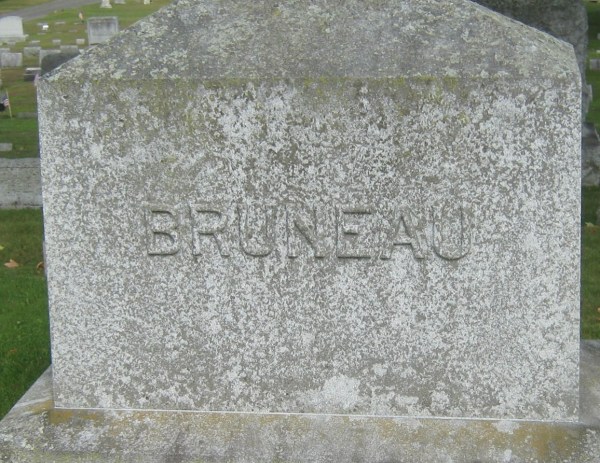
Bruneau Family Tombstone North Adams, MA

Notes:

Dolphis Bruneau Massachusetts, U.S., Death Records, 1841-1915 [database on-line]. Provo, UT, USA: Ancestry.com Operations, Inc., 2013. Original data:Massachusetts Vital Records, 1840–1911. New England Historic Genealogical Society, Boston, Massachusetts.Massachusetts Vital Records, 1911–1915. New England Historic Genealogical Society, Boston, Massachusetts. Accesses March 15, 2022.

Dolphis Bruneau – Massachusetts, U.S., State and Federal Naturalization Records, 1798-1950 [database on-line] NAI Number: 4752894; Record Group Title: Records of the Immigration and Naturalization Service, 1787-2004; Record Group Number: R G 85.  Provo, UT, USA: Ancestry.com Operations, Inc., 2011. Accessed Mar 12, 2022.

Nellie Bruneau Henwood Obituary.The North Adams Transcript (North Adams, Massachusetts) December 27,1939, Page 3. Accessed on Newspapers.com Mar 27, 2022.

Maude L Bruneau Obituary. North Adams Transcript (North Adams, Massachusetts) March 17, 1962, Page 3. Accessed on Newspapers.com Mar 23, 2022.

Mrs Ester T Bruneau Obituary. North Adams Transcript (North Adams, Massachusetts) Dec 19, 1924, page 14. Accessed on Newspapers.com Mar 30, 2022.

1900 Census: North Adams Ward 3, Berkshire, Massachusetts;Roll:632;Page:7;Enumeration District:0051;FHL microfilm:1240632Ancestry.com.1900 United States Federal Census[database on-line]. Provo, UT, USA: Ancestry.com Operations Inc, 2004. Original data: United States of America, Bureau of the Census. Twelfth Census of the United States, 1900. Washington, D.C.: National Archives and Records Administration, 1900. T623, 1854 rolls. Accessed Mar 2, 2022.

Arthur Henwood: Draft Card H. Registration State:Massachusetts; Registration County: Berkshire Source Information Ancestry.com. U.S., World War I Draft Registration Cards, 1917-1918.Imaged from Family History Library microfilm M1509, 4,582 rolls. Provo, UT, USA: Ancestry.com Operations Inc, 2005. Accessed April 5, 2022.

What Did He Do?

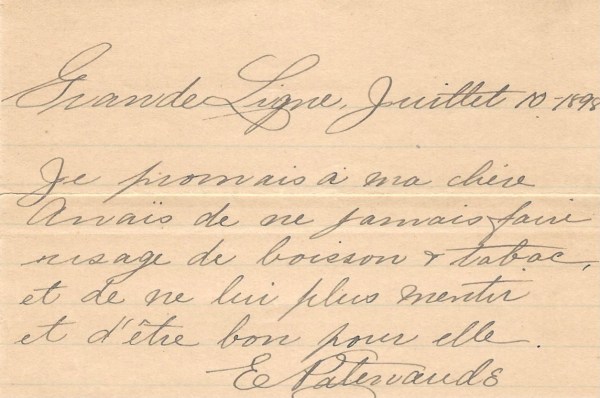
“Grande Ligne, July 10, 1898

I promise to my dear Anais never to use alcohol or tobacco

and not to lie to her anymore and to be good to her. 

E Patenaude”

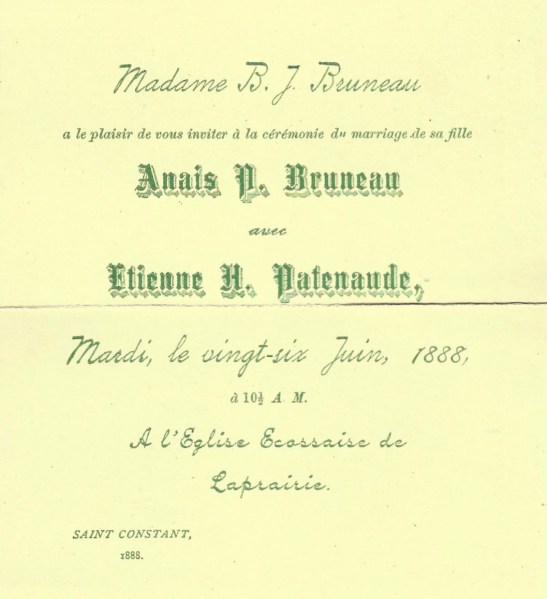
This note found in a box of Bruneau family pictures, along with an invitation to Anais Bruneau and Etienne Patenaude’s wedding made me wonder. At first I thought it was a promise made before they married but then realized the date was ten years later. What had Etienne done?

Anais, the sister of my great grandfather Ismael Bruneau was the youngest of 13 children of my two times great grandparents, Barnabé Bruneau and Sophie Marie Prud’homme. She appeared to be my great grandfather Ismael’s favourite and only three years his junior. He wrote many letters to Anais and some survived but none of her replies. He traveled for his studies and his ministry while she remained close to home in Saint Constant helping their parents. When Ismael was ministering in Kankakee, Illinois, he wrote that he wanted her to meet his beautiful soon-to-be wife. He asked her to come and visit and said that he would find her a tall strong farmer for a husband. As far as I know, Anais never visited and she found her own husband.

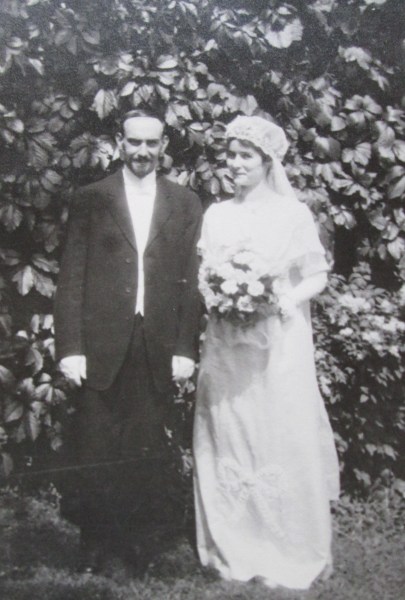
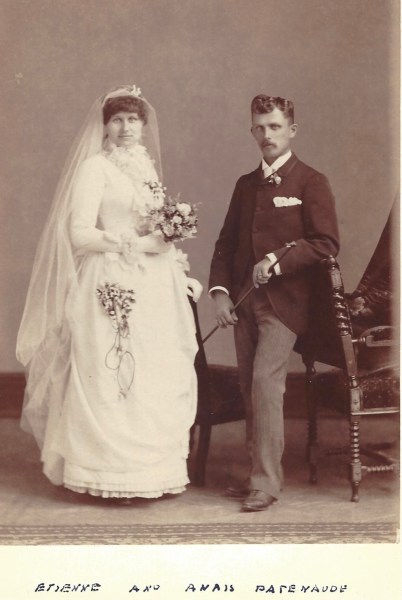
Anais married Etienne Hilaire Patenaude on a Thursday at ten and a half in the morning in L’Eglise Ecossaise in Laprarie, Quebec. I thought it was a strange day and time for a wedding but Anais dressed the part of a bride in a fancy white dress and veil with a bouquet of flowers as their wedding photograph shows. She was 33 and Etienne only 27.

They seemed to live a quiet life on a farm south of Montreal. They had no children. Her mother lived with them for a time after their marriage and most likely until her death. Anais was the good daughter and following her brother’s instructions, continued to look after her mother after her father died. Although Anais had seven sisters only she remained near St-Constant.

Nephews Edgar & Gerald Bruneau with Anais & Etienne in Grande Ligne

Etienne died in 1931 and Anais a year later at 77 years old. They are both buried in the cemetery at St Blaise Baptist Church in Grande Ligne showing they led a religious life. This church was associated with the Feller Institute, founded by Henrietta Feller a Swiss missionary who came to convert the native population but had greater success with the French Catholics. Madame Feller and her partner Louis Roussy were responsible for the conversion of Anais’ parents. Etienne’s parents were also Baptists.

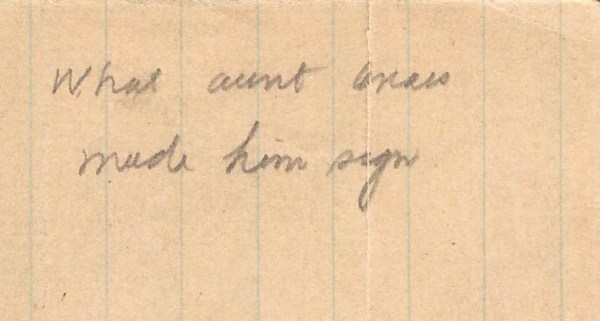
What did Etienne do to have him write this promise? They were both French Baptists and involved in the Mission at Grande Ligne where sobriety would be expected. Did he go off and drink, smoke and lie about it? Who saved this paper and how did it come to me? On the back is written, “What Aunt Anais made him sign.” So, according to family lore, it wasn’t his choice to make this declaration.

Notes:

Note by Etienne Patenaude translated by author.

Ancestry.com. 1921 Census of Canada[database on-line]. Provo, UT, USA: Ancestry.com Operations Inc, 2013.
Original data:Library and Archives Canada. Sixth Census of Canada, 1921. Ottawa, Ontario, Canada: Library and Archives Canada, 2013. Series RG31. Statistics Canada Fonds.Images are reproduced with the permission of Library and Archives Canada.

Ancestry.com. 1901 Census of Canada[database on-line]. Lehi, UT, USA: Ancestry.com Operations Inc, 2006.
Original data:Library and Archives Canada. Census of Canada, 1901. Ottawa, Ontario, Canada: Library and Archives Canada, 2004. http://www.bac-lac.gc.ca/eng/census/1901/Pages/about-census.aspxl. Series RG31-C-1. Statistics Canada Fonds. Microfilm reels: T-6428 to T-6556.Images are reproduced with the permission of Library and Archives Canada.

Ancestry.com. 1891 Census of Canada[database on-line]. Provo, UT, USA: Ancestry.com Operations Inc, 2008.
Original data:Library and Archives Canada. Census of Canada, 1891. Ottawa, Ontario, Canada: Library and Archives Canada, 2009. http://www.bac-lac.gc.ca/eng/census/1891/Pages/about-census.aspx. Series RG31-C-1. Statistics Canada Fonds. Microfilm reels: T-6290 to T-6427.

Ancestry.com. Quebec, Canada, Vital and Church Records (Drouin Collection), 1621-1968 [database on-line]. Lehi, UT, USA: Ancestry.com Operations, Inc., 2008. Original data:Gabriel Drouin, comp. Drouin Collection. Montreal, Quebec, Canada: Institut Généalogique Drouin.

Emilien Frechette What a Guy

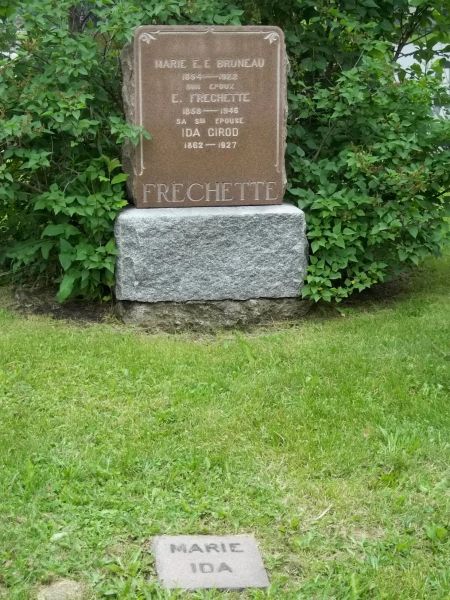
In Mount Royal cemetery, on the mountain in Montreal, lies the grave of Emilien Frechette. On the tombstone are the names of two of his three wives while in front is a little stone marker reading Marie and Ida. All his wives had a connection to the Bruneau family.

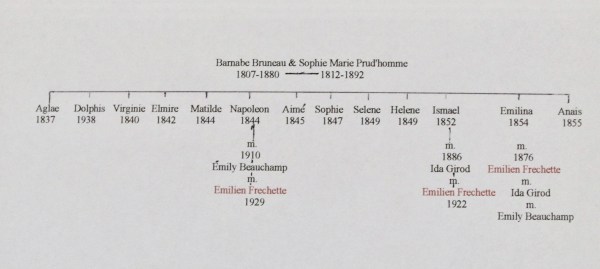
He first became a member of the Bruneau family in his early 30s when he married Marie Emilina Bruneau, daughter of Barnabé Bruneau and Sophie Marie Prud’homme. He must have he enjoyed his wife’s large family, she was one of thirteen children, because after Marie Emilina died he first married one and then a second of her sisters-in-law.

Emilien was born to Emilien Frechette and Philomine Laguë. His father was a Baptist and a farmer on Montreal’s South Shore near Iberville. After his father died, his mother, brother Philippe and three of his sisters moved to Worcester, Massachusetts between 1885 and 1895. Philippe was a carpenter and worked in the building trade while two of his sisters were teachers. I presume that Emilien stayed on the family farm.

With most of his family in the United States, Emilien must have spent time with the large Bruneau clan. In the 1891 census there appeared to be a daughter Alice, 3 who didn’t appear in later censuses. Was she his only child who died young?

After Marie Emilina died in 1922, Emilien must have been lonely on his farm. His brother-in-law, Ismael Bruneau, had died leaving his wife Ida Girod Bruneau a widow. Ida first moved her family from Quebec City to Lachute where she lived with her daughter Helvetia and then spent time visiting family in Switzerland. On her return, Emilien approached her and suggested as they were both alone and he had a large house, maybe they could live together and get married and so they did. My aunt Aline remembers her mother visiting grandmother Ida and coming back with baskets of berries that had to be sorted, cleaned and made into pies.

Emilien and Ida on his farm

Unfortunately, Ida was soon diagnosed with cancer and spent her last days in the Montreal General Hospital. She died in 1927 leaving Emilien a widower once again.

One thinks, Emilien liked the comfort of a wife and since another of his brother-laws was dead there was another sister-in-law to marry. In 1929, Emily Beauchamp Bruneau married Emilein Frechette.

Emily Beauchamp married Napoleon Bruneau in 1910. Neither had been married before. Emily was 41 and Napoleon 66 and so there were no children. Napoleon lived all his life in Laprairie, Quebec and kept himself busy. He was a farmer, a veterinarian, a mayor and a justice of the peace. They were both French Protestants. Unfortunately, in 1916 he was hit by a train while in Montreal and killed.

Emily was Emilien’s last wife and they continued to live on his farm in Iberville until his death in 1946. When Emily died in 1951 she wasn’t buried with her husband and his other wives but in her Beauchamp family’s private cemetery in Grenville, Quebec.

My mother remembered “oncle” Emilien. Her grandmother Ida died when she was just five but Emilien, a “nice old man”, kept in contact with all the family. What a guy!

Barnabe and Sophie Bruneau’s Children

Notes:

https://genealogyensemble.com/?s=Ida+Girod/

https://genealogyensemble.com/2015/11/04/call-me-ismael/

https://genealogyensemble.com/?s=Barnabe/

1881 Census Place: St Grégoire, Iberville, Quebec; Roll: C_13203; Page: 60; Family No:268Source Information Ancestry.com and The Church of Jesus Christ of Latter-day Saints. 1881 Census of Canada [database on-line]. Provo, UT, USA: Ancestry.com Operations Inc, 2009. Accessed November 24, 2021.

1891 Census: Place: St Valentin, St Jean, Quebec, Canada; Roll: T-6420;Family No: 157 Sub-district: St Valentin Source Information Ancestry.com. Accessed Nov 20, 2021.

Institut Généalogique Drouin; Montreal, Quebec, Canada; Drouin Collection;Author: Gabriel Drouin, comp. Year: 1929 Ancestry.com. Accessed January 4, 2022.

Library and Archives Canada; Ottawa, Ontario, Canada; Voters Lists, Federal Elections, 1935-1980Year: 1940 Ancestry.com. Canada, Voters Lists, 1935-1980 [database on-line]. Provo, UT, USA: Ancestry.com Operations, Inc., 2012. Accessed January 8, 2022.

When History and Genealogy Come Together

Genealogy is usually of little interest to children probably because their parents already seem from the Dark Ages and their grandparents from the times when Tyrannosaurus Rex tramped the planet.

It was the same thing for me way back in the 1960’s – except for the one day when I was about twelve years old. My mother came home all excited with some important news passed on to her by a cousin who had researched the Crepeau family tree.

My mom’s father, Jules Crepeau of Montreal, was descended from one Abraham Martin dit L’Ecossais, a pioneering (boat) pilot and land-owner in New France. My French Canadian mom found this fact highly entertaining. “I am descended from a Scotsman,” she told me, laughing. “What a joke.”

I remember this episode only because of another part of the story. Apparently, this Abraham Martin fellow owned the Plains of Abraham. THOSE Plains of Abraham. Now that I could sink my tweenage incisors into.

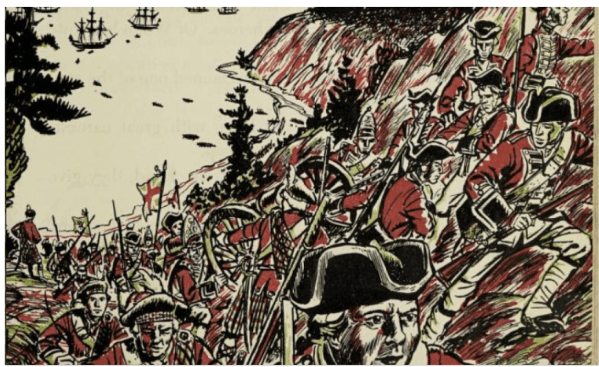
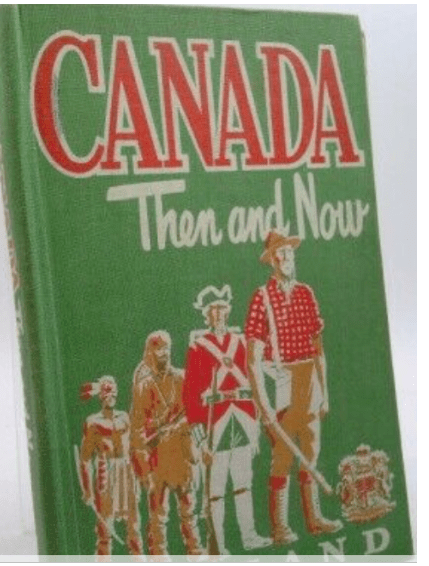
You see, I was learning about Canadian history in school. Our text was Canada Then and Now, a bright green text with a very iconographic cover pic.

From this textbook, I was learning for the first time how the French and British were always at war with each other, way back then, in Europe and in North America. In North America, the fought over control of the lucrative fur trade and, apparently, it all came to a head one morning on the 1th of September, 1759 when a British general named Samuel Wolfe, after being rebuffed a few times by the superior French forces, led a cagey attack on the French General named Louis Joseph Marquis de Montcalm on the cliffs of Quebec City, cutting off his supplies and defeating his superior forces. This was all part of something called The Seven Years War.

All night long kept quietly landing the men on Wolfe’s cove. By morning, 5000 British soldiers were drawn up ready on the Plains of Abraham. The French had avoided battle, believing they were safe because they had more men than the British and plenty of supplies. They knew the British wold have to withdraw before freeze up. But now tht the British had landed above the town and cut off supplies from Quebec. The time had come for battle.

The textbook instructed us Canadian children, in subtle terms, to take no especial pride in this seminal event:

Wolfe and Montcalm were great generals and gallant men. Today, on the Plains outside of Quebec, a monument stands to honor them both. Wolfe’s name is on one side, Montcalm’s on the other. There is a Latin inscription that says, “Valour gave them a common death. History a common fame and posterity a common memorial.”

Illustration from Canada Then and Now. Storming the Plains of Abraham

Today, I am much older and predictably I am into genealogy. I have written many many family stories from both sides of my tree.

My mother’s French Canadian side was easy-peasy to patch together thanks to all those fabulous Catholic church records on Drouin available. And yes, if the Mons Origins website information is correct, my mom was indeed descended from this Abraham Martin.

Should I write about this pioneer ancestor? I have long wondered.

Truth be told, I would very much like to puzzle out the story of my earlier French Canadian ancestors, as Tracey Arial and Claire Lindle have done so brilliantly on this blog. I’d like to discover exciting new tidbits of information about my ancestors to add to the historical record (perhaps using some of the stellar resources catalogued on Genealogy Ensemble by Jacques Gagne) but it all seems so difficult, so labour intensive and so hard on the eyes.

In the past, I have explored the lives of Les Filles de Roi – because I am particularly interested in the lives of women ancestors – only to find there doesn’t exist much detailed information about these pioneering females from Normandy and Ile de Paris. It seems no one bothered to document the day-to-day lives or unique personal stories of these ‘mothers of millions’ back then– either in Europe or New France.

When it comes to this Abraham Martin dit L’Ecossais character, it would be a real waste of time to try to find a new angle or to write something fresh about him. There are already reams and reams (or pixels and pixels) of information written about him. It appears that Abraham Martin dit L’Ecossais is one of the most famous French Canadian pioneers and a father to millions of North Americans, including Madonna and Justin Bieber – and, ah, little ole me.

Long story short: He married Marguerite Langlois. Had 14 children. I am descended through Vitaline Forget-Despatie, my mother’s father’s mother.

The kicker to this non-story of mine: Abraham wasn’t necessarily Scottish. He could have invented the epithet to avoid criminal prosecution or he was a war deserter. His name might have generated from the fact that he had visited Scotland many times in his youth.*1

Now, lately I have dug out one very interesting fact about my mom’s French Canadian ancestors on her dad’s side, one she didn’t know about. My mother always told me that the name Crepeau meant “curly haired one.” She had very very curly hair herself, as did her father. I have no idea how long she had known this fact or who originally informed her.

If that same cousin, back in 1967, had provided her with a paper genealogy, my mother would have noticed that the original Crepeaus, going back six to eight generations, were Crespeaus, from Poitou Charent. I have recently learned that the name Crespeau almost certainly came from Crespo, a very Spanish name – and not only that a Sephardic Jewish name.

I found this tidbit on sephardim.com:

“The name Crespo has been identified by the Holy Office of the Church of Spain as a Sephardic Jewish surname.”

How fascinating.

So, it seems, even genealogically-timid I can dig out an interesting fact or two about a distant French Canadian ancestor. Maybe I should keep trying.

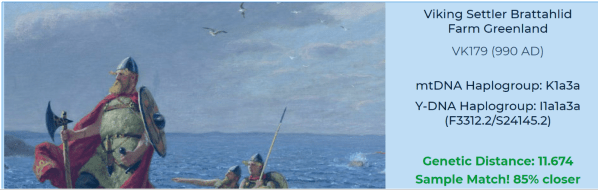
1. Even if Abraham Martin wasn’t born to the Tartan, he likely had English, Scottish and even Viking dna. Normandy, Normans, North men, Norsemen. Ancestry gives most of my many many French Canadian cousins a little bit of Norwegian ethnicity. I have a very vague 0-8 percent.

Wouldn’t it be funny if my mom were related to Eric the Red, chronicled in the second chapter of Canadian Then and Now, after the first chapter on “Indians” and “Eskimos.”

If you believe mytrueancestry.com, my husband, whose Mom comes from Isle of Lewis Scots, apparently is connected genetically to Eric’s clan. How very romantic! If I didn’t love him before, I’d have to love him now!

2. I checked the Y dna lists online at Family Tree and someone is trying to see if French Canadians have Semitic genes. There are very few members. On a regular French from France Y dna site I can see that some French Canadians have J M172, an Anatolian line, often thought of as the Greek Diaspora. Cote and Leger are the names that crop up. There are no Crespos, Crespeau’s or Crepeaus.