
This compilation looks at the Protestant churches in seven counties of Quebec east of Sherbrooke and north toward the St. Lawrence River, including the cities of Drummondville, Victoriaville and Richmond. The guide includes a list of names of Protestant families who settled in this area, a list of ministers who served these congregations and brief descriptions of the towns and villages where these churches were located. It guides researchers to the repositories where the records of these churches can be found. Protestant cemeteries in these counties are also listed.
Category Archives: Genealogy
The Biography of Stanley Clark Bagg
Don’t Believe Everything You Read
As a well-known Montreal land-owner, writer and philanthropist, my great-great grandfather Stanley Clark Bagg (1820-1873) was profiled in the Dictionary of Canadian Biography (DCB). Unfortunately, several errors appeared in that article and, when researchers look to the DCB as a reliable source of information, these mistakes are perpetuated.

The DBC is correct in saying that SCB, as I like to call him, was the only son of Stanley Bagg, a Montreal merchant, and his wife, Mary Ann Clark. The entry adds that SCB was a notary, large landowner and president of the Numismatic and Antiquarian Society of Montreal and of the English Workingmen’s Benefit Society.
Then it states, “The Bagg family claimed to be of Norman descent. At the end of the 18th century Stanley Clark’s grandfather emigrated from England to America. At his death he left large estates in Durham County, England to his son Stanley.” This paragraph seems to refer to SCB’s grandfather Bagg. In fact, it was SCB’s maternal grandfather, John Clark, who emigrated from Durham, England. A butcher by trade, Clark owned property in Durham and he purchased a number of farm properties in Montreal that his grandson inherited.
Far from being wealthy, SCB’s paternal grandfather, Phineas Bagg, brought his family to Canada after he lost his farm in Pittsfield, Massachusetts to pay off his debts. On this side of the family, SCB’s immigrant ancestor was John Bagg, possibly from Plymouth, England, whose marriage in Springfield, Massachusetts was recorded in 1657.
The DCB was correct in saying that Stanley Clark Bagg married Catharine, eldest daughter of Robert Mitcheson and Frances MacGregor of Philadelphia in 1844, however, it went too far in adding that Frances was descended from the chiefs of the MacGregor clan and the old Scottish kings. This is a family story that may or may not be true. My research on Mary Frances MacGregor’s ancestry has come up against a brick wall.
The Dictionary says that SCB and Catharine “had one son, Robert Stanley.” True, Robert Stanley Clark Bagg was their only son, but they also had four daughters: Katharine Sophia, Amelia Josephine, Mary Heloise and Helen Frances.
The final inaccuracy in the DCB article was the statement that “his family was one of the oldest English families on Montreal Island .…” Both the Bagg and Clark families arrived in Montreal in the late 1790s, three decades after the British conquered New France and after many English, Scottish and Loyalist families had made their way here.
These errors may be minor (although the descendants of SCB’s daughters might consider them quite important), but the online version of the DCB should be corrected quickly when issues are brought to their attention. The home page of the DCB (http://www.biographi.ca/en/index.php) invites readers to suggest corrections or additions, so I assume SCB’s biography will eventually be fixed. Meanwhile, in 2013, I wrote them and included extensive footnotes so they could verify my sources. Not long after that, without changing a word, they highlighted Stanley Clark Bagg as the Biography of the Day. Two years later, the corrections have yet to be made.
The takeaway from this article: even if you read about your ancestor in a source you consider reliable, check as many details as possible and be skeptical about sweeping or grandiose claims.
Photo: Stanley Clark Bagg, portrait by William Raphael; private collection.
Related articles:
Janice Hamilton, “John Clark of Durham, England,” http://writinguptheancestors.blogspot.ca/2014/05/john-clark-of-durham-england.html
Janice Hamilton, “An Economic Emigrant,” http://writinguptheancestors.blogspot.ca/2013/10/an-economic-emigrant.html
Janice Hamilton, “The MacGregors: Family Legend or True Story?” http://writinguptheancestors.blogspot.ca/2014/03/the-macgregors-family-legend-or-true.html
Notes:
The wording I have quoted here is from the online version of SCB’s biography: Pierre Landry, “Bagg, Stanley Clark” in Dictionary of Canadian Biography, vol. 10, University of Toronto/Université Laval, 2003–, http://www.biographi.ca/en/bio/bagg_stanley_clark_10E.html, accessed November 29, 2015. This is a rewrite of the original print version of SCB’s biography, published in Volume X of the DCB in 1972, which had even more errors.
I decided to blog about this after a friend showed me an article about Robert Stanley Bagg and Stanley Clark Bagg in a book edited by Col. William Wood, William Henry Atherton and Edwin P. Conklin, The Storied Province of Quebec, Past and Present, vol. IV, Toronto: Dominion Publishing Company Ltd., 1931, 435; http://www.ourroots.ca/page.aspx?id=3660140&qryID=7ac7b13a-a7be-4ef4-9eb9-ab5b20789894, accessed Nov. 29, 2015. That article not only invented a military career for SCB, it also erroneously stated that Stanley Bagg was born in England.
The most extensive biography of SCB was written shortly after his death and appeared in the journal to which he had been a regular contributor. The article is “In Memoriam, Stanley Clark Bagg, Esq, J.P., F.N.S.”, The Canadian Antiquarian and Numismatic Journal, vol. II, no. 2 (Montreal, Oct. 1873), p. 73, accessed through Google Books, Nov. 29, 2015.
French Protestant Churches in Quebec
Among the first European settlers who came to Quebec in the 1600s were some 300 Protestants, most of them fleeing religious persecution in France. If they hoped to find religious freedom on this side of the Atlantic, they were disappointed: the Catholic Church controlled all religious matters in New France and Protestants could not even baptize their children or buy land.
Many quietly gave in and became Catholic, and families forgot that their ancestors had been Calvinists or Huguenots. Those who maintained or adopted Protestant beliefs were discriminated against by both their English-speaking neighbours and by French-speaking Roman Catholics. Many of them left Quebec. For those who remained, their churches became the centers of their lives.
This compilation includes a list of books and articles about the history of French-speaking Protestants in Quebec and a list of Protestant churches, chapels and missions in Quebec since 1600. It tells you where to find the records of these institutions and how to contact the archives of the Anglicans, Presbyterians and other denominations.
French Protestant Churches in Quebec)
Night Flight
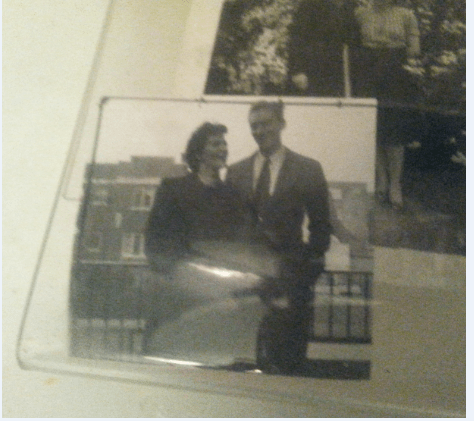
Peter Nixon, former RAF Ferry Command pilot, and new wife Marie-Marthe circa 1949.
My father had flown over the Nile.
The Nile River. In Africa.
And, even better, he had flown over the Nile…at night.
Weren’t we impressed, my two brothers and I, way back when in the 1960’s, to learn that particular spine-tingling fact.
Of course, we knew that our father had been in the War (well, duh) as part of something called the Ferry Command (ZZZzzzz) that moved planes back and forth over the ocean.
To us, our father’s Air Force career seemed dull and boring and highly unromantic and, obviously, not dangerous at all.
But, then, we kids ferreted out his black leather WWII log book. We deciphered his compact, prep-school handwriting to see that he had been over the Nile at night and, now, our already strapping 6 foot 4 inch British Pater suddenly seemed taller in our eyes.
(How ever did he fit that huge Yorkshire farmer frame into those tiny mosquito planes, I now wonder.)
I write about this because yesterday my husband came to pick me up at Trudeau Airport in Dorval.
My plane from New York City had been delayed by half an hour and he had wandered the premises for a bit.
“Do you know there’s a section of the airport devoted to the Ferry Command,” he asked me as we walked back to the car.
“No,” I said.
“And they show some of the airmen involved,” he continued. “Maybe your dad is one of them.”
But, I was too tuckered out from travelling all of one hour in a cramped commuter jet to take a look at said installation. Luckily, my husband had snapped some pictures on his phone.
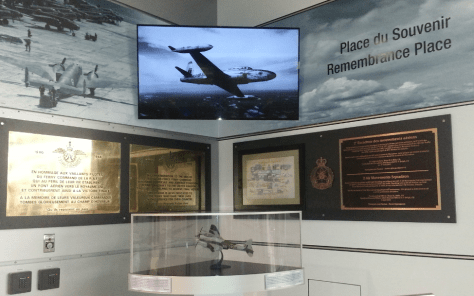
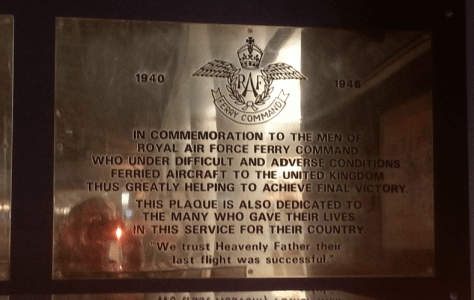
Half a century has now passed since the day we kids first perused that enigmatic leather log book.
My father has been dead for 10 years, succumbing in 2005 to Alzheimer’s in the Veteran’s Hospital at Ste. Anne de Bellevue.
While he was sick, a couple of books were (finally) written about the Ferry Command. I read them.
I came to realize that the Ferry Command is the reason I am here, on Earth and in Montreal.
The Ferry Command, you see, was headquartered at Dorval.
(Hence, the installation. Hence, IATA headquarters being in Montreal.)
My father never mentioned it, or, more likely, I wasn’t paying attention, but the Ferry Command was an important part of the WWII effort.
There was nothing safe about being a Ferry Command pilot. Ferry Command planes, I discovered, were shot down and/or crashed regularly, and some crashes (the ones that made headlines, anyway) involved planes that were taking a dozen or more Ferry Command pilots, huddled together like so many human popsicles in the frigid belly of the machine, back to Canada from an overseas mission.
What exactly was this Ferry Command? Well, before the US officially entered WWII, skilled American pilots were hired on the sly, at sky-high pay, to ferry planes from Canada to England.
Planes, secretly being manufactured in the States, were literally pushed over the Border, and, then, these Yankee flying aces would take them over to England.
When the US officially entered WWII, enlisted men from the RAF were brought into the Ferry Command, my father among them.
My father, a British child of the Raj, was 19 in 1941, either having just finished prep school at St Bees on the coast of Cumberland, or a year into his Oxford studies.
He had been a top athlete at St Bees, captain of all the school teams. I’m guessing that’s why he was funnelled into the RAF.
Anyway, I read that the Ferry Command pilots partied hard in the Mount Royal Hotel between assignments. I’m guessing my father met my French Canadian mother at one of these gatherings.
(Too late to ask either of them.)
Lately, I also learned something else of acute interest to me: that Ferry Command planes were serviced by young women maintenance workers at Keswick Airport in England. I’ve seen certain alluring pictures on the RAF website. (I suspect they only chose the prettiest Screen Gems style women for these promo pics.)
Now, my father never mentioned that. That, certainly, would have stuck in my brain, way back when, in the optimistic era of the Beatles, Emma Peel and Women’s Lib; a time when WWII, to us Boomer children anyway, seemed so many, many lightyears away.
The Family Secret
By Marian Bulford
My Gran told me that her mother Lilian, did not like her very much and was not very nice to her, and consequentially for some peculiar reason Lilian did not like my mother or me, either.
I remember Lilian as a very stern presence so I steered clear of her. She did live with my Gran for a time, but by the time I was a teen, she had moved to another daughter’s house to live, so I never had much contact with her.
A photo below shows the four generations myself, Gran Mum and Lilian and I do not look very happy to be in this photo!
When my mother found out she was pregnant with me, 2 years after being married, she told me that Lilian said “Well, you made your bed now you have to sleep in it” Not a very nice thing to say about becoming a Great Grandmother! I never did understand why she did not like us and what she meant by that remark but years later, I was to find out.
For a while, I lived with my Grandparents from 11 years to 14 years. They were very strict but loving and Gran and I went everywhere together, to church the church fétes and shopping trips. Gran taught me to cook and bake.
One day, Gran wanted to go and see her mother who was living in Okehampton, Devon, a train ride away from us in Plymouth.
A train ride, what a treat! I was about 14 and we lived a very quiet life. Off we went, sandwiches and tea packed for the two-hour train journey to visit great-grandmother Lilian.
After my Gran’s meeting with her mother lunch with the cousins and visiting, it was time to go. We had the train carriage to ourselves.
‘That was a lovely day, wasn’t it Gran?’ In answer, Gran burst into tears I was astounded, my Gran crying? She never cried.
I put my arm around her and asked her ‘Gran! What is the matter are you sick?” she cried some more, blew her nose and then said “I am a bastard”
Well! You could have knocked me down with a feather. Gran NEVER swore let alone say THAT word.
Eventually, she calmed down and I asked her what she was talking about. She must have been very very upset to divulge her mother’s secret to her young grand-daughter.
Apparently, Gran wanted to be baptized in the Church of England, and needed her birth certificate and to eventually claim her Old Age Pension, she also needed this document. That was the purpose of our visit.
When Lilian heard that Gran wanted her Birth Certificate SHE burst into tears and said that she hoped she would be dead by the time her secret came out.
Then, she had to reveal the reasons why she was so upset. Lilian was by then in her late 80’s and told Gran that she had given birth to her in the Leicestershire work house, because she was an unmarried mother. When she received Gran’s birth certificate it had stamped across it, in very large letters the word ‘ILLEGITIMATE’ Lilian had ripped it up and threw it away.
Lilian had, like many before and since, become pregnant at 17. The father Thomas was a Royal Navy Cooper a master carpenter. They met and she became pregnant. My Gran told me years later, that Lilian told her that she ‘fell off the style (or kissing gate) and never got up’ When Thomas did eventually come home from sea, they married. Gran was then three years old so yes, she WAS illegitimate for a while, but the parents had married, just a little late!
This seemed to be the reason Lilian did not like my Gran very much and Lilian did show a great deal of resentment towards Gran, my mother and me.
The four generations
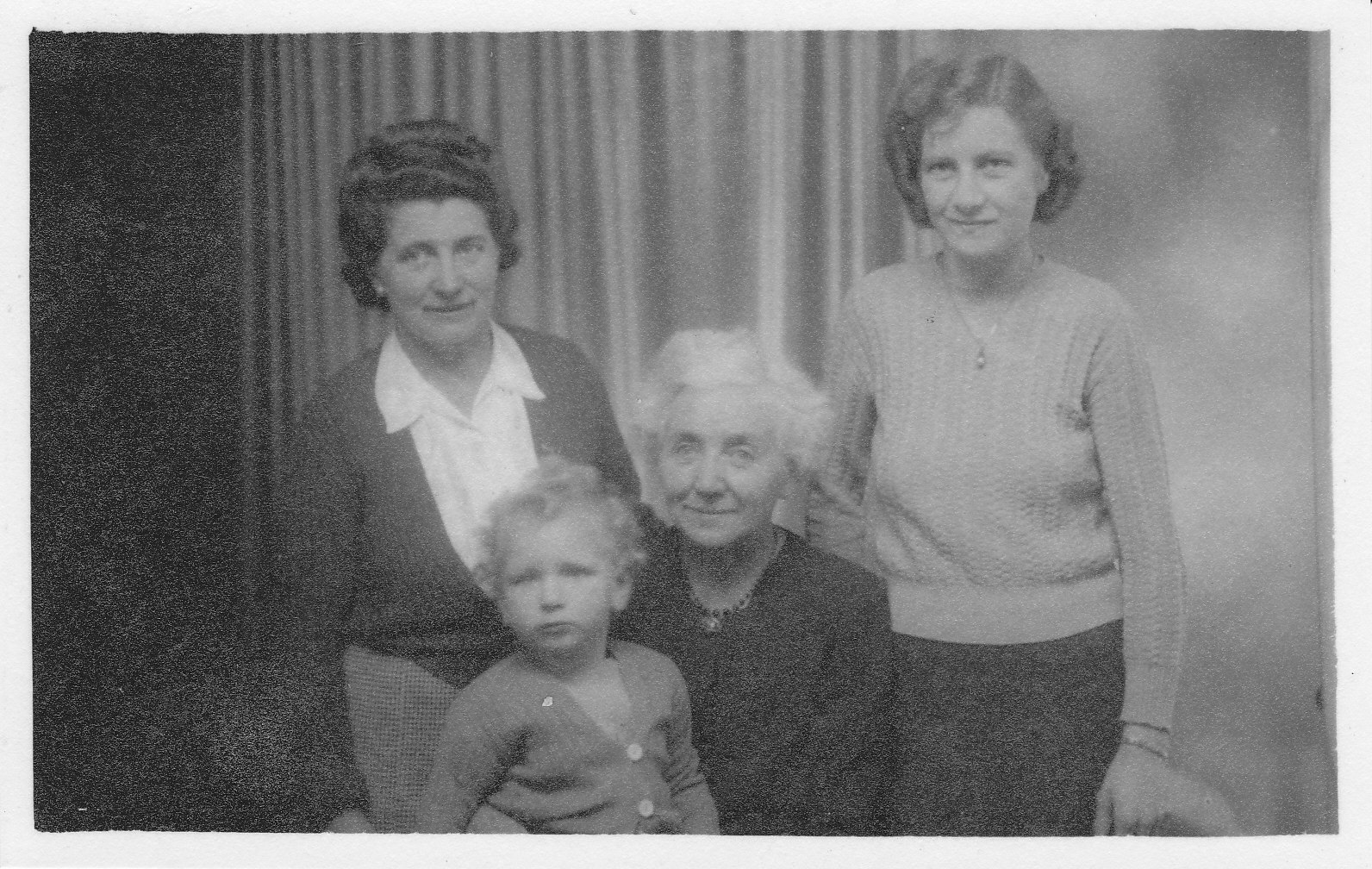
This article is a continuation of a previous story, called “Illegitimate”
https://genealogyensemble.com/2015/07/13/illegitimate-2/
Quebec City Directories
City directories contain a wealth of information for the genealogist, historian, urban geographer and the just plain curious. Quebec City directories are no different: they list residents, merchants and city streets, churches, courts, hotels, banks, charitable organizations and much more.
The link included in the PDF below will take you to the website of Quebec’s provincial library and archives, Bibliothèque et Archives nationales du Québec. It has digitized Quebec City directories (annuaires) from 1822-1976. If you had ancestors living in Quebec City or suburbs (banlieue) such as Beauport and Lévis during these years, you will probably find them in the directories. Some years include listings in what was known as the Huron Village.
The directories are at least partly written English until 1955; after that, they were published in French, but shouldn’t be hard to follow with the help of a free online translator such as Google Translate.
Thanks to Jacques Gagné for putting this listing together, and to Claire Lindell for editing.
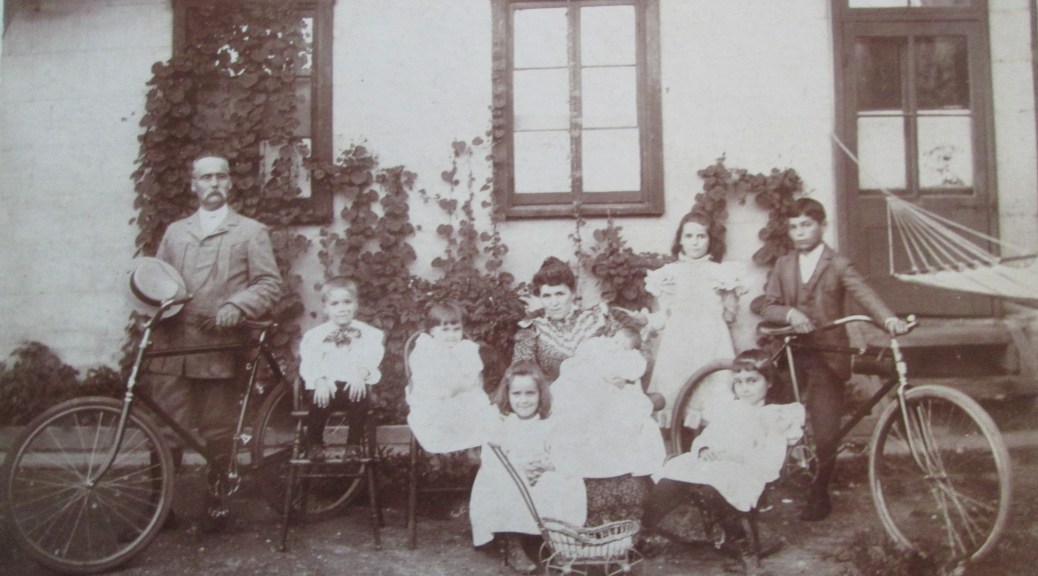
Call Me Ismael
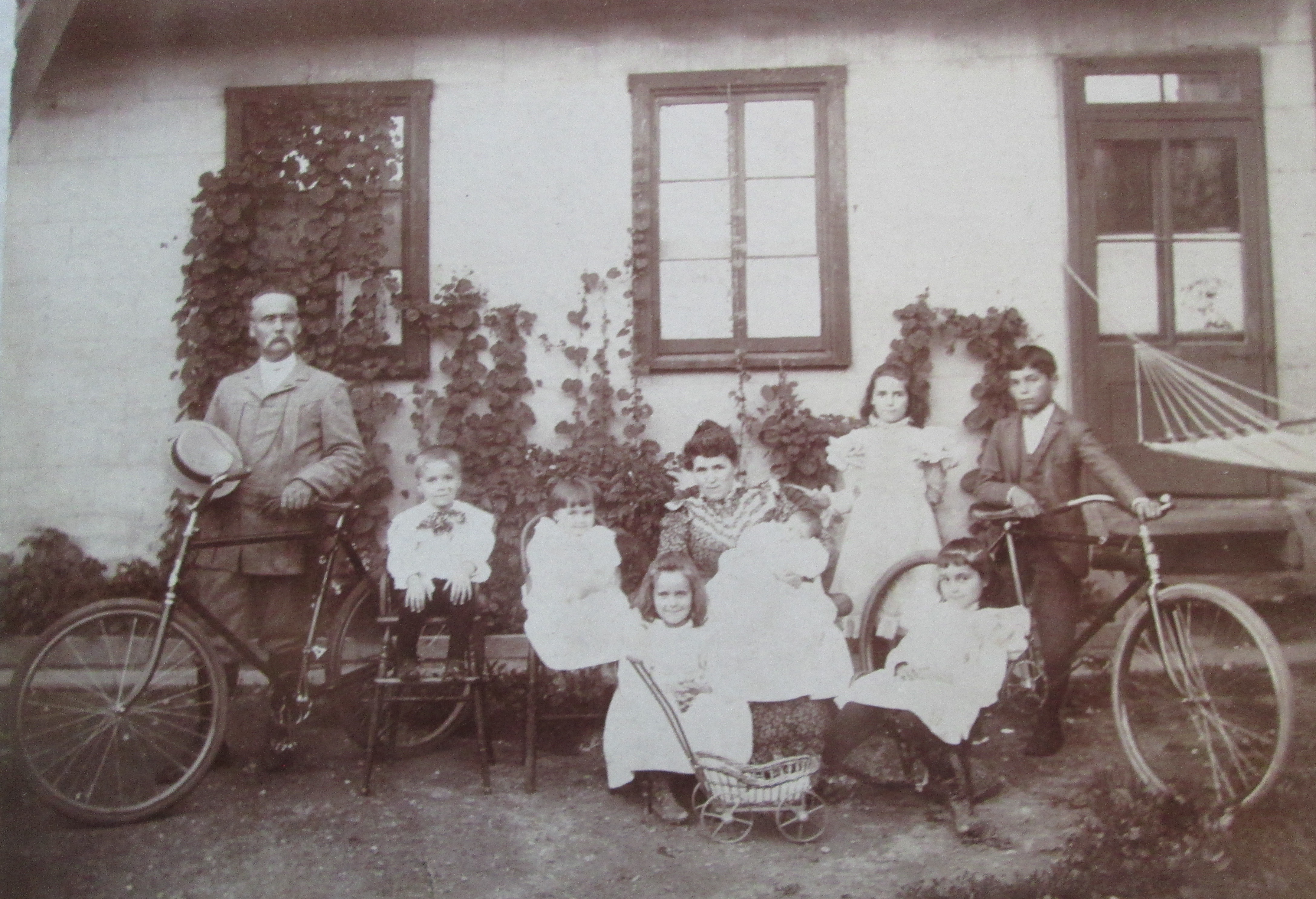
He arrived when the service was almost over. He walked to the pulpit and announced the last hymn “Seigneur Tu donne Ta Grace.” As the organ played he collapsed to the floor. So ended the life of Ismael Bruneau, my great grandfather.
His life began in 1852 as Ismaer Bruneau in St-Constant Quebec, just south of Montreal. Ismaer was the eleventh of thirteen children and the youngest son of Barnabé Bruneau and Sophie Prudhomme. He attended the French Protestant school in Pointe aux Trembles and one summer went to West Randolph, Vermont to work in the mills. He spent a lot of time thinking about his future. He had written for advice to the principal of the school, Dr. Tanner who encouraged him to return to his studies and take the classes for those considering the ministry.
He was not sure of that path. One day he was out walking in the woods and climbed to the top of a hill. He sat facing Canada and prayed to God about the decisions he must make. As he reported, there was a dark cloud on the horizon and a voice spoke to him as if from the sky, telling him to return home and study, then travel and spread the gospel.
Ismaer continued his studies at Pointe aux Trembles and was then admitted to the Presbyterian College in Montreal, which had begun teaching subjects in French. At this time he changed his name from Ismaer to Ismael which he thought was more biblical and added Prudhomme as a middle name in honour of his mother.
After graduating, he was sent to Saint-Anne’s Kankakee County, Illinois to work with Father Chiniquy. Father Chiniquy was a Catholic priest who had left Quebec in the wake of several scandals. His zeal for God remained intense but not his feelings for the Catholic Church, which he renounced. He made his beliefs known to his congregation and they all chose to follow him and convert to Protestantism.
One family living in Kankakee was the Girods, who had recently immigrated from Switzerland. When their daughter Ida, a teacher in Baltimore came to visit, she was introduced to their minister. Ismael had been very homesick and often wrote letters home. He began writing about the lovely woman he had met. Then in one letter, he wrote to his sister Anais, “ Wouldn’t you like to come out after the harvest and see my wife. It would be worth it for without a doubt she is one of the beauties of the world in my eyes.” Ismael and Ida were married June 12, 1886.
The Bruneaus had three children in Green Bay, Wisconsin, one in Holyoke, Massachusetts, three in Quebec City and the last three in Montreal. Ismael had wanted a biblical family, a child for each of the 12 tribes of Israel but in the end had only 10. Nine of the children survived. He continued moving and preaching, taking a charge in Cornwall, Ontario and finally in 1917 back to Quebec City.
In Quebec, he had a church in the Old City as well as a congregation in Portneuf. He would conduct the morning service, catch the train to Portneuf for an afternoon service and be back in Quebec City in time for the evening service. On January 27, 1918 the train was delayed because of a troop train. Arriving late in Quebec City he ran up the hill from the station. He entered the church before the service ended but while his spirit was still willing his heart was weak. His family suffered financial hardships after his death as there were no pensions and the Presbyterian Church sent his widow one cheque for the days he had worked that month and nothing more.
Bibliography:
Bruneau, Ida. A Short History of the Bruneau – Girod Families. 1993.
Duclos, Rieul P. Histoire Du Protestantisme Français Au Canada Et Aux États-Unis. Montreal, Canada: 1912. Print
Villard, Paul. Up to the Light: The Story of French Protestantism in Canada. Toronto: Issued for the Board of Home Missions of the United Church of Canada by the Committee on Literature, General Publicity and Missionary Education of the United Church of Canada, 1928. Print.
Here is a link to a story about Ismael’s wife Ida Girod.
https://wordpress.com/post/genealogyensemble.com/3674
The Missing Gravestone of Robert Hamilton and Janet Renwick
Writing a family history blog is a lot of work, but the effort is rewarding in many ways. Since I started writing my own blog and contributing to http://www.genealogyensemble.com, I have heard from several relatives I never knew I had. A distant relation in Australia is helping me break through a brick wall in Ireland. A researcher in Vancouver has provided information about a great-great aunt who moved there from Montreal. And a distant cousin in Ontario forwarded some of the letters our newly immigrated Hamilton ancestors sent home to Scotland.
Another breakthrough came through the kindness of the parish archivist in Lesmahagow, Scotland, hometown of those Hamilton ancestors. He ran across the article I posted about my three-times great-great grandfather Robert Hamilton, a tailor in the town Lesmahagow near Glasgow. Robert’s son and grandchildren left Scotland in 1829 and settled as farmers in what is now Scarborough, a suburb of Toronto. Robert, an elderly widower, stayed behind and died in Lesmahagow two years later.
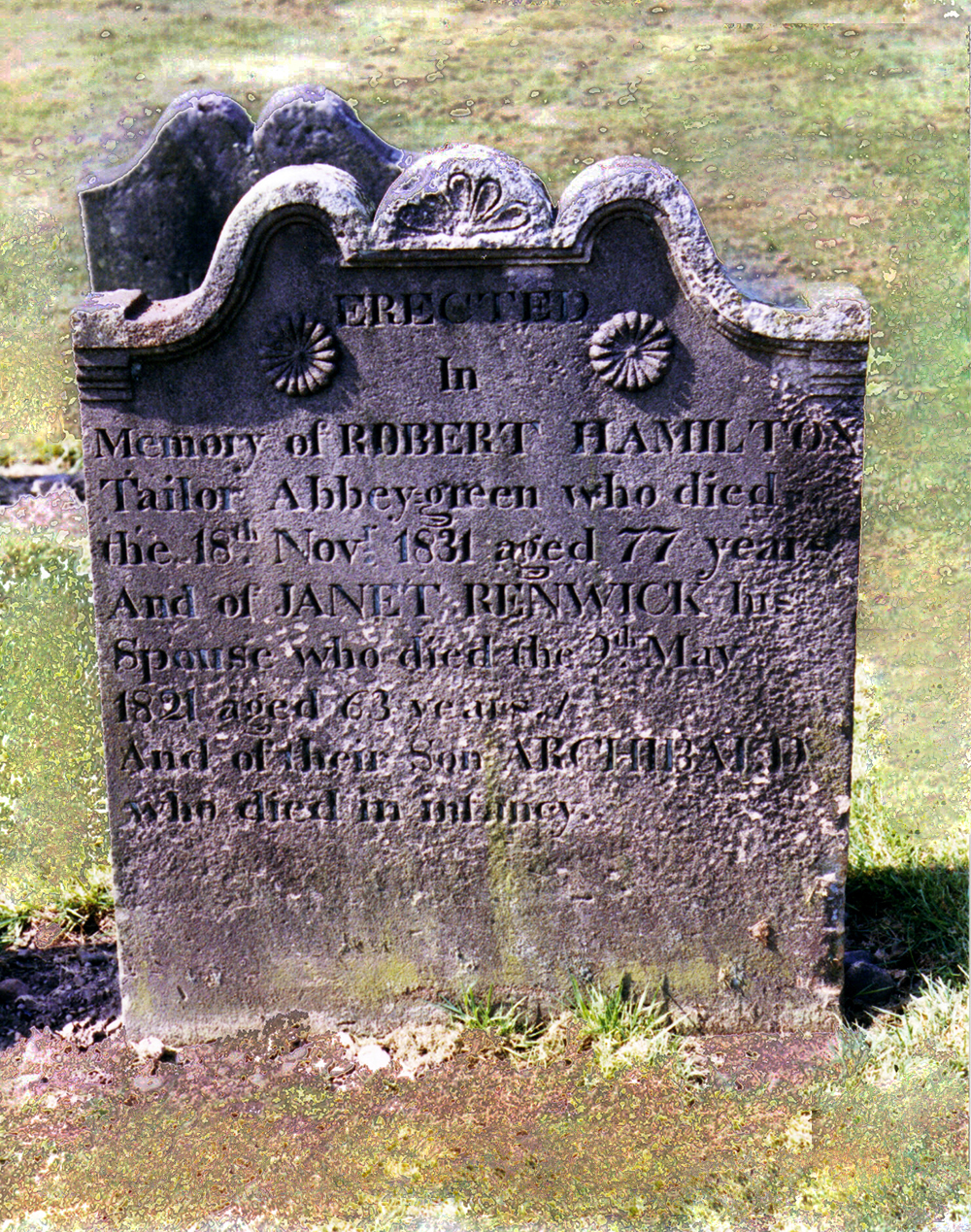
My uncle did some research on the family in the 1950s and copies of the documents he collected eventually made their way into my hands. One of the items I acquired was a sketch of the parish cemetery in Lesmahagow, showing the location of the grave of Robert Hamilton and his wife Janet Renwick. When my husband and I visited in 2012, there was only grass in that spot, so I was delighted when the parish archivist recently emailed me a photograph of the missing Hamilton gravestone. The photo was taken in 1999. Since then, the stone must have fallen over and been covered by dirt, or perhaps it became unstable and had to be removed for safety reasons.
The text shown in the photo says: Erected in memory of Robert Hamilton tailor of Abbey Green who died 18th Nov. 1831, aged 77 years, and of Janet Renwick, his spouse, who died 2nd May 1821, aged 63 years, and of their son Archibald, who died in infancy.
Most Scots could not afford gravestones in those days, and I am sure the Hamiltons were no different. Tailors did not make much money. This is a nice big stone, and I suspect it was erected by family members many years later, perhaps with money sent to Scotland from the farm in Canada.

See also: Robert Hamilton, Tailor of Lesmahagow, http://writinguptheancestors.blogspot.ca/2013/12/robert-hamilton-tailor-of-lesmahagow.html
This article is simultaneously posted on writinguptheancestors.blogspot.ca
American and British Isles Settlers in Western Quebec
This compilation looks at the towns and villages settled by the British and Americans in the early 1800s in what is now usually known as the Outaouais region of Quebec. This area is north of the city of Ottawa and the Ottawa River, which forms the boundary between Ontario and Quebec.
It is an area of great beauty, with ancient hills and many lakes and rivers, but its winters are long and cold. Many settlers were drawn here to work in logging, paper mills and other resource-based industries. Today the area’s population is primarily French-speaking. Most of the region remains rural, with the only large urban center being the amalgamated city of Gatineau, which includes the former city of Hull and surrounding town.
American & British Isles settlers in Western Quebec rev25 02 2016
A Small Life
I hold the documents as gently as I would the child for whom I have searched for so long. A birth certificate. A death certificate. Four days apart.
My husband knew he had a sister but that’s all he knew. The family never spoke of her and Jim grew up an only child. He did not even know his sister’s name. Thoughts of having a sister, however, evoked a tangle of fragmented memories and emotions that over the years he tried to shape into a plausible scenario. My searches on-line for a female Smith born to Jim’s parents came up empty. It was only last summer, when Jim was seventy, that a cousin found a name on a family tree she had been given: Elizabeth followed simply by a “d”. No dates. The name was enough to find the records.
Elizabeth Smith was born on December 18, 1943 to Peter Dudgeon Smith and Mary Ann Syme. She was born at home at 36 Bentinck Street in Glasgow. Bentinck is a street of tenement buildings near Kelvingrove Park. Today the area is very trendy, but during the war two families often lived in a single tenement sharing the kitchen and bathroom. Such was the case for Jim’s family. His father was in the navy and away at sea for weeks at a time. Given the cramped living quarters, it was very likely that Jim was witness to the sounds and sights of his mother’s labour and delivery, at best confusing for a two year old but likely quite terrifying. Certainly he would have seen the newborn and perhaps even held her although no picture exists today to document this event.
Elizabeth died at home between four and eight a.m. on December 23rd. I vision her mother nursing her in the middle of the night, returning her to her crib, falling back to sleep herself only to wake sometime later to find the tiny body. The cause of death was listed as congenital debility, a vague term explaining little. Was it clear at her birth that she would not live long? Was she not transferred to a hospital because nothing could be done? Or might congenital debility have been a term for what today we call Sudden Infant Death Syndrome and her death actually a shock to her parents?
Jim has a strong memory of his father being angry with his mother over the death. Was what Jim interpreted as anger actually grief? Or was it in fact anger? At what? His parent’s silence over the years is strange. Perhaps they felt Jim was too young to have remembered the event or they may have wanted to protect him from the tragedy. How much information he may have absorbed from adult conversations he overheard across the years is anyone’s guess. Collecting facts in bits and pieces without an understanding of the context would only serve to compound his confusion. He made what sense of it he could and eventually believed his sister was hit and killed by a car.
The location of Elizabeth’s grave is still not known. She is not buried with the Smiths in Greenock Cemetery. She may be with her mother’s people in Blantyre. What is known, however, is that Elizabeth lived for four days and is remembered by her big brother.
 Genealogy Ensemble