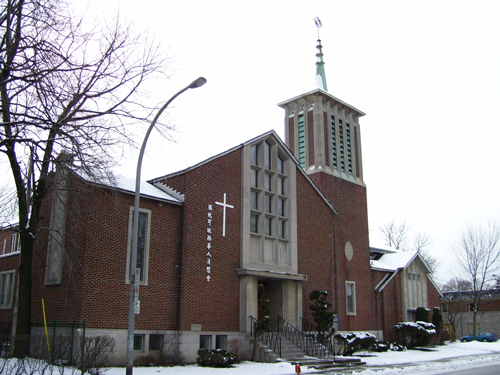
Montreal City West Baptist Church St. Laurent, Quebec
Anyone looking for information about ancestors who were active in Baptist Churches in Quebec between 1794 and 1967 will appreciate Jacques Gagné’s latest compilation, which tells you which records exist and where you might find them.
Jacque’s compilation is divided into Quebec cities and towns, including Berthier, Sherbrooke, etc. Researchers with ancestors in Quebec can look up the town in which their ancestors lived and see how many Baptist Churches were in that town and where the records for each church were sent.
The records that still exist are divided between twelve different repositories with locations throughout Quebec, in Ontario and in the United States. Jacques provides links and addresses for each repository so that researchers can contact the repository directly to look at records online or make arrangements for a visit.
Historian René E. S. Péron summarized the history of the Baptist religion as an introduction to the compilation so that researchers can get a sense of how decisions their ancestors made influenced the lives we live now. René’s article was posted on the blog last Thursday.
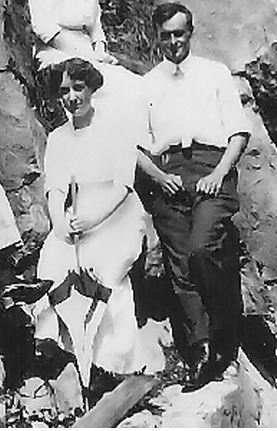
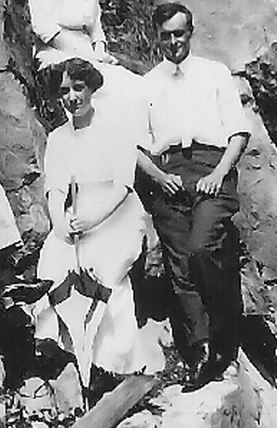
Edith and her beau circa 1909 somewhere near Potton Springs in the Eastern Townships of Quebec
Edith Nicholson (1884-1977), my husband’s Great Aunt Dede, never married. She told her nieces and nephews and great nieces and great nephews that she lost her Great Love in a hotel fire. The couple wasn’t ‘officially engaged’ but there was ‘an understanding’.
Some believed DeDe, some didn’t.
In 2004, I found 300 Nicholson family letters from the 1908-1913 period in an old trunk – and in a letter dated May 3, 1910, Edith writes of this loss to her mother, Margaret:
Your letter received this am. It was so good to hear your voice over the phone. It was quite natural. Oh, how I wish I could talk over everything with you. It seems terribly hard to think it all for the best, when there are so many that are of no use living on and others that are held in esteem cut off in a moment. One thing, I am very thankful for that he wrote me. No doubt one of the last things that he did. I can’t express my feelings. I never felt so badly in my life. But I suppose there are few who have had so pleasant a one as I have, and trouble comes to all.
So the story was true, after all!
Edith mentions many young men in her letters sent from Montreal where she was working as a teacher back to Richmond where her Mom lived. Edith often uses only initials when talking of her romantic life. Apparently, back then, courting was something to be coy about.
It took me long while to figure out but her Great Love was one Charlie Gagne, bank clerk, from Levis, Quebec. A French Canadian man, most likely. Now, that was a surprise.
It seems Edith and this Charlie had an on-again off-again relationship through 1908-1909.
Gagne is a French Canadian name but from the letters it is clear Charlie spent time around Edith’s group of Richmond Protestants. Perhaps he was a convert from Catholicism. In Montreal, Edith worked as a teacher at French Methodist Institute in Westmount, a school where Catholics, mostly French Canadians, were converted to “the Way.”
The Nicholson’s also left behind a photo album from the 1910 era. I have photographs of Edith on a country outing with a handsome young man. If this is Charlie of the May 3, 1910 letter, he is a slim, with a charming smile and a cocky attitude and he is a great dresser. Edith Nicholson would have accepted no less.
There are a few other mysterious mentions of Charlie, or Charlie G or CG in the 1909-10 letters.
In August 1909, Edith writes her Mom saying she managed to ‘show’ Charlie to her father at a train station, (it sounds like a set up) but her father was cool to her young man.
In September 1909, Edith’s mother Margaret writes her father Norman and says “Charlie has gone to Mexico. So that flirtation is over.”
In October 1909, Edith writes her Mom saying she hasn’t heard from Charlie G and that she has no intention of trying to contact him. “He could still be in Mexico, for all I know.”
In February, 1910, Edith writes that she is taking medicine, for ‘her heart has had a jolt’.
Then there’s NOTHING but that May 3 letter about Charlie’s death. Edith writes that she is looking at his picture in the Montreal Star and that “it does not do him justice.”
So I had bits and pieces of a sad love story, but I had to fill in the blanks. I couldn’t even be sure it was Charlie G. who died in the hotel fire.
One sentence in the May 3 missive was especially enigmatic. “It seems if it had only been an accident, it would be easier to understand.”
So, about 5 years ago, I skipped over to the McGill Library to check out the May 1910 Star.
Amidst the pages and pages of stories of Edward VII’s death, I found a story about a Cornwall fire, the Rossmore House Fire, where a Charlie Gagne, bank clerk from Levis, perished. Proof at last.
Charlie had recently been transferred to the Cornwall branch from the Danville, Quebec branch, which is near Richmond, Edith’s home-base. (The February jolt!)
Only half of Charlie’s body was found at the scene and that was burned beyond recognition. There was only a tie pin to identify him.
The fire had started in a stairwell and, as a boarder who knew the hotel well, Charlie tried to use the stairway to escape the fire, as did a few other boarders, including an entire family.
Most hotel clients had been rescued by fireman at their hotel window, or had frantically jumped to safety.
There was no photograph with this Montreal Gazette newspaper article, though – so I was confused.
Then Google News archives came online and I saw that the Rossmore Fire happened on April 29!
I headed down to Concordia’s Webster Library to check out the January-April reel of the 1910 Montreal Star.
Sure enough, the Cornwall fire was front page news on April 29 as the Star was an afternoon paper.
The next day’s issue had a back of the newspaper follow up article on the fire with a photograph of Charlie Gagne, Levis-born bank teller at the Bank of Montreal.
The photo was of a sober-faced Charlie, but it was without a doubt the man of the family album.
At long last, mystery over.
Then, much later, on Ancestry.ca, I found Charlie’s name on the 1901 Census and his 1910 death certificate that claims he died accidentally in a fire. Charlie, the snappy dresser, was the son of a modiste, a widow, and he had a younger sister. And he was buried as a Roman Catholic!
The Kings’ daughters (Filles du Roi) who came to Canada between 1663 and 1673 under are often described as poor, orphaned or prostitutes.
Yet my ancestor Catherine Clerice doesn’t seem to fit that description.
Catherine was indeed recruited by Louis XIV’s team and she did indeed get a dowry of 50 livres from the King. Her goods also included an additional 250 livres of her own money, which would have purchased 10 arpents of land in New France at that time if Gerry Lalonde is to be believed.
So why did she leave her family, her friends and everything she knew at only 18 years old? It may have been a strong sense of adventure, a lack of prospects, a sense of duty or just a momentary teenage impulse with long-lasting consequences.
Whatever her incentive, she left La Rochelle, France in June 1671 on a 300 ton ship known as the St. Jean-Baptiste.
The ships were very crowded and sanitation was not top priority. Disease was common among the women as bacteria and germs spread quickly among the crowded and filthy conditions. Food was a scarce commodity on the voyage as three months was too long to keep perishable foods such as fruit, vegetables, and meat from spoiling. Physical conditions on the voyage were terrible, but the girls on the ship also felt a great psychological burden during their passage. These were very young women who left their families, their country, and most of their belongings behind in order to go to a completely new world. Fear of the unknown left many of them uncertain about their future and even their survival.”[1]
She arrived in Quebec on August 15, 1671.
Within six weeks, she was betrothed to Jacques Lussier. Their contract “marriage act” was written by Romain Becquet on October 4, 1671 and the home of Anne Gasnier, who was a Kings Daughters’ patron.
The couple joined another nine couples to be married at Notre-Dame de Quebec on October 12. Toussaint Dubeau, Louis Denis dit Lafontaine and Rene Dumas witnessed their wedding. The first parish priest of Quebec, Henri de Bernieres, officiated.
Together, they had twelve children, including my own ancestor Louise.
The couple remained in Varennes, Quebec until both died.
According to Jerry DeKeyser, the property of Jacques Lussier was divided up after he died.
At that time, upon the death of one of the parents, the law obliged the survivor to have an inventory taken by a notary and to carry out the division of the property. On 13 March 1713, Catherine Clerice gathered her family before notary Adhemar and witnesses; she had the list of property, left by her late husband. All the furniture and real estate were written down on paper: the two tin chandeliers, the small earthen ware plates, the iron grill with seven bars, the very ornate wardrobe of Jacques Lussier, the farm with four arpents of frontage on which lived two oxen, four milk cows, three calves, three horses, and so forth. Then followed the deeds, papers and instructions. The ancestor had nearly 3,000 livres in ready cash, a fortune for that time.
Two days later, the Lussier family, very united, and very respectful to their mother, held a house auction. The disposable things were sold according to the best offer from the heirs and according to its portion of the inheritance. The paternal house and all that was necessary for her subsistence were left to Catherine Clerice.
The ordeal was too much. Ancestress Lussier, at the age of 68, went to join her husband on the first of March 1715. The pastor of Sainte Anne de Varennes, Canadian born Abbot Claude Volant de Saint-Claude, signed the registry after two witnesses; Jacques Girard and Jean Charbonneau.”[2]
[2] DeKeyser, Jerry C. “Genealogical Details For: Jacques Lussier, B. 1646 d. Abt Oct 1712 — Ancestors and Descendants of the DeKeyser and Related Families.” Genealogical Details For: Jacques Lussier, B. 1646 d. Abt Oct 1712 — Ancestors and Descendants of the DeKeyser and Related Families. 2013. Accessed May 27, 2015. http://www.cs.iusb.edu/~dekeyser/familytree/vft_indpage.php?idno=4491.
“Just open the window, Dan, and they’ll hear you clear to Fredericton!”[1] Daniel Hanington was nicknamed “Roaring Dan” by his fellow politicians in Moncton, because he had such a deep, booming voice. Although he thought of himself as a farmer, Daniel’s greatest interest was really politics.
Daniel was elected to the Legislative Assembly as Member for Westmoreland County (south eastern part of New Brunswick) in 1834. He served in either the Lower or Upper House until he died 55 years later, spanning the terms of 12 Lieutenant Governors. [2] According to the Saint John DAILY SUN, he “was a courteous, genial gentleman of the old school, respected by all who knew him… His election to the presidency of the Legislative Council in February, 1883, was a fitting crown to a long and successful political career, and he brought to the performance of the duties of this office an amount of political experience and a familiarity with public affairs in which he was absolutely without a rival among provincial public men.” [3]
Daniel was born to William Hanington and Mary Darby (the first English settlers in Shediac, New Brunswick) in 1804, and was educated at the Sackville Grammar School. He actually was a farmer as well as comptroller of customs at the port of Shediac, New Brunswick, for more than forty years. He retired from that post in 1880, at the age of 76.
His wife, Margaret Ann Peters (1811-1887), was the daughter of William Peters and Charlotte Haines, both having arrived in Saint John, New Brunswick, as youngsters with their families along with several other Empire Loyalists in 1783. Charlotte came with an aunt and uncle and never saw her parents again. She lost her little handmade slipper in the mud when she disembarked and the remaining slipper is in the Museum in Saint John.
When their children were growing up, Daniel refused two departmental offers, because the duties of the office would compel him to be away from home much of the time. He preferred the country life, and to oversee the education and training of his children. Indeed, they raised a truly remarkable family. All nine sons were first-class businessmen, including another successful politician like himself, a lumber merchant, a broker, a rector, a barrister, a chemist and druggist (my great great grandfather – James Peters Hanington), a civil engineer, a chief surgeon and a comptroller of customs. It was also noted that the three daughters had also “done well”, which I am guessing in those days meant they married men with family money and lucrative careers!
In 1881, Daniel and Margaret Ann celebrated their fiftieth wedding anniversary, with nine of their twelve children (one son died as an infant). At that time, the grand total of their children and their immediate families came to 73 people and over half of them were at the party!
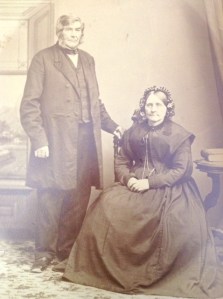
Daniel Hanington and his wife, Margaret Ann Peters
[1] as told by Mary Thorpe Lindsay Kerr (his great grand-daughter).
[2] The Canadian Biographical Dictionary 1881. Lieut-Col. Hon. Daniel Hanington, M.L.C., Shediac, NB
[3] DAILY SUN, Saint John, New Brunswick – newspaper
It’s a long way from my house in Montreal, Quebec to Providence, Rhode Island: six hours of driving, plus pit stops and traffic delays. But the moment I walked into my first event at last weekend’s New England Regional Genealogical Consortium (NERGC) conference in Providence, I felt right at home.
That first event was a special interest group meeting of genealogy bloggers. Everyone in that room shared my passion for blogging, although we do it in different ways. For example, Pat Richley-Erickson, who writes the award-winning http://blog.dearmyrtle.com/, also does video blogging on YouTube. At the meeting, I picked up some advice about backing up my blog, and about the value of Thomas MacEntee’s www.geneabloggers.com site as a resource for bloggers.
Over the next two days, I attended presentations from excellent speakers including Lisa Louise Cooke (http://lisalouisecooke.com/) and Judy G. Russell (www.legalgenealogist.com). I was especially interested in Dwight Fitch’s presentation on historical conflicts that affected the early settlements along the Connecticut River, since he used our common ancestor, Henry Burt (c. 1595-1662) of Springfield, Massachusetts, as an example.
Of course, I didn’t have to go all the way to Rhode Island to learn about genealogy. Many webinars and online hangouts take place every week. So for me, the best thing about attending a conference like this was the opportunity to meet people in an informal setting. For instance, I had a long conversation with a member of the Descendants of the Founders of Ancient Windsor. Windsor, Connecticut was founded in 1633 and, although I know I had ancestors there in the mid-1700s, I’ve always wondered whether they were founding families. I also got a chance to meet Joshua Taylor, co-host of Genealogy Roadshow on PBS, a show that I enjoy.
The people who attend and present lectures at conferences like this are the people who are setting the bar high for genealogical research standards. They help us figure out where and how to look for our ancestors, and they educate us about the laws and historical events of our ancestors’ times. They also push us to research diligently in order to prove our conclusions, and to cite our sources.
This was my second time attending a conference organized by the NERGC (www.nergc.org), an association that brings together 22 different genealogy societies in New England. Both conferences were extremely well run. Many volunteers worked hard to achieve that, so to them, I say thank you.
The next NERGC conference will take place in Springfield, Massachusetts in April, 2017. In the meantime, many other exciting genealogy conferences are coming up. (See http://calendar.eogn.com/ on Dick Eastman’s Online Newsletter.) Here are a few major conferences scheduled for eastern Canada and the United States over the next few months:
Quebec Family History Society (QFHS) June 19-21, 2015 Montreal, QC
Ontario Genealogical Society (OGS) May 29-31, 2015 Barrie, ON
New York State Family History Conference Sept. 17-19, 2015 Syracuse, NY
British Isles Family History Society of Greater Ottawa (BIFHSGO) Sept. 18-20, 2015 Ottawa, ON
Here are links to stories about some of my American ancestors:
Mary Darby was feeding the chickens in her father’s yard, when along came an oxcart carrying a handsome gentleman. To her amazement, he stopped the cart, dismounted, raised his hat in greeting and approached her for a chat. The story told is that young William Hanington (age 33 years) proposed to her on the spot and she (age 18 years) accepted just as quickly. After their marriage, she was taken across the Northumberland Strait from her father’s home in St. Eleanor’s, Isle St. Jean (now Summerside, PEI), in a canoe paddled by a couple of Indians, to her new home in Shediac, New Brunswick, where her English husband had settled seven years earlier in 1785.
Mary Darby was the daughter of Benjamin Darby, a Loyalist of Newbury, New York. Born in England in 1744, he emigrated to America in and settled in Newburg, 50 miles from New York City. He was imprisoned at one time for his Loyalist sympathies and suffered great hardships at the hands of the rebels. In 1783, hearing that Washington’s troups were marching on the town, he snatched his ailing wife from her sickbed and fled to New York with their five children. They embarked for Isle St. Jean at Long Island. Poor Mrs. Darby died on the voyage and was buried at sea. Mary Darby was only nine years old. Her father re-married and had another family.
Mary’s first home was the log house her husband William had built in 1787, just two years after his arrival from England. Although her first child died at birth, the next five of her twelve children were born in that log house. In 1804, he built a three-storey frame house for his wife and family. The house was all hand-wrought, the boards and beams were hewn by hand, the shingles were hand split, the trimming hand carved, split boards served as laths and the nails were all hand- made. Water was obtained from a deep well by means of a bucket attached to a long well-sweep or pole. Their son Daniel (my great great grandfather), born in 1804, was the first of the next seven children born in that frame house.
It’s hard to imagine but Mary was without female companionship for the first three years of her life in Shediac. It must have been such a relief when her sister Elizabeth and husband, John Welling, also came over from PEI in 1795 to settle in Shediac. John bought 200 acres of land from William for 20 pounds sterling (about $20 then). Once settled, Elizabeth and John also raised a large family of 12 children.
William died at the age of 79, in 1838, and Mary lived another 13 years without him. Her life must have been one of hardship and suffering and yet she lived to the age of 77 years. Amazing!
I’ve been trying to trace my great-uncles’ family ever since my great aunt told me that everyone, except his older brother Raymond, moved back from Michigan after Charlie’s dad lost his job in the depression.
According to his Ontario birth certificate, my great-uncle Jean Charles Horace Mathieu was born to Charles Mathieu and Mary in Fort William, Ontario on April 24, 1911,[1] so that’s where my research began.
Ten years later, the family had moved to 500 Aylmer Avenue in Windsor, Ontario, where they were renting a six-bedroom house. Both parents were 51 years old by then. His father Charles worked as a carpenter. His wife, who was born Marie Agnès Proulx, was then called Agnes. (She went by Mary and/or Agnes depending on the documents.)
Jean Charles had two older brothers, Arthur (16) and Raymond (14), an older sister Fernanda (12) and two younger brothers, Lawrence (8) and George Albert (6). [2]
There’s no hint of the family from then until 1932. There is one person who has a family tree on Ancestry who indicates that a Fernanda Mathieu crossed into Canada in 1924. That may have been John Charles’ sister, but it isn’t confirmed.
I wasn’t able to find the family on the 1930 U.S. Census.
By using Steve Morse’s search engine to search Lovells directory, I was able to find a carpenter named Charles Mathieu living at 6760 St. Denis in 1932[3]. I don’t know whether this was Charlies’ family or not.
If it was, they left Montreal again, because there are no listings for carpenters named Mathieu between 1933 and 1939.
Their next appearance in Lovells is 1940 when a carpenter named Mathieu lived at 3286 St. Antoine.[4]
That’s definitely them. I have an undated newspaper clipping about Aircraftman J.C.H. Mathieu between injured in a flying accident that says his parents lived at 3286 St. Antoine. [5] That clipping is undated, but I know that Jean Charles Mathieu lived in Montreal when he volunteered for the Royal Canadian Air Force in Montreal on August 8, 1940.
My original question remains unanswered.
——————————————
[1] Photocopy of Province of Ontario pocket birth certificate issued at Toronto on November 10, 1947, registered in April 24, 1911 in Fort William, Thunder Bay District by Geo. H Dunbar, Registrar Dunbar.
[2] 1921 Canadian Census, Province of Ontario, District of Essex North, Roger West Minard Subdistrict, Number 47, June 13, 1921, B, Page 20, derivative source.
[3] Lovvell’s Montreal Alphabetical Directory, 1932, p1456
[4] Lovell’s Montreal Alphabetical Directory, 1940, p1771.
[5] “Airman Injured,” Montreal Gazette, undated clipping, author’s collection.
I think queues were invented in the UK. We queued for everything and even though I was only about four-and-a-half years old, I remember queuing with my mother. One time, when she was heavily pregnant with my brother, she sent me into the shop to keep her place, whilst she rested on the wall outside.
I marched in, went straight up to the front of the queue and stated my order…….I remember very well, the smiles and laughs, but I got my order right away and, once outside, instructions from Mum on the correct way to queue. My Mum told me that ‘food was all we thought about’ how to get it what to make with it, how to stretch it.
We ate everything from the animal. Called ‘offal’ it included heart, kidneys, brain and stomach–all made into quite tasty dishes. I don’t know if I would have eaten the dishes, had I known what I was actually eating!
¹During rationing, 1 person’s typical weekly allowance would be: 1 fresh egg, 4 oz margarine, 4 oz bacon (about 4 rashers), 2 oz butter, 2 oz tea, 1 oz cheese and 8 oz sugar.
Meat was allocated by price, so cheaper cuts became popular. Points could be pooled or saved to buy pulses, cereals, tinned goods, dried fruit, biscuits and jam.
We used to have a dish called ‘tripe’ boiled animal stomach with onions. Or liver and onions still popular today. If you got a tongue at the butchers you could make many meals with it. Fried, or pressed in aspic to make ‘brawn’ then cut up to make sandwiches with or add to salads.
A favourite after the Sunday roast was “bubble and squeak” which was the left-over potatoes and greens cut up small and fried to a crisp with cold meat and pickled onions, usually fed to us on Monday as the family laundry was done on that day. Corned beef hash was another dish mixed with cabbage and potato and fried.
Chitterlings (intestines) were sometimes eaten cold. Pigs trotters added to a hearty mix of vegetables made a wonderful meal with dumplings. Many people made their own blood puddings.
Gran’s beef olives was a favourite meal. That was skirt steak, when we could get it, beaten to death with a rolling-pin cut into strips and the strips stuffed with sage and onion stuffing rolled up and secured with a tooth pick and roasted for hours on end.
Dripping’ was the various fat from animals carefully preserved (no refrigeration in those days) in a crock and kept on the cold, stone floor in the larder to spread on a piece of bread sprinkled with salt – very tasty!
Most people had an allotment and grew as many veggies as possible. Wasting food was a criminal offence during the war my Gran told me. Too bad that does not apply today!
²The Ministry of Food produced leaflets and posters advising housewives to be creative and one of England’s best known cooks, Marguerite Patten gave cooking tips on the radio.
‘Mock’ recipes included ‘cream’ (margarine milk and cornflour) and ‘mock goose’ (Lentils and breadcrumbs). Powdered eggs and Spam from the US were mainstays of wartime and after. Kippers and Sprats were a fish easy to obtain in Plymouth Devon, a Royal Naval fishing city where I was born.
This is an example of a ‘Government Recipe’ taken from the book ‘Ration Book Cookery Recipes and History. Published by English Heritage, London 1985.
Mock Goose
150 g (6 oz) split red lentils
275 ml (1/2 pint) water
15 ml (1 tbls) lemon juice
salt and pepper
For the ‘stuffing’
1 large onion
50 g (2 oz) wholemeal fresh breadcrumbs
15 ml (1 tbls) fresh sage, chopped.
Cook the lentils in the water until all the water has been absorbed. Add lemon juice and season. Then make the stuffing. Sauté the onion in a little water or vegetable stock for 10 minutes. Drain, then add to the breadcrumbs. Mix in the chopped sage and mix well. Put half the lentil mixture into a non-stick ovenproof dish, spread the ‘stuffing’ on top, then top off with the remaining lentils. Put in a moderate oven until the top is crisp and golden.
I have tried this recipe, and it was really good, considering not much was in the ingredients.
Despite the stresses of wartime, it was reported that the health of the poor improved. Babies and pregnant women were allocated extra nutrients such as milk, orange juice and cod liver oil.
Post war, the orange juice we got for my baby sister was condensed in a small bottle and carefully measured out by the teaspoon and mixed with water. For all the hardships I was never hungry and I do believe that I had a healthy start to life, due to rationing.
The following database contains information on villages and communities where families settled in Lower Canada and Quebec from 1760 onward. This document will assist researchers seeking to find the names ( past and current ) of these settlements.
Over the years there have been many name changes in both the counties, villages and settlements. These changes are noted, giving both the original name and the current name on modern maps.
There is a Table of Contents, along with several links to old county maps.
The old Edmonton newspaper clipping doesn’t include a clear date, but was written sometime well after January 1942 and prior to September 27, 1944.
Its title “Airman Shot Down Twice But ‘Nothing Much to Tell’ emphasizes the key point of the story.
The nutgraph reads “Like nearly all of the fighting men who return after serving in battle, WO. Hurtubise had little to say about his adventures in the air.” It goes on to say:
The airman had been shot down over friendly territory. He crashlanded both times. He admitted he had been wounded slightly but said “it was nothing at all. You’d never know it now.” [1]
The soldier of few words was a distant cousin—the son of my great-grandfather’s brother and my great grandmother’s sister. His name was Paul Emile Hurtubise. At the time of the newspaper article quoted above, he served as a Warrant Officer and pilot in the Royal Air Force.
Hurtubise was interviewed for the story at his 99 Avenue home in Edmonton (address 111204). The unnamed newspaper reporter writes that Hurtubise was shot down twice in North Africa and also served in raids over Sicily and Italy.
His father Gus was still alive at the time of the article, but his mother Ida died sometime prior to the article date, but after the 1921 census .[2] There was one mention on an ancestry family tree that she died in 1922, when he was only three years old, but that isn’t yet confirmed. Another newspaper clipping in French from an unnamed and undated source cites the family as formerly living in Peace River, Alberta.
Hurtubise attended Jesuit College in Edmonton and enlisted with the air force in January 1941. After training with the air force in Ontario, he got his wings in Dunnville, Ontario and went overseas in January 1942.
At the time of the article, he had returned to Canada to serve as a flying instructor, but at some point, he went back to the front.
On September 27, 1944, he crashed a third time in a Spitfire NH while serving with 412 Squadron.
The third time, he died. His remains are buried in plot 2B12 in the Reichswald Forest War Cemetery in Germany.[3] He is listed as a pilot officer in the Royal Canadian Air Force in the Service Files of the Second World War Dead.[4] He’s also commemorated on page 341 in the Second World War Book of Remembrance.
——————————————–
[1] “Airman Shot Down Twice But ‘Nothing Much to Tell’,” Edmonton Journal or Bulletin in its Forty-First Year, but the article describes January 1942 as the distant past.
[2] Alberta Province, Bow River District #2,Enumerated subdistrict 25, uncategorized district 218, section number 7, township 22, range 21, meridian 4, lines 28 to 31, family #69, page 5, Sixth Census of Canada, 1921. Ottawa, Ontario, Canada: Library and Archives Canada, 2013. Series RG31. Statistics Canada Fonds.



 Daniel Hanington and his wife, Margaret Ann Peters



 Genealogy Ensemble