My 2X great-grandfather, George Murray Boggie, born in 1826 in Old Deer, Aberdeen, Scotland,1 spent his whole life in the Royal Navy. This was a life of adventure, variety, and camaraderie, but also homesickness, hard work, long hours, and sometimes sickness.
George didn’t start out wanting to be a sailor. When he was 15, and perhaps earlier, he and his brother, James worked as apprentice writers in Peterhead, Aberdeenshire. They lodged with John Bradie, a newsroom keeper. 2 John probably worked at the same newsroom as George and James.
It turned out that writing was not the job for George. George started volunteering in the navy when he was 20. He served on about 14 ships between 1846 and 1854. In January 1854, he was serving on the HMS Euryalus. He then signed his indenture papers on 13 February 1854, which committed him to ten years of continuous service in the Royal Navy.3 The HMS Euryalus was commissioned in 1853 and soon after George joined the crew, it was deployed to the Baltic to take part in the Baltic Campaign as part of the Crimean War.4 The HMS Euryalus was part of an Anglo-French fleet that entered the Baltic to attak the Russian naval base of Kronstadt.5
While I do not have a picture of Great-Grandfather George, Royal Navy Form 95 says that he was 5 ft., 7.5 inches tall, with a ruddy complexion, dark hair, and blue eyes. He had a tattoo on his left arm, his initials: G.M.B. 7
George was already married and a father with two children when he started his indentureship. His daughter, Mary, was 4 and my great-grandfather, Henry was just two years old. His wife, Elspeth Milne would have had her hands full with a young family and an absent husband. Elspeth would also have been worried about George as he was in active military service. As George remained a member of the Royal Navy his entire working life, it is probable that he participated in many battles.
Sailors were constantly at work when at sea. All ships were dangerous workplaces and injuries and death as a result of injuries were common. Their sleeping quarters were cramped, the sailors’ sleep was often disturbed, and their meals were neither copious nor balanced. Although some ships did issue a daily ration of lime juice and sugar, but in quantities not exceeding one ounce of each, assumably to prevent scurvy. The ships were cold, damp, and uncomfortable and their clothes could be damp for months at a time. Most ships did not have a physician or surgeon on board so some health conditions could not be addressed quickly. Sailors’ wages were usually paid in arrears as a deterrent to desertion.8
Sailors were susceptible to tropical diseases and while dysentery can be caught anywhere, It’s a more common condition in tropical areas of the world with poor water sanitation. The Royal Navy sailed the world over, often in tropical waters. Dysentery on board was common. It is contagious and can be contracted from eating food prepared in unsanitary conditions or by drinking contaminated water. 9
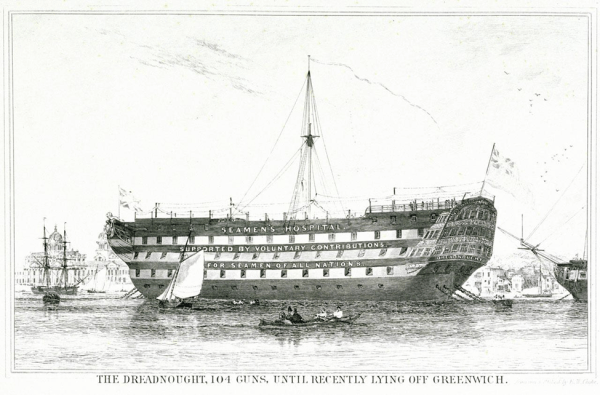
As George worked on 14 ships before he signed up for continuous service in 1854, he already had a good idea of what he was getting into. On 5 February 1847, George was admitted to the Dreadnought Seaman’s Hospital to treat dysentery.10 The registration indicates that he was victualled for 46 days which, I believe means that he was paid for the 46 days that he was in the hospital.
The Dreadnought Seamen’s Hospital provided seafarers with hospital care for 150 years. It started in 1821 as a wooden warship moored in the River Thames at Greenwich, England. After 1870, the hospital transferred to dry land at the former Greenwich Hospital Infirmary, and the hospital continued to treat sailors in Greenwich until its closure in 1986.11 In 1987, a Dreadnought Unit opened at St. Thomas Hospital in London.12
George was a member of the Royal Navy during the second half of the 19th century and, at that time, naval warfare underwent a complete transformation due to steam propulsion and metal ship construction. While Britain was required to replace its entire naval fleet, it managed to do so through unparalleled shipbuilding capacity and financial resources.13 When George started his career, he served on a wooden hulled steam frigate. By the time he completed his career, he would have seen great leaps of technological improvements.
Scotland’s People, Old Parish Registers, Boggie, George Murray, 1826, Old Deer, Aberdeenshire, accessed 7 June 2024.
Scotland’s People, 1841 Census, Boggie, George Murray, Peterhead, Aberdeenshire, accessed 12 June 2024.
Form 95, Indentured royal navy papers, Boggie, George Murray, dated 13 February 1854, National Archives, accessed 3 July 2024.
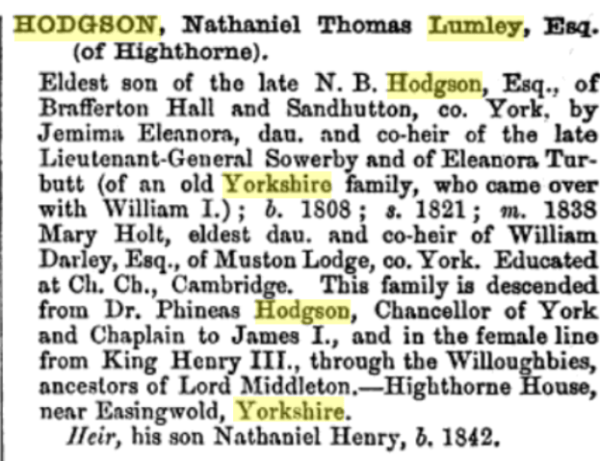
Antonia Willoughby, ancestor of Mr. Lumley Hodgson on his mom’s side.1
As is typical, I know little about the life of my great great grandmother, Ann Nesfield, a cook from North Yorkshire, UK except the basics: birth (1838), death (1912) marriage (1861) and children (10) but thanks to the Internet I know a great deal about her employer, Nathaniel Thomas Lumley Hodgson, a member of the landed gentry. So, just for fun, I have strung together this little fiction about my great great grandmother from some intriguing facts about Mr. Lumley Hodgson found online.
August 23, 1861. “Happiness in marriage in entirely a matter of chance.” I read that in a book by Miss Austen.
As it happens, I am getting married in less than a week to a tailor from the tiny village of Rievaulx, a man I hardly know, a Mr. Thomas Richardson. He visits my place of employ twice a year in the spring to make up my Master’s riding clothes.
Although most of my Master’s clothing is bought in London, he prefers Mr. Richardson, who lives only 12 miles away, for his country apparel.
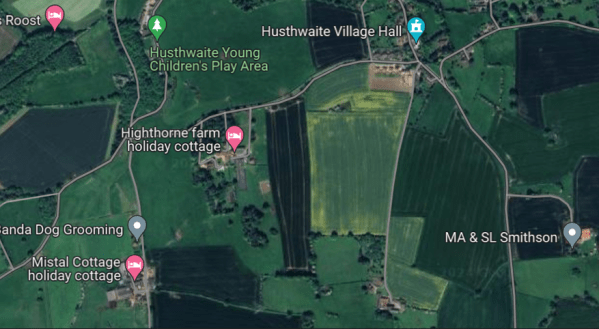
My name is Ann Nesfield. For many years now, I have been engaged as a cook at Mr. Nathaniel Thomas Lumley Hodgsons’ farm estate, Highthorne, near Husthwaite. It is a leisurely employment. I feed his small family, the household staff and the three farmhands. It is rare that important visitors come to stay, and if they do they come on business and sup at the local inn where they can haggle in manly fashion.
You see, Mr. Lumley Hodgson is a breeder of fine horses, of field hunters and of race horses. He trades mostly in the strong reliable Cleveland Bay, a local breed of which he is reet fond.
The Cleveland Bay, he informs everyone, was originally bred centuries ago by the local Cisterian Monks as a pack horse. Later, after the dissolution, the Cleveland was bred with some fleet and graceful Turkman stallions.
Today the Cleveland Bay is used in the field, both to hunt and to plow.
Mr. Hodgson seldom fails to tell his customers how 30 years ago he rode his own Cleveland Bay the one hundred and seventy five miles to and from Cambridge where he attended university.
If that doesn’t impress, he then relates the story of how another local man rode his Cleveland mare 70 miles a day for a week for jury duty in Leeds. Or how another man once burdened his beast with 700 pounds and rode 45 miles to Ilkley and back.
“The breed is being ruined,” Mr. L.H. likes to say, “by the London fashion for flashy carriage horses of 16.5 or 17 hands. Leggy useless brutes they are. All action and no go.”
Leggy Cleveland Bay Carriage Horses.
Mr. L.H. calls himself a farmer but he is a gentleman-farmer with a pedigree as impressive as his osses’. At Cambridge he shared lodgings with the great scientist Charles Darwin. This is also summat he usually tells a prospective client, for Mr. L.H. is a canny businessman and this association can only help him, considering his occupation.
There are rows and rows of stables on his 107 acre farm near Husthwaite that sits on one of the seven hills in the area. The main house, they say, was given as a reward many years ago to one of William the Conqueror’s faithful knights.
As I said, my Master’s household is small, made up of his wife Mary Darley (whose family owns many yackers of land in Yorkshire) two daughters, Julia, 22 and Emma, 8, as well as a nurse, a housemaid and a cook, yours truly.
At 23, I have been summat of a sister to Julia, who is sharp-witted but shy in company. She is destined never to marry. At least, there is never any talk of it, not since 1857 and the bachelor’s ball at the Yorkshire Union Hunt Club. So, on fine evenings, I am the one to accompany Julia out riding. We take two bay mares who she says are descended from the Darley Arabian, the daddy of all Thoroughbreds.
I am told I have a better seat than she does, but only by the groom, a Mr. Jack Bell. At breakfast time he likes to call out to me “Mornin’ Milady, grand day i’n’it”- a bit of a jape – and then he laughs showing a great gap where his front teeth should be.
A signed copy of the Voyage of the Beagle lies in a place of honour in Mr. Lumley Hodgson’s private library and has for decades. You can be sure I have never read it, but Julia has and told me all about it. She is the one who had me read Pride and Prejudice. She likes to lend me her favourite novels so she can explain them to me.
Over the years, I have heard (mostly overheard) so much about this Beagle book I feel as if I have read it and even been on the great sea voyage myself to the GA-LA-PA- GOS Islands and seen with my own eyes the strange and colourful creatures there.
Mr. Darwin has lately published another book called, I think, the Origin of Species. A copy arrived by messenger to Highthorne late last year.
This new book of Mr. Darwin’s has caused quite a stir locally. At a Methodist church service a month ago the minister bellowed that Darwin’s theory of evolution is blasphemous. Flippin’ ‘eck! The theory says we all come from monkeys! Mr. Lumley Hodgson – not in attendance – later told the minister that the theories in the book apply only to animals not to humans, but the minister was not satisfied. He said the question of the origin of all species was decided long ago and by an infallible source. He meant the Bible, of course. “God made the animals of the earth after their species as explained by Noah’s Ark.”
So, my Master, who can’t escape this connection with Mr. Darwin now, has decided to quit the farm for a while.
A few days ago he assembled the staff in the south hall and told us he is selling off his best hunters and other stock (including Emma’s comely Cobb pony and his prize Nag stallion) and moving his family to town for the winter. His excuse is that some of his horses have the equine flu (two have already been put down) and he thinks it might be catchin’ to humans.
No matter what the real reason for his takin’ his family to town, the result is that I am left in the lurch with no employment and no place to stay.
But just yesterday, Mrs. L. H. called me into her sitting room, the one with all the paintings of Julia’s frightsome-lookin’ ancestors, and pronounced, “Ann, you must marry Mr. Richardson, the tailor from Rievaulx. He is a respectable man who needs a wife. His sister, who has been housekeeping for him, has suddenly left for abroad. He says he is comfortably settled now in his own cottage and ready to marry and raise a family.”
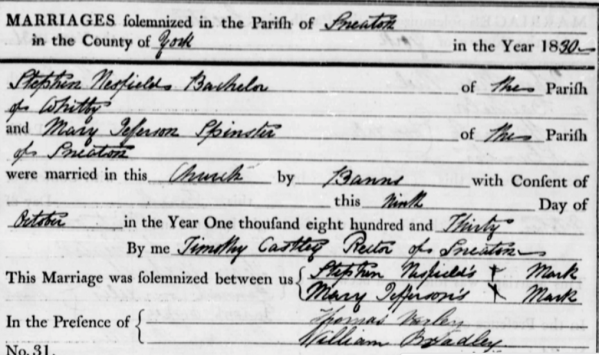
X marks the spot where my illiterate ancestors Mary Jeferson (Jefferson)of Sneaton and Stephen Nesfield of Whitby, Ann Nesfield’s parents, signed their marriage certificate in 1830.)
I must have looked very confused because she continued: “You remember Mr. Richardson from the spring? He waxed ecstatic over your Lamb’s Tail Pie and Tipsy Trifle.” (I did. Seems to me he had eyes for Julia back then.) “He says he needs a wife schooled in numbers to help him keep the accounts. And as Rievaulx is an isolated place, he requires a strong healthy girl who can walk the trails back and forth to Helmsley herself on market day. He is often on the road, so you will not have the use of his carriage as you do here to go to market in Easingwold. Yes, you must marry Mr. Richardson and very soon, too. We can have the ceremony right here in Husthwaite. But first you must visit him in Rievaulx. You can stay at our cousins the Lumleys who have a big farm there.”
So, it is set. My days of making simple Yorkshire meals for a small, ‘appy family in a reet bonnie setting near Husthwaite- and cantering over the dales at darkening with my almost sister Julia – are over.
Highthorne Farm is now a holiday destination, as is Birdsall rectory Manor, near Malton, North Yorkshire where Emma and Julia Hodgson, both unmarried, spent their old age with their brother, Captain Lumley Hodgson, according to 1911 UK Census. Lumley Hodgson’s mother’s relations, the Middletons (Willoughby) owned that place. On that census, Ann Nesfield Richardson was a widow living with her youngest daughter at New Cottage, Rievaulx, running a grocery. She died a year later.
I am off to Rievaulx to marry and make childer with a stranger. Otherwise, all that is left for me is to flit home to Whitby and that I cannot do. My mother is long dead and my father is in line to finish off his days at the workhouse should none of my half-siblings take him in.
Mr. Lumley Hodgson, his ‘ead filled with other worries, has no objections and no opinions on the subject either, although he jokes, “It’s either Mr. Richardson or Mr. Bell for you, I fear.”
But, I ‘ave watched Mr. Bell as he slips the belly-band around the more skittish horses in his care with a firm but gentle hand, keepin’ his voice soft and melodious all the while and I ‘ave noticed how his muscular shoulders glisten after an honest day’s work and I do not think the joke to be as funny as that.
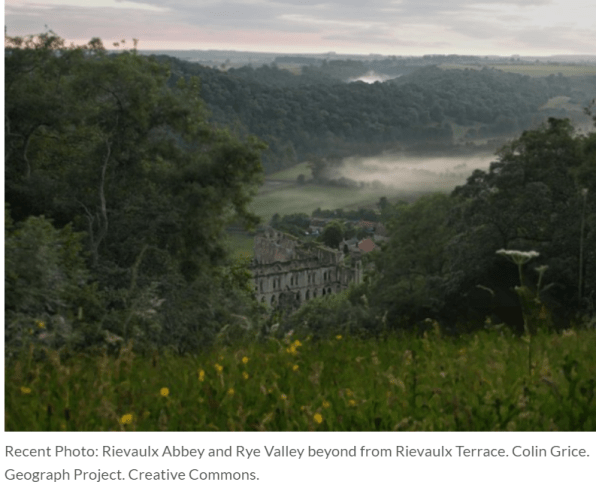
But Jack is a lowly farmhand and Mr. Richardson is a country tailor with a ready clientele and a sweet sunny cottage of his own, Abbot’s Well, with a fine prospect of the Rievaulx Monastery ruins. As I trot along on foot to Helmsley, my poke brimmin’ with dragonwort balm, tansy oil and other home-made potions to sell at market, I can watch from a distance as the Earl of Feversham’s family and friends go a-huntin’ o’er the heathery moors outfitted in all their finery on their own spirited Cleveland Bay/Thoroughbred crosses.
That is the selling point, according to Mrs. Hodgson: The cottage (complete with a little garden for growing my special herbs) and the mannerly profession.
But as Mrs. L. H. was quick to explain, this alliance is a major step up for me. I am but the daughter of a day labourer.
So, I hope Miss Austen is right, that it is ‘best to know as little as possible about the defects of your marriage partner,’ because I know almost nowt about this Mr. Thomas Richardson, except that he enjoys my tipsy trifle. (The trick is to use a lot of high quality whiskey). Still, that is as good a start as any, I reckon.
END
childer: children
Summat: something
Poke: bag
darkening: dusk
reet: very
nowt: nothing
Almost all of the entries for the Lumley-Hodgson’s in the press, mostly Yorkshire press, were related to Mr. L. H.’s businesses, horse and cattle breeding. By the 1870’s he was considered an expert ‘from the old school’ so his curmudgeonly opinions on the ‘horse question’ were much in demand and have left a long paper trail.
Yes, a notice in the paper in August 1861 said Mr. Lumley Hodgson was leaving Highthorne for ‘the health of his daughters.” (The girls were likely not frail, since Julia lived to a ripe old age and Emma was playing competitive doubles tennis in her thirties, I think.) And, yes, a week later, my great great grandmother, Ann Nesfield got married at Husthwaite.
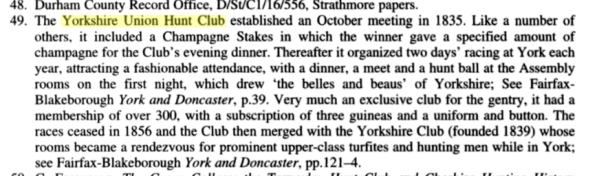
There aren’t many entries in the ‘social notes’ for the ladies of the family despite their good breeding; In 1857, Julia Lumley-Hodgson attended the last? hunt and supper at the Yorkshire Union Hunt Club, (a horse-racing club) where the fashionable young could mingle.
A hunt ball was given in 1867 at Highthorne. And in 1875, Mrs. Lumley Hodgson and Miss Hodgson (likely the much younger Emma) attended a bachelor’s ball in York.
Mr. Lumley-H died in 1886. A notice to creditors was put in the paper, his farm stock, ‘valuable hunters’, and effects put up for auction and his farm “in excellent condition” advertised for let… perfect “for a gentleman fond of rural pursuits.” In 1891 his wife (and girls?) were at Birdsall Manor near Malton (owned by Lord Middleton, a L.H. relation) and Mrs. L.H. was seeking a groom of good character, who must be single to work there. In 1911, her son Captain Hodgson, a widower, was at Birdsall Manor with Julia and Emma, both still single ladies with “private income’ listed where occupation should be.
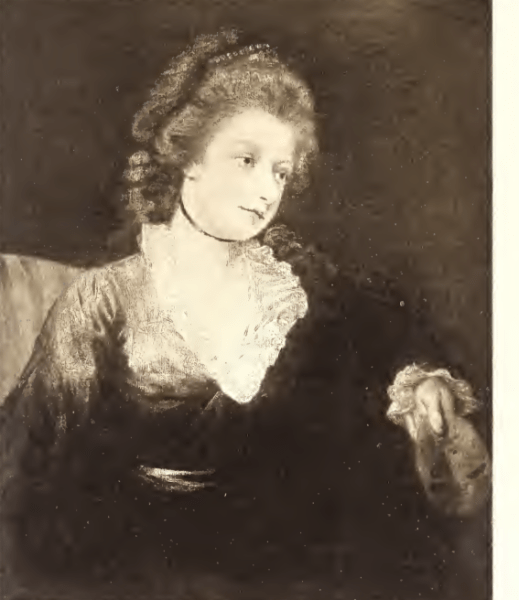
A few reports suggest Mrs. Lumley Hodgson dealt in fine art. The portait above was owned by her, found on Archive.org in A History of the Works of Sir Joshua Reynolds, Getty Museum publication. The weirdest entry about Lumley-Hodgson was that as an infant he sued his mother, Jemima, for land. Another online entry about Highthorne says he leased it in 1815. He would have been seven!
The Darley Arabian was brought to England from the East by the Alton, Yorkshire branch of Darley’s. Mary was from the Muston Lodge branch. They come from the same family originally.
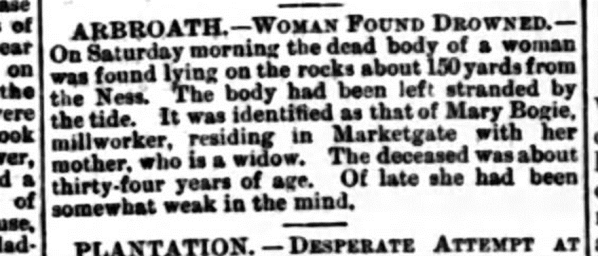
This sad sentence concludes the obituary of Mary Boggie who died by drowning on September 6, 1884 when she was just thirty-four years old.1 Her death was a suicide and this one sentence tries to explain why. Of course, no one will ever know why she jumped off a cliff into the cold and inhospitable waters of the North Sea. What we do know is that it was a desperate and definitive act.
Mary Boggie was Henry Boggie’s sister. Henry, my great-grandfather, was taken to court by my great-grandmother, Annie Orrock, in a paternity suit. He never lived with Annie and, as far as I know, did not participate in bringing up my grandmother, Elspeth Orrock. Mary and Henry were the only children of George Boggie and Elspeth Milne. The Boggie family lived all their lives in Arbroath, Scotland. Arbroath is a coastal town located on the North Sea, about 26 km northeast of Dundee and 72 km southwest of Aberdeen.2 In the 19th century, Arbroath experienced a rapid growth in population with an influx of workers needed for the expansion of the jute and sailcloth industry.3 George was a member of the merchant navy and would have been absent from home most of the time. Both Mary and Henry lived at home, with their mother, all of their adult lives.
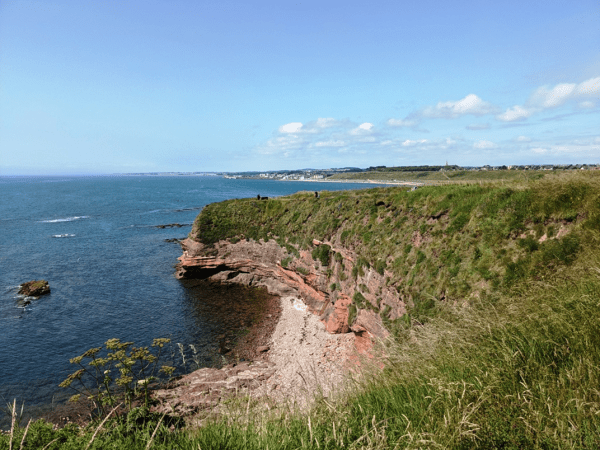
The registration of Mary’s death indicates that Henry was one of the “finders” of her body. The cause of death was “mental disturbance.”4 Who knows how long he and others were searching for her? She was found at the bottom of Whiting Ness, a cliff in Marketgate, Arbroath.
Part of the cliff face on Whiting Ness walk, James Herring, James Herring c10 Day Blog, Whiting Ness walk: The Needle’s E’e, The Deil’s Heid and Castle Gate, September 7, 2021
In 1884, sudden deaths in Scotland were referred to the Procurator Fiscal, known in other jurisdictions as the public prosecutor. The inquiry found that that the cause of Mary’s death was drowning and that she had committed suicide. The corrected entry notes that Mary had not been certified, meaning that she had never been certified as being mentally ill.5 The newspaper article implies that she was suffering from some mental affliction. And this is in accordance with the thinking at the time; that suicides were thought to be temporarily insane, thus being innocent of “self-murder.”6 Committing suicide was not considered a crime in Victorian and Edwardian Scotland. Citizens were free to take their own life, but it was assumed they would be answerable to God. This was not the case in England and Wales, where suicide was decriminalised only in 1961 with the passing of the Suicide Act. Prior to this, anyone who attempted suicide could be imprisoned and if they were successful and died, their families could be prosecuted. 7
No matter what the attitudes towards suicide at the time, Mary’s death was a tragedy. She could have been suffering from any number of mental or physical afflictions that would cause her to take her life. We can only imagine the anxiety and agony that Henry and Elspeth were feeling as people were desperately trying to find her. The trauma of finding her must have been almost more than Henry could bear. It would then be up to him to tell his mother. The suddenness and the violence of Mary’s death would have been a shock and difficult to understand. Henry and Elspeth were faced with an investigation and they would have had to deal with the press. Sadly, they may have had to deal with shame and the stigma of mental illness in the family.
Obituary for Mary Boggie, Glasgow Daily Mail, 8 September 1884, newspapers.com, accessed 23 May 2024.
Scotland’s People, Registration of Deaths 1884, Mary Boggie, accessed 3 April 2024.
Scotland’s People, Page 105, Register of Corrected Entries, Mary Boggie, signed by the Procurator Fiscal’s Office, 24 September 1884, accessed 3 April 2024.
JULIUS GRIFFITH – RCA, OSA, CSPWC, CSGA (1912-1997)
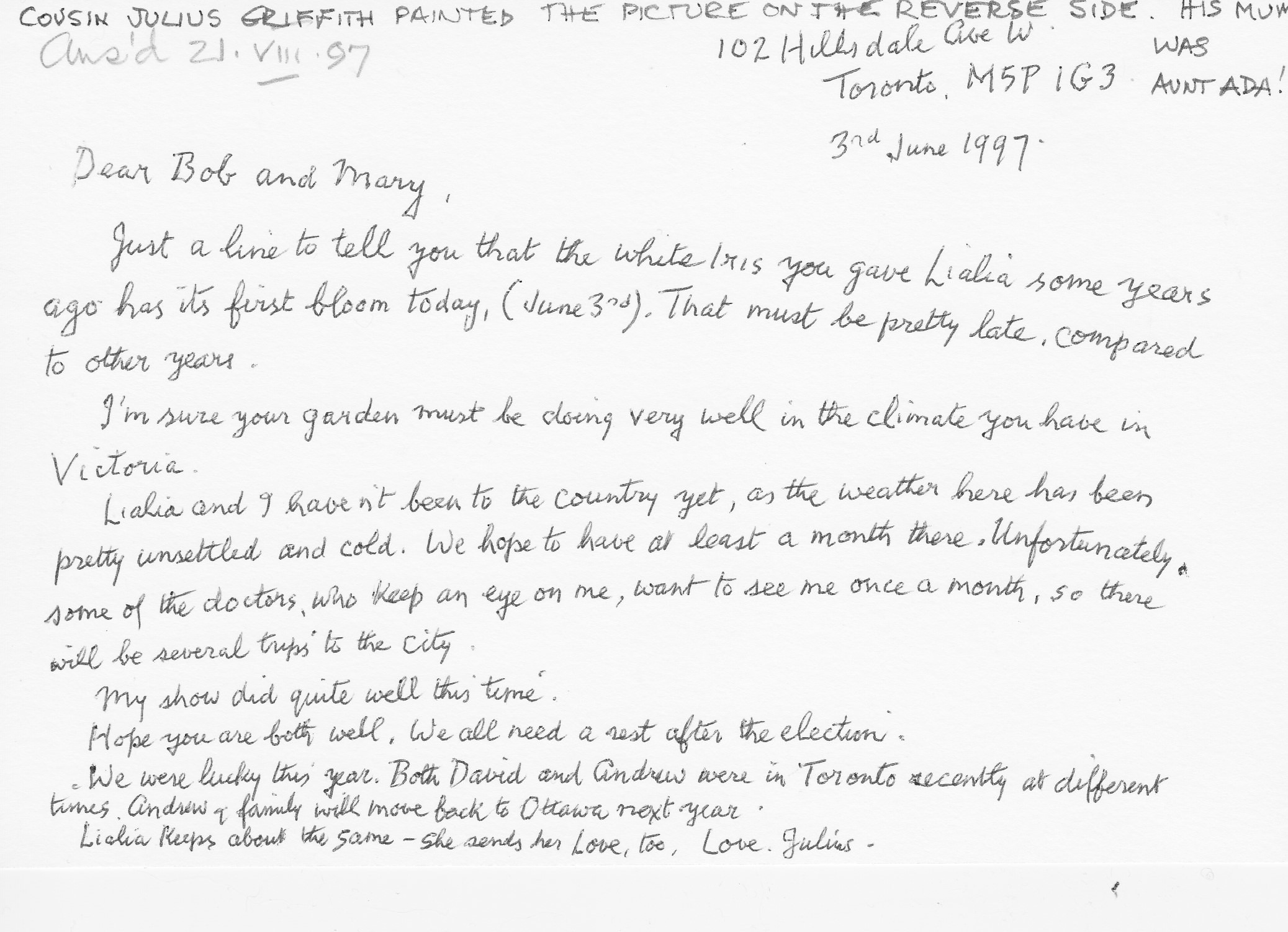
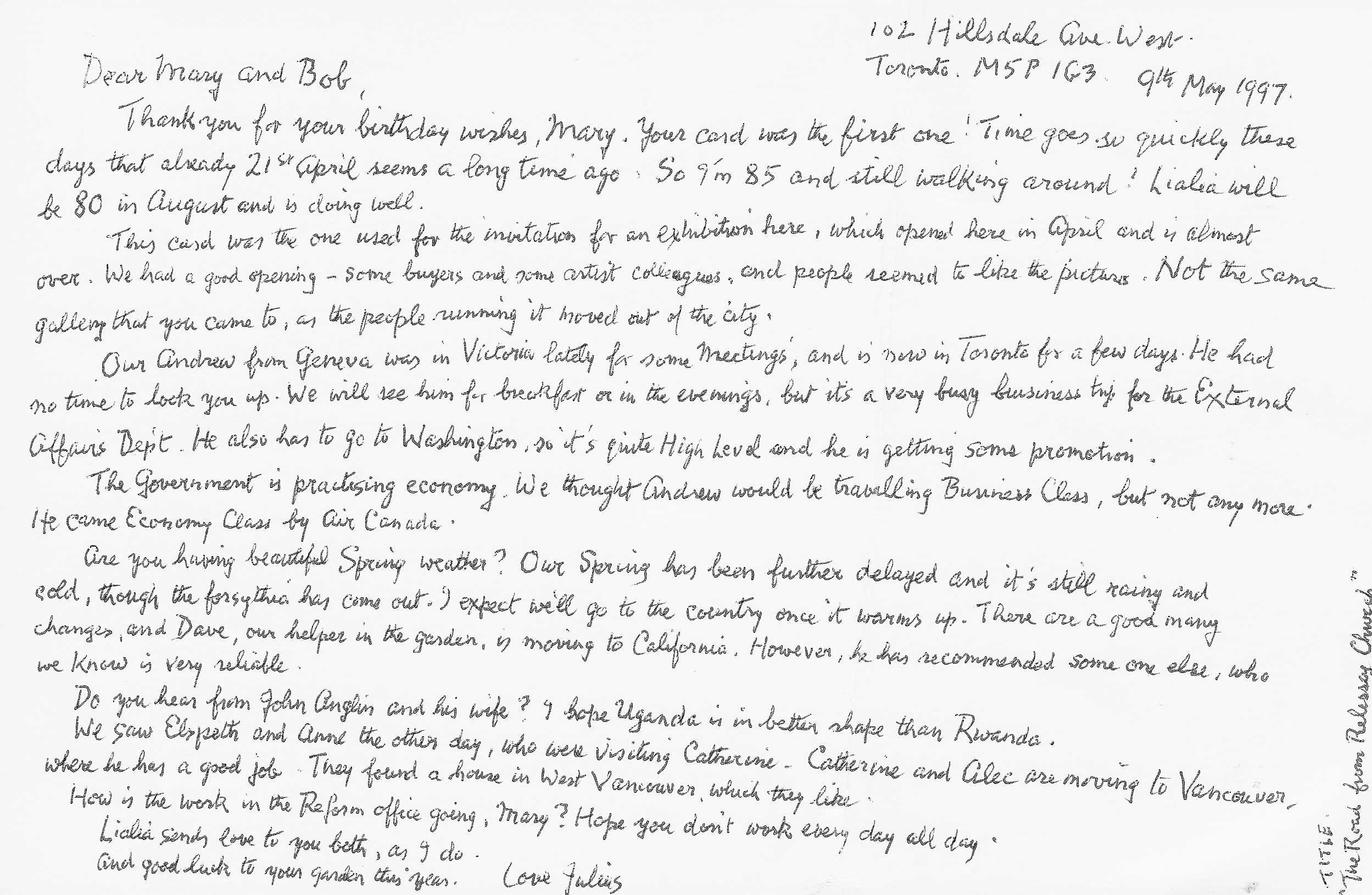
My collection of genealogy treasures includes two picture postcards sent to my Aunt Mary by her talented artist cousin, Julius Griffith, prior to his death in November 1997.
His meticulous handwriting described that day’s garden blooms, commented on the recent election, provided a short health update, news of a son moving back to Ottawa with his family and Lialia sending her love. At the very end, he writes “my show did quite well this time.”
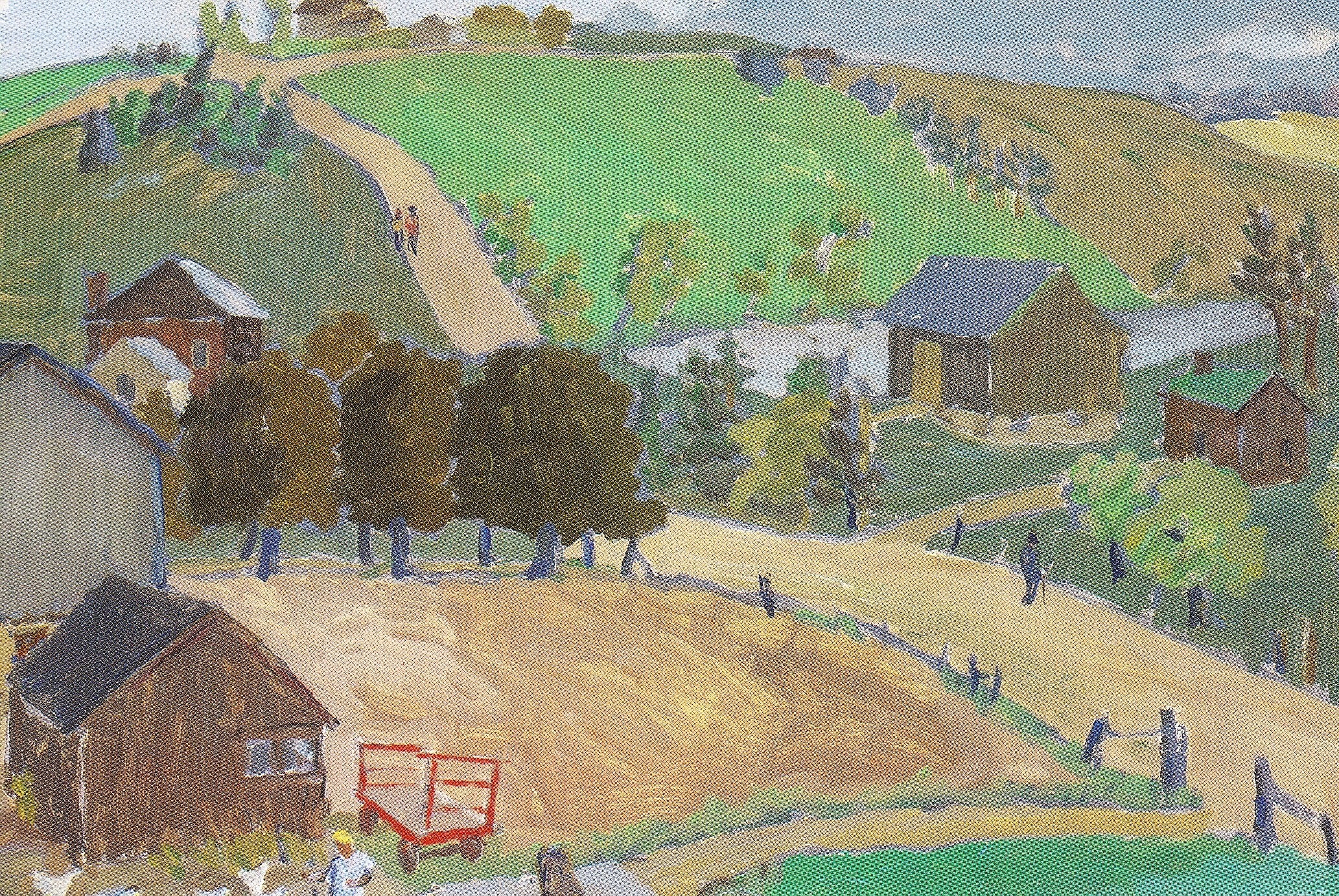
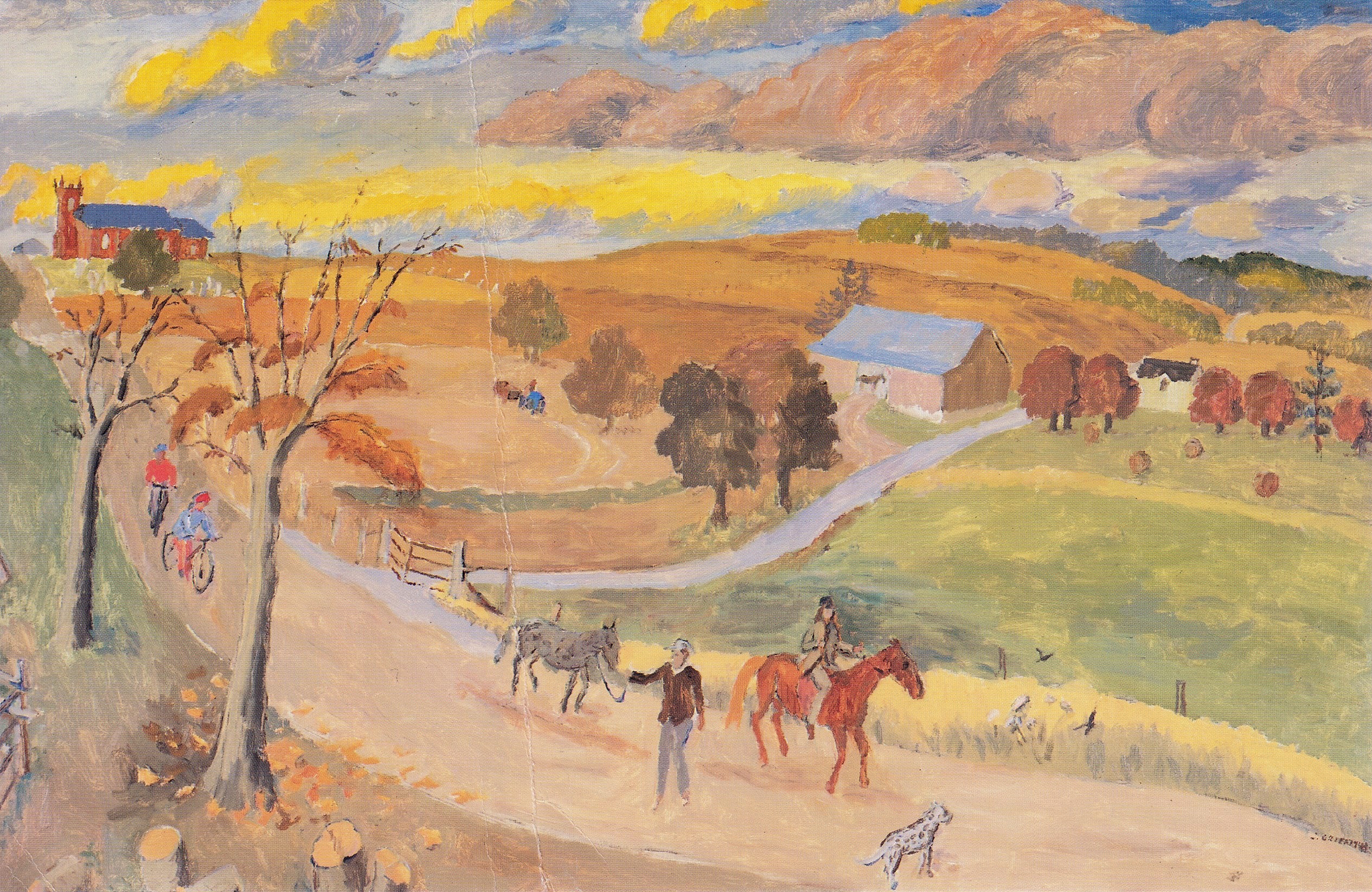
“The Road between Allen’s Farms”
And so it should have. Her cousin, Julius Edward Griffith (1912-1997) was a successful enough painter in watercolour that the members of the Canadian Society of Painters in Water Colours (CSPW), voted for him to be included as a member. Co-founded by a group of prestigious painters including Group of Seven artists A.J. Casson and Franklin Carmichael in 1925, the association continues to exist and has a storied history. For their Diamond Jubilee in 1985, they selected 60 paintings, including one from cousin Julius, and gave them to Her Majesty Queen Elizabeth II. The Queen formally exhibited the collection in Windsor Castle’s Drawing Gallery in 19861.
One of my two postcards could be a replica of his circa 1982 painting presented to the Queen, which was called “The Empty Farmhouse.” The official description describes it as a “watercolour view across fields of a square farmhouse with four windows, surrounded by trees.”
Julius Edward Griffith (1912-1997) was a successful painter in watercolour and oils, a graphic artist, an illustrator, a fine print maker and an art teacher.
As the only child of Katharine Ada Lindsay and Julius Henry Griffith, and born in Vancouver, British Columbia, Julius relished his grandfather Lindsay’s extensive art collection when he visited with him in Montreal, Quebec. Thus began his art education.
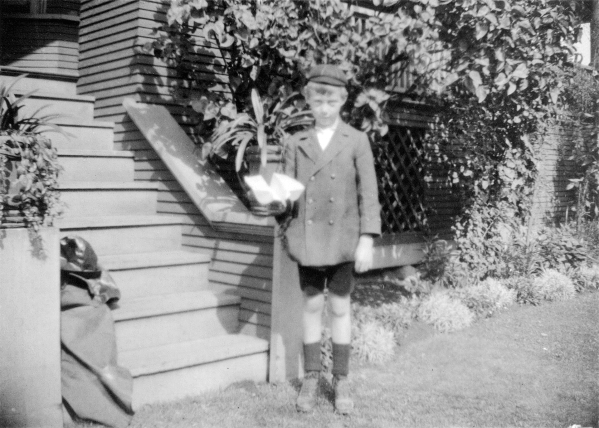
Julius Griffith – 1920
When Julius finished High School at 16, he was too young to attend the Royal Military College, as was his father’s family tradition. Instead, he studied at the Vancouver School of Art (Now Emily Carr University of Art + Design)under Charles H. Scott, F.H. Varley and J.W.G. MacDonald (two of which were Canada’s famous Group of Seven artists2). What a fantastic start to his artistic career! At the same time, he also learned block printing techniques from American artist Bruce Inverarity3 who lived in Vancouver at that time. Julius was immediately drawn to block printing because he enjoyed black and white contrast.
A few years later, he moved to England with his parents and studied at the Slade School of Art4 in London and continued his studies at the Central School of Arts & Crafts with Noel Rooke5 learning the technique of wood carving.
At age 21, Julius returned to Vancouver during the Depression hoping to get any kind of work as an artist. And he did! The owner of the Vancouver Sun newspaper commissioned him to paint two murals on the walls of his building and different groups of people were invited to watch his progress. Among these groups were his previous art teachers, Fred Varley and Jock Macdonald and their students at the time. He must have been so pleased at this role reversal!
In 1938, near the end of his fourth year back in England at the Royal College of Art6, he returned to Vancouver to see his father just before he died. After his father’s death, WWII interrupted Julius’ studies but he returned to England with his mother at that time as he wanted to serve.
During the war he worked with the “Air-raid Precautions” for a time and eventually joined the Red Cross. He worked in a country-house hospital in Sussex and, with so little to do, Julius taught art and learned to speak Russian.
What a serendipitous decision! He fell in love with his teacher – nurse Lialia Oralevs originally from Latvia – and they married quietly a couple of years later before the end of the war.
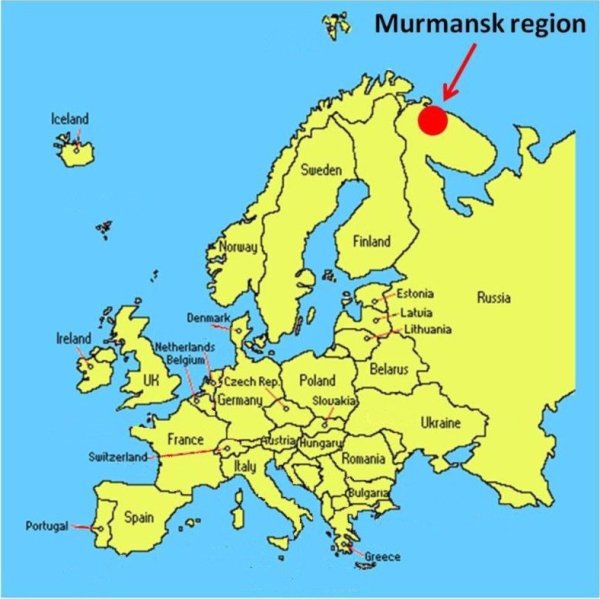
After learning to speak Russian, Julius presented himself in London to the Royal British Navy, passed an oral Russian test and worked as an interpreter under the rank of Sub-Lieutenant stationed in Murmansk7 and Archangel until the end of the war.
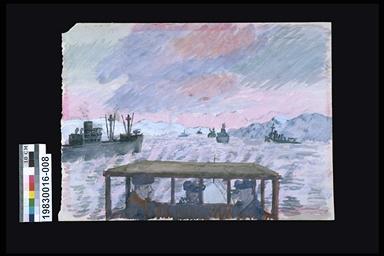
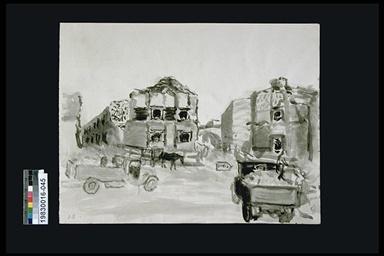
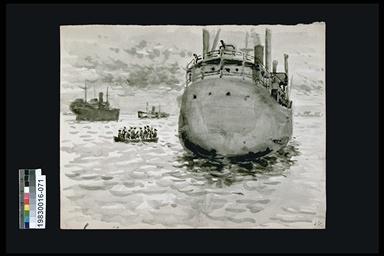
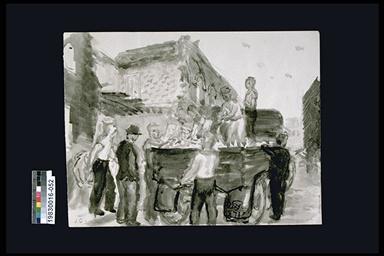
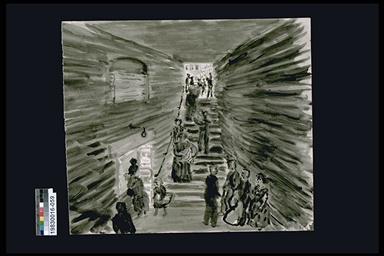
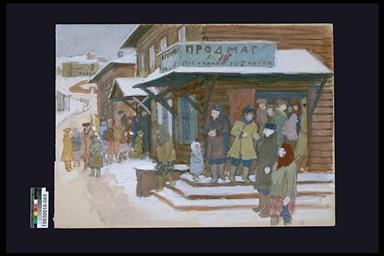
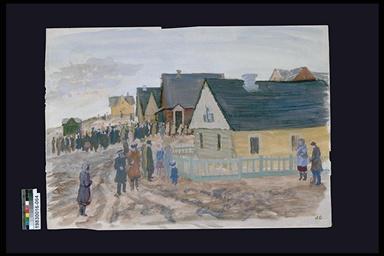
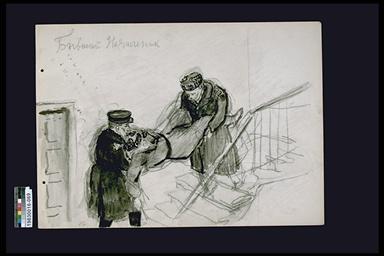
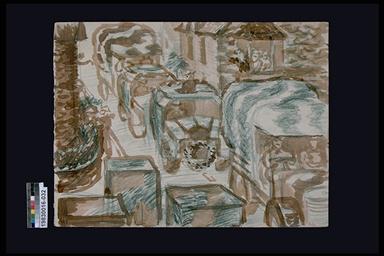
While in Russia, Julius would sketch scenes from memory in the privacy of his room at night and only after his 30-year oath of secrecy expired did he show them to the Canadian War Museum8. They purchased 90 of these drawings and The British War Artists Collection acquired several as well.
After the war, Julius and Lialia returned permanently to Canada. Julius quickly earned a degree at age 34 which enabled him to teach art and support his wife and four sons while continuing to pursue his passion as a graphic artist and wood engraver. Julius taught art in many of the top schools in Toronto – the Western Technical School, Artists’ Workshop, Ryerson Polytechnic Institute, Ontario College of Art, and at Central Technical School.
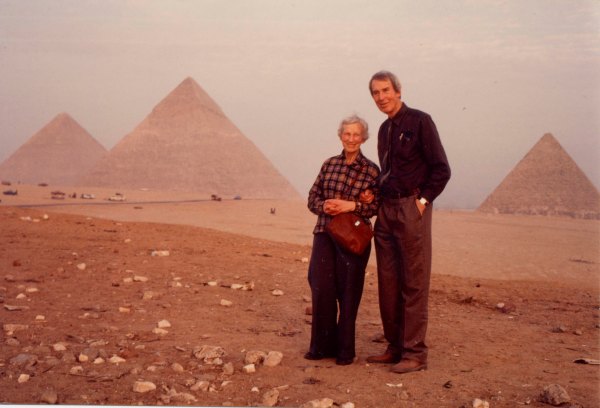
Although I never met Julius, I understand that they made quite the impressive pair with Julius at 6 feet 4 inches towering over five foot Lialia. Not surprisingly, “Julius seemed to develop a slight lilt to the left in later years, probably because he would put is left hand on Lialia’s shoulder and lean to hear or speak to her.” This 1985 photo taken during a trip to Egypt illustrates this charming pose.
Julius and Lialia – 1985 (courtesy of Lorne Griffith)
On the other postcard that he sent to my Aunt Mary in 1997, he wrote “This card was the one used for the invitation for an exhibition here, which opened in April and is almost over. We had a good opening – some buyers and some artist colleagues, and other people seemed to like the pictures.”
” The Road from Relessey Church”
Although I don’t have any of Julius’ original paintings, his two picture postcards with his personal handwritten messages are real treasures to me.
NOTE:
Julius’ work is displayed in the collections of the National Gallery of Canada, Canadian War Museum, Imperial War Museum (London), Art Gallery of Ontario, Toronto City Archives, Toronto Public Library, Art Gallery of Hamilton, McMaster University (Hamilton), Carleton University (Ottawa), Glenbow Museum (Calgary), Art Gallery of Greater Victoria (British Columbia), and numerous corporate and private collections.
When my English-born three-times great-grandfather Robert Mitcheson arrived in Philadelphia from the West Indies in 1817, he was a 38-year-old unattached merchant. Within two years he was married and had started a family, established a new career and was on the way to becoming an American citizen.
Robert (1779-1859) grew up in County Durham, England, where his father was a farmer and small-scale landowner. Robert became an iron manufacturer as a young man, then spent some time in the West Indies. Family stories say he was largely occupied in the West Indies trade. In 1817 he sailed from Antigua to Philadelphia with the intention of settling in the United States. He applied for naturalization – a first step towards citizenship — in July, 18201 and took an oath of citizenship on Sept. 12, 1825.
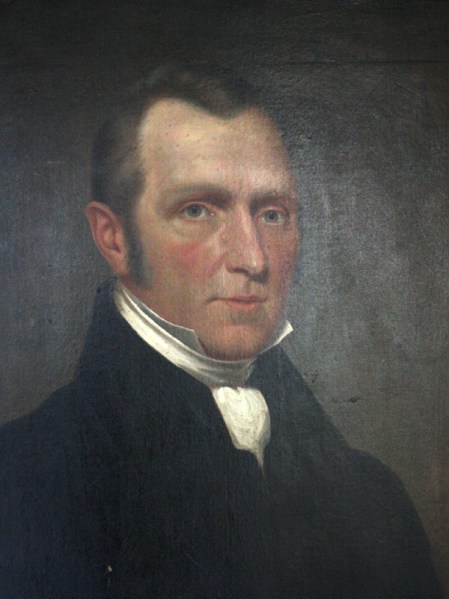
Robert Mitcheson, portrait probably painted in Philadelphia in the 1830s. Artist unknown. Bagg family collection.
Perhaps he had met his future wife, Scottish-born Mary Frances (Fanny) MacGregor, on a previous trip to the city. I have not found a record of their marriage, but it probably took place in Philadelphia. The couple’s first child, Robert McGregor Mitcheson, was born on August 15, 1818 and baptized at St. John’s Episcopal Church in north-end Philadelphia.2
In 1819 Robert was listed in a city directory as a distiller, and the following year’s directory clarified that he made brandy and cordials. The business was located at 275 North Third Street, in the Northern Liberties area of the city. The distillery continued to appear in each annual directory until 1835, when Robert was simply listed as “gentleman”, with his home address on Coates Street.
The family appeared in the U.S. census for the first time in 1830,3 living in Spring Garden, then a largely rural part of Philadelphia. Robert owned a large lot bounded by Coates (later renamed Fairmount Street) and Olive Streets, between Eleventh and Twelfth Streets. There, he and Fanny raised their five children: Robert McGregor (1818-1877), Catharine (my two-times great-grandmother, 1822-1914), Duncan (1827-1904), Joseph McGregor (1828-1886) and Mary Frances (1833-1919). Two other children, Sarah and Virginia, died as babies. Two of their sons graduated from the University of Pennsylvania. Robert M. became an Episcopal minister, and Joseph, who went by the name MacGregor J. Mitcheson, was a lawyer.
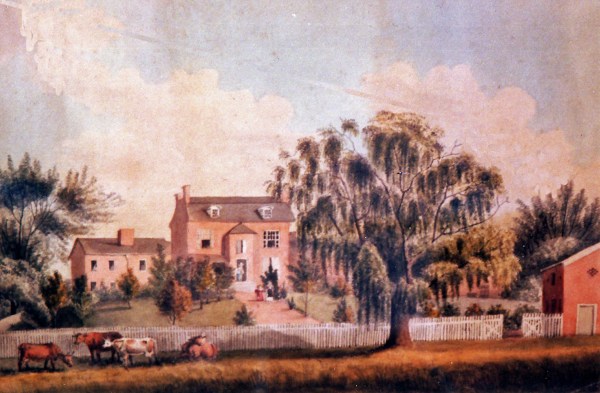
This painting of Monteith House, the family home in Spring Garden, was painted by daughter Catharine Mitcheson. Bagg family collection.
Robert never became part of city’s elite, despite his financial success. For one thing, he was a newcomer living in an old city. Founded in 1682, Philadelphia was the birthplace of the United States and many of its citizens were known as the descendants of colonial and revolutionary families. Also, Robert appears to have been a low-key person. A search for his name in local newspapers brought up only one article that named a long list of people involved in establishing a refuge for boys.
The only obituary I was able to find appeared in a Montreal newspaper, where daughter Catharine Mitcheson Bagg and her husband, Stanley Clark Bagg, lived.4 It said: “As a citizen of Philadelphia for more than 40 years, he has done much, in a quiet and unostentatious manner, for the advancement of her interests and the relief of the distressed. He enjoyed a well-earned reputation for unwavering integrity in all the transactions of his long life – prolonged almost to his 80th birthday — and his remarkable urbanity of manner which the firm, yet elastic step of his manly person, were but slightly impaired up to the period of his dissolution. He was universally respected and died serenely, with a Christian’s hope and faith.”5
Robert appears to have travelled back to England at least once, probably to visit family members and take care of some business, as he had inherited property in Durham when his father died in 1821. A land transfer document dated September 16, 1835 described him as “Robert Mitcheson, iron manufacturer, late of Swalwell, now of Philadelphia”.6 Several weeks later Robert Mitcheson, gentleman, appeared as a passenger on the Pocahontas, sailing from Liverpool to Philadelphia.7
Perhaps he also visited his brother William, an anchor maker and ship owner in London. A short biography of his son published by the St. Andrews Society in Philadelphia described Robert as a “retired merchant and shipowner,”8 however, I cannot confirm whether Robert owned any ships or perhaps invested in his brother’s business.
After Robert left the distillery business he reinvented himself again, this time as a landlord. The city was rapidly expanding and there was a need for housing. Many people lived in boarding houses and Robert saw rents from boarders as a way to generate income for his grown children after he died. In his will, he left 14 “dwelling houses” located near his house, as well as several nearby other buildings, in trust to sons Robert M. and MacGregor J..9 They were to collect the income and pay certain sums every year to their other three siblings, and to look after repairs to the buildings.
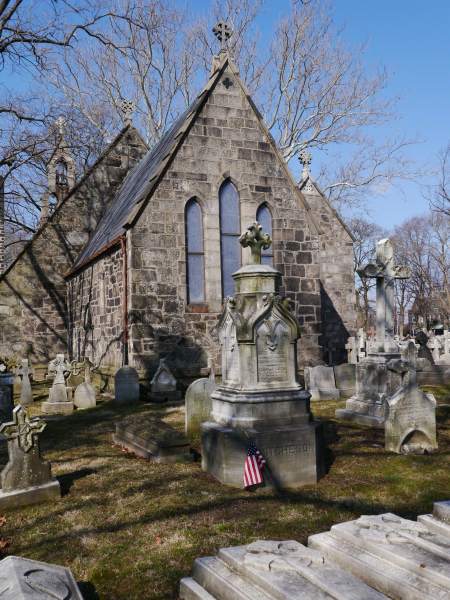
This large monument in the cemetery of St. James the Less Episcopal Church is in memory of Robert Mitcheson, his wife and several other family members. JH photo, 2013.
Robert died at age 79 and was buried in the cemetery at St. James the Less, a small, Gothic-style Episcopal church built around 1846 as a chapel of ease for wealthy families in the area. Robert is said to have helped found that church.
His story doesn’t end there, however. Sadly, his estate was the focus of a court battle that took almost 30 years to resolve, by which time both executors had also died. In addition to a dispute between the brothers, the case focused on a legal error in the way the trust was set up10 and who was to inherit the final balance of income.11
1. Ancestry.com. Pennsylvania, U.S., Federal Naturalization Records, 1795-1931 [database on-line]. Original data: Naturalization Records. National Archives at Philadelphia, Philadelphia, Pennsylvania. Accessed Feb. 15, 2023.
2. I found records from St. John’s Church at the Historical Society of Pennsylvania, Philadelphia in 2013.
3. “United States Census, 1830,” database with images, FamilySearch (https://familysearch.org/ark:/61903/1:1:XH5W-MC3, accessed Feb. 16, 2023), Robt Mitchinson, Spring Garden, Philadelphia, Pennsylvania, United States; citing 323, NARA microfilm publication M19, (Washington D.C.: National Archives and Records Administration, n.d.), roll 158; FHL microfilm 20,632.
4. Stanley Clark Bagg (SCB) was Robert’s son-in-law and also his nephew: Robert’s older sister, Mary Mitcheson Clark, was SCB’s maternal grandmother.
7. “Pennsylvania, Philadelphia Passenger Lists Index, 1800-1906,” database with images, FamilySearch (https://familysearch.org/ark:/61903/1:1:QV9Y-VXJ9, accessed Feb. 17, 2023), Robert Mitcheson, 1835; citing ship Pocahontas, NARA microfilm publication M360 (Washington, D.C.: National Archives and Records Administration, n.d.); FHL microfilm 419,525.
8. Biography of MacGregor Joseph Mitcheson in An Historical Catalogue of the St. Andrews Society of Philadelphia with Biographical Sketches of Deceased Members, 1749-1907, printed for the Society 1907; p. 287, Google Books, accessed July 19, 2013.
10. Mitcheson’s Estate, Orphan’s Court. Weekly Notes of Cases Argued and Determined in the Supreme Court of Pennsylvania, the County Courts of Philadelphia, and the United States District and Circuit Courts for the Eastern District of Pennsylvania by Members of the Bar. Volume XI, December 1881 to August 1882; p. 240. Philadelphia: Kay and Brother, 1882. Google Books, accessed Feb. 17, 2023.
11. Mitcheson’s Estate, Pennsylvania Court Reports, containing cases decided in the courts of the several counties of the Commonwealth of Pennsylvania, Vol. V, p. 99. Philadelphia, T. & J.W. Johnson & Co., 1888. Google Books, accessed Feb. 17, 2023.
The Titanic Sunk and Loss Feared of Over 1,500 Lives
The April 16, 1912 of the Guardian newspaper screamed this headline.1 Other newspapers around the world had similar headlines.
Just over three weeks later on May 11, 1912, my grandfather, Thomas McHugh, his widowed mother, Sarah McLaughlin, and his two brothers, Edward and Francis, boarded the S.S. Grampian in Glasgow, Scotland, to cross the Atlantic to start their new life in Canada.2
They would have been sad to leave their home, excited about their new lives, and definitely worried about hitting an iceberg.
There was a total of 1,638 “souls” on board the S.S. Grampian,3 33 of whom were Saloon or First-Class passengers, and 363 were 2nd cabin passengers. My family was part of the 1,244 passengers in steerage. The crossing took 20 days and the ship arrived in Quebec City on May 21, 1912. Between them, the McHughs arrived with $150 in their pockets. Browsing through the passenger lists, I can see that they had a lot more money than many of their fellow passengers. 4 A Google search tells me $150 in 1912 is about $4,300 in today’s dollars. As they were poor and lived in a tenement in Dundee, Scotland, I can only assume that this meant that they had carefully planned to emigrate.
Steerage accommodations were often divided into three compartments on the ships at that time: one compartment for single men on one side of hold of the ship as steerage passengers certainly did not have an ocean view; one for families in the middle; and a compartment for single women on the other side of the ship. I assume and hope that my family travelled together as a family. These compartments were crowded, with about 300 people in each of them.5 Nor did steerage passengers have a lot of room to move around top deck. They were restricted to a portion of the open deck and prevented from mingling with the Saloon and 2nd cabin passengers by metal gates.
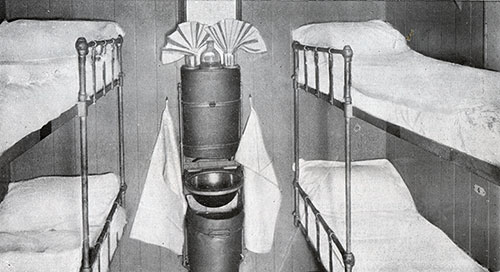
The berths were two-tiered and made of metal frames. Each bed had a mattress and a pillow that could be used as a life preserver. The passengers probably brought their own bedding. Most passengers slept fully dressed.6 The picture below is an example of a four-berth room found in a brochure for the Cunard Line, 1912,7 although many ships had no rooms in steerage and the berths were set up in an open space.
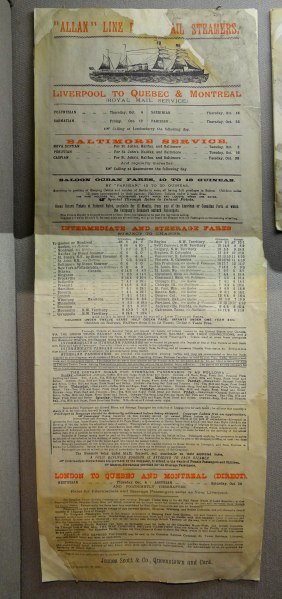
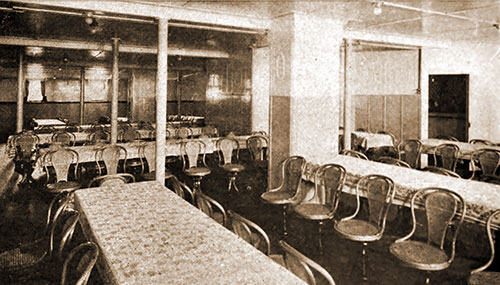
The dining room in steerage had long tables with benches. Steerage passengers were provided with a set of utensils that they used for the entire trip, normally a fork, spoon and a lunch pail. A small dish fit into the top of the pail for meat and potatoes, with an attachment on the lid as a dish for vegetables and a tin cup that fit inside for drinks. The pail also served as a wash basin. 8 The poster below indicates that steerage passengers had to pay 3s 6d per adult for their small pail and utensils (pannikin).9
An example of a dining room for the steerage passengers.10
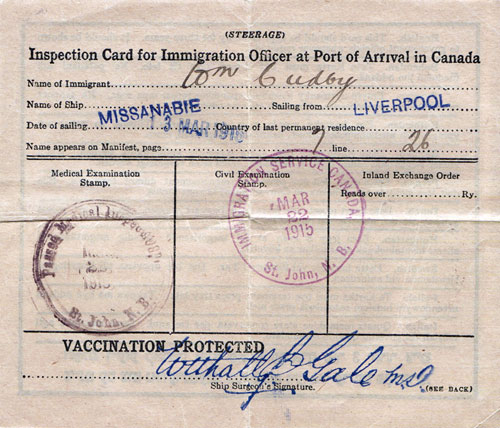
When the McHughs arrived in Quebec City, they were inspected by one of the medical examiners, either Dr. Drouin or Dr. Dupont, who were tasked with examining all the steerage passengers.11 Each immigrant would have been given an inspection card like the one illustrated below. The ship’s surgeon would have signed that they were vaccinated protected.12
My grandfather, Thomas, his brothers and his mother, were not the only McHughs to arrive on the S.S. Grampian. A year before Thomas arrived, his sister, Mary McHugh also arrived on this ocean liner.13 She came from Dundee, Scotland to work as a domestic. And Thomas’ wife, Elsie, accompanied by their seven children, arrived six months after Thomas, also on the S.S. Grampian. 14
It is no surprise that they all booked their passage on the S.S. Grampian as the Allan Shipping Line, founded in 1819 and whose main shipping line was between Scotland and Montreal, is credited with providing passage for the largest number of Scottish immigrants to Canada.15 In 1907 Sir Montagu Allan of the Allan Line Royal Mail Steamers ordered the building of the S.S. Grampian from the Stephens & Sons Ltd. shipbuilding yards in Scotland.16
When World War I broke out, the S.S. Grampian was used to transport troops of the Canadian Expeditionary Force (CEF) from Canada to Europe. After the war, during the summer of 1919, the S.S. Grampian had left Montreal on its way to Liverpool and struck an iceberg off the coast of Newfoundland. Even though the front of the ship was crushed, it managed to reach the port of St. John’s, Newfoundland. Two of the crew were killed, and two of them were injured. Even though the ship was repaired, two years later, while undergoing a refit, it was gutted by fire and sank. It was then considered a write-off.17
Newspapers.com, The Guardian, April 15, 1912, retrieved December 25, 2021.
“Canada Passenger Lists, 1881-1922,” database with images, FamilySearch (https://familysearch.org/ark:/61903/1:1:2HLP-31W : 23 February 2021), Thomas McHugh, May 1912; citing Immigration, Quebec City, Quebec, Canada, T-4785, Library and Archives Canada, Ottawa, Ontario, retrieved December 25, 2021.
Findmypast.com Passenger Lists Leaving UK 1890-1960, Mary McHugh, S.S. Grampian leaving Glasgow June 24, 1911 and arriving in Quebec City July 8, 1911, retrieved January 23, 2022.
Findmypast.com Passenger Lists Leaving UK 1890-1960, Elsie McHugh, retrieved December 13, 2017.
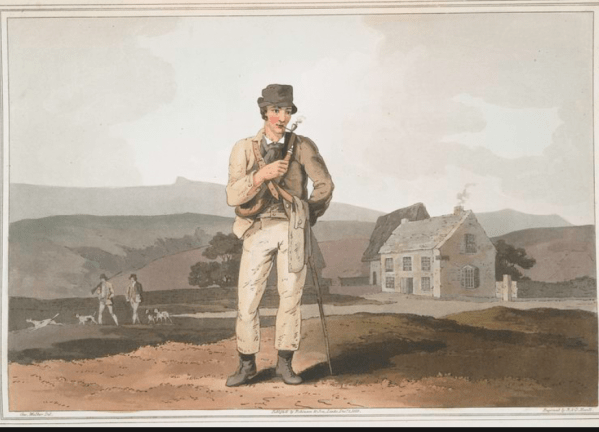
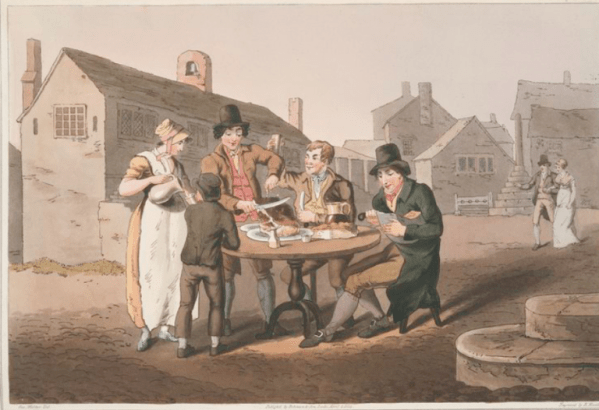
The Costumes of Yorkshire: George Walker, 1813. New York Public Library Online, Public Domain photo
“The past is a foreign country. They do things differently there,” writes L.P. Hartley at the very beginning of The Go-Between, a novel I read and loved in my 20’s.
As a woman who now likes to pen stories based on her family tree, this famous first line has new meaning for me. It makes me ask the question: Despite our best efforts, can we ever really know our more distant ancestors?
Sure, we can absorb with attention the family myths. We can dig out the dates of births, marriages and deaths. We can check out the newspaper record. We can look up legal documents and even research with scholarly precision the historical context of their -often- difficult lives.
But is that REALLY knowing them?
Or is the best way to know our ancestors through our own parents and grandparents, through their inherited behaviours and beliefs that we witnessed first-hand. I have three other ideas.
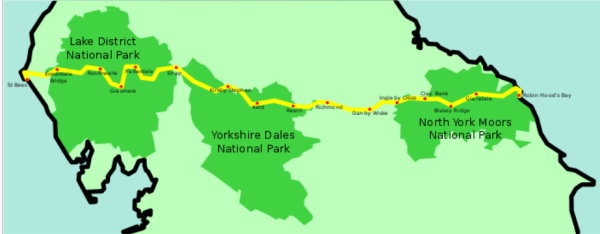
The Coast-to-Coast Walk (WIkipedia Share alike Pic John Carter
1. Visiting the ‘homeland’ can give you a feel for who your ancestors were.
There’s a well-known 182 mile coast-to-coast hike that goes from the soaring sandstone cliffs of St. Bee’s Head on the west coast of Cumbria to the charming storied fishing village of Robin Hood’s Bay on the east coast in Yorkshire. Patching together my father’s Nixon/Forster family tree, I discovered he had ancestors; farmers, lead miners, grocers, servants; living just north and south of – and even directly on – this picturesque route.
This 182 mile ‘footpath’ traverses three national parks: The Lake District, Yorkshire Dales and North York Moors National Parks. It’s a walk that offers up isolated pebbled beaches and quaint historic villages; rugged wildernesses with hilltop cairns; flat easy patches with long sweeping vistas; medieval castles and ancient stone circles; serene valleys dotted with sheep; sturdy Roman roads and magical heather moorlands.
As it happens, I can take this hike anytime (on YouTube) and see with my own eyes pretty much what many of my ancestors saw with their own eyes.
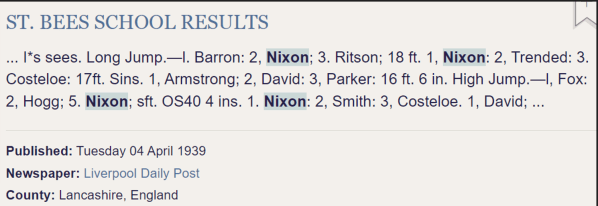
My ancestors had good eyes, I bet, for long distance gazing. Strong legs, too. And leathery skin beaten up by the cold wet winds of the moors. They probably were skinny and didn’t worry about cholesterol as they downed their breakfasts of heavy black rye bread and fatty bacon. Come to think of it, that description fits my father pretty well. His exceptional long distance eye-sight and strong legs made him a top athlete in the 1930’s at this boarding school in St. Bees. He was still participating in cross-country ski marathons in Quebec in the 1980s.1
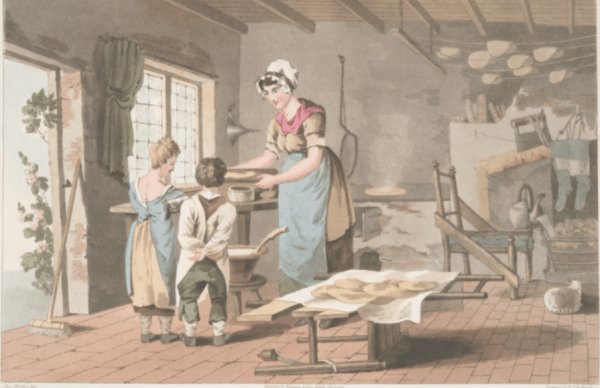
Woman making oatcakes on a Yorkshire farm
2. You can always look to old family recipes to teach yourself something essential about your antecedents.
In my 1960’s Montreal home, on Saturdays when we ate roast beef, I was in charge of making the Yorkshire pudding, and I do believe that it was my father who showed me how to make the batter and take fat drippings from the roast and spoon it into the bottom of the muffin tins.
Still, it was my French Canadian mother who was in charge of the kitchen and her roast was ‘blue’ -practically mooing on the plate a la francaise. My father ate only the outside over-cooked part.
Apart from frying our POM (Pride of Montreal) white bread slices in bacon fat (ICK!) and threatening to feed us smoked herring (double ICK) my British pater (who was born in Malaya, after all) didn’t seem to know much about his native Yorkshire foods. He never mentioned the oatcakes that were a staple of the poor; or the cheese pies eaten on various festive occasions or the special mutton pie made with candied fruit in a rich crust served with fresh fried trout and curd cheesecakes, washed down with ‘home-made’ whisky served as a reward at the end of sheep-shearing season.
As a child of the Raj, my father more often spoke with fond nostalgia of the Mulligatawny soup (curried chicken with apples) he ate on his father’s Selangor Rubber Estate.
Still, somehow, more through his dislikes rather than his preferences, I learned that (generally-speaking) eating plain hearty food was in his North of England blood.
Midsummer Eve in Yorkshire – a time when witches and fairies come out to play with the humans.
3. Consulting out-of-print genealogy books can give you an insider’s knowledge about the people who came before.
I stumbled upon a terrific little volume online: Rambles Through the North Yorkshire Dales. Published 1913 on archive.org. The book even has a chapter on the Yorkshire character. Bingo!
The Yorkshireman, says the author, a native, is notorious for being tight-fisted. “He loves to get the best of a bargain not only for business purposes but as sport.” He is suspicious of strangers, especially of the patronizing upper-crust kind. He is “reticent and hard on the outside with a queer sense of independence and a real and natural sense of humour.”
So right! My father would drive ten miles to save ten cents on gasoline. He could deconstruct a person’s character, a television show, a work of art with one well-chosen (often withering) word. He didn’t follow the current fashion – and mocked us when we wanted to. He was amused by the minutia of everyday life, although I seldom got his subtle jokes.
Yorkshiremen says the book are filled with ‘a fierce romanticism, a strong religious fervour.’ Still, people from the North of England were once very superstitious. These people believed or half-believed in dragons and water sprites, fairies and ‘boggles’ or imps who were often the ghosts of nasty feudal landlords long dead.
Many of the local traditions around holy wells and sacred fires, etc. stem back to pre-Christian times. and are still carried out in various and sundry small towns.
Does this fit my father? No, not at all. My father, educated in mathematics at Oxford, was a pragmatist. Still, he seemed to actually take delight in reading fairy tales to me.
Peter Nixon and Marie Marthe Crepeau
And last but not least, my North of England ancestors spoke funny. Real funny. According to my mother, my father lost his English accent the day he arrived in Canada.
I learned about the Yorkshire dialect by watching the original All Creatures Great and Small television series based on the life of Alf Wight or James Herriot, a veterinarian, in Thirsk, North Yorkshire. In that show, locals were used to play the farmers and I often needed subtitles to understand them!
No, my Yorkshire father never said things like, “Ere, wot’s f’r us tea Mutha” as in “Mother, what are we having for dinner?”
M’of t’sop, d’yawanowt?
I’m going to the shop? Do you want me to get anything?
Put t’wood int ‘ole. Close the door. (Put the wood in the hole)
Sit this sen Darn as in Sit down.3
but I suspect his grandfather, Robert Nixon, who was working as a delver in the local Rievaulx quarry in 1911 certainly did.
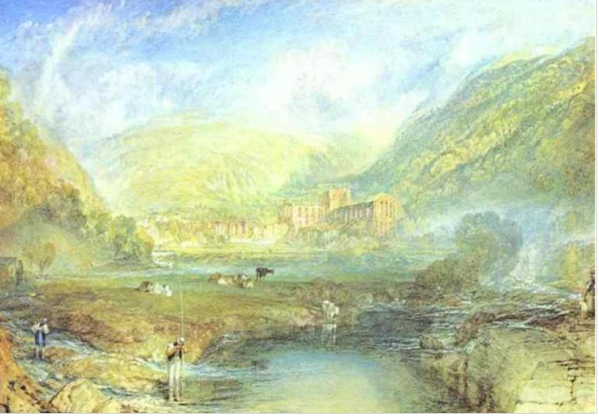
Rievaulx Castle by Turner: There is no shortage of paintings of the North of England, from Victorian Era and beyond, but these paintings seldom depict working people. The few I could find online were not Creative Commons. Indeed, Her Majesty the Queen has a nice one of poor fisher folk in her collection.
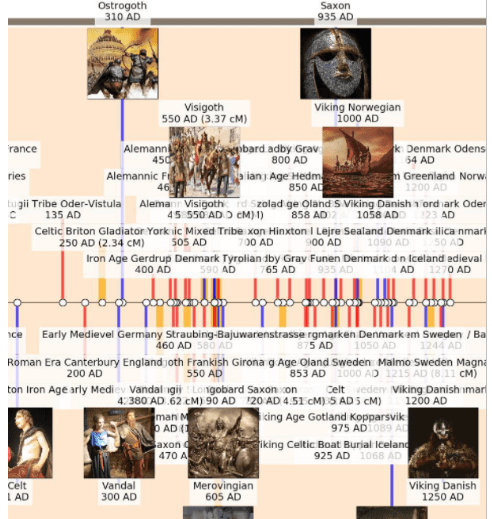
My father’s ancient genes according to mytrueancestry.com. Yes, Danish and Norwegian Viking, Saxon, Visigoth, Merovingian. The history of Yorkshire indicates this is all pretty on spot. He has lot of Celt too. And some deep Illyrian (Croatia). Maybe this has something to do with Hadrian’s Wall and the Roman Legions (mercenaries) who manned the outpost. Apparently, Northern English is riddled with Viking words.
Even better, his younger brother, Michael Nixon, living in Keswick right on the hiking path, was awarded the MBE for performing mountain top search and rescue in the mountains of the Lake Country well into his 80s! https://keswickmrt.org.uk/mike-nixon-mbe-1928-2018/)
I never met Michael. I don’t think my father knew him at all, either.
My father very very often made fun of the Canadian ‘aboot’ for ‘about.’ From what I can see, this ‘aboot’ is right outta Yorkshire so I have to wonder if there was something subconscious going on here: if years before at prep school he had had the ‘aboot’ shamed out of him. My grandmother spoke in the Queen’s English. She was from County Durham but educated at a Quaker School. I know because I have a tape of her speaking about British Malaya from Cambridge University archives. It is not in the public domain so I can’t link it here. https://imfromyorkshire.uk.com/yorkshire-sayings. Here’s a link to BBC Sounds discussion of English spoken in Helmsley North Yorkshire, the home of the Nixons. https://sounds.bl.uk/Accents-and-dialects/BBC-Voices/021M-C1190X0035XX-0301V0
My father was the top athlete at his school in 1939. This he had told me. He always wondered how good he might have been if he hadn’t been a chain smoker. Even better, in 1939, the newspaper record shows, he was the only one in his school to make the Northern England Cricket Team (for schools). This was a big deal, because a famous England coach was to be there! Years ago, I contacted the St Bees Historian who sent me a short record belonging to my father. The historian was impressed by the fact my father had captained all the school teams. I was impressed that he had been in the Shakespeare Club. That’s because my father used to always say “Out out damned Spot” to our dog, named Spotty. LOL. My father also told me a sadder story about how another student had once approached him saying, “I wish I were you.” My father, who basically had been orphaned at five by his Colonial parents, thought “No you don’t.” I put this is another story here on this blog..To the Lighthouse.
My great aunt Marguerite Lindsay, aged 22 in 1918, was well trained in mothering long before she might have had a child of her own. She “mothered” grown men while volunteering with the Information Bureau of the Canadian Red Cross Society in London during the Great War.
Lady Julia Drummond1, a Montreal philanthropist, established the Information Bureau within the Canadian Red Cross in 1915, when the first of the Canadian contingents landed in France.
“It was her absorbing wish to bring to the fighting men of Canada, when they returned from the battle line, sick or wounded, some sense of personal interest and sympathy, of individual thought and care.”2 Thereby, given the nickname “The Mothering Bureau.”
As soon as the wounded Canadians arrived in London, they were informed of the Information Bureau as sort of the fairy godmother of childhood dreams. Then they completed an index card (white for the enlisted men, blue for the officers), stamped and addressed to Lady Drummond, with their name, number, battalion, the name of the hospital and next of kin. Within days, not only would they receive a note from Lady Drummond herself, but each soldier met with their assigned “visitor” who learned more about him as she kept in touch with all Canadians admitted to her specific hospital.3
The Visitor reported weekly to the Bureau of the soldier’s wound or illness, his physical and mental condition, his needs and general well being. These reports, completed with initials and dates, were kept on his index card and eventually held a complete record of the soldier’s case.
The various departments would then immediately become active:
Letters of comfort or condolence based on these reports were quickly sent to the man’s family.
The parcels department would dispatch tobacco, cigarettes, and other comforts as requested by the visitor.
The newspaper department would send Canadian newspapers (often from their hometown).
The drives and entertainment department brought some diversion.
The hospitality department might arrange for leave in some kindly English home.
Efficient correspondence was the most important and valuable work of the Bureau.
Marguerite might have volunteered in one or several of the previously mentioned departments. However, I wonder if she worked along side Princess Mary3 (daughter of King George V and Queen Mary) as she too began her nurse’s training around the same time as Marguerite? Apparently Princess Mary told a friend: “they were some of the happiest days in my life.” Probably because she was not treated any differently from the others and the patients and her fellow nurses loved her.
Princess Mary wearing the same Red Cross uniform as Marguerite Lindsay – 1918Miss Marguerite Lindsay – 1918
During that time, most of Marguerite’s family were also involved in the war efforts in different ways. Marguerite’s mother and sister-in-law (wife of her brother Lionel a doctor in the Canadian Army Medical Corps) were also volunteers with Lady Drummond’s Information Bureau. Her brother Stanley, a Captain, fought in Ypres in 1915. And her father, Robert Lindsay, co-founded along with Lady Drummond and Lady Perley (wife of Canada’s High Commissioner) the first of The King George and Queen Mary Maple Leaf Clubs3. (A Montreal Stockbroker…and much more) Several large London homes were donated and refurbished to provide for the welfare of Canadian Expeditionary Force (CEF) soldiers on leave from the front.
Robert Lindsay kept a family residence in London for several years at 8 Radnor Place, Hyde Park, just over a mile from Coulter Hospital4 (another refurbished home) at 5 Grosvenor Square, Mayfair, where Marguerite volunteered her time with the Bureau. A 20-minute walk home to the shelter of family life might have provided a bit of normalcy to her hectic days.
Sometime in 1919, after the end of the war, Marguerite continued her volunteer work as one the much needed VADs (Voluntary Aid Detachments)5 at the Canadian Red Cross Hospital in Sidmouth, Devon. She must have lodged with the other nurses since the family home in Hyde Park was now 160 miles away.
What did Marguerite and the other volunteer “mothers” accomplish in the Great War?
To some of the men, they provided kit bags, tobacco and chewing gum and such, but to others – a renewed interest in a changed life and some hope for the future. All the soldiers were cared for as individuals and that’s what really mattered. A much needed human and personal touch during the time of war.
When I was a little girl, I would spend hours with my grandfather in his home workshop. He would make all kinds of things and I used to love watching him at work. I still have some of the tools he made, as well as a cribbage board and a turntable that swings the Scrabble board around to face each opponent. He crafted a complete house of Barbie furniture for my dolls and, to my delight, he asked me my opinion about every single piece. I felt both the weight of responsibility for deciding what each bed and chair would look like, and pride in participating in this project with him.
My grandfather, George Deakin (1901 -1983,) born in Sheffield, England, learned these skills when he was a young man. His father was a miner and George also worked for the coal mining companies of Sheffield, which were significant employers in the early 1900s. Gramps was a fitter which means that he made parts either for piping or for equipment and machinery.1, 2
I used to ask my grandfather why he came to Canada and the answer was always the same and always emphatic. “I did not want to work in the mine.” Sometimes he would go on to explain that, when he left, he still worked above ground for the mining company. However, he was a very short man and he knew that it was a matter of time before he would be required to work underground. Small men were valuable in the low tunnels of the coal mines, but the work was dangerous and unhealthy. Gramps had no intention of ever working underground.
So in 1923, he came to Canada as part of the Harvester Scheme. That year, Canada had a bumper wheat crop and North America could not provide the labour needed to harvest the crop. Under the Harvester Scheme, the two major Canadian railway companies entered into an agreement with the British government to transport 12,000 workers out west where they would earn $4.00 per day plus board. 3
He ended up in Manitoba and the Canadian west must have suited him because he used to enjoy talking about his time on the farm. The days were long and the men worked hard but Gramps found it satisfying to work so hard. And how the workers enjoyed the hearty meals that the women of the farm prepared for them!
He only stayed one harvesting season in Manitoba because, once that bumper crop had been harvested, there was no more work. He took the train to Montreal and easily found work as a draftsman at the Northern Electric plant. He had learned to read and draft drawings in Sheffield and his skills were in high demand. He worked at the Northern Electric plant in Lachine all his life, even during the Great Depression.
When Gramps first arrived in Canada, he was not sure he would stay.4 But after he met and married my grandmother in 1925, they settled in the Montreal suburb of Verdun and raised two children.
Here, he was able to work all his life in a job that he loved. He especially enjoyed the attention to detail that went into designing. And when he wasn’t designing at work, he was making tools, games, and Barbie furniture for the family.
In 18th century England, schoolmasters and tutors had to belong to the Church of England. The 1662 Act of Uniformity required all clergy, dons, schoolmasters, and tutors to subscribe to a declaration of conformity to the Articles of the Church of England.1
Samuel Everell,* my four times great-grandfather was the schoolmaster in the village of Longnor, Shropshire, England. He was probably a schoolmaster all his life as I can find him in the records as schoolmaster from the time he registered the birth of his son, Charles, in 18132 until he was 57, in the 1841 census.3 All of the records indicate that Samuel and his immediate family belonged to the Church of England. While there was a community of Quakers in the village of Longnor, Samuel could not have been one of their members. Nonconformists were banned from teaching.4
Samuel, while not necessarily well educated, would have certainly been able to read and write. He was born in 1784 in the village of Condover, about four miles away from Longnor. His father, Benjamin Everall was a blacksmith.5 At that time, one had to be a member of the nobility to attend one of the two universities in England: Cambridge or Oxford. Graduates of these universities sometimes became private tutors for the children of the gentry. These tutors would live with the family and even dine with them.
Samuel probably taught in a charity school. The gentry generally believed that education should not be extended to the poor as it might upset the social order.6 They did, however, believe that the poor should read the Bible. Education for the working classes was haphazard. Sunday schools taught reading so that children could read the scriptures. They also sometimes taught writing and arithmetic. In 1800, when Samuel was 16, there were 2,000 Sunday schools in England with an enrolment of 10% of the population between 5 and 18.7 Maybe this is where he learned to read and write. It was not unusual for one of the better students to become the schoolmaster. The salary of the schoolmaster was either covered by the parents or sometimes the gentry would contribute to the cost of the running of the school, including the schoolmaster’s salary.
It is possible that Samuel’s salary was paid by the estate of Sir Richard Corbet, the 4th Baronet of Longnor. The 1831 Parliamentary Report on Charities states the following:
Sir Richard Corbet, of Longnor, in his will dated November 19, 1764, declared that the trustees of his estate ensure that the poor children of Longnor, Leebotwood, Cardington, and Fodesley and poor children of the tenants and that the trustees shall appoint and pay the master to teach the children to read and write English. There were about 14 children who were instructed in a private home by the schoolmaster. The schoolmaster was paid quarterly between 14l and 15l and included 50s for teaching Sunday School. 7
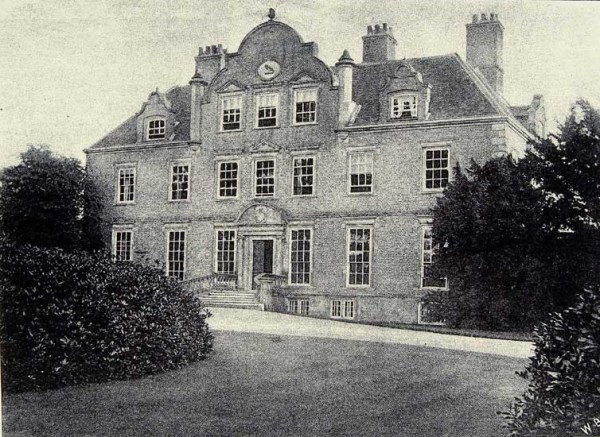
Manor of Sir Richard Corbet (1696-1774), 4th Baronet of Longnor.8
In the beginning of the 19th century, the Church of England continued to sponsor education. Samuel probably died around 1849, so he would not have seen any sweeping changes during the time he was a schoolmaster. However, the government did start to become involved in the education of the poor, voting sums of money for the construction of schools for the poor. Despite the Elementary Education Act of 1870, 2 million children out of 4.3 million children had no access to schooling at all. England saw compulsory and free primary education in the 1870s and 1880s. It wasn’t until 1918 that the Education Act (Fisher Act) made secondary education compulsory until age 14.9
*Everell can be found in the records as Everell, Everel, Everelle, Everil, Everill, and Heverell.




 Genealogy Ensemble