Who would have thought that finding the immigration records of my grandparents would have led to me to learn about two British government initiatives designed to promote emigration to Canada in the 1920s? I was browsing the Library and Archives Canada web site and found digitized records of Form 30 that recorded the entry of every immigrant between July 1921 and December 1924.1 I was thrilled to find the form that my grandfather, George Thomas Deakin, signed in August 1923, and the one that my grandmother, Grace Graham Hunter, signed in February 1924.
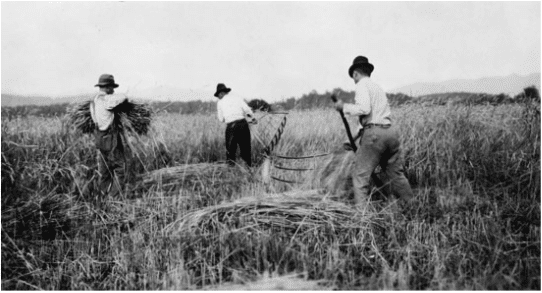
My grandfather’s form indicated that he came to Canada as part of the Harvester Scheme. In 1923, Canada had a bumper wheat crop and North America could not provide the labour needed to harvest the crop. Under the Harvester Scheme, the two major Canadian railway companies entered into an agreement with the British government to transport 12,000 workers out west where they would earn $4.00 per day plus board. This was considered a successful scheme as 11,871 migrants came to Canada to work on the farms in Western Canada. The harvest was successfully completed and 80% of the harvesters stayed and were considered “successfully assimilated.”2
Source: The Farm Collector
Like the Harvester Scheme, The Empire Settlement Act was also an initiave to provide Canada with badly needed labour. It was passed by the British Parliament in 1922 and its purpose was to provide an incentive for migrants to settle in the colonies. Canada badly needed farm labourers and domestic workers. At that time, the Canadian government favoured immigrants from Great Britain as a means of ensuring the predominance of British values. In the early 1920s, it was difficult for Canada to attract immigrants from Great Britain as Britain was enjoying a period of prosperity right after World War I. Another reason was the prohibitive cost of transatlantic transportation. Even passage in third class would have been expensive for a farm labourer or a domestic worker.3
My grandmother came to Canada to enter into domestic service as a cook and her destination in Montreal was the government hostel. Hostels were located in major urban areas across Canada. These hostels were partially funded by the provinces and immigrants from Great Britain were allowed free dormitory accommodation for 24 hours after their arrival. Young ladies were looked after by the Superintendent of the hostel and referred to a church worker. They were also referred to Employment Services of Canada who would find them employment.4
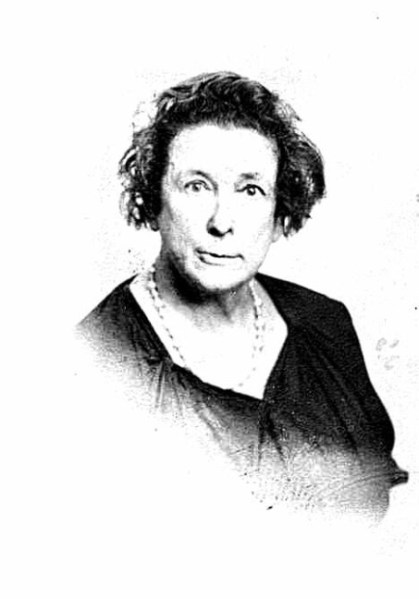
For many of my ancestors, I have a name, a date of birth and sometimes a death date. That doesn’t tell you much about their lives, who they were or what they looked like. Who resembles them? Having a picture that you can document of them is a treasure. I still have many images of unidentified people. Some you can guess at but still you aren’t sure.
I have no pictures of Annie Sutherland (1878-1953) or much information about her except for one entry in my grandfather William Harkness Sutherland’s diary, “ Annie visiting from New York”. Annie was his first cousin, the daughter of his uncle William Sutherland and Jessie Johnston.
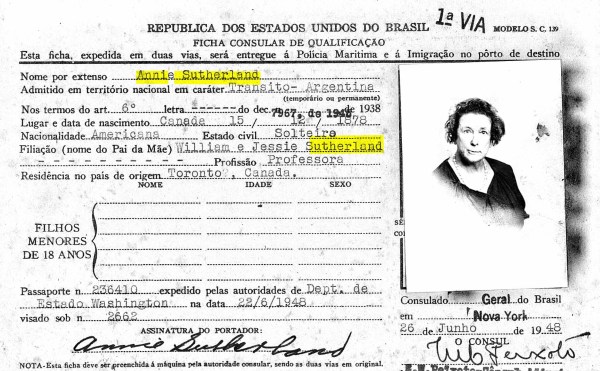
I thought I would try again to find Annie after researching her brother William. Annie is not a unique name so I didn’t have many expectations when I entered her name, birth year, and parent’s names in Ancestry. Up popped her visa for entry into Brazil in 1948! This document had her date of birth, her nationality, her parent’s names, her occupation and her picture! There she was for all to see at 69 years of age.
Annie Sutherland disappeared from Canadian records after the 1901 census when she was living with her parents at 21 Rose Ave along with her sisters Agnes, Isabel and Jessie and her brother Davison.
Single women at the turn of the century had few career choices open to them, one being a teacher. Annie and two of her sisters taught school. I imagine Annie wanted a little excitement in her life, so she immigrated to New York City in 1902 and moved in with her brother William. She continued to teach school.
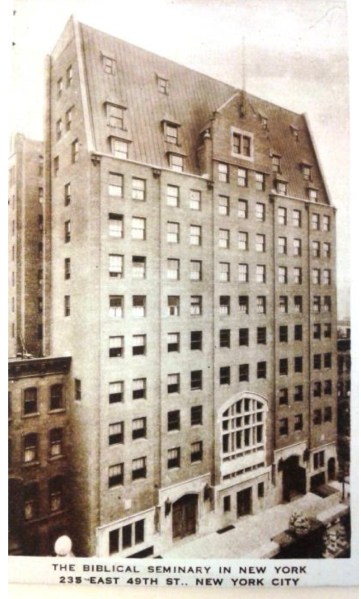
She originally taught at regular public schools. Religion was important in the family, like many Scottish Presbyterians at the time. They attended services regularly and were involved in the church life. The males, like my grandfather, were encouraged to become ministers but none had the calling. So, it is not surprising that at some point Annie began teaching at the Biblical Seminary of New York (which became the New York Theological Seminary).
Wilbert White founded the Prostatant nondenominational school to train Bible teachers, missionaries and YMCA (Young Mens Christian Association) workers. This was a ministry for the “real world” with the Bible being the centre of the curriculum. Women formed a large part of the diverse cultural student body and the staff. In 1921 the school moved downtown to East 49th Street. There, in a nine-story building, students, staff and other borders lived together. Annie lived at the school and according to the 1940 census was a teacher making $4,764 a year, a large salary for anyone at the time.
Teachers have the advantage of summers off, and Annie Sutherland travelled the world. While she taught others to be missionaries, perhaps she did missionary work herself during her vacations. She can be found on many ship manifests as she sailed to Brazil, Argentina, Mexico, England, France and the Mediterranean, being away for two months at a time.
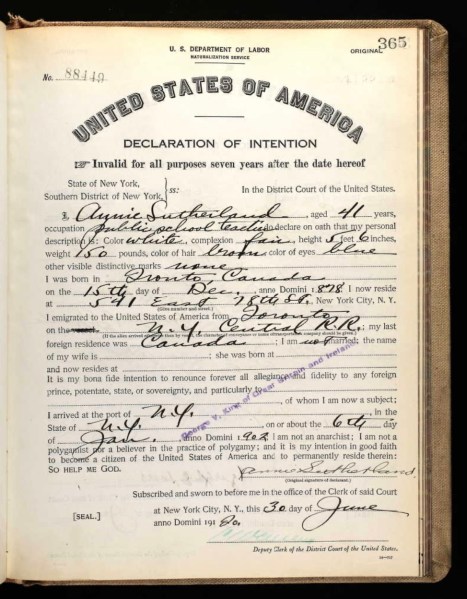
She, like her brother, decided to become an American citizen. She filed her declaration of intention in 1920, which included her renouncing her allegiance to George the V, King of Great Britain and Ireland. She received her naturalizing certificate five years later.
I last found her alive in New York City in 1950, living at the Prince George Hotel, having returned from another trip.
There is an Annie Sutherland buried in Mount Pleasant Cemetery in Toronto, who died in 1953 at 74 years of age. Is that Annie’s final resting place? Did she eventually return home from her travels?
Notes:
“Rio de Janeiro Brazil, Immigration Cards, 1900-1965”. Family Search, Salt Lake City, Utah, 2013. Index entries derived from digital copies of original and compiled records. Accessed on Ancestry March 10, 2020.
Mount Pleasant Cemetery: Annie Sutherland age 74 died 1953. Land, Section 33 lot 2650. accessed October 18, 2024.
New York Theological Seminary Records 1895-2005-https://library.columbia.edu/content/dam/libraryweb/locations/burke/fa/misc/ldpd_11693150.pdf
Year: 1901; Census Place: Toronto (Centre) (City/Cité) Ward/Quartier No 3, Toronto (Centre) (City/Cité), Ontario; Page: 2; Family No: 17 Ancestry.com. 1901 Census of Canada [database on-line]. Lehi, UT, USA: Ancestry.com Operations Inc, 2006. Original data: Library and Archives Canada. Census of Canada, 1901. Ottawa, Ontario, Canada:
Year: 1940; Census Place: New York, New York, New York; Roll: m-t0627-02648; Page: 61A; Enumeration District: 31-1008 Ancestry.com. 1940 United States Federal Census [database on-line]. Provo, UT, USA: Ancestry.com Operations, Inc., 2012.
The National Archives at Philadelphia; Philadelphia, PA; NAI Title: Declarations of Intention For Citizenship, 1/19/1842 – 10/29/1959; NAI Number: 4713410; Record Group Title: Records of District Courts of the United States, 1685-2009; Record Group Number: 21 Ancestry.com. New York, U.S., State and Federal Naturalization Records, 1794-1943 [database on-line]. Lehi, UT, USA: Ancestry.com Operations, Inc., 2013.
Some branches of family trees flourish while others wither and die out. I have traced one branch of my tree back to Pierre Gadois and Louise Mauger, two of my one thousand and twenty four 8th great-grandparents who arrived in Quebec in 1636. This couple has many thousands of descendants alive today, probably even more. But even though some of my great-grandparents had many children there aren’t the expected number of cousins. I have only seven first cousins while a friend says she has more than fifty. My granddaughter has only two so far.
Barnabé Bruneau and Sophie Marie Prudhomme my two-times great-grandparents had 13 children. They all survived to adulthood. One would have expected that they would all marry and have a number of children. Even if they each had only four children, that would be 52 cousins but that is not what happened.
Barnabe & Sophie Marie Bruneau
These 13 siblings only had 17 children with 10 of the children born to Ismael Bruneau and Ida Girod. Seven of their ten children have descendants alive today. I haven’t counted up how many relatives this is but quite a number. It is hard to keep track of your second and third cousins and those once removed as they marry and have children.
When my great uncle Herbert Bruneau, Ismael’s son, drew up a family tree in the 1960s, he wasn’t able to find a record of any of his cousin’s children. He thought that he and his sibling’s descendants were the only branches.
When I had my DNA analyzed by Ancestry, one of my matches, “Shedmore” rang a bell. Ancestry said he was a 4th – 6th cousin but in fact, his great-grandmother Elmire Bruneau was my great-grandfather Ismael’s sister and so we are third cousins. The tree did have another branch.
Elmire Bruneau Huntley
Elmire, born in St-Constant, Quebec, immigrated to the United States in 1864 and worked in New York City as a French governess. She is said to have met Andrew Washington Huntley around 1867 in the choir of the Plymouth Church in Brooklyn Heights. His family lived in Mooers, New York. He was a veteran of the Civil War having served in a number of units from 1862-1865. This couple moved many times during their marriage according to census records. First to Wells, Minnesota, then to Bridport, Vermont to farm, then Chicago, Illinois where he was a ticket agent on the Electric Railroad and finally to Los Angeles, California. Elmire died there in 1922. Her body accompanied by her daughter Faith, went by train back to Bridport, Vermont where she was buried beside her son Howard.
Andrew Washington Huntley
Howard died at 18 without children. It was her daughter Faith, who married Smith C. Shedrick and had four children, Etta Elmere, Howard S., Helena F. and Howard H. who kept the family tree growing. “Shedmore” turned out to be Etta’s son. He does not have any children but his brother had three children, five grandchildren and some great-grandchildren so Elmire’s Bruneau line lives on. Both Helena and Howard also married so there might be even more twigs on those branches.
Faith and Howard Huntley
It is nice to have cousins. Some might not be close but you do have a family connection. Reach out to your cousins, you never know who you will find or what they may know.
Notes:
All photographs are from Ismael Bruneau and Ida Girod’s albums in the possession of the author.
Year: 1870; Census Place: Clark or Wells, Faribault, Minnesota; Roll: T132_3; Page: 1440 Ancestry.com. 1870 United States Federal Census [database on-line]. Lehi, UT, USA: Ancestry.com Operations, Inc., 2009. Images reproduced by FamilySearch.Accessed Nov 22, 2021.
Year: 1900; Census Place: Chicago Ward 21, Cook, Illinois; Roll: 271; Page: 17; Enumeration District: 0638 Ancestry.com. 1900 United States Federal Census [database on-line]. Lehi, UT, USA: Ancestry.com Operations Inc, 2004. Accessed Mar 29, 2022.
Year: 1910; Census Place: Oak Park, Cook, Illinois; Roll: T624_239; Page: 21b; Enumeration District: 0077; FHL microfilm: 1374252 Ancestry.com. 1910 United States Federal Census [database on-line]. Lehi, UT, USA: Ancestry.com Operations Inc, 2006. AccessedNov 22, 2021.
Year: 1920; Census Place: Los Angeles Assembly District 73, Los Angeles, California; Roll: T625_114; Page: 17A; Enumeration District: 393 Ancestry.com. 1920 United States Federal Census [database on-line]. Provo, UT, USA: Ancestry.com Operations, Inc., 2010. Images reproduced by FamilySearch. Accessed Nov 22, 2021.
My father, Edward McHugh, didn’t really talk about his family’s trip of a lifetime. After all, Dad wasn’t even born yet. But it must have been discussed by everyone when he was a boy. In 1911, the first member of the family, Mary Ann McHugh, moved from Dundee, Scotland to Montreal.
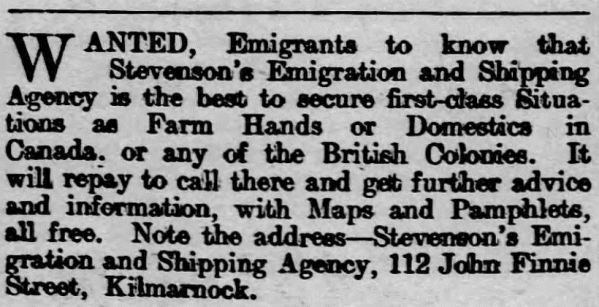
At the time, booking agents in the United Kingdom advertised and recruited potential immigrants to Canada. There was an acute need of domestic help and agricultural workers. Between 1890 and 1920, Canada experienced its third wave of immigration and its peak was between 1911 and 1913, just before World War I.1 The following type of advertisement was common in the newspapers.2
Booking agent advertisement
Maybe one of these advertisements gave the McHugh family the idea to emigrate to Canada. Or maybe Mary was ready for an adventure. She was just 21 when she disembarked from the SS Grampian that had left Glasgow on June 24, 1911 and arrived in Quebec City on July 9, 1911. She would have had a medical exam when she arrived to ensure that she was in good health and did not have an infectious disease. Conditions for immigration to the colonies were well known in the United Kingdom. The February 11, 1911 edition of the Hamilton Observer, in its article, Canadian Notes, People Prohibited, details the reason some potential immigrants could expect to be refused by Canada. The article explains the booking agent’s liability for the immigrants that arrived in Canada for a period of three years following their arrival:
“The following classes of people are prohibited from landing … feeble minded, idiotic, insane, or who have been insane within five years, afflicted with any loathsome, contagious, or infectious disease; anyone who is a pauper, who is destitute, who is a professional beggar or vagrant.”3
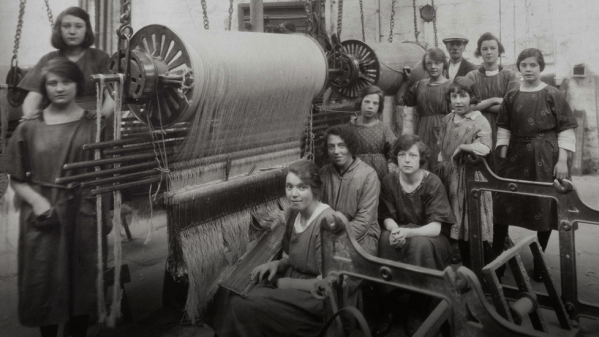
All of the members of the McHugh family worked in the jute mills in Dundee. The 1911 census indicates Mary was a jute weaver, which probably meant that she operated a jute weaving machine.4 She lived with her mother, Sarah Jane McLaughlin, and her brothers, Edward and Francis. They lived at 1 Tait Lane, Dundee. Her other brother, Thomas, my grandfather, lived with his wife and seven children at 9 Tait Lane.
The picture below shows the jute weaving machine.5
Mary must have been satisfied with her new life in Montreal, Quebec. Within a year, her mother and her two brothers, along with my grandfather, had followed her to Canada. Six months later, my grandmother, Elsie Orrock, and her seven children joined her husband, Thomas, in Montreal.
The McHughs lived close together in Dundee and they also lived close together in Verdun, Quebec. While I will never know for sure why they decided to emigrate, I can guess that they wanted a life that was not as hard as the one working in the jute mills. There are a few clues that this was not a spur of a moment decision but a planned family decision.
Mary left first and, if it did not suit her to live in Canada, she would have been able to easily return to Dundee. Her mother and brothers were still there. By the time her mother emigrated, along with her three sons, they arrived with $150 CAD, about $4,750 in today’s dollars. Browsing through the passenger lists, I can see that they had a lot more money than many of their fellow passengers. 6 They were not a rich family, so this amount of money would have taken some time to save up.
Coincidentally my grandfather joined the Freemasons in 1910 and achieved a Master Mason diploma and a Mark Mason diploma.7 By that time, he already had six children. He worked long hours in the jute mill, including Saturdays. Why would he join the masons when he was already a very busy man providing for his family, plus taking care of his widowed mother, and his siblings who still lived at home? There is no evidence that he ever joined the masons when he arrived in Canada. I believe that it is possible that he joined the masons to in case he needed the contacts to find employment. As he quickly found work, his busy family life prevented him from pursuing his membership in the masons.
Only one of my grandfather’s siblings stayed in Scotland, Sarah Jane McHugh. She was not living with the other McHughs at the time of the 1911 census. But she remained close to the family. Surprisingly, she travelled to Montreal to be a witness at her brother’s wedding at the Notre Dame Basilica in Montreal on May 8, 1913.8 That would have been quite a trip for Sarah Jane to make.
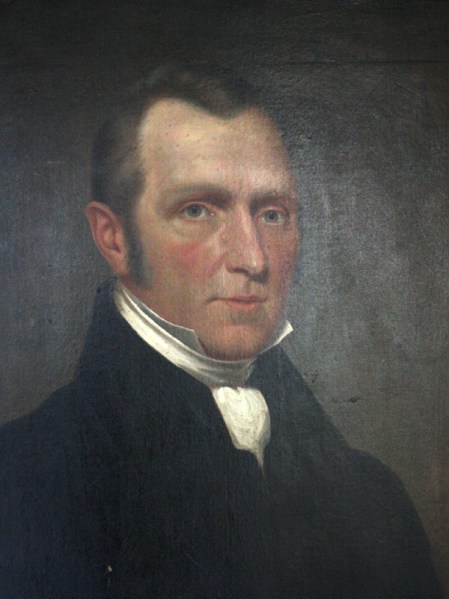
When my English-born three-times great-grandfather Robert Mitcheson arrived in Philadelphia from the West Indies in 1817, he was a 38-year-old unattached merchant. Within two years he was married and had started a family, established a new career and was on the way to becoming an American citizen.
Robert (1779-1859) grew up in County Durham, England, where his father was a farmer and small-scale landowner. Robert became an iron manufacturer as a young man, then spent some time in the West Indies. Family stories say he was largely occupied in the West Indies trade. In 1817 he sailed from Antigua to Philadelphia with the intention of settling in the United States. He applied for naturalization – a first step towards citizenship — in July, 18201 and took an oath of citizenship on Sept. 12, 1825.
Robert Mitcheson, portrait probably painted in Philadelphia in the 1830s. Artist unknown. Bagg family collection.
Perhaps he had met his future wife, Scottish-born Mary Frances (Fanny) MacGregor, on a previous trip to the city. I have not found a record of their marriage, but it probably took place in Philadelphia. The couple’s first child, Robert McGregor Mitcheson, was born on August 15, 1818 and baptized at St. John’s Episcopal Church in north-end Philadelphia.2
In 1819 Robert was listed in a city directory as a distiller, and the following year’s directory clarified that he made brandy and cordials. The business was located at 275 North Third Street, in the Northern Liberties area of the city. The distillery continued to appear in each annual directory until 1835, when Robert was simply listed as “gentleman”, with his home address on Coates Street.
The family appeared in the U.S. census for the first time in 1830,3 living in Spring Garden, then a largely rural part of Philadelphia. Robert owned a large lot bounded by Coates (later renamed Fairmount Street) and Olive Streets, between Eleventh and Twelfth Streets. There, he and Fanny raised their five children: Robert McGregor (1818-1877), Catharine (my two-times great-grandmother, 1822-1914), Duncan (1827-1904), Joseph McGregor (1828-1886) and Mary Frances (1833-1919). Two other children, Sarah and Virginia, died as babies. Two of their sons graduated from the University of Pennsylvania. Robert M. became an Episcopal minister, and Joseph, who went by the name MacGregor J. Mitcheson, was a lawyer.
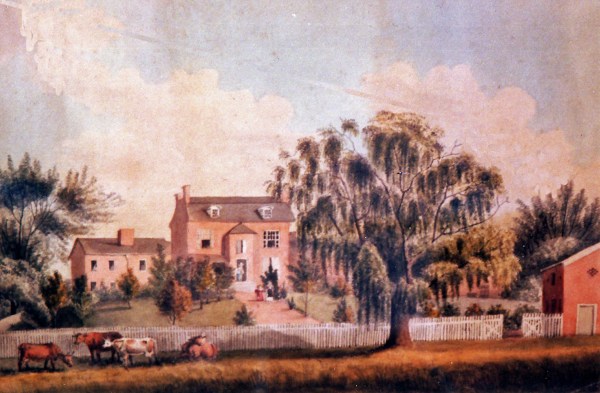
This painting of Monteith House, the family home in Spring Garden, was painted by daughter Catharine Mitcheson. Bagg family collection.
Robert never became part of city’s elite, despite his financial success. For one thing, he was a newcomer living in an old city. Founded in 1682, Philadelphia was the birthplace of the United States and many of its citizens were known as the descendants of colonial and revolutionary families. Also, Robert appears to have been a low-key person. A search for his name in local newspapers brought up only one article that named a long list of people involved in establishing a refuge for boys.
The only obituary I was able to find appeared in a Montreal newspaper, where daughter Catharine Mitcheson Bagg and her husband, Stanley Clark Bagg, lived.4 It said: “As a citizen of Philadelphia for more than 40 years, he has done much, in a quiet and unostentatious manner, for the advancement of her interests and the relief of the distressed. He enjoyed a well-earned reputation for unwavering integrity in all the transactions of his long life – prolonged almost to his 80th birthday — and his remarkable urbanity of manner which the firm, yet elastic step of his manly person, were but slightly impaired up to the period of his dissolution. He was universally respected and died serenely, with a Christian’s hope and faith.”5
Robert appears to have travelled back to England at least once, probably to visit family members and take care of some business, as he had inherited property in Durham when his father died in 1821. A land transfer document dated September 16, 1835 described him as “Robert Mitcheson, iron manufacturer, late of Swalwell, now of Philadelphia”.6 Several weeks later Robert Mitcheson, gentleman, appeared as a passenger on the Pocahontas, sailing from Liverpool to Philadelphia.7
Perhaps he also visited his brother William, an anchor maker and ship owner in London. A short biography of his son published by the St. Andrews Society in Philadelphia described Robert as a “retired merchant and shipowner,”8 however, I cannot confirm whether Robert owned any ships or perhaps invested in his brother’s business.
After Robert left the distillery business he reinvented himself again, this time as a landlord. The city was rapidly expanding and there was a need for housing. Many people lived in boarding houses and Robert saw rents from boarders as a way to generate income for his grown children after he died. In his will, he left 14 “dwelling houses” located near his house, as well as several nearby other buildings, in trust to sons Robert M. and MacGregor J..9 They were to collect the income and pay certain sums every year to their other three siblings, and to look after repairs to the buildings.
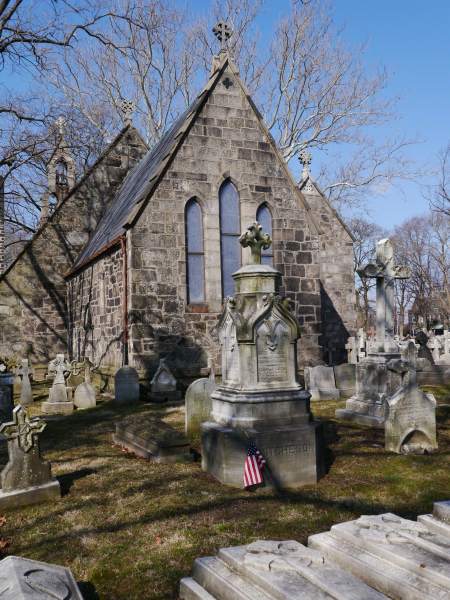
This large monument in the cemetery of St. James the Less Episcopal Church is in memory of Robert Mitcheson, his wife and several other family members. JH photo, 2013.
Robert died at age 79 and was buried in the cemetery at St. James the Less, a small, Gothic-style Episcopal church built around 1846 as a chapel of ease for wealthy families in the area. Robert is said to have helped found that church.
His story doesn’t end there, however. Sadly, his estate was the focus of a court battle that took almost 30 years to resolve, by which time both executors had also died. In addition to a dispute between the brothers, the case focused on a legal error in the way the trust was set up10 and who was to inherit the final balance of income.11
1. Ancestry.com. Pennsylvania, U.S., Federal Naturalization Records, 1795-1931 [database on-line]. Original data: Naturalization Records. National Archives at Philadelphia, Philadelphia, Pennsylvania. Accessed Feb. 15, 2023.
2. I found records from St. John’s Church at the Historical Society of Pennsylvania, Philadelphia in 2013.
3. “United States Census, 1830,” database with images, FamilySearch (https://familysearch.org/ark:/61903/1:1:XH5W-MC3, accessed Feb. 16, 2023), Robt Mitchinson, Spring Garden, Philadelphia, Pennsylvania, United States; citing 323, NARA microfilm publication M19, (Washington D.C.: National Archives and Records Administration, n.d.), roll 158; FHL microfilm 20,632.
4. Stanley Clark Bagg (SCB) was Robert’s son-in-law and also his nephew: Robert’s older sister, Mary Mitcheson Clark, was SCB’s maternal grandmother.
7. “Pennsylvania, Philadelphia Passenger Lists Index, 1800-1906,” database with images, FamilySearch (https://familysearch.org/ark:/61903/1:1:QV9Y-VXJ9, accessed Feb. 17, 2023), Robert Mitcheson, 1835; citing ship Pocahontas, NARA microfilm publication M360 (Washington, D.C.: National Archives and Records Administration, n.d.); FHL microfilm 419,525.
8. Biography of MacGregor Joseph Mitcheson in An Historical Catalogue of the St. Andrews Society of Philadelphia with Biographical Sketches of Deceased Members, 1749-1907, printed for the Society 1907; p. 287, Google Books, accessed July 19, 2013.
10. Mitcheson’s Estate, Orphan’s Court. Weekly Notes of Cases Argued and Determined in the Supreme Court of Pennsylvania, the County Courts of Philadelphia, and the United States District and Circuit Courts for the Eastern District of Pennsylvania by Members of the Bar. Volume XI, December 1881 to August 1882; p. 240. Philadelphia: Kay and Brother, 1882. Google Books, accessed Feb. 17, 2023.
11. Mitcheson’s Estate, Pennsylvania Court Reports, containing cases decided in the courts of the several counties of the Commonwealth of Pennsylvania, Vol. V, p. 99. Philadelphia, T. & J.W. Johnson & Co., 1888. Google Books, accessed Feb. 17, 2023.
The Titanic Sunk and Loss Feared of Over 1,500 Lives
The April 16, 1912 of the Guardian newspaper screamed this headline.1 Other newspapers around the world had similar headlines.
Just over three weeks later on May 11, 1912, my grandfather, Thomas McHugh, his widowed mother, Sarah McLaughlin, and his two brothers, Edward and Francis, boarded the S.S. Grampian in Glasgow, Scotland, to cross the Atlantic to start their new life in Canada.2
They would have been sad to leave their home, excited about their new lives, and definitely worried about hitting an iceberg.
There was a total of 1,638 “souls” on board the S.S. Grampian,3 33 of whom were Saloon or First-Class passengers, and 363 were 2nd cabin passengers. My family was part of the 1,244 passengers in steerage. The crossing took 20 days and the ship arrived in Quebec City on May 21, 1912. Between them, the McHughs arrived with $150 in their pockets. Browsing through the passenger lists, I can see that they had a lot more money than many of their fellow passengers. 4 A Google search tells me $150 in 1912 is about $4,300 in today’s dollars. As they were poor and lived in a tenement in Dundee, Scotland, I can only assume that this meant that they had carefully planned to emigrate.
Steerage accommodations were often divided into three compartments on the ships at that time: one compartment for single men on one side of hold of the ship as steerage passengers certainly did not have an ocean view; one for families in the middle; and a compartment for single women on the other side of the ship. I assume and hope that my family travelled together as a family. These compartments were crowded, with about 300 people in each of them.5 Nor did steerage passengers have a lot of room to move around top deck. They were restricted to a portion of the open deck and prevented from mingling with the Saloon and 2nd cabin passengers by metal gates.
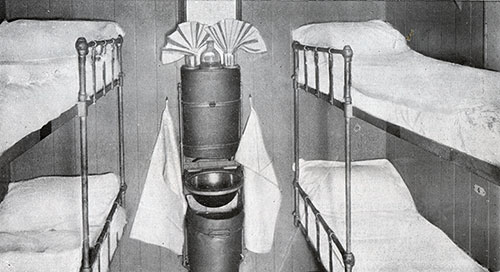
The berths were two-tiered and made of metal frames. Each bed had a mattress and a pillow that could be used as a life preserver. The passengers probably brought their own bedding. Most passengers slept fully dressed.6 The picture below is an example of a four-berth room found in a brochure for the Cunard Line, 1912,7 although many ships had no rooms in steerage and the berths were set up in an open space.
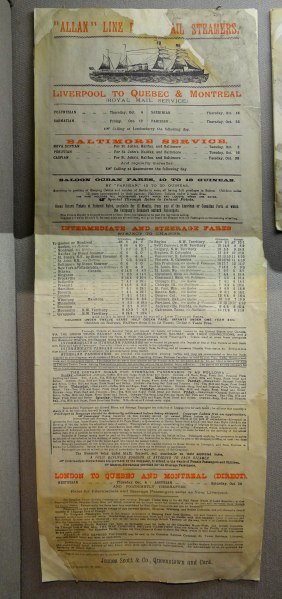
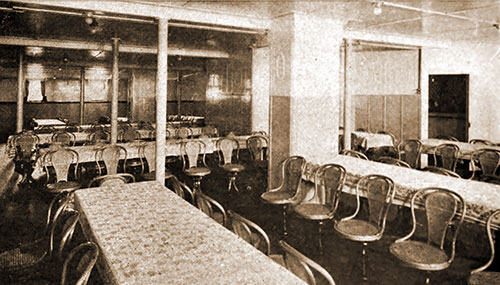
The dining room in steerage had long tables with benches. Steerage passengers were provided with a set of utensils that they used for the entire trip, normally a fork, spoon and a lunch pail. A small dish fit into the top of the pail for meat and potatoes, with an attachment on the lid as a dish for vegetables and a tin cup that fit inside for drinks. The pail also served as a wash basin. 8 The poster below indicates that steerage passengers had to pay 3s 6d per adult for their small pail and utensils (pannikin).9
An example of a dining room for the steerage passengers.10
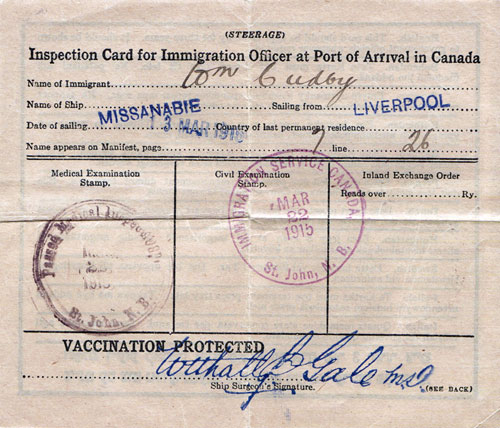
When the McHughs arrived in Quebec City, they were inspected by one of the medical examiners, either Dr. Drouin or Dr. Dupont, who were tasked with examining all the steerage passengers.11 Each immigrant would have been given an inspection card like the one illustrated below. The ship’s surgeon would have signed that they were vaccinated protected.12
My grandfather, Thomas, his brothers and his mother, were not the only McHughs to arrive on the S.S. Grampian. A year before Thomas arrived, his sister, Mary McHugh also arrived on this ocean liner.13 She came from Dundee, Scotland to work as a domestic. And Thomas’ wife, Elsie, accompanied by their seven children, arrived six months after Thomas, also on the S.S. Grampian. 14
It is no surprise that they all booked their passage on the S.S. Grampian as the Allan Shipping Line, founded in 1819 and whose main shipping line was between Scotland and Montreal, is credited with providing passage for the largest number of Scottish immigrants to Canada.15 In 1907 Sir Montagu Allan of the Allan Line Royal Mail Steamers ordered the building of the S.S. Grampian from the Stephens & Sons Ltd. shipbuilding yards in Scotland.16
When World War I broke out, the S.S. Grampian was used to transport troops of the Canadian Expeditionary Force (CEF) from Canada to Europe. After the war, during the summer of 1919, the S.S. Grampian had left Montreal on its way to Liverpool and struck an iceberg off the coast of Newfoundland. Even though the front of the ship was crushed, it managed to reach the port of St. John’s, Newfoundland. Two of the crew were killed, and two of them were injured. Even though the ship was repaired, two years later, while undergoing a refit, it was gutted by fire and sank. It was then considered a write-off.17
Newspapers.com, The Guardian, April 15, 1912, retrieved December 25, 2021.
“Canada Passenger Lists, 1881-1922,” database with images, FamilySearch (https://familysearch.org/ark:/61903/1:1:2HLP-31W : 23 February 2021), Thomas McHugh, May 1912; citing Immigration, Quebec City, Quebec, Canada, T-4785, Library and Archives Canada, Ottawa, Ontario, retrieved December 25, 2021.
Findmypast.com Passenger Lists Leaving UK 1890-1960, Mary McHugh, S.S. Grampian leaving Glasgow June 24, 1911 and arriving in Quebec City July 8, 1911, retrieved January 23, 2022.
Findmypast.com Passenger Lists Leaving UK 1890-1960, Elsie McHugh, retrieved December 13, 2017.
When I was a little girl, I would spend hours with my grandfather in his home workshop. He would make all kinds of things and I used to love watching him at work. I still have some of the tools he made, as well as a cribbage board and a turntable that swings the Scrabble board around to face each opponent. He crafted a complete house of Barbie furniture for my dolls and, to my delight, he asked me my opinion about every single piece. I felt both the weight of responsibility for deciding what each bed and chair would look like, and pride in participating in this project with him.
My grandfather, George Deakin (1901 -1983,) born in Sheffield, England, learned these skills when he was a young man. His father was a miner and George also worked for the coal mining companies of Sheffield, which were significant employers in the early 1900s. Gramps was a fitter which means that he made parts either for piping or for equipment and machinery.1, 2
I used to ask my grandfather why he came to Canada and the answer was always the same and always emphatic. “I did not want to work in the mine.” Sometimes he would go on to explain that, when he left, he still worked above ground for the mining company. However, he was a very short man and he knew that it was a matter of time before he would be required to work underground. Small men were valuable in the low tunnels of the coal mines, but the work was dangerous and unhealthy. Gramps had no intention of ever working underground.
So in 1923, he came to Canada as part of the Harvester Scheme. That year, Canada had a bumper wheat crop and North America could not provide the labour needed to harvest the crop. Under the Harvester Scheme, the two major Canadian railway companies entered into an agreement with the British government to transport 12,000 workers out west where they would earn $4.00 per day plus board. 3
He ended up in Manitoba and the Canadian west must have suited him because he used to enjoy talking about his time on the farm. The days were long and the men worked hard but Gramps found it satisfying to work so hard. And how the workers enjoyed the hearty meals that the women of the farm prepared for them!
He only stayed one harvesting season in Manitoba because, once that bumper crop had been harvested, there was no more work. He took the train to Montreal and easily found work as a draftsman at the Northern Electric plant. He had learned to read and draft drawings in Sheffield and his skills were in high demand. He worked at the Northern Electric plant in Lachine all his life, even during the Great Depression.
When Gramps first arrived in Canada, he was not sure he would stay.4 But after he met and married my grandmother in 1925, they settled in the Montreal suburb of Verdun and raised two children.
Here, he was able to work all his life in a job that he loved. He especially enjoyed the attention to detail that went into designing. And when he wasn’t designing at work, he was making tools, games, and Barbie furniture for the family.
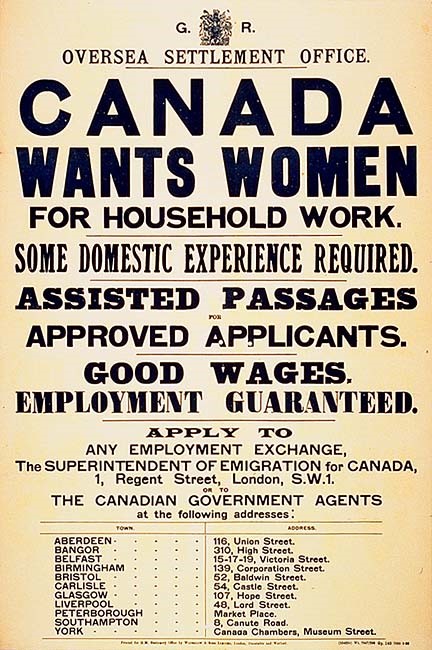
Good wages. Employment guaranteed. These words echoed over and over again in Mary McHugh’s head. And only some domestic experience required. Mary thought that she had quite enough domestic experience, thank you, as she was the only daughter still at home.
It was 1910 and Mary had turned 20 in February.1 Old enough to be married. No prospects in sight. She had been working at the jute factory since she finished school at 14.2 Like her older brother, Thomas McHugh, she immediately got a job in the jute factory as soon as she could. Mary’s mother, Sarah McLaughlin, was happy that Mary was working as Sarah was a widow and still had three children at home. Her husband, Michael McHugh, had died of tuberculosis when Mary’s brother, Francis, was just three months old.3 It had been a struggle for Sarah to make ends meet. Even though Sarah had managed to get a job as a charwoman,4 it was not easy. Sarah was exhausted when she got home, too, and it was up to Mary to help with the housework and cooking for her younger brothers. Mary’s older brother, Thomas, was already married with six children. He helped when he could but he had his own worries.
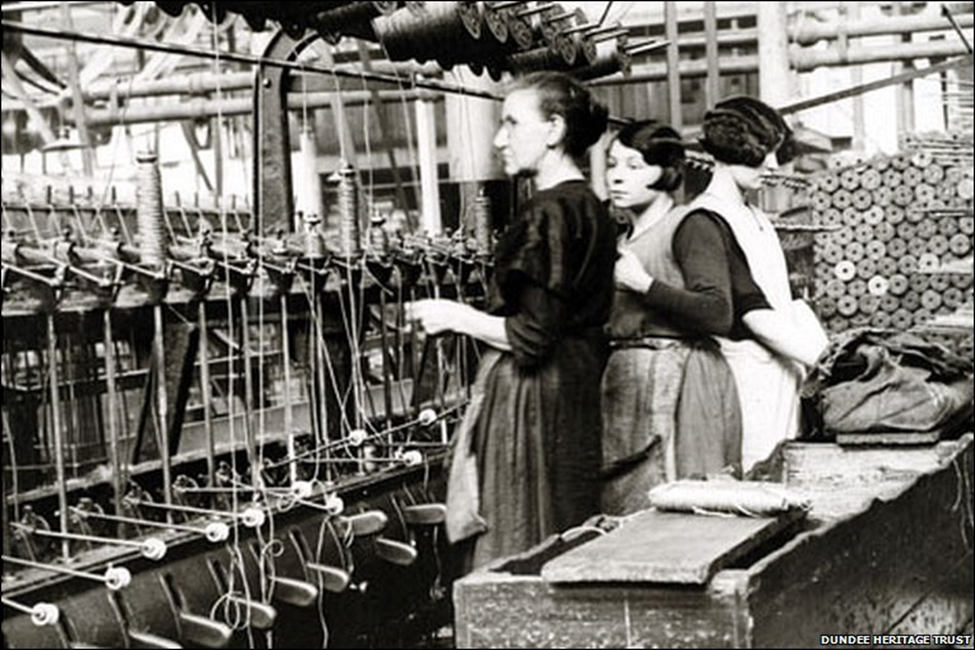
Mary thought ruefully about her job. She was a jute spinner at the flax mill.5 The mill was noisy and crowded. Mary worked twelve hours a day and it was back-breaking work. The women worked hard in the mills but made less wages than the men. The machines were dangerous. Accidents happened often.6 And then there was mill fever or brown lung. Most people who worked in the mill had a dry cough and sometimes even a fever.7
Photograph from the BBC8
Mary liked the idea of being a domestic. The hours would be long and she would be on her feet all day but the air would be clean and it would be quiet. But Canada? So far away? All by herself? Could she do it?
These thoughts were the beginning of Mary’s plan to emigrate to Canada. Mary McHugh was my great aunt and she arrived on the S.S. Grampion that sailed from Glasgow and arrived in Quebec City in July 1911.9
In the early 1900s the demand for domestic servants in Canada exceeded the number of young Canadian women willing to do this type of work. Governments, employers, and women’s organizations made a special effort to encourage the immigration of household workers.8 More specifically, British immigrants were considered as desirable immigrants to Canada. As of 1888, steamship agents received a bonus for selling the passage of a female immigrant whose intent was to work as a domestic servant in Canada. This was called the British Bonus and it came into effect by an Order-in-Council on September 27, 1890. Its purpose was to offer an incentive to desirable British immigrants. Often the Canadian employer would pay the fare of the immigrant to the steamship company.10 The emigrating domestic would then have to pay it back out to her employer out of her wages. This meant that the young immigrant woman was already indebted to her employer even before she started working. If she was unhappy with her employment, it made it difficult for her to find a better employment as long as she owed money.11
It is probable that Mary’s fare to Canada was paid by her employer. Beside Mary McHugh’s name on the passenger manifest of the Grampion there is a stamp British Bonus Allowed.
Hopefully Mary enjoyed her employment. She was the first member of the McHugh family to arrive in Montreal in 1911. She was probably delighted when her mother, Sarah, and three brothers, Thomas, Edward and Francis, followed her to Montreal in May 1912. And Thomas’ wife, Elsie Orrock, and their seven children, Ann, Elsie, Sarah, Francis, Mary, Adam, and Thomas arrived in October 1912. Mary married John Mervin Porter in June 1913 and her family would have been there to celebrate with her.
Notes and sources:
This poster from the Canadian Museum of History is from a 1926 pamphlet entitled Housework in Canada: duties, wages, conditions and opportunities for household workers but there would have been similar pamphlets advertising for immigrants that may have given Mary the idea. This pamphlet says that “Canada welcomes men and women of the right type who come to seek their fortune in this broad new land … (people) of good moral character, and in good health, mentally and physically.” You can see this on the Canadian Museum of History web site in the section Advertising in Britain in the 1920s, https://www.historymuseum.ca/cmc/exhibitions/hist/advertis/ads7-06e.html
Scotland’s People, Register of Births, Mary Ann McHugh, born February 4, 1890, accessed November 18, 2017.
Scotland’s People, Registers of Death, Michael McHugh, died May 16, 1895, accessed November 27, 2017 and Scotland’s People, Registers of Births, Francis McHugh, born February 21, 1895, accessed November 27, 2017.
Scotland’s People, 1911 Census, Sarah McHugh, 1 Tait Lane, Dundee, Scotland, accessed February 15, 2018.
Scotland’s People, 1911 Census, Mary McHugh, 1 Tait Lane, Dundee, Scotland, accessed February 15, 2018.
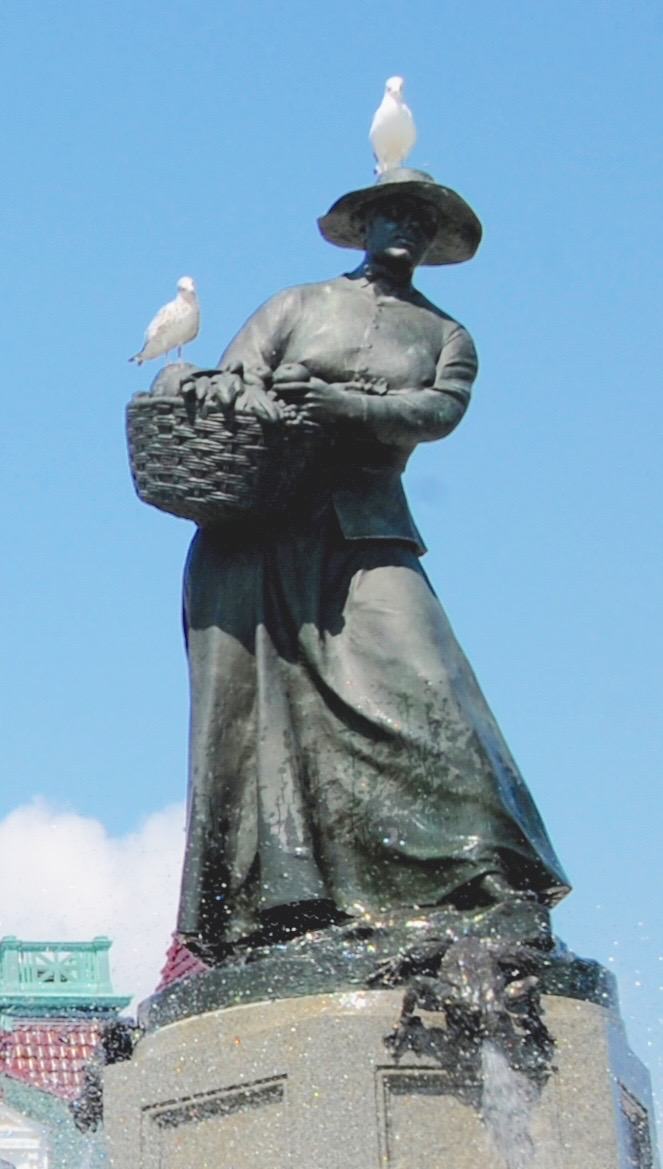
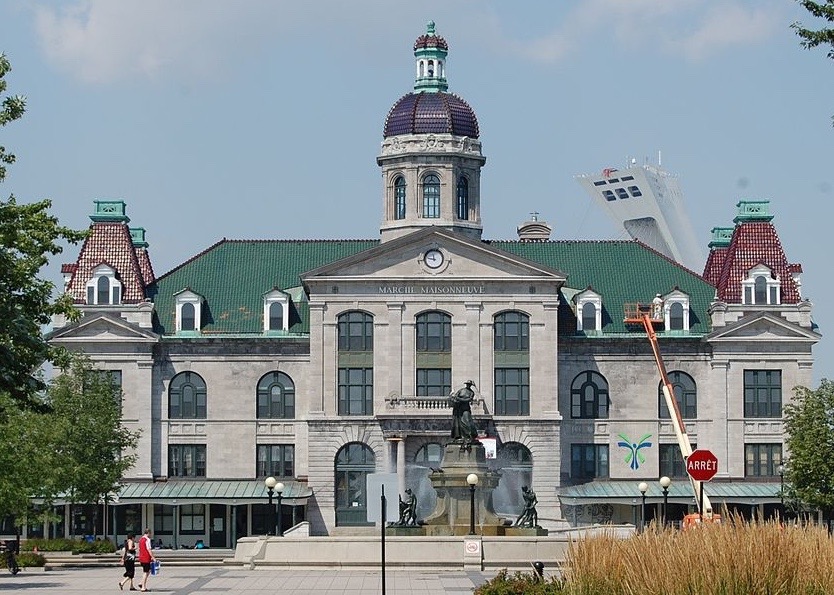
Women are rarely commemorated with a statue. There is one, La Fermière, in front of Marche Maisonneuve in Montreal’s East End. It depicts a woman holding a basket of produce. It was sculpted by Alfred Laliberté and he dedicated it to Louise Mauger, as a glorification of traditional rural values. She was one of the early settlers of Montreal and not the only person celebrated with a monument. Louise was my eight times great grandmother.
La Fermiere statue in front of Marche Maisonneuve
Both Louise (1598) and her husband Pierre Gadoys (1594) were born in Saint Martin d’-Inge in Perche, France. They came to New France about 1636 as part of a settlement initiative by Robert Giffard de Moncel, the first Seigneur of colonial New France. Records have them living and farming on the Beauport Seigneurie in 1636 and Pierre employed by the Société Notre-Dame de Montréal pour la Conversion des Sauvages, at Sainte-Foy or Sillery from 1643 to 1645.
Tracing families back is quite easy in Quebec as the church records of births, marriages and deaths, kept from the beginning of the colonies have been well preserved. My maternal grandmother was a Bruneau and her direct male line goes back to Francois Bruneau, my seven-time great grandfather, who arrived in New France in 1659.
The Bruneau family tree is just part of my story. There are all the women back through the tree who were only a name, their families not mentioned. A seventh times great grandfather is one of 256 grandfathers which means there are also 256 grandmothers who have their own stories.
I started with Sophie Marie Prud’homme who married Barnabé Bruneau, my two times great grandparents. Tracing back the Prud’homme line I arrived at Louis Prud’homme who arrived in New France in the 1640s, where he met and married Roberte Gadoys. Roberte came from France in the 1630s with her father Pierre Gadoys, her mother Louise Mauger and her brother Pierre.
Pierre Gadoys (Gadois, Gadoua) my 8th time’s great grandfather moved his family to Montreal shortly after this because of the many attacks by the Huron and Algonquin on settlers around Quebec City. Montreal was fortified. In 1648, he was the first person to be granted land in Montreal (Ville-Marie) by the governor, Paul de Chomedey de Maisonneuve. He was known as the “Premier Habitant or first farmer”1. The 40 arpents grant was from the current St Paul Street north to the Petite Riviere between St. Pierre and Bleury. In 1666 he was granted another 60 arpents for helping Charles LeMoyne fight the Iroquois.
Just as important as the first farmer is the first farmer’s wife. Louise had a lot of work to do. The couple had six children, possibly seven. Roberte, Pierre and Etienne (is the question mark) were born in France, while Francois, Jeanne and Joseph on the Seigneurie of Beauport and Jean-Baptiste was born in Sainte-Foy when Louise was 43. Jeanne died at birth, Joseph died in his first month and there is no other information about Francois. According to the 1667 census they had 40 acres under cultivation, six cows and a hired servant.
While Pierre Gadoys died in 1667, Louise lived another 23 years and died in Montreal at the age of 92.
Pierre also has a monument but it is a small trapezoid stone marker in Place d’Youville installed in 1992 as part of Montreal’s 350th celebration. It looks more like a concrete form used to block off a road than a commemoration. It is not a lovely bronze statue in the middle of a fountain.
Bibliography:
1. Dollier de Casson, Francois. Histoire du Montreal 1640-1672. pg 88
Jean-Jacques Lefebvre, “GADOYS, PIERRE,” in Dictionary of Canadian Biography, vol. 1, University of Toronto/Université Laval, 2003–, accessed November 29, 2018, http://www.biographi.ca/en/bio/gadoys_pierre_1E.html.
Fournier, Marcel. 1642-1643 Les Origins de Montréal Diffusion au Canada, 2013.
Le Bulletin Recherches Historique Vol XXXIII Levis – Mars 1927 Nos 3 Les Colons de Montreal de 1642-1667 pgs. 180,181.
PRDH-RAB; Origine des Familles Canadiennes; Parchemin Ancestry accessed January 2019.
Sulte, Benjamin: Histoire des Canadiens Français [1608-1880]: origine, histoire, religion, guerres, découvertes, colonisation, coutumes, vie domestique, sociale et politique, développement, avenir January 1, 1882 Wilson et Cie
Senécal, Jean-Guy(senecal@fmed.ulaval.ca); Sep 27, 1998, compilation OCR de trois documents Word disponible en ligne, ses documents se référant principalement au Tome IV & V, Chapitre IV du livreHistoire des Canadiens-Française de Benjamin Sulte, édition 1977.
Notes:
The statue La Fermière was made by Alfred Laliberte in 1915. It was part of a continent-wide city beautification project.
Pierre Gadoys’ sister Françoise was married to Nicholas Godé. They were present at the founding of Montreal.
It is possible but not proven that Pierre and Louise were in Montreal in May of 1642 for the founding ceremony. Their son Pierre, then 11, was said to have attended with his Aunt and Uncle, Francoise and Nicholas Godé. It was thought that Louise was not at the ceremony as she was attending to Jean Baptiste who was only a year old. Pierre first settled in Sillery with his family but had gone to Montreal in the early 1642 and then returned to Sillery as he was there in 1645.
After his death, Saint-Pierre street was named in his honour.
1666 Census – Pierre Gadois the eldest, 72, inhabitant; Louise Moger, 68, his wife; Jean-Baptiste, 25, gunsmith; Pierre Villeneuve, 25, hired servant.
1667 Census – Pierre Gadoys, 65; Louise Mauger, his wife, 65; Pierre Villeneuve, domestic, 24; 6 cattle, 40 acres under cultivation. She was buried March 18, 1690 in Montreal.
Pierre Gadoys: 1594 – Oct 20 1667 Married 1627 de Igé, Saint-Martin, Orne, France.
Louise Mauger: 1598 – Mar 18 1690
Roberte Gadoys: Baptised Sept 15 1628 France – Sept 14, 1716 Montreal
Pierre Gadois: Nov 17, 1631 or 1632 France– May 18, 1714 Montreal
Etienne Gadois: Baptised Nov 17 1631 France – ? Are Pierre and Etienne the same person??
Francois Gadois: Dec 2 1632 Quebec – ?
Jeanne Gadois: June 26 1638 – June 26, 1638 Quebec
Joseph Godois: Sept 28 1639 – Oct 1639 Quebec
Jean-Baptiste Gadois: Mar 1, 1641 Quebec – April 15 1728 Montreal.
The inscriptions on Pierre Gadois Monument In Place d’Youville, Montreal reads, “C’est d’ici que Le 4 Janvier 1648 Maisonneuve determina les bornes de la premiere concession accordee a Pierre Gadoys il fixait ainsi l’orientation des rues de la future Ville” and on another side, “Stele erigee grace a L’Ordre des Arpenteurs- Geometres du Quebec, a L’Association des Detaillants de Monuments du Quebec, aux Archives Nationales du Quebec, aux Productions D’Amerique Francaise et Au Groupe de Recherche de Raymond Dumais Archivist.”
Thousands of Irish immigrants came to Canada, especially in the 1800s. They came by ship, travelling up the St. Lawrence River to Quebec City, but many got sick and some died during the long voyage across the Atlantic.
After a cholera epidemic swept England in 1831, a quarantine station was built on Grosse ÎIe, an island in the St. Lawrence downriver from Quebec City. All ships were required to stop there so passengers could be checked by doctors to ensure they were not sick. Government authorities did not want people to bring disease to the busy port cities of Quebec City and Montreal.
The worst years were between 1845 and 1849, when the terrible potato famine hit Ireland. Many of those who fled Ireland, optimistic about starting new lives in North America, never made it. Most of them succumbed to typhus, a disease caused by bacteria carried by fleas and lice. More than 7,000 people are buried in three large cemeteries on Grosse Île.
The quarantine station continued from 1832 until 1937. Today, Parks Canada runs Grosse Île and the Irish Memorial National Historic Site. This moving historic site, including several buildings and cemeteries, is open to visitors from the beginning of May until mid-October. See https://www.pc.gc.ca/en/lhn-nhs/qc/grosseile/index.
There are a number of books about this place and the tragic events that happened there. One of the most moving volumes I have read is Eyewitness, Grosse Isle, 1847 (note the alternative spelling), by Marianna O’Gallagher & Rose Masson Dompierre, published in 1995 by Livres Carraig Books of Ste-Foy, Québec. You may be able to find it in a library or online.
This superb book begins with a map of Ireland indicating the places that sent 10 or more ships to Quebec in 1847 with Irish immigrants: 53 ships from Limerick, 33 from Cork, 32 from Belfast, 27 from Dublin, 27 from Sligo and 18 from Londonderry.
The authors got the idea for this book after reading letters that the chaplains of the quarantine station wrote to their superiors during the summer of 1847. The authors wrote, “In order to present a full portrait of the dramatic events that unfolded at Grosse Isle, and in order to distinguish between myth and reality, this book will be the forum where eyewitnesses speak. The priests’ letters, little known until today, but which are very significant, contain descriptions of everyday occurrences, prevailing conditions at ‘the Quarantine’ in 1847. The situation proved to be dramatic and arduous, and the missionaries, faced with the spiritual and physical needs of the immigrants, felt powerless and besieged. Very soon their letters elicited response from many quarters.”
For example, Rev. Armine W. Mountain, Church of England, Acting Chaplain Quarantine Station, wrote:
Buried: Meek, Catherine, daughter of James Meek, mason, late of the parish of Whiteburn, County Linlithgow, Scotland, and of France, by her maiden name Somerville, his wife, aged two years, died on the twenty-second and was buried on the twenty-fourth day of May in the year of our Lord one thousand eight hundred and forty-seven, by me – Armine W. Mountain – Present: Robert Armstrong, Joh X. Armstrong.
Rev. Charles Morice, Catholic Priest, Officiating Chaplain Grosse Isle, wrote:
Margaret Taylor, aged twenty three per ship Maria Soames
Elizabeth White, age sixty-three from ship Emigrant
Margaret McKay, age forty two years per ship Eliza
Alexander McKay, age fifty-two per ship Eliza
Robert Smyth, age two years per Sir Henry Pottinger died sixth October. All died, except the last, on the seventh of October and were buried on the evening of the same day in the year of our Lord one thousand Eight hundred and forty-seven by me – Charles Morice – Present: John Fitzgerald, Patrick Dolan



 Genealogy Ensemble