Category Archives: Ireland

The Miller of Moneymore

If you are looking for the old corn mill in Moneymore, Northern Ireland, turn off High Street in the village centre and go to the end of Mill Lane. It’s right there, although you might not guess that old stone building was once a busy mill since the water wheel has gone and the water that powered it flows in an underground river.
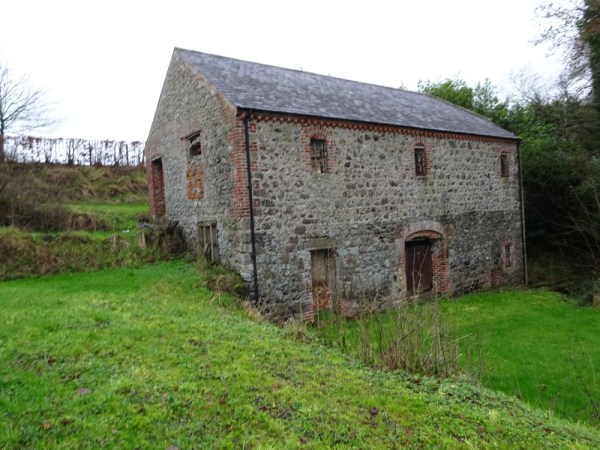
the old corn mill at Moneymore. Photo courtesy Sebastian Graham, http://www.millsofnorthernireland.com

Long ago, this corn mill (corn refers to oats in Ireland) was a very important building in the community: this was where people brought their oats, wheat, barley, and rye to be ground into flour. In the mid-1700s, my five-times great-grandfather Benjamin Workman was probably well-known in Moneymore because he was the local corn mill operator.

His great-grandson recounted the family’s history in a journal, written around the 1850s.1 He explained that Benjamin’s father, William, had a mill (probably a flax mill) and a farm at Brookend, County Tyrone, several miles south of Moneymore. Benjamin inherited the Brookend property from his father, but he was unhappy there because he didn’t get along with the neighbours.

When Moneymore needed a new miller, Benjamin left Brookend and took the job in town. He was not the owner – he rented the mill from the Drapers’ Company of London, which owned most of the property in the area – but everyone paid him to grind their flour.

It was a good move for Benjamin, and for the area residents. According to the journal account, when he died around 1767, he was mourned by Protestants and Catholics alike.

This story may be backed up by historical data: the 1766 Religious Census of County Derry confirms that Benjamin Workman, Protestant Dissident (in other words, Presbyterian,) was a landholder in Moneymore Townland, Barony of Loughinsholin, Derry County.2 An earlier census of Protestant householders in Ulster, carried out in 1740, showed there were several individuals with the name Workman in the area.3

Benjamin Workman, miller of Moneymore, and his wife (whose name is unknown) had at least one son, also named Benjamin. According to the journal, he succeeded to the business and property interests in Moneymore, and, like his father, he died at an advanced age.

This Benjamin married Ann Scott and the couple had four sons and two daughters. All but one of them left Ireland, although two returned and settled in other parts of the island. Only daughter Letitia stayed in Moneymore. According to the journal, she married, first, a man named Scott, with whom she had a daughter, and second, a man named McIvor. Letitia had five more children with her second husband. She died in Moneymore in 1832.4
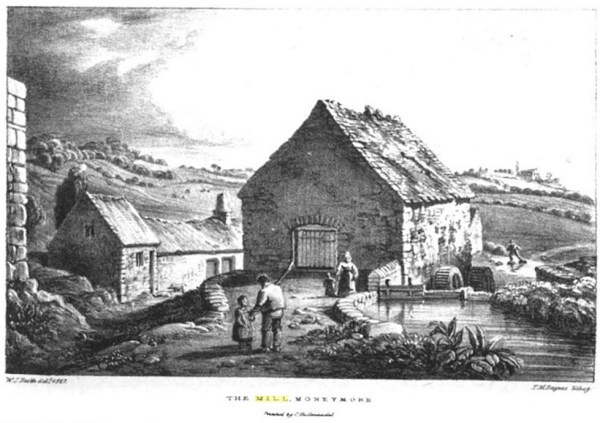
Caption: This illustration of the Moneymore corn mill accompanied an 1817 report on the plantation. The mill had a thatched roof and two water wheels, which was unusual and ineffective.

That is all I was able to discover about the Workman family in eighteenth-century Moneymore, so my curiosity turned to the mill and the town itself

More than 5000 mills were built in Northern Ireland, including 510 in County Derry (Londonderry) and 573 in neighbouring County Tyrone. There were several types, including corn, or grist mills, flax mills (flax is the plant that is used to make linen) and tuck mills (used to remove impurities from woolen cloth). Today, many have been demolished while others lie neglected, but studying them reveals much about the industrial and architectural history of the area.    

Moneymore’s corn mill was originally built around 1615, about the time Moneymore was founded. One and a half storeys high and 34 feet long, it was built almost entirely of wood, with a shingled roof. The smith at Moneymore provided most of the iron nails and fittings, the spindle shaft was manufactured in Ireland and other components were imported from London.5

It was rebuilt in 1785, but when a report was prepared on the plantation at Moneymore in 1817, the mill was found to be inefficient and in need of more repairs.Now, Sebastian Graham of the Mills of Northern Ireland heritage group, told me in an e-mail, “the mill is technically still there, but heavily changed. It became a flax mill as well as a corn mill around 1860 or so, and then a creamery.”

As for the village of Moneymore, located west of Lough Neagh, it was founded in the early 1600s as a part of a scheme to populate Ulster with Protestant settlers from England and Scotland. Ulster was the name of the northeastern part of the island of Ireland, now Northern Ireland and part of the United Kingdom. For decades, the English army fought the native Irish forces, but things turned in favour of the English at the end of the 16th century. The English confiscated the properties of the Irish chieftains in Ulster and, in 1608, launched a plan to create the Plantation of Ulster.

English and Scottish landlords were granted vast estates. In return, they were required to build towns, fortifications and houses, and to bring settlers to the area. They leased out properties of about 15 acres each, including cultivated land, turf-bogs and rough pastures, to tenant farmers.

The project required investors with deep pockets. The plantation of Moneymore was the property of the Drapers’ Company, a London trade association of wool and cloth merchants that had been founded in medieval times.

Like several other plantation-era villages, Moneymore was planned in a cruciform shape, with a marketplace at the intersection of two main streets. Proclamations were read out to the residents next to a tall wooden pole located beside the marketplace.  

From the beginning, however, the Drapers did not meet all the goals the government in London had set out. The fortifications at Moneymore were poorly built, the houses were tiny and the native Irish population remained larger than the number of settlers. Surveys carried out in the early 1800s found the manor house was in bad shape, as were the mill and the tenants’ cottages.

Today, the manor house has been restored and Northern Ireland is peaceful. As I researched this topic, I discovered my husband and I visited the area near Moneymore in 2008, before I began researching my family history. If only I had known!

This story is also posted on my family history blog, http://www.writinguptheancestors.ca

Sources

1.  Dr. Benjamin Workman, A Family Orchard: Leaves from the Workman Tree, Part 1. The Determinate Branch of the Compiler. Family History, Branch Introduction. https://freepages.rootsweb.com/~database/misc/WORKMAN.htm, accessed May 6, 2025. 

2.  1766 Religious Census for some parishes in Co. Derry, https://www.billmacafee.com/1766census/1766religiouscensusderry.pdf, Bill Macafee’s website, Family and Local History, Databases compiled from 18th Century Census Substitutes, https://www.billmacafee.com/18centurydatabases.htm, accessed May 6, 2025.

3.  Ireland, Ulster, Census of Protestant Households, 1740, results for Workman, Ancestry.com, https://www.ancestry.ca/search/collections/62769/?name=_Workman&count=50, accessed May 6, 2025.

4.  Death notice for Letitia McIver; Belfast, Northern Ireland, The Belfast Newsletter, Birth, Marriage and Death Notices, 1735-1925, notice for Letitia McIver, Ancestry.com,  accessed May 7, 2025, https://www.ancestry.ca/family-tree/person/tree/117115991/person/432122459458/facts

5.  Philip Robinson, The Plantation of Ulster, Belfast: The Ulster Historical Foundation, 1994, p. 146.

6.  Reports of the Deputations of The Drapers’ Company of Jan. 23, 1817, … Estates of the Company in the County of Londonderry, in Ireland. Google Books. Accessed May 7, 2025. P. 32.

Benjamin Workman, MD: Leading the Way

One spring day in 1819, a young man named Benjamin Workman stood on the dock at Belfast, Ireland, trying to decide where he should immigrate to in North America. He had relatives in the United States, but before he booked his passage, he wanted to check on the safety of the vessels that were scheduled to leave soon.

He noted that the captain of the New Orleans-bound ship appeared to be drunk, the mate of the ship going to New York swore profusely, and the crew of vessel going to Philadelphia ignored his questions, but the captain of the Sally, bound for Quebec, impressed him favourably, so that’s the ship he chose. He later noted that this had been a lucky choice since yellow fever was widespread in American port cities that year.1

Benjamin left Ireland on April 27 and arrived in Montreal a few weeks later. He was 25 years old and had 25 guineas (a coin worth one pound, one shilling) in his pocket.

This photo of Dr. Ben Workman appears in Christine Johnston’s book The Father of Canadian Psychiatry, Joseph Workman

His choice of Canada turned out to be a good decision: within 10 years, all of his eight younger siblings and both of their parents had followed him. The Workmans were all hard-working, ambitious and smart, and they took advantage of the opportunities available to them in their new homeland. Four of Ben’s brothers (Alexander, Joseph, William and Thomas) became prominent in business, medicine and politics. His only sister, Ann (1809-1882), married Irish-born Montreal hardware merchant Henry Mulholland and was my great-great-grandmother.

Benjamin’s parents were Joseph Workman (1759-1848) and Catherine Gowdey (1769-1872). Ben was born on Nov. 4, 17942 in the village of Ballymacash, County Antrim, near Lisburn, where the family lived in a small house near the top of a hill.  

Joesph was a teacher in Ballymacash, but he left teaching for a job as a manager for a local landowner, and as a deputy clerk of the peace for the area. Without its only teacher, the local school had to close, so young Ben started studying on his own, reading the Bible and geography books while his father helped him with arithmetic. When Ben was 11, Joseph apprenticed him to a linen weaver, but it soon became clear that Ben had no talent in that field. What he really wanted to do was study. Eventually, Ben went back to school, where he excelled in grammar and the classics. After he graduated, he found a teaching job in Belfast, then another position near Lisburn.   

Ben’s decision to leave Ireland was influenced by an event that took place in 1817. As he was eating his evening meal at his parents’ home, a dozen beggars came in the gate and asked for food and money. Perhaps realizing how widespread poverty was in Ireland, he began to think about going to North America.3

Montreal suited Ben well: other Irish and Scottish immigrants arrived there around the same time, and there were work opportunities for all. He immediately found a teaching job, but after that school’s owner disappeared with its funds, several parents who had noticed what a good teacher Ben was started a new school, with Ben as headmaster.

The Union School, as it was called, was unique. For one thing, girls were admitted, although they were taught separately by a female teacher. It was also successful. By the spring of 1820, it had 120 pupils, and it remained the largest English school in Canada for 20 years.4 Several of its graduates went on to have distinguished careers in business and politics. In 1824, Ben became the sole owner of the school, but he eventually turned over the responsibility of running it to his brother Alexander, who had come to Montreal in 1820.

In 1829, Benjamin switched careers and became a newspaper editor, partnering with a friend to purchase a weekly Montreal newspaper, the Canadian Courant. It had been founded in 1807 as the Canadian Courant and Montreal Advertiser. Ben published the newspaper until 1834, using it to promote his liberal religious views, social welfare issues, and the temperance movement. When the paper ceased publication, Ben blamed distillers, saying that their advertising had dried up because of his support for temperance.

Meanwhile, Ben experienced several tragedies in his personal life, as he was married twice and became a widower twice. He married Margaret Manson, a teacher at the Union School, in 1823. The couple had no children and Margaret died seven years later. He married Mary Ann Mills on October 14, 1838, in Franklin, Michigan, and the couple had three children: Mary Matilda, born in July 1840; a son, Joseph, who was born in November 1841 and died at age 10 months; and Annie, born in July 1843. Mary Ann died two months after Annie’s birth, and Ben’s mother, Catherine, looked after his two daughters.

Soon after that, Ben took up his third career — as a druggist. For several years in the 1840s, Lovell’s city directory of Montreal listed “B. Workman & Co., chemists and druggists”, located at 172 St. Paul Street, corner Customs House Square.5 Meanwhile, he studied medicine at McGill University, graduating in 1853, at age 59. He was henceforth known as Benjamin Workman M.D., which helps differentiate him from several other Benjamins in the family.

During these years as a pharmacist and doctor, Ben demonstrated compassion and generosity, often providing care to people who were too poor to pay. Then, in 1856, he reinvented himself again and moved to Toronto, where he assisted his brother Joseph run the Provincial Lunatic Asylum, the largest and most progressive psychiatric hospital in Canada at the time.

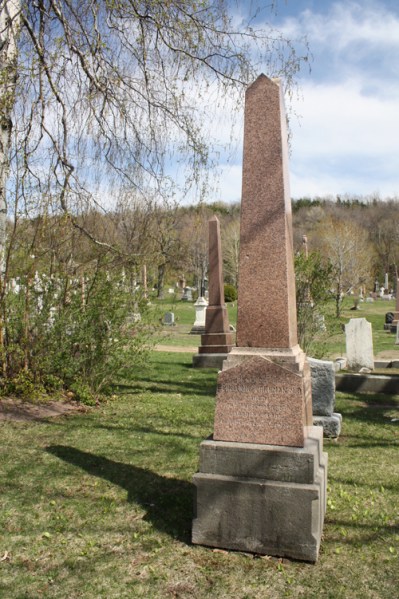
Benjamin is buried in Montreal’s Mount Royal Cemetery, near the Workman family plot. JH photo.

Benjamin Workman is probably best remembered as the founder of the Unitarian Congregation in Montreal.  In Ireland, the Workman family had attended the Non-Subscribing Presbyterian Church of Ireland in Dunmurry. Its members strongly believed in freedom of thought in religion.6

When Ben first arrived in Montreal, there were not enough Unitarians to organize a congregation, so he attended the St. Gabriel Street Presbyterian Church. When the city’s Unitarian congregation was permanently established in 1842, he played a key role.7

In 1855, Ben got into a disagreement with the congregation’s minister, Rev. John Cordner, a man he himself had recruited for the job. Benjamin argued that Cordner had excessive authority, and when the rest of the congregation sided with their minister, Ben withdrew from the church. Soon after, he moved to Toronto, joining the Unitarian congregation his brother Joseph had helped to found there. He got along well with the Toronto congregation’s members and their minister, and he ran the Sunday School there for many years.

Ben lived with his daughter Anne in Uxbridge Ontario at the end of his life, dying there on Sept. 26, 1878, several weeks short of his 84th birthday. He was buried a few days later next to the large Workman family plot at Montreal’s Mount Royal Cemetery.

This article is also posted on http://www.writinguptheancestors.ca.

See also:

Janice Hamilton, “Dr. Joseph Workman, Pioneer in the Treatment of Mental Illness” Writing Up the Ancestors, Oct 26, 2017, https://www.writinguptheancestors.ca/2017/10/dr-joseph-workman-mental-health-pioneer.html

Janice Hamilton, “Henry Mulholland, Hardware Merchant” Writing Up the Ancestors, March 17, 2016,  https://www.writinguptheancestors.ca/2016/03/henry-mulholland-montreal-hardware.html

Notes:

The children of Joseph and Catherine Workman were: Benjamin (1794-1878), Alexander (1798-1891), John (1803-1829), Joseph (1805-1894), William (1807-1878). Ann (1809-1882), Samuel (1811-1869), Thomas (1813-1889), Matthew Francis (1815-1839).

Benjamin kept a journal in which he recorded his memories of growing up in Ballymacash, and an account of the Workman family’s 200-year history in Ireland.  A large online database called A Family Orchard: Leaves from the Workman Tree, https://freepages.rootsweb.com/~database/misc/WORKMAN.htm, includes a family history going back to the 1600s, that was part of Ben’s journal. The late Calgary researcher Frederick Hunter prepared this site and database. 

Catherine Gowdey’s name has been spelled in various ways, including Gowdie and Gowdy.

Thank you to Christine Johnston, former archivist and historian of the First Unitarian Congregation of Toronto, and author of a biography of Ben’s brother Joseph.

Sources: 

1. Christine I. M. Johnston, The Father of Canadian Psychiatry: Joseph Workman, Victoria: The Ogden Press, 2000, p. 16.

2. A Family Orchard: Leaves from the Workman Tree, https://freepages.rootsweb.com/~database/misc/WORKMAN.htm, accessed Jan. 31, 2025.

3. The Digger, One Family’s Journey from Ballymacash to Canada, Lisburn.com, http://lisburn.com/history/digger/Digger-2011/digger-19-08-2011.html, accessed Jan. 31, 2024.

4. Nicholas Flood Davin, The Irishman in Canada, London: S. Low, Marston, 1877, p. 334, Internet Archive, https://archive.org/details/irishmanincanada00daviuoft/page/334/mode/2up, accessed Jan. 31, 2025.

5. Lovells Montreal Directory, 1849, p. 246, Bibliothèque et Archives nationales du Québec (BAnQ), https://numerique.banq.qc.ca/patrimoine/details/52327/3652392, accessed Jan. 31, 2024.

6. Christine Johnston, The Father of Canadian Psychiatry: Joseph Workman, p. 15.

7. Christine Johnston. “The Irish Connection: Benjamin and Joseph and Their Brothers and Their Coats of Many Colours,” CUUHS Meeting, May 1982, Paper #4, p. 2.

Understanding Mary, My Protestant Irish Ancestor

Can I learn anything about my great great great grandmother’s life, despite having only a name, a birthplace and a rough idea of where she lived as she raised her children?

That challenge led me to a fascinating thesis about the Irish Protestant Identity in Ontario written in 2010 by Brenda Hooper-Goranson. Hooper-Goranson’s research describes how many Irish women of Mary’s time ensured a lasting Irish identity in Canada that differed from that in the homeland.

Thanks to Ms. Hooper-Goranson, I have been able to imagine the life of women like my ancestor in general terms even if her actual life and personality remain obscure.

An Irish Protestant identity was transferred to Canada as solidly intact as any Irish Catholic identity was and it can even be argued that the former outlasted the latter with regard to late nineteenth-early twentieth century Canadianizing influences,” wrote Hopper-Goranson in the introduction of her thesis. “That distinctive presence was changed or softened in only one regard. In time, with the space and distance that Canada afforded, abrading homeland identities might be abridged, and Irish Protestant and Irish Catholic on new soil found opportunities to simply be ‘Irish’.1

People like Mary maintained connections to family in Ireland, helped foster relationships with neighbours, brought recipes, seeds, textiles and furniture from their home country to their new communities and fostered religious practices and apprenticeships in their children.

Whether Mary herself did such things isn’t certain. We do know that she was born in Ireland, thanks to the 1932 death certificate of her daughter.2 That same document mentions her husband’s Scottish roots, the family religion of Brethren, their daughter’s 1856 birth in Orangeville, Canada West and her death in Weston, Ontario.

Those facts allowed me to make several assumptions about my great great grandmother’s life that enabled me to read Hooper-Goranson’s thesis with an eye to imagining more. We know for sure that Mary Willard travelled from Ireland to Canada West at some point, and the decision probably wasn’t hers. A father, a husband—in those days, women didn’t often get to set their own destinies.

Where she lived in Ireland, whether she lived in other places too, whether she married her Scottish husband in Europe or elsewhere, whether they met on a specific journey or after separately travelling to North America isn’t clear. All I know for sure is that Mary Willard identified as Irish; her faith was Protestant; and she and her husband lived in Canada West when her daughter was born. Given that her daughter died in the Grand River region not far from her birth, it’s likely that her parents lived in the same region for most of their lives.

We do know that in the 1800’s, Canada attracted more migrants from Ireland than any other country in the world. When possible, these migrants tended to settle together with others of the same religion, many in Canada West, which became Ontario.

Irish hostilities between Protestants and Catholics became prevalent late in that century. Fenians raided Canada West from Irish communities in the northern states beginning in 1866. Riots broke out in Toronto in 1875, during the Jubilee March and in 1878, when O’Donavon Rossa visited the city to give a speech.

In most Canada West communities, however, Hooper-Goranson argues that the challenges of felling forests, building homes, subsistence farming and mourning the losses from fevers and disease blurred the lines between groups. Often, a general homesickness for Ireland linked Catholic and Protestant settlers together into a common identity.

Class structures brought to the New World from Europe when Mary Willard lived fell apart in a matter of months, primarily to the amount of work required just to stay alive. Women of all stations did everything required to run a household, including helping grow crops for food, making candles, producing soap, grinding sugar, baking bread, milking cows, knitting or spinning clothes and preparing flour or wool. People offering domestic assistance had so many possible positions, they could be choosy.

…the observations of lrish Protestant immigrant James Reford show that he too, took note of a change in the social climate in America when he complained that even Irish Catholic servants “from the bogs of Connoght” expected certain comforts and conveniences far different from Home. “If you want a girl to do housework the first question is have you got hot and cold water in the house, stationary wash tubs, wringer? Is my bedroom carpeted [with] bureau table wash stand and chairs … and what privileges and the wages? … The writer makes the charge that such girls are too ambitious, and deceitful about their previously humble origins.3

Despite the amount of hard work, Irish women in Upper Canada worked hard to match the fashion trends back in Ireland.

After joining her husband in Canada in 1836, Margaret Carrothers wrote several years later from London, Upper Canada, encouraging her mother to make the journey herself with the remittance pay she sent home. Part of her enticement was the reassurance that her mother could look the part of the Irish lady even on the frontier. Although Margaret requested her mother bring the latest patterns of capes, sleeves, cloaks, and bonnets she delighted that ” … Dress of every kind is worn the same here as with you only much richer and gayer …… this has become a very fashionable place you would see more silks worn here in one day than you would see in Maguires bridge in your lifetime and could not tell the difference between the Lady and the Servant Girl as it is not uncommon for her to wear a Silk Cloak and Boa and Muff on her hands and her Bonnet ornamented with artificial flowers and vail.4

Whether hostilities arose or not often depended on whether communities included nationalities beyond Catholic and Protestant Irish. In those cases, rather than differentiating between themselves, Irish settlers saw themselves as a common group against the others.

There were many occasions where Irish Protestants and Irish Catholics found cause with one another enough to march together in support or defiance of Tenants Leagues, Famine Relief, Confederation, Fenianism, Irish politics and personages, and of course, St. Patrick’s Day was held sacred to both.5

Generations of women built up and maintained national communities as religious differences diminished. They married Irish men, stayed in contact with family members in Ireland, collected Irish recipes, crafted Irish patterns onto clothing and household items, learned Irish Dancing and celebrated holidays with neighbours.

Traditionally, Irish families make their plum pudding on the last Sunday in November before the beginning of Advent. Everyone in the household is supposed to stir the mixture, which contains 13 ingredients to represent Christ and his Disciples.

My great granny Charlotte used to make one every year. I remember it being blacker than fruit cake and with a yummy rum topping.

Sadly, her recipe either was never written down or, if it was, it has since been lost. I’ve been trying to duplicate the flavour ever since.

Haven’t managed to get it right yet, but here’s my closest guess so far.

Christmas Plum Pudding

Ingredients

  • 1 cup (250g) brown sugar
  • Grated zest and juice of 2 oranges
  • 1 cup (250g) dried currants
  • 2 cups (500g) raisins, ideally different colours
  • 1/2 cup (125g) candied cherries
  • 1 can (350ml) stout (I use Buckwheat beer because I can’t eat gluten)
  • 2 cups (250g) all-purpose flour
  • 2 tsp. ground cinnamon
  • 2 tsps nutmeg
  • ground cloves
  • 1 cup (250g) butter, softened
  • 4 eggs, lightly beaten
  • 1 small apple, peeled, cored, and shredded

Directions

  1. Grease and line three pudding bowls or the cooking vessels of your choice.
  2. Mix everything together except for the eggs and the stout.
  3. Beat the eggs and slowly add them to the mixture.
  4. Pour the stout in slowly, mixing the whole time. This is a good time to get the family involved.
  5. Cover with a clean tea towel and leave overnight.
  6. The next day, preheat the oven to 350 degrees F (130C).
  7. Pour the mixture into the pudding bowls.
  8. Place deeper pans full of water in the oven. Put the bowls into the water so that they are about 2/3rds covered.
  9. Steam for 6 hours.
  10. Set aside in a cool dark place to dry.
  11. On Christmas day, steam the puddings for about 3 hours or until cooked through.
  12. Cut and serve with rum topping.

Rum Topping

Ingredients

  • 1/ cup softened butter
  • 1 cup sugar
  • 2 eggs, beaten
  • 3/4 cup rum, brandy or sherry
  • 1/4 tsp nutmeg

Directions

  1. Combine the sugar and butter with a hand mixer until fluffy and light.
  2. Beat in eggs.
  3. Add rum, brandy or sherry and nutmeg.
  4. Cook over boil water for 5 minutes or so, stirring constantly past the curdling point until the sauce looks smooth.
  5. Pour over the Christmas pudding.

Sources

1Hooper-Goranson, Brenda C. 2012. “No Earthly Distinctions : Irishness and Identity in Nineteenth Century Ontario, 1823-1900.” Dissertation, Library and Archives Canada = Bibliothèque et Archives Canada. McMaster University.

2 “Ontario Deaths, 1869-1937 and Overseas Deaths, 1939-1947,” database with images, FamilySearch (Ontario Deaths, 1869-1937), Deaths > 1932 > no 3918-5556 > image 1593 of 1748; citing Registrar General. Archives of Ontario, Toronto.

3Hooper-Goranson

4Linen Hall Library, Belfast, Edward N. Carrothers, “Irish Emigrants Letters From Canada, 1839-1870”, (Belfast Northern Ireland, 1951), pp.4-5. Margaret Carrothers, London, U.C. to Mrs. Kirk [Patrick?] Maguiresbridge, Ireland, December 25, 1839.

5Hooper-Goranson

Who were the Irish Presbyterians?

My father’s family were all professed Presbyterians, a religion which originated in Scotland. This included both those on his Scottish father’s side and his Irish mother’s side. Religion was very important in all their lives. They were part of a church, “which had a noble band of loyal devoted men and women who have counted it their chief joy to seek its highest welfare”.

It was not until 1843 that marriages performed by Presbyterian ministers were legally recognized in Ireland. My two times great grandparents, Susan Dodds and Alexander Bailey married in that year in Armagh were some of the first to have a recognized Presbyterian marriage.

The name Presbyterian comes from their form of church governance, an assembly of elders. These protestant churches trace their roots to the Church of Scotland whose theology emphasizes the sovereignty of God and following only the scriptures. The Scottish Reformation of 1560 shaped this Church, when many broke with Rome, led among others, by John Knox. This religion was brought to Ireland from Scotland with the migrations of people in the 1600s. Irish Presbyterians were never a single entity. Groups splintered, formed new congregations, united with others and broke apart again.

The majority of the Irish remained Catholic even when Henry VIII founded the Anglican Church, the Church of England and then the Church of Ireland. Most protestants lived in the north. While they soon outnumbered the Church of Ireland, the life of an Irish Presbyterian was not easy.

The government passed the Test Act in 1704, which stated that those wishing to hold civil or military office had to prove they had taken communion in the Church of Ireland. The Church of Ireland demanding tithes also angered the Presbyterians. Even after the Toleration Act of 1719 passed and Presbyterians were not penalized for their beliefs, they still felt estranged, which contributed to the large scale North American emigration in the early 1800s.

When the Susan and Alexander Bailey arrived in Toronto, they probably attended Knox Presbyterian Church, opened in 1820 as the First Presbyterian Church of York, Upper Canada. This church started by Scottish immigrants, welcomed the Irish but they wanted their own church and organized the Second Presbyterian Church in 1851.

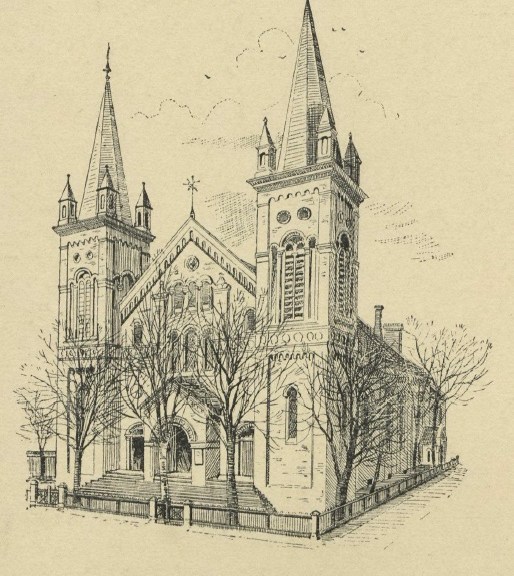
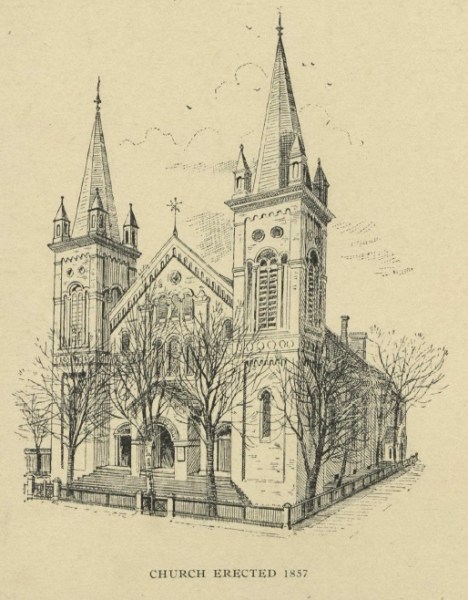
Cooke’s Presbyterian Church, Toronto, Ontario, Canada

The congregation raised money for a minister’s stipend and met first in St Lawrence Hall and then an empty Methodist church on George Street. This church soon became too small for the current members and the many others asking for seats. A new property purchased at Queen and Mutual St for 475 pounds soon a housed brick church.

There used to be many churches in the area as Toronto had a Sabbath Day Law with no public transport running on Sundays. People had to walk to church.

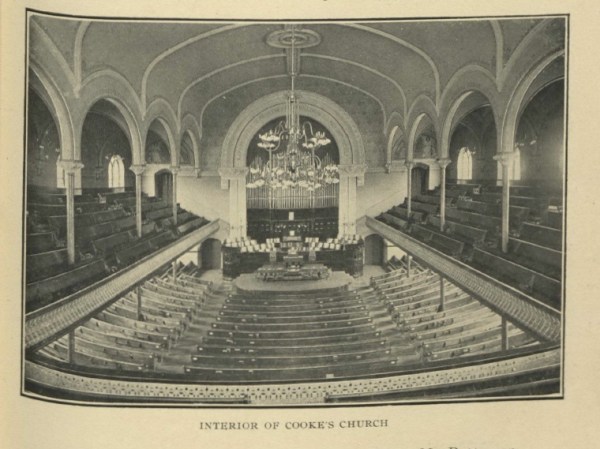
The new building became Cooke’s Church, named for Henry Cooke an Irish Presbyterian minister who in 1834 united the Irish Presbyterians. With his ordination in 1808, his ministry began in Northern Ireland. He reformed both the church and public education. He believed that the only music in churches should be what God created. There could be voices singing but no man-made musical instruments. When he died there was a massive funeral march through Belfast with all religious denominations in attendance.

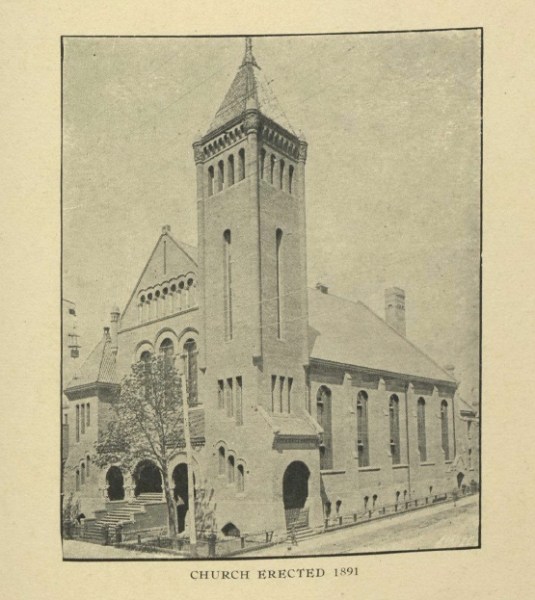
The congregation kept growing. The church was renovated, enlarged and then in 1891 a new church that could hold 2000 worshipers was built on the same site. The Irish always knew they would be welcome in Cooke’s Church.

The new Cooke’s Presbyterian Church, Toronto, Ontario, Canada

My great grandparents, William Eagle from County Monaghan and Eliza Jane Bailey, were members of Cooke’s Church. William served as an elder until his death. Both their daughters, Amy and Minnie, were very involved in church life. Amy sang in the choir and served as secretary and treasurer of other societies. Minnie was the President of the Young Women’s Mission Band which had formerly been the Ernest Helpers Society. Their mother Eliza served on the Women’s Association as well as being Honorary President of the Women’s Foreign Missionary Society.

Donald and Alice Sutherland, another set of great grandparents, although Scottish Presbyterians were also members of Cooke’s Church. Their children were named in the anniversary booklet. Mary, the Christian Endeavor Society flower convenor and Wilson on the Junior Visiting Committee. It is there that my grandparents, William Sutherland and Minnie Eagle met and were married by Reverend Andrew Taylor.

In 1925 the Presbyterians, Methodists and Congregational Unionists joined together to form the United Church of Canada. The congregations of Cooke’s Church and Knox Church both voted against the union and remained part of the Presbyterian Church of Canada. Knox Church is still an active church celebrating its 200th Anniversary this year.

Cooke’s Church interior with their large organ.

Cooke’s Church closed in 1982. There were few parishioners left as most had moved away from the downtown. It’s glory years only a memory when it was the most pretentious structure in the city, a landmark on East Queen Street and a great spiritual influence. It was torn down in 1984 and is now a parking lot.

Notes:

Roulston, William J. Researching Presbyterian Ancestors in Ireland, Ulster Historical Foundation 2020.

Alison, James. Annals of Sixty Years Cooke’s Presbyterian Church Toronto 1851 – 1911. 1911.

https://en.wikipedia.org/wiki/Presbyterianism accessed October 18, 2020.

In Ireland there were many Presbyterian Sects:

The Presbyterian Church of Ireland

The Non-Subscribing Presbyterian Church

The Secession Church

The Reformed Presbyterian (Covenanters) Church

There is a story about my great grandfather Donald Sutherland leaving his church because they purchased an organ. He seemed to subscribed to the ideas of Henry Cooke. According to a story in the Toronto Star, in 1880, a group of parishioners heard the choir had brought a organ into the church for choir practice. These people entered the church and dragged the offending instrument into the street. A riot ensued. Some were arrested and all were suspended from the church. They went off and formed their own church. Was this the incident Donald was involved with?

A story about Susan Dodds https://wordpress.com/post/genealogyensemble.com/1691

Grosse Île and the Irish

Thousands of Irish immigrants came to Canada, especially in the 1800s. They came by ship, travelling up the St. Lawrence River to Quebec City, but many got sick and some died during the long voyage across the Atlantic.

After a cholera epidemic swept England in 1831, a quarantine station was built on Grosse ÎIe, an island in the St. Lawrence downriver from Quebec City. All ships were required to stop there so passengers could be checked by doctors to ensure they were not sick. Government authorities did not want people to bring disease to the busy port cities of Quebec City and Montreal.

The worst years were between 1845 and 1849, when the terrible potato famine hit Ireland. Many of those who fled Ireland, optimistic about starting new lives in North America, never made it. Most of them succumbed to typhus, a disease caused by bacteria carried by fleas and lice. More than 7,000 people are buried in three large cemeteries on Grosse Île.

The quarantine station continued from 1832 until 1937. Today, Parks Canada runs Grosse Île and the Irish Memorial National Historic Site. This moving historic site, including several buildings and cemeteries, is open to visitors from the beginning of May until mid-October. See https://www.pc.gc.ca/en/lhn-nhs/qc/grosseile/index.

There are a number of books about this place and the tragic events that happened there. One of the most moving volumes I have read is Eyewitness, Grosse Isle, 1847 (note the alternative spelling), by  Marianna O’Gallagher & Rose Masson Dompierre, published in 1995 by Livres Carraig Books of Ste-Foy, Québec. You may be able to find it in a library or online.

This superb book begins with a map of Ireland indicating the places that sent 10 or more ships to Quebec in 1847 with Irish immigrants: 53 ships from Limerick, 33 from Cork, 32 from Belfast, 27 from Dublin, 27 from Sligo and 18 from Londonderry.

The authors got the idea for this book after reading letters that the chaplains of the quarantine station wrote to their superiors during the summer of 1847. The authors wrote, “In order to present a full portrait of the dramatic events that unfolded at Grosse Isle, and in order to distinguish between myth and reality, this book will be the forum where eyewitnesses speak. The priests’ letters, little known until today, but which are very significant, contain descriptions of everyday occurrences, prevailing conditions at ‘the Quarantine’ in 1847. The situation proved to be dramatic and arduous, and the missionaries, faced with the spiritual and physical needs of the immigrants, felt powerless and besieged. Very soon their letters elicited response from many quarters.”

For example, Rev. Armine W. Mountain, Church of England, Acting Chaplain Quarantine Station, wrote:

Buried: Meek, Catherine, daughter of James Meek, mason, late of the parish of Whiteburn, County Linlithgow, Scotland, and of France, by her maiden name Somerville, his wife, aged two years, died on the twenty-second and was buried on the twenty-fourth day of May in the year of our Lord one thousand eight hundred and forty-seven, by me – Armine W. Mountain – Present: Robert Armstrong, Joh X. Armstrong.

Rev. Charles Morice, Catholic Priest, Officiating Chaplain Grosse Isle, wrote:

Buried: Heatherington, Taylor, Craig, White, McCray, McCray, Smyth

Hugh Heatherington, aged forty, from Ship Dykes

Margaret Taylor, aged twenty three per ship Maria Soames

Elizabeth White, age sixty-three from ship Emigrant

Margaret McKay, age forty two years per ship Eliza

Alexander McKay, age fifty-two per ship Eliza

Robert Smyth, age two years per Sir Henry Pottinger died sixth October. All died, except the last, on the seventh of October and were buried on the evening of the same day in the year of our Lord one thousand Eight hundred and forty-seven by me – Charles Morice – Present: John Fitzgerald, Patrick Dolan

 https://www.amazon.ca/Eyewitness-Grosse-Isle-Marianna-OGallagher/dp/096908059X

Other suggested reading:

John Boileau, “The Dead of Grosse Île,” Legion: Canada’s Military History Magazine, March 1, 2006, https://legionmagazine.com/en/2006/03/the-dead-of-grosse-ile/

You can read a list of some of those who died on Grosse Île at https://www.pc.gc.ca/en/lhn-nhs/qc/grosseile/decouvrir-discover/natcul4.

To search Library and Archives Canada’s records, see “Immigrants at Grosse Ile Quarantine Station, 1832-1937,” https://www.bac-lac.gc.ca/eng/discover/immigration/immigration-records/immigrants-grosse-ile-1832-1937/Pages/immigrants-grosse-ile.aspx

Irish Catholic Churches in Montreal

Every year, the city of Montreal hosts a huge St. Patrick’s Day parade that brings people by the thousands to the downtown streets to celebrate their real or imagined Irish heritage. In fact, many Montrealers do have Irish roots that go back centuries.

In 1700, around 130 of the 2,500 families in New France, or roughly 5%, were Irish, and there was massive immigration from Ireland to North America between 1816 and 1860. By 1871, the Irish were the second largest ethnic group in Canada after the French.

The year 1847 was a tragic one as the Irish fled poverty and starvation in their homeland and died of disease before they arrived in Canada. Almost 3900 are buried at Grosse Île, an island in the St. Lawrence River northeast of Quebec City; another 5,000 are buried at the so-called fever sheds near the Montreal waterfront. Many children who became orphans at this time were adopted by French families, but kept their Irish names.

The early Irish of Montreal resided in the central part of the city. Over time, they moved westward, eastward and northward into Saint Ann’s, Saint Mary’s, Saint Antoine’s, Saint James’, Saint Lawrence’s and Saint Louis Wards. They were the primary residents in districts such as Griffintown, Point-St-Charles, St. Henry, Verdun and Ville Émard. Other Irish families eventually moved east into the Rosemount and Hochelaga districts.

Prior to the establishment of St-Patrick’s church in 1847 and St-Ann in 1854, the main churches of the Irish in Montreal were Notre Dame de Bon Secours, the Church of the Récollet Fathers and Notre Dame Basilica.

When I identify a church as being Irish Catholic in this research guide, I do not mean to imply that parishioners were mostly of Irish descent. It does suggest that, at one point in time, a minimum of 10% of the acts of baptism, marriage and death records addressed Irish immigrants or their descendants.

Especially during the early years, acts of baptism, marriage and death that took place at most of the smaller parishes in the Montreal region were registered in the records of Notre-Dame Church. For example, a baptism or marriage might have been held in Griffintown, but the act would have been included in the Notre-Dame-de-Montréal records.

The attached research guide lists the churches in which the Irish presence was appreciable, or parishes that were inaugurated by members of the Irish community. The years in brackets reflect the year I was able to ascertain as being the beginning of the Irish-Scottish-British presence in these Catholic churches. I reached my conclusions following several years of research on more than 3,000 books addressing marriages and baptisms at the Archives nationales du Québec (BAnQ) in Old Montreal.

This research guide includes descriptions of the parishes where Irish Catholics attended church in the Montreal region, as well as a list of the cemeteries where many of them were buried. It also includes a list of recommended books and articles, and a list of repositories including archives and museums, online resources and other local sources of information. It is part of a series of research guides to Irish family history resources across the province of Quebec.

To access the PDF research guide to Irish Catholic Churches of Montreal, click on the link:

Irish Catholic Churches in Montreal from 1815

Irish Catholic Churches of Arthabaska, Compton, Frontenac, Mégantic, Wolfe Counties, Quebec

The research guide below is part of a series of seven compilations designed to help you find your Irish immigrant ancestors in mostly French-speaking Quebec. It explores Arthabaska, Compton, Frontenac, Megantic and Wolfe counties, the most easterly of the province’s Eastern Townships.

Few Irish people came to this primarily rural area until the late 1800s. The earliest church record I was able to trace in regard to the Irish of these counties was 1829, within the parish of Saint-Jacques in the then village of Leeds, Megantic County.

Parish records can help you find traces of the Irish setters who came to North America by the tens of thousands during the first half of the 19th century. Please note: The inclusion of an Irish Catholic churches in this research guide does not imply that parishioners were mostly of Irish descent, but implies that at one point in time, a minimum of 10% of the acts of baptism, marriage, death addressed Irish immigrants or their descendants.

A good place to start looking for English-speaking settlers in the Eastern Townships is the Eastern Townships Resource Centre, http://www.etrc.ca/. The Eastern Townships Resource Centre preserves the documentary heritage of the Eastern Townships and serves as an archival expertise resource for local heritage organizations. While its Archives Department concentrates on the acquisition of private archives related to the English-speaking community, the Centre’s mission, mandate and on-going activities are meant to be inclusive of all communities present in the Eastern Townships.

Thousands of documents such as diaries, letters, minute books, photographs, postcards, maps, plans and audio-visual material are made available to researchers. Assistance is also provided to genealogists tracing their family roots. You will find contact information for this organization at the end of the PDF research guide below.

Another research guide I prepared a few years ago may also be helpful to your search. See “British, Irish, Scottish, Loyalist, American, German, Scandinavian, Dutch and Huguenot families in Lower Canada and Québec” by Jacques Gagne, https://genealogyensemble.com/wp-content/uploads/2015/04/british-irish-scottish-loyalist-american-german-scandinavian-dutch-in-quebec2.pdf

townships map

This guide mentions a number of books about Quebec’s large Irish population. Two additional articles of interest are, “Pioneer English Catholics in the Eastern Townships” by T.J. Walsh, http://www.cchahistory.ca/journal/CCHA1939-40/Walsh.html  and “A.C. Buchanan and the Megantic Experiment: Promoting British Colonization in Lower Canada” by J.I. Little, https://hssh.journals.yorku.ca/index.php/hssh/article/viewFile/40265/36450

The attached research guide is an expanded and improved version of a similar guide I posted on Genealogy Ensemble in 2014. It includes a detailed list of the Catholic parish churches in these five counties where people with Irish names worshiped. It also includes links to help you find the cemeteries where they were buried, a recommended reading list and a list of archives and other repositories where further records can be found.

Click on the link to open the PDF:  Irish Catholic Churches of Arthabaska, Compton, Megantic, Frontenac, Wolfe counties


Irish Catholic Churches in Rural Quebec: Bagot, Brome, Missisquoi, Shefford Counties

Between 1815 and 1837, an estimated 200,000 Irish immigrants arrived at the Port of Quebec. Many continued on to the United States or Upper Canada, but some settled in Quebec’s Eastern Townships. This research guide is designed to help you find Irish Catholic ancestors who lived in the Eastern Townships counties of Bagot, Brome, Missisquoi and Shefford.

Please note: When I identify a church as being an Irish Catholic Church in this research guide, I do not mean to imply that parishioners were mostly from of Irish descent. Rather, I mean that, at one point in time, at least 10 percent of the acts of baptism, marriage and death within a particular parish addressed Irish immigrants or their descendants.

If you are researching ancestors in this region, you may find the Eastern Townships Resource Centre (ERTC), http://www.etrc.ca/ to be helpful. For more than 30 years, the ETRC has been preserving the documentary heritage of the Eastern Townships and serving as an archival expertise resource for local heritage organizations.

The ETRC Archives preserves collections that illustrate the development of the Eastern Townships’ English-speaking community. Thousands of documents such as diaries, letters, minute books, photographs, postcards, maps, plans and audio-visual material are made available to researchers, and assistance is also provided to genealogists tracing their family roots.

The research guide attached below includes brief histories of the Catholic churches attended by Irish Catholics in these four counties, a list of cemeteries where these people may have been buried, a list of books and articles about the Irish in Quebec, and a list of website and archives you may find useful.

It is an expanded and updated version of a guide to Irish Catholic churches in Quebec posted to Genealogy Ensemble in 2014. Other similar guides that have been posted over recent weeks explore the Irish Catholic churches in Lanaudière, in Quebec City, and in other Eastern Townships counties, with more research guides covering other regions of Quebec to come soon.

Click on the link below to view a PDF of the research guide Irish Catholic Churches in Bagot, Brome, Missisquoi and Shefford Counties:

Irish Catholic Churches in Bagot, Brome, Missisquoi, Shefford Counties


Happy St. Patrick’s Day

Montrealers really enjoy a parade and this year marks the 194th Saint Patricks Day Parade organized by the Irish Society of Montreal. On Sunday, March 19th people will line St Catherine’s Street, mostly on the sunny side, to cheer the floats, dance to the bands and even have a “little something” to help them stay warm.

This is a great time to start researching your ancestors. You never know what stories you will uncover. Some of you may find Irish roots even if your name is Tremblay or Gagnon. Many Irish came to Canada in the mid-1800’s, before and after the potato famine. Sandra McHugh’s great-grandparents left Ireland at this time but moved to Scotland rather than  North America. Read about their journey in Everyone is Irish on St Patricks Day. https://genealogyensemble.com/2016/03/16/everyone-is-irish-on-st-patricks-day/

Most of the Irish immigrants to Canada arrived in Quebec City and then traveled on to Montreal. Some of the Irish Catholics did settle in towns and villages all around Quebec while most of the Protestants moved on to Upper Canada. Jacques Gagne’s The Irish of Frampton Quebec https://genealogyensemble.com/2016/09/11/the-irish-of-frampton-quebec/ and The Irish Catholic Churches of Quebec https://genealogyensemble.com/2014/05/20/irish-catholic-churches-of-quebec/ are great sources of information on the lives of these people who populated Quebec.   

Janice Hamilton shows that persistence pays off in genealogy research in her Breaking Through My Sherman Brick Wall about the Irish origins of her great great grandmother Martha Bagnall Shearman. https://genealogyensemble.com/2016/07/06/breaking-through-my-shearman-brick-wall/ Census, birth, marriage and death records are harder to find in Ireland as a fire destroyed the Public Records Office in1922 but information can still be found. Janice found that aside from Canada the family has spread to the United States and New Zealand. There are Irish everywhere.

My Irish ancestors were all Protestants and more apt to celebrate the glorious twelfth than Saint Patricks Day. The Orangemen would march on July 12th to celebrate the battle of the Boyne when the protestant king, William of Orange defeated catholic James II. Susan Dodds and Alexander Bailey came from County Monaghan in Northern Ireland and their story is told in The Sampler. https://genealogyensemble.com/2016/04/20/susan-dodds-sampler/

So whether you have the ancestors or just want to pretend, have corn-beef and cabbage, drink a green beer and celebrate being Irish!

Breaking Through My Shearman Brick Wall

In 2014, I wrote about the brick wall surrounding the Irish origins of my great-great grandmother Martha Bagnall Shearman.1 Thanks to the generosity of a new-found distant cousin, I have now demolished that brick wall, moved the family tree back another six generations and discovered additional Shearman family branches in New Zealand and the United States.

I knew that Martha Shearman was born in Waterford, Ireland, married Charles Francis Smithers there in 1844 and came to Canada three years later.2 Because of Charles’ career in banking, the Smithers family lived for several years in Brooklyn, New York, and I discovered that two of Martha’s brothers and a sister had also immigrated to Brooklyn. I knew nothing, however, about the Shearman family’s roots in Ireland.

I posted the article online and eventually Lorraine Elliott, who was born in New Zealand and lives in Australia, came across my blog, Writing Up the Ancestors. She contacted me to tell me that her ancestor Robert Clarke Shearman,3 a New Zealand policeman, was another of Martha’s siblings. The clue that helped convinced her we were related was a photograph in her great-great-grandfather’s album identified as Maria Boate, Martha’s and Robert’s sister in Brooklyn.

Some years ago, Lorraine’s research had led her to a genealogy of the Shearman family written in 1853 by John Francis Shearman (I’ll refer to him as JFS). He was a cousin of Martha’s and Robert’s, an amateur archaeologist and a Catholic priest. (Some of the Shearmans were Protestants, others converted to Catholicism.) This document is in the archives of the National University of Ireland at Maynooth, near Dublin. She sent me the notes she had on that document, along with some of her own research on the extended Shearman family.

The JFS genealogy takes the Shearmans back to the mid-17th century when Thomas Shearman (c 1610-1704) came to Ireland from England with Oliver Cromwell’s invasion forces. He then settled in Burnchurch, County Kilkenny. Subsequent generations of Shearmans lived in and around Grange, not far from Kilkenny City.

P1220924
Grange House, now long gone, was once on this road in County Kilkenny.

Lorraine’s notes stated that Martha was one of 13 children, and that their parents were Thomas Shearman (c 1785-1850) and his wife, Charlotte Bennett Clarke (no dates available).4 Her research suggested that Thomas lived in Dunkitt, Kilkenny, near the city of Waterford, but other sources say that he was from the nearby city of Waterford. Perhaps he lived in Dunkitt in his early life, then moved to the city.

I recently came across another Shearman genealogy on familysearch.org.5 This 15-page manuscript was written in 1863 by a member of another branch of the family, George Shearman (1818-1908) of Penn Yan, a small town in New York State. It was clearly based on the family history written by JFS 10 years earlier, and it added more detail about George’s line and had less information about mine. It listed Thomas Shearman and named his sons, but only mentioned that he had five daughters.

All this information comes with a caveat: neither of these documents meets the requirements of genealogical proof standards. The names and dates of birth, marriage and death were probably based on family records and anecdotes and parish records that existed at the time, but today there are no official records in Ireland to back them up.

Nevertheless, records of the Shearmans can be found in various cemeteries, old Irish city directories, newspaper articles, Tithe Applotment Books and indexes of wills. Kilkenny researcher Edward Law found numerous records pertaining to Grange House, home to my Shearman ancestors, and the librarian with the Kilkenny Archaeological Society, Rothe House, Kilkenny was extremely helpful in my search for traces of the family.

This article is also posted on writinguptheancestors.blogspot.ca.

Footnotes

  1. Janice Hamilton, “My Shearman Brick Wall”, Writing Up the Ancestors, Feb. 9, 2014, http://writinguptheancestors.blogspot.ca/2014/02/my-shearman-brick-wall.html
  2. Janice Hamilton, “Waterford Cathedral: A Tale of Two Weddings”, Writing Up the Ancestors, June 8, 2016, http://writinguptheancestors.blogspot.ca/2016/06/christ-church-cathedral-waterford-tale.html
  3. Robert S. Hill, “Shearman, Robert Clarke”, from the Dictionary of New Zealand Biography, Te Ara – the Encyclopedia of New Zealand, http://TeAra.got.nz/en/biographies/1s10/shearman-robert-clarke. Note that this article says Robert’s uncle was William Hobson, first governor of New Zealand; Lorraine has been unable to confirm that.
  4. Charlotte was the daughter of Waterford pewter manufacturer Charles Clarke and his wife “Miss Bennett, late of Bath.” My maternal line has now come to another brick wall.
  5. “Genealogy of the Shearmans”, prepared by George Shearman of Penn Yan, New York, c. 1863 https://familysearch.org/ark:/61903/3:1:939K-VQH2-8?mode=g&i=113&wc=9DWX-ZNL%3A1040900401%2C1040900901%3Fcc%3D1880619&cc=1880619