Category Archives: Loyalists

Petticoat Pioneer

(reposted from June 2020)

Charlotte Haines (1773-1851) was only ten years old when the breakaway 13 colonies won the War of Independence in April 1783. Those residing in the new United States of America, who had remained loyal to the British Crown, were persecuted and forced out of their homes and their belongings seized. Chaos reigned everywhere and families were torn apart.

One fateful day around this time, young Charlotte sneaked away to visit her British Loyalist cousins, against the expressed wishes of her American Patriot stepfatheri. Upon her return, standing outside the front door, he refused her entry back into the family home.

Charlotte was my three-times great-grandmother. Her daughter Margaret Ann Peters married Daniel Hanington and their son James Peters Hanington was my grandmother’s father.

The British government came to the aid of these Loyalists and arranged for transportation for those who wished to leave the new America. Charlotte’s grandparents, Gilbert and Anna Pugsley, rescued young Charlotte and her brother David. Together they sailed from New York for ten days on the “Jason”ii, with 124 other “refugees” as part of the final large scale evacuation and landed in New Brunswick (then still part of Nova Scotia) in October 1783…just in time for the brutally cold winter.

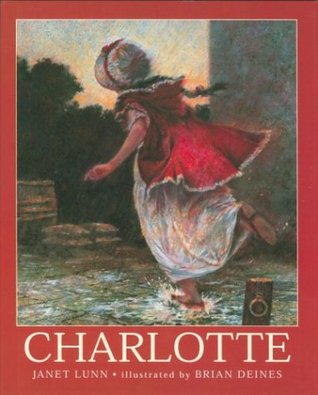
Charlotte has been the favourite subject of a couple of books and several folktales. She warranted her own chapter in “Pioneer Profiles of New Brunswick Settlers”iii and is the main character in a children’s book titled “Charlotte”iv. One folktale claimed that she was the first Loyalist to set foot ashore (not true) and in doing so, she lost her “slipper” in the mud (possibly). The matching slipper (unlikely) was donated to the New Brunswick Museum years later, however, it looks somewhat too big and stylish for a ten-year old girl. But they make wonderful stories and fully recognize young Charlotte as one of the first “petticoat pioneers” of New Brunswick.
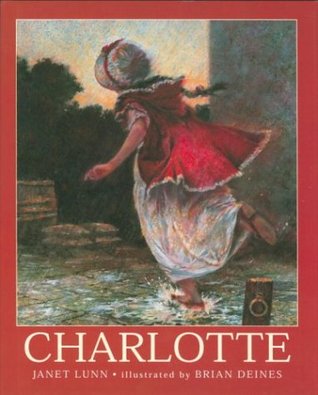
Children’s story about Charlotte Haines by Janet Lunn

Fourteen thousand Loyalists established a new settlement in 1783 along the St. John River and shortly afterwards they petitioned for their own colony. In 1784, Great Britain granted their request and divided Nova Scotia into two — New Brunswick and Nova Scotia. The Loyalists, who made up 90 percent of the population of New Brunswick, became a separate colony with its capital, Fredericton, 90 miles upriver from Saint John.

The Loyalists and their children were entitled to free land once they provided the necessary proof. Charlotte, as the biological daughter of John Haines, a Loyalist on record, appears in 1786 documentation as one of the grantees of 84 lots on Long Island, Queen’s County, along with several other prominent Loyalists – although she was only 13 at the time. I can imagine her grandfather Pugsley nodding discreetly in her direction as he looked after her interests.

For their first three years, the British provided the Loyalists with a few simple tools, blankets, material for clothing and seeds for wheat, peas, corn and potatoes. The rations of basic food supplied by the British supplemented the abundance of game and fish available to them in the forest and streams. Most lived in tents on dirt floors until they were able to build primitive log cabins. Tree by tree, stump by stump, the fertile uplands were cleared to widen the fields making them ready for crops.

The Loyalists kept meaningful social contacts through various community events. Neighbours organized “frolics” whereby the men would work together to clear land, move rocks, build a barn or complete some other task which proved impossible for one or two people. At the same time, the women prepared meals and the children had a chance to play with friends. Women also held their own frolics to make quilts, card wool or shell corn. These Loyalist neighbours were dependent on one another in times of sickness, accidents and childbirth and supported one another at gatherings for weddings, funerals and church services.

Perhaps Charlotte met her future husband at one of these popular frolics. At 17, Charlotte married William Peters (also from a United Empire Loyalist family) in 1791 in Gagetown. Soon afterwards, the happy couple moved downriver, settled in Hampstead and built a home where the St. John River widens to a magnificent view.

At that time, there existed only ten miles of roadway in the whole province and another 20 years would pass before there would be an 82-mile long road linking Fredericton and Saint John. However, in the meantime, the river served as a “highway” enabling the transport of passengers and necessary goods between the two cities.

When the steamboats first chugged noisily up the river in 1816, William decided to compete with them and he built a 100-foot long side wheeler powered by 12 horses walking up and down the deck and propelling the boat along.
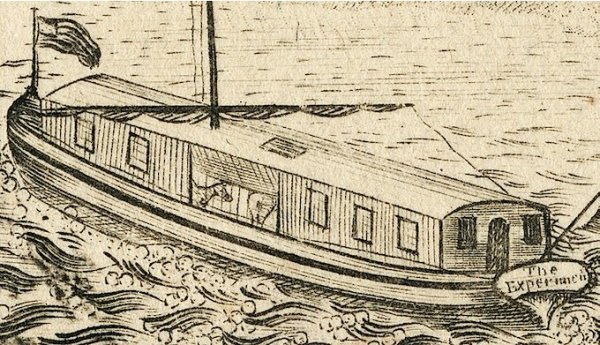
A drawing of The Experiment – an example of another horse powered side wheeler.

William actively pursued his interest in politics, and as the first representative of Queen’s County in the New Brunswick Legislature, he spent a lot of time in Fredericton (50 miles away) attending the sessions of Parliament.

Meanwhile, back home, Charlotte managed their entire land-holding on her own. Eventually they had 15 children, five sons and ten daughters. She bore her last child at 50 years old according to the baptismal certificate. They all survived except their son John who drowned at 21 attempting to save another man’s life.

Not only did she clothe, feed and care for them all (including the servants) but also provided much of their early education as well. On Saturday evenings in the summer, the fiddlers would play rollicking tunes and the tapping of dancing feet could be heard in big houses and cabins alike. When winter shut down the fields, and with food plentifully stored in the cellar, the spinning wheels would begin to hum during those coldest months.

By the time William died in 1836, they had recently relocated to Woodstock (100 miles upriver from Hampstead) with two of their younger children, James and Caroline. Their older children were married with homes of their own scattered along the St. John River Valley. Around this time, she wrote a letterv to her daughter Susan, Mrs. Thomas Tilley:

I take my pen to address a few lines to you to inquire after the health of you and all of your family.  The grate distance we are from you prevents me from hearing.  You heard of the death of your Father at Woodstock.

Charlotte described William’s death in some detail and then continued:

I hop [sic] this may find you all well.  I am not well.  My head troubles me very much.  There is not one day that it don’t ake [sic] so that I cant hardly stir.  My cough is something better.  James and Caroline is well and harty [sic] and quite contented hear.  I like the place and if your Father has lived and been hear to see to it we might have made a good living.  It is pleasant and a good place for business but we must try to due the best we can.  The place is out of repair and soon would have been a common if we had not come hear.  I should be glad if my friends was near to us.  I don’t know as ever I shall see you all again.  I thought to have gon [sic]to see you all before I came up hear but I was so sick that I could not go down to see you.  James and Caroline wishes to be remembered to you and all the family.  I desire to be remembered to Thomas and the children and tel them I should be glad to see them and you.  Give my love to all inquiring friends and except a share for yourself.
This from you afectionet [sic] Mother, Charlotte Peters

Although she had her share of aches and pains at that time, she lived another 15 years and ultimately enjoyed the blessing of 111 grandchildren.

She had a powerful influence over all her family for she believed that their heritage carried a great responsibility to others. When the grandchildren would visit, her graceful hands were always busy winding yarn or knitting a sock while patiently answering their questions and reciting passages from the bible.

One of her grandchildren, Samuel Leonard Tilley, later known as Sir Leonard, served as Premier of New Brunswick and went on to became one of the Fathers of Confederation.
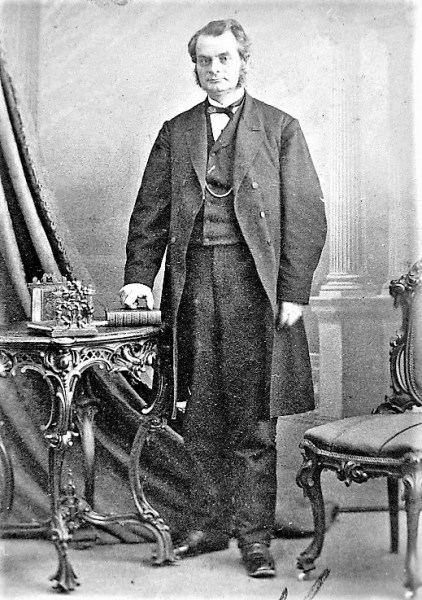
Sir Samuel Leonard Tilley 1864

A common tale states that Tilley proposed the term “Dominion” in Canada’s name, at the London conference in 1866, which he gleaned from Psalm 72:8 – “He shall have dominion also from sea to sea, and from the river unto the ends of the earth”. Ultimately, as Minister of Finance in the federal government, he was also instrumental in seeing the transcontinental railway completed.vi

Young Charlotte Haines might have felt all alone in the world at age ten but, when she died 68 years later, the epitaph on her tombstone proclaimed her legacy: “…Lamented by a large circle of descendants and friends by whom she was universally beloved and respected.”
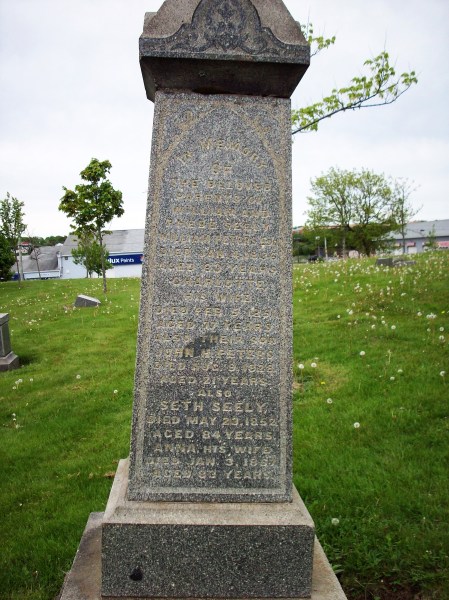
The gravestone of Charlotte Haines Peters and family – St.John’s Anglican Church, Gagetown, Queens County, New Brunswick

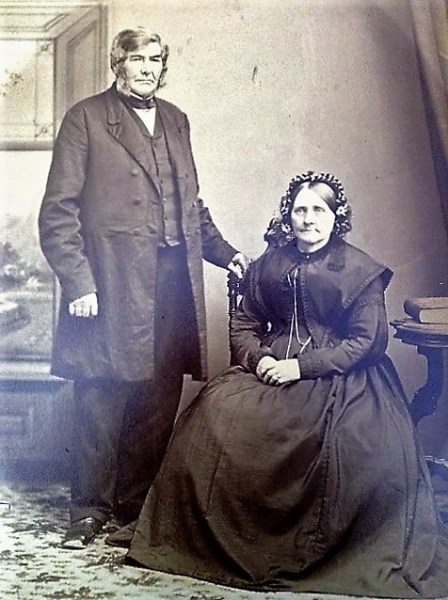
Charlotte’s daughter Margaret Ann Peters and her husband Daniel Hanington “Roaring Dan” (my great great grandparents).

Notes:

iCharlotte’s mother, Miss Pugsley, died when she was very young. Charlotte’s father remarried Sarah Haight before he died. Then Sarah remarried Stephen Haviland who was Charlotte’s stepmother’s husband (step step father?)

iiThe Ship Passenger Lists, American Loyalists to New Brunswick, David Bell, http://www.uelac.org/Loyalist-Ships/Loyalist-Ships.php as seen 2020-03-28

iiiCharlotte Gourlay Rovinson, Pioneer Profiles of New Brunswick Settlers, (Mika Publishing Company), 1980, p.143.

ivJanet Lunn, Charlotte, (Tundra Books), 1998.

v https://queenscountyheritage.wordpress.com/2011/09/28/loyalist-of-the-day-charlotte-haines-peters/ as seen 2020-04-02

vi Conrad Black, Rise to Greatness: The History of Canada, (Random House), 2014.

Image – https://wiki2.org/en/Experiment_(horse-powered_boat) as seen 2020-06-11
William Hanington comes to Canada in 1785

… and now his church celebrates its 200th Anniversary in 2023

(upcoming celebration details below)

The deed described the property as “a commodious estate upon the outskirts of the thriving town of Halifax, in the Colony of Nova Scotia, Canada”. Imagine William’s surprise to arrive in Halifax in February to discover that “outskirts” meant a 200-mile hike through thick forest and deep snow!

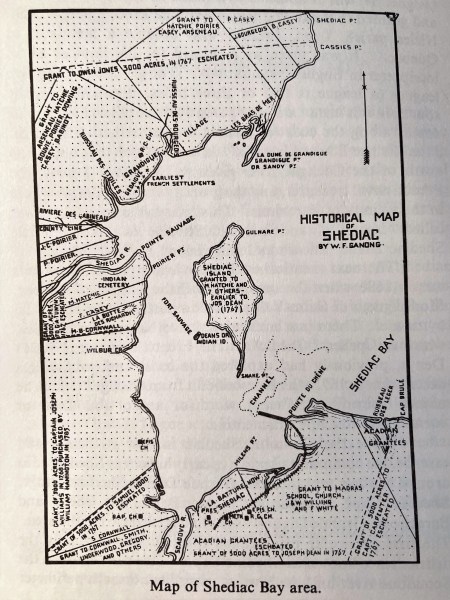
My great-great-great grandfather, William Hanington, was born in London, England, in 1759. As the son of a fish dealer, he trained as an apprentice to the Fishmonger’s Company but became a freeman in 1782. Two years later, at the age of 25, this adventurous young man paid £500 sterling for 5,000 acres of land “near” Halifax, Nova Scotia, from Captain Joseph Williams.

After the initial shock upon their arrival, William and his companion found an Indian guide, loaded all their worldly belongings onto a hand sled, trudged through the snow, slept in the open and finally arrived in bitterly cold Shediac in March 1785. His discouraged companion quickly returned to Halifax and sailed back to England on the first available ship!

Large Lower left piece of land belonged to William Hanington 1785

William, however, was obviously made of sturdier stuff and delighted by what he found! A good size stream flowed into the bay and he had never seen such giant trees! He must have pictured the lucrative possibilities for trade in lumber, fish, furs and more.

Seven years after his arrival in Shediac, at the age of 33, he hired a couple of Indian guides to paddle a canoe over to Ile St. Jean (now known as Prince Edward Island) where there were other English settlers. The Darbys were Loyalist sympathizers who escaped from the rebels in New York. While riding along in an oxcart through St. Eleanor’s (now known as Summerside), he spotted a young lady (age 18) named Mary Darby, drawing water in her father’s yard. After a brief stay with her family, William and Mary married and paddled back to Shediac where they eventually raised a large family of 13 children.

After the first three years together, they persuaded Mary’s sister Elizabeth and her husband John Welling to come over from Ile St. Jean and settle on their land – becoming the second English family in Shediac.

And in the next five years, William boasted eight families on his property of about one hundred acres of cleared land. He opened a general store and dealt in fish, fur and lumber. The furs and timber were shipped to England and the fish to Halifax and the West Indies! He imported English goods from Halifax and West Indies products – mainly sugar, molasses and rum from St. Pierre. He also bartered with the friendly Indians for furs and helped them clear land.

Before long, a considerable village clustered about the Hanington Store – including a post office and a tavern. William remained the leading figure of the community and acted as the Collector of Customs of the Port, Supervisor of Roads and Magistrate enabling him to officiate over the marriages of many couples. To top it all off, in 1800, just 15 years after his arrival from England, this remarkable young man built a shipyard 10 miles north of Shediac in Cocagne.

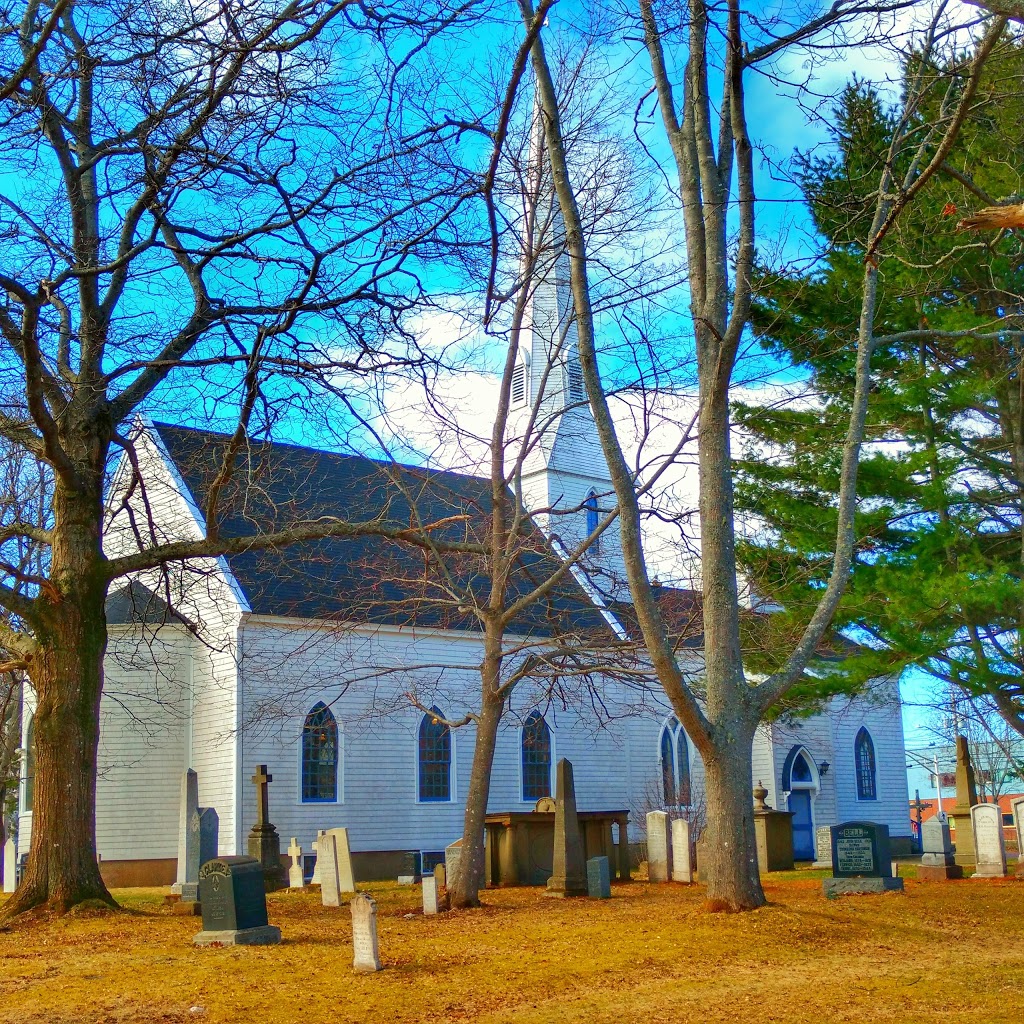
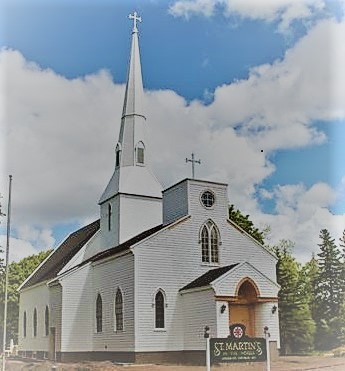
The only thing lacking in this delightful little community was a church. Until then, William being a religious man, conducted service in his home every Sunday and welcomed all to attend. Then in 1823, William donated the necessary land and lumber and oversaw the completion of St. Martin-in-the-Woods, the first Protestant church. He named it after his church in England; the famous St. Martin-in-the-Fields overlooking Trafalgar Square in London.

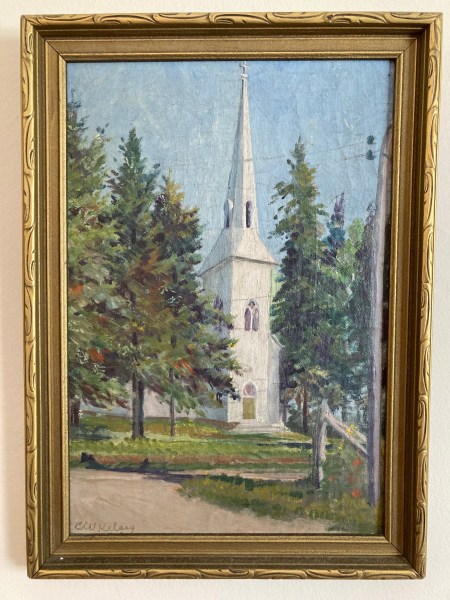
Painting of

St Martin-in-the-Woods Church

by Charles Kelsey

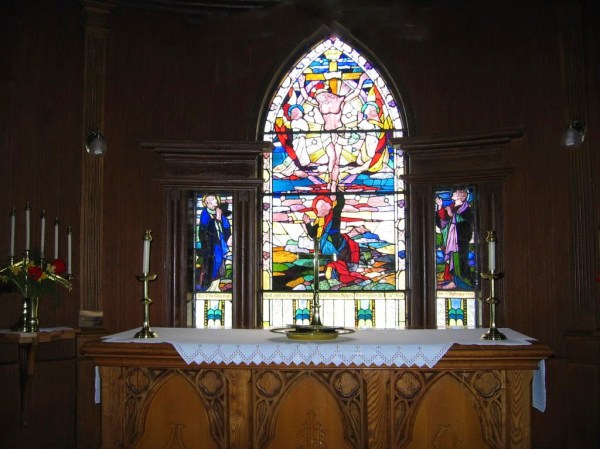
In 1934, my grandfather Canon Sydenham Lindsay (Shediac summer resident at Iona Cottage – She Owned A Cottage – with his wife Millicent Hanington and sometimes stand-in priest at the church) dedicated a large memorial stain glass window in the sanctuary to his father-in-law, Dr. James Peters Hanington (1846-1927) who was my great-grandfather and William’s grandson. The window was designed and installed by Charles W. Kelsey of Montreal and described as follows:

The centre light of the window represents the Crucifixion, with Mary Magdalene at the foot of the cross, while the two side windows represent the Blessed Virgin Mary and Saint John the Evangelist.(1934 – The Montreal Gazette)

Stain Glass Window in St Martin-in-the-Woods (photo credit Paul Almond)

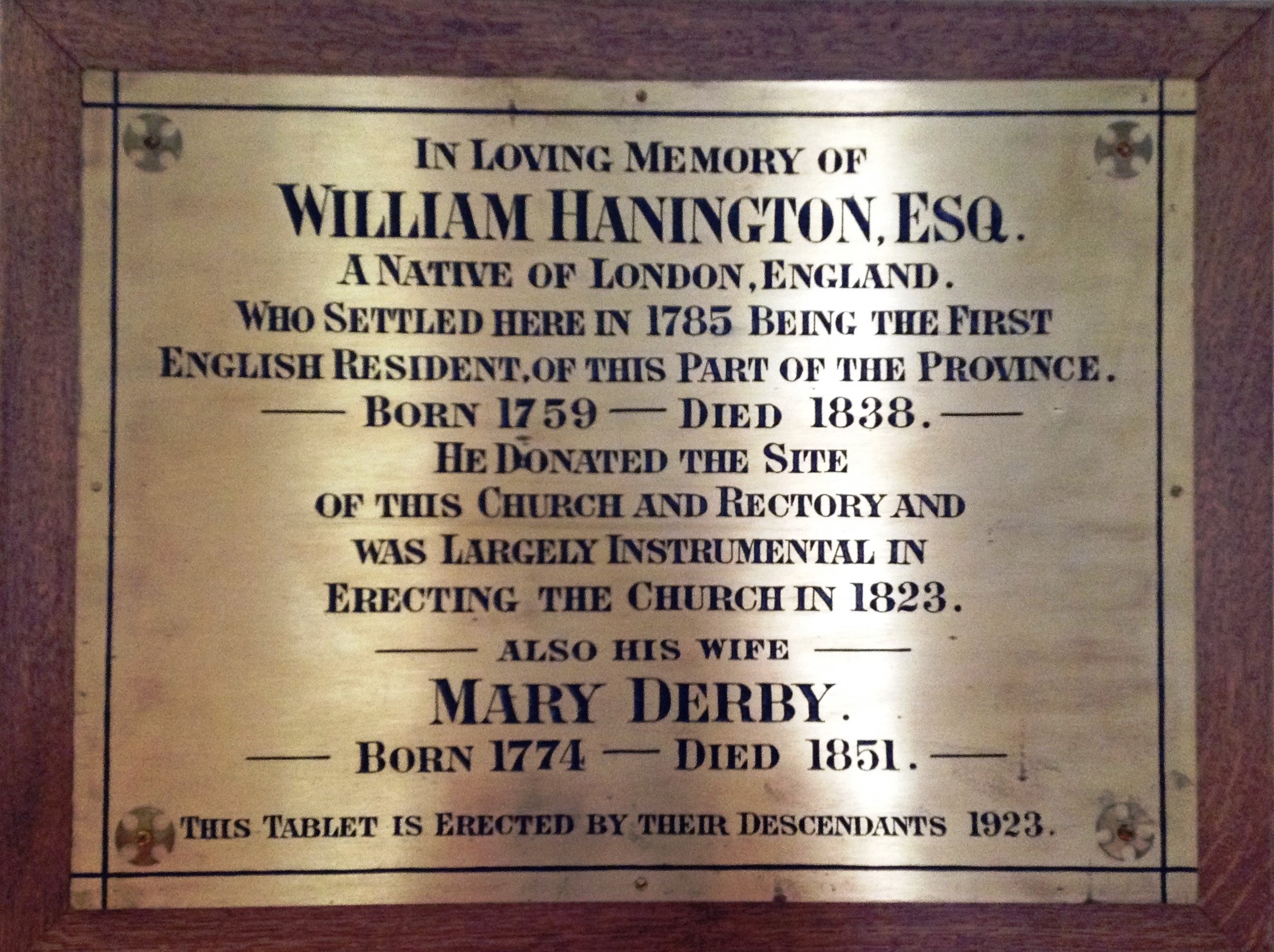
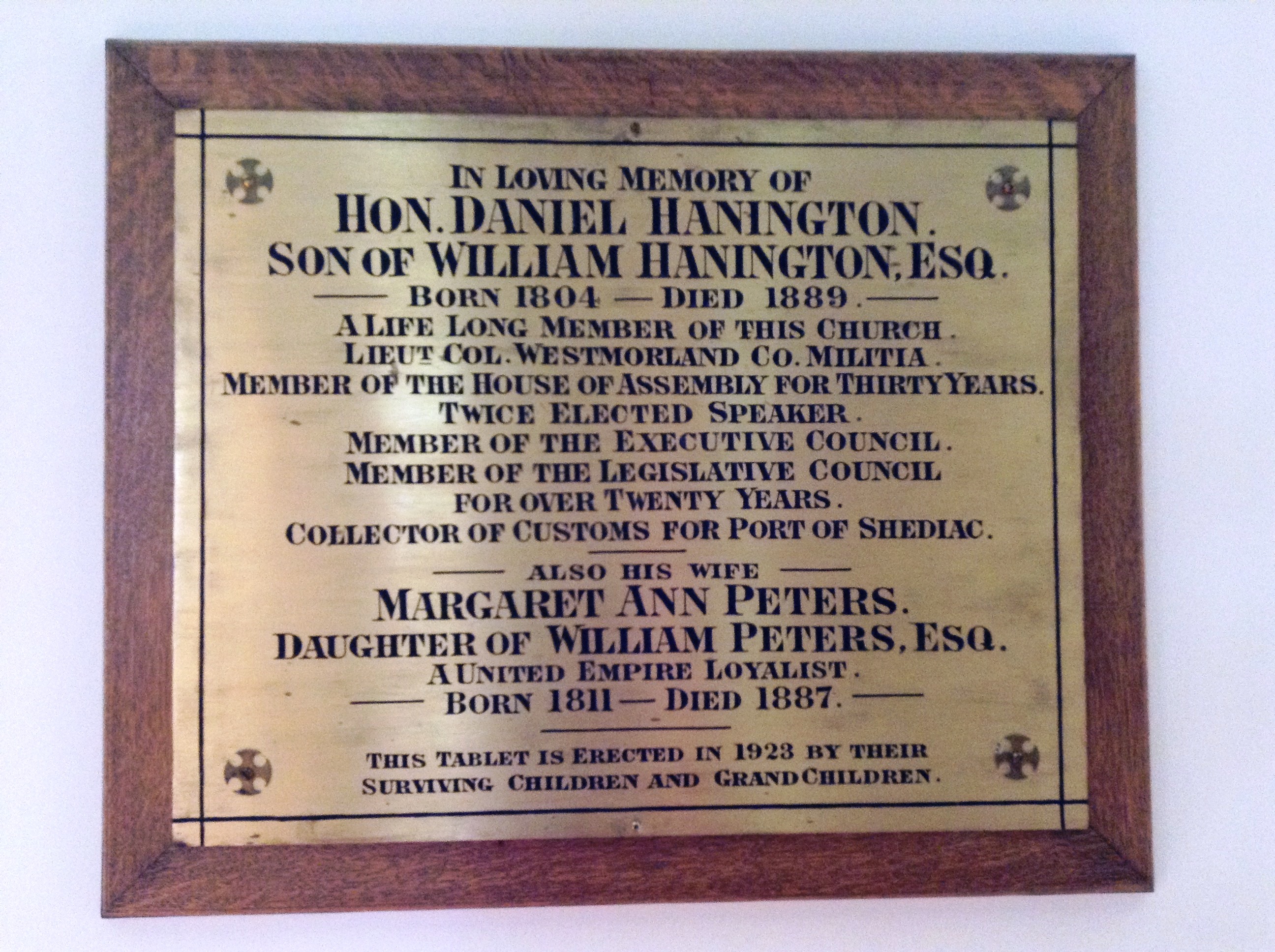
Also mounted inside on the church’s side walls are two honourary brass plaques. One in memory of William and his wife and one in memory of his son Hon. Daniel Hanington (1804-1889) and his wife Margaret Ann Peters – my great great grandparents.

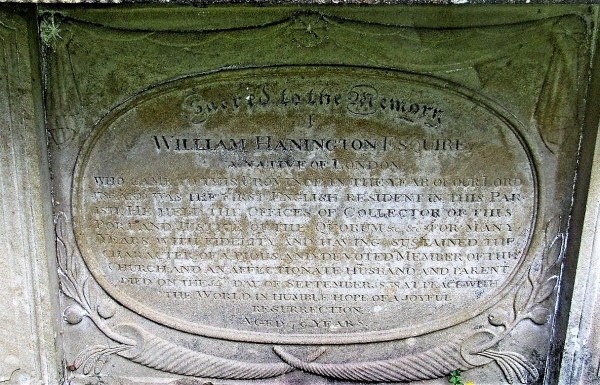
William died in 1838 at age 79. A huge memorial of native freestone marked his grave, in the cemetery beside his beloved church nestled in the community of Shediac, where he spent a lifetime building a “commodious estate” from a forest of giant trees.

Two hundred years later on this anniversary of the St. Martin-in-the-Woods church, William and Mary are lovingly encircled by the graves of several generations of their descendants.

*********************************************************************

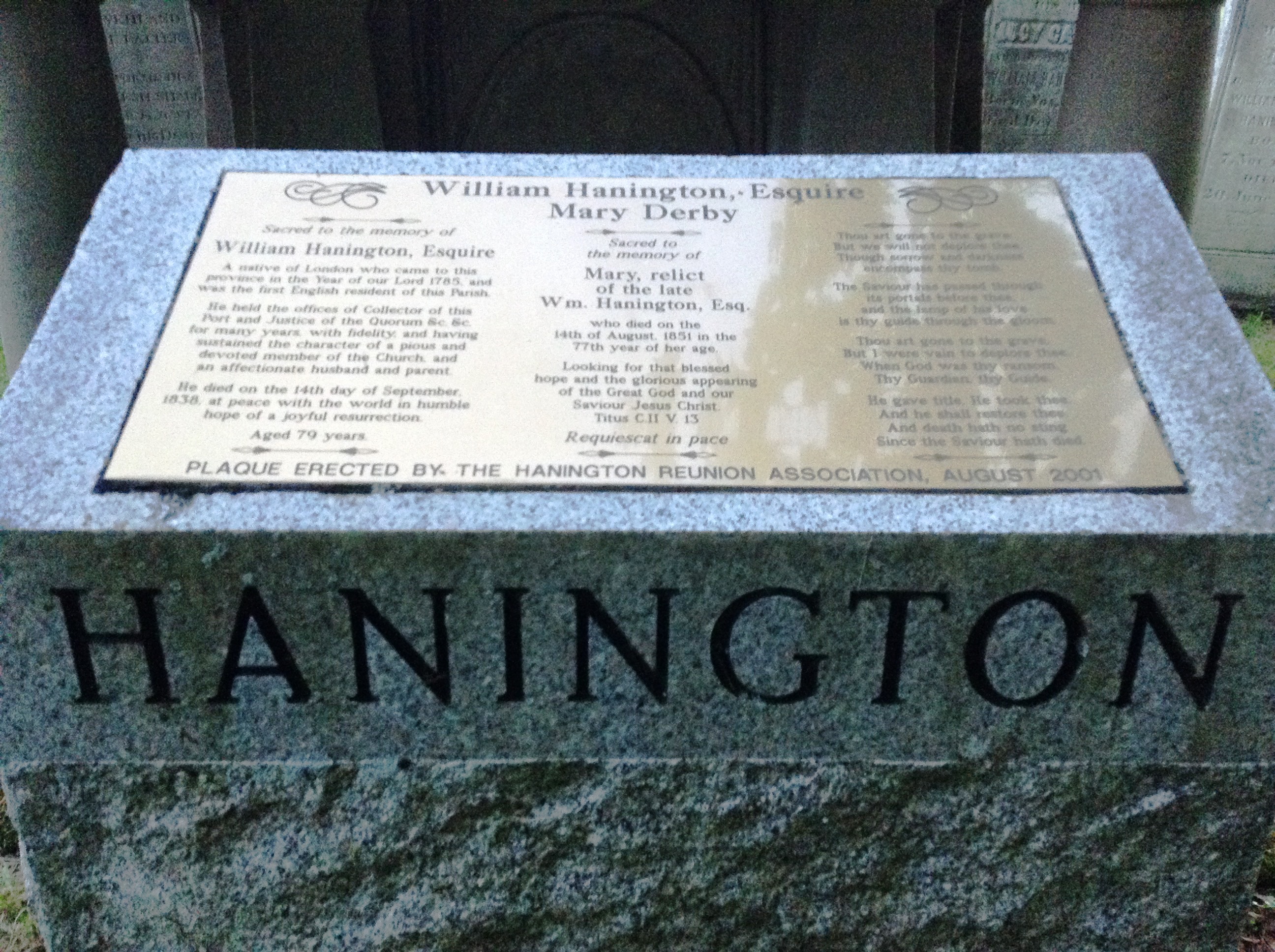
A memorial plaque to William and his wife Mary, was erected in 2001 by the Hanington Reunion Association. This year the Association will be adding a bench in the cemetery in celebration of the 200 years.

Close-up of the Headstone of William Hanington (1759-1838)

(L)Hanington Reunion Association Plaque (2001) honouring William Hanington and his wife Mary Darby and (R) photo by Scotty Horsman showing William’s large headstone at the side of the church.

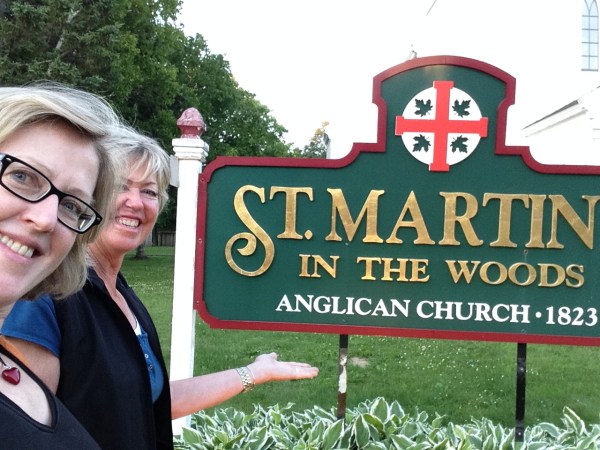
In 2015, my sister and I visited the church and our ancestors in the graveyard and also enjoyed meeting some Hanington cousins as well!

Read our story here: Sister Pilgrimage

***********************************************************************

ANNIVERSARY CELEBRATION DETAILS FOR SEPT 16-17, 2023:

The main events for the 200th Anniversary will be Sept. 16th and 17th with a corn boil, hotdog/hamburger barbecue and cake on Saturday, Sept. 16th. There will also be games, a bonfire, fireworks and music at the church shore.

The Anglican Bishop, David Edwards, of Fredericton will be attending this celebration. He will also be at the 10:30 AM church service on Sunday, Sept. 17th. After the church service there will be a pot luck lunch and a skit in the hall. There will also be items on display in thechurch basement and in the hall. There will be items for sale – glasses, mugs and lapel pins, with the Hanington crest as well as lapel pins. ornaments and trivets with the church on them.

**************************************************************************

If anyone would like a PDF copy of Lilian Hamilton’s famous Hanington genealogy family tree book from 1988, please email me at anglinlucy@gmail.com

My cousin was kind enough to take the time to copy the book into PDF so that everyone can have a digital copy.

My Hanington number is 6-9-7-3-4 if anyone wants to know who I am!

petticoat pioneer

Charlotte Haines (1773-1851) was only ten years old when the breakaway 13 colonies won the War of Independence in April 1783. Those residing in the new United States of America, who had remained loyal to the British Crown, were persecuted and forced out of their homes and their belongings seized. Chaos reigned everywhere and families were torn apart.

One fateful day around this time, young Charlotte sneaked away to visit her British Loyalist cousins, against the expressed wishes of her American Patriot stepfatheri. Upon her return, standing outside the front door, he refused her entry back into the family home.

Charlotte was my three-times great-grandmother. Her daughter Margaret Ann Peters married Daniel Hanington and their son James Peters Hanington was my grandmother’s father.

The British government came to the aid of these Loyalists and arranged for transportation for those who wished to leave the new America. Charlotte’s grandparents, Gilbert and Anna Pugsley, rescued young Charlotte and her brother David. Together they sailed from New York for ten days on the “Jason”ii, with 124 other “refugees” as part of the final large scale evacuation and landed in New Brunswick (then still part of Nova Scotia) in October 1783…just in time for the brutally cold winter.

Charlotte has been the favourite subject of a couple of books and several folktales. She warranted her own chapter in “Pioneer Profiles of New Brunswick Settlers”iii and is the main character in a children’s book titled “Charlotte”iv. One folktale claimed that she was the first Loyalist to set foot ashore (not true) and in doing so, she lost her “slipper” in the mud (possibly). The matching slipper (unlikely) was donated to the New Brunswick Museum years later, however, it looks somewhat too big and stylish for a ten-year old girl. But they make wonderful stories and fully recognize young Charlotte as one of the first “petticoat pioneers” of New Brunswick.

Children’s story about Charlotte Haines by Janet Lunn

Fourteen thousand Loyalists established a new settlement in 1783 along the St. John River and shortly afterwards they petitioned for their own colony. In 1784, Great Britain granted their request and divided Nova Scotia into two — New Brunswick and Nova Scotia. The Loyalists, who made up 90 percent of the population of New Brunswick, became a separate colony with its capital, Fredericton, 90 miles upriver from Saint John.

The Loyalists and their children were entitled to free land once they provided the necessary proof. Charlotte, as the biological daughter of John Haines, a Loyalist on record, appears in 1786 documentation as one of the grantees of 84 lots on Long Island, Queen’s County, along with several other prominent Loyalists – although she was only 13 at the time. I can imagine her grandfather Pugsley nodding discreetly in her direction as he looked after her interests.

For their first three years, the British provided the Loyalists with a few simple tools, blankets, material for clothing and seeds for wheat, peas, corn and potatoes. The rations of basic food supplied by the British supplemented the abundance of game and fish available to them in the forest and streams. Most lived in tents on dirt floors until they were able to build primitive log cabins. Tree by tree, stump by stump, the fertile uplands were cleared to widen the fields making them ready for crops.

The Loyalists kept meaningful social contacts through various community events. Neighbours organized “frolics” whereby the men would work together to clear land, move rocks, build a barn or complete some other task which proved impossible for one or two people. At the same time, the women prepared meals and the children had a chance to play with friends. Women also held their own frolics to make quilts, card wool or shell corn. These Loyalist neighbours were dependent on one another in times of sickness, accidents and childbirth and supported one another at gatherings for weddings, funerals and church services.

Perhaps Charlotte met her future husband at one of these popular frolics. At 17, Charlotte married William Peters (also from a United Empire Loyalist family) in 1791 in Gagetown. Soon afterwards, the happy couple moved downriver, settled in Hampstead and built a home where the St. John River widens to a magnificent view.

At that time, there existed only ten miles of roadway in the whole province and another 20 years would pass before there would be an 82-mile long road linking Fredericton and Saint John. However, in the meantime, the river served as a “highway” enabling the transport of passengers and necessary goods between the two cities.

When the steamboats first chugged noisily up the river in 1816, William decided to compete with them and he built a 100-foot long side wheeler powered by 12 horses walking up and down the deck and propelling the boat along.

A drawing of The Experiment – an example of another horse powered side wheeler.

William actively pursued his interest in politics, and as the first representative of Queen’s County in the New Brunswick Legislature, he spent a lot of time in Fredericton (50 miles away) attending the sessions of Parliament.

Meanwhile, back home, Charlotte managed their entire land-holding on her own. Eventually they had 15 children, five sons and ten daughters. She bore her last child at 50 years old according to the baptismal certificate. They all survived except their son John who drowned at 21 attempting to save another man’s life.

Not only did she clothe, feed and care for them all (including the servants) but also provided much of their early education as well. On Saturday evenings in the summer, the fiddlers would play rollicking tunes and the tapping of dancing feet could be heard in big houses and cabins alike. When winter shut down the fields, and with food plentifully stored in the cellar, the spinning wheels would begin to hum during those coldest months.

By the time William died in 1836, they had recently relocated to Woodstock (100 miles upriver from Hampstead) with two of their younger children, James and Caroline. Their older children were married with homes of their own scattered along the St. John River Valley. Around this time, she wrote a letterv to her daughter Susan, Mrs. Thomas Tilley:

I take my pen to address a few lines to you to inquire after the health of you and all of your family.  The grate distance we are from you prevents me from hearing.  You heard of the death of your Father at Woodstock.

Charlotte described William’s death in some detail and then continued:

I hop [sic] this may find you all well.  I am not well.  My head troubles me very much.  There is not one day that it don’t ake [sic] so that I cant hardly stir.  My cough is something better.  James and Caroline is well and harty [sic] and quite contented hear.  I like the place and if your Father has lived and been hear to see to it we might have made a good living.  It is pleasant and a good place for business but we must try to due the best we can.  The place is out of repair and soon would have been a common if we had not come hear.  I should be glad if my friends was near to us.  I don’t know as ever I shall see you all again.  I thought to have gon [sic]to see you all before I came up hear but I was so sick that I could not go down to see you.  James and Caroline wishes to be remembered to you and all the family.  I desire to be remembered to Thomas and the children and tel them I should be glad to see them and you.  Give my love to all inquiring friends and except a share for yourself.
This from you afectionet [sic] Mother, Charlotte Peters

Although she had her share of aches and pains at that time, she lived another 15 years and ultimately enjoyed the blessing of 111 grandchildren.

She had a powerful influence over all her family for she believed that their heritage carried a great responsibility to others. When the grandchildren would visit, her graceful hands were always busy winding yarn or knitting a sock while patiently answering their questions and reciting passages from the bible.

One of her grandchildren, Samuel Leonard Tilley, later known as Sir Leonard, served as Premier of New Brunswick and went on to became one of the Fathers of Confederation.

Sir Samuel Leonard Tilley 1864

A common tale states that Tilley proposed the term “Dominion” in Canada’s name, at the London conference in 1866, which he gleaned from Psalm 72:8 – “He shall have dominion also from sea to sea, and from the river unto the ends of the earth”. Ultimately, as Minister of Finance in the federal government, he was also instrumental in seeing the transcontinental railway completed.vi

Young Charlotte Haines might have felt all alone in the world at age ten but, when she died 68 years later, the epitaph on her tombstone proclaimed her legacy: “…Lamented by a large circle of descendants and friends by whom she was universally beloved and respected.”

The gravestone of Charlotte Haines Peters and family – St.John’s Anglican Church, Gagetown, Queens County, New Brunswick

iCharlotte’s mother, Miss Pugsley, died when she was very young. Charlotte’s father remarried Sarah Haight before he died. Then Sarah remarried Stephen Haviland who was Charlotte’s stepmother’s husband (step step father?)

iiThe Ship Passenger Lists, American Loyalists to New Brunswick, David Bell, http://www.uelac.org/Loyalist-Ships/Loyalist-Ships.php as seen 2020-03-28

iiiCharlotte Gourlay Rovinson, Pioneer Profiles of New Brunswick Settlers, (Mika Publishing Company), 1980, p.143.

ivJanet Lunn, Charlotte, (Tundra Books), 1998.

v https://queenscountyheritage.wordpress.com/2011/09/28/loyalist-of-the-day-charlotte-haines-peters/ as seen 2020-04-02

vi Conrad Black, Rise to Greatness: The History of Canada, (Random House), 2014.

Image – https://wiki2.org/en/Experiment_(horse-powered_boat) as seen 2020-06-11
Searching for Loyalist Orphans in Quebec

The Loyalist Orphans of Quebec under British Military Rule and Lower Canada

United Empire Loyalists were people who remained loyal to the British during the American Revolution (1765-1783), and settled elsewhere in British North America after the United States became independent. In Quebec, the Loyalists settled in various places from the Mauricie to the Gaspé, but primarily in the Eastern Townships, southeast of Montreal and near the American border.

Most of these families were poor and had gone through very hard times fleeing their homes. The difficulties involved with rebuilding their lives, clearing lands and erecting barns and houses in Quebec often resulted in the early deaths of parents. Their orphaned children were usually assigned to other families in the three regional Judicial Districts of Montreal, Quebec City and Trois-Rivières.

If you suspect you had Loyalist ancestors who came to Quebec, but it appears they simply vanished, notarial acts dealing with these orphans might help you break through your brick walls. The notarial documents known as tutelles and curatelles (guardianships of minors) are most likely to be helpful.

The attached compilation is a list of notaries who served during this time period and these places, and whose tutelle and curatelle acts might shed light on the lives of the Loyalist orphans. Click here: Searching for Loyalist Orphans in Quebec

Thank you to the Heritage Branch of the United Empire Loyalists’ Association of Canada for this info, passed on in a 2014 conversation with a member of the executive.

Key Terms:

The following are notarial acts or notarial expressions used in official documents which you might want to consider in your notarial searches of your ancestors in Québec and Lower Canada (Bas-Canada).

Curatelle – Judicial acts – Authority given to an adult individual by the Justice system (Regional Court House) or by an assembly of family members in order for the selected person to be the administrator of all assets, funds, capital for those who are not capable of managing their assets.

Testament – Wills and testaments

Tutelle – Authority given to a person by law or by the wishes of a testator or by an assembly of family members in order for said person selected to be the guardian of said emancipated minor and for said chosen person to be the overseer and administrator of all assets, funds, capital obtained through a will from his or her parents.

See also: Jacques Gagne, Genealogy Ensemble, Feb. 10, 2019, “Quebec guardianship records can help resolve brick walls,” https://genealogyensemble.com/2019/02/10/quebec-guardianship-records-can-help-resolve-brick-walls/

Some Geographic Background:

The first Loyalist families under British Military Rule arrived in Québec in 1777.  Loyalists from the Mohawk Valley appear to have been the first to arrive, settling along the shores of the Richelieu River near the town of St. Johns (St-Jean-sur-Richelieu) and in Montreal.

In 1779, Governor Frederick Haldimand assigned Captain Daniel McAlpin with the King’s Royal Regiment to oversee the establishment of the Loyalist refugees in British Quebec.

In the Montreal region, Loyalist families settled in Pointe-Claire, Lachine, and Montreal.

Along the shores of the Richelieu River, in addition to St. Johns, Loyalist refugee camps were organized in Chambly, Sorel, St-Ours, Sorel being the largest refuge in the region. A few miles away in Yamaska, a small group of Loyalist families were present.

Across the St. Lawrence River from Sorel, in the townships of Berthier and Yamachiche, a much larger group of Loyalists families were given temporary lands. The hamlet of Yamachiche became known to Loyalist families as Machiche. It became the largest temporary Loyalist settlement in Quebec. The settlement of Machiche was organized from two seigneuries which were the property of Conrad Gugy, secretary to Frederick Haldimand, Governor of Trois-Rivières and later Governor of Quebec.

The seigneuries owned by Conrad Gugy were the Seigneurie de Grosbois-Ouest, also known as Petite-Rivière-Yamachiche. In 1771, Gugy purchased a second seigneury, Seigneurie de Dumontier, which adjoined the Seigneurie de Grosbois-Ouest where the Loyalist camp of Machiche was organized.

South of Quebec City, in present day Beauce County, there was a small and short-lived Loyalist refuge referred to as Nouvelle-Beauce. It was along the banks of the Chaudière River near present-day St-Georges-de-Beauce.

Just north of Montréal, in the townships of Terrebonne and St-Eustache, a few Loyalist families settled on farms alongside former German mercenaries who had fought with British Regiments during the American Revolutionary War.

A few Loyalist families also settled in the Lower Laurentians in hamlets such as Lachute, St. Andrews (St-André-d’Argenteuil) and more to the east in St-Gabriel-de-Brandon, within the present-day district of D’Autray in the County of Berthier.

In 1784, a large group of Loyalist families settled in the Gaspé Peninsula and organized communities such as New Carlisle, Bonaventure, New Richmond, Carleton, Port Daniel and the Matapedia region.

Finally, the largest group of Loyalist settlers in Quebec were the families who were highly instrumental in establishing the Eastern Townships and of the communities on the Upper Richelieu River at Bay Missisquoi.

Loyalists were present within the Eastern Townships in St. Armand, Stanbridge, Dunham, Sutton, Farnham, Granby, Shefford, Stukely, Bolton, Brome, Potton, Stanstead, Magog, Hatley, Oxford, Ascot, Eaton and Clifton townships and also Foucault, Bay Missisquoi and Noyan on the shores of the Richelieu River at the U.S. – Canadian border.

http://www.biographi.ca/en/bio/gugy_conrad_4E.html

http://gaspesie.quebecheritageweb.com/article/loyalists-gaspesia-1784-1984

uelac.org/SirJohnJohnson/eastern-townships.php

Researching Quebec Loyalists at the BAnQ

Loyalist families settled in Quebec following the end of the American Revolution in 1783. At that time, Quebec was under British rule.

For a complete listings of United Empire Loyalists fonds which can be viewed at various repositories of the Bibliothèque et Archives nationales du Québec (BAnQ), go to the catalogue search page https://cap.banq.qc.ca/fr/ and search for the word Loyalist.

The collection includes books, theses, essays and papers. Some of the items in this collection have been reproduced on microfiche from old documents originating in other archives, libraries or historical societies in the provinces of Quebec, Ontario, Nova Scotia, New Brunswick and Prince Edward Island. A fair number of these papers were first published in the 19th century by historians, scholars, archivists and lecturers.

Between 60% to 70% of the material regarding the Loyalists stored at the various repositories of BAnQ in Montreal address Loyalist families who settled in Upper Canada (Ontario), Nova Scotia, New Brunswick and Prince Edward Island. I am mainly interested in Loyalists who settled in Quebec

The compilation attached here, “Researching Quebec Loyalists at the BAnQ,” lists 168 books, historical documents and other material available at the BAnQ in Montreal concerning the Loyalists who settled in what is now the Province of Quebec. Quebec Loyalists at the BAnQ

Please note: In order to borrow books or CDs from the Grande Bibliothèque de Montréal, one must obtain a BAnQ membership card. It is free to all residents of the Province of Quebec. For researchers residing outside of Quebec, temporary memberships can be issued with limited borrowing options. See my post Genealogy Ensemble dated Nov. 17, 2019, Exploring la Grande Bibliothèque.

Only at the Grande Bibliothèque de Montréal can a visitor borrow a book or CD.

The other repositories of the BAnQ in the Montreal region are:  the Collection nationale (du Québec) housed within the same building as the Grande Bibliothèque de Montréal; BAnQ Vieux-Montréal (Archives nationales du Québec on Viger Avenue in Old Montreal); BAnQ Rosemont La Petite-Patrie at 2275 Holt Street and, opening in 2020, the Bibliothèque Saint-Sulpice at 1700 St. Denis Street near Sherbrooke Street (east). At these repositories, material can only be viewed on location.

   Contents of the compilation

Page 2   Grande Bibliothèque de Montréal

Page 3   Collection nationale

Page 10 BAnQ Vieux-Montréal

Page 11 BAnQ Rosemont-La Petite-Patrie

 Page 11 BAnQ Online Digitized Books

 Page 12 BAnQ – Sir John Johnson and the British Governors during and following the great Loyalist migration.


Tips on Researching Gaspé Ancestors

Over the centuries, Quebec’s Gaspé Peninsula has been home to a mix of residents including the Micmac First Nations people, French settlers, Acadians and Loyalists. The Gaspé is surrounded by water on three sides — the estuary of the St. Lawrence River, the Gulf of St. Lawrence and the Bay of Chaleur – so in the past, many Gaspé residents made their living by fishing, however, the fishing industry has changed and suffered in recent years. The interior of the peninsula features mountains, forests and rivers.

If you had ancestors from the Gaspé, the idea of researching their lives might seem daunting. It is a long way from central Canada, and many people in the region do not speak English today. However, there are a number of databases and other resources online, and you can contact the archives there to ask for help.

The attached PDF has links to a variety of resources, including background on the Loyalists who came from the United States after the revolution and settled in the area. The major part of this document lists the notaries who practised in the Gaspé. Their records should help you find your ancestors’ land transactions, business agreements, wills, inventories, and other records.

One of the best researchers to have studied the people of the Gaspé was Michel Émard, a medical doctor, historian and author. This research guide tells you where to find the books he wrote. It also tells you how to contact the main archives serving the area.

Here is the link to the PDF: notaries of the gaspé peninsula guide

The townships of the Eastern Townships and the seigneuries of the Upper Richelieu River Valley

Today, Quebec’s Eastern Townships and Richelieu Valley areas feature fertile farmland and forests, lakes and rivers, wineries, ski hills and cycling trails for tourists, but at the end of the 18th and beginning of the 19th centuries, these areas were being newly settled by former colonial soldiers, British families, new immigrants from Scotland and Ireland, and Loyalists from south of the border.

This extensive guide to the settlement of these areas includes a description of the counties and townships in southern Quebec where these people settled. It does not attempt to cover any of the First Nations people who lived here before the European settlers arrived.

Quebec’s Eastern Townships and the Upper Richelieu Valley

Here are the topics you will find in this 120-page PDF:

Page 1   Biographies of the governors, land surveyors, missionaries and seigneurs who were influential in this area. Also geographical information about the Eastern Townships and a map of the area in 1792.

Page 6   An alphabetical list of the townships and counties of southern Quebec, with a brief history of the settlement of each area. Places highlighted in the Eastern Townships include Acton, Barford, Brome County, Bury, Compton, Drummondville, Magog, Megantic County, Missisquoi County, Richmond, Sherbrooke, Sutton, Stanstead and Thetford Township. The list of places in the Upper Richelieu Valley begins on p. 68 and includes Lacolle, and Saint-Valentin.  Where place names or jurisdiction have changed, I have indicated the old and new information. I have included links to a variety of web pages including archival sites, cemetery lists, and information about area churches.

Page 72   A list of links to cemeteries in these areas.

Page 75   A list of judicial districts and information on some of the notaries who worked in these communities. This section includes links to the more detailed articles I have written and published on Genealogy Ensemble about important notaries in these areas such as Louis Chaboillez and Peter Lukin.

Page 109   A list of repositories, including branches of the BAnQ, Bishops University and Protestant church archives.

Page 114   Links to some of my own articles on topics such as the saddlebag preachers and the German presence in the Eastern Townships.

Page 115   A list of authors, historians, genealogists and archivists who have contributed to our understanding of the history and people of the Eastern Townships.

Most people do not combine the Eastern Townships (better known in Quebec as les Cantons de l’Est, or l’Estrie,) with the Upper Richelieu River Valley. The Richelieu River lies to the west of the Eastern Townships and connects Lake Champlain to the St. Lawrence River. I did so because, following the British Conquest of 1759 at the Plains of Abraham, British officers, British and Scottish soldiers, and Loyalist families fleeing the United States after the American Revolution began to emigrate to the shores of the Richelieu River.

They settled along the length of the Richelieu, from the fortified town of Sorel on the St. Lawrence River to the village of Lacolle at the U.S. border, populating towns such as Chambly, St. Johns (also referred to as Dorchester in the 1780s and later renamed Saint-Jean-sur-Richelieu, the original name under French rule), Abbotsford, McMasterville, Otterburn Park, Mount Johnson (Mont-St-Grégoire), the Seigneury of Sir John Johnson, the Seigneury of Gabriel Christie, Henryville, Christieville, Odelltown, Clarenceville, Noyan, Fadden Corner and hamlets along the western sector of Missisquoi Bay.

One reason people chose to live in these areas was that much of the land in Quebec was owned by a few landowners called seigneurs. This system of land ownership, based on feudal principles borrowed from France, continued until the middle of the 19th century. The  Loyalists especially, who had owned their own land in the Thirteen Colonies, did not wish to settle on seigneurial lands and pay a rent yearly to a seigneur whom they had never met. So Governor Frederick Haldimand decided to create the Eastern Townships of Quebec and Governor Guy Carleton (Lord Dorchester) who replaced Haldimand (second term as governor) supported Haldimand’s decision.


Louis Chaboillez, Notary of Missisquoi Bay, 1787-1813

If your Loyalist ancestors settled in the Missisquoi Bay area of Quebec, including towns such as Frelighsburg, Philipsburg, Saint-Armand and Pigeon Hill, the files of notary Louis Chaboillez might help you learn something about them.

This area, located just north of the Vermont border near Lake Champlain and the Richelieu and Pike Rivers, has a long history. The shore of Missisquoi Bay was once the site of an Abenaki village, but in the mid-1700s, the governor of New France divided the land into vast estates called seigneuries. Two of the seigneuries in this part of Quebec were the St. Armand and the Foucault Seigneuries. The first owner of the Saint-Armand seigneury was a Quebec City man who built ships for the King of France, and later, this seigneury was owned by a senior British colonial administrator.

Although New France became the British colony of Lower Canada in 1763, the seigneurial system of land ownership remained in effect until 1854. But long before 1854, many new settlers began to arrive in the area, and they wanted to own their own property.

Thousands of Loyalists who had been loyal to the British during the American Revolution left the United States for Canada in 1784. In the Missisquoi Bay area, they built homes, farms, flour mills, schools and churches. The government of Lower Canada had to find a way to sort out titles to properties in this and similar areas, and it gave this responsibility to certain notaries. The man who undertook this task in the Missisquoi Bay region was Louis Chaboillez. A notary who practiced between 1787 and 1813 in the Judicial District of Montreal, he was assigned to legalize the allotment of lands in the Eastern Townships of Quebec and in the Richelieu River Valley. He served families in the Eastern Townships until the arrival of notary Léon Lalanne in the spring of 1799.

You can find the collection of notarial acts written by Louis Chaboillez between 1787 and 1813 at the Bibliothèque et Archives nationales du Québec (BAnQ) in downtown Montreal. The acts are on microfilm under Cote (Fonds) # CN60,S74 (1787-1813). The original fonds (collection) includes 14.67 metres of documents and one map. It appears that all documents written by Chaboillez were reproduced, with the exception of the map, on microfilms # 3291, 3292, 3293, 3294, 3295, 3296, 3297, 3298, 3299, 3300, 3301, 3302, 3303, 3304, 3305, 3306, 3307, 3380, 3496, 3497 and 3733. A few additional acts were reproduced on Cote (Fonds) #ZQ601.

As of October, 2016, the notarial acts of Louis Chaboillez were not available on the BAnQ’s website (http://bibnum2.banq.qc.ca/bna/notaires/).

The main Montreal branch of the Bibliothèque et Archives nationales du Québec is located at 535 avenue Viger Est, Montréal, QC H2L 2P3; Tel : 514-873-1100 #4 or 1-800-363-9028; email: archives.montreal@banq.qc.ca. The archives is open from Tuesday through Saturday every week; please verify for actual opening hours and legal holidays. See  www.banq.qc.ca/archives/entrez_archives/centres_archives/ca_montreal.html.

Louis Chaboillez’s notarial acts can also be found in the Parchemin collection, compiled by Archiv-Histo, under cote # 06010074 (1787-1813). The Parchemin collection is available at libraries throughout Canada and the United States. Archiv-Histo is an associate society of the Chambre des notaires du Québec.

The collection of notarial acts on Parchemin is the largest and most precise in Quebec. Not all of the documents produced by Quebec notaries between 1663 and 1900 are available at BAnQ repositories across the province. Parchemin tells you where notarial acts (minutiers) are kept, and which ones were destroyed by fire. To learn more, see https://www.archiv-histo.com/EN/index.php.

Compiled by Jacques Gagné  gagne.jacques@sympatico.ca  2016-10-16


Notary Peter Lukin Sr. and the Christie Seigneuries

Notary Peter Lukin Sr. helped the people of the Upper Richelieu River Valley and Eastern Townships of Quebec sort out land ownership issues between 1790 and 1814. Among his clients were Loyalists and other American-born settlers who had moved north of the border in search of farmland, as well as British, Scottish and Irish-born families.

Although New France was ceded to Britain in 1763 and became the Lower Canada colony, the old seigneurial land-ownership system of New France persisted until 1854. The seigneurial system began in the 1600s as a tool to control the settlement of New France. The king granted large areas of land to influential people including military officers and members of the aristocracy. The seigneurs then rented out farm lots to the habitants, or tenants. The habitants paid rent in cash or grain in exchange for land management assistance and various rights from the seigneurs. This system determined the way rural society in New France developed. When the British abolished the system in 1854, the colonial government had to introduce a means for the tenants to buy their farms.

One area in which the seigneurial system existed was in the Upper Richelieu Valley, an area with very fertile soil that attracted many settlers. The valley stretches next to the Richelieu River, which flows north out of Lake Champlain in northern Vermont and  empties into the St. Lawrence River near the town of Sorel. Lieutenant-Colonel Gabriel Christie acquired five seigneuries in this region following the fall of New France. The Christie Seigneuries remained in his family’s possession long after the seigneurial system was officially abolished.

In her book The Christie Seigneuries; Estate Management and Settlement in the Upper Richelieu Valley 1760-1854 (McGill-Queen’s University Press, 1992), historian Françoise Noël wrote that seigneurial property rights were used to control access to land, timber mills and other resources in the area for many years.

On May 8, 1790, Peter Lukin Sr., a notary and Justice of the Peace in the Judicial District of Montreal, was appointed as one of several notaries assigned to legalize the allotment of lands in the Eastern Townships and the Richelieu River Valley, including the Christie Seigneuries.

The seigneurial system was never implemented in the Eastern Townships, which was settled in the late 1700s and early 1800s.

The notarial acts of Peter Lukin Sr., 1790-1814, Cote # CN601, S269, can be found on microfilm at the Bibliothèque et Archives nationales du Québec (BAnQ) in Montreal. The BAnQ Montréal is located at 535 avenue Viger Est, Montréal, QC, H2L 2P3; Tel: 514-873-1100 plus option 4, plus option 1; Toll Free: 1-800-363-9028 plus option 4 plus 1; email: archives.montreal@banq.qc.ca

http://www.banq.qc.ca/archives/entrez_archives/centres_archives/

http://bibnum2.banq.qc.ca/bna/notaires/

A database of the Christie Seigneuries, “The Upper Richelieu Valley Database by Seigneury,” prepared by Françoise Noël can be found at http://faculty.nipissingu.ca/noel/files/2013/01/Christie_Seigneuries_by_Seigneury.pdf

Noël also identified three other early notaries who served in the region of the Christie Seigneuries within the Upper Richelieu River Valley:

Pierre de Mérut Panet – Notary, Judicial District of Montréal 1755-1778

Pierre Lanctot – Notary, Judicial District of Montréal 1809-1850

Pierre Besse – Notary – Judicial District of Richelieu 1811-1813

The Notarial Acts of Pierre de Mérut Panet likely address the British officers who were granted lands in the Upper Richelieu River Valley and perhaps also in the Lower Richelieu River Valley (the Sorel area) who fought with military leaders James Wolfe, Jeffery Amherst, James Murray, Charles Saunders, Thomas Gage, George Townshend and Robert Monckton at the Battle of the Plains of Abraham in 1759 and at the Conquest of Montreal in 1760.

Loyalist Settlers and their Notaries: Leon Lalanne

If you had ancestors who were early immigrants to Quebec’s Eastern Townships, the records of notary Leon Lalamme might help you learn details about their lives, but you will have to travel to Sherbrooke to consult them.

The first Europeans to settle in the Eastern Townships region (now known as Estrie) were farmers from Vermont, New York state and New Hampshire. They were looking for free land. After the American Revolution, Loyalists who had supported the British flooded across the border. Having supported the losing side in the war, they were promised new land in Canada. Most of them came from Massachusetts, Connecticut, New York, Rhode Island, Pennsylvania and Vermont.

The trouble was that, in this part of Lower Canada, other settlers were already living on the land. The colonial government passed an act to legalize the allotment of lands in the Eastern Townships, and several notaries were appointed to settle these issues.

Among the notaries appointed to this task were two from Montreal: Louis Chaboillez, who practiced from 1787 to 1813; and Peter Lukin, who practiced from 1790 to 1814. Pierre Gamelin, who practiced in Saint-Jean-sur-Richelieu from 1815 to 1855, was a third appointee.

Leon Lalanne.was another notary who served Loyalist & non-Loyalist American families in the Eastern Townships. He practiced between 1799 and 1845. He lived in the village of St. Armand (now known as Frelighsburg) until 1842, then moved to Brome County and served families there until his retirement.

As well as acting as a notary to former American families, he also served the needs of Dutch, Scottish, British, Irish and French Canadian residents. His records at the Archives nationales du Québec are mostly in the English language, and total 8.23 linear metres (28 feet). Notarial acts cover agreements such as land sales and rentals, marriage contracts, wills, apprenticeships and protests over unpaid loans.

The microfilms of Lalanne’s notarial acts (Cote # CN 502, S26) are stored at the Bibliothèque et Archives nationales du Québec (BAnQ) in Sherbrooke, They have not been digitized. The BAnQ Sherbrooke is located at 225 rue Frontenac #401, Sherbrooke QC J1H 1K1, tel: 819-820-3010, toll free: 1-800-363-9028; email: archives.sherbrooke@banq.qc.ca

On the web: www.banq.qc.ca/archives/entrez_archives/centres_archives/

Note that the Bedford Judicial District (District judiciaire de Bedford) was a group of villages, towns and townships within Missisquoi, Brome and Shefford counties. The St. Francis Judicial District (District judiciaire Saint-François (Sherbrooke)) included villages, towns and townships in Sherbrooke, Stanstead, Compton, Richmond and Wolfe counties.

Among the other notaries who practiced in the Eastern Townships and southwestern Quebec in the early 19th century were Edouard Faribault, Farnham,1826-1832; Richard Dickinson, Bedford, 1826-1877; Henry Bondy, Sweetsburg,1829 -1869; Samuel Gale, East Farnham, 1802-1819; Louis Barbeau, Laprairie, 1804-1864 (his files were burned, but some still exist in the Ellis Papers at the Archives); Pierre Besse,1809-1810, Trois-Rivières and 1811-1854, Richelieu.

Over the next few months, I intend to post more information on the notaries who served the residents of the Eastern Townships. Some, but not all, of these notaries are included on the website of the BAnQ; see http://bibnum2.banq.qc.ca/bna/notaires/

Finally, thanks to Pennie Redmile for help with this post. She has been a family lineage researcher for 35 years and is also an expert on Quebec notarial records. She has compiled information on hundreds of Loyalist and non-Loyalist families, plus British, Scottish, Irish families who settled in Missisquoi, Brome and Shefford Counties, as well as the Upper Richelieu Valley (Missisquoi Bay) from the 1780s onward. She is now retired.

Compiled by: Jacques Gagné  gagne.jacques@sympatico.ca    2016-10-10